
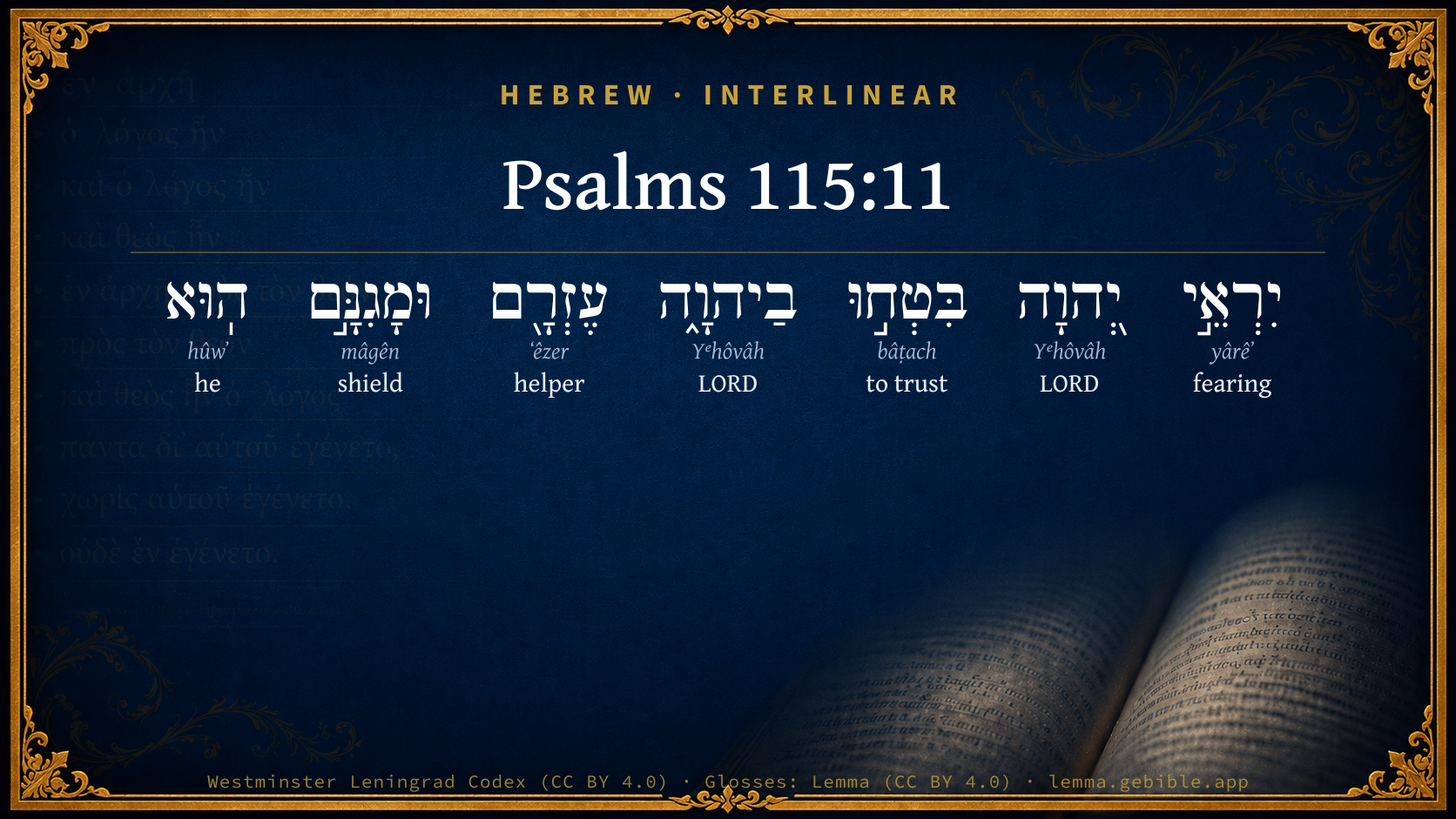
Psalms 115:11

Hebrew (Westminster Leningrad Codex) Psalms 115:11 appears in the Hebrew Old Testament. The text above is from the Westminster Leningrad Codex. Each word links to its Strong’s number, a concise gloss, and parsing drawn from the Open Scriptures Hebrew Bible morphology. Click any word for its full Brown-Driver-Briggs (BDB) entry.
Download image
Cite this verse

Psalms 115:11 (World English Bible). Public Domain. Lemma interlinear Bible study tool, https://lemma.gebible.app/v/psalms/115/11.

Show BibTeX & RIS
BibTeX
RIS
English Translation
You who fear Yahweh, trust in Yahweh! He is their help and their shield.
World English Bible · Public Domain
Download a study sheet

One document with this verse’s original text, its word-by-word gloss line, the meaning frame, cross-references with their text, attributed commentary, and full source and license credits — printable, and it pastes into notes with its structure intact.

This verse Autodidact and up

Study sheet (.html) Plain text (.txt)

A passage Seminary Student

Up to 50 verses in one chapter. A passage sheet keeps up to 6 commentary sources and 12 cross-references per verse, in the order this page ranks them, and says so on the sheet whenever that leaves anything out. Ask for a single verse and you get the Autodidact verse sheet above.

Everything on this page stays free to read, with no account — the sheet is a download of what is already on screen, not access to it.

Want to remove ads? Support Godless Engineer
Compare translations 3

The same verse in 3 English versions, stacked beneath the original-language interlinear above. Click any original word for its lexicon entry.

Each is an independent rendering of the whole verse — the interlinear is not word-aligned to these translations.

Highlighted words mark where these versions differ — a whole-verse word diff, not a word-by-word alignment.

  • World English Bible Public Domain
    You who fear Yahweh, trust in Yahweh! He is their help and their shield.
  • King James Version Public Domain
    Ye that fear the LORD, trust in the LORD: he is their help and their shield.
  • unfoldingWord Literal Text CC BY-SA 4.0
    Fearers of Yahweh, trust in Yahweh; he their help and their shield.

unfoldingWord Literal Text — © unfoldingWord, licensed CC BY-SA 4.0. Word-aligned USFM3 via Door43 (git.door43.org/unfoldingWord/en_ult).

Versions to compare (up to 4)

3 of 4 selected

Show all 17 translations

Every available English version of this verse, each an independent rendering of the whole verse.

  • World English Bible Public Domain
    You who fear Yahweh, trust in Yahweh! He is their help and their shield.
  • Berean Standard Bible Public Domain
    You who fear the LORD, trust in the LORD! He is their help and shield.
  • Majority Standard Bible Public Domain
    You who fear the LORD, trust in the LORD! He is their help and shield.
  • King James Version Public Domain
    Ye that fear the LORD, trust in the LORD: he is their help and their shield.
  • American Standard Version (1901) Public Domain
    Ye that fear Jehovah, trust in Jehovah: He is their help and their shield.
  • Revised Version (1885) Public Domain
    Ye that fear the LORD, trust in the LORD: he is their help and their shield.
  • Geneva Bible (1599) Public Domain
    Ye that feare the Lord, trust in the Lord: for he is their helper and their shield.
  • Young's Literal Translation Public Domain
    Ye fearing Jehovah, trust in Jehovah, `Their help and their shield `is' He.'
  • Literal Standard Version CC BY-SA 4.0
    You fearing YHWH, trust in YHWH, “He [is] their help and their shield.”
  • Unlocked Literal Bible CC BY-SA 4.0
    You who honor Yahweh, trust in him; he is your help and shield.
  • unfoldingWord Literal Text CC BY-SA 4.0
    Fearers of Yahweh, trust in Yahweh; he their help and their shield.
  • Darby Bible Public Domain
    Ye that fear Jehovah, confide in Jehovah: he is their help and their shield.
  • World Messianic Bible Public Domain
    You who fear the LORD, trust in the LORD! He is their help and their shield.
  • Webster's Bible Public Domain
    Ye that fear the LORD, trust in the LORD: he is their help and their shield.
  • Free Bible Version CC BY-SA 4.0
    Those who honor the Lord, trust in the Lord! He is the one who helps you and protects you.
  • Bible in Basic English Public Domain
    You worshippers of the Lord, have faith in the Lord: he is their help and their breastplate.
  • JPS Tanakh (1917) Public Domain
    Ye that fear the LORD, trust in the LORD! He is their help and their shield.

Literal Standard Version (2020), Covenant Press — licensed CC BY-SA 4.0. Text via the HelloAO Bible API (eBible.org). Unlocked Literal Bible (unfoldingWord) — licensed CC BY-SA 4.0. Text via the HelloAO Bible API (eBible.org). unfoldingWord Literal Text — © unfoldingWord, licensed CC BY-SA 4.0. Word-aligned USFM3 via Door43 (git.door43.org/unfoldingWord/en_ult). Free Bible Version, Dr. Jonathan Gallagher — licensed CC BY-SA 4.0. Text via the HelloAO Bible API (eBible.org).

Word by word

More ways to search: Search by grammar → Find every occurrence → Compare this word →

Practice this passage: Drill this verse → Learn its vocabulary →

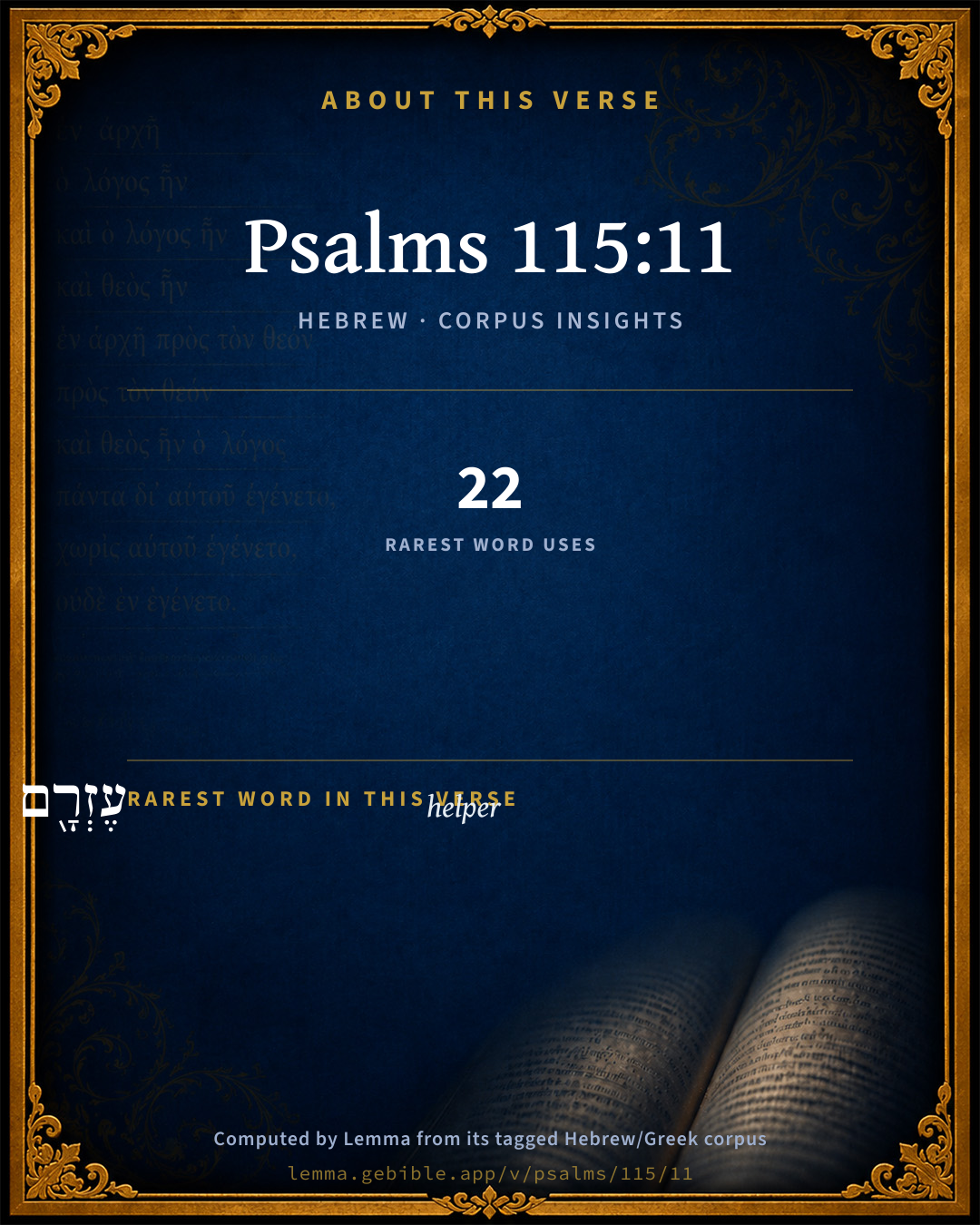
About this verse

These counts appear in no published source. They are computed here, from the morphology-tagged text and Lemma’s own curated glosses. What Lemma adds →

7
words
6
distinct lemmas
Wisdom
section

Notable vocabulary

The rarest word here is עֶזְרָ֖ם helper H5828 — appearing just 22 times in the whole Hebrew Bible.

Shared distinctive vocabulary

עֶזְרָ֖ם helper H5828 occurs in 21 verses of the Hebrew Bible. Also found in:

Grammatical profile

  • 1 verb
  • 4 nouns
  • 1 adjective
  • 1 pronoun

Verb forms

  • בִּטְח֣וּ Qal · Imperative

Repetition

A word recurs within this verse — often emphatic in Hebrew:

  • יְ֭הוָה LORD H3068 ×2

Cross-references

9

Topical passages linked to Psalms 115:11 in the Treasury of Scripture Knowledge — connected by theme and wording, ordered by reader-vote popularity; previews shown in the World English Bible.

  • Proverbs 14:26 In the fear of Yahweh is a secure fortress, And he will be a refuge for his children.
  • Acts 10:35 but in every nation he who fears him and works righteousness is acceptable to him.
  • Psalms 103:11 For as the heavens are high above the earth, So great is his loving kindness toward those who fear him.
  • Psalms 147:11 Yahweh takes pleasure in those who fear him, In those who hope in his loving kindness.
  • Proverbs 30:5 "Every word of God is flawless. He is a shield to those who take refuge in him.
  • Revelation 19:5 A voice came forth from the throne, saying, "Give praise to our God, all you his servants, you who fear him, the small and the great!"
  • Psalms 22:23 You who fear Yahweh, praise him! All you descendants of Jacob, glorify him! Stand in awe of him, all you descendants of Israel!
  • Psalms 33:18 Behold, Yahweh's eye is on those who fear him, On those who hope in his loving kindness;
  • Psalms 118:4 Now let those who fear Yahweh say That his loving kindness endures forever.

Cross-references courtesy of OpenBible.info (CC BY 4.0).

Hebrew and Greek witnesses Masoretic Hebrew ↔ Greek Septuagint

The same verse in the two great witnesses to the Old Testament, shown verse-for-verse.

You’re reading Greek Psalm 113 (Hebrew Psalm 115). The Septuagint counts the superscription, so verse numbers can differ from the Hebrew — chapter-level alignment, not verse-by-verse. Numbering follows Rahlfs.

These are two independent witnesses, not word-aligned to each other, and the Septuagint is shown in lemma (dictionary) form.

Hebrew Psalms 115:11 Masoretic · Westminster Leningrad Codex

יִרְאֵ֣י יְ֭הוָה בִּטְח֣וּ בַיהוָ֑ה עֶזְרָ֖ם וּמָגִנָּ֣ם הֽוּא

You who fear Yahweh, trust in Yahweh! He is their help and their shield.

World English Bible · Public Domain

Greek LXX Greek Psalm 113:11 Septuagint · lemma form

ὁ δέ θεός ἐγώ ἐν ὁ οὐρανός ἄνω ἐν ὁ οὐρανός καί ἐν ὁ γῆ πᾶς ὅσος θέλω ποιέω

No English rendering of this Greek verse — the small residue in the structurally divergent books.

Hebrew: Westminster Leningrad Codex (CC BY 4.0). Greek: Septuagint (public domain); English from a public-domain English Septuagint. How the Septuagint differs from the Hebrew →

Commentary

Notes on Psalms 115:11 from classic Christian and Jewish commentators (each source and its license shown beneath its notes). The classic Christian expositions comment on the surrounding passage and are grouped to its opening verse, so a note may address several verses; the Jewish commentaries on the Tanakh (Rashi and others) are per-verse, so they appear only where the commentator wrote on this verse.

Lemma curates 59 commentaries, every one of them public domain or Creative Commons licensed, each selected and text-cleaned for this edition rather than reprinted as found. About our sources →

Trapp's Complete Commentary

John Trapp

Psa 115:11 Ye that fear the LORD, trust in the LORD: he [is] their help and their shield.

Ver. 11. Ye that fear the Lord] Peregrini ex omni populo, saith Aben Ezra, devout persons out of every nation dwelling among the Jews, though not absolute proselytes, Act 2:5; Act 10:2; Act 13:16. Such also, fearing the Lord, are heirs of the promises; and therefore may boldly say, "The Lord is my helper, and I will not fear what man shall do unto me," Heb 13:6.

John Trapp, A Commentary or Exposition upon All the Books of the Old and New Testament (1647–1656) — public domain. Text from a community e-Sword module.

J. A. Alexander on Psalms

Joseph Addison Alexander

11. (Psa 115:11) Fearers of Jehovah, trust ye in Jehovah; their help and their shield (is) He. He turns again to the people at large, who are here described as fearers of Jehovah, not in reference to the actual character of all the individual members, but to the high vocation of the body. See above, Psa 22:23; Psa 111:5.

Joseph Addison Alexander, The Psalms Translated and Explained (1850) — public domain. Text from a community e-Sword module.

Adam Clarke's Commentary

Verse 11. Ye that fear the Lord] All real penitents, and sincere believers, trust in the Lord, in the almighty, omniscient, and infinitely good Jehovah.

He is their help and shield] He is the succour, support, guardian, and defence of all who put their confidence in him.

Adam Clarke's Commentary on the Bible (1810–1826) — public domain. Text from a community e-Sword/MySword module.

John Calvin's Commentaries

11. Ye who fear Jehovah! He does not speak of strangers, as some erroneously suppose, as if this were a prediction respecting the calling of the Gentiles. Connecting them with the children of Israel and with the sons of Aaron, they are of opinion that he refers to the heathens and to the uncircumcised who were not yet gathered into the sheepfold. By parity of reason one might infer, that the priests are not of the seed of Abraham, because they are separately mentioned. It is more probable that there is in these words a tacit correction of what he had said before, by which he makes a distinction between the genuine worshippers of God and those hypocrites who were the degenerate sons of Abraham. Not a few of the seed of Abraham according to the flesh having departed from the faith of their father, the prophet here restricts the promise to those who, having received it by faith, were worshipping God in purity. We now perceive the reason for his first addressing the Israelites, next the house of Aaron, and then the fearers of Jehovah It is as if a person in our times were to point his exhortation first to the whole body of the Church, and then come more particularly to the ministers and teachers, who ought to be ensamples to others. And as many falsely pique themselves upon the mere name of being connected with the Church, and hence deserve not to be classed with God’s true followers, he expressly mentions the genuine and not the counterfeit worshippers of God.

John Calvin's Commentaries (1540-1563) — public domain. Text from the Calvin Translation Society English edition (1840s-50s) via the Christian Classics Ethereal Library (ccel.org). Calvin's coverage is partial (roughly two-thirds of the Bible); uncommented books and verses are honest gaps, never fabricated. The 19th-century editor's footnotes and remarks are omitted so the notes are faithfully Calvin's own voice.

John Gill's Exposition

Ye that fear the Lord, trust in the Lord,.... Which is said not to distinguish true saints from hypocrites, in Israel or in Aaron's house; rather to describe such who belonged to neither: but, as Aben Ezra interprets it, who feared the Lord, of every people and nation; or proselytes, as Jarchi explains it: the distinction between the people of the Jews, and the proselytes among them, under the character of those that feared the Lord, may be observed in Act 13:26. It takes in all true worshippers of the Lord; and who are exhorted to trust in him, for faith and fear are consistent; and where there is the one, there is the other; where there is the true fear of God, not a slavish nor an hypocritical fear, but a holy reverence and a godly fear, there will be faith and confidence in him. Job was a man that feared the Lord, and yet trusted in him; these characters meet in the same persons, see Psa 31:19.

He is their help and their shield; the help and shield of all those that fear the Lord, their protector and defender, and therefore should trust in him. The word "ezer", translated help, in this and the two preceding verses, is applied to God, and often in this book of Psalms, as a title and epithet belonging to him; and it may be observed that "Aesar", in the Etruscan language, signifies God (z).

(z) Sueton. in Angust. c. 97.

John Gill's Exposition of the Whole Bible (1746–1763) — public domain (CC PDM 1.0). Text via the HelloAO Bible API.

Albert Barnes' Notes on the Bible

Ye that fear the Lord ... - All the people that reverence God; all his true worshippers.

Albert Barnes' Notes on the Bible (1834–1885) — public domain. Text from a community e-Sword/MySword module.

Matthew Poole's English Annotations

All and every one of you who worship the true God, not only Aaronites and Israelites, but even Gentile proselytes, who are said to come to trust under the wings of the God of Israel, Rth 2:12. And such there were many at this time in the church of Israel, whom therefore he fitly invites to trust God, because he is no less their than the Israelites’ help and shield, as it follows.

Matthew Poole's English Annotations on the Holy Bible (1683–1685) — public domain. Text from a community e-Sword/MySword module.

The Treasury of David

Charles H. Spurgeon

Ver. 11. The next verse is of the same tenorYe that fear the LORD, trust in the LORD, whether belonging to Israel, or to the house of Aaron, or not, all those who reverence Jehovah are permitted and commanded to confide in him.

He is their help and their shield. He does aid and protect all those who worship him in filial fear, to whatever nation they may belong. No doubt these repeated exhortations were rendered necessary by the trying condition in which the children of Israel were found: the sneers of the adversary would assail all the people, they would most bitterly be felt by the priests and ministers, and those who were secret proselytes would groan in secret under the contempt forced upon their religion and their God. All this would be very staggering to faith, and therefore they were bidden again and again and again to trust in Jehovah.

This must have been a very pleasant song to households in Babylon, or far away in Persia, when they met together in the night to eat the Paschal supper in a land which knew them not, where they wept as they remembered Zion. We seem to hear them repeating the threefold word, "Trust in Jehovah, "men and women and little children singing out their scorn of the dominant idolatry, and declaring their adhesion to the one God of Israel. In the same manner in this day of blasphemy and rebuke it becomes us all to abound in testimonies to the truth of God. The sceptic is loud in his unbelief, let us be equally open in the avowal of our faith.

Ver. 11. Filial fear the foundation of fuller faith.

Psalms 115:12*

Charles H. Spurgeon's The Treasury of David (1869–1885) — public domain. Psalms only. Text from a community e-Sword/MySword module.

Whedon's Commentary on the Bible

Daniel D. Whedon

11. Ye that fear the Lord—This should not be applied to proselytes, as distinct from “Israel,” for the New Testament usage had not yet obtained. See Act_13:16. Neither can we apply it to spiritual worshippers as distinguished from nominal Israel. Rather, with Hengstenberg, we accept it as a generic term for “the whole people,” for they were fearers of God by profession, and the term supplied a basis for the exhortation to trust God. This view is supported by Psa_115:13, and Psa_22:23; Psa_135:20

Daniel D. Whedon (gen. ed.), Commentary on the Old and New Testaments (1874–1909) — public domain. Text from a community e-Sword module.

The Pulpit Commentary

Ye that fear the Lord, trust in the Lord. Professor Cheyne explains this of proselytes, the sebomenoi of the Acts; but surely the order followed is one of climax first, ordinary Israelites; next, those officially holy, the priests; finally, those actually holy, the truly faithful Israelites. He is their Help and their Shield. It would have been better in every case to have kept the Hebrew order of the words Help and their Shield is he."

The Pulpit Commentary (1880–1919), ed. H.D.M. Spence-Jones & Joseph S. Exell — public domain. Text from a community e-Sword module.

John Wesley's Explanatory Notes

Ye that fear - All of you who worship the true God, not only Israelites, but even Gentile proselytes.

John Wesley, Explanatory Notes Upon the Whole Bible (1754–1765) — public domain. Text via the GEBible commentary corpus.

Scofield Reference Notes

C. I. Scofield

fear

Also Psa 115:13, (See Scofield "Psa 19:9").

The Scofield Reference Bible (1917 edition), notes by C. I. Scofield — public domain. Text from a community e-Sword module.

Rashi

Rabbi Shlomo Yitzchaki (Rashi)

Those who fear the Lord These are the proselytes.

Rashi on the Tanakh — English translations: “The Judaica Press complete Tanach with Rashi, translated by A. J. Rosenberg” (CC BY 4.0); “Pentateuch with Rashi's commentary by M. Rosenbaum and A.M. Silbermann, 1929-1934” (public domain); “The Metsudah Tanach series, Lakewood, N.J” (CC BY 4.0); and “The Book of Joshua, Metsudah Publications, 1997” (CC BY 4.0). Text via Sefaria.

Lesson kit

Teaching starters — assembled from the data on this page, not authored interpretation. Every prompt links to the verse data it draws on. Edit before teaching.

Psalms, in the Wisdom, opens this verse with 7 words (6 distinct Hebrew lemmas). Its most distinctive word is ʻêzer (“helper”). A historical commentator’s framing appears above. Read the whole chapter for the surrounding context.

Discussion questions

  1. What does “helper” (ʻêzer) contribute to the verse as a whole?
  2. How does Genesis 2:18, which shares the word «helper», read alongside this verse?
  3. What does the repetition of “LORD” (2× in this one verse) do in this verse?
  4. These translations render this verse differently. What is at stake in choosing one wording over another?
  5. «בִּטְח֣וּ» is a Qal Imperative verb. How does that grammatical form shape the action described?
  6. Compare how Trapp's Complete Commentary and J. A. Alexander on Psalms read this verse. Where do they agree or differ?

Things to notice

Reading settings

Reading text

Shown beneath each verse's original-language words.

Old Testament
Old Testament edition

Read the OT as the Masoretic Hebrew (MT) or the Greek Septuagint (LXX).

English shown for the Greek Septuagint (in the Hebrew ↔ Greek comparison).

Comparing translations? Open the Compare panel on any verse page to stack up to four side by side.