
Proverbs 11:28

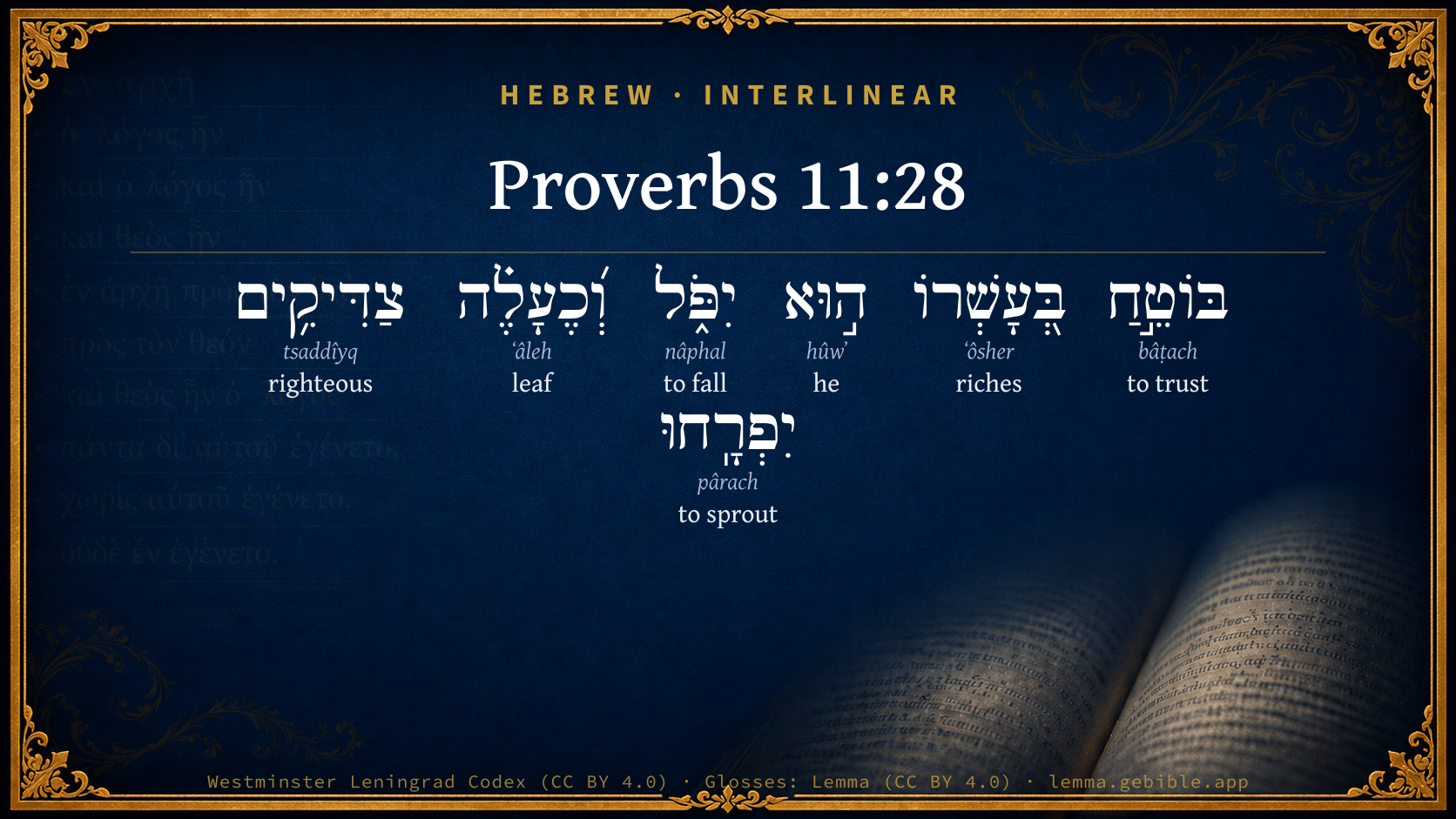
Hebrew (Westminster Leningrad Codex) Proverbs 11:28 appears in the Hebrew Old Testament. The text above is from the Westminster Leningrad Codex. Each word links to its Strong’s number, a concise gloss, and parsing drawn from the Open Scriptures Hebrew Bible morphology. Click any word for its full Brown-Driver-Briggs (BDB) entry.
Download image
Cite this verse

Proverbs 11:28 (World English Bible). Public Domain. Lemma interlinear Bible study tool, https://lemma.gebible.app/v/proverbs/11/28.

Show BibTeX & RIS
BibTeX
RIS
English Translation
He who trusts in his riches will fall, But the righteous shall flourish as the green leaf.
World English Bible · Public Domain
Download a study sheet

One document with this verse’s original text, its word-by-word gloss line, the meaning frame, cross-references with their text, attributed commentary, and full source and license credits — printable, and it pastes into notes with its structure intact.

This verse Autodidact and up

Study sheet (.html) Plain text (.txt)

A passage Seminary Student

Up to 50 verses in one chapter. A passage sheet keeps up to 6 commentary sources and 12 cross-references per verse, in the order this page ranks them, and says so on the sheet whenever that leaves anything out. Ask for a single verse and you get the Autodidact verse sheet above.

Everything on this page stays free to read, with no account — the sheet is a download of what is already on screen, not access to it.

Want to remove ads? Support Godless Engineer
Compare translations 3

The same verse in 3 English versions, stacked beneath the original-language interlinear above. Click any original word for its lexicon entry.

Each is an independent rendering of the whole verse — the interlinear is not word-aligned to these translations.

Highlighted words mark where these versions differ — a whole-verse word diff, not a word-by-word alignment.

  • World English Bible Public Domain
    He who trusts in his riches will fall, But the righteous shall flourish as the green leaf.
  • King James Version Public Domain
    He that trusteth in his riches shall fall; but the righteous shall flourish as a branch.
  • unfoldingWord Literal Text CC BY-SA 4.0
    One trusting in his riches, he himself will fall, but like a leaf, the righteous will sprout.

unfoldingWord Literal Text — © unfoldingWord, licensed CC BY-SA 4.0. Word-aligned USFM3 via Door43 (git.door43.org/unfoldingWord/en_ult).

Versions to compare (up to 4)

3 of 4 selected

Show all 18 translations

Every available English version of this verse, each an independent rendering of the whole verse.

  • World English Bible Public Domain
    He who trusts in his riches will fall, But the righteous shall flourish as the green leaf.
  • Berean Standard Bible Public Domain
    He who trusts in his riches will fall, but the righteous will thrive like foliage.
  • Majority Standard Bible Public Domain
    He who trusts in his riches will fall, but the righteous will thrive like foliage.
  • King James Version Public Domain
    He that trusteth in his riches shall fall; but the righteous shall flourish as a branch.
  • American Standard Version (1901) Public Domain
    He that trusteth in his riches shall fall; But the righteous shall flourish as the green leaf.
  • Revised Version (1885) Public Domain
    He that trusteth in his riches shall fall: but the righteous shall flourish as the green leaf.
  • Geneva Bible (1599) Public Domain
    He that trusteth in his riches, shall fall: but the righteous shall florish as a leafe.
  • Douay-Rheims (1899) Public Domain
    He that trusteth in his riches shall fall: but the just shall spring up as a green leaf.
  • Young's Literal Translation Public Domain
    Whoso is confident in his wealth he falleth, And as a leaf, the righteous flourish.
  • Literal Standard Version CC BY-SA 4.0
    Whoever is confident in his wealth falls, || And as a leaf, the righteous flourish.
  • Unlocked Literal Bible CC BY-SA 4.0
    Those who trust in their riches will fall, but like the leaf, righteous people will flourish.
  • unfoldingWord Literal Text CC BY-SA 4.0
    One trusting in his riches, he himself will fall, but like a leaf, the righteous will sprout.
  • Darby Bible Public Domain
    He that trusteth in his riches shall fall; but the righteous shall flourish as a leaf.
  • World Messianic Bible Public Domain
    He who trusts in his riches will fall, but the righteous shall flourish as the green leaf.
  • Webster's Bible Public Domain
    He that trusteth in his riches shall fall: but the righteous shall flourish as a branch.
  • Free Bible Version CC BY-SA 4.0
    If you trust in your riches, you'll fall; but if you do good, you'll flourish like green leaves.
  • Bible in Basic English Public Domain
    He who puts his faith in wealth will come to nothing; but the upright man will be full of growth like the green leaf.
  • JPS Tanakh (1917) Public Domain
    He that trusteth in his riches shall fall; but the righteous shall flourish as foliage.

Literal Standard Version (2020), Covenant Press — licensed CC BY-SA 4.0. Text via the HelloAO Bible API (eBible.org). Unlocked Literal Bible (unfoldingWord) — licensed CC BY-SA 4.0. Text via the HelloAO Bible API (eBible.org). unfoldingWord Literal Text — © unfoldingWord, licensed CC BY-SA 4.0. Word-aligned USFM3 via Door43 (git.door43.org/unfoldingWord/en_ult). Free Bible Version, Dr. Jonathan Gallagher — licensed CC BY-SA 4.0. Text via the HelloAO Bible API (eBible.org).

Word by word

More ways to search: Search by grammar → Find every occurrence → Compare this word →

Practice this passage: Drill this verse → Learn its vocabulary →

About this verse

These counts appear in no published source. They are computed here, from the morphology-tagged text and Lemma’s own curated glosses. What Lemma adds →

7
words
7
distinct lemmas
Wisdom
section

Notable vocabulary

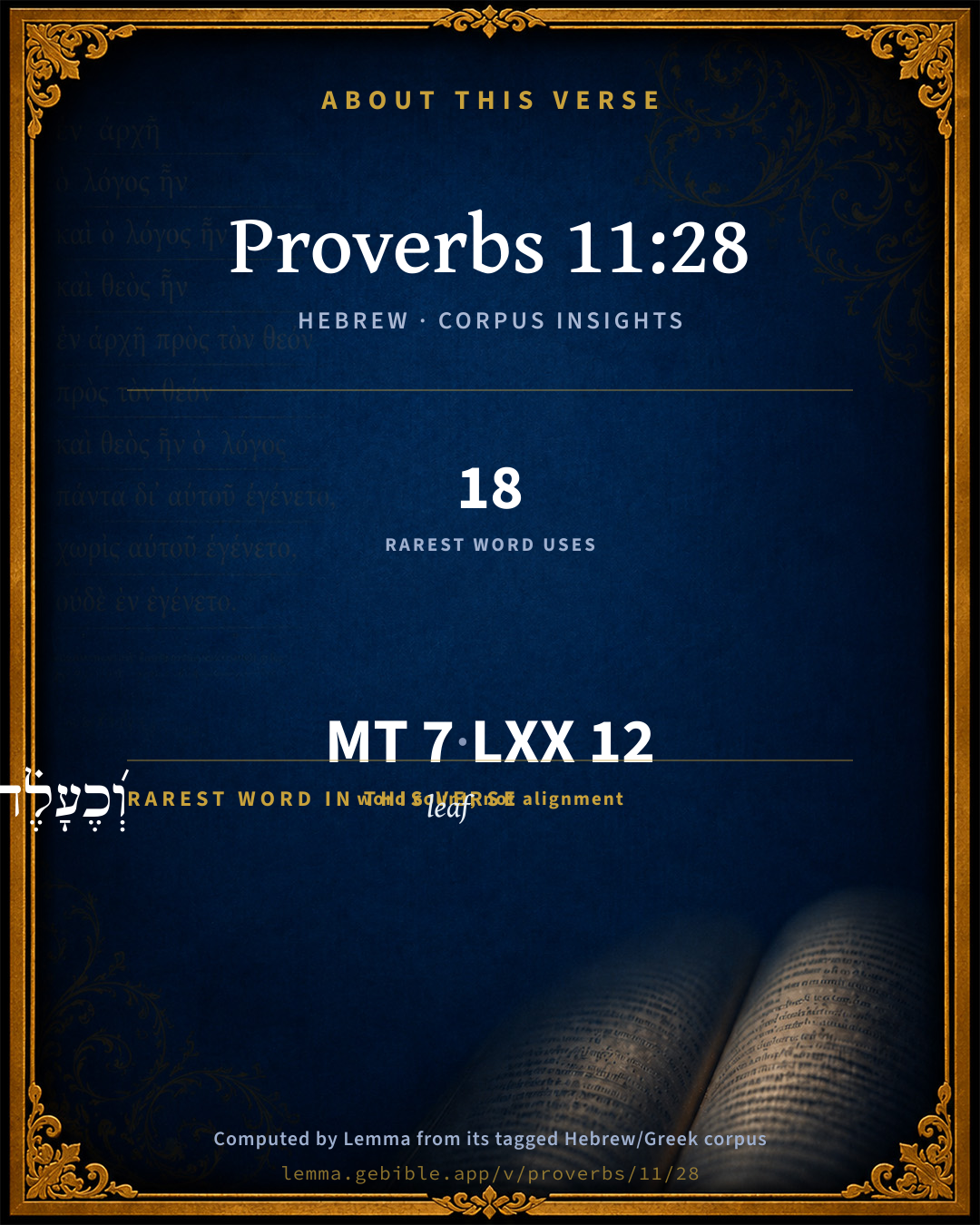
The rarest word here is וְ֝כֶעָלֶ֗ה leaf H5929 — appearing just 18 times in the whole Hebrew Bible.

Shared distinctive vocabulary

וְ֝כֶעָלֶ֗ה leaf H5929 occurs in 13 verses of the Hebrew Bible. Also found in:

Grammatical profile

  • 3 verbs
  • 2 nouns
  • 1 adjective
  • 1 pronoun

Verb forms

  • בּוֹטֵ֣חַ Qal · Participle Active
  • יִפֹּ֑ל Qal · Imperfect
  • יִפְרָֽחוּ Qal · Imperfect

Hebrew & Septuagint length

In English translation the verse runs 17 words from the Hebrew and 15 from the Septuagint (LXX English) — closely comparable.

A rough comparison of the two English renderings, which tokenize alike — not a word-level alignment.

Word counts can differ between the Hebrew and the Greek without any difference in meaning — e.g. the Hebrew direct-object marker אֵת has no separate Greek word, and Greek often adds the article ὁ.

In the original languages it is 7 Hebrew tokens and 12 Greek tokens — but the two are counted differently (Hebrew bundles its prefixes and suffixes into one token; the Greek is in lemma form), so that isn’t a like-for-like length.

Cross-references

13

Topical passages linked to Proverbs 11:28 in the Treasury of Scripture Knowledge — connected by theme and wording, ordered by reader-vote popularity; previews shown in the World English Bible.

  • 1 Timothy 6:17 Charge those who are rich in this present world that they not be haughty, nor have their hope set on the uncertainty of riches, but on the living God, who richly provides us with everything to enjoy;
  • Jeremiah 17:8 For he shall be as a tree planted by the waters, who spreads out its roots by the river, and shall not fear when heat comes, but its leaf shall be green; and shall not be careful in the year of drought, neither shall cease from yielding fruit.
  • Psalms 52:7–8 "Behold, this is the man who didn't make God his strength, But trusted in the abundance of his riches, And strengthened himself in his wickedness."
  • Psalms 1:3 He will be like a tree planted by the streams of water, That brings forth its fruit in its season, Whose leaf also does not wither. Whatever he does shall prosper.
  • Psalms 62:10 Don't trust in oppression. Don't become vain in robbery. If riches increase, Don't set your heart on them.
  • Psalms 92:12–14 The righteous shall flourish like the palm tree. He will grow like a cedar in Lebanon.
  • Mark 10:24–25 The disciples were amazed at his words. But Jesus answered again, "Children, how hard is it for those who trust in riches to enter into the Kingdom of God!
  • Deuteronomy 8:12–14 lest, when you have eaten and are full, and have built goodly houses, and lived therein;
  • Job 31:24–25 "If I have made gold my hope, And have said to the fine gold, 'You are my confidence;'
  • Psalms 49:6 Those who trust in their wealth, And boast in the multitude of their riches--
  • Proverbs 10:15 The rich man's wealth is his strong city. The destruction of the poor is their poverty.
  • Isaiah 60:21 Your people also shall be all righteous; they shall inherit the land forever, the branch of my planting, the work of my hands, that I may be glorified.
  • Luke 12:20 "But God said to him, 'You foolish one, tonight your soul is required of you. The things which you have prepared--whose will they be?'

Cross-references courtesy of OpenBible.info (CC BY 4.0).

Hebrew and Greek witnesses Masoretic Hebrew ↔ Greek Septuagint

The same verse in the two great witnesses to the Old Testament, shown verse-for-verse.

These are two independent witnesses, not word-aligned to each other, and the Septuagint is shown in lemma (dictionary) form.

Hebrew Proverbs 11:28 Masoretic · Westminster Leningrad Codex

בּוֹטֵ֣חַ בְּ֭עָשְׁרוֹ ה֣וּא יִפֹּ֑ל וְ֝כֶעָלֶ֗ה צַדִּיקִ֥ים יִפְרָֽחוּ

He who trusts in his riches will fall, But the righteous shall flourish as the green leaf.

World English Bible · Public Domain

Greek LXX Proverbs 11:28 Septuagint · lemma form

ὁ πείθω ἐπί πλοῦτος οὗτος πίπτω ὁ δέ ἀντιλαμβάνω δίκαιος οὗτος ἀνατέλλω

He that trusts in wealth shall fall; but he that helps righteous men shall rise.

LXX2012 (modern English Septuagint) · Public Domain

On this verse, The Pulpit Commentary discusses the Septuagint’s reading. Read the note in Commentary ↓

Hebrew: Westminster Leningrad Codex (CC BY 4.0). Greek: Septuagint (public domain); English from LXX2012 (modern English Septuagint) (Public Domain). How the Septuagint differs from the Hebrew →

Commentary

Notes on Proverbs 11:28 from classic Christian and Jewish commentators (each source and its license shown beneath its notes). The classic Christian expositions comment on the surrounding passage and are grouped to its opening verse, so a note may address several verses; the Jewish commentaries on the Tanakh (Rashi and others) are per-verse, so they appear only where the commentator wrote on this verse.

Lemma curates 59 commentaries, every one of them public domain or Creative Commons licensed, each selected and text-cleaned for this edition rather than reprinted as found. About our sources →

Trapp's Complete Commentary

John Trapp

Pro 11:28 He that trusteth in his riches shall fall: but the righteous shall flourish as a branch.

Ver. 28. He that trusteth to his riches shall fall.] Riches were never true to any that trusted to them. The rich churl that trusted and boasted that he had "much goods laid up in store" for many years, when, like a jay, he was pruning himself in his boughs, he came tumbling down with the arrow in his side. {Luk 12:15-21} So did Nebuchadnezzar, Belshazzar, Herod, &c. "The righteous also shall see and fear, and laugh at such a one, saying, Lo, this is the man that made not God his strength, but trusted in the abundance of his riches, and strengthened himself in his wickedness." {Psa 52:6-7} "But I am like a green olive tree," &c. {Psa 52:8} Agreeable whereunto is this that follows here: "But the righteous shall flourish as a branch," while the wicked, Faenea quadam felicitate temporaliter florent, et exoriuntur ut exurantur, {a} flourish and ruffle for a time, but shall be soon cut down like the grass, and wither as the green herb.

{a} Aug., Epist. 120.

John Trapp, A Commentary or Exposition upon All the Books of the Old and New Testament (1647–1656) — public domain. Text from a community e-Sword module.

The Biblical Illustrator

Joseph S. Exell

Pro_11:28

He that trusteth in his riches shall fall

Trusting in riches

I.

Here is a common tendency. Trusting in wealth is--

1. Spiritually unsatisfactory.

2. Necessarily evanescent.

II. Here is a terrible catastrophe. Fall.

1. Whence? From all his hopes.

2. Whither? To disappointment and despair.

3. When? Whenever moral conviction seizes the soul, whether before or after death.

4. Why? Because wealth was never a fit foundation for the soul. (Homilist.)

But the righteous shall flourish as a branch.--

The secret of spiritual life

The righteous--and some such there have been even in the darkest periods of the worlds history--the righteous flourish as a branch. They lean not on their own stem and live not on their own root. From the beginning the same Jesus to whom we look was made known to faith. The manner and measure of making known truth to the understanding were in those days widely different; but the nature and the source of spiritual life were the same. But though all the real branches live, all do not equally flourish. Whatever girds the branch too tightly round impedes the flow of sap from the stem and leaves the extremities to wither. Many cares and vanities and passions wrap themselves round a soul and cause the life even of the living to pine away. When the world in any of its forms lays its grasp round the life, the stricture chokes the secret channels between the disciple and his Lord, and the fruit of unrighteousness drops unripe. It is only as a branch that Christians can flourish in this wilderness; they have no independent source of life and growth. (W. Arnot, D.D.)

The Biblical Illustrator, edited by Joseph S. Exell (c. 1880s–1900s) — public domain. Text from a community e-Sword module.

The Preacher's Complete Homiletical Commentary

Joseph S. Exell (gen. ed.)

CRITICAL NOTES.—

Pro_11:28. Branch, rather, “a green leaf.”

MAIN HOMILETICS OF Pro_11:28

TRUST IN RICHES AND TRUST IN GOD

I. The trust in riches springs,

1. From the fact that gold, and what it can do for us, is within reach of the senses. Unless the bodily senses are counterbalanced by the moral—the spiritual—sense, they have a tendency to shut us in upon the seen—to shut out the unseen. This is why men make to themselves gods that they can see and carry about with them. The rich man can look upon his gold and upon all that it has purchased for him, his mansion, his lands, his sumptuous table, his obsequious servants. All these things are daily before his eyes, and if his spiritual sight is not keen, they are very likely to become his confidence.

2. From the fact that gold can do very much for men. It can afford him opportunities of the best education. Gold can place the son of a tradesman side by side with that of the nobleman in this respect. It can surround him with all the refining influences of life. It will open to him positions of power and influence, its magic power will surround him with friends. When a man feels that he owes all these good things to gold, he is very prone to trust in it.

3. From the fact that gold is so universal in its influence in the present world. There is no place upon the globe, where there are human beings, where gold, or what gold can purchase, will not do something for a man. No monarch has such a wide dominion or so many subjects as this King Gold.

II. But he that trusts in riches will find them fail him.

1. Because he is more than the object of his trust. Man is more than gold because it was made for him and not man for gold. God made it to be his servant, but when a man makes it the object of his supreme hope and confidence, he inverts the Divine order and becomes its slave. And man needs something more than himself to be the object of his trust.

2. Because there are comforts for existence that gold cannot buy. Faith in a living God, a good conscience, hope for the future, present peace and rest of soul cannot be purchased for all the gold of the Indies. Nebuchadnezzar could make an image of gold, but all his riches could not purchase the faith and godly courage of the three Hebrew youths. The rich man in hell needed comfort that all his earthly wealth could not have purchased.

3. Because the only Being who can supply man’s deepest needs cannot be bribed. Pardon of sin cannot be “gotten for gold neither shall silver be weighed for the price thereof.” A holy character “cannot be valued with the gold of Ophir, with the precious onyx or the sapphire. The gold and the crystal cannot equal it: and the exchange of it shall not be for jewels of fine gold.” (Job_28:16-17). The Holy Ghost—that “gift of God,” cannot be “purchased with money.” (Act_8:20). A golden key will not open the gate of heaven. Therefore “Charge them that are rich in this world, that they be not high-minded, nor trust in uncertain riches, but in the living God. (1Ti_6:17).

III. The righteous man shall not fall, but flourish as a branch, because as a branch in a tree he is in connection with life. Gold is a dead thing, but the God of the good man is a Living Person, a Being who can understand and supply all his soul’s need—a Being who is not only King of the present and the seen, but of the future and of the unseen. “I am the vine, ye are the branches.” “Because I live, ye shall live also” (Joh_14:19; Joh_15:5). He shall not only live, but flourish—“his leaf shall not wither”—“he shall bring forth fruit in his season” (Psa_1:3). The cause of the branch being laden with fruitfulness and beauty is because of its connection with the root. Trust is the link between the creature and the Creator, which makes the one a partaker of the fulness of the other. “Blessed is the man that trusteth in the Lord, and whose hope the Lord is. For he shall be as a tree planted by the waters, and that spreadeth out her roots by the river, and shall not see when heat cometh, but her leaf shall be green; and shall not be careful in the year of drought, neither shall cease from yielding fruit” (Jer_17:7-8).

OUTLINES AND SUGGESTIVE COMMENTS

I have read of one that, upon his dying bed, called for his bags, and laid a bag of gold to his heart, and then cried out, “Take it away, it will not do, it will not do!” There are things that earthly riches cannot do. They can never satisfy Divine justice, nor pacify Divine wrath, nor quiet a guilty conscience. And till these things are done, the man is undone.—Brooks.

As sheep that go in fat pastures come sooner to the slaughter-house than those which are kept upon the bare common: so, likewise, rich men, who are pampered with the wealth of this world, sooner forsake God, and therefore are sooner forsaken of God than others.—Cawdray.

He that trusts in riches may trust in that which may not disappoint him. That is, it may remain great, and may follow him to the grave. But while his riches are piling up, he himself is withering away. It is not the rich, but they that trust in riches (Mar_10:24). The truly important thing is the man himself; and while the unregenerate falls, or decays, the righteous, even without money, prospers. He grows from within. That is he grows, and not his money.—Miller.

Be not proud of riches, but afraid of them, lest they be as silver bars to cross the way to heaven. We must answer for our riches, but our riches cannot answer for us.—Mason.

Riches were never true to any that trusted in them. The rich churl that trusted and boasted that he had “much goods laid up in store” for many years, when, like a jay, he was pruning himself in his boughs, came tumbling down with the arrow in his side.—Trapp.

Riches are of a falling nature, now they fall to a man, now they fall from him, now they fall to this man, now to that, now to another. There is no holdfast of them, and less holdfast by them. He, therefore, that trusteth in them shall fall, fall into their hands and power, who seek his hurt and mischief, because not trusting in God, he receiveth no succour from Him.—Jermin.

Good men have the Lord Jesus Christ for their root, and God the Father to dress and keep them, therefore the drought of adversity shall not hurt them, nor the dews of wholesome prosperity fail them. They shall have safety for their bodies, graces for their souls, competency for their state, and all good furtherances for their everlasting glory.—Dod.

Money, thou bane of bliss, and source of woe,

Whence com’st thou, that thou art so fresh and fine?

I know thy parentage is base and low:

Man found thee poor and dirty in a mine.

Surely thou didst so little little contribute

To this great kingdom, which thou now hast got,

That he was fain, when thou wert destitute,

To dig thee out of thy dark cave and grot.

Then forcing thee, by fire he made thee bright;

Nay, thou hast got the face of man: for we

Have with our stamp and seal transferred our right:

Thou art the man, and man but dross to thee.

Man calleth thee his wealth, who made thee rich,

And while he digs out thee, falls in the ditch.

Herbert.

The Preacher's Complete Homiletical Commentary (gen. ed. Joseph S. Exell; Funk & Wagnalls, c. 1892) — public domain (pre-1929). A full-Bible homiletical/sermon-outline anthology covering 65 of 66 books (2 John is absent from the source module). Text from a community e-Sword module.

Tyndale Open Study Notes

Tyndale Open Resources

11:28 Money can be a blessing from God, but it is uncertain. The godly trust in God and flourish (see Ps 1).

Tyndale Open Study Notes — © Tyndale Open Resources, licensed CC BY-SA 4.0. Text via the HelloAO Bible API.

Matthew Henry's Commentary

Observe, 1. Our riches will fail us when we are in the greatest need: He that trusts in them, as if they would secure him the favour of God and be his protection and portion, shall fall, as a man who lays his weight on a broken reed, which will not only disappoint him, but run into his hand and pierce him. 2. Our righteousness will stand us in stead when our riches fail us: The righteous shall then flourish as a branch, the branch of righteousness, like a tree whose leaf shall not wither, Psa 1:3. Even in death, when riches fail men, the bones of the righteous shall flourish as a herb, Isa 66:14. When those that take root in the world wither those that are grafted into Christ and partake of his root and fatness shall be fruitful and flourishing.

Matthew Henry's Commentary on the Whole Bible (1708–1710) — public domain (CC PDM 1.0). Text via the HelloAO Bible API.

Jamieson, Fausset & Brown

Robert Jamieson, A. R. Fausset & David Brown

(Compare Pro 10:15; Psa 49:6; Ti1 6:17).

righteous . . . branch-- (Psa 1:3; Jer 17:8).

Jamieson, Fausset & Brown — Commentary Critical and Explanatory on the Whole Bible (1871) — public domain (CC PDM 1.0). Text via the HelloAO Bible API.

Ellicott's Commentary for English Readers

(28) He that trusteth in his riches shall fall.—Because of their uncertainty, and because they prevent his trusting in the living God (1Ti_6:17).

A Bible Commentary for English Readers, edited by Charles John Ellicott (1878–1897) — public domain. Text from a community e-Sword module.

The Cambridge Bible for Schools and Colleges

gen. ed. J. J. S. Perowne

28. branch] Rather leaf, R.V. Comp. Gen_3:7; Psa_1:3.

The Cambridge Bible for Schools and Colleges (gen. ed. J. J. S. Perowne; Cambridge University Press, 1878–1918) — public domain. Text from a community e-Sword module.

John Gill's Exposition

He that trusteth in his riches shall fall,.... As leaves in autumn, which are withered and dry. To trust in riches is to trust in uncertain things; things not to be depended on, being here today and gone tomorrow; it is like leaning upon a broken staff, which giving way, the person falls: and so the fall of Babylon will be, while she is trusting in and boasting of her riches and grandeur, Rev 18:7;

but the righteous shall flourish as a branch; that abides in the tree, is alive and green, full of leaves, and laden with fruit: so the righteous are as branches in Christ, and receive life and nourishment from him, and abide in him; and bring forth fruit and flourish, like palm trees and cedars, in the house of the Lord, and grow in every grace, and in the knowledge of Christ; see Jer 17:7.

John Gill's Exposition of the Whole Bible (1746–1763) — public domain (CC PDM 1.0). Text via the HelloAO Bible API.

Albert Barnes' Notes on the Bible

Branch - Better, leaf, as in Psa 1:3; Isa 34:4.

Albert Barnes' Notes on the Bible (1834–1885) — public domain. Text from a community e-Sword/MySword module.

Matthew Poole's English Annotations

He that trusteth in his riches, as his chief portion, and felicity, and ground of safety,

shall fall, as a withered leaf, by comparing this clause with the latter.

The righteous, who maketh God alone, and not riches, his trust,

shall flourish as a branch, to wit, a green and flourishing branch.

Matthew Poole's English Annotations on the Holy Bible (1683–1685) — public domain. Text from a community e-Sword/MySword module.

Whedon's Commentary on the Bible

Daniel D. Whedon

28. Shall fall — Fall off, as a withered leaf from a tree. The Hebrew is emphatic: Himself shall fall. His riches may not fall, but he will if he trusts in them. Compare Mat_10:24. Flourish as a branch — A leaf. A green and flourishing leaf was an emblem of prosperity. Compare Psa_1:3; Psa_49:6; Psa_92:12; Isa_34:4; Jer_17:8; Luk_12:21; 1Ti_6:17.

Daniel D. Whedon (gen. ed.), Commentary on the Old and New Testaments (1874–1909) — public domain. Text from a community e-Sword module.

The Pulpit Commentary

There are many expressions in this and the following verses which recall Ps 1. He that trusteth in his riches shall fall. (Pro_10:2 Psa_49:6, 7 52:7; Ecc_5:8) Wealth is of all things the most uncertain, and leads the heart astray from God. (1Ti_6:17) As a branch; " as a leaf". (Psa_1:3 Isa_34:4) The righteous grow in grace and spiritual beauty, and bring forth the fruit of good works. Septuagint, "He who layeth hold on what is righteous or, "helpeth the righteous shall spring up (anatelei )."

The Pulpit Commentary (1880–1919), ed. H.D.M. Spence-Jones & Joseph S. Exell — public domain. Text from a community e-Sword module.

Keil & Delitzsch

C. F. Keil & F. Delitzsch

The following proverbs are especially directed, as connected with this כן, against the contradiction of the external appearance and of the masked internal nature.

20 An abomination to Jahve are the crookedly dishonest of heart,

And they who are of honest walk are his delight.

Keil & Delitzsch — Biblical Commentary on the Old Testament (1861–1891) — public domain (CC PDM 1.0). Text via the HelloAO Bible API. (Old Testament only.)

Bridges on Proverbs

Charles Bridges

Here is the cause and misery of the fall. Man seeks his rest in God’s blessings, in opposition to himself. (Jer 9:23-24 .) Riches are one of his grounds of trust. (Pro 10:15 . Luk 12:19 .) He depends on them, as the saint upon his God. (Pro 18:10-11 .) And is not this the "denial of the God that is above"? (Job 31:24-25, Job 31:28 .) A revolting truth indeed! such as only the heart crucified to the world by the cross of Christ can receive. Not that the possession of riches is a sin,†1 but the trusting in them. (Mar 10:24 .) Nor may it be always wrong to improve an opportunity of increasing them. But no one that cares for his own soul, and believes the testimony of God (Mar 10:25-27 . 1Ti 6:9-10 ), will seek the opportunity; or even avail himself of it without a plain call, and clear advantage for the glory of God. (1Ti 6:18-19 .) Let God be our satisfying portion. Let him be supremely loved and honoured, and he will determine for us, whether the worldly advantage be a Providence or a temptation.

Disappointment will be the certain end of this trust. (Psa 49:6-12 . Ecc 5:10-11 .) When we need a staff, we shall find a piercing spear. (1Ti 6:10 .) Or we shall fall, like the withered leaf or blossom before the blast. (Deu 8:17-19 .) And how many a lovely blossom has thus fallen! (Mar 10:21-22 .) Thus does "the rich man fade away in his ways!" (Jas 1:10-11 .)

But the righteous is the branch; not like the leaf or blossom, easily shaken and withered;†2 but abiding in the true vine: full of life and fruit. (Joh 15:5 .) There may be, as in nature’s winter, times of apparent barrenness. But the spring returns, and with it the branch flourishes; never ceasing from yielding fruit; yea — "filled with the fruit of righteousness" (Jer 17:8 ): the branch of "the LORD’s planting; the work of his hands, that he may be glorified;" to be transplanted in his own best time to the other side of the river, where "the leaf shall not fade, neither shall the fruit thereof be consumed." (Isa 60:21 . Eze 47:12 .) Shall not this prospect fill us with lively joy and praise?

Footnotes:

†1 See the gift of God to Abraham, Gen 24:35 ; to David 1Ch 29:12 ; to Solomon 2Ch 1:11-12 ; to Job 42:11-12.

†2 See the same contrast, Psa 52:7-8 .

Charles Bridges, An Exposition of the Book of Proverbs (1846) — public domain. Text from a community e-Sword module.

Scofield Reference Notes

C. I. Scofield

trusteth

(See Scofield "Psa 2:12").

The Scofield Reference Bible (1917 edition), notes by C. I. Scofield — public domain. Text from a community e-Sword module.

Kretzmann's Popular Commentary

Paul E. Kretzmann

v. 28. He that trusteth In his riches, placing his confidence in his outward possessions, shall fall, for such trust is a species of idolatry; but the righteous shall flourish as a branch, like a green leaf, like luxurious foliage.

Paul E. Kretzmann, Popular Commentary of the Bible (1921–1924) — public domain. Text from a community e-Sword module.

Lesson kit

Teaching starters — assembled from the data on this page, not authored interpretation. Every prompt links to the verse data it draws on. Edit before teaching.

Proverbs, in the Wisdom, opens this verse with 7 words (7 distinct Hebrew lemmas). Its most distinctive word is ʻâleh (“leaf”). A historical commentator’s framing appears above. Read the whole chapter for the surrounding context.

Discussion questions

  1. How does “leaf” (ʻâleh) shape what this verse is saying?
  2. How does Genesis 3:7, which shares the word «leaf», read alongside this verse?
  3. The translations on this page render this verse differently — a whole-verse word diff, not a word-by-word alignment. What might account for the different wordings?
  4. «בּוֹטֵ֣חַ» is a Qal Participle Active verb. How does that grammatical form shape the action described?
  5. Compare how Trapp's Complete Commentary and The Biblical Illustrator read this verse. Where do they agree or differ?

Things to notice

Reading settings

Reading text

Shown beneath each verse's original-language words.

Old Testament
Old Testament edition

Read the OT as the Masoretic Hebrew (MT) or the Greek Septuagint (LXX).

English shown for the Greek Septuagint (in the Hebrew ↔ Greek comparison).

Comparing translations? Open the Compare panel on any verse page to stack up to four side by side.