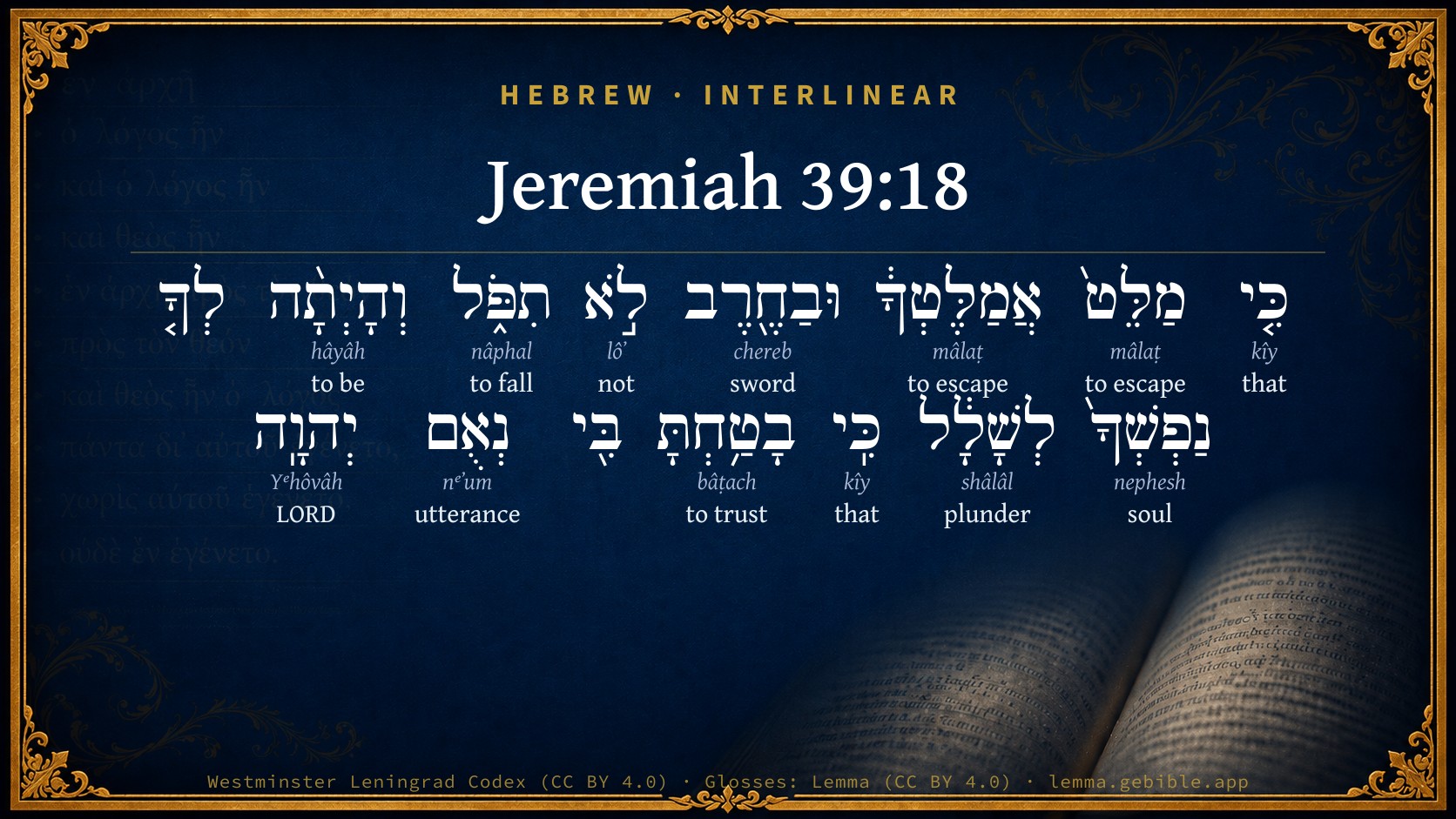
Jeremiah 39:18

Hebrew (Westminster Leningrad Codex) Jeremiah 39:18 appears in the Hebrew Old Testament. The text above is from the Westminster Leningrad Codex. Each word links to its Strong’s number, a concise gloss, and parsing drawn from the Open Scriptures Hebrew Bible morphology. Click any word for its full Brown-Driver-Briggs (BDB) entry.
Download image
Cite this verse

Jeremiah 39:18 (World English Bible). Public Domain. Lemma interlinear Bible study tool, https://lemma.gebible.app/v/jeremiah/39/18.

Show BibTeX & RIS
BibTeX
RIS
English Translation
For I will surely save you, and you shall not fall by the sword, but your life shall be for a prey to you; because you have put your trust in me, says Yahweh.
World English Bible · Public Domain
Download a study sheet

One document with this verse’s original text, its word-by-word gloss line, the meaning frame, cross-references with their text, attributed commentary, and full source and license credits — printable, and it pastes into notes with its structure intact.

This verse Autodidact and up

Study sheet (.html) Plain text (.txt)

A passage Seminary Student

Up to 50 verses in one chapter. A passage sheet keeps up to 6 commentary sources and 12 cross-references per verse, in the order this page ranks them, and says so on the sheet whenever that leaves anything out. Ask for a single verse and you get the Autodidact verse sheet above.

Everything on this page stays free to read, with no account — the sheet is a download of what is already on screen, not access to it.

Want to remove ads? Support Godless Engineer
Compare translations 3

The same verse in 3 English versions, stacked beneath the original-language interlinear above. Click any original word for its lexicon entry.

Each is an independent rendering of the whole verse — the interlinear is not word-aligned to these translations.

Highlighted words mark where these versions differ — a whole-verse word diff, not a word-by-word alignment.

  • World English Bible Public Domain
    For I will surely save you, and you shall not fall by the sword, but your life shall be for a prey to you; because you have put your trust in me, says Yahweh.
  • King James Version Public Domain
    For I will surely deliver thee, and thou shalt not fall by the sword, but thy life shall be for a prey unto thee: because thou hast put thy trust in me, saith the LORD.
  • unfoldingWord Literal Text CC BY-SA 4.0
    For I will certainly rescue you. You will not fall by the sword. You will escape with your life, since you trust in me—this was Yahweh’s declaration.’”

unfoldingWord Literal Text — © unfoldingWord, licensed CC BY-SA 4.0. Word-aligned USFM3 via Door43 (git.door43.org/unfoldingWord/en_ult).

Versions to compare (up to 4)

3 of 4 selected

Show all 18 translations

Every available English version of this verse, each an independent rendering of the whole verse.

  • World English Bible Public Domain
    For I will surely save you, and you shall not fall by the sword, but your life shall be for a prey to you; because you have put your trust in me, says Yahweh.
  • Berean Standard Bible Public Domain
    For I will surely rescue you so that you do not fall by the sword. Because you have trusted in Me, you will escape with your life like a spoil of war, declares the LORD.’”
  • Majority Standard Bible Public Domain
    For I will surely rescue you so that you do not fall by the sword. Because you have trusted in Me, you will escape with your life like a spoil of war, declares the LORD.’”
  • King James Version Public Domain
    For I will surely deliver thee, and thou shalt not fall by the sword, but thy life shall be for a prey unto thee: because thou hast put thy trust in me, saith the LORD.
  • American Standard Version (1901) Public Domain
    For I will surely save thee, and thou shalt not fall by the sword, but thy life shall be for a prey unto thee; because thou hast put thy trust in me, saith Jehovah.
  • Revised Version (1885) Public Domain
    For I will surely save thee, and thou shalt not fall by the sword, but thy life shall be for a prey unto thee: because thou hast put thy trust in me, saith the LORD.
  • Geneva Bible (1599) Public Domain
    For I will surely deliuer thee, and thou shalt not fall by the sworde, but thy life shall be for a praye vnto thee, because thou hast put thy trust in me, sayth the Lord.
  • Douay-Rheims (1899) Public Domain
    But delivering, I will deliver thee, and thou shalt not fall by the sword: but thy life shall be saved for thee, because thou hast put thy trust in me, saith the Lord.
  • Young's Literal Translation Public Domain
    for I do certainly deliver thee, and by sword thou fallest not, and thy life hath been to thee for a spoil, for thou hast trusted in Me -- an affirmation of Jehovah.'
  • Literal Standard Version CC BY-SA 4.0
    for I certainly deliver you, and you do not fall by sword, and your life has been to you for a spoil, for you have trusted in Me—a declaration of YHWH.”
  • Unlocked Literal Bible CC BY-SA 4.0
    For I will certainly rescue you. You will not fall by the sword. You will escape with your life, since you trust in me—this was Yahweh's declaration.'”
  • unfoldingWord Literal Text CC BY-SA 4.0
    For I will certainly rescue you. You will not fall by the sword. You will escape with your life, since you trust in me—this was Yahweh’s declaration.’”
  • Darby Bible Public Domain
    for I will certainly save thee, and thou shalt not fall by the sword, but thou shalt have thy life for a prey; for thou hast put thy confidence in me, saith Jehovah.
  • World Messianic Bible Public Domain
    For I will surely save you. You won’t fall by the sword, but you will escape with your life, because you have put your trust in me,” says the LORD.’”
  • Webster's Bible Public Domain
    For I will surely deliver thee, and thou shalt not fall by the sword, but thy life shall be for a prey to thee: because thou hast put thy trust in me, saith the LORD.
  • Free Bible Version CC BY-SA 4.0
    I promise to rescue you so that you're won't be killed. Your reward will be your life, because you trusted in me, declares the Lord.”
  • Bible in Basic English Public Domain
    For I will certainly let you go free, and you will not be put to the sword, but your life will be given to you out of the hands of your attackers: because you have put your faith in me, says the Lord.
  • JPS Tanakh (1917) Public Domain
    For I will surely deliver thee, and thou shalt not fall by the sword, but thy life shall be for a prey unto thee; because thou hast put thy trust in Me, saith the LORD.'

Literal Standard Version (2020), Covenant Press — licensed CC BY-SA 4.0. Text via the HelloAO Bible API (eBible.org). Unlocked Literal Bible (unfoldingWord) — licensed CC BY-SA 4.0. Text via the HelloAO Bible API (eBible.org). unfoldingWord Literal Text — © unfoldingWord, licensed CC BY-SA 4.0. Word-aligned USFM3 via Door43 (git.door43.org/unfoldingWord/en_ult). Free Bible Version, Dr. Jonathan Gallagher — licensed CC BY-SA 4.0. Text via the HelloAO Bible API (eBible.org).

Word by word

More ways to search: Search by grammar → Find every occurrence → Compare this word →

Practice this passage: Drill this verse → Learn its vocabulary →

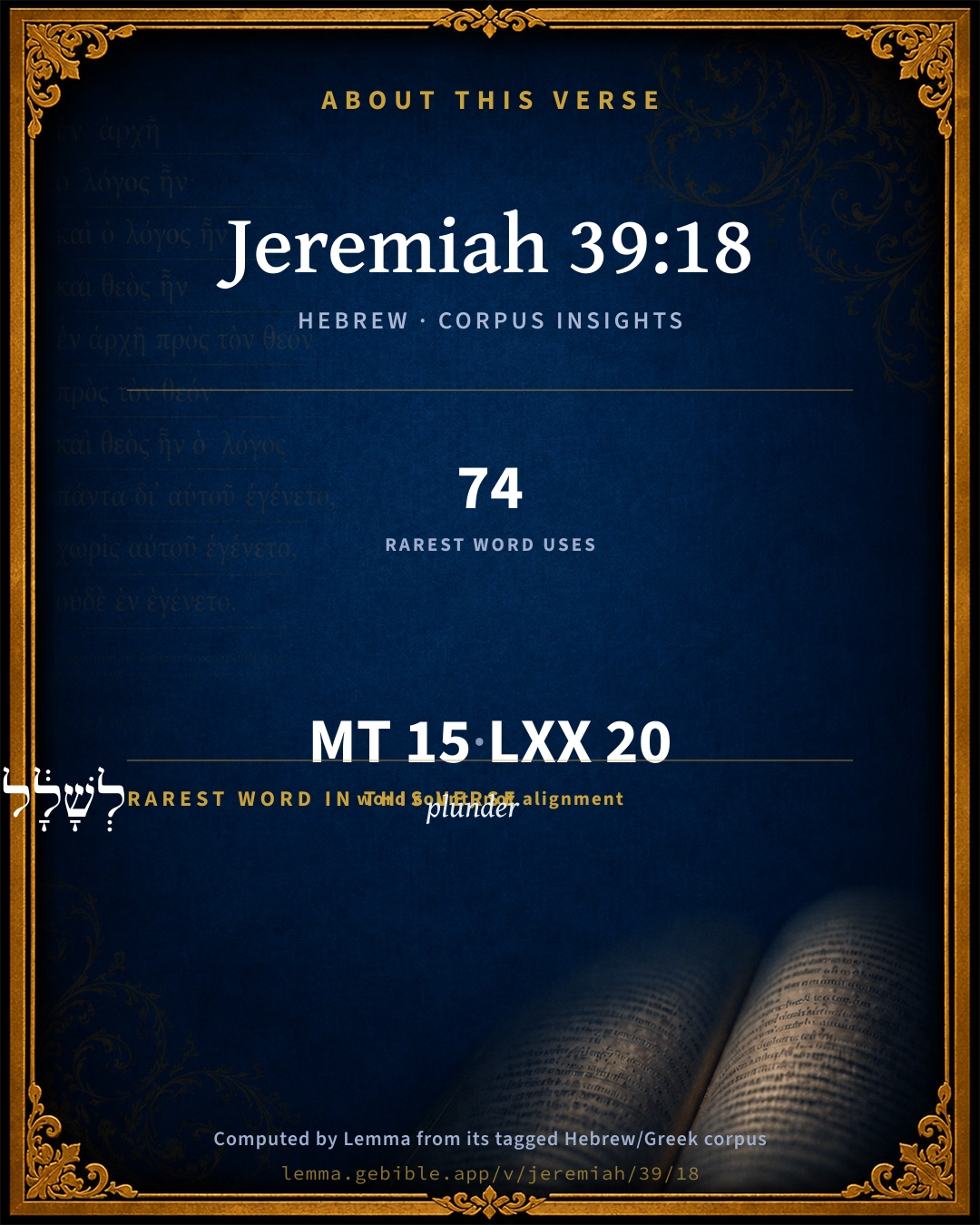
לְשָׁלָ֔ל
shâlâl
H7998
“to/for · plunder”
Preposition + Noun, Common, Masculine, Singular, Absolute
Part of Speech
Preposition + Noun
Type
Common
Gender
Masculine
Number
Singular
State
Absolute
Full BDB Definition

Origin: from H7997

TWOT: 2400a

prey, plunder, spoil, booty - prey - booty, spoil, plunder (of war) - plunder (private) - gain (meaning dubious)
  1. כִּ֤י kîy H3588 “that” Conjunction
  2. מַלֵּט֙ mâlaṭ H4422 “to escape” Verb, Piel, Infinitive Absolute
  3. אֲמַלֶּטְךָ֔ mâlaṭ H4422 “to escape · you” Verb, Piel, Imperfect, 1st Person, Common, Singular + Suffix, Personal, 2nd Person, Masculine, Singular
  4. וּבַחֶ֖רֶב chereb H2719 “and · in/at the · sword” Conjunction + Preposition, Determined + Noun, Common, Feminine, Singular, Absolute
  5. לֹ֣א lôʼ H3808 “not” Particle, Negative
  6. תִפֹּ֑ל nâphal H5307 “to fall” Verb, Qal, Imperfect, 2nd Person, Masculine, Singular
  7. וְהָיְתָ֨ה hâyâh H1961 “and · to be” Conjunction + Verb, Qal, Sequential Perfect, 3rd Person, Feminine, Singular
  8. נַפְשְׁךָ֙ nephesh H5315 “soul · your” Noun, Common, Both, Singular, Construct + Suffix, Personal, 2nd Person, Masculine, Singular
  9. כִּֽי kîy H3588 “that” Conjunction
  10. בָטַ֥חְתָּ bâṭach H982 “to trust” Verb, Qal, Perfect, 2nd Person, Masculine, Singular
  11. נְאֻם nᵉʼum H5002 “utterance of” Noun, Common, Masculine, Singular, Construct
  12. יְהוָֽה Yᵉhôvâh H3068 “LORD” Noun, Proper

About this verse

These counts appear in no published source. They are computed here, from the morphology-tagged text and Lemma’s own curated glosses. What Lemma adds →

15
words
11
distinct lemmas
Prophets
section

Grammatical profile

  • 5 verbs
  • 5 nouns
  • 2 prepositions
  • 2 conjunctions
  • 1 particle

Verb forms

  • מַלֵּט֙ Piel · Infinitive Absolute
  • אֲמַלֶּטְךָ֔ Piel · Imperfect
  • תִפֹּ֑ל Qal · Imperfect
  • וְהָיְתָ֨ה Qal · Sequential Perfect
  • בָטַ֥חְתָּ Qal · Perfect

Repetition

Words recur within this verse — often emphatic in Hebrew:

  • מַלֵּט֙ to escape H4422 ×2
  • כִּ֤י that H3588 ×2

Hebrew & Septuagint length

In the original languages it is 15 Hebrew tokens and 20 Greek tokens — but the two are counted differently (Hebrew bundles its prefixes and suffixes into one token; the Greek is in lemma form), so that isn’t a like-for-like length.

Cross-references

17

Topical passages linked to Jeremiah 39:18 in the Treasury of Scripture Knowledge — connected by theme and wording, ordered by reader-vote popularity; previews shown in the World English Bible.

  • Psalms 34:22 Yahweh redeems the soul of his servants. None of those who take refuge in him shall be condemned.
  • Jeremiah 38:2 Thus says Yahweh, He who remains in this city shall die by the sword, by the famine, and by the pestilence; but he who goes forth to the Chaldeans shall live, and his life shall be to him for a prey, and he shall live.
  • Jeremiah 21:9 He who remains in this city shall die by the sword, and by the famine, and by the pestilence; but he who goes out, and passes over to the Chaldeans who besiege you, he shall live, and his life shall be to him for a prey.
  • Ephesians 1:12 to the end that we should be to the praise of his glory, we who had before hoped in Christ:
  • Psalms 84:12 Yahweh of Hosts, Blessed is the man who trusts in you.
  • 1 Chronicles 5:20 They were helped against them, and the Hagrites were delivered into their hand, and all who were with them; for they cried to God in the battle, and he was entreated of them, because they put their trust in him.
  • Psalms 147:11 Yahweh takes pleasure in those who fear him, In those who hope in his loving kindness.
  • Psalms 33:18 Behold, Yahweh's eye is on those who fear him, On those who hope in his loving kindness;
  • Psalms 37:3 Trust in Yahweh, and do good. Dwell in the land, and enjoy safe pasture.
  • Psalms 37:39–40 But the salvation of the righteous is from Yahweh. He is their stronghold in the time of trouble.
  • Psalms 146:3–6 Don't put your trust in princes, Each a son of man in whom there is no help.
  • Psalms 2:12 Kiss the son, lest he be angry, and you perish in the way, For his wrath will soon be kindled. Blessed are all those who take refuge in him.
  • Isaiah 26:3 You will keep [him] in perfect peace, [whose] mind [is] stayed [on you]; because he trusts in you.
  • Jeremiah 17:7–8 Blessed is the man who trusts in Yahweh, and whose trust Yahweh is.
  • Jeremiah 45:4–5 Thus shall you tell him, Thus says Yahweh: Behold, that which I have built will I break down, and that which I have planted I will pluck up; and this in the whole land.
  • 1 Peter 1:21 who through him are believers in God, who raised him from the dead, and gave him glory; so that your faith and hope might be in God.
  • Romans 2:12 For as many as have sinned without law will also perish without the law. As many as have sinned under the law will be judged by the law.

Cross-references courtesy of OpenBible.info (CC BY 4.0).

Hebrew and Greek witnesses Masoretic Hebrew ↔ Greek Septuagint

The same verse in the two great witnesses to the Old Testament, shown verse-for-verse.

These are two independent witnesses, not word-aligned to each other, and the Septuagint is shown in lemma (dictionary) form.

Hebrew Jeremiah 39:18 Masoretic · Westminster Leningrad Codex

כִּ֤י מַלֵּט֙ אֲמַלֶּטְךָ֔ וּבַחֶ֖רֶב לֹ֣א תִפֹּ֑ל וְהָיְתָ֨ה לְךָ֤ נַפְשְׁךָ֙ לְשָׁלָ֔ל כִּֽי בָטַ֥חְתָּ בִּ֖י נְאֻם יְהוָֽה

For I will surely save you, and you shall not fall by the sword, but your life shall be for a prey to you; because you have put your trust in me, says Yahweh.

World English Bible · Public Domain

Greek LXX Structure differs

In the Septuagint, Jeremiah is about an eighth shorter than the Hebrew and arranges its material differently — the Oracles Against the Nations (Hebrew chapters 46–51) appear in the middle of the Greek book, after 25:13. Because the chapter and verse boundaries do not line up, a verse-for-verse comparison with the Hebrew is not shown.

A verse-for-verse comparison isn’t shown here because the chapters and verses don’t line up. Switch to the LXX edition with the MT / LXX toggle above to read the Greek directly.

Hebrew: Westminster Leningrad Codex (CC BY 4.0). Greek: Septuagint (public domain); English from a public-domain English Septuagint. How the Septuagint differs from the Hebrew →

Targum (Aramaic paraphrase)

1

The Targum is the ancient Jewish Aramaic paraphrase of the Hebrew Scriptures — an interpretive translation, not the Hebrew text itself. Onkelos (literal) and Pseudo-Jonathan (expansive) render the Torah, and Jonathan the Prophets. Coverage is partial: where no permissively-licensed English translation exists for a verse, only the Aramaic is shown. This is verse-level text, not a word-by-word alignment to the Hebrew.

  1. Targum Jonathan Prophets (Joshua–Malachi)
    אֲרֵי שֵׁיזָבָא אֱשֵׁיזָבִינָךְ וּבְחַרְבָא לָא תִתְקְטִיל וּתְהֵי לָךְ נַפְשָׁךְ לְשֵׁיזָבָא אֲרֵי אִתְרַחֵיצְתָּא עַל מֵימְרִי אֲמַר יְיָ:

    (no public-domain English translation for this verse)

    Targum Jonathan — Aramaic: “Mikraot Gedolot” (public domain). English: “Sefaria Community Translation” (CC0 1.0 (public-domain dedication)); “London "Chaldee Paraphrase," 1871” (public domain). Text via Sefaria.

Commentary

Notes on Jeremiah 39:18 from classic Christian and Jewish commentators (each source and its license shown beneath its notes). The classic Christian expositions comment on the surrounding passage and are grouped to its opening verse, so a note may address several verses; the Jewish commentaries on the Tanakh (Rashi and others) are per-verse, so they appear only where the commentator wrote on this verse.

Lemma curates 59 commentaries, every one of them public domain or Creative Commons licensed, each selected and text-cleaned for this edition rather than reprinted as found. About our sources →

Trapp's Complete Commentary

John Trapp

Jer 39:18 For I will surely deliver thee, and thou shalt not fall by the sword, but thy life shall be for a prey unto thee: because thou hast put thy trust in me, saith the LORD.

Ver. 18. For I will surely deliver thee.] Heb., Delivering, deliver thee. It would be a great stay of mind, if God should say the same to us in particular and by name, as he doth here to this Ethiopian. And yet he saith no less to us in the precious promises, which we are by faith to appropriate.

But thy life shall be for a prey unto thee.] Pro lucre cessura est. For saving my prophet’s life, thou shall have thine own; so sure a gain is godliness.

Because thou hast put thy trust in me.] What may not faith have at God’s hands? Those that trust him, do, after a sort, engage him to deliver them, and to do them good.

John Trapp, A Commentary or Exposition upon All the Books of the Old and New Testament (1647–1656) — public domain. Text from a community e-Sword module.

MacLaren's Expositions of Holy Scripture

Alexander MacLaren

Jeremiah

EBEDMELECH THE ETHIOPIAN

Jer 39:18.

Ebedmelech is a singular anticipation of that other Ethiopian eunuch whom Philip met on the desert road to Gaza. It is prophetic that on the eve of the fall of the nation, a heathen man should be entering into union with God. It is a picture in little of the rejection of Israel and the ingathering of the Gentiles.

I. The identity in all ages of the bond that unites men to God.

It is a common notion that faith is peculiar to the New Testament. But the Old Testament ‘trust’ is identical with the New Testament ‘faith,’ and it is a great pity that the variation in translation has obscured that identity. The fact of the prominence given to law in the Old Testament does not affect this. For every effort to keep the law must have led to consciousness of imperfection, and that consciousness must have driven to the exercise of penitent trust. The difference of degrees of revelation does not affect it, for faith is the same, however various the contents of the creed.

Note further the personal object of Faith-’in ME.’ The object of Faith is not a proposition but a Person. That Person is the same in the Old Testament and in the New. The Jehovah of the one is the God in Christ of the other. Consequently faith must be more than intellectual assent, it must be voluntary and emotional, the act of the whole man, ‘the synthesis of the reason and the will.’

II. The contrast of a formal and real union with God.

The king, prophets, priests, the whole nation, had an outward connection with Him, but it meant nothing. And this foreigner, a slave, perhaps not even a proselyte, a eunuch, had what the children of the covenant had not, a true union with God through Faith.

Judaism was not an exclusive system, but was intended to bring in the nations to share in its blessings. Outward descent gave outward place within the covenant, but the distinction of real and formal place there was established from the beginning. What else than this is the meaning of all the threatenings of Deuteronomy? What else did Isaiah mean when he called the rulers in Jerusalem ‘Rulers of Sodom’? Here the fates of Ebedmelech and of Zedekiah illustrate both sides of the truth. The danger of trusting in outward possession and of thinking that God’s mercy is our property besets all Churches. Organisations of Christianity are necessary, but it is impossible to tell the harm that formal connection with them has done. There is only one bond that unites men to God-personal trust in Him as ‘in Christ reconciling the world to Himself.’

III. The possibility of exercising uniting faith even in most unfavourable circumstances.

This Ebedmelech had everything against him. The contemptuous exclusion of him from any share in the covenant might well have discouraged him. The poorest Jew treated him as a heathen dog, who had no right even to crumbs from the table spread for the children only. He was plunged into a sea of godlessness, and saw examples enough of utter carelessness as to Jehovah in His professed servants to drive him away from a religion which had so little hold on its professed adherents. The times were gloomy, and the Jehovah whom Judah professed to worship seemed to have small power to help His worshippers. It would have been no wonder if the conduct of the people of Jerusalem had caused the name of Jehovah to be blasphemed by this Gentile, nor if he had revolted from a religion that was alleged to be the special property of one race, and that such a race! But he listened to the cry of his own heart, and to the words of God’s prophet, and his faith pierced through all obstacles-like the roots of some tree feeling for the water. He found the vitalising fountain that he sought, and His name stands to all ages as a witness that no seeking heart, that longs for God, is ever balked in its search, and that a faith, very imperfect as to its knowledge, may be so strong as to its substance that it unites him who exercises it with God, while the possessors of ecclesiastical privileges and of untarnished and full-orbed orthodox knowledge have no fellowship with Him.

IV. The safety given by such uniting faith.

To Ebedmelech, escape from death by the besiegers’ swords was promised. To us a more blessed safety and exemption from a worse destruction are assured. ‘The life which is life indeed’ may be ours, and shall assuredly be ours, if our trust knits us to Him who is the Life, and who has said ‘He that liveth and believeth in Me shall never die.’

Alexander MacLaren, Expositions of Holy Scripture (1904–1910) — public domain. Text from a community e-Sword module.

Geneva Bible (1599)

Geneva Bible translators

Thus God recompensed his zeal and favor, which he showed to his Prophet in his troubles.

Geneva Bible (1599) marginal notes — public domain. Text via Bolls.life.

Jamieson, Fausset & Brown

Robert Jamieson, A. R. Fausset & David Brown

life . . . for a prey--(See on Jer 21:9; Jer 38:2; Jer 45:5).

put . . . trust in me-- (Jer 38:7-9). Trust in God was the root of his fearlessness of the wrath of men, in his humanity to the prophet (Ch1 5:20; Psa 37:40). The "life" he thus risked was to be his reward, being spared beyond all hope, when the lives of his enemies should be forfeited ("for a prey").

Next: Jeremiah Chapter 40

Jamieson, Fausset & Brown — Commentary Critical and Explanatory on the Whole Bible (1871) — public domain (CC PDM 1.0). Text via the HelloAO Bible API.

Adam Clarke's Commentary

Verse 18. I will surely deliver thee] Thou hast feared the Lord, and not the king, nor his princes, and thou hast taken the part of the prophet, and become his intercessor. Thou shalt not be slain. Thou hast put thy trust in me; thou shalt therefore be safe whithersoever thou goest. They that fear God need fear nothing besides.

Adam Clarke's Commentary on the Bible (1810–1826) — public domain. Text from a community e-Sword/MySword module.

John Calvin's Commentaries

Then he says, that he would be safe, because the Lord would deliver him in that day And, again, he confirms the same thing, For delivering I will deliver thee, and thou shalt not fall by the sword The Prophet again calls the attention of Ebedmelech to God himself; for we know how all things are in a confusion when cities are taken by storm. Except then Ebedmelech had his mind fixed on God, he could never have retained any hope of deliverance. Hence the Prophet assures him again, that God would be his deliverer. And he adds, Thy soul shall be for a prey This mode of expression has been elsewhere explained. The comparison is taken from those who deem that a great gain which is yet but small, if they get it beyond their expectation, as when a man finds a prey which he had by no means hoped for: he becomes suddenly rich, or increased in his goods; and though the gain may not be great, he yet greatly rejoices. So they who escape alive from present death, have no small reason to be joyful, because their life has been preserved. In the meantime God alludes to those who regard it enough to escape from death, though they may be deprived of all other things. As those who, in shipwreck, cast forth their mer-chandize, and their money, and all they have, deem it enough if they can reach the harbor, and they prefer to beg their bread all their life rather than to sink in the midst of the sea, so he who escapes with his life; though poverty is bitter, yet the horror of death is so great, that he deems his life a great, gain, though stripped of all that he had.

The reason follows, because he trusted in God. Another reason might have been assigned, even because he had not been wanting in his kindness to a holy man, but had extended his hand to him in his extreme misery; but as that office of humanity proceeded from faith and piety, God does here express the chief cause. As then the mercy which Ebedmelech exercised towards the Prophet was an evidence of his piety and faith, here is found the fruit in its own tree, or in its root: and certain it is, that Ebedmelech would have never been so humane towards the Prophet, had he not relied on God and his aid; for unbelief is always timid. There is then no doubt but that the vigor which appeared in Ebedmelech, when he regarded his life in bringing aid to the Prophet, made manifest that faith which is now commended: because then thou hast trusted in me, therefore delivering I will deliver thee, says God. There is now then no doubt but that Ebedmelech had some of the elements of faith and piety. If then God has allowed us to make farther progress, we may feel the more assured that he will be our deliverer; for his grace and his power will ever exceed our faith, how much so ever it may be. Now follows —

John Calvin's Commentaries (1540-1563) — public domain. Text from the Calvin Translation Society English edition (1840s-50s) via the Christian Classics Ethereal Library (ccel.org). Calvin's coverage is partial (roughly two-thirds of the Bible); uncommented books and verses are honest gaps, never fabricated. The 19th-century editor's footnotes and remarks are omitted so the notes are faithfully Calvin's own voice.

The Cambridge Bible for Schools and Colleges

gen. ed. J. J. S. Perowne

18. thy life shall be for a prey unto thee] See on Jer_21:9.

The Cambridge Bible for Schools and Colleges (gen. ed. J. J. S. Perowne; Cambridge University Press, 1878–1918) — public domain. Text from a community e-Sword module.

John Gill's Exposition

For I will surely deliver thee,.... Or, in "delivering will deliver thee" (p); this is a repetition and confirmation of what is promised in Jer 39:17, and more fully explains it:

and thou shall not fall by the sword: by the sword of the Chaldeans, when the city should be taken, as he feared he should:

but thy life shall be for a prey unto thee: shall be safe; be like a prey taken out of the hand of the mighty, and be enjoyed beyond expectation, having been given up for lost; and therefore matter of the greater joy, such as is expressed at the taking of spoils:

because thou hast put thy trust in me, saith the Lord. The Targum is, "in my word"; what he had done in serving the prophet, and other good actions, sprung from a principle of faith and confidence in the Lord; and this the Lord had a respect unto; without which works are not right; and without which it is impossible to please God with them; and which faith may be, and be true, where fears are.

(p) "eripiendo eripiam te", Schmidt; "eruendo eruam te", Pagninus, Montanus.

John Gill's Exposition of the Whole Bible (1746–1763) — public domain (CC PDM 1.0). Text via the HelloAO Bible API.

Albert Barnes' Notes on the Bible

A prey unto thee - An unexpected and unlooked-for gain. He had given proof of faith in courageously delivering God’s prophet.

Albert Barnes' Notes on the Bible (1834–1885) — public domain. Text from a community e-Sword/MySword module.

Haydock's Catholic Bible Commentary

Saved. Hebrew, "a booty," chap. xxi. 9. Thus God rewards what is done to his servants, Matthew xxv. 40. (Calmet)

George Leo Haydock (1774–1849), Haydock's Catholic Family Bible and Commentary, 1859 edition — public domain. Excludes Psalms (Douay-Rheims chapter numbering differs from Protestant) and Deuterocanonical books (Catholic canon only).

Matthew Poole's English Annotations

For God would deliver him, so as he should not die by the sword; but how little else soever he saved, he should save his life, because he had put his trust in God, not fearing the wrath of men in the doing of what was his duty. We read no more in holy writ of this man, and so cannot tell how otherwise God dealt with him; only may be assured that he was not slain by the Chaldeans. And from this we may observe,

1. How kind God hath always declared himself to those who have showed the least kindness to those that have been his true and faithful ministers.

2. That the root of such good works as God rewardeth must be faith, a trusting in the Lord.

3. That those who do good works out of a principle of faith may yet be encumbered with slavish fears.

Matthew Poole's English Annotations on the Holy Bible (1683–1685) — public domain. Text from a community e-Sword/MySword module.

The Pulpit Commentary

For a prey unto thee. The same remarkable phrase in Jer_21:9 Jer_38:2.

The Pulpit Commentary (1880–1919), ed. H.D.M. Spence-Jones & Joseph S. Exell — public domain. Text from a community e-Sword module.

Scofield Reference Notes

C. I. Scofield

trust

(See Scofield "Psa 2:12").

The Scofield Reference Bible (1917 edition), notes by C. I. Scofield — public domain. Text from a community e-Sword module.

Lesson kit

Teaching starters — assembled from the data on this page, not authored interpretation. Every prompt links to the verse data it draws on. Edit before teaching.

Jeremiah, in the Prophets, opens this verse with 15 words (11 distinct Hebrew lemmas). Its most distinctive word is shâlâl (“plunder”). A historical commentator’s framing appears above. Read the whole chapter for the surrounding context.

Discussion questions

  1. How does “plunder” (shâlâl) shape what this verse is saying?
  2. Psalms 34:22 shares this passage’s theme. How do the two illuminate each other?
  3. “to escape” occurs 2× in this one verse. What is the effect of the repetition?
  4. The translations on this page render this verse differently — a whole-verse word diff, not a word-by-word alignment. What might account for the different wordings?
  5. The verb «מַלֵּט֙» is Piel Infinitive Absolute. How does its form color the action?
  6. Reading how Trapp's Complete Commentary and MacLaren's Expositions of Holy Scripture read this verse, where do the two commentators agree and where do they part?

Things to notice

Reading settings

Reading text

Shown beneath each verse's original-language words.

Old Testament
Old Testament edition

Read the OT as the Masoretic Hebrew (MT) or the Greek Septuagint (LXX).

English shown for the Greek Septuagint (in the Hebrew ↔ Greek comparison).

Comparing translations? Open the Compare panel on any verse page to stack up to four side by side.