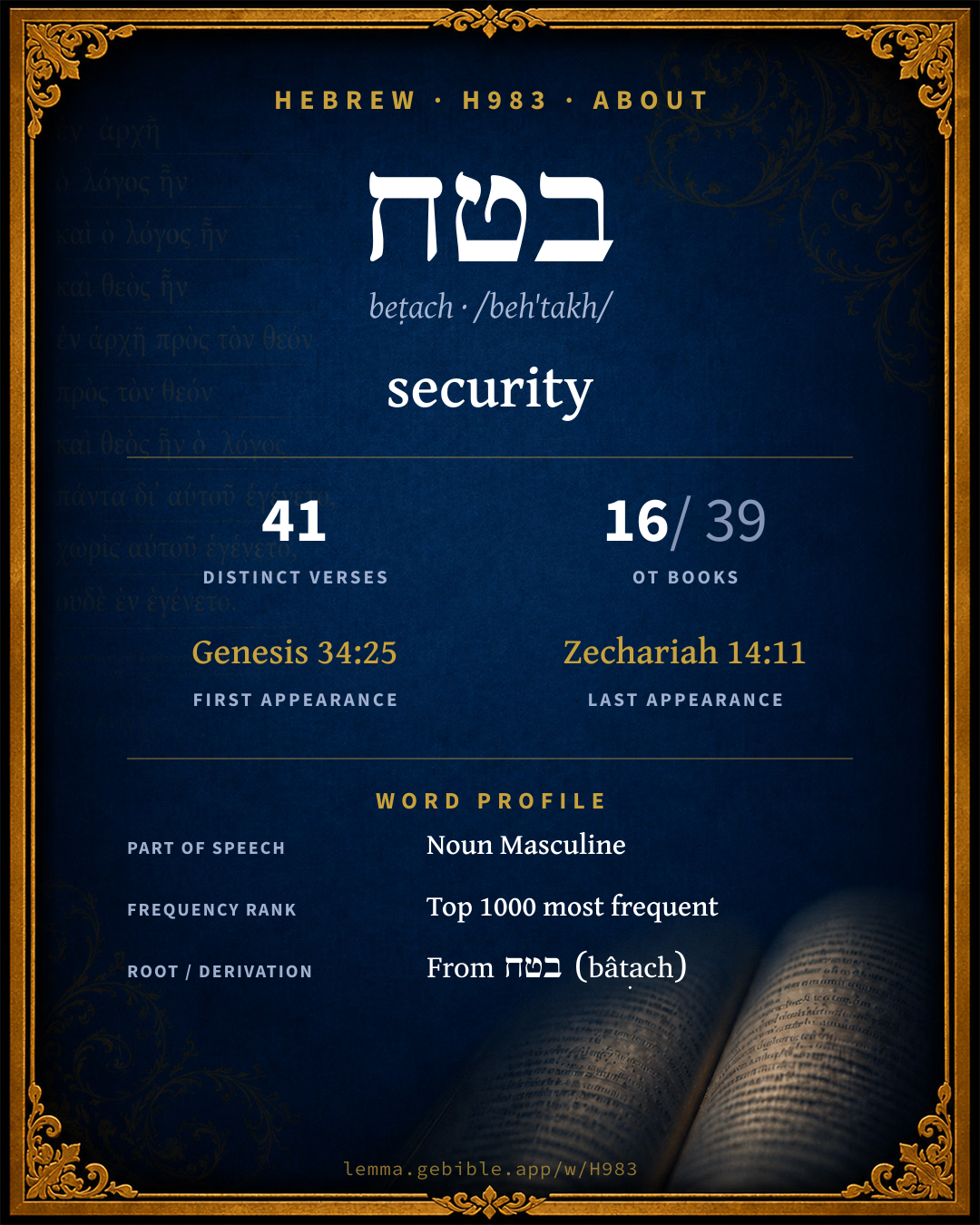
בֶּ֫טַח
security
‘security’ is one of 2 main senses fuller range ↓
Full lexicon entry — Brown-Driver-Briggs (BDB)
From Brown-Driver-Briggs (BDB)
Where this word appears
Grammar key — what these labels mean
Part of speech
- Noun
- A naming word — a person, place, thing, or idea.
Noun type
- Common
- A common noun — a general class of person, place, or thing (“king,” “city,” “water”), not a specific name.
State
- Absolute
- The independent form of a noun, not bound to a following word.
Gender
- Masculine
- Grammatically masculine.
Number
- Singular
- One.
Every verse where H983 appears — 41 distinct verses across 16 books. Click any verse to open its interlinear word-by-word view. Verse text shown in the World English Bible for context — . Each verse’s Hebrew form is shown with its reference; the English is not keyword-highlighted, since the data carries no word-level English alignment. Use “Compare translations” on any verse to read it across multiple English versions. This concordance covers the Hebrew Bible; Septuagint (Greek Old Testament) occurrences are not indexed here.
Genesis 1 verse
Leviticus 3 verses
- Leviticus 25:18 לָ/בֶֽטַח prep + n c ms "'Therefore you shall do my statutes, and keep my ordinances and do them; and you shall dwell in the land in safety.
- Leviticus 25:19 לָ/בֶ֖טַח prep + n c ms The land shall yield its fruit, and you shall eat your fill, and dwell therein in safety.
- Leviticus 26:5 לָ/בֶ֖טַח prep + n c ms Your threshing shall reach to the vintage, and the vintage shall reach to the sowing time; and you shall eat your bread to the full, and dwell in your land safely.
Deuteronomy 3 verses
- Deuteronomy 12:10 בֶּֽטַח n c ms But when you go over the Jordan, and dwell in the land which Yahweh your God causes you to inherit, and he gives you rest from all your enemies round about, so that you dwell in safety;
- Deuteronomy 33:12 לָ/בֶ֖טַח prep + n c ms Of Benjamin he said, The beloved of Yahweh shall dwell in safety by him; He covers him all the day long, He dwells between his shoulders.
- Deuteronomy 33:28 בֶּ֤טַח n c ms Israel dwells in safety, The fountain of Jacob alone, In a land of grain and new wine; Yes, his heavens drop down dew.
Judges 2 verses
- Judges 8:11 בֶֽטַח n c ms Gideon went up by the way of those who lived in tents on the east of Nobah and Jogbehah, and struck the host; for the host was secure.
- Judges 18:7 לָ֠/בֶטַח prep + n c ms Then the five men departed, and came to Laish, and saw the people who were therein, how they lived in security, after the manner of the Sidonians, quiet and secure; for there was none in the land, possessing authority, that might put [them] to shame in anything, and they were far from the Sidonians, and had no dealings with any man.
1 Samuel 1 verse
1 Kings 1 verse
Job 2 verses
Psalms 3 verses
- Psalms 4:8 לָ֝/בֶ֗טַח prep + n c ms In peace I will both lay myself down and sleep, For you, Yahweh alone, make me live in safety.
- Psalms 16:9 לָ/בֶֽטַח prep + n c ms Therefore my heart is glad, and my tongue rejoices. My body shall also dwell in safety.
- Psalms 78:53 לָ֭/בֶטַח prep + n c ms He led them safely, so that they weren't afraid, But the sea overwhelmed their enemies.
Proverbs 4 verses
- Proverbs 1:33 בֶּ֑טַח n c ms But whoever listens to me will dwell securely, And will be at ease, without fear of harm."
- Proverbs 3:23 לָ/בֶ֣טַח prep + n c ms Then you shall walk in your way securely. Your foot won't stumble.
- Proverbs 3:29 לָ/בֶ֣טַח prep + n c ms Don't devise evil against your neighbor, Seeing he dwells securely by you.
- Proverbs 10:9 בֶּ֑טַח n c ms He who walks blamelessly walks surely, But he who perverts his ways will be found out.
Isaiah 3 verses
- Isaiah 14:30 לָ/בֶ֣טַח prep + n c ms The firstborn of the poor shall feed, and the needy shall lie down in safety; and I will kill your root with famine, and your remnant shall be killed.
- Isaiah 32:17 וָ/בֶ֖טַח conj + n c ms The work of righteousness shall be peace; and the effect of righteousness, quietness and confidence forever.
- Isaiah 47:8 לָ/בֶ֔טַח prep + n c ms Now therefore hear this, you who are given to pleasures, who sit securely, who say in your heart, I am, and there is none else besides me; I shall not sit as a widow, neither shall I know the loss of children:
Jeremiah 4 verses
- Jeremiah 23:6 לָ/בֶ֑טַח prep + n c ms In his days Judah shall be saved, and Israel shall dwell safely; and this is his name by which he shall be called: Yahweh our righteousness.
- Jeremiah 32:37 לָ/בֶֽטַח prep + n c ms Behold, I will gather them out of all the countries, where I have driven them in my anger, and in my wrath, and in great indignation; and I will bring them again to this place, and I will cause them to dwell safely:
- Jeremiah 33:16 לָ/בֶ֑טַח prep + n c ms In those days shall Judah be saved, and Jerusalem shall dwell safely; and this is [the name] by which she shall be called: Yahweh our righteousness.
- Jeremiah 49:31 לָ/בֶ֖טַח prep + n c ms Arise, go up to a nation that is at ease, that dwells without care, says Yahweh; that have neither gates nor bars, that dwell alone.
Ezekiel 10 verses
- Ezekiel 28:26 לָ/בֶטַח֒ לָ/בֶ֑טַח prep + n c ms prep + n c ms They shall dwell securely therein; yes, they shall build houses, and plant vineyards, and shall dwell securely, when I have executed judgments on all those who do them despite round about them; and they shall know that I am Yahweh their God.
- Ezekiel 30:9 בֶּ֑טַח n c ms In that day shall messengers go forth from before me in ships to make the careless Ethiopians afraid; and there shall be anguish on them, as in the day of Egypt; for, behold, it comes.
- Ezekiel 34:25 לָ/בֶ֔טַח prep + n c ms I will make with them a covenant of peace, and will cause evil animals to cease out of the land; and they shall dwell securely in the wilderness, and sleep in the woods.
- Ezekiel 34:27 לָ/בֶ֑טַח prep + n c ms The tree of the field shall yield its fruit, and the earth shall yield its increase, and they shall be secure in their land; and they shall know that I am Yahweh, when I have broken the bars of their yoke, and have delivered them out of the hand of those who made slaves of them.
- Ezekiel 34:28 לָ/בֶ֖טַח prep + n c ms They shall no more be a prey to the nations, neither shall the animals of the earth devour them; but they shall dwell securely, and none shall make them afraid.
- Ezekiel 38:8 לָ/בֶ֖טַח prep + n c ms After many days you shall be visited: in the latter years you shall come into the land that is brought back from the sword, that is gathered out of many peoples, on the mountains of Israel, which have been a continual waste; but it is brought forth out of the peoples, and they shall dwell securely, all of them.
- Ezekiel 38:11 לָ/בֶ֑טַח prep + n c ms and you shall say, I will go up to the land of unwalled villages; I will go to those who are at rest, who dwell securely, all of them dwelling without walls, and having neither bars nor gates;
- Ezekiel 38:14 לָ/בֶ֖טַח prep + n c ms Therefore, son of man, prophesy, and tell Gog, Thus says the Lord Yahweh: In that day when my people Israel dwells securely, shall you not know it?
- Ezekiel 39:6 לָ/בֶ֑טַח prep + n c ms I will send a fire on Magog, and on those who dwell securely in the isles; and they shall know that I am Yahweh.
- Ezekiel 39:26 לָ/בֶ֖טַח prep + n c ms They shall bear their shame, and all their trespasses by which they have trespassed against me, when they shall dwell securely in their land, and none shall make them afraid;
Hosea 1 verse
Micah 1 verse
Zephaniah 1 verse
Zechariah 1 verse
About this entry
At a glance — auto-summarized from this page’s data, not written by a person. Every figure links to its source below. This summary describes the numbers; it doesn’t interpret them.
At its core, בטח (beṭach) means “security.” Translators differ — “safely” in the King James Version, then “securely” (Berean Standard Bible) and “security” (unfoldingWord Literal Text), as the renderings breakdown shows. It turns up in 41 verses across 16 books, a moderately common footprint. It first appears in Genesis 34:25. Ranging over 2 senses, it is not a single-sense word. Each statement above links to its evidence; the full detail follows below.
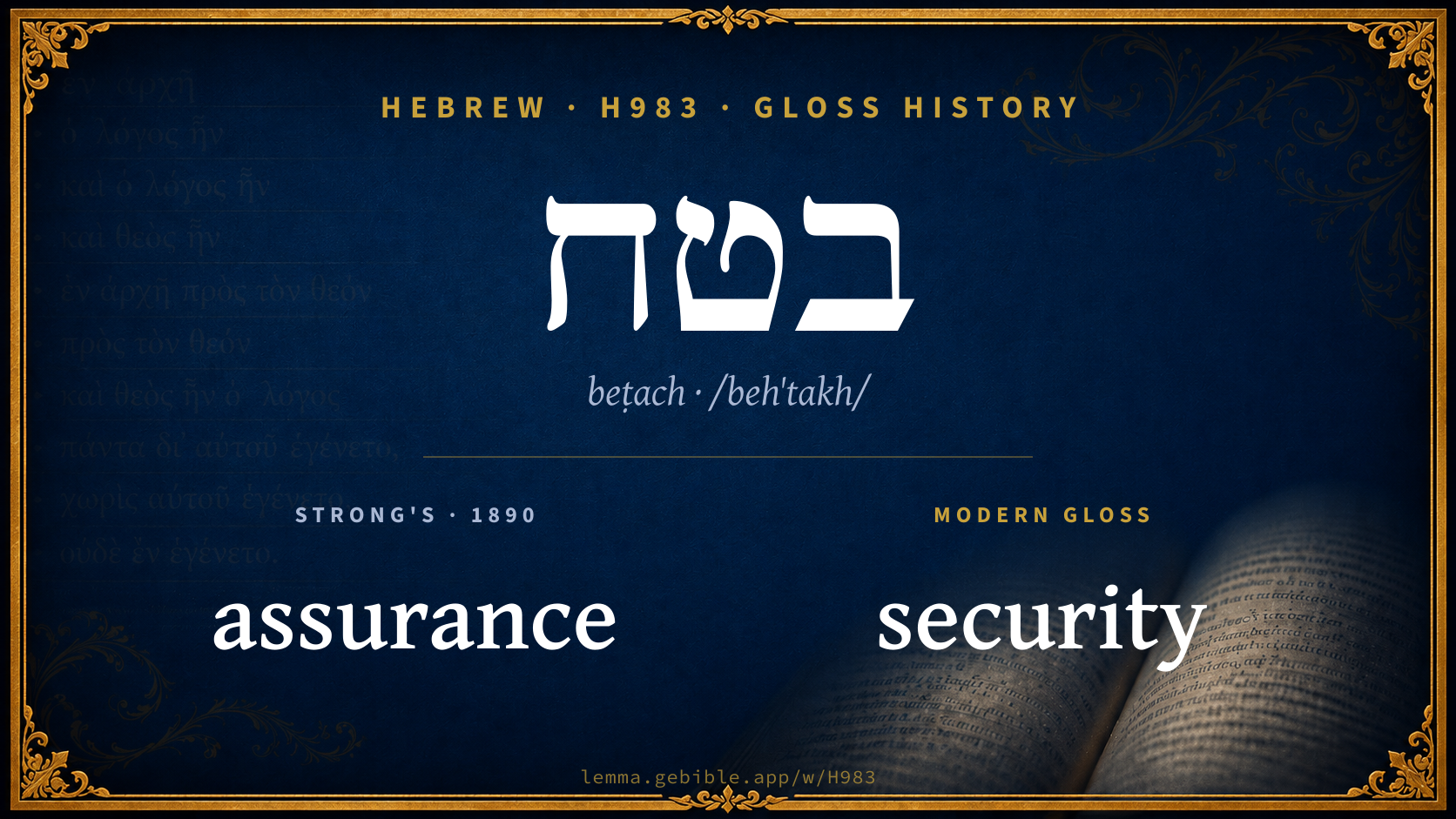
Gloss history
Strong's 1890 vs modern scholarship
About this word
Strong's H983 catalogs a Hebrew word from the Hebrew Old Testament.
These counts are not copied from any lexicon or concordance. They are computed here, from the morphology-tagged Hebrew Old Testament. What Lemma adds →
- 41
- distinct verses
- The word appears in 41 distinct verses.
- 16 / 39
- OT books
- The word appears in 16 of 39 Old Testament books.
- #864
- by frequency
- Top 1000 most frequent Hebrew words (rank 864 of 8,640 Hebrew words by occurrence).
View all 41 occurrences in the concordance →
By section of the Old Testament
By traditional corpus
Conventional, traditional groupings — biblical authorship is debated, so this is a traditional corpus grouping, not an authorship claim. Each share is this word’s portion of its verses in that division of the Hebrew canon. Each figure is a share of the word’s 41 distinct verses.
- Prophets (Nevi'im) 25 verses · 61%
- Writings (Ketuvim) 9 verses · 22%
- Torah (Pentateuch) 7 verses · 17%
How translations render this word
Counts come from each version’s own published word-to-Strong’s tagging or interlinear alignment — an approximate guide to how each version renders this word, not a word-level alignment the data otherwise carries. Because each total is that version’s own tagged count, the per-version totals vary from one another and need not match the appearance or distinct-verse counts above. These counts may also differ from a printed concordance because Lemma counts each distinctly tagged rendering and does not collapse phrase taggings into a single head-word total. This is a fixed set of word-tagged versions (KJV, ASV, BSB, ULT) and does not change with the reading translation you choose elsewhere. Each version’s license is shown beside its name below (and on Sources).
BDB lists this Strong’s number as 2 distinct words (homographs). Each count above pools all of them and is not split by sense — see the Senses section below. A low-frequency rendering may belong to a different one of those words, not the primary meaning.
- King James Version†: Safely 16×, Safety 7×, Carelessly 3×
- American Standard Version†: Securely 11×, Safely 8×, Safety 8×
- Berean Standard Bible†: Securely 21×, Safety 8×, Secure 2×
- unfoldingWord Literal Text†: Security 14×, Safety 11×, Securely 8×
King James Version Public Domain
Renders H983 across 42† tagged occurrences — most commonly:
Plus 14 renderings that appear only once — usually multi-word phrases or single function words the recovered tagging swept in, not distinct renderings.
American Standard Version Public Domain
Renders H983 across 42† tagged occurrences — most commonly:
Plus 13 renderings that appear only once — usually multi-word phrases or single function words the recovered tagging swept in, not distinct renderings.
Berean Standard Bible Public Domain
Renders H983 across 39† tagged occurrences — most commonly:
Plus 6 renderings that appear only once — usually multi-word phrases or single function words the recovered tagging swept in, not distinct renderings. Not rendered by a distinct English word in 3 further occurrences.
unfoldingWord Literal Text CC BY-SA 4.0
Renders H983 across 39† tagged occurrences — most commonly:
Plus 4 renderings that appear only once — usually multi-word phrases or single function words the recovered tagging swept in, not distinct renderings.
Senses in the full BDB
What do BDB’s symbols mean?
BDB uses these scholarly abbreviations:
| Symbol | Meaning |
|---|---|
| 𝔊 | the Septuagint (the ancient Greek translation, LXX) |
| 𝔙 | the Vulgate (the Latin translation) |
| 𝔖 | the Syriac version (the Peshitta) |
| 𝔗 | the Targum (the Aramaic translation) |
| ψ | the Psalms |
| √ | root (the underlying root or stem) |
| ‖ | parallel passage (a synonymous or contrasted parallel) |
| † | the dagger: every passage where the word occurs is cited |
The 0 senses and sub-senses the full Brown-Driver-Briggs lexicon distinguishes for this word, in lexicon order (not ranked by frequency), with BDB’s own verbatim wording and sub-sense lettering. Shown in Hebrew script with BDB’s own scholarly abbreviations. The condensed entry is in the Lexicon Entry tab. See also the Forms in the corpus table below.
בטח I [m.] security
בטח II loc. city of Hadadezer king of Zobah 2 S 8
Senses from the full Brown-Driver-Briggs lexicon (Brown, Driver, Briggs; Oxford 1906 — public domain), digitized via Sefaria, supplemented by the OpenScriptures HebrewLexicon (CC BY 4.0). Full attribution on Sources.
Word origin
I. n.[m.] security—Gn 34:25 + 41 times; הַשְׁקֵט וָבֶטַח Is 32:17 quietness and security = בְּהַשְׁקֵט וּבְבִטְחָה Is 30:15 (but prob. both infs.) elsewhere always adverb;—securely, ישׁב לבטח Lv 25:18, 19; 26:5 Ju 18:7 1 K 5:5 ψ 4:9 Pr 3:29 Is 47:8 Je 32:37; 49:31 Ez 28:26; 34:25, 28; 38:8, 11, 14; 39:6, 26 Zp 2:15 Zc 14:11; ישׁב בטח Dt 12:10 1 S 12:11; שׁכן לבטח Dt 33:12 ψ 16:9 Je 23:6; 33:16; שׁכן בטח Dt 33:28 Pr 1:33; לבטח (היה) Jb 24:23 Ez 34:27; היה בטח Ju 8:11; הלך לבטח Pr 3:23; הלך בטח Pr 10:9; שׁכב לבטח Jb 11:18 Ho 2:20; רבץ לבטח Is 14:30; נחה לבטח ψ 78:53; עבר בטח Mi 2:8; כושׁ בטח Cush (dwelling) securely Ez 30:9 (pregnant construction, del. בטח Co); וַיָּבֹאוּ עַל הָעִיר בֶּטַח and they came upon the city (dwelling) securely Gn 34:25 (J).
II. n.pr.loc. city of Hadadezer king of Zobah 2 S 8:8 (but read rather טִבְחַת so 1 Ch 18:8; 𝔊 Sm Μασβακ, 𝔊L Ματεβακ; 𝔊 Ch Μεταβηχας, 𝔊L ταβααθ; cf. also We Dr).
— Brown-Driver-Briggs (Oxford 1906, public domain), digitized via Sefaria, supplemented by the OpenScriptures HebrewLexicon (CC BY 4.0). See Sources.
Derived from בטח (bâṭach) (H982) — to trust.
Jastrow Dictionary
A second Hebrew/Aramaic lexicon for comparison, covering Aramaic and post-biblical (Talmudic, Targumic, Midrashic) usage that the biblical-Hebrew BDB does not. Matched by lemma rather than by Strong’s number, so a lemma may carry more than one Jastrow headword (shown separately below), and the entries cover usage well beyond the Bible.
בָּטַח
- , v. בטי; cmp. רָוַח) to be at ease, without trouble, whence to trust. Ber. 6ᵇ הו"ל לבְטוֹחַ וכ׳ he ought to have trusted in the name of the Lord, but did not trust.—Part. pass. בָּטוּחַ assured. Y. Naz. IV, end, 53ᶜ.—Lev. R. s. 31 ב׳ שגוזר he may rest assured that &c.; a. fr.
- to assure, promise. Ber. 17ᵃ הבטחה שה׳ the assurance which the Lord has given. Pesik. R. s. 1, beg. אע"פ שמתו המַבְטִיחִין וכ׳ though those who gave the assurances, the prophets, are dead, but the Lord who promised (through them) is ever-living; a. fr.—Part. Hof. מוּבְטָח (= בָּטוּחַ) confident, sure. Ber. 4ᵃ מ׳ אני בך וכ׳ I am sure that thou rewardest &c. Ib.ᵇ מ׳ לו may rest assured. Gitt. 58ᵃ מוּבְטַחְנִי = מ׳ אני; a. fr.
בְּטַח I
- Taan. 22ᵇ הואיל וקא ב׳ בע"א since he trusts in idols.
- = preced. Hif. Targ. Ruth II, 13.
- to feel safe. Targ. Jer. XII, 5.
בְּטַח II
- (בטח, בטי, v. Ges. H. Dict. s. v. בטח; cmp. מִקְוֶה) a hollow column-like receptacle of rain water near the house. [Maim., a projection in front of the window to stand upon in climbing.] Ohol. XII, 3 הבטח (Ar. Var. אבטח). Tosef. ib. XIII, 3 אבטי (ed. Zuck. אבטו, corr. acc.). [Cmp. פותי for פותח, טְפֵי IV for טפח.] V. בִּטְוַיָּא.
A Dictionary of the Targumim, the Talmud Babli and Yerushalmi, and the Midrashic Literature (Marcus Jastrow; London, Luzac, 1903) — Public Domain. Digitized via Sefaria. Digitized via Sefaria. Full attribution on Sources.
Forms in the corpus
The 17 distinct written forms H983 takes in the Hebrew Bible, most frequent first — each parse links to that state’s occurrences in the concordance. Hebrew forms include their vowel points and cantillation, so a single lemma takes many written forms.
| Form | Parsing | Example | Uses |
|---|---|---|---|
| לָ/בֶ֖טַח | Noun, Common, Masculine, Singular, Absolute | Deuteronomy 33:12 | 8 |
| לָ/בֶ֑טַח | Noun, Common, Masculine, Singular, Absolute | Ezekiel 28:26 | 6 |
| לָ/בֶֽטַח | Noun, Common, Masculine, Singular, Absolute | Hosea 2:18 | 5 |
| בֶּ֑טַח | Noun, Common, Masculine, Singular, Absolute | Ezekiel 30:9 | 4 |
| לָ/בֶ֔טַח | Noun, Common, Masculine, Singular, Absolute | Ezekiel 34:25 | 3 |
| לָ/בֶ֣טַח | Noun, Common, Masculine, Singular, Absolute | Isaiah 14:30 | 3 |
| בֶּֽטַח | Noun, Common, Masculine, Singular, Absolute | Deuteronomy 12:10 | 2 |
| לָ֭/בֶטַח | Noun, Common, Masculine, Singular, Absolute | Job 24:23 | 2 |
| בֶֽטַח | Noun, Common, Masculine, Singular, Absolute | Judges 8:11 | 1 |
| בֶּ֔טַח | Noun, Common, Masculine, Singular, Absolute | Micah 2:8 | 1 |
| בֶּ֤טַח | Noun, Common, Masculine, Singular, Absolute | Deuteronomy 33:28 | 1 |
| וָ/בֶ֖טַח | Noun, Common, Masculine, Singular, Absolute | Isaiah 32:17 | 1 |
| לָ/בֶ֗טַח | Noun, Common, Masculine, Singular, Absolute | 1 Kings 4:25 | 1 |
| לָ/בֶ֥טַח | Noun, Common, Masculine, Singular, Absolute | Job 11:18 | 1 |
| לָ/בֶטַח֒ | Noun, Common, Masculine, Singular, Absolute | Ezekiel 28:26 | 1 |
| לָ֝/בֶ֗טַח | Noun, Common, Masculine, Singular, Absolute | Psalms 4:8 | 1 |
| לָ֠/בֶטַח | Noun, Common, Masculine, Singular, Absolute | Judges 18:7 | 1 |
Same root — word family
Other BDB entries built from the same root as H983, grouped by Strong’s listed origin. These share a root / origin per the lexicon — not necessarily a shared meaning. Each links to that word’s own entry.
Derives from
Shares the same root
Proper names from this root
People and places named from this root — a name, not an additional meaning of the word.
Compare all same-root words → Showing 4 of 6 — not the complete family. 1 of the same-root words is a proper name (a person or place). They share a root, not necessarily a meaning.
Septuagint verse parallels
This word appears in 37 verses that also exist in the Greek Old Testament (Septuagint), out of the 41 Hebrew verses it occurs in. You can read those verses in Greek by switching the Old Testament edition to the Septuagint.
Read these verses in the Septuagint
- Genesis 34:25
- Leviticus 25:18
- Deuteronomy 12:10
- Judges 8:11
- 1 Samuel 12:11
- Job 11:18
- Psalms 4:8
- Proverbs 1:33
- Isaiah 14:30
- Jeremiah 23:6
- Ezekiel 28:26
- Hosea 2:18
This is a verse-level parallel only — the same verses exist in both the Hebrew and Greek Old Testaments. No word-level Hebrew↔Greek correspondence is claimed: the data carries no such alignment, so no Greek word is shown as this Hebrew word’s translation. Coverage is not total — the Septuagint omits the deuterocanon and renumbers the Psalms, so some Hebrew verses have no direct Greek parallel.