
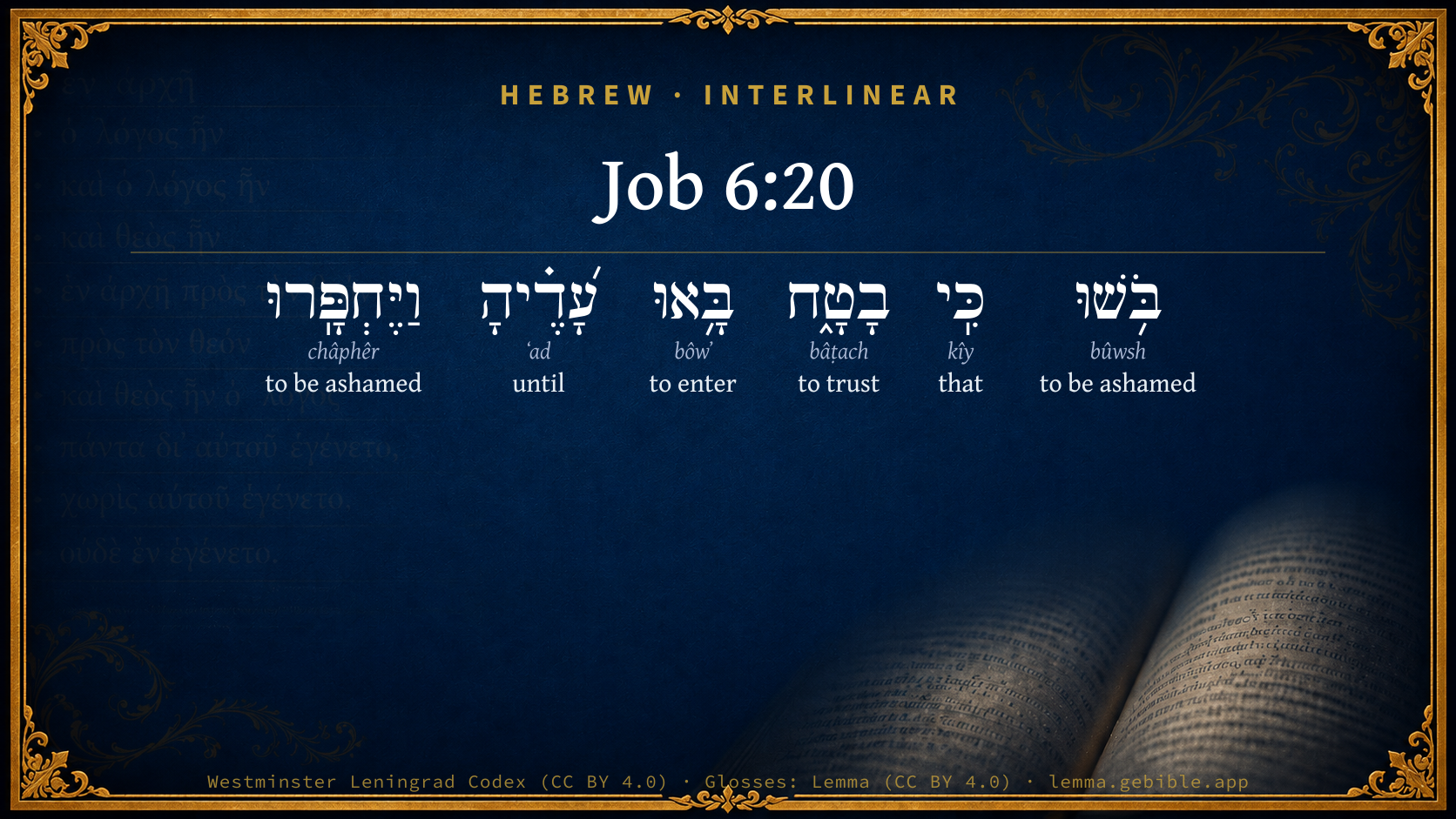
Job 6:20

Hebrew (Westminster Leningrad Codex) Job 6:20 appears in the Hebrew Old Testament. The text above is from the Westminster Leningrad Codex. Each word links to its Strong’s number, a concise gloss, and parsing drawn from the Open Scriptures Hebrew Bible morphology. Click any word for its full Brown-Driver-Briggs (BDB) entry.
Download image
Cite this verse

Job 6:20 (World English Bible). Public Domain. Lemma interlinear Bible study tool, https://lemma.gebible.app/v/job/6/20.

Show BibTeX & RIS
BibTeX
RIS
English Translation
They were distressed because they were confident; They came there, and were confounded.
World English Bible · Public Domain
Highlights
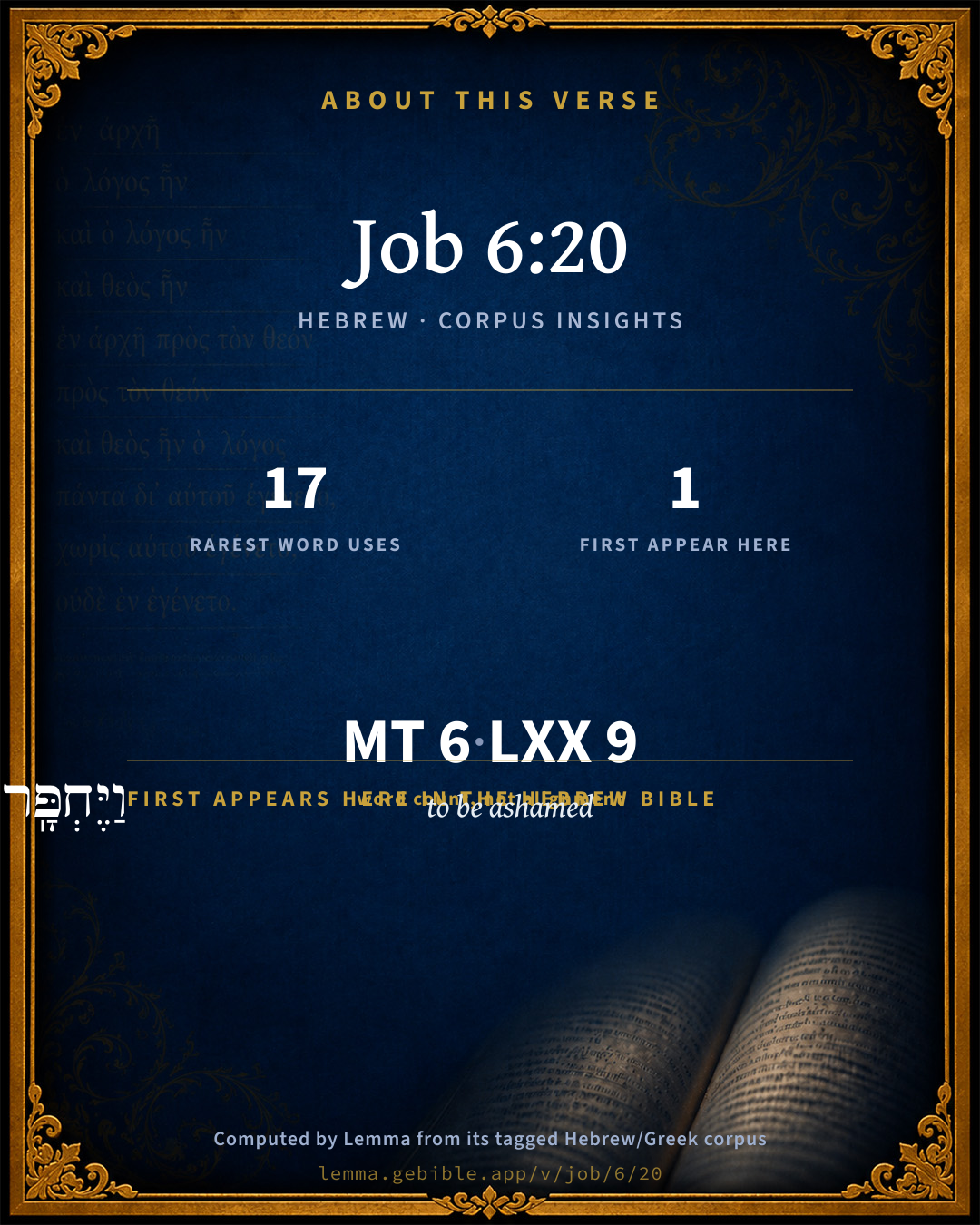
  • 1 first appearance in the Hebrew Bible
Full analysis ↓
Download a study sheet

One document with this verse’s original text, its word-by-word gloss line, the meaning frame, cross-references with their text, attributed commentary, and full source and license credits — printable, and it pastes into notes with its structure intact.

This verse Autodidact and up

Study sheet (.html) Plain text (.txt)

A passage Seminary Student

Up to 50 verses in one chapter. A passage sheet keeps up to 6 commentary sources and 12 cross-references per verse, in the order this page ranks them, and says so on the sheet whenever that leaves anything out. Ask for a single verse and you get the Autodidact verse sheet above.

Everything on this page stays free to read, with no account — the sheet is a download of what is already on screen, not access to it.

Want to remove ads? Support Godless Engineer
Compare translations 3

The same verse in 3 English versions, stacked beneath the original-language interlinear above. Click any original word for its lexicon entry.

Each is an independent rendering of the whole verse — the interlinear is not word-aligned to these translations.

Highlighted words mark where these versions differ — a whole-verse word diff, not a word-by-word alignment.

  • World English Bible Public Domain
    They were distressed because they were confident; They came there, and were confounded.
  • King James Version Public Domain
    They were confounded because they had hoped; they came thither, and were ashamed.
  • unfoldingWord Literal Text CC BY-SA 4.0
    They were ashamed, because they had been confident; they went as far as it, and they were confounded.

unfoldingWord Literal Text — © unfoldingWord, licensed CC BY-SA 4.0. Word-aligned USFM3 via Door43 (git.door43.org/unfoldingWord/en_ult).

Versions to compare (up to 4)

3 of 4 selected

Show all 18 translations

Every available English version of this verse, each an independent rendering of the whole verse.

  • World English Bible Public Domain
    They were distressed because they were confident; They came there, and were confounded.
  • Berean Standard Bible Public Domain
    They are confounded because they had hoped; their arrival brings disappointment.
  • Majority Standard Bible Public Domain
    They are confounded because they had hoped; their arrival brings disappointment.
  • King James Version Public Domain
    They were confounded because they had hoped; they came thither, and were ashamed.
  • American Standard Version (1901) Public Domain
    They were put to shame because they had hoped; They came thither, and were confounded.
  • Revised Version (1885) Public Domain
    They were ashamed because they had hoped; they came thither, and were confounded.
  • Geneva Bible (1599) Public Domain
    But they were confounded: when they hoped, they came thither and were ashamed.
  • Douay-Rheims (1899) Public Domain
    They are confounded, because I have hoped: they are come also even unto me, and are covered with shame.
  • Young's Literal Translation Public Domain
    They were ashamed that one hath trusted, They have come unto it and are confounded.
  • Literal Standard Version CC BY-SA 4.0
    They were ashamed that one has trusted, || They have come to it and are confounded.
  • Unlocked Literal Bible CC BY-SA 4.0
    They were disappointed because they had been confident of finding water. They went there, but they were deceived.
  • unfoldingWord Literal Text CC BY-SA 4.0
    They were ashamed, because they had been confident; they went as far as it, and they were confounded.
  • Darby Bible Public Domain
    They are ashamed at their hope; they come thither, and are confounded.
  • World Messianic Bible Public Domain
    They were distressed because they were confident. They came there, and were confounded.
  • Webster's Bible Public Domain
    They were confounded because they had hoped; they came thither, and were ashamed.
  • Free Bible Version CC BY-SA 4.0
    but their hopes were dashed—they came and found nothing.
  • Bible in Basic English Public Domain
    They were put to shame because of their hope; they came and their hope was gone.
  • JPS Tanakh (1917) Public Domain
    They were ashamed because they had hoped; they came thither, and were confounded.

Literal Standard Version (2020), Covenant Press — licensed CC BY-SA 4.0. Text via the HelloAO Bible API (eBible.org). Unlocked Literal Bible (unfoldingWord) — licensed CC BY-SA 4.0. Text via the HelloAO Bible API (eBible.org). unfoldingWord Literal Text — © unfoldingWord, licensed CC BY-SA 4.0. Word-aligned USFM3 via Door43 (git.door43.org/unfoldingWord/en_ult). Free Bible Version, Dr. Jonathan Gallagher — licensed CC BY-SA 4.0. Text via the HelloAO Bible API (eBible.org).

Word by word

More ways to search: Search by grammar → Find every occurrence → Compare this word →

Practice this passage: Drill this verse → Learn its vocabulary →

וַיֶּחְפָּֽרוּ
châphêr
H2659
“and · to be ashamed”
Conjunction + Verb, Qal, Sequential Imperfect, 3rd Person, Masculine, Plural
Part of Speech
Conjunction + Verb
Stem
Qal
Form
Sequential Imperfect
Person
3rd Person
Gender
Masculine
Number
Plural
Full BDB Definition

Origin: a primitive root [perhaps rath, the same as H2658 through the idea of detection]

TWOT: 715

to be ashamed, be confounded, be abashed, feel abashed - (Qal) to be ashamed, be abashed - (Hiphil) to display shame, demonstrate shame, cause embarrassment
  1. בֹּ֥שׁוּ bûwsh H954 “to be ashamed” Verb, Qal, Perfect, 3rd Person, Common, Plural
  2. כִּֽי kîy H3588 “that” Conjunction
  3. בָטָ֑ח bâṭach H982 “to trust” Verb, Qal, Perfect, 3rd Person, Masculine, Singular
  4. בָּ֥אוּ bôwʼ H935 “to enter” Verb, Qal, Perfect, 3rd Person, Common, Plural
  5. עָ֝דֶ֗יהָ ʻad H5704 “until · her” Preposition + Suffix, Personal, 3rd Person, Feminine, Singular

About this verse

These counts appear in no published source. They are computed here, from the morphology-tagged text and Lemma’s own curated glosses. What Lemma adds →

6
words
6
distinct lemmas
Wisdom
section

Notable vocabulary

The rarest word here is וַיֶּחְפָּֽרוּ to be ashamed H2659 — appearing just 17 times in the whole Hebrew Bible.

First appearance in Scripture

This word makes its first canonical appearance in the Hebrew Bible here:

  • וַיֶּחְפָּֽרוּ to be ashamed H2659

Shared distinctive vocabulary

וַיֶּחְפָּֽרוּ to be ashamed H2659 occurs in 17 verses of the Hebrew Bible. Also found in:

Grammatical profile

  • 4 verbs
  • 1 preposition
  • 1 conjunction

Verb forms

  • בֹּ֥שׁוּ Qal · Perfect
  • בָטָ֑ח Qal · Perfect
  • בָּ֥אוּ Qal · Perfect
  • וַיֶּחְפָּֽרוּ Qal · Sequential Imperfect

Hebrew & Septuagint length

In English translation the verse runs 13 words from the Hebrew and 12 from the Septuagint (LXX English) — closely comparable.

A rough comparison of the two English renderings, which tokenize alike — not a word-level alignment.

Word counts can differ between the Hebrew and the Greek without any difference in meaning — e.g. the Hebrew direct-object marker אֵת has no separate Greek word, and Greek often adds the article ὁ.

In the original languages it is 6 Hebrew tokens and 9 Greek tokens — but the two are counted differently (Hebrew bundles its prefixes and suffixes into one token; the Greek is in lemma form), so that isn’t a like-for-like length.

Cross-references

4

Topical passages linked to Job 6:20 in the Treasury of Scripture Knowledge — connected by theme and wording, ordered by reader-vote popularity; previews shown in the World English Bible.

  • Jeremiah 14:3–4 Their nobles send their little ones to the waters: they come to the cisterns, and find no water; they return with their vessels empty; they are disappointed and confounded, and cover their heads.
  • Jeremiah 17:13 Yahweh, the hope of Israel, all who forsake you shall be disappointed. Those who depart from me shall be written in the earth, because they have forsaken Yahweh, the spring of living waters.
  • Romans 5:5 and hope doesn't disappoint us, because God's love has been poured out into our hearts through the Holy Spirit who was given to us.
  • Romans 9:33 even as it is written, "Behold, I lay in Zion a stumbling stone and a rock of offense; And no one who believes in him will be disappointed."

Cross-references courtesy of OpenBible.info (CC BY 4.0).

Hebrew and Greek witnesses Masoretic Hebrew ↔ Greek Septuagint

The same verse in the two great witnesses to the Old Testament, shown verse-for-verse.

These are two independent witnesses, not word-aligned to each other, and the Septuagint is shown in lemma (dictionary) form.

Hebrew Job 6:20 Masoretic · Westminster Leningrad Codex

בֹּ֥שׁוּ כִּֽי בָטָ֑ח בָּ֥אוּ עָ֝דֶ֗יהָ וַיֶּחְפָּֽרוּ

They were distressed because they were confident; They came there, and were confounded.

World English Bible · Public Domain

Greek LXX Job 6:20 Septuagint · lemma form

καί αἰσχύνη ὀφείλω ὁ ἐπί πόλις καί χρῆμα πείθω

They too that trust in cities and riches shall come to shame.

LXX2012 (modern English Septuagint) · Public Domain

Hebrew: Westminster Leningrad Codex (CC BY 4.0). Greek: Septuagint (public domain); English from LXX2012 (modern English Septuagint) (Public Domain). How the Septuagint differs from the Hebrew →

Commentary

Notes on Job 6:20 from classic Christian and Jewish commentators (each source and its license shown beneath its notes). The classic Christian expositions comment on the surrounding passage and are grouped to its opening verse, so a note may address several verses; the Jewish commentaries on the Tanakh (Rashi and others) are per-verse, so they appear only where the commentator wrote on this verse.

Lemma curates 59 commentaries, every one of them public domain or Creative Commons licensed, each selected and text-cleaned for this edition rather than reprinted as found. About our sources →

Trapp's Complete Commentary

John Trapp

Job 6:20 They were confounded because they had hoped; they came thither, and were ashamed.

Ver. 20. They were confounded because they had hoped, &c.] Heb. They blushed, or they were abashed, because disappointed and defeated of their hope and expectation. See Jer 14:3-4 Joe 1:10-11. God’s people have a promise, that hoping in him they shall never be ashamed, Joe 2:26 Rom 10:11. Their hope is infallible, Rom 5:5, because founded upon faith unfeigned, 1Ti 1:5. Hence they are commanded to rejoice in hope, Rom 12:12, and to conceive gaudium in re, gaudium in spe, gaudium de possessione, gaudium de promissione, &c., joy for what they have in hand, and in present possession; joy also for what they have in hope, and in reversion. Wicked men’s hopes may hope headless (as the proverb is, and as these troops of Tema experimented), they come to the world’s felicities as they do to a lottery, with heads full of hopes, but return with hearts full of blanks: not so the saints; God will be better to them than their hopes; and when at worst, they can confidently say, it is well for the present, and it will be better hereafter.

John Trapp, A Commentary or Exposition upon All the Books of the Old and New Testament (1647–1656) — public domain. Text from a community e-Sword module.

Joseph Benson's Commentary

Job 6:20. They were confounded — That is, the troops and companies were miserably disappointed; because they hoped — Comforted themselves with the expectation of water there to quench their thirst; they came, and were ashamed — To think that they should expect relief from such uncertain streams, and had deceived themselves and others. Thus we prepare confusion for ourselves by our vain hopes: the reeds break under us because we lean upon them.

Joseph Benson's Commentary on the Old and New Testaments (1811–1818) — public domain. Text from a community e-Sword module.

Jamieson, Fausset & Brown

Robert Jamieson, A. R. Fausset & David Brown

literally, "each had hoped"; namely, that their companions would find water. The greater had been their hopes the more bitter now their disappointment;

they came thither--to the place.

and were ashamed--literally, "their countenances burn," an Oriental phrase for the shame and consternation of deceived expectation; so "ashamed" as to disappointment (Rom 5:5).

Jamieson, Fausset & Brown — Commentary Critical and Explanatory on the Whole Bible (1871) — public domain (CC PDM 1.0). Text via the HelloAO Bible API.

Ellicott's Commentary for English Readers

(20) They were confounded.—Comp. Jeremiah’s description of the famine (Jer_14:3). (See margin.)

A Bible Commentary for English Readers, edited by Charles John Ellicott (1878–1897) — public domain. Text from a community e-Sword module.

John Gill's Exposition

For now ye are nothing,.... Once they seemed to be something to him; he thought them men wise, good, and religious, kind, bountiful, and tenderhearted; but now he found them otherwise, they were nothing to him as friends or as comforters in his distress; the "Cetib", or Scripture, is, as we read, and is followed by many; but the marginal reading is, "now ye are to it" (a); that is, ye are like to it, the brook whose waters he had been describing; so Jarchi interprets it; Mr. Broughton very agreeably takes in both, "so now ye are become like that, even nothing"; as that deceitful brook is no more, nor of any use to travellers fainting through thirst; so ye are like that, of no use and advantage to me in my affliction:

ye see my casting down; from a state of prosperity to a state of adversity; from a pinnacle of honour, from being the greatest man in the east, a civil magistrate, and the head of a flourishing family, to the lowest degree of disgrace and dishonour; from wealth and riches to want and poverty; as well as saw the inward dejection of his mind, through the poisoned arrows of the Almighty within him:

and ye are afraid; of the righteous judgments of God, taking these calamities to be such, and fearing the same or the like should fall on them, should they keep him company; or however should they patronize and defend him; and afraid also of being too near him, lest his breath, and the smell of him, should be infectious, and they should catch a distemper from him; or lest he should be expensive and troublesome to them.

(a) "certe nunc fuistis illi", Bolducius; so Michaelis; "certe nunc estis similes illi", Pagninus, Vatablus, Mercerus.

John Gill's Exposition of the Whole Bible (1746–1763) — public domain (CC PDM 1.0). Text via the HelloAO Bible API.

Albert Barnes' Notes on the Bible

They were confounded because they had hoped - The caravans of Tema and Sheba. The word “confounded” here means ashamed. It represents the state of feeling which one has who has met with disappointment. He is perplexed, distressed, and ashamed that he had entertained so confident hope; see the notes at Isa 30:5. They were downcast and sad that the waters had failed, and they looked on one another with confusion and dismay. There are few images more poetic than this, and nothing that would more strikingly exhibit the disappointment of Job, that he had looked for consolation from his friends, and had not found it. He was down-cast, distressed, and disheartened, like the travelers of Tema and of Sheba, because they had nothing to offer to console him; because he had waited for them to sustain him in his afflictions, and had been wholly disappointed.

Albert Barnes' Notes on the Bible (1834–1885) — public domain. Text from a community e-Sword/MySword module.

Haydock's Catholic Bible Commentary

I. Hebrew, "they had hoped" to pass along. (Haydock)

George Leo Haydock (1774–1849), Haydock's Catholic Family Bible and Commentary, 1859 edition — public domain. Excludes Psalms (Douay-Rheims chapter numbering differs from Protestant) and Deuterocanonical books (Catholic canon only).

Matthew Poole's English Annotations

They were confounded, i.e. the troops and companies. Because they had hoped; they comforted themselves with the expectation of water there to quench their thirst.

Were ashamed; as having deceived themselves and others with vain and false hopes.

Matthew Poole's English Annotations on the Holy Bible (1683–1685) — public domain. Text from a community e-Sword/MySword module.

Whedon's Commentary on the Bible

Daniel D. Whedon

20. They were confounded, etc. — Rather, They were ashamed because they trusted; they came thither and reddened with shame. Job now closes a most striking description of the failure of human friendship. He leads us to the mountain torrent, swollen by wintry storms, boisterous, impetuous. While we gaze, the voice of the torrent ceases to be heard; for the summer sun is on the sky. With a master stroke Job fixes our eye on the toiling, thirsting, dying hosts of a caravan who have turned aside that they may find water and life in the hour of their distress. Again a single touch shows us their confusion and despair as they sink down in the dreary wastes and die. Such is friendship, loud in its professions and strong in the day of prosperity. Such was the thirst of Job’s soul for the pure streams of friendship; but he thirsted in vain.

Daniel D. Whedon (gen. ed.), Commentary on the Old and New Testaments (1874–1909) — public domain. Text from a community e-Sword module.

The Pulpit Commentary

They were confounded because they had hoped. Shame and confusion of face came upon them in consequence of their vain hope. In the same way, Job implies, he is ashamed of having looked for compassion and kindness from his friends. He should have been wiser and have known better. They came thither, and were ashamed. They not only hoped, but acted on their hope let it turn them aside from their way (ver. 18) and bring them to ruin.

The Pulpit Commentary (1880–1919), ed. H.D.M. Spence-Jones & Joseph S. Exell — public domain. Text from a community e-Sword module.

John Wesley's Explanatory Notes

Hoped - They comforted themselves with the expectation of water. Ashamed - As having deceived themselves and others. We prepare confusion for ourselves, by our vain hopes: the reeds break under us, because we lean upon them.

John Wesley, Explanatory Notes Upon the Whole Bible (1754–1765) — public domain. Text via the GEBible commentary corpus.

Rashi

Rabbi Shlomo Yitzchaki (Rashi)

They are ashamed because they had hoped; they came to it Those who drink it are ashamed because everyone had hoped to drink thereof.

Rashi on the Tanakh — English translations: “The Judaica Press complete Tanach with Rashi, translated by A. J. Rosenberg” (CC BY 4.0); “Pentateuch with Rashi's commentary by M. Rosenbaum and A.M. Silbermann, 1929-1934” (public domain); “The Metsudah Tanach series, Lakewood, N.J” (CC BY 4.0); and “The Book of Joshua, Metsudah Publications, 1997” (CC BY 4.0). Text via Sefaria.

Lesson kit

Teaching starters — assembled from the data on this page, not authored interpretation. Every prompt links to the verse data it draws on. Edit before teaching.

Job, in the Wisdom, opens this verse with 6 words (6 distinct Hebrew lemmas). Its most distinctive word is châphêr (“to be ashamed”). A historical commentator’s framing appears above. Read the whole chapter for the surrounding context.

Discussion questions

  1. How does “to be ashamed” (châphêr) shape what this verse is saying?
  2. This is the first place “to be ashamed” appears in Scripture (first appears here). What does its debut here establish?
  3. How does Psalms 34:5, which shares the word «to be ashamed», read alongside this verse?
  4. These translations render this verse differently. What is at stake in choosing one wording over another?
  5. «בֹּ֥שׁוּ» is a Qal Perfect verb. How does that grammatical form shape the action described?
  6. Compare how Trapp's Complete Commentary and Joseph Benson's Commentary read this verse. Where do they agree or differ?

Things to notice

Reading settings

Reading text

Shown beneath each verse's original-language words.

Old Testament
Old Testament edition

Read the OT as the Masoretic Hebrew (MT) or the Greek Septuagint (LXX).

English shown for the Greek Septuagint (in the Hebrew ↔ Greek comparison).

Comparing translations? Open the Compare panel on any verse page to stack up to four side by side.