Isaiah 42:17

Hebrew (Westminster Leningrad Codex) Isaiah 42:17 appears in the Hebrew Old Testament. The text above is from the Westminster Leningrad Codex. Each word links to its Strong’s number, a concise gloss, and parsing drawn from the Open Scriptures Hebrew Bible morphology. Click any word for its full Brown-Driver-Briggs (BDB) entry.
Download image
Cite this verse

Isaiah 42:17 (World English Bible). Public Domain. Lemma interlinear Bible study tool, https://lemma.gebible.app/v/isaiah/42/17.

Show BibTeX & RIS
BibTeX
RIS
English Translation
They shall be turned back, they shall be utterly disappointed, who trust in engraved images, who tell molten images, You are our gods.
World English Bible · Public Domain
Download a study sheet

One document with this verse’s original text, its word-by-word gloss line, the meaning frame, cross-references with their text, attributed commentary, and full source and license credits — printable, and it pastes into notes with its structure intact.

This verse Autodidact and up

Study sheet (.html) Plain text (.txt)

A passage Seminary Student

Up to 50 verses in one chapter. A passage sheet keeps up to 6 commentary sources and 12 cross-references per verse, in the order this page ranks them, and says so on the sheet whenever that leaves anything out. Ask for a single verse and you get the Autodidact verse sheet above.

Everything on this page stays free to read, with no account — the sheet is a download of what is already on screen, not access to it.

Want to remove ads? Support Godless Engineer
Compare translations 3

The same verse in 3 English versions, stacked beneath the original-language interlinear above. Click any original word for its lexicon entry.

Each is an independent rendering of the whole verse — the interlinear is not word-aligned to these translations.

Highlighted words mark where these versions differ — a whole-verse word diff, not a word-by-word alignment.

  • World English Bible Public Domain
    They shall be turned back, they shall be utterly disappointed, who trust in engraved images, who tell molten images, You are our gods.
  • King James Version Public Domain
    They shall be turned back, they shall be greatly ashamed, that trust in graven images, that say to the molten images, Ye are our gods.
  • unfoldingWord Literal Text CC BY-SA 4.0
    They will be turned back, they will have shame shame, the ones trusting in a carved idol, the ones saying to a cast idol, ‘You our gods.’ q1

unfoldingWord Literal Text — © unfoldingWord, licensed CC BY-SA 4.0. Word-aligned USFM3 via Door43 (git.door43.org/unfoldingWord/en_ult).

Versions to compare (up to 4)

3 of 4 selected

Show all 18 translations

Every available English version of this verse, each an independent rendering of the whole verse.

  • World English Bible Public Domain
    They shall be turned back, they shall be utterly disappointed, who trust in engraved images, who tell molten images, You are our gods.
  • Berean Standard Bible Public Domain
    But those who trust in idols and say to molten images, ‘You are our gods!’ will be turned back in utter shame.
  • Majority Standard Bible Public Domain
    But those who trust in idols and say to molten images, ‘You are our gods!’ will be turned back in utter shame.
  • King James Version Public Domain
    They shall be turned back, they shall be greatly ashamed, that trust in graven images, that say to the molten images, Ye are our gods.
  • American Standard Version (1901) Public Domain
    They shall be turned back, they shall be utterly put to shame, that trust in graven images, that say unto molten images, Ye are our gods.
  • Revised Version (1885) Public Domain
    They shall be turned back, they shall be greatly ashamed, that trust in graven images, that say unto molten images, Ye are our gods.
  • Geneva Bible (1599) Public Domain
    They shall be turned backe: they shall be greatly ashamed, that trust in grauen images, and say to the molten images, Yee are our gods.
  • Douay-Rheims (1899) Public Domain
    They are turned back: let them be greatly confounded, that trust in a graven thing, that say to a molten thing: You are our god.
  • Young's Literal Translation Public Domain
    Removed backward -- utterly ashamed, Are those trusting in a graven image, Those saying to a molten image, `Ye `are' our gods.'
  • Literal Standard Version CC BY-SA 4.0
    Removed backward—utterly ashamed, || Are those trusting in a carved image, || Those saying to a molten image, “You [are] our gods.”
  • Unlocked Literal Bible CC BY-SA 4.0
    They will be turned back, they will be completely put to shame, those who trust in carved figures, who say to cast metal figures, “You are our gods.”
  • unfoldingWord Literal Text CC BY-SA 4.0
    They will be turned back, they will have shame shame, the ones trusting in a carved idol, the ones saying to a cast idol, ‘You our gods.’ q1
  • Darby Bible Public Domain
    They shall be turned back, they shall be covered with shame, that confide in graven images, that say to the molten images, Ye are our gods.
  • World Messianic Bible Public Domain
    “Those who trust in engraved images, who tell molten images, ‘You are our gods,’ will be turned back. They will be utterly disappointed.
  • Webster's Bible Public Domain
    They shall be turned back, they shall be greatly ashamed, that trust in graven images, that say to the molten images, Ye are our gods.
  • Free Bible Version CC BY-SA 4.0
    But those who trust in idols and say to images, ‘You are our gods!’ will be rejected in humiliation and shame.
  • Bible in Basic English Public Domain
    They will be turned back and be greatly shamed who put their hope in pictured images, who say to metal images, You are our gods.
  • JPS Tanakh (1917) Public Domain
    They shall be turned back, greatly ashamed, that trust in graven images, that say unto molten images: 'Ye are our gods.'

Literal Standard Version (2020), Covenant Press — licensed CC BY-SA 4.0. Text via the HelloAO Bible API (eBible.org). Unlocked Literal Bible (unfoldingWord) — licensed CC BY-SA 4.0. Text via the HelloAO Bible API (eBible.org). unfoldingWord Literal Text — © unfoldingWord, licensed CC BY-SA 4.0. Word-aligned USFM3 via Door43 (git.door43.org/unfoldingWord/en_ult). Free Bible Version, Dr. Jonathan Gallagher — licensed CC BY-SA 4.0. Text via the HelloAO Bible API (eBible.org).

Word by word

More ways to search: Search by grammar → Find every occurrence → Compare this word →

Practice this passage: Drill this verse → Learn its vocabulary →

נָסֹ֤גוּ
çûwg
H5472
“to backslide”
Verb, Niphal, Perfect, 3rd Person, Common, Plural
Part of Speech
Verb
Stem
Niphal
Form
Perfect
Person
3rd Person
Gender
Common
Number
Plural
Full BDB Definition

Origin: a primitive root

TWOT: 1469

to move, go, turn back, move away, backslide - (Qal) to backslide, prove recreant to - (Niphal) - to turn oneself away, turn back - to be turned or driven back, be repulsed
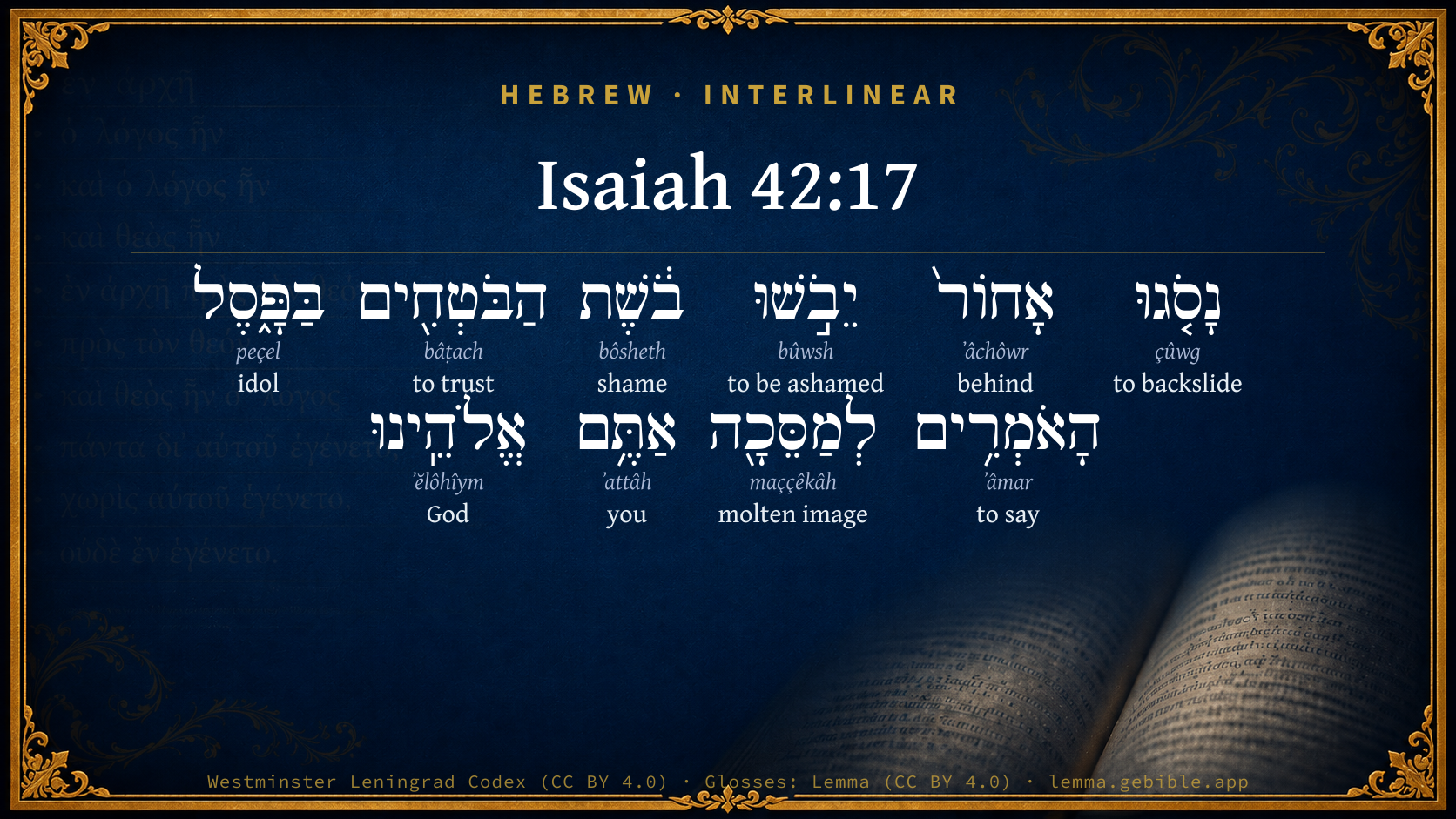
  1. אָחוֹר֙ ʼâchôwr H268 “behind” Noun, Common, Masculine, Singular, Absolute
  2. יֵבֹ֣שׁוּ bûwsh H954 “to be ashamed” Verb, Qal, Imperfect, 3rd Person, Masculine, Plural
  3. בֹ֔שֶׁת bôsheth H1322 “shame” Noun, Common, Feminine, Singular, Absolute
  4. הַבֹּטְחִ֖ים bâṭach H982 “the · trusting” Particle, Definite Article + Verb, Qal, Participle Active, Masculine, Plural, Absolute
  5. בַּפָּ֑סֶל peçel H6459 “in/at the · idol” Preposition, Determined + Noun, Common, Masculine, Singular, Absolute
  6. הָאֹמְרִ֥ים ʼâmar H559 “the · saying” Particle, Definite Article + Verb, Qal, Participle Active, Masculine, Plural, Absolute
  7. לְמַסֵּכָ֖ה maççêkâh H4541 “to/for · molten image” Preposition + Noun, Common, Feminine, Singular, Absolute
  8. אַתֶּ֥ם ʼattâh H859 “you” Pronoun, Personal, 2nd Person, Masculine, Plural
  9. אֱלֹהֵֽינוּ ʼĕlôhîym H430 “God(s) · our” Noun, Common, Masculine, Plural, Construct + Suffix, Personal, 1st Person, Common, Plural

About this verse

These counts appear in no published source. They are computed here, from the morphology-tagged text and Lemma’s own curated glosses. What Lemma adds →

10
words
10
distinct lemmas
Prophets
section

Notable vocabulary

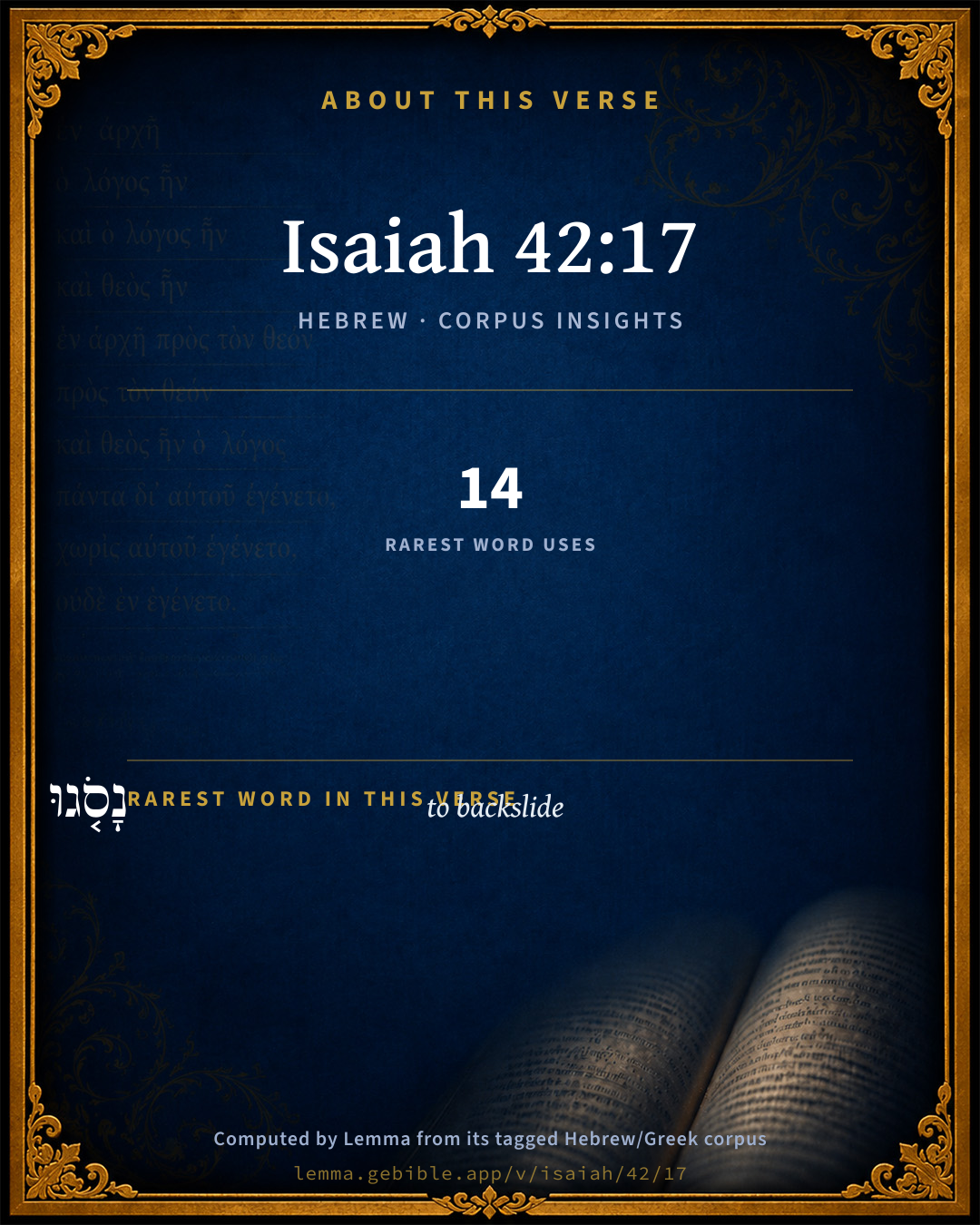
The rarest word here is נָסֹ֤גוּ to backslide H5472 — appearing just 14 times in the whole Hebrew Bible.

Shared distinctive vocabulary

נָסֹ֤גוּ to backslide H5472 occurs in 14 verses of the Hebrew Bible. Also found in:

Grammatical profile

  • 4 verbs
  • 5 nouns
  • 1 pronoun

Verb forms

  • נָסֹ֤גוּ Niphal · Perfect
  • יֵבֹ֣שׁוּ Qal · Imperfect
  • הַבֹּטְחִ֖ים Qal · Participle Active
  • הָאֹמְרִ֥ים Qal · Participle Active

Hebrew & Septuagint length

In English translation the verse runs 23 words from the Hebrew and 24 from the Septuagint (LXX English) — closely comparable.

A rough comparison of the two English renderings, which tokenize alike — not a word-level alignment.

Word counts can differ between the Hebrew and the Greek without any difference in meaning — e.g. the Hebrew direct-object marker אֵת has no separate Greek word, and Greek often adds the article ὁ.

Cross-references

9

Topical passages linked to Isaiah 42:17 in the Treasury of Scripture Knowledge — connected by theme and wording, ordered by reader-vote popularity; previews shown in the World English Bible.

  • Psalms 97:7 Let all them be shamed who serve engraved images, Who boast in their idols. Worship him, all you gods!
  • Isaiah 1:29 For they shall be ashamed of the oaks which you have desired, And you shall be confounded for the gardens that you have chosen.
  • Isaiah 44:11 Behold, all his fellows shall be disappointed; and the workmen, they are of men: let them all be gathered together, let them stand up; they shall fear, they shall be put to shame together.
  • Isaiah 45:16–17 They shall be disappointed, yes, confounded, all of them; they shall go into confusion together who are makers of idols.
  • Exodus 32:4 He received what they handed him, and fashioned it with an engraving tool, and made it a molten calf; and they said, "These are your gods, Israel, which brought you up out of the land of Egypt."
  • Exodus 32:8 They have turned aside quickly out of the way which I commanded them. They have made themselves a molten calf, and have worshiped it, and have sacrificed to it, and said, 'These are your gods, Israel, which brought you up out of the land of Egypt.'"
  • Isaiah 44:17 The residue of it he makes a god, even his engraved image; he falls down to it and worships, and prays to it, and says, Deliver me; for you are my god.
  • Jeremiah 2:26–27 As the thief is ashamed when he is found, so is the house of Israel ashamed; they, their kings, their princes, and their priests, and their prophets;
  • Habakkuk 2:18–20 "What value does the engraved image have, that its maker has engraved it; the molten image, even the teacher of lies, that he who fashions its form trusts in it, to make mute idols?

Cross-references courtesy of OpenBible.info (CC BY 4.0).

Hebrew and Greek witnesses Masoretic Hebrew ↔ Greek Septuagint

The same verse in the two great witnesses to the Old Testament, shown verse-for-verse.

These are two independent witnesses, not word-aligned to each other, and the Septuagint is shown in lemma (dictionary) form.

Hebrew Isaiah 42:17 Masoretic · Westminster Leningrad Codex

נָסֹ֤גוּ אָחוֹר֙ יֵבֹ֣שׁוּ בֹ֔שֶׁת הַבֹּטְחִ֖ים בַּפָּ֑סֶל הָאֹמְרִ֥ים לְמַסֵּכָ֖ה אַתֶּ֥ם אֱלֹהֵֽינוּ

They shall be turned back, they shall be utterly disappointed, who trust in engraved images, who tell molten images, You are our gods.

World English Bible · Public Domain

Greek LXX Isaiah 42:17 Septuagint · lemma form

αὐτός δέ ἀποστρέφω εἰς ὁ ὀπίσω αἰσχύνω αἰσχύνη ὁ πείθω ἐπί ὁ γλυπτός ὁ λέγω ὁ χωνευτός σύ εἰμί θεός ἐγώ

But they are turned back: be you⌃ utterly ashamed that trust in graven images, who say to the molten images, You⌃ are our gods.

LXX2012 (modern English Septuagint) · Public Domain

Hebrew: Westminster Leningrad Codex (CC BY 4.0). Greek: Septuagint (public domain); English from LXX2012 (modern English Septuagint) (Public Domain). How the Septuagint differs from the Hebrew →

Targum (Aramaic paraphrase)

1

The Targum is the ancient Jewish Aramaic paraphrase of the Hebrew Scriptures — an interpretive translation, not the Hebrew text itself. Onkelos (literal) and Pseudo-Jonathan (expansive) render the Torah, and Jonathan the Prophets. Coverage is partial: where no permissively-licensed English translation exists for a verse, only the Aramaic is shown. This is verse-level text, not a word-by-word alignment to the Hebrew.

  1. Targum Jonathan Prophets (Joshua–Malachi)
    יִסְתַּחֲרוּן לַאֲחוֹרָא יִבַּהֲתוּן בַּהֲתָא פַלְחֵי צַלְמַיָא דְאָמְרִין לִצְלַם מַתְּכָא אַתּוּן טַעֲוָתָנָא:

    They shall be turned back, they shall be ashamed, that worship images, that say to the molten images, Ye are our gods.

    Targum Jonathan — Aramaic: “Mikraot Gedolot” (public domain). English: “Sefaria Community Translation” (CC0 1.0 (public-domain dedication)); “London "Chaldee Paraphrase," 1871” (public domain). Text via Sefaria.

Commentary

Notes on Isaiah 42:17 from classic Christian and Jewish commentators (each source and its license shown beneath its notes). The classic Christian expositions comment on the surrounding passage and are grouped to its opening verse, so a note may address several verses; the Jewish commentaries on the Tanakh (Rashi and others) are per-verse, so they appear only where the commentator wrote on this verse.

Lemma curates 59 commentaries, every one of them public domain or Creative Commons licensed, each selected and text-cleaned for this edition rather than reprinted as found. About our sources →

Trapp's Complete Commentary

John Trapp

Isa 42:17 They shall be turned back, they shall be greatly ashamed, that trust in graven images, that say to the molten images, Ye [are] our gods.

Ver. 17. They shall be greatly ashamed.] Heb., Be ashamed with shame; because disappointed and defeated, as the Papists oft have been when they have fought against Protestants, in that Bellum Hussiticum in Germany especially; and yet Bellarmine hath the face to say that the Catholics were never yet worsted by the heretics, as they call us, in a set battle.

John Trapp, A Commentary or Exposition upon All the Books of the Old and New Testament (1647–1656) — public domain. Text from a community e-Sword module.

Whedon's Commentary on the Bible

Daniel D. Whedon

17. They shall be turned back — It is true, many of the heathen will remain blind, but those who are “turned back” to the truth as originally given to all shall be greatly ashamed; or, ashamed with shame; that is, utterly mortified at their stupidity in ever having worshipped idols.

Sec. 3. GOD’S CONTROVERSY WITH ISRAEL, Isa_42:17 to Isa_44:5.

The controversy with heathendom closed. Its period is from Abraham’s call ideally to the last triumph of Messiah. The message is now again to Israel. It began in Isa_1:2, and has been scatteringly resumed ever since.

Daniel D. Whedon (gen. ed.), Commentary on the Old and New Testaments (1874–1909) — public domain. Text from a community e-Sword module.

Jamieson, Fausset & Brown

Robert Jamieson, A. R. Fausset & David Brown

turned back . . . ashamed--disappointed in their trust; the same phrase occurs in Psa 35:4.

Jamieson, Fausset & Brown — Commentary Critical and Explanatory on the Whole Bible (1871) — public domain (CC PDM 1.0). Text via the HelloAO Bible API.

Ellicott's Commentary for English Readers

(17) They shall be greatly ashamed . . .—Manifestly the winding up of a section. The foretold victories of Cyrus shall bring shame and confusion on the worshippers of the idols which he, the representative of a purer faith, should overthrow.

A Bible Commentary for English Readers, edited by Charles John Ellicott (1878–1897) — public domain. Text from a community e-Sword module.

The Cambridge Bible for Schools and Colleges

gen. ed. J. J. S. Perowne

17. The confusion of the idolaters, through the “revelation of the glory of God” (ch. Isa_40:5), the Babylonians being those specially referred to (cf. ch. Isa_46:1); they shall be utterly ashamed (as ch. Isa_41:11).

The Cambridge Bible for Schools and Colleges (gen. ed. J. J. S. Perowne; Cambridge University Press, 1878–1918) — public domain. Text from a community e-Sword module.

John Gill's Exposition

They shall be turned back,.... Either from their former course, from their idolatry and their idols, and be converted, and turn to the living God; or it may be understood of such Gentiles as were not converted, when others were, who should be put to flight, and should fly to the rocks and mountains to hide and cover them from the wrath of God; for this phrase is used of the overthrow of enemies, of their being obliged to turn their backs and flee:

they shall be greatly ashamed that trust in graven images; as converted persons when they come to be convinced of the folly of their idolatrous practices are; and if not converted, yet are confounded when they find their idols cannot help and assist them, nor deliver them out of their trouble:

that say to the molten images, ye are our gods; as the Israelites did to the molten calf made by Aaron; and the stupidity of the one and the other is much alike; this of the Gentiles, and that of the Israelites.

John Gill's Exposition of the Whole Bible (1746–1763) — public domain (CC PDM 1.0). Text via the HelloAO Bible API.

Albert Barnes' Notes on the Bible

They shall be turned back - The phrases, to be turned back, and to be suffused with shame, are frequently used in the Scriptures to denote a state of disappointment in regard to an object of trust or confidence, and especially of those who had trusted in idols (see Psa 35:4; Psa 70:3; Psa 97:7; compare the notes at Isa 1:29; Isa 19:9; Isa 37:27; see also Eze 16:52). The sense here is, that they should find no such protection in their idol-gods as they had hoped, and that they should be covered with conscious guilt forever, having trusted in them and given to them the homage which was due to the true God.

Albert Barnes' Notes on the Bible (1834–1885) — public domain. Text from a community e-Sword/MySword module.

Matthew Poole's English Annotations

This may be understood either,

1. Of the converted Gentiles; who shall be turned back from their former sinful course, and shall sincerely grieve, and be ashamed that they did trust, &c., as the word may be rendered; that they should ever be guilty of such wickedness and madness to worship and trust in idols. Or rather,

2. Of those Gentiles who, when their brethren embraced the true God and Christ, persisted obstinately in their idolatrous courses, who shall be confounded and destroyed; for this phrase of being turned back is generally used in Scripture in a bad sense; or of them who are overthrown, or put to flight in battle, as Psa 9:3; 35:4; 70:2,3, &c. And the like I may say of being ashamed, or confounded, or put to shame, especially where this phrase is joined with the other, as it is in the two places of the Psalms last quoted.

Matthew Poole's English Annotations on the Holy Bible (1683–1685) — public domain. Text from a community e-Sword/MySword module.

The Pulpit Commentary

They shall be turned back, etc. While the people of God are led by God"s hand through new paths, and are illumined with abundant light, and have their difficulties smoothed away from before them. their idolatrous oppressors will be "turned back" or suffer defeat, and be put to shame, finding no help from their idols, whose powerlessness will be openly shown, to the utter confusion of their votaries.

The Pulpit Commentary (1880–1919), ed. H.D.M. Spence-Jones & Joseph S. Exell — public domain. Text from a community e-Sword module.

Keil & Delitzsch

C. F. Keil & F. Delitzsch

In connection with this, the following v. declares what effect this double manifestation will produce among the heathen. "They fall back, are put deeply to shame, that trust in molten images, that say to the molten image, Thou art our God." Bōsheth takes the place of an inf. intens.; cf., Hab 3:9. Jehovah's glorious acts of judgment and salvation unmask the false gods, to the utter confusion of their worshippers. And whilst in this way the false religions fall, the redemption of Israel becomes at the same time the redemption of the heathen. The first half of this third prophecy is here brought to a close.

Keil & Delitzsch — Biblical Commentary on the Old Testament (1861–1891) — public domain (CC PDM 1.0). Text via the HelloAO Bible API. (Old Testament only.)

J. A. Alexander on Isaiah

Joseph Addison Alexander

“They are turned back, they shall be ashamed with shame (i.e., utterly ashamed), those trusting in the graven image, those saying to the molten image, Ye are our gods.” This verse describes the effect to be produced by the expected changes on the enemies of God and the worshippers of idols. They are turned back, utterly defeated, foiled in their malignant opposition. Nor is this all; for they are yet to be utterly ashamed, confounded, disappointed, and disgraced. In the last clause it is plain that the graven and molten image are separated only by the parallelism, because the address at the end is in the plural form, not ‘thou art’, but ‘ye are our gods’.

Joseph Addison Alexander, The Prophecies of Isaiah (1846–1847; New York: Scribner, 1870–1878) — public domain. Text from a community e-Sword module.

unfoldingWord translationNotes

Door43 World Missions Community

General Information:

Yahweh continues speaking.

They will be turned back, they will be completely put to shame

Rejecting those who worship idols is spoken of as if it is forcing them to turn back and move the opposite direction. This can be stated in active form. AT: "I will reject them and put them to shame" (See: Metaphor and Active or Passive)

translationWords

turn

shame

trust

image

unfoldingWord translationNotes — © Distant Shores Media and the Door43 World Missions Community, licensed CC BY-SA 4.0. Source: git.door43.org/Door43/en_tn.

Ibn Ezra

Rabbi Abraham ibn Ezra

They shall be turned back, etc., for I have the power to do as I like, not so the idols.

מסכה Molten images. The plural פסלי images must be supplied from the preceding phrase, because of the pronoun אַתֶּם ye which follows.

Ibn Ezra on the Tanakh — English translations: “Sefaria Community Translation” (CC0 1.0 (public-domain dedication)); “Yalkut, Sifsei Chachomim Chumash, Metsudah Publications, 2009” (CC BY 4.0); and “Commentary of Ibn Ezra on Isaiah - trans. by M. Friedlander, 1873” (public domain). Text via Sefaria.

Lesson kit

Teaching starters — assembled from the data on this page, not authored interpretation. Every prompt links to the verse data it draws on. Edit before teaching.

Isaiah, in the Prophets, opens this verse with 10 words (10 distinct Hebrew lemmas). Its most distinctive word is çûwg (“to backslide”). A historical commentator’s framing appears above. Read the whole chapter for the surrounding context.

Discussion questions

  1. What does “to backslide” (çûwg) contribute to the verse as a whole?
  2. How does Psalms 35:4, which shares the word «to backslide», read alongside this verse?
  3. The translations on this page render this verse differently — a whole-verse word diff, not a word-by-word alignment. What might account for the different wordings?
  4. «נָסֹ֤גוּ» is a Niphal Perfect verb. How does that grammatical form shape the action described?
  5. Compare how Trapp's Complete Commentary and Whedon's Commentary on the Bible read this verse. Where do they agree or differ?

Things to notice

Reading settings

Reading text

Shown beneath each verse's original-language words.

Old Testament
Old Testament edition

Read the OT as the Masoretic Hebrew (MT) or the Greek Septuagint (LXX).

English shown for the Greek Septuagint (in the Hebrew ↔ Greek comparison).

Comparing translations? Open the Compare panel on any verse page to stack up to four side by side.