
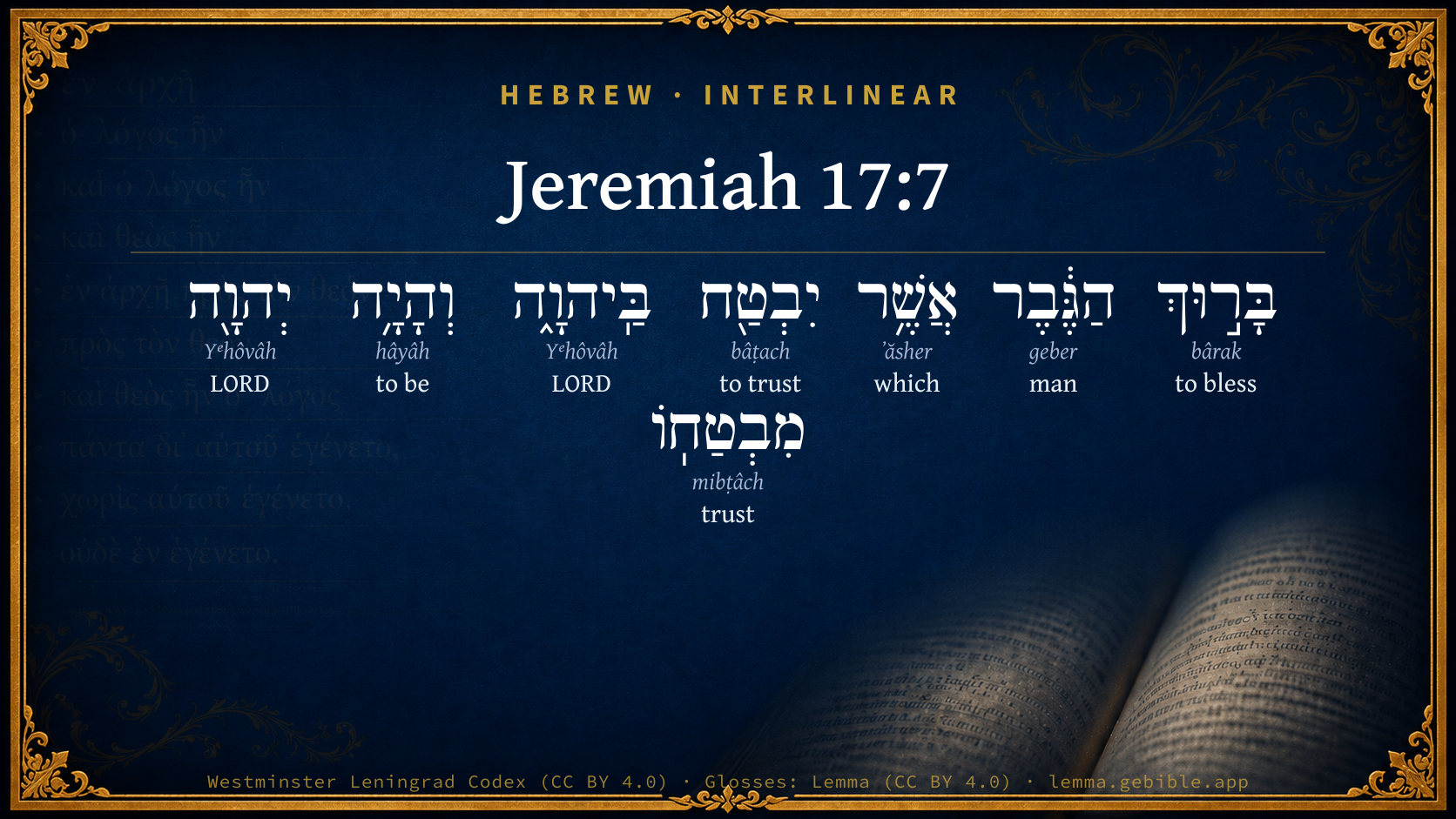
Jeremiah 17:7

Hebrew (Westminster Leningrad Codex) Jeremiah 17:7 appears in the Hebrew Old Testament. The text above is from the Westminster Leningrad Codex. Each word links to its Strong’s number, a concise gloss, and parsing drawn from the Open Scriptures Hebrew Bible morphology. Click any word for its full Brown-Driver-Briggs (BDB) entry.
Download image
Cite this verse

Jeremiah 17:7 (World English Bible). Public Domain. Lemma interlinear Bible study tool, https://lemma.gebible.app/v/jeremiah/17/7.

Show BibTeX & RIS
BibTeX
RIS
English Translation
Blessed is the man who trusts in Yahweh, and whose trust Yahweh is.
World English Bible · Public Domain
Download a study sheet

One document with this verse’s original text, its word-by-word gloss line, the meaning frame, cross-references with their text, attributed commentary, and full source and license credits — printable, and it pastes into notes with its structure intact.

This verse Autodidact and up

Study sheet (.html) Plain text (.txt)

A passage Seminary Student

Up to 50 verses in one chapter. A passage sheet keeps up to 6 commentary sources and 12 cross-references per verse, in the order this page ranks them, and says so on the sheet whenever that leaves anything out. Ask for a single verse and you get the Autodidact verse sheet above.

Everything on this page stays free to read, with no account — the sheet is a download of what is already on screen, not access to it.

Want to remove ads? Support Godless Engineer
Compare translations 3

The same verse in 3 English versions, stacked beneath the original-language interlinear above. Click any original word for its lexicon entry.

Each is an independent rendering of the whole verse — the interlinear is not word-aligned to these translations.

Highlighted words mark where these versions differ — a whole-verse word diff, not a word-by-word alignment.

  • World English Bible Public Domain
    Blessed is the man who trusts in Yahweh, and whose trust Yahweh is.
  • King James Version Public Domain
    Blessed is the man that trusteth in the LORD, and whose hope the LORD is.
  • unfoldingWord Literal Text CC BY-SA 4.0
    Blessed is the man who trusts in Yahweh, and his confidence is Yahweh.

unfoldingWord Literal Text — © unfoldingWord, licensed CC BY-SA 4.0. Word-aligned USFM3 via Door43 (git.door43.org/unfoldingWord/en_ult).

Versions to compare (up to 4)

3 of 4 selected

Show all 18 translations

Every available English version of this verse, each an independent rendering of the whole verse.

  • World English Bible Public Domain
    Blessed is the man who trusts in Yahweh, and whose trust Yahweh is.
  • Berean Standard Bible Public Domain
    But blessed is the man who trusts in the LORD, whose confidence is in Him.
  • Majority Standard Bible Public Domain
    But blessed is the man who trusts in the LORD, whose confidence is in Him.
  • King James Version Public Domain
    Blessed is the man that trusteth in the LORD, and whose hope the LORD is.
  • American Standard Version (1901) Public Domain
    Blessed is the man that trusteth in Jehovah, and whose trust Jehovah is.
  • Revised Version (1885) Public Domain
    Blessed is the man that trusteth in the LORD, and whose hope the LORD is.
  • Geneva Bible (1599) Public Domain
    Blessed be the man, that trusteth in ye Lord, and whose hope the Lord is.
  • Douay-Rheims (1899) Public Domain
    Blessed be the man that trusteth in the Lord, and the Lord shall be his confidence.
  • Young's Literal Translation Public Domain
    Blessed `is' the man who trusteth in Jehovah, And whose confidence hath been Jehovah.
  • Literal Standard Version CC BY-SA 4.0
    Blessed [is] the man who trusts in YHWH, || And whose confidence has been YHWH.
  • Unlocked Literal Bible CC BY-SA 4.0
    But the person who trusts in Yahweh is blessed, for Yahweh is his reason for confidence.
  • unfoldingWord Literal Text CC BY-SA 4.0
    Blessed is the man who trusts in Yahweh, and his confidence is Yahweh.
  • Darby Bible Public Domain
    Blessed is the man that confideth in Jehovah, and whose confidence Jehovah is.
  • World Messianic Bible Public Domain
    “Blessed is the man who trusts in the LORD, and whose confidence is in the LORD.
  • Webster's Bible Public Domain
    Blessed is the man that trusteth in the LORD, and whose hope the LORD is.
  • Free Bible Version CC BY-SA 4.0
    Blessed are those who trust in the Lord, who put their confidence in him.
  • Bible in Basic English Public Domain
    A blessing is on the man who puts his faith in the Lord, and whose hope the Lord is.
  • JPS Tanakh (1917) Public Domain
    Blessed is the man that trusteth in the LORD, and whose trust the LORD is.

Literal Standard Version (2020), Covenant Press — licensed CC BY-SA 4.0. Text via the HelloAO Bible API (eBible.org). Unlocked Literal Bible (unfoldingWord) — licensed CC BY-SA 4.0. Text via the HelloAO Bible API (eBible.org). unfoldingWord Literal Text — © unfoldingWord, licensed CC BY-SA 4.0. Word-aligned USFM3 via Door43 (git.door43.org/unfoldingWord/en_ult). Free Bible Version, Dr. Jonathan Gallagher — licensed CC BY-SA 4.0. Text via the HelloAO Bible API (eBible.org).

Word by word

More ways to search: Search by grammar → Find every occurrence → Compare this word →

Practice this passage: Drill this verse → Learn its vocabulary →

About this verse

These counts appear in no published source. They are computed here, from the morphology-tagged text and Lemma’s own curated glosses. What Lemma adds →

8
words
7
distinct lemmas
Prophets
section

Notable vocabulary

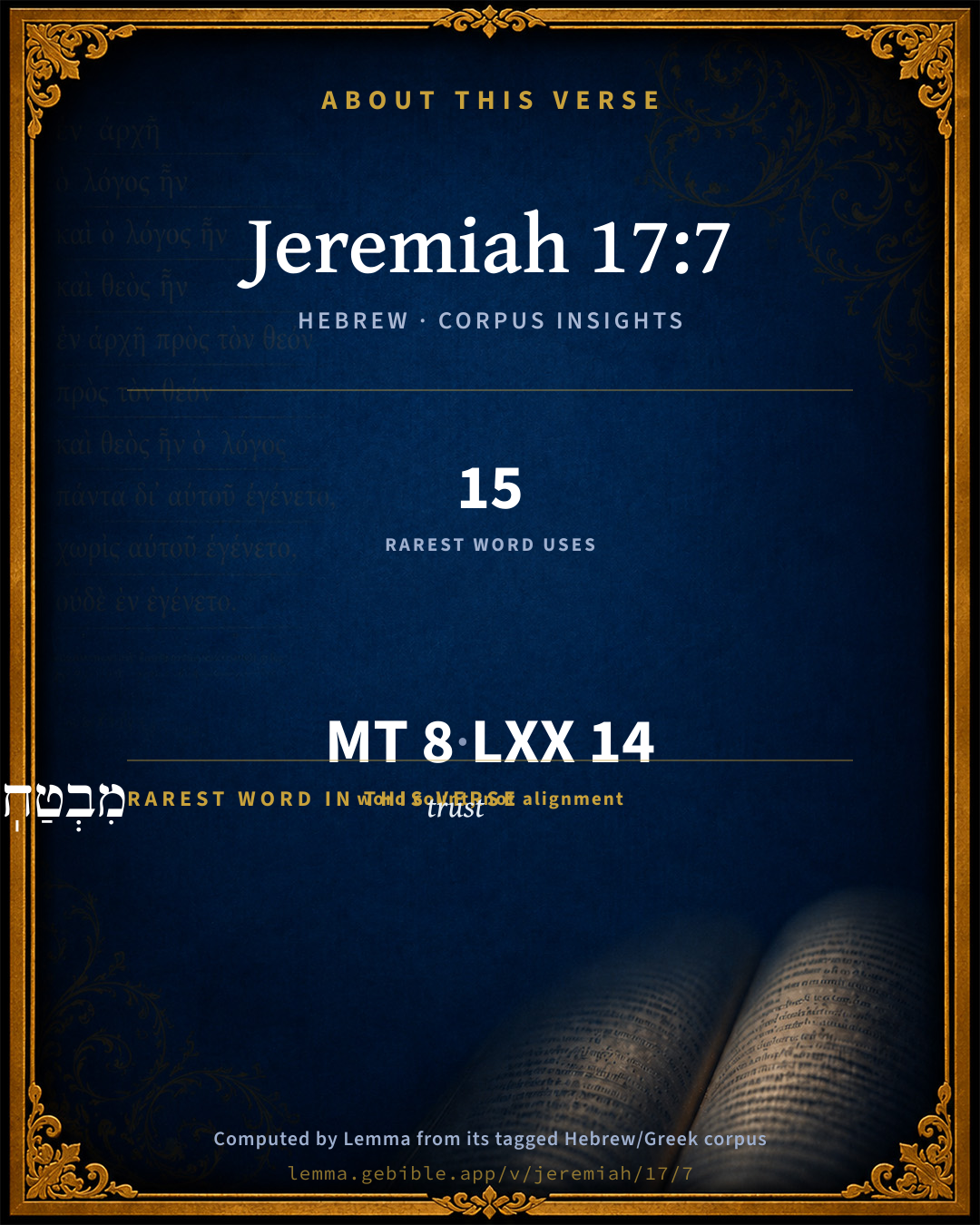
The rarest word here is מִבְטַחֽוֹ trust H4009 — appearing just 15 times in the whole Hebrew Bible.

Shared distinctive vocabulary

מִבְטַחֽוֹ trust H4009 occurs in 15 verses of the Hebrew Bible. Also found in:

Grammatical profile

  • 3 verbs
  • 4 nouns
  • 1 particle

Verb forms

  • בָּר֣וּךְ Qal · Participle Passive
  • יִבְטַ֖ח Qal · Imperfect
  • וְהָיָ֥ה Qal · Sequential Perfect

Repetition

A word recurs within this verse — often emphatic in Hebrew:

  • בַּֽיהוָ֑ה LORD H3068 ×2

Hebrew & Septuagint length

In the original languages it is 8 Hebrew tokens and 14 Greek tokens — but the two are counted differently (Hebrew bundles its prefixes and suffixes into one token; the Greek is in lemma form), so that isn’t a like-for-like length.

Cross-references

10

Topical passages linked to Jeremiah 17:7 in the Treasury of Scripture Knowledge — connected by theme and wording, ordered by reader-vote popularity; previews shown in the World English Bible.

  • Isaiah 26:3–4 You will keep [him] in perfect peace, [whose] mind [is] stayed [on you]; because he trusts in you.
  • Psalms 34:8 Oh taste and see that Yahweh is good. Blessed is the man who takes refuge in him.
  • Psalms 40:4 Blessed is the man who makes Yahweh his trust, And doesn't respect the proud, nor such as turn aside to lies.
  • Psalms 125:1 Those who trust in Yahweh are as Mount Zion, Which can't be moved, but remains forever.
  • Isaiah 30:18 Therefore will Yahweh wait, that he may be gracious to you; and therefore will he be exalted, that he may have mercy on you: for Yahweh is a God of justice; blessed are all those who wait for him.
  • Psalms 84:12 Yahweh of Hosts, Blessed is the man who trusts in you.
  • Proverbs 16:20 He who heeds the Word finds prosperity. Whoever trusts in Yahweh is blessed.
  • Psalms 146:5 Happy is he who has the God of Jacob for his help, Whose hope is in Yahweh, his God:
  • Psalms 2:12 Kiss the son, lest he be angry, and you perish in the way, For his wrath will soon be kindled. Blessed are all those who take refuge in him.
  • Ephesians 1:12 to the end that we should be to the praise of his glory, we who had before hoped in Christ:

Cross-references courtesy of OpenBible.info (CC BY 4.0).

Hebrew and Greek witnesses Masoretic Hebrew ↔ Greek Septuagint

The same verse in the two great witnesses to the Old Testament, shown verse-for-verse.

These are two independent witnesses, not word-aligned to each other, and the Septuagint is shown in lemma (dictionary) form.

Hebrew Jeremiah 17:7 Masoretic · Westminster Leningrad Codex

בָּר֣וּךְ הַגֶּ֔בֶר אֲשֶׁ֥ר יִבְטַ֖ח בַּֽיהוָ֑ה וְהָיָ֥ה יְהוָ֖ה מִבְטַחֽוֹ

Blessed is the man who trusts in Yahweh, and whose trust Yahweh is.

World English Bible · Public Domain

Greek LXX Structure differs

In the Septuagint, Jeremiah is about an eighth shorter than the Hebrew and arranges its material differently — the Oracles Against the Nations (Hebrew chapters 46–51) appear in the middle of the Greek book, after 25:13. Because the chapter and verse boundaries do not line up, a verse-for-verse comparison with the Hebrew is not shown.

A verse-for-verse comparison isn’t shown here because the chapters and verses don’t line up. Switch to the LXX edition with the MT / LXX toggle above to read the Greek directly.

On this verse, Joseph Benson's Commentary discusses the Septuagint’s reading. Read the note in Commentary ↓

Hebrew: Westminster Leningrad Codex (CC BY 4.0). Greek: Septuagint (public domain); English from a public-domain English Septuagint. How the Septuagint differs from the Hebrew →

Targum (Aramaic paraphrase)

1

The Targum is the ancient Jewish Aramaic paraphrase of the Hebrew Scriptures — an interpretive translation, not the Hebrew text itself. Onkelos (literal) and Pseudo-Jonathan (expansive) render the Torah, and Jonathan the Prophets. Coverage is partial: where no permissively-licensed English translation exists for a verse, only the Aramaic is shown. This is verse-level text, not a word-by-word alignment to the Hebrew.

  1. Targum Jonathan Prophets (Joshua–Malachi)
    בְּרִיךְ גַבְרָא דְאִתְרְחֵיץ בְּמֵימְרָא דַייָ וִיהֵי מֵימְרָא דַייָ רוֹחְצָנֵיהּ:

    (no public-domain English translation for this verse)

    Targum Jonathan — Aramaic: “Mikraot Gedolot” (public domain). English: “Sefaria Community Translation” (CC0 1.0 (public-domain dedication)); “London "Chaldee Paraphrase," 1871” (public domain). Text via Sefaria.

Commentary

Notes on Jeremiah 17:7 from classic Christian and Jewish commentators (each source and its license shown beneath its notes). The classic Christian expositions comment on the surrounding passage and are grouped to its opening verse, so a note may address several verses; the Jewish commentaries on the Tanakh (Rashi and others) are per-verse, so they appear only where the commentator wrote on this verse.

Lemma curates 59 commentaries, every one of them public domain or Creative Commons licensed, each selected and text-cleaned for this edition rather than reprinted as found. About our sources →

Trapp's Complete Commentary

John Trapp

Jer 17:7 Blessed [is] the man that trusteth in the LORD, and whose hope the LORD is.

Ver. 7. Blessed is the man that trusteth in the Lord.] See on Jer 17:5 Psa 25:12; Psa 32:10; Psa 34:8; Psa 84:12; Psa 125:1; Psa 146:5, where David. having entered a caveat against creature confidence, persuadeth people, by trusting in God alone, to provide for their own safety and happiness. See Nah 1:7. Such shall have marvellous lovingkindness from God, {Psa 17:7} above all that can be uttered (Psa 31:19; see Pro 28:25).

John Trapp, A Commentary or Exposition upon All the Books of the Old and New Testament (1647–1656) — public domain. Text from a community e-Sword module.

Joseph Benson's Commentary

Jer 17:7-8. Blessed is the man that trusteth in the Lord — That lives in continual obedience to him, and relies entirely upon him for every blessing he wants for his body or soul, for himself or others who, under God, are dependant upon him; and whose hope the Lord is — Who makes the Lord’s favour the good he hopes for, and his power the strength he hopes in. Trusting aright in the Lord necessarily implies walking closely with him, and not departing from him in heart. For it is naturally impossible that any one should repose confidence in another for any thing which had been promised under a condition, without a consciousness in himself that he had, at least in some good measure, complied with the condition upon which it was promised. For he shall be like a tree planted, &c. — He shall be prosperous and successful in his counsels and undertakings. He may be compared to a tree planted in a fertile soil, on the bank of a river, to which it extends its roots, and from which it derives abundance of sap and nourishment. And shall not see when heat cometh — Ου φοβηθησετα οταν ελθη καυμα, say the LXX., shall not fear when heat cometh. They follow the reading of the Hebrew text, which is to be preferred before that of the margin. And shall not be careful in the year of drought — Shall not be solicitous for fear it should lack moisture; that is, in a time when the leaves of trees standing on dry mountainous places are parched and withered, it shall retain its verdure, and continue to yield its fruit. Blaney translates the clause, “And it is not sensible when heat cometh; but its leaf is green, and in a year of drought it is without concern; nor doth it decline bearing fruit.”

Joseph Benson's Commentary on the Old and New Testaments (1811–1818) — public domain. Text from a community e-Sword module.

Tyndale Open Study Notes

Tyndale Open Resources

17:7-8 Those who trust in the Lord, like trees planted along a riverbank, will have abundant resources and be well prepared to meet the vicissitudes of life. • Water represents the law of the Lord (cp. Ps 1; Ezek 47:1-12; Rev 2:1-2).

Tyndale Open Study Notes — © Tyndale Open Resources, licensed CC BY-SA 4.0. Text via the HelloAO Bible API.

Jamieson, Fausset & Brown

Robert Jamieson, A. R. Fausset & David Brown

(Psa 34:8; Pro 16:20; Isa 30:18). Jeremiah first removed the weeds (false trusts), so that there might be room for the good grain [CALVIN].

Jamieson, Fausset & Brown — Commentary Critical and Explanatory on the Whole Bible (1871) — public domain (CC PDM 1.0). Text via the HelloAO Bible API.

John Calvin's Commentaries

Observed ought to be the order which the Prophet keeps; for he could not have profitably spoken of this second part had he not first taken away that false confidence to which the Jews had long cleaved; for when any one casts seed on an uncultivated soil, what fruit can there be to his labor? As then it is necessary to make use of the plough before the seed is sown, so also, when we seek to teach profitably, it is necessary to pull up the vices which have their roots in the hearts of men; and this especially must be the case when we treat of faith in God alone, and of sincere calling on his name. And the Prophet had a particular reason for what he did, because the Jews had long hardened themselves in false confidences, so that they disregarded God in two respects, — they despised his threatenings, and also made no account of his gracious promises. The Prophet then couht have effected nothing had he not pursued this method, — that is, to correct the evil by which they had been long tainted; for noxious weeds must be first taken away before there can be any room for the corn to grow.

But had he spoken only negatively, that is, had he only condemned their false confidence, it would not have been sufficient. The Jews indeed might have said, that they had been deceived in placing their hopes in the Egyptians; but this might have happened through some bad men: and by looking for aid elsewhere, when disappointed, they would indeed have condemned their own counsels, but would yet have remained in suspense and anxious, without seeking God. Hence we see how suitably the Prophet began by condemning the Jews for placing confidence in men, and then how wisely he added this second part; for, as I have said, it was not enough to speak as it were negatively, without inviting them to return to God. But this is often the case in the present day; for we see that many laugh at those superstitions which have hitherto prevailed under the Papacy; but yet no religion appears in them. It is enough for them to ridicule these mummeries; but it would have been better for them to be retained in the fear of God, even by some superstition, than thus to expose evil, and yet to have no reverence for God. It is the same absurdity as to pull down a bad house and to leave man under the open air; for what end can such a thing be done? for he who is compelled to leave his house had something to cover him for a time. Hence it is not sufficient to destroy what is bad, except a good building succeeds.

This is the method and order which the Prophet observed: After having said, that all they are accursed who confide in men, he now adds, Blessed is the man who trusts in Jehovah; as though he had said, that men are wholly inexcusable in relying on themselves or on others, when God willingly offers himself to them. What then in it that prevents men from having their safety secured? Their own sin in rejecting the grace of God, which is freely offered to them; but they prefer to deceive themselves, and to ascribe to themselves and to others what justly belongs to God alone.

We see then that the ingratitude of the whole world is here condemned by the Prophet when he says, that all who trust in Jehovah are blessed: for had God concealed himself there would have been some covering for ignorance; and also a defense of this kind might have been made, — “What else could we do? We sought the aid which was within our reach: had God called us to himself or allowed us to come to him, we would have been very willing; but as he has forsaken us, it was indeed the last refuge of despair to consider what was to be done, and to seek from every quarter aids for ourselves.” Hence the Prophet here shews that all such defences were frivolous, for God had freely invited them to himself; for to no purpose would he have said, that they are blessed who trust in Jehovah, had not God set himself forth as their confidence.

But we must notice what farther confirms this sentence, which is in itself very clear, And whose confidence Jehovah is. No additional light seems to be given to the preceding truth; and then what ambiguity does it contain which requires an explanation? Blessed is the man who trusts in Jehovah; even children can understand this: the words, then, of the Prophet are either superfluous, or there is some reason why he repeats what is so clear. Doubtless the unbelief, which every one of us finds in himself, is the best teacher; for even they who seem to have real confidence in God, yet falter when some trial assails them. Since then it is a common thing with us to look around to various quarters when any danger is near, we may hence, easily know that we do not hope in God. What then seems to us so easy, we find in reality to be very difficult: and hence the Prophet, after having said, that they are blessed who trust in God, has mentioned this in the second place, And whose hope is God; as though he had said, “The world knows not what it is to trust in God: though every one boldly testifies this, and even boastingly declares that he trusts in God, yet not one in a thousand finds that he understands this, or has ever known what it is from the heart to hope in God.” We now see that this repetition is not superfluous or unmeaning.

John Calvin's Commentaries (1540-1563) — public domain. Text from the Calvin Translation Society English edition (1840s-50s) via the Christian Classics Ethereal Library (ccel.org). Calvin's coverage is partial (roughly two-thirds of the Bible); uncommented books and verses are honest gaps, never fabricated. The 19th-century editor's footnotes and remarks are omitted so the notes are faithfully Calvin's own voice.

Ellicott's Commentary for English Readers

(7) Blessed is the man . . .—The words that follow in Jer_17:8 are almost a paraphrase of Psa_1:3. and, we may well believe, were suggested by them. The prophet has, as it were, his own Ebal and Gerizim: trust in God inheriting the blessing, and distrust the curse.

A Bible Commentary for English Readers, edited by Charles John Ellicott (1878–1897) — public domain. Text from a community e-Sword module.

The Cambridge Bible for Schools and Colleges

gen. ed. J. J. S. Perowne

7. hope] lit. as mg. trust.

The Cambridge Bible for Schools and Colleges (gen. ed. J. J. S. Perowne; Cambridge University Press, 1878–1918) — public domain. Text from a community e-Sword module.

John Gill's Exposition

Blessed is the man that trusteth in the Lord,.... In the Word of the Lord, as the Targum, in Christ the essential Word of God; see Psa 2:12 who have a spiritual knowledge of him, and so trust in him, Psa 9:10 who have seen the vanity and emptiness of all other objects of trust, there being no salvation in them, only in him; who betake themselves to him as their only refuge; lay hold, rest, and rely upon him, as their Saviour; commit their all unto him; trust him with all their concerns, respecting life and salvation, and with their immortal souls; and expect all from him, grace here, and glory hereafter: who trust in his person for their acceptance with God; in his righteousness for their justification; in his blood for the pardon of their sins; in his fulness for the supply of their wants; in his power for protection and preservation; and in all for eternal life and happiness: and such are blessed persons; for they are in the utmost safety; they are as Mount Zion, which can never be removed; they shall want no good thing, temporal or spiritual, proper for them; they enjoy great peace now, and in the world to come everlasting glory:

and whose hope the Lord is; the Word of the Lord, according to the Targum, as before: Christ, who is the Hope of Israel, our hope, and Christ in us the hope of glory, Jer 14:8, whose hope is from the Lord, of which he is the author and giver; and is a good hope, through his grace; and which has the Lord Jesus Christ for its object; who turn in to him as prisoners of hope; and lay hold on him, the hope set before them; and do hope in him for pardoning mercy, salvation, and eternal life. Blessed men! their hope shall not make them ashamed; they shall not be disappointed, Psa 146:5.

John Gill's Exposition of the Whole Bible (1746–1763) — public domain (CC PDM 1.0). Text via the HelloAO Bible API.

Matthew Poole's English Annotations

Trusting in the Lord necessarily implieth also a walking close with him, and not in heart departing from him; for it is naturally impossible that any should repose a confidence in another for any good things, which that other hath promised under any condition, without some satisfaction in himself that he hath in some measure fulfilled the condition upon which the promise is made. But that man that truly trusteth and hopeth in the Lord is and shall be a blessed man.

Matthew Poole's English Annotations on the Holy Bible (1683–1685) — public domain. Text from a community e-Sword/MySword module.

Whedon's Commentary on the Bible

Daniel D. Whedon

7, 8. Blessed… trusteth — The blessedness of trusting in God heightens by contrast the curse of trusting in man. Mark the particulars of this contrast. One is a solitary, worthless shrub; the other a tree. One is in the desert; the other by the watercourses. One shall not see when good cometh; the other shall not see when heat cometh. One inhabits parched, barren, uninhabitated places; the other has a leaf always green, is unaffected by the year of drought, and does not leave off fruitbearing.

Shall not see — Rather, fear. “See” comes from the marginal reading of the Masoretes, is opposed to the leading ancient Versions, and has nothing to commend it.

By the waters — Literally, watercourses. The reference may be to natural or to artificial channels.

Daniel D. Whedon (gen. ed.), Commentary on the Old and New Testaments (1874–1909) — public domain. Text from a community e-Sword module.

The Pulpit Commentary

Vers. 7, 8. The blessing on the man who trusts in Jehovah.

I MAN"S CLAIM TO BE RECKONED AS STRONG NEED NOT BE AN EMPTY ONE. He deserves the appellation of rbG if only he will set the right way to obtain it. Weak as he appears from the point of view given, when his natural resources are fully opened up and tested, he may nevertheless become strong by the favor of Jehovah to perform the most extraordinary achievements. From one extreme where the strength of the godless is found to be but a mockery, we are taken all the way to another extreme, illustrated by the confident assertion of the apostle that he could do all things through Christ who gave him inward strength. We are every one of us meant to be strong with a strength which can meet the severest tests; and those who are the weakest in other respects often prove the strongest in spiritual life with what it requires both of activity and endurance. And it is of particular importance to be observed that the man weak of will, easily yielding to temptation, bound these many years by the chain of some dehumanizing habit, can be made strong enough to overcome his enemies and trample them under his feet. There is that in him which can be so renewed, so vivified, that he will become steadfast and energetic in attaining the Divine purpose of existence. Recollect the instance of the man who was above forty years old when his feet and ankle-bones received strength. Jesus of Nazareth did not bring this about merely for this man"s physical benefit; but chiefly that those who were inwardly lame should be stimulated to seek him, and have the feet and ankle-bones of the inward man strengthened for a holy and a truly manly service. God must needs pour contempt upon the boastings of the natural man, in order that, when he has effectually humbled him, he may then exalt him into the possession of true strength.

II THE REQUISITE FOR THE ATTAINMENT OF TRUE STRENGTH IS POINTED OUT. Pointed out clearly and simply. He is the strong man who trusts in Jehovah, and he is strong just as far as he does trust. Notice how the requirement of trust is expressed twice over, first by a verb and then by a noun, both of which have the same root-letters. It is as if we first saw the man in the active exercise of trust, and then the habitual confidence of his nature. We see the man trusting and we also see the trusting man. "All things are possible to him that believeth." When God speaks, the trustful hearer readily acts upon the strength of God meaning what he says. The statements of the gospel transcend human powers of discovery, and they can only be believed because God makes them he whose regular and beneficent ways in nature prove him to be so true. Man by faith puts himself in the hands of God, his Maker, and then he can do things far beyond what he has hitherto imagined to be practicable. Look at the sublimest illustration of this ever given upon earth; when the man Christ Jesus believingly said, "Father, into thy hands I commend my spirit." Then, in a very few hours, the strength imparted even to the dead was revealed by the resurrection of Christ.

III THE ILLUSTRATION OF HOW THE BLESSING COMES. Possibly there is here a reference to some regular practice of the foreseeing planter of trees. The necessity of planting trees near water-courses is not obvious to us, seeing that in our moist climate we often see noble umbrageous trees far enough from anything of the kind. The children of this world are wise in their generation. They bear in mind they have to bear in mind the scorching heat, the rainless, cloudless heavens, or, if clouds there be, too often waterless clouds, mocking, tantalizing beauties of the sky; and so they plant their trees where they may stretch out their thirsty roots to the passing stream. And yet these same children of this world, prudent for their trees, may yet be foolish for themselves, taking up a position in life admirable for the gaining of temporal ends, but leaving at a great distance the river that flows from "the throne of God and of the Lamb." Thus there is here a lesson from the tree which cannot choose to the man who can choose. We all have our choice of the essentials of position. There are two sets of circumstances those we cannot choose and those we are bound to choose. It is in the power of us all to be planted by the waters. God"s gifts of grace flow through fixed and well-defined channels, and to these we must go. We are not allowed to make compromises. A very little seeming difference may, in reality, make all the difference between wisdom and folly in this matter. It did not need that the tree should be planted very far away from the water, a few yards more or less might determine the result. There is also in this illustration the notion of a hidden means of supply. To outward appearance there is no connection between the tree and the river; the connection is underneath, and it is real, increasing, and constant. Y.

The Pulpit Commentary (1880–1919), ed. H.D.M. Spence-Jones & Joseph S. Exell — public domain. Text from a community e-Sword module.

unfoldingWord translationNotes

Door43 World Missions Community

he will be like a tree planted by water

The person who trusts in Yahweh will always prosper, just like a tree does when it is planted by a river. It is not affected when there is no rain. This can be stated in active form. AT: "he will be like a tree that someone has planted by water" (See: Simile and Active or Passive)

It will not fear the heat when it comes ... It is not anxious in a year of drought

Yahweh speaks of a tree that draws its water from a stream being unaffected by heat and drought as if the tree were unafraid of these things. AT: "The heat will not affect it when it comes ... No harm is caused to it in a year of drought" (See: Personification)

translationWords

bless

confidence

water

fruit

unfoldingWord translationNotes — © Distant Shores Media and the Door43 World Missions Community, licensed CC BY-SA 4.0. Source: git.door43.org/Door43/en_tn.

Lesson kit

Teaching starters — assembled from the data on this page, not authored interpretation. Every prompt links to the verse data it draws on. Edit before teaching.

Jeremiah, in the Prophets, opens this verse with 8 words (7 distinct Hebrew lemmas). Its most distinctive word is mibṭâch (“trust”). A historical commentator’s framing appears above. Read the whole chapter for the surrounding context.

Discussion questions

  1. What does “trust” (mibṭâch) contribute to the verse as a whole?
  2. Job 8:14 shares the word «trust» with this verse. How do the two illuminate each other?
  3. “LORD” occurs 2× in this one verse. What is the effect of the repetition?
  4. These translations render this verse differently; the difference is in the English rendering, not the original. What questions does that raise?
  5. The verb «בָּר֣וּךְ» is Qal Participle Passive. How does its form color the action?
  6. Reading how Trapp's Complete Commentary and Joseph Benson's Commentary read this verse, where do the two commentators agree and where do they part?

Things to notice

Reading settings

Reading text

Shown beneath each verse's original-language words.

Old Testament
Old Testament edition

Read the OT as the Masoretic Hebrew (MT) or the Greek Septuagint (LXX).

English shown for the Greek Septuagint (in the Hebrew ↔ Greek comparison).

Comparing translations? Open the Compare panel on any verse page to stack up to four side by side.