Psalms 28:7

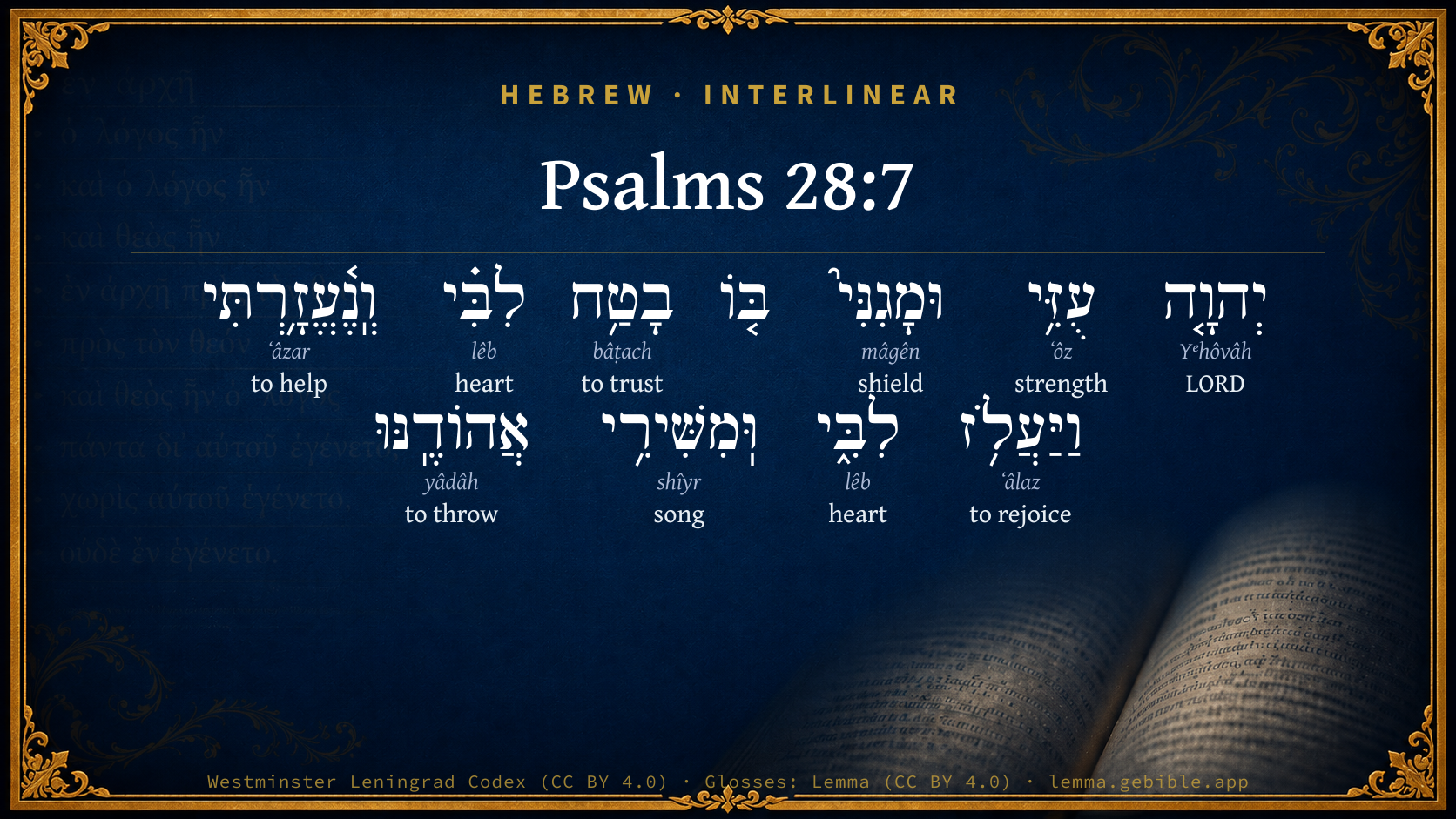
Hebrew (Westminster Leningrad Codex) Psalms 28:7 appears in the Hebrew Old Testament. The text above is from the Westminster Leningrad Codex. Each word links to its Strong’s number, a concise gloss, and parsing drawn from the Open Scriptures Hebrew Bible morphology. Click any word for its full Brown-Driver-Briggs (BDB) entry.
Download image
Cite this verse

Psalms 28:7 (World English Bible). Public Domain. Lemma interlinear Bible study tool, https://lemma.gebible.app/v/psalms/28/7.

Show BibTeX & RIS
BibTeX
RIS
English Translation
Yahweh is my strength and my shield. My heart has trusted in him, and I am helped. Therefore my heart greatly rejoices. With my song I will thank him.
World English Bible · Public Domain
Download a study sheet

One document with this verse’s original text, its word-by-word gloss line, the meaning frame, cross-references with their text, attributed commentary, and full source and license credits — printable, and it pastes into notes with its structure intact.

This verse Autodidact and up

Study sheet (.html) Plain text (.txt)

A passage Seminary Student

Up to 50 verses in one chapter. A passage sheet keeps up to 6 commentary sources and 12 cross-references per verse, in the order this page ranks them, and says so on the sheet whenever that leaves anything out. Ask for a single verse and you get the Autodidact verse sheet above.

Everything on this page stays free to read, with no account — the sheet is a download of what is already on screen, not access to it.

Want to remove ads? Support Godless Engineer
Compare translations 3

The same verse in 3 English versions, stacked beneath the original-language interlinear above. Click any original word for its lexicon entry.

Each is an independent rendering of the whole verse — the interlinear is not word-aligned to these translations.

Highlighted words mark where these versions differ — a whole-verse word diff, not a word-by-word alignment.

  • World English Bible Public Domain
    Yahweh is my strength and my shield. My heart has trusted in him, and I am helped. Therefore my heart greatly rejoices. With my song I will thank him.
  • King James Version Public Domain
    The LORD is my strength and my shield; my heart trusted in him, and I am helped: therefore my heart greatly rejoiceth; and with my song will I praise him.
  • unfoldingWord Literal Text CC BY-SA 4.0
    Yahweh is my strength and my shield; in him my heart trusts, and I am helped; therefore my heart exults, and with my song I will praise him.

unfoldingWord Literal Text — © unfoldingWord, licensed CC BY-SA 4.0. Word-aligned USFM3 via Door43 (git.door43.org/unfoldingWord/en_ult).

Versions to compare (up to 4)

3 of 4 selected

Show all 18 translations

Every available English version of this verse, each an independent rendering of the whole verse.

  • World English Bible Public Domain
    Yahweh is my strength and my shield. My heart has trusted in him, and I am helped. Therefore my heart greatly rejoices. With my song I will thank him.
  • Berean Standard Bible Public Domain
    The LORD is my strength and my shield; my heart trusts in Him, and I am helped. Therefore my heart rejoices, and I give thanks to Him with my song.
  • Majority Standard Bible Public Domain
    The LORD is my strength and my shield; my heart trusts in Him, and I am helped. Therefore my heart rejoices, and I give thanks to Him with my song.
  • King James Version Public Domain
    The LORD is my strength and my shield; my heart trusted in him, and I am helped: therefore my heart greatly rejoiceth; and with my song will I praise him.
  • American Standard Version (1901) Public Domain
    Jehovah is my strength and my shield; My heart hath trusted in him, and I am helped: Therefore my heart greatly rejoiceth; And with my song will I praise him.
  • Revised Version (1885) Public Domain
    The LORD is my strength and my shield; my heart hath trusted in him, and I am helped: therefore my heart greatly rejoiceth; and with my song will praise him.
  • Geneva Bible (1599) Public Domain
    The Lord is my strength and my shielde: mine heart trusted in him, and I was helped: therfore mine heart shall reioyce, and with my song will I praise him.
  • Douay-Rheims (1899) Public Domain
    The Lord is my helper and my protector: in him hath my heart confided, and I have been helped. And my flesh hath flourished again, and with my will I will give praise to him.
  • Young's Literal Translation Public Domain
    Jehovah `is' my strength, and my shield, In Him my heart trusted, and I have been helped. And my heart exulteth, And with my song I thank Him.
  • Literal Standard Version CC BY-SA 4.0
    YHWH [is] my strength, and my shield, || In Him my heart trusted, and I have been helped. And my heart exults, || And I thank Him with my song.
  • Unlocked Literal Bible CC BY-SA 4.0
    Yahweh is my strength and my shield; my heart trusts in him, and I am helped. Therefore my heart greatly rejoices, and I will praise him with singing.
  • unfoldingWord Literal Text CC BY-SA 4.0
    Yahweh is my strength and my shield; in him my heart trusts, and I am helped; therefore my heart exults, and with my song I will praise him.
  • Darby Bible Public Domain
    Jehovah is my strength and my shield; my heart confided in him, and I was helped: therefore my heart exulteth, and with my song will I praise him.
  • World Messianic Bible Public Domain
    The LORD is my strength and my shield. My heart has trusted in him, and I am helped. Therefore my heart greatly rejoices. With my song I will thank him.
  • Webster's Bible Public Domain
    The LORD is my strength, and my shield; my heart trusted in him, and I am helped: therefore my heart greatly rejoiceth; and with my song will I praise him.
  • Free Bible Version CC BY-SA 4.0
    The Lord is my strength and my shield. I trust in him and he helps me. I'm so happy, and I sing my thanks to him.
  • Bible in Basic English Public Domain
    The Lord is my strength and my breastplate, my heart had faith in him and I am helped; for this cause my heart is full of rapture, and I will give him praise in my song.
  • JPS Tanakh (1917) Public Domain
    The LORD is my strength and my shield, in Him hath my heart trusted, and I am helped; therefore my heart greatly rejoiceth, and with my song will I praise Him.

Literal Standard Version (2020), Covenant Press — licensed CC BY-SA 4.0. Text via the HelloAO Bible API (eBible.org). Unlocked Literal Bible (unfoldingWord) — licensed CC BY-SA 4.0. Text via the HelloAO Bible API (eBible.org). unfoldingWord Literal Text — © unfoldingWord, licensed CC BY-SA 4.0. Word-aligned USFM3 via Door43 (git.door43.org/unfoldingWord/en_ult). Free Bible Version, Dr. Jonathan Gallagher — licensed CC BY-SA 4.0. Text via the HelloAO Bible API (eBible.org).

Word by word

More ways to search: Search by grammar → Find every occurrence → Compare this word →

Practice this passage: Drill this verse → Learn its vocabulary →

וַיַּעֲלֹ֥ז
ʻâlaz
H5937
“and · to rejoice”
Conjunction + Verb, Qal, Sequential Imperfect, 3rd Person, Masculine, Singular
Part of Speech
Conjunction + Verb
Stem
Qal
Form
Sequential Imperfect
Person
3rd Person
Gender
Masculine
Number
Singular
Full BDB Definition

Origin: a primitive root

TWOT: 1625

(Qal) to exult, rejoice, triumph
  1. יְהוָ֤ה Yᵉhôvâh H3068 “LORD” Noun, Proper
  2. עֻזִּ֥י ʻôz H5797 “strength · my” Noun, Common, Masculine, Singular, Construct + Suffix, Personal, 1st Person, Common, Singular
  3. וּמָגִנִּי֮ mâgên H4043 “and · shield · my” Conjunction + Noun, Common, Both, Singular, Construct + Suffix, Personal, 1st Person, Common, Singular
  4. בָטַ֥ח bâṭach H982 “to trust” Verb, Qal, Perfect, 3rd Person, Masculine, Singular
  5. לִבִּ֗י lêb H3820 “heart · my” Noun, Common, Masculine, Singular, Construct + Suffix, Personal, 1st Person, Common, Singular
  6. וְֽנֶ֫עֱזָ֥רְתִּי ʻâzar H5826 “and · to help” Conjunction + Verb, Niphal, Perfect, 1st Person, Common, Singular
  7. לִבִּ֑י lêb H3820 “heart · my” Noun, Common, Masculine, Singular, Construct + Suffix, Personal, 1st Person, Common, Singular
  8. וּֽמִשִּׁירִ֥י shîyr H7892 “and · from · song · my” Conjunction + Preposition + Noun, Common, Both, Singular, Construct + Suffix, Personal, 1st Person, Common, Singular
  9. אֲהוֹדֶֽנּוּ yâdâh H3034 “to throw · him” Verb, Hiphil, Imperfect, 1st Person, Common, Singular + Suffix, Personal, 3rd Person, Masculine, Singular

About this verse

These counts appear in no published source. They are computed here, from the morphology-tagged text and Lemma’s own curated glosses. What Lemma adds →

11
words
9
distinct lemmas
Wisdom
section

Notable vocabulary

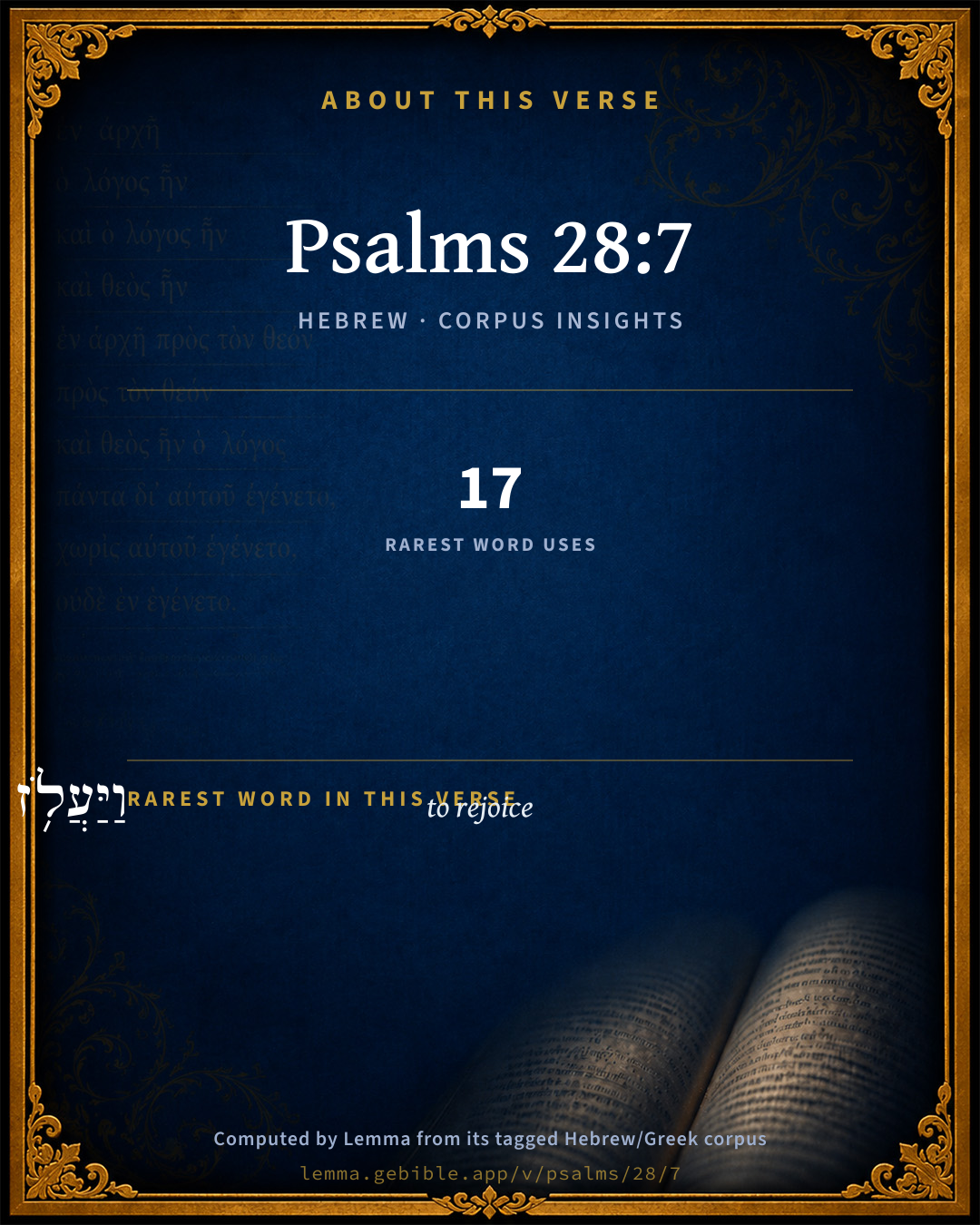
The rarest word here is וַיַּעֲלֹ֥ז to rejoice H5937 — appearing just 17 times in the whole Hebrew Bible.

Shared distinctive vocabulary

וַיַּעֲלֹ֥ז to rejoice H5937 occurs in 16 verses of the Hebrew Bible. Also found in:

Grammatical profile

  • 4 verbs
  • 6 nouns
  • 1 preposition

Verb forms

  • בָטַ֥ח Qal · Perfect
  • וְֽנֶ֫עֱזָ֥רְתִּי Niphal · Perfect
  • וַיַּעֲלֹ֥ז Qal · Sequential Imperfect
  • אֲהוֹדֶֽנּוּ Hiphil · Imperfect

Repetition

A word recurs within this verse — often emphatic in Hebrew:

  • לִבִּ֗י heart H3820 ×2

Hebrew & Septuagint length

In English translation the verse runs 29 words from the Hebrew and 30 from the Septuagint (LXX English) — closely comparable.

A rough comparison of the two English renderings, which tokenize alike — not a word-level alignment.

Word counts can differ between the Hebrew and the Greek without any difference in meaning — e.g. the Hebrew direct-object marker אֵת has no separate Greek word, and Greek often adds the article ὁ.

Cross-references

31

Topical passages linked to Psalms 28:7 in the Treasury of Scripture Knowledge — connected by theme and wording, ordered by reader-vote popularity; previews shown in the World English Bible.

  • Psalms 30:11–12 You have turned my mourning into dancing for me. You have removed my sackcloth, and clothed me with gladness,
  • Psalms 56:3–4 When I am afraid, I will put my trust in you.
  • Isaiah 61:10 I will greatly rejoice in Yahweh, my soul shall be joyful in my God; for he has clothed me with the garments of salvation, he has covered me with the robe of righteousness, as a bridegroom decks himself with a garland, and as a bride adorns herself with her jewels.
  • Ephesians 6:10 Finally, be strong in the Lord, and in the strength of his might.
  • Psalms 40:3 He has put a new song in my mouth, even praise to our God. Many shall see it, and fear, and shall trust in Yahweh.
  • Isaiah 12:2 Behold, God is my salvation. I will trust, and will not be afraid; for Yah, Yahweh, is my strength and song; and he has become my salvation."
  • Psalms 13:5 But I trust in your loving kindness. My heart rejoices in your salvation.
  • Psalms 28:8 Yahweh is their strength. He is a stronghold of salvation to his anointed.
  • Psalms 118:6–9 Yahweh is on my side. I will not be afraid. What can man do to me?
  • Psalms 84:11 For Yahweh God is a sun and a shield. Yahweh will give grace and glory. He withholds no good thing from those who walk blamelessly.
  • Psalms 68:3–4 But let the righteous be glad. Let them rejoice before God. Yes, let them rejoice with gladness.
  • Psalms 3:3 But you, Yahweh, are a shield around me, My glory, and the one who lifts up my head.
  • Psalms 22:4 Our fathers trusted in you. They trusted, and you delivered them.
  • Psalms 69:30 I will praise the name of God with a song, And will magnify him with thanksgiving.
  • Exodus 15:1–21 Then Moses and the children of Israel sang this song to Yahweh, and said, "I will sing to Yahweh, for he has triumphed gloriously: The horse and his rider he has thrown into the sea.
  • Psalms 91:4 He will cover you with his feathers. Under his wings you will take refuge. His faithfulness is your shield and rampart.
  • 1 Samuel 2:1–11 Hannah prayed, and said: My heart exults in Yahweh; My horn is exalted in Yahweh; My mouth is enlarged over my enemies; Because I rejoice in your salvation.
  • Psalms 21:1 The king rejoices in your strength, Yahweh! How greatly he rejoices in your salvation!
  • Psalms 96:1–3 Sing to Yahweh a new song! Sing to Yahweh, all the earth.
  • Genesis 15:1 After these things the word of Yahweh came to Abram in a vision, saying, "Don't be afraid, Abram. I am your shield, your exceedingly great reward."
  • Psalms 46:1 God is our refuge and strength, A very present help in trouble.
  • 2 Samuel 22:1–51 David spoke to Yahweh the words of this song in the day that Yahweh delivered him out of the hand of all his enemies, and out of the hand of Saul:
  • Psalms 16:9–11 Therefore my heart is glad, and my tongue rejoices. My body shall also dwell in safety.
  • Psalms 33:21 For our heart rejoices in him, Because we have trusted in his holy name.
  • Revelation 5:9 They sang a new song, saying, "You are worthy to take the book, And to open its seals: For you were killed, And bought us for God with your blood, Out of every tribe, language, people, and nation,
  • Psalms 18:1–2 I love you, Yahweh, my strength.
  • Psalms 118:13–15 You pushed me back hard, to make me fall, But Yahweh helped me.
  • Revelation 15:3 They sang the song of Moses, the servant of God, and the song of the Lamb, saying, "Great and marvelous are your works, Lord God, the Almighty; Righteous and true are your ways, you King of the nations.
  • Judges 5:1–31 Then sang Deborah and Barak the son of Abinoam on that day, saying,
  • Psalms 19:14 Let the words of my mouth and the meditation of my heart Be acceptable in your sight, Yahweh, my rock, and my redeemer.
  • Isaiah 45:24 Only in Yahweh, it is said of me, is righteousness and strength; even to him shall men come; and all those who were incensed against him shall be disappointed.

Cross-references courtesy of OpenBible.info (CC BY 4.0).

Hebrew and Greek witnesses Masoretic Hebrew ↔ Greek Septuagint

The same verse in the two great witnesses to the Old Testament, shown verse-for-verse.

You’re reading Greek Psalm 27 (Hebrew Psalm 28). The Septuagint counts the superscription, so verse numbers can differ from the Hebrew — chapter-level alignment, not verse-by-verse. Numbering follows Rahlfs.

These are two independent witnesses, not word-aligned to each other, and the Septuagint is shown in lemma (dictionary) form.

Hebrew Psalms 28:7 Masoretic · Westminster Leningrad Codex

יְהוָ֤ה עֻזִּ֥י וּמָגִנִּי֮ בּ֤וֹ בָטַ֥ח לִבִּ֗י וְֽנֶ֫עֱזָ֥רְתִּי וַיַּעֲלֹ֥ז לִבִּ֑י וּֽמִשִּׁירִ֥י אֲהוֹדֶֽנּוּ

Yahweh is my strength and my shield. My heart has trusted in him, and I am helped. Therefore my heart greatly rejoices. With my song I will thank him.

World English Bible · Public Domain

Greek LXX Greek Psalm 27:7 Septuagint · lemma form

κύριος βοηθός ἐγώ καί ὑπερασπιστής ἐγώ ἐπί αὐτός ἐλπίζω ὁ καρδία ἐγώ καί βοηθέω καί ἀναθάλλω ὁ σάρξ ἐγώ καί ἐκ θέλημα ἐγώ ἐκὁμολογέω αὐτός

The Lord is my helper and my defender; my heart has hoped in him, and I am helped: my flesh has revived, and willingly will I give praise to him.

LXX2012 (modern English Septuagint) · Public Domain

On this verse, Ellicott's Commentary for English Readers discusses the Septuagint’s reading. Read the note in Commentary ↓

Hebrew: Westminster Leningrad Codex (CC BY 4.0). Greek: Septuagint (public domain); English from LXX2012 (modern English Septuagint) (Public Domain). How the Septuagint differs from the Hebrew →

Commentary

Notes on Psalms 28:7 from classic Christian and Jewish commentators (each source and its license shown beneath its notes). The classic Christian expositions comment on the surrounding passage and are grouped to its opening verse, so a note may address several verses; the Jewish commentaries on the Tanakh (Rashi and others) are per-verse, so they appear only where the commentator wrote on this verse.

Lemma curates 59 commentaries, every one of them public domain or Creative Commons licensed, each selected and text-cleaned for this edition rather than reprinted as found. About our sources →

Trapp's Complete Commentary

John Trapp

Psa 28:7 The LORD [is] my strength and my shield; my heart trusted in him, and I am helped: therefore my heart greatly rejoiceth; and with my song will I praise him.

Ver. 7. The Lord is my strength and my shield] So that I am furnished and harnessed within and without. See Psa 18:2.

My heart trusted in him, and I am helped] Faith substantiateth things not yet seen, Heb 11:1, it altereth the tenses, saith one, and putteth the future into the present tense, as here.

My heart greatly rejoiceth, &c.] Inwardly I am glad, warmed at heart; and outwardly cheerful, even unto singing. And what will David sing? See his ditty in the next words.

John Trapp, A Commentary or Exposition upon All the Books of the Old and New Testament (1647–1656) — public domain. Text from a community e-Sword module.

The Biblical Illustrator

Joseph S. Exell

Psa_28:7

The Lord is my strength and my shield.

A sacred solo

Note in the three sentences-there is in each that which is inward and that which is outward. The Lord is my strength--that is inward; My shield--that is outward. My heart trusted in Him--inward; I am helped--outward. My heart greatly rejoiceth--inward; With my song will I praise Him--outward. It teaches us that truth and beauty of form are to be linked together: to be holy we need not to be uncouth. Slovenly preaching, doggerel verses and discordant singing are to be avoided in our worship.

I. We have here A sure possession. With double grip the psalmist takes hold of God. The Lord is my strength and my shield. It is not anything belonging to the Lord, but the Lord Himself that he thus lays hold on. He also can say this has a large inheritance which death cannot wither, nor space compass, nor time limit, nor eternity explore. He may be short in pocket money, as owners of large estates sometimes are; but he is infinitely rich, for he hath real property and an indefeasible title to it. Notice how God is laid hold of--

1. Inwardly, as his strength. You cannot tell how strong you are if you can say this: what marvellous capacity for endurance. Increase of burden is nothing to groan at if there be increase of strength. And with this we can, also, do anything. Then--

2. There is the outward manifestation. God is our shield. Where would you hide yourself, said one to Luther, if the Elector of Saxony should withdraw his protection? He smiled and said, I put no trust in the Prince of Saxony. Beneath the broad shield of Heaven I stand secure against Pope and Turk and devil. So he did, so do we. And many of us can attest this.

II. A definite experience. My heart trusted in Him and I am helped. He does not say, I trusted as one who makes a profession with his lips, but my heart trusted. Happy the man who in his heart trusts. Did you ever notice the middle verse of the whole Bible? It is Psa_118:8. It is better to trust in the Lord than to put confidence in man. The comparison will not bear a thought, the preference is infinite. May the heart always trust, and in God alone. Then we have the outward manifestation of the inward experience, I am helped. Not I was, nor I shall be, but I am. Old Master Trapp says, faith has no tenses, because faith deals with a God whose name is I am. With man we trust and are often disappointed or deceived, but never so with God.

III. A declared emotion. Therefore my heart greatly rejoiceth, and with my song, etc. Some peoples rejoicing is but skin deep. They laugh: their face is surfaced over with smiles, and their mirth bubbles up with silly glee. Nothing is more sad. You may perhaps have heard of Carlini, one of the most celebrated clowns of the beginning of this century, a man whose wit and humour kept all Paris in roars of laughter; but he himself had little share of the cheerfulness he simulated so well and stimulated so much. His comedies brought him no comfort; he was a victim of habitual despondency. He consulted a physician, who gave him some medicine, but advised him by way of recreation to go and hear Carlini. If he does not fetch the blues out of you nobody will. Alas, sir, said he, I am Carlini. And so often men make mirth for others, but live in gloom themselves. Not so the man who has laid hold on God. My heart greatly rejoiceth. And we should tell out our joy. With my song will I praise Him. Hard-worked mothers, toiling labourers, wearied servants, sing praise unto Him. The birds, the flowers, the many-tinted shells in depth of ocean, all praise Him. Do you the same. (C. H. Spurgeon.)

The Lord acknowledged and praised

I. the Lord acknowledged.

1. AS the source of strength.

(1) Physical.

(2) Intellectual.

(3) Spiritual.

2. As a shield.

(1) Against temptation.

(2) Against the fiery darts of Satan.

(3) Against the attacks of personal enemies.

II. the Lord trusted.

1. With the heart.

2. For the salvation of the soul.

3. For the power to keep from falling.

4. For help in every hour of need.

III. the Lord rejoiced is.

1. Because the soul is at peace with God.

2. Because of the consciousness of security in God.

3. Because of the manifested presence of God in the soul.

IV. the Lord praised.

1. For the manifestation of His power.

(1) To give strength in the hour of weakness.

(2) To give encouragement in the hour of despondency.

(3) To give light in the hour of darkness.

(4) To give inspiration in the hour of conflict.

2. For the manifestation of His love.

(1) In cleansing the heart from all sin.

(2) In inscribing the name in heaven.

(3) In the adoption of sons into the Divine family.

(4) In the blessed assurance of an eternal home in heaven. (O. T. Adams.)

The security of those who have God for their strength and shield

He is invulnerable whom God shields. The devil might spare his arrows, for not one of them will take effect on him whom God shields. David rested in his God in the midst of trouble, for God was a shield unto him. Oh, man, what about your fortifications? The French, yonder in Paris, put out statements and bulletins about the state of the fortifications--about the condition of the chain of forts that encircle their city. Now, as you walk around the walls of your own soul, have you got God as a shield? You, young fellow, are you shielded by God? Is God your shield? Have you covenanted with Jehovah? If you have, then--oh, hear it!--you are safe, for the Lord is thy shield. (J. Robertson.)

The Biblical Illustrator, edited by Joseph S. Exell (c. 1880s–1900s) — public domain. Text from a community e-Sword module.

The Treasury of David

Charles H. Spurgeon

Ver. 7. Here is David's declaration and confession of faith, coupled with a testimony from his experience. The Lord is my strength. The Lord employs his power on our behalf, and moreover, infuses strength into us in our weakness. The psalmist, by an act of appropriating faith, takes the omnipotence of Jehovah to be his own. Dependence upon the invisible God gives great independence of spirit, inspiring us with confidence more than human. And my shield. Thus David found both sword and shield in his God. The Lord preserves his people from unnumbered ills; and the Christian warrior, sheltered behind his God, is far more safe than the hero when covered with his shield of brass or triple steel. My heart trusted in him, and I am helped. Heart work is sure work; heart trust is never disappointed. Faith must come before help, but help will never be long behindhand. Every day the believer may say, "I am helped, "for the divine assistance is vouchsafed us every moment, or we should go back unto perdition; when more manifest help is needed, we have but to put faith into exercise, and it will be given us. Therefore my heart greatly rejoiceth; and with my song will I praise him. The heart is mentioned twice to show the truth of his faith and his joy. Observe the adverb "greatly, "we need not be afraid of being too full of rejoicing at the remembrance of grace received. We serve a great God, let us greatly rejoice in him. A song is the soul's fittest method of giving vent to its happiness, it were well if we were more like the singing lark, and less like the croaking raven. When the heart is glowing, the lips should not be silent. When God blesses us, we should bless him with all our heart.

Ver. 7. The Lord is my strength. Oh, sweet consolation! If a man have a burden upon him, yet if he have strength added to him, if the burden be doubled, yet if his strength be trebled, the burden will not be heavier, but lighter than it was before to his natural strength; so if our afflictions be heavy, and we cry out, Oh, we cannot bear them! yet if we cannot bear them with our own strength, why may we not bear them with the strength of Jesus Christ? Do we think that Christ could not bear them? or if we dare not think but that Christ could bear them, why may not we come to bear them? Some may question, can we have the strength of Christ? Yes; that very strength is made over to us by faith, for so the Scripture saith frequently, The Lord is our strength; God is our strength; The Lord Jehovah is our strength; Christ is our strength Ps 28:7 43:2 Ps 118:14 Isa 12:2 Hab 3:19 Col 1:11; and, therefore, is Christ's strength ours, made over unto us, that we may be able to bear whatsoever lies upon us. Isaac Ambrose.

Ver. 7. The Lord is my strength inwardly, and my shield outwardly. Faith finds both these in Jehovah, and the one not without the other, for what is a shield without strength, or strength without a shield? My heart trusted in him, and I am helped: the idea of the former sentence is here carried out, that outward help was granted to inward confidence. W. Wilson, D.D.

Ver. 7. My heart trusted in him, and I am helped. Faith substantiates things not yet seen; it altereth the tense, saith one, and putteth the future into the present tense as here. John Trapp.

Ver. 7. The heart's possessions, confidence, experience, joy, and music.

Ver. 7. Adoring God for his mercies.

1. What God is to the believer.

2. What should be the disposition of our hearts towards him. C. Simeon.

Psalms 28:8*

Charles H. Spurgeon's The Treasury of David (1869–1885) — public domain. Psalms only. Text from a community e-Sword/MySword module.

J. A. Alexander on Psalms

Joseph Addison Alexander

7. (Psa 28:7) Jehovah, my strength and my shield! In him has my heart trusted, and I have been helped, and my heart shall exult, and by my song I will thank (or praise) him. The construction of the first clause as a proposition, by supplying the substantive verb, Jehovah (is) my strength and my shield, is unnecessary, and neither so simple nor so strong as that which makes it a grateful and admiring exclamation.—My heart is twice used in this sentence to express the deep and cordial nature of the exercises which he is describing. The same heart that trusted now rejoices. As he believed with all his heart, so now he rejoices in like manner.—By my song, literally from or out of it, as the source and the occasion of his praise. Compare Psa 22:26 (25).

Joseph Addison Alexander, The Psalms Translated and Explained (1850) — public domain. Text from a community e-Sword module.

Tyndale Open Study Notes

Tyndale Open Resources

28:7 my strength and shield: The Lord protects the psalmist (see 59:9, 17).

Tyndale Open Study Notes — © Tyndale Open Resources, licensed CC BY-SA 4.0. Text via the HelloAO Bible API.

Jamieson, Fausset & Brown

Robert Jamieson, A. R. Fausset & David Brown

The repetition of "heart" denotes his sincerity.

Jamieson, Fausset & Brown — Commentary Critical and Explanatory on the Whole Bible (1871) — public domain (CC PDM 1.0). Text via the HelloAO Bible API.

Adam Clarke's Commentary

Verse 7. The Lord is my strength] I have the fullest persuasion that he hears, will answer, and will save me.

Adam Clarke's Commentary on the Bible (1810–1826) — public domain. Text from a community e-Sword/MySword module.

Ellicott's Commentary for English Readers

(7) Therefore my heart greatly rejoiceth.—Better, danceth for joy, as in the Prayer Book. Another possible translation is, “And when I have been helped my heart will dance for joy.”

With my song.—Literally, from my song, but the reading is doubtful. The LXX. have “my flesh has flourished,” which is probably correct.

A Bible Commentary for English Readers, edited by Charles John Ellicott (1878–1897) — public domain. Text from a community e-Sword module.

The Cambridge Bible for Schools and Colleges

gen. ed. J. J. S. Perowne

7. my strength] Cp. Exo_15:2. my shield] See note on Psa_3:3.

trusted] Better as R.V., hath trusted.

greatly rejoiceth] Exulteth. Cp. Psa_5:11; 1Sa_2:1.

The Cambridge Bible for Schools and Colleges (gen. ed. J. J. S. Perowne; Cambridge University Press, 1878–1918) — public domain. Text from a community e-Sword module.

John Gill's Exposition

The Lord is my strength,.... That is, the author both of natural and spiritual strength; that gave him strength of body, and fortitude of mind, to bear up under all the exercises he was tried with; the strength of his life, spiritual and temporal, and of his salvation; the strength of his heart under present distresses, and who he knew would be so in the hour of death, when his heart and strength would fail;

and my shield; to protect and defend him; as were the love, power, and faithfulness of God, and the Lord Jesus Christ, his power and fulness, his blood, righteousness, and salvation;

my heart trusted in him; in the Lord as his strength and shield; not in any creature, nor in his own strength and righteousness; but in the Lord God, in whom are righteousness and strength: and it is plain he did not trust in his own heart, since his heart trusted in the Lord; and which shows that his trust was an hearty one, his faith was a faith unfeigned, he believed with the heart unto righteousness;

and I am helped: this was the fruit of his trust, even a gracious experience of divine assistance: saints are helpless in themselves, and are also as to the help of man; God is the only helper of them; he helps them out of all their troubles; in whatsoever he calls them unto, and to what they want; and the help he affords is sometimes quick, and always seasonable; and sometimes by means, and sometimes without them;

therefore my heart greatly rejoiceth; that is, in the Lord, the ground of which was the help he had from him; and this joy was very great, a joy unspeakable, and full of glory; it was not carnal, but spiritual, a heart joy, joy in the Holy Ghost;

and with my song will I praise him; praise is due to God, what glorifies him, and is acceptable to him; it becomes the saints, is comely for them, and it is pleasant work to them, when grace is in exercise; see Psa 69:30; this may be understood of one of his songs, and one of the best of them, and of one better than this, as a Jewish writer (u) observes.

(u) R. Moseh in Aben Ezra in loc.

John Gill's Exposition of the Whole Bible (1746–1763) — public domain (CC PDM 1.0). Text via the HelloAO Bible API.

Albert Barnes' Notes on the Bible

The Lord is my strength - See the notes at Psa 18:1.

And my shield - See the notes at Psa 3:3. Compare Psa 33:20; Psa 59:11; Psa 84:9; Psa 89:18; Gen 15:1.

My heart trusted in him - I trusted or confided in him. See Psa 13:5.

And I am helped - I have found the assistance which I desired.

Therefore my heart greatly rejoiceth - I greatly rejoice. I am happy. He had found the assurance of the divine favor which he desired, and his heart was glad.

And with my song will I praise him - I will sing praises to Him. Compare Psa 22:25.

Albert Barnes' Notes on the Bible (1834–1885) — public domain. Text from a community e-Sword/MySword module.

The Pulpit Commentary

The Lord is my Strength and my Shield. (see Psa_18:1, 2 119:114) My heart trusted in him, and I am helped. As far as feeling goes, David is already "helped." He feels himself delivered out of his peril. Therefore, he says, my heart greatly rejoiceth; and with my song literally, out of my song, which is explained to mean "out of my store of song will I praise him. He is ready to offer thanksgiving for a mercy not yet received.

The Pulpit Commentary (1880–1919), ed. H.D.M. Spence-Jones & Joseph S. Exell — public domain. Text from a community e-Sword module.

John Wesley's Explanatory Notes

I am helped - He speaks of it as past, because God assured him by his spirit, that he had heard and accepted his prayers.

John Wesley, Explanatory Notes Upon the Whole Bible (1754–1765) — public domain. Text via the GEBible commentary corpus.

Rashi

Rabbi Shlomo Yitzchaki (Rashi)

and I will thank Him with my song Now what is the thanks?...The Lord is strength to them to those who rely on Him, viz. the entire house of Israel, at the time that He is the stronghold of the salvations of His anointed.

Rashi on the Tanakh — English translations: “The Judaica Press complete Tanach with Rashi, translated by A. J. Rosenberg” (CC BY 4.0); “Pentateuch with Rashi's commentary by M. Rosenbaum and A.M. Silbermann, 1929-1934” (public domain); “The Metsudah Tanach series, Lakewood, N.J” (CC BY 4.0); and “The Book of Joshua, Metsudah Publications, 1997” (CC BY 4.0). Text via Sefaria.

Lesson kit

Teaching starters — assembled from the data on this page, not authored interpretation. Every prompt links to the verse data it draws on. Edit before teaching.

Psalms, in the Wisdom, opens this verse with 11 words (9 distinct Hebrew lemmas). Its most distinctive word is ʻâlaz (“to rejoice”). A historical commentator’s framing appears above. Read the whole chapter for the surrounding context.

Discussion questions

  1. How does “to rejoice” (ʻâlaz) shape what this verse is saying?
  2. How does 2 Samuel 1:20, which shares the word «to rejoice», read alongside this verse?
  3. What does the repetition of “heart” (2× in this one verse) do in this verse?
  4. The translations on this page render this verse differently — a whole-verse word diff, not a word-by-word alignment. What might account for the different wordings?
  5. «בָטַ֥ח» is a Qal Perfect verb. How does that grammatical form shape the action described?
  6. Compare how Trapp's Complete Commentary and The Biblical Illustrator read this verse. Where do they agree or differ?

Things to notice

Reading settings

Reading text

Shown beneath each verse's original-language words.

Old Testament
Old Testament edition

Read the OT as the Masoretic Hebrew (MT) or the Greek Septuagint (LXX).

English shown for the Greek Septuagint (in the Hebrew ↔ Greek comparison).

Comparing translations? Open the Compare panel on any verse page to stack up to four side by side.