
Jeremiah 7:14

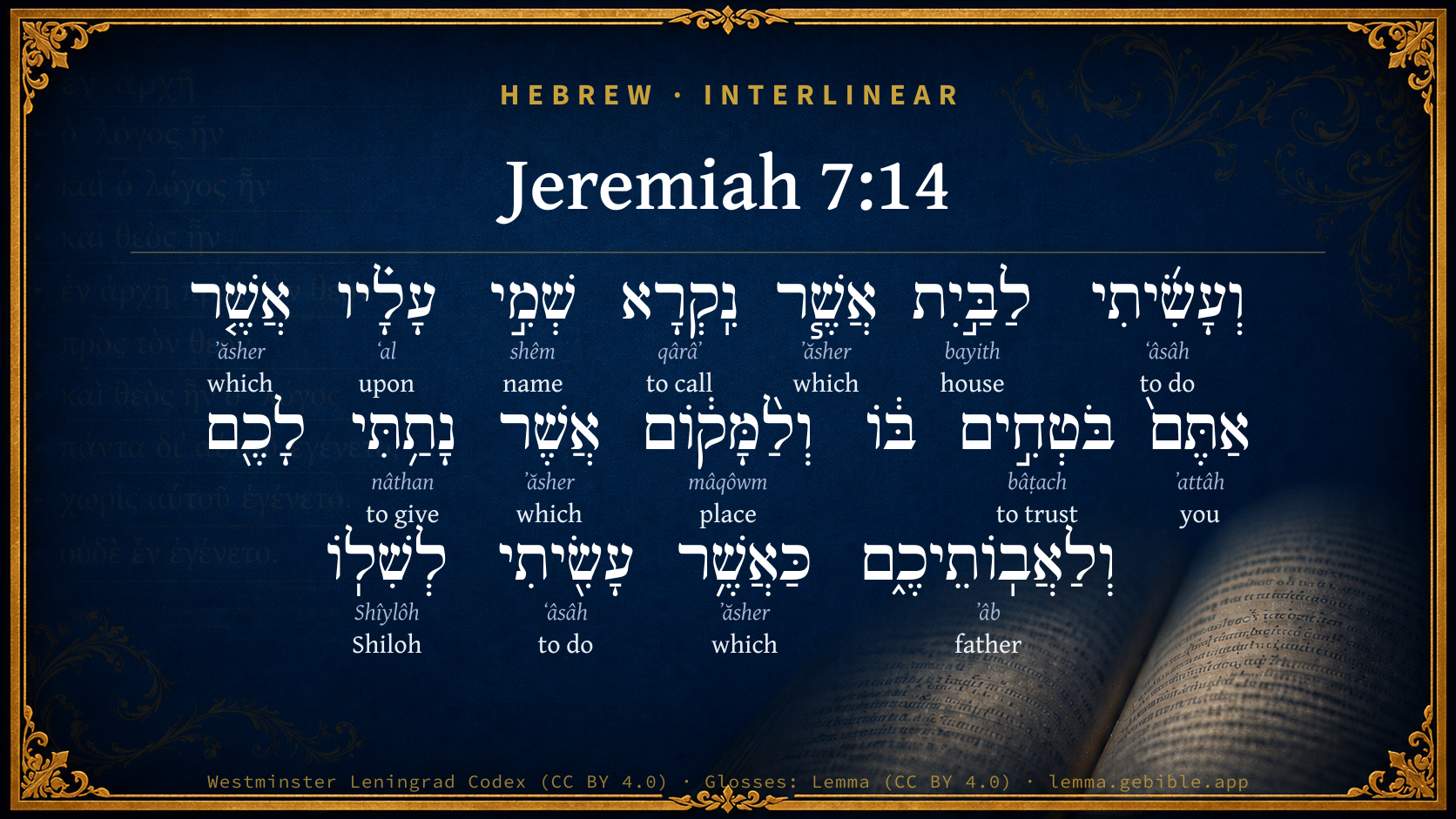
Hebrew (Westminster Leningrad Codex) Jeremiah 7:14 appears in the Hebrew Old Testament. The text above is from the Westminster Leningrad Codex. Each word links to its Strong’s number, a concise gloss, and parsing drawn from the Open Scriptures Hebrew Bible morphology. Click any word for its full Brown-Driver-Briggs (BDB) entry.
Download image
Cite this verse

Jeremiah 7:14 (World English Bible). Public Domain. Lemma interlinear Bible study tool, https://lemma.gebible.app/v/jeremiah/7/14.

Show BibTeX & RIS
BibTeX
RIS
English Translation
therefore will I do to the house which is called by my name, in which you trust, and to the place which I gave to you and to your fathers, as I did to Shiloh.
World English Bible · Public Domain
Download a study sheet

One document with this verse’s original text, its word-by-word gloss line, the meaning frame, cross-references with their text, attributed commentary, and full source and license credits — printable, and it pastes into notes with its structure intact.

This verse Autodidact and up

Study sheet (.html) Plain text (.txt)

A passage Seminary Student

Up to 50 verses in one chapter. A passage sheet keeps up to 6 commentary sources and 12 cross-references per verse, in the order this page ranks them, and says so on the sheet whenever that leaves anything out. Ask for a single verse and you get the Autodidact verse sheet above.

Everything on this page stays free to read, with no account — the sheet is a download of what is already on screen, not access to it.

Want to remove ads? Support Godless Engineer
Compare translations 3

The same verse in 3 English versions, stacked beneath the original-language interlinear above. Click any original word for its lexicon entry.

Each is an independent rendering of the whole verse — the interlinear is not word-aligned to these translations.

Highlighted words mark where these versions differ — a whole-verse word diff, not a word-by-word alignment.

  • World English Bible Public Domain
    therefore will I do to the house which is called by my name, in which you trust, and to the place which I gave to you and to your fathers, as I did to Shiloh.
  • King James Version Public Domain
    Therefore will I do unto this house, which is called by my name, wherein ye trust, and unto the place which I gave to you and to your fathers, as I have done to Shiloh.
  • unfoldingWord Literal Text CC BY-SA 4.0
    therefore I shall do to the house that is called by my name, which you are trusting in, and to the place that I gave to you and your fathers, as I did to Shiloh.

unfoldingWord Literal Text — © unfoldingWord, licensed CC BY-SA 4.0. Word-aligned USFM3 via Door43 (git.door43.org/unfoldingWord/en_ult).

Versions to compare (up to 4)

3 of 4 selected

Show all 18 translations

Every available English version of this verse, each an independent rendering of the whole verse.

  • World English Bible Public Domain
    therefore will I do to the house which is called by my name, in which you trust, and to the place which I gave to you and to your fathers, as I did to Shiloh.
  • Berean Standard Bible Public Domain
    therefore what I did to Shiloh I will now do to the house that bears My Name, the house in which you trust, the place that I gave to you and your fathers.
  • Majority Standard Bible Public Domain
    therefore what I did to Shiloh I will now do to the house that bears My Name, the house in which you trust, the place that I gave to you and your fathers.
  • King James Version Public Domain
    Therefore will I do unto this house, which is called by my name, wherein ye trust, and unto the place which I gave to you and to your fathers, as I have done to Shiloh.
  • American Standard Version (1901) Public Domain
    therefore will I do unto the house which is called by my name, wherein ye trust, and unto the place which I gave to you and to your fathers, as I did to Shiloh.
  • Revised Version (1885) Public Domain
    therefore will I do unto the house, which is called by my name, wherein ye trust, and unto the place which I gave to you and to your fathers, as I have done to Shiloh.
  • Geneva Bible (1599) Public Domain
    Therefore will I do vnto this House, wherupon my Name is called, wherein also yee trust, euen vnto the place that I gaue to you and to your fathers, as I haue done vnto Shilo.
  • Douay-Rheims (1899) Public Domain
    I will do to this house, in which my name is called upon, and in which you trust, and to the places which I have given you and your fathers, as I did to Silo.
  • Young's Literal Translation Public Domain
    I also to the house on which My name is called, In which ye are trusting, And to the place that I gave to you, and to your fathers, Have done, as I have done to Shiloh.
  • Literal Standard Version CC BY-SA 4.0
    I also have done to the house on which My Name is called, || In which you are trusting, || And to the place that I gave to you, and to your fathers, || As I have done to Shiloh.
  • Unlocked Literal Bible CC BY-SA 4.0
    Therefore, what I did to Shiloh, I will also do to this house that is called by my name, the house in which you have trusted, this place that I gave to you and your ancestors.
  • unfoldingWord Literal Text CC BY-SA 4.0
    therefore I shall do to the house that is called by my name, which you are trusting in, and to the place that I gave to you and your fathers, as I did to Shiloh.
  • Darby Bible Public Domain
    I will even do unto the house which is called by my name, wherein ye trust, and unto the place which I gave to you and to your fathers, as I have done to Shiloh;
  • World Messianic Bible Public Domain
    therefore I will do to the house which is called by my name, in which you trust, and to the place which I gave to you and to your fathers, as I did to Shiloh.
  • Webster's Bible Public Domain
    Therefore will I do to this house, which is called by my name, in which ye trust, and to the place which I gave to you and to your fathers, as I have done to Shiloh.
  • Free Bible Version CC BY-SA 4.0
    So now I'm going to do to my Temple, what I did to Shiloh. This is the Temple you put your faith in, the place I gave to you and your forefathers.
  • Bible in Basic English Public Domain
    For this reason I will do to the house which is named by my name, and in which you have put your faith, and to the place which I gave to you and to your fathers, as I have done to Shiloh.
  • JPS Tanakh (1917) Public Domain
    therefore will I do unto the house, whereupon My name is called, wherein ye trust, and unto the place which I gave to you and to your fathers, as I have done to Shiloh.

Literal Standard Version (2020), Covenant Press — licensed CC BY-SA 4.0. Text via the HelloAO Bible API (eBible.org). Unlocked Literal Bible (unfoldingWord) — licensed CC BY-SA 4.0. Text via the HelloAO Bible API (eBible.org). unfoldingWord Literal Text — © unfoldingWord, licensed CC BY-SA 4.0. Word-aligned USFM3 via Door43 (git.door43.org/unfoldingWord/en_ult). Free Bible Version, Dr. Jonathan Gallagher — licensed CC BY-SA 4.0. Text via the HelloAO Bible API (eBible.org).

Word by word

More ways to search: Search by grammar → Find every occurrence → Compare this word →

Practice this passage: Drill this verse → Learn its vocabulary →

לְשִׁלֽוֹ
Shîylôh
H7887
“to/for · Shiloh”
Preposition + Noun, Proper
Part of Speech
Preposition + Noun
Type
Proper
Full BDB Definition

Origin: from the same as H7886

TWOT: 2376

Shiloh = "place of rest" - a city in Ephraim and temporary home of the Ark of the Covenant and the Tabernacle, the place where Samuel grew up
  1. וְעָשִׂ֜יתִי ʻâsâh H6213 “and · to do” Conjunction + Verb, Qal, Sequential Perfect, 1st Person, Common, Singular
  2. לַבַּ֣יִת bayith H1004 “to/for the · house” Preposition, Determined + Noun, Common, Masculine, Singular, Absolute
  3. אֲשֶׁ֧ר ʼăsher H834 “which” Particle, Relative
  4. נִֽקְרָא qârâʼ H7121 “to call” Verb, Niphal, Perfect, 3rd Person, Masculine, Singular
  5. שְׁמִ֣י shêm H8034 “name · my” Noun, Common, Masculine, Singular, Construct + Suffix, Personal, 1st Person, Common, Singular
  6. עָלָ֗יו ʻal H5921 “upon · him” Preposition + Suffix, Personal, 3rd Person, Masculine, Singular
  7. אֲשֶׁ֤ר ʼăsher H834 “which” Particle, Relative
  8. אַתֶּם֙ ʼattâh H859 “you” Pronoun, Personal, 2nd Person, Masculine, Plural
  9. בֹּטְחִ֣ים bâṭach H982 “trusting” Verb, Qal, Participle Active, Masculine, Plural, Absolute
  10. וְלַ֨מָּק֔וֹם mâqôwm H4725 “and · to/for the · place” Conjunction + Preposition, Determined + Noun, Common, Masculine, Singular, Absolute
  11. אֲשֶׁר ʼăsher H834 “which” Particle, Relative
  12. נָתַ֥תִּי nâthan H5414 “to give” Verb, Qal, Perfect, 1st Person, Common, Singular
  13. וְלַאֲבֽוֹתֵיכֶ֑ם ʼâb H1 “and · to/for · fathers · your” Conjunction + Preposition + Noun, Common, Masculine, Plural, Construct + Suffix, Personal, 2nd Person, Masculine, Plural
  14. כַּאֲשֶׁ֥ר ʼăsher H834 “like/as · which” Preposition + Particle, Relative
  15. עָשִׂ֖יתִי ʻâsâh H6213 “to do” Verb, Qal, Perfect, 1st Person, Common, Singular

About this verse

These counts appear in no published source. They are computed here, from the morphology-tagged text and Lemma’s own curated glosses. What Lemma adds →

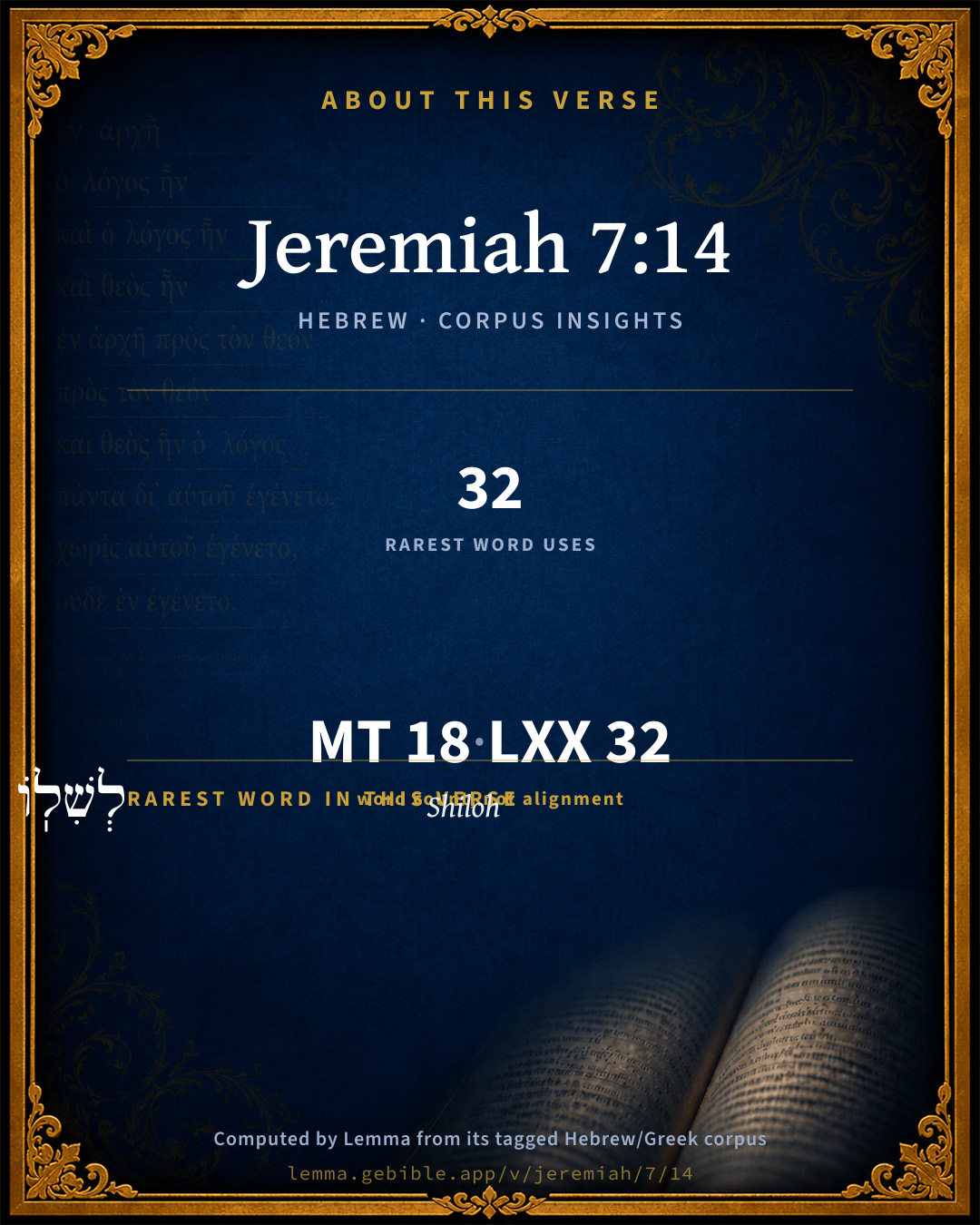
18
words
12
distinct lemmas
Prophets
section

Shared distinctive vocabulary

לְשִׁלֽוֹ Shiloh H7887 occurs in 30 verses of the Hebrew Bible. Also found in:

Grammatical profile

  • 5 verbs
  • 5 nouns
  • 1 pronoun
  • 3 prepositions
  • 4 particles

Verb forms

  • וְעָשִׂ֜יתִי Qal · Sequential Perfect
  • נִֽקְרָא Niphal · Perfect
  • בֹּטְחִ֣ים Qal · Participle Active
  • נָתַ֥תִּי Qal · Perfect
  • עָשִׂ֖יתִי Qal · Perfect

Repetition

Words recur within this verse — often emphatic in Hebrew:

  • וְעָשִׂ֜יתִי to do H6213 ×2
  • אֲשֶׁ֧ר which H834 ×4

Hebrew & Septuagint length

In the original languages it is 18 Hebrew tokens and 32 Greek tokens — but the two are counted differently (Hebrew bundles its prefixes and suffixes into one token; the Greek is in lemma form), so that isn’t a like-for-like length.

Cross-references

24

Topical passages linked to Jeremiah 7:14 in the Treasury of Scripture Knowledge — connected by theme and wording, ordered by reader-vote popularity; previews shown in the World English Bible.

  • 2 Kings 25:9 He burnt the house of Yahweh, and the king's house; and all the houses of Jerusalem, even every great house, burnt he with fire.
  • Psalms 78:60 So that he forsook the tent of Shiloh, The tent which he placed among men;
  • Jeremiah 7:4 Don't you trust in lying words, saying, The temple of Yahweh, the temple of Yahweh, the temple of Yahweh, are these.
  • Deuteronomy 28:52 They shall besiege you in all your gates, until your high and fortified walls come down, in which you trusted, throughout all your land; and they shall besiege you in all your gates throughout all your land, which Yahweh your God has given you.
  • Jeremiah 7:10 and come and stand before me in this house, which is called by my name, and say, We are delivered; that you may do all these abominations?
  • Deuteronomy 12:5 But to the place which Yahweh your God shall choose out of all your tribes, to put his name there, even to his habitation shall you seek, and there you shall come;
  • 1 Samuel 4:10–11 The Philistines fought, and Israel was struck, and they fled every man to his tent: and there was a very great slaughter; for there fell of Israel thirty thousand footmen.
  • 1 Kings 9:7–8 then will I cut off Israel out of the land which I have given them; and this house, which I have made holy for my name, will I cast out of my sight; and Israel shall be a proverb and a byword among all peoples.
  • 2 Chronicles 7:21 This house, which is so high, everyone who passes by it shall be astonished, and shall say, Why has Yahweh done thus to this land, and to this house?
  • 2 Chronicles 36:18–19 All the vessels of the house of God, great and small, and the treasures of the house of Yahweh, and the treasures of the king, and of his princes, all these he brought to Babylon.
  • Psalms 74:6–8 Now all its carved work They break down with hatchet and hammers.
  • Isaiah 64:11 Our holy and our beautiful house, where our fathers praised you, is burned with fire; and all our pleasant places are laid waste.
  • Jeremiah 7:12 But go you now to my place which was in Shiloh, where I caused my name to dwell at the first, and see what I did to it for the wickedness of my people Israel.
  • Jeremiah 26:6–9 then will I make this house like Shiloh, and will make this city a curse to all the nations of the earth.
  • Jeremiah 26:18 Micah the Morashtite prophesied in the days of Hezekiah king of Judah; and he spoke to all the people of Judah, saying, Thus says Yahweh of Hosts: Zion shall be plowed as a field, and Jerusalem shall become heaps, and the mountain of the house as the high places of a forest.
  • Jeremiah 52:13–23 and he burned the house of Yahweh, and the king's house; and all the houses of Jerusalem, even every great house, burned he with fire.
  • Lamentations 2:7 The Lord has cast off his altar, he has abhorred his sanctuary; He has given up into the hand of the enemy the walls of her palaces: They have made a noise in the house of Yahweh, as in the day of a solemn assembly.
  • Lamentations 4:1 How is the gold become dim! [how] is the most pure gold changed! The stones of the sanctuary are poured out at the head of every street.
  • Ezekiel 7:20–22 As for the beauty of his ornament, he set it in majesty; but they made the images of their abominations [and] their detestable things therein: therefore have I made it to them as an unclean thing.
  • Ezekiel 9:5–7 To the others he said in my hearing, Go you through the city after him, and strike: don't let your eye spare, neither have you pity;
  • Ezekiel 24:21 Speak to the house of Israel, Thus says the Lord Yahweh: Behold, I will profane my sanctuary, the pride of your power, the desire of your eyes, and that which your soul pities; and your sons and your daughters whom you have left behind shall fall by the sword.
  • Micah 3:11–12 Her leaders judge for bribes, And her priests teach for a price, And her prophets of it tell forturnes for money: Yet they lean on Yahweh, and say, Isn't Yahweh in the midst of us? No disaster will come on us.
  • Matthew 24:1–2 Jesus went out from the temple, and was going on his way. His disciples came to him to show him the buildings of the temple.
  • Acts 6:13–14 and set up false witnesses who said, "This man never stops speaking blasphemous words against this holy place and the law.

Cross-references courtesy of OpenBible.info (CC BY 4.0).

Hebrew and Greek witnesses Masoretic Hebrew ↔ Greek Septuagint

The same verse in the two great witnesses to the Old Testament, shown verse-for-verse.

These are two independent witnesses, not word-aligned to each other, and the Septuagint is shown in lemma (dictionary) form.

Hebrew Jeremiah 7:14 Masoretic · Westminster Leningrad Codex

וְעָשִׂ֜יתִי לַבַּ֣יִת אֲשֶׁ֧ר נִֽקְרָא שְׁמִ֣י עָלָ֗יו אֲשֶׁ֤ר אַתֶּם֙ בֹּטְחִ֣ים בּ֔וֹ וְלַ֨מָּק֔וֹם אֲשֶׁר נָתַ֥תִּי לָכֶ֖ם וְלַאֲבֽוֹתֵיכֶ֑ם כַּאֲשֶׁ֥ר עָשִׂ֖יתִי לְשִׁלֽוֹ

therefore will I do to the house which is called by my name, in which you trust, and to the place which I gave to you and to your fathers, as I did to Shiloh.

World English Bible · Public Domain

Greek LXX Structure differs

In the Septuagint, Jeremiah is about an eighth shorter than the Hebrew and arranges its material differently — the Oracles Against the Nations (Hebrew chapters 46–51) appear in the middle of the Greek book, after 25:13. Because the chapter and verse boundaries do not line up, a verse-for-verse comparison with the Hebrew is not shown.

A verse-for-verse comparison isn’t shown here because the chapters and verses don’t line up. Switch to the LXX edition with the MT / LXX toggle above to read the Greek directly.

Hebrew: Westminster Leningrad Codex (CC BY 4.0). Greek: Septuagint (public domain); English from a public-domain English Septuagint. How the Septuagint differs from the Hebrew →

Targum (Aramaic paraphrase)

1

The Targum is the ancient Jewish Aramaic paraphrase of the Hebrew Scriptures — an interpretive translation, not the Hebrew text itself. Onkelos (literal) and Pseudo-Jonathan (expansive) render the Torah, and Jonathan the Prophets. Coverage is partial: where no permissively-licensed English translation exists for a verse, only the Aramaic is shown. This is verse-level text, not a word-by-word alignment to the Hebrew.

  1. Targum Jonathan Prophets (Joshua–Malachi)
    וְאַעְבֵּיד לְבֵיתָא דְאִתְקְרֵי שְׁמִי עֲלוֹהִי דְאַתּוּן רְחִיצִין בֵּיהּ וּלְאַתְרָא דִיהָבֵית לְכוֹן וּלְאֲבָהַתְכוֹן כְּמָא דַעֲבָדֵית לְשִׁילוֹ:

    (no public-domain English translation for this verse)

    Targum Jonathan — Aramaic: “Mikraot Gedolot” (public domain). English: “Sefaria Community Translation” (CC0 1.0 (public-domain dedication)); “London "Chaldee Paraphrase," 1871” (public domain). Text via Sefaria.

Commentary

Notes on Jeremiah 7:14 from classic Christian and Jewish commentators (each source and its license shown beneath its notes). The classic Christian expositions comment on the surrounding passage and are grouped to its opening verse, so a note may address several verses; the Jewish commentaries on the Tanakh (Rashi and others) are per-verse, so they appear only where the commentator wrote on this verse.

Lemma curates 59 commentaries, every one of them public domain or Creative Commons licensed, each selected and text-cleaned for this edition rather than reprinted as found. About our sources →

Trapp's Complete Commentary

John Trapp

Jer 7:14 Therefore will I do unto [this] house, which is called by my name, wherein ye trust, and unto the place which I gave to you and to your fathers, as I have done to Shiloh.

Ver. 14. Therefore will I do unto this house.] Which ye fondly think that I am bound to hold and uphold. The disciples also seem to have had a conceit that the temple and the world must needs end together; hence that mixed discourse of our Saviour - now of one, and now of another. {Mat 24:2 Jer 7:3} {See Trapp on "Jer 7:3"}

John Trapp, A Commentary or Exposition upon All the Books of the Old and New Testament (1647–1656) — public domain. Text from a community e-Sword module.

Jamieson, Fausset & Brown

Robert Jamieson, A. R. Fausset & David Brown

I gave--and I therefore can revoke the gift for it is still Mine (Lev 25:23), now that ye fail in the only object for which it was given, the promotion of My glory.

Shiloh--as I ceased to dwell there, transferring My temple to Jerusalem; so I will cease to dwell at Jerusalem.

Jamieson, Fausset & Brown — Commentary Critical and Explanatory on the Whole Bible (1871) — public domain (CC PDM 1.0). Text via the HelloAO Bible API.

John Calvin's Commentaries

Therefore, he says, I will do to this house, which is called by my name, etc. He anticipates, no doubt, all objections, as though he had said, “I know what you will say, — that this place is sacred to God, that his name is invoked here, and that sacrifices are here offered: all these things, he says, are alleged to no purpose, for in Shiloh also was his name invoked, and he dwelt there. Though then ye foolishly trust in this place, it shall not yet escape that judgment which happened to the former place.” He adds, which I gave to you and to your fathers Be it so; for this is to be considered as a concession; and at the same time objections are anticipated, in order that the Jews might understand that it availed them nothing, that God had chosen to build his sanctuary on Mount Sion; for the object was to promote religion. But as the place was converted to a wholly different purpose, and as God’s name was there shamefully profaned, he says, “Though I gave this place to you and your fathers, yet nothing better shall be its fate than the fate of Shiloh.” It follows —

John Calvin's Commentaries (1540-1563) — public domain. Text from the Calvin Translation Society English edition (1840s-50s) via the Christian Classics Ethereal Library (ccel.org). Calvin's coverage is partial (roughly two-thirds of the Bible); uncommented books and verses are honest gaps, never fabricated. The 19th-century editor's footnotes and remarks are omitted so the notes are faithfully Calvin's own voice.

John Gill's Exposition

Therefore will I do unto this house, which is called by my name,.... The temple, as in Jer 7:11, for though it was called by his name, and his name was called upon in it, yet this could not secure it from desolation; for so the name of the Lord was set in the tabernacle at Shiloh, and yet he forsook it through the wickedness of the people:

wherein ye trust; they trusted in the sacrifices there offered up, and the service there performed; in the holiness of the place, and because it was the residence of the divine Majesty; wherefore they thought this would be a protection and defence of them; and this was trusting in lying words, as in Jer 7:4,

and unto the place which I gave unto you and your fathers; meaning either Jerusalem; and so the Syriac version renders it, "and to the city"; or the whole land of Judea, as in Jer 7:7,

as I have done to Shiloh; See Gill on Jer 7:12.

John Gill's Exposition of the Whole Bible (1746–1763) — public domain (CC PDM 1.0). Text via the HelloAO Bible API.

Matthew Poole's English Annotations

Therefore, because they have added this their obstinate refusing of all admonitions to the rest of their provocations,

will I do unto this house, viz. cause the consecrated things of the temple to be taken away by the hand of the Babylonians. The place, see Jer 7:7, which I gave to you, viz. upon condition of your obedience, Psa 105:44,45, and therefore may justly, upon the breach of the condition, take from you again, nay, by virtue of my sovereignty, Job 1:21.

Shiloh: see Jer 7:12.

Matthew Poole's English Annotations on the Holy Bible (1683–1685) — public domain. Text from a community e-Sword/MySword module.

Whedon's Commentary on the Bible

Daniel D. Whedon

14. Will I do unto this house — It was after this passage, as we learn from the twenty-sixth chapter, that the priests, the prophets, and the people took Jeremiah and said, “Thou shalt surely die.” But the man of God, strong in his consciousness of being joined to Jehovah, spoke such clear, bold words in his own vindication that they could not compass his ruin. History furnishes few examples of courage so intrepid and words so forceful as those of this weeping prophet on this occasion.

Daniel D. Whedon (gen. ed.), Commentary on the Old and New Testaments (1874–1909) — public domain. Text from a community e-Sword module.

The Pulpit Commentary

To Shiloh. Shiloh and the temple of Shiloh are interchanged, precisely as Jerusalem and the temple of Jerusalem. (Jer_26:9 Mic_3:12)

The Pulpit Commentary (1880–1919), ed. H.D.M. Spence-Jones & Joseph S. Exell — public domain. Text from a community e-Sword module.

Rashi

Rabbi Shlomo Yitzchaki (Rashi)

as I did to Shiloh in the days of Eli.

Rashi on the Tanakh — English translations: “The Judaica Press complete Tanach with Rashi, translated by A. J. Rosenberg” (CC BY 4.0); “Pentateuch with Rashi's commentary by M. Rosenbaum and A.M. Silbermann, 1929-1934” (public domain); “The Metsudah Tanach series, Lakewood, N.J” (CC BY 4.0); and “The Book of Joshua, Metsudah Publications, 1997” (CC BY 4.0). Text via Sefaria.

Lesson kit

Teaching starters — assembled from the data on this page, not authored interpretation. Every prompt links to the verse data it draws on. Edit before teaching.

Jeremiah, in the Prophets, opens this verse with 18 words (12 distinct Hebrew lemmas). Its most distinctive word is Shîylôh (“Shiloh”). A historical commentator’s framing appears above. Read the whole chapter for the surrounding context.

Discussion questions

  1. What does “Shiloh” (Shîylôh) contribute to the verse as a whole?
  2. How does Joshua 18:1, which shares the word «Shiloh», read alongside this verse?
  3. What does the repetition of “to do” (2× in this one verse) do in this verse?
  4. The translations on this page render this verse differently — a whole-verse word diff, not a word-by-word alignment. What might account for the different wordings?
  5. «וְעָשִׂ֜יתִי» is a Qal Sequential Perfect verb. How does that grammatical form shape the action described?
  6. Compare how Trapp's Complete Commentary and Jamieson, Fausset & Brown read this verse. Where do they agree or differ?

Things to notice

Reading settings

Reading text

Shown beneath each verse's original-language words.

Old Testament
Old Testament edition

Read the OT as the Masoretic Hebrew (MT) or the Greek Septuagint (LXX).

English shown for the Greek Septuagint (in the Hebrew ↔ Greek comparison).

Comparing translations? Open the Compare panel on any verse page to stack up to four side by side.