
Proverbs 29:25

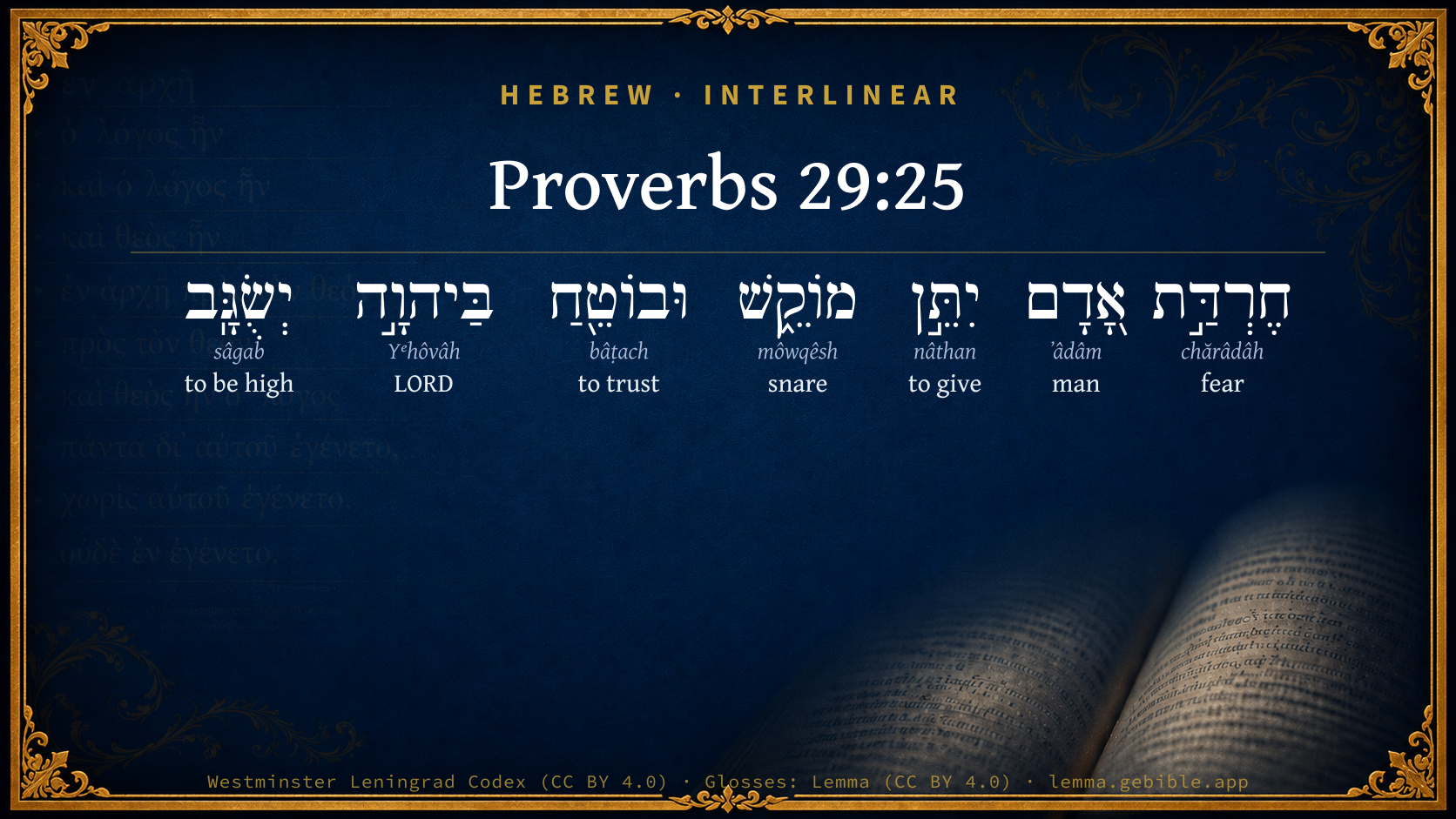
Hebrew (Westminster Leningrad Codex) Proverbs 29:25 appears in the Hebrew Old Testament. The text above is from the Westminster Leningrad Codex. Each word links to its Strong’s number, a concise gloss, and parsing drawn from the Open Scriptures Hebrew Bible morphology. Click any word for its full Brown-Driver-Briggs (BDB) entry.
Download image
Cite this verse

Proverbs 29:25 (World English Bible). Public Domain. Lemma interlinear Bible study tool, https://lemma.gebible.app/v/proverbs/29/25.

Show BibTeX & RIS
BibTeX
RIS
English Translation
The fear of man proves to be a snare, But whoever puts his trust in Yahweh is kept safe.
World English Bible · Public Domain
Download a study sheet

One document with this verse’s original text, its word-by-word gloss line, the meaning frame, cross-references with their text, attributed commentary, and full source and license credits — printable, and it pastes into notes with its structure intact.

This verse Autodidact and up

Study sheet (.html) Plain text (.txt)

A passage Seminary Student

Up to 50 verses in one chapter. A passage sheet keeps up to 6 commentary sources and 12 cross-references per verse, in the order this page ranks them, and says so on the sheet whenever that leaves anything out. Ask for a single verse and you get the Autodidact verse sheet above.

Everything on this page stays free to read, with no account — the sheet is a download of what is already on screen, not access to it.

Want to remove ads? Support Godless Engineer
Compare translations 3

The same verse in 3 English versions, stacked beneath the original-language interlinear above. Click any original word for its lexicon entry.

Each is an independent rendering of the whole verse — the interlinear is not word-aligned to these translations.

Highlighted words mark where these versions differ — a whole-verse word diff, not a word-by-word alignment.

  • World English Bible Public Domain
    The fear of man proves to be a snare, But whoever puts his trust in Yahweh is kept safe.
  • King James Version Public Domain
    The fear of man bringeth a snare: but whoso putteth his trust in the LORD shall be safe.
  • unfoldingWord Literal Text CC BY-SA 4.0
    The anxiety of a man sets a snare, but the one trusting in Yahweh will be set on high.

unfoldingWord Literal Text — © unfoldingWord, licensed CC BY-SA 4.0. Word-aligned USFM3 via Door43 (git.door43.org/unfoldingWord/en_ult).

Versions to compare (up to 4)

3 of 4 selected

Show all 18 translations

Every available English version of this verse, each an independent rendering of the whole verse.

  • World English Bible Public Domain
    The fear of man proves to be a snare, But whoever puts his trust in Yahweh is kept safe.
  • Berean Standard Bible Public Domain
    The fear of man is a snare, but whoever trusts in the LORD is set securely on high.
  • Majority Standard Bible Public Domain
    The fear of man is a snare, but whoever trusts in the LORD is set securely on high.
  • King James Version Public Domain
    The fear of man bringeth a snare: but whoso putteth his trust in the LORD shall be safe.
  • American Standard Version (1901) Public Domain
    The fear of man bringeth a snare; But whoso putteth his trust in Jehovah shall be safe.
  • Revised Version (1885) Public Domain
    The fear of man bringeth a snare: but whoso putteth his trust in the LORD shall be safe.
  • Geneva Bible (1599) Public Domain
    The feare of man bringeth a snare: but he that trusteth in the Lord, shalbe exalted.
  • Douay-Rheims (1899) Public Domain
    He that feareth man, shall quickly fall: he that trusteth in the Lord, shall be set on high.
  • Young's Literal Translation Public Domain
    Fear of man causeth a snare, And the confident in Jehovah is set on high.
  • Literal Standard Version CC BY-SA 4.0
    Fear of man causes a snare, || And the confident in YHWH is set on high.
  • Unlocked Literal Bible CC BY-SA 4.0
    The fear of man makes a snare, but the one who trusts in Yahweh will be protected.
  • unfoldingWord Literal Text CC BY-SA 4.0
    The anxiety of a man sets a snare, but the one trusting in Yahweh will be set on high.
  • Darby Bible Public Domain
    The fear of man bringeth a snare; but whoso putteth his confidence in Jehovah is protected.
  • World Messianic Bible Public Domain
    The fear of man proves to be a snare, but whoever puts his trust in the LORD is kept safe.
  • Webster's Bible Public Domain
    The fear of man bringeth a snare: but he who putteth his trust in the LORD shall be safe.
  • Free Bible Version CC BY-SA 4.0
    Being afraid of people traps you, but if you trust in the Lord you're safe.
  • Bible in Basic English Public Domain
    The fear of man is a cause of danger: but whoever puts his faith in the Lord will have a safe place on high.
  • JPS Tanakh (1917) Public Domain
    The fear of man bringeth a snare; but whoso putteth his trust in the LORD shall be set up on high.

Literal Standard Version (2020), Covenant Press — licensed CC BY-SA 4.0. Text via the HelloAO Bible API (eBible.org). Unlocked Literal Bible (unfoldingWord) — licensed CC BY-SA 4.0. Text via the HelloAO Bible API (eBible.org). unfoldingWord Literal Text — © unfoldingWord, licensed CC BY-SA 4.0. Word-aligned USFM3 via Door43 (git.door43.org/unfoldingWord/en_ult). Free Bible Version, Dr. Jonathan Gallagher — licensed CC BY-SA 4.0. Text via the HelloAO Bible API (eBible.org).

Word by word

More ways to search: Search by grammar → Find every occurrence → Compare this word →

Practice this passage: Drill this verse → Learn its vocabulary →

About this verse

These counts appear in no published source. They are computed here, from the morphology-tagged text and Lemma’s own curated glosses. What Lemma adds →

7
words
7
distinct lemmas
Wisdom
section

Notable vocabulary

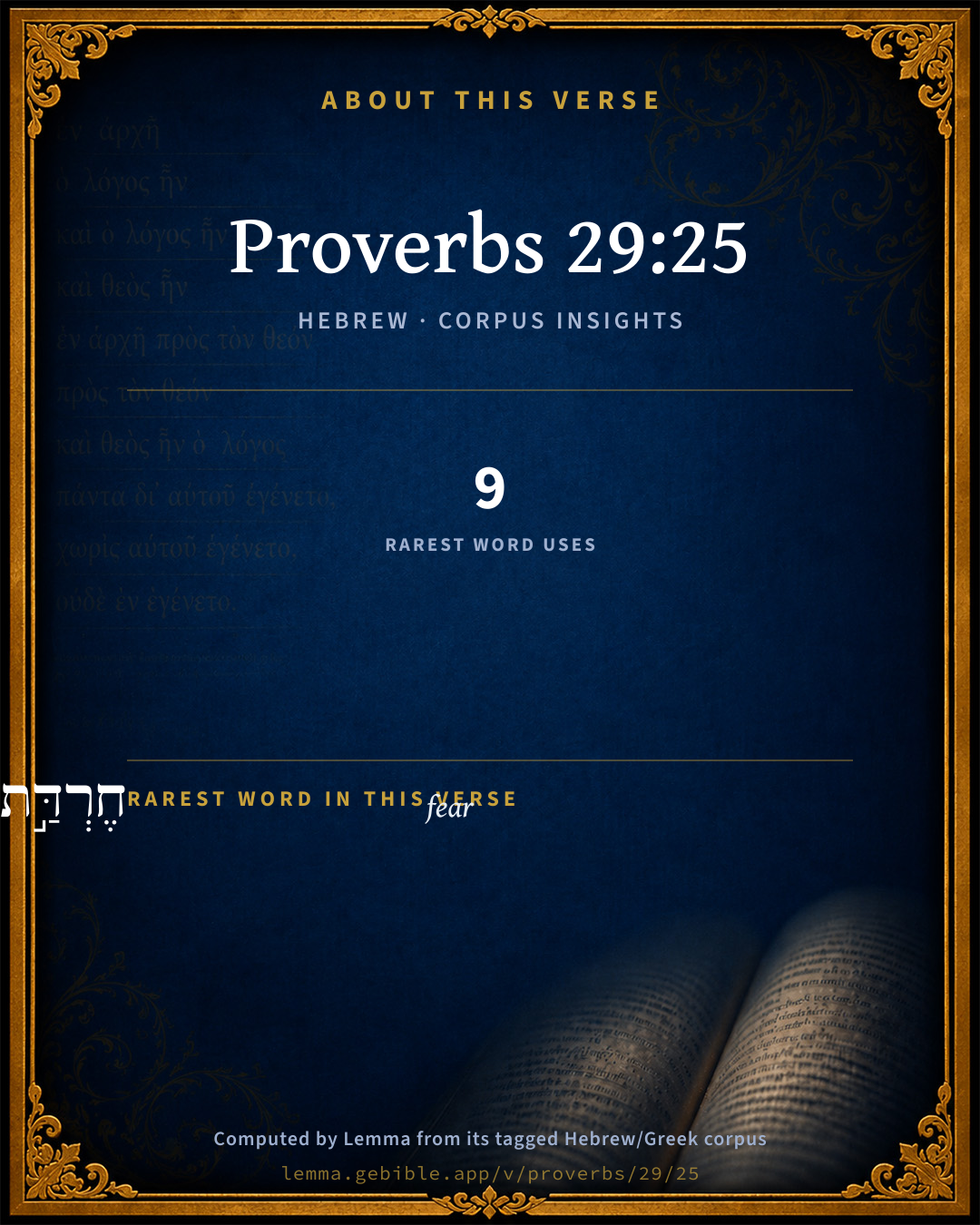
The rarest word here is חֶרְדַּ֣ת fear H2731 — appearing just 9 times in the whole Hebrew Bible.

Shared distinctive vocabulary

חֶרְדַּ֣ת fear H2731 occurs in 8 verses of the Hebrew Bible. Also found in:

Grammatical profile

  • 3 verbs
  • 4 nouns

Verb forms

  • יִתֵּ֣ן Qal · Imperfect
  • וּבוֹטֵ֖חַ Qal · Participle Active
  • יְשֻׂגָּֽב Pual · Imperfect

Hebrew & Septuagint length

In English translation the verse runs 19 words from the Hebrew and 34 from the Septuagint (LXX English) — the Septuagint runs noticeably longer here. See the side-by-side →

A rough comparison of the two English renderings, which tokenize alike — not a word-level alignment.

Word counts can differ between the Hebrew and the Greek without any difference in meaning — e.g. the Hebrew direct-object marker אֵת has no separate Greek word, and Greek often adds the article ὁ.

Cross-references

33

Topical passages linked to Proverbs 29:25 in the Treasury of Scripture Knowledge — connected by theme and wording, ordered by reader-vote popularity; previews shown in the World English Bible.

  • Psalms 118:8 It is better to take refuge in Yahweh, Than to put confidence in man.
  • Luke 12:4 "I tell you, my friends, don't be afraid of those who kill the body, and after that have no more that they can do.
  • Proverbs 18:10 The name of Yahweh is a strong tower: The righteous run to him, and are safe.
  • Psalms 91:14 "Because he has set his love on me, therefore I will deliver him. I will set him on high, because he has known my name.
  • Proverbs 16:20 He who heeds the Word finds prosperity. Whoever trusts in Yahweh is blessed.
  • John 12:42–43 Nevertheless even of the rulers many believed in him, but because of the Pharisees they didn't confess it, so that they wouldn't be put out of the synagogue,
  • Proverbs 30:5 "Every word of God is flawless. He is a shield to those who take refuge in him.
  • Psalms 125:1 Those who trust in Yahweh are as Mount Zion, Which can't be moved, but remains forever.
  • 2 Timothy 4:16–17 At my first defense, no one came to help me, but all left me. May it not be held against them.
  • 1 Peter 1:21 who through him are believers in God, who raised him from the dead, and gave him glory; so that your faith and hope might be in God.
  • Matthew 10:28 Don't be afraid of those who kill the body, but are not able to kill the soul. Rather, fear him who is able to destroy both soul and body in Gehenna.
  • 1 Chronicles 5:20 They were helped against them, and the Hagrites were delivered into their hand, and all who were with them; for they cried to God in the battle, and he was entreated of them, because they put their trust in him.
  • Matthew 26:69–74 Now Peter was sitting outside in the court, and a maid came to him, saying, "You were also with Jesus, the Galilean!"
  • John 9:22 His parents said these things because they feared the Jews; for the Jews had already agreed that if any man would confess him as Christ, he would be put out of the synagogue.
  • Genesis 20:11 Abraham said, "Because I thought, 'Surely the fear of God is not in this place. They will kill me for my wife's sake.'
  • Isaiah 57:11 Of whom have you been afraid and in fear, that you lie, and have not remembered me, nor laid it to your heart? Haven't I held my peace even of long time, and you don't fear me?
  • John 3:2 The same came to him by night, and said to him, "Rabbi, we know that you are a teacher come from God, for no one can do these signs that you do, unless God is with him."
  • Genesis 20:2 Abraham said about Sarah his wife, "She is my sister." Abimelech king of Gerar sent, and took Sarah.
  • Galatians 2:11–13 But when Peter came to Antioch, I resisted him to the face, because he stood condemned.
  • Genesis 26:7 The men of the place asked him about his wife. He said, "She is my sister," for he was afraid to say, "My wife," lest, he thought, the men of the place might kill me for Rebekah, because she was beautiful to look on.
  • 1 Samuel 15:24 Saul said to Samuel, I have sinned; for I have transgressed the commandment of Yahweh, and your words, because I feared the people, and obeyed their voice.
  • Proverbs 28:25 One who is greedy stirs up strife; But one who trusts in Yahweh will prosper.
  • Daniel 6:23 Then was the king exceeding glad, and commanded that they should take Daniel up out of the den. So Daniel was taken up out of the den, and no manner of hurt was found on him, because he had trusted in his God.
  • John 19:12–13 At this, Pilate was seeking to release him, but the Jews cried out, saying, "If you release this man, you aren't Caesar's friend! Everyone who makes himself a king speaks against Caesar!"
  • Ecclesiastes 7:18 It is good that you should take hold of this. Yes, also from that don't withdraw your hand; for he who fears God will come forth from them all.
  • Genesis 12:11–13 It happened, when he was come near to enter into Egypt, that he said to Sarai his wife, "See now, I know that you are a beautiful woman to look on.
  • Exodus 32:22–24 Aaron said, "Don't let the anger of my lord grow hot. You know the people, that they are set on evil.
  • 1 Samuel 27:1 David said in his heart, I shall now perish one day by the hand of Saul: there is nothing better for me than that I should escape into the land of the Philistines; and Saul will despair of me, to seek me any more in all the borders of Israel: so shall I escape out of his hand.
  • 1 Samuel 27:11 David saved neither man nor woman alive, to bring them to Gath, saying, Lest they should tell of us, saying, So did David, and so has been his manner all the while he has lived in the country of the Philistines.
  • 1 Kings 19:3 When he saw that, he arose, and went for his life, and came to Beersheba, which belongs to Judah, and left his servant there.
  • Psalms 69:29 But I am in pain and distress. Let your salvation, God, protect me.
  • Matthew 15:12 Then the disciples came, and said to him, "Do you know that the Pharisees were offended, when they heard this saying?"
  • Daniel 3:28 Nebuchadnezzar spoke and said, Blessed be the God of Shadrach, Meshach, and Abednego, who has sent his angel, and delivered his servants who trusted in him, and have changed the king's word, and have yielded their bodies, that they might not serve nor worship any god, except their own God.

Cross-references courtesy of OpenBible.info (CC BY 4.0).

Hebrew and Greek witnesses Masoretic Hebrew ↔ Greek Septuagint

The same verse in the two great witnesses to the Old Testament, shown verse-for-verse.

Here the Septuagint runs noticeably longer than the Hebrew — LXX2012 (modern English Septuagint) 34 words vs World English Bible 19. A rough length comparison of the two English translations, not a word-level alignment — read both below.

These are two independent witnesses, not word-aligned to each other, and the Septuagint is shown in lemma (dictionary) form.

Hebrew Proverbs 29:25 Masoretic · Westminster Leningrad Codex

חֶרְדַּ֣ת אָ֭דָם יִתֵּ֣ן מוֹקֵ֑שׁ וּבוֹטֵ֖חַ בַּיהוָ֣ה יְשֻׂגָּֽב

The fear of man proves to be a snare, But whoever puts his trust in Yahweh is kept safe.

World English Bible · Public Domain

Greek LXX Proverbs 29:25 Septuagint · lemma form

φοβέω καί αἰσχύνω ἄνθρωπος ὑποσκελίζω ὁ δέ πείθω ἐπί κύριος εὐφραίνω ἀσέβεια ἀνήρ δίδωμι σφάλμα ὅς δέ πείθω ἐπί ὁ δεσπότης σώζω

they fearing and reverencing men unreasonably have been overthrown, but he that trusts in the Lord shall rejoice. Ungodliness causes a man to stumble: but he that trusts in his master shall be safe.

LXX2012 (modern English Septuagint) · Public Domain

On this verse, Haydock's Catholic Bible Commentary discusses the Septuagint’s reading. Read the note in Commentary ↓

Hebrew: Westminster Leningrad Codex (CC BY 4.0). Greek: Septuagint (public domain); English from LXX2012 (modern English Septuagint) (Public Domain). How the Septuagint differs from the Hebrew →

Commentary

Notes on Proverbs 29:25 from classic Christian and Jewish commentators (each source and its license shown beneath its notes). The classic Christian expositions comment on the surrounding passage and are grouped to its opening verse, so a note may address several verses; the Jewish commentaries on the Tanakh (Rashi and others) are per-verse, so they appear only where the commentator wrote on this verse.

Lemma curates 59 commentaries, every one of them public domain or Creative Commons licensed, each selected and text-cleaned for this edition rather than reprinted as found. About our sources →

Trapp's Complete Commentary

John Trapp

Pro 29:25 The fear of man bringeth a snare: but whoso putteth his trust in the LORD shall be safe.

Ver. 25. The fear of man bringeth a snare.] This cowardly passion expectorates and exposes a man to many, both sins and sufferings. And albeit faith, when it is in the heart, quelleth and killeth distrustful fear, and is therefore fitly opposed to it in this sacred sentence: yet in the very best sense fights sore against faith when it is upon its own dunghill. I mean in a sensible danger. Nature’s retraction of itself from a visible fear, may cause the pulse of a Christian that beats truly and strongly in the main point, the state of the soul, to intermit and falter at such a time, as we see in the examples of Abraham, Isaac, David, Peter, others who showed some trepidation and timidity, and, like fearful birds and beasts, fell into the pits and toils of the hunter, and hazarded themselves to God’s displeasure. The chameleon is said to be the most fearful of all creatures, and doth therefore turn himself into so many colours to avoid danger, which yet will not be. God equally hateth the timorous and the treacherous. "Fearful" men are the first in that black roll. {Rev 21:8}

But he that trusteth in the Lord shall be safe.] {a} Or, Set on high, as on a rock; his place of defence shall be munitions of rocks, {Isa 33:16} far out of harm’s way; he shall be kept safe, as in a tower of brass, or town of war. "Even the youth shall faint and be weary, and the young men shall utterly fall; but they that wait upon the Lord shall mount up with wings as eagles," &c. {Isa 40:30-31} Like as the coney that flies to the holes in the rocks doth easily avoid the dogs that pursue her, when the hare that trusts to the swiftness of her legs is at length overtaken and tore in pieces: so here.

{a} Tectus et tutus.

John Trapp, A Commentary or Exposition upon All the Books of the Old and New Testament (1647–1656) — public domain. Text from a community e-Sword module.

The Biblical Illustrator

Joseph S. Exell

Pro_29:25

The fear of man bringeth a snare.

The mischiefs of slavish complaisance and cowardice

Every passion of the soul may be of use to us, but is capable also, by being perverted, of causing much vexation and misery to ourselves and injury to our fellow-creatures. Year, while it proceeds from right principles, and is proportioned to the weight and moment of the evils about which it is conversant, must serve the most beneficial purposes, as it warns us where our greatest danger lies, and strongly prompts us to avoid it. But the case is quite otherwise when it forms imaginary dangers and alarms with false terrors. Then our fears turn us aside from our duty, and in avoiding trifling evils we run ourselves into greater.

I. What is the fear of man? A reverence of human authority and customs, and a dread of the censure and reproaches of our fellow-creatures.

1. There is a reverence due to human authority in all points that do not exceed the just bounds of it, and the paying this regard is absolutely necessary to hold the frame of civil societies together. The ends of society cannot be secured but by mutual condescension and respect, and the compliance and submission of the minor part, in things lawful.

2. A man ought to be afraid of censure and reproach being fixed upon him, and anxious to deliver and clear himself from it. Men must be of a temper quite stupid if they have no fear at all of public reproach and infamy, and must lose a very powerful restraint from mean, ungenerous, and disgraceful practices.

3. We are guilty of the utmost rashness and folly if we expose ourselves to the resentments of our fellow-men unnecessarily. And a dread of those punishments which the civil magistrate inflicts is not only lawful, but necessary. Thus far, then, the fear of man may be defended and justified.

II. In what sense. It bringeth a snare. It throws temptations in mens way which are likely to prevail so far as to destroy all improvements in true wisdom and virtue.

1. Suppose a man, under the influence of this slavish principle, engages in search after truth, what proficiency is it possible for him to make? In order to making improvements in Divine knowledge it is absolutely necessary that the mind be free, calm, and unruffled, under no restraint or terror. There must be no corrupt passion to darken the understanding, nor private interest to mislead and pervert it.

2. It is as great an absurdity to expect that one who is dispirited by worldly fears should be a confessor and martyr for true religion as that a coward should be brave and valiant. Slavish fear of man leads men even to revile and banter the truth.

3. This fear will have the same malignant influence upon our morals as upon our faith. When it rises to such a height as to overrule the dictates of natural conscience, and entirely to destroy the strength and constancy of our minds, we are an easy prey to every temptation, and lie open to the most desperate and abandoned wickedness. If it be our ultimate view to secure the countenance and favour of persons in authority and avoid their displeasure, this likewise will subject us to many snares and inconveniences.

III. Offer some remedies against this fear of man.

1. Maintain and improve in our minds a strong sense of the necessary difference between good and evil.

2. Add a becoming sense of the dignity of our nature.

3. Trust in God, as advised in the latter part of the text.

4. Cultivate a supreme reverence for God. These two--fear of man and fear of God--are absolutely inconsistent, and cannot subsist together. (James Foster.)

The fear of man

This is a deadly foe to a godly, consistent life. It stops many a one on the very threshold of the kingdom. It turns back many who seemed to run well.

1. The fear of man often leads to downright, positive sin.

2. The fear of man keeps many a lad from decision for Christ. (G. Everard, M.A.)

The fear of man

I. Our great danger.

1. For the fear of man is more general than we are aware of.

2. To all who yield to its influence it brings a fatal snare.

II. Its proper and only effectual antidote. Regard for God Himself. We should trust Him for support, happiness, recompense. Improvement:

1. A word of caution.

2. Of encouragement. (S. Simeon, M.A.)

Whoso putteth his trust in the Lord shall be safe.

How to be safe

I. There is safety nowhere except in the care of God, for in His hands alone are sources of safety.

II. God can make safe only those who trust Him fully.

III. Complete trust can exist only between parties in accord and in the confidence of each other.

IV. In order to trust in the Lord two things are essential.

1. We must confidently believe that God is able, willing, and ready to care for us.

2. That we are worthy of His care.

V. To be safe we must be at one with God.

VI. Outside of Gods protection are danger, darkness, Death--eternal. (Homiletic Review.).

The Biblical Illustrator, edited by Joseph S. Exell (c. 1880s–1900s) — public domain. Text from a community e-Sword module.

Joseph Benson's Commentary

Pro 29:25. The fear of man — Inordinate fear of harm or suffering from men, which is properly opposed to trust in God, because it arises from a distrust of God’s promises and providence; bringeth a snare — Is an occasion of many sins, and consequently of punishments from God: but whoso putteth his trust in the Lord — Walks in God’s ways, and securely relies upon him, to protect him from the designs and malice of wicked men; shall be safe — Shall be preserved from all real evil, through God’s watchful providence over him.

Joseph Benson's Commentary on the Old and New Testaments (1811–1818) — public domain. Text from a community e-Sword module.

The Preacher's Complete Homiletical Commentary

Joseph S. Exell (gen. ed.)

MAIN HOMILETICS OF Pro_29:25-26

SAFETY FROM A SNARE

I. Men fear and hope too much from their fellow men. This fear and this hope are very active agents in this world, influencing men often to abstain from what they know to be right, and inducing them to do deeds of evil. Good men have often staggered and sometimes fallen before this fear and have been misled by this false hope, and both the hope and the fear are intensified when the object of them belongs to the ranks of the conventually great—when the man whom they desire to propitiate is a “ruler” among his fellows. Such a man sometimes has the power to injure those who displease him, and has also much that he can bestow upon those who seek his favour; but the weight of his displeasure and the worth of his gifts are generally estimated far too highly by his inferiors in rank, and when this is the case they are snares which lead to sin.

II. Trust in God is the only escape from the fear that will mislead, and the hope that will disappoint. The many and great contrasts, not only between the favour of God and the favour of man, but between all that is connected with the seeking and the bestowal, will lead every wise man to forsake the pursuit of the less for the greater.

1. The favour of an earthly ruler is often obtained only by the exercise of great skill on the part of the seeker. When the woman of Tekoa desired to obtain from David the forgiveness of Absalom, what ingenuity on her part was necessary in order to gain the monarch’s ear and goodwill. She had to study how to put the case before him in the best light, and to enact a little drama before his eyes in order to enlist his attention and soften his heart. And yet she was pleading with a tender-hearted father for his own son. How different is it when we plead for the mercy of God either for ourselves or others. The simplest statement of the case is sufficient; no schemes or plans of any kind are necessary to win the ear of Him who is always waiting to be gracious.

2. Success with an earthly ruler is often quite unconnected with the merit or demerit of the pleader. It often happens that the most worthless characters obtain the greatest favours, even if the ruler himself be a fairly impartial man, because they have more friends at court than a deserving man. In the case just mentioned, Absalom, a thoroughly bad man, was able to command the services of a person who was probably more fitted to gain the desired end than any person in the kingdom. If there had been a banished subject who really merited a free pardon from the king, he would probably not have been able to command the services of so successful a pleader as the woman of Tekoa. But the case is altogether different with Him who doth not “judge after the sight of His eyes, neither reprove after the hearing of His ears.” (Isa_11:3.) The “judgment which cometh from the Lord” is founded on the strictest impartiality, and depends upon nothing but the character and needs of the suitor. If we add to these drawbacks the uncertain good which may be contained in the “favour of a ruler” even after it is obtained, we may well wonder that it is as true now as in Solomon’s days that the “many” seek it, and only the few trust their earthly and their spiritual interests with their God. How many of the few who are not disappointed of the favour of great men are disappointed in it, and find it a poor and unsatisfying portion after all; but the testimony of all those who seek the higher good is “In Thy favour is life, and Thy loving-kindness is better than life.” (Psa_63:3.)

OUTLINES AND SUGGESTIVE COMMENTS

To those who look out upon society from the standpoint of trust in God, the greatest magnates of the world will appear only as grasshoppers.… He who can say, “Surely my judgment is with the Lord,” will stand before his race with undaunted heroism, and before his God with devotion. Conscious dependence on the Almighty is the spirit of independence towards men.—Dr. David Thomas.

The fear of man leads you into a snare, and will the fear of God make you safe? No; if the character of the affection remain the same, you will gain nothing by a change of object. If you simply turn round and fear God as you feared man you have not thereby escaped. The fear of the greater Being is the greater fear. The weight presses in the same direction, and it is heavier by all the difference between the finite and the infinite.… It is not a transference of fear from man to God that can make the sinner safe. The kind of affection must be changed, as well as its object. Safety lies not in terror, but in trust. Hope leads to holiness. He who is made nigh to God by the death of His Son stands high above the wretched snares that entangled his feet when he feared men. The sovereign’s son is safe from the temptation to commit petty theft.… When you know in whom you have believed, and feel that any step in life’s journey hereafter may be the step into heaven, the fear of this man and the favour of that will exert no sensible influence in leading you to the right hand or to the left.—Arnot.

Albeit faith, when it is in the heart, quelleth and killeth distrustful fear, and is therefore fitly opposed to it in this sacred sentence; yet in the very best sense it fights sore against faith when it is upon its own dunghill. I mean in a sensible danger. Nature’s retraction of itself from a visible fear, may cause the pulse of a Christian that beats truly and strongly in the main point—the state of the soul—to intermit and falter at such a time, as we see in the examples of Abraham, Isaac, David, Peter, and others.… The chameleon is said to be the most fearful of all creatures, and doth therefore turn himself into so many colours to avoid danger, which yet will not be. God equally hateth the timorous and the treacherous. “Fearful” men are the first in that black roll. (Rev_21:8.)—Trapp.

There is a higher step to be taken before we can well step so high; there is the favour of God to be procured before that the favour of the ruler can well be obtained. For kings are but God’s kingdoms; as they reign over their people, so He reigneth over them; as they sit on the throne of their kingdom, so He sitteth on the throne of their hearts, and by a distributive justice dispenseth the judgment of his and their favours according as it seemeth good to His eternal wisdom. The favour therefore of thy ruler is worth thy seeking for; but first seek and get God’s favour, if thou wilt get and enjoy the other to thy happiness. And when thou hast gotten it, remember that it was God’s hand which directed the king’s hand to reach it forth unto thee. For it is too commonly seen, as one speaketh, “Then doth God especially slip out of the minds of men, when they enjoy His benefits and favours.”—Jermin.

For Homiletics on Pro_29:27, see on chap. Pro_28:4

The Preacher's Complete Homiletical Commentary (gen. ed. Joseph S. Exell; Funk & Wagnalls, c. 1892) — public domain (pre-1929). A full-Bible homiletical/sermon-outline anthology covering 65 of 66 books (2 John is absent from the source module). Text from a community e-Sword module.

Tyndale Open Study Notes

Tyndale Open Resources

29:25 Fearing people is a dangerous trap: See 1:7; Luke 12:4-5.

Tyndale Open Study Notes — © Tyndale Open Resources, licensed CC BY-SA 4.0. Text via the HelloAO Bible API.

Geneva Bible (1599)

Geneva Bible translators

He that feareth man more than God, falleth into a snare and is destroyed.

Geneva Bible (1599) marginal notes — public domain. Text via Bolls.life.

Matthew Henry's Commentary

Here, 1. We are cautioned not to dread the power of man, neither the power of a prince nor the power of the multitude; both are formidable enough, but the slavish fear of either brings a snare, that is, exposes men to many insults (some take a pride in terrifying the timorous), or rather exposes men to many temptations. Abraham, for fear of man, denied his wife, and Peter his Master, and many a one his God and religion. We must not shrink from duty, nor commit sin, to avoid the wrath of man, nor, though we see it coming upon us, be disquieted with fear, Dan 3:16; Psa 118:6. He must himself die (Isa 51:12) and can but kill our body, Luk 12:5. 2. We are encouraged to depend upon the power of God, which would keep us from all that fear of man which has either torment or temptation in it. Whoso puts his trust in the Lord, for protection and supply in the way of duty, shall be set on high, above the power of man and above the fear of that power. A holy confidence in God makes a man both great and easy, and enables him to look with a gracious contempt upon the most formidable designs of hell and earth against him. If God be my salvation, I will trust and not be afraid.

Matthew Henry's Commentary on the Whole Bible (1708–1710) — public domain (CC PDM 1.0). Text via the HelloAO Bible API.

Jamieson, Fausset & Brown

Robert Jamieson, A. R. Fausset & David Brown

The fear . . . snare--involves men in difficulty (compare Pro 29:6).

shall be safe--(Compare Margin; Pro 18:10).

Jamieson, Fausset & Brown — Commentary Critical and Explanatory on the Whole Bible (1871) — public domain (CC PDM 1.0). Text via the HelloAO Bible API.

Adam Clarke's Commentary

Verse 25. The fear of man bringeth a snare] How often has this led weak men, though sincere in their general character, to deny their God, and abjure his people! See the case of Peter; and learn from this, O reader, that where the mighty have been slain, thou wilt fall, unless thou call on the Strong for strength, and for courage to use it. Be not ashamed of JESUS nor of his people, nor of his cross. Glory in this, that thou knowest him, art joined to them, and art counted worthy to bear it.

Adam Clarke's Commentary on the Bible (1810–1826) — public domain. Text from a community e-Sword/MySword module.

Ellicott's Commentary for English Readers

(25) The fear of man bringeth a snare.—Even, it may be, the loss of eternal life. (Comp. Mat_10:28; Joh_12:25.)

A Bible Commentary for English Readers, edited by Charles John Ellicott (1878–1897) — public domain. Text from a community e-Sword module.

The Cambridge Bible for Schools and Colleges

gen. ed. J. J. S. Perowne

25. shall be safe] “Heb. shall be set on high” (marg. of A.V. and R.V.), as on an inaccessible rock, or in an impregnable fortress. Comp. Pro_18:10.

The Cambridge Bible for Schools and Colleges (gen. ed. J. J. S. Perowne; Cambridge University Press, 1878–1918) — public domain. Text from a community e-Sword module.

John Gill's Exposition

The fear of man bringeth a snare,.... Either that which is subjectively in man; not a divine fear, or the fear of God, that grace which is put into the heart, for that leads to no snare, but tends to life; but a human fear, a servile one, a distrust of the power and providence, grace and goodness, of God, which has torment in it; which brings into bondage, and into many distresses and difficulties, and is opposed to trust in the Lord: or objectively, which has man for its object; a fear of losing the favour and friendship of men, of not having honour and applause from them; and a fear of their reproaches and reviling; of the wrath of men, of persecution from them, and of sufferings by them, even death itself; which has been sometimes a snare to ministers of the word, to drop or conceal some truths of it; and to professors of religion, not to embrace, own, and profess them; as many, through fear of the Jews, would not profess Jesus to be the Messiah, though they knew he was, Joh 7:13; yea, such a fear has been a snare to the best of men, and leads into temptation and sin; as particularly Abraham and Peter, Gen 12:12;

but whoso putteth his trust in the Lord shall be safe; that trusts in the Lord as the God of nature and providence, and the God of all grace, for all mercies, spiritual, temporal, and eternal, and leaves himself and case with him; such an one is safe from men, and the fear of them, and from snares and temptations, and sin and mischief, which come by them: or, "shall be lifted up on high" (d); he is upon a high rock, firm and sure; he dwells on high, his place of defence is the munition of rocks; he is in a high tower which is impregnable, in a city of refuge where he is safe; he is as immovable as Mount Zion; he is above the fear of man, or danger from him; he is out of the reach of all his enemies, men or devils; see Pro 18:10.

(d) "sublevabitur", V. L. "elevabitur", Pagninus, Montanus; "exaltabitar", Vatablus; "in edito collocatur", Junius & Tremellius, Piscator; "sublimabitur", Cocceius, Michaelis; "celsa in arce locabitur", Schultens, so Ben Melech.

John Gill's Exposition of the Whole Bible (1746–1763) — public domain (CC PDM 1.0). Text via the HelloAO Bible API.

Albert Barnes' Notes on the Bible

The confusion and wretchedness in which the fear of what men can do entangles us, is contrasted with the security of one, who not only “fears” the Lord, so as to avoid offending Him, but trusts in Him as his protector and guide.

Albert Barnes' Notes on the Bible (1834–1885) — public domain. Text from a community e-Sword/MySword module.

Haydock's Catholic Bible Commentary

Fall. Human respects will not long preserve him from sin. (Calmet) --- Septuagint have a double version: "Those who fear and are ashamed of men, shall be thrown down. But he who confideth in the Lord, shall rejoice. Impiety overturneth man, while he who trusteth in the Lord shall be saved." (Grabe) (Haydock)

George Leo Haydock (1774–1849), Haydock's Catholic Family Bible and Commentary, 1859 edition — public domain. Excludes Psalms (Douay-Rheims chapter numbering differs from Protestant) and Deuterocanonical books (Catholic canon only).

Matthew Poole's English Annotations

The fear of man, inordinate fear of harm or mischief from men, which is fitly opposed to trust in God, because it comes from a distrust of God’s promise and providence,

bringeth a snare; is an occasion of many sins, and of great danger, both of injuries from men, and of sore punishments from God.

Putteth his trust in the Lord; keeping God’s way, and securely relying upon God to protect him from the designs and rage of wicked men.

Matthew Poole's English Annotations on the Holy Bible (1683–1685) — public domain. Text from a community e-Sword/MySword module.

Whedon's Commentary on the Bible

Daniel D. Whedon

25. Fear… snare — Fear often makes men do that which is wrong, and thus brings them into difficulty or “a snare;” but confidence in Jehovah, his power, his protection, raises them above such fear.

Shall be safe — Shall be set on high; above danger, in a place of safety. A good man can dare to do right in the face of opposition, and in despite of fearful threats and certain death. There are many examples of this on record. Comp. Psa_91:14; Psa_107:41; Pro_18:10; 2Sa_14:15.

Daniel D. Whedon (gen. ed.), Commentary on the Old and New Testaments (1874–1909) — public domain. Text from a community e-Sword module.

The Pulpit Commentary

The fear of man bringeth a snare. He who, through fear of what man may do to him, think or say of him, does what he knows to be wrong, lets his moral cowardice lead him into sin, leaves duty undone, such a man gets no real good from his weakness, outrages conscience, displeases God. See our Lord"s words. (Mat_10:28 Mar_8:38; and comp. Isa_51:12, etc.) Whoso putteth his trust in the Lord shall be safe. (Pro_18:10) Such trust carries a man safe through all dangers; fearing to offend God, living as always under his eye, he feels Divine protection, and knows that whatever happens is for the best. The LXX joins this to the preceding verse, thus: "He who shareth with a thief hateth his own soul; and if, when an oath is offered, they who hear it give, no information, they fearing and reverencing men, are overthrown, but he that trusteth in the Lord shall rejoice." They add another rendering of the last verse, "Ungodliness causeth a man to stumble, but he who trusts in the Lord (epi tw despoth 2Pe_2:1) shall be saved." Despothv is used for Jehovah in the New Testament, e.g. Luk_2:29 Act_4:24.

The fear of man.

I THE FEAR.

1. In what it consists. This fear is a dread of the disfavour of man, and its hurtful results. It may take various forms.

(1) Fear of human authority. Thus, in days of persecution, the weak shrink from martyrdom. Wrongs are often permitted for fear of the consequences of agitating against them.

(2) Fear of the great. Some men have an awe of mere rank and station. They bow obsequiously before riches; they dread to oppose important personages.

(3) Fear of society. "Mrs. Grundy" is regarded with awe. It is thought to be a dreadful thing to be out of the fashion. Social impropriety, in the eyes of the fastidious, is regarded as worse than moral delinquency.

(4) Fear of the multitude. This is the new fear of man peculiarly mischievous in our democratic age. There is a danger lest men should concede to popular clamour what they do not believe to be good or right.

(5) Fear of those we love. Perhaps this is the most difficult fear to resist. (but see Mat_10:37)

2. How it originates.

(1) In cowardice. This is an unworthy fear. It is selfish and immoral. It springs from too much regard for our own feelings, and too little reference for duty.

(2) In godlessness. Man takes the place of God. The mob is deified. Human action is treated as supreme.

II ITS SNARE.

1. The deception of it.

(1) In regard to duty. Fear takes the place of conscience. It blinds us to the sense of right and wrong, blurring the great outlines of morality. Instead of asking, "What is right?" a person who is haunted by this shameful fear only inquires, "What is safe?" Now, there is no more self-deluded mortal than the man who is only sure of being "safe." When he folds his arms in smug complacency, he is really "in the gall of bitterness and the bonds of iniquity.

(2) In regard to danger. Subservience to the opinion of other people can never afford real security. It is but a shallow and tricky device. We can never please all men, and in attempting to escape the wrath of one party we rouse that of another. If, however, the sleek time server were clever enough to propitiate all human enmity, he would have left himself exposed to the far more terrible wrath of Heaven.

2. The fatality of it. This fear brings a snare. It entraps its unwary victim. When once the craven-hearted man is caught in the meshes of worldly fears, he finds it vain to struggle for liberty. This fear creates a miserable bondage. No serf under the old feudal system was more bound to his lord than the poor slave of public opinion is to his hydra-headed master. This wretched fear of man is fatal to all true manliness. It will make shipwreck of the most honourable career. The only needful fear is fear of doing wrong, fear of the devil. (Mat_10:28)

III ITS ANTIDOTE. We are to find a refuge from the ensnaring fear of man by putting our trust in the Lord. God is mightier than the whole world. A howling mob hounding its victims to death cannot shake the confidence of one who has made the Lord his Refuge. Trust in God saved Shadrach, Meshach, and Abednego from cowardice when threatened by cruel Nebuchadnezzar and cast into the burning fiery furnace. Christ was calm and fearless before all his foes, fortified by the prayers of Gethsemane. We need to rise into a higher atmosphere above all the mists of popular opinion. Men may frown and rage, or laugh and ridicule; but he who dwells in the secret place of the Most High shall abide under the shadow of the Almighty. (Psa_91:1) "Earth may be darkness; Heaven will give thee Light.

Vers. 25, 26. Two temptations and two resources.

As responsible human souls, we find ourselves exposed to two dangers, and we have two sources of refuge and strength of a very similar character.

I TWO TEMPTATIONS.

1. To be unduly affected by the fear of man"s displeasure. "The fear of man," etc. Now, the fear of man:

(1) May be dutiful. It is the duty of children to have a reverential regard for their parents, and to shun most carefully their disapproval. There is a "fear" appropriate to servants. (Eph_6:5) We should fear to dissatisfy those who have a right to our faithful service.

(2) May be desirable. We should, as wise co-workers with God, fear to do that which, instead of conciliating, will disaffect those whom we want to win to righteousness and wisdom. But the tear of which Solomon writes

(3) is dishonourable and dangerous. It is a fear which is born of cowardice, a slavish disinclination to encounter the anger or the opposition of those who are in the wrong. It is an undue concern about the action of those who may claim a right, but who cannot sustain it, to keep us back from duty or to compel us to some unworthiness.

By this unmanly and unholy fear we may be

(1) prevented from entering the kingdom or the Church of Christ;

(2) deterred from speaking his truth with fulness and faithfulness;

(3) hindered from bearing the testimony we should otherwise offer against some evil course;

(4) led into actual and even active fellowship with wrong, Then, indeed, our fear is "a snare," and it betrays us into sin.

2. To be unduly impelled by a desire for man"s favour. "Many seek the ruler"s favour." There is, of course, nothing wrong in seeking the interest of the powerful. It is simple wisdom, on the part of those who are struggling and rising, to do that. But it may easily be and often is overdone. Our Lord used very decisive language on this subject.When (Joh_5:44)

(1) the desire is excessive;

(2) language is used or action is taken which is untruthful or dishonest, or which makes a man fall in his own regard;

(3) there is so much solicitude that a man loses self-reliance as well as self-respect, and forgets the help which is to be had from above; then "seeking the ruler"s favour" is a mistake, and even more and worse than that.

II TWO SOURCES OF STRENGTH.

1. A sense of Divine approval. "Every man"s judgment cometh from the Lord." Why be troubled about man"s condemnation so long as we have his acquittal? Let Judas complain, if Jesus excuses and commends. (Joh_12:1-8) Let the critics pass their sentence; it is a small thing to a man who is living under an abiding sense that "he that judgeth him is the Lord". (1Co_4:3, 4 Rom_2:29) "Men heed thee, love thee, praise thee not; The Master praises; what are men? And it is not only the present judgment and acceptance of God to which we have recourse, but his future judgment also, and the commendation he will pass upon our fidelity. (see Rom_14:10-13 1Co_4:5)

2. A hope of Divine succour. "Whoso putteth his trust in the Lord shall be safe." Again and again, in the Old and New Testaments, by psalmists and prophets and apostles, as well as by our Lord himself, we are invited and exhorted to "put our trust in the Lord;" and we are assured that, so doing, we shall not be ashamed. If God does not deliver us from our enemies, and from the trouble riley occasion us, he will certainly deliver us in our adversity; he will give us strength to endure, grace to submit, courage to bear and brave the worst, sanctity of spirit as the result; he will turn the well of our affliction into a fountain of spiritual blessing. C.

The Pulpit Commentary (1880–1919), ed. H.D.M. Spence-Jones & Joseph S. Exell — public domain. Text from a community e-Sword module.

John Wesley's Explanatory Notes

A snare - Is an occasion of many sins.

John Wesley, Explanatory Notes Upon the Whole Bible (1754–1765) — public domain. Text via the GEBible commentary corpus.

Keil & Delitzsch

C. F. Keil & F. Delitzsch

25 Fear of man bringeth a snare with it;

But he that trusteth in Jahve is advanced.

It sounds strange, Hitzig remarks, that here in the Book of an Oriental author one should be warned against the fear of man. It is enough, in reply to this, to point to Isa 51:12. One of the two translations in the lxx (cf. Jerome and Luther) has found this "strange" thought not so strange as not to render it, and that in the gnomic aorist: φοβηθέντες καὶ αἰσχυνθέντες ἀνθρώπους ὑπεσκελίσθησαν. And why should not חרדּת אדם be able to mean the fear of man (cowardice)? Perhaps not so that אדם is the gen. objecti, but so that חרדת אדם means to frighten men, as in Sa1 14:15. חרדת אלהים, a trembling of God; cf. Psa 64:2; פחד איב, the fear occasioned by the enemy, although this connection, after Deu 2:25, can also mean fear of the enemy (gen. objecti). To יתּן, occasioned = brings as a consequence with it, cf. Pro 10:10; Pro 13:15; the synallage generis is as at Pro 12:25 : it is at least strange with fem. infinit. and infinitival nouns, Pro 16:16; Pro 25:14; Psa 73:28; but חרדּה (trembling) is such a nom. actionis, Ewald, 238a. Regarding ישׂגּב (for which the lxx.1 σωθήσεται, and lxx2 εὐφρανθήσεται = ישׂמח), vid., at Pro 18:10. He who is put into a terror by a danger with which men threaten him, so as to do from the fear of man what is wrong, and to conceal the truth, falls thereby into a snare laid by himself - it does not help him that by this means he has delivered himself from the danger, for he brands himself as a coward, and sins against God, and falls into an agony of conscience (reproach and anguish of heart) which is yet worse to bear than the evil wherewith he was threatened. It is only confidence in God that truly saves. The fear of man plunges him into yet greater suffering than that from which he would escape; confidence in God, on the other hand, lifts a man internally, and at last externally, above all his troubles.

Keil & Delitzsch — Biblical Commentary on the Old Testament (1861–1891) — public domain (CC PDM 1.0). Text via the HelloAO Bible API. (Old Testament only.)

Bridges on Proverbs

Charles Bridges

A snare brings a man into straits. He is not master of himself. Here Satan spreads the snare, and the fear of man drives into it. And a fearful snare it is, and ever hath been to thousands. Many, once entangled, have never escaped. It besets every step of the path-way to heaven, every sphere of obligation. The king turns aside from strict integrity.†1 The judge willfully pronounces an unrighteous sentence.†2 The Minister faints under the cross;†3 and to avoid it, compromises the simplicity of the Gospel.†4 There is a timidity in acting out an unpopular doctrine. The people cannot bear the full light. The Sun of righteousness is therefore exhibited under a mist; but dimly visible; shorn of his glowing beams. The strictness of the precepts is unpalatable. It must therefore be softened down, modified or explained away.†5 Or inconstancy of profession must be quietly dealt with, lest the good opinion of some influential man be forfeited. Such is the power of evil shame! Such low thoughts, not only of God, but of immortal souls, and usefulness to our fellow-sinners! This time-serving shews a man-pleaser, not a true "servant of God" (Gal 1:10 ), and brings a blast alike to his work and to his soul.†6

The same deadly influence operates in families. Sometimes even parents shrink from the open protection of their child. (Joh 9:22 .) They dare not avow a supreme regard to his primary interests, or profess in opposition to many around them, the Patriarch’s godly determination — "As for me and my house" — however evil it may seem to others — "we will serve the LORD." (Jos 24:15 .)

Every class of society exhibits this corrupt principle. Perhaps the highest are bound in the most abject and hopeless chains; and to their tyrant they seem to acknowledge a sort of conscience, or religious obedience. They will set at nought all religion without fear; but such submissive slaves are they to the omnipotency of fashion, that they would "tremble very exceedingly"†7 at the suspicion of godliness attaching to them; thus "honoring" a vain idol above the Lord of heaven and earth. Many would be bold to front danger, who would shrink from shame. They would fearlessly face the cannon’s mouth, and yet be panic-struck at the ridicule of a puny worm. Or even if some public excitement roused an impulse of boldness for religion, in the more quiet atmosphere there is a cold timidity of silence. They shrink from the bold consistency of a living witness. They are afraid of the stamp of singularity. They are satisfied with a meager external decorum, with no spiritual character or privilege. All is heartless delusion.

What — again, makes so many, specially among the young, ashamed to be found upon their knees; to be known as readers of their Bibles; to cast in their lot decidedly among the saints of God? They know the Christian to be on the right side; and oft is there a whisper of conscience — ’Would that my soul were in his place!’†8 But they have only half a mind to religion. The fear of man bringeth a snare. And therefore they ask — not ’What ought I to do?’ but, ’What will my friends think of me?’ They cannot brave the finger of scorn. And if they seem for a while to be in earnest, ’their slavish fears’ (as Bunyan well describes the case) ’overmaster them. They betake themselves to second thoughts — namely — that it is good to be wise, and not to run, for they knew not what, the hazard of losing all, or at least bringing themselves into unavoidable and unnecessary troubles.’†9 They would rather writhe under their convictions, till they have worn themselves away, than welcome what Moses "esteemed greater riches than the treasures of Egypt — the reproach of Christ." (Heb 11:26 .)

But how painful to see the children of God entangled in the snare! The father of the faithful twice denied his wife.†10 His son follows his weak example.†11 "Aaron fashions the golden calf."†12 "The man after God’s own heart" sinks himself into the lowest degradation.†13 Hezekiah, distinguished for his trust, gives way to his fear.†14 The ardent disciple, even after the most solemn pledges to his Savior, and after an act of great boldness in his defense, yields up his courage to a servant girl, and solemnly abjures his Lord.†15 Oh! do we not hear the warning voice against "entrance into temptation — against the weakness of the flesh"?†16 Let us run into our hiding-place, and cry — "Hold thou me up, and I shall be safe." (Psa 119:117 .) Humbling indeed is the contrast between the boldness of the servants of Satan and the timidity of the soldiers of Christ! Who of us has not cause of painful self-condemnation?

How different is this servile principle from the godly fear of sin, which the wise man had lately marked as the substance of happiness! (Pro 28:14 .) That is a holy principle; this an inlet to sin.†17 That is our keeping grace;†18 this wounds our conscience, and seduces us also from our allegiance. ’By the fear of the LORD men depart from evil;†19 by the fear of man they run themselves into evil.’†20 The one is the pathway to heaven. (Pro 19:23 .) The other, involving the denial of the Savior, plunges its wretched slave into the lake of fire. (Mar 8:38 . Rev 21:8 .)

But even apart from this tremendous end, observe its weighty hindrance to Christian integrity. Indeed — as Mr. Scott most truly observes — ’it is’ — often at least — ’the last victory the Christian gains. He will master, by that grace which is given of God, his own lusts and passions, and all manner of inward and outward temptations. He will be dead to the pleasures of the world, long before he has mastered this fear of man. "This kind of spirit goeth not out" but by a very spiritual and devout course of life.’†21 The hindrance meets us at every turn, like a chain upon our wheels; so that, like the Egyptian chariots, they "drive heavily." (Exo 14:25 .) Oh! for a free deliverance from this principle of bondage; scarcely however to be expected, till we have been made to feel its power!

Thank God — there is a way of deliverance. Faith unbinds the soul from fear. If fear makes the giant tremble before the worm, trust in the LORD makes the worm stronger than the giant. Neither the fury of the King,†22 or of the people;†23 neither the fire,†24 or the den of lions,†25 daunts and hurts him that "believeth in his God." ’He that fears to flinch, shall never flinch from fear.’†26 Faith gives power to prayer. The strength from prayer makes us cheerful in obedience, and resolute in trial. Here is safety, strength, courage, peace. Nothing but faith gives the victory; but the victory of faith is complete.†27 He only, who putteth his trust in the LORD, is prepared, when God and man are at contraries, to "obey God rather than man." (Act 4:19 .) A secret union with God is implanted in the soul by this faith; an union as mighty, as it is secret; a sacred spring of life — the energy of God himself (Gal 2:20 ); triumphant therefore in the mightiest conflict with the flesh. The man, dependent on the world for happiness, is in bondage. The servant of God is in liberty. It matters not to him, whether the world smile or frown. He is safe, beyond its reach — set on high.†28 Faith brings him to his strong tower. (Pro 18:10 .) There he is "kept by the power of God unto salvation." (1Pe 1:5 .) Fear brings us into the snare. Faith brings liberty, safety, exaltation. Oh! thou God of power and grace, may my soul praise thee for this mighty deliverance, this joyous freedom! May I never be ashamed of my Master! May I be bound to his people, and glory in his cross! (Gal 6:14 .)

Footnotes:

†1 1Sa 15:24 . Mat 14:9 .

†2 Joh 19:8, Joh 19:13, Joh 19:16 .

†3 1Ki 19:3 . Jon 1:1-3 .

†4 Gal 2:12; Gal 6:12 .

†5 Isa 30:9-10. Jer 5:31 .

†6 Zec 11:17. ’Remember Dr. Dodd’ - writes Mr. Venn to his son - ’I myself heard him tell his own flock, whom he was lecturing in his house that he was obliged to give up that method of helping their souls, because it exposed him to so much reproach. He gave it up, and fell from one compliance to another, with his corrupt nature; and under what reproach did he die!’ Let the concluding advice of this excellent Minister be well pondered - ’Be afraid of nothing more than the detestable cowardice of a selfish and unbelieving heart.’ - Life, pp. 255, 256.

†7 Gen 27:33. The same word in the original.

†8 Joh 7:13; Joh 12:42-43 . Act 26:11 . 2Ti 1:15 ; 2Ti 4:16 .

†9 Conversation between Hopeful and Christian.

†10 Gen 12:11-13; Gen 20:2, Gen 20:11 .

†11 Gen 26:7.

†12 Exo 32:22-24.

†13 1Sa 21:10-13 .

†14 2Ki 18:13-16 . 2Ch 16:1-7 .

†15 Mat 26:69-74.

†16 Mat 26:41.

†17 Gen 39:9, with Isa 57:11 .

†18 1Co 10:12 . Heb 4:1 .

†19 Pro 16:6.

†20 Flavel’s Treatise on Fear, Chapter 2.

†21 Life, pp. 116, 117.

†22 2Ki 6:31-32 .

†23 Num 14:6-10.

†24 Dan 3:17.

†25 Dan 6:10.

†26 Hildersham.

†27 1Jn 5:4-5, Compare Heb 11:27 . ’I cannot wield the sword of the Spirit’ - said the weak and timid Haller to his friends, when going to the disputation at Berne against the Romanists. ’If you do not stretch your hands to me, all is over.’ He then threw himself trembling at the feet of the Lord, and soon rose enlightened, and exclaiming - ’Faith in the Savior gives me courage, and scatters all my fears.’’ - D’Aubigne’s Hist. Refor. Book 15. Chapter 2.

†28 Psa 69:29; Psa 91:14 . Isa 33:16 .

Charles Bridges, An Exposition of the Book of Proverbs (1846) — public domain. Text from a community e-Sword module.

Scofield Reference Notes

C. I. Scofield

trust

(See Scofield "Psa 2:12"), Also; Pro 28:25.

The Scofield Reference Bible (1917 edition), notes by C. I. Scofield — public domain. Text from a community e-Sword module.

unfoldingWord translationNotes

Door43 World Missions Community

The fear of man makes a snare

Being afraid of what other people might do is spoken of as stepping into a trap. AT: "Anyone who is afraid of what other people might do to him is like a person who has become snared in a trap" (See: Metaphor)

a snare

a trap that catches animals with ropes

the one who trusts in Yahweh will be protected

This can be translated in active form. AT: "Yahweh will protect the one who trusts in him" (See: Active or Passive)

Many are those who seek the face of the ruler

The word "face" is a metonym for the ruler listening to people telling him what they want him to do and then doing it. AT: "Many people want their ruler to pay attention to them" (See: Metonymy)

from Yahweh is justice for a person

It is Yahweh, not human rulers, who will see that people treat a person justly. The abstract noun "justice" can be stated as "just." AT: "it is Yahweh who is truly just towards a person" (See: Abstract Nouns)

translationWords

fear

trust

Yahweh

face

rule

just

unfoldingWord translationNotes — © Distant Shores Media and the Door43 World Missions Community, licensed CC BY-SA 4.0. Source: git.door43.org/Door43/en_tn.

Rashi

Rabbi Shlomo Yitzchaki (Rashi)

A snare brings terror to a person It is transposed. A snare of sin brings terror to a person. Another explanation: According to its apparent meaning, if a person is stingy and fears that if he gives charity he will require help from people, this fear will be a snare for him. I prefer the former [interpretation], however.

Rashi on the Tanakh — English translations: “The Judaica Press complete Tanach with Rashi, translated by A. J. Rosenberg” (CC BY 4.0); “Pentateuch with Rashi's commentary by M. Rosenbaum and A.M. Silbermann, 1929-1934” (public domain); “The Metsudah Tanach series, Lakewood, N.J” (CC BY 4.0); and “The Book of Joshua, Metsudah Publications, 1997” (CC BY 4.0). Text via Sefaria.

Lesson kit

Teaching starters — assembled from the data on this page, not authored interpretation. Every prompt links to the verse data it draws on. Edit before teaching.

Proverbs, in the Wisdom, opens this verse with 7 words (7 distinct Hebrew lemmas). Its most distinctive word is chărâdâh (“fear”). The Greek Septuagint runs longer here. A historical commentator’s framing appears above. Read the whole chapter for the surrounding context.

Discussion questions

  1. The word chărâdâh carries the sense “fear.” How does it shape the verse?
  2. How does Genesis 27:33, which shares the word «fear», read alongside this verse?
  3. The Septuagint runs longer here than the Hebrew. What might account for the difference?
  4. These translations render this verse differently. What is at stake in choosing one wording over another?
  5. «יִתֵּ֣ן» is a Qal Imperfect verb. How does that grammatical form shape the action described?
  6. Compare how Trapp's Complete Commentary and The Biblical Illustrator read this verse. Where do they agree or differ?

Things to notice

Reading settings

Reading text

Shown beneath each verse's original-language words.

Old Testament
Old Testament edition

Read the OT as the Masoretic Hebrew (MT) or the Greek Septuagint (LXX).

English shown for the Greek Septuagint (in the Hebrew ↔ Greek comparison).

Comparing translations? Open the Compare panel on any verse page to stack up to four side by side.