Psalms 52:8

Hebrew (Westminster Leningrad Codex) Psalms 52:8 appears in the Hebrew Old Testament. The text above is from the Westminster Leningrad Codex. Each word links to its Strong’s number, a concise gloss, and parsing drawn from the Open Scriptures Hebrew Bible morphology. Click any word for its full Brown-Driver-Briggs (BDB) entry.
Download image
Cite this verse

Psalms 52:8 (World English Bible). Public Domain. Lemma interlinear Bible study tool, https://lemma.gebible.app/v/psalms/52/8.

Show BibTeX & RIS
BibTeX
RIS
English Translation
But as for me, I am like a green olive tree in God's house. I trust in God's loving kindness forever and ever.
World English Bible · Public Domain
Download a study sheet

One document with this verse’s original text, its word-by-word gloss line, the meaning frame, cross-references with their text, attributed commentary, and full source and license credits — printable, and it pastes into notes with its structure intact.

This verse Autodidact and up

Study sheet (.html) Plain text (.txt)

A passage Seminary Student

Up to 50 verses in one chapter. A passage sheet keeps up to 6 commentary sources and 12 cross-references per verse, in the order this page ranks them, and says so on the sheet whenever that leaves anything out. Ask for a single verse and you get the Autodidact verse sheet above.

Everything on this page stays free to read, with no account — the sheet is a download of what is already on screen, not access to it.

Want to remove ads? Support Godless Engineer
Compare translations 3

The same verse in 3 English versions, stacked beneath the original-language interlinear above. Click any original word for its lexicon entry.

Each is an independent rendering of the whole verse — the interlinear is not word-aligned to these translations.

Highlighted words mark where these versions differ — a whole-verse word diff, not a word-by-word alignment.

  • World English Bible Public Domain
    But as for me, I am like a green olive tree in God's house. I trust in God's loving kindness forever and ever.
  • King James Version Public Domain
    But I am like a green olive tree in the house of God: I trust in the mercy of God for ever and ever.
  • unfoldingWord Literal Text CC BY-SA 4.0
    But I like a green olive tree in the house of God. I will trust in the covenant faithfulness of God forever and ever.

unfoldingWord Literal Text — © unfoldingWord, licensed CC BY-SA 4.0. Word-aligned USFM3 via Door43 (git.door43.org/unfoldingWord/en_ult).

Versions to compare (up to 4)

3 of 4 selected

Show all 18 translations

Every available English version of this verse, each an independent rendering of the whole verse.

  • World English Bible Public Domain
    But as for me, I am like a green olive tree in God's house. I trust in God's loving kindness forever and ever.
  • Berean Standard Bible Public Domain
    But I am like an olive tree flourishing in the house of God; I trust in the loving devotion of God forever and ever.
  • Majority Standard Bible Public Domain
    But I am like an olive tree flourishing in the house of God; I trust in the loving devotion of God forever and ever.
  • King James Version Public Domain
    But I am like a green olive tree in the house of God: I trust in the mercy of God for ever and ever.
  • American Standard Version (1901) Public Domain
    But as for me, I am like a green olive-tree in the house of God: I trust in the lovingkindness of God for ever and ever.
  • Revised Version (1885) Public Domain
    But as for me, I am like a green olive tree in the house of God: I trust in the mercy of God for ever and ever.
  • Geneva Bible (1599) Public Domain
    But I shall bee like a greene oliue tree in the house of God: for I trusted in the mercie of God for euer and euer.
  • Douay-Rheims (1899) Public Domain
    The just shall see and fear, and shall laugh at him, and say:
  • Young's Literal Translation Public Domain
    And I, as a green olive in the house of God, I have trusted in the kindness of God, To the age and for ever,
  • Literal Standard Version CC BY-SA 4.0
    And I, as a green olive in the house of God, || I have trusted in the kindness of God, || For all time and forever,
  • Unlocked Literal Bible CC BY-SA 4.0
    But as for me, I am like a green olive tree in God's house; I will trust in the covenant faithfulness of God forever and ever.
  • unfoldingWord Literal Text CC BY-SA 4.0
    But I like a green olive tree in the house of God. I will trust in the covenant faithfulness of God forever and ever.
  • Darby Bible Public Domain
    But as for me, I am like a green olive-tree in the house of God: I will confide in the loving-kindness of God for ever and ever.
  • World Messianic Bible Public Domain
    But as for me, I am like a green olive tree in God’s house. I trust in God’s loving kindness forever and ever.
  • Webster's Bible Public Domain
    \\52:6\\The righteous also shall see, and fear, and shall laugh at him:
  • Free Bible Version CC BY-SA 4.0
    But I'm like an olive tree growing strongly in God's house. I trust in God's unfailing love forever and ever.
  • Bible in Basic English Public Domain
    But I am like a branching olive-tree in the house of God; I have put my faith in his mercy for ever and ever.
  • JPS Tanakh (1917) Public Domain
    (52-10) But as for me, I am like a leafy olive-tree in the house of God; I trust in the mercy of God for ever and ever.

Literal Standard Version (2020), Covenant Press — licensed CC BY-SA 4.0. Text via the HelloAO Bible API (eBible.org). Unlocked Literal Bible (unfoldingWord) — licensed CC BY-SA 4.0. Text via the HelloAO Bible API (eBible.org). unfoldingWord Literal Text — © unfoldingWord, licensed CC BY-SA 4.0. Word-aligned USFM3 via Door43 (git.door43.org/unfoldingWord/en_ult). Free Bible Version, Dr. Jonathan Gallagher — licensed CC BY-SA 4.0. Text via the HelloAO Bible API (eBible.org).

Word by word

More ways to search: Search by grammar → Find every occurrence → Compare this word →

Practice this passage: Drill this verse → Learn its vocabulary →

רַ֭עֲנָן
raʻănân
H7488
“luxuriant”
Adjective, Adjective, Masculine, Singular, Absolute
Part of Speech
Adjective
Type
Adjective
Gender
Masculine
Number
Singular
State
Absolute
Full BDB Definition

Origin: from an unused root meaning to be green

TWOT: 2190a

(Palel) to be or grow luxuriant or fresh or green (verb) - luxuriant, fresh (adjective)
  1. וַאֲנִ֤י ʼănîy H589 “and · I” Conjunction + Pronoun, Personal, 1st Person, Common, Singular
  2. כְּזַ֣יִת zayith H2132 “like/as · olive” Preposition + Noun, Common, Masculine, Singular, Absolute
  3. בְּבֵ֣ית bayith H1004 “in/at · house of” Preposition + Noun, Common, Masculine, Singular, Construct
  4. אֱלֹהִ֑ים ʼĕlôhîym H430 “God(s)” Noun, Common, Masculine, Plural, Absolute
  5. בָּטַ֥חְתִּי bâṭach H982 “to trust” Verb, Qal, Perfect, 1st Person, Common, Singular
  6. בְחֶֽסֶד chêçêd H2617 “in/at · kindness of” Preposition + Noun, Common, Masculine, Singular, Construct
  7. אֱ֝לֹהִ֗ים ʼĕlôhîym H430 “God(s)” Noun, Common, Masculine, Plural, Absolute
  8. עוֹלָ֥ם ʻôwlâm H5769 “forever” Noun, Common, Masculine, Singular, Absolute
  9. וָעֶֽד ʻad H5703 “and · perpetuity” Conjunction + Noun, Common, Masculine, Singular, Absolute

About this verse

These counts appear in no published source. They are computed here, from the morphology-tagged text and Lemma’s own curated glosses. What Lemma adds →

10
words
9
distinct lemmas
Wisdom
section

Notable vocabulary

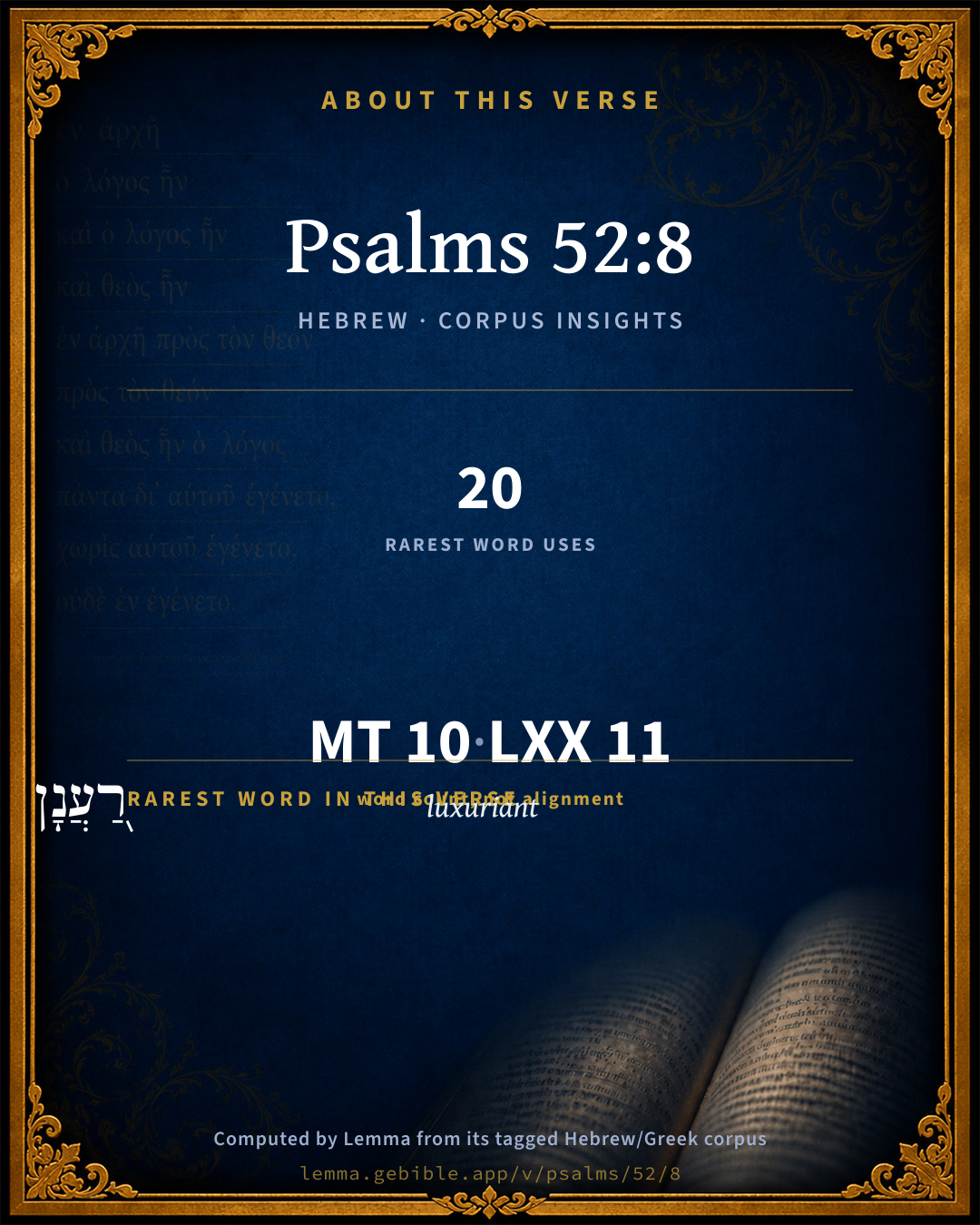
The rarest word here is רַ֭עֲנָן luxuriant H7488 — appearing just 20 times in the whole Hebrew Bible.

Shared distinctive vocabulary

רַ֭עֲנָן luxuriant H7488 occurs in 20 verses of the Hebrew Bible. Also found in:

Grammatical profile

  • 1 verb
  • 7 nouns
  • 1 adjective
  • 1 pronoun

Verb forms

  • בָּטַ֥חְתִּי Qal · Perfect

Repetition

A word recurs within this verse — often emphatic in Hebrew:

  • אֱלֹהִ֑ים God H430 ×2

Hebrew & Septuagint length

In English translation the verse runs 23 words from the Hebrew and 25 from the Septuagint (LXX English) — closely comparable.

A rough comparison of the two English renderings, which tokenize alike — not a word-level alignment.

Word counts can differ between the Hebrew and the Greek without any difference in meaning — e.g. the Hebrew direct-object marker אֵת has no separate Greek word, and Greek often adds the article ὁ.

In the original languages it is 10 Hebrew tokens and 11 Greek tokens — but the two are counted differently (Hebrew bundles its prefixes and suffixes into one token; the Greek is in lemma form), so that isn’t a like-for-like length.

Cross-references

9

Topical passages linked to Psalms 52:8 in the Treasury of Scripture Knowledge — connected by theme and wording, ordered by reader-vote popularity; previews shown in the World English Bible.

  • Psalms 92:12–14 The righteous shall flourish like the palm tree. He will grow like a cedar in Lebanon.
  • Psalms 1:3 He will be like a tree planted by the streams of water, That brings forth its fruit in its season, Whose leaf also does not wither. Whatever he does shall prosper.
  • Hosea 14:6–8 His branches will spread, And his beauty will be like the olive tree, And his fragrance like Lebanon.
  • Psalms 13:5 But I trust in your loving kindness. My heart rejoices in your salvation.
  • Jeremiah 11:16 Yahweh called your name, A green olive tree, beautiful with goodly fruit: with the noise of a great tumult he has kindled fire on it, and the branches of it are broken.
  • Psalms 147:11 Yahweh takes pleasure in those who fear him, In those who hope in his loving kindness.
  • Romans 11:24 For if you were cut out of that which is by nature a wild olive tree, and were grafted contrary to nature into a good olive tree, how much more will these, which are the natural branches, be grafted into their own olive tree?
  • Psalms 33:18 Behold, Yahweh's eye is on those who fear him, On those who hope in his loving kindness;
  • Psalms 128:3 Your wife will be as a fruitful vine, In the innermost parts of your house; Your children like olive plants, Around your table.

Cross-references courtesy of OpenBible.info (CC BY 4.0).

Hebrew and Greek witnesses Masoretic Hebrew ↔ Greek Septuagint

The same verse in the two great witnesses to the Old Testament, shown verse-for-verse.

You’re reading Greek Psalm 51 (Hebrew Psalm 52). The Septuagint counts the superscription, so verse numbers can differ from the Hebrew — chapter-level alignment, not verse-by-verse. Numbering follows Rahlfs.

These are two independent witnesses, not word-aligned to each other, and the Septuagint is shown in lemma (dictionary) form.

Hebrew Psalms 52:8 Masoretic · Westminster Leningrad Codex

וַאֲנִ֤י כְּזַ֣יִת רַ֭עֲנָן בְּבֵ֣ית אֱלֹהִ֑ים בָּטַ֥חְתִּי בְחֶֽסֶד אֱ֝לֹהִ֗ים עוֹלָ֥ם וָעֶֽד

But as for me, I am like a green olive tree in God's house. I trust in God's loving kindness forever and ever.

World English Bible · Public Domain

Greek LXX Greek Psalm 51:8 Septuagint · lemma form

καί ὁράω δίκαιος καί φοβέω καί ἐπί αὐτός γελάω καί εἶπον

But I am as a fruitful olive in the house of God: I have trusted in the mercy of God for ever, even for evermore.

LXX2012 (modern English Septuagint) · Public Domain

Hebrew: Westminster Leningrad Codex (CC BY 4.0). Greek: Septuagint (public domain); English from LXX2012 (modern English Septuagint) (Public Domain). How the Septuagint differs from the Hebrew →

Commentary

Notes on Psalms 52:8 from classic Christian and Jewish commentators (each source and its license shown beneath its notes). The classic Christian expositions comment on the surrounding passage and are grouped to its opening verse, so a note may address several verses; the Jewish commentaries on the Tanakh (Rashi and others) are per-verse, so they appear only where the commentator wrote on this verse.

Lemma curates 59 commentaries, every one of them public domain or Creative Commons licensed, each selected and text-cleaned for this edition rather than reprinted as found. About our sources →

Trapp's Complete Commentary

John Trapp

Psa 52:8 But I [am] like a green olive tree in the house of God: I trust in the mercy of God for ever and ever.

Ver. 8. But I am like a green olive tree, &c.] Thus, when Doeg blasted David, David blessed himself. Let him flourish in the court, I shall much more in the house of God. My name shall be precious among the saints when he stinketh above ground; he shall wither when I shall be fresh, flourishing, and fruitful.

I trust in the mercy of God] Not in riches, as Doeg; and this faith is the root of my fruitfulness, cheerfulness, &c. Gul. Parisiensis reporteth of true crystal, that by touching only it reviveth the decayed virtue of other precious stones; sure it is, that faith reviveth the virtue of other precious graces.

John Trapp, A Commentary or Exposition upon All the Books of the Old and New Testament (1647–1656) — public domain. Text from a community e-Sword module.

The Biblical Illustrator

Joseph S. Exell

Psa_52:8

I am like a green olive-tree in the house of God.

Life like a green olive-tree

The olive-tree loves fat soil. It attains to finest fruitfulness when its bed is rich in nutriment. Starve its soil, the tree remains dwarfed and impoverished. A recent traveller, describing the olive-yards of Palestine, says that the soil in which the finest olives grow is rich as a bride-cake. Now I think it is to this characteristic of a splendid olive-tree that the psalmist refers. He himself is like an olive-tree in the richness of his rootage. God is the soil of his life, and he exults in the wealth of his resources. Here is the possibility of every man: he may become rooted in God. But how little use we make of our resources! A little while ago I got a load of soil for the purposes of a small kitchen-garden, and the man who keeps my garden in order saw the soil and exclaimed, Thats a splendid bit of earth, its fit for potting work; you can get far more out of that than vegetables. The phrase at once acquired spiritual suggestiveness. I thought how little I was getting out of God, and how much He wishes me to have. He wants us to be like olive-trees that are rooted in almost inexhaustible resources. It is the apostolic figure; the Apostle Paul speaks of being rooted in Him. This, I think, is the first suggestion of the psalmists thought; he is like an olive-tree in the wealth of his resources. But he is also like the olive-tree in the vigour of his life. Currents of strength rise out of his resourceful rootage and endow them with spiritual vim and vitality. It is the purpose of our God that every one of our powers should move with firmness and decision. It is His will that there should be nothing weak about our moral and spiritual equipment. He wants everything not only to be beautiful, but to be strong. When we are rooted in Him every branch of the life is pervaded by rivers of sap, and every faculty is urged by Divine energy into manifold fruitfulness. The spiritual sap makes everything it pervades fruit for the King. When we are rooted in God everything is sappy. It may be a letter we are writing. It may be a wish we are expressing. It may be a bit of work we are doing. It may be our ordinary occupation, the drudgery of daily life. If we are rooted in God all the issues of the life are sappy with His Spirit, and we become like green olive-trees. Now let us look at the character in a little more detail. I trust in the mercy of God for ever and ever. What a strong and exquisite word is this word translated mercy. One element of its wealthy content is the suggestion of kindness, but it means more than this: Let me put it in this way: the word is descriptive in the first place of the attitude of bowing and coming quite near to the person, an immediate approach to a need. It is the act of the Good Samaritan stooping to the wounded, and pouring in oil and wine. It is pity in action, pity at work. But there is a second element in the word which greatly corroborates the first. Mercy is not only kindness, it is loyalty also. It is love that never says die. It remains full, flowing all through the changing seasons, even in the drought of a fierce indifference. It is the leal love of the Master Himself. Having loved His own lie loved them unto the end. This is the mercy of God, and in this mercy the psalmist declares he trusts for ever. Trusts! And there again is a significant word. It means to his for refuge, to take up your home in a thing, to settle down. It is a comfortable nestling in the leal love of the Lord. It is to be so sure of Him that worry and fretfulness pass away, and we are like little children, almost careless in our sense of gracious security. I will give thee thanks for ever. Here is another characteristic of the life that is like an olive-tree; it is a praiseful, thankful life. There is a sentence in one of Jane Austens novels which I think is very expressive. Describing one of her characters, she says, He was a very liberal thanker. I think that is very finely descriptive of a rich and welcome character. To be liberal thankers heavenward, as well as toward our fellows, is to receive continual spiritual enlargement. Gratitude makes room for more grace. And surely we have abundant opportunity for gratitude! We only need to open our eyes to have our praise awakened at every turn. Every time we express our thanks we make more room for God. I do not wonder, then, that this man, who was rooted in God like an olive-tree, should find himself instinctively and unceasingly bearing the fruit of gratitude and praise. And I will wait on Thy name, for it is good, in the presence of Thy saints. What will he wait on? The Lords name! And what names the Lord has given Himself, and every name a promise and a pledger He never goes back upon His name. Every name is honoured to the last extremity of its significance. And we can put in richer names than ever the psalmist could. We can insert the name Saviour, Comforter, Counsellor, Friend. On this name the psalmist says he will wait. That does not mean that he will sit down and indolently tarry until something turns up. It literally means that he will hind himself around the name of God, that he will decline every other support, that he will be wrapped around the covenant of the Lords own name. The man who does this will have reason for singing every day. He will find that the support holds, and day by day his experience of security will teach his lips a new song. And he says that he will do this waiting in the presence of Thy saints. That is to say, he will mingle with other people who are doing the same, he will make a profession of his willing confidence in God, and he will listen to similar professions made by others. In their mutual confidences they will give one another mutual support. Ah! yes, this kind of communion is always good. It nourishes the life like bread, it refreshes the life like water. Thou satisfiest my mouth with good things. (J. H. Jowett, M. A.)

I trust in the mercy of God for ever and ever.--

On trusting in the mercy of God

I. What mercy is.

1. Mercy, as an attribute of God, is not to be confounded with mere goodness. Goodness may demand the exercise of justice; indeed, it often does; but to say that mercy demands the exercise of justice is to use the word without meaning. Mercy asks that justice be set aside.

2. Mercy is a disposition to pardon the guilty. Desert is never the rule by which mercy-is guided; while it is precisely the rule of justice.

3. Mercy is exercised only where there is guilt. The penalty of the law must have been previously incurred, else there can be no scope for mercy.

4. Mercy can be exercised no further than one deserves punishment. If great punishment is deserved, great mercy can be shown; if endless punishment is due, there is then scope for infinite mercy to be shown, but not otherwise.

II. What is implied in trusting in the mercy of God.

1. A conviction of guilt.

2. That we have no hope on the score of justice. If we had anything to expect from justice, we should not look to mercy.

3. A just apprehension of what mercy is--pardon for the crimes of the guilty.

4. A belief that He is merciful. We could not trust Him if we had no such belief.

5. A conviction of deserving endless punishment.

6. A cessation from all excuses and excuse-making.

III. The conditions upon which we may confidently and securely trust in the mercy of God for ever.

1. Public justice must be appeased. Its demands must be satisfied. However much disposed God may be to pardon, yet He is too good to exercise mercy on any such conditions or under any such circumstances as will impair the dignity of His law, throw out a licence to sin, and open the very floodgates of iniquity. Jehovah never can do this.

2. We must repent.

3. We must confess our sins.

4. We must really make restitution, so far as lies in our power.

5. Another condition is that you really reform.

6. You must go the whole length in justifying the law and its penalty.

7. No sinner can be a proper object of mercy who is not entirely submissive to all those measures of the government that have brought him to conviction.

8. You must close in most cordially with the plan of salvation.

IV. Some mistakes into which many fall.

1. Many really trust in justice, and not in mercy. This is a fatal rock. The sinner who can do this calmly has never seen Gods law and his own heart.

2. Many trust professedly in the mercy of God without fulfilling the conditions on which only mercy can be shown. They may hold on in such trusting till they die--but no longer.

3. Sinners do not consider that God cannot dispense with their fulfilling those conditions. He has no right to do so. They spring out of the very constitution of His government, from His very nature, and must therefore be strictly fulfilled.

4. Many are defeating their own salvation by self-justification. Pleas that excuse self and cavils that arraign God, stand alike and fatally in the way of a pardon. Since the world began it has not been known that a sinner has found mercy in this state.

5. Many pretend to trust in mercy who yet profess to be punished for their sins as they go along. They hope for salvation through mercy, and yet they are punished for all their sins in this life. Two more absurd and self-contradictory things were never put together.

6. Persons who in the letter plead for mercy, often rely really upon justice. The deep conviction of sin and ill-desert does not sink into their soul till they realize what mercy is, and feel that they can rely on nothing else.

7. Some are covering up their sins, yet dream of going to heaven. Do they think they can hide those sins from the Omniscient Eye? Do they think to cover their sins and yet prosper, despite of Gods awful Word?

8. We cannot reasonably ask for mercy beyond our acknowledged and felt guilt; and they mistake fatally who suppose that they can. (C. G. Finney.)

The Biblical Illustrator, edited by Joseph S. Exell (c. 1880s–1900s) — public domain. Text from a community e-Sword module.

Joseph Benson's Commentary

Psa 52:8. I am like a green olive-tree — When Doeg and his brethren shall wither and perish, I, who have made God my refuge; I, whom he despised and persecuted, and thought to be in a desperate condition, shall be established and flourish; in the house of God — In God’s church, and among his people; or, in God’s tabernacle, from which Doeg shall be plucked away; but to which, I doubt not, I shall be restored. “One principal part of the happiness David promised himself was, that he should have a constant admission to the house of God, and the solemnities of his worship there; notwithstanding he was now driven from it by the malice of his enemies.” As “the olive-tree is an evergreen, and therefore of long duration,” and as it also “propagates itself by fresh shoots, being thus far, as it were, immortal; hence the psalmist compares himself to it, to denote the stability and perpetuity of his prosperity, and that of his family; adding, I trust in the mercy of God for ever and ever — His promises shall never fail; nor shall those who hate me rejoice over me in my destruction.”

Joseph Benson's Commentary on the Old and New Testaments (1811–1818) — public domain. Text from a community e-Sword module.

J. A. Alexander on Psalms

Joseph Addison Alexander

10. (Psa 52:8). And I (am) like a green olive-tree in the house of God, I have-trusted in the mercy of God (to) eternity and perpetuity. He expects not only the destruction of the wicked but his own salvation. To express the connection of the verses clearly, our idiom would require an adversative particle at the beginning, but I. See above, on Psa 2:6. A verdant fruitful tree is a favourite emblem of prosperity. See above, on Psa 1:3. The olive is here specified, as palms and cedars are in Psa 92:13-14 (12, 13). The imagery of the verse before us is copied in Jer 11:16. The house of God, the tabernacle, considered as his earthly residence, in which he entertains his friends and provides for his own household. See above, on Psa 15:1; Psa 22:6; Psa 27:4-5; Psa 36:9 (8). The mixed metaphors only show that the whole description is a figurative one, and should be so interpreted. have (already) trusted, which includes his present trust, but also includes more, to wit, that it is not a new or sudden impulse, but a settled habit of his soul. The two nouns, eternity and perpetuity, are combined in the adverbial sense of for ever and ever. See above, on Psa 10:16; Psa 21:5 (4), Psa 45:7 (6), Psa 48:14 (13). This qualifying phrase relates, not to the act, but to the object, of his trust. His meaning is not, "I will trust for ever in God's mercy," which would have required a future verb; but, "I have already trusted, and do still trust, in his mercy, as a mercy that will last for ever."

Joseph Addison Alexander, The Psalms Translated and Explained (1850) — public domain. Text from a community e-Sword module.

Tyndale Open Study Notes

Tyndale Open Resources

52:8-9 The psalmist commits himself to a life of trust in the Lord. • An olive tree lives a long time when cared for (1:3; 128:3). The psalmist desires to be close to the Lord, his Savior and the source of his blessing (18:6; 23:6).

Tyndale Open Study Notes — © Tyndale Open Resources, licensed CC BY-SA 4.0. Text via the HelloAO Bible API.

Geneva Bible (1599)

Geneva Bible translators

He rejoiceth to have a place among the servants of God, that he may grow in the knowledge of godliness.

Geneva Bible (1599) marginal notes — public domain. Text via Bolls.life.

Jamieson, Fausset & Brown

Robert Jamieson, A. R. Fausset & David Brown

The figure used is common (Psa 1:3; Jer 11:16).

green--fresh.

house, &c.--in communion with God (compare Psa 27:4-5).

for ever and ever--qualifies "mercy."

Jamieson, Fausset & Brown — Commentary Critical and Explanatory on the Whole Bible (1871) — public domain (CC PDM 1.0). Text via the HelloAO Bible API.

Adam Clarke's Commentary

Verse 8. But I am like a green olive-tree in the house of God] I shall be in the house of God, full of spiritual vigour, bringing forth evergreen leaves and annual fruit, as the olive does when planted in a proper soil and good situation. It does not mean that there were olive-trees planted in God's house; but he was in God's house, as the olive was in its proper place and soil.

I trust in the mercy of God] The wicked man trusts in his riches: I trust in my God. He, like a bad tree, bringing forth poisonous fruit, shall be cursed, and pulled up from the roots; I, like a healthy olive in a good soil, shall, under the influence of God's mercy, bring forth fruit to his glory. As the olive is ever green, so shall I flourish in the mercy of God for ever and ever.

Adam Clarke's Commentary on the Bible (1810–1826) — public domain. Text from a community e-Sword/MySword module.

John Calvin's Commentaries

8 But I am like a green olive-tree We have seen that David was enabled, by the exercise of faith, to look down upon the worldly grandeur of Doeg with a holy contempt; and now we find him rising superior to all that was presently afflictive in his own condition. Though, to appearance, he more resembled the withered trunk of a tree which rots upon the ground, he compares himself, in the confidence of coming prosperity, to a green olive. I need not say that the destruction of Doeg could only communicate comfort to his mind, in the way of convincing him that God was the avenging judge of human cruelty, and leading him to infer that, as he had punished his wrongs, so he would advance him to renewed measures of prosperity. From his language, it appears that he could conceive of no higher felicity in his condition than being admitted amongst the number of the worshippers of God, and engaging in the exercises of devotion. This was characteristic of his spirit. We have already had occasion to see that he felt his banishment from the sanctuary of God more keenly than separation from his consort, the loss of worldly substance, or the dangers and hardships of the wilderness. The idea of an allusion being here made, by way of contrast, to Doeg, who came to the tabernacle of the Lord merely as a spy, and under hypocritical pretexts, is strained and far-fetched. It is more natural to suppose that David distinguishes himself from all his enemies, without exception, intimating that, though he was presently removed from the tabernacle, he would soon be restored to it; and that they who boasted of possessing, or rather monopolising, the house of God, would be rooted out of it with disgrace. And here let us engrave the useful lesson upon our hearts, that we should consider it the great end of our existence to be found numbered amongst the worshippers of God; and that we should avail ourselves of the inestimable privilege of the stated assemblies of the Church, which are necessary helps to our infirmity, and means of mutual excitement and encouragement. By these, and our common Sacraments, the Lord, who is one God, and who designed that we should be one in him, is training us up together in the hope of eternal life, and in the united celebration of his holy name. Let us learn with David to prefer a place in the house of God to all the lying vanities of this world. He adds the reason why he should be like the green olive-tree — because he hoped in the goodness of God; for the causal particle appears to be understood. And in this he adverts to the contrast between him and his enemies. They might flourish for a time, spread their branches far and wide, and shoot themselves up to a gigantic stature, but would speedily wither away, because they had no root in the goodness of God; whereas he was certain to derive from this source ever renewed supplies of sap and vigor. As the term of his earthly trials might be protracted, and there was a danger that he might sink under their long continuance, unless his confidence should extend itself far into futurity, he declares expressly that he would not presume to prescribe times to God, and that his hopes were stretched into eternity. It followed that he surrendered himself entirely to God in all that regarded this life or his death. The passage puts us in possession of the grand distinction between the genuine children of God and those who are hypocrites. They are to be found together in the Church, as the wheat is mingled with the chaff on the same threshing-floor; but the one class abides for ever in the steadfastness of a well-founded hope, while the other is driven away in the vanity of its false confidences.

John Calvin's Commentaries (1540-1563) — public domain. Text from the Calvin Translation Society English edition (1840s-50s) via the Christian Classics Ethereal Library (ccel.org). Calvin's coverage is partial (roughly two-thirds of the Bible); uncommented books and verses are honest gaps, never fabricated. The 19th-century editor's footnotes and remarks are omitted so the notes are faithfully Calvin's own voice.

Ellicott's Commentary for English Readers

(8) But I am like.—The flourishing olive alternates with the vine, in Hebrew poetry, as an emblem of prosperous Israel. (See Jer_11:16; Hos_14:6.) The epithet “green” hardly refers to the colour so much as the “vigour” of the tree, for the foliage of “wan grey olive wood” cannot be called verdant. But though the olive is scarcely, to our Western eyes, a beautiful tree, “to the Oriental the coolness of the pale-blue foliage, its evergreen freshness, spread like a silver sea along the slopes of the hills, speaks of peace and plenty, food and gladness” (Tristram, Nat. Hist. of the Bible, p. 374).

In the house of God.—Here and in the more elaborate simile (Psa_92:13) the situation, “in the house of God,” is added to show that the prophecy has come of religious trust. It is quite possible that trees were actually planted in the precincts of the Temple, as they are in the Haram area now, so that the rendering, “near the house of God,” would express a literal fact. Or the whole may be figurative, as in the verse, “like the olive branches round about Thy table.”

A Bible Commentary for English Readers, edited by Charles John Ellicott (1878–1897) — public domain. Text from a community e-Sword module.

The Cambridge Bible for Schools and Colleges

gen. ed. J. J. S. Perowne

8. But I am like a green olive tree] R.V., But as for me, I am like a green olive tree, rightly emphasising the contrast between the fate of the wicked man and the hopes of the speaker. But who is the speaker? Is it, as is commonly supposed, the Psalmist? or is the speech of the righteous in Psa_52:7 continued, but with a transition to the singular, in order more forcibly to express the personal faith of each individual? It makes little difference to the sense: the Psalmist, if he is the speaker, speaks as the representative of the righteous.

like a green olive tree in the house of God] It is possible (cp. Psa_92:13) that trees grew in the temple courts, as they grow at the present day in the Haram area, and that he compares his prosperity and security to that of the carefully tended trees planted in sacred ground. But more probably two figures are combined. He is like an evergreen olive tree, while the wicked man is rooted up: he is God’s guest, enjoying His favour and protection. For the metaphor of the tree cp. Jer_11:16; Hos_14:8 (of the nation); Psa_1:3; Psa_92:12 ff: and for that of the guest see Psa_23:6; Psa_27:4; Psa_15:1. Note too that God’s house may mean the land of Israel (Hos_9:15), in which the righteous dwells securely while the wicked man is driven out of it (Psa_52:5).

mercy] Rather, lovingkindness, as in Psa_52:1.

The Cambridge Bible for Schools and Colleges (gen. ed. J. J. S. Perowne; Cambridge University Press, 1878–1918) — public domain. Text from a community e-Sword module.

John Gill's Exposition

But I am like a green olive tree in the house of God,.... Or rather it should be supplied, "I shall be" (d); since David was at this time an exile from the house of God: and this expresses his faith and confidence, that, notwithstanding his present troubles, he should be restored again, and be in a very flourishing condition, in the church of God; which is here meant by "the house of God": it being of his building, and where he dwells, and where to have a place is the great privilege of the saints; they are planted there by the Lord himself, and shall never be rooted up; they are fixed there, and shall never go out; which was David's confidence, Psa 23:6; and where he believed he should be as "a green olive tree"; which is a very choice and fruitful tree, has fatness in it, produces an excellent oil; is beautiful to look at; delights in hot climates and sunny places; is found on mountains, we read of the mount of Olives; is ever green and durable, and its leaves and branches are symbols of peace: all which is applicable to truly righteous persons and believers in Christ; who are the excellent of the earth, are filled with the fruits of righteousness; are fat and flourishing; have the oil of grace, the anointing which teacheth all things; are a perfection of beauty, made perfectly comely through Christ's comeliness; thrive under him, the sun of righteousness; grow in the mountain of the Lord's house, the church: their grace is incorruptible, their leaf withers not; they are rooted in Christ, and ever continue; they are the sons of peace, and their last end will be eternal peace. Now as such David was assured he should be, when his enemy would be rooted up out of the land of the living, and cast like a dry and worthless branch into everlasting burnings; the ground of which confidence follows:

I trust in the mercy of God for ever and ever; the mercy of God is not only an encouragement to trust, but the object of it; not the absolute mercy of God, but the grace and goodness of God in Christ Jesus, which endures continually, Psa 52:1; and so does hope in it, which never makes ashamed, but abides to the end. The psalmist seems to have respect to the mercy promised him, that he should sit upon the throne. This he believed, and therefore was assured he should be in the flourishing circumstances in the house of God before mentioned.

(d) "Ero", Piscator, Cocceius, Gejerus.

John Gill's Exposition of the Whole Bible (1746–1763) — public domain (CC PDM 1.0). Text via the HelloAO Bible API.

Albert Barnes' Notes on the Bible

But I am like a green olive-tree in the house of God - I am safe and happy, notwithstanding the effort made by my enemy, the informer, to secure my destruction. I have been kept unharmed, like a green and flourishing tree - a tree protected in the very courts of the sanctuary - safe under the care and the eye of God. A green tree is the emblem of prosperity. See Psa 1:3, note; Psa 37:35, note; compare Psa 92:12. The “house of God” here referred to is the tabernacle, considered as the place where God was supposed to reside. See Psa 15:1, note; Psa 23:6, note; Psa 27:4-5, notes. The particular allusion here is to the “courts” of the tabernacle. An olive tree would not be cultivated in the tabernacle, but it might in the “courts” or “area” which surrounded it. The name “house of God” would be given to the whole area, as it was afterward to the entire area in which the temple was. A tree thus planted in the very courts of the sanctuary would be regarded as sacred, and would be safe as long as the tabernacle itself was safe, for it would be, as it were, directly under the divine protection. So David had been, notwithstanding all the efforts of his enemies to destroy him.

I trust in the mercy of God forever and ever -

(a) I “have” always done it. It has been my constant practice in trouble or danger.

(b) I “will” always do it.

As the result of all my experience, I will still do it; and thus trusting in God, I shall have the consciousness of safety.

Albert Barnes' Notes on the Bible (1834–1885) — public domain. Text from a community e-Sword/MySword module.

Matthew Poole's English Annotations

I am like a green olive tree; when Doeg and his brethren shall wither and perish, I, who have made God my refuge, I, whom he despised and persecuted, and thought to be in a desperate condition, shall be established and flourish.

In the house of God; either,

1. In God’s church, or among his people. Or,

2. In God’s tabernacle, from which Doeg shall be plucked away, Psa 52:5, and from which I am now banished by the tyranny and malice of this man, and his confederates; but, I doubt not, I shall be restored to it, and dwell in it all the days of my life, which is the one thing that I desire, Psa 27:4.

Matthew Poole's English Annotations on the Holy Bible (1683–1685) — public domain. Text from a community e-Sword/MySword module.

The Treasury of David

Charles H. Spurgeon

Ver. 8. But I, hunted and persecuted though I am, am like a green olive tree. I am not plucked up or destroyed, but am like a flourishing olive, which out of the rock draws oil, and amid the drought still lives and grows. In the house of God. He was one of the divine family, and could not be expelled from it; his place was near his God, and there was he safe and happy, despite all the machinations of his foes. He was bearing fruit, and would continue to do so when all his proud enemies were withered like branches lopped from the tree. I trust in the mercy of God for ever and ever. Eternal mercy is my present confidence. David knew God's mercy to be eternal and perpetual, and in that he trusted. What a rock to build on! What a fortress to fly to!

Ver. 8. (first clause):

"But I am olive charged with fruit

In fertile soil that grows."

This appears to express of the Hebrew words, which our translators render, like a green olive tree, but which in reality have no reference to the colour, but to the flourishing, vigorous, and thriving state of the plant; just as Homer gives it the epithet of "luxuriant, "and "flourishing; "and Ovid that of "ever flourishing." The fact is, the colour of the leaves of this tree is not a bright lively green; but a dark, disagreeable, or yellowish one. Scheuchzer describes the leaves, as "superne coloris atrovirentis, vel in viridi flavescentis." An English traveller, writing from Italy, thus expresses his disappointment about the olive tree: --"The fields, and indeed the whole face of Tuscany, are in a manner covered with olive trees; but the olive tree does not answer the character I have conceived of it. The royal psalmist and some of the sacred writers, speak with rapture of the `green olive tree, 'so that I expected a beautiful green; and I confess to you, I was wretchedly disappointed to find its hue resembling that of our hedges when they are covered with dust." I have heard other travellers express the same feeling of disappointment. "The true way of solving the difficulty, "as Harmer properly remarks, "is to consider the word translated `green, 'not as descriptive of colour, but of some other property; youthfulness, vigour, prosperity, or the like." Richard Mant.

Ver. 8. Green olive tree in the house of God. Several expositors fancifully imagine that olive trees grow in certain of the courts of the Tabernacle; but the notion must not be endured, it would have been too near an approach to the groves of the heathen to have been tolerated, at least in David's time. The text should surely be read with some discretion; the poet does not refer to olive trees in God's house, but compares himself in the house of God to an olive tree. This reminds us of the passage, "Thy children like olive plants around thy table, "where some whose imaginations have been more lively than their judgments, have seen a table surrounded, not with children, but with olive plants. Whoever, in the realms of common sense, ever heard of olive plants round a table? If, as Thrupp supposes, Nob was situated upon the Mount of Olives, we can, without any conjecture, see a reason for the present reference to a flourishing olive tree. C. H. S.

Ver. 8. The believer's character, position, confidence, and continuance.

Psalms 52:9*

Charles H. Spurgeon's The Treasury of David (1869–1885) — public domain. Psalms only. Text from a community e-Sword/MySword module.

Whedon's Commentary on the Bible

Daniel D. Whedon

8. But I am like a green olive tree—The contrast now appears between the psalmist and his enemies. These had been uprooted, (Psa_52:5,) he had taken deeper root and had sent out a more fruitful branch. The olive was the emblem of peace, riches, prosperity and beauty, Gen_8:11; Hab_3:17; Hos_14:6.

In the house of God—The idea of the “olive tree in the house of God,” Stanley suggests, is borrowed from the choice trees, (among which was “the venerable olive,”) planted of old in the sacred enclosure of the temple, and then, as now in the same place, (the Harem es-Sherif, or noble Sanctuary of the Moslems,) proverbial for their beauty and sanctity. David knew no piety that was not rooted in God, and fed by the ordinances of his house. Though now exiled and persecuted, he was in union and fellowship with all lovers of the true Church.

Daniel D. Whedon (gen. ed.), Commentary on the Old and New Testaments (1874–1909) — public domain. Text from a community e-Sword module.

The Pulpit Commentary

But I am like a green olive tree in the house of God. In conclusion, the psalmist contrasts his own condition, as one of God"s people, with that of Doeg, which he had described in vers. 7-9. Doeg is about to be "plucked up" and "rooted out of the land of the living" (ver. 5); he is like a flourishing green olive tree planted in the sanctuary, or "house of God." Doeg is entirely without any trust in the Almighty (ver. 7); he declares of himself, I trust in the mercy of God for ever and ever. It is questioned whether olive trees were at any time planted in the courts of either the tabernacle or the temple; but it certainly cannot be proved that they were not. In the courts of Egyptian temples trees were abundant (Herod., 2:138; Wilkinson, in the author"s "Herodotus," vol. 2. p. 236), also probably in Phoenician temples (Perrot and Chipiez, "Histoire de l"Art dans l"An-tiquite," vol. 3. p. 322). And to this day there grow in the Hardin area at Jerusalem, on the site of the Jewish temple, a number of magnificent cypresses, olive, and lemon trees.

The olive an emblem of the gifts and graces of the Holy Spirit.

"I am like a green olive tree," etc. In Psalm 92 the righteous are compared to two of the noblest trees the queenly palm and the imperial cedar. In Psalm 1 to an evergreen tree that loves to grow by flowing waters the orange or citron, crowned at once with silver blossom and golden fruit. Here a less majestic tree is chosen, yet one which plays a great part in Scripture the olive, whose golden oil, from its ordinary plentiful use in food and in light, and from its rare sacredness in the anointing of kings, priests, and prophets, is the constant emblem of the graces and gifts of the Holy Spirit.

I The lesson common to all these similitudes palm, cedar, citron, olive; and what our Lord adds, the vine and its branches, is this: EACH CHRISTIAN LIFE MUST HAVE ITS OWN ROOT, AND SHOULD EXHIBIT A BEAUTY AND A FRUITFULNESS OF ITS OWN The image is in strong contrast with the picture of the ungodly man. (ver. 7; cf. Psa_37:35 Joh_15:6) "I for my part, whatever others may think or say, desire, or do I choose my part here, in Christ: "rooted and grounded in his love." "Green," q.d. flourishing; full of life and beauty; and no less of fruit a flourishing olive tree.

II Nevertheless, THE HOME OF THE CHRISTIAN LIFE IS IN THE CHURCH OF GOD, OF WHICH THE ANCIENT TEMPLE WAS THE SHADOW. (Eph_2:20-22 1Co_3:16) Trees could not grow, of course, in the temple, strictly so called; but in the ample space of the "Court of the Gentiles" ("the mountain of the house"), olive berries were likely to be dropped and take root.

Vers. 8, 9. Here we have The testimony of a saint, confirmed as "good" by all the saints.

I THE CHARACTER OF THE SAINTS. "I am like a green olive tree." The olive was remarkable for life, beauty, and usefulness. Habakkuk speaks of the "labours of the olive"; (Hab_3:17) Jeremiah, of its "goodly fruit"; (Jer_11:16) and Hosed, of its "beauty". (Hos_14:6) It was therefore a fitting symbol of God"s people, (Rom_11:16) who are adorned with the beauty of holiness, and bear fruit to the praise of God.

II THE OCCUPATIONS OF THE SAINTS.

1. The first thing named is trusting. "I trust in the mercy of God." The wisdom, the power, the faithfulness, of God all command our trust; but "mercy," what is most needed and always needed, is here singled out. The next thing is:

2. Praising. "I will praise thee for ever." Looking to the past, the present, and the future, countless reasons rise up for praise. What God has done is proof and promise of what he will do.

3. Waiting" is the last thing mentioned. "I will wait on thy Name." God"s Name is himself, in all that he is and says and does. The more clearly and fully we know God"s Name, the more will our hearts go forth to him in love and hope. Waiting upon him ever brings refreshment, and invigorates our souls for new endeavour.

III THE HOME OF THE SAINTS. "The house of God. So it is here. So it will be hereafter. The saints are happy in their being, secure in their possessions, joyous in their prospects. There are ever light, and sweetness, and holy companionships, and delightful employments, where they dwell. Heaven is their eternal home. W.F.

The Pulpit Commentary (1880–1919), ed. H.D.M. Spence-Jones & Joseph S. Exell — public domain. Text from a community e-Sword module.

John Wesley's Explanatory Notes

The house - In God's church, or among his people.

John Wesley, Explanatory Notes Upon the Whole Bible (1754–1765) — public domain. Text via the GEBible commentary corpus.

Keil & Delitzsch

C. F. Keil & F. Delitzsch

The gloomy song now brightens up, and in calmer tones draws rapidly to a close. The betrayer becomes like an uprooted tree; the betrayed, however, stands firm and is like to a green-foliaged olive (Jer 11:16) which is planted in the house of Elohim (Psa 90:14), that is to say, in sacred and inaccessible ground; cf. the promise in Isa 60:13. The weighty expression כּי עשׂית refers, as in Ps 22:32, to the gracious and just carrying out of that which was aimed at in the election of David. If this be attained, then he will for ever give thanks and further wait on the Name, i.e., the self-attestation, of God, which is so gracious and kind, he will give thanks and "wait" in the presence of all the saints. This "waiting," ואקוּה, is open to suspicion, since what he intends to do in the presence of the saints must be something that is audible or visible to them. Also "hoping in the name of God" is, it is true, not an unbiblical notional combination (Isa 36:8); but in connection with שׁמך כי טוב which follows, one more readily looks for a verb expressing a thankful and laudatory proclamation (cf. Ps 54:8). Hitzig's conjecture that we should read ואחוּה is therefore perfectly satisfactory. נגד חסידיך does not belong to טוב, which would be construed with בּעיני htiw deurtsnoc , and not נגד, but to the two votive words; cf. Psa 22:26; Psa 138:1, and other passages. The whole church (Psa 22:23., Psa 40:10.) shall be witness of his thankfulness to God, and of his proclamation of the proofs which God Himself has given of His love and favour.

Keil & Delitzsch — Biblical Commentary on the Old Testament (1861–1891) — public domain (CC PDM 1.0). Text via the HelloAO Bible API. (Old Testament only.)

unfoldingWord translationNotes

Door43 World Missions Community

a green olive tree

Green olive trees are strong and secure. They do not fall over.

I am like a green olive tree in God's house

Being safe and secure is spoken of as being like a strong tree. AT: "I am strong in God's house, like a green olive tree" or "Because I worship in God's house, I am secure like a green olive tree" (See: Simile)

in God's house

This refers to God's temple.

I will trust in the covenant faithfulness of God forever and ever

The abstract noun "faithfulness" can be translated with an adjective. AT: "I will trust in God forever and ever because he is faithful to his covenant" (See: Abstract Nouns)

I will wait for your name, because it is good

God's name represents God himself. Waiting for God represents waiting for God to help him. AT: "I will wait for you, because you are good" or "I will wait for you to help me, because you are good" (See: Metonymy)

translationWords

olive

house

trust

covenant faithfulness

eternity

name

godly

unfoldingWord translationNotes — © Distant Shores Media and the Door43 World Missions Community, licensed CC BY-SA 4.0. Source: git.door43.org/Door43/en_tn.

Rashi

Rabbi Shlomo Yitzchaki (Rashi)

and laugh at him And this is the ridicule they will say about him: “Behold! This is the man who does not place his trust in the Holy One, blessed be He. See what happened to him.”

Rashi on the Tanakh — English translations: “The Judaica Press complete Tanach with Rashi, translated by A. J. Rosenberg” (CC BY 4.0); “Pentateuch with Rashi's commentary by M. Rosenbaum and A.M. Silbermann, 1929-1934” (public domain); “The Metsudah Tanach series, Lakewood, N.J” (CC BY 4.0); and “The Book of Joshua, Metsudah Publications, 1997” (CC BY 4.0). Text via Sefaria.

Lesson kit

Teaching starters — assembled from the data on this page, not authored interpretation. Every prompt links to the verse data it draws on. Edit before teaching.

Psalms, in the Wisdom, opens this verse with 10 words (9 distinct Hebrew lemmas). Its most distinctive word is raʻănân (“luxuriant”). A historical commentator’s framing appears above. Read the whole chapter for the surrounding context.

Discussion questions

  1. The word raʻănân carries the sense “luxuriant.” How does it shape the verse?
  2. How does Deuteronomy 12:2, which shares the word «luxuriant», read alongside this verse?
  3. What does the repetition of “God” (2× in this one verse) do in this verse?
  4. These translations render this verse differently. What is at stake in choosing one wording over another?
  5. «בָּטַ֥חְתִּי» is a Qal Perfect verb. How does that grammatical form shape the action described?
  6. Compare how Trapp's Complete Commentary and The Biblical Illustrator read this verse. Where do they agree or differ?

Things to notice

Reading settings

Reading text

Shown beneath each verse's original-language words.

Old Testament
Old Testament edition

Read the OT as the Masoretic Hebrew (MT) or the Greek Septuagint (LXX).

English shown for the Greek Septuagint (in the Hebrew ↔ Greek comparison).

Comparing translations? Open the Compare panel on any verse page to stack up to four side by side.