
Psalms 146:3

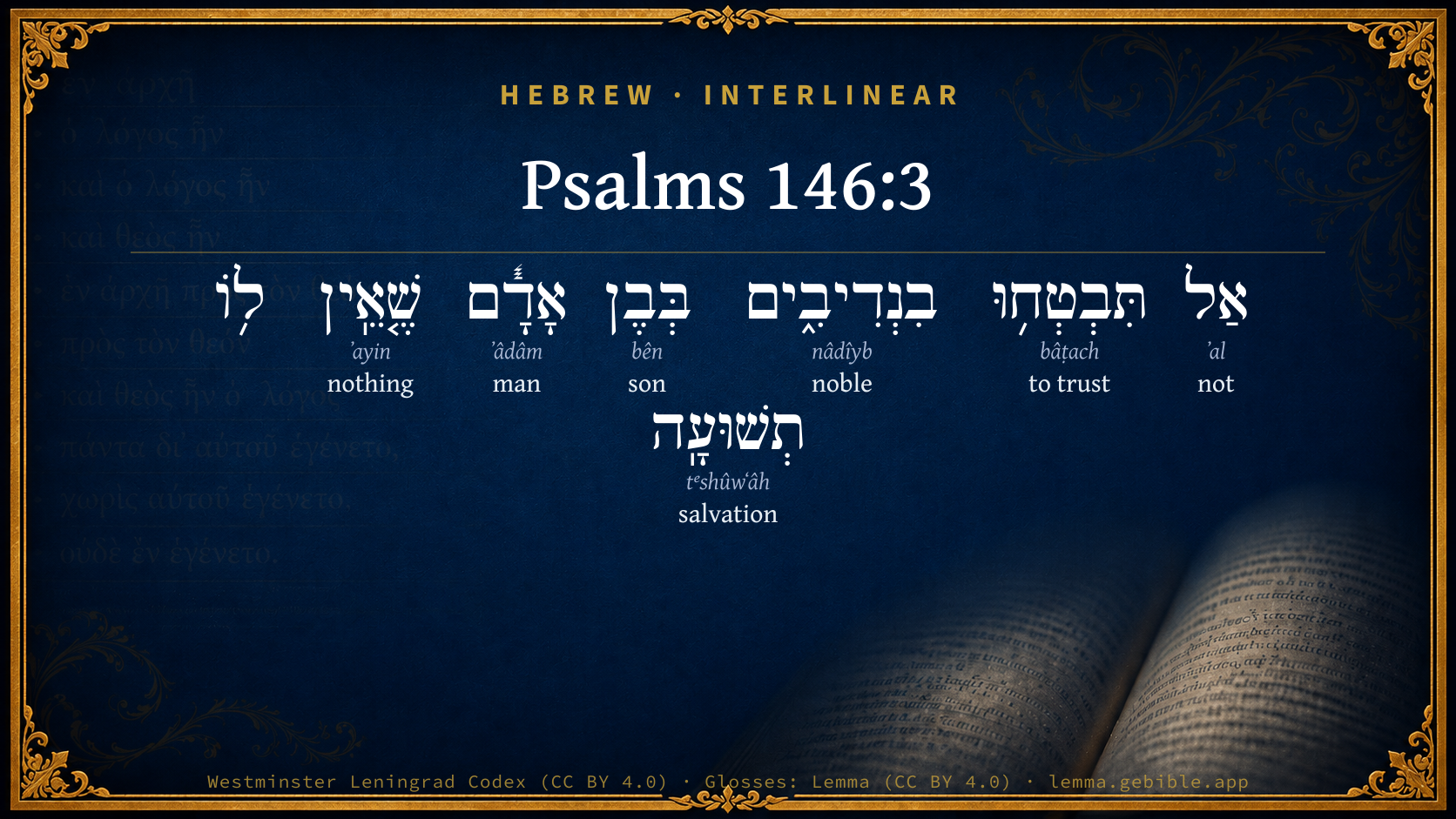
Hebrew (Westminster Leningrad Codex) Psalms 146:3 appears in the Hebrew Old Testament. The text above is from the Westminster Leningrad Codex. Each word links to its Strong’s number, a concise gloss, and parsing drawn from the Open Scriptures Hebrew Bible morphology. Click any word for its full Brown-Driver-Briggs (BDB) entry.
Download image
Cite this verse

Psalms 146:3 (World English Bible). Public Domain. Lemma interlinear Bible study tool, https://lemma.gebible.app/v/psalms/146/3.

Show BibTeX & RIS
BibTeX
RIS
English Translation
Don't put your trust in princes, Each a son of man in whom there is no help.
World English Bible · Public Domain
Download a study sheet

One document with this verse’s original text, its word-by-word gloss line, the meaning frame, cross-references with their text, attributed commentary, and full source and license credits — printable, and it pastes into notes with its structure intact.

This verse Autodidact and up

Study sheet (.html) Plain text (.txt)

A passage Seminary Student

Up to 50 verses in one chapter. A passage sheet keeps up to 6 commentary sources and 12 cross-references per verse, in the order this page ranks them, and says so on the sheet whenever that leaves anything out. Ask for a single verse and you get the Autodidact verse sheet above.

Everything on this page stays free to read, with no account — the sheet is a download of what is already on screen, not access to it.

Want to remove ads? Support Godless Engineer
Compare translations 3

The same verse in 3 English versions, stacked beneath the original-language interlinear above. Click any original word for its lexicon entry.

Each is an independent rendering of the whole verse — the interlinear is not word-aligned to these translations.

Highlighted words mark where these versions differ — a whole-verse word diff, not a word-by-word alignment.

  • World English Bible Public Domain
    Don't put your trust in princes, Each a son of man in whom there is no help.
  • King James Version Public Domain
    Put not your trust in princes, nor in the son of man, in whom there is no help.
  • unfoldingWord Literal Text CC BY-SA 4.0
    Do not trust in nobles, in the son of man, in whom there is no salvation.

unfoldingWord Literal Text — © unfoldingWord, licensed CC BY-SA 4.0. Word-aligned USFM3 via Door43 (git.door43.org/unfoldingWord/en_ult).

Versions to compare (up to 4)

3 of 4 selected

Show all 18 translations

Every available English version of this verse, each an independent rendering of the whole verse.

  • World English Bible Public Domain
    Don't put your trust in princes, Each a son of man in whom there is no help.
  • Berean Standard Bible Public Domain
    Put not your trust in princes, in mortal man, who cannot save.
  • Majority Standard Bible Public Domain
    Put not your trust in princes, in mortal man, who cannot save.
  • King James Version Public Domain
    Put not your trust in princes, nor in the son of man, in whom there is no help.
  • American Standard Version (1901) Public Domain
    Put not your trust in princes, Nor in the son of man, in whom there is no help.
  • Revised Version (1885) Public Domain
    Put not your trust in princes, nor in the son of man, in whom there is no help.
  • Geneva Bible (1599) Public Domain
    Put not your trust in princes, nor in the sonne of man, for there is none helpe in him.
  • Douay-Rheims (1899) Public Domain
    Great is the Lord, and greatly to be praised: and of his greatness there is no end.
  • Young's Literal Translation Public Domain
    Trust not in princes -- in a son of man, For he hath no deliverance.
  • Literal Standard Version CC BY-SA 4.0
    Do not trust in princes—in a son of man, || For he has no deliverance.
  • Unlocked Literal Bible CC BY-SA 4.0
    Do not put your trust in princes or in mankind, in whom there is no salvation.
  • unfoldingWord Literal Text CC BY-SA 4.0
    Do not trust in nobles, in the son of man, in whom there is no salvation.
  • Darby Bible Public Domain
    Put not confidence in nobles, in a son of man, in whom there is no salvation.
  • World Messianic Bible Public Domain
    Don’t put your trust in princes, in a son of man in whom there is no help.
  • Webster's Bible Public Domain
    Put not your trust in princes, nor in the son of man, in whom there is no help.
  • Free Bible Version CC BY-SA 4.0
    Don't put your confidence in human leaders—they can't save you.
  • Bible in Basic English Public Domain
    Put not your faith in rulers, or in the son of man, in whom there is no salvation.
  • JPS Tanakh (1917) Public Domain
    Put not your trust in princes, nor in the son of man, in whom there is no help.

Literal Standard Version (2020), Covenant Press — licensed CC BY-SA 4.0. Text via the HelloAO Bible API (eBible.org). Unlocked Literal Bible (unfoldingWord) — licensed CC BY-SA 4.0. Text via the HelloAO Bible API (eBible.org). unfoldingWord Literal Text — © unfoldingWord, licensed CC BY-SA 4.0. Word-aligned USFM3 via Door43 (git.door43.org/unfoldingWord/en_ult). Free Bible Version, Dr. Jonathan Gallagher — licensed CC BY-SA 4.0. Text via the HelloAO Bible API (eBible.org).

Word by word

More ways to search: Search by grammar → Find every occurrence → Compare this word →

Practice this passage: Drill this verse → Learn its vocabulary →

בִנְדִיבִ֑ים
nâdîyb
H5081
“in/at · noble”
Preposition + Adjective, Adjective, Masculine, Plural, Absolute
Part of Speech
Preposition + Adjective
Type
Adjective
Gender
Masculine
Number
Plural
State
Absolute
Full BDB Definition

Origin: from H5068

TWOT: 1299b

inclined, willing, noble, generous (adjective) - incited, inclined, willing - noble, princely (in rank) - noble (in mind and character) - noble one (noun masculine)
  1. אַל ʼal H408 “not” Particle, Negative
  2. תִּבְטְח֥וּ bâṭach H982 “to trust” Verb, Qal, Jussive, 2nd Person, Masculine, Plural
  3. בְּבֶן bên H1121 “in/at · son of” Preposition + Noun, Common, Masculine, Singular, Construct
  4. אָדָ֓ם ʼâdâm H120 “man” Noun, Common, Masculine, Singular, Absolute
  5. שֶׁ֤אֵֽין ʼayin H369 “who/which · nothing” Particle, Relative + Particle, Negative
  6. תְשׁוּעָֽה tᵉshûwʻâh H8668 “salvation” Noun, Common, Feminine, Singular, Absolute

About this verse

These counts appear in no published source. They are computed here, from the morphology-tagged text and Lemma’s own curated glosses. What Lemma adds →

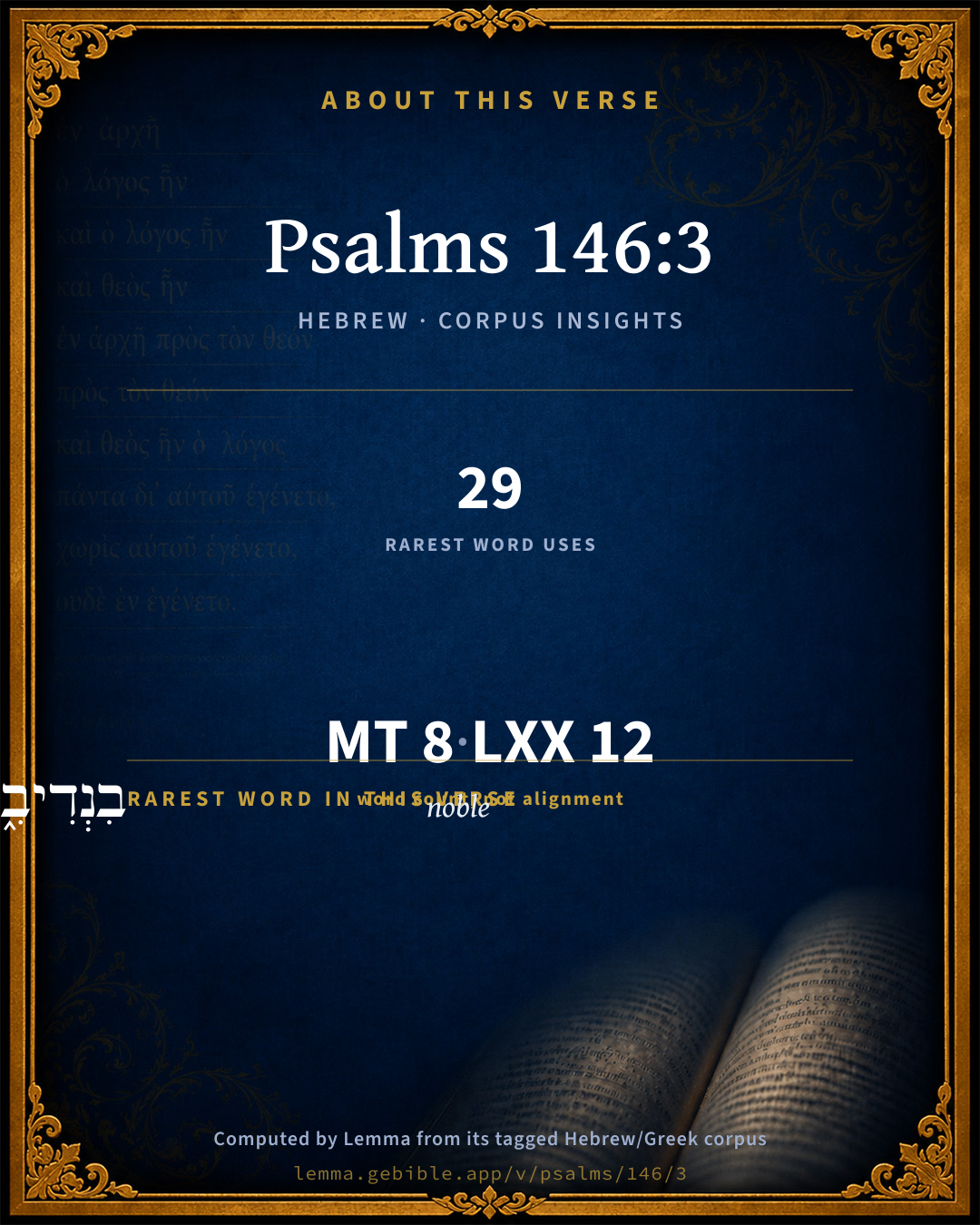
8
words
7
distinct lemmas
Wisdom
section

Shared distinctive vocabulary

בִנְדִיבִ֑ים noble H5081 occurs in 26 verses of the Hebrew Bible. Also found in:

Grammatical profile

  • 1 verb
  • 3 nouns
  • 1 adjective
  • 1 preposition
  • 2 particles

Verb forms

  • תִּבְטְח֥וּ Qal · Jussive

Hebrew & Septuagint length

In English translation the verse runs 17 words from the Hebrew and 16 from the Septuagint (LXX English) — closely comparable.

A rough comparison of the two English renderings, which tokenize alike — not a word-level alignment.

Word counts can differ between the Hebrew and the Greek without any difference in meaning — e.g. the Hebrew direct-object marker אֵת has no separate Greek word, and Greek often adds the article ὁ.

In the original languages it is 8 Hebrew tokens and 12 Greek tokens — but the two are counted differently (Hebrew bundles its prefixes and suffixes into one token; the Greek is in lemma form), so that isn’t a like-for-like length.

Cross-references

8

Topical passages linked to Psalms 146:3 in the Treasury of Scripture Knowledge — connected by theme and wording, ordered by reader-vote popularity; previews shown in the World English Bible.

  • Psalms 118:8–9 It is better to take refuge in Yahweh, Than to put confidence in man.
  • Jeremiah 17:5–6 Thus says Yahweh: Cursed is the man who trusts in man, and makes flesh his arm, and whose heart departs from Yahweh.
  • Isaiah 2:22 Stop trusting in man, whose breath is in his nostrils; For of what account is he?
  • Psalms 108:12 Give us help against the enemy, For the help of man is vain.
  • Isaiah 31:3 Now the Egyptians are men, and not God; and their horses flesh, and not spirit: and when Yahweh shall stretch out his hand, both he who helps shall stumble, and he who is helped shall fall, and they all shall be consumed together.
  • Psalms 62:9 Surely men of low degree are just a breath, And men of high degree are a lie. In the balances they will go up. They are together lighter than a breath.
  • Psalms 60:11 Give us help against the adversary, For the help of man is vain.
  • Isaiah 37:6 Isaiah said to them, Thus shall you tell your master, Thus says Yahweh, Don't be afraid of the words that you have heard, with which the servants of the king of Assyria have blasphemed me.

Cross-references courtesy of OpenBible.info (CC BY 4.0).

Hebrew and Greek witnesses Masoretic Hebrew ↔ Greek Septuagint

The same verse in the two great witnesses to the Old Testament, shown verse-for-verse.

You’re reading Greek Psalm 145 (Hebrew Psalm 146). The Septuagint counts the superscription, so verse numbers can differ from the Hebrew — chapter-level alignment, not verse-by-verse. Numbering follows Rahlfs.

These are two independent witnesses, not word-aligned to each other, and the Septuagint is shown in lemma (dictionary) form.

Hebrew Psalms 146:3 Masoretic · Westminster Leningrad Codex

אַל תִּבְטְח֥וּ בִנְדִיבִ֑ים בְּבֶן אָדָ֓ם שֶׁ֤אֵֽין ל֥וֹ תְשׁוּעָֽה

Don't put your trust in princes, Each a son of man in whom there is no help.

World English Bible · Public Domain

Greek LXX Greek Psalm 145:3 Septuagint · lemma form

μή πείθω ἐπί ἄρχων καί ἐπί υἱός ἄνθρωπος ὅς οὐ εἰμί σωτηρία

Trust not in princes, nor in the children of men, in whom there is no safety.

LXX2012 (modern English Septuagint) · Public Domain

Hebrew: Westminster Leningrad Codex (CC BY 4.0). Greek: Septuagint (public domain); English from LXX2012 (modern English Septuagint) (Public Domain). How the Septuagint differs from the Hebrew →

Commentary

Notes on Psalms 146:3 from classic Christian and Jewish commentators (each source and its license shown beneath its notes). The classic Christian expositions comment on the surrounding passage and are grouped to its opening verse, so a note may address several verses; the Jewish commentaries on the Tanakh (Rashi and others) are per-verse, so they appear only where the commentator wrote on this verse.

Lemma curates 59 commentaries, every one of them public domain or Creative Commons licensed, each selected and text-cleaned for this edition rather than reprinted as found. About our sources →

Trapp's Complete Commentary

John Trapp

Psa 146:3 Put not your trust in princes, [nor] in the son of man, in whom [there is] no help.

Ver. 3. Put not your trust in princes] But in God alone; this being a principal piece of his praise; it is a kind of setting the crown on his head. See Jdg 9:15. The word rendered princes signifieth liberal, bountiful ones, ευεργεται, so princes would be accounted; but there is no trusting to them without God, or against him.

Nor in the son of man] The arm of flesh. See Psa 118:8-9.

In whom there is no help] For themselves, saith Aben Ezra; much less for others.

John Trapp, A Commentary or Exposition upon All the Books of the Old and New Testament (1647–1656) — public domain. Text from a community e-Sword module.

The Biblical Illustrator

Joseph S. Exell

Psa_146:3-4

Put not your trust in princes.

Dependence on man forbidden

I. Mankind are naturally disposed to do this. The young depend upon the old, and the old upon the young. The poor depend upon the rich, and the rich upon the poor. The servant depends upon his master, and the master upon the servant. The subject depends upon the ruler, and the ruler upon the subject. The child depends upon its parents, and the parent on the child. Is it strange, therefore, that such creatures as we are, in our present state, should depend too much upon each other? We early form this habit, which is constantly strengthening through all the changes and periods of life, and which God originally intended we should form and cultivate. But He never meant that our dependence upon each other should be a just ground of our renouncing our supreme dependence upon Himself.

II. God has forbidden them to do this.

1. He has required them to place their own supreme dependence upon Himself.

2. He has forbidden them to trust in themselves.

III. Why He has forbidden it.

1. Because mankind are so very unfit objects upon which to place supreme dependence.

(1) Mortal.

(2) Frail;

(3) Fickle.

(4) Absolutely dependent on God.

2. To preserve them from the numerous dangers and disappointments to which such undue confidence exposes them.

3. Because it tends to alienate them from Himself, and fix them down in ease and security, upon a false and fallible foundation.

4. To prevent their ruining themselves for ever. (N. Emmons, D. D.)

The forbidding of carnal confidence

1. What a man doth most trust in, that he esteemeth most of, and praiseth in his heart most; therefore doth the psalmist set us upon God, as on the right object of trust, and diverteth us from the wrong, that he may teach us to make God the only object of praise.

2. Because the main object of our carnal confidence naturally is man in power, who seemeth able to do for us, able to promote us to dignity and riches, and to keep us up in some state in the world; therefore must we throw down this idol in particular, that we may place our confidence in God the better.

3. To cut off carnal confidence in man, that neither mean men may trust in great men, nor great men may trust in the multitude of mean men, we must remember that no man is naturally better than his progenitors, but such as his fathers were, such is he--that is, a sinful, weak, and unconstant creature.

4. The reason why we should not put trust in man is because he can neither help himself nor the man that trusteth in him when there is most need.

5. He that cannot deliver himself from death is not to be trusted in, because it is uncertain how soon death shall seize upon him.

6. Whatsoever the good will, or purpose, or promise of any man can give assurance of, all doth vanish when the man dieth. (D. Dickson.)

Man too frail for our support

We may lean on the creature without falling for a time, even as one doth against a crazy fence; but eventually the prop giveth way, and injury if not death ensues. God alone is safely to be trusted. (Anon.)

The Biblical Illustrator, edited by Joseph S. Exell (c. 1880s–1900s) — public domain. Text from a community e-Sword module.

Joseph Benson's Commentary

Psa 146:3-6. Put not your trust in princes — However great their wealth or power may be; nor in the son of man, in whom there is no help — “Earthly princes, if they have the will, often want the power, even to protect their friends. And should they want neither will nor power to advance them, yet still all depends upon the breath in their nostrils, which perhaps, at the very critical moment, goeth forth; they return to the earth; their thoughts, and all the thoughts of those who hoped to rise by their means, fall into the same grave, and are buried with them for ever.” Happy is he that hath the God of Jacob for his help — That has an interest in his attributes and promises, and has them engaged for him; whose hope is in the Lord his God — Who relies on him for help and support in all circumstances and situations, having made him his friend, so that he can call him his God and Father. Which made heaven and earth, &c. — And, therefore, has all power in himself, and the command of the powers of all the creatures, which, being derived from him, depend upon him; which keepeth truth for ever — Because he liveth for ever to fulfil his promises, and because he is eternally and unchangeably faithful.

Joseph Benson's Commentary on the Old and New Testaments (1811–1818) — public domain. Text from a community e-Sword module.

J. A. Alexander on Psalms

Joseph Addison Alexander

3. (Psa 146:3) Trust ye not in princes, in the son of man, to whom there is no salvation, who cannot save either himself or others, but is wholly dependent upon God. Compare Psa 40:4; Psa 75:6-7; Psa 108:13; Psa 116:11; Psa 144:10. This may be regarded as an exhortation to men in general from Israel, an exhortation founded on his own experience

Joseph Addison Alexander, The Psalms Translated and Explained (1850) — public domain. Text from a community e-Sword module.

Geneva Bible (1599)

Geneva Bible translators

That God may have the whole praise: wherein he forbiddeth all vain confidence, showing that of nature we are more inclined to put our trust in creatures, than in God the Creator.

Geneva Bible (1599) marginal notes — public domain. Text via Bolls.life.

Adam Clarke's Commentary

Verse 3. Put not your trust in princes] This may refer, as has been stated above, to Cyrus, who had revoked his edict for the rebuilding of Jerusalem. Perhaps they had begun to suppose that they were about to owe their deliverance to the Persian king. God permitted this change in the disposition of the king, to teach them the vanity of confidence in men, and the necessity of trusting in himself.

Adam Clarke's Commentary on the Bible (1810–1826) — public domain. Text from a community e-Sword/MySword module.

John Calvin's Commentaries

3. Trust not in princes This admonition is appropriately inserted, for one means by which men blind themselves is that of involving their minds through a number of inventions, and being thus prevented from engaging in the praises of God. That God may have the whole praise due to him, David exposes and overthrows those false stays on which we would otherwise be too much disposed to trust. His meaning is, that we should withdraw ourselves from man in general, but he names princes, from whom more is to be feared than common men. For what promise could poor people hold out, or such as need the help of others? The great and wealthy, again, have a dangerous attraction through the splendor attaching to them, suggesting to us the step of taking shelter under their patronage. As the simple are fascinated by looking to their grandeur, he adds, that the most powerful of the world’s princes is but a son of man This should be enough to rebuke our folly in worshipping them as a kind of demigods, as Isaiah says, (Isaiah 31:3,) “The Egyptian is man, and not God; flesh, and not spirit.” Although princes then are furnished with power, money, troops of men, and other resources, David reminds us, that it is wrong to place our trust in frail mortal man, and vain to seek safety where it cannot be found.

This he explains more fully in the verse, which follows, where he tells us how short and fleeting the life of man is. Though God throw loose the reins, and suffer princes even to invade heaven in the wildest enterprises, the passing of the spirit, like a breath, suddenly overthrows all their counsels and plans. The body being the dwelling-place of the soul, what is here said may very well be so understood; for at death God recalls the spirit. We may understand it more simply, however, of the vital breath; and this will answer better with the context — that as soon as man has ceased to breathe, his corpse is subject to putrefaction. It follows, that those who put their trust in men, depend upon a fleeting breath. When he says that in that day all his thoughts perish, or flow away, perhaps under this expression he censures the madness of princes in setting no bounds to their hopes and desires, and scaling the very heavens in their ambition, like the insane Alexander of Macedon, who, upon hearing that there were other worlds, wept that he had not yet conquered one, although soon after the funeral urn sufficed him. Observation itself proves that the schemes of princes are deep and complicated. That we may not fall, therefore, into the error of connecting our hopes with them, David says that the life of princes also passes away swiftly and in a moment, and that with it all their plans vanish.

John Calvin's Commentaries (1540-1563) — public domain. Text from the Calvin Translation Society English edition (1840s-50s) via the Christian Classics Ethereal Library (ccel.org). Calvin's coverage is partial (roughly two-thirds of the Bible); uncommented books and verses are honest gaps, never fabricated. The 19th-century editor's footnotes and remarks are omitted so the notes are faithfully Calvin's own voice.

Ellicott's Commentary for English Readers

(3, 4) Princes—The thought of Psa_118:8-9 is here elaborated, with distinct allusion to Gen_2:7; Gen_3:19 (Comp. 1Ma_2:63.) The verse, no doubt, was in Shakespeare’s mind when he made Wolsey say:

“Oh, how wretched

Is that poor man that hangs on princes’ favours!”

as it was quoted by Strafford when the news reached him that Charles I. had given the royal assent to the bill of attainder against him. But in the psalm it is not the caprice of princes, as in these notable instances, but their frailty as men that is declared untrustworthy.

A Bible Commentary for English Readers, edited by Charles John Ellicott (1878–1897) — public domain. Text from a community e-Sword module.

The Cambridge Bible for Schools and Colleges

gen. ed. J. J. S. Perowne

3. Cp. Psa_118:8-9, and see notes there for illustration of the kind of circumstances which may have suggested the warning. Cp. also Jer_17:5 ff. Heathen princes doubtless are meant. It is possible that a party in Jerusalem was advocating a foreign alliance.

in whom there is no help] Or, salvation. Cp. Psa_33:16; Psa_60:11 (= Psa_108:12) and note.

3, 4. The central thought of the Ps., expressed in Psa_146:5 ff., is prefaced by a warning against the temptation to rely upon the favour and protection of men, however powerful. Princes to-day, they may be I dust to-morrow; and their loftiest schemes crumble into dust with them.

The Cambridge Bible for Schools and Colleges (gen. ed. J. J. S. Perowne; Cambridge University Press, 1878–1918) — public domain. Text from a community e-Sword module.

John Gill's Exposition

Put not your trust in princes,.... Not in foreign princes, in alliances and confederacies with them; nor in any at home. David did not desire his people to put their trust in him, nor in his nobles and courtiers; but in the Lord Christ, who, as he is the object of praise, is also the proper object of trust. Princes, though ever so liberal and bountiful, as their name signifies, and therefore called benefactors, Luk 22:25 or ever so mighty and powerful, wise and prudent, yet are not to be depended upon; they are changeable, fickle, and inconstant; and oftentimes not faithful to their word, but fallacious and deceitful; "men of high degree are a lie", Psa 62:9; wherefore it is better to trust in the Lord Jehovah, in whom is everlasting strength; who gives all things richly to enjoy; who is unchangeable, and ever abides faithful; see Psa 118:8;

nor in the son of man, in whom there is no help; or "salvation" (m): not in any mere man born of a woman; not in Abraham, the father of the faithful, of whom the Jews boasted, as the Midrash; nor in Moses, as Arama; nor in Cyrus, as R. Obadiah; no, nor in David himself, nor in any of the princes; for how great soever they look, or in whatsoever honour and esteem they may be, they are but sons of men; are frail mortal men, and die like men, though they may be called gods, as they are by office: but no man or son of man, let him be what he will, is to be trusted in; there is a curse on him that does it, Jer 17:5. There is indeed a Son of man that is to be trusted in, the Lord Jesus Christ; but then he is God as well as man, the true God, the great God, God over all, blessed for ever; were he not, he would not be the proper object of trust, for there is no "help" or "salvation" in a mere creature; even kings and princes cannot help and save themselves oftentimes, and much less their people; their salvation is of God, and not from themselves, or from their armies, Psa 33:16. There is help in Christ, on whom it is laid, and where it is found; there is salvation in him, but in no other; he is the author and giver of it, and therefore he, and not another, is to be trusted in.

(m) "salus", V. L. Pagninus, Montanus, Junius & Tremellius, Piscator, &c.

John Gill's Exposition of the Whole Bible (1746–1763) — public domain (CC PDM 1.0). Text via the HelloAO Bible API.

Albert Barnes' Notes on the Bible

Put not your trust in princes - Rely on God rather than on man, however exalted he may be. There is a work of protection and salvation which no man, however exalted he may be, can perform for you; a work which God alone, who is the Maker of all things, and who never dies, can accomplish. See the notes at Psa 118:8-9. Compare also the notes at Isa 2:22 : “Cease ye from man, whose breath is in his nostrils, for wherein is he to be accounted of?”

Nor in the son of man - Any son of man; any human being, no matter what his rank or power. The phrase is often used to denote man. See the notes at Psa 8:4. The appellation “Son of man” was often applied by the Saviour to himself to express emphatically the idea that he was a man - that he had a human nature; that he was identified with the race; that he was a brother, a fellow-sufferer, a friend of man: that he was not a cold and abstract being so exalted that he could not feel or weep over the sins and woes of a fallen and suffering world. The language here, however, it is scarcely necessary to say, does not refer to him. It is right to put our trust in him; we have no other trust.

In whom there is no help - Margin, salvation. So the Hebrew. The idea is, that man cannot save us. He cannot save himself; he cannot save others.

Albert Barnes' Notes on the Bible (1834–1885) — public domain. Text from a community e-Sword/MySword module.

Matthew Poole's English Annotations

In princes; in men of greatest wealth and power, in whose favour men are very prone to trust.

In whom there is no help; who are utterly unable frequently to give you that help which they promise, and you expect.

Matthew Poole's English Annotations on the Holy Bible (1683–1685) — public domain. Text from a community e-Sword/MySword module.

The Treasury of David

Charles H. Spurgeon

Ver. 3. Put not your trust in princes. If David be the author this warning comes from a prince. In any case it comes from the Spirit of the living God. Men are always far too apt to depend upon the great ones of earth, and forget the Great One above; and this habit is the fruitful source of disappointment. Princes are only men, and men with greater needs than others; why, then, should we look to them for aid? They are in greater danger, are burdened with greater cares, and are more likely to be misled than other men; therefore, it is folly to select them for our confidence. Probably no order of men have been so false to their promises and treaties as men of royal blood. So live as to deserve their trust, but do not burden them with your trust.

Nor in the son of man, in whom there is no help. Though you should select one son of man out of the many, and should imagine that he differs from the rest and may be safely depended on, you will be mistaken. There is none to be trusted, no, not one. Adam fell; therefore lean not on his sons. Man is a helpless creature without God; therefore, look not for help in that direction. All men are like the few men who are made into princes, they are more in appearance than in reality, more in promising than in performing, more apt to help themselves than to help others. How many have turned away heartsick from men on whom they once relied! Never was this the case with a believer in the Lord. He is a very present help in time of trouble. In man there is no help in times of mental depression, in the day of sore bereavement, in the night of conviction of sin, or in the hour of death. What a horror when most in need of help to read those black words, NO HELP!

Ver. 3. Put not your trust in princes, etc. Through some kind of weakness, the soul of man, whensoever it is in tribulation here, despairs of God, and chooseth to rely on man. Let it be said to one when set in some affliction, "There is a great man by whom thou mayest be set free"; he smiles, he rejoiceth, he is lifted up. But if it is said to him, "God frees you", he is chilled, so to speak, by despair. The aid of a mortal is promised, and thou rejoicest; the aid of the Immortal is promised, and art thou sad? It is promised thee that thou shalt be freed by one who needeth to be freed with thee, and you exult as at some great aid: thou art promised that great Liberator, who needeth none to free him, and you despair, as though it were but a fable. Woe to such thoughts: they wander far; truly there is sad and great death in them. Augustine.

Ver. 3. Put your trust in princes. The word rendered "princes" signifieth liberal, bountiful ones, eurgetai, so princes would be accounted; but there's no trusting to them without God, or against him. John Trapp.

Ver. 3. Put not your trust in princes. King Charles had given the Earl of Strafford a solemn pledge, on the word of a king, that he should not suffer in "life, honour, or fortune", yet with singular baseness and ingratitude, as well as short sighted policy, gave his assent to the bill of attainder. On learning that this had been done, Strafford, laying his hand on his heart, and raising his eyes to heaven, uttered the memorable words, "Put not your trust in princes, nor in the sons of men, for in them there is no salvation." James Taylor, in the "Imperial Dictionary of Universal Biography", 1868.

Ver. 3. Put not your trust in princes. Shakespeare puts this sentiment into Wolsey's mouth:

"O how wretched

Is that poor man that hangs on princes' favour!

There is, betwixt that smile we would aspire to,

That sweet aspect of princes, and their ruin,

More pangs and fears than wars and women have:

And when he falls, he falls like Lucifer,

Never to hope again."

Ver. 3. Put not your trust in princes, etc. True, may some say, it were a folly to trust in weak princes, to trust in them for help who have no power to help; but we will apply to mighty princes; we hope there is help in them. No; those words, "in whom there is no help", are not a distinction of weak princes, from strong, but a conclusion that there is no help in the strongest. That's strange. What? No help in strong princes! If he had said, no help in mean men, carnal reason would have consented; but when he saith, "Trust not in princes, nor in any son of man", one or other, who can believe this? Yet this is divine truth; we may write insufficiency, insufficiency, and a third time, insufficiency, upon them all; the close of this verse may be their motto, There is no help, in them. Joseph Caryl.

Ver. 3. Princes. Earthly princes offer baubles to allure the soul from the pursuit of an eternal prize. Princes themselves have pronounced their principality to be their own greatest peril. Pope Pius the Fifth said, "When I was a monk I had hope of my salvation; when I became Cardinal I began to fear; when I was made Pope I all but despaired of eternity." Thomas Le Blanc.

Ver. 3. Nor in the son of man. All sons of man are like the man they are sprung of, who, being in honour, did not abide. Matthew Henry.

Ver. 3. For one man to put confidence in another, is as if one beggar should ask an alms of another, or one cripple should carry another, or the blind lead the blind. Anthony Farindon.

Ver. 3-4. You see the first and the last, highest and lowest, of all the sons of Adam, they may be made honourable princes, but they are born sinful, the sons of men; born weak, there is no help in them; born mortal, their breath departeth; born corruptible, they return to their earth; and lastly, the mortality and corruption is not only in their flesh, but in some part or remnant of their spirits, for their thoughts perish. The prophet (if you mark it) climbeth up by degrees to the disabling of the best men amongst us, and in them of all the rest. For if princes deserve not confidence, the argument must needs hold by comparison, much less do meaner men deserve it. The order of the words is so set that the members following are evermore either the reason or some confirmation to that which went before. "Trust not in princes." Why? Because they are "the sons of men." Why not in "the sons of men"? Because there is no help in them. Why is there no help in them? Because when "their breath goeth forth, they turn again to their earth." What if their flesh be corrupted? Nay, "their thoughts" also "come to nothing."

For, first, this first order and rank which the prophet hath here placed, the princes and gods of the earth, are by birth men; secondly, weak men, and such in whom no help is; thirdly, not only weak, but dying, their breath goeth out; fourthly, not only dying, but subject to dissolution, they turn to the earth; fifthly, if their bodies only were dissolved, and their intentions and actions might stand, there were less cause to distrust them; but their thoughts are as transitory as their bodies. John King (1559?-1621), in a Funeral Sermon.

Ver. 3-4. The Psalmist inscribes an antithesis. Princes, though masters of armies, possessors of riches, loaded with honours, revelling in pleasures, are at the mercy of a ruthless Black Prince. Death is tyrant over prince and peasant alike. The very pleasures which are envied are often ministers of death to voluptuous princes. Thomas Le Blanc.

Ver. 3.

1. It dishonours God.

2. It degrades you.

3. It disappoints in every case.

Psalms 146:4*

Charles H. Spurgeon's The Treasury of David (1869–1885) — public domain. Psalms only. Text from a community e-Sword/MySword module.

Whedon's Commentary on the Bible

Daniel D. Whedon

3. Put not… trust in princes—A prince, (Cyrus, Ezr_1:1-4,) and then another, (Darius Hystaspes, Ezra 6,) had helped Israel in rebuilding the temple. Yet they were but the servants of a Higher; they were but sons of men, weak and changeful.

Daniel D. Whedon (gen. ed.), Commentary on the Old and New Testaments (1874–1909) — public domain. Text from a community e-Sword module.

The Pulpit Commentary

Put not your trust in princes. (comp. Psa_118:10) Israel was always apt to trust in bureau rather than Divine help. Now it was Egypt, (Isa_30:2 Isa_36:6) now Assyria, (2Ki_16:7) now their own kings or nobles. At the time of the return from the Captivity, too much was expected from Zerubbabel and the other "princes." Nor in the son of man. The Prayer-book paraphrase, "nor in any child of man," brings out the sense. Confidence in human aid of whatever kind is forbidden. In whom there is no help; or, "that hath no saving power" (hWv).

HOMILIES BY R. TUCK Ver. 3. The vanity of human trusts.

"Rely not even on pious princes, they are but men, and many princes will be arrayed against you; but trust God. This sentiment was naturally awakened by the circumstances of the period of return from the Captivity, to which these psalms belong." "This psalm was evidently composed for a time of great national depression, when the community, sick of dependence on the favor of foreign princes, turned more and more to the thought of the eternal righteousness and faithfulness of Jehovah." "Oh, how wretched Is that poor man that hangs on princes" favors!

"The word employed, n"diblm, means primarily free-will givers or benefactors, so that it is not the capriciousness of earthly potentates that is in view, but their inability, willing or not, to render substantial assistance.

I THIS IS THE LESSON WHICH THE RACE HAS TO LEARN. In the light of it may be read the story of humanity. That story begins with the safety and innocence of free-willed, voluntary dependence. It passes into the peril and disaster of self-reliance. Ages unfold a thousand forms in which man vainly tries to remedy the disaster into which he has brought himself by relying on the aid of his fellow-man. The universal hopelessness of such reliance, however tried, will bring round the race at last to the safety and virtue of full and entire and obedient trust in God.

II THIS IS THE LESSON WHICH THE INDIVIDUAL HAS TO LEARN. It is the lesson to be learned in every life that is lived; and yet some never seem to learn it. The more marked instances of the untrustworthiness of man, which sometimes bring about our material ruin, are but prominent and impressive illustrations of an insufficiency which belongs to humanity, and is found in some degree affecting every form of human relation and alliance. Measures of trust in men are permissible, and bring much of the restfulness and joy of life; but absolute trust in man is never safe. Even from our dearest and best friends of earth we learn to turn to God, and find in him, and in him alone, our soul"s refuge and rest. R.T.

The Pulpit Commentary (1880–1919), ed. H.D.M. Spence-Jones & Joseph S. Exell — public domain. Text from a community e-Sword module.

Scofield Reference Notes

C. I. Scofield

trust

(See Scofield "Psa 2:12").

The Scofield Reference Bible (1917 edition), notes by C. I. Scofield — public domain. Text from a community e-Sword module.

unfoldingWord translationNotes

Door43 World Missions Community

in princes

Here "princes" represents all human leaders. (See: Synecdoche)

in mankind, in whom there is no salvation

The abstract noun "salvation" can be stated as "save." AT: "in any person because they cannot save you" (See: Abstract Nouns)

in mankind

"in humankind" or "in people"

When a person's life's breath stops

This is a polite way to refer to someone dying. AT: When a person dies" (See: Euphemism)

he returns to the ground

This means that just as God made the first human, Adam, from the soil, so will a person's body decay and become soil again when he dies. (See: Assumed Knowledge and Implicit Information)

translationWords

trust

prince

save

unfoldingWord translationNotes — © Distant Shores Media and the Door43 World Missions Community, licensed CC BY-SA 4.0. Source: git.door43.org/Door43/en_tn.

Ibn Ezra

Rabbi Abraham ibn Ezra

"Do not" - There are those who say [that the psalmist is speaking] about a human being [in the sense that he is one] who does not have a true salvation [by which] to save you. What seems right in my eyes is [that the psalmist is speaking] about a human being [in the sense that] he is unable to save himself.

Ibn Ezra on the Tanakh — English translations: “Sefaria Community Translation” (CC0 1.0 (public-domain dedication)); “Yalkut, Sifsei Chachomim Chumash, Metsudah Publications, 2009” (CC BY 4.0); and “Commentary of Ibn Ezra on Isaiah - trans. by M. Friedlander, 1873” (public domain). Text via Sefaria.

Lesson kit

Teaching starters — assembled from the data on this page, not authored interpretation. Every prompt links to the verse data it draws on. Edit before teaching.

Psalms, in the Wisdom, opens this verse with 8 words (7 distinct Hebrew lemmas). Its most distinctive word is nâdîyb (“noble”). A historical commentator’s framing appears above. Read the whole chapter for the surrounding context.

Discussion questions

  1. The word nâdîyb carries the sense “noble.” How does it shape the verse?
  2. Exodus 35:5 shares the word «noble» with this verse. How do the two illuminate each other?
  3. These translations render this verse differently; the difference is in the English rendering, not the original. What questions does that raise?
  4. The verb «תִּבְטְח֥וּ» is Qal Jussive. How does its form color the action?
  5. Reading how Trapp's Complete Commentary and The Biblical Illustrator read this verse, where do the two commentators agree and where do they part?

Things to notice

Reading settings

Reading text

Shown beneath each verse's original-language words.

Old Testament
Old Testament edition

Read the OT as the Masoretic Hebrew (MT) or the Greek Septuagint (LXX).

English shown for the Greek Septuagint (in the Hebrew ↔ Greek comparison).

Comparing translations? Open the Compare panel on any verse page to stack up to four side by side.