Ezekiel 16:15

Hebrew (Westminster Leningrad Codex) Ezekiel 16:15 appears in the Hebrew Old Testament. The text above is from the Westminster Leningrad Codex. Each word links to its Strong’s number, a concise gloss, and parsing drawn from the Open Scriptures Hebrew Bible morphology. Click any word for its full Brown-Driver-Briggs (BDB) entry.
Download image
Cite this verse

Ezekiel 16:15 (World English Bible). Public Domain. Lemma interlinear Bible study tool, https://lemma.gebible.app/v/ezekiel/16/15.

Show BibTeX & RIS
BibTeX
RIS
English Translation
But you did trust in your beauty, and played the prostitute because of your renown, and poured out your prostitution on everyone who passed by; his it was.
World English Bible · Public Domain
Highlights
  • 1 first appearance in the Hebrew Bible
Full analysis ↓
Download a study sheet

One document with this verse’s original text, its word-by-word gloss line, the meaning frame, cross-references with their text, attributed commentary, and full source and license credits — printable, and it pastes into notes with its structure intact.

This verse Autodidact and up

Study sheet (.html) Plain text (.txt)

A passage Seminary Student

Up to 50 verses in one chapter. A passage sheet keeps up to 6 commentary sources and 12 cross-references per verse, in the order this page ranks them, and says so on the sheet whenever that leaves anything out. Ask for a single verse and you get the Autodidact verse sheet above.

Everything on this page stays free to read, with no account — the sheet is a download of what is already on screen, not access to it.

Want to remove ads? Support Godless Engineer
Compare translations 3

The same verse in 3 English versions, stacked beneath the original-language interlinear above. Click any original word for its lexicon entry.

Each is an independent rendering of the whole verse — the interlinear is not word-aligned to these translations.

Highlighted words mark where these versions differ — a whole-verse word diff, not a word-by-word alignment.

  • World English Bible Public Domain
    But you did trust in your beauty, and played the prostitute because of your renown, and poured out your prostitution on everyone who passed by; his it was.
  • King James Version Public Domain
    But thou didst trust in thine own beauty, and playedst the harlot because of thy renown, and pouredst out thy fornications on every one that passed by; his it was.
  • unfoldingWord Literal Text CC BY-SA 4.0
    But you trusted in your own beauty, and you acted like a prostitute because of your fame; you poured out your acts of prostitution on everyone who passed by, so that your beauty became his.

unfoldingWord Literal Text — © unfoldingWord, licensed CC BY-SA 4.0. Word-aligned USFM3 via Door43 (git.door43.org/unfoldingWord/en_ult).

Versions to compare (up to 4)

3 of 4 selected

Show all 18 translations

Every available English version of this verse, each an independent rendering of the whole verse.

  • World English Bible Public Domain
    But you did trust in your beauty, and played the prostitute because of your renown, and poured out your prostitution on everyone who passed by; his it was.
  • Berean Standard Bible Public Domain
    But because of your fame, you trusted in your beauty and played the harlot. You lavished your favors on everyone who passed by, and your beauty was theirs for the asking.
  • Majority Standard Bible Public Domain
    But because of your fame, you trusted in your beauty and played the harlot. You lavished your favors on everyone who passed by, and your beauty was theirs for the asking.
  • King James Version Public Domain
    But thou didst trust in thine own beauty, and playedst the harlot because of thy renown, and pouredst out thy fornications on every one that passed by; his it was.
  • American Standard Version (1901) Public Domain
    But thou didst trust in thy beauty, and playedst the harlot because of thy renown, and pouredst out thy whoredoms on every one that passed by; his it was.
  • Revised Version (1885) Public Domain
    But thou didst trust in thy beauty, and playedst the harlot because of thy renown, and pouredst out thy whoredoms on every one that passed by; his it was.
  • Geneva Bible (1599) Public Domain
    Nowe thou didest trust in thine owne beautie, and playedst the harlot, because of thy renowne, and hast powred out thy fornications on euery one that passed by, thy desire was to him.
  • Douay-Rheims (1899) Public Domain
    But trusting in thy beauty, thou playedst the harlot because of thy renown, and thou hast prostituted thyself to every passenger, to be his.
  • Young's Literal Translation Public Domain
    And thou dost trust in thy beauty, And goest a-whoring because of thy renown, And dost pour out thy whoredoms On every passer by -- to him it is.
  • Literal Standard Version CC BY-SA 4.0
    And you trust in your beauty, || And go whoring because of your renown, || And pour out your whoredoms on everyone passing by—to him [that would have] it.
  • Unlocked Literal Bible CC BY-SA 4.0
    But you trusted in your own beauty, and you acted like a prostitute because of your fame; you poured out your acts of prostitution on everyone who passed by, so that your beauty became his.
  • unfoldingWord Literal Text CC BY-SA 4.0
    But you trusted in your own beauty, and you acted like a prostitute because of your fame; you poured out your acts of prostitution on everyone who passed by, so that your beauty became his.
  • Darby Bible Public Domain
    But thou didst confide in thy beauty, and playedst the harlot because of thy renown, and pouredst out thy whoredoms on every one that passed by: his it was.
  • World Messianic Bible Public Domain
    “‘“But you trusted in your beauty, and played the prostitute because of your renown, and poured out your prostitution on everyone who passed by. It was his.
  • Webster's Bible Public Domain
    But thou didst trust in thy own beauty, and playedst the harlot because of thy renown, and pouredst out thy fornications on every one that passed by; his it was.
  • Free Bible Version CC BY-SA 4.0
    You were so proud of your beauty that you were unfaithful to me. You thought that because you were so famous you could prostitute yourself and sleep with anyone who passed by. They took your beautiful body for themselves.
  • Bible in Basic English Public Domain
    But you put your faith in the fact that you were beautiful, acting like a loose woman because you were widely talked of, and offering your cheap love to everyone who went by, whoever it might be.
  • JPS Tanakh (1917) Public Domain
    But thou didst trust in thy beauty and play the harlot because of thy renown, and didst pour out thy harlotries on every one that passed by; his it was.

Literal Standard Version (2020), Covenant Press — licensed CC BY-SA 4.0. Text via the HelloAO Bible API (eBible.org). Unlocked Literal Bible (unfoldingWord) — licensed CC BY-SA 4.0. Text via the HelloAO Bible API (eBible.org). unfoldingWord Literal Text — © unfoldingWord, licensed CC BY-SA 4.0. Word-aligned USFM3 via Door43 (git.door43.org/unfoldingWord/en_ult). Free Bible Version, Dr. Jonathan Gallagher — licensed CC BY-SA 4.0. Text via the HelloAO Bible API (eBible.org).

Word by word

More ways to search: Search by grammar → Find every occurrence → Compare this word →

Practice this passage: Drill this verse → Learn its vocabulary →

בְיָפְיֵ֔ךְ
yŏphîy
H3308
“in/at · beauty · your”
Preposition + Noun, Common, Masculine, Singular, Construct + Suffix, Personal, 2nd Person, Feminine, Singular
Part of Speech
Preposition + Noun
Type
Common
Gender
Masculine
Number
Singular
State
Construct
Full BDB Definition

Origin: from H3302

TWOT: 890c

beauty
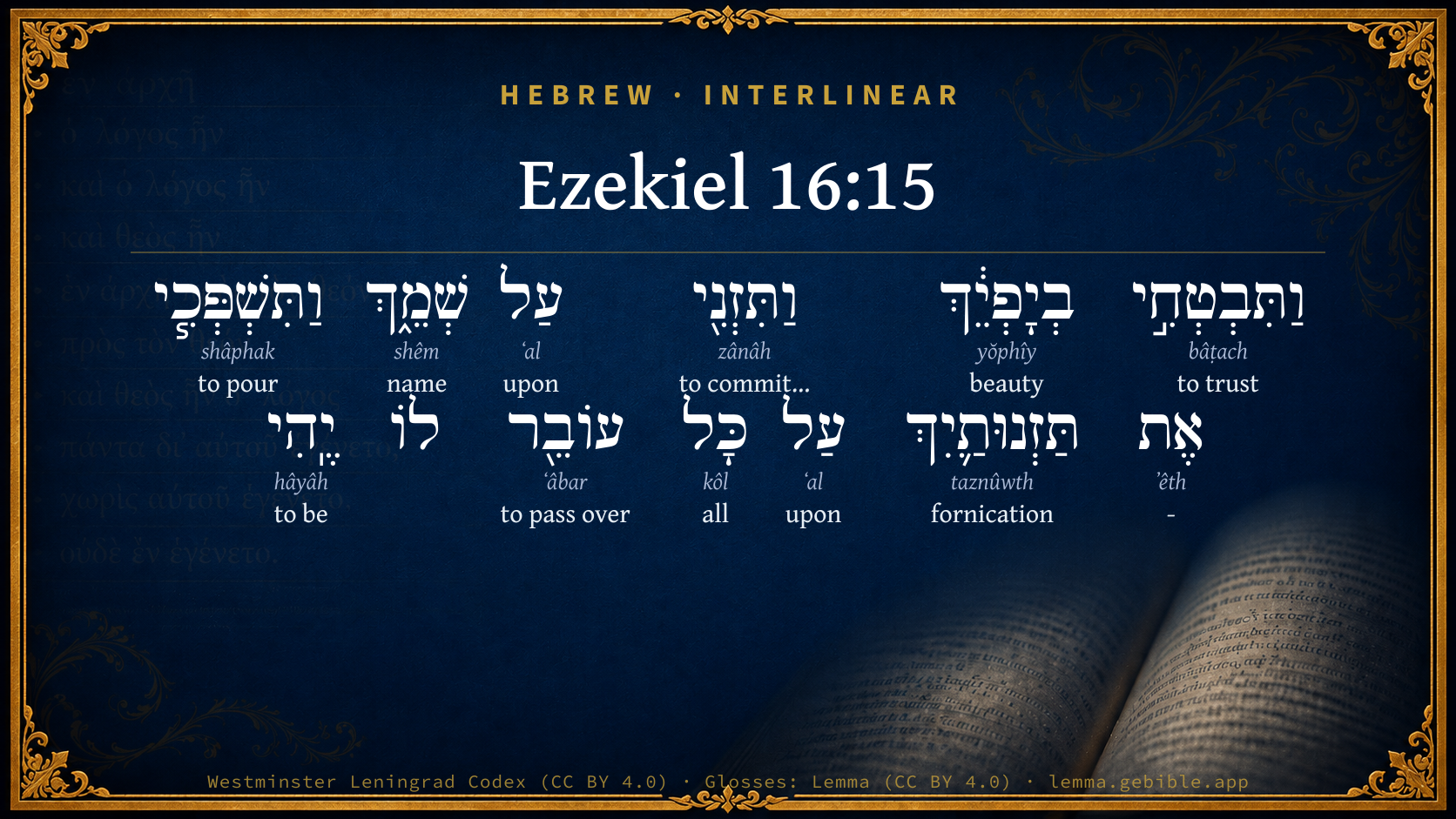
  1. וַתִּבְטְחִ֣י bâṭach H982 “and · to trust” Conjunction + Verb, Qal, Sequential Imperfect, 2nd Person, Feminine, Singular
  2. וַתִּזְנִ֖י zânâh H2181 “and · to commit fornication” Conjunction + Verb, Qal, Sequential Imperfect, 2nd Person, Feminine, Singular
  3. עַל ʻal H5921 “upon” Preposition
  4. שְׁמֵ֑ךְ shêm H8034 “name · your” Noun, Common, Masculine, Singular, Construct + Suffix, Personal, 2nd Person, Feminine, Singular
  5. וַתִּשְׁפְּכִ֧י shâphak H8210 “and · to pour” Conjunction + Verb, Qal, Sequential Imperfect, 2nd Person, Feminine, Singular
  6. אֶת ʼêth H853 “-” Particle, Direct Object
  7. תַּזְנוּתַ֛יִךְ taznûwth H8457 “fornications · your” Noun, Common, Feminine, Plural, Construct + Suffix, Personal, 2nd Person, Feminine, Singular
  8. עַל ʻal H5921 “upon” Preposition
  9. כָּל kôl H3605 “all of” Noun, Common, Masculine, Singular, Construct
  10. עוֹבֵ֖ר ʻâbar H5674 “passing over” Verb, Qal, Participle Active, Masculine, Singular, Absolute
  11. יֶֽהִי hâyâh H1961 “to be” Verb, Qal, Jussive, 3rd Person, Masculine, Singular

About this verse

These counts appear in no published source. They are computed here, from the morphology-tagged text and Lemma’s own curated glosses. What Lemma adds →

13
words
11
distinct lemmas
Prophets
section

Notable vocabulary

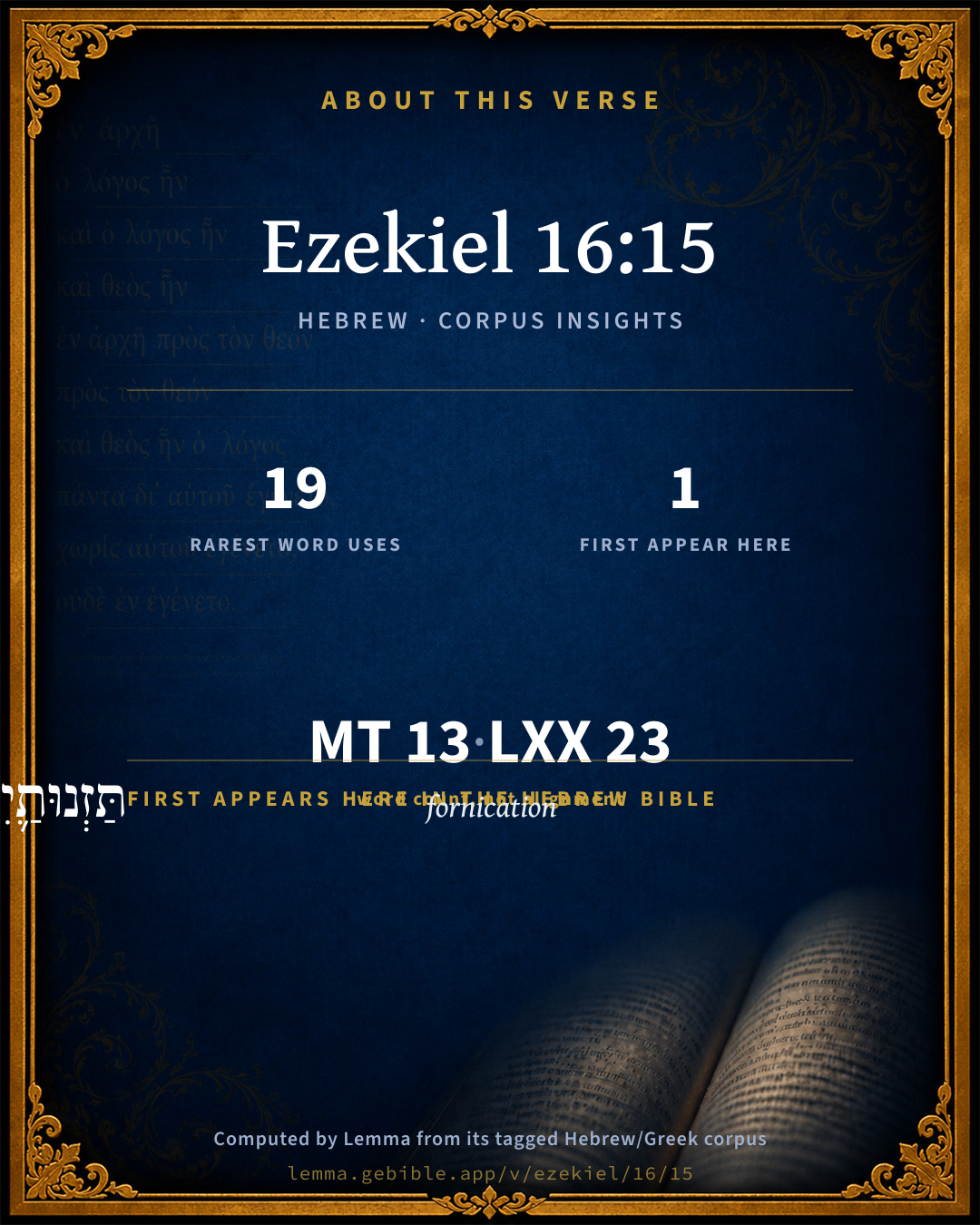
The rarest word here is בְיָפְיֵ֔ךְ beauty H3308 — appearing just 19 times in the whole Hebrew Bible.

First appearance in Scripture

This word makes its first canonical appearance in the Hebrew Bible here:

  • תַּזְנוּתַ֛יִךְ fornication H8457

Shared distinctive vocabulary

בְיָפְיֵ֔ךְ beauty H3308 occurs in 19 verses of the Hebrew Bible. Also found in:

Grammatical profile

  • 5 verbs
  • 4 nouns
  • 3 prepositions
  • 1 particle

Verb forms

  • וַתִּבְטְחִ֣י Qal · Sequential Imperfect
  • וַתִּזְנִ֖י Qal · Sequential Imperfect
  • וַתִּשְׁפְּכִ֧י Qal · Sequential Imperfect
  • עוֹבֵ֖ר Qal · Participle Active
  • יֶֽהִי Qal · Jussive

Repetition

A word recurs within this verse — often emphatic in Hebrew:

Hebrew & Septuagint length

In English translation the verse runs 28 words from the Hebrew and 24 from the Septuagint (LXX English) — closely comparable.

A rough comparison of the two English renderings, which tokenize alike — not a word-level alignment.

Word counts can differ between the Hebrew and the Greek without any difference in meaning — e.g. the Hebrew direct-object marker אֵת has no separate Greek word, and Greek often adds the article ὁ.

In the original languages it is 13 Hebrew tokens and 23 Greek tokens — but the two are counted differently (Hebrew bundles its prefixes and suffixes into one token; the Greek is in lemma form), so that isn’t a like-for-like length.

Cross-references

31

Topical passages linked to Ezekiel 16:15 in the Treasury of Scripture Knowledge — connected by theme and wording, ordered by reader-vote popularity; previews shown in the World English Bible.

  • Isaiah 57:8 Behind the doors and the posts have you set up your memorial: for you have uncovered [yourself] to another than me, and are gone up; you have enlarged your bed, and made you a covenant with them: you loved their bed where you saw it.
  • Jeremiah 2:20 For of old time I have broken your yoke, and burst your bonds; and you said, I will not serve; for on every high hill and under every green tree you did bow yourself, playing the prostitute.
  • Ezekiel 16:25 You have built your lofty place at the head of every way, and have made your beauty an abomination, and have opened your feet to everyone who passed by, and multiplied your prostitution.
  • Jeremiah 7:4 Don't you trust in lying words, saying, The temple of Yahweh, the temple of Yahweh, the temple of Yahweh, are these.
  • Ezekiel 23:3 and they played the prostitute in Egypt; they played the prostitute in their youth; there were their breasts pressed, and there was handled the bosom of their virginity.
  • Isaiah 1:21 How the faithful city has become a prostitute! She was full of justice; righteousness lodged in her, But now murderers.
  • Ezekiel 23:8 Neither has she left her prostitution since [the days of] Egypt; for in her youth they lay with her, and they handled the bosom of her virginity; and they poured out their prostitution on her.
  • Hosea 1:2 When Yahweh spoke at the first by Hosea, Yahweh said to Hosea, "Go, take for yourself a wife of prostitution and children of unfaithfulness; for the land commits great adultery against from Yahweh."
  • Exodus 32:6–35 They rose up early on the next day, and offered burnt offerings, and brought peace-offerings; and the people sat down to eat and to drink, and rose up to play.
  • Numbers 25:1–2 Israel abode in Shittim; and the people began to play the prostitute with the daughters of Moab:
  • Deuteronomy 32:15 But Jeshurun grew fat, and kicked: You have grown fat, you are grown thick, you are become sleek; Then he forsook God who made him, Lightly esteemed the Rock of his salvation.
  • Judges 2:12 and they forsook Yahweh, the God of their fathers, who brought them out of the land of Egypt, and followed other gods, of the gods of the peoples who were round about them, and bowed themselves down to them: and they provoked Yahweh to anger.
  • Judges 3:6 and they took their daughters to be their wives, and gave their own daughters to their sons and served their gods.
  • Judges 10:6 The children of Israel again did that which was evil in the sight of Yahweh, and served the Baals, and the Ashtaroth, and the gods of Syria, and the gods of Sidon, and the gods of Moab, and the gods of the children of Ammon, and the gods of the Philistines; and they forsook Yahweh, and didn't serve him.
  • 1 Kings 11:5 For Solomon went after Ashtoreth the goddess of the Sidonians, and after Milcom the abomination of the Ammonites.
  • 1 Kings 12:28 Whereupon the king took counsel, and made two calves of gold; and he said to them, It is too much for you to go up to Jerusalem: see your gods, Israel, which brought you up out of the land of Egypt.
  • 2 Kings 17:7 It was so, because the children of Israel had sinned against Yahweh their God, who brought them up out of the land of Egypt from under the hand of Pharaoh king of Egypt, and had feared other gods,
  • 2 Kings 21:3 For he built again the high places which Hezekiah his father had destroyed; and he reared up altars for Baal, and made an Asherah, as did Ahab king of Israel, and worshiped all the host of the sky, and served them.
  • Psalms 106:35 But mixed themselves with the nations, And learned their works.
  • Isaiah 48:1 Hear you this, house of Jacob, who are called by the name of Israel, and are come forth out of the waters of Judah; who swear by the name of Yahweh, and make mention of the God of Israel, but not in truth, nor in righteousness
  • Jeremiah 3:1 They say, If a man put away his wife, and she go from him, and become another man's, will he return to her again? Won't that land be greatly polluted? But you have played the prostitute with many lovers; yet return again to me, says Yahweh.
  • Ezekiel 16:36–37 Thus says the Lord Yahweh, Because your filthiness was poured out, and your nakedness uncovered through your prostitution with your lovers; and because of all the idols of your abominations, and for the blood of your children, that you gave to them;
  • Ezekiel 20:8 But they rebelled against me, and would not listen to me; they did not every man cast away the abominations of their eyes, neither did they forsake the idols of Egypt. Then I said I would pour out my wrath on them, to accomplish my anger against them in the midst of the land of Egypt.
  • Ezekiel 23:11–21 Her sister Oholibah saw this, yet was she more corrupt in her doting than she, and in her prostitution which were more than the prostitution of her sister.
  • Ezekiel 27:3 and tell Tyre, you who dwell at the entry of the sea, who are the merchant of the peoples to many isles, thus says the Lord Yahweh: You, Tyre, have said, I am perfect in beauty.
  • Ezekiel 33:13 When I tell the righteous, that he shall surely live; if he trust to his righteousness, and commit iniquity, none of his righteous deeds shall be remembered; but in his iniquity that he has committed, therein shall he die.
  • Hosea 4:10 They will eat, and not have enough. They will play the prostitute, and will not increase; Because they have abandoned giving to Yahweh.
  • Micah 3:11 Her leaders judge for bribes, And her priests teach for a price, And her prophets of it tell forturnes for money: Yet they lean on Yahweh, and say, Isn't Yahweh in the midst of us? No disaster will come on us.
  • Zephaniah 3:11 In that day you will not be disappointed for all your doings, in which you have transgressed against me; for then I will take away out of the midst of you your proudly exulting ones, and you will no more be haughty in my holy mountain.
  • Matthew 3:9 Don't think to yourselves, 'We have Abraham for our father,' for I tell you that God is able to raise up children to Abraham from these stones.
  • Revelation 17:5 And on her forehead a name was written, "MYSTERY, BABYLON THE GREAT, THE MOTHER OF THE PROSTITUTES AND OF THE ABOMINATIONS OF THE EARTH."

Cross-references courtesy of OpenBible.info (CC BY 4.0).

Hebrew and Greek witnesses Masoretic Hebrew ↔ Greek Septuagint

The same verse in the two great witnesses to the Old Testament, shown verse-for-verse.

These are two independent witnesses, not word-aligned to each other, and the Septuagint is shown in lemma (dictionary) form.

Hebrew Ezekiel 16:15 Masoretic · Westminster Leningrad Codex

וַתִּבְטְחִ֣י בְיָפְיֵ֔ךְ וַתִּזְנִ֖י עַל שְׁמֵ֑ךְ וַתִּשְׁפְּכִ֧י אֶת תַּזְנוּתַ֛יִךְ עַל כָּל עוֹבֵ֖ר לוֹ יֶֽהִי

But you did trust in your beauty, and played the prostitute because of your renown, and poured out your prostitution on everyone who passed by; his it was.

World English Bible · Public Domain

Greek LXX Ezekiel 16:15 Septuagint · lemma form

καί πείθω ἐν ὁ κάλλος σύ καί πορνεύω ἐπί ὁ ὄνομα σύ καί ἐκχέω ὁ πορνεία σύ ἐπί πᾶς πάροδος ὅς οὐ εἰμί

You did trust in your beauty, and did go a-whoring because of your renown, and did pour out your fornication on every passer by.

LXX2012 (modern English Septuagint) · Public Domain

On this verse, The Cambridge Bible for Schools and Colleges discusses the Septuagint’s reading. Read the note in Commentary ↓

Hebrew: Westminster Leningrad Codex (CC BY 4.0). Greek: Septuagint (public domain); English from LXX2012 (modern English Septuagint) (Public Domain). How the Septuagint differs from the Hebrew →

Targum (Aramaic paraphrase)

1

The Targum is the ancient Jewish Aramaic paraphrase of the Hebrew Scriptures — an interpretive translation, not the Hebrew text itself. Onkelos (literal) and Pseudo-Jonathan (expansive) render the Torah, and Jonathan the Prophets. Coverage is partial: where no permissively-licensed English translation exists for a verse, only the Aramaic is shown. This is verse-level text, not a word-by-word alignment to the Hebrew.

  1. Targum Jonathan Prophets (Joshua–Malachi)
    וְאִתְרְחֵיצְתְּ בְּשׁוּפְרֵיךְ וּטְעֵית עַל שְׁמִיךְ וְאִתְחַבַּרְתְּ לִיךְ לְמִפְלַח לְטַעֲוָתָא עִם כָּל דְעָדֵי וְלָא כְשַׁר לִיךְ לְמֶעְבַּד כֵּן:

    (no public-domain English translation for this verse)

    Targum Jonathan — Aramaic: “Mikraot Gedolot” (public domain). English: “Sefaria Community Translation” (CC0 1.0 (public-domain dedication)); “London "Chaldee Paraphrase," 1871” (public domain). Text via Sefaria.

Commentary

Notes on Ezekiel 16:15 from classic Christian and Jewish commentators (each source and its license shown beneath its notes). The classic Christian expositions comment on the surrounding passage and are grouped to its opening verse, so a note may address several verses; the Jewish commentaries on the Tanakh (Rashi and others) are per-verse, so they appear only where the commentator wrote on this verse.

Lemma curates 59 commentaries, every one of them public domain or Creative Commons licensed, each selected and text-cleaned for this edition rather than reprinted as found. About our sources →

Matthew Henry's Commentary

In these verses we have an account of the great wickedness of the people of Israel, especially in worshipping idols, notwithstanding the great favours that God had conferred upon them, by which, one would think, they should have been for ever engaged to him. This wickedness of theirs is here represented by the lewd and scandalous conversation of that beautiful maid which was rescued from ruin, brought up and well provided for by a kind friend and benefactor, that had been in all respects as a father and a husband to her. Their idolatry was the great provoking sin that they were guilty of; it began in the latter end of Solomon's time (for from Samuel's till then I do not remember that we read any thing of it), and thenceforward continued more or less the crying sin of that nation till the captivity; and, though it now and then met with some check from the reforming kings, yet it was never totally suppressed, and for the most part appeared to a high degree impudent and barefaced. They not only worshipped the true God by images, as the ten tribes by the calves at Dan and Bethel, but they worshipped false gods, Baal and Moloch, and all the senseless rabble of the pagan deities.

This is that which is here all along represented (as often elsewhere) under the similitude of whoredom and adultery, 1. Because it is the violation of a marriage-covenant with God, forsaking him and embracing the bosom of a stranger; it is giving that affection and that service to his rivals which are due to him alone. 2. Because it is the corrupting and defiling of the mind, and the enslaving of the spiritual part of the man, and subjecting it to the power and dominion of sense, as whoredom is. 3. Because it debauches the conscience, sears and hardens it; and those who by their idolatries dishonour the divine nature, and change the truth of God into a lie and his glory into shame, God justly punishes by giving them over to a reprobate mind, to dishonour the human nature with vile affections, Rom 1:23, etc. It is a besotting bewitching sin; and, when men are given up to it, they seldom recover themselves out of the snare. 4. Because it is a shameful scandalous sin for those that have joined themselves to the Lord to join themselves to an idol. Now observe here,

I. What were the causes of this sin. How came the people of God to be drawn away to the service of idols? How came a virgin so well taught, so well educated, to be debauched? Who would have thought it? But, 1. They grew proud (Eze 16:15): "Thou trustedst to thy beauty, and didst expect that that should make thee an interest, and didst play the harlot because of thy renown." They thought, because they were so complimented and admired by their neighbours, that, further to ingratiate themselves with them and return their compliments, they must join with them in their worship and conform to their usages. Solomon admitted idolatry, to gratify his wives and their relations. Note, Abundance of young people are ruined by pride and particularly pride in their beauty. Rara est concordia formae atque pudicitiae - Beauty and chastity are seldom associated 2. They forgot their beginning (Eze 16:22) "Thou hast not remembered the days of thy youth, how poor, and mean, and despicable thou wast, and what great things God did for thee and what lasting obligations he laid upon thee thereby." Note, It should be an effectual check to our pride and sensuality to consider what we are and how much we are beholden to the free grace of God. 3. They were weak in understanding and in resolution (Eze 16:30): How weak is thy heart, seeing thou dost all these things. Note, The strength of men's lusts is an evidence of the weakness of their hearts; they have no acquaintance with themselves, nor government of themselves. She is weak, and yet an imperious whorish woman. Note, Those that are most foolish are commonly most imperious, and think themselves fit to manage others when they are far from being able to manage themselves.

II. What were the particulars of it. 1. They worshipped all the idols that came in their way, all that they were ever courted to the worship of; they were at the beck of all their neighbours (Eze 16:15): Thou pouredst out thy fornications on every one that passed by; his it was. They were ready to close with every temptation of this kind, though ever so absurd. No foreign idol could be imported, no new god invented, but they were ready to catch at it, as a common trumpet that prostitutes herself to all comers and multiplies her whoredoms, Eze 16:25. Thus some common drunkards will be company for every one that puts up the finger to them; how weak are the hearts of such! 2. They adorned their idol-temples, and groves, and high places, with the fine rich clothing that God had given them (Eze 16:16, Eze 16:18): Thou deckedst thy high places with divers colours, with the coats of divers colours, like Joseph's, which God had given them as particular marks of his favour, and hast played the harlot (that is, worshipped idols) thereupon. Of this he saith, "The like things shall not come, neither shall it be so; that is, this is a thing by no means to be suffered; I will never endure such practices as these without showing my resentments." 3. They made images for worship of the jewels which God had given them (Eze 16:17): The jewels of my gold and my silver which I had given thee. Note, It is God that gives us our gold and silver; the products of trade, of art and industry, are the gifts of God's providence to us, as well as the fruits of the earth. And what God gives us the use of he still retains a property in. "It is my silver and my gold, though I have given it to thee." It is his still, so that we ought to serve and honour him with it, and are accountable to him for the disposal of it. Every penny has God's image upon it as well as Caesar's. Should we make our silver and gold, our plate, money, and jewels, the matter of our pride and contention, our covetousness and prodigality, if we duly considered that they were God's silver and his gold? The Israelites began betimes to turn their jewels into idols, when Aaron made the golden calf of their earrings. 4. They served their idols with the good things which God gave them for their own use and to serve him with (Eze 16:18): "Thou hast set my oil and my incense before the, upon their altars, as perfumes to these dunghill-deities; my meat, and fine flour, and oil, and that honey which Canaan flowed with, and wherewith I fed thee, thou hast regaled them and their hungry priests with, hast made an offering of it to them for a sweet savour, to purify them, and procure acceptance with them: and thus it was, saith the Lord God; it is too plain to be denied, too bad to be excused. These things thou hast done. He that knows all things knows it." See how fond they were of their idols, that they would part with that which was given them for the necessary subsistence of themselves and their families to honour them with, which may shame our niggardliness and strait-handedness in the service of the true and living God. 5. They had sacrificed their children to their idols. This is insisted upon here, and often elsewhere, as one of the worst instances of their idolatry, as indeed there was none in which the devil triumphed so much over the children of men, both their natural reason and their natural affection, as in this (see Jer 7:31; Jer 19:5; Jer 32:35): Thou hast taken thy sons and thy daughters, and not only made them to pass through the fire, or between two fires, in token of their being dedicated to Moloch, but thou hast sacrificed them to be devoured, Eze 16:20. Never was there such an instance of the degenerating of the paternal authority into the most barbarous tyranny as this was. Yet that was not the worst of it: it was an irreparable wrong to God himself, who challenged a special property in their children more than in their gold and silver and their meat: They are my children (Eze 16:21), the sons and daughters which thou hast borne unto me, Eze 16:20. He is the Father of spirits, and rational souls are in a particular manner his; and therefore the taking away of life, human life, unjustly, is a high affront to the God of life. But the children of Israelites were his by a further right; they were the children of the covenant, born in God's house. He had said to Abraham, I will be a God to thee and to thy seed; they had the seal of the covenant in their flesh from eight days old; they were to bear God's name, and keep up his church; to murder them was in the highest degree inhuman, but to murder them in honour of an idol was in the highest degree impious. One cannot think of it without the utmost indignation: to see the pitiless hands of the parents shedding the guiltless blood of their own children, and by offering those pieces of themselves to the devil for buying sacrifices openly avowing the offering up of themselves to him for living sacrifices! How absurd was this, that the children which were born to God should be sacrificed to devils! Note, The children of parents that are members of the visible church are to be looked upon as born unto God, and his children,; as such, and under that character, we are to love them, and pray for them, bring them up for him, and, if he calls for them, cheerfully part with them to him; for may he not do what he will with his own? Upon this instance of their idolatry, which indeed ought not to pass without a particular brand, this remark is made (Eze 16:20), Is this of thy whoredoms a small matter? which intimates that there were those who made a small matter of it, and turned it into a jest. Note, There is no sin so heinous, so apparently heinous, which men of profligate consciences will not make a mock at. But is whoredom, is spiritual whoredom, a small matter? Is it a small matter for men to make their children brutes and the devil their god? It will be a great matter shortly. 6. They built temples in honour of their idols, that others might be invited to resort thither and join with them in the worship of their idols: "After all thy wickedness of this kind committed in private, for which, woe, woe, unto thee" (that comes in in a sad parenthesis, denoting those to be in a woeful condition who are going on in sin, and giving them warning in time, if they would but take it), "thou hast at length arrived at such a pitch of impudence as to proclaim it; thou hast long had a whore's heart, but now thou hast come to have a whore's forehead, and canst not blush," Eze 16:23-35. Thou hast built there an eminent place, a brothel-house (so the margin reads it), and such their idol temples were. Thou hast made for thyself a high place, for one idol or other, in every street, and at every head of the way; and again Eze 16:31. They did all they could to seduce and debauch others, and to spread the contagion, by making the temptations to idolatry as strong as possibly they could; and hereby the ringleaders in idolatry did but make themselves vile, and even those that had courted them to it, finding themselves outdone by them, began to be surfeited with the abundance and violence of their idolatries: Thou hast made thy beauty to be abhorred, even by those that had admired it. The Jewish nation, by leaving their own God, and doting on the gods of the nations round about them, had made themselves mean and despicable in the eyes even of their heathen neighbours; much more was their beauty abhorred by all that were wise and good, and had any concern for the honour of God and religion. Note, Those shame themselves that bring a reproach on their profession. And justly will that beauty, that excellency, at length be made the object of the loathing of others which men have made the matter of their own pride.

III. What were the aggravations of this sin.

1. They were fond of the idols of those nations which had been their oppressors and persecutors. As, (1.) The Egyptians. They were a people notorious for idolatry, and for the most sottish senseless idolatries; they had of old abused Israel by their barbarous dealings, and of late by their treacherous dealings - were always either cruel or false to them; and yet so infatuated were they that they committed fornication with the Egyptians their neighbours, not only by joining with them in their idolatries, but by entering into leagues and alliances with them, and depending upon them for help in their straits, which was an adulterous departure from God. (2.) The Assyrians. They had also been vexatious to Israel: "And yet thou hast played the whore with them (Eze 16:28); though they lived at a greater distance, yet thou hast entertained their idols and their superstitious usages, and so hast multiplied thy fornications unto Chaldea, hast borrowed images of gods, patterns of altars, rites of sacrificing, and one foolery or other of that kind, from that remote country, that enemy's country, and hast imported them into the land of Canaan, enfranchised and established them there." Thus Mr. George Herbert long since foretold, or feared at least,

That Seine shall swallow Tiber, and the Thames

By letting in them both pollute her streams.

2. They had been under the rebukes of Providence for their sins, and yet they persisted in them (Eze 16:27): I have stretched out my hand over thee, to threaten and frighten thee. So God did before he laid his hand upon them to ruin and destroy them; and that is his usual method, to try to bring men to repentance first by less judgments. He did so here. Before he brought such a famine upon them as broke the staff of bread he diminished their ordinary food, but them short before he cut them off. When the overplus is abused, it is just with God to diminish that which is for necessity. Before he delivered them to the Chaldeans to be destroyed he delivered them to the daughters of the Philistines to be ridiculed for their idolatries; for they hated them, and, though they were idolaters themselves, yet were ashamed of the lewd way of the Israelites, who had grown more profane in their idolatries than any of their neighbours, who changed their gods, whereas other nations did not change theirs, Jer 2:10, Jer 2:11. For this they were justly chastised by the Philistines. Or it may refer to the inroads which the Philistines made upon the south of Judah in the reign of Ahaz, by which it was weakened and impoverished, and which was the beginning of sorrows to them (Ch2 28:18); but they did not take warning by those judgments, and therefore were justly abandoned to ruin at last. Note, In the account which impenitent sinners shall be called to they will be told not only of the mercies for which they have been ungrateful, but of the afflictions under which they have been incorrigible, Amo 4:11.

3. They were insatiable in their spiritual whoredom: Thou couldst not be satisfied, Eze 16:28 and again Eze 16:29. When they had multiplied their idols and superstitious usages beyond measure, yet still they were enquiring after new gods and new fashions in worship. Those that in sincerity join themselves to the true God find enough in him for their satisfaction; and, though they still desire more of God, yet they never desire more than God. But those that forsake this living fountain for broken cisterns will find themselves soon surfeited, but never satisfied; they have soon enough of the gods they have, and are still enquiring after more.

4. They were at great expense with their idolatry, and laid out a great deal of wealth in purchasing patterns of images and altars, and hiring priests to attend upon them from other countries. Harlots generally had their hire; but this impudent adulteress, instead of being hired to serve idols, hired idols to protect her and accept her homage. This is much insisted on, Eze 16:31-34. "In this respect the contrary is in thee from other women in thy whoredoms: others are courted, but thou makest court to those that do not follow thee, art fond of making leagues and alliances with those heathen nations that despise thee; others have gifts given them, but thou givest thy gifts, the gifts which God had graciously given thee, to thy idols; herein thou art like a wife that commits adultery, not for gain, as harlots do, but entirely for the sin's sake." Note, Spiritual lusts, those of the mind, such as theirs after idols were, are often as strong and impetuous as any carnal lusts are. And it is a great aggravation of sin when men are their own tempters, and, instead of proposing to themselves any worldly advantage by their sin, are at great expense with it; such are transgressors without cause (Psa 25:3), wicked transgressors indeed.

And now is not Jerusalem in all this made to know her abominations? For what greater abominations could she be guilty of than these? Here we may see with wonder and horror what the corrupt nature of men is when God leaves them to themselves, yea, though they have the greatest advantages to be better and do better. And the way of sin is down-hill. Nitimur in vetitum - We incline to what is forbidden.

Matthew Henry's Commentary on the Whole Bible (1708–1710) — public domain (CC PDM 1.0). Text via the HelloAO Bible API.

The Cambridge Bible for Schools and Colleges

gen. ed. J. J. S. Perowne

15. because of thy renown] In the consciousness of it. The consciousness of her beauty and renown removed from her mind the sense of dependence and responsibility, and she became vain in her own imaginations. Another prophet has expressed the same idea in regard to Babylon: “Thou saidst, I shall be a lady for ever, so that thou didst not lay these things to thy heart, neither didst consider the issue of them … thou hast said, None seeth me.” (Isa_47:7; Isa_47:10). Hävern. quotes Ovid, Fasti, i. 419, Fastus inest pulchris, sequiturque superbia formam.

every one that passed by] A figure taken from the habit of harlots sitting by the wayside, Gen_38:14; Jer_3:2, “By the ways thou hast sat for them as an Arab in the desert.”

his it was] The prostitution was indiscriminate, Jer_3:2; cf. ch. Eze_23:40. The idea expressed is the ineradicable tendency of the people to adopt the religious customs of the nations with which age after age they came into connexion (Eze_16:23 seq.). The phrase is peculiar and wanting in LXX.

15–22. All the gifts of Jehovah to her she took and bestowed on idols: her raiment (Eze_16:16; Eze_16:18), her gold and silver (Eze_16:17), and her delicate fare (Eze_16:19). And as if this were a small matter, she sacrificed also the children which were Jehovah’s to her idols (Eze_16:20-21).

15–34. The wife’s infidelities—Israel’s idolatries and idolatrous alliances with foreign nations

The idolatries of Israel are represented figuratively as a wife’s infidelities against her husband, as had been common in the prophets since Hosea, particularly in Jeremiah (in Isaiah only the single passage ch. Eze_1:21). These idolatries seem presented in two stages: Eze_16:15-22, her addicting herself to the worship and religious customs of the Canaanites among whom she dwelt; and Eze_16:23-34, her alliances with foreign peoples and adoption of their religions.

The Cambridge Bible for Schools and Colleges (gen. ed. J. J. S. Perowne; Cambridge University Press, 1878–1918) — public domain. Text from a community e-Sword module.

Trapp's Complete Commentary

John Trapp

Eze 16:15 But thou didst trust in thine own beauty, and playedst the harlot because of thy renown, and pouredst out thy fornications on every one that passed by; his it was.

Ver. 15. But thou didst trust in thine own beauty.] Thou grewest proud of it, and thoughtest there was none such; whenas thou mightest well have said of it, as he in the holy history did of his hatchet, "Alas, master, it was but borrowed."

And playedst the harlot.] Being fair and foolish.

“ Lis est cum forma magna pudicitiae. ”

Because of thy renown.] Being puffed up with the greatness of thy name and fame, which should have made thee more morigerous. {Pro 27:21} {See Trapp on "Pro 27:21"}

And pouredst out thy fornications.] Indifferently and impudently, like a filthy strumpet.

His it was.] Quicunque vult; come as come would: so detestably insatiated wast thou. The Papists boast of their Church that she is a pious mother, that shutteth her bosom to no man. Meretricis scilicet hoc est meretricissimae.

John Trapp, A Commentary or Exposition upon All the Books of the Old and New Testament (1647–1656) — public domain. Text from a community e-Sword module.

Joseph Benson's Commentary

Eze 16:15-19. But thou didst trust in thine own beauty — Houbigant translates this, “But thou, trusting in thy beauty, didst play the harlot, degenerating from thy renown:” as if he had said, Thou didst abuse those honours, privileges, and advantages which I had bestowed upon thee, and didst make them an occasion of pride, of self-confidence, and of forsaking me thy benefactor, and serving idols. It was chiefly by their frequent and scandalous idolatries that the Jews and Israelites polluted their glory, and profaned the great name of Jehovah. And they presumed upon that very favour which God had showed to Jerusalem, in choosing it for the place of his residence, as if that would secure them from his vengeance, let their idolatries and other wickedness be never so great. And playedst the harlot — Idolatry, as has been often observed, is expressed by this metaphor. And of thy garments thou didst take, &c. — This was a great aggravation of their ingratitude, that they applied those very blessings which Jehovah, the true God, had given them, to the worship of idols, contrary to his express command. And deckedst thy high places — Places of idolatrous worship, commonly built on eminences, with divers colours. Or, as the LXX. interpret it, Thou madest idols, or images, of divers colours. Thou madest little shrines, chapels, or altars for idols, and deckedst them with hangings of divers colours, Eze 16:18, 2Ki 23:7. The like things shall not come, &c. — I will utterly destroy those idolatries, and those that commit them. Thou hast also taken thy fair jewels, &c. — The wealth I had bestowed upon thee thou hast laid out in doing honour to idols; and particularly in setting up images to deified heroes, and didst pay them religious worship, here signified by committing whoredom with them. And coveredst them — Didst clothe with thy broidered garments the images thou hast made. And hast set mine oil, &c., before them — Thou offeredst these my creatures as meat-offerings, unto idols. The meat-offering is called an offering of a sweet savour, because of the frankincense which was put upon it, Lev 2:2. The oblation here mentioned differs from those offered to God in one particular, namely, that honey was mixed with it, which God had expressly forbidden to be used in his service, Lev 2:11.

Joseph Benson's Commentary on the Old and New Testaments (1811–1818) — public domain. Text from a community e-Sword module.

The Preacher's Complete Homiletical Commentary

Joseph S. Exell (gen. ed.)

ISRAEL’S APOSTACY FROM GOD (Eze_16:15-34)

EXEGETICAL NOTES. Its origin and nature (Eze_16:15-22); its magnitude and extent (Eze_16:23-34).

Eze_16:15. The apostacy of Israel is described under the image of whoredom and adultery. “Thou didst trust in thine own beauty.” The gifts of God, when they ceased to be recognised as such, became a snare. Israel prostituted them in the service of idolatry. Because of thy renown. “Teaching that the Jews had employed the renown, which through the Divine goodness they had acquired, as a means of seducing neighbouring nations to commit spiritual fornication.”—(Henderson).

Eze_16:16. The “high places” were temples erected, upon heights by the side of altars (1Ki_13:32; 2Ki_17:29). In 2Ki_23:7, the Jewish women are described as wearing hangings to adorn the temples of Astarte. The latter part of the verse expresses the idea that such gross abominations in Israel were altogether unparalleled in the past, as they would be in the future.

Eze_16:17-19. “Images of Men.” Heb. “Of a male.” This may describe idolatry in general, and thus the word “male” would be used as corresponding with the description of Israel as an adulteress. But some expositors think that a reference is made here to a certain abominable form of idolatry. “Scholz and Hävernick understand what were worshipped in the idolatrous service of phallus, or the membrum virile, which the Egyptians regarded as the emblem of fecundity, and which is still licentiously worshipped by the Hindoos under the name of lingam.”—(Henderson).

Eze_16:20-22. “To cause them to pass through the fire.” A clear reference to Moloch-worship in which children were sacrificed to the idol by burning them. “The passing through was the mode of slaying, and the devouring was the consequence of it. The idols were thought to be present in the fire.”—(Hengstenberg.)

Eze_16:23-27. “An eminent place.” The Heb may be rendered a brothel, or place of prostitution. The word was so understood by the LXX. Thus figuratively the prophet describes their unholy passion for idol-worship. “The natural heights are too far for the people hungering after idols. They wish to plant idolatry in the city thoroughfare, and so build for themselves artificial heights. We must distinguish between the thought and its clothing. The thought is, that the objects of idolatry became the prime impulse of the popular life, by which is to be understood much less religious than political adultery, though both went hand in hand.”—(Hengstenberg.) “And hast made thy beauty to be abhorred.” The Heb. verb in the Piel conjugation signifies to abhor, never to cause to be abhorred. To prostitute their beauty was to show their contempt for it. By forsaking God and His Holy worship they showed how little esteem they had for the national honour. “And hast opened thy feet to every one that passed by.” “At an earlier period Israel stood, by the situation of their country, which admitted no isolation, in manifold intercourse with the world; but in the time which the prophet has in view they lay in the middle of the contending world-powers—the Asiatic and the African—and were thus in their intervening territory tempted by the force of circumstances to adultery with powerful neighbours.”—(Hengstenberg.) “The Egyptians, thy neighbours, great of flesh.” Heb. “The Sons of Egypt.” An euphemism to denote the licentious character of the Egyptian worship. “The sons of Egypt are not its gods, and therefore the reference is to political whoredom. Let it be remembered how in express terms intercourse with Egypt was forbidden to Israel, how return thither is threatened them rather as the worst punishment (Deu_28:68); and let one compare from the days of Solomon onwards (1Ki_3:1; 1Ki_9:16; 1Ki_10:28; 2 Kings 18; Isa_30:1-33; Isa_31:1; Isa_36:6; Jer_37:5; Jer_37:7).—(Lange). “The daughters of the Philistines which are ashamed of thy lewd ways.” “The daughters of the Philistians are the Philistian states, corresponding to the representation of Israel as an adulterous wife. The Philistians are mentioned as the principal foes, because Israel fell completely into their power at the end of the period of the Judges (Judges 13; 1 Samuel 4); and they are referred to here, for the deeper humiliation of Israel, as having been ashamed of the licentious conduct of the Israelites, because they adhered to their gods, and did not exchange them for others as Israel had done (Jer_2:10-11).—(Keil).

Eze_16:28-34. “Thou hast played the whore also with the Assyrians, because thou wast unsatiable.” “Having got no satisfaction in the African, they betake themselves now to the Asiatic world-power. They long after it, and find no satisfaction even when the longing is realized.”—(Lange). “Not satisfied with adopting the idolatories of Egypt, the Jews practised those of the more distant Assyrians and Babylonians. They were perfectly insatiable in their lust. Their idolatry was an amalgamation of all the different forms which obtained in the countries around them.”—(Henderson). “How weak is thine heart.” Some render it, “Yet how languishing is thine heart.” In this sense we are to understand that sickly craving of lustful desire, which had grown into a disease. Ewald designates the expression as “a biting sarcasm; how great must be the languishing of love!” Others understand it more generally of the tendency of oft-repeated sin to weaken our moral nature. “The influence of sin on the soul is to render it morally impotent. Though it may not deprive it of the powers which are requisite to constitute man a responsible agent, it weakens his principle of action, takes possession of those powers, and forms itself into habits which the individual allows to grow upon him, so that he becomes at last insensible to the operation of the strongest moral motives.”—(Henderson). “And the contrary is in thee from other women in thy whoredoms.” Israel gave presents to its lovers, contrary to the practice of prostitutes in general. The Jews practised idolatry not from the mere love of gain, but from the gratification they found in that sin. They had arrived at that lowest stage of depravity when sin is loved merely for its own sake. “Ezekiel has thus fulfilled the task appointed him in Eze_16:2, to charge Jerusalem with her abominations. The address now turns to an announcement of the punishment.”—(Keil).

HOMILETICS

ISRAEL’S APOSTACY: AN EXAMPLE OF MONSTROUS INIQUITY

I. It was the prostitution of God’s best gifts. “Thou didst trust in thine own beauty, and playedst the harlot because of thy renown” (Eze_16:15). They ceased to recognise their superior endowments as the free and undeserved gifts of God’s great favour, and therefore these became a snare to them and the occasion of falling. Their iniquity was beyond that of other nations, because theirs was the sin of a people taken into special covenant with God. It is more than common iniquity—it is monstrous to turn God’s gifts into the means of sin (Jud_1:4). The sins against the clearest light are the greatest of all.

II. It took the worst possible forms.

1. They devoted all God’s gifts to idols.

(1.) The common gifts of Providence. Food of various kinds, represented by “fine flour, and oil, and honey” (Eze_16:19).

(2.) Luxuries. “Jewels of gold and silver.” With these they made images to be employed in the most degrading forms of idolatry.

(3.) Even their own children. They gave them up to Moloch-worship, caused them “to pass through the fire” (Eze_16:21). Such was their infatuation with this idolatry, that they silenced the common instincts of nature, and gave up their own children to the most cruel forms of death. The prophet speaks of their great sins with the utmost force of language when he calls them “abominations.”

2. They took special pains to spread idolatry. They built idol temples close to the dwellings of the worshippers, so that they might not have to seek them in distant places. They tempted others with all the wiles and artifices of wickedness, “Thou hast opened thy feet to every one that passed by” (Eze_16:25). With a zeal worthy of a better cause they sought out the worst forms of idolatry among the nations of the earth—The Egyptians (Eze_16:26), the Assyrians (Eze_16:28), the Chaldeans (Eze_16:29). They seemed bent not merely upon imitating, but even surpassing the worst abominations of the heathen around them.

3. Their lust of idolatry was insatiable. When they had gained their desire, they refused to be satisfied, and still cried out for more (Eze_16:28-29). “How weak is thine heart, saith the Lord God!” (Eze_16:30). Their lust was glutted until they could feel only the sickly languishing of “an imperious whorish woman.”

4. They loved the sin of idolatry for its own sake. Not for gain, but because they had a delight in it (Eze_16:33-34).

5. They sinned thus grievously after due chastisement. God compares himself to a husband who endeavours by means of chastisement to induce his faithless wife to return. The supply of food, clothing, and of all the necessaries and comforts of a wife are diminished. She is even delivered over unto the will of them that hate her (Eze_16:27). Such was the discipline by which the Lord sought to bring His ancient people to a sense of their folly, and to restore to them the privileges of the faithful. He did not suffer Israel to attain to that glory and power which was their sure portion had they continued to serve the Lord with a perfect heart. He allowed their enemies to triumph over them, so that they had not the undisturbed possession of Canaan. To remain unimproved under the chastisements of God, and not even to feel them, shows a heart in the last stage of hardening. “Thou hast stricken them, but they have not grieved” (Jer_5:3).

(Eze_16:15-19.)

I. Where God bestows choice mercies upon a people, He looks for answerable returns from them. He gave life to the Israelitish state (Eze_16:6). He multiplied it as the bud of the field (Eze_16:7). He loved this people, entered into covenant with them, married them unto Himself (Eze_16:8). He washed away their blood, and anointed them with oil (Eze_16:9). He gave them costly apparel, fine flour, honey and oil, royal dignity, special beauty, great fame and glory (Eze_16:10-14); and now expected that they should have lived to Him, and improved all for the honour of His name. “But thou didst trust in thine own beauty,” etc. I looked not for this at thy hands; I looked that thou shouldst have been faithful and fruitful in all good works, and been as exemplary for holiness and justice to other nations, as I was exemplary in my mercies towards thee above other nations (Isa_5:2).

II. Ingratitude in God’s people is a provoking sin, and causes God to upbraid them for it. From the beginning of Eze_16:6, to the end of Eze_16:14, which are but nine verses, there is “I” seventeen times, and every mention of it is a matter for upbraiding unto them. When God had made Adam after His image, planted him in Paradise, given him dominion over all the creatures, for him not to obey one little command was gross ingratitude, provoked the Lord to upbraid him and punish him for it (Genesis 3) Christ upbraids Chorazin, Bethsaida, and Capernaum where His mighty works were done, because they brought not forth fruits answerable, but were impenitent and ungrateful (Matthew 11)

III. We are very apt to trust in, and be proud of, the mercies God bestows upon us. “Thou did’st trust in thine own beauty.” Those things that I gave thee to make thee beautiful, thou hast abused and put too much confidence in. The heart of man is ready to idolize every mercy God gives. There are several mercies we are apt to trust in.

1. In riches. The rich man confides in wealth as citizens do in a walled, well fortified, and well built city (Pro_10:15; Psa_52:7; 1Ti_6:17).

2. In princes and great ones (Psa_146:3; Isa_2:22; Jer_17:5; Isa_30:3).

3. In your own natural excellencies. “Let not the wise man glory in his wisdom,” etc. (Jer_9:23). “He that trusteth in his own heart is a fool” (Pro_28:26); the heart is the most excellent part of man (See also Pro_3:5).

4. In the ordinances and means of grace (Jer_7:4; Jer_7:14-15.

IV. Great renown, through man’s corruption, oft proves a snare, occasions great sins. God made this people above all nations, in praise, in name, in honour, that they might be a holy people unto Him (Deu_26:19). Their renown should have encouraged them unto holiness, and it was an incentive unto looseness. Solomon had great renown abroad in the nations (1Ki_4:31); that drew the princes to bestow their daughters upon him. His name made way for unlawful marriages, and they made way for unlawful gods.

V. The most beautiful and renowned church may degenerate, apostatise, and become corrupt. This Israelitish woman was the only spouse of God. He entered into covenant with her, she became His; He put more spiritual beauty and comeliness upon her than upon all the nations, and made her renowned throughout all the world; yet she forsook God, played the harlot, prostituted herself to every idol and idolater. And now where was the Church of God? She “played the harlot with many lovers” (Jer_3:1). Here was visible apostacy, visible idolatry, but no true visible Church. Neither was God without a true Church at this time. There were some godly ones in secret, who mourned for the abominations done in the city, temple, and everywhere (Eze_9:4). But these lay hid, and durst not appear in the ways of worship then amongst them. So in Elijah’s days. He complained, “The children of Israel have forsaken thy covenant,” etc. (1Ki_19:10); but God had then seven thousand in secret (Eze_16:18). The true Church may be brought to such a paucity, such a lowness, that there may be no public meetings, or view thereof. The papists say their Church cannot err, especially in things necessary to salvation; and why? because it is the spouse of Christ. Was not this Israelitish Church the spouse of God? And did it not err in the great and weighty things of salvation? Did it not leave God and fall into idolatry, such practices as exclude the kingdom of heaven? What privilege hath the Roman Church more than this had? Whatever papists say or write, their Church hath trusted in her beauty, been proud of her renown, and played the harlot as notoriously as ever Jerusalem did.—(Greenhill.)

The Preacher's Complete Homiletical Commentary (gen. ed. Joseph S. Exell; Funk & Wagnalls, c. 1892) — public domain (pre-1929). A full-Bible homiletical/sermon-outline anthology covering 65 of 66 books (2 John is absent from the source module). Text from a community e-Sword module.

Keil & Delitzsch

C. F. Keil & F. Delitzsch

The apostasy of Israel. Its origin and nature, Eze 16:15-22; its magnitude and extent, Eze 16:23-34. In close connection with what precedes, this apostasy is described as whoredom and adultery. - Eze 16:15. But thou didst trust in thy beauty, and didst commit fornication upon thy name, and didst pour out thy fornication over every one who passed by: his it became. Eze 16:16. Thou didst take off thy clothes, and didst make to thyself spotted heights, and didst commit fornication upon them: things which should not come, and that which should not take place. Eze 16:17. And thou didst take jewellery of thine ornament of my gold and of my silver, which I had given thee, and didst make thyself male images, and didst commit fornication with them; Eze 16:18. And thou didst take thy embroidered clothes, and didst cover them therewith: and my oil and my incense thou didst set before them. Eze 16:19. And my bread, which I gave to thee, fine flour, and oil, and honey, wherewith I fed thee, thou didst set before them for a pleasant odour: this came to pass, is the saying of the Lord Jehovah. Eze 16:20. And thou didst take thy sons and thy daughters, whom thou barest to me, and didst sacrifice them to them to devour. Was thy fornication too little? Eze 16:21. Thou didst slay my sons, and didst give them up, devoting them to them. Eze 16:22. And in all thine abominations and thy fornication thou didst not remember the days of thy youth, when thou wast naked and bare, and layest stamping in thy blood. - The beauty, i.e., the glory, of Israel led to its fall, because it made it the ground of its confidence; that is to say, it looked upon the gifts and possessions conferred upon it as its desert; and forgetting the giver, began to traffic with the heathen nations, and allowed itself to be seduced to heathen ways. For the fact, compare Deu 32:15 and Hos 13:6. "We are inflamed with pride and arrogance, and consequently profane the gifts of God, in which His glory ought to be resplendent" (Calvin). תּזני על שׁמך does not mean either "thou didst commit fornication notwithstanding thy name" (Winer and Ges. Thes. p. 422), or "against thy name" (Hvernick); for על connected with זנה has neither of these meanings, even in Jdg 19:2. It means, "thou didst commit fornication upon thy name, i.e., in reliance upon thy name" (Hitzig and Maurer); only we must not understand שׁם as referring to the name of the city of God, but must explain it, in accordance with Eze 16:14, as denoting the name, i.e., the renown, which Israel had acquired among the heathen on account of its beauty. In the closing words, לו יהי, לו refers to כּל־עובר, and יהי stands for ויהי, the copula having been dropped from ויהי because לו ought to stand first, and only יהי remaining (compare יך, Hos 6:1). The subject to יהי is יפי; the beauty became his (cf. Psa 45:12). This fornication is depicted in concrete terms in Eze 16:16-22; and with the marriage relation described in Eze 16:8-13 still in view, Israel is represented as giving up to idolatry all that it had received from its God. - Eze 16:16. With the clothes it made spotted heights for itself. בּמות stands for בּתּי בּמות, temples of heights, small temples erected upon heights by the side of the altars (Kg1 13:32; Kg2 17:29; for the fact, see the comm. on Kg1 3:2), which may probably have consisted simply of tents furnished with carpets. Compare Kg2 23:7, where the women are described as weaving tents for Astarte, also the tent-like temples of the Slavonian tribes in Germany, which consisted of variegated carpets and curtains (see Mohne on Creuzer's Symbolik, V. p. 176). These bamoth Ezekiel calls טלאות, not variegated, but spotted or speckled (cf. Gen 30:32), possibly with the subordinate idea of patched (מטלּא, Jos 9:5), because they used for the carpets not merely whole garments, but pieces of cloth as well; the word being introduced here for the purpose of indicating contemptuously the worthlessness of such conduct. "Thou didst commit whoredom upon them," i.e., upon the carpets in the tent-temples. The words 'לא באות וגו are no doubt relative clauses; but the usual explanation, "which has not occurred, and will not be," after Exo 10:14, cannot be vindicated, as it is impossible to prove either the use of בּוא in the sense of occurring or happening (= היה), or the use of the participle instead of the preterite in connection with the future. The participle באות in this connection can only supply one of the many senses of the imperfect (Ewald, 168c), and, like יהיה, express that which ought to be. The participial form באות is evidently chosen for the sake of obtaining a paronomasia with בּמות: the heights which should not come (i.e., should not be erected); while לא יהיה points back to ותּזני עליהם: "what should not happen."

Eze 16:17-22

The jewellery of gold and silver was used by Israel for צלמי זכר, idols of the male sex, to commit fornication with them. Ewald thinks that the allusion is to Penates (teraphim), which were set up in the house, with ornaments suspended upon them, and worshipped with lectisternia. But there is no more allusion to lectisternia here than in Eze 23:41. And there is still less ground for thinking, as Vatke, Movers, and Hvernick do, of Lingam-or Phallus-worship, of which it is impossible to find the slightest trace among the Israelites. The arguments used by Hvernick have been already proved by Hitzig to have no force whatever. The context does not point to idols of any particular kind, but to the many varieties of Baal-worship; whilst the worship of Moloch is specially mentioned in Eze 16:20. as being the greatest abomination of the whole. The fact that נתן לפּניהם, to set before them (the idols), does not refer to lectisternia, but to sacrifices offered as food for the gods, is indisputably evident from the words לריח ניחח, the technical expression for the sacrificial odour ascending to God (cf. Lev 1:9, Lev 1:13, etc.). ויּהי (Eze 16:19), and it came to pass (sc., this abomination), merely serves to give emphatic expression to the disgust which it occasioned (Hitzig). - Eze 16:20, Eze 16:21. And not even content with this, the adulteress sacrificed the children which God had given her to idols. The revulsion of feeling produced by the abominations of the Moloch-worship is shown in the expression לאכול, thou didst sacrifice thy children to idols, that they might devour them; and still more in the reproachful question 'המעט, "was there too little in thy whoredom?" מן before תּזנוּתיך is used in a comparative sense, though not to signify "was this a smaller thing than thy whoredom?" which would mean far too little in this connection. The מן is rather used, as in Eze 8:17 and Isa 49:6, in the sense of too: was thy whoredom, already described in Eze 16:16-19, too little, that thou didst also slaughter thy children to idols? The Chetib תזנותך (Eze 16:20 and Eze 16:25) is a singular, as in Eze 16:25 and Eze 16:29; whereas the Keri has treated it as a plural, as in Eze 16:15, Eze 16:22, and Eze 16:33, but without any satisfactory ground. The indignation comes out still more strongly in the description given of these abominations in Eze 16:21 : "thou didst slay my sons" (whereas in Eze 16:20 we have simply "thy sons, whom thou hast born to me"), "and didst give them up to them, בּהעביר, by making them pass through," sc. the fire. העביר is used here not merely or lustration or februation by fire, but for the actual burning of the children slain as sacrifices, so that it is equivalent to העביר בּאשׁ למּלך (Kg2 23:10). By the process of burning, the sacrifices were given to Moloch to devour. Ezekiel has the Moloch-worship in his eye in the form which it had assumed from the times of Ahaz downwards, when the people began to burn their children to Moloch (cf. Kg2 16:3; Kg2 21:6; Kg2 23:10), whereas all that can be proved to have been practised in earlier times by the Israelites was the passing of children through fire without either slaying or burning; a februation by fire (compare the remarks on this subject in the comm. on Lev 18:21). - Amidst all these abominations Israel did not remember its youth, or how the Lord had adopted it out of the deepest wretchedness to be His people, and had made it glorious through the abundance of His gifts. This base ingratitude shows the depth of its fall, and magnifies its guilt. For Eze 16:22 compare Eze 16:7 and Eze 16:6.

Keil & Delitzsch — Biblical Commentary on the Old Testament (1861–1891) — public domain (CC PDM 1.0). Text via the HelloAO Bible API. (Old Testament only.)

Tyndale Open Study Notes

Tyndale Open Resources

16:15-19 Instead of appreciating the good things God had given her, Jerusalem prostituted her fame and beauty to false gods and offered to idols the clothes, jewels, food, and oil that the Lord had given her.

Tyndale Open Study Notes — © Tyndale Open Resources, licensed CC BY-SA 4.0. Text via the HelloAO Bible API.

Geneva Bible (1599)

Geneva Bible translators

There was none idolatry so vile wherewith thou didst not pollute thyself.

In abusing my gifts, and in putting thy confidence in thine own wisdom and dignity, which were the occasions of thine idolatry.

Geneva Bible (1599) marginal notes — public domain. Text via Bolls.life.

Jamieson, Fausset & Brown

Robert Jamieson, A. R. Fausset & David Brown

Instead of attributing the glory of her privileges and gifts to God, Israel prided herself on them as her own (Deu 32:15; Jer 7:4; Mic 3:11), and then wantonly devoted them to her idols (Hos 2:8; compare Luk 15:12-13).

playedst . . . harlot because of thy renown--"didst play the wanton upon thy name" [FAIRBAIRN], namely, by allowing thy renown to lead thee into idolatry and leagues with idolaters (Isa 1:21; Isa 57:8; Jer 3:2, Jer 3:6). English Version is better, "because of thy renown," that is, relying on it; answering to "thou didst trust in thine own beauty."

his it was--Thy beauty was yielded up to every passer-by Israel's zest for the worship of foul idols was but an anxiety to have the approbation of heaven for their carnal lusts, of which the idols were the personification; hence, too, their tendency to wander from Jehovah, who was a restraint on corrupt nature.

Jamieson, Fausset & Brown — Commentary Critical and Explanatory on the Whole Bible (1871) — public domain (CC PDM 1.0). Text via the HelloAO Bible API.

Adam Clarke's Commentary

Verse 15. Thou didst trust in thine own beauty] Riches, strength, alliances, c. never considering that all they possessed came from God; therefore it was his comeliness which he had put upon them. Witness their original abject state, and the degree of eminence to which they had arrived afterwards through the protecting power of God.

Adam Clarke's Commentary on the Bible (1810–1826) — public domain. Text from a community e-Sword/MySword module.

John Calvin's Commentaries

Here God begins to expostulate with his people; and with this view relates all the benefits which for a long time he had bestowed upon the Israelites, and especially upon the tribe of Judea. The Prophet now addresses them. Nothing was more unworthy or preposterous than for the Jews to be proud through the pretext of God’s gifts. But this vice has always been rife in the world, as it is now too prevalent, and especially among handsome women; for, though beauty is God’s gift, nine women out of ten who possess it are proud, and fond of men, and unite lust with elegance of form. This is quite unworthy of them; but it was customary in all ages, as it is this day: for we recognize the same in men; for as each excels in anything, so he arrogates to himself more than he ought, when he exults against God, and is reproachful towards others. If any one abounds in riches, he immediately gives himself to luxury and empty pomp; and others abuse them to various perverse, and even corrupt uses. If any one is endowed with ability, he turns his acuteness to cunning and fraud; then he plans many devices, as if he wished to mingle earth and heaven. Thus almost all men profane God’s gifts. But here the Prophet shows the fountain of this pride, when he says that the Jews trusted in their own beauty: for if modesty flourished in us, it would certainly suffice for restraining all insolence; but when that restraint has been once thrown off, there is no moderation before either God or man. This passage, then, is worthy of observation, where God reproves his ancient people for trusting in their beauty: because the figure signifies that they drew their material for pride from the gifts which ought rather to lead them to piety; for the gifts which we receive from God’s hand ought to be invitations to gratitude: but we are puffed up by pride; and luxury, so that we profane God’s gifts, in which his glory ought to shine forth. We must also observe that God has thus far recited his benefits, that the people’s ingratitude may appear more detestable: for God gives all things abundantly, and upbraids not, as James says, (James 1:5;) that is, if we acknowledge that we owe all things to him, and thus devote and consecrate ourselves in obedience to his glory, with the blessings which he has bestowed upon us. But when God sees us impiously burying and profaning his gifts, and, through trusting in them, growing insolent, it is not surprising if he reproves us beyond what is customary. Hence we see that God assumes as it were another character, when he expostulates with us concerning our ingratitude; because he willingly acknowledges his gifts in us, and receives them as if they were our own; as we call that bread ours by which he nourishes us, although it is compelled to change its nature as far as we are concerned. It always remains the same in itself; but I speak of external form. God therefore, as it were, transfigures himself, so as to reprove his own gifts, conferred for the purpose of our glorying only in him. (Matthew 7:11; Luke 11:13.)

God afterwards says, that the people had played the harlot according to their renown. I have no doubt that the Prophet alludes to famous harlots who excel in beauty, and interpreters have not observed this sufficiently; for they do not explain anything by saying, you have committed fornication in thy name: for as many lovers flow from all sides in troops towards a famous harlot, so the Prophet says the Jews were like her; and since they were universally noted, they were exposed to promiscuous lust, and attracted lovers to themselves. Here the Prophet condemns two kinds of fornication in the Jews; one consisting in superstitions and in the multiplication of idols, — the other in perverse and unlawful treaties: and we know this to be the worst kind of fornication, when God’s worship is vitiated; for this is our spiritual chastity, if we worship God purely according to the prescription of his teaching, if we do not bend to either the right or the left from his commands: so on the other hand, as soon as we pass the goal fixed by him, we wander like impure harlots, and all our superstitions are so many acts of defilement. The Prophet begins with the former kind, when he says that the Jews had committed fornication, namely, with their idols. But before he comes to that, he shows that their lust had been insatiable, since they had so eagerly and ardently approached their various idols, just as a harlot burns with unsatisfied desire, and is carried hither and thither, and must have a number of men; so the Prophet here says that the Jews committed fornication, not with one or two only, but with whomsoever they met; and this was occasioned by that favor of which we formerly spoke. It now follows —

John Calvin's Commentaries (1540-1563) — public domain. Text from the Calvin Translation Society English edition (1840s-50s) via the Christian Classics Ethereal Library (ccel.org). Calvin's coverage is partial (roughly two-thirds of the Bible); uncommented books and verses are honest gaps, never fabricated. The 19th-century editor's footnotes and remarks are omitted so the notes are faithfully Calvin's own voice.

Ellicott's Commentary for English Readers

(15) Didst trust in thine own beauty.—Comp. Deu_32:15; Hos_13:6. There can scarcely be a more striking instance of the working of the hand of Providence in history than the story of the kingdom of Israel during and after the reign of Solomon. Raised as a theocracy to great power and wealth by the Divine blessing, it began to trust in its own beauty. Solomon’s policy was to make it a great and powerful empire among the nations of the earth, losing sight of its true character as the kingdom of God. Consequently the very means he took to aggrandise it became the instruments of its fall. His vast Oriental harem, gathered from all surrounding nations, introduced idolatry into the palace, and fostered it throughout the land. His magnificence was sustained by taxation, which gave the pretext for revolt. The doom was pronounced that the kingdom should be divided, and when this was fulfilled at Solomon’s death, his empire outside the boundaries of Palestine fell apart like a rope of sand, while within, instead of one compact and united monarchy, were two petty kingdoms often in hostility to one another, and each inviting to its assistance the most powerful neighbouring monarchs, to whose rapacity the whole ultimately fell a prey.

Playedst the harlot . . . his it would be.—The political relation of the two parts of Israel just described, placed her at the mercy of every more powerful nation, and gave the impetus to every sort of idolatry which her masters chose to encourage. This apostacy from God, still keeping up the figure of the earlier part of the chapter, is represented as harlotry; and not only so, but as indiscriminate harlotry, for Israel never adopted and clung to any one false God, but worshipped the abominations of every nation which prevailed over her.

A Bible Commentary for English Readers, edited by Charles John Ellicott (1878–1897) — public domain. Text from a community e-Sword module.

John Gill's Exposition

And of thy garments thou didst take,.... Which were made of fine linen, silk, and broidered work; which God had given them, and they were richly clad with:

and deckedst thy high places with divers colours; that is, with garments of divers colours; either they erected tents on their high places, made with these; or they covered their altars with them, which were on their high places for the ornament of them, as harlots deck their beds to allure their lovers; see Pro 7:16; or "thou hast made for thyself high places spotted" (d); so the word is rendered in Gen 30:32; alluding to garments spotted with the flesh by adulterers. The Targum is, "thou hast made for thyself high places covered with idols": and so the Septuagint version renders it, "idols sewed together". The word, in the Talmudic language (e), has the signification of sewing. These idols were decked as children's babies are; and so the Syriac version, "thou hast made for thyself babies"; images like babies, richly dressed with their garments above described, such as the papists now have;

and playedst the harlot thereon; committed idolatry on the high places; or "with them" (f); that is, with the images and idols decked with their garments, which were set on those high places:

the like things shall not come, neither shall it be so; the like idolatries shall set be committed any more; and after the Babylonish captivity worshipping of idols was not practised by the Jews; nor is it to this day: or such "things have not come yet", and there "shall not be" the like (g); the sense is, there never were such idolatries committed by this people before; and there hover shall be, or will be, the like afterwards. Kimchi's note is,

"the high places shall not come as these; as if it was said these shall not be in futurity; and there shall not be a man or a people that shall make like these for multitudes;''

so Ben Melech; and "high places", does agree with "come". The Targum joins this with the preceding clause,

""and playedst the harlot" with them, as is not right and fit''

(d) "et fecisti tibi excelsa maculosa", Montanus; "excelsa conspera maculis", Calvin; "latis maculis interstincta", Junius & Tremellius, Piscator, Polanus. (e) T. Bab. Gittin. fol. 45. 2. Misn. Celim, c. 27. sect. 6. (f) "iisque", Ar. Interp. (g) "non eventurae sunt tales scortationes, nec erit qui sic scortetur", Piscator.

John Gill's Exposition of the Whole Bible (1746–1763) — public domain (CC PDM 1.0). Text via the HelloAO Bible API.

Albert Barnes' Notes on the Bible

The prophet now describes the idolatries of the time of the Kings. The earlier offences in the time of the Judges are not noticed, that being an unsettled time. The conduct of the people after they had “prospered into a kingdom” is to be described.

Because of thy renown - The marriages of Solomon with pagan wives, and his consequent idolatries, are a clear instance of such, misuse of glory.

Albert Barnes' Notes on the Bible (1834–1885) — public domain. Text from a community e-Sword/MySword module.

Haydock's Catholic Bible Commentary

Renown, or name; thus dishonouring me, thy husband, Isaias iv. 1.

George Leo Haydock (1774–1849), Haydock's Catholic Family Bible and Commentary, 1859 edition — public domain. Excludes Psalms (Douay-Rheims chapter numbering differs from Protestant) and Deuterocanonical books (Catholic canon only).

Matthew Poole's English Annotations

Hear, O heavens, and be astonished at the complaint God doth make against this unthankful, forgetful, and perfidious woman!

Thou didst trust; grew proud, laid aside humility, which became one raised from a most abject state, cast off the modesty, chastity, and fidelity which became a wife.

Thine own beauty; it was not her own, but put upon her; she owed it to the love, bounty, and care of God; but, forgetting this, she accounts it her own, and then disposeth of it as she lists.

Playedst the harlot; no doubt with the increase of wealth and honour the lewdness of harlots and adulteresses increased too, but here spiritual harlotry, i.e. idolatry, is meant; and to this course did the wanton, unstable, and ungodly Jews betake themselves from the days of the judges, and, especially in the latter days of their kingdom, this people went a whoring after idols.

Because of thy renown; some would read it, against thy renown, to the blasting of thy honour; but rather her renown abroad drew to her idolatrous strangers, who brought their idols with them, and acquainted the Jews with the pomps of their idolatrous worship.

Pouredst out thy fornications; didst readily and profusely lavish thy wealth, and prostitute thyself to them, thy land, thy cities; Jerusalem itself was full of the idols which the nations far and near did worship. Every stranger who passed through thee might find room for his idol and idolatry, and very like it was thou didst infect every one-with somewhat of thine, as well as wast infected with their idolatry.

His it was; thy person, affection, riches, religion, all was at the command and service of every adulterer, so impudently vile and false was she to God.

Matthew Poole's English Annotations on the Holy Bible (1683–1685) — public domain. Text from a community e-Sword/MySword module.

Whedon's Commentary on the Bible

Daniel D. Whedon

15. Thou… playedst the harlot… pouredst out thy fornications — Jehovah married Israel on the first passover night. Idolatry is a breach of the marriage covenant; for “thy Maker is thine husband” (Isa_54:5). These figures of speech shock us; yet that they do is no sign of our superior chastity. The Jews have always been, and are yet, peerless among the nations for their faithfulness to the marriage vow. In ancient Israel prenuptial unchastity on the part of the women as well as adultery was punished with death (Deu_22:13-18). The fact that the prophet could use such figures of speech in this connection proves Jewish abhorrence of such customs and suggests also how horribly common these iniquities were among the heathen. The fact is that in all Canaan, outside of the Hebrew community, lust and licentiousness were universal. The Canaanitish religions “far from discouraging sensuality made it a part of their holiest rites. Both men and women gave themselves up to natural and unnatural lust in honor of the gods. As a natural result the moral fabric of the nation fell into utter ruin. In private life adultery and the still more degrading sin of Sodom were common.” — Andrew Harper, Book of Deuteronomy.

Daniel D. Whedon (gen. ed.), Commentary on the Old and New Testaments (1874–1909) — public domain. Text from a community e-Sword module.

The Pulpit Commentary

We enter on the history of the apostasy, and the root evil was that the bride of Jehovah had been unfaithful to her Lord. She looked on her glory as her own, and did not recognize that everything in it was the gift of God. (Hos_2:8) The words obviously point to the policy which Solomon had initiated, of alliances with the heathen and the consequent adoption of their worship. This, as from the earliest days of Israel, was the "whoredom" (Revised Version) of the unfaithful with. (Exo_34:15; Lev_17:7; Deu_31:16; Jud_1:2:17; Jer_2:20 Hos_1:2) And it was, so to speak, apromiscuous whoredom. Every passer by was admitted to her embraces, every nation that offered its alliance had its worship recognized and adopted. In the closing words of extremest scorn, the prophet adds, his it was. Jerusalem was, as I have said, the Messalina of the nations.

Ver. 15 (first clause, "Thou didst trust in thine own beauty"). Trust in beauty.

I THE POSSESSION OF BEAUTY TEMPTS TO UNREASONABLE SELF-CONFIDENCE.

1. It is felt to be a pleasant endowment. The national beauty of Israel could not but please the people. Bodily grace and mental gifts are naturally valued by those who own them, for undoubtedly in themselves they are good.

2. It is flattered with admiration. The beautiful bride is renowned (see ver. 14). This implies that her beauty was much spoken of. Such a fact could not but be pleasant to one who loved admiration. But the pleasure of receiving flattery is dangerous and deceptive. The person admired is likely to attach too much weight to it.

3. It is seen to be a means of influence. There is power in beauty. Admiration rules the admirer. The person who is fawned upon by flattering neighbours seems to exercise a certain power over them.

II THIS TRUST IN THE POSSESSION OF BEAUTY IS DECEPTIVE.

1. The beauty is not an original possession. The beauty of the bride was developed through the kind treatment of her rescuer. The gifts and possessions of Israel were not won by her powers, but conferred by the providence of God. Christian attainments are all endowments of Divine grace. To trust these things to the neglect of him from whom they come, and even to claim them as original resources, is to lean upon a falsehood. This must fail.

2. The beauty is fleeting. Nothing is so fragile. When it is most needed it may be found to have departed. To trust it is to lose it (see ver. 39).

3. The beauty is feeble. Beauty is not strength. A gorgeously clad army may suffer ignominious defeat in the day of war. Grace and attractiveness in speech and bearing do not signify strength of character. The most winning people may be the most helpless when energy and determination are in requisition.

III TRUE SECURITY IS FOUND ONLY IN LOOKING AWAY FROM SELF TO CHRIST.

1. It must come from the abandonment of self-trust. Even though we are flattered into believing great things of ourselves, taken at the very best, human strength and goodness fail before the assaults of sin. We have to learn that we are "miserable and blind and naked," and to give up the Pharisee"s boast for the publican"s only plea, "God be merciful to me a sinner!" owning that "all our righteousness is as filthy rags.

2. The needed security will be found in Christ. He is strong to save. even though he appears before us in the weakness of human suffering, and with the shame of his cross. At first we may exclaim, "He hath no form nor comeliness; and when we shall see him, there is no beauty that we should desire him". (Isa_53:2) But in the end we can believe the promise, "Thine eyes shall see the King in his beauty". (Isa_33:17) For if we begin by trusting Christ"s saving strength in this world of sin and need, we shall afterwards behold his beauty and glory in the world of light.

Vers. 15-59. Inexcusable infidelity.

Universal consent accounts that woman vile who, married to a kind and honourable husband, in order to gratify her own unchastened desires, commits adultery with her neighbours and acquaintances, and expends her husband"s substance in rewarding her numerous and profligate admirers. The guilt of Jerusalem must indeed have been great if it could only be adequately set forth under the similitude of guilt so flagrant and abominable as that described in this most appalling chapter. Passing away from the figure to the reality, we have to trace the unfaithfulness of Jerusalem to him who had saved her from death, distinguished her by favour, and exalted her to honour.

I JERUSALEM"S DISLOYALTY ORIGINATED IN HER ASSUMING AS HER OWN WHAT WAS REALLY THE GIFT AND GRACE OF GOD. What a lesson is there in the striking expression, "Thou didst trust in thine own beauty"! thine own, as if for that beauty thou hadst to thank thyself; as if it were aught else than the gift of Divine bounty and the token of Divine favour! We are far less likely to abuse our position and our possessions if we do but remember that they are not ours, save by God"s kindness, and that we are not our own.

II DISLOYALTY ORIGINATED IN FORGETFULNESS OF DIVINE GRACE AND COMPASSION. Very touching is that expression in ver. 22, "Thou hast not remembered the days of thy youth." Here is the radical error. It is pride and self-confidence that leads men astray. They who are forgetful of God are in danger of being unfaithful to him. Jerusalem said, "I sit a queen!" And saying so, she fell. It is a too common experience. The Christian may learn to cultivate the spirit of complete dependence upon God; for the consciousness that he owes all to God will help to bind him to loyal allegiance and constant service.

III DISLOYALTY WAS MANIFESTED IN THE ADOPTION OF THE IDOLATRY OF SURROUNDING NATIONS. In Jerusalem and the neighborhood the deities of the several peoples to the east, north, and south of Palestine had their deluded votaries; and not only so, idolatry was openly practised. With spiritual wantonness the citizens of the great and glorious city admitted and embraced every form of idolatry, and that even within sight, if not within the precincts, of the very temple of Jehovah.

IV DISLOYALTY LED TO CONFORMITY TO ALL THE VILE PRACTICES WHICH ARE CONNECTED WITH IDOLATRY. Cruel and lustful rites, it is well known, were associated with heathen worship. In vers. 20 and 21 reference is made to the practice, connected with the worship of Moloch, of causing sons and daughters to pass through the fire. This was but one of the abominable and reprehensible practices encouraged by heathen priests. When these practices are compared with the observances of the Law of Moses, who can avoid the conclusion that, whereas the former were the invention of sinful men, the latter bear marks of appointment by a pure and merciful God? Once let men abandon the true religion, and "go after false gods," and none can tell into what excesses of iniquity they may be led.

V DISLOYALTY WAS CARRIED TO AN EXTENT EXTRAVAGANT AND MONSTROUS. Jerusalem is compared with Samaria and with Sodom, and is represented as "corrupted more than they in all her ways!" Indeed, had not the abominations wrought in Jerusalem been flagrant, the language of this chapter would not have been justified. The abuse of the best is ever the worst. The greater the height from which the fall, the severer is the hurt received. The Lord was aggrieved by the lengths to which the disobedient proceeded, the riot of iniquity into which they ran.

VI FORBEARANCE WITH DISLOYALTY GAVE PLACE TO DIVINE DISPLEASURE, INDIGNATION, AND WRATH. The conduct of Jerusalem is nut unobserved and is not uncensured, Mercy has been defied, and just authority has been set at naught. It is not possible that infidelity so flagrant can be overlooked. Severe and righteous is the resolution of the almighty King, "I will judge thee;" "I will even deal with thee as thou hast done." Not only has Jerusalem to reckon with justice that cannot be perverted and with wisdom that cannot be eluded; it has to reckon with power that cannot be resisted. When God arises to judgment and calls the nations before him, a righteous sentence is pronounced, to which all must submit, and which none can question.

VII THOSE WHO TEMPTED JERUSALEM TO DISLOYALTY WERE MADE INSTRUMENTS IN JERUSALEM"S PUNISHMENT. The lovers are called in to minister punishment to the adulteress; the surrounding nations, especially the Assyrians and Chaldeans and the Egyptians, were made instrumental in chastising the people that had permitted themselves to be deluded and seduced by their vile idolatries. Jerusalem"s sin was great in proportion to her privileges, and her affliction was as her sin. And there was an awful appropriateness in the employment of the heathen people to chastise those who should have witnessed against their follies instead of being partakers of their sins. T.

Vers. 15-34. A picture of flagrant apostasy from God.

thou didst trust in thine own beauty, and playedst the harlot because of thy renown," etc. The prophet row passes from what God had done for his people Israel to set forth how they had requited him. He had shown how, under his fostering care, the outcast child had grown into a beautiful maiden, whom he had espoused and arrayed in robes and ornaments of beauty, until she had become renowned amongst the nations. Now he exhibits the apostasy of the people under the figure of the gross unfaithfulness of this wife to her husband, with whom she had entered into solemn covenant, and to whom she owed everything good and valuable that she possessed. Idolatry is frequently set forth in the Scriptures under the similitude of fornication or adultery. (cf. Jer_3:20) The chief point of the comparison is perhaps this, that, as the marriage covenant is an endearing and sacred one, and the violation of it is therefore a heinous sin, so the covenant between God and his people is intimate and holy, and to violate it is to incur the darkest guilt. The wife is under the most solemn obligations not to turn aside from her husband to another man, or to allow any one to rival him in her affections. And those who have entered into covenant with God ought not to allow any person or thing to compete with him for the supreme place in their hearts. We can only view this representation of the people"s apostasy "generally," as Fairbairn observes, "and with respect to its leading features; as from the very nature of the image it is impossible to be minute, without at the same time falling into indelicacy.

I THE BASE BEGINNINGS OF THIS APOSTASY.

1. Forgetfulness of the past. "In all thine abominations and thy whoredoms thou hast not remembered the days of thy youth, when thou wast naked and bare, and wast polltuted in thy blood." The Israelites forgot the helpless and afflicted condition in which the Lord found them in Egypt, and how he had championed their cause, delivered them from their oppressors, and raised them into an independent, prosperous, and powerful nation. Had they remembered these things, the recollection would have bound them to him by the tender and tenacious ties of gratitude.

They remembered not the multitude of thy mercies. They soon forgot his works. They forgot God their Saviour, Which had done great things in Egypt. (Psa_106:7, Psa_106:13, Psa_106:21)

A lively recollection of what God has done for us, and of how much we owe to him, will prove a powerful preventive to our departing from him.

1. Confidence in themselves and their possessions. "Thou didst trust in thine own beauty." The things which God had enabled them to acquire position, prosperity, power they had abused by making them occasions of sin. They reposed in them the trust which they should have reposed in God alone. How often have men abused their prosperity in a similar manner! A man by the blessing of God succeeds in his business undertakings, and then attributes all his success to his tact, perseverance, and energy, and places his supreme confidence in those powers or in himself. How vain is such confidence. (cf. Pro_28:26; ! (Jer_9:23) And another, who has prospered in his worldly affairs, places his trust in his riches. This also is vain. (cf. Psa_49:6, 7 52:7; 1Ti_6:17) "He who has a high opinion of himself has no desire for grace; and the more he trusts in himself, the more quickly will he squander gifts and blessings. Self-exaltation leads from grace, just as self-knowledge leads to grace" (Schroder).

2. Perversion of the position which they had attained through the favourof God. "And playedst the harlot because of thy renown." The eminence which they had attained by means of his blessing they turned into an occasion of exalting themselves against him. "God made this people above all nations," says Greenhill, "in praise, in name, in honour, that they might be a holy people unto him; (Deu_26:19) their renown should have encouraged them to holiness, and it was an incentive unto looseness. Solomon had great renown abroad in the nations; (1Ki_4:31) that drew the princes to bestow their daughters upon him; (1Ki_11:3) he had seven hundred wives, princesses; his name made way for unlawful marriages, and they made way for unlawful gods." Their prosperity and fame they thus perverted in saddest, sinfullest manner.

II THE DREAD PROGRESS OF THIS APOSTASY. The apostasy itself consisted of the worship of idols, or the giving unto idols the homage which was due to God alone, and the formation of forbidden political alliances, or reposing in nations the confidence which should have been placed alone in God. The beginning of the apostasy seems to have been in the latter part of the reign of Solomon, when his heathen "wives turned away his heart after other gods". (1Ki_11:4-8) It entered upon another stage when the ten tribes under Jeroboam began to worship the true God by means of the images of the calves which were set up at Dan and Bethel. Afterwards the people began to adopt the vile idols of their heathen neighbours. But in the paragraph before us the chief stages of this apostasy are:

1. The manufacture and worship of idols. (Vers. 16-18.)

2. The building of chambers for their idolatrous practices. (Vers. 24, 25.) Not content with the high places, or natural heights, set apart for worship, they erected these vaulted chambers in the thoroughfares of the city. "The natural heights," says Hengstenberg, "are too far from the people hungering after idols. They wish to plant idolatry in the city thoroughfare, and so build for themselves artificial heights. We must distinguish between the thought end its clothing. The thought is that the objects of idolatry became the prime impulse of the popular life, by which is to be understood much less religious than political adultery, though both went hand in hand.

3. The sacrifice of their children to Moloch. (Vers. 20, 21.) From Eze_20:26 it appears that they offered their firstborn to this revolting heathen deity. The god was supposed to be present in the fire, and the children who were made to pass Through it were devoured by it. Aben Ezra says that "to cause to pass through" is the same as "to burn." And the Jews did this notwithstanding the most solemn and stern warnings against it. "The offender who devoted his offspring to Moloch was to be put to death by stoning; and in case the people of the land refused to inflict upon him this judgment, Jehovah would himself execute it, and cut him off from among his people." (Lev_18:21 Lev_20:2-5) But they had become guilty even of this atrocity. The Lord calls these children whom they so cruelly sacrificed, his children. "Thou hast slain my children." They were his because he is "the Father of spirits." His also because they were born under the covenant, and bore in themselves the mark of the covenant.

So these people had gone from bad to worse until their sins were now calling loudly for vengeance. There is no standing still in sin. When man has departed from God, unless means be used and efforts be made to return unto him, he will depart ever to a greater distance; the breach between them will grow wider until it becomes a great and awful gulf. Beware of the first faint alienation of the heart from him. Stop the very beginnings of departure from him. Keep dose to him in true and tender affection, and loyal and loving service.

III THE SORE AGGRAVATIONS OF THIS APOSTASY.

1. Their extreme readiness to depart from God. (Vers. 25-34.) The nations (lid not seek after them, but they after the nations. They were eager to adopt their idols, and to enter into political alliances with them. "The treacherous and wanton dealing was all on Israel"s part," says Fairbairn; "she conceded everything to them, they yielded back nothing in return to her her wickedness was gratuitous and unrequited folly. A solemn and pregnant truth, which the Church of God should never forget. She loses all, and the world gains all, when she foolishly stoops to impair the testimony of God, or adjust the claims and services of religion to the tastes and practices of the carnal mind. A nominal advance or apparent reconciliation may possibly be made by the manoeuvere; but it can be no more than nominal and apparent; the interests that really profit by such a policy are those of the flesh and the world. It is only when the Church is faithful to her testimony when she stands in the truth of Christ, and in that truth shines forth "bright as the sun, clear as the moon," that she is found also, in her conflict with evil, " terrible as an army with banners.

2. Their abuse of his gifts in departing from him. (Vers. 17-19.) "My gold and my silver mine oil and mine incense my meat also I gave thee, these things he charges them with having applied to idolatrous uses. The "Speaker"s Commentary" points out an illustration of this in its notes on ver. 33: "The picture is heightened by the contrast between one who as a prostitute receives hire for her shame, and one who as a wife is so utterly abandoned as to bestow her husband"s goods to purchase her own dishonour. The conduct of Ahaz in purchasing aid from the King of Assyria with the silver and gold that was found in the house of the Lord (2Ki_16:8) is an excellent illustration, and may perhaps be referred to in this very passage." And very often still men abuse the gifts of God to his dishonour, as in the employment of their abilities for base or unworthy purposes, the use of riches for vain or sinful objects, etc.

3. Their resolute persistence in departing from him. Nothing stopped them in their apostasy; or, if checked for a time, it was speedily resumed again. The bestowment of many and precious favours upon them did not bind them to the Lord. They actually made these (as we have seen) an occasion of apostasy. Nor did the infliction of chastisement effectually restrain their great and persistent unfaithfulness. Such chastisement is spoken of in ver. 27. The blessings which God had promised to his people on condition oftheir fidelity to the covenant, and which in former times had been so abundantly bestowed (cf. vers. 9-14), he diminished as a punishment for their sins. By their religious and political unfaithfulnesses they had been great losers "in land, and people, and influence, and splendour;" but still they were bent upon backsliding from him. Neither mercies nor judgments, rewards nor punishments, availed to secure their fidelity to the Lord their God. "My people are bent to backsliding from me." Their hearts were "fully set in them to do evil. W.J.

The Pulpit Commentary (1880–1919), ed. H.D.M. Spence-Jones & Joseph S. Exell — public domain. Text from a community e-Sword module.

John Wesley's Explanatory Notes

Playedst the harlot - Thou didst go a whoring after idols. Thy renown - Her renown abroad drew to her idolatrous strangers, who brought their idols with them. Pouredst out - Didst readily prostitute thyself to them; every stranger, who passed thro' thee, might find room for his idol, and idolatry. He it was - Thy person was at the command of every adulterer.

John Wesley, Explanatory Notes Upon the Whole Bible (1754–1765) — public domain. Text via the GEBible commentary corpus.

Scofield Reference Notes

C. I. Scofield

trust

(See Scofield "Psa 2:12").

The Scofield Reference Bible (1917 edition), notes by C. I. Scofield — public domain. Text from a community e-Sword module.

Kretzmann's Popular Commentary

Paul E. Kretzmann

The Horrible Unfaithfulness of the Lord’s People

v. 15. But thou, namely, Jerusalem, as representing the people who were the chosen of the Lord, didst trust in thine own beauty, as she gained in power, influence, and the respect of other nations, and playedst the harlot, in spiritual adultery and in seeking the friendship of heathen nations, because of thy renown, by allowing the name which she had among other nations to lead her into idolatry and into leagues with idolaters, and pouredst out thy fornications on every one chat passed by, inviting heathen abominations; his it was, namely, the beauty which she yielded up to every passer-by. This is significant in describing what actually amounted to an anxiety on the part of Israel to participate in heathen worship.

v. 16. And of thy garments, the material wealth which was the Lord’s gift to His people, thou didst take and deckedst thy high places, the summits of hills and mountains where the heathen altars were usually erected, with divers colors, literally, "high places, spotted," or "patched ones," for the tabernacles near the heathen altars were usually woven or sewed of various colors and pieces, and playedst the harlot thereupon, on the carpets and tapestries of the heathen temples. The like things shall not come, neither shall it be so, for all such acts are utterly abominable in the sight of God.

v. 17. Thou hast also taken thy fair jewels of My gold and of My silver which I had given thee, for all of this was still the Lord’s, all the wealth given to men being entrusted to them only as His stewards, and madest to thyself images of men, male idols being mentioned especially, since Jerusalem is represented as a woman and a harlot, and didst commit whoredom with them.

v. 18. And tookest thy broidered garments and coveredst them, the idols often being decked with the richest draperies; and thou hast set Mine oil and Mine incense, which should have been used in his worship alone, before them.

v. 19. My meat also which I gave thee, fine flour and oil and honey, wherewith I fed thee, the rich fruit of the soil which the Lord provided for His people in the Promised Land, thou hast even set it before them for a sweet savor, in various meat-offerings; and thus it was, saith the Lord God, this abomination actually took place, flagrantly, continuously.

v. 20. Moreover, thou hast taken thy sons and thy daughters, whom thou hast borne unto Me, for children are ever a gift of God, and these hast thou sacrificed unto them to be devoured, this being done chiefly in the worship of Molech, or Moloch, the idol of the Moabites. Is this of thy whoredoms a small matter? literally, "Was it less than thy whoredoms?" that is, Was it not enough that Jerusalem had committed spiritual adultery in such great measure? Must she, in addition, also sacrifice her children to such abominations?

v. 21. That thou hast slain My children and delivered them to cause them to pass through the fire for them? namely, for the idols,

v. 22. And in all thine abominations and thy whoredoms, in all the willful apostasy practiced by the children of Israel, thou hast not remembered the days of thy youth, when thou wast naked and bare and wast polluted in thy blood, as described in the opening verses of the chapter. But the Lords accusation gains in fierceness as He proceeds.

v. 23. And it came to pass after all thy wickedness, after such a heap of guilt had accumulated, (woe, woe unto thee, saith the Lord God,)

v. 24. that thou hast also built unto thee an eminent place, a vault or vaulted chamber, such as were used for immoral purposes in connection with idolatrous customs, and hast made thee an high place in every street, the temples of idolatry finally being erected anywhere, without the slightest feeling of shame.

v. 25. Thou hast built thy high place at every head of the way, at every crossroads, and hast made thy beauty to be abhorred, familiarity and a too-willing yielding breeding contempt also in this instance, and hast opened thy feet, in shameless invitation, to every one that passed by and multiplied thy whoredoms. This is said chiefly in reference to the fact that all the heathen nations whose trade-routes passed through Canaan found Israel willing to accept their idols.

v. 26. Thou hast also committed fornication with the Egyptians, thy neighbors, political aspirations, in this case, leading to idolatry, great of flesh, of brutal lowness, and hast increased thy whoredoms provoke Me to anger.

v. 27. Behold, therefore I have stretched out My hand over thee, in a gesture threatening quick punishment, and have diminished thine ordinary food, the allowance which she, as a faithful wife, had originally received, and delivered thee unto the will of them that hate thee, the daughters of the Philistines, which are ashamed of thy lewd way. They were haters from the beginning, and Moses had good reasons for choosing the longer way to journey to the Land of Promise, Exo 13:17. But they became despisers as well. It was on account of the rebellious, idolatrous attitude of the children of Israel almost from the very start that the Lord did not permit them to occupy the peak of magnificence amid glory which might have been theirs, and did not give them the full and undisturbed possession of the land of Canaan, but let the Philistines be one of the nations which served as scourges to chastise Israel.

v. 28. Thou hast played the whore also with the Assyrians, to whom Israel as well as Judah made overtures at a later date, because thou wast unsatiable, not satisfied with the chaste intercourse of an honorable marriage, nor even with the whoredoms with neighboring nations; yea, thou hast played the harlot with them and yet couldest not be satisfied, seeking leagues with them, in direct defiance of God’s prohibition.

v. 29. Thou hast, moreover, multiplied thy fornication, still with her lust for idolatry unsatisfied, in the land of Canaan unto Chaldea, the land of Chaldea known for its Canaanitish abominations and immoralities; and yet thou wast not satisfied herewith. Thus the wickedness of the people of Israel and Judah, represented by the city of Jerusalem, had reached a stage which was without example even in those days of loose morality.

v. 30. How weak is thine heart, withered and languishing with idolatrous love, saith the Lord God, speaking in a holy, but bitter sarcasm, seeing thou doest all these things, the work of an imperious whorish woman, one whose wealth and power causes her to put aside all restrictions,

v. 31. in that thou buildest thine eminent place, the vault or chamber of immorality, in the head of every way and makest thine high place in every street, Cf v. 25; and hast not been as an harlot in that thou scornest hire, prostituting her person merely to satisfy her idolatrous lust,

v. 32. but as a wife that committeth adultery, which taketh strangers instead of her husband, for so Israel had acted in forsaking Jehovah, the God of the covenant.

v. 33. They give gifts to all whores, this being the rule generally observed, but thou givest thy gifts to all thy lovers, drawing upon the resources with which the goodness of the Lord provided her, and hirest them, thereby reversing the process, that they may come unto thee on every side for thy whoredom. Thus Israel hired her lovers instead of being, like other harlots, hired by them.

v. 34. And the contrary is in thee from other women in thy whoredoms, whereas none followeth thee to commit whoredoms, for she was no longer sought by them, and in that thou givest a reward, and no reward is given unto thee, therefore thou art contrary. It is the manner of sin, especially of idolatry, that it so enmeshes the sinner as to harden him to the point of utter shamelessness, no matter in which particular field his transgression may be.

Paul E. Kretzmann, Popular Commentary of the Bible (1921–1924) — public domain. Text from a community e-Sword module.

unfoldingWord translationNotes

Door43 World Missions Community

General Information:

Yahweh continues to speak about Jerusalem as if the city were a young woman. The city represents the people who live there. (See: Metaphor and Metonymy)

you trusted in your own beauty

"you placed your confidence in your own beauty"

acted like a prostitute

Yahweh speaks of Jerusalem as if the city were an unfaithful wife who sleeps with other men in exchange for payment. (See: Metaphor)

you poured out your acts of prostitution

Yahweh speaks of Jerusalem's immoral actions as if they were liquids and of committing those actions repeatedly as if it were pouring those liquids from a container. AT: "you repeatedly committed your acts of prostitution" (See: Metaphor)

so that your beauty became his

This Hebrew phrase is translated in many different ways by various modern versions. For example, some Bibles read "so that you gave yourself to him" or "his it was"

translationWords

trust

prostitute

high place

unfoldingWord translationNotes — © Distant Shores Media and the Door43 World Missions Community, licensed CC BY-SA 4.0. Source: git.door43.org/Door43/en_tn.

Rashi

Rabbi Shlomo Yitzchaki (Rashi)

and you went astray because of your fame You relied on the fame of the beauty that spread concerning you.

and you poured out your harlotries You displayed your beauty to every passerby until the lust for your harlotry gushed upon them [arousing them] to seduce you into fornicating with them.

to him it would be And once they desired you, you surrendered yourself to them; and to anyone who requested your harlotry, it would be his. Jonathan renders: and it was not fitting for you to do so, as though it were written לֹא יְהִי. This entire allegory represents the Calf of the desert and the other idolatry that the tribe of Dan worshipped in the desert, as it is written (Deut. 25:18): “all those who trailed after you,” and we find in the Pesikta (d’Rav Kahana p. 27b): This is the tribe of Dan, for the cloud would reject them, because the were all idolators.

Rashi on the Tanakh — English translations: “The Judaica Press complete Tanach with Rashi, translated by A. J. Rosenberg” (CC BY 4.0); “Pentateuch with Rashi's commentary by M. Rosenbaum and A.M. Silbermann, 1929-1934” (public domain); “The Metsudah Tanach series, Lakewood, N.J” (CC BY 4.0); and “The Book of Joshua, Metsudah Publications, 1997” (CC BY 4.0). Text via Sefaria.

Lesson kit

Teaching starters — assembled from the data on this page, not authored interpretation. Every prompt links to the verse data it draws on. Edit before teaching.

Ezekiel, in the Prophets, opens this verse with 13 words (11 distinct Hebrew lemmas). Its most distinctive word is yŏphîy (“beauty”). A historical commentator’s framing appears above. Read the whole chapter for the surrounding context.

Discussion questions

  1. How does “beauty” (yŏphîy) shape what this verse is saying?
  2. The word “fornication” first appears here in Scripture. What is being introduced at this debut?
  3. Esther 1:11 shares the word «beauty» with this verse. How do the two illuminate each other?
  4. “upon” occurs 2× in this one verse. What is the effect of the repetition?
  5. The translations on this page render this verse differently — a whole-verse word diff, not a word-by-word alignment. What might account for the different wordings?
  6. The verb «וַתִּבְטְחִ֣י» is Qal Sequential Imperfect. How does its form color the action?
  7. Reading how Matthew Henry's Commentary and The Cambridge Bible for Schools and Colleges read this verse, where do the two commentators agree and where do they part?

Things to notice

Reading settings

Reading text

Shown beneath each verse's original-language words.

Old Testament
Old Testament edition

Read the OT as the Masoretic Hebrew (MT) or the Greek Septuagint (LXX).

English shown for the Greek Septuagint (in the Hebrew ↔ Greek comparison).

Comparing translations? Open the Compare panel on any verse page to stack up to four side by side.