
Psalms 4:5

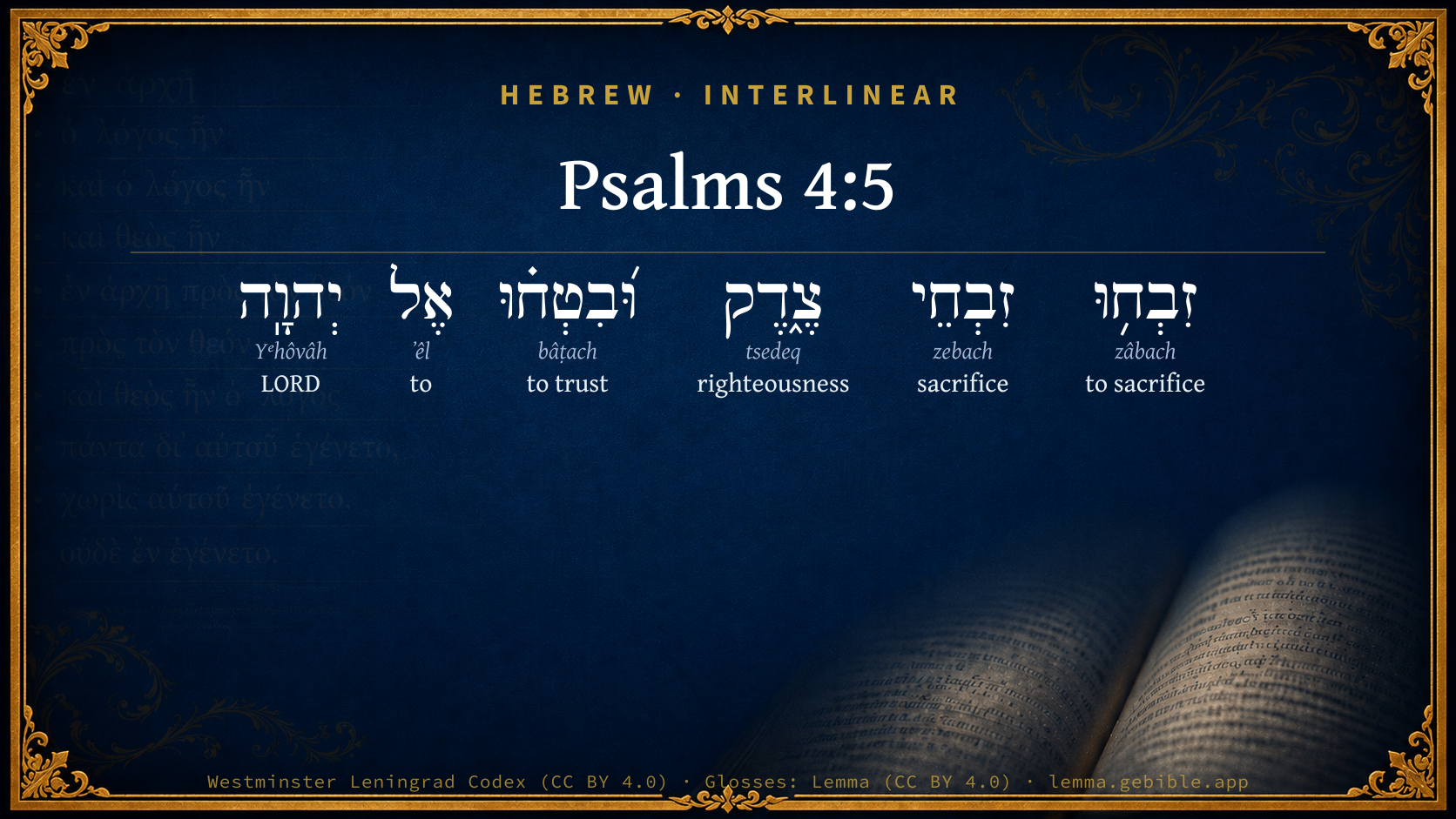
Hebrew (Westminster Leningrad Codex) Psalms 4:5 appears in the Hebrew Old Testament. The text above is from the Westminster Leningrad Codex. Each word links to its Strong’s number, a concise gloss, and parsing drawn from the Open Scriptures Hebrew Bible morphology. Click any word for its full Brown-Driver-Briggs (BDB) entry.
Download image
Cite this verse

Psalms 4:5 (World English Bible). Public Domain. Lemma interlinear Bible study tool, https://lemma.gebible.app/v/psalms/4/5.

Show BibTeX & RIS
BibTeX
RIS
English Translation
Offer the sacrifices of righteousness. Put your trust in Yahweh.
World English Bible · Public Domain
Download a study sheet

One document with this verse’s original text, its word-by-word gloss line, the meaning frame, cross-references with their text, attributed commentary, and full source and license credits — printable, and it pastes into notes with its structure intact.

This verse Autodidact and up

Study sheet (.html) Plain text (.txt)

A passage Seminary Student

Up to 50 verses in one chapter. A passage sheet keeps up to 6 commentary sources and 12 cross-references per verse, in the order this page ranks them, and says so on the sheet whenever that leaves anything out. Ask for a single verse and you get the Autodidact verse sheet above.

Everything on this page stays free to read, with no account — the sheet is a download of what is already on screen, not access to it.

Want to remove ads? Support Godless Engineer
Compare translations 3

The same verse in 3 English versions, stacked beneath the original-language interlinear above. Click any original word for its lexicon entry.

Each is an independent rendering of the whole verse — the interlinear is not word-aligned to these translations.

Highlighted words mark where these versions differ — a whole-verse word diff, not a word-by-word alignment.

  • World English Bible Public Domain
    Offer the sacrifices of righteousness. Put your trust in Yahweh.
  • King James Version Public Domain
    Offer the sacrifices of righteousness, and put your trust in the LORD.
  • unfoldingWord Literal Text CC BY-SA 4.0
    Sacrifice sacrifices of righteousness and trust in Yahweh. ts\*

unfoldingWord Literal Text — © unfoldingWord, licensed CC BY-SA 4.0. Word-aligned USFM3 via Door43 (git.door43.org/unfoldingWord/en_ult).

Versions to compare (up to 4)

3 of 4 selected

Show all 18 translations

Every available English version of this verse, each an independent rendering of the whole verse.

  • World English Bible Public Domain
    Offer the sacrifices of righteousness. Put your trust in Yahweh.
  • Berean Standard Bible Public Domain
    Offer the sacrifices of the righteous and trust in the LORD.
  • Majority Standard Bible Public Domain
    Offer the sacrifices of the righteous and trust in the LORD.
  • King James Version Public Domain
    Offer the sacrifices of righteousness, and put your trust in the LORD.
  • American Standard Version (1901) Public Domain
    Offer the sacrifices of righteousness, And put your trust in Jehovah.
  • Revised Version (1885) Public Domain
    Offer the sacrifices of righteousness, and put your trust in the LORD.
  • Geneva Bible (1599) Public Domain
    Offer the sacrifices of righteousnes, and trust in the Lord.
  • Douay-Rheims (1899) Public Domain
    Be angry, and sin not: the things you say in your hearts, be sorry for them upon your beds.
  • Young's Literal Translation Public Domain
    Sacrifice ye sacrifices of righteousness, And trust ye unto Jehovah.
  • Literal Standard Version CC BY-SA 4.0
    Sacrifice sacrifices of righteousness, || And trust in YHWH.
  • Unlocked Literal Bible CC BY-SA 4.0
    Offer the sacrifices of righteousness and put your trust in Yahweh.
  • unfoldingWord Literal Text CC BY-SA 4.0
    Sacrifice sacrifices of righteousness and trust in Yahweh. ts\*
  • Darby Bible Public Domain
    Offer sacrifices of righteousness, and confide in Jehovah.
  • World Messianic Bible Public Domain
    Offer the sacrifices of righteousness. Put your trust in the LORD.
  • Webster's Bible Public Domain
    \\4:4\\Stand in awe, and sin not: commune with your own heart upon your bed, and be still. Selah.
  • Free Bible Version CC BY-SA 4.0
    Offer sacrifices with the right attitude. Trust in the Lord.
  • Bible in Basic English Public Domain
    Give the offerings of righteousness, and put your faith in the Lord.
  • JPS Tanakh (1917) Public Domain
    (4-6) Offer the sacrifices of righteousness, and put your trust in the LORD.

Literal Standard Version (2020), Covenant Press — licensed CC BY-SA 4.0. Text via the HelloAO Bible API (eBible.org). Unlocked Literal Bible (unfoldingWord) — licensed CC BY-SA 4.0. Text via the HelloAO Bible API (eBible.org). unfoldingWord Literal Text — © unfoldingWord, licensed CC BY-SA 4.0. Word-aligned USFM3 via Door43 (git.door43.org/unfoldingWord/en_ult). Free Bible Version, Dr. Jonathan Gallagher — licensed CC BY-SA 4.0. Text via the HelloAO Bible API (eBible.org).

Word by word

More ways to search: Search by grammar → Find every occurrence → Compare this word →

Practice this passage: Drill this verse → Learn its vocabulary →

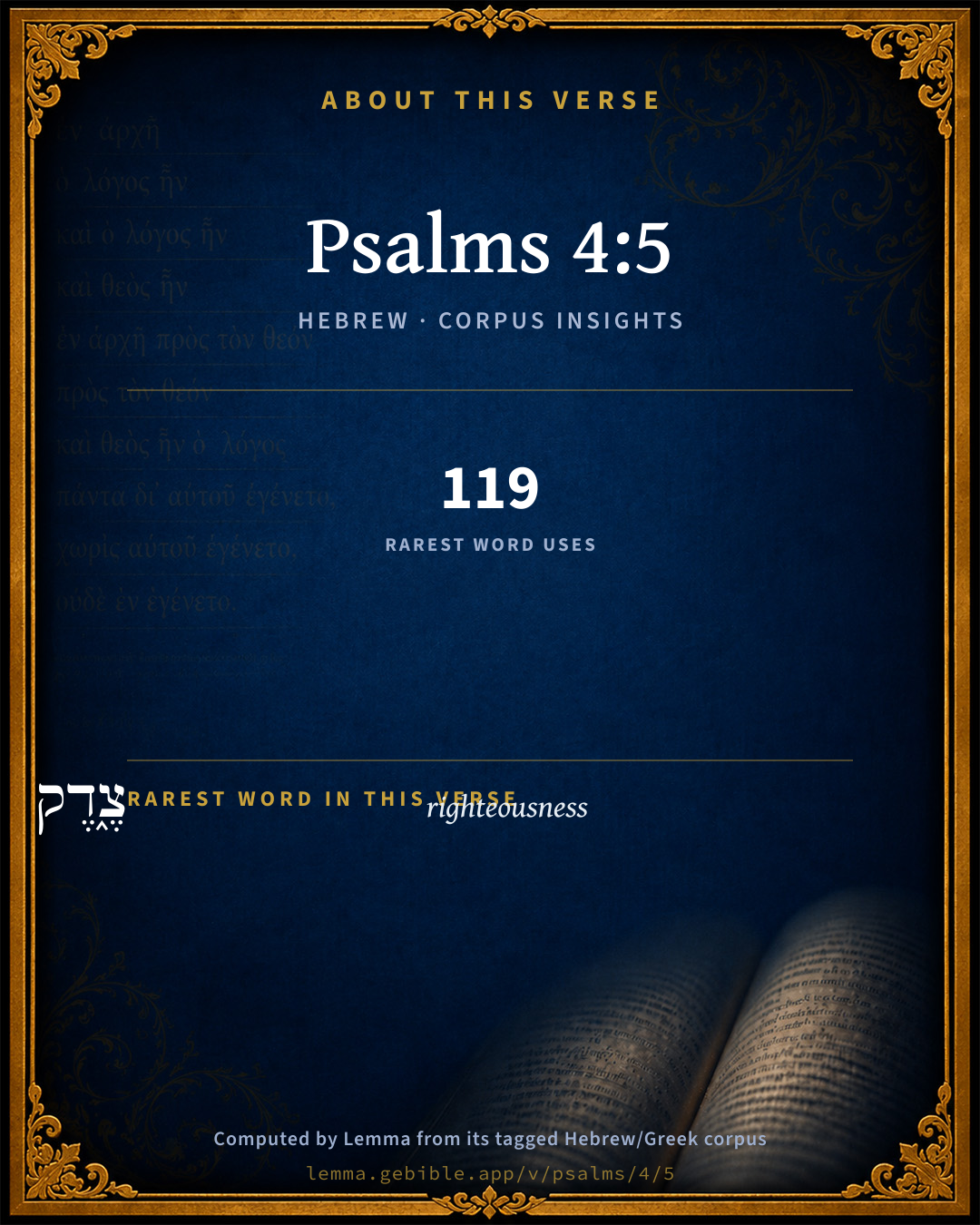
צֶ֑דֶק
tsedeq
H6664
“righteousness”
Noun, Common, Masculine, Singular, Absolute
Part of Speech
Noun
Type
Common
Gender
Masculine
Number
Singular
State
Absolute
Full BDB Definition

Origin: from H6663

TWOT: 1879a

justice, rightness, righteousness - what is right or just or normal, rightness, justness (of weights and measures) - righteousness (in government) - of judges, rulers, kings - of law - of Davidic king, Messiah - of Jerusalem as seat of just government - of God's attribute - righteousness, justice (in case or cause) - rightness (in speech) - righteousness (as ethically right) - righteousness (as vindicated), justification (in controversy), deliverance, victory, prosperity - of God as covenant-keeping in redemption - in name of Messianic king - of people enjoying salvation - of Cyrus
  1. זִבְח֥וּ zâbach H2076 “sacrifice” Verb, Qal, Imperative, 2nd Person, Masculine, Plural
  2. זִבְחֵי zebach H2077 “sacrifices of” Noun, Common, Masculine, Plural, Construct
  3. וּ֝בִטְח֗וּ bâṭach H982 “and · trust” Conjunction + Verb, Qal, Imperative, 2nd Person, Masculine, Plural
  4. אֶל ʼêl H413 “to” Preposition
  5. יְהוָֽה Yᵉhôvâh H3068 “LORD” Noun, Proper

About this verse

These counts appear in no published source. They are computed here, from the morphology-tagged text and Lemma’s own curated glosses. What Lemma adds →

6
words
6
distinct lemmas
Wisdom
section

Grammatical profile

  • 2 verbs
  • 3 nouns
  • 1 preposition

Verb forms

  • זִבְח֥וּ Qal · Imperative
  • וּ֝בִטְח֗וּ Qal · Imperative

Hebrew & Septuagint length

In English translation the verse runs 10 words from the Hebrew and 10 from the Septuagint (LXX English) — the same length.

A rough comparison of the two English renderings, which tokenize alike — not a word-level alignment.

Word counts can differ between the Hebrew and the Greek without any difference in meaning — e.g. the Hebrew direct-object marker אֵת has no separate Greek word, and Greek often adds the article ὁ.

Cross-references

18

Topical passages linked to Psalms 4:5 in the Treasury of Scripture Knowledge — connected by theme and wording, ordered by reader-vote popularity; previews shown in the World English Bible.

  • Hebrews 13:15–16 Through him, then, let us offer up a sacrifice of praise to God continually, that is, the fruit of lips which make confession to his name.
  • Psalms 37:3 Trust in Yahweh, and do good. Dwell in the land, and enjoy safe pasture.
  • Psalms 51:19 Then you will delight in the sacrifices of righteousness, In burnt offerings and in whole burnt offerings. Then they will offer bulls on your altar.
  • Deuteronomy 33:19 They shall call the peoples to the mountain; There shall they offer sacrifices of righteousness: For they shall suck the abundance of the seas, The hidden treasures of the sand.
  • Psalms 62:8 Trust in him at all times, you people. Pour out your heart before him. God is a refuge for us. Selah.
  • 1 Peter 4:19 Therefore let them also who suffer according to the will of God in doing good entrust their souls to him, as to a faithful Creator.
  • Isaiah 1:11–18 "What are the multitude of your sacrifices to me?," says Yahweh. "I have had enough of the burnt offerings of rams, And the fat of fed animals. I don't delight in the blood of bulls, Or of lambs, Or of male goats.
  • Matthew 5:23 "If therefore you are offering your gift at the altar, and there remember that your brother has anything against you,
  • Psalms 50:14 Offer to God the sacrifice of thanksgiving. Pay your vows to the Most High.
  • Psalms 84:11–12 For Yahweh God is a sun and a shield. Yahweh will give grace and glory. He withholds no good thing from those who walk blamelessly.
  • Isaiah 61:8 For I, Yahweh, love justice, I hate robbery with iniquity; and I will give them their recompense in truth, and I will make an everlasting covenant with them.
  • Malachi 1:8 When you offer the blind for sacrifice, isn't that evil? And when you offer the lame and sick, isn't that evil? Present it now to your governor! Will he be pleased with you? Or will he accept your person?" says Yahweh of Hosts.
  • Isaiah 50:10 Who is among you who fears Yahweh, who obeys the voice of his servant? He who walks in darkness, and has no light, let him trust in the name of Yahweh, and rely on his God.
  • 2 Samuel 15:12 Absalom sent for Ahithophel the Gilonite, David's counselor, from his city, even from Giloh, while he was offering the sacrifices. The conspiracy was strong; for the people increased continually with Absalom.
  • Psalms 26:1 Judge me, Yahweh, for I have walked in my integrity. I have trusted also in Yahweh without wavering.
  • Isaiah 26:3–4 You will keep [him] in perfect peace, [whose] mind [is] stayed [on you]; because he trusts in you.
  • Malachi 1:11–14 For from the rising of the sun even to the going down of the same, my name is great among the nations, and in every place incense will be offered to my name, and a pure offering: for my name is great among the nations," says Yahweh of Hosts.
  • Psalms 2:12 Kiss the son, lest he be angry, and you perish in the way, For his wrath will soon be kindled. Blessed are all those who take refuge in him.

Cross-references courtesy of OpenBible.info (CC BY 4.0).

Hebrew and Greek witnesses Masoretic Hebrew ↔ Greek Septuagint

The same verse in the two great witnesses to the Old Testament, shown verse-for-verse.

You’re reading Greek Psalm 4 (Hebrew Psalm 4). The Septuagint counts the superscription, so verse numbers can differ from the Hebrew — chapter-level alignment, not verse-by-verse. Numbering follows Rahlfs.

These are two independent witnesses, not word-aligned to each other, and the Septuagint is shown in lemma (dictionary) form.

Hebrew Psalms 4:5 Masoretic · Westminster Leningrad Codex

זִבְח֥וּ זִבְחֵי צֶ֑דֶק וּ֝בִטְח֗וּ אֶל יְהוָֽה

Offer the sacrifices of righteousness. Put your trust in Yahweh.

World English Bible · Public Domain

Greek LXX Greek Psalm 4:5 Septuagint · lemma form

ὀργίζω καί μή ἁμαρτάνω λέγω ἐν ὁ καρδία σύ καί ἐπί ὁ κοίτη σύ κατανύσσω διάψαλμα

Offer the sacrifice of righteousness, and trust in the Lord.

LXX2012 (modern English Septuagint) · Public Domain

On this verse, J. A. Alexander on Psalms discusses the Septuagint’s reading. Read the note in Commentary ↓

Hebrew: Westminster Leningrad Codex (CC BY 4.0). Greek: Septuagint (public domain); English from LXX2012 (modern English Septuagint) (Public Domain). How the Septuagint differs from the Hebrew →

Commentary

Notes on Psalms 4:5 from classic Christian and Jewish commentators (each source and its license shown beneath its notes). The classic Christian expositions comment on the surrounding passage and are grouped to its opening verse, so a note may address several verses; the Jewish commentaries on the Tanakh (Rashi and others) are per-verse, so they appear only where the commentator wrote on this verse.

Lemma curates 59 commentaries, every one of them public domain or Creative Commons licensed, each selected and text-cleaned for this edition rather than reprinted as found. About our sources →

Trapp's Complete Commentary

John Trapp

Psa 4:5 Offer the sacrifices of righteousness, and put your trust in the LORD.

Ver. 5. Offer the sacrifices of righteousness] Confess your sins, and slay them; run to him who is the propitiation, Jesus Christ the righteous, present your bodies a living sacrifice, bring a contrite spirit; to do good and to communicate forget not, &c., else you offer the sacrifice of fools, as Ecc 5:1, and not of righteousness, as here. The Chaldee hath it, Domate concupiscentias, sacrifice and subdue your lusts.

And put your trust in the Lord] It is well observed that God brings men home by a contrary way to where they fell from him. We fell from him by distrust, by having him in a jealousy, as if he aimed more at himself than at our good. We return to him by having a good conceit of him, that he loves us better than we can love ourselves, and therefore that we ought to put our trust in him, both in life and death.

John Trapp, A Commentary or Exposition upon All the Books of the Old and New Testament (1647–1656) — public domain. Text from a community e-Sword module.

The Biblical Illustrator

Joseph S. Exell

Psa_4:5

Offer the sacrifices of righteousness, and put your trust in the Lord.

Sacrifice and trust

What are we to understand by this expression, The sacrifices of righteousness?

1. By way of specification. The sacrifices of righteousness are righteous sacrifices, sacrifices and oblations under the law. The sacrifice of contrition and humiliation. The sacrifice of praise and thanksgiving. The sacrifice of alms and charitable contributions. The exercise and practice of righteousness. To offer the sacrifices of righteousness is to be abundant in acts of justice and equity, and righteousness betwixt man and man.

2. By way of modification or qualification, as to the manner of performance. In a righteous manner; from a righteous principle, to a righteous end. In faith, in obedience, in humility. Notice the privilege of all true Christians under the gospel. Sacrifice is not now confined to any particular place. It is performed with less difficulty. The Christian sacrifices are sanctified by the sacrifice of Christ, who has offered Himself up for us. Take the second sentence of the text, Put your trust in the Lord. This is a duty by itself. Faith in God is required, together with righteousness to men. Look at this duty in its connection with the first sentence, Offer the sacrifices. A double force in this--as the sacrifices are preparatory, and disposing to this trust; and as this trust qualifies and regulates those sacrifices. The best ground of our trust is the free mercy of God in Christ. (T. Horton, D. D.)

The sacrifices of righteousness

Taking the language of the text in its most rigid meaning, estimating our sacrifices of righteousness by the perfect rule originally given to us,--and remembering that God cannot receive anything less valuable without violating the faithfulness, and compromising the purity of His character,--we have no sacrifices to offer to Him which will justify us in expecting that, for the sake of these, we shall regain and enjoy any of those blessings which His goodness ever prompts Him to bestow upon His rational offspring, as constituting at once their honour and their happiness. Still, we are commanded to offer the sacrifices of righteousness, and we are encouraged to trust in the Lord. The two things must be consistent. It must be practicable for us, fallen though we be, to do both the one and the other.

1. Offer the sacrifices of righteousness, by cherishing those sentiments of humility and sorrow which become creatures who have lost their righteousness; and trust in the Lord, that if you do so, He will comfort you, and lift you up. Humility and sorrow, it is true, cannot compensate for the want of righteousness. They amount to a recognition of that want. Humility and sorrow answer the purpose assigned them, as being a heartfelt testimony on the part of the transgressor to the infinite excellence of Gods law, and to the fitness and importance, and necessity, of that obedience which it demands. In this there is a tribute paid to the authority of God. Presenting this sacrifice of righteousness, you need not be afraid of your offering being rejected or disdained.

2. By a believing application to the obedience of Christ, as constituting that righteousness for the sake of which God justifies the ungodly. Our humility, however deep, and our sorrow, however sincere, come far short of what Gods law requires of us. And so must all the best affections, and all the worthiest doings, of which we are capable. It is the grand object of the gospel dispensation, to provide for us that righteousness of which we are naturally destitute, but which, nevertheless, the holiness and immutability of Gods law render absolutely necessary. This provision has been made by appointing Christ as our surety and substitute. In what manner does the righteousness of Christ become ours, so that we may offer it as a sacrifice to God, and trust in Him, that, for its sake, He will forgive and bless us? It is appropriated by faith, by that faith which implies a renunciation of all dependence on our own inherent righteousness as the instituted method of justification. We offer to God the sacrifice of this righteousness when we direct our views to it, and place our confidence in it.

3. By an earnest desire and uniform endeavour to be adorned with the graces of personal righteousness. Personal righteousness is absolutely, and in every case, indispensable. Strive and pray that your offering may be cheerful, unreserved, and constant. Thus offering the sacrifices of righteousness, you may trust in the Lord that your offering shall not be in vain.

4. By striving to promote the interests of righteousness among your fellow men. No doubt our principal concern is to be holy ourselves. But if we are sincere in that work, we will be anxious that our neighbours shall be holy in the same manner, and to the same extent, and will make every exertion that may be requisite for attaining that end. And explicit obligation is laid upon us to aim at the suppression of sin, and at the prosperity of virtue among our fellow creatures. As to the means by which you are to promote this object, it must strike you at once that the grand and efficient means of diffusing righteousness is to be found in the diffusion of Christianity. Christianity is a system of righteousness. If you would secure for Christianity its purifying effects in their best style, and in their fullest measure, you must present it to men in its true and native character, as it has been set forth by God Himself. And you must exhibit its purifying influence on your own deportment. (A. Thomson, D. D.)

The Biblical Illustrator, edited by Joseph S. Exell (c. 1880s–1900s) — public domain. Text from a community e-Sword module.

Joseph Benson's Commentary

Psa 4:5. Offer — Unto God, that he may be reconciled to you; the sacrifice of righteousness — Righteous sacrifices; which requires that the persons offering them be righteous and do righteous things, and offer them with an honest mind, with faith and true repentance. Without which he intimates that all their sacrifices were of no esteem with God, and would be wholly unprofitable to them. And put your trust in the Lord — And then, that is, so doing, you may rely upon God, and confidently expect his assistance and blessing, for which otherwise it is in vain for you to hope. Dr. Horne, who thinks this Psalm looks forward to gospel days, interprets this verse in the following manner: “The Jews are no longer to offer the shadowy sacrifices of their law, since He who is the substance of them all is come into the world. The Gentiles are no more to offer their idolatrous sacrifices, since their idols have fallen before the cross. But returning sinners, whether Jews or Gentiles, are to offer the same sacrifices of evangelical righteousness; not putting their trust in them, but in the Lord Jesus, through whose Spirit they are enabled to offer, and through whose blood their offerings are acceptable unto God.”

Joseph Benson's Commentary on the Old and New Testaments (1811–1818) — public domain. Text from a community e-Sword module.

Tyndale Open Study Notes

Tyndale Open Resources

4:5 Offer sacrifices in the right spirit: Redirecting emotions toward the Lord prevents a godly individual from doing too much self-reflection (40:6-8; 51:17).

Tyndale Open Study Notes — © Tyndale Open Resources, licensed CC BY-SA 4.0. Text via the HelloAO Bible API.

Geneva Bible (1599)

Geneva Bible translators

Serve God purely, and not with outward ceremonies.

Geneva Bible (1599) marginal notes — public domain. Text via Bolls.life.

Jamieson, Fausset & Brown

Robert Jamieson, A. R. Fausset & David Brown

Not only repent, but manifest penitence by sacrifices or righteousness or righteous sacrifices, &c.

Jamieson, Fausset & Brown — Commentary Critical and Explanatory on the Whole Bible (1871) — public domain (CC PDM 1.0). Text via the HelloAO Bible API.

Adam Clarke's Commentary

Verse 5. Offer the sacrifices of righteousness] Do not attempt to offer a sacrifice to God for prosperity in your present rebellious conduct. Such a sacrifice would be a sin. Turn to God from whom you have revolted; and offer to him a righteous sacrifice, such as the law prescribes, and such as he can receive. Let all hear and consider this saying. No sacrifice - no performance of religious duty, will avail any man, if his heart be not right with God. And let all know, that under the Gospel dispensation no sacrifice of any kind will be received but through the all-atoning sacrifice made by Christ.

Because of sin, justice has stopped every man's mouth; so that none can have access to God, but through the Mediator. By him only can the mouth of a sinner be opened to plead with God. Hear this, ye who trust in yourselves, and hope for heaven without either faith or dependence on the vicarious sacrifice of Christ.

Adam Clarke's Commentary on the Bible (1810–1826) — public domain. Text from a community e-Sword/MySword module.

John Calvin's Commentaries

5. Sacrifice ye. Many are of opinion that David exhorts his enemies to give some evidence of their repentance; and I certainly admit, that sacrifices were partly enjoined for the purpose of inducing men to walk in newness of life. But when I consider the character of the men who opposed David, I am satisfied that he here censures their hypocrisy, and beats down their groundless boasting. David, when he wandered as a fugitive in deserts, or in caves, or on mountains, or in the regions beyond his own country, might seem to have been separated from the Church of God; and certainly he was commonly accounted as a corrupt member cut off from the body and the communion of the saints. Meanwhile the ark of the covenant was in the hands of his enemies, they kept possession of the temple, and they were the first in offering sacrifices. They, therefore, vaunted themselves against David with the same boldness and presumption with which we know hypocrites to have been always puffed up. Nor is it to be doubted, but they proudly abused the name of God as if they only had been his true worshippers. “Comme s’ils eussent este gens de bien, adonnez a son service et qu’il n’y eust eu zele qu’en eux.” — Fr. As if they had been his genuine people devoted to his service, and that there was no zeal but among them.

“Entre les sacrifices de justice et toutes les ceremonies, quand elles sont destituees de la verite interieure et destournees de leur droit usage et par consequent falsifiees.” — Fr. Between the sacrifices of righteousness, and all ceremonies, when they are unaccompanied with sincerity of heart, and perverted from their proper use, and are consequently spurious.

John Calvin's Commentaries (1540-1563) — public domain. Text from the Calvin Translation Society English edition (1840s-50s) via the Christian Classics Ethereal Library (ccel.org). Calvin's coverage is partial (roughly two-thirds of the Bible); uncommented books and verses are honest gaps, never fabricated. The 19th-century editor's footnotes and remarks are omitted so the notes are faithfully Calvin's own voice.

Ellicott's Commentary for English Readers

(5) Sacrifices of righteousness.—Comp. Psa_51:18-19; Deu_33:19. The context in both places directs to the translation “right” or “due” sacrifices, i.e., sacrifices duly and religiously performed.

A Bible Commentary for English Readers, edited by Charles John Ellicott (1878–1897) — public domain. Text from a community e-Sword module.

The Cambridge Bible for Schools and Colleges

gen. ed. J. J. S. Perowne

5. sacrifices of righteousness] Sacrifices offered in a right spirit, cp. Deu_33:19; Psa_51:19. The rebels are still addressed. The sacrifices with which they pretended to hallow their cause (2Sa_15:12) were a wretched hypocrisy, inasmuch as they were acting in opposition to the will of God. Let them approach Him in a right spirit, and instead of impatiently trying to remedy evils by revolution, rely entirely upon His guidance.

5, 6. After an interval for reflection indicated by the interlude (Selah) David points the malcontents among the people to the true source of prosperity.

The Cambridge Bible for Schools and Colleges (gen. ed. J. J. S. Perowne; Cambridge University Press, 1878–1918) — public domain. Text from a community e-Sword module.

John Gill's Exposition

Offer the sacrifices of righteousness,.... Offer for sacrifice things righteously gotten, for the Lord hates robbery for burnt offering, Isa 61:8. Some respect may be had to the unrighteous acquisitions of Absalom and his men, and who were now in possession of Jerusalem, and of the altars of the Lord, and were sacrificing on them; in which they gloried; and to which this may be opposed. Likewise sacrifices of righteousness are such as were according to the law, and were offered in a right manner; which were not maimed, nor had any blemish in them; see Mal 1:13; and particularly such as were offered up in the faith of the great sacrifice, Christ; for, without faith, it is impossible to please God by any sacrifice. And this sense is confirmed by the following clause, which requires trust in the Lord. Moreover, righteousness, with the Jews, signifies alms, beneficence, showing mercy to the indigent; and acts of liberality are sacrifices, with which God is well pleased; and which are preferred by him to the sacrifices of the ceremonial law, Heb 13:16. The sacrifices also of a broken heart, and of a contrite spirit, are such as God esteems of; he looks to those that have them, and dwells with them. And to this sense the Chaldee paraphrase inclines, in which the words are thus paraphrased;

"subdue your corruptions, and it shall be reckoned to you as a sacrifice of righteousness?''

and why may not the sacrifice of praise for mercies received, especially for the righteousness of Christ, be at least included, if not principally designed; since these are sacrifices which, under the ceremonial law, were more pleasing to God than others; and are always acceptable to him through Jesus Christ our Lord? Agreeably to this, Aben Ezra thinks the peace offerings are intended, which were in a way of thanksgiving; and are opposed to sin offerings, and trespass offerings, and burnt offerings; from the last of which sacrifices of righteousness are distinguished in Psa 51:19;

and put your trust in the Lord: not in your strength, in horses and chariots, and numbers of men; nor in wise counsels, nor in riches, nor in fleshly privileges, nor in works of righteousness, or sacrifices of righteousness: for though they are to be performed, they are not to be trusted in; nor in your own hearts. And while the psalmist is striking at the false confidence of the sons of men he is addressing, he may at the same time be thought to be encouraging those that were with him to trust in the Lord, Jehovah, the Son of God, before spoken of by him as the object of trust, Psa 2:12; to trust in his person for the acceptance of their persons and sacrifices of righteousness; and in his righteousness for justification; in his blood for pardon; in his sacrifice for expiation of sin; in his fulness for daily supplies; and in his power for protection and safety. And it is right to trust in him at all times; in times of affliction, temptation, and desertion: he is always the same; in him is everlasting strength; he has an heart as well as an ability to help and succour, and none ever trusted in him and were confounded. Such have peace and safety, and can want no good thing.

John Gill's Exposition of the Whole Bible (1746–1763) — public domain (CC PDM 1.0). Text via the HelloAO Bible API.

Albert Barnes' Notes on the Bible

Offer the sacrifices of righteousness - Offer righteous sacrifices; that is, sacrifices prompted by right motives, and in accordance with the prescriptions in the law of God. This appears to be addressed also to those who in Psa 4:2 are called “sons of men;” that is, those who were arrayed against the psalmist. According to the common opinion this psalm was composed by David on occasion of his being driven from his throne and kingdom; and, of course, Zion, the ark, and the tabernacle, were in the hands of his enemies. The exhortation here may be, either that, as his enemies were now in possession of the usual seat of public worship, they would conduct the worship of God by keeping up the regular daily sacrifice; or, more probably, it means that in view of their sins, particularly in this rebellion, and as the result of the calm reflection to which he had exhorted them in Psa 4:4, they should now manifest their repentance, and their purpose to turn to God, by presenting to him an appropriate sacrifice. They were sinners. They were engaged in an unholy cause. He exhorts them to pause, to reflect, to turn to God, and to bring a sacrifice for their sins, that their guilt might be blotted out.

And put your trust in the Lord - That is, turn from your evil ways, and confide in God in all his arrangements, and submit to him. Compare Psa 2:12.

Albert Barnes' Notes on the Bible (1834–1885) — public domain. Text from a community e-Sword/MySword module.

Matthew Poole's English Annotations

Offer, to wit, unto God, that he may be reconciled to you, and may pardon all your murmurings and insurrections against him and against me. For it seems plain that this, as well as the former verse, is spoken not to David’s friends and favourers, as some think, but to his enemies, even to those sons of men, Psa 4:2, to whom he directeth his speech, Psa 4:3, but know, and, Psa 4:4, stand in awe and here offer: The sacrifices of righteousness, i.e. righteous sacrifices; which requires that the persons offering them be righteous, and do righteous things, and offer them with an honest mind, and with faith (as it follows) and true repentance; without which he intimates that all their sacrifices were of no esteem with God, and would be wholly unprofitable to them. And withal, it is probable that he reflects upon the followers of Saul or of Absalom, who had the only place of sacrifice in their possession, whilst David was debarred of the opportunity of sacrificing, as he complains, 1Sa 26:19; and accordingly they gloried in their sacrifices, and upon that account promised themselves success against David, who was by God’s providence deprived of the opportunities of reconciling and engaging God by sacrifices.

And put your trust in the Lord; and then, i.e. so doing, you may rely upon God, and confidently expect his assistance, which otherwise it is in vain for you to hope for. Withal, he seems to reflect upon his enemies, who trusted to an arm of flesh, to their own great numbers and power, and to intimate what his course was, to wit, to trust in the Lord.

Matthew Poole's English Annotations on the Holy Bible (1683–1685) — public domain. Text from a community e-Sword/MySword module.

Whedon's Commentary on the Bible

Daniel D. Whedon

5. Offer the sacrifices of righteousness—Be diligent in all religious duty and worship. A sacrifice of righteousness is such a one as the law prescribes, offered in form and spirit according to the will of God.

Put your trust in the Lord—Here is the ground of all David’s self control, the secret of all his success. His enemies had trusted in men and the wave of popular favour. See 2Sa_15:12; 2Sa_17:11

Daniel D. Whedon (gen. ed.), Commentary on the Old and New Testaments (1874–1909) — public domain. Text from a community e-Sword module.

The Pulpit Commentary

Offer the sacrifices of righteousness. Sacrifices of victims are scarcely meant; certainly not, if the time of the composition is that of David"s exile, since victims could be offered nowhere but at Jerusalem. We may suppose a reference to those sacrifices which are most truly "sacrifices of righteousness," vie. "a broken spirit, a broken and a contrite heart," which God "will not despise". (Psa_51:17) And put your trust in the Lord. Sacrifice without faith is vain. Even "sacrifices of righteousness," to be of any service, must be accompanied by trust in the Lord.

The Pulpit Commentary (1880–1919), ed. H.D.M. Spence-Jones & Joseph S. Exell — public domain. Text from a community e-Sword module.

John Wesley's Explanatory Notes

Offer - Unto God, that he may be reconciled to you. Righteousness - Righteous sacrifices; which requires that the persons offering them be righteous and do righteous things, and offer them with an honest mind, with faith and true repentance. Without which, he intimates, that all their sacrifices were of no esteem with God, and would be wholly unprofitable to them.

John Wesley, Explanatory Notes Upon the Whole Bible (1754–1765) — public domain. Text via the GEBible commentary corpus.

J. A. Alexander on Psalms

Joseph Addison Alexander

5. The address to his enemies is still continued, but merely as a vehicle of truth and his own feelings. Rage and sin not, i. e. do not sin by raging, as you have done, against me, the Lord's Anointed, and indirectly therefore against himself. This construction of the Hebrew words, though not the most obvious or agreeable to usage, agrees best with the context and with the Septuagint version, adopted by Paul in Eph 4:26, where the precept, Be ye angry and sin not, seems to be a positive prohibition of anger, i. e., of its wilful continuance, as appears from what the apostle adds, perhaps in allusion to the last clause of the verse before us. Some, it is true, have understood Paul as meaning, Be angry upon just occasions, but be careful not to sin by groundless anger or excess. But even if this be the sense of the words there, it is entirely inappropriate here, where the anger of the enemies was altogether sinful, and they could not therefore be exhorted to indulge it. There is still another meaning which the Hebrew words will bear. The verb strictly means to be violently moved with any passion or emotion, whether anger (Pro 29:9), grief (2Sa 18:33), or fear (Isa 32:11). It might therefore be translated here, tremble, stand in awe, and sin not. But this, although it yields a good sense, cuts off all connection between David's words and those of Paul, and makes the explanation of the latter still more difficult. The English word rage not only conveys the sense of the original correctly, but is probably connected with it in its etymology. The command to cease from raging against God and his Anointed, is still further carried out in the next clause. Say in your heart, to yourselves, and not aloud, much less with clamour, what you have to say. The Hebrew verb does not mean to speak but to say, and, like this English word, is always followed by the words spoken, except in a few cases where they can be instantly supplied from the context. E g. Exo 19:25, "So Moses went unto the people and said (not spake) to them" what God had just commanded him. Gen 4:8, "And Cain said to Abel his brother (not talked with him)," let us go into the field, as appears from what immediately follows. Compare 2Ch 2:10. It might here be rendered, say (so) in your heart, i. e. say we will no longer sin by raging against David; but the other is more natural, and agrees better with what follows. Say (what you do say) in your heart, upon your bed, i. e. in the silence of the night, often spoken of in Scripture as the season of reflection (Eph 4:26), and be still, be silent, implying repentance and submission to authority. The effect of this exhortation to be still is beautifully trengthened by a pause in the performance. Selah.

Joseph Addison Alexander, The Psalms Translated and Explained (1850) — public domain. Text from a community e-Sword module.

Scofield Reference Notes

C. I. Scofield

trust (See Scofield "Psa 2:12").

The Scofield Reference Bible (1917 edition), notes by C. I. Scofield — public domain. Text from a community e-Sword module.

Rashi

Rabbi Shlomo Yitzchaki (Rashi)

Quake Tremble before the Holy One, blessed be He, and do not sin.

say [this] in your heart on your bed and be forever silent Bring back to your heart [the thought] that the Holy One, blessed be He, admonished [you] concerning that.

Rashi on the Tanakh — English translations: “The Judaica Press complete Tanach with Rashi, translated by A. J. Rosenberg” (CC BY 4.0); “Pentateuch with Rashi's commentary by M. Rosenbaum and A.M. Silbermann, 1929-1934” (public domain); “The Metsudah Tanach series, Lakewood, N.J” (CC BY 4.0); and “The Book of Joshua, Metsudah Publications, 1997” (CC BY 4.0). Text via Sefaria.

Radak

Rabbi David Kimhi (Radak)

Tremble: – The meaning is “fear,” as “and shall tremble and be in anguish” (Deut. 2:25). Fear God if ye do not fear me.

and sin not: – in still pursuing after and rebelling against me.

Say it in your heart (i.e. think) upon your bed: – for a man upon his bed finds his heart freer from the concerns of the world and then will his intention be pure. And David addresses them: “Consider in your heart”. And so the thought of the heart is called “speaking” (as in the text) “That saith in her heart” (Is. 47:8). And he says

Be still. Selah: – His meaning is: “Be silent, and cease to rebel against me;” for “stillness” has the sense of silence of speech and voice, as “They kept still for my counsel” (Job 29:21); “stillness and a voice I heard” (ibid. 4:16). There is also (a stillness) which is (equivalent to) silence of action and movement, as “He turneth the storm to stillness” (Ps. 107:29); “my bowels boil and are not still” (Job 30:27); “and the sun stood still” (Josh. 10:13); “Be still (tarry) until we come unto you” (1 Sam. 14:9); “To the still stone” (Hab. 2:19), and (other instances) similar to these. And of this meaning is (the sentence) Be still: Selah, as though to say: “Cease you from your works.” And the great teacher of righteousness, our master Moses ben Maimon, has explained (Guide for the Perplexed, Bk. 1:50, 59) that this verse commands men of intelligence and reputation to recognise the truth and the praise of God in their hearts, so that no error of speech shall overtake them. But this is not (derived) from the sense of the Psalm.

Radak on the Tanakh — English translations: “Sefaria Community Translation” (CC0 1.0 (public-domain dedication)); “Eliyahu Munk, HaChut Hameshulash” (CC BY 4.0); “Rabbi Mike Feuer, Jerusalem Anthology” (CC BY 4.0); and “R. David Kimhi on the first book of Psalms, Translated by R.G. Finch, London, 1919” (public domain). Text via Sefaria.

Ibn Ezra

Rabbi Abraham ibn Ezra

Tremble (רִגְזוּ - rigzu): Because they shamed him instead of [giving him] his glory, and spoke falsehood concerning him [v. 3], he said: Tremble (Rigzu) out of [fear of] HaShem; fear (pachadu). Similar [is the usage of the root in (Genesis 45:24)]: "Do not tremble/quarrel (al tirg'zu) on the way." [The reason for fear is] because the king takes note of the mockery directed at him. And some say (v'yesh omrim): [That rigzu means "be angry," and the verse means:] Even if you think falsehood in your hearts, let it not come out of your mouths. But this is not correct (ve-zeh eineno nakhon). For it is written (Psalm 15:2): "who speaks truth in his heart," [and (Proverbs 6:18)]: "a heart that devises wicked thoughts (machshevot aven)." The speech of the heart is the essential thing (ha-ikkar), and the tongue is not, but rather [it is merely] an interpreter (melitz) between the heart and the hearers. Rather, the interpretation is: That you should think in your hearts at night upon your beds—when you have no involvement with other people—so that you will not speak falsehood during the day. And this [leads to the final phrase]: "And be silent/still. Selah" (וְדֹמּוּ סֶלָה - Ve-dommu selah).

Ibn Ezra on the Tanakh — English translations: “Sefaria Community Translation” (CC0 1.0 (public-domain dedication)); “Yalkut, Sifsei Chachomim Chumash, Metsudah Publications, 2009” (CC BY 4.0); and “Commentary of Ibn Ezra on Isaiah - trans. by M. Friedlander, 1873” (public domain). Text via Sefaria.

Lesson kit

Teaching starters — assembled from the data on this page, not authored interpretation. Every prompt links to the verse data it draws on. Edit before teaching.

Psalms, in the Wisdom, opens this verse with 6 words (6 distinct Hebrew lemmas). Its most distinctive word is tsedeq (“righteousness”). A historical commentator’s framing appears above. Read the whole chapter for the surrounding context.

Discussion questions

  1. The word tsedeq carries the sense “righteousness.” How does it shape the verse?
  2. How does Hebrews 13:15–16, which shares this passage’s theme, read alongside this verse?
  3. The translations on this page render this verse differently — a whole-verse word diff, not a word-by-word alignment. What might account for the different wordings?
  4. «זִבְח֥וּ» is a Qal Imperative verb. How does that grammatical form shape the action described?
  5. Compare how Trapp's Complete Commentary and The Biblical Illustrator read this verse. Where do they agree or differ?

Things to notice

Reading settings

Reading text

Shown beneath each verse's original-language words.

Old Testament
Old Testament edition

Read the OT as the Masoretic Hebrew (MT) or the Greek Septuagint (LXX).

English shown for the Greek Septuagint (in the Hebrew ↔ Greek comparison).

Comparing translations? Open the Compare panel on any verse page to stack up to four side by side.