
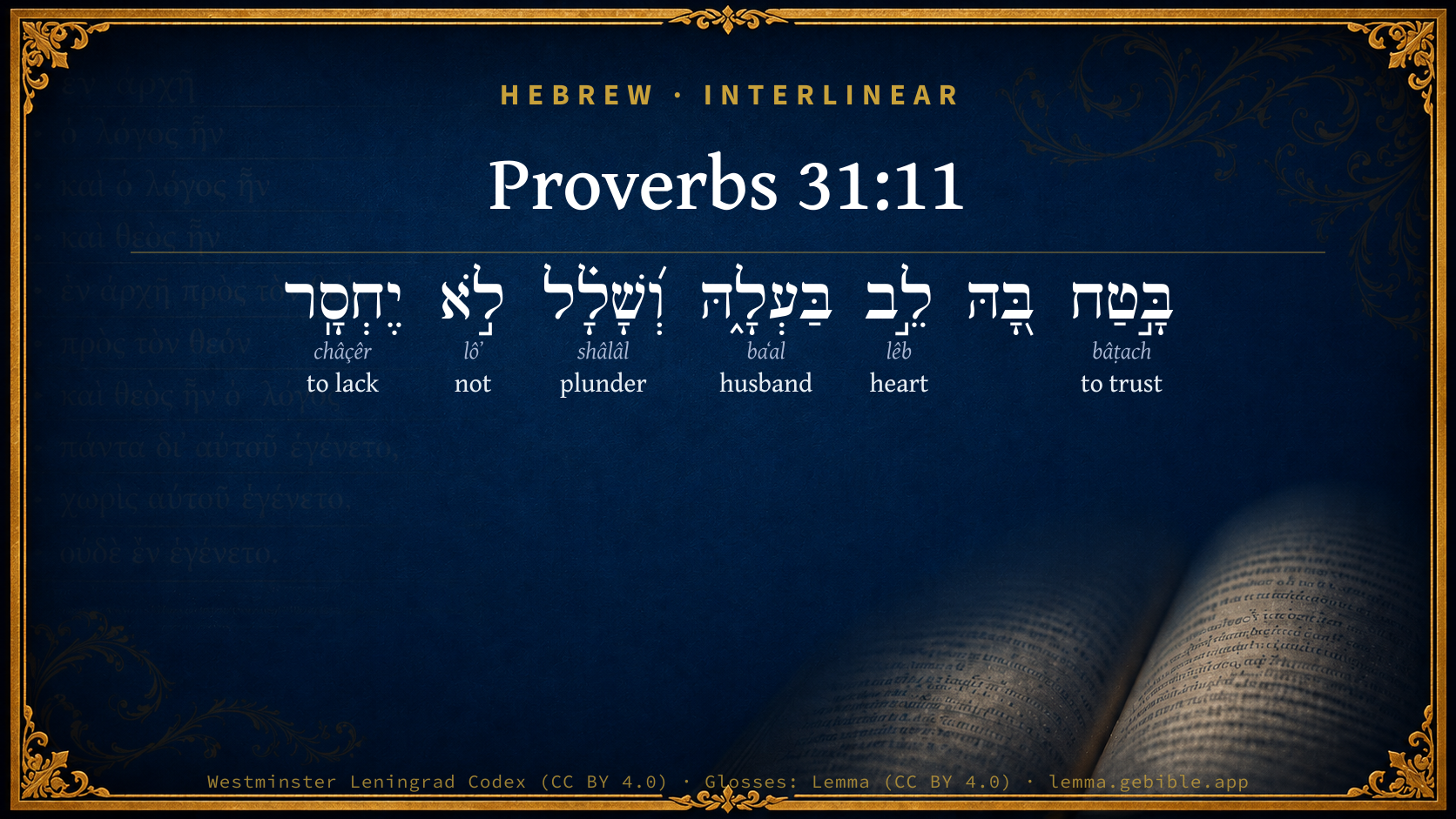
Proverbs 31:11

Hebrew (Westminster Leningrad Codex) Proverbs 31:11 appears in the Hebrew Old Testament. The text above is from the Westminster Leningrad Codex. Each word links to its Strong’s number, a concise gloss, and parsing drawn from the Open Scriptures Hebrew Bible morphology. Click any word for its full Brown-Driver-Briggs (BDB) entry.
Download image
Cite this verse

Proverbs 31:11 (World English Bible). Public Domain. Lemma interlinear Bible study tool, https://lemma.gebible.app/v/proverbs/31/11.

Show BibTeX & RIS
BibTeX
RIS
English Translation
The heart of her husband trusts in her. He shall have no lack of gain.
World English Bible · Public Domain
Download a study sheet

One document with this verse’s original text, its word-by-word gloss line, the meaning frame, cross-references with their text, attributed commentary, and full source and license credits — printable, and it pastes into notes with its structure intact.

This verse Autodidact and up

Study sheet (.html) Plain text (.txt)

A passage Seminary Student

Up to 50 verses in one chapter. A passage sheet keeps up to 6 commentary sources and 12 cross-references per verse, in the order this page ranks them, and says so on the sheet whenever that leaves anything out. Ask for a single verse and you get the Autodidact verse sheet above.

Everything on this page stays free to read, with no account — the sheet is a download of what is already on screen, not access to it.

Want to remove ads? Support Godless Engineer
Compare translations 3

The same verse in 3 English versions, stacked beneath the original-language interlinear above. Click any original word for its lexicon entry.

Each is an independent rendering of the whole verse — the interlinear is not word-aligned to these translations.

Highlighted words mark where these versions differ — a whole-verse word diff, not a word-by-word alignment.

  • World English Bible Public Domain
    The heart of her husband trusts in her. He shall have no lack of gain.
  • King James Version Public Domain
    The heart of her husband doth safely trust in her, so that he shall have no need of spoil.
  • unfoldingWord Literal Text CC BY-SA 4.0
    The heart of her husband trusts in her, and spoil he will not lack.

unfoldingWord Literal Text — © unfoldingWord, licensed CC BY-SA 4.0. Word-aligned USFM3 via Door43 (git.door43.org/unfoldingWord/en_ult).

Versions to compare (up to 4)

3 of 4 selected

Show all 18 translations

Every available English version of this verse, each an independent rendering of the whole verse.

  • World English Bible Public Domain
    The heart of her husband trusts in her. He shall have no lack of gain.
  • Berean Standard Bible Public Domain
    The heart of her husband trusts in her, and he lacks nothing of value.
  • Majority Standard Bible Public Domain
    The heart of her husband trusts in her, and he lacks nothing of value.
  • King James Version Public Domain
    The heart of her husband doth safely trust in her, so that he shall have no need of spoil.
  • American Standard Version (1901) Public Domain
    The heart of her husband trusteth in her, And he shall have no lack of gain.
  • Revised Version (1885) Public Domain
    The heart of her husband trusteth in her, and he shall have no lack of gain.
  • Geneva Bible (1599) Public Domain
    The heart of her husband trusteth in her, and he shall haue no neede of spoyle.
  • Douay-Rheims (1899) Public Domain
    The heart of her husband trusteth in her, and he shall have no need of spoils.
  • Young's Literal Translation Public Domain
    The heart of her husband hath trusted in her, And spoil he lacketh not.
  • Literal Standard Version CC BY-SA 4.0
    The heart of her husband has trusted in her, || And he does not lack spoil.
  • Unlocked Literal Bible CC BY-SA 4.0
    The heart of her husband trusts in her, and he will never be poor.
  • unfoldingWord Literal Text CC BY-SA 4.0
    The heart of her husband trusts in her, and spoil he will not lack.
  • Darby Bible Public Domain
    The heart of her husband confideth in her, and he shall have no lack of spoil.
  • World Messianic Bible Public Domain
    The heart of her husband trusts in her. He shall have no lack of gain.
  • Webster's Bible Public Domain
    The heart of her husband doth safely trust in her, so that he shall have no need of spoil.
  • Free Bible Version CC BY-SA 4.0
    Her husband has complete confidence in her, and with her he'll never be poor.
  • Bible in Basic English Public Domain
    The heart of her husband has faith in her, and he will have profit in full measure.
  • JPS Tanakh (1917) Public Domain
    The heart of her husband doth safely trust in her, and he hath no lack of gain.

Literal Standard Version (2020), Covenant Press — licensed CC BY-SA 4.0. Text via the HelloAO Bible API (eBible.org). Unlocked Literal Bible (unfoldingWord) — licensed CC BY-SA 4.0. Text via the HelloAO Bible API (eBible.org). unfoldingWord Literal Text — © unfoldingWord, licensed CC BY-SA 4.0. Word-aligned USFM3 via Door43 (git.door43.org/unfoldingWord/en_ult). Free Bible Version, Dr. Jonathan Gallagher — licensed CC BY-SA 4.0. Text via the HelloAO Bible API (eBible.org).

Word by word

More ways to search: Search by grammar → Find every occurrence → Compare this word →

Practice this passage: Drill this verse → Learn its vocabulary →

About this verse

These counts appear in no published source. They are computed here, from the morphology-tagged text and Lemma’s own curated glosses. What Lemma adds →

7
words
6
distinct lemmas
Wisdom
section

Notable vocabulary

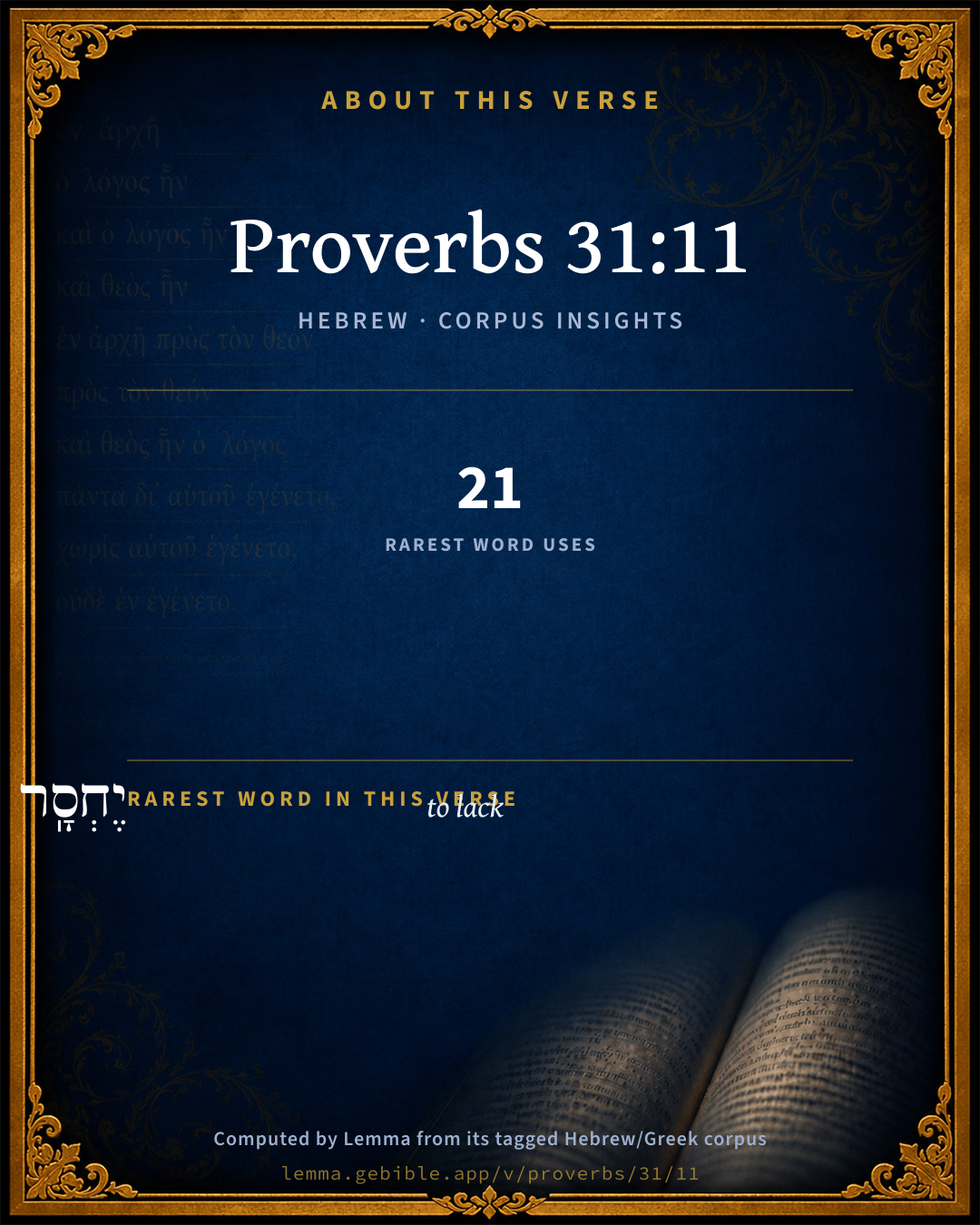
The rarest word here is יֶחְסָֽר to lack H2637 — appearing just 21 times in the whole Hebrew Bible.

Shared distinctive vocabulary

יֶחְסָֽר to lack H2637 occurs in 21 verses of the Hebrew Bible. Also found in:

Grammatical profile

  • 2 verbs
  • 3 nouns
  • 1 preposition
  • 1 particle

Verb forms

  • בָּ֣טַח Qal · Perfect
  • יֶחְסָֽר Qal · Imperfect

Hebrew & Septuagint length

In English translation the verse runs 15 words from the Hebrew and 19 from the Septuagint (LXX English) — closely comparable.

A rough comparison of the two English renderings, which tokenize alike — not a word-level alignment.

Word counts can differ between the Hebrew and the Greek without any difference in meaning — e.g. the Hebrew direct-object marker אֵת has no separate Greek word, and Greek often adds the article ὁ.

Cross-references

1

Topical passages linked to Proverbs 31:11 in the Treasury of Scripture Knowledge — connected by theme and wording, ordered by reader-vote popularity; previews shown in the World English Bible.

  • 1 Peter 3:1–7 In like manner, wives, be in subjection to your own husbands; so that, even if any don't obey the Word, they may be won by the behavior of their wives without a word;

Cross-references courtesy of OpenBible.info (CC BY 4.0).

Hebrew and Greek witnesses Masoretic Hebrew ↔ Greek Septuagint

The same verse in the two great witnesses to the Old Testament, shown verse-for-verse.

These are two independent witnesses, not word-aligned to each other, and the Septuagint is shown in lemma (dictionary) form.

Hebrew Proverbs 31:11 Masoretic · Westminster Leningrad Codex

בָּ֣טַח בָּ֭הּ לֵ֣ב בַּעְלָ֑הּ וְ֝שָׁלָ֗ל לֹ֣א יֶחְסָֽר

The heart of her husband trusts in her. He shall have no lack of gain.

World English Bible · Public Domain

Greek LXX Proverbs 31:11 Septuagint · lemma form

θαρσέω ἐπί αὐτός ὁ καρδία ὁ ἀνήρ αὐτός ὁ τοιοῦτος καλός σκῦλον οὐ ἀπορέω

The heart of her husband trusts in her: such a one shall stand in no need of fine spoils.

LXX2012 (modern English Septuagint) · Public Domain

On this verse, John Gill's Exposition discusses the Septuagint’s reading. Read the note in Commentary ↓

Hebrew: Westminster Leningrad Codex (CC BY 4.0). Greek: Septuagint (public domain); English from LXX2012 (modern English Septuagint) (Public Domain). How the Septuagint differs from the Hebrew →

Commentary

Notes on Proverbs 31:11 from classic Christian and Jewish commentators (each source and its license shown beneath its notes). The classic Christian expositions comment on the surrounding passage and are grouped to its opening verse, so a note may address several verses; the Jewish commentaries on the Tanakh (Rashi and others) are per-verse, so they appear only where the commentator wrote on this verse.

Lemma curates 59 commentaries, every one of them public domain or Creative Commons licensed, each selected and text-cleaned for this edition rather than reprinted as found. About our sources →

Trapp's Complete Commentary

John Trapp

Pro 31:11 The heart of her husband doth safely trust in her, so that he shall have no need of spoil.

Ver. 11. The heart of her husband doth safely trust in her.] He is confident of her love, care, and fidelity. He dare trust her with his soulsecrets, &c.; he doubteth not of her chastity, secrecy, or care to keep his family.

So that he shall have no need of spoil,] i.e., Of necessary commodities: for these she will provide as plentifully by her industry as if she had shared in the spoils of a sacked and ransacked city. The Turks, when they took Constantinople, were so enriched, that it is a proverb among them to this day, if any grow suddenly rich, to say, He hath been at the sacking of Constantinople. {a}

{a} Turkish History, fol. 347.

John Trapp, A Commentary or Exposition upon All the Books of the Old and New Testament (1647–1656) — public domain. Text from a community e-Sword module.

Joseph Benson's Commentary

Pro 31:11-12. The heart of her husband doth safely trust in her — For the prudent and faithful management of all his domestic affairs, which are committed to her care; so that he shall have no need of spoil — The sense is, either, 1st, He shall want no necessary provisions for his family, which are sometimes called spoil, or prey: or, 2d, He shall not need to use indirect and unlawful courses to get wealth, as by cheating, or oppressing his subjects, or others, as princes have often done to maintain the luxury of their wives, and as Solomon himself afterward did: because all shall abundantly be supplied to him by her providence. She will do him good, &c. — She will improve and not waste his estate.

Joseph Benson's Commentary on the Old and New Testaments (1811–1818) — public domain. Text from a community e-Sword module.

Geneva Bible (1599)

Geneva Bible translators

He shall not need to use any unlawful means to gain his living.

Geneva Bible (1599) marginal notes — public domain. Text via Bolls.life.

Jamieson, Fausset & Brown

Robert Jamieson, A. R. Fausset & David Brown

heart . . . trust in her--He relies on her prudence and skill.

no need of spoil--does not lack profit or gain, especially, that obtained by the risk of war.

Jamieson, Fausset & Brown — Commentary Critical and Explanatory on the Whole Bible (1871) — public domain (CC PDM 1.0). Text via the HelloAO Bible API.

Adam Clarke's Commentary

Verse 11. The heart of her husband]

3. She is an unspotted wife. The heart of her husband doth safely trust in her - he knows she will take care that a proper provision is made for his household, and will not waste any thing. He has no need for spoil - he is not obliged to go out on predatory excursions, to provide for his family, at the expense of the neighbouring tribes.

Adam Clarke's Commentary on the Bible (1810–1826) — public domain. Text from a community e-Sword/MySword module.

Ellicott's Commentary for English Readers

(11) So that he shall have no need of spoil.—Rather, shall have no lack of gain. His incomings constantly increase from the prudent care of his wife.

A Bible Commentary for English Readers, edited by Charles John Ellicott (1878–1897) — public domain. Text from a community e-Sword module.

The Cambridge Bible for Schools and Colleges

gen. ed. J. J. S. Perowne

11. doth safely trust in her] Or, trusteth in her, R.V. “The very first item in the catalogue of good qualities is the rarest of all: ‘the heart of her husband doth safely trust in her.’ The husband in nine cases out of every ten does not feel very confident that ‘she will do him good and not evil,’ and he sets a jealous watch over her, and places every valuable article under lock and key. His heart trusts more in hired guards and iron locks than in his wife.” Thomson, Land and Book.

so that he shall have no need of spoil] Rather: and, as a consequence, shewing that his trust is not misplaced, he shall have no lack of gain, R.V. “Heb.; spoil,” R.V. margin. Comp. “we shall fill our houses with spoil” (same Heb. word) Pro_1:13. The gain which accrues to him from her thrift and industry shall be as rich as spoil.

The Cambridge Bible for Schools and Colleges (gen. ed. J. J. S. Perowne; Cambridge University Press, 1878–1918) — public domain. Text from a community e-Sword module.

John Gill's Exposition

The heart of her husband doth safely trust in her,.... Christ her Maker is her husband, who has asked her in marriage, and has betrothed her to himself in righteousness; and of whose chaste love, and inviolable attachment to him, he is fully satisfied, as well as of her fidelity in keeping what he commits unto her; he trusts her with his Gospel and ordinances, which she faithfully retains and observes; and with his children born in her, who are nursed up at her side, to whom she gives the breasts of ordinances, bears them on her sides, and dandles them on her knees, as a tender and careful mother does, Isa 60:4;

so that he shall have no need of spoil; he shall never want any; by means of the word preached in her, prey and spoil shall be taken out of the hands of the mighty, and he shall divide the spoil with them; or have souls snatched out of the hands of Satan, and translated into his kingdom, Isa 53:12. The Septuagint version understands it of the virtuous woman, and not of her husband; "such an one as she shall not want good spoils"; now, prey or spoil sometimes signifies food, as in Psa 111:5; and so Jarchi interprets it here; and then the sense is, she shall not want spiritual provisions; she shall have plenty of them from her husband, who reposes such confidence in her; or shall not want excellent treasures, as the Arabic version, which also understands it of her; such are the word and ordinances, and particularly precious promises, which are more rejoicing than a great spoil, Psa 119:162; and so Ambrose interprets (y) it of the church, who needs no spoils because she abounds with them, even with the spoils of the world, and of the devil.

(y) Enarrat. in loc. p. 1099. tom. 2.

John Gill's Exposition of the Whole Bible (1746–1763) — public domain (CC PDM 1.0). Text via the HelloAO Bible API.

Albert Barnes' Notes on the Bible

No need of spoil - Better, no lack of gain, lack of honest gain.

Albert Barnes' Notes on the Bible (1834–1885) — public domain. Text from a community e-Sword/MySword module.

Haydock's Catholic Bible Commentary

Spoils, taken in war. His wife will supply all necessaries, ver. 21.

George Leo Haydock (1774–1849), Haydock's Catholic Family Bible and Commentary, 1859 edition — public domain. Excludes Psalms (Douay-Rheims chapter numbering differs from Protestant) and Deuterocanonical books (Catholic canon only).

Matthew Poole's English Annotations

Doth safely trust in her, for the prudent and faithful management of all his domestic affairs, which are committed to her care.

So that he shall have no need of spoil; the sense is either,

1. He shall want no necessary provisions for his family, which are sometimes called spoil, or prey, as below, Pro 31:15; Psa 111:5; Luk 11:22. Or,

2. He shall not need to use indirect and unlawful courses to get wealth, by cheating or oppressing his subjects or others, as princes have oft done to maintain the luxury of their wives, and as Solomon himself afterwards did, of which see on 1Ki 12:4,10,11, because all shall be abundantly supplied to him by her providence.

Matthew Poole's English Annotations on the Holy Bible (1683–1685) — public domain. Text from a community e-Sword/MySword module.

Whedon's Commentary on the Bible

Daniel D. Whedon

11. No need of spoil — Rather, he shall not lack income, domestic prosperity. “Spoil” is here used in a tropical sense, though one of its definitions suits well here: “That which is gained by strength or effort.” — Webster.

The heart of her husband confides in her:

He shall never lack domestic prosperity.

The meaning is, that such is her skill and care in the management of her domestic affairs, that her husband has full confidence that he shall suffer no loss; but, on the contrary, be largely benefited by her vigorous and well-directed exertions. “The Oriental husband, in many instances, is by no means confident that his wife can be trusted, and that she will always consult his interest, and not his injury. Hence, he commonly keeps a watch over her, and places all articles under lock and key. He trusts more in hired guards and iron locks than in his wife.” — Muenscher. This is one of the natural results of polygamy and concubinage.

Daniel D. Whedon (gen. ed.), Commentary on the Old and New Testaments (1874–1909) — public domain. Text from a community e-Sword module.

The Pulpit Commentary

BETH. The heart of her husband cloth safely trust in her. The husband of such a wife goes forth to his daily occupations, having full confidence in her whom he leaves at home, that she will act discreetly, and promote his interests while he is absent. (see the contrast in Pro_7:20) So that he shall have no need of spoil; rather, he shall not lack gain (shalal). The wife manages domestic concerns so well that her husband finds his honest gains increase, and sees his confidence profitably rewarded. Septuagint, "Such a woman shall want not fair spoils." It is obvious to see in this an adumbration of the Church winning souls from the power of the enemy, especially as shalal is used for an enemy"s spoils. (Psa_68:12 Isa_53:12; and elsewhere)

The Pulpit Commentary (1880–1919), ed. H.D.M. Spence-Jones & Joseph S. Exell — public domain. Text from a community e-Sword module.

John Wesley's Explanatory Notes

No need - He shall have no need to use indirect courses to get wealth.

John Wesley, Explanatory Notes Upon the Whole Bible (1754–1765) — public domain. Text via the GEBible commentary corpus.

Keil & Delitzsch

C. F. Keil & F. Delitzsch

The reason for this is now given:

11 ב The heart of her husband doth trust her,

And he shall not fail of grain.

If we interpret שׁלל, after Ecc 9:8, as subject, then we miss לּו; it will thus be object., and the husband subj. to לא יחסּר: nec lucro carebit, as e.g., Fleischer translates it, with the remark that שׁלל denotes properly the spoil which one takes from an enemy, but then also, like the Arab. ḍanymat, can mean profit and gain of all kinds (cf. Rdiger in Gesenius' Thes.). Thus also in our "kriegen" = to come into possession, the reference to war disappears. Hitzig understands by שׁלל, the continual prosperity of the man on account of his fortunate possession of such a wife; but in that case the poet should have said שׂמחת שׁלל; for שׁלל is gain, not the feeling that is therewith connected. There is here meant the gain, profit, which the housewife is the means of bringing in (cf. Psa 78:13). The heart of her husband (בּעלּהּ) can be at rest, it can rest on her whom it loves - he goes after his calling, perhaps a calling which, though weighty and honourable, brings in little or nothing; but the wife keeps the family possessions scrupulously together, and increases them by her laborious and prudent management, so that there is not wanting to him gain, which he properly did not acquire, but which the confidence he is justified in reposing in his wife alone brings to him. She is to him a perpetual spring of nothing but good.

Keil & Delitzsch — Biblical Commentary on the Old Testament (1861–1891) — public domain (CC PDM 1.0). Text via the HelloAO Bible API. (Old Testament only.)

Bridges on Proverbs

Charles Bridges

The price of the virtuous woman has been told. Her different features will now be given. The first lines of the portrait describe her character as a wife. Her fidelity, oneness of heart, and affectionate dutifulness, make the heart of her husband safely to trust in her.†1 He feels his comfort to be regarded, his burdens relieved, and his mind exempted from many teasing vexations. He is at ease in constrained absence from home, having left his interests safe in her keeping; while he is sure, that his return will be welcomed with the gladdening smile. A faithful wife and a confiding husband thus mutually bless each other. With such a jewel for his wife, the husband has no misgivings. His home is the home of his heart. He needs not to look into the matters entrusted to her with suspicious eye. He has no reserves or jealousies. Ruling in his sphere without, he encourages her to rule in her sphere within. All is conducted with such prudence and economy, that he has no need of spoil, no temptation to unjust gain; no need to leave his happy home, in order to enrich himself with the soldier’s spoils. The attachment of such a wife is as lasting, as the time of their union — constant — consistent. Instead of abusing confidence, she only seeks to make herself daily more worthy of it; not fretful and uncertain, caring "how she may please her husband" (1Co 7:34 ), doing him good, and not evil, all the days of her life. Would that it were always so! But look at Eve — the help-meet†2 becoming a tempter; Solomon’s wives drawing away his heart;†3 Jezebel stirring up her husband to abominable wickedness;†4 Job’s wife calling upon her husband to "curse God, and die;"†5 the painful cross of "the brawling woman"†6 — this is a fearful contrast — evil, not good. Often again is it a mixture of evil with the good. Rebekah caring for her husband in the act of opposition to God, yet wickedly deceiving him;†7 Rachel loving Jacob, yet bringing idolatry into his family;†8 Michal doing good to David at first in preserving his life, evil afterwards in despising him as a servant of God.†9 Often we hear of prudent management, but not in the fear of God, connected with a teasing temper. But in this picture it is good, and not evil.

Her husband’s comfort is her interest and her rest. To live for him is her highest happiness. Even if her minute attentions to this object are not always noticed, yet never will she harbor the suspicion of indifference or unkindness; nor will she return fancied neglect with sullenness, or by affected or morbid sensibility force on a feverish interchange of expression, which has little substantial foundation.

This course of disinterested regard and devoted affection, when conducted on Christian principles, commends most graciously the ’holy and honorable estate of matrimony.’ If it implies subjection, it involves no degradation. Indeed no greater glory could be desired, than that which is given to it, that it should illustrate "the great mystery," — "Christ and his Church,"†10 the identity of interest between them; her trials his;†11 his cause hers.†12

Footnotes:

†1 Such was Luther’s description of his wife - ’The greatest gift of God is a pious amiable spouse, who fears God, loves his house, and with whom one can live in perfect confidence.’ D’Aubigne’s Hist. Of Reformation, book 10. chapter 13. Contrast with this picture, Pro 7:18-20 . Gen 39:19-20 . Isaac Walton’s account of Bp. Sanderson’s wife was much after Solomon’s pattern - ’A wife, that made his life happy, by being always content, when he was cheerful; that was always cheerful when he was content; that divided her joys with him, and abated of his sorrow by bearing a part of that burden; a wife that demonstrated her affection by a cheerful obedience to all his desires during the whole course of his life.’ - Life of Bp. Sanderson. Ambrose expounds the woman to be the Church, and explains the confidence of her husband as the ground of her perseverance - adding - ’that it is not the heart of her Lord, who may be deceived, but of her husband, which cannot be mistaken.’ In loc. Would such a conceit with any other name escape severe castigation? Augustine’s Exposition is much in the same character - fancy, not judgment. - De Temper. Serm. p. 217. Many Romish commentators apply this description to the Virgin.

†2 Gen 2:18, with Gen 3:6 .

†3 1Ki 11:1-5 .

†4 1Ki 21:25 .

†5 Job 2:9.

†6 Pro 21:9; Pro 25:24 .

†7 Gen 27:1-46.

†8 Gen 31:19; Gen 35:1-4 .

†9 1Sa 19:12 . 2Sa 6:20-22 .

†10 Eph 5:32.

†11 Act 9:4.

†12 Psa 139:22.

Charles Bridges, An Exposition of the Book of Proverbs (1846) — public domain. Text from a community e-Sword module.

Scofield Reference Notes

C. I. Scofield

trust

(See Scofield "Psa 2:12").

The Scofield Reference Bible (1917 edition), notes by C. I. Scofield — public domain. Text from a community e-Sword module.

Rashi

Rabbi Shlomo Yitzchaki (Rashi)

and he will lack no gain lit. no plunder, i.e., he will lack no good.

Rashi on the Tanakh — English translations: “The Judaica Press complete Tanach with Rashi, translated by A. J. Rosenberg” (CC BY 4.0); “Pentateuch with Rashi's commentary by M. Rosenbaum and A.M. Silbermann, 1929-1934” (public domain); “The Metsudah Tanach series, Lakewood, N.J” (CC BY 4.0); and “The Book of Joshua, Metsudah Publications, 1997” (CC BY 4.0). Text via Sefaria.

Lesson kit

Teaching starters — assembled from the data on this page, not authored interpretation. Every prompt links to the verse data it draws on. Edit before teaching.

Proverbs, in the Wisdom, opens this verse with 7 words (6 distinct Hebrew lemmas). Its most distinctive word is châçêr (“to lack”). A historical commentator’s framing appears above. Read the whole chapter for the surrounding context.

Discussion questions

  1. How does “to lack” (châçêr) shape what this verse is saying?
  2. How does Genesis 8:3, which shares the word «to lack», read alongside this verse?
  3. The translations on this page render this verse differently — a whole-verse word diff, not a word-by-word alignment. What might account for the different wordings?
  4. «בָּ֣טַח» is a Qal Perfect verb. How does that grammatical form shape the action described?
  5. Compare how Trapp's Complete Commentary and Joseph Benson's Commentary read this verse. Where do they agree or differ?

Things to notice

Reading settings

Reading text

Shown beneath each verse's original-language words.

Old Testament
Old Testament edition

Read the OT as the Masoretic Hebrew (MT) or the Greek Septuagint (LXX).

English shown for the Greek Septuagint (in the Hebrew ↔ Greek comparison).

Comparing translations? Open the Compare panel on any verse page to stack up to four side by side.