

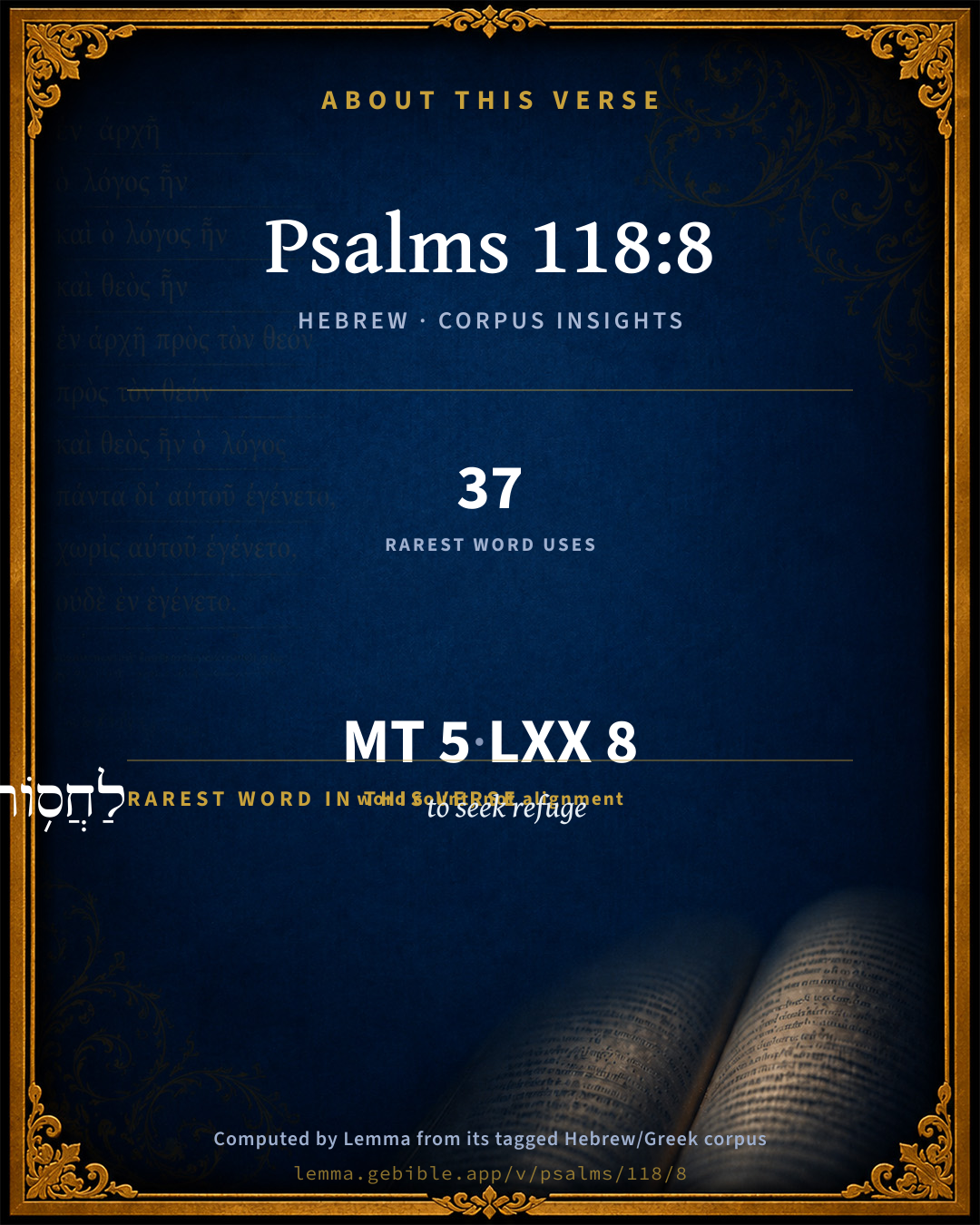
Psalms 118:8

Hebrew (Westminster Leningrad Codex) Psalms 118:8 appears in the Hebrew Old Testament. The text above is from the Westminster Leningrad Codex. Each word links to its Strong’s number, a concise gloss, and parsing drawn from the Open Scriptures Hebrew Bible morphology. Click any word for its full Brown-Driver-Briggs (BDB) entry.
Download image
Cite this verse

Psalms 118:8 (World English Bible). Public Domain. Lemma interlinear Bible study tool, https://lemma.gebible.app/v/psalms/118/8.

Show BibTeX & RIS
BibTeX
RIS
English Translation
It is better to take refuge in Yahweh, Than to put confidence in man.
World English Bible · Public Domain
Download a study sheet

One document with this verse’s original text, its word-by-word gloss line, the meaning frame, cross-references with their text, attributed commentary, and full source and license credits — printable, and it pastes into notes with its structure intact.

This verse Autodidact and up

Study sheet (.html) Plain text (.txt)

A passage Seminary Student

Up to 50 verses in one chapter. A passage sheet keeps up to 6 commentary sources and 12 cross-references per verse, in the order this page ranks them, and says so on the sheet whenever that leaves anything out. Ask for a single verse and you get the Autodidact verse sheet above.

Everything on this page stays free to read, with no account — the sheet is a download of what is already on screen, not access to it.

Want to remove ads? Support Godless Engineer
Compare translations 3

The same verse in 3 English versions, stacked beneath the original-language interlinear above. Click any original word for its lexicon entry.

Each is an independent rendering of the whole verse — the interlinear is not word-aligned to these translations.

Highlighted words mark where these versions differ — a whole-verse word diff, not a word-by-word alignment.

  • World English Bible Public Domain
    It is better to take refuge in Yahweh, Than to put confidence in man.
  • King James Version Public Domain
    It is better to trust in the LORD than to put confidence in man.
  • unfoldingWord Literal Text CC BY-SA 4.0
    Better to take shelter in Yahweh than to trust in man.

unfoldingWord Literal Text — © unfoldingWord, licensed CC BY-SA 4.0. Word-aligned USFM3 via Door43 (git.door43.org/unfoldingWord/en_ult).

Versions to compare (up to 4)

3 of 4 selected

Show all 18 translations

Every available English version of this verse, each an independent rendering of the whole verse.

  • World English Bible Public Domain
    It is better to take refuge in Yahweh, Than to put confidence in man.
  • Berean Standard Bible Public Domain
    It is better to take refuge in the LORD than to trust in man.
  • Majority Standard Bible Public Domain
    It is better to take refuge in the LORD than to trust in man.
  • King James Version Public Domain
    It is better to trust in the LORD than to put confidence in man.
  • American Standard Version (1901) Public Domain
    It is better to take refuge in Jehovah Than to put confidence in man.
  • Revised Version (1885) Public Domain
    It is better to trust in the LORD than to put confidence in man.
  • Geneva Bible (1599) Public Domain
    It is better to trust in the Lord, then to haue confidence in man.
  • Douay-Rheims (1899) Public Domain
    It is good to confide in the Lord, rather than to have confidence in man.
  • Young's Literal Translation Public Domain
    Better to take refuge in Jehovah than to trust in man,
  • Literal Standard Version CC BY-SA 4.0
    Better to take refuge in YHWH, || Than to trust in man,
  • Unlocked Literal Bible CC BY-SA 4.0
    It is better to take shelter in Yahweh than to put confidence in man.
  • unfoldingWord Literal Text CC BY-SA 4.0
    Better to take shelter in Yahweh than to trust in man.
  • Darby Bible Public Domain
    It is better to trust in Jehovah than to put confidence in man;
  • World Messianic Bible Public Domain
    It is better to take refuge in the LORD, than to put confidence in man.
  • Webster's Bible Public Domain
    It is better to trust in the LORD than to put confidence in man.
  • Free Bible Version CC BY-SA 4.0
    It's better to rely on the Lord than to trust in people.
  • Bible in Basic English Public Domain
    It is better to have faith in the Lord than to put one's hope in man.
  • JPS Tanakh (1917) Public Domain
    It is better to take refuge in the LORD than to trust in man.

Literal Standard Version (2020), Covenant Press — licensed CC BY-SA 4.0. Text via the HelloAO Bible API (eBible.org). Unlocked Literal Bible (unfoldingWord) — licensed CC BY-SA 4.0. Text via the HelloAO Bible API (eBible.org). unfoldingWord Literal Text — © unfoldingWord, licensed CC BY-SA 4.0. Word-aligned USFM3 via Door43 (git.door43.org/unfoldingWord/en_ult). Free Bible Version, Dr. Jonathan Gallagher — licensed CC BY-SA 4.0. Text via the HelloAO Bible API (eBible.org).

Word by word

More ways to search: Search by grammar → Find every occurrence → Compare this word →

Practice this passage: Drill this verse → Learn its vocabulary →

About this verse

These counts appear in no published source. They are computed here, from the morphology-tagged text and Lemma’s own curated glosses. What Lemma adds →

5
words
5
distinct lemmas
Wisdom
section

Shared distinctive vocabulary

לַחֲס֥וֹת to seek refuge H2620 occurs in 36 verses of the Hebrew Bible. Also found in:

Grammatical profile

  • 2 verbs
  • 2 nouns
  • 1 adjective

Verb forms

  • לַחֲס֥וֹת Qal · Infinitive Construct
  • מִ֝בְּטֹ֗חַ Qal · Infinitive Construct

Hebrew & Septuagint length

In English translation the verse runs 14 words from the Hebrew and 13 from the Septuagint (LXX English) — closely comparable.

A rough comparison of the two English renderings, which tokenize alike — not a word-level alignment.

Word counts can differ between the Hebrew and the Greek without any difference in meaning — e.g. the Hebrew direct-object marker אֵת has no separate Greek word, and Greek often adds the article ὁ.

In the original languages it is 5 Hebrew tokens and 8 Greek tokens — but the two are counted differently (Hebrew bundles its prefixes and suffixes into one token; the Greek is in lemma form), so that isn’t a like-for-like length.

Cross-references

4

Topical passages linked to Psalms 118:8 in the Treasury of Scripture Knowledge — connected by theme and wording, ordered by reader-vote popularity; previews shown in the World English Bible.

  • Psalms 40:4 Blessed is the man who makes Yahweh his trust, And doesn't respect the proud, nor such as turn aside to lies.
  • Jeremiah 17:5–7 Thus says Yahweh: Cursed is the man who trusts in man, and makes flesh his arm, and whose heart departs from Yahweh.
  • Psalms 62:8–9 Trust in him at all times, you people. Pour out your heart before him. God is a refuge for us. Selah.
  • Micah 7:5–7 Don't trust in a neighbor. Don't put confidence in a friend. With the woman lying in your embrace, Be careful of the words of your mouth!

Cross-references courtesy of OpenBible.info (CC BY 4.0).

Hebrew and Greek witnesses Masoretic Hebrew ↔ Greek Septuagint

The same verse in the two great witnesses to the Old Testament, shown verse-for-verse.

You’re reading Greek Psalm 117 (Hebrew Psalm 118). The Septuagint counts the superscription, so verse numbers can differ from the Hebrew — chapter-level alignment, not verse-by-verse. Numbering follows Rahlfs.

These are two independent witnesses, not word-aligned to each other, and the Septuagint is shown in lemma (dictionary) form.

Hebrew Psalms 118:8 Masoretic · Westminster Leningrad Codex

ט֗וֹב לַחֲס֥וֹת בַּיהוָ֑ה מִ֝בְּטֹ֗חַ בָּאָדָֽם

It is better to take refuge in Yahweh, Than to put confidence in man.

World English Bible · Public Domain

Greek LXX Greek Psalm 117:8 Septuagint · lemma form

ἀγαθός πείθω ἐπί κύριος ἤ πείθω ἐπί ἄνθρωπος

It is better to trust in the Lord than to trust in man.

LXX2012 (modern English Septuagint) · Public Domain

Hebrew: Westminster Leningrad Codex (CC BY 4.0). Greek: Septuagint (public domain); English from LXX2012 (modern English Septuagint) (Public Domain). How the Septuagint differs from the Hebrew →

Commentary

Notes on Psalms 118:8 from classic Christian and Jewish commentators (each source and its license shown beneath its notes). The classic Christian expositions comment on the surrounding passage and are grouped to its opening verse, so a note may address several verses; the Jewish commentaries on the Tanakh (Rashi and others) are per-verse, so they appear only where the commentator wrote on this verse.

Lemma curates 59 commentaries, every one of them public domain or Creative Commons licensed, each selected and text-cleaned for this edition rather than reprinted as found. About our sources →

Trapp's Complete Commentary

John Trapp

Psa 118:8 [It is] better to trust in the LORD than to put confidence in man.

Ver. 8. It is better to trust in the Lord, &c.] Luther on this text calleth it, Artem artium, et mirificam, ac suam artem, non fidere hominibus, that is, the art of arts, and that which he had well studied, not to put confidence in man; as for trust in God, he calleth it, Sacrificium omnium gratissimum et suavissimum, et cultum omnium pulcherrimum, the most pleasant and sweetest of all sacrifices, the best of all services we perform to God.

Than to put confidence in man] Quia mutatur aut fortuna, aut voluntas, aut vita, saith Genebrard, because either men may die, or their affections may die, or their wealth decay.

John Trapp, A Commentary or Exposition upon All the Books of the Old and New Testament (1647–1656) — public domain. Text from a community e-Sword module.

The Biblical Illustrator

Joseph S. Exell

Psa_118:8-13

It is better to trust in the Lord than to put confidence in man.

Confidence in. God

I. As justified by experience. It is better, says Matthew Henry, more wise, more comfortable, and more safe, there is more reason for it, and it will speed better, to trust in the Lord, than to put confidence in man, yea, though it be in princes. He that devotes himself to Gods guidance and government, with an entire dependence upon Gods wisdom, power, and goodness, has a better security to make him safe, than if all the kings and potentates of the earth should undertake to protect him.

II. As the inspiration of courage. What courage breathes in these words, All nations compass me about, etc. True confidence in God will always make a man invincible and fearless. The courage of Moses, Daniel, and the three Hebrew youths, and Paul, who said, None of these things move me, all grew out of confidence in God. (Homilist.)

The duty of trust in God

It is readily acknowledged that God governs the world, and interposes in all the affairs of it; yet this principle has not those pious and generous effects that might be expected; how often do we promise ourselves success from human means and visible preparations, without taking a Divine Providence into the account, or without attributing so much to it, as to our own prudence, address, or experience

I. Wherein the religious trust here recommended does consist.

1. This duty implies a humble belief that all things, by Gods blessing, will succeed well with us. I do not mean that everything should exactly correspond to our desires, or the probability of second causes; but that upon the whole matter God will appear for us, and interest Himself in our favour.

2. In order to a well-grounded trust in God, human means and endeavours must not be wanting.

3. In the use of human means, we must take care not to have recourse to such as are unlawful. How can we reconcile it, either with a common sense of piety or prudence, to acknowledge that all things come to pass by the will of Heaven, and at the same time knowingly and deliberately to act in opposition to it?

4. The main foundation of our religious trust, upon which all the fore-mentioned qualifications of it are supported, is a due regard to the laws of God and religion in general.

II. Motives and arguments to enforce it.

1. Because there is nothing but God wherein we can place an entire trust and confidence. The good state of our fleets, the conduct of our generals, the integrity and abilities of our ministers, the number and importance of our alliances, are usually the first things that come into consideration; but yet if we leave God out of the account, they all signify nothing.

2. A motive to this duty shall be taken from the nature of it; as it is the highest and noblest act of religious honour, the most sensible acknowledgment of the Eternal power and Godhead. And for this reason so many particular promises are everywhere in Scripture annexed to it; and God has as remarkably on all occasions made them good. (R. Fiddes.)

Trust in princes perilous

Voltaire for a time was the friend and familiar of Frederick the Great. He was honoured with a seat at the Kings table, and appeared almost essential to the Kings happiness. But the attachment was soon over. Royal smiles turned to frowns, and Voltaire was put under arrest at Frankfort, and there the comedy ended. Many efforts have been made to exempt Frederick from all blame in this matter and throw it upon his servants, but there the ugly fact remains, and the man who was receiving the royal flatteries was shortly afterwards detained as a prisoner. The late Prince Bismarck of Germany experienced a reverse about as great when his royal master, the young Kaiser William II, dismissed him from his office. Shortly after that event, he had an interview with the Tsar, Alexander III., and with great freedom and certainty propounded his political convictions and intentions, as if futurity belonged to him. When the Tsar suddenly interrupted him and said, Yes, I agree with you, and I place the utmost confidence in you, but areyou quite sure that you will remain in office? Prince Bismarck replied, Certainly, Majesty; I am absolutely sure that while I live I shall remain Minister. However, only five months after, he was unceremoniously dismissed from office. (H. Livesey.)

The Biblical Illustrator, edited by Joseph S. Exell (c. 1880s–1900s) — public domain. Text from a community e-Sword module.

Joseph Benson's Commentary

Psa 118:8-9. It is better to trust in the Lord — It is much safer, and more to a person’s comfort; than to put confidence in man — As mine enemies do in their own numbers, and in their powerful confederates. “Armies of men, however numerous, and, to appearance, powerful, may be routed and dispersed at once: princes may not be able to help us; if able, they may fail us, as not being willing to do it; if both able and willing, they may die ere they can execute their purpose. But that hope which is placed in God, can never, by these or any other means, be disappointed.” — Horne.

Joseph Benson's Commentary on the Old and New Testaments (1811–1818) — public domain. Text from a community e-Sword module.

J. A. Alexander on Psalms

Joseph Addison Alexander

8. (Psa 118:8) It is good to confide in Jehovah (more) than to trust in man. This and the next verse affirm clearly and fully what is more obscurely intimated in Psa 116:11. As the Hebrew has no distinct form of comparison, this is the nearest possible approach to saying, it is better. Than, literally from, away from, implying difference, and then comparison, but not expressing it. The verb confide is the expressive one originally meaning to take refuge or find shelter. See above, on Psa 2:12.

Joseph Addison Alexander, The Psalms Translated and Explained (1850) — public domain. Text from a community e-Sword module.

Tyndale Open Study Notes

Tyndale Open Resources

118:8-9 Trusting in the Lord is better than placing confidence in even the most powerful human leaders (118:6; 146:3).

Tyndale Open Study Notes — © Tyndale Open Resources, licensed CC BY-SA 4.0. Text via the HelloAO Bible API.

Geneva Bible (1599)

Geneva Bible translators

He showeth that he had trusted in vain if he had put his confidence in man, to have been preferred to the kingdom and therefore he put his trust in God and obtained.

Geneva Bible (1599) marginal notes — public domain. Text via Bolls.life.

Adam Clarke's Commentary

Verse 8. Better to trust in the Lord] Man is feeble, ignorant, fickle, and capricious; it is better to trust in Jehovah than in such.

Adam Clarke's Commentary on the Bible (1810–1826) — public domain. Text from a community e-Sword/MySword module.

John Calvin's Commentaries

8 It is better to trust in Jehovah He appears to state nothing but what is common-place, it being unanimously admitted, that when God and men come into comparison, he must be viewed as infinitely exalted above them, and therefore it is best to trust in him for the aid which he has promised to his own people. All make this acknowledgment, and yet there is scarcely one among a hundred who is fully persuaded that God alone can afford him sufficient help. That man has attained a high rank among the faithful, who, resting satisfied in God, never ceases to entertain a lively hope, even when he finds no help upon earth. The comparison, however, is improper, inasmuch as we are not allowed to transfer to men even the smallest portion of our confidence, which must be placed in God alone. The meaning is by no means ambiguous; the Psalmist is ridiculing the illusory hopes of men by which they are tossed hither and thither; and declares, that when the world smiles upon them they wax proud, and either forsake God or despise him. Some are of opinion that David bitterly reproaches his enemies with their being deceived in depending upon the favor of Saul. This appears to me to be too limited a view of the passage; and I question not that David here proposes himself as an example to all the faithful; in that he had reaped the full fruit of his hope, when, depending solely upon God, he had patiently borne the loss of all earthly succor. In the 9th verse, in which he substitutes princes for men, there is an extension of the idea. “Not only those who put their confidence in men of low degree act foolishly, but also, those who confide even in the greatest potentates; for the trust that is put in flesh shall at last be accursed, but the enjoyment of God’s favor will convert even death itself into life.”

John Calvin's Commentaries (1540-1563) — public domain. Text from the Calvin Translation Society English edition (1840s-50s) via the Christian Classics Ethereal Library (ccel.org). Calvin's coverage is partial (roughly two-thirds of the Bible); uncommented books and verses are honest gaps, never fabricated. The 19th-century editor's footnotes and remarks are omitted so the notes are faithfully Calvin's own voice.

The Cambridge Bible for Schools and Colleges

gen. ed. J. J. S. Perowne

8, 9. It is good to take refuge in Jehovah, and not to put trust in man … in princes] Cp. Psa_146:3; Psa_116:11; Psalms 62; and for the construction, see note on Psa_52:3. Artaxerxes had given Nehemiah letters to the Persian governors, and an escort of cavalry (Neh_2:7-9), but these did not prevent the hostility of Tobiah and Sanballat. Repeatedly Nehemiah ascribes the frustration of their plots to the direct interposition of God.

The Cambridge Bible for Schools and Colleges (gen. ed. J. J. S. Perowne; Cambridge University Press, 1878–1918) — public domain. Text from a community e-Sword module.

John Gill's Exposition

All nations compassed me about,.... Not all the nations of the world, but all the neighbouring nations about Judea; as the Philistines, Moabites, Ammonites, Amalekites, and Syrians; and these not all at one time, but sometimes one, and sometimes another, whom David fought with and subdued: and these, applied to Christ, design Herod and Pontius Pilate, with the Gentiles and the people of Israel; who were gathered together against him, to do what God had determined should be done, Act 4:27; see Psa 22:12. And this is sometimes the case of the church and people of God: at the first setting up of the interest of Christ, the whole world was against it; and in such circumstances was the church of Christ, when the whole world wondered after the beast, the Romish antichrist; as it will be when the kings of the earth and of the whole world will be gathered to the battle at Armageddon; and also when the Gog and Magog army shall compass the camp of the saints and the beloved city; see Rev 13:3; and so Jarchi interprets this of Gog and Magog. Yea, it is applicable to particular believers, who are attacked by Satan, the god of this world; and who are hated and persecuted by the men of it in general; and who are beset on all hands, at times, with the temptations of the devil, and the corruptions of their own hearts, and the snares of the world; that it is as if all nations compassed them about;

but in the name of the Lord will I destroy them; that is, calling upon the name of the Lord; as Asa, Jehoshaphat, and others did besides David: or trusting in the name of the Lord; and so the Targum,

"in the name of the Word of the Lord I trusted, therefore will I cut them off.''

Or, going forth in the name and strength of the Lord, as David did against Goliath; and so against all nations that gathered together against him, whose armies he vanquished and destroyed, and made the nations tributary to him. Thus our Lord Jesus Christ, his antitype, as Mediator stood in the strength and in the majesty of the name of the Lord, calling upon him to glorify him; and, trusting in his help and power, he attacked all his and our enemies, and obtained an entire victory over them, to the utter demolition of them; sin, Satan, the world, death, and hell. The word (u) used has the signification of concision or circumcision; and may have a peculiar regard to the Jews, who boasted of their circumcision, and were the implacable enemies of Christ; and who were destroyed by him, when wrath came upon them to the uttermost.

(u) "concidebam eos", Piscator; "concidam eos", Schmidt.

John Gill's Exposition of the Whole Bible (1746–1763) — public domain (CC PDM 1.0). Text via the HelloAO Bible API.

Albert Barnes' Notes on the Bible

It is better to trust in the Lord than to put confidence in man - This is stated apparently as the result of his own experience. He had found people weak and faithless; he had not so found God. Compare Psa 40:4; Psa 62:8-9. Literally, “Good is it to trust in Yahweh more than to confide in man.” This is the Hebrew form of comparison, and is equivalent to what is stated in our version, “It is better,” etc. It is better,

(1) because man is weak - but God is Almighty;

(2) because man is selfish - but God is benevolent;

(3) because man is often faithless and deceitful - God never;

(4) because there are emergencies, as death, in which man cannot aid us, however faithful, kind, and friendly he may be - but there are no circumstances in this life, and none in death, where God cannot assist us; and

(5) because the ability of man to help us pertains at best only to this present life - the power of God will be commensurate with eternity.

Albert Barnes' Notes on the Bible (1834–1885) — public domain. Text from a community e-Sword/MySword module.

Matthew Poole's English Annotations

As mine adversaries do in their own numbers, and in their great confederates.

Matthew Poole's English Annotations on the Holy Bible (1683–1685) — public domain. Text from a community e-Sword/MySword module.

The Treasury of David

Charles H. Spurgeon

Ver. 8. It is better to trust in the LORD than to put confidence in man. It is better in all ways, for first of all it is wiser: God is infinitely more able to help, and more likely to help, than man, and therefore prudence suggests that we put our confidence in him above all others. It is also morally better to do so, for it is the duty of the creature to trust in the Creator. God has a claim upon his creatures' faith, he deserves to be trusted; and to place our reliance upon another rather than upon himself, is a direct insult to his faithfulness. It is better in the sense of safer, since we can never be sure of our ground if we rely upon mortal man, but we are always secure in the hands of our God. It is better in its effect upon ourselves: to trust in man tends to make us mean, crouching, dependent; but confidence in God elevates, produces a sacred quiet of spirit, and sanctifies the soul. It is, moreover, much better to trust in God, as far as the result is concerned; for in many cases the human object of our trust fails from want of ability, from want of generosity, from want of affection, or from want of memory; but the Lord, so far from falling, does for us exceeding abundantly above all that we ask or even think. This verse is written out of the experience of many who have first of all found the broken reeds of the creature break under them, and have afterwards joyfully found the Lord to be a solid pillar sustaining all their weight.

Ver. 8. It may perhaps be considered beneath the dignity and solemnity of our subject to remark, that this 8th verse of this Psalm is the middle verse of the Bible. There are, I believe, 31,174 verses in all, and this is the 15,587th. I do not wish, nor would I advise you to occupy your time in counting for yourselves, nor should I indeed have noticed the subject at all, but that I wish to suggest one remark upon it, and that is, that though we may generally look upon such calculations as only laborious idleness, and they certainly have been carried to the most minute dissection of every part of Scripture, such as to how many times the word "Lord, "the word "GOD, " and even the word "and, "occurs, yet I believe that the integrity of the holy volume owes a vast deal to this scruple weighing of these calculators. I do not say, nor do I think, that they had such motives in their minds; but whatever their reasons were, I cannot but think that there was an overruling Providence in thus converting these trifling and apparently useless investigations into additional guards and fences around the sacred text. Barton Bouchier.

Ver. 8. It is better to trust in the LORD, etc. Luther on this text calleth it, artem artium, et mirificam, ac suam artem, non fidere hominibus, that is, the art of arts, and that which he had well studied, not to put confidence in man: as for trust in God, he calleth it sacrificium omnium gratissimum et suavissimum, et cultum omnium pulcherrimum, the most pleasant and sweetest of all sacrifices, the best of all services we perform to God. John Trapp.

Ver. 8. It is better to trust in the LORD. All make this acknowledgment, and yet there is scarcely one among a hundred who is fully persuaded that God alone can afford him sufficient help. That man has attained a high rank among the faithful, who resting satisfied in God, never ceases to entertain a lively hope, even when he finds no help upon earth. John Calvin.

Ver. 8. It is a great cause oftentimes why God blesseth not means, because we are so apt to trust in them, and rob God of his glory, not waiting for a blessing at his hands. This causeth the Lord to cross us, and to curse his own benefits, because we seek not him, but sacrifice to our own nets, putting confidence in outward means. Therefore when we hope for help from them, God bloweth upon them, and turneth them to our hurt and destruction. Abraham Wright.

Ver. 8. When my enemies have been brought to contempt, let not my friend present himself unto me as a good man, and bid me repose my hope in himself; for still must I trust in the Lord alone. Augustine.

Ver. 8-9. Nothing is more profitable than dwelling on familiar truths. Was there ever a good man who did not believe that it was better to trust in Jehovah than rely on any created arm? Yet David here repeats this truth, that if possible it may sink deep into every mind. William S. Plumer.

Ver. 8-9. Better. It is wiser, surer, morally more right, more ennobling, more happy in result.

Psalms 118:9*

Charles H. Spurgeon's The Treasury of David (1869–1885) — public domain. Psalms only. Text from a community e-Sword/MySword module.

The Pulpit Commentary

It is better to trust in the Lord than to put confidence in man. (comp. Psa_62:8, Psa_62:9) Israel, on its return from the Captivity, had begun by putting a good deal of trust in its human helpers, as Cyrus and the other friendly heathen mentioned in Ezr_1:4-6 Ezr_3:7. But this help, after a little time, had failed them, (Ezr_4:1-24) and they had found themselves in great difficulties.

Vers. 8, 9. The really better may not be the apparently better.

It may truly be said that the object of the discipline and experience of life is to deliver us from the fascination of what seems, and to get our conduct and relationships swayed and charactered and toned by what is . This, indeed, is presented in Eastern religions in extravagant forms (see the notion of Maya, illusion, from which men have to deliver themselves). But we never need refuse to accept a truth, because somebody, somewhere, has exaggerated it into a mischievous untruth. Creatures conditioned by senses, and placed in sense-relations, as we are, must live in a world of appearances; we can only know what our senses present to us, and they can only present the accidents of things. Reflection, working on the things which the senses offer to us, gradually helps us to the apprehension of that which is the substance and reality of things. The psalmist here is expressing this fact of life in one of its forms and relations. Man is always disposed to trust in his fellow man, and especially in those of his fellow men who may occupy positions of authority and power. We all incline to trust in man, especially in princes; we can see them. We have sense-estimates of them. We can sensibly apprehend what they can do for us. We fly to, and lean upon, human helpers in every emergency of life.

I LEANING UPON MAN MAY BE GOOD. It is not necessary to think or speak as if men were always untrustworthy. True, there is always an element of uncertainty in man, and an absolute reliance is not possible. But it would be wholly untrue to say that men always fail us. We have all proved, over and over again, how loyal, constant, and faithful the friends of our life have been. Some of the purest and most satisfying joys we have ever had in life have come out of our human fellowships. The psalmist is therefore true to fact when he speaks of something better, and implies that this confidence in man may be good.

II LEANING UPON GOD MUST BE BETTER. Just what advancing life and experience bring home to us is that the unseen is the real and permanent. And the very heart and essence of the unseen is God. All reality is unseen; it takes on appearance for the sake of the senses. We are passing on into the unseen; and we reach rest and satisfaction in the measure of our apprehending the unseen as we move towards the consummation. It is better to keep in the sphere of the "real." It is better to "trust in God. R.T.

The Pulpit Commentary (1880–1919), ed. H.D.M. Spence-Jones & Joseph S. Exell — public domain. Text from a community e-Sword module.

unfoldingWord translationNotes

Door43 World Missions Community

to take shelter in Yahweh

God is spoken of as if he were a shelter, a place where people can be protected. AT: "to seek protection from Yahweh" (See: Metaphor)

to take refuge in Yahweh

This verse is parallel to the one preceding it. God is spoken of as if he were a refuge, a place where people can be protected. AT: "to seek protection from Yahweh" (See: Metaphor)

translationWords

confidence

refuge

trust

unfoldingWord translationNotes — © Distant Shores Media and the Door43 World Missions Community, licensed CC BY-SA 4.0. Source: git.door43.org/Door43/en_tn.

Rashi

Rabbi Shlomo Yitzchaki (Rashi)

It is better to take shelter in the Lord Heb. לחסות. This shelter (חסיון) is only an expression of the shelter of a shadow, a small thing.

Trust (מבטח) is a stout and strong support. Nevertheless, to take shelter in the Lord is better than the promises of human beings.

Rashi on the Tanakh — English translations: “The Judaica Press complete Tanach with Rashi, translated by A. J. Rosenberg” (CC BY 4.0); “Pentateuch with Rashi's commentary by M. Rosenbaum and A.M. Silbermann, 1929-1934” (public domain); “The Metsudah Tanach series, Lakewood, N.J” (CC BY 4.0); and “The Book of Joshua, Metsudah Publications, 1997” (CC BY 4.0). Text via Sefaria.

Lesson kit

Teaching starters — assembled from the data on this page, not authored interpretation. Every prompt links to the verse data it draws on. Edit before teaching.

Psalms, in the Wisdom, opens this verse with 5 words (5 distinct Hebrew lemmas). Its most distinctive word is châçâh (“to seek refuge”). A historical commentator’s framing appears above. Read the whole chapter for the surrounding context.

Discussion questions

  1. How does “to seek refuge” (châçâh) shape what this verse is saying?
  2. Deuteronomy 32:37 shares the word «to seek refuge» with this verse. How do the two illuminate each other?
  3. The translations on this page render this verse differently — a whole-verse word diff, not a word-by-word alignment. What might account for the different wordings?
  4. The verb «לַחֲס֥וֹת» is Qal Infinitive Construct. How does its form color the action?
  5. Reading how Trapp's Complete Commentary and The Biblical Illustrator read this verse, where do the two commentators agree and where do they part?

Things to notice

Reading settings

Reading text

Shown beneath each verse's original-language words.

Old Testament
Old Testament edition

Read the OT as the Masoretic Hebrew (MT) or the Greek Septuagint (LXX).

English shown for the Greek Septuagint (in the Hebrew ↔ Greek comparison).

Comparing translations? Open the Compare panel on any verse page to stack up to four side by side.