Isaiah 36:5

Hebrew (Westminster Leningrad Codex) Isaiah 36:5 appears in the Hebrew Old Testament. The text above is from the Westminster Leningrad Codex. Each word links to its Strong’s number, a concise gloss, and parsing drawn from the Open Scriptures Hebrew Bible morphology. Click any word for its full Brown-Driver-Briggs (BDB) entry.
Download image
Cite this verse

Isaiah 36:5 (World English Bible). Public Domain. Lemma interlinear Bible study tool, https://lemma.gebible.app/v/isaiah/36/5.

Show BibTeX & RIS
BibTeX
RIS
English Translation
I say, [your] counsel and strength for the war are but vain words: now on whom do you trust, that you have rebelled against me?
World English Bible · Public Domain
Download a study sheet

One document with this verse’s original text, its word-by-word gloss line, the meaning frame, cross-references with their text, attributed commentary, and full source and license credits — printable, and it pastes into notes with its structure intact.

This verse Autodidact and up

Study sheet (.html) Plain text (.txt)

A passage Seminary Student

Up to 50 verses in one chapter. A passage sheet keeps up to 6 commentary sources and 12 cross-references per verse, in the order this page ranks them, and says so on the sheet whenever that leaves anything out. Ask for a single verse and you get the Autodidact verse sheet above.

Everything on this page stays free to read, with no account — the sheet is a download of what is already on screen, not access to it.

Want to remove ads? Support Godless Engineer
Compare translations 3

The same verse in 3 English versions, stacked beneath the original-language interlinear above. Click any original word for its lexicon entry.

Each is an independent rendering of the whole verse — the interlinear is not word-aligned to these translations.

Highlighted words mark where these versions differ — a whole-verse word diff, not a word-by-word alignment.

  • World English Bible Public Domain
    I say, [your] counsel and strength for the war are but vain words: now on whom do you trust, that you have rebelled against me?
  • King James Version Public Domain
    I say, sayest thou, (but they are but vain words) I have counsel and strength for war: now on whom dost thou trust, that thou rebellest against me?
  • unfoldingWord Literal Text CC BY-SA 4.0
    You speak only a word of lips, ‘Counsel and might for war.’ Now in whom do you trust, that you rebel against me?

unfoldingWord Literal Text — © unfoldingWord, licensed CC BY-SA 4.0. Word-aligned USFM3 via Door43 (git.door43.org/unfoldingWord/en_ult).

Versions to compare (up to 4)

3 of 4 selected

Show all 18 translations

Every available English version of this verse, each an independent rendering of the whole verse.

  • World English Bible Public Domain
    I say, [your] counsel and strength for the war are but vain words: now on whom do you trust, that you have rebelled against me?
  • Berean Standard Bible Public Domain
    You claim to have a strategy and strength for war, but these are empty words. In whom are you now trusting, that you have rebelled against me?
  • Majority Standard Bible Public Domain
    You claim to have a strategy and strength for war, but these are empty words. In whom are you now trusting, that you have rebelled against me?
  • King James Version Public Domain
    I say, sayest thou, (but they are but vain words) I have counsel and strength for war: now on whom dost thou trust, that thou rebellest against me?
  • American Standard Version (1901) Public Domain
    I say, `thy' counsel and strength for the war are but vain words: now on whom dost thou trust, that thou hast rebelled against me?
  • Revised Version (1885) Public Domain
    I say, thy counsel and strength for the war are but vain words: now on whom dost thou trust, that thou hast rebelled against me?
  • Geneva Bible (1599) Public Domain
    I say, Surely I haue eloquence, but counsell and strength are for the warre: on whom then doest thou trust, that thou rebellest against me?
  • Douay-Rheims (1899) Public Domain
    Or with what counsel or strength dost thou prepare for war? on whom dost thou trust, that thou art revolted from me?
  • Young's Literal Translation Public Domain
    I have said: Only, a word of the lips! counsel and might `are' for battle: now, on whom hast thou trusted, that thou hast rebelled against me?
  • Literal Standard Version CC BY-SA 4.0
    I have said, Only a word of the lips! Counsel and might [are] for battle. Now, on whom have you trusted, that you have rebelled against me?
  • Unlocked Literal Bible CC BY-SA 4.0
    You speak only useless words, saying there is counsel and strength for war. Now in whom are you trusting? Who has given you courage to rebel against me?
  • unfoldingWord Literal Text CC BY-SA 4.0
    You speak only a word of lips, ‘Counsel and might for war.’ Now in whom do you trust, that you rebel against me?
  • Darby Bible Public Domain
    Thou sayest, but it is a word of the lips, [There is] counsel and strength for war. Now on whom dost thou rely, that thou hast revolted against me?
  • World Messianic Bible Public Domain
    I say that your counsel and strength for the war are only vain words. Now in whom do you trust, that you have rebelled against me?
  • Webster's Bible Public Domain
    I say, sayest thou (but they are but vain words) I have counsel and strength for war: now on whom dost thou trust, that thou rebellest against me?
  • Free Bible Version CC BY-SA 4.0
    You say you have a strategy and are ready for war, but these are empty words. Who are you relying on, now that you have rebelled against me?
  • Bible in Basic English Public Domain
    You say you have a design and strength for war, but these are only words: now to whom are you looking for support, that you have gone against my authority?
  • JPS Tanakh (1917) Public Domain
    I said: It is but vain words; for counsel and strength are for the war. Now on whom dost thou trust, that thou hast rebelled against me?

Literal Standard Version (2020), Covenant Press — licensed CC BY-SA 4.0. Text via the HelloAO Bible API (eBible.org). Unlocked Literal Bible (unfoldingWord) — licensed CC BY-SA 4.0. Text via the HelloAO Bible API (eBible.org). unfoldingWord Literal Text — © unfoldingWord, licensed CC BY-SA 4.0. Word-aligned USFM3 via Door43 (git.door43.org/unfoldingWord/en_ult). Free Bible Version, Dr. Jonathan Gallagher — licensed CC BY-SA 4.0. Text via the HelloAO Bible API (eBible.org).

Word by word

More ways to search: Search by grammar → Find every occurrence → Compare this word →

Practice this passage: Drill this verse → Learn its vocabulary →

מָרַ֖דְתָּ
mârad
H4775
“to rebel”
Verb, Qal, Perfect, 2nd Person, Masculine, Singular
Part of Speech
Verb
Stem
Qal
Form
Perfect
Person
2nd Person
Gender
Masculine
Number
Singular
Full BDB Definition

Origin: a primitive root

TWOT: 1240

to rebel, revolt, be rebellious - (Qal) to rebel, revolt - against human king - against God - against light (poetic)
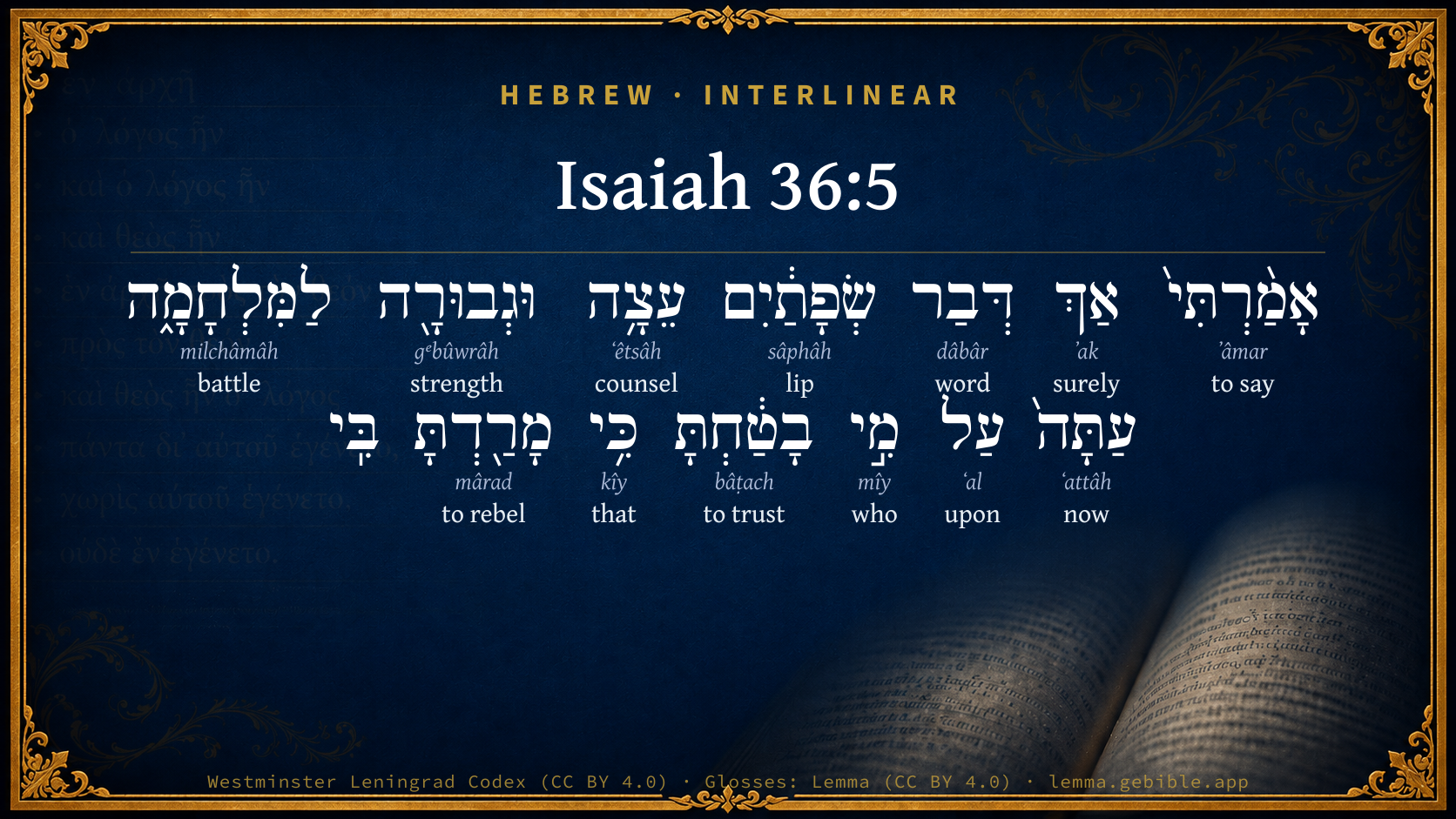
  1. אָמַ֨רְתִּי֙ ʼâmar H559 “to say” Verb, Qal, Perfect, 1st Person, Common, Singular
  2. אַךְ ʼak H389 “surely” Particle, Accusative
  3. דְּבַר dâbâr H1697 “word of” Noun, Common, Masculine, Singular, Construct
  4. שְׂפָתַ֔יִם sâphâh H8193 “lips” Noun, Common, Feminine, Dual, Absolute
  5. עֵצָ֥ה ʻêtsâh H6098 “counsel” Noun, Common, Feminine, Singular, Absolute
  6. וּגְבוּרָ֖ה gᵉbûwrâh H1369 “and · strength” Conjunction + Noun, Common, Feminine, Singular, Absolute
  7. לַמִּלְחָמָ֑ה milchâmâh H4421 “to/for the · battle” Preposition, Determined + Noun, Common, Feminine, Singular, Absolute
  8. עַתָּה֙ ʻattâh H6258 “now” Adverb
  9. עַל ʻal H5921 “upon” Preposition
  10. מִ֣י mîy H4310 “who” Particle, Interrogative
  11. בָטַ֔חְתָּ bâṭach H982 “to trust” Verb, Qal, Perfect, 2nd Person, Masculine, Singular
  12. כִּ֥י kîy H3588 “that” Conjunction

About this verse

These counts appear in no published source. They are computed here, from the morphology-tagged text and Lemma’s own curated glosses. What Lemma adds →

14
words
13
distinct lemmas
Prophets
section

Notable vocabulary

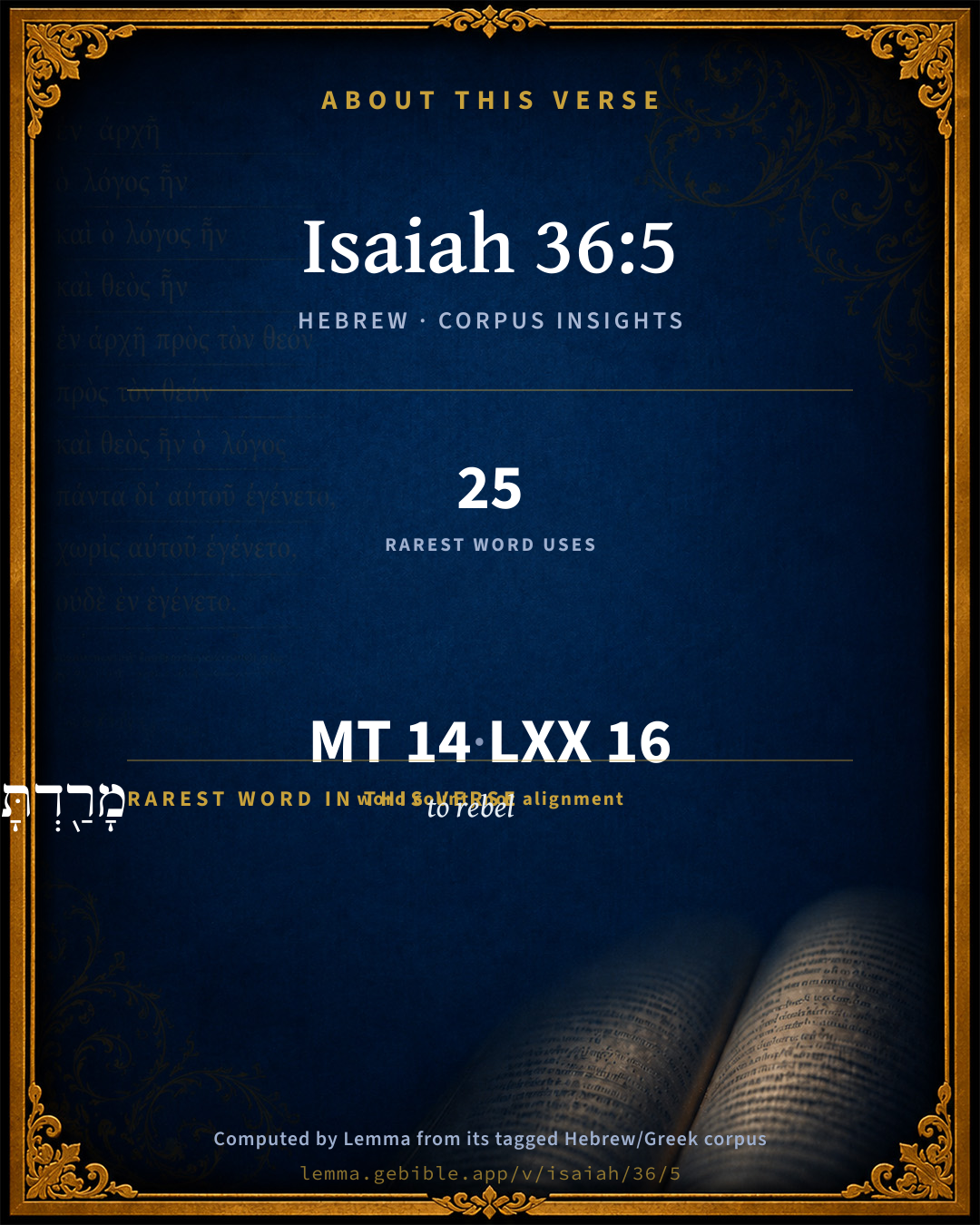
The rarest word here is מָרַ֖דְתָּ to rebel H4775 — appearing just 25 times in the whole Hebrew Bible.

Shared distinctive vocabulary

מָרַ֖דְתָּ to rebel H4775 occurs in 23 verses of the Hebrew Bible. Also found in:

Grammatical profile

  • 3 verbs
  • 5 nouns
  • 2 prepositions
  • 1 conjunction
  • 1 adverb
  • 2 particles

Verb forms

  • אָמַ֨רְתִּי֙ Qal · Perfect
  • בָטַ֔חְתָּ Qal · Perfect
  • מָרַ֖דְתָּ Qal · Perfect

Hebrew & Septuagint length

In English translation the verse runs 25 words from the Hebrew and 24 from the Septuagint (LXX English) — closely comparable.

A rough comparison of the two English renderings, which tokenize alike — not a word-level alignment.

Word counts can differ between the Hebrew and the Greek without any difference in meaning — e.g. the Hebrew direct-object marker אֵת has no separate Greek word, and Greek often adds the article ὁ.

In the original languages it is 14 Hebrew tokens and 16 Greek tokens — but the two are counted differently (Hebrew bundles its prefixes and suffixes into one token; the Greek is in lemma form), so that isn’t a like-for-like length.

Cross-references

7

Topical passages linked to Isaiah 36:5 in the Treasury of Scripture Knowledge — connected by theme and wording, ordered by reader-vote popularity; previews shown in the World English Bible.

  • 2 Kings 18:7 Yahweh was with him; wherever he went forth he prospered: and he rebelled against the king of Assyria, and didn't serve him.
  • 2 Kings 24:1 In his days Nebuchadnezzar king of Babylon came up, and Jehoiakim became his servant three years: then he turned and rebelled against him.
  • Nehemiah 2:19–20 But when Sanballat the Horonite, and Tobiah the servant, the Ammonite, and Geshem the Arabian, heard it, they ridiculed us, and despised us, and said, What is this thing that you do? will you rebel against the king?
  • Proverbs 21:30–31 There is no wisdom nor understanding Nor counsel against Yahweh.
  • Proverbs 24:5–6 A wise man has great power; And a knowledgeable man increases strength;
  • Jeremiah 52:3 For through the anger of Yahweh did it happen in Jerusalem and Judah, until he had cast them out from his presence. Zedekiah rebelled against the king of Babylon.
  • Ezekiel 17:15 But he rebelled against him in sending his ambassadors into Egypt, that they might give him horses and much people. Shall he prosper? shall he escape who does such things? shall he break the covenant, and yet escape?

Cross-references courtesy of OpenBible.info (CC BY 4.0).

Hebrew and Greek witnesses Masoretic Hebrew ↔ Greek Septuagint

The same verse in the two great witnesses to the Old Testament, shown verse-for-verse.

These are two independent witnesses, not word-aligned to each other, and the Septuagint is shown in lemma (dictionary) form.

Hebrew Isaiah 36:5 Masoretic · Westminster Leningrad Codex

אָמַ֨רְתִּי֙ אַךְ דְּבַר שְׂפָתַ֔יִם עֵצָ֥ה וּגְבוּרָ֖ה לַמִּלְחָמָ֑ה עַתָּה֙ עַל מִ֣י בָטַ֔חְתָּ כִּ֥י מָרַ֖דְתָּ בִּֽי

I say, [your] counsel and strength for the war are but vain words: now on whom do you trust, that you have rebelled against me?

World English Bible · Public Domain

Greek LXX Isaiah 36:5 Septuagint · lemma form

μή ἐν βουλή ἤ λόγος χεῖλος παράταξις γίγνομαι καί νῦν ἐπί τίς πείθω ὅτι ἀπειθέω ἐγώ

Is war carried on with counsel and mere words of the lips? and now on whom do you trust, that you rebel against me?

LXX2012 (modern English Septuagint) · Public Domain

Hebrew: Westminster Leningrad Codex (CC BY 4.0). Greek: Septuagint (public domain); English from LXX2012 (modern English Septuagint) (Public Domain). How the Septuagint differs from the Hebrew →

Targum (Aramaic paraphrase)

1

The Targum is the ancient Jewish Aramaic paraphrase of the Hebrew Scriptures — an interpretive translation, not the Hebrew text itself. Onkelos (literal) and Pseudo-Jonathan (expansive) render the Torah, and Jonathan the Prophets. Coverage is partial: where no permissively-licensed English translation exists for a verse, only the Aramaic is shown. This is verse-level text, not a word-by-word alignment to the Hebrew.

  1. Targum Jonathan Prophets (Joshua–Malachi)
    אֲמַרֵית בְּרַם בְּמַמְלֵל סִפְוָן בְּמֵלָךְ וּגְבוּרָא אַעְבֵּיד קְרָבָא כְּעַן עַל מַן אִיתְרַחֵיצְתָּא אֲרֵי מְרַדְתָּא בִּי:

    I say (you speak but empty words?) I make war with counsel and might: now, in whom dost thou trust, that thou hast rebelled against me?

    Targum Jonathan — Aramaic: “Mikraot Gedolot” (public domain). English: “Sefaria Community Translation” (CC0 1.0 (public-domain dedication)); “London "Chaldee Paraphrase," 1871” (public domain). Text via Sefaria.

Commentary

Notes on Isaiah 36:5 from classic Christian and Jewish commentators (each source and its license shown beneath its notes). The classic Christian expositions comment on the surrounding passage and are grouped to its opening verse, so a note may address several verses; the Jewish commentaries on the Tanakh (Rashi and others) are per-verse, so they appear only where the commentator wrote on this verse.

Lemma curates 59 commentaries, every one of them public domain or Creative Commons licensed, each selected and text-cleaned for this edition rather than reprinted as found. About our sources →

The Biblical Illustrator

Joseph S. Exell

Isa_36:5

Now on whom dost thou trust?

--

Trust in others sometimes dishonoured

That question may not be without importance in matters of ordinary life. We have all to trust our fellows, more or less, and I suppose we have all had to smart in some degree, as the result of it. We may trust the mass of men in trifles without any serious consequences; but when it comes to large sums, when the whole of a mans fortune, for instance, is staked upon the character and reputation of someone else, then it is not altogether an unimportant question, On whom dost thou trust? Many have rested on some choice friend, and found him play the Judas! How often have our dearest counsellors turned away from us as Ahithophel did from David! How frequently have we confidently rested upon the integrity, friendship, and fidelity of some person whom we thought we knew and could trust, and we have found that Cursed is he that trusteth in man, and maketh flesh his arm. Use discretion in all your transactions in life, as to how far you will trust the sons of men. (C. H. Spurgeon.)

In whom art thou trusting?

I. Let us put this question, and collect A LITTLE BUNDLE OF ANSWERS.

1. I think I hear some answer, I do not know that I have thought about the matter at all; I hope it is a long time before I shall die, and there is no need to trouble myself before it is necessary, and, therefore, I put the matter off. Do not you think that you are very foolish? There is a gate to death, ay! and to hell, too, from the place where you are now sitting. Suppose you were sure of a long life, would you wish to delay being happy?

2. I hear one say, I thank God I am about as good as most people; when my poor neighbours have needed charity, they have never found a churl in me. I hope I can say it will go well with me, and if it does not, sir, it will go badly with a good many. I am afraid it will go badly with a great many; but I do not see what consolation you ought to get out of that, for company in being ruined will not decrease, but rather increase the catastrophe. The sum and substance of your confidence is, that you are trusting in yourself. Now, do you really and honestly think that you are of yourself sufficient to bring yourself safe to Gods right hand? I think your conscience can remind you of some slips and flaws.

3. I trust in my priest; he has been regularly ordained; he belongs to an Apostolic Church; he tells me that he will forgive my sins if I confess them to him, and that when I come to die he will give me my viaticum. Do not be misled; your priest might as well trust in you as you trust in him.

4. Well, God is merciful. He is not so severe as to be unkind towards us, and we dare say, though we may have a good many faults, yet as He is a very good and gracious God, He will forgive our sins and accept us. If you go to God out of Christ, you will find Him to be a consuming fire, and instead of mercy you shall receive justice.

5. Well, sir, I do not say that I can trust to my works, but I am a good-hearted man; I am a man of good intentions, and though I have a great many faults, yet I am good-hearted at bottom, and I think God will look at my heart, and will put me right at the end, notwithstanding my slips and wanderings by the way. It will turn out, I am afraid, to be a delusion and a snare. Your heart is deceitful above all things, and desperately wicked. Do not talk about its goodness any more, for when you do, you give God the lie, and how can you expect to go to the heaven where God is, when you are thus insulting Him all the while?

II. THE CHRISTIANS ANSWER. I trust, says the Christian, a triune God-Father, Son, and Holy Spirit. To some this does not look like a real trust. Why, we cannot see God, says one. How do we know all about this Trinity? Is this a real trust? Cannot you trust in a thousand things you have never seen or heard? Some of you may be earning your living by electricity, but you never saw it. Some have said, But does God interfere to help His people? Is the trust you impose in Him so really recognised by Him that you can distinctly prove that He helps you? Yes, we can. We can say, also, by way of commending our God to others, that we feel we can rest upon Him for the future.

III. SOME WORDS OF ADVICE TO THOSE WHO ARE SO TRUSTING.

1. Drive out all unbelief. If we have such a God to trust to, let us trust with all our might.

2. Let us seek the Holy Spirits help in this matter. The Author of our faith must be the Finisher of it also.

3. Let us try to bring others to trust where we have trusted.

4. We must prove our faith by our works. (C. H. Spurgeon.)

Unregenerate human nature bad all through:

That is a very silly thing which people say of men when they die, Oh, he was rather loose in his morals, but he was a good-hearted man at bottom. It reminds me of Rowland Hills saying, Yes, but when you go to market to buy apples, and you see a number of rotten ones at the top, if the market-woman says, Oh, never mind, it is only the rotten apples at the top, they are very good at bottom, you will say to her, My good soul, I will be bound to say the best are on the top, and they will not improve as you go down, for generally they will get far worse. And so if a man is bad on the surface, I cannot tell how much worse he may be down below. It is said there was a man who used to swear and drink, who, nevertheless, applied for membership with Mr. Hill, and gave this reason for it, that though he did drink occasionally and frequently swear, yet he was good at bottom. Mr. Hill said, Then you think I am going grovelling down through the dirty foul filth of your life to get the little good that is somewhere at the bottom of you! Why, sir, it will not pay for the risk of digging out, and I am not going to do it. (C. H. Spurgeon.)

The Biblical Illustrator, edited by Joseph S. Exell (c. 1880s–1900s) — public domain. Text from a community e-Sword module.

The Preacher's Complete Homiletical Commentary

Joseph S. Exell (gen. ed.)

IN WHOM ART THOU TRUSTING?

Isa_36:5.… Now on whom dost thou trust?

The question is important in ordinary life, but it is overwhelmingly so in spiritual things.

I. A LITTTE BUNDLE OF ANSWERS.

1. “I do not know that I have thought about the matter; I have left the matter of dying, and of eternity, and of judgment out of my consideration.” How foolish! There are more gates to death than you dream of. Have not you walked with dying men? Suppose you were sure of a long life, why delay being happy? Christ says of the rich man in hell, “He lift up his eyes.” He might and should have done so before, but he said, “Tell my brethren.”

2. “I thank God I am about as good as most people.” Company in being ruined will not decrease, but rather increase the catastrophe. You are trusting in yourself. But is conscience quiet? Only the absolutely perfect man can be saved by his own works.

3. “I trust in my priest.” Has any priest grace to spare for you? You are, or may be, as much a priest as any man can be; Christians are “a royal priesthood.”

4. “Well, God is merciful.” You are trusting in the mercy of God; but, as you state it, you are trusting in what you will never find. If you go to God out of Christ, you will find Him to be a consuming fire; instead of mercy you shall receive justice (H. E. I. 2316–2317, 2349–2350).

5. “Well, I do not say that I can trust to my works, but I am a good-hearted man.” There is much truth in the saying, “If it is bad at the top, it is worse at the bottom; and if it is not good on the surface, it will never pay for getting at it” (Jer_17:9; H. E. I. 2669–2680).

II. THE CHRISTIAN’S ANSWER.

I trust a triune God—Father, Son, and Holy Spirit. I trust to the Father’s choosing me; to the Son, as my Redeemer, Intercessor, my resurrection, and life; to the Holy Spirit, to save me from my inbred sins, to sanctify me wholly.

To some men this does not look like a real trust. “We cannot see God; how do we know all this about the Trinity?” Cannot you trust in a thousand things you have never seen or heard? You have never seen electricity nor gravity. Those that have trusted in God find Him to be as real as if they could see Him. “Can we prove that God interferes to help His people?” Yes, He hears prayer. A Christian is sometimes asked whether he has a right to trust God. He has God’s promise to help him. “Is He worthy to be trusted?” He has proved Himself faithful and true. The Christian commends God to others in saying that he feels he can rest upon Him for the future.

III. SOME WORDS OF ADVICE TO THOSE WHO ARE TRUSTING.

1. Drive out all unbelief. With such a God to trust to, let us trust with all our might. It is an insult to Him to doubt Him. The devil calls God a liar, but it is hard if a man’s own child is to think ill of his father. We are verily guilty in speaking hard things of our God.

2. Seek the Holy Spirit’s help. We have often said we would not doubt again, yet we have Let us ask to be strengthened. We often forget that the Author of our faith must be the Finisher of it also.

3. Try to bring others to trust where we have trusted (Joh_1:40-42; Joh_1:45).

4. Love Him who thus gives Himself to be trusted by us. The sister graces ever live together. Show your love.

4. We must prove our faith by our works. Let us do more for God. “No day without a deed.” Cease working and you will soon cease believing.—C. H. Spurgeon: Metropolitan Tabernacle Pulpit, vol xi. pp. 469–480.

The Preacher's Complete Homiletical Commentary (gen. ed. Joseph S. Exell; Funk & Wagnalls, c. 1892) — public domain (pre-1929). A full-Bible homiletical/sermon-outline anthology covering 65 of 66 books (2 John is absent from the source module). Text from a community e-Sword module.

Tyndale Open Study Notes

Tyndale Open Resources

36:5 Who are you counting on: Judah had asked Egypt to help them (see 30:1-5).

Tyndale Open Study Notes — © Tyndale Open Resources, licensed CC BY-SA 4.0. Text via the HelloAO Bible API.

Ibn Ezra

Rabbi Abraham ibn Ezra

1. In the book of Kings (18:20) Thou sayest (but they are but vain words) I have counsel and strength for war; that is, thou hast said to thy people, that thou hast wisdom and strength for war, but this was only a word of the lips, thy strength consisted only in words. In the book of Isaiah (36:5) it is said, I say but vain words are counsel and strength for war. These are the words of Rabshakeh; he says: I believe, that thy counsel and strength for war consist only in words.

Ibn Ezra on the Tanakh — English translations: “Sefaria Community Translation” (CC0 1.0 (public-domain dedication)); “Yalkut, Sifsei Chachomim Chumash, Metsudah Publications, 2009” (CC BY 4.0); and “Commentary of Ibn Ezra on Isaiah - trans. by M. Friedlander, 1873” (public domain). Text via Sefaria.

Geneva Bible (1599)

Geneva Bible translators

He speaketh this in the person of Hezekiah, falsely charging him that he put his trust in his wit and eloquence, whereas his only confidence was in the Lord.

Geneva Bible (1599) marginal notes — public domain. Text via Bolls.life.

Jamieson, Fausset & Brown

Robert Jamieson, A. R. Fausset & David Brown

counsel--Egypt was famed for its wisdom.

Jamieson, Fausset & Brown — Commentary Critical and Explanatory on the Whole Bible (1871) — public domain (CC PDM 1.0). Text via the HelloAO Bible API.

Adam Clarke's Commentary

Verse 5. I say - "Thou hast said"] Fourteen MSS. (three ancient) of Kennicott's and De Rossi's have it in the second person, אמרת amarta; and so the other copy, 2Kg 18:20.

But they are but vain words] דבר שפתים debar sephathayim, a word of the lips. Thou dost talk about counsels, but thou hast none; about strength, but there is none with thee.

Adam Clarke's Commentary on the Bible (1810–1826) — public domain. Text from a community e-Sword/MySword module.

Ellicott's Commentary for English Readers

(5, 6) I have counsel and strength for war . . .—Reports of Hezekiah’s speech. probably also of his negotiations with Egypt, had reached the ears of the Assyrian king. So Sennacherib. in his inscriptions, speaks of “the king of Egypt as a monarch who could not save those who trusted in him” (Smith, Assyrian Canon). The Pharaoh in this case was Shabatoka, or Sabaco II., the father of the Tir-hakah of Isa xxxvii 9, one of the Ethiopian dynasty that reigned in Egypt from B.C. 725-665.

A Bible Commentary for English Readers, edited by Charles John Ellicott (1878–1897) — public domain. Text from a community e-Sword module.

The Cambridge Bible for Schools and Colleges

gen. ed. J. J. S. Perowne

5. I say, sayest thou, (but they are but vain words) &c.] Rather (as Cheyne and others) Thinkest thou that a mere word of the lips is counsel and strength for war? “You cannot think so,” reasons the Rabshakeh, “you must have some ground of confidence; what is it?” The rendering of A.V. which takes the phrase “merely a word of the lips” as a parenthetic ejaculation is intelligible, but hardly right. In any case the text must be corrected in accordance with that of 2Ki_18:20 (“thou sayest [thinkest]” for “I say [think]”).

The Cambridge Bible for Schools and Colleges (gen. ed. J. J. S. Perowne; Cambridge University Press, 1878–1918) — public domain. Text from a community e-Sword module.

John Gill's Exposition

I say, (sayest thou,) but they are but vain words,.... Or, "word of lips" (f); meaning the following, which he suggests were only the fruit of his lips, not of his heart; or were vain and foolish, and without effect, and stood for nothing; so the first part of the words are Hezekiah's, "I say (sayest thou)"; and the latter, Rabshakeh's note upon them; though they may be understood as Hezekiah's, or what he is made to speak by Rabshakeh, as the ground of his confidence, namely, "word of lips"; that is, prayer to God, as Kimchi explains it; or eloquence in addressing his soldiers, and encouraging them to fight, either of which Rabshakeh derides, as well as what follows:

I have counsel and strength for war; as he had; he had wise ministers to consult, and was capable of forming a good plan, and wise schemes, and of putting them in execution, and of heartening men; though he did not put his confidence in these things, as Rabshakeh suggested, Ch2 32:3, the words may be rendered; "but counsel and strength are for war" (g): what signifies words to God, or eloquence with men? this is all lip labour, and of little service; wisdom and counsel to form plans, and power to execute them, are the things which are necessary to carry on a war with success, and which, it is intimated, were wanting in Hezekiah; and therefore he had nothing to ground his confidence upon, within himself, or his people:

now on whom dost thou trust, that thou rebellest against me? which it does not appear he had, having paid the money agreed to for the withdrawment of his army; but this was a pretence for the siege of Jerusalem.

(f) "verbum labiorum", Montanus; "vel, sermo labiorum", Vatablus. (g) "consilium et fortitudo ad praelium", Montanus; "sed consilio et fortitudine opus ad praelium", Pagninus, i.e. "requiruntur", ut Grotius.

John Gill's Exposition of the Whole Bible (1746–1763) — public domain (CC PDM 1.0). Text via the HelloAO Bible API.

Albert Barnes' Notes on the Bible

I say, sayest thou - In 2Ki 18:20, this is ‘thou sayest;’ and thus many manuscripts read it here, and Lowth and Noyes have adopted that reading. So the Syriac reads it. But the sense is not affected whichever reading is adopted. It is designed to show to Hezekiah that his reliance, either on his own resources or on Egypt, was vain.

But they are but vain words - Margin, as Hebrew, ‘A word of lips;’ that is, mere words; vain and empty boasting.

On whom dost thou trust, that thou rebellest against me? - Hezekiah had revolted from the Assyrian power, and had refused to pay the tribute which had been imposed on the Jews in the time of Ahaz 2Ki 18:7.

Albert Barnes' Notes on the Bible (1834–1885) — public domain. Text from a community e-Sword/MySword module.

Whedon's Commentary on the Bible

Daniel D. Whedon

5. And the contempt is kept up through several verses. Instead of the interpretation given in italicized words in this verse, a better meaning of the original is this: “I, Rabshakeh, say, A mere word of lips [foolish talk] is your counsel and strength for the war which you are vainly urging upon your armed men and followers.” The speaker feigns that this counsel and strength is what Egypt has promised.

Daniel D. Whedon (gen. ed.), Commentary on the Old and New Testaments (1874–1909) — public domain. Text from a community e-Sword module.

The Pulpit Commentary

I say. In 2Ki_18:20 we read, "Thou sayest" for "I say," which gives a better sense. Dr. Kay holds the two forms to be "complementary." I have counsel and strength for war. Either the words of Hezekiah had been reported to Sennacherib, or he rightly divined Hezekiah"s thoughts. It was, no doubt, in reliance on the "counsel" of Eliakim and the "strength" of Egypt that the Jewish monarch had a second time provoked his suzerain.

The Pulpit Commentary (1880–1919), ed. H.D.M. Spence-Jones & Joseph S. Exell — public domain. Text from a community e-Sword module.

J. A. Alexander on Isaiah

Joseph Addison Alexander

“I say (or have said), only word of lips, counsel and strength for the war; now on whom hast thou confided, that thou hast rebelled against me?” The parallel passage in Kings has ‘thou hast said’, which Lowth assumes to be the true text here, while others treat the common reading as an error of the writer or abridger. The truth no doubt is that both the readings are original, since both may be so explained as to express the same idea. The simplest construction of what follows is: ‘I say, mere word of lips is (your) counsel and strength for the war,’ (i.e., your pretended strength) and wisdom are mere talk, false pretension. The allusion is not so much to Hezekiah’s prayers as to his addresses to the people, recorded in 2Ch 32:6-8. The sense of the other passage (2Ki 18:20) seems to be, thou hast said (to thyself, or thought, that) mere talk is counsel and strength for the war. The contemptuous import of word of lips, is apparent from Pro 14:23. The rebellion mentioned in the last clause is Hezekiah’s casting off the Assyrian yoke. (2Ki 18:7).

Joseph Addison Alexander, The Prophecies of Isaiah (1846–1847; New York: Scribner, 1870–1878) — public domain. Text from a community e-Sword module.

Scofield Reference Notes

C. I. Scofield

trust

(See Scofield "Psa 2:12")

The Scofield Reference Bible (1917 edition), notes by C. I. Scofield — public domain. Text from a community e-Sword module.

Rashi

Rabbi Shlomo Yitzchaki (Rashi)

I said (until now), “It is but words of the lips, that he speaks (lit., in his mouth), saying, ‘I will not serve the king of Assyria.’ And when he sees that I will march against him with an army, he will recant. Now I have marched. From now on, either he will serve me, or he will need to seek counsel and might for war.”

Now that the time has come, tell me now on whom you have depended to rebel against me.

Rashi on the Tanakh — English translations: “The Judaica Press complete Tanach with Rashi, translated by A. J. Rosenberg” (CC BY 4.0); “Pentateuch with Rashi's commentary by M. Rosenbaum and A.M. Silbermann, 1929-1934” (public domain); “The Metsudah Tanach series, Lakewood, N.J” (CC BY 4.0); and “The Book of Joshua, Metsudah Publications, 1997” (CC BY 4.0). Text via Sefaria.

Lesson kit

Teaching starters — assembled from the data on this page, not authored interpretation. Every prompt links to the verse data it draws on. Edit before teaching.

Isaiah, in the Prophets, opens this verse with 14 words (13 distinct Hebrew lemmas). Its most distinctive word is mârad (“to rebel”). A historical commentator’s framing appears above. Read the whole chapter for the surrounding context.

Discussion questions

  1. How does “to rebel” (mârad) shape what this verse is saying?
  2. How does Genesis 14:4, which shares the word «to rebel», read alongside this verse?
  3. The translations on this page render this verse differently — a whole-verse word diff, not a word-by-word alignment. What might account for the different wordings?
  4. «אָמַ֨רְתִּי֙» is a Qal Perfect verb. How does that grammatical form shape the action described?
  5. Compare how The Biblical Illustrator and The Preacher's Complete Homiletical Commentary read this verse. Where do they agree or differ?

Things to notice

Reading settings

Reading text

Shown beneath each verse's original-language words.

Old Testament
Old Testament edition

Read the OT as the Masoretic Hebrew (MT) or the Greek Septuagint (LXX).

English shown for the Greek Septuagint (in the Hebrew ↔ Greek comparison).

Comparing translations? Open the Compare panel on any verse page to stack up to four side by side.