

Psalms 115:9

Hebrew (Westminster Leningrad Codex) Psalms 115:9 appears in the Hebrew Old Testament. The text above is from the Westminster Leningrad Codex. Each word links to its Strong’s number, a concise gloss, and parsing drawn from the Open Scriptures Hebrew Bible morphology. Click any word for its full Brown-Driver-Briggs (BDB) entry.
Download image
Cite this verse

Psalms 115:9 (World English Bible). Public Domain. Lemma interlinear Bible study tool, https://lemma.gebible.app/v/psalms/115/9.

Show BibTeX & RIS
BibTeX
RIS
English Translation
Israel, trust in Yahweh! He is their help and their shield.
World English Bible · Public Domain
Download a study sheet

One document with this verse’s original text, its word-by-word gloss line, the meaning frame, cross-references with their text, attributed commentary, and full source and license credits — printable, and it pastes into notes with its structure intact.

This verse Autodidact and up

Study sheet (.html) Plain text (.txt)

A passage Seminary Student

Up to 50 verses in one chapter. A passage sheet keeps up to 6 commentary sources and 12 cross-references per verse, in the order this page ranks them, and says so on the sheet whenever that leaves anything out. Ask for a single verse and you get the Autodidact verse sheet above.

Everything on this page stays free to read, with no account — the sheet is a download of what is already on screen, not access to it.

Want to remove ads? Support Godless Engineer
Compare translations 3

The same verse in 3 English versions, stacked beneath the original-language interlinear above. Click any original word for its lexicon entry.

Each is an independent rendering of the whole verse — the interlinear is not word-aligned to these translations.

Highlighted words mark where these versions differ — a whole-verse word diff, not a word-by-word alignment.

  • World English Bible Public Domain
    Israel, trust in Yahweh! He is their help and their shield.
  • King James Version Public Domain
    O Israel, trust thou in the LORD: he is their help and their shield.
  • unfoldingWord Literal Text CC BY-SA 4.0
    Israel, trust in Yahweh; he their help and their shield.

unfoldingWord Literal Text — © unfoldingWord, licensed CC BY-SA 4.0. Word-aligned USFM3 via Door43 (git.door43.org/unfoldingWord/en_ult).

Versions to compare (up to 4)

3 of 4 selected

Show all 18 translations

Every available English version of this verse, each an independent rendering of the whole verse.

  • World English Bible Public Domain
    Israel, trust in Yahweh! He is their help and their shield.
  • Berean Standard Bible Public Domain
    O Israel, trust in the LORD! He is their help and shield.
  • Majority Standard Bible Public Domain
    O Israel, trust in the LORD! He is their help and shield.
  • King James Version Public Domain
    O Israel, trust thou in the LORD: he is their help and their shield.
  • American Standard Version (1901) Public Domain
    O Israel, trust thou in Jehovah: He is their help and their shield.
  • Revised Version (1885) Public Domain
    O Israel, trust thou in the LORD: he is their help and their shield.
  • Geneva Bible (1599) Public Domain
    O Israel, trust thou in the Lord: for he is their helpe and their shielde.
  • Douay-Rheims (1899) Public Domain
    I will please the Lord in the land of the living.
  • Young's Literal Translation Public Domain
    O Israel, trust in Jehovah, `Their help and their shield `is' He.'
  • Literal Standard Version CC BY-SA 4.0
    O Israel, trust in YHWH, “He [is] their help and their shield.”
  • Unlocked Literal Bible CC BY-SA 4.0
    Israel, trust in Yahweh; he is your help and shield.
  • unfoldingWord Literal Text CC BY-SA 4.0
    Israel, trust in Yahweh; he their help and their shield.
  • Darby Bible Public Domain
    O Israel, confide thou in Jehovah: he is their help and their shield.
  • World Messianic Bible Public Domain
    Israel, trust in the LORD! He is their help and their shield.
  • Webster's Bible Public Domain
    O Israel, trust thou in the LORD: he is their help and their shield.
  • Free Bible Version CC BY-SA 4.0
    Israel, trust in the Lord! He is the one who helps you and protects you.
  • Bible in Basic English Public Domain
    O Israel, have faith in the Lord: he is their help and their breastplate.
  • JPS Tanakh (1917) Public Domain
    O Israel, trust thou in the LORD! He is their help and their shield!

Literal Standard Version (2020), Covenant Press — licensed CC BY-SA 4.0. Text via the HelloAO Bible API (eBible.org). Unlocked Literal Bible (unfoldingWord) — licensed CC BY-SA 4.0. Text via the HelloAO Bible API (eBible.org). unfoldingWord Literal Text — © unfoldingWord, licensed CC BY-SA 4.0. Word-aligned USFM3 via Door43 (git.door43.org/unfoldingWord/en_ult). Free Bible Version, Dr. Jonathan Gallagher — licensed CC BY-SA 4.0. Text via the HelloAO Bible API (eBible.org).

Word by word

More ways to search: Search by grammar → Find every occurrence → Compare this word →

Practice this passage: Drill this verse → Learn its vocabulary →

About this verse

These counts appear in no published source. They are computed here, from the morphology-tagged text and Lemma’s own curated glosses. What Lemma adds →

6
words
6
distinct lemmas
Wisdom
section

Notable vocabulary

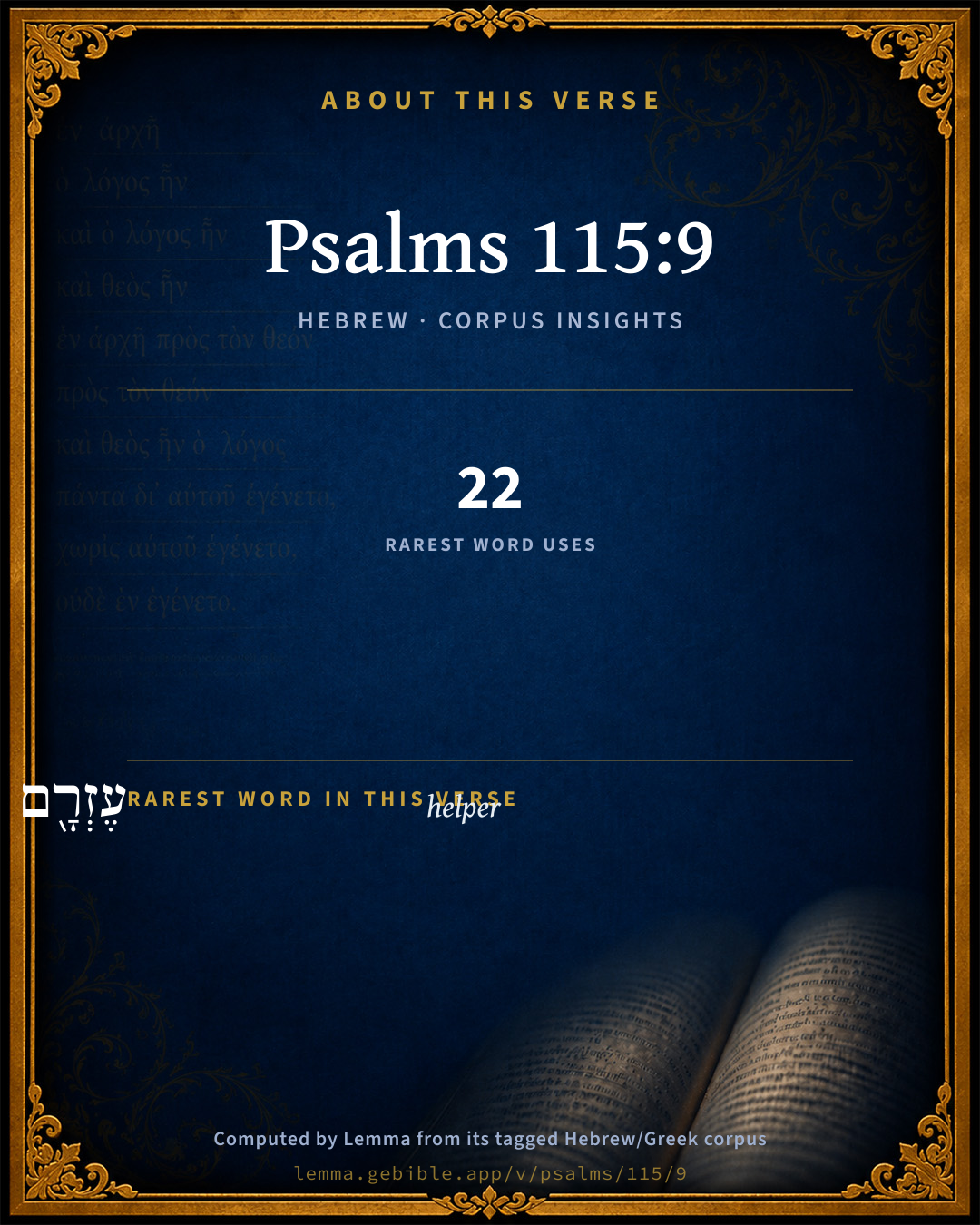
The rarest word here is עֶזְרָ֖ם helper H5828 — appearing just 22 times in the whole Hebrew Bible.

Shared distinctive vocabulary

עֶזְרָ֖ם helper H5828 occurs in 21 verses of the Hebrew Bible. Also found in:

Grammatical profile

  • 1 verb
  • 4 nouns
  • 1 pronoun

Verb forms

  • בְּטַ֣ח Qal · Imperative

Cross-references

14

Topical passages linked to Psalms 115:9 in the Treasury of Scripture Knowledge — connected by theme and wording, ordered by reader-vote popularity; previews shown in the World English Bible.

  • Psalms 62:8 Trust in him at all times, you people. Pour out your heart before him. God is a refuge for us. Selah.
  • Psalms 37:3 Trust in Yahweh, and do good. Dwell in the land, and enjoy safe pasture.
  • Proverbs 30:5 "Every word of God is flawless. He is a shield to those who take refuge in him.
  • Psalms 118:2–4 Let Israel now say That his loving kindness endures forever.
  • Psalms 135:19–20 House of Israel, praise Yahweh! House of Aaron, praise Yahweh!
  • Deuteronomy 33:29 Happy are you, Israel: Who is like you, a people saved by Yahweh, The shield of your help, The sword of your excellency! Your enemies shall submit themselves to you; You shall tread on their high places.
  • Psalms 33:20–21 Our soul has waited for Yahweh. He is our help and our shield.
  • Psalms 146:5–6 Happy is he who has the God of Jacob for his help, Whose hope is in Yahweh, his God:
  • Exodus 19:5 Now therefore, if you will indeed obey my voice, and keep my covenant, then you shall be my own possession from among all peoples; for all the earth is mine;
  • Psalms 84:11 For Yahweh God is a sun and a shield. Yahweh will give grace and glory. He withholds no good thing from those who walk blamelessly.
  • Psalms 130:7 Israel, hope in Yahweh, For with Yahweh there is loving kindness. With him is abundant redemption.
  • Jeremiah 17:17–18 Don't be a terror to me: you are my refuge in the day of evil.
  • Ephesians 1:12 to the end that we should be to the praise of his glory, we who had before hoped in Christ:
  • Psalms 125:1 Those who trust in Yahweh are as Mount Zion, Which can't be moved, but remains forever.

Cross-references courtesy of OpenBible.info (CC BY 4.0).

Hebrew and Greek witnesses Masoretic Hebrew ↔ Greek Septuagint

The same verse in the two great witnesses to the Old Testament, shown verse-for-verse.

You’re reading Greek Psalm 113 (Hebrew Psalm 115). The Septuagint counts the superscription, so verse numbers can differ from the Hebrew — chapter-level alignment, not verse-by-verse. Numbering follows Rahlfs.

These are two independent witnesses, not word-aligned to each other, and the Septuagint is shown in lemma (dictionary) form.

Hebrew Psalms 115:9 Masoretic · Westminster Leningrad Codex

יִ֭שְׂרָאֵל בְּטַ֣ח בַּיהוָ֑ה עֶזְרָ֖ם וּמָגִנָּ֣ם הֽוּא

Israel, trust in Yahweh! He is their help and their shield.

World English Bible · Public Domain

Greek LXX Greek Psalm 113:9 Septuagint · lemma form

μή ἐγώ κύριος μή ἐγώ ἀλλά ἤ ὁ ὄνομα σύ δίδωμι δόξα ἐπί ὁ ἔλεος σύ καί ὁ ἀλήθεια σύ

No English rendering of this Greek verse — the small residue in the structurally divergent books.

On this verse, The Cambridge Bible for Schools and Colleges discusses the Septuagint’s reading. Read the note in Commentary ↓

Hebrew: Westminster Leningrad Codex (CC BY 4.0). Greek: Septuagint (public domain); English from a public-domain English Septuagint. How the Septuagint differs from the Hebrew →

Commentary

Notes on Psalms 115:9 from classic Christian and Jewish commentators (each source and its license shown beneath its notes). The classic Christian expositions comment on the surrounding passage and are grouped to its opening verse, so a note may address several verses; the Jewish commentaries on the Tanakh (Rashi and others) are per-verse, so they appear only where the commentator wrote on this verse.

Lemma curates 59 commentaries, every one of them public domain or Creative Commons licensed, each selected and text-cleaned for this edition rather than reprinted as found. About our sources →

Trapp's Complete Commentary

John Trapp

Psa 115:9 O Israel, trust thou in the LORD: he [is] their help and their shield.

Ver. 9. O Israel, trust thou in the Lord] Whatever others do, Jos 24:15, and the rather because others do not, Psa 119:42; the worse they are, the better be ye.

He is their help and their shield] God is engaged in point of honour to help and protect those that trust in him.

John Trapp, A Commentary or Exposition upon All the Books of the Old and New Testament (1647–1656) — public domain. Text from a community e-Sword module.

Joseph Benson's Commentary

Psa 115:9-11. O Israel, trust in the Lord — Do not you follow the example of these infatuated idolaters, but trust in, worship, and serve the Lord only. He is their help and their shield — The shield to defend, and the help to support and strengthen those that trust in and cleave to him. O house of Aaron, trust in the Lord — You priests and Levites proceeding from Aaron, or related to him, who have peculiar reasons, and are under many and special obligations to trust in and serve him; who have a more distinct knowledge of God, which is the foundation of trust in, and obedience to, him, (Psa 9:10,) and who are in duty bound to be both instructers of, and examples to, the people in this as well as in all other branches of truth and righteousness. Ye that fear the Lord — All of you, who worship the true God, not only Israelites, but even Gentile proselytes, trust in the Lord — “Let the men of the world make to themselves gods, and vainly trust in the work of their own hands or heads; but let the church repose all her confidence in Jehovah her Saviour and Redeemer, who alone can be her defender and protector;” and not suffer any apprehension of danger or distress, any trials or troubles, temptations or snares, whether from visible or invisible enemies, to separate her from him.

Joseph Benson's Commentary on the Old and New Testaments (1811–1818) — public domain. Text from a community e-Sword module.

Keil & Delitzsch

C. F. Keil & F. Delitzsch

After this confession of Israel there now arises a voice that addresses itself to Israel. The threefold division into Israel, the house of Aaron, and those who fear Jahve is the same as in Psa 118:2-4. In Ps 135 the "house of Levi" is further added to the house of Aaron. Those who fear Jahve, who also stand in the last passage, are probably the proselytes (in the Acts of the Apostles σεβόμενοι τὸν Θεόν, or merely σεβόμενοι)

(Note: The appellation φοβούμενοι does not however occur, if we do not bring Act 10:2 in here; but in Latin inscriptions in Orelli-Hentzen No. 2523, and in Auer in the Zeitschrift fr katholische Theologie 1852, S. 80, the proselyte (religionis Judaicae) is called metuens.))

at any rate these are included even if Israel in Psa 115:9 is meant to signify the laity, for the notion of "those who fear Jahve" extends beyond Israel. The fact that the threefold refrain of the summons does not run, as in Psa 33:20, our help and shield is He, is to be explained from its being an antiphonal song. In so far, however, as the Psalm supplicates God's protection and help in a campaign the declaration of confident hope, their help and shield is He, may, with Hitzig, be referred to the army that is gone or is going forth. It is the same voice which bids Israel to be of good courage and announces to the people the well-pleased acceptance of the sacrifice with the words "Jahve hath been mindful of us" (זכרנוּ ה, cf. עתּה ידעתּי, Psa 20:7), perhaps simultaneously with the presentation of the memorial portion (אזכרה) of the meat-offering (Psa 38:1). The יברך placed at the head is particularized threefold, corresponding to the threefold summons. The special promise of blessing which is added in Psa 115:14 is an echo of Deu 1:11, as in Sa2 24:3. The contracted future יסף we take in a consolatory sense; for as an optative it would be too isolated here. In spite of all oppression on the part of the heathen, God will make His people ever more numerous, more capable of offering resistance, and more awe-inspiring.

Keil & Delitzsch — Biblical Commentary on the Old Testament (1861–1891) — public domain (CC PDM 1.0). Text via the HelloAO Bible API. (Old Testament only.)

J. A. Alexander on Psalms

Joseph Addison Alexander

9. (Psa 115:9) O Israel, trust thou in Jehovah; their help and their shield (is) He, This is the practical application of the contrast just presented. Since idols are impotent and God almighty, it is folly to fear them or their servants; it is worse than folly not to trust in Him. The last clause is borrowed from Psa 33:20. After addressing Israel directly in the first clause, he resumes the third person in the second, and, as if speaking to himself, assigns the reason for the exhortation. The first clause is, as it were, uttered in a loud voice, and the second in a low one.

Joseph Addison Alexander, The Psalms Translated and Explained (1850) — public domain. Text from a community e-Sword module.

Tyndale Open Study Notes

Tyndale Open Resources

115:9-11 Israel . . . priests . . . you who fear the Lord: The psalmist calls on all those in the God-fearing community to commit their ways to the living God. The threefold address assures them that the Lord is their true helper and shield (cp. 118:2-4).

Tyndale Open Study Notes — © Tyndale Open Resources, licensed CC BY-SA 4.0. Text via the HelloAO Bible API.

Matthew Henry's Commentary

In these verses,

I. We are earnestly exhorted, all of us, to repose our confidence in God, and not suffer our confidence in him to be shaken by the heathens' insulting over us upon the account of our present distresses. It is folly to trust in dead images, but it is wisdom to trust in the living God, for he is a help and a shield to those that do trust in them, a help to furnish them with and forward them in that which is good, and a shield to fortify them against and protect them from every thing that is evil. Therefore, 1. Let Israel trust in the Lord; the body of the people, as to their public interests, and every particular Israelite, as to his own private concerns, let them leave it to God to dispose of all for them, and believe it will dispose of all for the best and will be their help and shield. 2. Let the priests, the Lord's ministers, and all the families of the house of Aaron, trust in the Lord, (Psa 115:10); they are most maligned and struck at by the enemies and therefore of them God takes particular care. They ought to be examples to others of a cheerful confidence in God, and a faithful adherence to him in the worst of times. 3. Let the proselytes, who are not of the seed of Israel, but fear the Lord, who worship him and make conscience of their duty to him, let them trust in him, for he will not fail nor forsake them, Psa 115:11. Note, Wherever there is an awful fear of God, there may be a cheerful faith in him: those that reverence his word may rely upon it.

II. We are greatly encouraged to trust in God, and good reason is given us why we should stay ourselves upon him with an entire satisfaction. Consider, 1. What we have experienced (Psa 115:12): The Lord has been mindful of us, and never unmindful, has been so constantly, has been so remarkably upon special occasions. He has been mindful of our case, our wants and burdens, mindful of our prayers to him, his promises to us, and the covenant-relation between him and us. All our comforts are derived from God's thoughts to us-ward; he has been mindful of us, though we have forgotten him. Let this engage us to trust in him, that we have found him faithful. 2. What we may expect. From what he has done for us we may infer, He will bless us; he that has been our help and our shield will be so; he that has remembered us in our low estate will not forget us; for he is still the same, his power and goodness the same, and his promise inviolable; so that we have reason to hope that he who has delivered, and does, will yet deliver. Yet this is not all: He will bless us; he has promised that he will; he has pronounced a blessing upon all his people. God's blessing us is not only speaking good to us, but doing well for us; those whom he blesses are blessed indeed. It is particularly promised that he will bless the house of Israel, that is, he will bless the commonwealth, will bless his people in their civil interests. He will bless the house of Aaron, that is, the church, the ministry, will bless his people in their religious concerns. The priests were to bless the people; it was their office (Num 6:23); but God blessed them, and so blessed their blessings. Nay (Psa 115:13), he will bless those that fear the Lord, though they be not of the house of Israel or the house of Aaron; for it was a truth, before Peter perceived it, That in every nation he that fears God is accepted or him, and blessed, Act 10:34, Act 10:35. He will bless them both small and great, both young and old. God has blessings in store for those that are good betimes and for those that are old disciples, both those that are poor in the world and those that make a figure. The greatest need his blessing, and it shall not be denied to the meanest that fear him. Both the weak in grace and the strong shall be blessed of God, the lambs and the sheep of his flock. It is promised (Psa 115:14), The Lord shall increase you. Whom God blesses he increases; that was one of the earliest and most ancient blessings, Be fruitful and multiply. God's blessing gives an increase - increase in number, building up the family - increase in wealth, adding to the estate and honour - especially an increase in spiritual blessings, with the increasings of God. He will bless you with the increase of knowledge and wisdom, of grace, holiness, and joy; those are blessed indeed whom God thus increases, who are made wiser and better, and fitter for God and heaven. It is promised that this shall be, (1.) A constant continual increase: "He shall increase you more and more; so that, as long as you live, you shall be still increasing, till you come to perfection, as the shining light," Pro 4:18. (2.) An hereditary increase: "You and your children; you in your children." It is a comfort to parents to see their children increasing in wisdom and strength. There is a blessing entailed upon the seed of those that fear God even in their infancy. For (Psa 115:15), You are blessed of the Lord, you and your children are so; all that see them shall acknowledge them, that they are the seed which the Lord has blessed, Isa 59:9. Those that are the blessed of the Lord have encouragement enough to trust in the Lord, as their help and shield, for it is he that made heaven and earth; therefore his blessings are free, for he needs not any thing himself; and therefore they are rich, for he has all things at command for us if we fear him and trust in him. He that made heaven and earth can doubtless make those happy that trust in him, and will do it.

III. We are stirred up to praise God by the psalmist's example, who concludes the psalm with a resolution to persevere in his praises. 1. God is to be praised, Psa 115:16. He is greatly to be praised; for, (1.) His glory is high. See how stately his palace is, and the throne he has prepared in the heavens: The heaven, even the heavens are the Lord's; he is the rightful owner of all the treasures of light and bliss in the upper and better world, and is in the full possession of them, for he is himself infinitely bright and happy. (2.) His goodness is large, for the earth he has given to the children of men, having designed it, when he made it, for their use, to find them with meat, drink, and lodging. Not but that still he is proprietor in chief; the earth is the Lord's, and the fulness thereof; but he has let out that vineyard to these unthankful husbandmen, and from them he expects the rents and services; for, though he has given them the earth, his eye is upon them, and he will call them to render an account how they use it. Calvin complains that profane wicked people, in his days, perverted this scripture, and made a jest of it, which some in our days do, arguing, in banter, that God, having given the earth to the children of men, will no more look after it, nor after them upon it, but they may do what they will with it, and make the best of it as their portion; it is as it were thrown like a prey among them, Let him seize it that can. It is a pity that such an instance as this gives of God's bounty to man, and such a proof as arises from it of man's obligation to God, should be thus abused. From the highest heavens, it is certain, God beholds all the children of men; to them he has given the earth; but to the children of God heaven is given. 2. The dead are not capable of praising him (Psa 115:17), nor any that go into silence. The soul indeed lives in a state of separation from the body and is capable of praising God; and the souls of the faithful, after they are delivered from the burdens of the flesh, do praise God, are still praising him; for they go up to the land of perfect light and constant business. But the dead body cannot praise God; death puts an end to our glorifying God in this world of trial and conflict, to all our services in the field; the grave is a land of darkness and silence, where there is no work or device. This they plead with God for deliverance out of the hand of their enemies, "Lord, if they prevail to cut us off, the idols will carry the day, and there will be none to praise thee, to bear thy name, and to bear a testimony against the worshippers of idols." The dead praise not the Lord, so as we do in the business and for the comforts of this life. See Psa 30:9; Psa 88:10. 3. Therefore it concerns us to praise him (Psa 115:18): "But we, we that are alive, will bless the Lord; we and those that shall come after us, will do it, from this time forth and for evermore, to the end of time; we and those we shall remove to, from this time forth and to eternity. The dead praise not the Lord, therefore we will do it the more diligently." (1.) Others are dead, and an end is thereby put to their service, and therefore we will lay out ourselves to do so much the more for God, that we may fill up the gap. Moses my servant is dead, now therefore, Joshua, arise. (2.) We ourselves must shortly go to the land of silence; but, while we do live, we will bless the Lord, will improve our time and work that work of him that sent us into the world to praise him before the night comes, and because the night comes, wherein no man can work. The Lord will bless us (Psa 115:12); he will do well for us, and therefore we will bless him, we will speak well of him. Poor returns for such receivings! Nay, we will not only do it ourselves, but will engage others to do it. Praise the Lord; praise him with us; praise him in your places, as we in ours; praise him when we are gone, that he may be praised for evermore. Hallelujah.

Matthew Henry's Commentary on the Whole Bible (1708–1710) — public domain (CC PDM 1.0). Text via the HelloAO Bible API.

Adam Clarke's Commentary

Verse 9. O Israel] The body of the Jewish people.

Adam Clarke's Commentary on the Bible (1810–1826) — public domain. Text from a community e-Sword/MySword module.

John Calvin's Commentaries

9 O Israel! trust thou in Jehovah The prophet again resumes the doctrinal point, that the genuine worshippers of God have no cause to fear that he will forsake or frustrate them in the time of need; because he is as much disposed to provide for their safety as he is furnished with power to do it. He proceeds, in the first place, to exhort all the Israelites generally to place their confidence in God; and, secondly, he addresses the house of Aaron in particular; and, thirdly, he sets down all who fear God. For this arrangement there was good cause. God had adopted indiscriminately all the people, to whom also his grace was offered, so that they were bound in common to place their hope in him. In accordance with this Paul says, that the twelve tribes of Israel wait for the promised deliverance, (Acts 26:7) The prophet, therefore, with great propriety first addresses Israel at large. But having in a peculiar manner set apart the Levites for himself, and more especially the priests of the house of Aaron, to take the precedence, and to preside over ecclesiastical matters, he demands more from them than from the common people; not that salvation was promised specially to them, but because it was proper that they who had the exclusive privilege of entering the sanctuary should point out the way to others. As if the prophet had said, Ye sons of Aaron, whom God hath chosen to be the teachers of religion to his people, be ye to others an example of faith, seeing that he hath so highly honored you in permitting you to enter his sanctuary.

John Calvin's Commentaries (1540-1563) — public domain. Text from the Calvin Translation Society English edition (1840s-50s) via the Christian Classics Ethereal Library (ccel.org). Calvin's coverage is partial (roughly two-thirds of the Bible); uncommented books and verses are honest gaps, never fabricated. The 19th-century editor's footnotes and remarks are omitted so the notes are faithfully Calvin's own voice.

Ellicott's Commentary for English Readers

(9) O Israel.—There is consummate art in this sudden change of address. It is like the pointed application of some general truth in a sermon. It is possible that in the liturgic use a change in the music was made here, the Levites and choir turning to the people with a loud burst of song.

He is their help and their shield.—The original form of this motto of trust appears in Psa_33:20. Here the change of person suggests some musical arrangement. Apparently one part of the choir, or, it may be, one officiating priest, addressed successively the whole congregation with the charge, “trust in Jehovah,” and each time the full choir took up the refrain, “He is their helper and shield,” repeating to the priest the ground on which he urged confidence and loyalty. Then in Psa_115:12-13 congregation and choir join, changing to the first person.

A Bible Commentary for English Readers, edited by Charles John Ellicott (1878–1897) — public domain. Text from a community e-Sword module.

The Cambridge Bible for Schools and Colleges

gen. ed. J. J. S. Perowne

9. Israel] The LXX and Syr. have house of Israel, as in Psa_135:19; hence the P.B.V.

he is their help and their shield] At first sight the transition to the third person seems awkward, and some of the Ancient Versions (LXX, Syr., Jer.) read the verb in the preceding line with different vowels in the third person, The house of I. trusteth in the Lord. But this is less forcible, and the change of person may be explained by supposing that the first line in each of these verses was sung by the precentor, and that this refrain was the answer of the choir.

help and shield as in Psa_33:20; cp. Deu_33:29; Psa_3:3; Psa_28:7.

The threefold division ‘Israel,’ ‘house of Aaron,’ ‘fearers of Jehovah,’ recurs in Psa_118:2-4 : in Psa_135:19 ff. ‘the house of Levi’ is added. Israel as a whole is first addressed, then the religious leaders of the people, then the inner circle of those who are truly God-fearing; or perhaps the Psalmist assumes the reality of their devotion and addresses people and priests together as ‘fearers of Jehovah.’ Many commentators however hold that by ‘fearers of Jehovah’ are meant Gentile proselytes (1Ki_8:41; Isa_56:6). In the N.T. God-fearing Gentiles, who had attached themselves more or less closely to the faith and worship of Israel, are designated as ‘those who fear,’ or ‘reverence, God’ (οἱ φοβούμενοι τὸν Θεόν, οἱ σεβόμενοι τὸν Θεόν, or οἱ σεβόμενοι) simply: Act_13:16; Act_13:26; Act_16:14; Act_18:7; Act_17:17). But the general usage of the O.T., and of the Psalter in particular, makes it improbable that the phrase ‘fearers of Jehovah’ has this sense here. In the closely parallel passage, Psa_22:23, it certainly denotes Israelites, whether it be understood as synonymous with the ‘seed of Israel’ or as designating an inner circle of true believers. The question is discussed by Prof. A. B. Davidson in the Expository Times, 1892, pp. 491 ff., who comes to the conclusion that “any reference to a Gentile element in the Palestinian community is wholly without probability.” It seems evident from the words “both small and great” of Psa_115:13 that it is not “some small section like Gentile proselytes” that is meant: and “the intensely national and even local spirit” of this and kindred Psalms (Psa_115:14; Psa_135:21) forbids us to suppose that the Psalmist intended to include all who in every place acknowledged Jehovah.

9–13. An exhortation to Israel to trust Jehovah, Who will surely bless His people.

The Cambridge Bible for Schools and Colleges (gen. ed. J. J. S. Perowne; Cambridge University Press, 1878–1918) — public domain. Text from a community e-Sword module.

John Gill's Exposition

O Israel, trust thou in the Lord,.... Or, "the house of Israel hath trusted in the Lord": so the Septuagint, Vulgate Latin, Syriac, Arabic, and Ethiopic versions: the Targum is,

"Israel trusteth in the Word of the Lord;''

in distinction from the Heathens, that trust in their idols. But it is better rendered as an imperative, trust thou; it being an exhortation to Israel to trust in the Lord, in opposition to idols; and may be understood of Israel, literally taken, who were God's chosen covenant people, to whom he had made a revelation of himself, and of his will; and therefore should trust in him, and in no other; and of spiritual Israel, or all the elect of God, and redeemed of the Lamb; every Israelite indeed; every wrestling Jacob, and prevailing Israel; every praying soul; every sensible sinner, Jew or Gentile. It becomes them to trust in the Lord, not in the creature; not in their own strength, wisdom, riches, righteousness, or fleshly privileges; but in the Lord, as the God of nature, providence, and grace; as a promising and covenant keeping God, who is to be trusted with all, and for every thing temporal and spiritual, and at all times.

He is their help and their shield; the help and shield of every true Israelite; of everyone that trusts in the Lord; or,

"your help and your shield, O ye Israelites;''

so Ben Balaam in Aben Ezra reads the words: which are a reason or argument encouraging trust in the Lord, since he is the help of his people; they are helpless in themselves, and vain is the help of man, for there is none in him; there is no help but in the Lord, and he is a present, seasonable, and sufficient help: Jehovah the Father has promised them help, and he is both able and faithful to make it good; he has laid help upon his Son for them; and has set up a throne of grace, where they may come for grace to help them in time of need: Christ has helped them out of the miserable estate they were fallen into by sin; he helps them on in their way to heaven, by his power and grace, and at last brings them thither: the Spirit of God helps them to the things of Christ; to many exceeding great and precious promises; and out of many difficulties, snares, and temptations; and he helps them in prayer under all their infirmities, and makes intercession for them, according to the will of God; and therefore they should trust in the Lord, Father, Son, and Spirit: and who is also "their shield", to protect and defend them from all dangers, evils, and enemies; what a shield is to the body, to secure it from hurt, that to the people of God are the love and favour of God, his power and might, his truth and faithfulness; as likewise Christ, his blood, righteousness, and salvation; and the Spirit, and his grace; see Psa 5:12, Eph 6:16.

John Gill's Exposition of the Whole Bible (1746–1763) — public domain (CC PDM 1.0). Text via the HelloAO Bible API.

Albert Barnes' Notes on the Bible

O Israel, trust thou in the Lord - This exhortation is founded in a great measure on what had been just said in regard to idols. They had no power. There was no reason why they should be confided in. They could not help in the day of trouble; and as people need a god, and as the idols cannot be to them as gods, the exhortation is addressed to his people to trust him. He would be to them all that was implied in the name God; all that was wanted in a God.

He is their help - The help of those who trust in him. He is able to help them in the time of trouble; he is willing to help them; he will help them. They who put their trust in him will find him a sure and certain help. This is the experience of all who confide in him.

And their shield - Their protector. See Psa 5:12, note; Psa 18:2, note; Psa 33:20, note. Compare Gen 15:1; Deu 33:29; Pro 30:5.

Albert Barnes' Notes on the Bible (1834–1885) — public domain. Text from a community e-Sword/MySword module.

Matthew Poole's English Annotations

O Israel, do not thou follow the example of these brutish idolaters, but serve the Lord only.

Their help; who trust in God, as he now required. Or

their is put for your by a change of persons, which is most frequent in Scripture, and especially in these books.

Matthew Poole's English Annotations on the Holy Bible (1683–1685) — public domain. Text from a community e-Sword/MySword module.

The Treasury of David

Charles H. Spurgeon

Ver. 9. O Israel, trust thou in the LORD. Whatever others do, let the elect of heaven keep fast to the God who chose them. Jehovah is the God of Jacob, let his children prove their loyalty to their God by their confidence in him. Whatever our trouble may be, and however fierce the blasphemous language of our enemies, let us not fear nor falter, but confidently rest in him who is able to vindicate his own honour, and protect his own servants.

He is their help and their shield. He is the friend of his servants, both actively and passively, giving them both aid in labour and defence in danger. In the use of the pronoun "their, "the Psalmist may have spoken to himself, in a sort of soliloquy: he had given the exhortation, "trust in Jehovah, "and then he whispers to himself, "They may well do so, for he is at all times the strength and security of his servants."

Ver. 9. He is their help. We should rather have expected, "Our help and our shield, "&c. But the burden thrice introduced, appears to be a well known formula of praise. "Their, "i.e., "of all who trust in him." The verses contain a climax: (1) Israel in general is addressed; (2) the priests or ministers of God's service; (3) the true Israelites; not only chosen out of all people, or out of the chosen people for outward service; but serving God in sincerity of heart. Speaker's Commentary.

Ver. 9. The living God claims spiritual worship; the life of such worship is faith; faith proves God to be a living reality"He is their help, "etc. Only elect Israel will ever render this living worship.

Ver. 9-11.

1. The reproof. "O Israel!" "O house of Aaron!" "Ye who fear the Lord." Have you been unbelieving towards your God?

2. The correction or admonition. "Trust in the Lord, "Have you trusted in the true God as others have in their false gods?

3. The instruction. "He is their help, "etc. Let churches, ministers, and all who fear God know that at all times and under all circumstances he is their help and their shield. G. R.

Psalms 115:10*

Charles H. Spurgeon's The Treasury of David (1869–1885) — public domain. Psalms only. Text from a community e-Sword/MySword module.

Whedon's Commentary on the Bible

Daniel D. Whedon

9. O Israel, trust thou in the Lord—From the disgusting picture of idols and idol worshippers, the author turns to Jehovah, the object of Israel’s “trust,” “their help and shield.” This change in the strain of the psalm, Perowne thinks, “must unquestionably have been accompanied by a change in the music.” The exhortation to trust, founded on the doctrine of Psa_33:20, contrasts with the nothingness of idols and the depraving effect of idol worship.

Help—Coupled with shield, should be understood in the military sense of succour. A threefold division of Israel is here given—Israel, the house of Aaron, and those who fear God; to which the “house of Levi” is added, Psa_135:20.

Their help—That is, that of all those who fear God and trust him.

Daniel D. Whedon (gen. ed.), Commentary on the Old and New Testaments (1874–1909) — public domain. Text from a community e-Sword module.

The Pulpit Commentary

Vers. 9-11. The idols and the idol-worshippers having been sufficiently scorned; the latter especially, for their "trust" in idols, Israel is exhorted to trust in the only sure Object of confidence, Jehovah. Three several times the leader of the choir gives forth the call Trust in the Lord and three several times the choir responds with the acknowledgment that he, and he alone, "is their Help and Shield." The exhortation seems to be addressed, first, to the lay people generally (ver. 9); then to the clerical order (ver. 10); finally, to all, whether laity or clergy, who are true Israelites at heart (comp. vers. 12, 13).

O Israel, trust thou in the Lord. Follow not the example of the heathen who trust in idols. Rather, be an example to them. He is their Help and their Shield. (comp. Psa_33:20) The change of per son implies a change of speaker.

The call to trust implies imperiled trust.

This and the following verses were, apparently, sung as responses. This explains the repetition of the same idea. The scornful taunts of the surrounding peoples might have had a serious influence on Jehovah"s servants. It might have taken all heart out of them. Probably many of the weaker ones did flag under the discouragements, and so there was a real need of this pleading of the psalmist for full and even rejoicing trust in God. The confidence felt by one man will often inspire the confidence of others. When one man can see God plainly working as Helper and Defender, he, in a very wonderful way, opens the eyes of others to see the same signs of Divine presence and power. Our trust in God passes from one to another, even as does an epidemic disease. And it may also be shown how often psalm and song help us to fetch back imperiled trust. Treating the case of the restored exiles as illustrative, we may see how our trust in God may now be imperiled

I BY GOD"S UNFULFILLED PROMISES. Some of God"s promises really belong to our future, and we have no right to look for their present fulfillment; but such is the restlessness of man, that he persists in thinking he ought to have everything now. And as he cannot, he readily regards some of God"s promises as unfulfilled. So through long ages men expected the promised Messiah, and often lost their faith and dimmed their hope because he did not come. But God"s promises never are unfulfilled. It is only this he has our whole lives to work in, he has all the ages to work in. Compare our Lord"s saying, "My time is not yet come, but your time is always ready." Trust should make a treasure of the promises.

II BY GOD"S INCOMPLETELY FULFILLED PROMISES. It is harder to keep trust when a promise has begun to be fulfilled, and has been checked in the fulfillment, than when it is altogether delayed. It was harder for the exiles to look on the new foundations of the temple than on the old ruins. There is no feature of Divine discipline that so severely tries our power to keep on trusting, as this checking of blessings that have begun to be bestowed; this asking us to accept of incomplete fulfillments.

III BY GOD"S MISUNDERSTOOD PROMISES. So often we take God to promise what we wish him to promise, rather than what he does promise. Then we raise unreason able expectations, and get unreasonably depressed when they are not fulfilled. God may test and try our trust, but he never puts it in peril; we do that when we cannot wait, and persist in misunderstanding. R.T.

The Pulpit Commentary (1880–1919), ed. H.D.M. Spence-Jones & Joseph S. Exell — public domain. Text from a community e-Sword module.

John Wesley's Explanatory Notes

Their - Who trust in him.

John Wesley, Explanatory Notes Upon the Whole Bible (1754–1765) — public domain. Text via the GEBible commentary corpus.

Scofield Reference Notes

C. I. Scofield

trust

Also; Psa 115:11. (See Scofield "Psa 2:12").

The Scofield Reference Bible (1917 edition), notes by C. I. Scofield — public domain. Text from a community e-Sword module.

unfoldingWord translationNotes

Door43 World Missions Community

Israel, trust in Yahweh

The word "Israel" represents the people of Israel. AT: "People of Israel, trust in Yahweh" (See: Metonymy)

your help and shield

The writer speaks of Yahweh as if he were a shield because he protects his people as a shield would protect them from harm. AT: "the one who helps you and protects you" (See: Metaphor)

House of Aaron

Here the word "House" represents the family or descendants. This phrase refers to the priests, who were descendants of Aaron. AT: "Descendants of Aaron" or "Priests" (See: Metonymy)

translationWords

Israel

trust

Yahweh

shield

house

Aaron

honor

unfoldingWord translationNotes — © Distant Shores Media and the Door43 World Missions Community, licensed CC BY-SA 4.0. Source: git.door43.org/Door43/en_tn.

Lesson kit

Teaching starters — assembled from the data on this page, not authored interpretation. Every prompt links to the verse data it draws on. Edit before teaching.

Psalms, in the Wisdom, opens this verse with 6 words (6 distinct Hebrew lemmas). Its most distinctive word is ʻêzer (“helper”). A historical commentator’s framing appears above. Read the whole chapter for the surrounding context.

Discussion questions

  1. What does “helper” (ʻêzer) contribute to the verse as a whole?
  2. Genesis 2:18 shares the word «helper» with this verse. How do the two illuminate each other?
  3. These translations render this verse differently. What is at stake in choosing one wording over another?
  4. The verb «בְּטַ֣ח» is Qal Imperative. How does its form color the action?
  5. Reading how Trapp's Complete Commentary and Joseph Benson's Commentary read this verse, where do the two commentators agree and where do they part?

Things to notice

Reading settings

Reading text

Shown beneath each verse's original-language words.

Old Testament
Old Testament edition

Read the OT as the Masoretic Hebrew (MT) or the Greek Septuagint (LXX).

English shown for the Greek Septuagint (in the Hebrew ↔ Greek comparison).

Comparing translations? Open the Compare panel on any verse page to stack up to four side by side.