

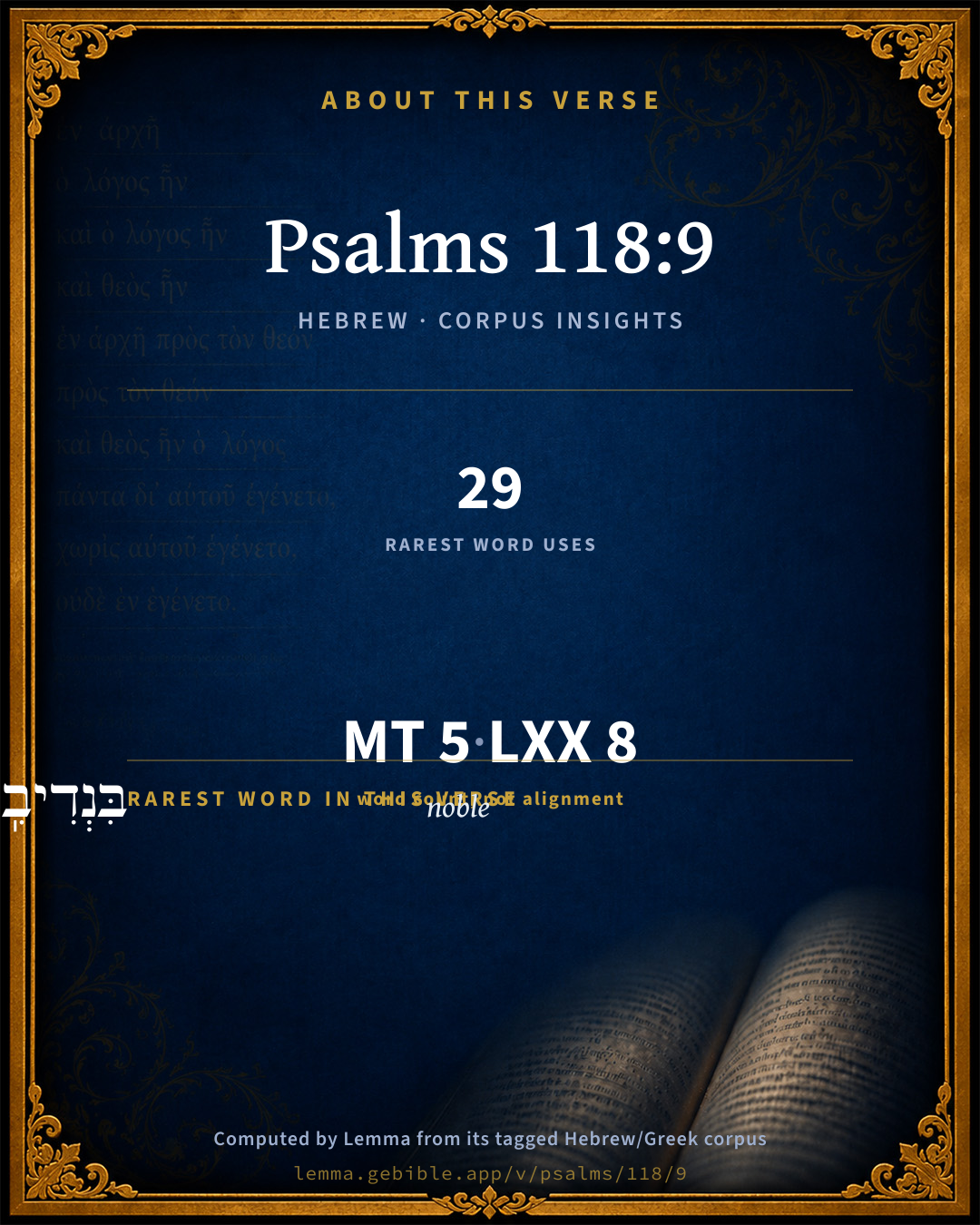
Psalms 118:9

Hebrew (Westminster Leningrad Codex) Psalms 118:9 appears in the Hebrew Old Testament. The text above is from the Westminster Leningrad Codex. Each word links to its Strong’s number, a concise gloss, and parsing drawn from the Open Scriptures Hebrew Bible morphology. Click any word for its full Brown-Driver-Briggs (BDB) entry.
Download image
Cite this verse

Psalms 118:9 (World English Bible). Public Domain. Lemma interlinear Bible study tool, https://lemma.gebible.app/v/psalms/118/9.

Show BibTeX & RIS
BibTeX
RIS
English Translation
It is better to take refuge in Yahweh, Than to put confidence in princes.
World English Bible · Public Domain
Download a study sheet

One document with this verse’s original text, its word-by-word gloss line, the meaning frame, cross-references with their text, attributed commentary, and full source and license credits — printable, and it pastes into notes with its structure intact.

This verse Autodidact and up

Study sheet (.html) Plain text (.txt)

A passage Seminary Student

Up to 50 verses in one chapter. A passage sheet keeps up to 6 commentary sources and 12 cross-references per verse, in the order this page ranks them, and says so on the sheet whenever that leaves anything out. Ask for a single verse and you get the Autodidact verse sheet above.

Everything on this page stays free to read, with no account — the sheet is a download of what is already on screen, not access to it.

Want to remove ads? Support Godless Engineer
Compare translations 3

The same verse in 3 English versions, stacked beneath the original-language interlinear above. Click any original word for its lexicon entry.

Each is an independent rendering of the whole verse — the interlinear is not word-aligned to these translations.

Highlighted words mark where these versions differ — a whole-verse word diff, not a word-by-word alignment.

  • World English Bible Public Domain
    It is better to take refuge in Yahweh, Than to put confidence in princes.
  • King James Version Public Domain
    It is better to trust in the LORD than to put confidence in princes.
  • unfoldingWord Literal Text CC BY-SA 4.0
    Better to take shelter in Yahweh than to trust in princes.

unfoldingWord Literal Text — © unfoldingWord, licensed CC BY-SA 4.0. Word-aligned USFM3 via Door43 (git.door43.org/unfoldingWord/en_ult).

Versions to compare (up to 4)

3 of 4 selected

Show all 18 translations

Every available English version of this verse, each an independent rendering of the whole verse.

  • World English Bible Public Domain
    It is better to take refuge in Yahweh, Than to put confidence in princes.
  • Berean Standard Bible Public Domain
    It is better to take refuge in the LORD than to trust in princes.
  • Majority Standard Bible Public Domain
    It is better to take refuge in the LORD than to trust in princes.
  • King James Version Public Domain
    It is better to trust in the LORD than to put confidence in princes.
  • American Standard Version (1901) Public Domain
    It is better to take refuge in Jehovah Than to put confidence in princes.
  • Revised Version (1885) Public Domain
    It is better to trust in the LORD, than to put confidence in princes.
  • Geneva Bible (1599) Public Domain
    It is better to trust in the Lord, then to haue confidence in princes.
  • Douay-Rheims (1899) Public Domain
    It is good to trust in the Lord, rather than to trust in princes.
  • Young's Literal Translation Public Domain
    Better to take refuge in Jehovah, Than to trust in princes.
  • Literal Standard Version CC BY-SA 4.0
    Better to take refuge in YHWH, || Than to trust in princes.
  • Unlocked Literal Bible CC BY-SA 4.0
    It is better to take refuge in Yahweh than to put one's trust in a princes.
  • unfoldingWord Literal Text CC BY-SA 4.0
    Better to take shelter in Yahweh than to trust in princes.
  • Darby Bible Public Domain
    It is better to trust in Jehovah than to put confidence in nobles.
  • World Messianic Bible Public Domain
    It is better to take refuge in the LORD, than to put confidence in princes.
  • Webster's Bible Public Domain
    It is better to trust in the LORD than to put confidence in princes.
  • Free Bible Version CC BY-SA 4.0
    It's better to rely on the Lord than to trust in the rich and powerful.
  • Bible in Basic English Public Domain
    It is better to have faith in the Lord than to put one's hope in rulers.
  • JPS Tanakh (1917) Public Domain
    It is better to take refuge in the LORD than to trust in princes.

Literal Standard Version (2020), Covenant Press — licensed CC BY-SA 4.0. Text via the HelloAO Bible API (eBible.org). Unlocked Literal Bible (unfoldingWord) — licensed CC BY-SA 4.0. Text via the HelloAO Bible API (eBible.org). unfoldingWord Literal Text — © unfoldingWord, licensed CC BY-SA 4.0. Word-aligned USFM3 via Door43 (git.door43.org/unfoldingWord/en_ult). Free Bible Version, Dr. Jonathan Gallagher — licensed CC BY-SA 4.0. Text via the HelloAO Bible API (eBible.org).

Word by word

More ways to search: Search by grammar → Find every occurrence → Compare this word →

Practice this passage: Drill this verse → Learn its vocabulary →

בִּנְדִיבִֽים
nâdîyb
H5081
“in/at · noble”
Preposition + Adjective, Adjective, Masculine, Plural, Absolute
Part of Speech
Preposition + Adjective
Type
Adjective
Gender
Masculine
Number
Plural
State
Absolute
Full BDB Definition

Origin: from H5068

TWOT: 1299b

inclined, willing, noble, generous (adjective) - incited, inclined, willing - noble, princely (in rank) - noble (in mind and character) - noble one (noun masculine)
  1. ט֗וֹב ṭôwb H2896 “good” Adjective, Adjective, Masculine, Singular, Absolute
  2. לַחֲס֥וֹת châçâh H2620 “to seek refuge” Preposition + Verb, Qal, Infinitive Construct
  3. בַּיהוָ֑ה Yᵉhôvâh H3068 “in/at · LORD” Preposition + Noun, Proper
  4. מִ֝בְּטֹ֗חַ bâṭach H982 “from · to trust” Preposition + Verb, Qal, Infinitive Construct

About this verse

These counts appear in no published source. They are computed here, from the morphology-tagged text and Lemma’s own curated glosses. What Lemma adds →

5
words
5
distinct lemmas
Wisdom
section

Shared distinctive vocabulary

בִּנְדִיבִֽים noble H5081 occurs in 26 verses of the Hebrew Bible. Also found in:

Grammatical profile

  • 2 verbs
  • 1 noun
  • 2 adjectives

Verb forms

  • לַחֲס֥וֹת Qal · Infinitive Construct
  • מִ֝בְּטֹ֗חַ Qal · Infinitive Construct

Hebrew & Septuagint length

In English translation the verse runs 14 words from the Hebrew and 13 from the Septuagint (LXX English) — closely comparable.

A rough comparison of the two English renderings, which tokenize alike — not a word-level alignment.

Word counts can differ between the Hebrew and the Greek without any difference in meaning — e.g. the Hebrew direct-object marker אֵת has no separate Greek word, and Greek often adds the article ὁ.

In the original languages it is 5 Hebrew tokens and 8 Greek tokens — but the two are counted differently (Hebrew bundles its prefixes and suffixes into one token; the Greek is in lemma form), so that isn’t a like-for-like length.

Cross-references

7

Topical passages linked to Psalms 118:9 in the Treasury of Scripture Knowledge — connected by theme and wording, ordered by reader-vote popularity; previews shown in the World English Bible.

  • Psalms 146:3–5 Don't put your trust in princes, Each a son of man in whom there is no help.
  • Isaiah 31:1 Woe to those who go down to Egypt for help, and rely on horses, and trust in chariots because they are many, and in horsemen because they are very strong, but they don't look to the Holy One of Israel, neither seek Yahweh!
  • Isaiah 30:2–3 that set out to go down into Egypt, and have not asked at my mouth; to strengthen themselves in the strength of Pharaoh, and to take refuge in the shadow of Egypt!
  • Isaiah 31:8 The Assyrian shall fall by the sword, not of man; and the sword, not of men, shall devour him; and he shall flee from the sword, and his young men shall become subject to forced labor.
  • Ezekiel 29:7 When they took hold of you by your hand, you did break, and did tear all their shoulders; and when they leaned on you, you broke, and mad all their loins to be at a stand.
  • Isaiah 30:15–17 For thus said the Lord Yahweh, the Holy One of Israel, In returning and rest shall you be saved; in quietness and in confidence shall be your strength. You would not:
  • Isaiah 36:6–7 Behold, you trust on the staff of this bruised reed, even on Egypt, whereon if a man lean, it will go into his hand, and pierce it: so is Pharaoh king of Egypt to all who trust on him.

Cross-references courtesy of OpenBible.info (CC BY 4.0).

Hebrew and Greek witnesses Masoretic Hebrew ↔ Greek Septuagint

The same verse in the two great witnesses to the Old Testament, shown verse-for-verse.

You’re reading Greek Psalm 117 (Hebrew Psalm 118). The Septuagint counts the superscription, so verse numbers can differ from the Hebrew — chapter-level alignment, not verse-by-verse. Numbering follows Rahlfs.

These are two independent witnesses, not word-aligned to each other, and the Septuagint is shown in lemma (dictionary) form.

Hebrew Psalms 118:9 Masoretic · Westminster Leningrad Codex

ט֗וֹב לַחֲס֥וֹת בַּיהוָ֑ה מִ֝בְּטֹ֗חַ בִּנְדִיבִֽים

It is better to take refuge in Yahweh, Than to put confidence in princes.

World English Bible · Public Domain

Greek LXX Greek Psalm 117:9 Septuagint · lemma form

ἀγαθός ἐλπίζω ἐπί κύριος ἤ ἐλπίζω ἐπί ἄρχων

It is better to hope in the Lord, than to hope in princes.

LXX2012 (modern English Septuagint) · Public Domain

Hebrew: Westminster Leningrad Codex (CC BY 4.0). Greek: Septuagint (public domain); English from LXX2012 (modern English Septuagint) (Public Domain). How the Septuagint differs from the Hebrew →

Commentary

Notes on Psalms 118:9 from classic Christian and Jewish commentators (each source and its license shown beneath its notes). The classic Christian expositions comment on the surrounding passage and are grouped to its opening verse, so a note may address several verses; the Jewish commentaries on the Tanakh (Rashi and others) are per-verse, so they appear only where the commentator wrote on this verse.

Lemma curates 59 commentaries, every one of them public domain or Creative Commons licensed, each selected and text-cleaned for this edition rather than reprinted as found. About our sources →

Trapp's Complete Commentary

John Trapp

Psa 118:9 [It is] better to trust in the LORD than to put confidence in princes.

Ver. 9. Than to put confidence in princes] In ingenuis. Great men’s words, saith one, are like dead men’s shoes; he may go barefoot that waiteth for them. "Surely men of high degree are a lie," Psa 52:9.

John Trapp, A Commentary or Exposition upon All the Books of the Old and New Testament (1647–1656) — public domain. Text from a community e-Sword module.

J. A. Alexander on Psalms

Joseph Addison Alexander

9. (Psa 118:9) It is good to confide in Jehovah (more) than to trust in nobles. This merely strengthens the foregoing declaration, by rendering it more specific and emphatic. The Lord is more to be confided in, not merely than the mass of men, but than their chiefs. Nobles is a better translation than princes, because it keeps up the association with the adjective sense noble, generous, liberal, spontaneous, which is otherwise lost sight of. See above, on Psa 51:12. Even the Persian patrons and protectors of the Jews had not entirely deserved their confidence; nor at all, in comparison with Jehovah their covenanted God.

Joseph Addison Alexander, The Psalms Translated and Explained (1850) — public domain. Text from a community e-Sword module.

Adam Clarke's Commentary

Verse 9. In princes.] Men of high estate are generally proud, vain-glorious, self-confident, and rash: it is better to trust in God than in them. Often they cannot deliver, and often they will not when they can. However, in the concerns of our salvation, and in matters which belong to Providence, they can do nothing.

Adam Clarke's Commentary on the Bible (1810–1826) — public domain. Text from a community e-Sword/MySword module.

Ellicott's Commentary for English Readers

(9) Trust.—The word constantly used of the security the Israelite found in his relation to Jehovah. The meaning here is apparently, “Fidelity to the covenant is better than alliance with foreign princes,” though, of course, the larger sense, in which the words are applicable to all men, may be read into the words.

A Bible Commentary for English Readers, edited by Charles John Ellicott (1878–1897) — public domain. Text from a community e-Sword module.

John Gill's Exposition

They compassed me about; yea, they compassed me about,.... Which is repeated not only for the confirmation of, it, but to denote the frequency and fury of their attacks, and their obstinate persisting therein; See Gill on Psa 118:10;

but in the name of the Lord I will destroy them; which also is repeated to show the strength of his faith, and the continuance of it, notwithstanding his numerous enemies, and their violent efforts against him.

John Gill's Exposition of the Whole Bible (1746–1763) — public domain (CC PDM 1.0). Text via the HelloAO Bible API.

Albert Barnes' Notes on the Bible

It is better ... than to put confidence in princes - Even in the most mighty of the human race; in those who of all people may be supposed to have the most ability to aid us; in those whose favor is often sought more than the favor of God. Princes are only men; often as faithless and deceitful as other men; often less reliable in their character than those in more humble life. and in the great matters where we most need aid - in sickness, in danger, in death, in the eternal world - as absolutely powerless as men in the lowest condition of poverty, or in the most humble rank.

Albert Barnes' Notes on the Bible (1834–1885) — public domain. Text from a community e-Sword/MySword module.

The Treasury of David

Charles H. Spurgeon

Ver. 9. It is better to trust in the LORD than to put confidence in princes. These should be the noblest of men, chivalrous in character, and true to the core. The royal word should be unquestionable. They are noblest in rank and mightiest in power, and yet as a rule princes are not one whit more reliable than the rest of mankind. A gilded vane turns with the wind as readily as a meaner weathercock. Princes are but men, and the best of men are poor creatures. In many troubles they cannot help us in the least degree: for instance, in sickness, bereavement, or death; neither can they assist us one jot in reference to our eternal state. In eternity a prince's smile goes for nothing; heaven and hell pay no homage to royal authority. The favour of princes is proverbially fickle, the testimonies of worldlings to this effect are abundant. All of us remember the words put by the world's great poet into the lips of the dying Wolsey; their power lies in their truth:

"O how wretched

Is that poor man that hangs on princes' favours!

There is betwixt that smile we would aspire to,

That sweet aspect of princes, and their ruin,

More pangs and fears than wars or women have;

And when he falls, he falls like Lucifer,

Never to hope again."

Yet a prince's smile has a strange witchery to many hearts, few are proof against that tuft hunting which is the index of a weak mind. Principle has been forgotten and character has been sacrificed to maintain position at court; yea, the manliness which the meanest slave retains has been basely bartered for the stars and garters of a profligate monarch. He who puts his confidence in God, the great King, is thereby made mentally and spiritually stronger, and rises to the highest dignity of manhood; in fact, the more he trusts the more is he free, but the fawning sycophant of greatness is meaner than the dirt he treads upon. For this reason and a thousand others it is infinitely better to trust in the Lord than to put confidence in princes.

Ver. 9. It is better to trust in the LORD than to put confidence in princes. David knew that by experience, for he confided in Saul his king, at another time in Achish, the Philistine, at another time in Ahithophel his own most prudent minister, besides some others; and they all failed him; but he never confided in God without feeling the benefit of it. Robert Bellarmine.

Ver. 9. It is better, etc. Literally, "Good is it to trust in Jehovah more than to confide in man." This is the Hebrew form of comparison, and is equivalent to what is stated in our version. "It is better, "etc. It is better, (1) because man is weak, but God is Almighty; (2) because man is selfish, but God is benevolent; (3) because man is often faithless and deceitful, God never; (4) because there are emergencies, as death, in which man cannot aid us, however faithful, kind, and friendly he may be, but there are no circumstances in this life, and none in death, where God cannot assist us; and (5) because the ability of man to help us pertains at best only to the present life, the power of God will be commensurate with eternity. Albert Barnes.

Ver. 9. Than to put confidence in princes. Great men's words, saith one, are like dead men's shoes; he may go barefoot that waiteth for them. John Trapp.

Ver. 9. They who constantly attend upon God, and depend upon him, have a much sweeter life, than those that wait upon princes with great observance and expectation. A servant of the Lord is better provided for than the greatest favourites and minions of princes. Thomas Manton.

Psalms 118:10*

Charles H. Spurgeon's The Treasury of David (1869–1885) — public domain. Psalms only. Text from a community e-Sword/MySword module.

Whedon's Commentary on the Bible

Daniel D. Whedon

9. Princes—The representatives of earthly power. This is an advance in the thought from “man,” in the preceding line. God alone can be trusted, who overrules men and “princes.” The faithlessness of “princes” was felt by the returned exiles in all their attempts at reconstruction. See, as to the temple building, Ezra 4, 5, , 6. But God triumphed through his prophets.

Ezr_5:1

Daniel D. Whedon (gen. ed.), Commentary on the Old and New Testaments (1874–1909) — public domain. Text from a community e-Sword module.

The Pulpit Commentary

It is better to trust in the Lord than to put confidence in princes. The "princes" after Cyrus had proved "broken reeds," and, instead of favoring Israel, had favored Israel"s enemies. (Ezr_4:6-24) At last Darius had done them justice, but it was felt that no sure dependence could be placed either on him or on his successors. Jehovah alone was Israel"s safe ground of confidence, He "would not fail them, nor forsake them". (Jos_1:5)

The Pulpit Commentary (1880–1919), ed. H.D.M. Spence-Jones & Joseph S. Exell — public domain. Text from a community e-Sword module.

Scofield Reference Notes

C. I. Scofield

trust

(See Scofield "Psa 2:12").

The Scofield Reference Bible (1917 edition), notes by C. I. Scofield — public domain. Text from a community e-Sword module.

Lesson kit

Teaching starters — assembled from the data on this page, not authored interpretation. Every prompt links to the verse data it draws on. Edit before teaching.

Psalms, in the Wisdom, opens this verse with 5 words (5 distinct Hebrew lemmas). Its most distinctive word is nâdîyb (“noble”). A historical commentator’s framing appears above. Read the whole chapter for the surrounding context.

Discussion questions

  1. What does “noble” (nâdîyb) contribute to the verse as a whole?
  2. How does Exodus 35:5, which shares the word «noble», read alongside this verse?
  3. These translations render this verse differently; the difference is in the English rendering, not the original. What questions does that raise?
  4. «לַחֲס֥וֹת» is a Qal Infinitive Construct verb. How does that grammatical form shape the action described?
  5. Compare how Trapp's Complete Commentary and J. A. Alexander on Psalms read this verse. Where do they agree or differ?

Things to notice

Reading settings

Reading text

Shown beneath each verse's original-language words.

Old Testament
Old Testament edition

Read the OT as the Masoretic Hebrew (MT) or the Greek Septuagint (LXX).

English shown for the Greek Septuagint (in the Hebrew ↔ Greek comparison).

Comparing translations? Open the Compare panel on any verse page to stack up to four side by side.