Isaiah 32:11

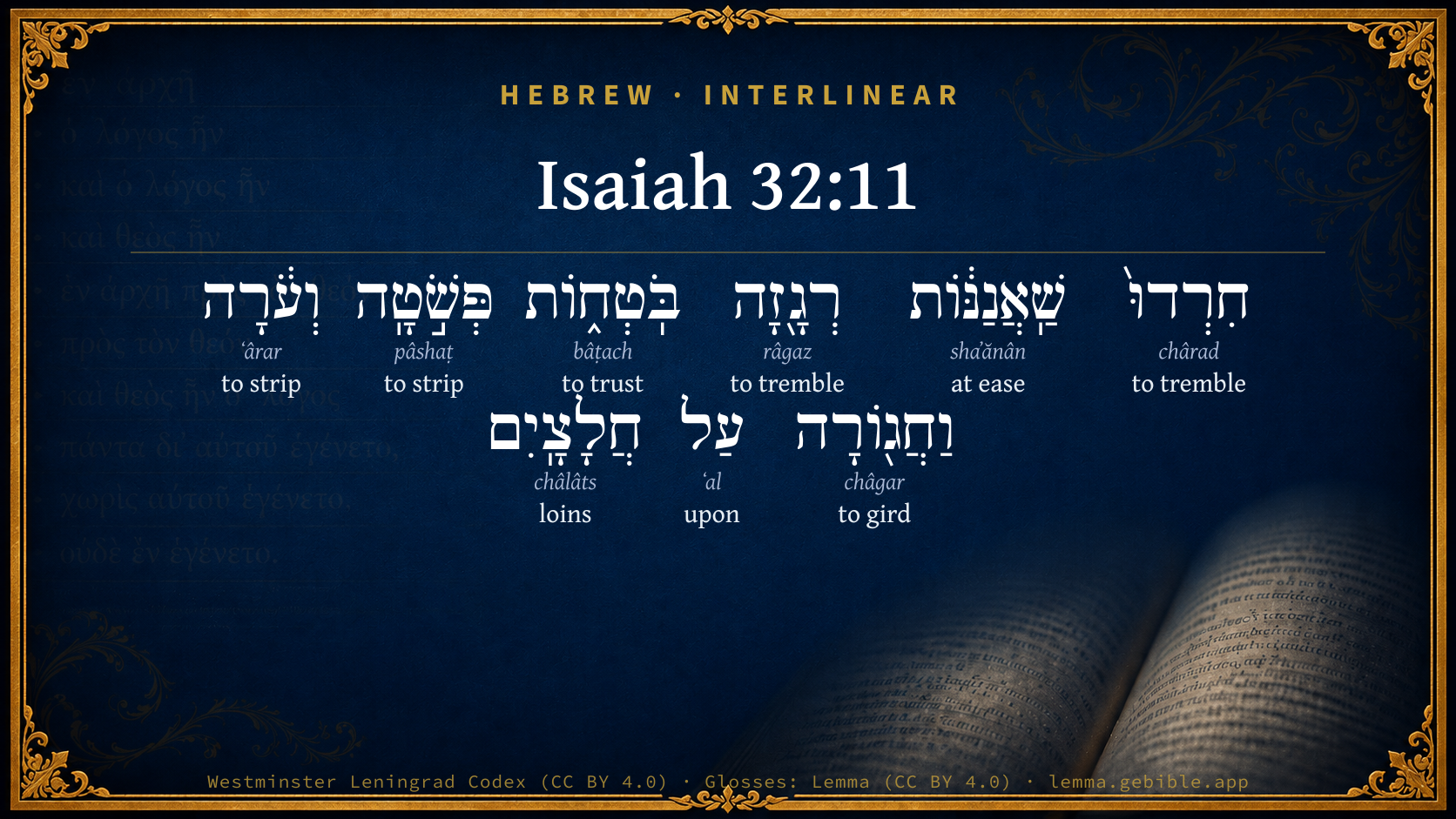
Hebrew (Westminster Leningrad Codex) Isaiah 32:11 appears in the Hebrew Old Testament. The text above is from the Westminster Leningrad Codex. Each word links to its Strong’s number, a concise gloss, and parsing drawn from the Open Scriptures Hebrew Bible morphology. Click any word for its full Brown-Driver-Briggs (BDB) entry.
Download image
Cite this verse

Isaiah 32:11 (World English Bible). Public Domain. Lemma interlinear Bible study tool, https://lemma.gebible.app/v/isaiah/32/11.

Show BibTeX & RIS
BibTeX
RIS
English Translation
Tremble, you women who are at ease; be troubled, you careless ones; strip yourselves, and make yourselves naked, and gird [sackcloth] on your loins.
World English Bible · Public Domain
Download a study sheet

One document with this verse’s original text, its word-by-word gloss line, the meaning frame, cross-references with their text, attributed commentary, and full source and license credits — printable, and it pastes into notes with its structure intact.

This verse Autodidact and up

Study sheet (.html) Plain text (.txt)

A passage Seminary Student

Up to 50 verses in one chapter. A passage sheet keeps up to 6 commentary sources and 12 cross-references per verse, in the order this page ranks them, and says so on the sheet whenever that leaves anything out. Ask for a single verse and you get the Autodidact verse sheet above.

Everything on this page stays free to read, with no account — the sheet is a download of what is already on screen, not access to it.

Want to remove ads? Support Godless Engineer
Compare translations 3

The same verse in 3 English versions, stacked beneath the original-language interlinear above. Click any original word for its lexicon entry.

Each is an independent rendering of the whole verse — the interlinear is not word-aligned to these translations.

Highlighted words mark where these versions differ — a whole-verse word diff, not a word-by-word alignment.

  • World English Bible Public Domain
    Tremble, you women who are at ease; be troubled, you careless ones; strip yourselves, and make yourselves naked, and gird [sackcloth] on your loins.
  • King James Version Public Domain
    Tremble, ye women that are at ease; be troubled, ye careless ones: strip you, and make you bare, and gird sackcloth upon your loins.
  • unfoldingWord Literal Text CC BY-SA 4.0
    Shudder, haughty; tremble, ones being confident; strip and bare and gird upon loins.

unfoldingWord Literal Text — © unfoldingWord, licensed CC BY-SA 4.0. Word-aligned USFM3 via Door43 (git.door43.org/unfoldingWord/en_ult).

Versions to compare (up to 4)

3 of 4 selected

Show all 18 translations

Every available English version of this verse, each an independent rendering of the whole verse.

  • World English Bible Public Domain
    Tremble, you women who are at ease; be troubled, you careless ones; strip yourselves, and make yourselves naked, and gird [sackcloth] on your loins.
  • Berean Standard Bible Public Domain
    Shudder, you ladies of leisure; tremble, you daughters of complacency. Strip yourselves bare and put sackcloth around your waists.
  • Majority Standard Bible Public Domain
    Shudder, you ladies of leisure; tremble, you daughters of complacency. Strip yourselves bare and put sackcloth around your waists.
  • King James Version Public Domain
    Tremble, ye women that are at ease; be troubled, ye careless ones: strip you, and make you bare, and gird sackcloth upon your loins.
  • American Standard Version (1901) Public Domain
    Tremble, ye women that are at ease; be troubled, ye careless ones; strip you, and make you bare, and gird `sackcloth' upon your loins.
  • Revised Version (1885) Public Domain
    Tremble, ye women that are at ease; be troubled, ye careless ones: strip you, and make you bare, and gird sackcloth upon your loins.
  • Geneva Bible (1599) Public Domain
    Yee women, that are at ease, be astonied: feare, O yee carelesse women: put off the clothes: make bare, and girde sackcloth vpon the loynes.
  • Douay-Rheims (1899) Public Domain
    Be astonished, ye rich women, be troubled, ye confident ones: strip yen, and be confounded, gird your loins.
  • Young's Literal Translation Public Domain
    Tremble ye women, ye easy ones, Be troubled, ye confident ones, Strip and make bare, with a girdle on the loins,
  • Literal Standard Version CC BY-SA 4.0
    Tremble, you women, you easy ones, || Be troubled, you confident ones, || Strip and make bare, with a girdle on the loins,
  • Unlocked Literal Bible CC BY-SA 4.0
    Tremble, you women who are at ease; be troubled, you confident ones; take off your fine clothes and make yourselves bare; put on sackcloth around your waists.
  • unfoldingWord Literal Text CC BY-SA 4.0
    Shudder, haughty; tremble, ones being confident; strip and bare and gird upon loins.
  • Darby Bible Public Domain
    Tremble, ye women that are at ease; be troubled, ye careless ones; strip you, and make you bare, and gird [sackcloth] on your loins!
  • World Messianic Bible Public Domain
    Tremble, you women who are at ease! Be troubled, you careless ones! Strip yourselves, make yourselves naked, and put sackcloth on your waist.
  • Webster's Bible Public Domain
    Tremble, ye women that are at ease; be troubled, ye careless ones: strip ye, and make you bare, and gird sackcloth upon your loins.
  • Free Bible Version CC BY-SA 4.0
    Shudder, you women relaxing! Tremble, you ladies who feel so safe! Strip off your clothes, bare yourselves and put on sackcloth around your waists.
  • Bible in Basic English Public Domain
    Be shaking with fear, you women who are living in comfort; be troubled, you who have no fear of danger: take off your robes and put on clothing of grief.
  • JPS Tanakh (1917) Public Domain
    Tremble, ye women that are at ease; be troubled, ye confident ones; strip you, and make you bare, and gird sackcloth upon your loins,

Literal Standard Version (2020), Covenant Press — licensed CC BY-SA 4.0. Text via the HelloAO Bible API (eBible.org). Unlocked Literal Bible (unfoldingWord) — licensed CC BY-SA 4.0. Text via the HelloAO Bible API (eBible.org). unfoldingWord Literal Text — © unfoldingWord, licensed CC BY-SA 4.0. Word-aligned USFM3 via Door43 (git.door43.org/unfoldingWord/en_ult). Free Bible Version, Dr. Jonathan Gallagher — licensed CC BY-SA 4.0. Text via the HelloAO Bible API (eBible.org).

Word by word

More ways to search: Search by grammar → Find every occurrence → Compare this word →

Practice this passage: Drill this verse → Learn its vocabulary →

וְעֹ֔רָה
ʻârar
H6209
“and · strip”
Conjunction + Verb, Qal, Imperative, 2nd Person, Feminine, Plural
Part of Speech
Conjunction + Verb
Stem
Qal
Form
Imperative
Person
2nd Person
Gender
Feminine
Number
Plural
Full BDB Definition

Origin: a primitive root

TWOT: 1705

to strip, make bare, strip oneself - (Qal) to strip, strip oneself - (Poel) to lay bare - (Hithpalpel) to be utterly stripped, be utterly laid bare - (Pilpel) break
  1. חִרְדוּ֙ chârad H2729 “tremble” Verb, Qal, Imperative, 2nd Person, Masculine, Plural
  2. שַֽׁאֲנַנּ֔וֹת shaʼănân H7600 “at ease” Adjective, Adjective, Feminine, Plural, Absolute
  3. רְגָ֖זָה râgaz H7264 “tremble” Verb, Qal, Imperative, 2nd Person, Feminine, Plural
  4. בֹּֽטְח֑וֹת bâṭach H982 “trusting” Verb, Qal, Participle Active, Feminine, Plural, Absolute
  5. פְּשֹׁ֣טָֽה pâshaṭ H6584 “strip” Verb, Qal, Imperative, 2nd Person, Feminine, Plural
  6. וַחֲג֖וֹרָה châgar H2296 “and · gird” Conjunction + Verb, Qal, Imperative, 2nd Person, Feminine, Plural
  7. עַל ʻal H5921 “upon” Preposition
  8. חֲלָצָֽיִם châlâts H2504 “loins” Noun, Common, Both, Dual, Absolute

About this verse

These counts appear in no published source. They are computed here, from the morphology-tagged text and Lemma’s own curated glosses. What Lemma adds →

9
words
9
distinct lemmas
Prophets
section

Notable vocabulary

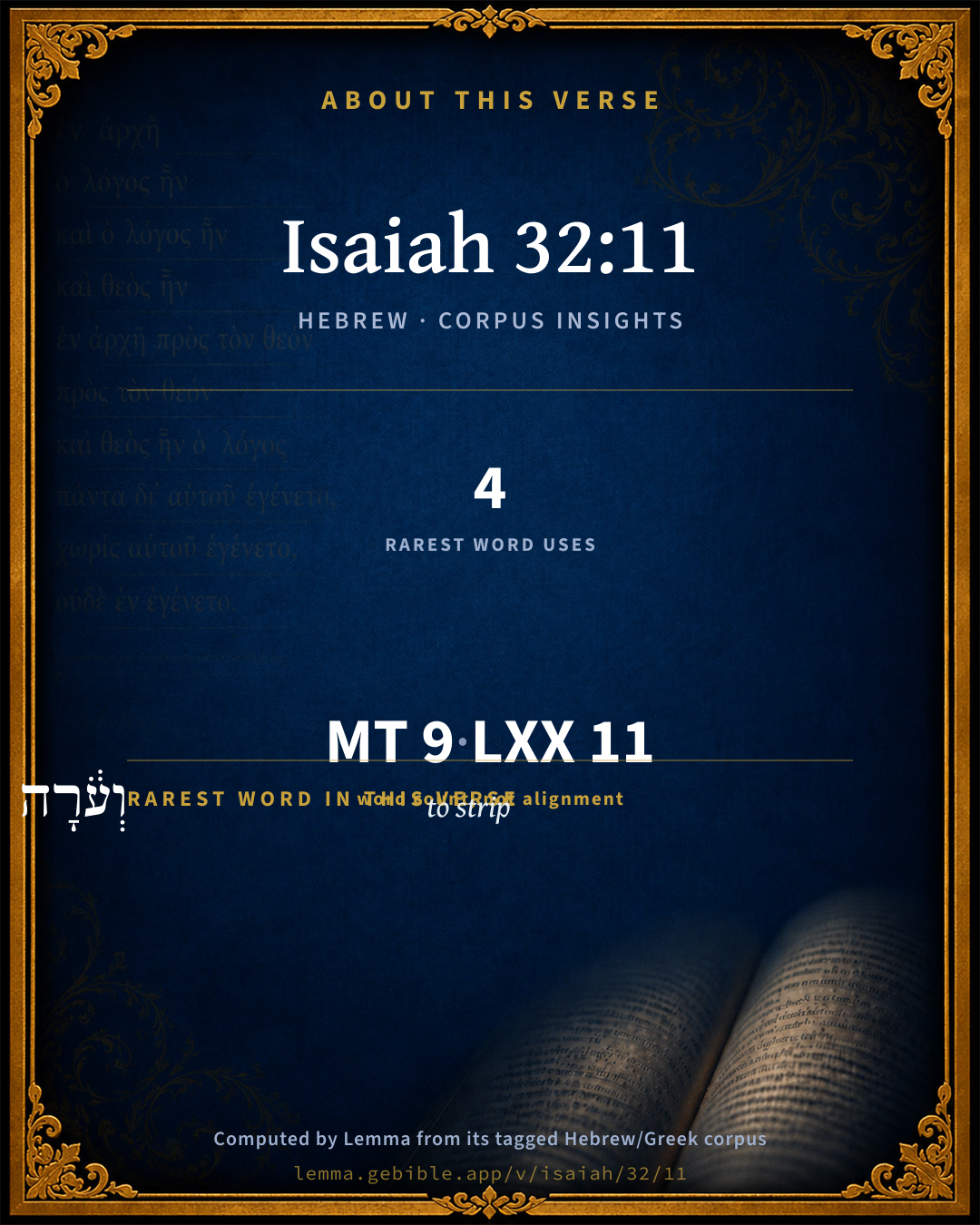
The rarest word here is וְעֹ֔רָה to strip H6209 — appearing just 4 times in the whole Hebrew Bible.

Shared distinctive vocabulary

וְעֹ֔רָה to strip H6209 occurs in 3 verses of the Hebrew Bible. Also found in:

Grammatical profile

  • 6 verbs
  • 1 noun
  • 1 adjective
  • 1 preposition

Verb forms

  • חִרְדוּ֙ Qal · Imperative
  • רְגָ֖זָה Qal · Imperative
  • בֹּֽטְח֑וֹת Qal · Participle Active
  • פְּשֹׁ֣טָֽה Qal · Imperative
  • וְעֹ֔רָה Qal · Imperative
  • וַחֲג֖וֹרָה Qal · Imperative

Hebrew & Septuagint length

In English translation the verse runs 24 words from the Hebrew and 14 from the Septuagint (LXX English) — the Septuagint runs noticeably shorter here. See the side-by-side →

A rough comparison of the two English renderings, which tokenize alike — not a word-level alignment.

Word counts can differ between the Hebrew and the Greek without any difference in meaning — e.g. the Hebrew direct-object marker אֵת has no separate Greek word, and Greek often adds the article ὁ.

In the original languages it is 9 Hebrew tokens and 11 Greek tokens — but the two are counted differently (Hebrew bundles its prefixes and suffixes into one token; the Greek is in lemma form), so that isn’t a like-for-like length.

Cross-references

16

Topical passages linked to Isaiah 32:11 in the Treasury of Scripture Knowledge — connected by theme and wording, ordered by reader-vote popularity; previews shown in the World English Bible.

  • Isaiah 3:24 It shall happen that instead of sweet spices, there shall be rottenness; Instead of a belt, a rope; Instead of well set hair, baldness; Instead of a robe, a girding of sackcloth; And branding instead of beauty.
  • Deuteronomy 28:48 therefore shall you serve your enemies whom Yahweh shall send against you, in hunger, and in thirst, and in nakedness, and in want of all things: and he shall put a yoke of iron on your neck, until he have destroyed you.
  • Isaiah 2:19 Men shall go into the caves of the rocks, And into the holes of the earth, From before the terror of Yahweh, And from the glory of his majesty, When he arises to shake the earth mightily.
  • Isaiah 2:21 To go into the caverns of the rocks, And into the clefts of the ragged rocks, From before the terror of Yahweh, And from the glory of his majesty, When he arises to shake the earth mightily.
  • Isaiah 15:3 In their streets they gird themselves with sackcloth; on their housetops, and in their broad places, everyone wails, weeping abundantly.
  • Isaiah 20:4 so shall the king of Assyria lead away the captives of Egypt, and the exiles of Ethiopia, young and old, naked and barefoot, and with buttocks uncovered, to the shame of Egypt.
  • Isaiah 22:4–5 Therefore said I, Look away from me, I will weep bitterly; don't labor to comfort me for the destruction of the daughter of my people.
  • Isaiah 33:14 The sinners in Zion are afraid; trembling has seized the godless ones: Who among us can dwell with the devouring fire? who among us can dwell with everlasting burning?
  • Isaiah 47:1–3 Come down, and sit in the dust, virgin daughter of Babylon; sit on the ground without a throne, daughter of the Chaldeans: for you shall no more be called tender and delicate.
  • Jeremiah 4:8 For this gird you with sackcloth, lament and wail; for the fierce anger of Yahweh hasn't turned back from us.
  • Jeremiah 6:26 Daughter of my people, gird you with sackcloth, and wallow yourself in ashes: make you mourning, as for an only son, most bitter lamentation; for the destroyer shall suddenly come on us.
  • Jeremiah 49:3 Wail, Heshbon, for Ai is laid waste; cry, you daughters of Rabbah, gird you with sackcloth: lament, and run back and forth among the fences; for Malcam shall go into captivity, his priests and his princes together.
  • Hosea 2:3 Lest I strip her naked, And make her bare as in the day that she was born, And make her like a wilderness, And set her like a dry land, And kill her with thirst.
  • Micah 1:8–11 For this I will lament and wail; I will go stripped and naked; I will howl like the jackals, And moan like the daughters of owls.
  • Luke 23:27–30 A great multitude of the people followed him, including women who also mourned and lamented him.
  • James 5:5 You have lived delicately on the earth, and taken your pleasure. You have nourished your hearts as in a day of slaughter.

Cross-references courtesy of OpenBible.info (CC BY 4.0).

Hebrew and Greek witnesses Masoretic Hebrew ↔ Greek Septuagint

The same verse in the two great witnesses to the Old Testament, shown verse-for-verse.

Here the Septuagint runs noticeably shorter than the Hebrew — LXX2012 (modern English Septuagint) 14 words vs World English Bible 24. A rough length comparison of the two English translations, not a word-level alignment — read both below.

These are two independent witnesses, not word-aligned to each other, and the Septuagint is shown in lemma (dictionary) form.

Hebrew Isaiah 32:11 Masoretic · Westminster Leningrad Codex

חִרְדוּ֙ שַֽׁאֲנַנּ֔וֹת רְגָ֖זָה בֹּֽטְח֑וֹת פְּשֹׁ֣טָֽה וְעֹ֔רָה וַחֲג֖וֹרָה עַל חֲלָצָֽיִם

Tremble, you women who are at ease; be troubled, you careless ones; strip yourselves, and make yourselves naked, and gird [sackcloth] on your loins.

World English Bible · Public Domain

Greek LXX Isaiah 32:11 Septuagint · lemma form

ἐκἵστημι λυπέω ὁ πείθω ἐκδύω γυμνός γίγνομαι περιζώννυμι σάκκος ὁ ὀσφύς

Be amazed, be pained, you⌃ confident ones: strip you, bare yourselves, gird your loins;

LXX2012 (modern English Septuagint) · Public Domain

On this verse, Adam Clarke's Commentary discusses the Septuagint’s reading. Read the note in Commentary ↓

Hebrew: Westminster Leningrad Codex (CC BY 4.0). Greek: Septuagint (public domain); English from LXX2012 (modern English Septuagint) (Public Domain). How the Septuagint differs from the Hebrew →

Targum (Aramaic paraphrase)

1

The Targum is the ancient Jewish Aramaic paraphrase of the Hebrew Scriptures — an interpretive translation, not the Hebrew text itself. Onkelos (literal) and Pseudo-Jonathan (expansive) render the Torah, and Jonathan the Prophets. Coverage is partial: where no permissively-licensed English translation exists for a verse, only the Aramaic is shown. This is verse-level text, not a word-by-word alignment to the Hebrew.

  1. Targum Jonathan Prophets (Joshua–Malachi)
    אִיתְּבַרוּ דְיַתְבִין שְׁלֵיוָן זָעוּ דִי שָׁרָן לְרוֹחֲצָן שְׁלָחוּ וְאִיתְעַרְטִלוּ וֶאֱסָרוּ עַל חַרְצִין:

    They that dwell at ease shall be broken, they that dwell in safety shall tremble; strip ye, and make you bare, and gird sackcloth upon your loins.

    Targum Jonathan — Aramaic: “Mikraot Gedolot” (public domain). English: “Sefaria Community Translation” (CC0 1.0 (public-domain dedication)); “London "Chaldee Paraphrase," 1871” (public domain). Text via Sefaria.

Commentary

Notes on Isaiah 32:11 from classic Christian and Jewish commentators (each source and its license shown beneath its notes). The classic Christian expositions comment on the surrounding passage and are grouped to its opening verse, so a note may address several verses; the Jewish commentaries on the Tanakh (Rashi and others) are per-verse, so they appear only where the commentator wrote on this verse.

Lemma curates 59 commentaries, every one of them public domain or Creative Commons licensed, each selected and text-cleaned for this edition rather than reprinted as found. About our sources →

Trapp's Complete Commentary

John Trapp

Isa 32:11 Tremble, ye women that are at ease; be troubled, ye careless ones: strip you, and make you bare, and gird [sackcloth] upon [your] loins.

Ver. 11. Tremble, ye women.] Adhortatio ad poenitentiam, saith Hyperius; an exhortation to repentance, {a} not unlike that of St James, {Jas 4:9-10} "Afflict yourselves, and weep and mourn; let your laughter be turned into mourning, your joy into heaviness."

{a} Trepidate, O tranquillae. - Tremel.

John Trapp, A Commentary or Exposition upon All the Books of the Old and New Testament (1647–1656) — public domain. Text from a community e-Sword module.

The Biblical Illustrator

Joseph S. Exell

Isa_32:11

Be troubled, ye careless ones

Besetting sins may be the defects of virtues

The besetting sins of either sex are its virtues prostituted.

A mans greatest temptations proceed from his strength; but the glory of the feminine nature is repose, and trust is the strength of the feminine character, in which very things, however, lies all the possibility of womans degradation. (Prof g. A. Smith, D. D.)

The careless sinner reproved

I. I am to EXPOSTULATE WITH THOSE WHO ARE CARELESS IN THE CONCERNS OF RELIGION AND THEIR SOULS. The following things are submitted to your consideration:--

1. The importance of religion, which is neglected by you.

2. The beneficial proofs of the Divine agency which surround you.

3. Your personal obligations to God are neither few nor small.

4. The grand display of the love of God in giving His only-begotten Son, that whosoever believeth in Him, &c.

5. The certainty of judgment and a future state.

II. We are now to ADDRESS THESE EXPOSTULATIONS TO THE CONSIDERATION OF YOUTH, MANHOOD, AND AGE. (A. Shanks.)

An alarm to the careless

To be careless in temporal things is generally regarded as a very serious defect or offence. How much more so when one is careless in spiritual things! Yet this is characteristic of great numbers who hear the Gospel. Is there no cause for alarm? A careless attitude and habit towards God and Christ and salvation are--

1. Unreasonable,

2. Hazardous.

3. God-provoking. (J. M. Sherwood.)

The Biblical Illustrator, edited by Joseph S. Exell (c. 1880s–1900s) — public domain. Text from a community e-Sword module.

The Preacher's Complete Homiletical Commentary

Joseph S. Exell (gen. ed.)

A CALL TO THE CARELESS

Isa_32:11. Be troubled, ye careless ones [1192]

[1192] See outlines on chap. Isa_1:3, p. 7–12.

I. Who are the careless ones in our own day?

1. Those who neglect the Bible. Its main object is to arouse the attention of sinners. Claims and deserves attention. That man is indifferent to the welfare of his country who never examines the principles of its constitution, the character of its laws, &c. So he who neglects the Bible can never be regarded as a serious man. He is careless on the most momentous of all subjects.

2. Those who neglect prayer. All who have any proper feeling towards God must regard this as a solemn duty. Nature teaches its necessity and importance, the Scriptures enjoin it with great earnestness (Luk_18:1; 1Th_5:17).

3. Those who neglect the Sabbath. This “made for man,” appointed for his convenience and spiritual good. An institution of unspeakable importance as regards eternity—in fact, no religion without it.

4. Those who neglect the institutions of the sanctuary. Those anxious to know “what they must do to be saved” always prize the preaching of the Gospel. On the other hand, as the interest in religion declines, so will be our indifference to the means of grace. See you one who makes his attendance on God’s house a matter of convenience, who avails himself of any trifling excuse to be absent, &c., there is a careless one. So also with those who are so absorbed in the pursuits of this life, so as to have neither leisure nor disposition to attend the place of prayer.

5. In a word, those are careless ones who live in impenitence and unbelief. Repentance and faith in Christ. The great interest of the soul cannot be secured without these, and no man can be said to take heed to the things that belong to his peace, without obeying Christ’s commands concerning them.

II. Why such ought to be troubled. Those who are indifferent are disposed to remain so—carelessness perpetuates itself. Still there are reasons why such should be troubled.

1. The fact that you are careless is a ground of alarm. Carelessness, an evidence of our ignorance of the true condition of the soul in the sight of God. Something truly frightful in false security where the danger is real and great. With such this fancied security is the most alarming symptom. The sinner suffering from a disease which no human skill can remove—in danger of eternal death. How fearful then the indifference, how appalling the apathy of such!

2. This indifference indicates a state of mind in which every blessing will be abused, and every warning neglected. A habit of body that would render everything received for nourishment or for medicine useless would be dreadful; what, then, of that moral disease which perverts every gift and makes the diversified means which God employs accomplish nothing for our good?

3. You ought to be troubled when you reflect what it is you are careless about, viz., your salvation. The man who is indifferent about his health, or regardless of his temporal interest, is unwise; what, then, of one who hazards the salvation of his soul by neglect? Salvation is offered in Christ—indifference is unbelief. Why so eager after the acquisition of wealth, and indifferent about the true riches?

4. Another cause of alarm is the exposure of your present position. Neglect of the Gospel ensures destruction (Heb_2:3). This apathy a crime for which no amiableness or morality can atone.

5. No more powerful means will be employed to awaken you to the concerns of your soul. God disclaims any responsibility for your loss (Isa_5:4; Mat_23:37). Ministers have preached, Christian friends have entreated, the Holy Spirit has been sent down, and still you are careless. The very heathen will rise up in judgment. If one rising from the dead would not make those hear who had Moses and the prophets, what shall awaken those who have Christ and the apostles?

6. This carelessness is induced, it is not natural. A long process of hardening the heart is gone through before such a state of apathy is reached. But once ours, it has all the force of habit, and is not easily broken up (Mat_11:21). This indifference is voluntary (Act_24:25). Felix might have taken a different course. No iron necessity binds men to the fatal course they take, but a perverse will and an unbelieving heart.

7. This carelessness is a state of mind that provokes God to withdraw His Spirit. Deeply criminal. No apathy in heaven, there ought to be none on earth. Must it not offend God, to say that He has failed to reveal Himself in a way to interest His creatures? And yet men can be interested in a novel while the Gospel is neglected. Under the old dispensation He said, “My people would not hearken to My voice, so I gave them up to their hearts’ lust.” What of those who then reject the ?Song of Solomon 8. This indifference will ultimately be broken up, and will aggravate condemnation a thousandfold. Though retribution sleep, it must come and will not tarry. The Jews were spared forty years after the Saviour had wept over their doomed city. So with the sinner; there comes a time when he can be indifferent no longer; the realities of judgment and eternity produce a conviction which will go on deepening for ever. How it will embitter the soul then to dwell upon this carelessness of the past. Recollection itself a source of misery. (Luk_16:25). What words can express the anguish of a soul thus reminded of lost opportunities, &c.?

Throw off this lethargy. From this moment seek the Lord with your whole heart, and call upon Him while He is near. Why run the desperate hazard of having to do all this on a dying bed?—Mark Tucker, D.D.: National Preacher, vol. vii. p. 138.

The Preacher's Complete Homiletical Commentary (gen. ed. Joseph S. Exell; Funk & Wagnalls, c. 1892) — public domain (pre-1929). A full-Bible homiletical/sermon-outline anthology covering 65 of 66 books (2 John is absent from the source module). Text from a community e-Sword module.

Tyndale Open Study Notes

Tyndale Open Resources

32:11 Burlap was worn to show . . . grief, especially when mourning (see Ps 30:11). The Assyrian conquest of the farmlands of Judah and most of its cities (except Jerusalem) would cause rich people in the large cities to mourn.

Tyndale Open Study Notes — © Tyndale Open Resources, licensed CC BY-SA 4.0. Text via the HelloAO Bible API.

Jamieson, Fausset & Brown

Robert Jamieson, A. R. Fausset & David Brown

strip you--of your gay clothing. (See Isa 2:19, Isa 2:21).

Jamieson, Fausset & Brown — Commentary Critical and Explanatory on the Whole Bible (1871) — public domain (CC PDM 1.0). Text via the HelloAO Bible API.

Adam Clarke's Commentary

Verse 11. Gird sackcloth] שק sak, sackcloth, a word necessary to the sense, is here lost, but preserved by the Septuagint, MSS. Alex. and Pachom., and I. D. II., and edit. Ald. and Comp., and the Arabic and Syriac.

Tremble - be troubled - strip you] פשטה peshotah, רגזה regazah, &c. These are infinitives, with a paragogic ה he, according to Schultens, Institut. Ling. Hebr. p. 453, and are to be taken in an imperative sense.

Adam Clarke's Commentary on the Bible (1810–1826) — public domain. Text from a community e-Sword/MySword module.

Ellicott's Commentary for English Readers

(11) Tremble, ye women that are at ease . . .—The words find at once a parallel and a contrast in those spoken to the daughters of Jerusalem in Luke (Luk_23:28-30). The call to repentance includes their stripping themselves of their costly finery, and putting on the “sackcloth” (the word is implied, though not expressed in the Hebrew), which was the outward symbol of repentance (Jon_3:5-8). The words, it may be noted, are masculine, the call not being limited to the women.

A Bible Commentary for English Readers, edited by Charles John Ellicott (1878–1897) — public domain. Text from a community e-Sword module.

The Cambridge Bible for Schools and Colleges

gen. ed. J. J. S. Perowne

11. The speaker calls on his female auditors at once to assume the garb of mourners; so certain is the calamity. The word for “tremble” is in the masc. gender in the original, a not uncommon irregularity (Amo_4:1; Mic_1:13, &c.). Indeed the next verse presents an example.

strip ye, and make ye bare]—as Arabian women occasionally do in a paroxysm of grief or terror.

gird (sc. sackcloth) upon your loins] Cf. ch. Isa_3:24; 1Ki_21:27; 2Ki_6:30; Job_16:15.

The words “be troubled,” “strip,” “make bare” and “gird” represent anomalous forms in the Hebrew, which are the despair of grammarians. The imperative no doubt gives the right sense.

The Cambridge Bible for Schools and Colleges (gen. ed. J. J. S. Perowne; Cambridge University Press, 1878–1918) — public domain. Text from a community e-Sword module.

John Gill's Exposition

Tremble, ye women that are at ease,.... Which may be considered either as an exhortation to repentance for their sins, of which, if a due sense was impressed on their hearts, would cause a trembling of body and mind, under a fearful expectation of divine wrath; or as a prediction, that though they were now quite tranquil and easy, and nothing disturbed them, yet such calamities would come upon them as would make them tremble:

be troubled, ye careless ones; or, "confident ones" (l); that live securely, trusting in their present wealth and riches, and confident that things will always continue as they are; be it known to you that trouble will come, and better it would be for you if you were now troubled for your sins, and truly repented of them, that the judgments threatened, and coming, might be prevented:

strip ye, and make you bare; of your fine clothes, and beautiful ornaments, in which they prided themselves, which used to be done in time of mourning, Eze 7:27 or it signifies that this should be their case, they would be stripped not only of their richest clothes and decorating jewels, but of their ordinary apparel, and left bare and naked by the enemy:

and gird sackcloth upon your loins; as a token of mourning; see Gen 37:34 the word "sackcloth" is supplied, as it is by Kimchi, and in the Syriac and Arabic versions; though some understand it as a direction to gird their loins for servile work, signifying what would be their condition and circumstances when taken and carried captive by the enemy; they would no longer live at ease, and in pleasure, as mistresses, but would serve as handmaids.

(l) "confidentes", Pagninus, Montanus, Junius & Tremellius, Piscator.

John Gill's Exposition of the Whole Bible (1746–1763) — public domain (CC PDM 1.0). Text via the HelloAO Bible API.

Albert Barnes' Notes on the Bible

Strip ye, and make ye bare - That is, take off your joyful and splendid apparel, and put on the habiliments of mourning, indicative of a great calamity.

And gird sackcloth - (See the note at Isa 3:24).

Albert Barnes' Notes on the Bible (1834–1885) — public domain. Text from a community e-Sword/MySword module.

Matthew Poole's English Annotations

Strip you, and make you bare; put off your ornaments, as God commanded upon a like occasion, Exo 33:5, that you may put on sackcloth instead of them, as mourners and penitents used to do.

Matthew Poole's English Annotations on the Holy Bible (1683–1685) — public domain. Text from a community e-Sword/MySword module.

Whedon's Commentary on the Bible

Daniel D. Whedon

11. Strip you… sackcloth — This means to put on signs of grief. “Sackcloth” instead of daily gay apparel.

Daniel D. Whedon (gen. ed.), Commentary on the Old and New Testaments (1874–1909) — public domain. Text from a community e-Sword module.

The Pulpit Commentary

Tremble... be troubled. The repetition of this verse is, as usual, emphatic. Its object is to impress those whom the prophet is addressing with the certainty of the coming judgment. Strip you, and make you bare; i.e. "bare your breasts," in preparation for the beating which is to follow (see the comment on the next verse).

Folk who are at ease.

Special reference is made to the women of the upper classes in Jerusalem, who were living in self-indulgence and extravagance, and setting mischievous example to all the women of the land. The coming woes would affect them all the more seriously because of the luxuries which they had gathered round themselves, and which had become to them fancied necessities. No doubt the idle, self-indulgent, and too often profligate conduct of these women greatly added to the pressure of the existing evils. It is suggested to us to consider how greatly; in every age, women represent and augment the evils of their times. Many a man has been ruined by his efforts to feed the pride, vanity, and luxury of these ease-loving, careless wives and daughters. And nations have lost their manhood in the moral decay of the "mothers" of the race. "When a land goes to ruin a great part of the blame of it rests upon the women. For they are more easily prompted to evil, as they are to good." But this "being at ease" describes the condition of what is called a "high state of civilization," when money is accumulated in the hands of the few, and these few, having no need to work, give themselves up to self-indulgence, manufacturing wants, and constantly craving for some excitement to relieve the dreadful ennui of life.

I MEN AND WOMEN SHOULD NOT BE AT EASE. There is work to be done. Work for all. It is put close to our hand. There are evils to fight evils so gigantic that every man and woman may have a place in the soldier-ranks. God worketh hitherto; Christ works; and woe to all who, in negligence or in rebelliousness, refuse to bear the yoke!

II MANY MEN AND WOMEN MUST MASTER THEMSELVES AND THEIR CIRCUMSTANCES IF THEY ARE TO CEASE TO RE AT EASE. For careless ways may have become fixed habits. We may have deceived ourselves into the idea that our "doing nothing," our busy idleness, is really doing something. We begin to take life into our hands for ordering, when we face the question, "What is life given me for?" "Life is real, life is earnest.

III GOD"S WOE SURELY COMES ON ALL WHO KEEP AT EASE, Our Lord pictured this in his parable of the "rich man and Lazarus." That rich man, living at ease, is not to be envied while he lived, for the woe of God lay on him, making bitterness for his many idle hours. Much less is he to be envied when his life is done, for the woe of God is on him there. "In hell he lift up his eyes, being in torments." "Tremble, ye women that are at ease! R.T.

The Pulpit Commentary (1880–1919), ed. H.D.M. Spence-Jones & Joseph S. Exell — public domain. Text from a community e-Sword module.

John Wesley's Explanatory Notes

Strip - Put off your ornaments.

John Wesley, Explanatory Notes Upon the Whole Bible (1754–1765) — public domain. Text via the GEBible commentary corpus.

J. A. Alexander on Isaiah

Joseph Addison Alexander

He now speaks as if the event had already taken place, and calls upon them to express their sorrow and alarm by the usual signs of mourning. “Tremble ye careless (women), quake ye confiding (ones), strip you and make you bare, and gird (sackcloth) on your loins.”

Joseph Addison Alexander, The Prophecies of Isaiah (1846–1847; New York: Scribner, 1870–1878) — public domain. Text from a community e-Sword module.

unfoldingWord translationNotes

Door43 World Missions Community

General Information:

Isaiah continues speaking.

Tremble

shake from fear

at ease

"secure" or "carefree"

take off your fine clothes and make yourselves bare

Here "bare" does not necessarily mean naked, but to wear minimal covering such as undergarments. AT: "take off you fine clothes and make yourself unclothed" or "take off your fancy clothes" (See: Assumed Knowledge and Implicit Information)

put on sackcloth around your waists

This is an act of grieving or mourning. AT: "put sackcloth around waists as you grieve" (See: Symbolic Action)

You will wail for the pleasant fields, for the fruitful vines

This means that they will cry out loudly as they grieve what happens to their fruitful fields and vines. AT: "You will wail because of what happens to your pleasant fields and fruitful vines" (See: Assumed Knowledge and Implicit Information)

thorns and briers

See how you translated this phrase in Isaiah 5:6.

the once joyful houses

Here the houses are described as joyful because of the joyful people in them. AT: "your houses where you were once joyful" (See: Personification)

the city of revelry

"your joyful city." The word "revelry" means celebrating and partying.

translationWords

confidence

sackcloth

fruit

vine

people of God

joy

unfoldingWord translationNotes — © Distant Shores Media and the Door43 World Missions Community, licensed CC BY-SA 4.0. Source: git.door43.org/Door43/en_tn.

Rashi

Rabbi Shlomo Yitzchaki (Rashi)

to be troubled (רְגָזָה) to be troubled. (This is an infinitive despite the absence of the ‘lammed.’)

to undress (פְּשֹׁטָה) to undress. (This too is an infinitive with the ‘lammed’ missing.)

and to bare (וְעֹרָה) An expression of ‘naked’ (עֶרְיָה) (Micah 1:11).

and to gird (וַחֲגוֹרָה) Therefore, the accent is before the last syllable, and so did Jonathan render: Undress and bare yourselves and gird on your loins. Since they will undress and bare themselves of their garments, they will not gird on their garments but on their loins.

Rashi on the Tanakh — English translations: “The Judaica Press complete Tanach with Rashi, translated by A. J. Rosenberg” (CC BY 4.0); “Pentateuch with Rashi's commentary by M. Rosenbaum and A.M. Silbermann, 1929-1934” (public domain); “The Metsudah Tanach series, Lakewood, N.J” (CC BY 4.0); and “The Book of Joshua, Metsudah Publications, 1997” (CC BY 4.0). Text via Sefaria.

Ibn Ezra

Rabbi Abraham ibn Ezra

חרדו Tremble. Imperative masculine. Comp. תעירו ye stir (Song 2:7); תמצאו ye find (Ib. 5:8). It may be considered as an elliptical expression.

רגזה I have explained this word already. פשוטה וערה Strip you and make you bare. These words are to be explained in the same way. וערה And make you bare. Comp. עריה naked (Ez. 16:7). עריה תעור Thy bow will be made quite naked (Hab. 3:9). I think that women, daughters (ver. 9), are to be taken literally.

Ibn Ezra on the Tanakh — English translations: “Sefaria Community Translation” (CC0 1.0 (public-domain dedication)); “Yalkut, Sifsei Chachomim Chumash, Metsudah Publications, 2009” (CC BY 4.0); and “Commentary of Ibn Ezra on Isaiah - trans. by M. Friedlander, 1873” (public domain). Text via Sefaria.

Lesson kit

Teaching starters — assembled from the data on this page, not authored interpretation. Every prompt links to the verse data it draws on. Edit before teaching.

Isaiah, in the Prophets, opens this verse with 9 words (9 distinct Hebrew lemmas). Its most distinctive word is ʻârar (“to strip”). The Greek Septuagint runs shorter here. A historical commentator’s framing appears above. Read the whole chapter for the surrounding context.

Discussion questions

  1. How does “to strip” (ʻârar) shape what this verse is saying?
  2. Isaiah 23:13 shares the word «to strip» with this verse. How do the two illuminate each other?
  3. Compared with the Hebrew, the Septuagint runs shorter here. What questions does that raise?
  4. The translations on this page render this verse differently — a whole-verse word diff, not a word-by-word alignment. What might account for the different wordings?
  5. The verb «חִרְדוּ֙» is Qal Imperative. How does its form color the action?
  6. Reading how Trapp's Complete Commentary and The Biblical Illustrator read this verse, where do the two commentators agree and where do they part?

Things to notice

Reading settings

Reading text

Shown beneath each verse's original-language words.

Old Testament
Old Testament edition

Read the OT as the Masoretic Hebrew (MT) or the Greek Septuagint (LXX).

English shown for the Greek Septuagint (in the Hebrew ↔ Greek comparison).

Comparing translations? Open the Compare panel on any verse page to stack up to four side by side.