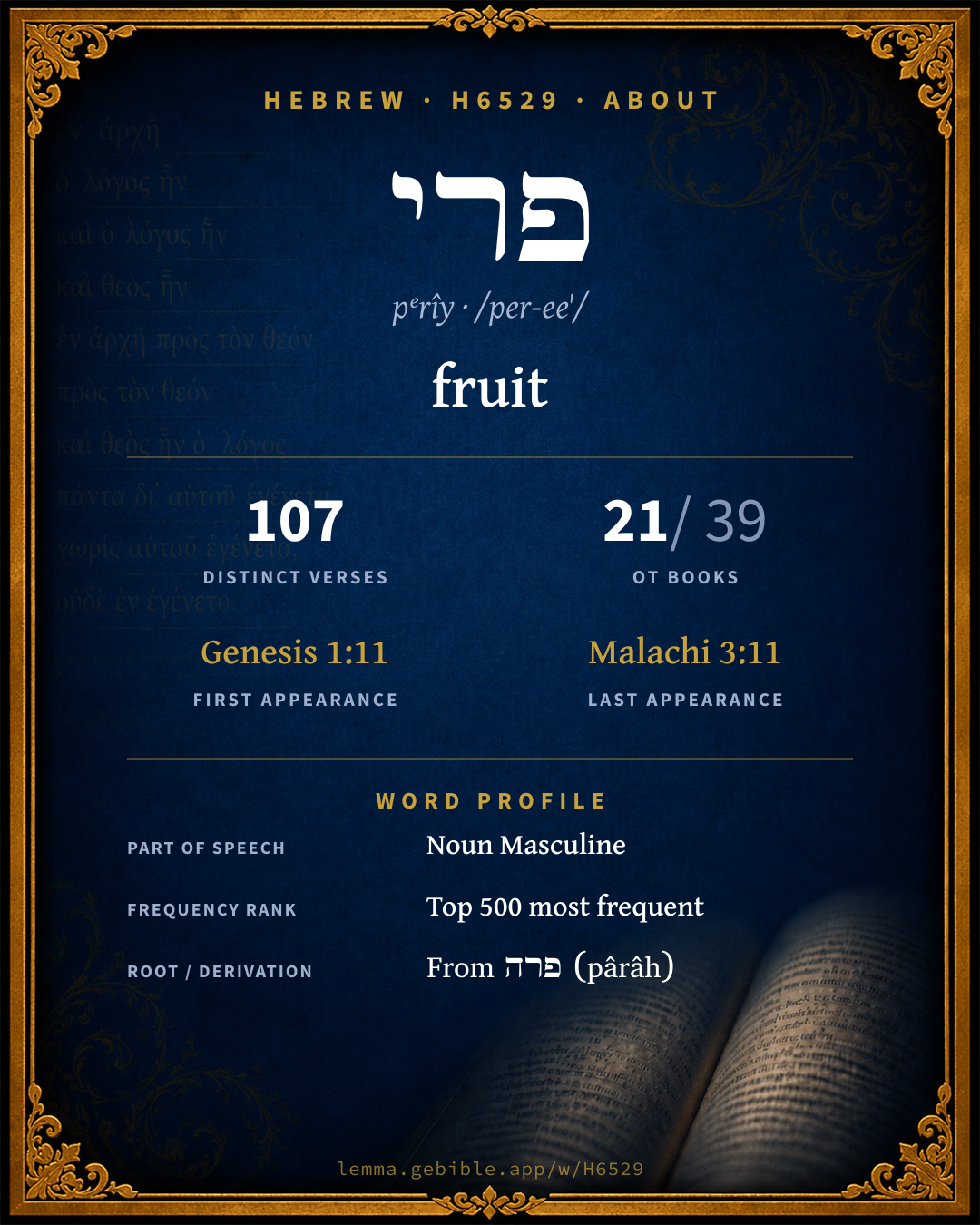
פְּרִי
fruit
‘fruit’ is one of 4 main senses fuller range ↓
Full lexicon entry — Brown-Driver-Briggs (BDB)
From Brown-Driver-Briggs (BDB)
Where this word appears
See every Construct-state word in the Hebrew Bible →
Grammar key — what these labels mean
Part of speech
- Noun
- A naming word — a person, place, thing, or idea.
Noun type
- Common
- A common noun — a general class of person, place, or thing (“king,” “city,” “water”), not a specific name.
State
- Construct
- A noun bound to a following noun in a possessive / “of” relationship (the construct chain).
- Absolute
- The independent form of a noun, not bound to a following word.
Gender
- Masculine
- Grammatically masculine.
Number
- Singular
- One.
Grammatical forms
- Noun, Common, Masculine, Singular, Construct 104 times (87%)
- Noun, Common, Masculine, Singular, Absolute 15 times (13%)
Parsed forms decoded from the imported morphology (morphhb / Westminster Leningrad Codex — WLC text public domain, morphhb tagging CC BY 4.0), counted across 119 parsed occurrences — not distinct verses.
Every verse where H6529 appears — 107 distinct verses across 21 books. Click any verse to open its interlinear word-by-word view. Verse text shown in the World English Bible for context — . Each verse’s Hebrew form is shown with its reference; the English is not keyword-highlighted, since the data carries no word-level English alignment. Use “Compare translations” on any verse to read it across multiple English versions. This concordance covers the Hebrew Bible; Septuagint (Greek Old Testament) occurrences are not indexed here.
Genesis 8 verses
- Genesis 1:11 פְּרִ֞י פְּרִי֙ n c ms n c ms God said, "Let the earth put forth grass, herbs yielding seed, and fruit trees bearing fruit after their kind, with its seed in it, on the earth," and it was so.
- Genesis 1:12 פְּרִ֛י n c ms The earth brought forth grass, herbs yielding seed after their kind, and trees bearing fruit, with its seed in it, after their kind: and God saw that it was good.
- Genesis 1:29 פְרִי n c ms cs God said, "Behold, I have given you every herb yielding seed, which is on the surface of all the earth, and every tree, which bears fruit yielding seed. It will be your food.
- Genesis 3:2 מִ/פְּרִ֥י prep + n c ms cs The woman said to the serpent, "Of the fruit of the trees of the garden we may eat,
- Genesis 3:3 וּ/מִ/פְּרִ֣י conj + prep + n c ms cs but of the fruit of the tree which is in the midst of the garden, God has said, 'You shall not eat of it, neither shall you touch it, lest you die.'"
- Genesis 3:6 מִ/פִּרְי֖/וֹ prep + n c ms cs + sfx pers 3ms When the woman saw that the tree was good for food, and that it was a delight to the eyes, and that the tree was to be desired to make one wise, she took of the fruit of it, and ate; and she gave some to her husband with her, and he ate.
- Genesis 4:3 מִ/פְּרִ֧י prep + n c ms cs As time passed, it happened that Cain brought an offering to Yahweh from the fruit of the ground.
- Genesis 30:2 פְּרִי n c ms cs Jacob's anger was kindled against Rachel, and he said, "Am I in God's place, who has withheld from you the fruit of the womb?"
Exodus 1 verse
Leviticus 8 verses
- Leviticus 19:23 פִּרְי֑/וֹ n c ms cs + sfx pers 3ms "'When you come into the land, and have planted all kinds of trees for food, then you shall count their fruit as forbidden. Three years shall they be forbidden to you. It shall not be eaten.
- Leviticus 19:24 פִּרְי֑/וֹ n c ms cs + sfx pers 3ms But in the fourth year all its fruit shall be holy, for giving praise to Yahweh.
- Leviticus 19:25 פִּרְי֔/וֹ n c ms cs + sfx pers 3ms In the fifth year you shall eat its fruit, that it may yield its increase to you. I am Yahweh your God.
- Leviticus 23:40 פְּרִ֨י n c ms cs You shall take on the first day the fruit of goodly trees, branches of palm trees, and boughs of thick trees, and willows of the brook; and you shall rejoice before Yahweh your God seven days.
- Leviticus 25:19 פִּרְיָ֔/הּ n c ms cs + sfx pers 3fs The land shall yield its fruit, and you shall eat your fill, and dwell therein in safety.
- Leviticus 26:4 פִּרְיֽ/וֹ n c ms cs + sfx pers 3ms then I will give you your rains in their season, and the land shall yield its increase, and the trees of the field shall yield their fruit.
- Leviticus 26:20 פִּרְיֽ/וֹ n c ms cs + sfx pers 3ms and your strength will be spent in vain; for your land won't yield its increase, neither will the trees of the land yield their fruit.
- Leviticus 27:30 מִ/פְּרִ֣י prep + n c ms cs "'All the tithe of the land, whether of the seed of the land or of the fruit of the trees, is Yahweh's. It is holy to Yahweh.
Numbers 3 verses
- Numbers 13:20 מִ/פְּרִ֣י prep + n c ms cs and what the land is, whether it is fat or lean, whether there is wood therein, or not. Be of good courage, and bring of the fruit of the land. Now the time was the time of the first-ripe grapes.
- Numbers 13:26 פְּרִ֥י n c ms cs They went and came to Moses, and to Aaron, and to all the congregation of the children of Israel, to the wilderness of Paran, to Kadesh; and brought back word to them, and to all the congregation, and shown them the fruit of the land.
- Numbers 13:27 פִּרְיָֽ/הּ n c ms cs + sfx pers 3fs They told him, and said, We came to the land where you sent us; and surely it flows with milk and honey; and this is the fruit of it.
Deuteronomy 12 verses
- Deuteronomy 1:25 מִ/פְּרִ֣י prep + n c ms cs They took of the fruit of the land in their hands, and brought it down to us, and brought us word again, and said, It is a good land which Yahweh our God gives to us.
- Deuteronomy 7:13 פְּרִֽי וּ/פְרִֽי n c ms cs conj + n c ms cs and he will love you, and bless you, and multiply you; he will also bless the fruit of your body and the fruit of your ground, your grain and your new wine and your oil, the increase of your cattle and the young of your flock, in the land which he swore to your fathers to give you.
- Deuteronomy 26:2 פְּרִ֣י n c ms cs that you shall take of the first of all the fruit of the ground, which you shall bring in from your land that Yahweh your God gives you; and you shall put it in a basket, and shall go to the place which Yahweh your God shall choose, to cause his name to dwell there.
- Deuteronomy 26:10 פְּרִ֣י n c ms cs Now, behold, I have brought the first of the fruit of the ground, which you, Yahweh, have given me. You shall set it down before Yahweh your God, and worship before Yahweh your God:
- Deuteronomy 28:4 פְּרִֽי וּ/פְרִ֥י וּ/פְרִ֣י n c ms cs conj + n c ms cs conj + n c ms cs Blessed shall be the fruit of your body, and the fruit of your ground, and the fruit of your animals, the increase of your cattle, and the young of your flock.
- Deuteronomy 28:11 בִּ/פְרִ֧י וּ/בִ/פְרִ֥י וּ/בִ/פְרִ֣י prep + n c ms cs conj + prep + n c ms cs conj + prep + n c ms cs Yahweh will make you plenteous for good, in the fruit of your body, and in the fruit of your cattle, and in the fruit of your ground, in the land which Yahweh swore to your fathers to give you.
- Deuteronomy 28:18 פְּרִֽי וּ/פְרִ֣י n c ms cs conj + n c ms cs Cursed shall be the fruit of your body, and the fruit of your ground, the increase of your cattle, and the young of your flock.
- Deuteronomy 28:33 פְּרִ֤י n c ms cs The fruit of your ground, and all your labors, shall a nation which you don't know eat up; and you shall be only oppressed and crushed always;
- Deuteronomy 28:42 וּ/פְרִ֣י conj + n c ms cs All your trees and the fruit of your ground shall the locust possess.
- Deuteronomy 28:51 פְּרִ֨י וּ/פְרִֽי n c ms cs conj + n c ms cs and shall eat the fruit of your cattle, and the fruit of your ground, until you are destroyed; that also shall not leave you grain, new wine, or oil, the increase of your cattle, or the young of your flock, until they have caused you to perish.
- Deuteronomy 28:53 פְרִֽי n c ms cs You shall eat the fruit of your own body, the flesh of your sons and of your daughters, whom Yahweh your God has given you, in the siege and in the distress with which your enemies shall distress you.
- Deuteronomy 30:9 בִּ/פְרִ֨י וּ/בִ/פְרִ֧י וּ/בִ/פְרִ֥י prep + n c ms cs conj + prep + n c ms cs conj + prep + n c ms cs Yahweh your God will make you plenteous in all the work of your hand, in the fruit of your body, and in the fruit of your cattle, and in the fruit of your ground, for good: for Yahweh will again rejoice over you for good, as he rejoiced over your fathers;
2 Kings 2 verses
- 2 Kings 19:29 פִרְיָֽ/ם n c ms cs + sfx pers 3mp This shall be the sign to you: You shall eat this year that which grows of itself, and in the second year that which springs of the same; and in the third year sow you, and reap, and plant vineyards, and eat the fruit of it.
- 2 Kings 19:30 פְרִ֖י n c ms The remnant that has escaped of the house of Judah shall again take root downward, and bear fruit upward.
Nehemiah 3 verses
- Nehemiah 9:36 פִּרְיָ/הּ֙ n c ms cs + sfx pers 3fs Behold, we are servants this day, and as for the land that you gave to our fathers to eat the fruit of it and the good of it, behold, we are servants in it.
- Nehemiah 10:35 פְּרִ֥י n c ms cs and to bring the first fruits of our ground, and the first fruits of all fruit of all manner of trees, year by year, to the house of Yahweh;
- Nehemiah 10:37 וּ/פְרִ֨י conj + n c ms cs and that we should bring the first fruits of our dough, and our heave-offerings, and the fruit of all manner of trees, the new wine and the oil, to the priests, to the chambers of the house of our God; and the tithes of our ground to the Levites; for they, the Levites, take the tithes in all the cities of our tillage.
Psalms 11 verses
- Psalms 1:3 פִּרְי֨/וֹ n c ms cs + sfx pers 3ms He will be like a tree planted by the streams of water, That brings forth its fruit in its season, Whose leaf also does not wither. Whatever he does shall prosper.
- Psalms 21:10 פִּ֭רְיָ/מוֹ n c ms cs + sfx pers 3mp You will destroy their descendants from the earth, Their posterity from among the children of men.
- Psalms 58:11 פְּרִ֣י n c ms So that men shall say, "Most assuredly there is a reward for the righteous. Most assuredly there is a God who judges the earth."
- Psalms 72:16 פִּרְי֑/וֹ n c ms cs + sfx pers 3ms There shall be abundance of grain throughout the land. Its fruit sways like Lebanon. Let it flourish, thriving like the grass of the field.
- Psalms 104:13 מִ/פְּרִ֥י prep + n c ms cs He waters the mountains from his chambers. The earth is filled with the fruit of your works.
- Psalms 105:35 פְּרִ֣י n c ms cs Ate up every plant in their land; And ate up the fruit of their ground.
- Psalms 107:34 פְּ֭רִי n c ms And a fruitful land into a salt waste, For the wickedness of those who dwell in it.
- Psalms 107:37 פְּרִ֣י n c ms cs Sow fields, plant vineyards, And reap the fruits of increase.
- Psalms 127:3 פְּרִ֣י n c ms cs Behold, children are a heritage of Yahweh. The fruit of the womb is his reward.
- Psalms 132:11 מִ/פְּרִ֥י prep + n c ms cs Yahweh has sworn to David in truth. He will not turn from it: "I will set the fruit of your body on your throne.
- Psalms 148:9 פְּ֝רִ֗י n c ms Mountains and all hills; Fruit trees and all cedars;
Proverbs 10 verses
- Proverbs 1:31 מִ/פְּרִ֣י prep + n c ms cs Therefore they will eat of the fruit of their own way, And be filled with their own schemes.
- Proverbs 8:19 פִּ֭רְיִ/י n c ms cs + sfx pers 1cs My fruit is better than gold, yes, than fine gold; My yield than choice silver.
- Proverbs 11:30 פְּֽרִי n c ms cs The fruit of the righteous is a tree of life. He who is wise wins souls.
- Proverbs 12:14 מִ/פְּרִ֣י prep + n c ms cs A man shall be satisfied with good by the fruit of his mouth. The work of a man's hands shall be rewarded to him.
- Proverbs 13:2 מִ/פְּרִ֣י prep + n c ms cs By the fruit of his lips, a man enjoys good things; But the unfaithful crave violence.
- Proverbs 18:20 מִ/פְּרִ֣י prep + n c ms cs A man's stomach is filled with the fruit of his mouth. With the harvest of his lips he is satisfied.
- Proverbs 18:21 פִּרְיָֽ/הּ n c ms cs + sfx pers 3fs Death and life are in the power of the tongue; Those who love it will eat its fruit.
- Proverbs 27:18 פִּרְיָ֑/הּ n c ms cs + sfx pers 3fs Whoever tends the fig tree shall eat its fruit. He who looks after his master shall be honored.
- Proverbs 31:16 מִ/פְּרִ֥י prep + n c ms cs She considers a field, and buys it. With the fruit of her hands, she plants a vineyard.
- Proverbs 31:31 מִ/פְּרִ֣י prep + n c ms cs Give her of the fruit of her hands! Let her works praise her in the gates!
Ecclesiastes 1 verse
Song of Solomon 5 verses
- Song of Solomon 2:3 וּ/פִרְי֖/וֹ conj + n c ms cs + sfx pers 3ms As the apple tree among the trees of the wood, So is my beloved among the sons. I sat down under his shadow with great delight, His fruit was sweet to my taste.
- Song of Solomon 4:13 פְּרִ֣י n c ms cs Your shoots are an orchard of pomegranates, with precious fruits: Henna with spikenard plants,
- Song of Solomon 4:16 פְּרִ֥י n c ms cs Awake, north wind; and come, you south; Blow on my garden, that its spices may flow out. Let my beloved come into his garden, And taste his precious fruits. Lover
- Song of Solomon 8:11 בְּ/פִרְי֖/וֹ prep + n c ms cs + sfx pers 3ms Solomon had a vineyard at Baal Hamon. He leased out the vineyard to keepers. Each was to bring a thousand shekels of silver for its fruit.
- Song of Solomon 8:12 פִּרְיֽ/וֹ n c ms cs + sfx pers 3ms My own vineyard is before me. The thousand are for you, Solomon; Two hundred for those who tend its fruit. Lover
Isaiah 9 verses
- Isaiah 3:10 פְרִ֥י n c ms cs Tell the righteous "Good!" For they shall eat the fruit of their deeds.
- Isaiah 4:2 וּ/פְרִ֤י conj + n c ms cs In that day, Yahweh's branch will be beautiful and glorious, and the fruit of the land will be the beauty and glory of the survivors of Israel.
- Isaiah 10:12 פְּרִי n c ms cs Therefore it shall happen that, when the Lord has performed his whole work on Mount Zion and on Jerusalem, I will punish the fruit of the stout heart of the king of Assyria, and the glory of his high looks.
- Isaiah 13:18 וּ/פְרִי conj + n c ms cs [Their] bows shall dash the young men in pieces; and they shall have no pity on the fruit of the womb; their eye shall not spare children.
- Isaiah 14:29 וּ/פִרְי֖/וֹ conj + n c ms cs + sfx pers 3ms Don't rejoice, O Philistia, all of you, because the rod that struck you is broken; for out of the serpent's root shall come forth an adder, and his fruit shall be a fiery flying serpent.
- Isaiah 27:9 פְּרִ֖י n c ms cs Therefore by this shall the iniquity of Jacob be forgiven, and this is all the fruit of taking away his sin: that he makes all the stones of the altar as chalk stones that are beaten in sunder, [so that] the Asherim and the sun-images shall rise no more.
- Isaiah 37:30 פִרְיָֽ/ם n c ms cs + sfx pers 3mp This shall be the sign to you: you shall eat this year that which grows of itself, and in the second year that which springs of the same; and in the third year sow you, and reap, and plant vineyards, and eat the fruit of it.
- Isaiah 37:31 פְרִ֖י n c ms The remnant that is escaped of the house of Judah shall again take root downward, and bear fruit upward.
- Isaiah 65:21 פִּרְיָֽ/ם n c ms cs + sfx pers 3mp They shall build houses, and inhabit them; and they shall plant vineyards, and eat the fruit of them.
Jeremiah 11 verses
- Jeremiah 2:7 פִּרְיָ֖/הּ n c ms cs + sfx pers 3fs I brought you into a plentiful land, to eat the fruit of it and the goodness of it; but when you entered, you defiled my land, and made my heritage an abomination.
- Jeremiah 6:19 פְּרִ֣י n c ms cs Hear, earth: behold, I will bring evil on this people, even the fruit of their thoughts, because they have not listened to my words; and as for my law, they have rejected it.
- Jeremiah 7:20 פְּרִ֣י n c ms cs Therefore thus says the Lord Yahweh: Behold, my anger and my wrath shall be poured out on this place, on man, and on animal, and on the trees of the field, and on the fruit of the ground; and it shall burn, and shall not be quenched.
- Jeremiah 11:16 פְרִי n c ms cs Yahweh called your name, A green olive tree, beautiful with goodly fruit: with the noise of a great tumult he has kindled fire on it, and the branches of it are broken.
- Jeremiah 12:2 פֶ֑רִי n c ms You have planted them, yes, they have taken root; they grow, yes, they bring forth fruit: you are near in their mouth, and far from their heart.
- Jeremiah 17:8 פֶּֽרִי n c ms For he shall be as a tree planted by the waters, who spreads out its roots by the river, and shall not fear when heat comes, but its leaf shall be green; and shall not be careful in the year of drought, neither shall cease from yielding fruit.
- Jeremiah 17:10 כִּ/פְרִ֖י prep + n c ms cs I, Yahweh, search the mind, I try the heart, even to give every man according to his ways, according to the fruit of his doings.
- Jeremiah 21:14 כִּ/פְרִ֥י prep + n c ms cs I will punish you according to the fruit of your doings, says Yahweh; and I will kindle a fire in her forest, and it shall devour all that is round about her.
- Jeremiah 29:5 פִּרְיָֽ/ן n c ms cs + sfx pers 3fp Build you houses, and dwell in them; and plant gardens, and eat the fruit of them.
- Jeremiah 29:28 פְּרִי/הֶֽן n c ms cs + sfx pers 3fp because he has sent to us in Babylon, saying, [The captivity] is long: build you houses, and dwell in them; and plant gardens, and eat the fruit of them?
- Jeremiah 32:19 וְ/כִ/פְרִ֖י conj + prep + n c ms cs great in counsel, and mighty in work; whose eyes are open on all the ways of the sons of men, to give everyone according to his ways, and according to the fruit of his doings:
Lamentations 1 verse
Ezekiel 10 verses
- Ezekiel 17:8 פֶּ֔רִי n c ms It was planted in a good soil by many waters, that it might bring forth branches, and that it might bear fruit, that it might be a goodly vine.
- Ezekiel 17:9 פִּרְיָ֣/הּ n c ms cs + sfx pers 3fs Say you, Thus says the Lord Yahweh: Shall it prosper? shall he not pull up the roots of it, and cut off the fruit of it, that it may wither; that all its fresh springing leaves may wither? and not by a strong arm or much people can it be raised from the roots of it.
- Ezekiel 17:23 פֶ֔רִי n c ms in the mountain of the height of Israel will I plant it; and it shall bring forth boughs, and bear fruit, and be a goodly cedar: and under it shall dwell all birds of every wing; in the shade of the branches of it shall they dwell.
- Ezekiel 19:12 פִּרְיָ֑/הּ n c ms cs + sfx pers 3fs But it was plucked up in fury, it was cast down to the ground, and the east wind dried up its fruit: its strong rods were broken off and withered; the fire consumed them.
- Ezekiel 19:14 פִּרְיָ֣/הּ n c ms cs + sfx pers 3fs Fire is gone out of the rods of its branches, it has devoured its fruit, so that there is in it no strong rod to be a scepter to rule. This is a lamentation, and shall be for a lamentation.
- Ezekiel 25:4 פִרְיֵ֔/ךְ n c ms cs + sfx pers 2fs therefore, behold, I will deliver you to the children of the east for a possession, and they shall set their encampments in you, and make their dwellings in you; they shall eat your fruit, and they shall drink your milk.
- Ezekiel 34:27 פִּרְי֗/וֹ n c ms cs + sfx pers 3ms The tree of the field shall yield its fruit, and the earth shall yield its increase, and they shall be secure in their land; and they shall know that I am Yahweh, when I have broken the bars of their yoke, and have delivered them out of the hand of those who made slaves of them.
- Ezekiel 36:8 וּ/פֶרְיְ/כֶ֥ם conj + n c ms cs + sfx pers 2mp But you, mountains of Israel, you shall shoot forth your branches, and yield your fruit to my people Israel; for they are at hand to come.
- Ezekiel 36:30 פְּרִ֣י n c ms cs I will multiply the fruit of the tree, and the increase of the field, that you may receive no more the reproach of famine among the nations.
- Ezekiel 47:12 פִּרְי֗/וֹ פִרְי/וֹ֙ n c ms cs + sfx pers 3ms n c ms cs + sfx pers 3ms By the river on the bank of it, on this side and on that side, shall grow every tree for food, whose leaf shall not wither, neither shall the fruit of it fail: it shall bring forth new fruit every month, because the waters of it issue out of the sanctuary; and the fruit of it shall be for food, and the leaf of it for healing.
Hosea 4 verses
- Hosea 9:16 פְּרִ֣י n c ms Ephraim is struck. Their root has dried up. They will bear no fruit. Even though they bring forth, yet I will kill the beloved ones of their womb."
- Hosea 10:1 פְּרִ֖י לְ/פִרְי֗/וֹ n c ms prep + n c ms cs + sfx pers 3ms Israel is a luxuriant vine that puts forth his fruit. According to the abundance of his fruit he has multiplied his altars. As their land has prospered, they have adorned their sacred stones.
- Hosea 10:13 פְּרִי n c ms cs You have plowed wickedness. You have reaped iniquity. You have eaten the fruit of lies, For you trusted in your way, in the multitude of your mighty men.
- Hosea 14:8 פֶּרְיְ/ךָ֥ n c ms cs + sfx pers 2ms Ephraim, what have I to do any more with idols? I answer, and will take care of him. I am like a green fir tree; From me your fruit is found."
Joel 1 verse
Amos 3 verses
- Amos 2:9 פִּרְי/וֹ֙ n c ms cs + sfx pers 3ms Yet I destroyed the Amorite before them, Whose height was like the height of the cedars, And he was strong as the oaks; Yet I destroyed his fruit from above, and his roots from beneath.
- Amos 6:12 וּ/פְרִ֥י conj + n c ms cs Do horses run on the rocky crags? Does one plow there with oxen? But you have turned justice into poison, And the fruit of righteousness into bitterness;
- Amos 9:14 פְּרִי/הֶֽם n c ms cs + sfx pers 3mp I will bring back the captivity of my people Israel, And they will rebuild the ruined cities, and inhabit them; and they will plant vineyards, and drink wine from them. They shall also make gardens, And eat the fruit of them.
Micah 2 verses
- Micah 6:7 פְּרִ֥י n c ms cs Will Yahweh be pleased with thousands of rams? With tens of thousands of rivers of oil? Shall I give my firstborn for my disobedience? The fruit of my body for the sin of my soul?
- Micah 7:13 מִ/פְּרִ֖י prep + n c ms cs Yet the land will be desolate because of those who dwell therein, For the fruit of their doings.
Zechariah 1 verse
Malachi 1 verse
About this entry
At a glance — auto-summarized from this page’s data, not written by a person. Every figure links to its source below. This summary describes the numbers; it doesn’t interpret them.
At its core, פרי (pᵉrîy) means “fruit.” Carrying more than one sense, it rewards its full sense range. It turns up in 107 verses across 21 books, a common footprint. Scripture first uses it in Genesis 1:11. It shares a root with פרה and אפרת. Dig into 107-verse concordance and the renderings breakdown below.
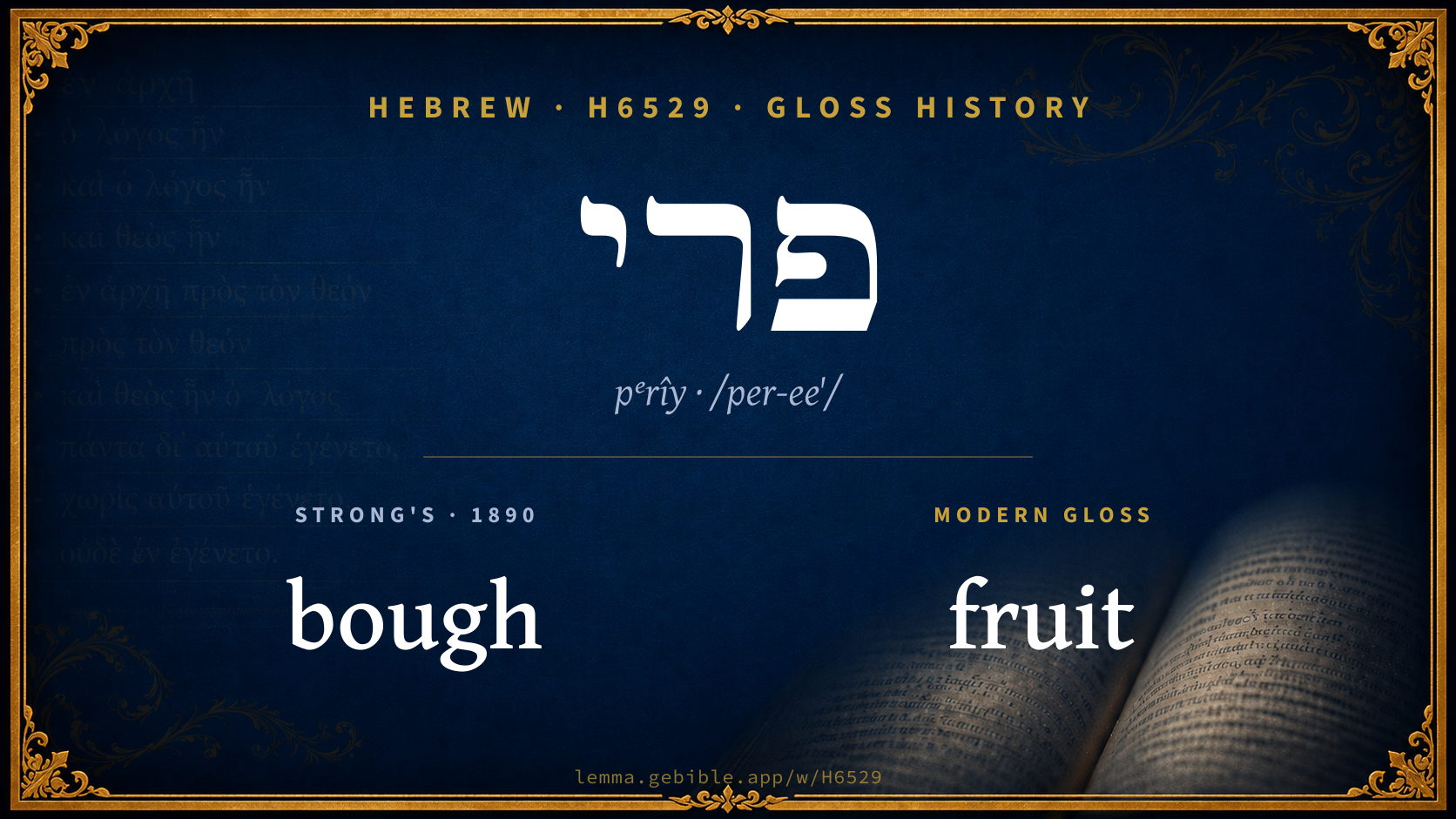
Gloss history
Strong's 1890 vs modern scholarship
About this word
Strong's H6529 catalogs a Hebrew word from the Hebrew Old Testament.
These counts are not copied from any lexicon or concordance. They are computed here, from the morphology-tagged Hebrew Old Testament. What Lemma adds →
- 107
- distinct verses
- The word appears in 107 distinct verses.
- 21 / 39
- OT books
- The word appears in 21 of 39 Old Testament books.
- #363
- by frequency
- Top 500 most frequent Hebrew words (rank 363 of 8,640 Hebrew words by occurrence).
View all 107 occurrences in the concordance →
Most concentrated in
- Deuteronomy 12 verses 11%
- Psalms 11 verses 10%
- Jeremiah 11 verses 10%
By section of the Old Testament
By traditional corpus
Conventional, traditional groupings — biblical authorship is debated, so this is a traditional corpus grouping, not an authorship claim. Each share is this word’s portion of its verses in that division of the Hebrew canon. Each figure is a share of the word’s 107 distinct verses.
- Prophets (Nevi'im) 44 verses · 41%
- Torah (Pentateuch) 32 verses · 30%
- Writings (Ketuvim) 31 verses · 29%
How translations render this word
Counts come from each version’s own published word-to-Strong’s tagging or interlinear alignment — an approximate guide to how each version renders this word, not a word-level alignment the data otherwise carries. Because each total is that version’s own tagged count, the per-version totals vary from one another and need not match the appearance or distinct-verse counts above. These counts may also differ from a printed concordance because Lemma counts each distinctly tagged rendering and does not collapse phrase taggings into a single head-word total. This is a fixed set of word-tagged versions (KJV, ASV, BSB, ULT) and does not change with the reading translation you choose elsewhere. Each version’s license is shown beside its name below (and on Sources).
- King James Version: Fruit 89×, Fruits 6×, All the fruit 3×
- American Standard Version: Fruit 76×, Fruit of them 4×, Fruit thereof 4×
- Berean Standard Bible: Fruit 74×, Produce 11×, Offspring 5×
- unfoldingWord Literal Text: Fruit 53×, Fruit of 48×, According to the fruit of 2×
King James Version Public Domain
Renders H6529 across 119 tagged occurrences — most commonly:
Plus 13 renderings that appear only once — usually multi-word phrases or single function words the recovered tagging swept in, not distinct renderings.
American Standard Version Public Domain
Renders H6529 across 118 tagged occurrences — most commonly:
Plus 20 renderings that appear only once — usually multi-word phrases or single function words the recovered tagging swept in, not distinct renderings.
Berean Standard Bible Public Domain
Renders H6529 across 119 tagged occurrences — most commonly:
Plus 16 renderings that appear only once — usually multi-word phrases or single function words the recovered tagging swept in, not distinct renderings.
unfoldingWord Literal Text CC BY-SA 4.0
Renders H6529 across 121 tagged occurrences — most commonly:
Plus 14 renderings that appear only once — usually multi-word phrases or single function words the recovered tagging swept in, not distinct renderings.
Senses in the full BDB
What do BDB’s symbols mean?
BDB uses these scholarly abbreviations:
| Symbol | Meaning |
|---|---|
| 𝔊 | the Septuagint (the ancient Greek translation, LXX) |
| 𝔙 | the Vulgate (the Latin translation) |
| 𝔖 | the Syriac version (the Peshitta) |
| 𝔗 | the Targum (the Aramaic translation) |
| ψ | the Psalms |
| √ | root (the underlying root or stem) |
| ‖ | parallel passage (a synonymous or contrasted parallel) |
| † | the dagger: every passage where the word occurs is cited |
The 3 senses and sub-senses the full Brown-Driver-Briggs lexicon distinguishes for this word, in lexicon order (not ranked by frequency), with BDB’s own verbatim wording and sub-sense lettering. Shown in Hebrew script with BDB’s own scholarly abbreviations. The condensed entry is in the Lexicon Entry tab. See also the Forms in the corpus table below.
- 1. פְּרִי הָאֲדָמָה Gn 4:3 (J), fruit of the ground, of produce in gen., so Dt 7:13 + 9 times Dt + 3 times; פ׳ הָאֶרֶץ Nu 13:20, 26, 27 (JE) + 5 times, cf. Ez 25:4; fruit of vineyard 2 K 19:29 = Is 37:30, Zc 8:12 Is 65:21 Ct 8:11, 12, in fig. Ho 10:1(×2) + 5 times +Ez 17:14 (but del. 𝔊 Co al.); especially פ׳ הָעֵץ Gn 3:2, 3, 6 Ex 10:15 (all J) + 21 times, also, in fig., Am 2:9 Ho 9:16 + 4 times + Ez 17:23 (read פֹּארָה branches Co al.); of gardens Am 9:14; Je 29:5, 28, fig. Ct 4:12, 16; עֵץ פְּרִי is fruit-tree Gn 1:11 ψ 148:9, cf. Ec 2:5; אֶרֶץ פְּרִי ψ 107:34; פְּרִי תְּבוּאָה v 37 fruit of (consisting in) a crop; ψ 72:16 is dub.; Che Du interpr. as 2; Bae proposes יִפְרוּ. e.g. Genesis 4:3
- 2. = off-spring: fruit of womb (בֶּטֶן) Gn 30:2; Dt 7:13 + 9 times, cf. La 2:20 ψ 21:11; of cattle (בְּהֵמָה) Dt 28:4, 11, 51; 30:9; of serpent, fig. of power conquering Philistia Is 14:29. e.g. Genesis 30:2
- 3. fig. of fruit of actions, i.e. their consequences: good Is 3:10 ψ 58:12; bad Ho 10:13 Pr 1:31 Mi 7:13, of thoughts Je 6:19; of result of removing sin Is 27:9; result of labour (fruit of hands) Pr 31:16, 31; product of works of י׳ ψ 104:13, of wisdom Pr 8:19; פ׳ צְדָקָה Am 6:12, cf. פ׳ צְדִּיק Pr 11:30 (read צֶדֶק 𝔊 Hi Toy); of doings (i.e. course of life, or character) Je 17:10; 21:14; 32:19; פ׳ פִי־אִישׁ i.e. speech Pr 12:14; 13:2; 18:20; fruit of arrogance Is 10:12 is arrogant speech; fruit of tongue Pr 18:21 = consequences of speech. e.g. Isaiah 3:10
Senses from the full Brown-Driver-Briggs lexicon (Brown, Driver, Briggs; Oxford 1906 — public domain), digitized via Sefaria, supplemented by the OpenScriptures HebrewLexicon (CC BY 4.0). Full attribution on Sources.
Word origin
n.m. Ho 14:9 fruit;—abs. פ׳ Ho 9:16 +, פֶּ֑רִי Je 12:12 +; especially cstr. פְּרִי Gn 4:3 +; sf. פִּרְיִי Pr. 8:19, פֶּרְיְךָ Ho 14:9, פִּרְיוֹ Gn 3:6 +, וּפֶרְיְכֶם Ez 36:8, פְּרִיהֶם Am 9:14, פִּרְיָם La 2:20 +, פִּרְיָמוֹ ψ 21:11, פְּרִיהֶן Je 29:28, פִּרְיָן v 5, etc.;—
— Brown-Driver-Briggs (Oxford 1906, public domain), digitized via Sefaria, supplemented by the OpenScriptures HebrewLexicon (CC BY 4.0). See Sources.
Derived from פרה (pârâh) (H6509) — to bear fruit.
Jastrow Dictionary
A second Hebrew/Aramaic lexicon for comparison, covering Aramaic and post-biblical (Talmudic, Targumic, Midrashic) usage that the biblical-Hebrew BDB does not. Matched by lemma rather than by Strong’s number, so a lemma may carry more than one Jastrow headword (shown separately below), and the entries cover usage well beyond the Bible.
פרי
- [to break through,] to grow, increase, be fruitful. Gitt. 57ᵃ כלומר פְּרוּ ורבו וכ׳ intimating, ‘multiply and increase like chickens’. Num. R. s. 11 את פְּרֵה ורבה לגוי גדול be thou fruitful and grow to be a great nation. Ib. כל מה … היה פָּרֶה ורבה whatever existed in the Temple grew and increased (v. פַּרְוַיִם). Ḥag. 16ᵃ פָּרִין ורבין כבני אדם they increase by propagation like human beings. Ḥull. 92ᵃ (ref. to כפרחת, Gen. XL, 10) הגיע לִפְרוֹת ולרבות … the time has come for Israel to grow and increase (as a nation); a. fr. e.g. Genesis 40:10
- 1. to cause to grow, make fruitful. Ber. 40ᵃ דגים קטנים מַפְרִין ומרבין ומברין כל גופו וכ׳ (Ms. M. מפרין ומרבין גופו וכ׳) small fish make fruitful (increase the sexual vigor) and strengthen the whole body of man; ib. 57ᵇ מפרין ומברין (Ms. M. מפרין ומרבין); Ab. Zar. 29ᵃ מפרין ומרבין (read: ומַבְרִין); a. e.—[
- 2. to increase the rent above the original stipulation in consideration of a loan, v. פָּרַז. B. Mets. V, 5 (69ᵇ) מפרין על שדהו ואין חוששין וכ׳ Ar. (Y. ed. ואין חושש—which indicates that מפרין is singular, fr. פָּרַן q. v.).]
פְּרֵי
- 1. to increase, grow. B. Bath. 18ᵇ הדר פָּארֵי it will grow again; ib. 19ᵃ top.
- 2. (cmp. פרח) to run. Lam. R. to III, 7 ערקת תורתיה ופרא בתרה Ar. (ed. נפק) his cow ran off, and he ran after her. Y. Sabb. VI, 8ᶜ bot. חויא פָרֵי בתרך a serpent is running after thee. Y. Maas. Sh. V, 56ᵃ top הוות פַּרְיָא והוה פרי וכ׳ she (the cow) ran, and he ran after her &c.; a. fr.
פְּרִי
- preced. wds.) fruit, produce; fruition, usufruct; profit, interest. Ber. VI, 1 (35ᵃ) על פירות … בורא פְּ׳ העץ over fruits of trees you must say, (blessed be thou &c.) who hast created the fruit of the tree; על פירות הארץ … בורא פ׳ האדמה over growths from the ground you must say; … who hast created the products of the soil. Y. Sabb. VII, 10ᵃ הפירי, v. בָּחַל II. Ḥull. 79ᵃ פ׳ עם האם the copulation of a hybrid issue with its mother; a. v. fr.—Pl. פִּרוֹת, פֵּי׳. Ber. l. c., v. supra. Gitt. 47ᵇ, a. e. המוכר שדהו לפ׳ if a man sells his field for the usufruct (for a number of years). Ib. קנין פ׳ כקנין הגיף דמי possession of the usufruct is like ownership of a field (for the time being). Keth. IX, 1 הרי זה אוכל פ׳ בחייה he has the usufruct (of her property) during her lifetime. Ib. פֵּירֵי פ׳ (פֵּרֵי) the usufruct of the produce of the produce, i.e. of the income invested. Peah I, 1 אלו דברים שאדם אוכל פּירוֹתֵיהֶן וכ׳ these are the things of which a man enjoys the interest (for which man is rewarded) in this world, whereas the principal remains for the hereafter. Tosef. ib. I, 2 זכות יש לה קרן ויש לה פ׳ a good deed yields a principal (for the hereafter), and bears interest (in this world); ib. 3 עבירה יש לה קרן ואין לה פ׳ sin creates a capital, but bears no interest; עבירה שעושה פ׳ יש לה פ׳ a sin which bears fruit (influences other people for bad) bears fruit (is punished in this world); Kidd. 40ᵃ; a. v. fr.—Midr. Sam. ch. IV פְּרָיִין שלו its fruits.
A Dictionary of the Targumim, the Talmud Babli and Yerushalmi, and the Midrashic Literature (Marcus Jastrow; London, Luzac, 1903) — Public Domain. Digitized via Sefaria. Digitized via Sefaria. Full attribution on Sources.
Forms in the corpus
The 69 distinct written forms H6529 takes in the Hebrew Bible, most frequent first — each parse links to that state’s occurrences in the concordance. Hebrew forms include their vowel points and cantillation, so a single lemma takes many written forms.
The 60 most common forms are shown; 9 rarer forms follow in the full concordance.
Same root — word family
Other BDB entries built from the same root as H6529, grouped by Strong’s listed origin. These share a root / origin per the lexicon — not necessarily a shared meaning. Each links to that word’s own entry.
Derives from
Proper names from this root
People and places named from this root — a name, not an additional meaning of the word.
Compare all same-root words → 1 of the same-root words is a proper name (a person or place). They share a root, not necessarily a meaning.
Septuagint verse parallels
This word appears in 100 verses that also exist in the Greek Old Testament (Septuagint), out of the 107 Hebrew verses it occurs in. You can read those verses in Greek by switching the Old Testament edition to the Septuagint.
Read these verses in the Septuagint
- Genesis 1:11
- Exodus 10:15
- Leviticus 19:23
- Numbers 13:20
- Deuteronomy 1:25
- 2 Kings 19:29
- Psalms 1:3
- Proverbs 1:31
- Ecclesiastes 2:5
- Song of Solomon 2:3
- Isaiah 3:10
- Jeremiah 2:7
This is a verse-level parallel only — the same verses exist in both the Hebrew and Greek Old Testaments. No word-level Hebrew↔Greek correspondence is claimed: the data carries no such alignment, so no Greek word is shown as this Hebrew word’s translation. Coverage is not total — the Septuagint omits the deuterocanon and renumbers the Psalms, so some Hebrew verses have no direct Greek parallel.