
Psalms 104:13

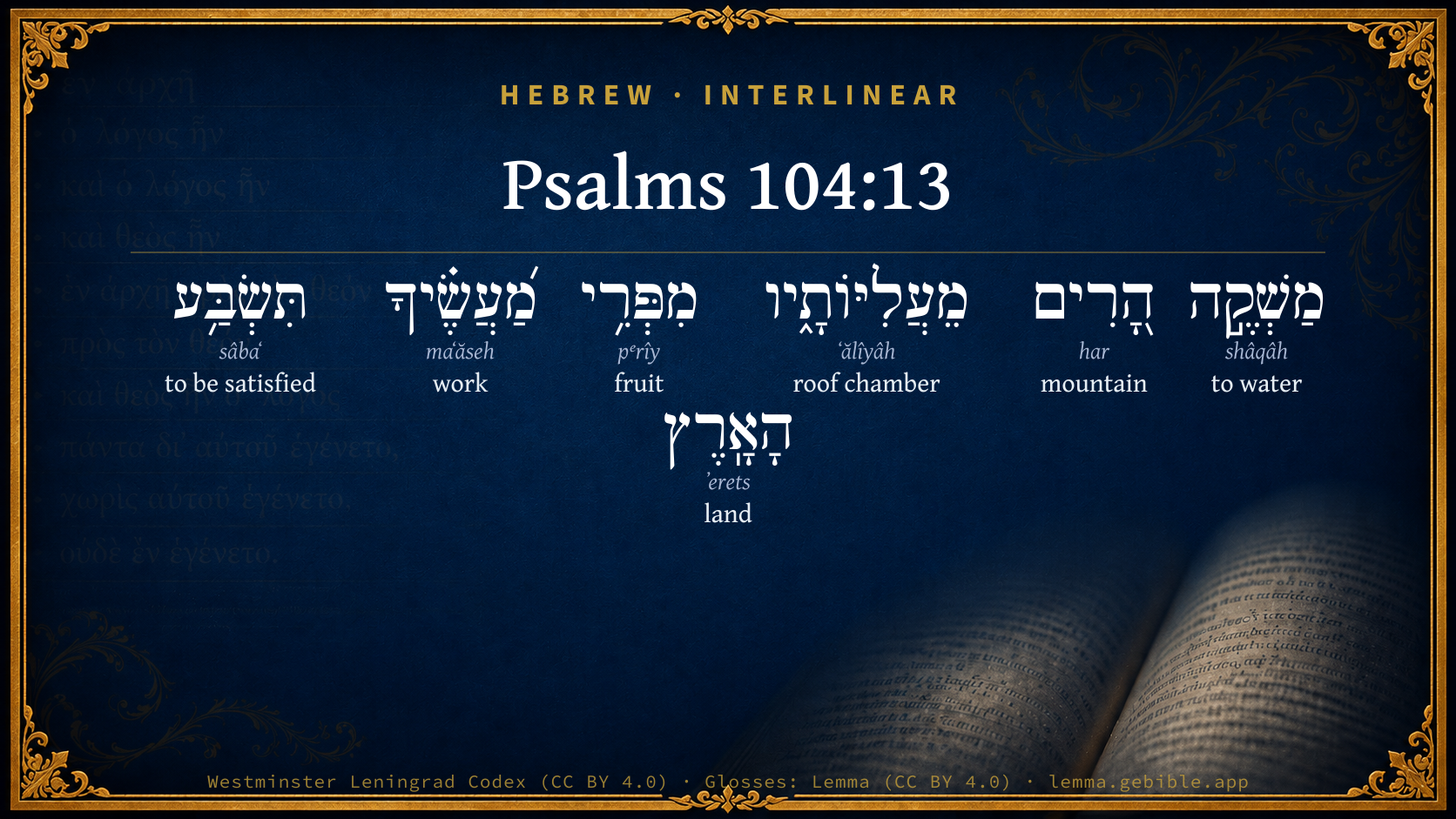
Hebrew (Westminster Leningrad Codex) Psalms 104:13 appears in the Hebrew Old Testament. The text above is from the Westminster Leningrad Codex. Each word links to its Strong’s number, a concise gloss, and parsing drawn from the Open Scriptures Hebrew Bible morphology. Click any word for its full Brown-Driver-Briggs (BDB) entry.
Download image
Cite this verse

Psalms 104:13 (World English Bible). Public Domain. Lemma interlinear Bible study tool, https://lemma.gebible.app/v/psalms/104/13.

Show BibTeX & RIS
BibTeX
RIS
English Translation
He waters the mountains from his chambers. The earth is filled with the fruit of your works.
World English Bible · Public Domain
Download a study sheet

One document with this verse’s original text, its word-by-word gloss line, the meaning frame, cross-references with their text, attributed commentary, and full source and license credits — printable, and it pastes into notes with its structure intact.

This verse Autodidact and up

Study sheet (.html) Plain text (.txt)

A passage Seminary Student

Up to 50 verses in one chapter. A passage sheet keeps up to 6 commentary sources and 12 cross-references per verse, in the order this page ranks them, and says so on the sheet whenever that leaves anything out. Ask for a single verse and you get the Autodidact verse sheet above.

Everything on this page stays free to read, with no account — the sheet is a download of what is already on screen, not access to it.

Want to remove ads? Support Godless Engineer
Compare translations 3

The same verse in 3 English versions, stacked beneath the original-language interlinear above. Click any original word for its lexicon entry.

Each is an independent rendering of the whole verse — the interlinear is not word-aligned to these translations.

Highlighted words mark where these versions differ — a whole-verse word diff, not a word-by-word alignment.

  • World English Bible Public Domain
    He waters the mountains from his chambers. The earth is filled with the fruit of your works.
  • King James Version Public Domain
    He watereth the hills from his chambers: the earth is satisfied with the fruit of thy works.
  • unfoldingWord Literal Text CC BY-SA 4.0
    The one watering the mountains from his upper chambers— from the fruit of your works the earth is satisfied.

unfoldingWord Literal Text — © unfoldingWord, licensed CC BY-SA 4.0. Word-aligned USFM3 via Door43 (git.door43.org/unfoldingWord/en_ult).

Versions to compare (up to 4)

3 of 4 selected

Show all 18 translations

Every available English version of this verse, each an independent rendering of the whole verse.

  • World English Bible Public Domain
    He waters the mountains from his chambers. The earth is filled with the fruit of your works.
  • Berean Standard Bible Public Domain
    He waters the mountains from His chambers; the earth is satisfied by the fruit of His works.
  • Majority Standard Bible Public Domain
    He waters the mountains from His chambers; the earth is satisfied by the fruit of His works.
  • King James Version Public Domain
    He watereth the hills from his chambers: the earth is satisfied with the fruit of thy works.
  • American Standard Version (1901) Public Domain
    He watereth the mountains from his chambers: The earth is filled with the fruit of thy works.
  • Revised Version (1885) Public Domain
    He watereth the mountains from his chambers: the earth is satisfied with the fruit of thy works.
  • Geneva Bible (1599) Public Domain
    He watereth the mountaines from his chambers, and the earth is filled with the fruite of thy workes.
  • Douay-Rheims (1899) Public Domain
    Thou waterest the hills from thy upper rooms: the earth shall be filled with the fruit of thy works:
  • Young's Literal Translation Public Domain
    Watering hills from His upper chambers, From the fruit of Thy works is the earth satisfied.
  • Literal Standard Version CC BY-SA 4.0
    Watering hills from His upper chambers, || The earth is satisfied from the fruit of Your works.
  • Unlocked Literal Bible CC BY-SA 4.0
    He waters the mountains from his water chambers in the sky. The earth is filled with the fruit of his labor.
  • unfoldingWord Literal Text CC BY-SA 4.0
    The one watering the mountains from his upper chambers— from the fruit of your works the earth is satisfied.
  • Darby Bible Public Domain
    He watereth the mountains from his upper-chambers: the earth is satisfied with the fruit of thy works.
  • World Messianic Bible Public Domain
    He waters the mountains from his rooms. The earth is filled with the fruit of your works.
  • Webster's Bible Public Domain
    He watereth the hills from his chambers: the earth is satisfied with the fruit of thy works.
  • Free Bible Version CC BY-SA 4.0
    You send down rain on the mountains from your home high above; you fill the earth with good things.
  • Bible in Basic English Public Domain
    He sends down rain from his store-houses on the hills: the earth is full of the fruit of his works.
  • JPS Tanakh (1917) Public Domain
    Who waterest the mountains from Thine upper chambers; the earth is full of the fruit of Thy works.

Literal Standard Version (2020), Covenant Press — licensed CC BY-SA 4.0. Text via the HelloAO Bible API (eBible.org). Unlocked Literal Bible (unfoldingWord) — licensed CC BY-SA 4.0. Text via the HelloAO Bible API (eBible.org). unfoldingWord Literal Text — © unfoldingWord, licensed CC BY-SA 4.0. Word-aligned USFM3 via Door43 (git.door43.org/unfoldingWord/en_ult). Free Bible Version, Dr. Jonathan Gallagher — licensed CC BY-SA 4.0. Text via the HelloAO Bible API (eBible.org).

Word by word

More ways to search: Search by grammar → Find every occurrence → Compare this word →

Practice this passage: Drill this verse → Learn its vocabulary →

מֵעֲלִיּוֹתָ֑יו
ʻălîyâh
H5944
“from · roof chambers · his”
Preposition + Noun, Common, Feminine, Plural, Construct + Suffix, Personal, 3rd Person, Masculine, Singular
Part of Speech
Preposition + Noun
Type
Common
Gender
Feminine
Number
Plural
State
Construct
Full BDB Definition

Origin: from H5927

TWOT: 1624f

roof-room, roof chamber
  1. מַשְׁקֶ֣ה shâqâh H8248 “watering” Verb, Hiphil, Participle Active, Masculine, Singular, Absolute
  2. הָ֭רִים har H2022 “mountains” Noun, Common, Masculine, Plural, Absolute
  3. מִפְּרִ֥י pᵉrîy H6529 “from · fruit of” Preposition + Noun, Common, Masculine, Singular, Construct
  4. מַ֝עֲשֶׂ֗יךָ maʻăseh H4639 “works · your” Noun, Common, Masculine, Plural, Construct + Suffix, Personal, 2nd Person, Masculine, Singular
  5. תִּשְׂבַּ֥ע sâbaʻ H7646 “to be satisfied” Verb, Qal, Imperfect, 3rd Person, Feminine, Singular
  6. הָאָֽרֶץ ʼerets H776 “the · land” Particle, Definite Article + Noun, Common, Both, Singular, Absolute

About this verse

These counts appear in no published source. They are computed here, from the morphology-tagged text and Lemma’s own curated glosses. What Lemma adds →

7
words
7
distinct lemmas
Wisdom
section

Notable vocabulary

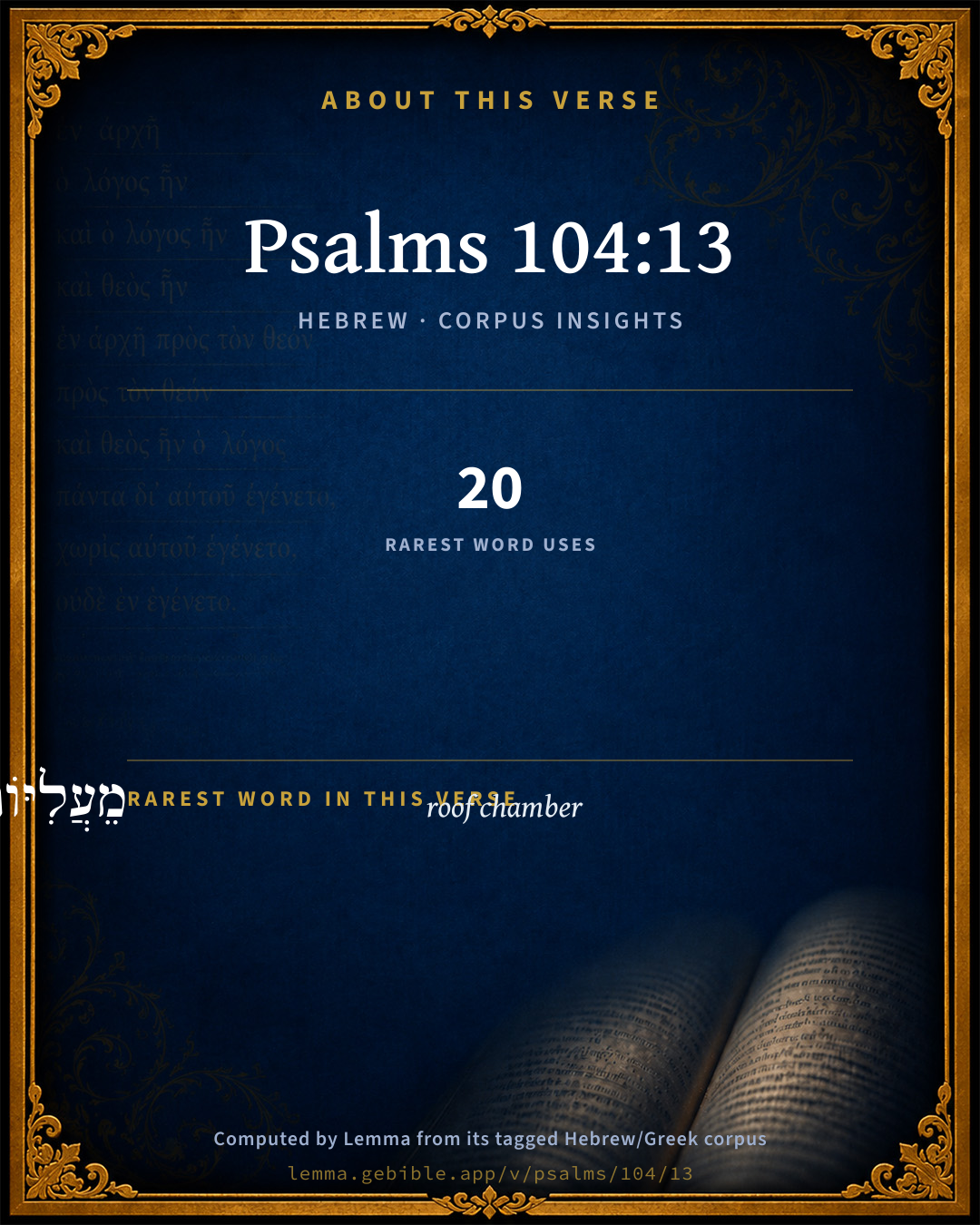
The rarest word here is מֵעֲלִיּוֹתָ֑יו roof chamber H5944 — appearing just 20 times in the whole Hebrew Bible.

Shared distinctive vocabulary

מֵעֲלִיּוֹתָ֑יו roof chamber H5944 occurs in 20 verses of the Hebrew Bible. Also found in:

Grammatical profile

  • 2 verbs
  • 5 nouns

Verb forms

  • מַשְׁקֶ֣ה Hiphil · Participle Active
  • תִּשְׂבַּ֥ע Qal · Imperfect

Hebrew & Septuagint length

In English translation the verse runs 17 words from the Hebrew and 18 from the Septuagint (LXX English) — closely comparable.

A rough comparison of the two English renderings, which tokenize alike — not a word-level alignment.

Word counts can differ between the Hebrew and the Greek without any difference in meaning — e.g. the Hebrew direct-object marker אֵת has no separate Greek word, and Greek often adds the article ὁ.

Cross-references

11

Topical passages linked to Psalms 104:13 in the Treasury of Scripture Knowledge — connected by theme and wording, ordered by reader-vote popularity; previews shown in the World English Bible.

  • Psalms 147:8 Who covers the sky with clouds, Who prepares rain for the earth, Who makes grass grow on the mountains.
  • Jeremiah 10:13 when he utters his voice, there is a tumult of waters in the heavens, and he causes the vapors to ascend from the ends of the earth; he makes lightnings for the rain, and brings forth the wind out of his treasuries.
  • Jeremiah 14:22 Are there any among the vanities of the nations that can cause rain? or can the sky give showers? Aren't you he, Yahweh our God? therefore we will wait for you; for you have made all these things.
  • Deuteronomy 11:11 but the land, where you go over to possess it, is a land of hills and valleys, [and] drinks water of the rain of the sky,
  • Job 38:25–28 Who has cut a channel for the flood water, Or the path for the thunderstorm;
  • Job 38:37 Who can number the clouds by wisdom? Or who can pour out the bottles of the sky,
  • Psalms 65:9–13 You visit the earth, and water it. You greatly enrich it. The river of God is full of water. You provide them grain, for so you have ordained it.
  • Psalms 104:3 He lays the beams of his chambers in the waters. He makes the clouds his chariot. He walks on the wings of the wind.
  • Amos 9:6 It is he who builds his chambers in the heavens, and has founded his vault on the earth; he who calls for the waters of the sea, and pours them out on the surface of the earth; Yahweh is his name.
  • Matthew 5:45 that you may be children of your Father who is in heaven. For he makes his sun to rise on the evil and the good, and sends rain on the just and the unjust.
  • Acts 14:17 Yet he didn't leave himself without witness, in that he did good and gave you rains from the sky and fruitful seasons, filling our hearts with food and gladness."

Cross-references courtesy of OpenBible.info (CC BY 4.0).

Hebrew and Greek witnesses Masoretic Hebrew ↔ Greek Septuagint

The same verse in the two great witnesses to the Old Testament, shown verse-for-verse.

You’re reading Greek Psalm 103 (Hebrew Psalm 104). The Septuagint counts the superscription, so verse numbers can differ from the Hebrew — chapter-level alignment, not verse-by-verse. Numbering follows Rahlfs.

These are two independent witnesses, not word-aligned to each other, and the Septuagint is shown in lemma (dictionary) form.

Hebrew Psalms 104:13 Masoretic · Westminster Leningrad Codex

מַשְׁקֶ֣ה הָ֭רִים מֵעֲלִיּוֹתָ֑יו מִפְּרִ֥י מַ֝עֲשֶׂ֗יךָ תִּשְׂבַּ֥ע הָאָֽרֶץ

He waters the mountains from his chambers. The earth is filled with the fruit of your works.

World English Bible · Public Domain

Greek LXX Greek Psalm 103:13 Septuagint · lemma form

ποτίζω ὄρος ἐκ ὁ ὑπερῷον αὐτός ἀπό καρπός ὁ ἔργον σύ χορτάζω ὁ γῆ

He waters the mountains from his chambers: the earth shall be satisfied with the fruit of your works.

LXX2012 (modern English Septuagint) · Public Domain

Hebrew: Westminster Leningrad Codex (CC BY 4.0). Greek: Septuagint (public domain); English from LXX2012 (modern English Septuagint) (Public Domain). How the Septuagint differs from the Hebrew →

Commentary

Notes on Psalms 104:13 from classic Christian and Jewish commentators (each source and its license shown beneath its notes). The classic Christian expositions comment on the surrounding passage and are grouped to its opening verse, so a note may address several verses; the Jewish commentaries on the Tanakh (Rashi and others) are per-verse, so they appear only where the commentator wrote on this verse.

Lemma curates 59 commentaries, every one of them public domain or Creative Commons licensed, each selected and text-cleaned for this edition rather than reprinted as found. About our sources →

Trapp's Complete Commentary

John Trapp

Psa 104:13 He watereth the hills from his chambers: the earth is satisfied with the fruit of thy works.

Ver. 13. He watereth the hills from his chambers] That is from his clouds, he giveth water to hills and high places, where wells and rivers are not.

The earth is satisfied with the fruit of thy works] i.e. With the rain of thy clouds, dropping fatness.

John Trapp, A Commentary or Exposition upon All the Books of the Old and New Testament (1647–1656) — public domain. Text from a community e-Sword module.

Joseph Benson's Commentary

Psa 104:13-15. He watereth the hills — Which most need moisture, and have least of it in themselves; from his chambers — From those chambers spoken of Psa 104:3, the beams of which he lays in the waters, those store- chambers, the clouds that distil the fruitful showers. The earth, &c. — By this means all the parts of the earth, the hills as well as the dales, the mountains as well as the valleys, are satisfied with the fruit of thy works — With those sweet showers which they drink in, or rather with the effect of them, the fruitfulness caused thereby. “Hence all the glory and beauty of the vegetable world; hence grass that nourishes the cattle, that they may nourish the human race; hence the green herb for food and for medicine; hence fields covered with corn, for the support of life; hence vines and olive-trees, laden with fruits, whose juices exhilarate the heart, and brighten the countenance.” — Horne.

Joseph Benson's Commentary on the Old and New Testaments (1811–1818) — public domain. Text from a community e-Sword module.

J. A. Alexander on Psalms

Joseph Addison Alexander

13. (Psa 104:13) Watering mountains from his upper rooms—from the fruit of thy works is the earth filled. He still returns to God as the author of these merciful provisions, and represents him by a beautiful figure, as pouring this abundant supply of water from his upper rooms, the same word that was rendered halls in ver. 3; but here the connection seems to require that its precise etymological import should be prominent. The fruit of thy works, the result or product of thy creative energy. Filled, not in the sense of being occupied, which would require a different Hebrew verb, but in that of being abundantly supplied or saturated. See above, on Psa 8:5. The sudden apostrophe to God himself enhances the poetical effect.

Joseph Addison Alexander, The Psalms Translated and Explained (1850) — public domain. Text from a community e-Sword module.

Geneva Bible (1599)

Geneva Bible translators

From the clouds.

Geneva Bible (1599) marginal notes — public domain. Text via Bolls.life.

Adam Clarke's Commentary

Verse 13. From his chambers] The clouds, as in Ps 104:3.

The earth is satisfied] The inhabitants of it.

Adam Clarke's Commentary on the Bible (1810–1826) — public domain. Text from a community e-Sword/MySword module.

John Calvin's Commentaries

The same subject is prosecuted in the 13th verse, where it is said that God watereth the mountains from his chambers It is no ordinary miracle that the mountains, which seem to be condemned to perpetual drought, and which, in a manner, are suspended in the air, nevertheless abound in pastures. The prophet, therefore, justly concludes that this fruitfulness proceeds from nothing else but the agency of God, who is their secret cultivator. Labour cannot indeed, in the proper sense, be attributed to God, but still it is not without reason applied to him, for, by merely blessing the earth from the place of his repose, he works more efficaciously than if all the men in the world were to waste themselves by incessant labor.

14. Making grass to grow for cattle The Psalmist now comes to men, of whom God vouchsafes to take a special care as his children. After having spoken of the brute creation, he declares, that corn is produced, and bread made of it, for the nourishment of the human race; and he mentions in addition to this, wine and oil, two things which not only supply the need of mankind, but also contribute to their cheerful enjoyment of life. Some understand the Hebrew word לעבדת, laäbodath, which I have rendered for the service, to denote the labor which men bestow in husbandry; for while grass grows on the mountains of itself, and without human labor, corn and herbs, which are sown, can only be produced, as is well known, by the labor and sweat of men. According to them the meaning is, that God blesses the toil of men in the cultivation of the fields. But this being too strained an interpretation, it is better to understand the word service, in the ordinary sense of the term. With respect to the word bread, I do not object to the view of those who understand it in a restricted sense, although it probably includes all kinds of food; only I dislike the opinion of those who exclude bread. There is no force in the reason which they allege for taking this view, namely, that in the following verse another use of bread is added, when it is said, that it strengthens the heart of man; for there the same thing is expressed in different words. The prophet, in stating that God causeth the earth to bring forth herbs for the support of men, intends to say that the earth supplies them not only with food in corn, but also with other herbs and fruits; for the means of our sustenance is not limited exclusively to one kind of food.

John Calvin's Commentaries (1540-1563) — public domain. Text from the Calvin Translation Society English edition (1840s-50s) via the Christian Classics Ethereal Library (ccel.org). Calvin's coverage is partial (roughly two-thirds of the Bible); uncommented books and verses are honest gaps, never fabricated. The 19th-century editor's footnotes and remarks are omitted so the notes are faithfully Calvin's own voice.

Ellicott's Commentary for English Readers

(13) Chambers—i.e., of cloud, as in Psa_104:3.

Thy works.—If we go by the parallelism, this means the “rain,” here called God’s works, as in Psa_65:9 (see Note), his “river.” Others prefer to see a general reference to the operations of nature which produce fruit.

A Bible Commentary for English Readers, edited by Charles John Ellicott (1878–1897) — public domain. Text from a community e-Sword module.

The Cambridge Bible for Schools and Colleges

gen. ed. J. J. S. Perowne

13. Who giveth the mountains drink from his upper chambers. Palestine was “a land of mountains and valleys, drinking water of the rain of heaven” (Deu_11:11). It is not inaccessible mountain tops which the poet is thinking of, so much as the upland corn fields (Psa_72:16), watered by the rain which God sends down from His “upper chambers” (Psa_104:3), as the valleys are watered by streams.

the fruit of thy works] Generally explained to mean the rain, as a product of the clouds which God has made. But this is harsh: it is much more natural to take the phrase in the simple sense of “fruit produced by God’s manifold operations.” Earth is fertilised by the rain and springs, and rejoices in its abundant produce. The thought is further developed in Psa_104:14-18.

The Cambridge Bible for Schools and Colleges (gen. ed. J. J. S. Perowne; Cambridge University Press, 1878–1918) — public domain. Text from a community e-Sword module.

John Gill's Exposition

He watereth the hills from his chambers,.... The house of his superior treasures, as the Targum. The airy regions, Psa 104:3 with the clouds of heaven, by the rain which they drop down upon them; the usefulness of which blessings of nature is largely described in this and some following verses. "The hills", which are naturally dry and barren, and receive but little advantage from the springs, fountains, and rivers below, are supplied with water from above; and become fruitful, bear herbage, and are clothed with flocks. This seems to refer to the first rain that was upon the earth, Gen 2:5 and which favour is continued to all lands, excepting some part of the land of Egypt, and in all ages since; see Psa 65:9. So ministers of the word, who are set in the first place, and are eminent in the church of God, and who water others, are watered themselves with the gifts and graces of the Spirit descending from above, as the apostles were, in an extraordinary manner, at the day of Pentecost; and as others in a more ordinary manner daily are. So likewise the churches of Christ, comparable to hills and mountains for firmness and visibility, and the several members thereof, are watered with the dews of divine favour, with the rain of the divine word; which comes down from heaven as the rain does, and drops and distils like that; and with the grace of the divine Spirit, whereby their souls become as a watered garden, whose springs fail not.

The earth is satisfied with the fruit of thy works; with the fruits which grow out of it by means of rain, as are after mentioned; herbs, grass, and trees, so Aben Ezra: or with the influences of the heavens, which are the work of God's hands, and by which the earth is made fruitful; or more particularly with the virtue and efficacy of the rain, so Kimchi; which is the Lord's peculiar work, Jer 14:22. This the earth drinking in, is as satisfied with as a thirsty man is with drinking a draught of water; see Deu 11:11. So the people of God, comparable to the good earth that drinks in the rain that often comes upon it, are satisfied with the love of God, with the blessings of his grace, with the doctrines of his Gospel, and with the ordinances of his house.

John Gill's Exposition of the Whole Bible (1746–1763) — public domain (CC PDM 1.0). Text via the HelloAO Bible API.

Albert Barnes' Notes on the Bible

He watereth the hills from his chambers - The waters, as stated before, run in the valleys - in the natural channels made for them among the hills, Psa 104:10. But still, it was a fact that the hills themselves were watered; that there were springs far up their heights; and that vegetation was sustained above the reach of the fountains and streams below; and it was a proof of the divine skill and beneficence that, in some way, water was furnished on the summits and sides of the hills themselves. This was caused, the psalmist says, by God’s pouring water on them, as it were, from his own “chambers” - his abode on high. The allusion is, doubtless, to rain, which seems to be poured down from the very abode of God. The word rendered “chambers” means “upper rooms,” (see the notes at Psa 104:3); and the reference is to the dwelling-place of God, as far above the earth.

The earth is satisfied with the fruit of thy works - Thy doings; with what thou hast done. All the needs of the earth seem to be met and “satisfied;” all that it could desire to make it fertile and beautiful; and the proper abode of man, of beast, and of fowl, has been granted. It has no cause of complaint; nothing has been left undone, in the valleys or on the hills, on the dry land or in the waters, that was needful to be done to carry out the purpose for which it has been called into being.

Albert Barnes' Notes on the Bible (1834–1885) — public domain. Text from a community e-Sword/MySword module.

Matthew Poole's English Annotations

He watereth the hills; which most need moisture, and have least of it in them.

From his chambers; from the clouds, as above, Psa 104:3.

The earth is satisfied; by this means all the parts of the earth, the mountains as well as the valleys, are made fruitful.

With the fruit of thy works; with the effects of those sweet showers, which he calls God’s works, because he alone can and doth give them, as is noted, Jer 10:13; 14:22.

Matthew Poole's English Annotations on the Holy Bible (1683–1685) — public domain. Text from a community e-Sword/MySword module.

The Treasury of David

Charles H. Spurgeon

Ver. 13. He watereth the hills from his chambers. As the mountains are too high to be watered by rivers and brooks, the Lord himself refreshes them from those waters above the firmament which the poet had in a former verse described as the upper chambers of heaven. Clouds are detained among the mountain crags, and deluge the hill sides with fertilizing rain. Where man cannot reach the Lord can, whom none else can water with grace he can, and where all stores of refreshment fail he can supply all that is needed from his own halls.

The earth is satisfied with the fruit of thy works. The result of the divine working is fulness everywhere, the soil is saturated with rain, the seed germinates, the beasts drink, and the birds sing nothing is left without supplies. So, too, is it in the new creation, he giveth more grace, he fills his people with good, and makes them all confess, "of his fulness have all we received and grace for grace."

Ver. 13. The earth is satisfied with the fruit of thy works; that is, with the rain, which is thy work, causing it to be showered down when you please upon the earth; or, with the rain, which proceeds from the clouds; or, with the fruits, which thou causeth the earth by this means to bring forth. Arthur Jackson.

Psalms 104:14*

Charles H. Spurgeon's The Treasury of David (1869–1885) — public domain. Psalms only. Text from a community e-Sword/MySword module.

Whedon's Commentary on the Bible

Daniel D. Whedon

13. Watereth the hills from his chambers—See on Psa_104:3; Psa_104:10.

The earth is satisfied—The earth being, literally, watered from his “chambers,” “is satisfied,” being stimulated to its highest power of productivity, (Psa_65:8-13; Jer_14:22,) and thus, also, the earth, metonymically, that is, its inhabitants, as animals and plants, all things of the earth which have life—are supplied to satiety. So Psa_104:14, and Psa_145:16.

Fruit of thy works—The context would require us to understand, by this, the result of God’s wise arrangements and adaptations in universal nature.

Daniel D. Whedon (gen. ed.), Commentary on the Old and New Testaments (1874–1909) — public domain. Text from a community e-Sword module.

The Pulpit Commentary

He (i.e. God) watereth the hills from his chambers (comp. ver. 3). The mountains themselves, even their highest tops, are not left dry. Where springs cannot reach, rain falls from God"s "chambers" in the sky, and spreads equal refreshment. The earth is satisfied with the fruit of thy works. The whole earth mountains, hills, plains, valleys is thus "satisfied," i.e. sufficiently supplied with water, by the means which God has elaborated.

The Pulpit Commentary (1880–1919), ed. H.D.M. Spence-Jones & Joseph S. Exell — public domain. Text from a community e-Sword module.

John Wesley's Explanatory Notes

The hills - Which most need moisture. From - From the clouds. Satisfied - By this means all the parts of the earth, are made fruitful. The fruit - With the effects of those sweet showers.

John Wesley, Explanatory Notes Upon the Whole Bible (1754–1765) — public domain. Text via the GEBible commentary corpus.

unfoldingWord translationNotes

Door43 World Missions Community

He waters the mountains from his water chambers in the sky

This means that God causes it to rain. The waters are described as residing in chambers in the sky. AT: "He waters the mountains by causing the rains to fall from the sky" (See: Metaphor)

the fruit of his labor

"the many good things that you create"

and plants for man to cultivate

The words "he makes" and "grow" are understood from the previous phrase, and can be repeated here. AT: "and he makes the plants grow for man to cultivate" (See: Ellipsis)

translationWords

heaven

fruit

labor

cow

wine

oil

life

unfoldingWord translationNotes — © Distant Shores Media and the Door43 World Missions Community, licensed CC BY-SA 4.0. Source: git.door43.org/Door43/en_tn.

Lesson kit

Teaching starters — assembled from the data on this page, not authored interpretation. Every prompt links to the verse data it draws on. Edit before teaching.

Psalms, in the Wisdom, opens this verse with 7 words (7 distinct Hebrew lemmas). Its most distinctive word is ʻălîyâh (“roof chamber”). A historical commentator’s framing appears above. Read the whole chapter for the surrounding context.

Discussion questions

  1. What does “roof chamber” (ʻălîyâh) contribute to the verse as a whole?
  2. How does Judges 3:20, which shares the word «roof chamber», read alongside this verse?
  3. The translations on this page render this verse differently — a whole-verse word diff, not a word-by-word alignment. What might account for the different wordings?
  4. «מַשְׁקֶ֣ה» is a Hiphil Participle Active verb. How does that grammatical form shape the action described?
  5. Compare how Trapp's Complete Commentary and Joseph Benson's Commentary read this verse. Where do they agree or differ?

Things to notice

Reading settings

Reading text

Shown beneath each verse's original-language words.

Old Testament
Old Testament edition

Read the OT as the Masoretic Hebrew (MT) or the Greek Septuagint (LXX).

English shown for the Greek Septuagint (in the Hebrew ↔ Greek comparison).

Comparing translations? Open the Compare panel on any verse page to stack up to four side by side.