
Proverbs 18:20

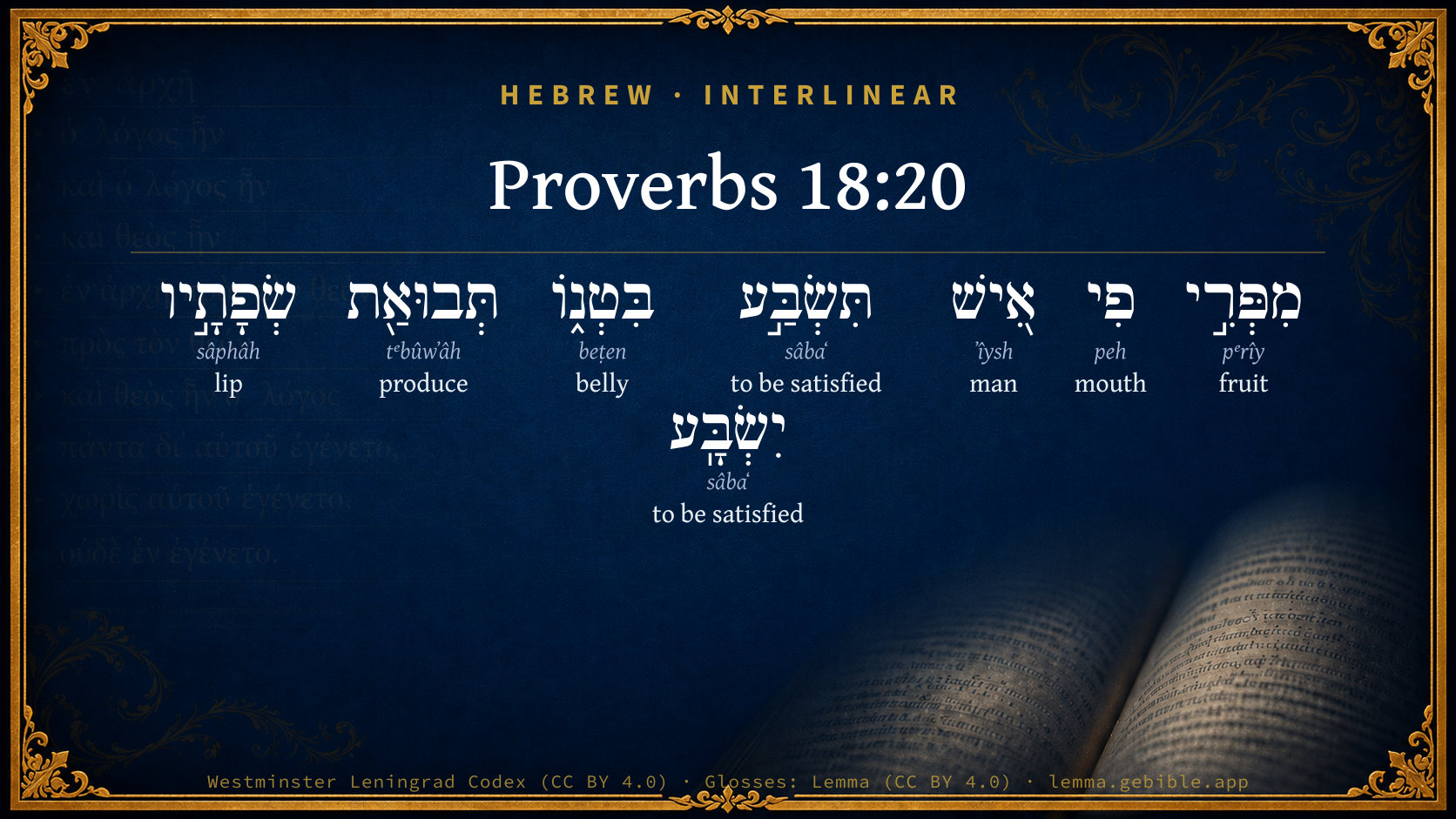
Hebrew (Westminster Leningrad Codex) Proverbs 18:20 appears in the Hebrew Old Testament. The text above is from the Westminster Leningrad Codex. Each word links to its Strong’s number, a concise gloss, and parsing drawn from the Open Scriptures Hebrew Bible morphology. Click any word for its full Brown-Driver-Briggs (BDB) entry.
Download image
Cite this verse

Proverbs 18:20 (World English Bible). Public Domain. Lemma interlinear Bible study tool, https://lemma.gebible.app/v/proverbs/18/20.

Show BibTeX & RIS
BibTeX
RIS
English Translation
A man's stomach is filled with the fruit of his mouth. With the harvest of his lips he is satisfied.
World English Bible · Public Domain
Download a study sheet

One document with this verse’s original text, its word-by-word gloss line, the meaning frame, cross-references with their text, attributed commentary, and full source and license credits — printable, and it pastes into notes with its structure intact.

This verse Autodidact and up

Study sheet (.html) Plain text (.txt)

A passage Seminary Student

Up to 50 verses in one chapter. A passage sheet keeps up to 6 commentary sources and 12 cross-references per verse, in the order this page ranks them, and says so on the sheet whenever that leaves anything out. Ask for a single verse and you get the Autodidact verse sheet above.

Everything on this page stays free to read, with no account — the sheet is a download of what is already on screen, not access to it.

Want to remove ads? Support Godless Engineer
Compare translations 3

The same verse in 3 English versions, stacked beneath the original-language interlinear above. Click any original word for its lexicon entry.

Each is an independent rendering of the whole verse — the interlinear is not word-aligned to these translations.

Highlighted words mark where these versions differ — a whole-verse word diff, not a word-by-word alignment.

  • World English Bible Public Domain
    A man's stomach is filled with the fruit of his mouth. With the harvest of his lips he is satisfied.
  • King James Version Public Domain
    A man's belly shall be satisfied with the fruit of his mouth; and with the increase of his lips shall he be filled.
  • unfoldingWord Literal Text CC BY-SA 4.0
    From the fruit of the mouth of a man his belly is satisfied; the produce of his lips, he is satisfied.

unfoldingWord Literal Text — © unfoldingWord, licensed CC BY-SA 4.0. Word-aligned USFM3 via Door43 (git.door43.org/unfoldingWord/en_ult).

Versions to compare (up to 4)

3 of 4 selected

Show all 18 translations

Every available English version of this verse, each an independent rendering of the whole verse.

  • World English Bible Public Domain
    A man's stomach is filled with the fruit of his mouth. With the harvest of his lips he is satisfied.
  • Berean Standard Bible Public Domain
    From the fruit of his mouth a man’s belly is filled; with the harvest from his lips he is satisfied.
  • Majority Standard Bible Public Domain
    From the fruit of his mouth a man’s belly is filled; with the harvest from his lips he is satisfied.
  • King James Version Public Domain
    A man's belly shall be satisfied with the fruit of his mouth; and with the increase of his lips shall he be filled.
  • American Standard Version (1901) Public Domain
    A man's belly shall be filled with the fruit of his mouth; With the increase of his lips shall he be satisfied.
  • Revised Version (1885) Public Domain
    A man’s belly shall be filled with the fruit of his mouth; with the increase of his lips shall he be satisfied.
  • Geneva Bible (1599) Public Domain
    With the fruite of a mans mouth shall his belly be satisfied, and with the increase of his lips shall he be filled.
  • Douay-Rheims (1899) Public Domain
    Of the fruit of a man's mouth shall his belly be satisfied: and the offspring of his lips shall fill him.
  • Young's Literal Translation Public Domain
    From the fruit of a man's mouth is his belly satisfied, `From the' increase of his lips he is satisfied.
  • Literal Standard Version CC BY-SA 4.0
    From the fruit of a man’s mouth is his belly satisfied, || [From the] increase of his lips he is satisfied.
  • Unlocked Literal Bible CC BY-SA 4.0
    From the fruit of his mouth one's stomach is filled; with the harvest of his lips he is satisfied.
  • unfoldingWord Literal Text CC BY-SA 4.0
    From the fruit of the mouth of a man his belly is satisfied; the produce of his lips, he is satisfied.
  • Darby Bible Public Domain
    A man's belly is satisfied with the fruit of his mouth; with the increase of his lips is he satisfied.
  • World Messianic Bible Public Domain
    A man’s stomach is filled with the fruit of his mouth. With the harvest of his lips he is satisfied.
  • Webster's Bible Public Domain
    A man's belly shall be satisfied with the fruit of his mouth; and with the increase of his lips shall he be filled.
  • Free Bible Version CC BY-SA 4.0
    Make sure you're satisfied with what you say—you have to live with your words.
  • Bible in Basic English Public Domain
    With the fruit of a man's mouth his stomach will be full; the produce of his lips will be his in full measure.
  • JPS Tanakh (1917) Public Domain
    A man's belly shall be filled with the fruit of his mouth; with the increase of his lips shall he be satisfied.

Literal Standard Version (2020), Covenant Press — licensed CC BY-SA 4.0. Text via the HelloAO Bible API (eBible.org). Unlocked Literal Bible (unfoldingWord) — licensed CC BY-SA 4.0. Text via the HelloAO Bible API (eBible.org). unfoldingWord Literal Text — © unfoldingWord, licensed CC BY-SA 4.0. Word-aligned USFM3 via Door43 (git.door43.org/unfoldingWord/en_ult). Free Bible Version, Dr. Jonathan Gallagher — licensed CC BY-SA 4.0. Text via the HelloAO Bible API (eBible.org).

Word by word

More ways to search: Search by grammar → Find every occurrence → Compare this word →

Practice this passage: Drill this verse → Learn its vocabulary →

About this verse

These counts appear in no published source. They are computed here, from the morphology-tagged text and Lemma’s own curated glosses. What Lemma adds →

8
words
7
distinct lemmas
Wisdom
section

Shared distinctive vocabulary

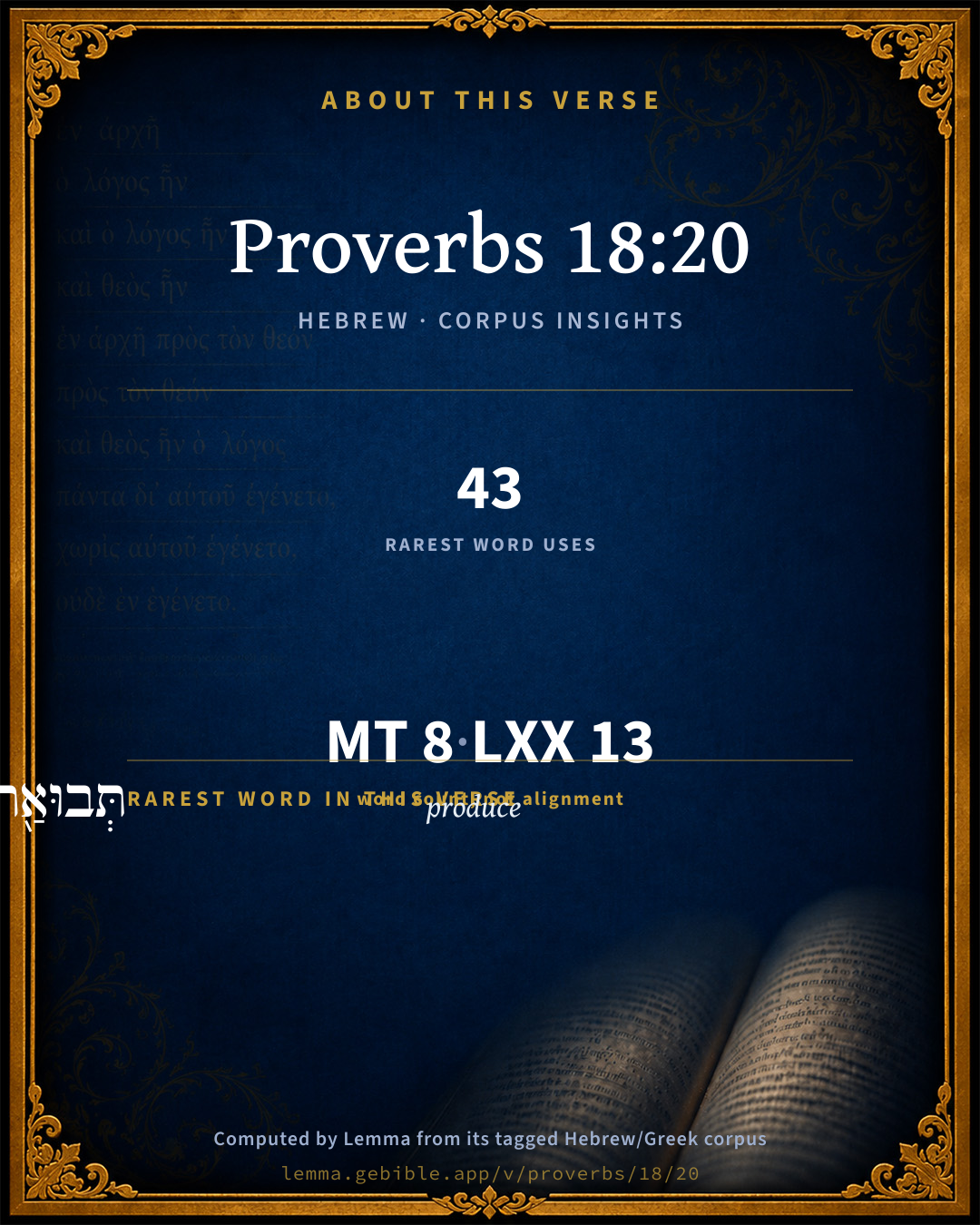
תְּבוּאַ֖ת produce H8393 occurs in 40 verses of the Hebrew Bible. Also found in:

Grammatical profile

  • 2 verbs
  • 6 nouns

Verb forms

  • תִּשְׂבַּ֣ע Qal · Imperfect
  • יִשְׂבָּֽע Qal · Imperfect

Repetition

A word recurs within this verse — often emphatic in Hebrew:

  • תִּשְׂבַּ֣ע to be satisfied H7646 ×2

Hebrew & Septuagint length

In English translation the verse runs 20 words from the Hebrew and 22 from the Septuagint (LXX English) — closely comparable.

A rough comparison of the two English renderings, which tokenize alike — not a word-level alignment.

Word counts can differ between the Hebrew and the Greek without any difference in meaning — e.g. the Hebrew direct-object marker אֵת has no separate Greek word, and Greek often adds the article ὁ.

In the original languages it is 8 Hebrew tokens and 13 Greek tokens — but the two are counted differently (Hebrew bundles its prefixes and suffixes into one token; the Greek is in lemma form), so that isn’t a like-for-like length.

Cross-references

4

Topical passages linked to Proverbs 18:20 in the Treasury of Scripture Knowledge — connected by theme and wording, ordered by reader-vote popularity; previews shown in the World English Bible.

  • Proverbs 12:13–14 An evil man is trapped by sinfulness of lips, But the righteous shall come out of trouble.
  • Proverbs 25:11–12 A word fitly spoken Is like apples of gold in settings of silver.
  • Proverbs 13:2 By the fruit of his lips, a man enjoys good things; But the unfaithful crave violence.
  • Proverbs 22:18 For it is a pleasant thing if you keep them within you, If all of them are ready on your lips.

Cross-references courtesy of OpenBible.info (CC BY 4.0).

Hebrew and Greek witnesses Masoretic Hebrew ↔ Greek Septuagint

The same verse in the two great witnesses to the Old Testament, shown verse-for-verse.

These are two independent witnesses, not word-aligned to each other, and the Septuagint is shown in lemma (dictionary) form.

Hebrew Proverbs 18:20 Masoretic · Westminster Leningrad Codex

מִפְּרִ֣י פִי אִ֭ישׁ תִּשְׂבַּ֣ע בִּטְנ֑וֹ תְּבוּאַ֖ת שְׂפָתָ֣יו יִשְׂבָּֽע

A man's stomach is filled with the fruit of his mouth. With the harvest of his lips he is satisfied.

World English Bible · Public Domain

Greek LXX Proverbs 18:20 Septuagint · lemma form

ἀπό καρπός στόμα ἀνήρ πίμπλημι κοιλία αὐτός ἀπό δέ καρπός χεῖλος αὐτός ἐνπίμπλημι

A man fills his belly with the fruits of his mouth; and he shall be satisfied with the fruits of his lips.

LXX2012 (modern English Septuagint) · Public Domain

On this verse, Keil & Delitzsch discusses the Septuagint’s reading. Read the note in Commentary ↓

Hebrew: Westminster Leningrad Codex (CC BY 4.0). Greek: Septuagint (public domain); English from LXX2012 (modern English Septuagint) (Public Domain). How the Septuagint differs from the Hebrew →

Commentary

Notes on Proverbs 18:20 from classic Christian and Jewish commentators (each source and its license shown beneath its notes). The classic Christian expositions comment on the surrounding passage and are grouped to its opening verse, so a note may address several verses; the Jewish commentaries on the Tanakh (Rashi and others) are per-verse, so they appear only where the commentator wrote on this verse.

Lemma curates 59 commentaries, every one of them public domain or Creative Commons licensed, each selected and text-cleaned for this edition rather than reprinted as found. About our sources →

Trapp's Complete Commentary

John Trapp

Pro 18:20 A man’s belly shall be satisfied with the fruit of his mouth; [and] with the increase of his lips shall he be filled.

Ver. 20. A man’s belly shall be satisfied with the fruit of his mouth.] {See Trapp on "Pro 12:14"} {See Trapp on "Pro 13:2"}

And with the increase of his lips shall he be satisfied.] It is worthy the observing, saith an interpreter here, that Solomon doth vary his words: he speaketh sometimes of the "mouth," sometimes of the "lips," sometimes of the "tongue," as Pro 18:21, to show that all the instruments or means of speech shall have, as it were, their proper and just reward.

John Trapp, A Commentary or Exposition upon All the Books of the Old and New Testament (1647–1656) — public domain. Text from a community e-Sword module.

Joseph Benson's Commentary

Pro 18:20. A man’s belly shall be satisfied, &c. — Wise and edifying discourses tend to the comfort and satisfaction of the speaker, as well as to the good of the hearers.

Joseph Benson's Commentary on the Old and New Testaments (1811–1818) — public domain. Text from a community e-Sword module.

The Preacher's Complete Homiletical Commentary

Joseph S. Exell (gen. ed.)

CRITICAL NOTES.—

Pro_18:20. Satisfied. “If this word is taken in a good sense the fruit must be good; but it may be ironical, meaning false or malignant words will find ample retribution. Perhaps the next verse helps us to determine the meaning” (Stuart).

Pro_18:21. They that love it, i.e., “make it a special object of gratification” (Stuart).

MAIN HOMILETICS OF Pro_18:20-21

THE POWER OF THE LITTLE MEMBER

Solomon again and again reverts to the mighty influences for good and evil which flow from the use of the tongue—that “little member” upon which such great issues often depend. He here notices—

I. The power of words over the man who utters them. He declares that the state of the inward man—its rest or unrest, its gladness or its gloom—depends very much upon the use that is made of the tongue. A little thought and observation will convince us that this is true. Beginning with the familiar intercourse of every-day life, how true it is that the utterance of kindly words of sympathy, and advice and warning, have a tendency to make sunshine in the heart of him who utters them, while censorious, hasty, harsh words embitter and darken the spirit of their author. Going beyond these to utterances which have a wider influence, the proverb is no less true. The painter that has conceived a picture in his mind, and then, seeing it upon canvas, thinks of the many eyes who will gaze upon it with interest, and of those who perchance will be elevated and instructed by it, feels a satisfaction in the thought that it owes its existence to him—that without the working of his brain and hand it would not have been. “He is filled with the increase” of his skilful hand. So the man whose words are listened to and waited for by other men—whether he be the skilful barrister, or the powerful statesman, or the preacher of the Gospel, has a satisfaction in being able so to put forth his conceptions as to give to his fellow-men new ideas—to show them things in a light in which they might never have seen them but for this power which he possesses. He has joy in being the originator of fresh and living thoughts, and in being able by clothing them in words to impart them to others. But upon the moral quality of the “fruit of his mouth” will depend the length and depth of his satisfaction. The simple power to influence men by speech will gratify for the moment—but if the increase of the lips is to be an abiding source of contentment there must be a consciousness that the power has been used to benefit mankind in some way or other—that the skilful pleading has been on the side of right, that the powerful logic has been used to expose the false and to defend the true, or the brilliant oratory has had for its aim the moral enlightenment and strengthening of the listeners. If it be not so, the fruit of a man’s mouth will be like the roll given to the apocalyptic seer, “in the mouth as sweet as honey,” but afterwards “bitter.” (Rev_10:10.) How sad must be the reflections of those who have possessed this God-given power for good or ill when they have to look back upon its misuse.

II. The power of words over those who hear them. The tongue in its mighty influence is a king having the power of life and death. No other member of the human body can lay claim to such wide-spread and regal authority. The eye can influence men, but not so powerfully as the tongue, nor can its influence reach so many at once. The hand can strike down the body of a single foe, or of two or three at once. But the tongue can reach a thousand hearts at one time, and make men its slaves, not in twos and threes but in masses. And as it sways the affections and takes a man’s will captive, it wields the power of life and death not over the body of the man but over the man himself. The tongue of the tempter can drag its victims down, body and soul, to hell, while the tongue which is touched with a living coal from off the altar of God can be the means of persuading men to be reconciled to their Heavenly Father, and so of making them partakers of eternal life. Seeing, then, what issues of life and death are dependent upon this king, it is manifest that men should keep him in absolute control; if so much depends upon his action he ought to be under the strictest supervision. If one member of the body politic, by the position which he holds and the ability which he possesses, is able to exercise a very powerful influence in the kingdom for weal or for woe, men watch him narrowly and jealously to see how he uses his power, and if they are anxious for the well-being of the State they endeavour to restrain him when he is going wrong and stimulate him when he is using his influence for the right. So ought every man to watch and guard his own tongue; seeing that life and death are in its power, he ought to bring all his words to the bar of conscience and try them there, severely condemning them if they have not been such as would minister life to the hearers, and remembering that his Master has said, “By thy words thou shalt be justified, and by thy words thou shalt be condemned” (Mat_12:37).

OUTLINES AND SUGGESTIVE COMMENTS

If a man were possessed of a field exceedingly productive, either of good fruits or of noisome and poisonous herbs, according to the cultivation bestowed on it, what pains would he use to clear it of every weed, and to have it sown with good grain! and yet, when the harvest is come, he may take his choice whether he will eat of the product or not. Such a field is the tongue of man, with this difference, that a man is obliged to eat the fruit of it, although it should be worse than hemlock. What care, then, should we use to pluck from our hearts every root of bitterness, and to have them furnished with knowledge and prudence, that our discourse may be good, to the use of edifying!—Lawson.

There is a sense in which we may understand the language, even taking the former clause of the twentieth verse literally—“A man’s belly shall be satisfied with the fruit of his mouth.” You may smile and say, A man cannot live upon words! Very true. But the way in which a man uses his lips and his tongue, as the organs of speech, may contribute not a little to his getting, or his failing to get, “the meat that perisheth.” I mean not that any of you should, in the slightest degree, try to work your way in life by words of flattery; but when a man’s general conversation is such as to procure for him a character for discretion, courtesy, gratitude, straight forward integrity, and trustworthiness, this may surely contribute, eminently and directly, to the temporal sustenance and comfort of the man himself and his family: while an opposite style of intercourse may tend to penury and starvation. A man may, in various ways, make his “lips” the instrument of either want on the one hand, or plenty on the other.—Wardlaw.

Our understanding of Pro_18:20 is, that as the outward wants of a man are satisfied by his daily acts, so he himself is, and that simply as his acts, or because of the intimate sympathy between the man and what he does. This thought is still clearer in the verse that follows:—“Death and life are in the power (literally the hand) of the tongue.” There can be no doubt that men’s conduct (for tongue is but the leading instrument of it) determines death or life, yet, in spite of the adventurous hazard, their love to it (or literally, just as they love this or that sort of tongue), they shall eat its fruit, and incur, of course, fearful responsibilities.—Miller.

The Preacher's Complete Homiletical Commentary (gen. ed. Joseph S. Exell; Funk & Wagnalls, c. 1892) — public domain (pre-1929). A full-Bible homiletical/sermon-outline anthology covering 65 of 66 books (2 John is absent from the source module). Text from a community e-Sword module.

Keil & Delitzsch

C. F. Keil & F. Delitzsch

With Pro 18:19, the series of proverbs which began with that of the flatterer closes. The catchword אח, which occurred at its commencement, 9b, is repeated at its close, and serves also as a landmark of the group following Pro 18:20-24. The proverb of the breach of friendship and of contentions is followed by one of the reaction of the use of the tongue on the man himself.

Pro 18:20

20 Of the fruit which a man's mouth bringeth is his heart satisfied;

By the revenue of his lips is he filled.

He will taste in rich measure of the consequences not merely of the good (Pro 12:14, cf. Pro 13:2), but of whatever he has spoken. This is an oxymoron like Mat 15:11, that not that which goeth into the mouth, but that which cometh out of it, defileth a man. As at Joh 4:34 the conduct of a man, so here his words are called his βρῶμα. Not merely the conduct (Pro 1:31; Isa 3:10), but also the words are fruit-bringing; and not only do others taste of the fruit of the words as of the actions of a man, whether they be good or bad, but above all he himself does so, both in this life and in that which is to come.

Pro 18:21

21 Death and life are in the power of the tongue;

And whoever loveth it shall eat its fruit.

The hand, יד, is so common a metaphor for power, that as here a hand is attributed to the tongue, so e.g., Isa 47:14 to the flame, and Psa 49:16 to Hades. Death and life is the great alternative which is placed, Deu 30:15, before man. According as he uses his tongue, he falls under the power of death or attains to life. All interpreters attribute, 21b, ואהביה to the tongue: qui eam (linguam) amant vescentur (יאכל, distrib. sing., as Pro 3:18, Pro 3:35, etc.) fructu ejus. But "to love the tongue" is a strange and obscure expression. He loves the tongue, says Hitzig, who loves to babble. Euchel: he who guards it carefully, or: he who takes care of it, i.e., who applies himself to right discourse. Combining both, Zckler: who uses it much, as εὐλογῶν or κακολογῶν. The lxx translates, οἱ κρατοῦντες αὐτῆς, i.e., אחזיה; but אחז means prehendere and tenere, not cohibere, and the tongue kept in restraint brings forth indeed no bad fruit, but it brings no fruit at all. Why thus? Does the suffix of ואהביה, perhaps like Pro 8:17, Chethı̂b, refer to wisdom, which, it is true, is not named, but which lies everywhere before the poet's mind? At Pro 14:3 we ventured to make חכמה the subject of 3b. Then 21b would be as a miniature of Pro 8:17-21. Or is ואהביה a mutilation of ואהב יהוה: and he who loves Jahve (Psa 97:10) enjoys its (the tongue's) fruit?

Pro 18:22

22 Whatso hath found a wife hath found a good thing,

And hath obtained favour from Jahve.

As ואהביה, 21b, reminds us of Pro 8:17, so here not only 22b, but also 22a harmonizes with Pro 8:35 (cf. Pro 12:2). A wife is such as she ought to be, as Pro 18:14, אישׁ, a man is such as he ought to be; the lxx, Syr., Targ., and Vulgate supply bonam, but "gnomic brevity and force disdains such enervating adjectives, and cautious limitations of the idea" (Fl.). Besides, אשׁה טובה in old Hebr. would mean a well-favoured rather than a good-dispositioned wife, which later idea is otherwise expressed, Pro 19:14; Pro 31:10. The Venet. rightly has γυναῖκα, and Luther ein Ehefraw, for it is a married woman that is meant. The first מצא is perf. hypotheticum, Gesen. 126, Anm. 1. On the other hand, Ecc 7:26, "I found, מוצא אני, more bitter than death the woman," etc.; wherefore, when in Palestine one married a wife, the question was wont to be asked: או מוצא מצא, has he married happily (after מצא of the book of Proverbs) or unhappily (after מוצא of Ecclesiastes) (Jebamoth 63b)?

(Note: Cf. Gendlau's Sprichwrter u. Redensarten deutsch-jdischer Vorzeit (1860), p. 235.)

The lxx adds a distich to Pro 18:22, "He that putteth away a good wife putteth away happiness; and he that keepeth an adulteress, is foolish and ungodly." He who constructed this proverb [added by the lxx] has been guided by מצא to מוציא (Ezr 10:3); elsewhere ἐκβάλλειν (γυναῖκα), Gal 4:30, Sir. 28:15, is the translation of גּרשׁ. The Syr. has adopted the half of that distich, and Jerome the whole of it. On the other hand, Pro 18:23, Pro 18:24, and Pro 19:1-2, are wanting in the lxx. The translation which is found in some Codd. is that of Theodotion (vid., Lagarde).

Pro 18:23

23 The poor uttereth suppliant entreaties;

And the rich answereth rudenesses.

The oriental proverbial poetry furnishes many parallels to this. It delights in the description of the contrast between a suppliant poor man and the proud and avaricious rich man; vid., e.g., Samachschari's Goldene Halsbnder, No. 58. תּחנוּנים, according to its meaning, refers to the Hithpa. התחנּן, misericordiam alicujus pro se imploravit; cf. the old vulgar "barmen," i.e., to seek to move others to Erbarmen [compassion] (רחמים). עזּות, dura, from עז (synon. קשׁה), hard, fast, of bodies, and figuratively of an unbending, hard, haughty disposition, and thence of words of such a nature (Fl.). Both nouns are accus. of the object, as Job 40:27, תחנונים with the parallel רכּות. The proverb expresses a fact of experience as a consolation to the poor to whom, if a rich man insults him, nothing unusual occurs, and as a warning to the rich that he may not permit himself to be divested of humanity by mammon. A hard wedge to a hard clod; but whoever, as the Scripture saith, grindeth the poor by hard stubborn-hearted conduct, and grindeth his bashful face (Isa 3:15), challenges unmerciful judgment against himself; for the merciful, only they shall obtain mercy, αὐτοὶ ἐλεηθήσονται (Mat 5:7).

Pro 18:24

24 A man of many friends cometh off a loser;

But there is a friend more faithful than a brother.

Jerome translates the commencing word by vir, but the Syr., Targ. by אית, which is adopted by Hitzig, Bttcher, and others. But will a German poet use in one line "itzt" [same as jetzt = now], and in the next "jetzt"? and could the Hebrew poet prefer to ישׁ its rarer, and her especially not altogether unambiguous form אישׁ (cf. to the contrary, Ecc 7:15)? We write אישׁ, because the Masora comprehends this passage, with Sa2 14:19; Mic 6:10, as the סבירין ישׁ 'ג, i.e., as the three, where one ought to expect ישׁ, and is thus exposed to the danger of falling into error in writing and reading; but erroneously אשׁ is found in all these three places in the Masora magna of the Venetian Bible of 1526; elsewhere the Masora has the defectiva scriptio with like meaning only in those two other passages. While אישׁ = ישׁ, or properly ישׁ, with equal possibility of אשׁ,

(Note: One sees from this interchange how softly the י was uttered; cf. Wellhausen's Text der B. Samuel (1871) (Preface). Kimchi remarks that we say אקטל for אקטל, because we would otherwise confound it with יקטל.)

and it makes no material difference in the meaning of 24a whether we explain: there are friends who serve to bring one to loss: or a man of many friends comes to loss, - the inf. with ל is used in substantival clauses as the expression of the most manifold relations, Gesen. 132, Anm. 1 (cf. at Hab 1:17), here in both cases it denotes the end, as e.g., Psa 92:8, to which it hastens with many friends, or with the man of many friends. It is true that אישׁ (like בּעל) is almost always connected only with genitives of things; but as one says אישׁ אלהים: a man belongs to God, so may one also say אישׁ רעים: a man belongs to many friends; the common language of the people may thus have named a man, to whom, because he has no definite and decided character, the rule that one knows a man by his friends is not applicable, a so-called every-man's-friend, or all-the-world's-friend. Theodotion translates ἀνὴρ ἑταιριῶν τοῦ ἑταιρεύσασθαι; and thus also the Syr., Targ., and Jerome render (and among the moderns, Hitzig) התרעע as reflexive in the sense of to cherish social intercourse; but this reflexive is התרעה, Pro 22:24. That התרועע is either Hithpa. of רוּע, to exult, Psa 60:10; 65:14, according to which the Venet. translates (contrary to Kimchi) ὥστε ἀλαλάζειν: such an one can exult, but which is not true, since, according to 24b, a true friend outweighs the many; or it is Hithpa. of רעע, to be wicked, sinful (Fl.: sibi perniciem paraturus est); or, which we prefer, warranted by Isa 24:19, of רעע, to become brittle (Bttcher and others) - which not only gives a good sense, but also a similar alliteration with רעים, as Pro 3:29; Pro 13:20. In contradistinction to רע, which is a general, and, according to the usage of the language (e.g., 17b), a familiar idea, the true friend is called, in the antithetical parallel member, אהב (Pro 27:6); and after Pro 17:17, דּבק מאח, one who remains true in misfortune. To have such an one is better than to have many of the so-called friends; and, as appears from the contrast, to him who is so fortunate as to have one such friend, there comes a blessing and safety. Immanuel has given the right explanation: "A man who sets himself to gain many friends comes finally to be a loser (סופו להשּׁבר), for he squanders his means, and is impoverished in favour of others." And Schultens: At est amicus agglutinatus prae fratre. Rarum et carum esse genus insinuatur, ac proinde intimam illam amicitiam, quae conglutinet compingatque corda, non per multos spargendam, sed circumspecte et ferme cum uno tantum ineundam. Thus closes this group of proverbs with the praise of friendship deepened into spiritual brotherhood, as the preceding, Pro 18:19, with a warning against the destruction of such a relation by a breach of trust not to be made good again.

Keil & Delitzsch — Biblical Commentary on the Old Testament (1861–1891) — public domain (CC PDM 1.0). Text via the HelloAO Bible API. (Old Testament only.)

Matthew Henry's Commentary

Note, 1. Our comfort depends very much upon the testimony of our own consciences, for us or against us. The belly is here put for the conscience, as Pro 20:27. Now it is of great consequence to us whether that be satisfied, and what that is filled with, for, accordingly, will our satisfaction be and our inward peace. 2. The testimony of our consciences will be for us, or against us, according as we have or have not governed our tongues well. According as the fruit of the mouth is good or bad, unto iniquity or unto righteousness, so the character of the man is, and consequently the testimony of his conscience concerning him. "We ought to take as great care about the words we speak as we do about the fruit of our trees or the increase of the earth, which we are to eat; for, according as they are wholesome or unwholesome, so will the pleasure or the pain be wherewith we shall be filled." So bishop Patrick.

Matthew Henry's Commentary on the Whole Bible (1708–1710) — public domain (CC PDM 1.0). Text via the HelloAO Bible API.

Jamieson, Fausset & Brown

Robert Jamieson, A. R. Fausset & David Brown

(Compare Pro 12:14; Pro 13:2). Men's words are the fruit, or, increase of his lips, and when good, benefit them.

satisfied with--(Compare Pro 1:31; Pro 14:14).

Jamieson, Fausset & Brown — Commentary Critical and Explanatory on the Whole Bible (1871) — public domain (CC PDM 1.0). Text via the HelloAO Bible API.

Adam Clarke's Commentary

Verse 20. With the fruit of his mouth] Our own words frequently shape our good or evil fortune in life.

Adam Clarke's Commentary on the Bible (1810–1826) — public domain. Text from a community e-Sword/MySword module.

Ellicott's Commentary for English Readers

(20) A man’s belly shall be satisfied with the fruit of his mouth.—See above on Pro_12:14.

A Bible Commentary for English Readers, edited by Charles John Ellicott (1878–1897) — public domain. Text from a community e-Sword module.

John Gill's Exposition

A man's belly shall be satisfied with the fruit of his mouth,.... With his own words and discourses, when they are prudent, pious, and savoury; when they are with grace, and minister it; they are satisfying to himself, to his own mind and conscience, and to his family; to all within his house, which is, as it were, his belly; but, if otherwise, it will not be profitable nor satisfying to either; and therefore, if a man would keep conscience easy, and be useful to others, he ought to take care what he says; see Pro 12:14;

and with the increase of his lips shall he be filled; the same thing as before, expressed in different words, alluding to the sowing, of seed in the earth, and the increase of it; as a man sows he reaps, and enjoys the fruits of his labour; according to what a man sows with his lips, such is his harvest he is afterwards a partaker of.

John Gill's Exposition of the Whole Bible (1746–1763) — public domain (CC PDM 1.0). Text via the HelloAO Bible API.

Albert Barnes' Notes on the Bible

The general sense is plain. A man must for good or evil take the consequence of his words, as well as his deeds. Compare the marginal reference.

Albert Barnes' Notes on the Bible (1834–1885) — public domain. Text from a community e-Sword/MySword module.

Haydock's Catholic Bible Commentary

Satisfied. Those who are guarded in their words get employment. (Haydock) (Chap. xii. 14.)

George Leo Haydock (1774–1849), Haydock's Catholic Family Bible and Commentary, 1859 edition — public domain. Excludes Psalms (Douay-Rheims chapter numbering differs from Protestant) and Deuterocanonical books (Catholic canon only).

Matthew Poole's English Annotations

Wise and edifying discourses tend to the comfort and satisfaction of the speaker, as well as to the good of the hearers.

Matthew Poole's English Annotations on the Holy Bible (1683–1685) — public domain. Text from a community e-Sword/MySword module.

Whedon's Commentary on the Bible

Daniel D. Whedon

20. A man’s belly… fruit of his mouth — A man’s words frequently determine his future for good or evil.

Satisfied — Satiated, or filled with the fruits of his own discourse. “There is here a paradox in the form of statement. A man’s belly is to be filled, not, as is usual, by what he puts into his month, but by what comes out of it.” — Speaker’s Commentary. Compare Pro_12:24; Pro_13:2; Pro_14:14; Mat_12:37.

Daniel D. Whedon (gen. ed.), Commentary on the Old and New Testaments (1874–1909) — public domain. Text from a community e-Sword module.

The Pulpit Commentary

With the first clause, comp, Pro_12:14, and with the second, Pro_13:2. A man"s belly; i.e. himself, his mind and body, equivalent to shall he be filled, or satisfied, in the second clause. A man must accept the consequences of his words, good or evil. The next verse explains this.

The Pulpit Commentary (1880–1919), ed. H.D.M. Spence-Jones & Joseph S. Exell — public domain. Text from a community e-Sword module.

John Wesley's Explanatory Notes

Satisfied - Wise discourses tend to the satisfaction of the speaker, as well as to the good of the hearers.

John Wesley, Explanatory Notes Upon the Whole Bible (1754–1765) — public domain. Text via the GEBible commentary corpus.

Bridges on Proverbs

Charles Bridges

Who would not be careful, what seed he puts into a fruitful field when he knows that his harvest will be according to his seed? (Gal 6:7-8 .) Here is not a field, but "a world" (Jas 3:6 ), to be cultivated, so that we may be satisfied with the fruit, and filled with the increase. What this fruit and increase may be, is a fearful alternative. The fruit of our lips — the power of our tongue — will be poisonous or wholesome, death or life.†1 Evil words tend to death,†2 good words to life†3 — to the comfort of the speaker, as well as to the blessing of the hearer. There is no mean; nothing but extremes. It is either the worst of evils, or the best of blessings.

This is clearly manifested in public responsibilities. The testimony of witnesses, and the legal decision of the judge, fearfully shew, that death or life is in the power of the tongue. Take even a more important field of illustration — the Ministry of the gospel — the doctrine of false and true teachers. Suppose the sinner’s conscience to be awakened. Eagerly he longs for an answer to that immensely momentous question — "What must I do to be saved?" (Act 16:30 .) Let him be blinded to his own state; soothed with false remedies, or the true remedy concealed or obscured. Or let him be directed to the cross as the one object, compared with which all other objects are vanity and delusion — do not we see, that, according to the use of the tongue, death and life is in the power of it? Nay — in another, — perhaps a more solemn, apprehension of the great work, when all is simply and fully exhibited; when man’s helplessness and Divine sufficiency — sin and the Savior — the ruin and the restoration — are clearly displayed; according as the message is rejected or welcomed, it becomes "a savour of death unto death, or of life unto life." (2Co 2:16 .) Thus again, death or life is in the power of the tongue.

In the common intercourse of life, also is the tongue "the fountain both of bitter waters and sweet;" as powerful to destroy as to edify; the poison, or antidote, as it may be used. ’A man by using his tongue aright, in talking, exhorting, witnessing, counseling, may save; and, by abusing it in any of these ways, or any other, may destroy.’†4 Either way he will be filled with the fruit. The curse of destroying others will return upon himself. In administering a blessing to his neighbour, is own soul will be fed. (Pro 11:25 .) They that love it shall eat the fruit of it. It is, however, the habitual, not the occasional, use of this little member, that determines its fruit. A saint may "speak unadvisedly" — a sinner acceptably — "with his lips." Neither would thus determine his true character.

Born as we are for eternity, no utterance of our tongue can be called trifling. A word, though light as air, scarcely marked, and soon forgotten, may rise up as a witness at the throne of judgment for death or for life eternal. (Mat 12:37 .) When I think of this awful power, shall I not — as Chrysostom warns ’guard this little member more than the pupil of the eye?’†5 Are not the sins of the tongue an overwhelming manifestation of the long-suffering of God? ’Woe is me’ — exclaimed a man of God, — ’for I am a man of unclean lips.’†6 Shall I not cry to my God, that he would restrain my tongue;†7 yea, cry more earnestly, that he would consecrate it†8 as a sacred gift, stamped with his image, that it might be my glory, not my shame; my organ of praise, my exercise of joy?†9 In the inner man the heart is the main thing to be kept (Pro 4:23 ); in the outer man the tongue (Pro 21:23 .) O my God! take them both into thine own keeping, under thine own discipline, as instruments for thy service and glory.

Footnotes:

†1 Pro 18:7. Psa 50:20-21 . Mat 5:22 ; Mat 12:36 . Jud 1:14-15.

†2 Pro 13:2 . Compare Sir 28:18 .

†3 Pro 12:14; Pro 13:2. Psa 34:12-13 .

†4 Muffet in loco.

†5 Homily 62 on Matt.

†6 Isa 6:5.

†7 Psa 141:3.

†8 Psa 51:15.

†9 Psa 57:7-8.

Charles Bridges, An Exposition of the Book of Proverbs (1846) — public domain. Text from a community e-Sword module.

Kretzmann's Popular Commentary

Paul E. Kretzmann

v. 20. A man’s belly shall be satisfied with the fruit of his mouth, his whole body will have to bear the consequences of his speeches; and with the increase of his ups shall he be filled, it will come back to him as it has gone forth from his mouth.

Paul E. Kretzmann, Popular Commentary of the Bible (1921–1924) — public domain. Text from a community e-Sword module.

Lesson kit

Teaching starters — assembled from the data on this page, not authored interpretation. Every prompt links to the verse data it draws on. Edit before teaching.

Proverbs, in the Wisdom, opens this verse with 8 words (7 distinct Hebrew lemmas). Its most distinctive word is tᵉbûwʼâh (“produce”). A historical commentator’s framing appears above. Read the whole chapter for the surrounding context.

Discussion questions

  1. How does “produce” (tᵉbûwʼâh) shape what this verse is saying?
  2. Genesis 47:24 shares the word «produce» with this verse. How do the two illuminate each other?
  3. “to be satisfied” occurs 2× in this one verse. What is the effect of the repetition?
  4. The translations on this page render this verse differently — a whole-verse word diff, not a word-by-word alignment. What might account for the different wordings?
  5. The verb «תִּשְׂבַּ֣ע» is Qal Imperfect. How does its form color the action?
  6. Reading how Trapp's Complete Commentary and Joseph Benson's Commentary read this verse, where do the two commentators agree and where do they part?

Things to notice

Reading settings

Reading text

Shown beneath each verse's original-language words.

Old Testament
Old Testament edition

Read the OT as the Masoretic Hebrew (MT) or the Greek Septuagint (LXX).

English shown for the Greek Septuagint (in the Hebrew ↔ Greek comparison).

Comparing translations? Open the Compare panel on any verse page to stack up to four side by side.