
Ezekiel 17:23

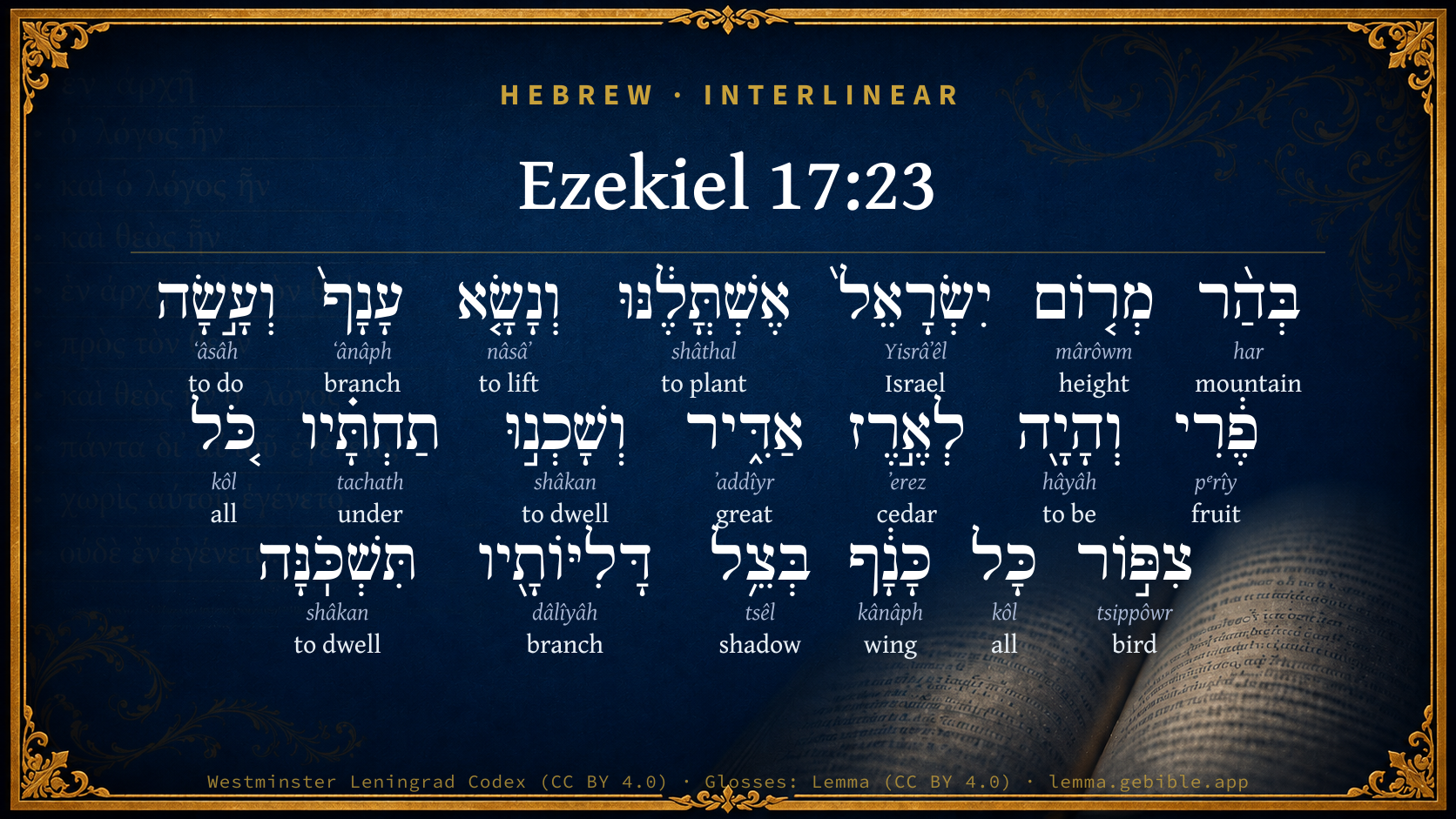
Hebrew (Westminster Leningrad Codex) Ezekiel 17:23 appears in the Hebrew Old Testament. The text above is from the Westminster Leningrad Codex. Each word links to its Strong’s number, a concise gloss, and parsing drawn from the Open Scriptures Hebrew Bible morphology. Click any word for its full Brown-Driver-Briggs (BDB) entry.
Download image
Cite this verse

Ezekiel 17:23 (World English Bible). Public Domain. Lemma interlinear Bible study tool, https://lemma.gebible.app/v/ezekiel/17/23.

Show BibTeX & RIS
BibTeX
RIS
English Translation
in the mountain of the height of Israel will I plant it; and it shall bring forth boughs, and bear fruit, and be a goodly cedar: and under it shall dwell all birds of every wing; in the shade of the branches of it shall they dwell.
World English Bible · Public Domain
Download a study sheet

One document with this verse’s original text, its word-by-word gloss line, the meaning frame, cross-references with their text, attributed commentary, and full source and license credits — printable, and it pastes into notes with its structure intact.

This verse Autodidact and up

Study sheet (.html) Plain text (.txt)

A passage Seminary Student

Up to 50 verses in one chapter. A passage sheet keeps up to 6 commentary sources and 12 cross-references per verse, in the order this page ranks them, and says so on the sheet whenever that leaves anything out. Ask for a single verse and you get the Autodidact verse sheet above.

Everything on this page stays free to read, with no account — the sheet is a download of what is already on screen, not access to it.

Want to remove ads? Support Godless Engineer
Compare translations 3

The same verse in 3 English versions, stacked beneath the original-language interlinear above. Click any original word for its lexicon entry.

Each is an independent rendering of the whole verse — the interlinear is not word-aligned to these translations.

Highlighted words mark where these versions differ — a whole-verse word diff, not a word-by-word alignment.

  • World English Bible Public Domain
    in the mountain of the height of Israel will I plant it; and it shall bring forth boughs, and bear fruit, and be a goodly cedar: and under it shall dwell all birds of every wing; in the shade of the branches of it shall they dwell.
  • King James Version Public Domain
    In the mountain of the height of Israel will I plant it: and it shall bring forth boughs, and bear fruit, and be a goodly cedar: and under it shall dwell all fowl of every wing; in the shadow of the branches thereof shall they dwell.
  • unfoldingWord Literal Text CC BY-SA 4.0
    I will plant it on the mountains of Israel so it will bear branches and produce fruit, and it will become a majestic cedar so that every winged bird will live under it. They will nest in the shade of its branches.

unfoldingWord Literal Text — © unfoldingWord, licensed CC BY-SA 4.0. Word-aligned USFM3 via Door43 (git.door43.org/unfoldingWord/en_ult).

Versions to compare (up to 4)

3 of 4 selected

Show all 18 translations

Every available English version of this verse, each an independent rendering of the whole verse.

  • World English Bible Public Domain
    in the mountain of the height of Israel will I plant it; and it shall bring forth boughs, and bear fruit, and be a goodly cedar: and under it shall dwell all birds of every wing; in the shade of the branches of it shall they dwell.
  • Berean Standard Bible Public Domain
    I will plant it on the mountain heights of Israel so that it will bear branches; it will yield fruit and become a majestic cedar. Birds of every kind will nest under it, taking shelter in the shade of its branches.
  • Majority Standard Bible Public Domain
    I will plant it on the mountain heights of Israel so that it will bear branches; it will yield fruit and become a majestic cedar. Birds of every kind will nest under it, taking shelter in the shade of its branches.
  • King James Version Public Domain
    In the mountain of the height of Israel will I plant it: and it shall bring forth boughs, and bear fruit, and be a goodly cedar: and under it shall dwell all fowl of every wing; in the shadow of the branches thereof shall they dwell.
  • American Standard Version (1901) Public Domain
    in the mountain of the height of Israel will I plant it; and it shall bring forth boughs, and bear fruit, and be a goodly cedar: and under it shall dwell all birds of every wing; in the shade of the branches thereof shall they dwell.
  • Revised Version (1885) Public Domain
    in the mountain of the height of Israel will I plant it: and it shall bring forth boughs, and bear fruit, and be a goodly cedar: and under it shall dwell all fowl of every wing; in the shadow of the branches thereof shall they dwell.
  • Geneva Bible (1599) Public Domain
    Euen in the hie mountaine of Israel will I plant it: and it shall bring forth boughes and beare fruite, and be an excellent cedar, and vnder it shall remaine all birds, and euery foule shall dwell in the shadow of the branches thereof.
  • Douay-Rheims (1899) Public Domain
    On the high mountains of Israel will I plant it, and it shall shoot forth into branches, and shall bear fruit, and it shall become a great cedar: and all birds shall dwell under it, and every fowl shall make its nest under the shadow of the branches thereof.
  • Young's Literal Translation Public Domain
    In a mountain -- the high place of Israel, I plant it, And it hath borne boughs, and yielded fruit, And become a goodly cedar, And dwelt under it have all birds of every wing, In the shade of its thin shoots they dwell.
  • Literal Standard Version CC BY-SA 4.0
    In a mountain—the high place of Israel, I plant it, || And it has borne boughs, and yielded fruit, || And become a good cedar, || And every bird of every [kind of] wing has dwelt under it, || They dwell in the shade of its thin shoots.
  • Unlocked Literal Bible CC BY-SA 4.0
    I will plant it on the mountains of Israel so it will bear branches and produce fruit, and it will become a majestic cedar so that every winged bird will live under it. They will nest in the shade of its branches.
  • unfoldingWord Literal Text CC BY-SA 4.0
    I will plant it on the mountains of Israel so it will bear branches and produce fruit, and it will become a majestic cedar so that every winged bird will live under it. They will nest in the shade of its branches.
  • Darby Bible Public Domain
    upon the mountain of the height of Israel will I plant it; and it shall bring forth branches, and bear fruit, and become a noble cedar; and under it shall dwell all birds of every wing; in the shadow of the branches thereof shall they dwell.
  • World Messianic Bible Public Domain
    I will plant it in the mountain of the height of Israel; and it will produce boughs, and bear fruit, and be a good cedar. Birds of every kind will dwell in the shade of its branches.
  • Webster's Bible Public Domain
    In the mountain of the hight of Israel will I plant it: and it shall bring forth boughs, and bear fruit, and be a goodly cedar: and under it shall dwell all fowl of every wing; in the shade of its branches shall they dwell.
  • Free Bible Version CC BY-SA 4.0
    I will plant it on Israel's high mountain so that it can grow branches, produce fruit and become a magnificent cedar. All kinds of birds will live in it, nesting in the shade of its branches.
  • Bible in Basic English Public Domain
    It will be planted on the high mountain of Israel: it will put out branches and have fruit and be a fair cedar: under it all birds of every sort will make their living-place, resting in the shade of its branches.
  • JPS Tanakh (1917) Public Domain
    in the mountain of the height of Israel will I plant it; and it shall bring forth boughs, and bear fruit, and be a stately cedar; and under it shall dwell all fowl of every wing, in the shadow of the branches thereof shall they dwell.

Literal Standard Version (2020), Covenant Press — licensed CC BY-SA 4.0. Text via the HelloAO Bible API (eBible.org). Unlocked Literal Bible (unfoldingWord) — licensed CC BY-SA 4.0. Text via the HelloAO Bible API (eBible.org). unfoldingWord Literal Text — © unfoldingWord, licensed CC BY-SA 4.0. Word-aligned USFM3 via Door43 (git.door43.org/unfoldingWord/en_ult). Free Bible Version, Dr. Jonathan Gallagher — licensed CC BY-SA 4.0. Text via the HelloAO Bible API (eBible.org).

Word by word

More ways to search: Search by grammar → Find every occurrence → Compare this word →

Practice this passage: Drill this verse → Learn its vocabulary →

עָנָף֙
ʻânâph
H6057
“branch”
Noun, Common, Masculine, Singular, Absolute
Part of Speech
Noun
Type
Common
Gender
Masculine
Number
Singular
State
Absolute
Full BDB Definition

Origin: from an unused root meaning to cover

TWOT: 1657a

bough, branch
  1. בְּהַ֨ר har H2022 “in/at · mountain of” Preposition + Noun, Common, Masculine, Singular, Construct
  2. מְר֤וֹם mârôwm H4791 “height of” Noun, Common, Masculine, Singular, Construct
  3. יִשְׂרָאֵל֙ Yisrâʼêl H3478 “Israel” Noun, Proper
  4. אֶשְׁתֳּלֶ֔נּוּ shâthal H8362 “to plant · him” Verb, Qal, Imperfect, 1st Person, Common, Singular + Suffix, Personal, 3rd Person, Masculine, Singular
  5. וְנָשָׂ֤א nâsâʼ H5375 “and · to lift” Conjunction + Verb, Qal, Sequential Perfect, 3rd Person, Masculine, Singular
  6. וְעָ֣שָׂה ʻâsâh H6213 “and · to do” Conjunction + Verb, Qal, Sequential Perfect, 3rd Person, Masculine, Singular
  7. פֶ֔רִי pᵉrîy H6529 “fruit” Noun, Common, Masculine, Singular, Absolute
  8. וְהָיָ֖ה hâyâh H1961 “and · to be” Conjunction + Verb, Qal, Sequential Perfect, 3rd Person, Masculine, Singular
  9. לְאֶ֣רֶז ʼerez H730 “to/for · cedar” Preposition + Noun, Common, Masculine, Singular, Absolute
  10. אַדִּ֑יר ʼaddîyr H117 “great” Adjective, Adjective, Masculine, Singular, Absolute
  11. וְשָׁכְנ֣וּ shâkan H7931 “and · to dwell” Conjunction + Verb, Qal, Sequential Perfect, 3rd Person, Common, Plural
  12. תַחְתָּ֗יו tachath H8478 “under · him” Preposition + Suffix, Personal, 3rd Person, Masculine, Singular
  13. כֹּ֚ל kôl H3605 “all of” Noun, Common, Masculine, Singular, Construct
  14. צִפּ֣וֹר tsippôwr H6833 “bird” Noun, Common, Both, Singular, Absolute
  15. כָּל kôl H3605 “all of” Noun, Common, Masculine, Singular, Construct
  16. כָּנָ֔ף kânâph H3671 “wing” Noun, Common, Feminine, Singular, Absolute
  17. בְּצֵ֥ל tsêl H6738 “in/at · shadow of” Preposition + Noun, Common, Masculine, Singular, Construct
  18. דָּלִיּוֹתָ֖יו dâlîyâh H1808 “branches · his” Noun, Common, Feminine, Plural, Construct + Suffix, Personal, 3rd Person, Masculine, Singular
  19. תִּשְׁכֹּֽנָּה shâkan H7931 “to dwell” Verb, Qal, Imperfect, 3rd Person, Feminine, Plural

About this verse

These counts appear in no published source. They are computed here, from the morphology-tagged text and Lemma’s own curated glosses. What Lemma adds →

20
words
18
distinct lemmas
Prophets
section

Notable vocabulary

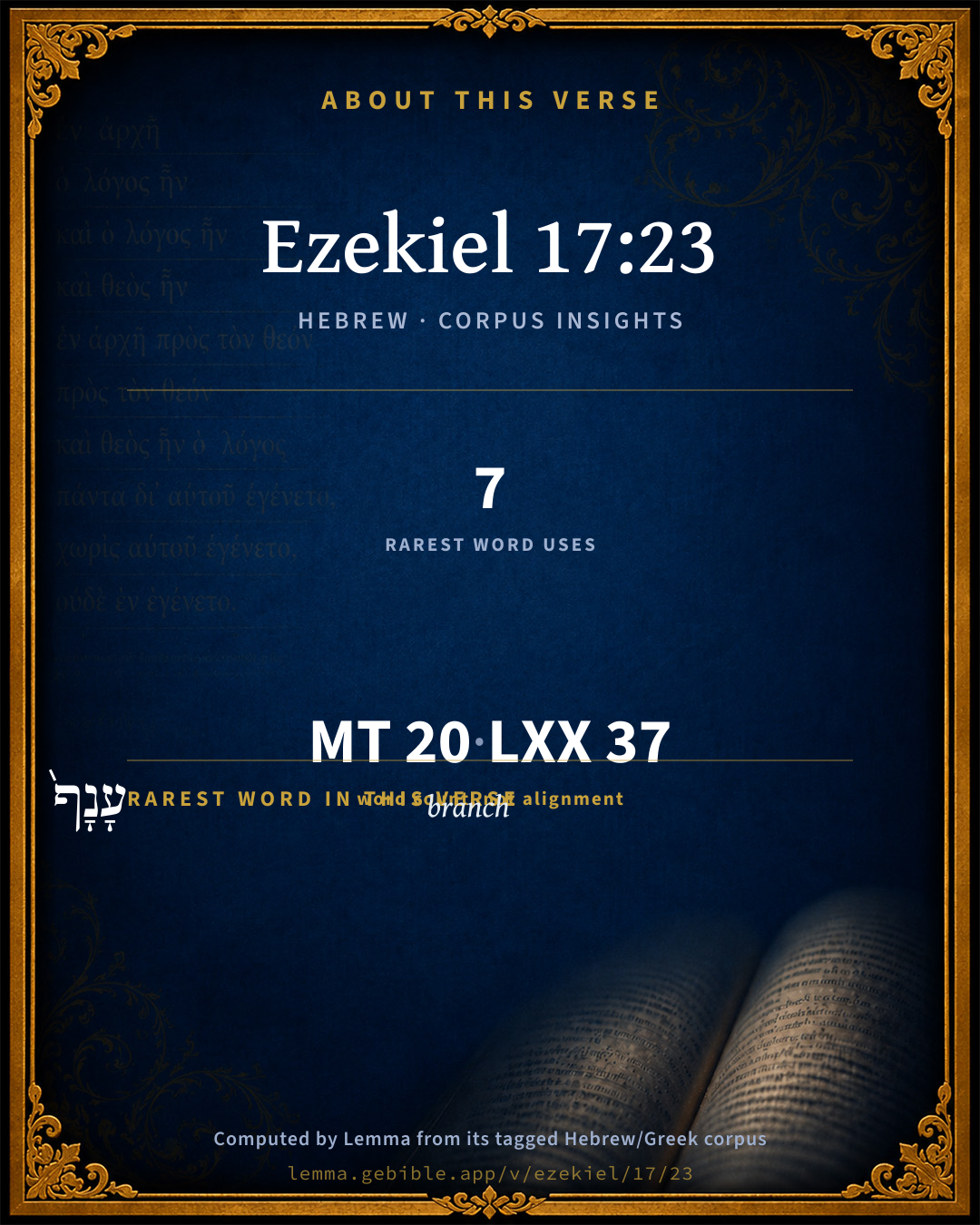
The rarest word here is עָנָף֙ branch H6057 — appearing just 7 times in the whole Hebrew Bible.

Shared distinctive vocabulary

עָנָף֙ branch H6057 occurs in 7 verses of the Hebrew Bible. Also found in:

Grammatical profile

  • 6 verbs
  • 12 nouns
  • 1 adjective
  • 1 preposition

Verb forms

  • אֶשְׁתֳּלֶ֔נּוּ Qal · Imperfect
  • וְנָשָׂ֤א Qal · Sequential Perfect
  • וְעָ֣שָׂה Qal · Sequential Perfect
  • וְהָיָ֖ה Qal · Sequential Perfect
  • וְשָׁכְנ֣וּ Qal · Sequential Perfect
  • תִּשְׁכֹּֽנָּה Qal · Imperfect

Repetition

Words recur within this verse — often emphatic in Hebrew:

  • וְשָׁכְנ֣וּ to dwell H7931 ×2
  • כֹּ֚ל all H3605 ×2

Hebrew & Septuagint length

In English translation the verse runs 47 words from the Hebrew and 53 from the Septuagint (LXX English) — closely comparable.

A rough comparison of the two English renderings, which tokenize alike — not a word-level alignment.

Word counts can differ between the Hebrew and the Greek without any difference in meaning — e.g. the Hebrew direct-object marker אֵת has no separate Greek word, and Greek often adds the article ὁ.

In the original languages it is 20 Hebrew tokens and 37 Greek tokens — but the two are counted differently (Hebrew bundles its prefixes and suffixes into one token; the Greek is in lemma form), so that isn’t a like-for-like length.

Cross-references

22

Topical passages linked to Ezekiel 17:23 in the Treasury of Scripture Knowledge — connected by theme and wording, ordered by reader-vote popularity; previews shown in the World English Bible.

  • Matthew 13:32 which indeed is smaller than all seeds. But when it is grown, it is greater than the herbs, and becomes a tree, so that the birds of the air come and lodge in its branches."
  • Ezekiel 31:6 All the birds of the sky made their nests in its boughs; and under its branches did all the animals of the field bring forth their young; and under its shadow lived all great nations.
  • Isaiah 2:2 It shall happen in the latter days, that the mountain of Yahweh's house shall be established on the top of the mountains, And shall be raised above the hills; And all nations shall flow to it.
  • Hosea 14:7 Men will dwell in his shade. They will revive like the grain, And blossom like the vine. Their fragrance will be like the wine of Lebanon.
  • John 15:5–8 I am the vine. You are the branches. He who remains in me, and I in him, the same bears much fruit, for apart from me you can do nothing.
  • Psalms 22:27–30 All the ends of the earth shall remember and turn to Yahweh. All the relatives of the nations shall worship before you.
  • Psalms 92:12–13 The righteous shall flourish like the palm tree. He will grow like a cedar in Lebanon.
  • Isaiah 27:6 In days to come shall Jacob take root; Israel shall blossom and bud; and they shall fill the surface of the world with fruit.
  • Daniel 4:10–14 Thus were the visions of my head on my bed: I saw, and, behold, a tree in the midst of the earth; and the height of it was great.
  • Daniel 4:21–23 whose leaves were beautiful, and the fruit of it much, and in it was food for all; under which the animals of the field lived, and on whose branches the birds of the sky had their habitation:
  • John 12:24 Most assuredly I tell you, unless a grain of wheat falls into the earth and dies, it remains by itself alone. But if it dies, it bears much fruit.
  • Isaiah 11:6–10 The wolf shall dwell with the lamb, and the leopard shall lie down with the kid; and the calf and the young lion and the fattened calf together; and a little child shall lead them.
  • Acts 10:11–12 He saw heaven opened and a certain container descending to him, like a great sheet let down by four corners on the earth,
  • Galatians 3:28 There is neither Jew nor Greek, there is neither slave nor free man, there is neither male nor female; for you are all one in Christ Jesus.
  • Colossians 3:11 where there can't be Greek and Jew, circumcision and uncircumcision, barbarian, Scythian, bondservant, freeman; but Christ is all, and in all.
  • Genesis 49:10 The scepter will not depart from Judah, Nor the ruler's staff from between his feet, Until he comes to whom it belongs. To him will the obedience of the peoples be.
  • Psalms 72:8–11 He shall have dominion also from sea to sea, From the River to the ends of the earth.
  • Isaiah 49:18 Lift up your eyes round about, and see: all these gather themselves together, and come to you. As I live, says Yahweh, you shall surely clothe you with them all as with an ornament, and gird yourself with them, like a bride.
  • Isaiah 60:4–12 Lift up your eyes round about, and see: they all gather themselves together, they come to you; your sons shall come from far, and your daughters shall be carried in the arms.
  • Matthew 13:47–48 "Again, the Kingdom of Heaven is like a dragnet, that was cast into the sea, and gathered some fish of every kind,
  • Luke 14:21–23 "That servant came, and told his lord these things. Then the master of the house, being angry, said to his servant, 'Go out quickly into the streets and lanes of the city, and bring in the poor, maimed, blind, and lame.'
  • Revelation 11:15 The seventh angel sounded, and great voices in heaven followed, saying, "The kingdom of the world has become the Kingdom of our Lord, and of his Christ. He will reign forever and ever!"

Cross-references courtesy of OpenBible.info (CC BY 4.0).

Hebrew and Greek witnesses Masoretic Hebrew ↔ Greek Septuagint

The same verse in the two great witnesses to the Old Testament, shown verse-for-verse.

These are two independent witnesses, not word-aligned to each other, and the Septuagint is shown in lemma (dictionary) form.

Hebrew Ezekiel 17:23 Masoretic · Westminster Leningrad Codex

בְּהַ֨ר מְר֤וֹם יִשְׂרָאֵל֙ אֶשְׁתֳּלֶ֔נּוּ וְנָשָׂ֤א עָנָף֙ וְעָ֣שָׂה פֶ֔רִי וְהָיָ֖ה לְאֶ֣רֶז אַדִּ֑יר וְשָׁכְנ֣וּ תַחְתָּ֗יו כֹּ֚ל צִפּ֣וֹר כָּל כָּנָ֔ף בְּצֵ֥ל דָּלִיּוֹתָ֖יו תִּשְׁכֹּֽנָּה

in the mountain of the height of Israel will I plant it; and it shall bring forth boughs, and bear fruit, and be a goodly cedar: and under it shall dwell all birds of every wing; in the shade of the branches of it shall they dwell.

World English Bible · Public Domain

Greek LXX Ezekiel 17:23 Septuagint · lemma form

ἐν ὄρος μετέωρος ὁ ἰσραήλ καί καταφυτεύω καί ἐκφέρω βλαστός καί ποιέω καρπός καί εἰμί εἰς κέδρος μέγας καί ἀναπαύω ὑποκάτω αὐτός πᾶς θηρίον καί πᾶς πετεινόν ὑπό ὁ σκιά αὐτός ἀναπαύω ὁ κλῆμα αὐτός ἀπο καταἵστημι

and I will hang it on a lofty mountain of Israel: yes, I will plant it, and it shall put forth shoots, and shall bear fruit, and it shall be a great cedar: and every bird shall rest beneath it, even every fowl shall rest under its shadow: its branches shall be restored.

LXX2012 (modern English Septuagint) · Public Domain

Hebrew: Westminster Leningrad Codex (CC BY 4.0). Greek: Septuagint (public domain); English from LXX2012 (modern English Septuagint) (Public Domain). How the Septuagint differs from the Hebrew →

Targum (Aramaic paraphrase)

1

The Targum is the ancient Jewish Aramaic paraphrase of the Hebrew Scriptures — an interpretive translation, not the Hebrew text itself. Onkelos (literal) and Pseudo-Jonathan (expansive) render the Torah, and Jonathan the Prophets. Coverage is partial: where no permissively-licensed English translation exists for a verse, only the Aramaic is shown. This is verse-level text, not a word-by-word alignment to the Hebrew.

  1. Targum Jonathan Prophets (Joshua–Malachi)
    בְּטוּר קוּדְשָׁא דְיִשְׂרָאֵל אֲקַיְמִינֵיהּ וְיַכְנֵישׁ מַשִׁרְיָן וְיַעְבֵיד סוּמְכְוָן וִיהֵי לְמֶלֶךְ תַּקִיף וְיִסְתַּמְכוּן עֲלוֹהִי כָּל צַדִיקַיָא וְכָל עִנְוְתָנַיָא בִּטְלַל מַלְכוּתֵיהּ יִשְׁרוּן:

    (no public-domain English translation for this verse)

    Targum Jonathan — Aramaic: “Mikraot Gedolot” (public domain). English: “Sefaria Community Translation” (CC0 1.0 (public-domain dedication)); “London "Chaldee Paraphrase," 1871” (public domain). Text via Sefaria.

Commentary

Notes on Ezekiel 17:23 from classic Christian and Jewish commentators (each source and its license shown beneath its notes). The classic Christian expositions comment on the surrounding passage and are grouped to its opening verse, so a note may address several verses; the Jewish commentaries on the Tanakh (Rashi and others) are per-verse, so they appear only where the commentator wrote on this verse.

Lemma curates 59 commentaries, every one of them public domain or Creative Commons licensed, each selected and text-cleaned for this edition rather than reprinted as found. About our sources →

Trapp's Complete Commentary

John Trapp

Eze 17:23 In the mountain of the height of Israel will I plant it: and it shall bring forth boughs, and bear fruit, and be a goodly cedar: and under it shall dwell all fowl of every wing; in the shadow of the branches thereof shall they dwell.

Ver. 23. In the mountain.] In the Church, that highest top.

And it shall bring forth boughs, &c.] Christ shall yield food and defence to all his.

All fowl of every wing,] i.e., The just, saith the Chaldee, who mind heavenly things, and mount upward.

John Trapp, A Commentary or Exposition upon All the Books of the Old and New Testament (1647–1656) — public domain. Text from a community e-Sword module.

Geneva Bible (1599)

Geneva Bible translators

Both the Jews and Gentiles shall be gathered into it.

Geneva Bible (1599) marginal notes — public domain. Text via Bolls.life.

Jamieson, Fausset & Brown

Robert Jamieson, A. R. Fausset & David Brown

under it . . . all fowl--the Gospel "mustard tree," small at first, but at length receiving all under its covert (Mat 13:32); the antithesis to Antichrist, symbolized by Assyria, of which the same is said (Eze 31:6), and Babylon (Dan 4:12). Antichrist assumes in mimicry the universal power really belonging to Christ.

Jamieson, Fausset & Brown — Commentary Critical and Explanatory on the Whole Bible (1871) — public domain (CC PDM 1.0). Text via the HelloAO Bible API.

Adam Clarke's Commentary

Verse 23. In the mountain of the height of Israel] He shall make his appearance at the temple, and found his Church at Jerusalem.

Shall bring forth boughs] Apostles, evangelists, and their successors in the Gospel ministry.

And bear fruit] Multitudes of souls shall be converted by their preaching.

And under it shall dwell all fowl of every wing] All the nations of the earth shall receive his Gospel.

In the shadow of the branches thereof shall they dwell.] Trust in him alone for salvation, and be saved in their trusting.

Adam Clarke's Commentary on the Bible (1810–1826) — public domain. Text from a community e-Sword/MySword module.

John Calvin's Commentaries

When God announces that the twig which he will plant shall become a lofty cedar, he shows by lofty words that the increase of Christ’s kingdom shall be so wonderful, that it shall surpass the common rule of nature; which indeed was shadowed forth in the person of Zerubbabel, who was chosen to bring back the people from their sad and disgraceful captivity. (Ezra 2:2; Haggai 1:14.) For it does not naturally happen that a twig increases in a short time to a lofty cedar, for we know how slowly cedars grow, and hence we see the Spirit’s intention in saying that a tree should spring from a very small twig. And this prophecy answers to one of Isaiah’s, where he says, (Isaiah 11:1,) A branch shall spring from the root of Jesse: for the house of Jesse was cut off, and he names the house of an obscure and private man as if the remembrance of David were utterly lost. The house of Jesse then was cut off like a tree: that twig, says he, shall spring from its root. Now the Prophet signifies the same thing, and almost under the same similitude. I leave the rest for the next lecture.

John Calvin's Commentaries (1540-1563) — public domain. Text from the Calvin Translation Society English edition (1840s-50s) via the Christian Classics Ethereal Library (ccel.org). Calvin's coverage is partial (roughly two-thirds of the Bible); uncommented books and verses are honest gaps, never fabricated. The 19th-century editor's footnotes and remarks are omitted so the notes are faithfully Calvin's own voice.

Ellicott's Commentary for English Readers

(23) In the mountain of the height of Israel, i.e., Mount Zion, called in the parallel passage (Eze_20:40) “mine holy mountain.” Similar prophecies are also to be found in Isa_2:2-4; Mic_4:1-3; Psa_2:6. No point is made more clear in the prophecies of the Christian dispensation than that it is to have its roots in the Jewish, that the “law shall go forth from Zion,” and that the new covenant shall yet be a covenant with God’s people of old. This mountain is to be understood as the representative of the centre and seat of the kingdom of Israel, and not to be confined too literally to the actual hill of Zion itself.

Be a goodly cedar.—Not like the vine of low stature; this shall grow into a strong and great tree, under whose shadow all the inhabitants of the earth shall find sustenance and protection. A similar figure is used by the contemporary prophet Daniel (Dan_4:20-21), and by our Lord Himself in the parable (Mat_13:32). The universality of the blessings of the Christian dispensation, in contrast with the narrowness of the Jewish, is one of its features most frequently dwelt upon both in prophecy and in the New Testament, and shall still enter into the burden of the songs of the redeemed (Rev_5:9). The last clause of the verse repeats and emphasises the permanence of the connection of the believer with Christ.

A Bible Commentary for English Readers, edited by Charles John Ellicott (1878–1897) — public domain. Text from a community e-Sword module.

The Cambridge Bible for Schools and Colleges

gen. ed. J. J. S. Perowne

23. mountain of the height] Cf. ch. Eze_20:40, Eze_40:2.

fowl of every wing] As fowls flock to a great tree so all peoples will put their trust in the shadow of this great monarchy in the land of Israel; ch. Eze_31:6; Dan_4:12; Mat_13:32.

The Cambridge Bible for Schools and Colleges (gen. ed. J. J. S. Perowne; Cambridge University Press, 1878–1918) — public domain. Text from a community e-Sword module.

Albert Barnes' Notes on the Bible

In the mountain of the height of Israel - The parallel passage Eze 20:40 points to the mountain on which the temple stood. But it is not here the actual Mount Moriah so much as the kingdom of which that mountain was the representative, the seat of the throne of the anointed Son of God (Psa 2:6; compare Psa 40:2).

All fowl of every wing - (or, of every kind) are those who flock from all lands to this kingdom. Compare Mat 13:32.

The prophet brings prominently forward the future exaltation of the king; and he furnishes us thereby with hope, encouragement, and consolation, at such times as we see the Church of Christ in like depression.

Albert Barnes' Notes on the Bible (1834–1885) — public domain. Text from a community e-Sword/MySword module.

Matthew Poole's English Annotations

In the mountain; either the church or Jerusalem, whence the law of Christ was to be published, and where the preachers of the gospel were to continue till furnished with abilities for that work. Like a tree that taketh root, and spreadeth forth into branches, so the kingdom of Christ should grow, and be fruitful in good works, not flourishing in boughs and leaves only, but much more in excellent fruits of holiness, justice, and temperance, and in joy, peace, and love.

A goodly cedar; the goodliest that ever grew, most excellent and most durable.

All fowl, all nations, the Gentiles as well as the Jews, shall build, breed, and multiply under the kingdom of Christ; it shall be no more confined to the Jews, but extend to the Gentiles also. There they shall find peace and safety; and this repeated confirms the certainty of the promise.

Matthew Poole's English Annotations on the Holy Bible (1683–1685) — public domain. Text from a community e-Sword/MySword module.

Whedon's Commentary on the Bible

Daniel D. Whedon

23. In the mountain of the height… will I plant it — Compare Eze_17:3; Eze_20:40; Eze_40:2; Isa_2:9; Isa_11:10; Mic_4:1-3. This new kingdom shall be conspicuous and fruitful, yea, it shall be a universal kingdom, for “all fowl of every wing” shall dwell under it (Eze_31:6; Dan_4:12). Babylon could only make of the Israelitish kingdom a “vine of low stature,” and Egypt could not do more; but Jehovah can make of it a mighty cedar crowning the mountain height. This was never realized until the Messianic kingdom was set up by the divine “Branch” on the holy hill of Zion. (Zec_3:8; Isa_53:2; Isa_11:1.) In the only fragment of a wall preserved from the most ancient mosque in Damascus is carved this sentence: “Thy kingdom is an everlasting kingdom, and thy dominion endureth throughout all generations” (<19E513>Psa_145:13; Dan_2:44; Dan_7:27).

Daniel D. Whedon (gen. ed.), Commentary on the Old and New Testaments (1874–1909) — public domain. Text from a community e-Sword module.

John Wesley's Explanatory Notes

In the mountain - In Jerusalem. All fowl - All nations. In the shadow - There they shall find peace and safety.

John Wesley, Explanatory Notes Upon the Whole Bible (1754–1765) — public domain. Text via the GEBible commentary corpus.

Rashi

Rabbi Shlomo Yitzchaki (Rashi)

shall they dwell Heb. תִּשְּׁכֹּנָה. The ‘dagesh’ in the ‘nun’ serves instead of a second ‘nun,’ as though it were written תִּשּׁכֹּנְנָה.

Rashi on the Tanakh — English translations: “The Judaica Press complete Tanach with Rashi, translated by A. J. Rosenberg” (CC BY 4.0); “Pentateuch with Rashi's commentary by M. Rosenbaum and A.M. Silbermann, 1929-1934” (public domain); “The Metsudah Tanach series, Lakewood, N.J” (CC BY 4.0); and “The Book of Joshua, Metsudah Publications, 1997” (CC BY 4.0). Text via Sefaria.

Lesson kit

Teaching starters — assembled from the data on this page, not authored interpretation. Every prompt links to the verse data it draws on. Edit before teaching.

Ezekiel, in the Prophets, opens this verse with 20 words (18 distinct Hebrew lemmas). Its most distinctive word is ʻânâph (“branch”). A historical commentator’s framing appears above. Read the whole chapter for the surrounding context.

Discussion questions

  1. What does “branch” (ʻânâph) contribute to the verse as a whole?
  2. Leviticus 23:40 shares the word «branch» with this verse. How do the two illuminate each other?
  3. “to dwell” occurs 2× in this one verse. What is the effect of the repetition?
  4. These translations render this verse differently. What is at stake in choosing one wording over another?
  5. The verb «אֶשְׁתֳּלֶ֔נּוּ» is Qal Imperfect. How does its form color the action?
  6. Reading how Trapp's Complete Commentary and Geneva Bible (1599) read this verse, where do the two commentators agree and where do they part?

Things to notice

Reading settings

Reading text

Shown beneath each verse's original-language words.

Old Testament
Old Testament edition

Read the OT as the Masoretic Hebrew (MT) or the Greek Septuagint (LXX).

English shown for the Greek Septuagint (in the Hebrew ↔ Greek comparison).

Comparing translations? Open the Compare panel on any verse page to stack up to four side by side.