
Jeremiah 32:19

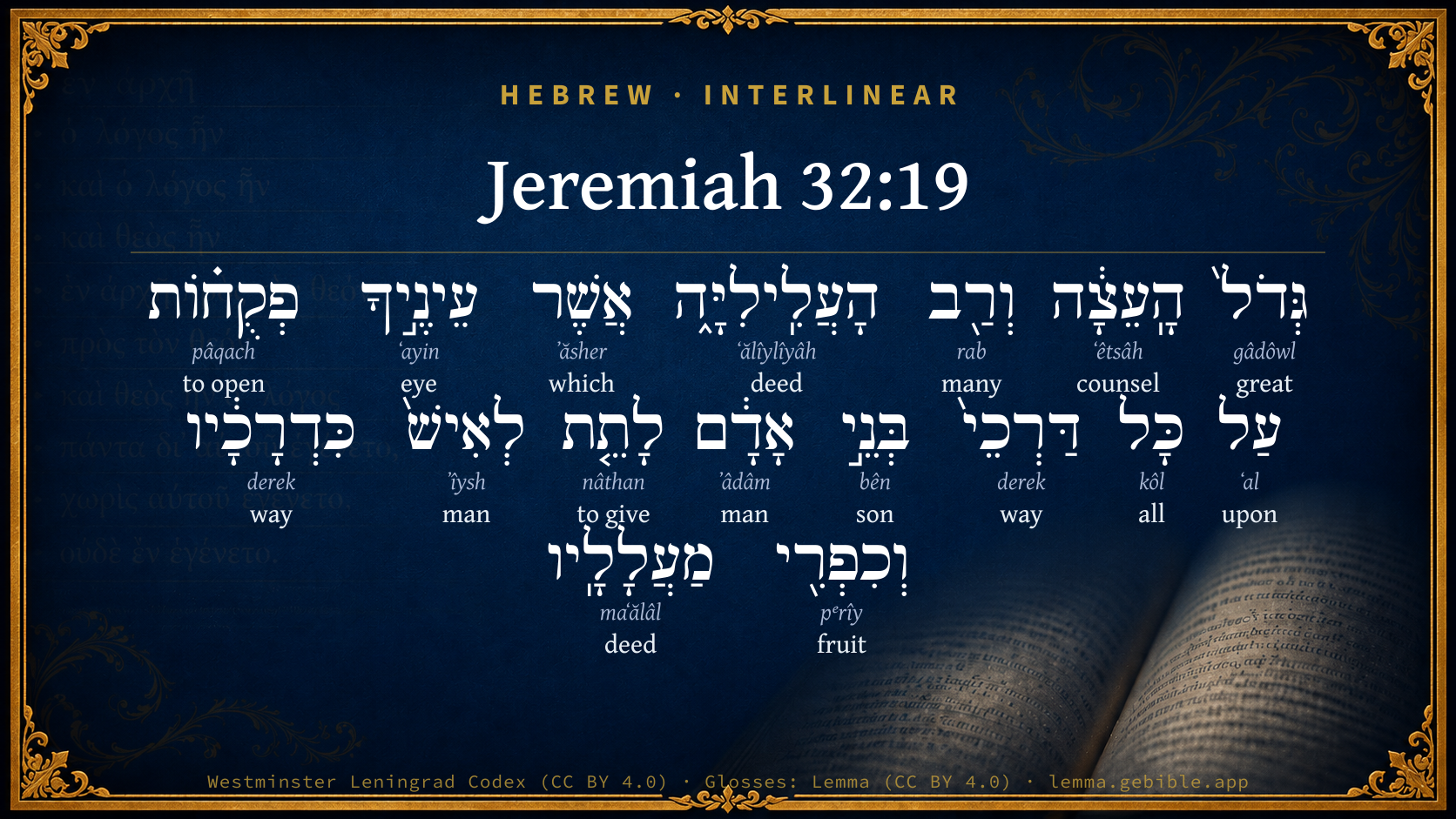
Hebrew (Westminster Leningrad Codex) Jeremiah 32:19 appears in the Hebrew Old Testament. The text above is from the Westminster Leningrad Codex. Each word links to its Strong’s number, a concise gloss, and parsing drawn from the Open Scriptures Hebrew Bible morphology. Click any word for its full Brown-Driver-Briggs (BDB) entry.
Download image
Cite this verse

Jeremiah 32:19 (World English Bible). Public Domain. Lemma interlinear Bible study tool, https://lemma.gebible.app/v/jeremiah/32/19.

Show BibTeX & RIS
BibTeX
RIS
English Translation
great in counsel, and mighty in work; whose eyes are open on all the ways of the sons of men, to give everyone according to his ways, and according to the fruit of his doings:
World English Bible · Public Domain
Highlights
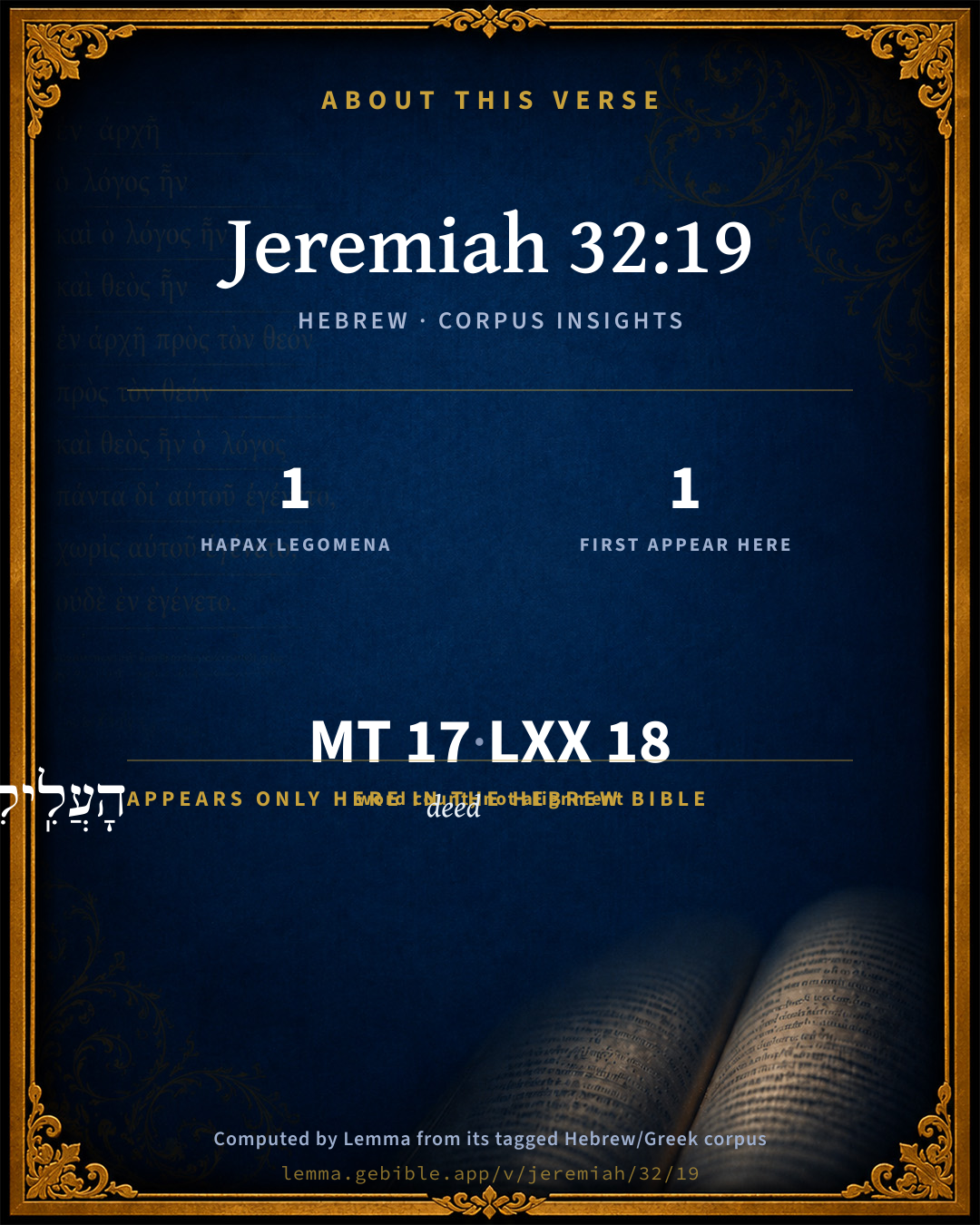
  • 1 hapax legomenon — only here in the Hebrew Bible
  • 1 first appearance in the Hebrew Bible
Full analysis ↓
Download a study sheet

One document with this verse’s original text, its word-by-word gloss line, the meaning frame, cross-references with their text, attributed commentary, and full source and license credits — printable, and it pastes into notes with its structure intact.

This verse Autodidact and up

Study sheet (.html) Plain text (.txt)

A passage Seminary Student

Up to 50 verses in one chapter. A passage sheet keeps up to 6 commentary sources and 12 cross-references per verse, in the order this page ranks them, and says so on the sheet whenever that leaves anything out. Ask for a single verse and you get the Autodidact verse sheet above.

Everything on this page stays free to read, with no account — the sheet is a download of what is already on screen, not access to it.

Want to remove ads? Support Godless Engineer
Compare translations 3

The same verse in 3 English versions, stacked beneath the original-language interlinear above. Click any original word for its lexicon entry.

Each is an independent rendering of the whole verse — the interlinear is not word-aligned to these translations.

Highlighted words mark where these versions differ — a whole-verse word diff, not a word-by-word alignment.

  • World English Bible Public Domain
    great in counsel, and mighty in work; whose eyes are open on all the ways of the sons of men, to give everyone according to his ways, and according to the fruit of his doings:
  • King James Version Public Domain
    Great in counsel, and mighty in work: for thine eyes are open upon all the ways of the sons of men: to give every one according to his ways, and according to the fruit of his doings:
  • unfoldingWord Literal Text CC BY-SA 4.0
    You are great in wisdom and mighty in deeds, for your eyes are open to all the ways of people, to give to each man what his conduct and deeds deserve.

unfoldingWord Literal Text — © unfoldingWord, licensed CC BY-SA 4.0. Word-aligned USFM3 via Door43 (git.door43.org/unfoldingWord/en_ult).

Versions to compare (up to 4)

3 of 4 selected

Show all 18 translations

Every available English version of this verse, each an independent rendering of the whole verse.

  • World English Bible Public Domain
    great in counsel, and mighty in work; whose eyes are open on all the ways of the sons of men, to give everyone according to his ways, and according to the fruit of his doings:
  • Berean Standard Bible Public Domain
    the One great in counsel and mighty in deed, whose eyes are on all the ways of the sons of men, to reward each one according to his ways and according to the fruit of his deeds.
  • Majority Standard Bible Public Domain
    the One great in counsel and mighty in deed, whose eyes are on all the ways of the sons of men, to reward each one according to his ways and according to the fruit of his deeds.
  • King James Version Public Domain
    Great in counsel, and mighty in work: for thine eyes are open upon all the ways of the sons of men: to give every one according to his ways, and according to the fruit of his doings:
  • American Standard Version (1901) Public Domain
    great in counsel, and mighty in work; whose eyes are open upon all the ways of the sons of men, to give every one according to his ways, and according to the fruit of his doings:
  • Revised Version (1885) Public Domain
    great in counsel, and mighty in work: whose eyes are open upon all the ways of the sons of men; to give every one according to his ways, and according to the fruit of his doings:
  • Geneva Bible (1599) Public Domain
    Great in counsell, and mightie in worke, (for thine eyes are open vpon all the wayes of ye sonnes of men, to giue to euery one according to his wayes, and according to the fruite of his workes)
  • Douay-Rheims (1899) Public Domain
    Great in counsel and incomprehensible in thought: whose eyes are open upon all the ways of the children of Adam, to render unto every one according to his ways, and according to the fruit of his devices.
  • Young's Literal Translation Public Domain
    Great in counsel, and mighty in act, in that Thine eyes are open on all the ways of the sons of Adam, to give to each according to his ways, and according to the fruit of his doings:
  • Literal Standard Version CC BY-SA 4.0
    great in counsel, and mighty in act, in that Your eyes are open on all the ways of the sons of Adam, to give to each according to his ways, and according to the fruit of his doings;
  • Unlocked Literal Bible CC BY-SA 4.0
    You are great in wisdom and mighty in deeds, for your eyes are open to all the ways of people, to give to each man what his conduct and deeds deserve.
  • unfoldingWord Literal Text CC BY-SA 4.0
    You are great in wisdom and mighty in deeds, for your eyes are open to all the ways of people, to give to each man what his conduct and deeds deserve.
  • Darby Bible Public Domain
    great in counsel and mighty in work, whose eyes are open upon all the ways of the children of men, to give every one according to his ways, and according to the fruit of his doings:
  • World Messianic Bible Public Domain
    great in counsel, and mighty in work; whose eyes are open to all the ways of the children of men, to give everyone according to his ways, and according to the fruit of his doings;
  • Webster's Bible Public Domain
    Great in counsel, and mighty in work: for thy eyes are open upon all the ways of the sons of men: to give every one according to his ways, and according to the fruit of his doings:
  • Free Bible Version CC BY-SA 4.0
    you are the one who is supremely wise and who does incredible things. You watch what everyone does, and you reward them according to the way they live and what their actions deserve.
  • Bible in Basic English Public Domain
    Great in wisdom and strong in act: whose eyes are open on all the ways of the sons of men, giving to everyone the reward of his ways and the fruit of his doings:
  • JPS Tanakh (1917) Public Domain
    great in counsel, and mighty in work; whose eyes are open upon all the ways of the sons of men, to give every one according to his ways, and according to the fruit of his doings;

Literal Standard Version (2020), Covenant Press — licensed CC BY-SA 4.0. Text via the HelloAO Bible API (eBible.org). Unlocked Literal Bible (unfoldingWord) — licensed CC BY-SA 4.0. Text via the HelloAO Bible API (eBible.org). unfoldingWord Literal Text — © unfoldingWord, licensed CC BY-SA 4.0. Word-aligned USFM3 via Door43 (git.door43.org/unfoldingWord/en_ult). Free Bible Version, Dr. Jonathan Gallagher — licensed CC BY-SA 4.0. Text via the HelloAO Bible API (eBible.org).

Word by word

More ways to search: Search by grammar → Find every occurrence → Compare this word →

Practice this passage: Drill this verse → Learn its vocabulary →

הָעֲלִֽילִיָּ֑ה
ʻălîylîyâh
H5950
“the · deed”
Particle, Definite Article + Noun, Common, Feminine, Singular, Absolute
Part of Speech
Particle + Noun
Type
Common
Gender
Feminine
Number
Singular
State
Absolute
Full BDB Definition

Origin: for H5949

TWOT: 1627d

deed
  1. גְּדֹל֙ gâdôwl H1419 “great of” Adjective, Adjective, Masculine, Singular, Construct
  2. הָֽעֵצָ֔ה ʻêtsâh H6098 “the · counsel” Particle, Definite Article + Noun, Common, Feminine, Singular, Absolute
  3. וְרַ֖ב rab H7227 “and · many of” Conjunction + Adjective, Adjective, Masculine, Singular, Construct
  4. אֲשֶׁר ʼăsher H834 “which” Particle, Relative
  5. עֵינֶ֣יךָ ʻayin H5869 “eyes · your” Noun, Common, Both, Dual, Construct + Suffix, Personal, 2nd Person, Masculine, Singular
  6. פְקֻח֗וֹת pâqach H6491 “opened” Verb, Qal, Participle Passive, Feminine, Plural, Absolute
  7. עַל ʻal H5921 “upon” Preposition
  8. כָּל kôl H3605 “all of” Noun, Common, Masculine, Singular, Construct
  9. דַּרְכֵי֙ derek H1870 “ways of” Noun, Common, Both, Plural, Construct
  10. בְּנֵ֣י bên H1121 “sons of” Noun, Common, Masculine, Plural, Construct
  11. אָדָ֔ם ʼâdâm H120 “man” Noun, Common, Masculine, Singular, Absolute
  12. לָתֵ֤ת nâthan H5414 “to give” Preposition + Verb, Qal, Infinitive Construct
  13. לְאִישׁ֙ ʼîysh H376 “to/for · man” Preposition + Noun, Common, Masculine, Singular, Absolute
  14. כִּדְרָכָ֔יו derek H1870 “like/as · ways · his” Preposition + Noun, Common, Both, Plural, Construct + Suffix, Personal, 3rd Person, Masculine, Singular
  15. וְכִפְרִ֖י pᵉrîy H6529 “and · like/as · fruit of” Conjunction + Preposition + Noun, Common, Masculine, Singular, Construct
  16. מַעֲלָלָֽיו maʻălâl H4611 “deeds · his” Noun, Common, Masculine, Plural, Construct + Suffix, Personal, 3rd Person, Masculine, Singular

About this verse

These counts appear in no published source. They are computed here, from the morphology-tagged text and Lemma’s own curated glosses. What Lemma adds →

17
words
16
distinct lemmas
Prophets
section

Notable vocabulary

1 hapax legomenon — a word that appears only here in the entire Hebrew Bible:

  • הָעֲלִֽילִיָּ֑ה deed H5950

First appearance in Scripture

This word makes its first canonical appearance in the Hebrew Bible here:

  • הָעֲלִֽילִיָּ֑ה deed H5950

Shared distinctive vocabulary

פְקֻח֗וֹת to open H6491 occurs in 18 verses of the Hebrew Bible. Also found in:

Grammatical profile

  • 2 verbs
  • 11 nouns
  • 2 adjectives
  • 1 preposition
  • 1 particle

Verb forms

  • פְקֻח֗וֹת Qal · Participle Passive
  • לָתֵ֤ת Qal · Infinitive Construct

Repetition

A word recurs within this verse — often emphatic in Hebrew:

  • דַּרְכֵי֙ way H1870 ×2

Hebrew & Septuagint length

In the original languages it is 17 Hebrew tokens and 18 Greek tokens — but the two are counted differently (Hebrew bundles its prefixes and suffixes into one token; the Greek is in lemma form), so that isn’t a like-for-like length.

Cross-references

26

Topical passages linked to Jeremiah 32:19 in the Treasury of Scripture Knowledge — connected by theme and wording, ordered by reader-vote popularity; previews shown in the World English Bible.

  • Jeremiah 17:10 I, Yahweh, search the mind, I try the heart, even to give every man according to his ways, according to the fruit of his doings.
  • Matthew 16:27 For the Son of Man will come in the glory of his Father with his angels, and then he will render to everyone according to his deeds.
  • Psalms 62:12 Also to you, Lord, belongs loving kindness, For you reward every man according to his work.
  • Isaiah 28:29 This also comes forth from Yahweh of Hosts, who is wonderful in counsel, and excellent in wisdom.
  • Job 34:21 "For his eyes are on the ways of a man, He sees all his goings.
  • Jeremiah 16:17 For my eyes are on all their ways; they are not hidden from my face, neither is their iniquity concealed from my eyes.
  • Revelation 2:23 I will kill her children with Death, and all the assemblies will know that I am he who searches the minds and hearts. I will give to each one of you according to your deeds.
  • Revelation 22:12 "Behold, I come quickly. My reward is with me, to repay to each man according to his work.
  • Proverbs 5:21 For the ways of man are before the eyes of Yahweh. He examines all his paths.
  • Isaiah 9:6 For to us a child is born, to us a son is given; and the government shall be on his shoulder: and his name shall be called Wonderful, Counselor, Mighty God, Everlasting Father, Prince of Peace.
  • Isaiah 40:13 Who has directed the Spirit of Yahweh, or being his counselor has taught him?
  • Jeremiah 23:24 Can any hide himself in secret places so that I shall not see him? says Yahweh. Don't I fill heaven and earth? says Yahweh.
  • John 5:29 and will come out; those who have done good, to the resurrection of life; and those who have done evil, to the resurrection of judgment.
  • Hebrews 4:13 There is no creature that is hidden from his sight, but all things are naked and laid open before the eyes of him with whom we have to do.
  • Psalms 34:15 Yahweh's eyes are toward the righteous. His ears listen to their cry.
  • Ecclesiastes 12:14 For God will bring every work into judgment, with every hidden thing, whether it is good, or whether it is evil.
  • Isaiah 46:10–11 declaring the end from the beginning, and from ancient times things that are not [yet] done; saying, My counsel shall stand, and I will do all my pleasure;
  • Daniel 4:35 All the inhabitants of the earth are reputed as nothing; and he does according to his will in the army of heaven, and among the inhabitants of the earth; and none can stay his hand, or tell him, What do you?
  • Romans 2:6–10 who "will pay back to everyone according to their works:"
  • Romans 11:33–34 Oh the depth of the riches both of the wisdom and the knowledge of God! How unsearchable are his judgments, and his ways past tracing out!
  • 2 Corinthians 5:10 For we must all be revealed before the judgment seat of Christ; that each one may receive the things in the body, according to what he has done, whether good or bad.
  • Ephesians 1:11 in whom also we were assigned an inheritance, having been foreordained according to the purpose of him who works all things after the counsel of his will;
  • Exodus 15:11 Who is like you, Yahweh, among the gods? Who is like you, glorious in holiness, Fearful in praises, doing wonders?
  • 1 Kings 8:32 then hear you in heaven, and do, and judge your servants, condemning the wicked, to bring his way on his own head, and justifying the righteous, to give him according to his righteousness.
  • 2 Chronicles 16:9 For the eyes of Yahweh run back and forth throughout the whole earth, to show himself strong in the behalf of them whose heart is perfect toward him. Herein you have done foolishly; for from henceforth you shall have wars.
  • Psalms 33:13–15 Yahweh looks from heaven. He sees all the sons of men.

Cross-references courtesy of OpenBible.info (CC BY 4.0).

Hebrew and Greek witnesses Masoretic Hebrew ↔ Greek Septuagint

The same verse in the two great witnesses to the Old Testament, shown verse-for-verse.

These are two independent witnesses, not word-aligned to each other, and the Septuagint is shown in lemma (dictionary) form.

Hebrew Jeremiah 32:19 Masoretic · Westminster Leningrad Codex

גְּדֹל֙ הָֽעֵצָ֔ה וְרַ֖ב הָעֲלִֽילִיָּ֑ה אֲשֶׁר עֵינֶ֣יךָ פְקֻח֗וֹת עַל כָּל דַּרְכֵי֙ בְּנֵ֣י אָדָ֔ם לָתֵ֤ת לְאִישׁ֙ כִּדְרָכָ֔יו וְכִפְרִ֖י מַעֲלָלָֽיו

great in counsel, and mighty in work; whose eyes are open on all the ways of the sons of men, to give everyone according to his ways, and according to the fruit of his doings:

World English Bible · Public Domain

Greek LXX Structure differs

In the Septuagint, Jeremiah is about an eighth shorter than the Hebrew and arranges its material differently — the Oracles Against the Nations (Hebrew chapters 46–51) appear in the middle of the Greek book, after 25:13. Because the chapter and verse boundaries do not line up, a verse-for-verse comparison with the Hebrew is not shown.

A verse-for-verse comparison isn’t shown here because the chapters and verses don’t line up. Switch to the LXX edition with the MT / LXX toggle above to read the Greek directly.

Hebrew: Westminster Leningrad Codex (CC BY 4.0). Greek: Septuagint (public domain); English from a public-domain English Septuagint. How the Septuagint differs from the Hebrew →

Targum (Aramaic paraphrase)

1

The Targum is the ancient Jewish Aramaic paraphrase of the Hebrew Scriptures — an interpretive translation, not the Hebrew text itself. Onkelos (literal) and Pseudo-Jonathan (expansive) render the Torah, and Jonathan the Prophets. Coverage is partial: where no permissively-licensed English translation exists for a verse, only the Aramaic is shown. This is verse-level text, not a word-by-word alignment to the Hebrew.

  1. Targum Jonathan Prophets (Joshua–Malachi)
    דְרַבְרְבִין מִלְכוֹהִי וְסַגִיאִין עוֹבָדוֹהִי דִי קָדָמָךְ גַלְיָן כָּל אוֹרְחַת בְּנֵי אֱנָשָׁא לְמִתַּן לֶאֱנַשׁ כְּאוֹרְחָתֵיהּ וּכְפֵירֵי עוֹבָדוֹהִי:

    (no public-domain English translation for this verse)

    Targum Jonathan — Aramaic: “Mikraot Gedolot” (public domain). English: “Sefaria Community Translation” (CC0 1.0 (public-domain dedication)); “London "Chaldee Paraphrase," 1871” (public domain). Text via Sefaria.

Commentary

Notes on Jeremiah 32:19 from classic Christian and Jewish commentators (each source and its license shown beneath its notes). The classic Christian expositions comment on the surrounding passage and are grouped to its opening verse, so a note may address several verses; the Jewish commentaries on the Tanakh (Rashi and others) are per-verse, so they appear only where the commentator wrote on this verse.

Lemma curates 59 commentaries, every one of them public domain or Creative Commons licensed, each selected and text-cleaned for this edition rather than reprinted as found. About our sources →

Trapp's Complete Commentary

John Trapp

Jer 32:19 Great in counsel, and mighty in work: for thine eyes [are] open upon all the ways of the sons of men: to give every one according to his ways, and according to the fruit of his doings:

Ver. 19. Great in counsel and mighty in work.] See on Isa 9:6; Isa 28:29.

For thine eyes are upon all the ways of the sons of men.] Oh that we could always look upon these eyes of God as looking on us! it would be a notable retentive from evil and incentive to good.

To give unto every one according to his ways.] God’s providence (which is nothing else but the carrying on of his decree) is that helm which turneth about the whole ship of the universe.

John Trapp, A Commentary or Exposition upon All the Books of the Old and New Testament (1647–1656) — public domain. Text from a community e-Sword module.

The Biblical Illustrator

Joseph S. Exell

Jer_32:19

Great in counsel, and mighty in work.

The greatness of Gods wisdom, and the abundance of His power

I. Consider the subject speculatively.

1. My first proofs shall be taken from the nature of God. The nature of God proves that He is great in counsel. Consider the perfect knowledge that He hath of all possible beings, as well as of all the beings which do actually exist. The knowledge of all possible beings, diversified without end by the same intelligence that imagines them: What designs, or, as our prophet expresseth himself, What greatness of counsel doth it afford the Supreme Being? But let us not lose ourselves in the world of possible beings; let us confine our attention to real existences. I am willing even to reduce them to two classes. Let each of you imagine, as far as his ability can reach, how great the counsel of an intelligence must be, who perfectly knows all that can result from the various arrangements of matter, and from the different modifications of mind. The Supreme Being perfectly knows what must result from every different arrangement of the parts of bodies infinitely small; and He perfectly knows what must result from every different arrangement of the parts of bodies infinitely great. What treasures of plans! What myriads of designs! or, to use the language of my text, What greatness of counsel must this knowledge supply! But God knows spirits also as perfectly as He knows bodies. If He knows all that must result from the various arrangements of matter, He also knows all that must result from the different modifications of mind. Human spirits, of which we have but an imperfect knowledge, are thoroughly known to Him. He knows the conceptions of our minds, the passions of our hearts, all our purposes, and all our powers. But what is this object of the Divine knowledge? What is this handful of mankind, in comparison of all the other spirits that compose the whole intelligent world, of which we are only an inconsiderable part? God knows them as He knows us; and He diversifies the counsels of His own wisdom according to the different thoughts, deliberations, and wishes of these different spirits. We have proved then, by considering the Divine perfections, that God is great in counsel, and we shall endeavour to prove by the same method that He is mighty in work. These two, wisdom and power, are not always united; yet it is on their union that the happiness of intelligent beings depends. In God, the Supreme Being, there is a perfect harmony of wisdom and power: The efficiency of His will, and the extent of His knowledge are equal Carry your thoughts back into those periods in which the Perfect Being existed alone. Sound reason must allow that He hath so existed. What could then have been the rule or model of beings which should in future exist? The ideas of God were those models. And what could cause those beings, that had only an ideal existence in the intelligence of God, actually to exist out of it? The efficiency of His will was the cause. The will of the same Being then, whose ideas had been the exemplars, or models, of the attributes of creatures, caused their existence. The Supreme Being therefore, who is great in counsel, is mighty in work. This being granted, consider now the ocean of Gods power, as ye have already considered the greatness of His counsel. God not only knows what motion of your brain will excite such or such an idea in your mind, but He excites or prevents that idea as He pleaseth, because He produceth or preventeth that motion of your brain as He pleaseth. God not only knows what objects will excite certain passions within you, but He excites or diverts those passions as He pleaseth. God not only knows what projects your passions will produce, when they have gained an ascendency over you, but He inclines you to form, or not to form, such projects, because, as it seems best to Him, He excites those passions, or He curbs them.

2. Let us take another method (and here I allege the second proof of the truth of my text, that is, the history of the world, or of the Church): Let us take, I say, another method of proving that God, who is great in counsel, is also mighty in work. What counsel can ye imagine too great for God to execute, or which He hath not really executed? Let the most fruitful imagination exert its fertility to the utmost; let it make every possible effort to form plans worthy of an infinite intelligence, it can invent nothing so difficult that God hath not realised.

(1) God hath the power of making the deepest of His childrens afflictions produce their highest happiness.

(2) God establisheth His Church by the very means that tyrants use to destroy it.

(3) God turneth the victories of Satan to the ruin of his empire. Here fix your attention upon the work of redemption, for the perfections of God, which we celebrate to-day, are more illustriously displayed in it than in any other of the Creators wonders.

II. Consider the greatness of Gods counsel, and the omnipotence of His working, in a practical light. When we have proved that God is great in counsel, and mighty in work, in my opinion, we have sufficiently shown, on the one hand, the extravagance of those madmen who pretend to exercise wisdom and understanding, and counsel against the Lord: and, on the other, the wisdom of those who, taking His laws for the only rules of their conversation, commit their peace, their lives, and their salvation, to the disposal of His providence. Only let us take care that we do not flatter ourselves into an opinion that we possess this wisdom while we are destitute of it: and let us take care, while we exclaim against the extravagance of those madmen, that we do not imitate their dangerous examples. But what! Is it possible to find, among beings who have the least spark of reason, an individual mad enough to suppose himself wiser than that God who is great in counsel, or, is there one who dare resist a God mighty in working? But who then, ye will ask me, who are those men, who presumptuously think of overcoming God by their superior knowledge and power? Who? It is that soldier, who, with a brutal courage, defies danger, affronts death, resolutely marches amidst fires and flames, even though he hath taken no care to have an interest in the Lord of hosts, or to commit his soul to His trust. Who? It is that statesman, who, despising the suggestions of evangelical prudence, pursues stratagems altogether worldly; who makes no scruple of committing what are called State crimes; who, with a disdainful air, affects to pity us, when we affirm that the most advantageous service that a wise legislator can perform for society is to render the Deity propitious to it; that the happiest nations are those whose God is the Lord. Who? It is that philosopher, who makes a parade of I know not what stoical firmness; who conceits himself superior to all the vicissitudes of life; who boasts of his tranquil expectation of death, yea, who affects to desire its approach, for the sake of enjoying the pleasure of insulting his casuist, who hath ventured to foretell that he will be terrified at it. Who? It is that voluptuary, who opposeth to all our exhortations and threatenings, to the most affecting denunciations of calamities from God in this life, and to the most awful descriptions of judgment to come in the next, to all our representations of hell, of an eternity spent in the most execrable company, and in the most excruciating pain; who opposeth to all these the buzz of amusements, the hurry of company, gaming at home or diversions abroad. Let us abhor this disposition of mind; let us entertain right notions of sin; let us consider him who commits it as a madman, who hath taken it into his head that he hath more knowledge than God, the fountain of intelligence, more strength than He beneath whose power all the creatures of the universe are compelled to bow. When we are tempted to sin, let us remember what sin is. Let each of us ask himself, What can I, a miserable man, mean? Do I mean to provoke the Lord to jealousy? Do I pretend to be stronger than He? Can I resist His will? (J. Saurin.)

For Thine eyes are upon the sons of men.--

Perfect observation and estimation of character

In the course of a discussion in a society of artists, a singular fact was mentioned about a well-known painter. It is that he paints beyond the skin-deep beauty and expression of his sitters, and where the character has warranted it, he has brought out all of the latent beauty and portrayed almost the very soul of the person. He sometimes has made enemies of his sitters because of his conscientious efforts to portray character. There is the story of a society beauty, who, when she received her portrait from this artist, took it to her room, studied it for a while, recognised the fact that the artist had laid bare her true character on the canvas, and in a moment of fury cut out the face and destroyed it. She did not want that peculiar nature of hers staring her in the face from the walls of her room. Yet an unerring portrait of character is really being painted of every one, and will at last be exposed.

The Biblical Illustrator, edited by Joseph S. Exell (c. 1880s–1900s) — public domain. Text from a community e-Sword module.

Tyndale Open Study Notes

Tyndale Open Resources

32:19 The Lord knows what each person does, and he holds each one accountable as he judges their sins fairly.

Tyndale Open Study Notes — © Tyndale Open Resources, licensed CC BY-SA 4.0. Text via the HelloAO Bible API.

Jamieson, Fausset & Brown

Robert Jamieson, A. R. Fausset & David Brown

counsel . . . work--devising . . . executing (Isa 28:29).

eyes . . . open upon all-- (Job 34:21; Pro 5:21).

to give . . . according to . . . ways-- (Jer 17:10).

Jamieson, Fausset & Brown — Commentary Critical and Explanatory on the Whole Bible (1871) — public domain (CC PDM 1.0). Text via the HelloAO Bible API.

Adam Clarke's Commentary

Verse 19. Thine eyes are open upon all the ways of - men] Thou art omniscient, and knowest all things; thou art omnipresent, and seest all things.

Adam Clarke's Commentary on the Bible (1810–1826) — public domain. Text from a community e-Sword/MySword module.

John Calvin's Commentaries

He goes on with the same subject, for he expresses his wonder and admiration as to God’s judgments. he first declares that God is great in counsel and great in work By counsel, he understands the wisdom of God, which not only surpasses all our thoughts, but also absorbs them. And then he mentions the execution of his counsel, which affords evidences of that wisdom which appears to us. By the works of God we learn how great and how unequalled is his wisdom: for that in itself cannot be comprehended, nay, men could not have the least knowledge of it, except it were rendered conspicuous by works. The works of God then through their excellency are evidences of his immeasurable wisdom. For this reason and in this sense the Prophet calls God great in counsel and great in work

He adds, that his eyes are open on all the ways of men By these words he intimates that he is the judge of the whole world, and that whatever men may consult, speak, or do, must come to a reckoning. The meaning is, that the providence of God so extends to all parts of the world, that the works of men cannot possibly be hid from him, and that no one can escape his hand; for after having spoken of God’s eyes, he adds, that he may render to every one according to his ways and according to the fruit of his doings

The Prophet then does not speak here of any idle speculation such as ungodly men entertain; for they confess that all things are seen by God, but imagine that he is satisfied with having only this bare knowledge; and thus they deprive him of the dignity and office of a judge. But the Prophet here shews what the end of God’s providence is, why God has his eyes open, even that he may at last produce at his tribunal all the sayings and doings of men, yea, their thoughts also. We are further taught by these words that our life cannot be rightly formed, unless we bear in mind the presence of God, so as to know that his eyes are on us, and that there is nothing hid from him: for whence is there so much liberty in sinning, except that men grow wanton like fugitives? as when a rebellious son withdraws himself from the eyes of his father, he can then abandon himself wholly to sin, for he is freed from all fear and shame. So our thoughtlessness is like a flight, for we think that we are far removed from God. This then, as I have said, ought always to be remembered, that the eyes of God are open on all our ways, and for this end, — that he may render to every one according to his ways, and that every one may gather the fruit of his own doings.

Though, then, God for a time may connive at what we do, and may not manifestly shew that he is the judge of men, there is no reason that indifference should creep over us, as though we could escape from his hand; but let us know that all our doings and sayings are now noticed by him, that he may hereafter shew that he is not an idle observer, as some ungodly men dream, but that he is an eye-witness of all things, that he may at last appear as our judge.

This passage is turned by Papists for the support of merits by works; but it is a frivolous attempt; for when Scripture declares that it shall be rendered to every one according to his works, it does not exclude the gratuitous mercy of God; and when God renders a reward to the faithful, it depends on gratuitous pardon, because he forgives them whatever would otherwise vitiate their good works: and to speak more exactly, God does not render to the faithful according to their works, except as he gratuitously pardons them and forgives whatever they have done amiss. Reward then depends on the free mercy of God only. As to the wicked, it is no wonder that a just reward is said to be rendered to them;for we know that they are worthy of eternal perdition, and that God is a righteous judge when he punishes their sins. It follows, —

John Calvin's Commentaries (1540-1563) — public domain. Text from the Calvin Translation Society English edition (1840s-50s) via the Christian Classics Ethereal Library (ccel.org). Calvin's coverage is partial (roughly two-thirds of the Bible); uncommented books and verses are honest gaps, never fabricated. The 19th-century editor's footnotes and remarks are omitted so the notes are faithfully Calvin's own voice.

Ellicott's Commentary for English Readers

(19) Great in counsel . . .—So far as this is more than the continuance of the adoring ecstasy of the previous verse, it gives a fresh prominence to the law of direct, equitable, individual retribution. No law of the transmission of the inheritance of good or evil will be found, in the long-run, to clash with that.

A Bible Commentary for English Readers, edited by Charles John Ellicott (1878–1897) — public domain. Text from a community e-Sword module.

John Gill's Exposition

Which hast set signs and wonders in the land of Egypt, even unto this day,.... The prophet here descends to particular instances of the power, wisdom, and goodness of God; and begins with the miracles wrought in Egypt, the plagues inflicted on the Egyptians for refusing to let Israel go; these were set among them, they were true and real things, and obvious to everyone's view; there was no deception in them, they were plain to the senses of men; and the remembrance of them continued among the Egyptians to the times of the prophet; the tradition of what was done was handed down among them to that age: for that any marks of these things remained is not to be supposed; the tracks of Pharaoh's chariot wheels to be still seen in the Red sea must be rejected as fabulous, though Orosius relates it:

and in Israel, and amongst other men: that is, signs and wonders were set among the Israelites, or wrought for them; such as bringing them out of Egypt; leading them through the Red sea as on dry land; feeding them in the wilderness with manna and quails; subduing their enemies, and settling them in the land of Canaan; and in other nations very wonderful things have been done in one age or another: or else the meaning is, that the miracles done in Egypt were not only remembered there to this time, but also by the Israelites, and by other men, to whom the knowledge of these things came; on account of which God was more or less everywhere glorified, as follows:

and hast made thee a name as at this day; that is, got praise, honour, and glory, in Egypt, in Israel, and in other nations.

John Gill's Exposition of the Whole Bible (1746–1763) — public domain (CC PDM 1.0). Text via the HelloAO Bible API.

Matthew Poole's English Annotations

Who dost nothing but in infinite wisdom, as if thou hadst taken counsel upon it; and art mighty in thy works of providence, by which thou governest the world; whose eyes ran to and fro the earth, beholding the evil and the good; so that all things are naked before thee, and thou art not a mere curious and idle spectator of men’s actions, but lookest upon them for that end, that thou mightest reward or punish them, according as thou seest their actions good or bad in thy sight.

Matthew Poole's English Annotations on the Holy Bible (1683–1685) — public domain. Text from a community e-Sword/MySword module.

The Pulpit Commentary

Nothing hid from God.

"Thine eyes are open upon all the ways of the sons of men." No truth more forgotten than this. Men assent to it, but it has no power over the vast mass of men, and far too little power even over religious men. How different it is with the presence or absence of our fellow creatures! We have often much to conceal from them, and we would often make great efforts to prevent them knowing much of our lives. Hence it makes all the difference in the world to us whether they be with us or away from us. It regulates our conduct, our words, our looks, our very tone and movement. But how little of such effect does the thought of the Divine eye seeing all and always what we are and do, even to the understanding of our thoughts afar off! Therefore such forgetfulness of God"s presence as that which we are all of us so liable to be guilty of requires that we should diligently consider the many proofs of the truth declared in this verse. Note some of them.

I HE HAS LAID DOWN LAWS TO REGULATE AND GOVERN THE WAYS OF MEN. He has done this not only for those that are open and manifest, but those that are most secret as well. He is a "discerner of the thoughts and intents of the heart". (cf. Ps 139) "God looketh at the heart." Now, he could not thus largely and minutely lay down these laws if he did not know completely the ways which they concern.

II HE DISCOVERS THEM. If we have been engaged in some secret way, or such as we thought was secret, where no eye was upon us as we imagined; if afterwards some one meets us and tells us all that we did, we know that, unseen to us, he must by himself or by others have been present at that secret hour. Now, thus we know that God has been ever present. For:

1. He tells us all about them. What is memory? what, especially, is conscience, but God telling us that he is perfectly acquainted with all that we thought unknown?

2. He tells others of them. He told David (1Sa_23:12) that the men of Keilah would deliver him up into the hand of Saul. He told Joseph of Herod"s purpose to kill the infant Saviour. He warned the wise men from whom Herod hoped to have acquired the knowledge he needed. And again, he warned Joseph about Archelaus. And many such instances there are. Now, they all show that God knows all the ways of men.

III HE TURNS THEM WHICH WAY HE WILL. Sometimes he gives men their heart"s desire, satisfying the longing soul. Sometimes he overrules them for ends far other than the doers of them designed. As when they crucified our Lord, (Act_2:23) God ordered which way their sin should issue, which was quite other than they thought (cf. history of Joseph). Sometimes he baffles and denies them altogether. If he did not, this world would be hell. What if all the sin men conceive of they were to commit! Hence (Gen_20:6) God says he withheld Abimelech from sinning against Abraham, and suffered him not to touch Sarah. And God is forever graciously strangling sin in its very birth. But all this shows that "his eyes are open upon all the ways of the sons of men.

IV HE RECOMPENSES THEM.

1. When our secret ways have been evil, cannot we tell in the darkening of the face of God that he knows all? And when they have been such as the Lord delighteth to see in secret, do not our hearts know when we come to him that there is the answering smile?

2. And he recompenses them in his present outward dealings with us. The sinner"s most secret sin finds him out not seldom in this world. And the patient continuance in well doing, however humble and obscure, rarely fails to meet with its reward.

3. And God will judge them in the last great day. Then the thoughts of all hearts shall be revealed. "God shall bring every work into judgment, with every secret thing, whether it be good or whether it be evil." Again is it made evident that he knows all. He is "the Father who seeth in secret.

CONCLUSION. Understand what is the right use of this great doctrine. Not that we should be trying every hour of the day to be thinking of the all-seeing eye of God. We cannot, and God does not intend that we should, be ever thus conscious of his presence. Children are not of the presence of their parents. They are utterly unconstrained. But should need arise for their parents" help, should they be tempted to do what they know their parents would forbid, then in a moment they become conscious of their presence, and the needed aid is asked for, and the tempting sin is resisted. Now, thus should we remember the continual presence of God. "The right state of mind plainly is to have the thought of God"s presence so perpetually at hand that, as with Joseph in his great temptation, it shall always start before us whenever it is wanted." This is living with God and communion with Christ; and it is won by prayer and close walking with him, and blessed are they who win. C.

The Pulpit Commentary (1880–1919), ed. H.D.M. Spence-Jones & Joseph S. Exell — public domain. Text from a community e-Sword module.

Keil & Delitzsch

C. F. Keil & F. Delitzsch

God shows His greatness and might in the wisdom with which He regards the doings of men, and in the power with which He executes His decrees, so as to recompense to every one according to his deeds. On 19a cf. Isa 28:29; Psa 66:5. "To give to every one," etc., is repeated, word for word, from Jer 17:10.

Keil & Delitzsch — Biblical Commentary on the Old Testament (1861–1891) — public domain (CC PDM 1.0). Text via the HelloAO Bible API. (Old Testament only.)

unfoldingWord translationNotes

Door43 World Missions Community

General Information:

Jeremiah continues praying the introduction to his lament to Yahweh.

for your eyes are open to all the ways of people

Open eyes are a metonym for what the person sees. How a person lives is spoken of as if he were walking on a path. AT: "You see everything that people do" (See: Metonymy and Metaphor)

to give to each man what his conduct and deeds deserve

The abstract nouns "conduct" and "deeds," which are similar in meaning, can be translated as verbs. AT: "and will reward everyone according to how good or evil the things they do are" (See: Abstract Nouns and Doublet)

You did signs and wonders in the land of Egypt

This refers to an event in the past when God used his power to free the people of Israel from slavery in Egypt.

To this present day

"To this day"

among all mankind

"among all people"

you have made your name famous

Here "name" refers to God's reputation. AT: "you have made yourself famous" (See: Metonymy)

with a strong hand, with a raised arm

The phrase "strong hand" is a metonym for strength, and the phrase "raised arm" is a metonym for the strength of the arm, so the phrases "strong hand" and "raised arm" form a doublet. AT: "by your great strength" (See: Metonymy and Doublet)

translationWords

wise

works

people group

miracle

Egypt

name

people of God

hand

terror

unfoldingWord translationNotes — © Distant Shores Media and the Door43 World Missions Community, licensed CC BY-SA 4.0. Source: git.door43.org/Door43/en_tn.

Lesson kit

Teaching starters — assembled from the data on this page, not authored interpretation. Every prompt links to the verse data it draws on. Edit before teaching.

Jeremiah, in the Prophets, opens this verse with 17 words (16 distinct Hebrew lemmas). Its most distinctive word is ʻălîylîyâh (“deed”). A historical commentator’s framing appears above. Read the whole chapter for the surrounding context.

Discussion questions

  1. What does “deed” (ʻălîylîyâh) contribute to the verse as a whole?
  2. This verse holds 1 word here found nowhere else in the Hebrew Bible. What might the rare word draw attention to?
  3. The word “deed” first appears here in Scripture. What is being introduced at this debut?
  4. Genesis 3:5 shares the word «to open» with this verse. How do the two illuminate each other?
  5. “way” occurs 2× in this one verse. What is the effect of the repetition?
  6. These translations render this verse differently; the difference is in the English rendering, not the original. What questions does that raise?
  7. The verb «פְקֻח֗וֹת» is Qal Participle Passive. How does its form color the action?
  8. Reading how Trapp's Complete Commentary and The Biblical Illustrator read this verse, where do the two commentators agree and where do they part?

Things to notice

  • 1 word in this verse appears nowhere else in the Hebrew Bible.
  • 1 word makes its first canonical appearance in Scripture here.
  • This verse counts 17 Hebrew ↔ 18 Greek words.
  • These translations choose different wording for 21 words in this verse.
  • “way” occurs 2× in this single verse.

Reading settings

Reading text

Shown beneath each verse's original-language words.

Old Testament
Old Testament edition

Read the OT as the Masoretic Hebrew (MT) or the Greek Septuagint (LXX).

English shown for the Greek Septuagint (in the Hebrew ↔ Greek comparison).

Comparing translations? Open the Compare panel on any verse page to stack up to four side by side.