
Psalms 107:34

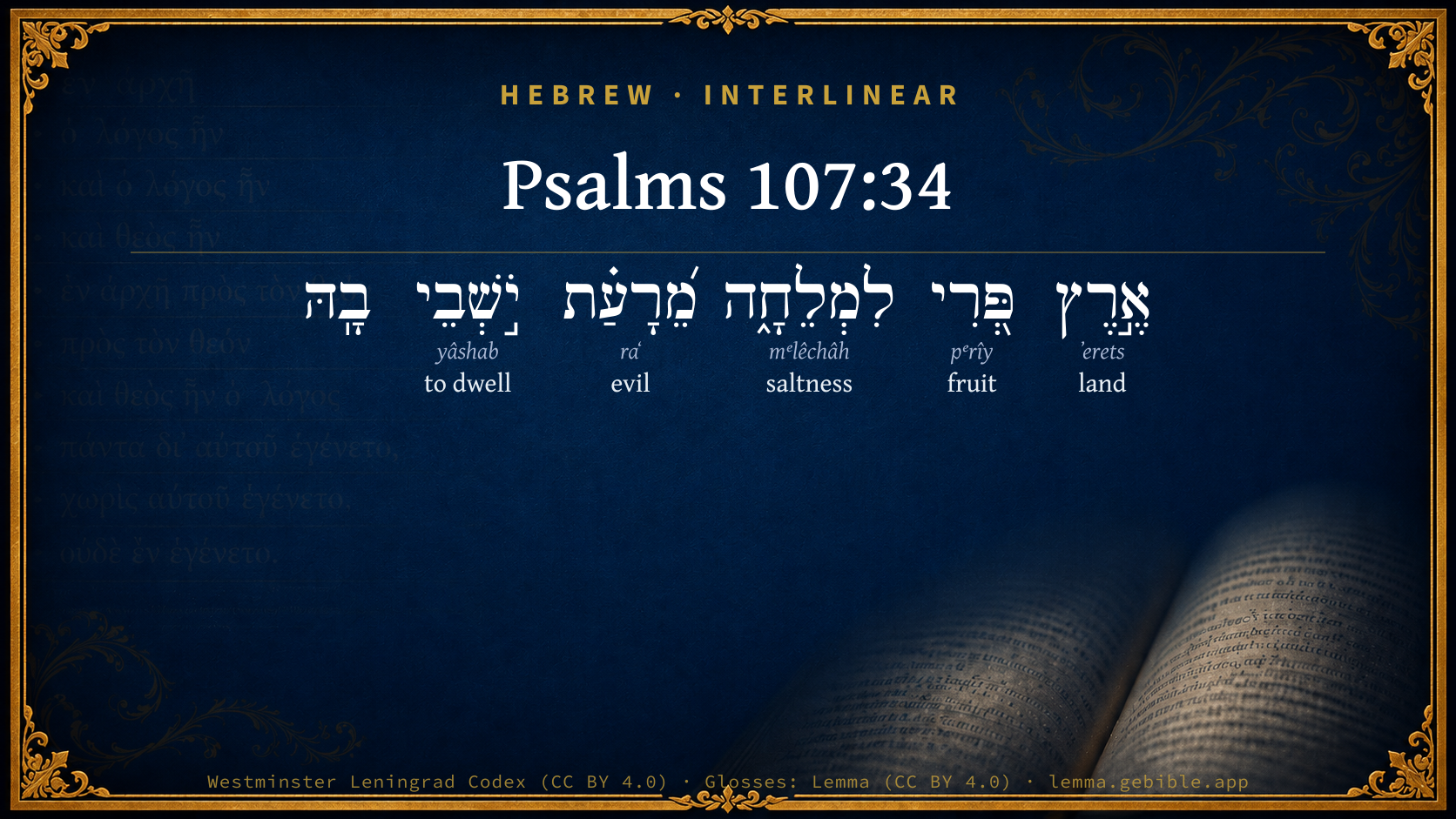
Hebrew (Westminster Leningrad Codex) Psalms 107:34 appears in the Hebrew Old Testament. The text above is from the Westminster Leningrad Codex. Each word links to its Strong’s number, a concise gloss, and parsing drawn from the Open Scriptures Hebrew Bible morphology. Click any word for its full Brown-Driver-Briggs (BDB) entry.
Download image
Cite this verse

Psalms 107:34 (World English Bible). Public Domain. Lemma interlinear Bible study tool, https://lemma.gebible.app/v/psalms/107/34.

Show BibTeX & RIS
BibTeX
RIS
English Translation
And a fruitful land into a salt waste, For the wickedness of those who dwell in it.
World English Bible · Public Domain
Download a study sheet

One document with this verse’s original text, its word-by-word gloss line, the meaning frame, cross-references with their text, attributed commentary, and full source and license credits — printable, and it pastes into notes with its structure intact.

This verse Autodidact and up

Study sheet (.html) Plain text (.txt)

A passage Seminary Student

Up to 50 verses in one chapter. A passage sheet keeps up to 6 commentary sources and 12 cross-references per verse, in the order this page ranks them, and says so on the sheet whenever that leaves anything out. Ask for a single verse and you get the Autodidact verse sheet above.

Everything on this page stays free to read, with no account — the sheet is a download of what is already on screen, not access to it.

Want to remove ads? Support Godless Engineer
Compare translations 3

The same verse in 3 English versions, stacked beneath the original-language interlinear above. Click any original word for its lexicon entry.

Each is an independent rendering of the whole verse — the interlinear is not word-aligned to these translations.

Highlighted words mark where these versions differ — a whole-verse word diff, not a word-by-word alignment.

  • World English Bible Public Domain
    And a fruitful land into a salt waste, For the wickedness of those who dwell in it.
  • King James Version Public Domain
    A fruitful land into barrenness, for the wickedness of them that dwell therein.
  • unfoldingWord Literal Text CC BY-SA 4.0
    fruitful ground into salt land, from the wickedness of the dwellers in it.

unfoldingWord Literal Text — © unfoldingWord, licensed CC BY-SA 4.0. Word-aligned USFM3 via Door43 (git.door43.org/unfoldingWord/en_ult).

Versions to compare (up to 4)

3 of 4 selected

Show all 18 translations

Every available English version of this verse, each an independent rendering of the whole verse.

  • World English Bible Public Domain
    And a fruitful land into a salt waste, For the wickedness of those who dwell in it.
  • Berean Standard Bible Public Domain
    and fruitful land into fields of salt, because of the wickedness of its dwellers.
  • Majority Standard Bible Public Domain
    and fruitful land into fields of salt, because of the wickedness of its dwellers.
  • King James Version Public Domain
    A fruitful land into barrenness, for the wickedness of them that dwell therein.
  • American Standard Version (1901) Public Domain
    A fruitful land into a salt desert, For the wickedness of them that dwell therein.
  • Revised Version (1885) Public Domain
    A fruitful land into a salt desert, for the wickedness of them that dwell therein.
  • Geneva Bible (1599) Public Domain
    And a fruitfull land into barrennes for the wickednes of them that dwell therein.
  • Douay-Rheims (1899) Public Domain
    A fruitful land into barrenness, for the wickedness of them that dwell therein.
  • Young's Literal Translation Public Domain
    A fruitful land becometh a barren place, For the wickedness of its inhabitants.
  • Literal Standard Version CC BY-SA 4.0
    A fruitful land becomes a barren place, || For the wickedness of its inhabitants.
  • Unlocked Literal Bible CC BY-SA 4.0
    and a fruitful land into a barren place because of the wickedness of its people.
  • unfoldingWord Literal Text CC BY-SA 4.0
    fruitful ground into salt land, from the wickedness of the dwellers in it.
  • Darby Bible Public Domain
    A fruitful land into a plain of salt, for the wickedness of them that dwell therein.
  • World Messianic Bible Public Domain
    and a fruitful land into a salt waste, for the wickedness of those who dwell in it.
  • Webster's Bible Public Domain
    A fruitful land into barrenness, for the wickedness of them that dwell in it.
  • Free Bible Version CC BY-SA 4.0
    Fruitful ground becomes a salty wasteland because of the wickedness of those living there.
  • Bible in Basic English Public Domain
    He makes a fertile country into a salt waste, because of the sins of those who are living there.
  • JPS Tanakh (1917) Public Domain
    A fruitful land into a salt waste, for the wickedness of them that dwell therein.

Literal Standard Version (2020), Covenant Press — licensed CC BY-SA 4.0. Text via the HelloAO Bible API (eBible.org). Unlocked Literal Bible (unfoldingWord) — licensed CC BY-SA 4.0. Text via the HelloAO Bible API (eBible.org). unfoldingWord Literal Text — © unfoldingWord, licensed CC BY-SA 4.0. Word-aligned USFM3 via Door43 (git.door43.org/unfoldingWord/en_ult). Free Bible Version, Dr. Jonathan Gallagher — licensed CC BY-SA 4.0. Text via the HelloAO Bible API (eBible.org).

Word by word

More ways to search: Search by grammar → Find every occurrence → Compare this word →

Practice this passage: Drill this verse → Learn its vocabulary →

About this verse

These counts appear in no published source. They are computed here, from the morphology-tagged text and Lemma’s own curated glosses. What Lemma adds →

6
words
5
distinct lemmas
Wisdom
section

Notable vocabulary

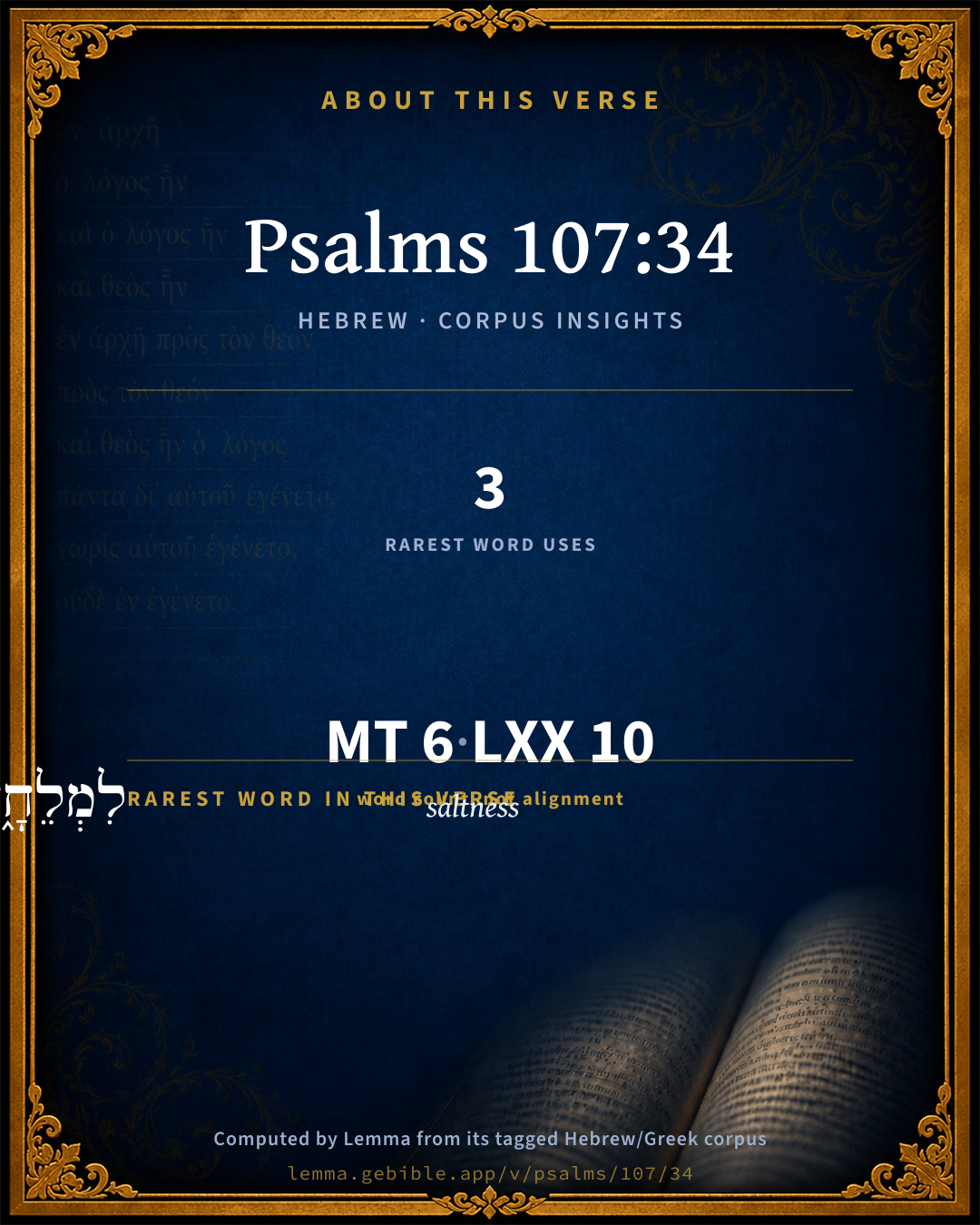
The rarest word here is לִמְלֵחָ֑ה saltness H4420 — appearing just 3 times in the whole Hebrew Bible.

Shared distinctive vocabulary

לִמְלֵחָ֑ה saltness H4420 occurs in 3 verses of the Hebrew Bible. Also found in:

Grammatical profile

  • 1 verb
  • 4 nouns
  • 1 preposition

Verb forms

  • יֹ֣שְׁבֵי Qal · Participle Active

Hebrew & Septuagint length

In English translation the verse runs 17 words from the Hebrew and 14 from the Septuagint (LXX English) — closely comparable.

A rough comparison of the two English renderings, which tokenize alike — not a word-level alignment.

Word counts can differ between the Hebrew and the Greek without any difference in meaning — e.g. the Hebrew direct-object marker אֵת has no separate Greek word, and Greek often adds the article ὁ.

In the original languages it is 6 Hebrew tokens and 10 Greek tokens — but the two are counted differently (Hebrew bundles its prefixes and suffixes into one token; the Greek is in lemma form), so that isn’t a like-for-like length.

Cross-references

7

Topical passages linked to Psalms 107:34 in the Treasury of Scripture Knowledge — connected by theme and wording, ordered by reader-vote popularity; previews shown in the World English Bible.

  • Genesis 13:10 Lot lifted up his eyes, and saw all the plain of the Jordan, that it was well watered every where, before Yahweh destroyed Sodom and Gomorrah, like the garden of Yahweh, like the land of Egypt, as you go to Zoar.
  • Genesis 14:3 All these joined together in the valley of Siddim (the same is the Salt Sea).
  • Deuteronomy 29:23–28 [and that] the whole land of it is sulfur, and salt, [and] a burning, [that] it is not sown, nor bears, nor any grass grows therein, like the overthrow of Sodom and Gomorrah, Admah and Zeboiim, which Yahweh overthrew in his anger, and in his wrath:
  • Ezekiel 47:11 But the miry places of it, and the marshes of it, shall not be healed; they shall be given up to salt.
  • Genesis 13:13 Now the men of Sodom were exceedingly wicked and sinners against Yahweh.
  • Genesis 19:24–25 Then Yahweh rained on Sodom and on Gomorrah sulfur and fire from Yahweh out of the sky.
  • Isaiah 32:13–15 On the land of my people shall come up thorns and briers; yes, on all the houses of joy in the joyous city.

Cross-references courtesy of OpenBible.info (CC BY 4.0).

Hebrew and Greek witnesses Masoretic Hebrew ↔ Greek Septuagint

The same verse in the two great witnesses to the Old Testament, shown verse-for-verse.

You’re reading Greek Psalm 106 (Hebrew Psalm 107). The Septuagint counts the superscription, so verse numbers can differ from the Hebrew — chapter-level alignment, not verse-by-verse. Numbering follows Rahlfs.

These are two independent witnesses, not word-aligned to each other, and the Septuagint is shown in lemma (dictionary) form.

Hebrew Psalms 107:34 Masoretic · Westminster Leningrad Codex

אֶ֣רֶץ פְּ֭רִי לִמְלֵחָ֑ה מֵ֝רָעַ֗ת יֹ֣שְׁבֵי בָֽהּ

And a fruitful land into a salt waste, For the wickedness of those who dwell in it.

World English Bible · Public Domain

Greek LXX Greek Psalm 106:34 Septuagint · lemma form

γῆ καρποφόρος εἰς ἅλμη ἀπό κακία ὁ καταοἰκέω ἐν αὐτός

a fruitful land into saltness, for the wickedness of them that dwell in it.

LXX2012 (modern English Septuagint) · Public Domain

On this verse, Ellicott's Commentary for English Readers discusses the Septuagint’s reading. Read the note in Commentary ↓

Hebrew: Westminster Leningrad Codex (CC BY 4.0). Greek: Septuagint (public domain); English from LXX2012 (modern English Septuagint) (Public Domain). How the Septuagint differs from the Hebrew →

Commentary

Notes on Psalms 107:34 from classic Christian and Jewish commentators (each source and its license shown beneath its notes). The classic Christian expositions comment on the surrounding passage and are grouped to its opening verse, so a note may address several verses; the Jewish commentaries on the Tanakh (Rashi and others) are per-verse, so they appear only where the commentator wrote on this verse.

Lemma curates 59 commentaries, every one of them public domain or Creative Commons licensed, each selected and text-cleaned for this edition rather than reprinted as found. About our sources →

Trapp's Complete Commentary

John Trapp

Psa 107:34 A fruitful land into barrenness, for the wickedness of them that dwell therein.

Ver. 34. A fruitful land into barrenness] Heb. saltness. See Luk 14:34-35 Deu 29:23 Jdg 9:45. Salt breedeth barrenness, by eating up the fat and moisture of the earth. Some think the psalmist here alludeth to Sodom and her sisters turned into the Red Sea.

For the wickedness of them that dwell therein] Hereof Judea is at this day a noble instance (besides many parts of Asia and Africa, once very fruitful, now, since they became Mahometan, dry and desert). Judea, saith one, hath now only some few parcels of rich ground found in it; that men may guess the goodness of the cloth by the fineness of the shreds. Greece, which was once Sol et sal gentium, saith another, terrarum flos, fens literarum, nunc vel Priamo miseranda manus; - nunc in Graecia desideramus Graeciam; it is nothing like the place it was once.

John Trapp, A Commentary or Exposition upon All the Books of the Old and New Testament (1647–1656) — public domain. Text from a community e-Sword module.

The Treasury of David

Charles H. Spurgeon

Ver. 34. The curse, cause, and cure of barrenness in a church.

Psalms 107:34*

Ver. 34. A fruitful land into barrenness. This has been done in many instances, and notably in the case of the psalmist's own country, which was once the glory of all lands and is now almost a desert.

For the wickedness of them that dwell therein. Sin is at the bottom of sorrow. It first made the ground sterile in father Adam's day, and it continues to have a blighting effect upon all that it touches. If we have not the salt of holiness we shall soon receive the salt of barrenness, for the text in the Hebrew is"a fruitful land into saltness." If we will not yield the Lord a harvest of obedience he may forbid the soil to yield us a harvest of bread, and what then? If we turn good into evil can we wonder if the Lord pays us in kind, and returns our baseness into our own bosoms? Many a barren church owes its present sad estate to its inconsistent behaviour, and many a barren Christian has come into this mournful condition by a careless, unsanctified walk before the Lord. Let not saints who are now useful run the risk of enduring the loss of their mercies, but let them be watchful that all things may go well with them.

Ver. 34. A fruitful land into barrenness. Hereof Judaea is at this day a notable instance (besides many parts of Asia, and Africa, once very fruitful, now, since they became Mahometan, dry and desert). Judaea, saith one, hath now only some few parcels of rich ground found in it; that men may guess the goodness of the cloth by the fineness of the shreds. John Trapp.

Ver. 34. For the wickedness of them that dwell therein. When I meet with a querulous husbandman, he tells me of a churlish soil, of a wet seed time, of a green winter, of an unkindly spring, of a lukewarm summer, of a blustering autumn; but I tell him of a displeased God, who will be sure to contrive and fetch all seasons and elements, to his own most wise drifts and purposes. Joseph Hall.

Ver. 34. For the wickedness. God locks up the clouds, because we have shut up our mouths. The earth is grown hard as iron to us, because we have hardened our hearts against our miserable neighbours. The cries of the poor for bread are loud, because our cries against sin have been so low. Sicknesses run apace from house to house, and sweep away the poor unprepared inhabitants, because we sweep not out the sin that breeds them. Richard Baxter, 1615-1691.

Psalms 107:35*

Charles H. Spurgeon's The Treasury of David (1869–1885) — public domain. Psalms only. Text from a community e-Sword/MySword module.

J. A. Alexander on Psalms

Joseph Addison Alexander

34. (Psa 107:34) A fruitful land to saltness, for the wickedness of those dwelling in it. The sentence is continued from the foregoing verse, the nouns being governed by the verb he turns. The first phrase literally means a land of fruit. The next noun may be taken either in the abstract sense of saltness or the concrete one of a saline soil or region, and by implication barren. For, literally from, as in Psa 107:17 above. Compare the threatening in Isa 13:19, and the great historical type of all such judgments, the destruction of Sodom and Gomorrah.

Joseph Addison Alexander, The Psalms Translated and Explained (1850) — public domain. Text from a community e-Sword module.

Geneva Bible (1599)

Geneva Bible translators

Or, saltness.

Geneva Bible (1599) marginal notes — public domain. Text via Bolls.life.

Ellicott's Commentary for English Readers

(34) Barrenness.—Better, a salt marsh, as in LXX. and Vulg. (See Job_39:6.)

A Bible Commentary for English Readers, edited by Charles John Ellicott (1878–1897) — public domain. Text from a community e-Sword module.

The Cambridge Bible for Schools and Colleges

gen. ed. J. J. S. Perowne

34. barrenness] A salt desert (Jer_17:6) like Sodom and Gomorrha, Deu_29:23.

The Cambridge Bible for Schools and Colleges (gen. ed. J. J. S. Perowne; Cambridge University Press, 1878–1918) — public domain. Text from a community e-Sword module.

John Gill's Exposition

And sow the fields, and plant vineyards,.... And so raise a sufficient supply of corn and wine for the support of themselves and families. In a spiritual sense the "fields" are the world, and the seed which is sown is the word; the persons that sow it are the ministers of the Gospel, which, by a divine blessing, brings forth fruit, in some thirty, some sixty, and some an hundred fold: the "vineyards" are the churches, planted by Christ and by his ministers, as his instruments; believers are the pleasant plants in them, and young converts are the tender grapes

Which may yield fruits of increase; or "fruit" and "increase"; the fields yield all sorts of grain for food, and the vineyards wine for drink. So the seed of the word being sown, and churches planted, they increase with the increase of God, and bring forth fruits of righteousness to the glory of his name.

John Gill's Exposition of the Whole Bible (1746–1763) — public domain (CC PDM 1.0). Text via the HelloAO Bible API.

Albert Barnes' Notes on the Bible

A fruitful land - Hebrew, A land of fruit. That is, a land that would produce abundance. The word “fruit” here is not used in the limited sense in which we now employ it, but means any productions of the earth.

Into barrenness - Margin, as in Hebrew, “saltness.” The word is used to denote a barren soil, because where salt “abounds” the soil “is” barren. Thus it is around the Dead Sea. Compare Job 39:6; Jer 17:6. See also Virg. Geor. II. 238, “Salsa ... tellus - frugibus infelix;” Pliny, Hist. Nat. 31. 7; Bochart, Hieroz. t. i., p. 872.

For the wickedness of them that dwell therein - As he overthrew Sodom and Gomorrah; probably alluding to that.

Albert Barnes' Notes on the Bible (1834–1885) — public domain. Text from a community e-Sword/MySword module.

Matthew Poole's English Annotations

Into barrenness, Heb. into saltness, which procures barrenness. See Deu 29:23; Jdg 9:45.

For the wickedness of them that dwell therein; he doth not inflict these judgments by choice, or without cause, but for the punishment of sin in some, and the prevention of it in others.

Matthew Poole's English Annotations on the Holy Bible (1683–1685) — public domain. Text from a community e-Sword/MySword module.

The Pulpit Commentary

A fruitful land into barrenness; literally, into saltness. The judgment upon Sodom and Gomorrah is probably in the writer"s mind. For the wickedness of them that dwell therein. God does not capriciously withdraw his blessings from a land. If he turns a fruitful land into a barren one, we may be sure that the inhabitants have provoked him by their sins.

The Pulpit Commentary (1880–1919), ed. H.D.M. Spence-Jones & Joseph S. Exell — public domain. Text from a community e-Sword module.

John Wesley's Explanatory Notes

For - He doth not inflict these judgments without cause, but for the punishment of sin in some, and the prevention of it in others.

John Wesley, Explanatory Notes Upon the Whole Bible (1754–1765) — public domain. Text via the GEBible commentary corpus.

Rashi

Rabbi Shlomo Yitzchaki (Rashi)

into a salty waste To be like a salty land insofar as it does not produce fruit.

Rashi on the Tanakh — English translations: “The Judaica Press complete Tanach with Rashi, translated by A. J. Rosenberg” (CC BY 4.0); “Pentateuch with Rashi's commentary by M. Rosenbaum and A.M. Silbermann, 1929-1934” (public domain); “The Metsudah Tanach series, Lakewood, N.J” (CC BY 4.0); and “The Book of Joshua, Metsudah Publications, 1997” (CC BY 4.0). Text via Sefaria.

Lesson kit

Teaching starters — assembled from the data on this page, not authored interpretation. Every prompt links to the verse data it draws on. Edit before teaching.

Psalms, in the Wisdom, opens this verse with 6 words (5 distinct Hebrew lemmas). Its most distinctive word is mᵉlêchâh (“saltness”). A historical commentator’s framing appears above. Read the whole chapter for the surrounding context.

Discussion questions

  1. What does “saltness” (mᵉlêchâh) contribute to the verse as a whole?
  2. How does Job 39:6, which shares the word «saltness», read alongside this verse?
  3. The translations on this page render this verse differently — a whole-verse word diff, not a word-by-word alignment. What might account for the different wordings?
  4. «יֹ֣שְׁבֵי» is a Qal Participle Active verb. How does that grammatical form shape the action described?
  5. Compare how Trapp's Complete Commentary and The Treasury of David read this verse. Where do they agree or differ?

Things to notice

Reading settings

Reading text

Shown beneath each verse's original-language words.

Old Testament
Old Testament edition

Read the OT as the Masoretic Hebrew (MT) or the Greek Septuagint (LXX).

English shown for the Greek Septuagint (in the Hebrew ↔ Greek comparison).

Comparing translations? Open the Compare panel on any verse page to stack up to four side by side.