Jeremiah 17:10

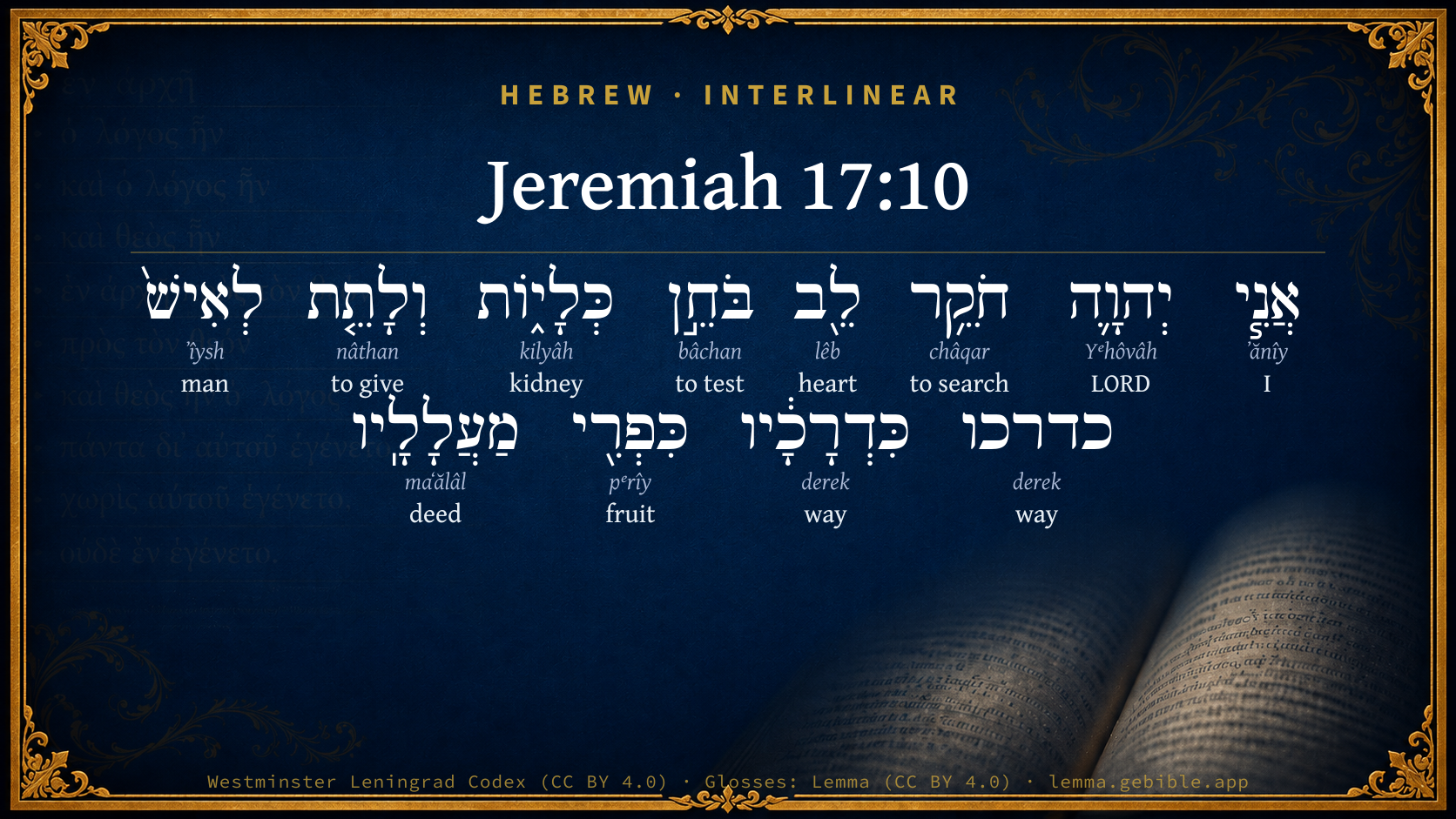
Hebrew (Westminster Leningrad Codex) Jeremiah 17:10 appears in the Hebrew Old Testament. The text above is from the Westminster Leningrad Codex. Each word links to its Strong’s number, a concise gloss, and parsing drawn from the Open Scriptures Hebrew Bible morphology. Click any word for its full Brown-Driver-Briggs (BDB) entry.
Download image
Cite this verse

Jeremiah 17:10 (World English Bible). Public Domain. Lemma interlinear Bible study tool, https://lemma.gebible.app/v/jeremiah/17/10.

Show BibTeX & RIS
BibTeX
RIS
English Translation
I, Yahweh, search the mind, I try the heart, even to give every man according to his ways, according to the fruit of his doings.
World English Bible · Public Domain
Download a study sheet

One document with this verse’s original text, its word-by-word gloss line, the meaning frame, cross-references with their text, attributed commentary, and full source and license credits — printable, and it pastes into notes with its structure intact.

This verse Autodidact and up

Study sheet (.html) Plain text (.txt)

A passage Seminary Student

Up to 50 verses in one chapter. A passage sheet keeps up to 6 commentary sources and 12 cross-references per verse, in the order this page ranks them, and says so on the sheet whenever that leaves anything out. Ask for a single verse and you get the Autodidact verse sheet above.

Everything on this page stays free to read, with no account — the sheet is a download of what is already on screen, not access to it.

Want to remove ads? Support Godless Engineer
Compare translations 3

The same verse in 3 English versions, stacked beneath the original-language interlinear above. Click any original word for its lexicon entry.

Each is an independent rendering of the whole verse — the interlinear is not word-aligned to these translations.

Highlighted words mark where these versions differ — a whole-verse word diff, not a word-by-word alignment.

  • World English Bible Public Domain
    I, Yahweh, search the mind, I try the heart, even to give every man according to his ways, according to the fruit of his doings.
  • King James Version Public Domain
    I the LORD search the heart, I try the reins, even to give every man according to his ways, and according to the fruit of his doings.
  • unfoldingWord Literal Text CC BY-SA 4.0
    I, Yahweh, the one searching heart, testing the kidneys, to give to each man according to his ways, according to the fruit of his deeds.”

unfoldingWord Literal Text — © unfoldingWord, licensed CC BY-SA 4.0. Word-aligned USFM3 via Door43 (git.door43.org/unfoldingWord/en_ult).

Versions to compare (up to 4)

3 of 4 selected

Show all 18 translations

Every available English version of this verse, each an independent rendering of the whole verse.

  • World English Bible Public Domain
    I, Yahweh, search the mind, I try the heart, even to give every man according to his ways, according to the fruit of his doings.
  • Berean Standard Bible Public Domain
    I, the LORD, search the heart; I examine the mind to reward a man according to his way, by what his deeds deserve.
  • Majority Standard Bible Public Domain
    I, the LORD, search the heart; I examine the mind to reward a man according to his way, by what his deeds deserve.
  • King James Version Public Domain
    I the LORD search the heart, I try the reins, even to give every man according to his ways, and according to the fruit of his doings.
  • American Standard Version (1901) Public Domain
    I, Jehovah, search the mind, I try the heart, even to give every man according to his ways, according to the fruit of his doings.
  • Revised Version (1885) Public Domain
    I the LORD search the heart, I try the reins, even to give every man according to his ways, according to the fruit of his doings.
  • Geneva Bible (1599) Public Domain
    I the Lord search the heart, and try ye reines, euen to giue euery man according to his wayes, and according to the fruite of his workes.
  • Douay-Rheims (1899) Public Domain
    I am the Lord who search the heart and prove the reins: who give to every one according to his way, and according to the fruit of his devices.
  • Young's Literal Translation Public Domain
    I Jehovah do search the heart, try the reins, Even to give to each according to his way, According to the fruit of his doings.
  • Literal Standard Version CC BY-SA 4.0
    I, YHWH, search the heart, try the reins, || Even to give to each according to his way, || According to the fruit of his doings.
  • Unlocked Literal Bible CC BY-SA 4.0
    I am Yahweh, the one who searches through the mind, who tests the hearts. I give to each person according to his ways, according to the fruit of his deeds.
  • unfoldingWord Literal Text CC BY-SA 4.0
    I, Yahweh, the one searching heart, testing the kidneys, to give to each man according to his ways, according to the fruit of his deeds.”
  • Darby Bible Public Domain
    I Jehovah search the heart, I try the reins, even to give each one according to his ways, according to the fruit of his doings.
  • World Messianic Bible Public Domain
    “I, the LORD, search the mind. I try the heart, even to give every man according to his ways, according to the fruit of his doings.”
  • Webster's Bible Public Domain
    I the LORD search the heart, I try the reins, even to give every man according to his ways, and according to the fruit of his doings.
  • Free Bible Version CC BY-SA 4.0
    But I, the Lord, see what people are thinking. I examine their minds, so I can reward them depending on their attitudes and the way they behave.
  • Bible in Basic English Public Domain
    I the Lord am the searcher of the heart, the tester of the thoughts, so that I may give to every man the reward of his ways, in keeping with the fruit of his doings.
  • JPS Tanakh (1917) Public Domain
    I the LORD search the heart, I try the reins, even to give every man according to his ways, according to the fruit of his doings.

Literal Standard Version (2020), Covenant Press — licensed CC BY-SA 4.0. Text via the HelloAO Bible API (eBible.org). Unlocked Literal Bible (unfoldingWord) — licensed CC BY-SA 4.0. Text via the HelloAO Bible API (eBible.org). unfoldingWord Literal Text — © unfoldingWord, licensed CC BY-SA 4.0. Word-aligned USFM3 via Door43 (git.door43.org/unfoldingWord/en_ult). Free Bible Version, Dr. Jonathan Gallagher — licensed CC BY-SA 4.0. Text via the HelloAO Bible API (eBible.org).

Word by word

More ways to search: Search by grammar → Find every occurrence → Compare this word →

Practice this passage: Drill this verse → Learn its vocabulary →

חֹקֵ֥ר
châqar
H2713
“searching”
Verb, Qal, Participle Active, Masculine, Singular, Absolute
Part of Speech
Verb
Stem
Qal
Form
Participle Active
Gender
Masculine
Number
Singular
State
Absolute
Full BDB Definition

Origin: a primitive root

TWOT: 729

to search, search for, search out, examine, investigate - (Qal) - to search (for) - to search through, explore - to examine thoroughly - (Niphal) - to be searched out, be found out, be ascertained, be examined - (Piel) to search out, seek out
  1. אֲנִ֧י ʼănîy H589 “I” Pronoun, Personal, 1st Person, Common, Singular
  2. יְהוָ֛ה Yᵉhôvâh H3068 “LORD” Noun, Proper
  3. לֵ֖ב lêb H3820 “heart” Noun, Common, Masculine, Singular, Absolute
  4. בֹּחֵ֣ן bâchan H974 “testing” Verb, Qal, Participle Active, Masculine, Singular, Absolute
  5. כְּלָי֑וֹת kilyâh H3629 “kidneys” Noun, Common, Feminine, Plural, Absolute
  6. וְלָתֵ֤ת nâthan H5414 “and · to give” Conjunction + Preposition + Verb, Qal, Infinitive Construct
  7. לְאִישׁ֙ ʼîysh H376 “to/for · man” Preposition + Noun, Common, Masculine, Singular, Absolute
  8. כדרכו derek H1870 “like/as · ways · his” Preposition + Noun, Common, Both, Plural, Construct + Suffix, Personal, 3rd Person, Masculine, Singular
  9. כִּדְרָכָ֔יו derek H1870 “like/as · ways · his” Preposition + Noun, Common, Both, Plural, Construct + Suffix, Personal, 3rd Person, Masculine, Singular
  10. כִּפְרִ֖י pᵉrîy H6529 “like/as · fruit of” Preposition + Noun, Common, Masculine, Singular, Construct
  11. מַעֲלָלָֽיו maʻălâl H4611 “deeds · his” Noun, Common, Masculine, Plural, Construct + Suffix, Personal, 3rd Person, Masculine, Singular

About this verse

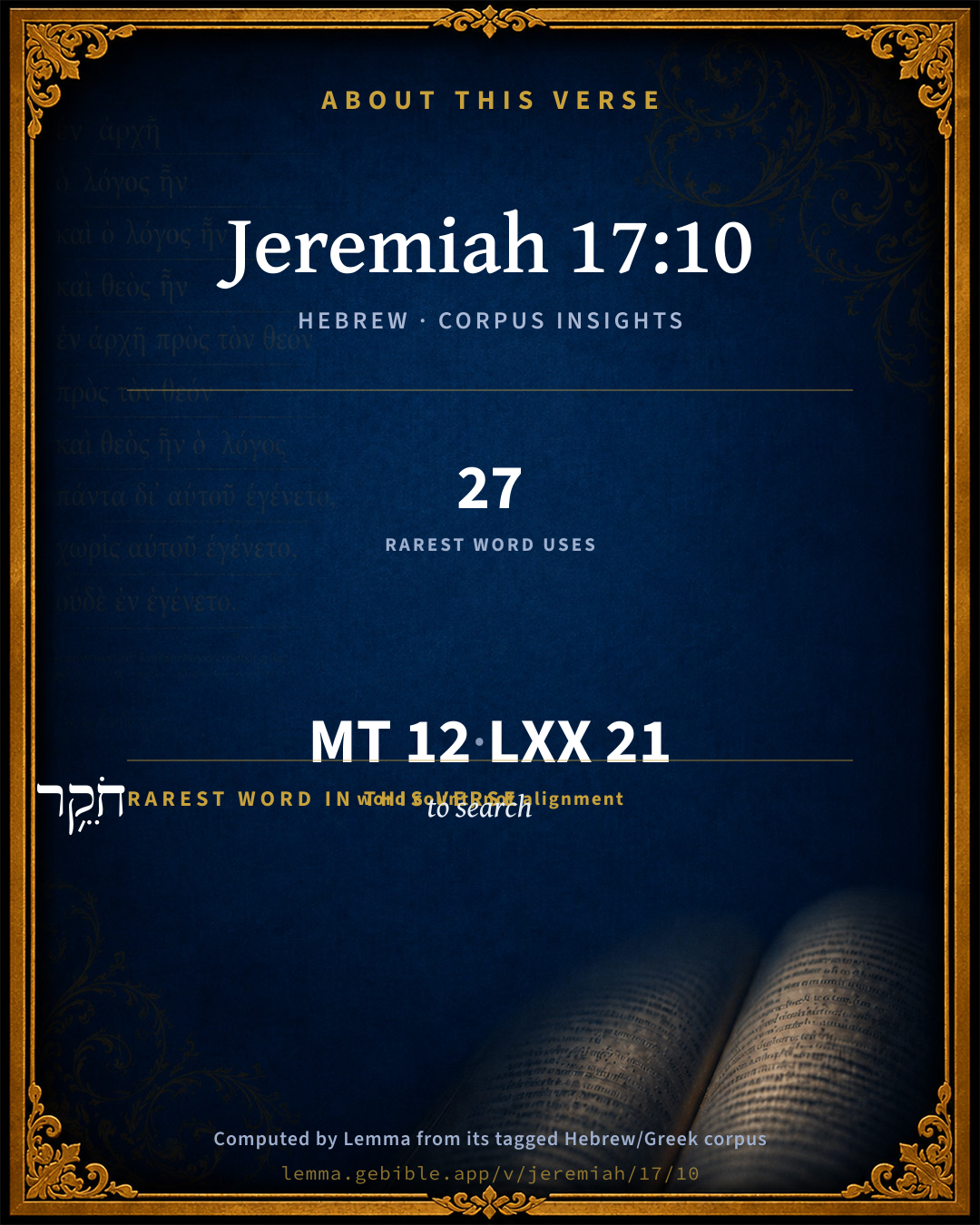
These counts appear in no published source. They are computed here, from the morphology-tagged text and Lemma’s own curated glosses. What Lemma adds →

12
words
11
distinct lemmas
Prophets
section

Shared distinctive vocabulary

חֹקֵ֥ר to search H2713 occurs in 26 verses of the Hebrew Bible. Also found in:

Grammatical profile

  • 3 verbs
  • 8 nouns
  • 1 pronoun

Verb forms

  • חֹקֵ֥ר Qal · Participle Active
  • בֹּחֵ֣ן Qal · Participle Active
  • וְלָתֵ֤ת Qal · Infinitive Construct

Repetition

A word recurs within this verse — often emphatic in Hebrew:

  • כדרכו way H1870 ×2

Hebrew & Septuagint length

In the original languages it is 12 Hebrew tokens and 21 Greek tokens — but the two are counted differently (Hebrew bundles its prefixes and suffixes into one token; the Greek is in lemma form), so that isn’t a like-for-like length.

Cross-references

25

Topical passages linked to Jeremiah 17:10 in the Treasury of Scripture Knowledge — connected by theme and wording, ordered by reader-vote popularity; previews shown in the World English Bible.

  • 1 Samuel 16:7 But Yahweh said to Samuel, "Don't look on his face, or on the height of his stature; because I have rejected him: for [Yahweh sees] not as man sees; for man looks at the outward appearance, but Yahweh looks at the heart."
  • Romans 8:27 He who searches the hearts knows what is on the Spirit's mind, because he makes intercession for the saints according to God.
  • Jeremiah 11:20 But, Yahweh of Hosts, who judge righteously, who try the heart and the mind, I shall see your vengeance on them; for to you have I revealed my cause.
  • Hebrews 4:12–13 For the word of God is living, and active, and sharper than any two-edged sword, and piercing even to the dividing of soul and spirit, of both joints and marrow, and is able to discern the thoughts and intentions of the heart.
  • Revelation 2:23 I will kill her children with Death, and all the assemblies will know that I am he who searches the minds and hearts. I will give to each one of you according to your deeds.
  • Psalms 139:23–24 Search me, God, and know my heart. Try me, and know my thoughts.
  • Jeremiah 32:19 great in counsel, and mighty in work; whose eyes are open on all the ways of the sons of men, to give everyone according to his ways, and according to the fruit of his doings:
  • Jeremiah 20:12 But, Yahweh of Hosts, who tests the righteous, who sees the heart and the mind, let me see your vengeance on them; for to you have I revealed my cause.
  • 1 Chronicles 28:9 You, Solomon my son, know the God of your father, and serve him with a perfect heart and with a willing mind; for Yahweh searches all hearts, and understands all the imaginations of the thoughts: if you seek him, he will be found of you; but if you forsake him, he will cast you off forever.
  • Galatians 6:7–8 Don't be deceived. God is not mocked, for whatever a man sows, that will he also reap.
  • Psalms 62:12 Also to you, Lord, belongs loving kindness, For you reward every man according to his work.
  • Proverbs 17:3 The refining pot is for silver, and the furnace for gold, But Yahweh tests the hearts.
  • Matthew 16:27 For the Son of Man will come in the glory of his Father with his angels, and then he will render to everyone according to his deeds.
  • Revelation 22:12 "Behold, I come quickly. My reward is with me, to repay to each man according to his work.
  • Romans 2:6–8 who "will pay back to everyone according to their works:"
  • 2 Chronicles 6:30 then hear from heaven, your dwelling-place and forgive, and render to every man according to all his ways, whose heart you know; (for you, even you only, know the hearts of the children of men;)
  • Isaiah 3:10–11 Tell the righteous "Good!" For they shall eat the fruit of their deeds.
  • Revelation 20:12 I saw the dead, the great and the small, standing before the throne, and they opened books. Another book was opened, which is the book of life. The dead were judged out of the things which were written in the books, according to their works.
  • Psalms 7:9 Oh let the wickedness of the wicked come to an end, But establish the righteous; Their minds and hearts are searched by the righteous God.
  • John 2:25 and because he didn't need for anyone to testify concerning man; for he himself knew what was in man.
  • 1 Chronicles 29:17 I know also, my God, that you try the heart, and have pleasure in uprightness. As for me, in the uprightness of my heart I have willingly offered all these things: and now have I seen with joy your people, that are present here, offer willingly to you.
  • Jeremiah 21:14 I will punish you according to the fruit of your doings, says Yahweh; and I will kindle a fire in her forest, and it shall devour all that is round about her.
  • Romans 6:21 What fruit then did you have at that time in the things of which you are now ashamed? For the end of those things is death.
  • Micah 7:13 Yet the land will be desolate because of those who dwell therein, For the fruit of their doings.

Cross-references courtesy of OpenBible.info (CC BY 4.0).

Hebrew and Greek witnesses Masoretic Hebrew ↔ Greek Septuagint

The same verse in the two great witnesses to the Old Testament, shown verse-for-verse.

These are two independent witnesses, not word-aligned to each other, and the Septuagint is shown in lemma (dictionary) form.

Hebrew Jeremiah 17:10 Masoretic · Westminster Leningrad Codex

אֲנִ֧י יְהוָ֛ה חֹקֵ֥ר לֵ֖ב בֹּחֵ֣ן כְּלָי֑וֹת וְלָתֵ֤ת לְאִישׁ֙ כדרכו כִּדְרָכָ֔יו כִּפְרִ֖י מַעֲלָלָֽיו

I, Yahweh, search the mind, I try the heart, even to give every man according to his ways, according to the fruit of his doings.

World English Bible · Public Domain

Greek LXX Structure differs

In the Septuagint, Jeremiah is about an eighth shorter than the Hebrew and arranges its material differently — the Oracles Against the Nations (Hebrew chapters 46–51) appear in the middle of the Greek book, after 25:13. Because the chapter and verse boundaries do not line up, a verse-for-verse comparison with the Hebrew is not shown.

A verse-for-verse comparison isn’t shown here because the chapters and verses don’t line up. Switch to the LXX edition with the MT / LXX toggle above to read the Greek directly.

Hebrew: Westminster Leningrad Codex (CC BY 4.0). Greek: Septuagint (public domain); English from a public-domain English Septuagint. How the Septuagint differs from the Hebrew →

Targum (Aramaic paraphrase)

1

The Targum is the ancient Jewish Aramaic paraphrase of the Hebrew Scriptures — an interpretive translation, not the Hebrew text itself. Onkelos (literal) and Pseudo-Jonathan (expansive) render the Torah, and Jonathan the Prophets. Coverage is partial: where no permissively-licensed English translation exists for a verse, only the Aramaic is shown. This is verse-level text, not a word-by-word alignment to the Hebrew.

  1. Targum Jonathan Prophets (Joshua–Malachi)
    אֲנָא יְיָ חָקַר לִבָּא בְּחַר כּוּלְיָתָא וּלְמִתַּן לֶאֱנַשׁ כְּאוֹרְחָתֵיהּ כְּפֵירֵי עוֹבָדוֹהִי:

    (no public-domain English translation for this verse)

    Targum Jonathan — Aramaic: “Mikraot Gedolot” (public domain). English: “Sefaria Community Translation” (CC0 1.0 (public-domain dedication)); “London "Chaldee Paraphrase," 1871” (public domain). Text via Sefaria.

Commentary

Notes on Jeremiah 17:10 from classic Christian and Jewish commentators (each source and its license shown beneath its notes). The classic Christian expositions comment on the surrounding passage and are grouped to its opening verse, so a note may address several verses; the Jewish commentaries on the Tanakh (Rashi and others) are per-verse, so they appear only where the commentator wrote on this verse.

Lemma curates 59 commentaries, every one of them public domain or Creative Commons licensed, each selected and text-cleaned for this edition rather than reprinted as found. About our sources →

Trapp's Complete Commentary

John Trapp

Jer 17:10 I the LORD search the heart, [I] try the reins, even to give every man according to his ways, [and] according to the fruit of his doings.

Ver. 10. I the Lord search the heart.] Be it never so full of shifts and fetches, I cannot be deceived in it. The watchmaker must needs know every turning and winding in the watch. God is the heart maker and the heart mender; neither is there any creature, no, not any creature of the heart, that is not manifest in his sight, but all things are naked and opened before his eyes. {Heb 4:13} "Naked" for the outside, and opened for the inside - dissected, quartered, and, as it were, "cleft through the back-bone," as the apostle’s word {a} there signifieth; so opened as the entrails of a man that is anatomised, or of a beast that is cut up and quartered. The heart and reins are taken to be the seat of the thoughts and affections, yea, of the strongest affection, namely, that which is for generation. These are a man’s inwardest and most remote parts, so that it is hard for food or physic to come at them. Covered they are also with fat and flesh, &c., and yet they are not hid from God’s eye, which is indeed a fiery eye, {Rev 1:14} and therefore needeth no outward light. Man’s eye is like a candle, which is first lighted, and then extinct; the angels’ eyes are like the stars, which shine indeed, and in the dark, too, but with a borrowed light, neither know they the thoughts of men’s hearts further than they are discovered. But God’s eye is like the sun, yea, far brighter and more piercing than that eye of the world; neither needeth he a window in man’s breast, as Momus wished, to look in at, for every man, before God, is all window, totus totus transparens et pellucidus. This Thales and other philosophers saw and confessed.

{a} τετραχηλισμενα.

John Trapp, A Commentary or Exposition upon All the Books of the Old and New Testament (1647–1656) — public domain. Text from a community e-Sword module.

The Biblical Illustrator

Joseph S. Exell

Jer_17:10

I the Lord search the heart.

God, the inspector of the heart

I. The description given of the human heart.

1. The heart is deceitful above all things. There is scarcely a truth, for instance, revealed in the Bible, which it has not, at one time or other, led some men to call in question. But the deceitfulness of the heart appears nowhere, perhaps, so striking as in the case of many who sit under the faithful ministry of the Gospel, or are visited with some severe attack of sickness. How many are there who, in these circumstances, form the most serious resolutions of repentance and reformation! Their goodness is as a morning cloud, and as the early dew it passeth away.

2. The heart is desperately wicked. We must take the heart as it is to the Physician of souls, or remain forever without a cure.

3. Who can know it? Its deceitfulness is an ocean which we cannot fathom, its wickedness a worm which we cannot explore.

II. The Divine conduct in reference to the heart.

1. He searches the heart, and tries the reins. He is acquainted with our principles and motives, our dispositions and affections. However small the measure of good, or the measure of evil, which may be lurking within, He must instantly see it. Though it should be only as a grain of mustard seed sown in a garden, or as a grain of wheat sown in a field, His piercing eye cannot fall to discover it.

2. The object which He has in view in doing this, or the important reason which He assigns for thus searching the heart and trying the reins;--even to give every man according to his ways, and according to the fruit of his doings.

(1) The ways of men, in some respects, are various as the leaves of the forest; but in the sight of God they are all either good or bad, righteous or wicked, godly or ungodly and according as their ways answer to this character will men be rewarded or punished by the Judge of quick and dead.

(2) There is scarcely anything we do or say but is attended with either a beneficial or an injurious effect upon others as well as ourselves; and in settling our everlasting destiny, God will not fail to take into account the good or the evil which may thus have resulted from our actions: for He will give every man, not only according to his ways, but also according to the fruit of his doings.

Conclusion--

1. If the heart is deceitful above all things, let us learn to distrust it for evermore.

2. If the heart is desperately wicked, let us see the necessity of having a new heart created within us.

3. Though we cannot fathom all the depths of deceit and wickedness contained in the human heart, we may yet obtain a much more extensive knowledge of these things than we generally possess.

4. Since God searches the heart, and tries the reins of the children of men, let us know the utter impossibility of imposing upon Him.

5. Since God will give every man according to his ways, and according to the fruit of his doings, what manner of persons ought we to be in all holy conversation and godliness! (D. Bees.)

God searching the human heart

Taken by the gardener into a gentlemans garden, I saw long rows of beautiful chrysanthemums, preparing for a flower show. Each one of those has to be examined every day, said he, lest earwigs get into the tender tops and eat out the young buds. And while I watched I saw the under-gardener going from one to another, gently opening the top shoots, and seeing that no hidden evil lurked within. Behold, Thou desirest truth in the inward parts: and in the hidden part Thou shalt make me to know wisdom (Psa_51:6). What earwigs of thought, desire, imagination get into the heads of the Lords plants, their best parts! How jealous Paul was of young converts, lest earwigs of false doctrine, or evil practice, should destroy his labour. The head Gardener sees to this. I the Lord search the heart (Jer_17:10). (Footsteps of Truth.)

To give every man according to his ways.--

Gods rule of judgment

I. The preparation God is making for the future judgment.

1. He continually marks the ways of men.

(1) Actions.

(2) Words.

(3) Thoughts.

2. He records everything in the book of His remembrance.

II. The rule by which the judgment shall be determined.

1. The sentence will be according to every mans works (Gal_6:7-8; 2Co_9:6).

2. Rightly understood, this strongly declares the equity of Gods future judgments. Everything that can affect the quality of an action will be taken into account. (C. Simeon, M. A.)

The Biblical Illustrator, edited by Joseph S. Exell (c. 1880s–1900s) — public domain. Text from a community e-Sword module.

Jamieson, Fausset & Brown

Robert Jamieson, A. R. Fausset & David Brown

Lest any should infer from Jer 17:9, "who can know it?" that even the Lord does not know, and therefore cannot punish, the hidden treachery of the heart, He says, "I the Lord search the heart," &c. (Ch1 28:9; Psa 7:9; Pro 17:3; Rev 2:23).

even to give--and that in order that I may give (Jer 32:19).

Jamieson, Fausset & Brown — Commentary Critical and Explanatory on the Whole Bible (1871) — public domain (CC PDM 1.0). Text via the HelloAO Bible API.

Adam Clarke's Commentary

Verse 10. I the Lord search the heart] The Lord is called by his apostles, Ac 1:24, Καρδιογνωστης, the Knower of the heart. To him alone can this epithet be applied; and it is from him alone that we can derive that instruction by which we can in any measure know ourselves.

Adam Clarke's Commentary on the Bible (1810–1826) — public domain. Text from a community e-Sword/MySword module.

John Calvin's Commentaries

By these words he means that they, after having for a long time made many evasions, would yet be brought to judgment, willing or unwilling; for they could not possibly deprive God of his right, that he should not be the judge of the world, and thus render to each the reward of his own works: for the Prophet does not speak of merits or of virtues, but only shews that how much soever the ungodly might hide themselves, they could not yet escape the tribunal of God, but that they must at last render an account to him.

We may further gather from this passage a general truth, — that the recesses of the heart are so hidden, that no judgment can be formed of man by any human being. We indeed know that there are appearances of virtue in many; but it belongs to God alone to search the hearts of men and to try the reins. Rashly then do many form an estimate of man’s character according to their own apprehensions or the measure of their own knowledge; for the heart of man is ever false and deceitful. If any one objects and says, that Jeremiah speaks of the Jews then living, there is an answer given by Paul,

“Whatsoever things are written in the Law pertain to all.” (Romans 15:4.)

Described then is here the character of all mankind, until God regenerates his elect. As then there is no purity except from the Spirit of God, as long as mencontinue in their own nature, their hearts are full of deceits and frauds. So the fairest splendor is nothing but hypocrisy, which is abominable in the sight of God. Let us proceed —

John Calvin's Commentaries (1540-1563) — public domain. Text from the Calvin Translation Society English edition (1840s-50s) via the Christian Classics Ethereal Library (ccel.org). Calvin's coverage is partial (roughly two-thirds of the Bible); uncommented books and verses are honest gaps, never fabricated. The 19th-century editor's footnotes and remarks are omitted so the notes are faithfully Calvin's own voice.

Ellicott's Commentary for English Readers

(10) According to his ways.—The Hebrew word is in the singular, his way, and the interpolated conjunction “and” is better omitted, so as to leave the last words as an explanation of what is meant by it. Jehovah, who “searches the heart,” answers the question “who can know it?” He does know, and will, in the end, judge with a perfectly righteous judgment. Men should live as in the presence of One to whom all hearts are open.

A Bible Commentary for English Readers, edited by Charles John Ellicott (1878–1897) — public domain. Text from a community e-Sword module.

The Cambridge Bible for Schools and Colleges

gen. ed. J. J. S. Perowne

10. search … reins] See on Jer_11:20.

even to give, etc.] found also Jer_32:19.

The Cambridge Bible for Schools and Colleges (gen. ed. J. J. S. Perowne; Cambridge University Press, 1878–1918) — public domain. Text from a community e-Sword module.

John Gill's Exposition

I the Lord search the heart,.... The inward parts of it, every room and corner in it; and know the thoughts of it; all its intents, purposes, designs, contrivances, and imaginations; all the secret motions of it, and the wickedness that is in it; so that this is an answer to the question in the preceding verse; and therefore, though the heart is deceitful, it cannot deceive him, because he judges not according to outward appearance; he sees and knows the heart; and none but the Lord, or he who is Jehovah, can so search the heart as thus to know it; wherefore, since Christ is said to search the reins and the heart, and to know the thoughts of men, and to be a discerner of the thoughts and intents of the heart, he must be Jehovah, and the true God, Rev 2:23,

I try the reins; the most inward and remote parts, covered with fat, and out of sight: these are the seat of the affections; and the Lord tries these, whether they are towards him or not; and whether sincere or hypocritical; Christ the omniscient God knew Peter's love to him, and the sincerity of it; for which he appeals to him as such, Joh 21:17,

even to give every man accordions to his ways, and according to the fruit of his doings; to do which it is necessary to search the heart, and try the reins, the fountain of all actions; and in which the principles of them are, and according to which they are denominated and judged of: in the future judgment every secret thing will be brought into account; the counsels of the heart will be made manifest; the book of conscience will be opened; and out of it, as well as other books, men will be judged according to their ways and works; and therefore it is requisite that the Judge should be the Lord God omniscient, the searcher and trier of the hearts and reins, as Christ is.

John Gill's Exposition of the Whole Bible (1746–1763) — public domain (CC PDM 1.0). Text via the HelloAO Bible API.

Matthew Poole's English Annotations

Lest these hypocrites should pretend that their hearts were not departed from God, or should say, Who then can judge us if none knoweth the heart? saith God, Though no creature knoweth the heart of another fellow creature, yet I know the hearts of all creatures, I search the secret thoughts, and counsels, and designs of all my creatures; for I will judge them according to their thoughts and the secret motions and affections of their souls, according to all their ways, and the fruit of their doings. You cannot therefore mock me, and tell me your hearts are not departed from me.

Matthew Poole's English Annotations on the Holy Bible (1683–1685) — public domain. Text from a community e-Sword/MySword module.

Whedon's Commentary on the Bible

Daniel D. Whedon

10. The ninth verse closes with the question:

Who can know it? — This verse answers it — Only God. He can probe it to the core, and understand all its crookedness and perverseness.

Ways — Literally, way. Omit the “and” inserted by the translators.

Daniel D. Whedon (gen. ed.), Commentary on the Old and New Testaments (1874–1909) — public domain. Text from a community e-Sword module.

Lesson kit

Teaching starters — assembled from the data on this page, not authored interpretation. Every prompt links to the verse data it draws on. Edit before teaching.

Jeremiah, in the Prophets, opens this verse with 12 words (11 distinct Hebrew lemmas). Its most distinctive word is châqar (“to search”). A historical commentator’s framing appears above. Read the whole chapter for the surrounding context.

Discussion questions

  1. How does “to search” (châqar) shape what this verse is saying?
  2. Deuteronomy 13:14 shares the word «to search» with this verse. How do the two illuminate each other?
  3. “way” occurs 2× in this one verse. What is the effect of the repetition?
  4. These translations render this verse differently. What is at stake in choosing one wording over another?
  5. The verb «חֹקֵ֥ר» is Qal Participle Active. How does its form color the action?
  6. Reading how Trapp's Complete Commentary and The Biblical Illustrator read this verse, where do the two commentators agree and where do they part?

Things to notice

Reading settings

Reading text

Shown beneath each verse's original-language words.

Old Testament
Old Testament edition

Read the OT as the Masoretic Hebrew (MT) or the Greek Septuagint (LXX).

English shown for the Greek Septuagint (in the Hebrew ↔ Greek comparison).

Comparing translations? Open the Compare panel on any verse page to stack up to four side by side.