Ezekiel 17:8

Hebrew (Westminster Leningrad Codex) Ezekiel 17:8 appears in the Hebrew Old Testament. The text above is from the Westminster Leningrad Codex. Each word links to its Strong’s number, a concise gloss, and parsing drawn from the Open Scriptures Hebrew Bible morphology. Click any word for its full Brown-Driver-Briggs (BDB) entry.
Download image
Cite this verse

Ezekiel 17:8 (World English Bible). Public Domain. Lemma interlinear Bible study tool, https://lemma.gebible.app/v/ezekiel/17/8.

Show BibTeX & RIS
BibTeX
RIS
English Translation
It was planted in a good soil by many waters, that it might bring forth branches, and that it might bear fruit, that it might be a goodly vine.
World English Bible · Public Domain
Download a study sheet

One document with this verse’s original text, its word-by-word gloss line, the meaning frame, cross-references with their text, attributed commentary, and full source and license credits — printable, and it pastes into notes with its structure intact.

This verse Autodidact and up

Study sheet (.html) Plain text (.txt)

A passage Seminary Student

Up to 50 verses in one chapter. A passage sheet keeps up to 6 commentary sources and 12 cross-references per verse, in the order this page ranks them, and says so on the sheet whenever that leaves anything out. Ask for a single verse and you get the Autodidact verse sheet above.

Everything on this page stays free to read, with no account — the sheet is a download of what is already on screen, not access to it.

Want to remove ads? Support Godless Engineer
Compare translations 3

The same verse in 3 English versions, stacked beneath the original-language interlinear above. Click any original word for its lexicon entry.

Each is an independent rendering of the whole verse — the interlinear is not word-aligned to these translations.

Highlighted words mark where these versions differ — a whole-verse word diff, not a word-by-word alignment.

  • World English Bible Public Domain
    It was planted in a good soil by many waters, that it might bring forth branches, and that it might bear fruit, that it might be a goodly vine.
  • King James Version Public Domain
    It was planted in a good soil by great waters, that it might bring forth branches, and that it might bear fruit, that it might be a goodly vine.
  • unfoldingWord Literal Text CC BY-SA 4.0
    It had been planted in good soil beside a large body of water so it would produce branches and sprout fruit, to become a magnificent vine.’

unfoldingWord Literal Text — © unfoldingWord, licensed CC BY-SA 4.0. Word-aligned USFM3 via Door43 (git.door43.org/unfoldingWord/en_ult).

Versions to compare (up to 4)

3 of 4 selected

Show all 18 translations

Every available English version of this verse, each an independent rendering of the whole verse.

  • World English Bible Public Domain
    It was planted in a good soil by many waters, that it might bring forth branches, and that it might bear fruit, that it might be a goodly vine.
  • Berean Standard Bible Public Domain
    It had been planted in good soil by abundant waters in order to yield branches and bear fruit and become a splendid vine.’
  • Majority Standard Bible Public Domain
    It had been planted in good soil by abundant waters in order to yield branches and bear fruit and become a splendid vine.’
  • King James Version Public Domain
    It was planted in a good soil by great waters, that it might bring forth branches, and that it might bear fruit, that it might be a goodly vine.
  • American Standard Version (1901) Public Domain
    It was planted in a good soil by many waters, that it might bring forth branches, and that it might bear fruit, that it might be a goodly vine.
  • Revised Version (1885) Public Domain
    It was planted in a good soil by many waters, that it might bring forth branches, and that it might bear fruit, that it might be a goodly vine.
  • Geneva Bible (1599) Public Domain
    It was planted in a good soyle by great waters, that it should bring forth branches, and beare fruite, and be an excellent vine.
  • Douay-Rheims (1899) Public Domain
    It was planted in a good ground upon many waters, that it might bring forth branches, and bear fruit, that it might become a large vine.
  • Young's Literal Translation Public Domain
    On a good field, by many waters, it is planted, To make branches, and to bear fruit, To be for an goodly vine.
  • Literal Standard Version CC BY-SA 4.0
    On a good field, by many waters, it is planted, to make branches, and to bear fruit, to be for a good vine.
  • Unlocked Literal Bible CC BY-SA 4.0
    It had been planted in good soil beside a large body of water so it would produce branches and sprout fruit, to become a magnificent vine.'
  • unfoldingWord Literal Text CC BY-SA 4.0
    It had been planted in good soil beside a large body of water so it would produce branches and sprout fruit, to become a magnificent vine.’
  • Darby Bible Public Domain
    It was planted in a good field by many waters, that it might bring forth branches and bear fruit, that it might be a noble vine.
  • World Messianic Bible Public Domain
    It was planted in a good soil by many waters, that it might produce branches and that it might bear fruit, that it might be a good vine.”’
  • Webster's Bible Public Domain
    It was planted in a good soil by great waters, that it might bring forth branches, and that it might bear fruit, that it might be a goodly vine.
  • Free Bible Version CC BY-SA 4.0
    Yet it had been planted in good soil beside a large river so it could grow strong, produce fruit, and become a superb vine.
  • Bible in Basic English Public Domain
    He had it planted in a good field by great waters so that it might put out branches and have fruit and be a strong vine.
  • JPS Tanakh (1917) Public Domain
    It was planted in a good soil by many waters, that it might bring forth branches, and that it might bear fruit, that it might be a stately vine.

Literal Standard Version (2020), Covenant Press — licensed CC BY-SA 4.0. Text via the HelloAO Bible API (eBible.org). Unlocked Literal Bible (unfoldingWord) — licensed CC BY-SA 4.0. Text via the HelloAO Bible API (eBible.org). unfoldingWord Literal Text — © unfoldingWord, licensed CC BY-SA 4.0. Word-aligned USFM3 via Door43 (git.door43.org/unfoldingWord/en_ult). Free Bible Version, Dr. Jonathan Gallagher — licensed CC BY-SA 4.0. Text via the HelloAO Bible API (eBible.org).

Word by word

More ways to search: Search by grammar → Find every occurrence → Compare this word →

Practice this passage: Drill this verse → Learn its vocabulary →

עָנָף֙
ʻânâph
H6057
“branch”
Noun, Common, Masculine, Singular, Absolute
Part of Speech
Noun
Type
Common
Gender
Masculine
Number
Singular
State
Absolute
Full BDB Definition

Origin: from an unused root meaning to cover

TWOT: 1657a

bough, branch
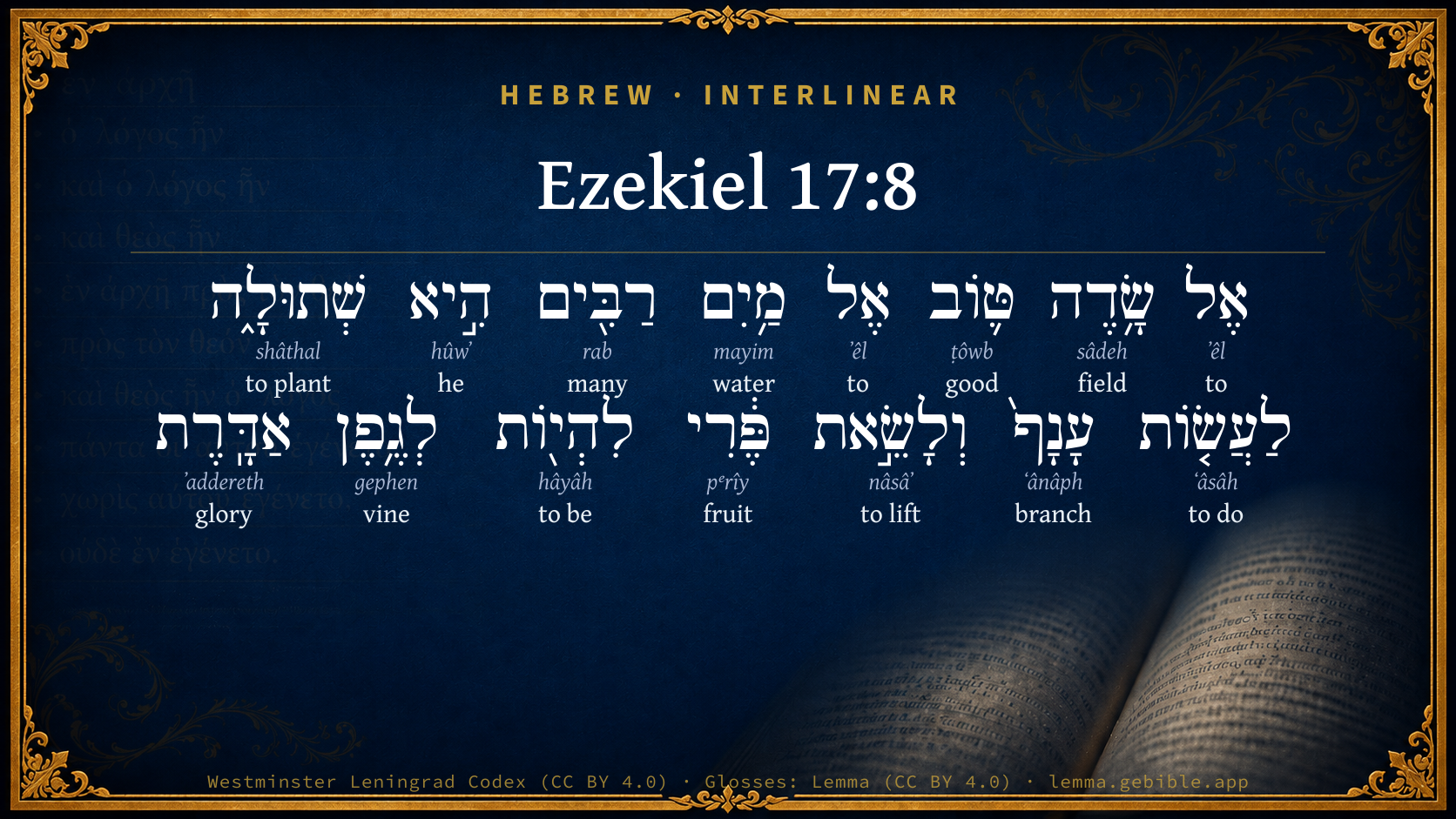
  1. אֶל ʼêl H413 “to” Preposition
  2. שָׂ֥דֶה sâdeh H7704 “field” Noun, Common, Masculine, Singular, Absolute
  3. טּ֛וֹב ṭôwb H2896 “good” Adjective, Adjective, Masculine, Singular, Absolute
  4. אֶל ʼêl H413 “to” Preposition
  5. מַ֥יִם mayim H4325 “water(s)” Noun, Common, Masculine, Plural, Absolute
  6. רַבִּ֖ים rab H7227 “many” Adjective, Adjective, Masculine, Plural, Absolute
  7. הִ֣יא hûwʼ H1931 “he” Pronoun, Personal, 3rd Person, Feminine, Singular
  8. שְׁתוּלָ֑ה shâthal H8362 “planted” Verb, Qal, Participle Passive, Feminine, Singular, Absolute
  9. לַעֲשׂ֤וֹת ʻâsâh H6213 “to do” Preposition + Verb, Qal, Infinitive Construct
  10. וְלָשֵׂ֣את nâsâʼ H5375 “and · to lift” Conjunction + Preposition + Verb, Qal, Infinitive Construct
  11. פֶּ֔רִי pᵉrîy H6529 “fruit” Noun, Common, Masculine, Singular, Absolute
  12. לִהְי֖וֹת hâyâh H1961 “to be” Preposition + Verb, Qal, Infinitive Construct
  13. לְגֶ֥פֶן gephen H1612 “to/for · vine of” Preposition + Noun, Common, Both, Singular, Construct
  14. אַדָּֽרֶת ʼaddereth H155 “glory” Noun, Common, Feminine, Singular, Absolute

About this verse

These counts appear in no published source. They are computed here, from the morphology-tagged text and Lemma’s own curated glosses. What Lemma adds →

15
words
14
distinct lemmas
Prophets
section

Notable vocabulary

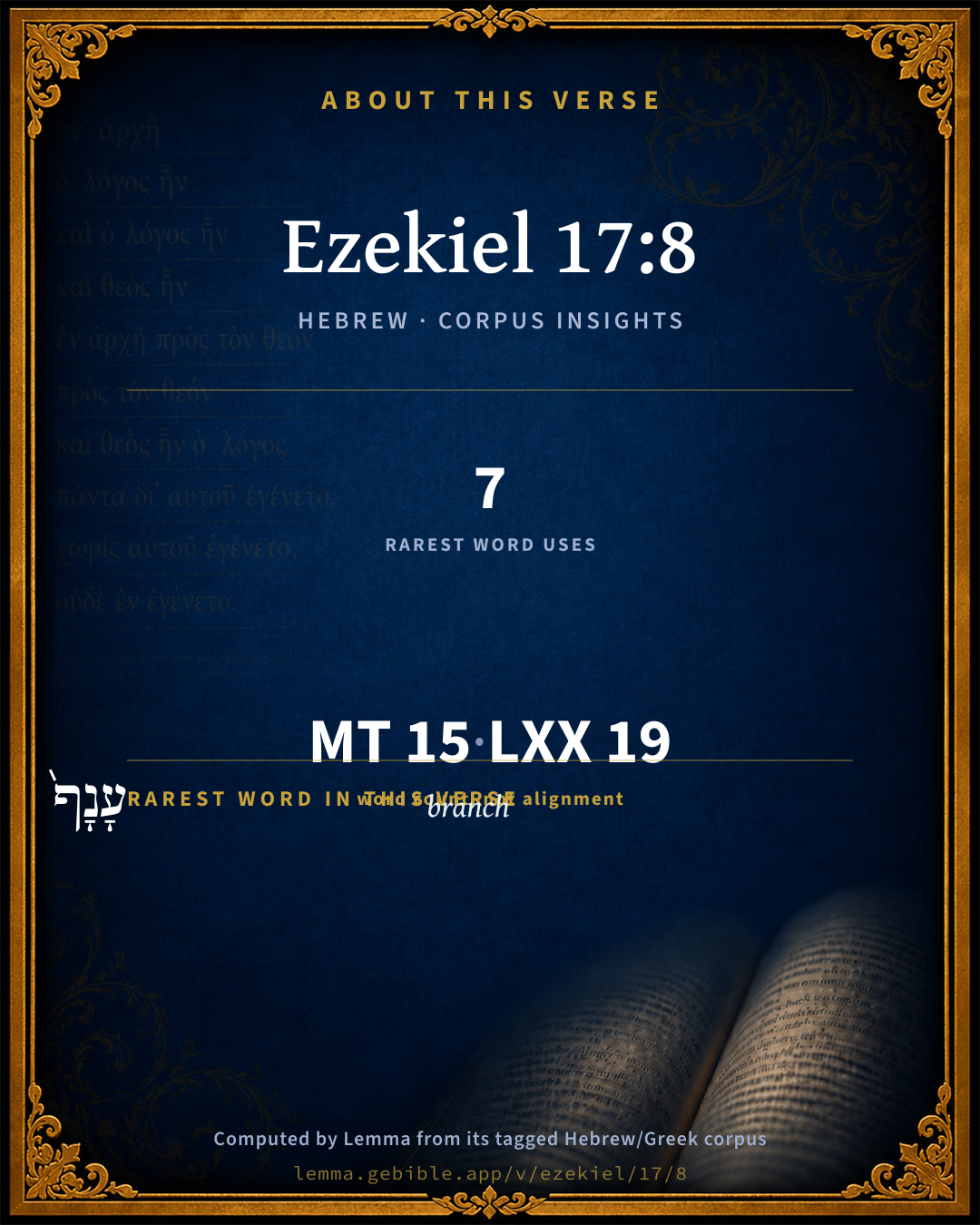
The rarest word here is עָנָף֙ branch H6057 — appearing just 7 times in the whole Hebrew Bible.

Shared distinctive vocabulary

עָנָף֙ branch H6057 occurs in 7 verses of the Hebrew Bible. Also found in:

Grammatical profile

  • 4 verbs
  • 6 nouns
  • 2 adjectives
  • 1 pronoun
  • 2 prepositions

Verb forms

  • שְׁתוּלָ֑ה Qal · Participle Passive
  • לַעֲשׂ֤וֹת Qal · Infinitive Construct
  • וְלָשֵׂ֣את Qal · Infinitive Construct
  • לִהְי֖וֹת Qal · Infinitive Construct

Repetition

A word recurs within this verse — often emphatic in Hebrew:

  • אֶל to H413 ×2

Hebrew & Septuagint length

In English translation the verse runs 29 words from the Hebrew and 22 from the Septuagint (LXX English) — closely comparable.

A rough comparison of the two English renderings, which tokenize alike — not a word-level alignment.

Word counts can differ between the Hebrew and the Greek without any difference in meaning — e.g. the Hebrew direct-object marker אֵת has no separate Greek word, and Greek often adds the article ὁ.

In the original languages it is 15 Hebrew tokens and 19 Greek tokens — but the two are counted differently (Hebrew bundles its prefixes and suffixes into one token; the Greek is in lemma form), so that isn’t a like-for-like length.

Cross-references

1

Topical passages linked to Ezekiel 17:8 in the Treasury of Scripture Knowledge — connected by theme and wording, ordered by reader-vote popularity; previews shown in the World English Bible.

  • Ezekiel 17:5–6 He took also of the seed of the land, and planted it in a fruitful soil; he placed it beside many waters; he set it as a willow tree.

Cross-references courtesy of OpenBible.info (CC BY 4.0).

Hebrew and Greek witnesses Masoretic Hebrew ↔ Greek Septuagint

The same verse in the two great witnesses to the Old Testament, shown verse-for-verse.

These are two independent witnesses, not word-aligned to each other, and the Septuagint is shown in lemma (dictionary) form.

Hebrew Ezekiel 17:8 Masoretic · Westminster Leningrad Codex

אֶל שָׂ֥דֶה טּ֛וֹב אֶל מַ֥יִם רַבִּ֖ים הִ֣יא שְׁתוּלָ֑ה לַעֲשׂ֤וֹת עָנָף֙ וְלָשֵׂ֣את פֶּ֔רִי לִהְי֖וֹת לְגֶ֥פֶן אַדָּֽרֶת

It was planted in a good soil by many waters, that it might bring forth branches, and that it might bear fruit, that it might be a goodly vine.

World English Bible · Public Domain

Greek LXX Ezekiel 17:8 Septuagint · lemma form

εἰς πεδίον καλός ἐπί ὕδωρ πολύς οὗτος πιαίνω ὁ ποιέω βλαστός καί φέρω καρπός ὁ εἰμί εἰς ἄμπελος μέγας

She thrives in a fair field by much water, to produce shoots and bear fruit, that she might become a great vine.

LXX2012 (modern English Septuagint) · Public Domain

Hebrew: Westminster Leningrad Codex (CC BY 4.0). Greek: Septuagint (public domain); English from LXX2012 (modern English Septuagint) (Public Domain). How the Septuagint differs from the Hebrew →

Targum (Aramaic paraphrase)

1

The Targum is the ancient Jewish Aramaic paraphrase of the Hebrew Scriptures — an interpretive translation, not the Hebrew text itself. Onkelos (literal) and Pseudo-Jonathan (expansive) render the Torah, and Jonathan the Prophets. Coverage is partial: where no permissively-licensed English translation exists for a verse, only the Aramaic is shown. This is verse-level text, not a word-by-word alignment to the Hebrew.

  1. Targum Jonathan Prophets (Joshua–Malachi)
    בַּחֲקַל טַב עֲלֵי מַיִין סַגִיאִין הִיא שְׁתִילָה לְמֶעְבַר עֲנַף וּלְמִטְעַן פֵּרִין לְמֶהֱוֵי לְגֶפֶן תַקִיף:

    (no public-domain English translation for this verse)

    Targum Jonathan — Aramaic: “Mikraot Gedolot” (public domain). English: “Sefaria Community Translation” (CC0 1.0 (public-domain dedication)); “London "Chaldee Paraphrase," 1871” (public domain). Text via Sefaria.

Commentary

Notes on Ezekiel 17:8 from classic Christian and Jewish commentators (each source and its license shown beneath its notes). The classic Christian expositions comment on the surrounding passage and are grouped to its opening verse, so a note may address several verses; the Jewish commentaries on the Tanakh (Rashi and others) are per-verse, so they appear only where the commentator wrote on this verse.

Lemma curates 59 commentaries, every one of them public domain or Creative Commons licensed, each selected and text-cleaned for this edition rather than reprinted as found. About our sources →

Trapp's Complete Commentary

John Trapp

Eze 17:8 It was planted in a good soil by great waters, that it might bring forth branches, and that it might bear fruit, that it might be a goodly vine.

Ver. 8. It was planted in a good soil.] He was well enough, if he could have kept him so.

“ O fortunates homines, bona si sun norint! ”

But discontent enjoyeth nothing: Zedekiah liketh not to be a vine, he must be a cedar. Aut Caesar aut nullus. Either Caesar or nothing.

John Trapp, A Commentary or Exposition upon All the Books of the Old and New Testament (1647–1656) — public domain. Text from a community e-Sword module.

Geneva Bible (1599)

Geneva Bible translators

They thought to be moistened by the waters of Nilus.

Geneva Bible (1599) marginal notes — public domain. Text via Bolls.life.

Jamieson, Fausset & Brown

Robert Jamieson, A. R. Fausset & David Brown

It was planted in a good soil--It was not want of the necessaries of life, nor oppression on the port of Nebuchadnezzar, which caused Zedekiah to revolt: it was gratuitous ambition, pride, and ingratitude.

Jamieson, Fausset & Brown — Commentary Critical and Explanatory on the Whole Bible (1871) — public domain (CC PDM 1.0). Text via the HelloAO Bible API.

Adam Clarke's Commentary

Verse 8. It was planted in a good soil] Though he depended on Babylon, he lived and reigned as Nebuchadnezzar's vicegerent in the land of Judea.

Adam Clarke's Commentary on the Bible (1810–1826) — public domain. Text from a community e-Sword/MySword module.

John Calvin's Commentaries

He exaggerates the ingratitude of Zedekiah, because, as we have said, he had been treated humanely by the king of Babylon; for he had been but a private man till that time: he was elevated to a throne and to a sway over the people beyond his expectation, and he had an avenger if any one despised him. For when he was tributary to the king of Babylon, he would doubtless have been assisted by him in adversity: hence his revolt was less excusable, since he had been treated liberally beyond all anticipation. For this reason it is said, the vine was planted in a good soil, and near many waters, that it might put forth branches and bear fruit, so that it might be a goodly vine. It follows —

John Calvin's Commentaries (1540-1563) — public domain. Text from the Calvin Translation Society English edition (1840s-50s) via the Christian Classics Ethereal Library (ccel.org). Calvin's coverage is partial (roughly two-thirds of the Bible); uncommented books and verses are honest gaps, never fabricated. The 19th-century editor's footnotes and remarks are omitted so the notes are faithfully Calvin's own voice.

The Cambridge Bible for Schools and Colleges

gen. ed. J. J. S. Perowne

8. The happy condition of Zedekiah’s monarchy under the king of Babylon, had he been content with his subordinate role as a feudatory prince.

The Cambridge Bible for Schools and Colleges (gen. ed. J. J. S. Perowne; Cambridge University Press, 1878–1918) — public domain. Text from a community e-Sword module.

John Gill's Exposition

Say thou, thus saith the Lord God,.... Tell Zedekiah and his people, in the name of the Lord, what will be the issue of his ingratitude and treachery to the king of Babylon, and his vain confidence in the king of Egypt:

shall it prosper? the vine, the kingdom of Judah, and Zedekiah the king of it; can it be thought that prosperity will attend such conduct as this? was is it ever known that persons guilty of such vices ever succeeded?

shall he not pull up the roots thereof; the first eagle, Nebuchadnezzar, being provoked by the rebellion of the king of Judah and his people; will he not come against them, and utterly destroy them, and root them up from being a people and a nation?

and cut off the fruit thereof, that it wither? the sons of the king, and of the nobles, and people of the land; so that the kingdom shall be ruined, and no hope left of its ever being restored again; which is the case of a vine when withered:

it shall wither in all the leaves of her spring; whereas it had been a springtime with this vine, under the influence of the king of Babylon, its leaves were green and flourishing; but now should wither, not as leaves do in autumn, which is to be expected, but in spring, which must be fatal; signifying, that in the midst of their prosperity, and when there was the greatest hope and expectation of a continuance and increase of it, utter ruin should come upon them:

even without great power or many people to pluck it up by the roots thereof; signifying with what ease the king of Babylon would take Jerusalem, and the land of Judea, its king and its princes, and utterly destroy them; he would have no need of a large army, or to employ all his forces, a few, were sufficient to do it; even as it does not require many hands to pluck up, a vine by the roots, a single person is equal to it.

John Gill's Exposition of the Whole Bible (1746–1763) — public domain (CC PDM 1.0). Text via the HelloAO Bible API.

Matthew Poole's English Annotations

It was planted by Nebuchadnezzar, in a very hopeful condition, where it might have thrived, been fruitful, and flourished. But they, both king and people, were unthankful, and discontented, and by sinful courses sought to better themselves; they had no great or just cause to complain of Nebuchadnezzar’s usage towards them, but out of pride, ambition, and ingratitude, joined with perjury, they revolt, and provoke God’s wrath and Nebuchadnezzar’s rage against them.

Matthew Poole's English Annotations on the Holy Bible (1683–1685) — public domain. Text from a community e-Sword/MySword module.

The Pulpit Commentary

Ezekiel repeats, as justifying Nebuchadnezzar"s action, that his first intention had been to leave Zedekiah under conditions which would have given his kingdom a fair measure of prosperity. The vine might have borne fruit.

The Pulpit Commentary (1880–1919), ed. H.D.M. Spence-Jones & Joseph S. Exell — public domain. Text from a community e-Sword module.

John Wesley's Explanatory Notes

Was planted - By Nebuchadnezzar, in a very hopeful condition, where it might have been fruitful, and flourished.

John Wesley, Explanatory Notes Upon the Whole Bible (1754–1765) — public domain. Text via the GEBible commentary corpus.

Rashi

Rabbi Shlomo Yitzchaki (Rashi)

In a good field, etc. i.e., she did this for no purpose, because she had been planted in a good field.

a sturdy vine Heb. אַדָרֶת, a sturdy vine.

Rashi on the Tanakh — English translations: “The Judaica Press complete Tanach with Rashi, translated by A. J. Rosenberg” (CC BY 4.0); “Pentateuch with Rashi's commentary by M. Rosenbaum and A.M. Silbermann, 1929-1934” (public domain); “The Metsudah Tanach series, Lakewood, N.J” (CC BY 4.0); and “The Book of Joshua, Metsudah Publications, 1997” (CC BY 4.0). Text via Sefaria.

Lesson kit

Teaching starters — assembled from the data on this page, not authored interpretation. Every prompt links to the verse data it draws on. Edit before teaching.

Ezekiel, in the Prophets, opens this verse with 15 words (14 distinct Hebrew lemmas). Its most distinctive word is ʻânâph (“branch”). A historical commentator’s framing appears above. Read the whole chapter for the surrounding context.

Discussion questions

  1. What does “branch” (ʻânâph) contribute to the verse as a whole?
  2. How does Leviticus 23:40, which shares the word «branch», read alongside this verse?
  3. What does the repetition of “to” (2× in this one verse) do in this verse?
  4. These translations render this verse differently. What is at stake in choosing one wording over another?
  5. «שְׁתוּלָ֑ה» is a Qal Participle Passive verb. How does that grammatical form shape the action described?
  6. Compare how Trapp's Complete Commentary and Geneva Bible (1599) read this verse. Where do they agree or differ?

Things to notice

Reading settings

Reading text

Shown beneath each verse's original-language words.

Old Testament
Old Testament edition

Read the OT as the Masoretic Hebrew (MT) or the Greek Septuagint (LXX).

English shown for the Greek Septuagint (in the Hebrew ↔ Greek comparison).

Comparing translations? Open the Compare panel on any verse page to stack up to four side by side.