
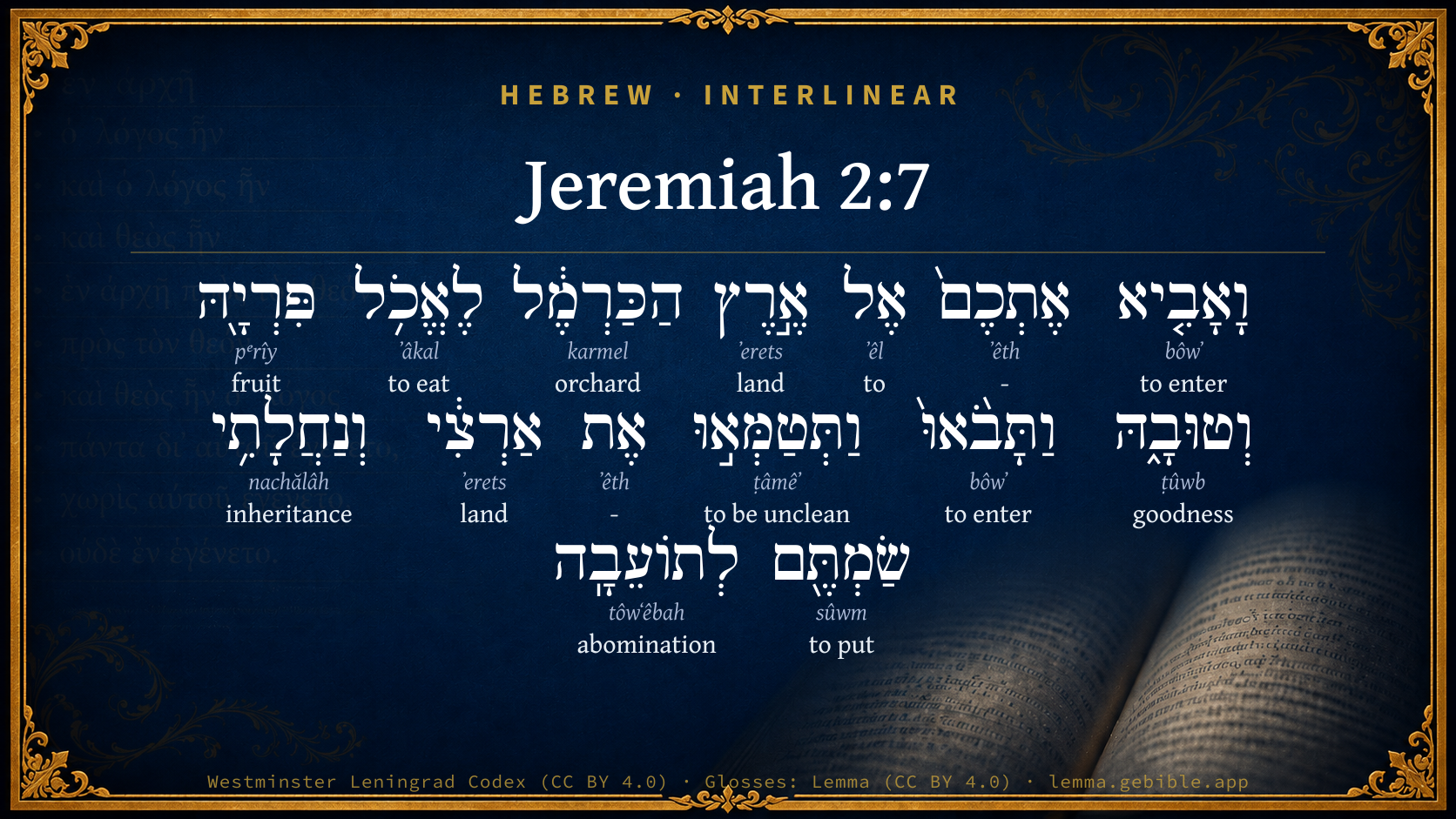
Jeremiah 2:7

Hebrew (Westminster Leningrad Codex) Jeremiah 2:7 appears in the Hebrew Old Testament. The text above is from the Westminster Leningrad Codex. Each word links to its Strong’s number, a concise gloss, and parsing drawn from the Open Scriptures Hebrew Bible morphology. Click any word for its full Brown-Driver-Briggs (BDB) entry.
Download image
Cite this verse

Jeremiah 2:7 (World English Bible). Public Domain. Lemma interlinear Bible study tool, https://lemma.gebible.app/v/jeremiah/2/7.

Show BibTeX & RIS
BibTeX
RIS
English Translation
I brought you into a plentiful land, to eat the fruit of it and the goodness of it; but when you entered, you defiled my land, and made my heritage an abomination.
World English Bible · Public Domain
Download a study sheet

One document with this verse’s original text, its word-by-word gloss line, the meaning frame, cross-references with their text, attributed commentary, and full source and license credits — printable, and it pastes into notes with its structure intact.

This verse Autodidact and up

Study sheet (.html) Plain text (.txt)

A passage Seminary Student

Up to 50 verses in one chapter. A passage sheet keeps up to 6 commentary sources and 12 cross-references per verse, in the order this page ranks them, and says so on the sheet whenever that leaves anything out. Ask for a single verse and you get the Autodidact verse sheet above.

Everything on this page stays free to read, with no account — the sheet is a download of what is already on screen, not access to it.

Want to remove ads? Support Godless Engineer
Compare translations 3

The same verse in 3 English versions, stacked beneath the original-language interlinear above. Click any original word for its lexicon entry.

Each is an independent rendering of the whole verse — the interlinear is not word-aligned to these translations.

Highlighted words mark where these versions differ — a whole-verse word diff, not a word-by-word alignment.

  • World English Bible Public Domain
    I brought you into a plentiful land, to eat the fruit of it and the goodness of it; but when you entered, you defiled my land, and made my heritage an abomination.
  • King James Version Public Domain
    And I brought you into a plentiful country, to eat the fruit thereof and the goodness thereof; but when ye entered, ye defiled my land, and made mine heritage an abomination.
  • unfoldingWord Literal Text CC BY-SA 4.0
    And I brought you into a land of fertile land, to eat its fruit and its good things. But you came and defiled my land, and you made my inheritance into an abomination!

unfoldingWord Literal Text — © unfoldingWord, licensed CC BY-SA 4.0. Word-aligned USFM3 via Door43 (git.door43.org/unfoldingWord/en_ult).

Versions to compare (up to 4)

3 of 4 selected

Show all 18 translations

Every available English version of this verse, each an independent rendering of the whole verse.

  • World English Bible Public Domain
    I brought you into a plentiful land, to eat the fruit of it and the goodness of it; but when you entered, you defiled my land, and made my heritage an abomination.
  • Berean Standard Bible Public Domain
    I brought you into a fertile land to eat its fruit and bounty, but you came and defiled My land, and made My inheritance detestable.
  • Majority Standard Bible Public Domain
    I brought you into a fertile land to eat its fruit and bounty, but you came and defiled My land and made My inheritance detestable.
  • King James Version Public Domain
    And I brought you into a plentiful country, to eat the fruit thereof and the goodness thereof; but when ye entered, ye defiled my land, and made mine heritage an abomination.
  • American Standard Version (1901) Public Domain
    And I brought you into a plentiful land, to eat the fruit thereof and the goodness thereof; but when ye entered, ye defiled my land, and made my heritage an abomination.
  • Revised Version (1885) Public Domain
    And I brought you into a plentiful land, to eat the fruit thereof and the goodness thereof; but when ye entered, ye defiled my land, and made mine heritage an abomination.
  • Geneva Bible (1599) Public Domain
    And I brought you into a plentifull countrey, to eat the fruit thereof, and the commodities of the same: but when yee entred, yee defiled my land, and made mine heritage an abomination.
  • Douay-Rheims (1899) Public Domain
    And I brought you into the land of Carmel, to eat the fruit thereof, and the best things thereof: ad when ye entered in, you defiled my land, and made my inheritance an abomination.
  • Young's Literal Translation Public Domain
    Yea, I bring you in to a land of fruitful fields, To eat its fruit and its goodness, And ye come in and defile My land, And Mine inheritance have made an abomination.
  • Literal Standard Version CC BY-SA 4.0
    Indeed, I bring you into a land of fruitful fields, || To eat its fruit and its goodness, || And you come in and defile My land, || And have made My inheritance an abomination.
  • Unlocked Literal Bible CC BY-SA 4.0
    But I brought you to the land of Carmel, to eat its fruit and other good things! Yet when you came, you defiled my land, you made my inheritance an abomination!
  • unfoldingWord Literal Text CC BY-SA 4.0
    And I brought you into a land of fertile land, to eat its fruit and its good things. But you came and defiled my land, and you made my inheritance into an abomination!
  • Darby Bible Public Domain
    And I brought you into a fruitful land, to eat the fruit thereof and the good thereof; and ye entered and defiled my land, and made my heritage an abomination.
  • World Messianic Bible Public Domain
    I brought you into a plentiful land to eat its fruit and its goodness; but when you entered, you defiled my land, and made my heritage an abomination.
  • Webster's Bible Public Domain
    And I brought you into a plentiful country, to eat the fruit of it, and the goodness of it; but when ye entered, ye defiled my land, and made my heritage an abomination.
  • Free Bible Version CC BY-SA 4.0
    I led you into a productive land to eat all the good things that grow there. But you came and made my land unclean, making it offensive to me.
  • Bible in Basic English Public Domain
    And I took you into a fertile land, where you were living on its fruit and its wealth; but when you came in, you made my land unclean, and made my heritage a disgusting thing.
  • JPS Tanakh (1917) Public Domain
    And I brought you into a land of fruitful fields, to eat the fruit thereof and the good thereof; but when ye entered, ye defiled My land, and made My heritage an abomination.

Literal Standard Version (2020), Covenant Press — licensed CC BY-SA 4.0. Text via the HelloAO Bible API (eBible.org). Unlocked Literal Bible (unfoldingWord) — licensed CC BY-SA 4.0. Text via the HelloAO Bible API (eBible.org). unfoldingWord Literal Text — © unfoldingWord, licensed CC BY-SA 4.0. Word-aligned USFM3 via Door43 (git.door43.org/unfoldingWord/en_ult). Free Bible Version, Dr. Jonathan Gallagher — licensed CC BY-SA 4.0. Text via the HelloAO Bible API (eBible.org).

Word by word

More ways to search: Search by grammar → Find every occurrence → Compare this word →

Practice this passage: Drill this verse → Learn its vocabulary →

הַכַּרְמֶ֔ל
karmel
H3759
“the · orchard”
Particle, Definite Article + Noun, Common, Masculine, Singular, Absolute
Part of Speech
Particle + Noun
Type
Common
Gender
Masculine
Number
Singular
State
Absolute
Full BDB Definition

Origin: from H3754

TWOT: 1041

plantation, garden-land, orchard, fruit orchard - fruit, garden-growth (metonymy)
  1. וָאָבִ֤יא bôwʼ H935 “and · to enter” Conjunction + Verb, Hiphil, Sequential Imperfect, 1st Person, Common, Singular
  2. אֶתְכֶם֙ ʼêth H853 “- · you” Particle, Direct Object + Suffix, Personal, 2nd Person, Masculine, Plural
  3. אֶל ʼêl H413 “to” Preposition
  4. אֶ֣רֶץ ʼerets H776 “land of” Noun, Common, Both, Singular, Construct
  5. לֶאֱכֹ֥ל ʼâkal H398 “to eat” Preposition + Verb, Qal, Infinitive Construct
  6. פִּרְיָ֖הּ pᵉrîy H6529 “fruit · her” Noun, Common, Masculine, Singular, Construct + Suffix, Personal, 3rd Person, Feminine, Singular
  7. וְטוּבָ֑הּ ṭûwb H2898 “and · goodness · her” Conjunction + Noun, Common, Masculine, Singular, Construct + Suffix, Personal, 3rd Person, Feminine, Singular
  8. וַתָּבֹ֨אוּ֙ bôwʼ H935 “and · to enter” Conjunction + Verb, Qal, Sequential Imperfect, 2nd Person, Masculine, Plural
  9. וַתְּטַמְּא֣וּ ṭâmêʼ H2930 “and · to be unclean” Conjunction + Verb, Piel, Sequential Imperfect, 2nd Person, Masculine, Plural
  10. אֶת ʼêth H853 “-” Particle, Direct Object
  11. אַרְצִ֔י ʼerets H776 “land · my” Noun, Common, Both, Singular, Construct + Suffix, Personal, 1st Person, Common, Singular
  12. וְנַחֲלָתִ֥י nachălâh H5159 “and · inheritance · my” Conjunction + Noun, Common, Feminine, Singular, Construct + Suffix, Personal, 1st Person, Common, Singular
  13. שַׂמְתֶּ֖ם sûwm H7760 “to put” Verb, Qal, Perfect, 2nd Person, Masculine, Plural
  14. לְתוֹעֵבָֽה tôwʻêbah H8441 “to/for · abomination” Preposition + Noun, Common, Feminine, Singular, Absolute

About this verse

These counts appear in no published source. They are computed here, from the morphology-tagged text and Lemma’s own curated glosses. What Lemma adds →

15
words
12
distinct lemmas
Prophets
section

Notable vocabulary

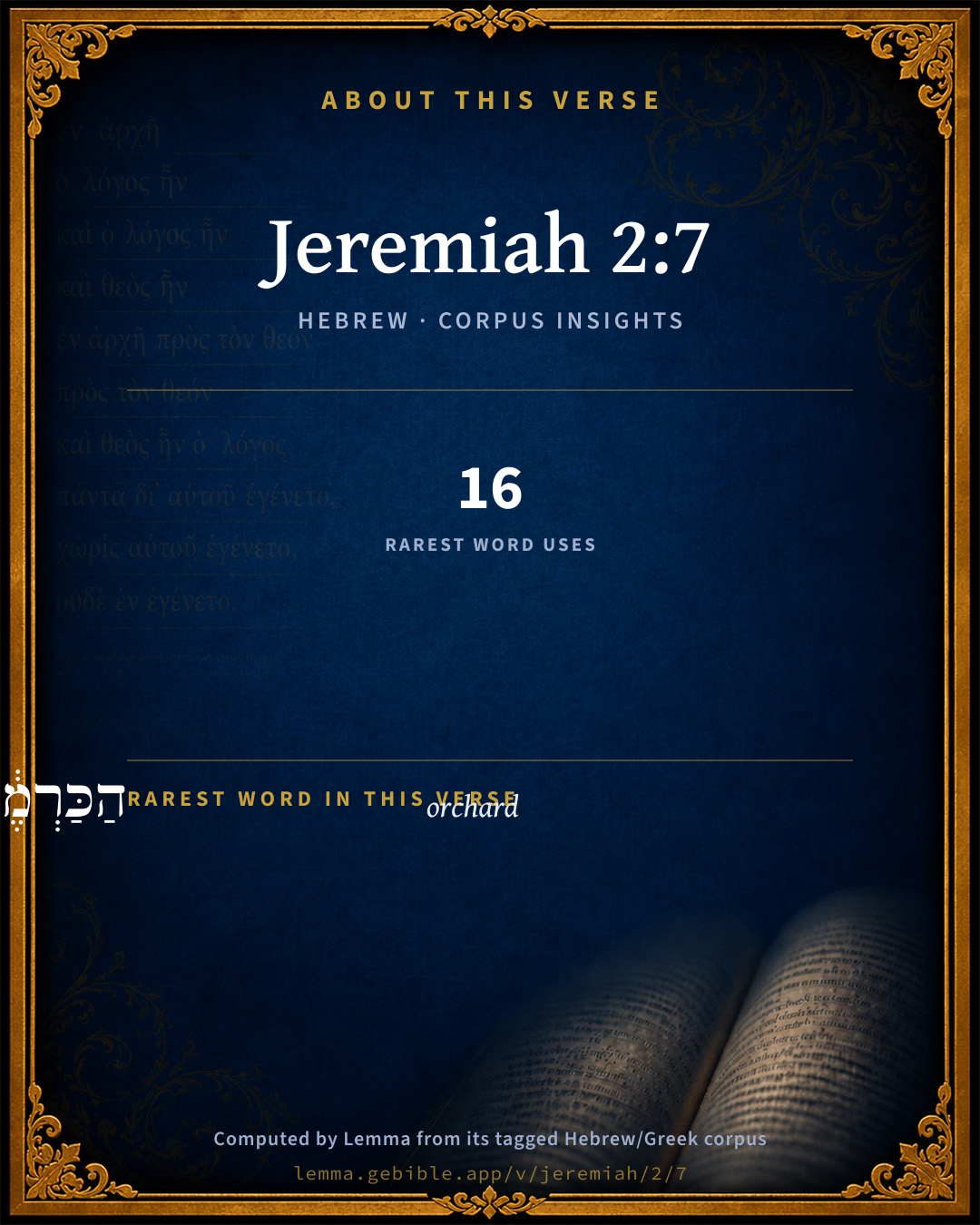
The rarest word here is הַכַּרְמֶ֔ל orchard H3759 — appearing just 16 times in the whole Hebrew Bible.

Shared distinctive vocabulary

הַכַּרְמֶ֔ל orchard H3759 occurs in 13 verses of the Hebrew Bible. Also found in:

Grammatical profile

  • 5 verbs
  • 7 nouns
  • 1 preposition
  • 2 particles

Verb forms

  • וָאָבִ֤יא Hiphil · Sequential Imperfect
  • לֶאֱכֹ֥ל Qal · Infinitive Construct
  • וַתָּבֹ֨אוּ֙ Qal · Sequential Imperfect
  • וַתְּטַמְּא֣וּ Piel · Sequential Imperfect
  • שַׂמְתֶּ֖ם Qal · Perfect

Repetition

Words recur within this verse — often emphatic in Hebrew:

  • וָאָבִ֤יא to enter H935 ×2
  • אֶ֣רֶץ land H776 ×2

Cross-references

18

Topical passages linked to Jeremiah 2:7 in the Treasury of Scripture Knowledge — connected by theme and wording, ordered by reader-vote popularity; previews shown in the World English Bible.

  • Deuteronomy 8:7–9 For Yahweh your God brings you into a good land, a land of brooks of water, of springs and springs, flowing forth in valleys and hills;
  • Jeremiah 16:18 First I will recompense their iniquity and their sin double, because they have polluted my land with the carcasses of their detestable things, and have filled my inheritance with their abominations.
  • Numbers 13:27 They told him, and said, We came to the land where you sent us; and surely it flows with milk and honey; and this is the fruit of it.
  • Ezekiel 36:17 Son of man, when the house of Israel lived in their own land, they defiled it by their way and by their doings: their way before me was as the uncleanness of a woman in her impurity.
  • Psalms 106:38–39 They shed innocent blood, Even the blood of their sons and of their daughters, Whom they sacrificed to the idols of Canaan. The land was polluted with blood.
  • Jeremiah 3:1 They say, If a man put away his wife, and she go from him, and become another man's, will he return to her again? Won't that land be greatly polluted? But you have played the prostitute with many lovers; yet return again to me, says Yahweh.
  • Jeremiah 3:9 It happened through the lightness of her prostitution, that the land was polluted, and she committed adultery with stones and with stocks.
  • Leviticus 18:24–28 "'Don't defile yourselves in any of these things: for in all these the nations which I am casting out before you were defiled.
  • Numbers 14:7–8 and they spoke to all the congregation of the children of Israel, saying, The land, which we passed through to spy it out, is an exceeding good land.
  • Numbers 35:33–34 So you shall not pollute the land in which you are: for blood, it pollutes the land; and no expiation can be made for the land for the blood that is shed therein, but by the blood of him who shed it.
  • Deuteronomy 6:10–11 It shall be, when Yahweh your God shall bring you into the land which he swore to your fathers, to Abraham, to Isaac, and to Jacob, to give you, great and goodly cities, which you didn't build,
  • Deuteronomy 6:18 You shall do that which is right and good in the sight of Yahweh; that it may be well with you, and that you may go in and possess the good land which Yahweh swore to your fathers,
  • Deuteronomy 11:10–12 For the land, where you go in to possess it, isn't as the land of Egypt, from whence you came out, where you sowed your seed, and watered it with your foot, as a garden of herbs;
  • Deuteronomy 21:23 his body shall not remain all night on the tree, but you shall surely bury him the same day; for he who is hanged is accursed of God; that you don't defile your land which Yahweh your God gives you for an inheritance.
  • Nehemiah 9:25 They took fortified cities, and a fat land, and possessed houses full of all good things, cisterns hewn out, vineyards, and olive groves, and fruit trees in abundance: so they ate, and were filled, and became fat, and delighted themselves in your great goodness.
  • Psalms 78:58–59 For they provoked him to anger with their high places, And moved him to jealousy with their engraved images.
  • Ezekiel 20:6 in that day I swore to them, to bring them forth out of the land of Egypt into a land that I had searched out for them, flowing with milk and honey, which is the glory of all lands.
  • Micah 2:10 Arise, and depart! For this is not your resting place, Because of uncleanness that destroys, Even with a grievous destruction.

Cross-references courtesy of OpenBible.info (CC BY 4.0).

Hebrew and Greek witnesses Masoretic Hebrew ↔ Greek Septuagint

The same verse in the two great witnesses to the Old Testament, shown verse-for-verse.

These are two independent witnesses, not word-aligned to each other, and the Septuagint is shown in lemma (dictionary) form.

Hebrew Jeremiah 2:7 Masoretic · Westminster Leningrad Codex

וָאָבִ֤יא אֶתְכֶם֙ אֶל אֶ֣רֶץ הַכַּרְמֶ֔ל לֶאֱכֹ֥ל פִּרְיָ֖הּ וְטוּבָ֑הּ וַתָּבֹ֨אוּ֙ וַתְּטַמְּא֣וּ אֶת אַרְצִ֔י וְנַחֲלָתִ֥י שַׂמְתֶּ֖ם לְתוֹעֵבָֽה

I brought you into a plentiful land, to eat the fruit of it and the goodness of it; but when you entered, you defiled my land, and made my heritage an abomination.

World English Bible · Public Domain

Greek LXX Structure differs

In the Septuagint, Jeremiah is about an eighth shorter than the Hebrew and arranges its material differently — the Oracles Against the Nations (Hebrew chapters 46–51) appear in the middle of the Greek book, after 25:13. Because the chapter and verse boundaries do not line up, a verse-for-verse comparison with the Hebrew is not shown.

A verse-for-verse comparison isn’t shown here because the chapters and verses don’t line up. Switch to the LXX edition with the MT / LXX toggle above to read the Greek directly.

On this verse, Ellicott's Commentary for English Readers discusses the Septuagint’s reading. Read the note in Commentary ↓

Hebrew: Westminster Leningrad Codex (CC BY 4.0). Greek: Septuagint (public domain); English from a public-domain English Septuagint. How the Septuagint differs from the Hebrew →

Targum (Aramaic paraphrase)

1

The Targum is the ancient Jewish Aramaic paraphrase of the Hebrew Scriptures — an interpretive translation, not the Hebrew text itself. Onkelos (literal) and Pseudo-Jonathan (expansive) render the Torah, and Jonathan the Prophets. Coverage is partial: where no permissively-licensed English translation exists for a verse, only the Aramaic is shown. This is verse-level text, not a word-by-word alignment to the Hebrew.

  1. Targum Jonathan Prophets (Joshua–Malachi)
    וְאָעֵלִית יַתְכוֹן לַאֲרַע דְיִשְׂרָאֵל דַהֲוַת מְנַצְבָא כְכַרְמְלָא לְמֵיכַל אִבָּהּ וְטוּבָהּ וְעַלְתּוּן וְסָאֵיבְתּוּן יַת אֲרַע בֵּית שְׁכִינְתִּי וְאַחְסַנְתִּי שַׁוֵיתוּן לְפוּלְחָן טַעֲוָתָא:

    (no public-domain English translation for this verse)

    Targum Jonathan — Aramaic: “Mikraot Gedolot” (public domain). English: “Sefaria Community Translation” (CC0 1.0 (public-domain dedication)); “London "Chaldee Paraphrase," 1871” (public domain). Text via Sefaria.

Commentary

Notes on Jeremiah 2:7 from classic Christian and Jewish commentators (each source and its license shown beneath its notes). The classic Christian expositions comment on the surrounding passage and are grouped to its opening verse, so a note may address several verses; the Jewish commentaries on the Tanakh (Rashi and others) are per-verse, so they appear only where the commentator wrote on this verse.

Lemma curates 59 commentaries, every one of them public domain or Creative Commons licensed, each selected and text-cleaned for this edition rather than reprinted as found. About our sources →

John Gill's Exposition

The priests said not, where is the Lord?.... Whose business it was to draw nigh to God, and offer the sacrifices of the people, and inquire of God for them; whose lips should keep knowledge, and at whose mouth the law should be sought, they being the messengers of the Lord of hosts, Mal 2:7,

and they that handle the law knew me not; the sanhedrim, according to Jarchi; or the lawyers and scribes, the Rabbins and doctors of the law, whose business it was to read and explain it; these did not understand it, nor the mind of God in it; and much less did they know him in a spiritual and evangelical manner; or as he is in Christ, and revealed in the Gospel:

the pastors also transgressed against me; kings, as the Targum, Jarchi, and Kimchi interpret it, who were pastors or shepherds in a civil sense; whose business it was to feed the people as the shepherd does his flock; that is, to guide and govern them by wholesome laws, by the laws of God; but, instead of this, they rebelled against the Lord, and transgressed his commands:

and the prophets prophesied by Baal; in his name; pretending to be inspired by that idol, and to receive the spirit of prophecy from him:

and walked after things that do not profit; the gods of the Gentiles, which could not supply them with the least temporal blessing, and much less give them spiritual and eternal ones; see Jer 14:22. This is to be understood of false prophets, as Ben Melech.

John Gill's Exposition of the Whole Bible (1746–1763) — public domain (CC PDM 1.0). Text via the HelloAO Bible API.

Trapp's Complete Commentary

John Trapp

Jer 2:7 And I brought you into a plentiful country, to eat the fruit thereof and the goodness thereof; but when ye entered, ye defiled my land, and made mine heritage an abomination.

Ver. 7. And I brought you into a plentiful country.] You lived in my good land, but not by my good laws; you had aequissima iura, sed iniquissima ingenia, most just laws but most foul nature, as was said of the Athenians; as if I had hired you to be wicked, so have you abused my mercies to my greatest dishonour.

John Trapp, A Commentary or Exposition upon All the Books of the Old and New Testament (1647–1656) — public domain. Text from a community e-Sword module.

Joseph Benson's Commentary

Jer 2:7-8. And I brought you into a plentiful country — Hebrew, into the land of Carmel. Carmel was so fertile a part of Judea, that the word from thence came to be used to express a fruitful place in general. Canaan was as one great, fruitful field, Deu 8:7. When ye entered, ye defiled my land — By your sins, especially by your idolatries, Psa 106:38; that sin being greatly aggravated by this circumstance, that the people thereby renounced God’s authority in that very land into which he had brought them, by a train of unparalleled wonders, and the propriety of which he had reserved to himself, though he had graciously bestowed upon them the use of it: see Lev 25:23. The priests said not, Where is the Lord? — That race of men, whom I exalted to the honourable office of ministering to me in holy things, neither inquired after me, nor cultivated any acquaintance or intercourse with me. And they that handle the law knew me not — They, whom I appointed to the important office of instructing others in the knowledge of me and their duty, (see Mal 2:6-7,) were ignorant or regardless of it themselves. And this was the principal cause of that degeneracy of manners which prevailed among the people. The pastors also transgressed against me — By pastors here, distinguished from the priests and prophets, are meant the kings, princes, and chiefs of the nation; for the word pastor is used in the prophets for a magistrate, as well as for a teacher of the people, and ecclesiastical governor. And the prophets prophesied by Baal — Gave forth prophecies in the name of Baal, with a view to recommend him as a god. Or, they that should have taught the people the true worship of God, were themselves worshippers of, and advocates for, Baal, and drew others from God to the worship of that idol; and walked after things that do not profit — Namely, after idols; things that could not possibly do them any service, but were sure to bring ruin upon them. It appears from hence, that all orders and degrees of men in authority had contributed to that general corruption of manners, whereof Jeremiah complains.

Joseph Benson's Commentary on the Old and New Testaments (1811–1818) — public domain. Text from a community e-Sword module.

Tyndale Open Study Notes

Tyndale Open Resources

2:7 defiled . . . corrupted: See Deut 4:25-28.

Tyndale Open Study Notes — © Tyndale Open Resources, licensed CC BY-SA 4.0. Text via the HelloAO Bible API.

Geneva Bible (1599)

Geneva Bible translators

By your idolatry and wicked manners, Ps. 78:58 and 106:38.

Geneva Bible (1599) marginal notes — public domain. Text via Bolls.life.

Jamieson, Fausset & Brown

Robert Jamieson, A. R. Fausset & David Brown

plentiful--literally, "a land of Carmel," or "well-cultivated land": a garden land, in contrast to the "land of deserts" (Jer 2:6).

defiled--by idolatries (Jdg 2:10-17; Psa 78:58-59; Psa 106:38).

you . . . ye--change to the second person from the third, "they" (Jer 2:6), in order to bring home the guilt to the living generation.

Jamieson, Fausset & Brown — Commentary Critical and Explanatory on the Whole Bible (1871) — public domain (CC PDM 1.0). Text via the HelloAO Bible API.

Adam Clarke's Commentary

Verse 7. And I brought you into a plentiful country] The land of Canaan.

My land] The particular property of God, which he gave to them as an inheritance, they being his peculiar people.

Adam Clarke's Commentary on the Bible (1810–1826) — public domain. Text from a community e-Sword/MySword module.

John Calvin's Commentaries

He afterwards adds, And I brought you in, etc. Here Jeremiah introduces God as the speaker; for God had, as with his hand stretched forth, brought in the children of Abraham into the possession of the promised land, which they did not get, as it is said in Psalm 44:3, by their own power and by their own sword; for though they had to fight with many enemies, yet it was God that made them victorious. He could then truly say, that they did not otherwise enter the land than under his guidance; inasmuch as he had opened a way and passage for them, and subdued and put to flight their enemies, that they might possess the heritage promised to them. I brought you in, he says, into the land, into Carmel Some consider this to be the name of a place; and no doubt there was the mount Carmel, so called on account of its great fertility. As then its name was given to it because it was so fertile, it is nothing strange that Jeremiah compares the land of Israel to Carmel. Some will have the preposition כ, caph, to be understood, “I have brought you into a land like Carmel.” But there is no need laboriously to turn in all directions the Prophet’s words. It is, as I think, a common noun, meaning fruitful, and used here to shew that the Israelites had been brought by God’s hand into a fertile land; for its fertility is everywhere celebrated, both in the Law and in the Prophets.

That ye might eat its fruit and its abundance; that is, “I wished you to enjoy the large and rich produce of the land.” By these words God intimates that the Israelites ought to have been induced by such allurements cordially to serve him; for by such liberal treatment he kindly invited them to himself. The greater, then, the bounty of God towards the people, the greater was the indignity offered by their defection, when they despised the various and abounding blessings of God.

Hence he adds, And ye have polluted my land, and mine heritage have ye made an abomination; as though he had said, “This is the reward by which my bounty towards you has been compensated. I indeed gave you this land, but on this condition, that ye serve me faithfully in it: but ye have polluted it.” He calls it his own land, as though he had said, that he had so given the land to the Israelites, that he remained still the lord of it as a proprietor, though he granted the occupation of it to them. He hence shews that they impiously abused his bounty, in polluting that land which was sacred to his name. For the same purpose he calls it his heritage, as if he said that they possessed the land by an hereditary right, and yet the heritage belonged to their Father. They ought, therefore, to have considered, that they had entered into the land, because it had been given to Abraham and to his children for an heritage, — by whom? By God, who was the fountain of this bounty. The more detestable, then, was their ingratitude, when they made the heritage of God an abomination It follows —

John Calvin's Commentaries (1540-1563) — public domain. Text from the Calvin Translation Society English edition (1840s-50s) via the Christian Classics Ethereal Library (ccel.org). Calvin's coverage is partial (roughly two-thirds of the Bible); uncommented books and verses are honest gaps, never fabricated. The 19th-century editor's footnotes and remarks are omitted so the notes are faithfully Calvin's own voice.

Ellicott's Commentary for English Readers

(7) A plentiful country.—Literally, a land of Carmel, that word, as meaning a vine-clad hill, having become a type of plenty. So “the forest of his Carmel,” in Isa_37:24; elsewhere, as in Isa_10:18; Isa_32:15, “fruitful.” The LXX. treats the word as a proper name, “I brought you unto Carmel.”

When ye entered.—The words point to the rapid degeneracy of Israel after the settlement in Canaan, as seen in the false worship and foul crimes of Judges 17-21. So in Psa_78:56-58. Instead of being the pattern nation, the firstfruits of mankind, they sank to the level, or below the level, of the heathen.

A Bible Commentary for English Readers, edited by Charles John Ellicott (1878–1897) — public domain. Text from a community e-Sword module.

The Cambridge Bible for Schools and Colleges

gen. ed. J. J. S. Perowne

7. a plentiful land] lit. a land of the Carmel. The word Carmel properly means a piece of ground fertile and well-cultivated (Jer_4:26 R.V. mg.), but was commonly used as the actual name of one such spot of Palestine, the only promontory that the sea-board of the country possesses, jutting out into the Mediterranean, and bounding the great plain of Esdraelon.

defiled] with (i) idolatry, (ii) sacrifices of their children; so Ps. 104:37. The old inhabitants of Canaan were driven out for their sins (cp. Deu_9:4 ff; Deu_18:12, etc.). Israel has proved little better. See Jer_3:2; Jer_3:9.

mine heritage] Cp. Exo_15:17; Psa_79:1. Elsewhere it is generally Israel itself that goes by this name; e.g. Deu_32:9. Cp. Jer_10:16; 1Sa_10:1; 1Ki_8:51; Psa_28:9; Psa_78:71; Isa_19:25.

The Cambridge Bible for Schools and Colleges (gen. ed. J. J. S. Perowne; Cambridge University Press, 1878–1918) — public domain. Text from a community e-Sword module.

Albert Barnes' Notes on the Bible

A plentiful country - literally, “a land of the Carmel,” a Carmel land (see 1Ki 18:19, note; Isa 29:17, note).

Albert Barnes' Notes on the Bible (1834–1885) — public domain. Text from a community e-Sword/MySword module.

Haydock's Catholic Bible Commentary

Carmel. That is, a fruitful, plentiful land. (Challoner) (Worthington) --- All Palestine is thus designated. (Menochius)

George Leo Haydock (1774–1849), Haydock's Catholic Family Bible and Commentary, 1859 edition — public domain. Excludes Psalms (Douay-Rheims chapter numbering differs from Protestant) and Deuterocanonical books (Catholic canon only).

Matthew Poole's English Annotations

Plentiful country, Heb.

land of Carmel, Isa 29:17; understand Canaan, Num 13:27; See Poole "Isa 35:2".

To eat the fruit thereof and the goodness; to enjoy all the blessing of it.

My land, i.e. consecrated to my name, Lev 25:23; and this you have defiled by going a whoring after your idols, Jer 3:1, and many other abominations, Psa 106:29,35,37-39.

Mine heritage; in the same sense that it is said in the foregoing clause my land, and which you received from me as your heritage, the place that I chose for my church’s present habitation, and earnest of their future heavenly one.

Matthew Poole's English Annotations on the Holy Bible (1683–1685) — public domain. Text from a community e-Sword/MySword module.

Whedon's Commentary on the Bible

Daniel D. Whedon

7. I brought you into a plentiful country — The original is Carmel, (כרמל) garden land, as opposed to the “wilderness.” The fruits of this “Carmel” are enumerated in Deu_8:7-9; “a good land, a land of brooks of water, of fountains and depths that spring out of valleys and hills; a land of wheat, and barley, and vines, and fig-trees, and pomegranates; a land of oil olive, and honey; a land wherein thou shalt eat bread without scarceness; thou shalt not lack any thing in it; a land whose stones are iron, and out of whose hills thou mayest dig brass.” In order rightly to appreciate this description we must bear in mind that its background is the peninsula of Sinai and the South Country, and also that the contrast was intensified and heightened by the hardships and privations of the forty years’ wandering in this region of silence and desolation. As the traveller of to-day emerges from the wilderness of the wandering into the land of promise he exchanges gloom, sterility, solitude, and monotony for beauty, variety, and the exhilaration of life.

Ye defiled my land — It should have been, in all its length and breadth, a sanctuary; ye have made it an abomination. Its high hills have become altars of lust; its green trees coverts of uncleanness; and even its sacred temple is filled with pollutions.

Daniel D. Whedon (gen. ed.), Commentary on the Old and New Testaments (1874–1909) — public domain. Text from a community e-Sword module.

The Pulpit Commentary

A plentiful country. "A Carmel land," as it were (so Payne Smith). "Carmel" is strictly an appellative noun, meaning" garden-land," i.e., land planted with vines and other choice plants. So Jer_4:26 Isa_29:17 Isa_37:24.

The Pulpit Commentary (1880–1919), ed. H.D.M. Spence-Jones & Joseph S. Exell — public domain. Text from a community e-Sword module.

John Wesley's Explanatory Notes

My land - Consecrated to my name; by your idols and many other abominations.

John Wesley, Explanatory Notes Upon the Whole Bible (1754–1765) — public domain. Text via the GEBible commentary corpus.

unfoldingWord translationNotes

Door43 World Missions Community

you defiled my land, you made my inheritance an abomination!

These two phrases mean the same thing. AT: "you sinned and made the land I gave you disgusting to me!" (See: Parallelism)

you defiled my land

Here "defiled" represents making the land unacceptable to God. They did this by sinning against him there when they worshiped idols. AT: "by sinning, you made my land no good" (See: Metaphor)

you made my inheritance an abomination

"you made my inheritance disgusting by your sin" or "by sinning, you made my inheritance repulsive"

my inheritance

Possible meanings are 1) God is speaking of his land as if he had inherited it. AT: "my land" or 2) God is speaking of the land he gave to Israel as if he had given it to them as an inheritance. AT: "the land I gave you" or "the land I gave you as an inheritance" (See: Metaphor)

Where is Yahweh?

This question would have shown that they wanted to obey Yahweh. AT: "We need to obey Yahweh!" (See: Rhetorical Question)

did not care about me

"were not committed to me" or "rejected me"

The shepherds transgressed against me

The leaders are spoken of as if they were shepherds and the people who followed them were sheep. AT: "Their leaders sinned against me" (See: Metaphor)

walked after unprofitable things

Here "walked after" represents obeying or worshiping. AT: "obeyed unprofitable things" or "worshiped unprofitable things" (See: Metaphor)

unprofitable things

Unprofitable things are things that cannot help a person. Here it refers to idols.

translationWords

Carmel

fruit

defile

inherit

abomination

priest

scribe

law

shepherd

transgress

prophet

Baal

walk

profit

unfoldingWord translationNotes — © Distant Shores Media and the Door43 World Missions Community, licensed CC BY-SA 4.0. Source: git.door43.org/Door43/en_tn.

Rashi

Rabbi Shlomo Yitzchaki (Rashi)

to a forest land To the land of Israel which is planted like כרמל, meaning: planted like a forest.

Rashi on the Tanakh — English translations: “The Judaica Press complete Tanach with Rashi, translated by A. J. Rosenberg” (CC BY 4.0); “Pentateuch with Rashi's commentary by M. Rosenbaum and A.M. Silbermann, 1929-1934” (public domain); “The Metsudah Tanach series, Lakewood, N.J” (CC BY 4.0); and “The Book of Joshua, Metsudah Publications, 1997” (CC BY 4.0). Text via Sefaria.

Lesson kit

Teaching starters — assembled from the data on this page, not authored interpretation. Every prompt links to the verse data it draws on. Edit before teaching.

Jeremiah, in the Prophets, opens this verse with 15 words (12 distinct Hebrew lemmas). Its most distinctive word is karmel (“orchard”). A historical commentator’s framing appears above. Read the whole chapter for the surrounding context.

Discussion questions

  1. What does “orchard” (karmel) contribute to the verse as a whole?
  2. Leviticus 2:14 shares the word «orchard» with this verse. How do the two illuminate each other?
  3. “to enter” occurs 2× in this one verse. What is the effect of the repetition?
  4. The translations on this page render this verse differently — a whole-verse word diff, not a word-by-word alignment. What might account for the different wordings?
  5. The verb «וָאָבִ֤יא» is Hiphil Sequential Imperfect. How does its form color the action?
  6. Reading how John Gill's Exposition and Trapp's Complete Commentary read this verse, where do the two commentators agree and where do they part?

Things to notice

Reading settings

Reading text

Shown beneath each verse's original-language words.

Old Testament
Old Testament edition

Read the OT as the Masoretic Hebrew (MT) or the Greek Septuagint (LXX).

English shown for the Greek Septuagint (in the Hebrew ↔ Greek comparison).

Comparing translations? Open the Compare panel on any verse page to stack up to four side by side.