
Proverbs 1:31

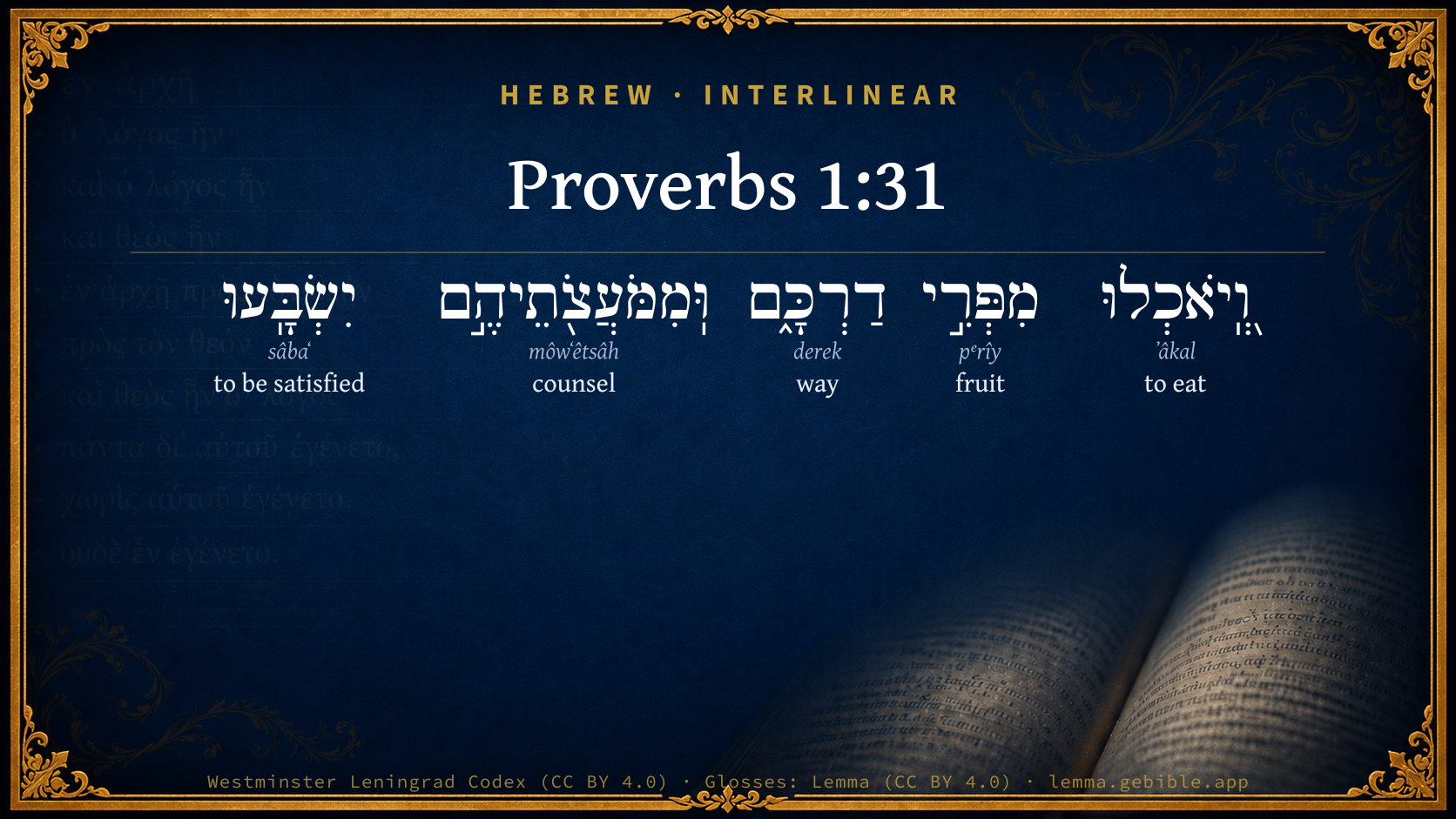
Hebrew (Westminster Leningrad Codex) Proverbs 1:31 appears in the Hebrew Old Testament. The text above is from the Westminster Leningrad Codex. Each word links to its Strong’s number, a concise gloss, and parsing drawn from the Open Scriptures Hebrew Bible morphology. Click any word for its full Brown-Driver-Briggs (BDB) entry.
Download image
Cite this verse

Proverbs 1:31 (World English Bible). Public Domain. Lemma interlinear Bible study tool, https://lemma.gebible.app/v/proverbs/1/31.

Show BibTeX & RIS
BibTeX
RIS
English Translation
Therefore they will eat of the fruit of their own way, And be filled with their own schemes.
World English Bible · Public Domain
Download a study sheet

One document with this verse’s original text, its word-by-word gloss line, the meaning frame, cross-references with their text, attributed commentary, and full source and license credits — printable, and it pastes into notes with its structure intact.

This verse Autodidact and up

Study sheet (.html) Plain text (.txt)

A passage Seminary Student

Up to 50 verses in one chapter. A passage sheet keeps up to 6 commentary sources and 12 cross-references per verse, in the order this page ranks them, and says so on the sheet whenever that leaves anything out. Ask for a single verse and you get the Autodidact verse sheet above.

Everything on this page stays free to read, with no account — the sheet is a download of what is already on screen, not access to it.

Want to remove ads? Support Godless Engineer
Compare translations 3

The same verse in 3 English versions, stacked beneath the original-language interlinear above. Click any original word for its lexicon entry.

Each is an independent rendering of the whole verse — the interlinear is not word-aligned to these translations.

Highlighted words mark where these versions differ — a whole-verse word diff, not a word-by-word alignment.

  • World English Bible Public Domain
    Therefore they will eat of the fruit of their own way, And be filled with their own schemes.
  • King James Version Public Domain
    Therefore shall they eat of the fruit of their own way, and be filled with their own devices.
  • unfoldingWord Literal Text CC BY-SA 4.0
    And they will eat from the fruit of their way, and from their plans they will be satisfied.

unfoldingWord Literal Text — © unfoldingWord, licensed CC BY-SA 4.0. Word-aligned USFM3 via Door43 (git.door43.org/unfoldingWord/en_ult).

Versions to compare (up to 4)

3 of 4 selected

Show all 18 translations

Every available English version of this verse, each an independent rendering of the whole verse.

  • World English Bible Public Domain
    Therefore they will eat of the fruit of their own way, And be filled with their own schemes.
  • Berean Standard Bible Public Domain
    So they will eat the fruit of their own way, and be filled with their own devices.
  • Majority Standard Bible Public Domain
    So they will eat the fruit of their own way, and be filled with their own devices.
  • King James Version Public Domain
    Therefore shall they eat of the fruit of their own way, and be filled with their own devices.
  • American Standard Version (1901) Public Domain
    Therefore shall they eat of the fruit of their own way, And be filled with their own devices.
  • Revised Version (1885) Public Domain
    Therefore shall they eat of the fruit of their own way, and be filled with their own devices.
  • Geneva Bible (1599) Public Domain
    Therefore shall they eate of ye fruite of their owne way, and be filled with their owne deuises.
  • Douay-Rheims (1899) Public Domain
    Therefore they shall eat the fruit of their own way, and shall be filled with their own devices.
  • Young's Literal Translation Public Domain
    And they eat of the fruit of their way, And from their own counsels they are filled.
  • Literal Standard Version CC BY-SA 4.0
    And they eat of the fruit of their way, || And they are filled from their own counsels.
  • Unlocked Literal Bible CC BY-SA 4.0
    They will eat the fruit of their ways, and with the fruit of their schemes they will be filled.
  • unfoldingWord Literal Text CC BY-SA 4.0
    And they will eat from the fruit of their way, and from their plans they will be satisfied.
  • Darby Bible Public Domain
    therefore shall they eat of the fruit of their way, and be filled with their own devices.
  • World Messianic Bible Public Domain
    Therefore they will eat of the fruit of their own way, and be filled with their own schemes.
  • Webster's Bible Public Domain
    Therefore shall they eat of the fruit of their own way, and be filled with their own devices.
  • Free Bible Version CC BY-SA 4.0
    So they'll have to eat the fruit of their own choices, bloated by their own devious schemes.
  • Bible in Basic English Public Domain
    So the fruit of their way will be their food, and with the designs of their hearts they will be made full.
  • JPS Tanakh (1917) Public Domain
    Therefore shall they eat of the fruit of their own way, and be filled with their own devices.

Literal Standard Version (2020), Covenant Press — licensed CC BY-SA 4.0. Text via the HelloAO Bible API (eBible.org). Unlocked Literal Bible (unfoldingWord) — licensed CC BY-SA 4.0. Text via the HelloAO Bible API (eBible.org). unfoldingWord Literal Text — © unfoldingWord, licensed CC BY-SA 4.0. Word-aligned USFM3 via Door43 (git.door43.org/unfoldingWord/en_ult). Free Bible Version, Dr. Jonathan Gallagher — licensed CC BY-SA 4.0. Text via the HelloAO Bible API (eBible.org).

Word by word

More ways to search: Search by grammar → Find every occurrence → Compare this word →

Practice this passage: Drill this verse → Learn its vocabulary →

About this verse

These counts appear in no published source. They are computed here, from the morphology-tagged text and Lemma’s own curated glosses. What Lemma adds →

5
words
5
distinct lemmas
Wisdom
section

Notable vocabulary

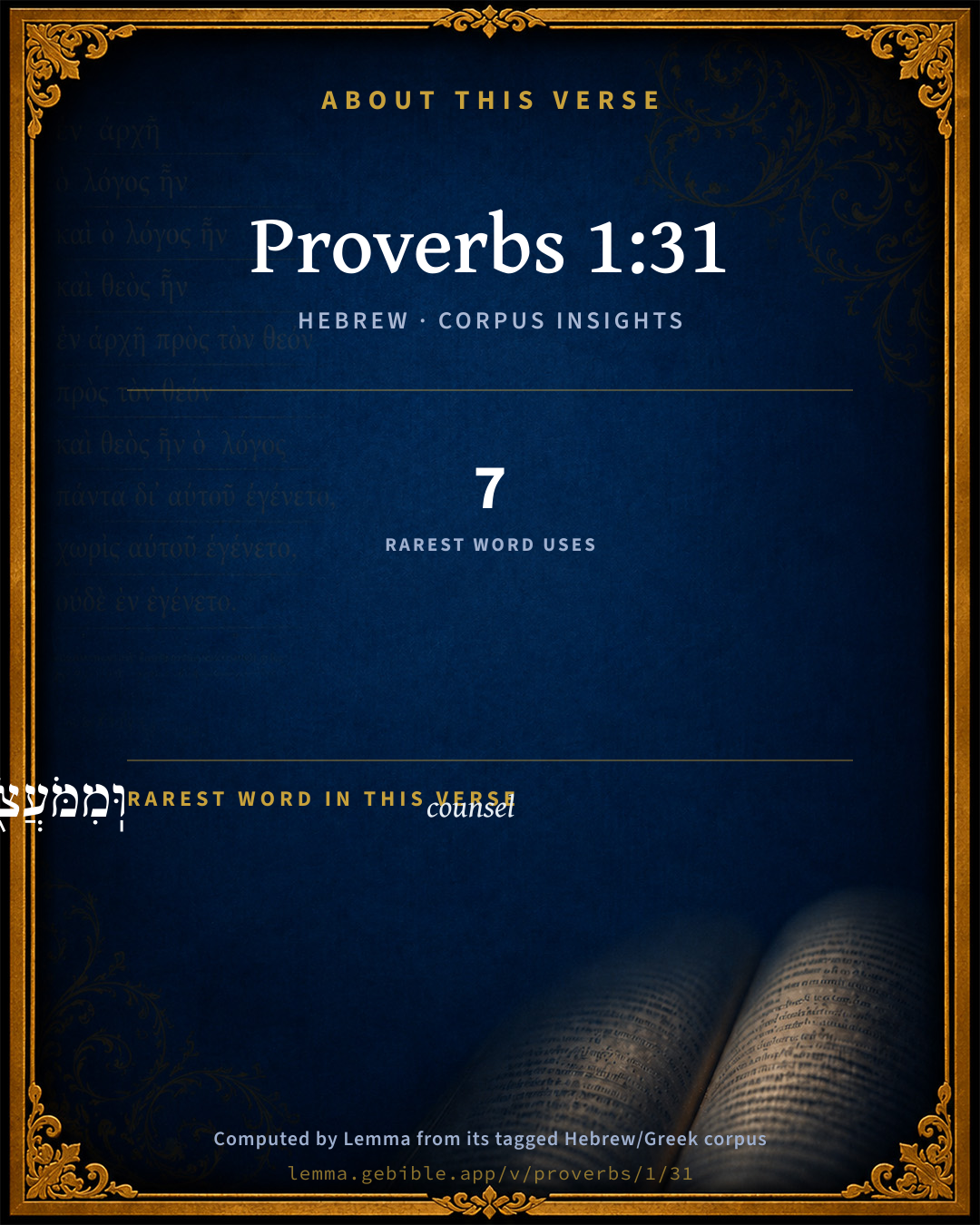
The rarest word here is וּֽמִמֹּעֲצֹ֖תֵיהֶ֣ם counsel H4156 — appearing just 7 times in the whole Hebrew Bible.

Shared distinctive vocabulary

וּֽמִמֹּעֲצֹ֖תֵיהֶ֣ם counsel H4156 occurs in 7 verses of the Hebrew Bible. Also found in:

Grammatical profile

  • 2 verbs
  • 3 nouns

Verb forms

  • וְֽ֭יֹאכְלוּ Qal · Imperfect
  • יִשְׂבָּֽעוּ Qal · Imperfect

Hebrew & Septuagint length

In English translation the verse runs 18 words from the Hebrew and 18 from the Septuagint (LXX English) — the same length.

A rough comparison of the two English renderings, which tokenize alike — not a word-level alignment.

Word counts can differ between the Hebrew and the Greek without any difference in meaning — e.g. the Hebrew direct-object marker אֵת has no separate Greek word, and Greek often adds the article ὁ.

Cross-references

7

Topical passages linked to Proverbs 1:31 in the Treasury of Scripture Knowledge — connected by theme and wording, ordered by reader-vote popularity; previews shown in the World English Bible.

  • Proverbs 14:14 The unfaithful will be repaid for his own ways; Likewise a good man will be rewarded for his ways.
  • Jeremiah 6:19 Hear, earth: behold, I will bring evil on this people, even the fruit of their thoughts, because they have not listened to my words; and as for my law, they have rejected it.
  • Job 4:8 According to what I have seen, those who plow iniquity, And sow trouble, Reap the same.
  • Proverbs 22:8 He who sows wickedness reaps trouble, And the rod of his fury will be destroyed.
  • Galatians 6:7–8 Don't be deceived. God is not mocked, for whatever a man sows, that will he also reap.
  • Isaiah 3:10–11 Tell the righteous "Good!" For they shall eat the fruit of their deeds.
  • Jeremiah 2:19 Your own wickedness shall correct you, and your backsliding shall reprove you: know therefore and see that it is an evil thing and a bitter, that you have forsaken Yahweh your God, and that my fear is not in you, says the Lord, Yahweh of Hosts.

Cross-references courtesy of OpenBible.info (CC BY 4.0).

Hebrew and Greek witnesses Masoretic Hebrew ↔ Greek Septuagint

The same verse in the two great witnesses to the Old Testament, shown verse-for-verse.

These are two independent witnesses, not word-aligned to each other, and the Septuagint is shown in lemma (dictionary) form.

Hebrew Proverbs 1:31 Masoretic · Westminster Leningrad Codex

וְֽ֭יֹאכְלוּ מִפְּרִ֣י דַרְכָּ֑ם וּֽמִמֹּעֲצֹ֖תֵיהֶ֣ם יִשְׂבָּֽעוּ

Therefore they will eat of the fruit of their own way, And be filled with their own schemes.

World English Bible · Public Domain

Greek LXX Proverbs 1:31 Septuagint · lemma form

τοϊγαρ-οῦν ἐσθίω ὁ ἑαυτοῦ ὁδός ὁ καρπός καί ὁ ἑαυτοῦ ἀσέβεια πίμπλημι

Therefore shall they eat the fruits of their own way, and shall be filled with their own ungodliness.

LXX2012 (modern English Septuagint) · Public Domain

On this verse, The Pulpit Commentary discusses the Septuagint’s reading. Read the note in Commentary ↓

Hebrew: Westminster Leningrad Codex (CC BY 4.0). Greek: Septuagint (public domain); English from LXX2012 (modern English Septuagint) (Public Domain). How the Septuagint differs from the Hebrew →

Commentary

Notes on Proverbs 1:31 from classic Christian and Jewish commentators (each source and its license shown beneath its notes). The classic Christian expositions comment on the surrounding passage and are grouped to its opening verse, so a note may address several verses; the Jewish commentaries on the Tanakh (Rashi and others) are per-verse, so they appear only where the commentator wrote on this verse.

Lemma curates 59 commentaries, every one of them public domain or Creative Commons licensed, each selected and text-cleaned for this edition rather than reprinted as found. About our sources →

Trapp's Complete Commentary

John Trapp

Pro 1:31 Therefore shall they eat of the fruit of their own way, and be filled with their own devices.

Ver. 31. Therefore shall they eat of the fruit.] Eat as they baked, drink as they brewed. They that sow the wind of iniquity, shall reap the whirlwind of misery, Aequum est ut faber quas fecit compedes ipse gestiat.

And be filled with their own devices.] Their never enough shall be quit with fire enough in the bottom of hell.

John Trapp, A Commentary or Exposition upon All the Books of the Old and New Testament (1647–1656) — public domain. Text from a community e-Sword module.

The Biblical Illustrator

Joseph S. Exell

Pro_1:31

Therefore shall they eat of the fruit of their own way.

Gods method of punishment

It is to let us punish ourselves. In this way man is led by bitter experience to see his own folly and Gods wisdom. When we will not be guided by God He grants all our wishes and desires to show us how foolish and miserable they are. When a man is cursed with every granted prayer he learns by bitter experience that it is possible to be his own worst enemy. His long-indulged desires become tyrannical tormentors. The promises of God are conditional. He will give us good things if we will do our part; but not if we neglect it, or do the contrary to it. God has given us the dignity of freedom, which involves the terrible possibility of disobeying His commands. It is the best thing for the thoughtless and careless to be let alone of God. Those who look back over their lives can trace most of their errors to the fact that they have tried to take themselves, so to speak, away from the guidance of God. Within the man who delights in sin, and loves darkness rather than light, there is a hell of his own making, from which he cannot depart any more than from himself. Only those who are beyond reformation, and who have altogether decided for the devil, God in this way leaves alone to be creatures of their own appetites and the prey of their sins. On others God inflicts sharp discipline in order to make them like Himself. (E. J. Hardy.)

Vain regrets

A man in South Africa bought a piece of land for the purpose of farming it, but, after a short trial, finding it unsuitable for that purpose, and hearing that gold was found in the neighbourhood, set to work to see if he could find any, but failed. Disgusted with his purchase, he sold it for what it would fetch, getting what we would call a mere song for it. The man who bought it, having also heard that there was a likelihood of gold being found, lost no time in making a vigorous search, and was rewarded in finding both gold and diamonds, which made him rich beyond his wildest dreams. Some years after- wards the former owner, who had left the country, heard from an old friend that gold by the ton and diamonds by hundreds were being taken from his bit of land, and it is said that he gnashed his teeth with rage and chagrin, as, with his hands clenched until the nails entered the palms, he exclaimed, Oh, what have I lost! what have I lost! You who have not accepted Christ, take care that some day when salvation is no longer yours to take or refuse, you in the bitterness of anguish can only say, Oh, what have I lost! what have I lost!

The Biblical Illustrator, edited by Joseph S. Exell (c. 1880s–1900s) — public domain. Text from a community e-Sword module.

Tyndale Open Study Notes

Tyndale Open Resources

1:31 Evil people suffer the consequences of their own actions (see 1:15-19); God will ensure that sinners receive their proper punishment (see Matt 25:44-46; Heb 10:29; 2 Pet 2:9).

Tyndale Open Study Notes — © Tyndale Open Resources, licensed CC BY-SA 4.0. Text via the HelloAO Bible API.

Geneva Bible (1599)

Geneva Bible translators

They shall feel what commodity their wicked life shall give them.

Geneva Bible (1599) marginal notes — public domain. Text via Bolls.life.

Jamieson, Fausset & Brown

Robert Jamieson, A. R. Fausset & David Brown

fruit . . . way--result of conduct (Isa 3:10; Eze 11:21; Rom 6:21; Gal 6:7-8).

be filled--even to repletion (Psa 123:4).

Jamieson, Fausset & Brown — Commentary Critical and Explanatory on the Whole Bible (1871) — public domain (CC PDM 1.0). Text via the HelloAO Bible API.

The Cambridge Bible for Schools and Colleges

gen. ed. J. J. S. Perowne

31. the fruit of their own way] As they sow, so shall they reap, in accordance with the eternal law of righteousness. Comp. Gal_6:7-8.

The Cambridge Bible for Schools and Colleges (gen. ed. J. J. S. Perowne; Cambridge University Press, 1878–1918) — public domain. Text from a community e-Sword module.

John Gill's Exposition

Therefore shall they eat of the fruit of their own way,.... Their evil ways; be punished according to their deserts, and receive the just reward of their iniquities; see Isa 3:10;

and be filled with their own devices; or "counsels" (g): their device and counsel was to put Christ to death; to deliver him to the Roman governor, that he might be crucified, as he was: and they afterwards had their bellyful of crucifixion, as the word (h) used signifies; such vast numbers of them were crucified by the Romans before the walls of the city, five hundred a day, and sometimes more; insomuch that room was needed for crosses, and crosses for bodies (i).

(g) "de consiliis suis", Pagninus, Montanus; "ex consiliis suis", Junius & Tremellius, &c. (h) "saturabuntar", V. L. Pagninus, Montanus, Tigurine version, Junius & Tremellius, Piscator, &c. (i) Josephus de Bello Jud. l. 5. c. 11. s. 1.

John Gill's Exposition of the Whole Bible (1746–1763) — public domain (CC PDM 1.0). Text via the HelloAO Bible API.

Matthew Poole's English Annotations

They shall eat of the fruit of their own way; they shall receive punishments answerable to their sins.

With their own devices; with the fruits or effects of their wicked devices. What was sweet in their mouths shall be bitter in their bellies, and that destruction which they have plotted against others shall fall upon themselves.

Matthew Poole's English Annotations on the Holy Bible (1683–1685) — public domain. Text from a community e-Sword/MySword module.

Whedon's Commentary on the Bible

Daniel D. Whedon

31. Therefore — For this reason they shall suffer the natural and penal consequences of their crimes. There is nothing arbitrary in their doom. As they have sown so shall they reap. They shall eat the fruit of their own doings.

It is possible that there is in the fearful language of this and the preceding verses a special reference to that class of persons described in Pro_1:11-19. It is natural that Solomon, as a sovereign, should think of such flagrant violators of law and right, having, probably, had frequently to deal with them, and being compelled in justice to treat them with great severity, notwithstanding their prayers for his clemency. They had proceeded in their evil courses until arrested by the hand of justice, and then, out of mercy to the innocent, no mercy could be shown to them. But the principle here developed is of higher and wider application. He who refuses to hearken to the voice of wisdom in cultivating and improving his mind till the time is past for such improvement, calls afterwards in vain for such knowledge.

The attainment mocks his efforts. There is a time, place, and opportunity for all things that ought to be done. But he that mis-improves or abuses them loses the advantage forever. So, in an eminent sense, of the knowledge of God and the attainment of his grace; if neglected in this, the day of salvation — the appropriate period for seeking it — the time will come when we shall have to say, “The harvest is past, the summer is ended, and we are not saved.” “Many shall seek to enter in and shall not be able.” We should not, however, apply too rigidly, and without qualification, the strong words and imagery with which the poet-sage invests personified Wisdom, to the great and good sovereign Judge, who, notwithstanding the infinite compassion of his nature, is compelled by the obligations of his justice to treat finally impenitent sinners with great severity. Even a human judge may be very severe in his sentence, yet very kind in his heart. But he must not let his compassion as a man slacken his hand of justice as a judge.

Daniel D. Whedon (gen. ed.), Commentary on the Old and New Testaments (1874–1909) — public domain. Text from a community e-Sword module.

The Pulpit Commentary

Therefore they shall eat, etc. A further enlargement of the declaration of Wisdom, showing that their calamity is the result of their own ways. The futures are resumed in the original from ver. 28. The word "therefore" does not occur, but it is met with in the LXX, toigaroun ; in the Vulgate, igitur; and in the Syriac, ideo. The truth here expressed is accordant with the tenor of the teaching of the Scripture, (comp. Pro_14:14 Pro_22:8 Job_4:8 Isa_3:10 Gal_6:7, Gal_6:8) and with our daily experience of God"s moral government of the world (see Butler, "Analogy," part 1, ch. 2, ad fin. ). This sentiment of retributive punishment also found expression in Terence, "Tute hoc intristi, tibi omne est edendum" ("Phorm.," 2. 1. 4). When we are punished, the blameworthiness lies not with God, but with us sinners (Wardlaw). They shall be failed; rather, satiated, or surfeited; saturabuntur (Vulgate). The verb bv (shava) means not only "to fill," but "to be satiated or cloyed". (cf. Pro_14:14 Pro_25:16 Psa_88:3 Psa_123:4) Michaelis remarks on this word, "Ad nauseam implebuntur et comedent, ita ut consiliorum suorum vehementer tandem, sed nimis sero, ipsos poeniteat" (Michaelis, "Notre Uberiores in Prov."), "They shall be filled and eat ad nauseam, so that at length, but too late, they shall vehemently repent them of their own counsels." Counsels (twOxewOm, moetsoth); i.e. ungodly counsels, or evil devices. The word only occurs in the plural.

Punishment the natural fruit of sin.

The punishment of sin is not an arbitrary penalty, but a natural consequence. It follows by laws of nature. It needs no executioner. The sin works out its own doom. This thought may be regarded from two points of view. From the standpoint of nature it is a proof that Divine justice does not abrogate, but works through natural laws. From the spiritual side it is an evidence that God has planted his moral laws in the very constitution of the world.

I SIN BEARS FRUIT. Nothing really perishes. Deeds live on in their consequences. Evil is not simply negative; there is a terribly active and even vital power in it. Its vitality may be of a diseased, destructive order, like that of the cancer that grows and spreads to the death of the body in which it is imbedded; but it is none the less vigorous and enduring.

II THE FRUIT OF SIN HAS A NATURAL AFFINITY TO THE STOCK FROM WHICH IT SPRINGS. The consequences of a sin have an inherent resemblance to the sin. As the Beatitudes are specially related to the graces they crown, so the curses of evil have close relations to particular forms of evil. Each sin bears its own fruit. Hatred provokes hatred; selfishness leads to isolation; falsehood engenders distrust.

III THE FRUIT OF SIN IS BEYOND OUR CONTROL. We are free to sow the seed or to refrain; we are not free to arrest the growth of the tree. A deed once done is not only irretrievable, but it passes out of our power while it lives on to work out perpetual consequences. It may become a Frankenstein, horribly tyrannizing over its creator.

IV THE FRUIT OF SIN MUST BE EATEN BY THE SINNER. It will come back to him when it is ripe. There may be a long interval between the sowing of the seed and the gathering of the fruit, but the sower will have to devour the harvest. Herein is the peculiar horror of the doom of sin. Though a man would fain forget the past, it returns in the dreadful resemblance it bears to its consequences, now fully developed and revealed in true colours. Nauseous and poisonous, it must not only be witnessed, but eaten. He will have to receive it in his own life, in most close and intimate union with himself.

CONCLUSION.

1. Let us beware of the thoughtless sowing which must lead to so fearful a harvest.

2. Let us lay hold of the hope of redemption in Christ through which our sins may be buried in the depths of the sea.

The Pulpit Commentary (1880–1919), ed. H.D.M. Spence-Jones & Joseph S. Exell — public domain. Text from a community e-Sword module.

John Wesley's Explanatory Notes

Eat - They should receive punishment answerable to their sins. Filled - With the fruits of them.

John Wesley, Explanatory Notes Upon the Whole Bible (1754–1765) — public domain. Text via the GEBible commentary corpus.

unfoldingWord translationNotes

Door43 World Missions Community

General Information:

Verse 33 ends wisdom's statement that began in Proverbs 1:22.

eat the fruit of their ways

Here a person's behavior is spoken of as if it were a way or road. Also, a person receiving the results of their behavior is spoken as if the person were eating the fruit of their behavior. AT: "experience the consequences of their actions" (See: Metaphor)

with the fruit of their schemes they will be filled

"they will eat the fruit of their schemes until they are full." A person receiving the results of their own evil plans is spoken of as eating the fruit of their schemes. AT: "they will suffer the consequences of their own evil plans" (See: Metaphor)

naive

inexperienced or immature

are killed when they turn away

A person rejecting wisdom is spoken of as if the person physically turns away from wisdom. This can be stated in active form. AT: "die because they refuse to learn" (See: Metaphor and Active or Passive)

the indifference of fools will destroy them

The abstract noun "indifference" can be stated as a verb. AT: "fools will die because they do not care about what should be done" (See: Abstract Nouns)

indifference

a lack of interest about something

translationWords

fruit

fool

life

unfoldingWord translationNotes — © Distant Shores Media and the Door43 World Missions Community, licensed CC BY-SA 4.0. Source: git.door43.org/Door43/en_tn.

Rashi

Rabbi Shlomo Yitzchaki (Rashi)

of the fruit of their way The fruit of the troubles that befall them they eat in their lifetime, and the principal is preserved for them in Gehinnom.

Rashi on the Tanakh — English translations: “The Judaica Press complete Tanach with Rashi, translated by A. J. Rosenberg” (CC BY 4.0); “Pentateuch with Rashi's commentary by M. Rosenbaum and A.M. Silbermann, 1929-1934” (public domain); “The Metsudah Tanach series, Lakewood, N.J” (CC BY 4.0); and “The Book of Joshua, Metsudah Publications, 1997” (CC BY 4.0). Text via Sefaria.

Lesson kit

Teaching starters — assembled from the data on this page, not authored interpretation. Every prompt links to the verse data it draws on. Edit before teaching.

Proverbs, in the Wisdom, opens this verse with 5 words (5 distinct Hebrew lemmas). Its most distinctive word is môwʻêtsâh (“counsel”). A historical commentator’s framing appears above. Read the whole chapter for the surrounding context.

Discussion questions

  1. What does “counsel” (môwʻêtsâh) contribute to the verse as a whole?
  2. Psalms 5:10 shares the word «counsel» with this verse. How do the two illuminate each other?
  3. These translations render this verse differently; the difference is in the English rendering, not the original. What questions does that raise?
  4. The verb «וְֽ֭יֹאכְלוּ» is Qal Imperfect. How does its form color the action?
  5. Reading how Trapp's Complete Commentary and The Biblical Illustrator read this verse, where do the two commentators agree and where do they part?

Things to notice

Reading settings

Reading text

Shown beneath each verse's original-language words.

Old Testament
Old Testament edition

Read the OT as the Masoretic Hebrew (MT) or the Greek Septuagint (LXX).

English shown for the Greek Septuagint (in the Hebrew ↔ Greek comparison).

Comparing translations? Open the Compare panel on any verse page to stack up to four side by side.