
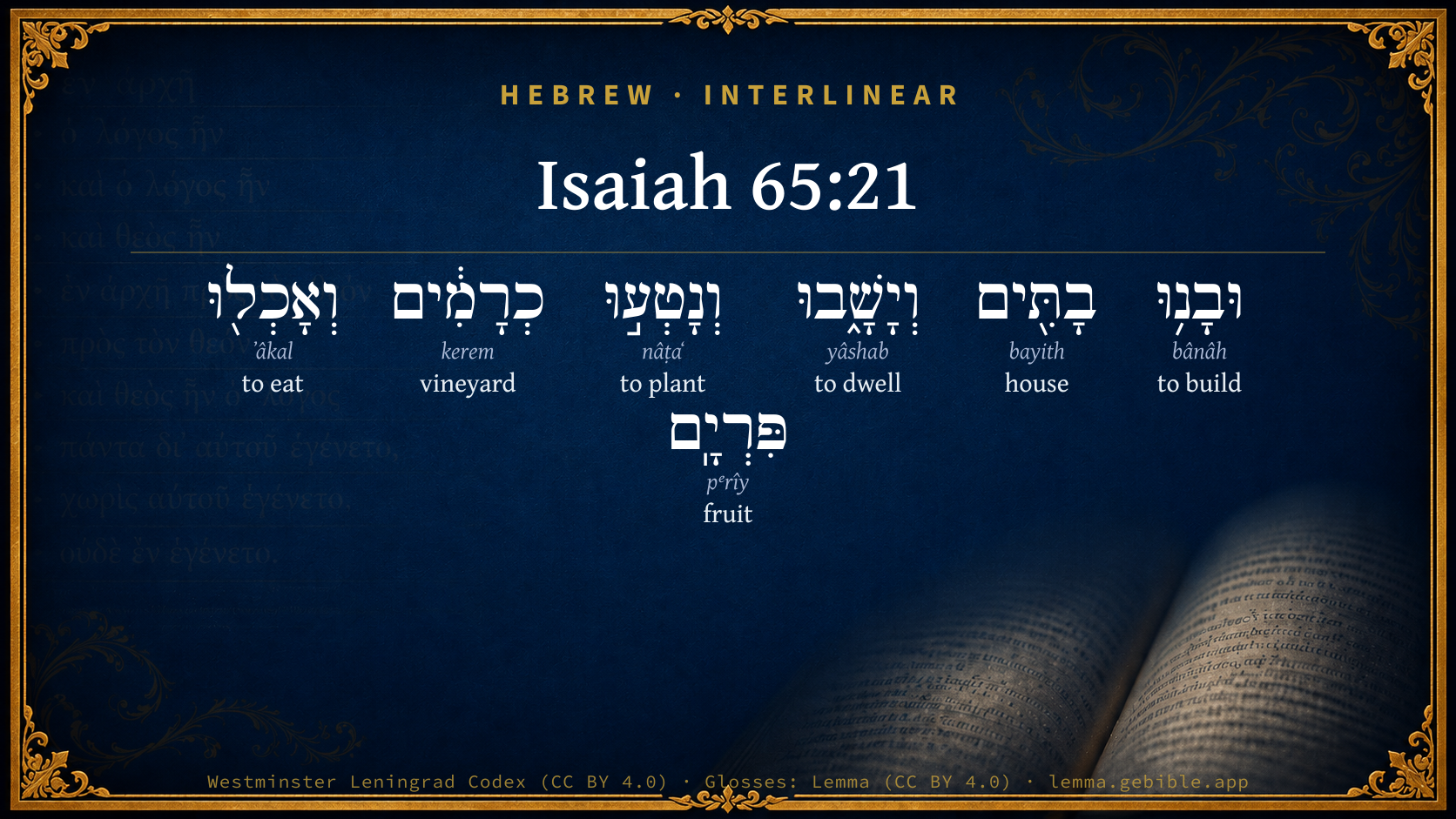
Isaiah 65:21

Hebrew (Westminster Leningrad Codex) Isaiah 65:21 appears in the Hebrew Old Testament. The text above is from the Westminster Leningrad Codex. Each word links to its Strong’s number, a concise gloss, and parsing drawn from the Open Scriptures Hebrew Bible morphology. Click any word for its full Brown-Driver-Briggs (BDB) entry.
Download image
Cite this verse

Isaiah 65:21 (World English Bible). Public Domain. Lemma interlinear Bible study tool, https://lemma.gebible.app/v/isaiah/65/21.

Show BibTeX & RIS
BibTeX
RIS
English Translation
They shall build houses, and inhabit them; and they shall plant vineyards, and eat the fruit of them.
World English Bible · Public Domain
Download a study sheet

One document with this verse’s original text, its word-by-word gloss line, the meaning frame, cross-references with their text, attributed commentary, and full source and license credits — printable, and it pastes into notes with its structure intact.

This verse Autodidact and up

Study sheet (.html) Plain text (.txt)

A passage Seminary Student

Up to 50 verses in one chapter. A passage sheet keeps up to 6 commentary sources and 12 cross-references per verse, in the order this page ranks them, and says so on the sheet whenever that leaves anything out. Ask for a single verse and you get the Autodidact verse sheet above.

Everything on this page stays free to read, with no account — the sheet is a download of what is already on screen, not access to it.

Want to remove ads? Support Godless Engineer
Compare translations 3

The same verse in 3 English versions, stacked beneath the original-language interlinear above. Click any original word for its lexicon entry.

Each is an independent rendering of the whole verse — the interlinear is not word-aligned to these translations.

Highlighted words mark where these versions differ — a whole-verse word diff, not a word-by-word alignment.

  • World English Bible Public Domain
    They shall build houses, and inhabit them; and they shall plant vineyards, and eat the fruit of them.
  • King James Version Public Domain
    And they shall build houses, and inhabit them; and they shall plant vineyards, and eat the fruit of them.
  • unfoldingWord Literal Text CC BY-SA 4.0
    And they will build houses, and they will dwell, and they will plant vineyards, and they will eat their fruit.

unfoldingWord Literal Text — © unfoldingWord, licensed CC BY-SA 4.0. Word-aligned USFM3 via Door43 (git.door43.org/unfoldingWord/en_ult).

Versions to compare (up to 4)

3 of 4 selected

Show all 18 translations

Every available English version of this verse, each an independent rendering of the whole verse.

  • World English Bible Public Domain
    They shall build houses, and inhabit them; and they shall plant vineyards, and eat the fruit of them.
  • Berean Standard Bible Public Domain
    They will build houses and dwell in them; they will plant vineyards and eat their fruit.
  • Majority Standard Bible Public Domain
    They will build houses and dwell in them; they will plant vineyards and eat their fruit.
  • King James Version Public Domain
    And they shall build houses, and inhabit them; and they shall plant vineyards, and eat the fruit of them.
  • American Standard Version (1901) Public Domain
    And they shall build houses, and inhabit them; and they shall plant vineyards, and eat the fruit of them.
  • Revised Version (1885) Public Domain
    And they shall build houses, and inhabit them; and they shall plant vineyards, and eat the fruit of them.
  • Geneva Bible (1599) Public Domain
    And they shall build houses and inhabite them, and they shall plant vineyards, and eate the fruite of them.
  • Douay-Rheims (1899) Public Domain
    And they shall build houses, and inhabit them; and they shall plant vineyards, and eat the fruits of them.
  • Young's Literal Translation Public Domain
    And they have built houses, and inhabited, And planted vineyards, and eaten their fruit.
  • Literal Standard Version CC BY-SA 4.0
    And they have built houses, and inhabited, || And planted vineyards, and eaten their fruit.
  • Unlocked Literal Bible CC BY-SA 4.0
    They will build houses and inhabit them, and they will plant vineyards and eat their fruit.
  • unfoldingWord Literal Text CC BY-SA 4.0
    And they will build houses, and they will dwell, and they will plant vineyards, and they will eat their fruit.
  • Darby Bible Public Domain
    And they shall build houses, and inhabit them; and they shall plant vineyards, and eat the fruit thereof:
  • World Messianic Bible Public Domain
    They will build houses and inhabit them. They will plant vineyards and eat their fruit.
  • Webster's Bible Public Domain
    And they shall build houses, and inhabit them; and they shall plant vineyards, and eat the fruit of them.
  • Free Bible Version CC BY-SA 4.0
    They will build houses and live in them; they will eat the fruit of the vineyards they themselves planted.
  • Bible in Basic English Public Domain
    And they will be building houses and living in them; planting vine-gardens and getting the fruit of them.
  • JPS Tanakh (1917) Public Domain
    And they shall build houses, and inhabit them; and they shall plant vineyards, and eat the fruit of them.

Literal Standard Version (2020), Covenant Press — licensed CC BY-SA 4.0. Text via the HelloAO Bible API (eBible.org). Unlocked Literal Bible (unfoldingWord) — licensed CC BY-SA 4.0. Text via the HelloAO Bible API (eBible.org). unfoldingWord Literal Text — © unfoldingWord, licensed CC BY-SA 4.0. Word-aligned USFM3 via Door43 (git.door43.org/unfoldingWord/en_ult). Free Bible Version, Dr. Jonathan Gallagher — licensed CC BY-SA 4.0. Text via the HelloAO Bible API (eBible.org).

Word by word

More ways to search: Search by grammar → Find every occurrence → Compare this word →

Practice this passage: Drill this verse → Learn its vocabulary →

וְנָטְע֣וּ
nâṭaʻ
H5193
“and · to plant”
Conjunction + Verb, Qal, Sequential Perfect, 3rd Person, Common, Plural
Part of Speech
Conjunction + Verb
Stem
Qal
Form
Sequential Perfect
Person
3rd Person
Gender
Common
Number
Plural
Full BDB Definition

Origin: a primitive root

TWOT: 1354

to plant, fasten, fix, establish - (Qal) - to plant - to plant, establish (figuratively) - (Niphal) - to be planted - to be established (figuratively)
  1. וּבָנ֥וּ bânâh H1129 “and · to build” Conjunction + Verb, Qal, Sequential Perfect, 3rd Person, Common, Plural
  2. בָתִּ֖ים bayith H1004 “houses” Noun, Common, Masculine, Plural, Absolute
  3. וְיָשָׁ֑בוּ yâshab H3427 “and · to dwell” Conjunction + Verb, Qal, Sequential Perfect, 3rd Person, Common, Plural
  4. כְרָמִ֔ים kerem H3754 “vineyards” Noun, Common, Both, Plural, Absolute
  5. וְאָכְל֖וּ ʼâkal H398 “and · to eat” Conjunction + Verb, Qal, Sequential Perfect, 3rd Person, Common, Plural
  6. פִּרְיָֽם pᵉrîy H6529 “fruit · their” Noun, Common, Masculine, Singular, Construct + Suffix, Personal, 3rd Person, Masculine, Plural

About this verse

These counts appear in no published source. They are computed here, from the morphology-tagged text and Lemma’s own curated glosses. What Lemma adds →

7
words
7
distinct lemmas
Prophets
section

Shared distinctive vocabulary

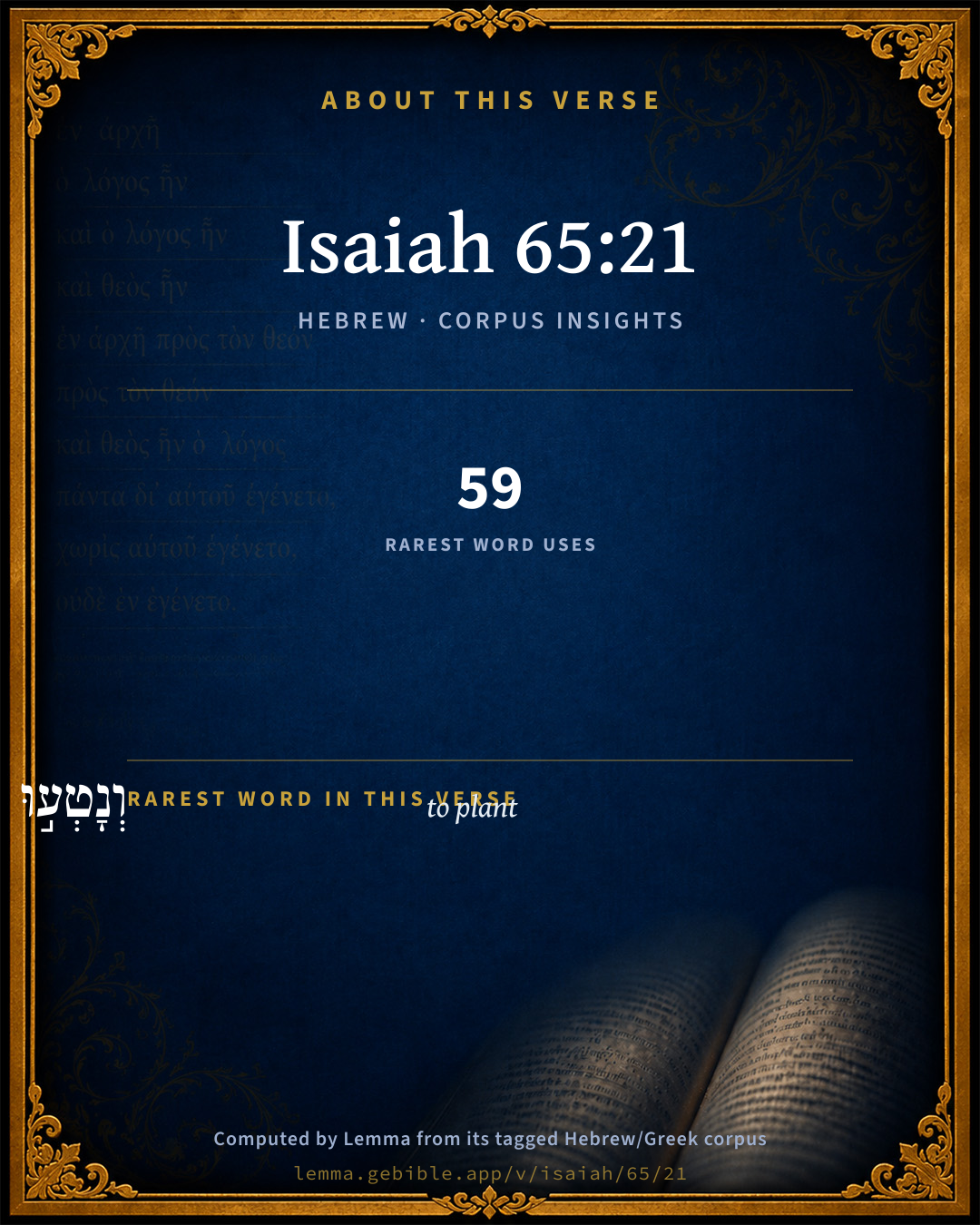
וְנָטְע֣וּ to plant H5193 occurs in 55 verses of the Hebrew Bible. Also found in:

Grammatical profile

  • 4 verbs
  • 3 nouns

Verb forms

  • וּבָנ֥וּ Qal · Sequential Perfect
  • וְיָשָׁ֑בוּ Qal · Sequential Perfect
  • וְנָטְע֣וּ Qal · Sequential Perfect
  • וְאָכְל֖וּ Qal · Sequential Perfect

Hebrew & Septuagint length

In English translation the verse runs 18 words from the Hebrew and 23 from the Septuagint (LXX English) — closely comparable.

A rough comparison of the two English renderings, which tokenize alike — not a word-level alignment.

Word counts can differ between the Hebrew and the Greek without any difference in meaning — e.g. the Hebrew direct-object marker אֵת has no separate Greek word, and Greek often adds the article ὁ.

Cross-references

7

Topical passages linked to Isaiah 65:21 in the Treasury of Scripture Knowledge — connected by theme and wording, ordered by reader-vote popularity; previews shown in the World English Bible.

  • Amos 9:14 I will bring back the captivity of my people Israel, And they will rebuild the ruined cities, and inhabit them; and they will plant vineyards, and drink wine from them. They shall also make gardens, And eat the fruit of them.
  • Isaiah 62:8–9 Yahweh has sworn by his right hand, and by the arm of his strength, Surely I will no more give your grain to be food for your enemies; and foreigners shall not drink your new wine, for which you have labored:
  • Jeremiah 31:4–5 Again will I build you, and you shall be built, O virgin of Israel: again shall you be adorned with your tambourines, and shall go forth in the dances of those who make merry.
  • Isaiah 32:18 My people shall abide in a peaceable habitation, and in safe dwellings, and in quiet resting-places.
  • Isaiah 37:30 This shall be the sign to you: you shall eat this year that which grows of itself, and in the second year that which springs of the same; and in the third year sow you, and reap, and plant vineyards, and eat the fruit of it.
  • Judges 6:1–6 The children of Israel did that which was evil in the sight of Yahweh: and Yahweh delivered them into the hand of Midian seven years.
  • Leviticus 26:16 I also will do this to you: I will appoint terror over you, even consumption and fever, that shall consume the eyes, and make the soul to pine away; and you will sow your seed in vain, for your enemies will eat it.

Cross-references courtesy of OpenBible.info (CC BY 4.0).

Hebrew and Greek witnesses Masoretic Hebrew ↔ Greek Septuagint

The same verse in the two great witnesses to the Old Testament, shown verse-for-verse.

These are two independent witnesses, not word-aligned to each other, and the Septuagint is shown in lemma (dictionary) form.

Hebrew Isaiah 65:21 Masoretic · Westminster Leningrad Codex

וּבָנ֥וּ בָתִּ֖ים וְיָשָׁ֑בוּ וְנָטְע֣וּ כְרָמִ֔ים וְאָכְל֖וּ פִּרְיָֽם

They shall build houses, and inhabit them; and they shall plant vineyards, and eat the fruit of them.

World English Bible · Public Domain

Greek LXX Isaiah 65:21 Septuagint · lemma form

καί οἰκοδομέω οἰκία καί αὐτός ἐνοἰκέω καί καταφυτεύω ἀμπελών καί αὐτός ἐσθίω ὁ γένημα αὐτός

and they shall build houses, and themselves shall dwell in them; and they shall plant vineyards, and themselves shall eat the fruit thereof.

LXX2012 (modern English Septuagint) · Public Domain

On this verse, Joseph Benson's Commentary discusses the Septuagint’s reading. Read the note in Commentary ↓

Hebrew: Westminster Leningrad Codex (CC BY 4.0). Greek: Septuagint (public domain); English from LXX2012 (modern English Septuagint) (Public Domain). How the Septuagint differs from the Hebrew →

Targum (Aramaic paraphrase)

1

The Targum is the ancient Jewish Aramaic paraphrase of the Hebrew Scriptures — an interpretive translation, not the Hebrew text itself. Onkelos (literal) and Pseudo-Jonathan (expansive) render the Torah, and Jonathan the Prophets. Coverage is partial: where no permissively-licensed English translation exists for a verse, only the Aramaic is shown. This is verse-level text, not a word-by-word alignment to the Hebrew.

  1. Targum Jonathan Prophets (Joshua–Malachi)
    וְיִבְנוֹן בָּתִּין וְיִתְבוּן וְיִצְבוּן כַּרְמִין וְיֵכְלוּן אִבְּהוֹן:

    And they shall build houses, and inhabit them; and they shall plant vineyards, and eat the fruit of them.

    Targum Jonathan — Aramaic: “Mikraot Gedolot” (public domain). English: “Sefaria Community Translation” (CC0 1.0 (public-domain dedication)); “London "Chaldee Paraphrase," 1871” (public domain). Text via Sefaria.

Commentary

Notes on Isaiah 65:21 from classic Christian and Jewish commentators (each source and its license shown beneath its notes). The classic Christian expositions comment on the surrounding passage and are grouped to its opening verse, so a note may address several verses; the Jewish commentaries on the Tanakh (Rashi and others) are per-verse, so they appear only where the commentator wrote on this verse.

Lemma curates 59 commentaries, every one of them public domain or Creative Commons licensed, each selected and text-cleaned for this edition rather than reprinted as found. About our sources →

Trapp's Complete Commentary

John Trapp

Isa 65:21 And they shall build houses, and inhabit [them]; and they shall plant vineyards, and eat the fruit of them.

Ver. 21. And they shall build houses and inhabit them.] The contrary whereunto is threatened against the wicked. {Deu 28:30-68} God’s people are freed from the curse of the law, from the hurt, if not from the smart of afflictions.

John Trapp, A Commentary or Exposition upon All the Books of the Old and New Testament (1647–1656) — public domain. Text from a community e-Sword module.

Joseph Benson's Commentary

Isa 65:21-23. They shall build houses and inhabit them — The prophet here describes another privilege of the church in these happy days. They shall enjoy blessings the very reverse of the curses denounced on the disobedient, Deu 28:30. They shall plant vineyards and eat the fruit of them. See note on Isa 62:8. They shall not plant and another eat — Which might happen, either through their enemies seizing the fruits of the trees they planted, or through their own premature death before those fruits were brought to perfection. For as the days of a tree are the days of my people — Not like the fading of a leaf, to which our present frail state is often compared, but their age shall equal the duration of the trees planted by them; yea, of the oaks, the most long-lived of trees, supposed to last about a thousand years, being five hundred years growing to full perfection, and as many decaying; “which,” says Bishop Lowth, “seems to be a moderate and probable computation.” The LXX. translate this clause, γαρ τας ημερας του ξυλου της ζωης εσυνται αι ημεραι του λαου μου; As the days of the tree of life shall be the days of my people. They shall not labour in vain — As those do who do not enjoy the fruit of their labour; nor bring forth — Beget and bring forth children; for trouble — Those that shall give them trouble by their bad conduct, or by the poverty and misery in which they shall be involved; for they are the seed of the blessed of the Lord, &c. — There is a blessing entailed upon them by descent from their ancestors, which their offspring with them shall partake of; who shall be a comfort to them, and whom they shall have the happiness to see walking in the truth.

Joseph Benson's Commentary on the Old and New Testaments (1811–1818) — public domain. Text from a community e-Sword module.

Geneva Bible (1599)

Geneva Bible translators

He proposeth to the faithful the blessings which are contained in the Law, and so under temporal things comprehendeth the spiritual promises.

Geneva Bible (1599) marginal notes — public domain. Text via Bolls.life.

Jamieson, Fausset & Brown

Robert Jamieson, A. R. Fausset & David Brown

(See on Isa 62:8; Amo 9:14).

Jamieson, Fausset & Brown — Commentary Critical and Explanatory on the Whole Bible (1871) — public domain (CC PDM 1.0). Text via the HelloAO Bible API.

Ellicott's Commentary for English Readers

(21) They shall build houses . . .—The proverbial type of national security and peace, as the opposite was of national misfortune (Lev_26:16; Deu_28:30).

A Bible Commentary for English Readers, edited by Charles John Ellicott (1878–1897) — public domain. Text from a community e-Sword module.

The Cambridge Bible for Schools and Colleges

gen. ed. J. J. S. Perowne

21, 22. In consequence of this extension of the term of life, each man shall enjoy the fruit of his own labour (cf. Deu_28:30). The idea is therefore somewhat different from that of ch. Isa_62:8-9.

as the days of a tree] Cf. Psa_92:12-13.

mine elect (= my chosen, Isa_65:15) shall long enjoy &c.] lit. “shall wear out,” “use up” (Job_21:13).

The Cambridge Bible for Schools and Colleges (gen. ed. J. J. S. Perowne; Cambridge University Press, 1878–1918) — public domain. Text from a community e-Sword module.

John Gill's Exposition

And they shall build houses, and inhabit them,.... In Jerusalem, and other parts of Judea: though this need not be limited to the Jews, but be considered as reaching to all the Lord's people, the Gentiles also; who will be in no fear of enemies, or ever be disturbed by them, but shall dwell in their own houses peaceably and quietly; this is the reverse of what is threatened to the wicked, Deu 28:30,

and they shall plant vineyards, and eat the fruit of them; they shall both live to dwell in their houses when built, and till their vineyards bring forth fruit, and then eat of them; and they shall be preserved from enemies breaking in upon them, and wasting their plantations.

John Gill's Exposition of the Whole Bible (1746–1763) — public domain (CC PDM 1.0). Text via the HelloAO Bible API.

Albert Barnes' Notes on the Bible

And they shall build houses - (See the notes at Isa 62:8-9).

Albert Barnes' Notes on the Bible (1834–1885) — public domain. Text from a community e-Sword/MySword module.

Matthew Poole's English Annotations

The quite contrary to what is said of the slothful man, Pro 12:27; see Job 27:13-17.

Matthew Poole's English Annotations on the Holy Bible (1683–1685) — public domain. Text from a community e-Sword/MySword module.

Whedon's Commentary on the Bible

Daniel D. Whedon

21, 22. Not build, and another inhabit — As against Deu_28:15-68, and Lev_26:14-46, (which see,) here is a promise of permanent blessedness in the new order of things. Like Lebanon’s cedars, symbols of everlastingness, so shall the lives of the righteous go on to indefinite years. The final grand Messianic period shall yield unceasing enjoyment.

Daniel D. Whedon (gen. ed.), Commentary on the Old and New Testaments (1874–1909) — public domain. Text from a community e-Sword module.

The Pulpit Commentary

They shall build houses, and inhabit them. The curse pronounced on apostasy in Deu_28:30 shall no more rest on God"s people. They shall have the fruition of their labours. No enemy shall be able to deprive them of their crops and houses.

The Pulpit Commentary (1880–1919), ed. H.D.M. Spence-Jones & Joseph S. Exell — public domain. Text from a community e-Sword module.

Keil & Delitzsch

C. F. Keil & F. Delitzsch

In the place of the threatened curses of the law in Lev 26:16 (cf., Deu 28:30), the very opposite will now receive their fullest realization. "And they will build houses and inhabit them, and plant vineyards and enjoy the fruit thereof. They will not build and another inhabit, nor plant and another enjoy; for like the days of trees are the days of my people, ad my chosen ones will consume the work of their hands. They will not weary themselves in vain, nor bring forth for sudden disaster; for they are a family of the blessed of Jehovah, and their offspring are left to them." They themselves will enjoy what they have worked for, without some one else stepping in, whether a countryman by violence or inheritance, or a foreigner by plunder or conquest (Isa 62:8), to take possession of that which they have built and planted (read יטעוּ without dagesh); for the duration of their life will be as great as that of trees (i.e., of oaks, terebinths, and cedars, which live for centuries), and thus they will be able thoroughly to enjoy in their own person what their hands have made. Billâh does not mean merely to use and enjoy, but to use up and consume. Work and generation will be blessed then, and there will be no more disappointed hopes. They will not weary themselves (יגעוּ with a preformative י without that of the root) for failure, not get children labbehâlâh, i.e., for some calamity to fall suddenly upon them and carry them away (Lev 26:16, cf., Psa 78:33). The primary idea of bâhal is either acting, permitting, or bearing, with the characteristic of being let loose, of suddenness, of overthrow, or of throwing into confusion. The lxx renders it εἰς κατάραν, probably according to the Egypto-Jewish usage, in which behâlâh may have signified cursing, like bahle, buhle in the Arabic (see the Appendices). The two clauses of the explanation which follows stand in a reciprocal relation to the two clauses of the previous promise. They are a family of the blessed of God, upon whose labour the blessing of God rests, and their offspring are with them, without being lost to them by premature death. This is the true meaning, as in Job 21:8, and not "their offspring with them," i.e., in like manner, as Hitzig supposes.

Keil & Delitzsch — Biblical Commentary on the Old Testament (1861–1891) — public domain (CC PDM 1.0). Text via the HelloAO Bible API. (Old Testament only.)

J. A. Alexander on Isaiah

Joseph Addison Alexander

“And they shall build houses and inhabit (them), and shall plant vineyards and eat the fruit of them, they shall not build and another inhabit, they shall not plant and another eat; for as the days of a tree (shall be) the days of my people, and the work of their hands my chosen ones shall wear out (or survive).” This is a promise of security and permanent enjoyment, clothed in expressions drawn from the promises and threatenings of the Mosaic law. By the age of a tree is generally understood the great age which some species are said to attain, such as the oak, the banyan, etc. The essential idea is in that of permanent continuance, and the figures here used to express it make it still more probable that in the whole foregoing context the predictions are to be figuratively understood.

Joseph Addison Alexander, The Prophecies of Isaiah (1846–1847; New York: Scribner, 1870–1878) — public domain. Text from a community e-Sword module.

Ibn Ezra

Rabbi Abraham ibn Ezra

And they shall build houses, etc. That is, they will be in safety, for there will be no enemy, as explained in the next verse; or, they will build houses, and dwell therein for a long time, while those that die in war are not so happy.

Ibn Ezra on the Tanakh — English translations: “Sefaria Community Translation” (CC0 1.0 (public-domain dedication)); “Yalkut, Sifsei Chachomim Chumash, Metsudah Publications, 2009” (CC BY 4.0); and “Commentary of Ibn Ezra on Isaiah - trans. by M. Friedlander, 1873” (public domain). Text via Sefaria.

Lesson kit

Teaching starters — assembled from the data on this page, not authored interpretation. Every prompt links to the verse data it draws on. Edit before teaching.

Isaiah, in the Prophets, opens this verse with 7 words (7 distinct Hebrew lemmas). Its most distinctive word is nâṭaʻ (“to plant”). A historical commentator’s framing appears above. Read the whole chapter for the surrounding context.

Discussion questions

  1. How does “to plant” (nâṭaʻ) shape what this verse is saying?
  2. How does Genesis 2:8, which shares the word «to plant», read alongside this verse?
  3. These translations render this verse differently. What is at stake in choosing one wording over another?
  4. «וּבָנ֥וּ» is a Qal Sequential Perfect verb. How does that grammatical form shape the action described?
  5. Compare how Trapp's Complete Commentary and Joseph Benson's Commentary read this verse. Where do they agree or differ?

Things to notice

Reading settings

Reading text

Shown beneath each verse's original-language words.

Old Testament
Old Testament edition

Read the OT as the Masoretic Hebrew (MT) or the Greek Septuagint (LXX).

English shown for the Greek Septuagint (in the Hebrew ↔ Greek comparison).

Comparing translations? Open the Compare panel on any verse page to stack up to four side by side.