
Isaiah 37:30

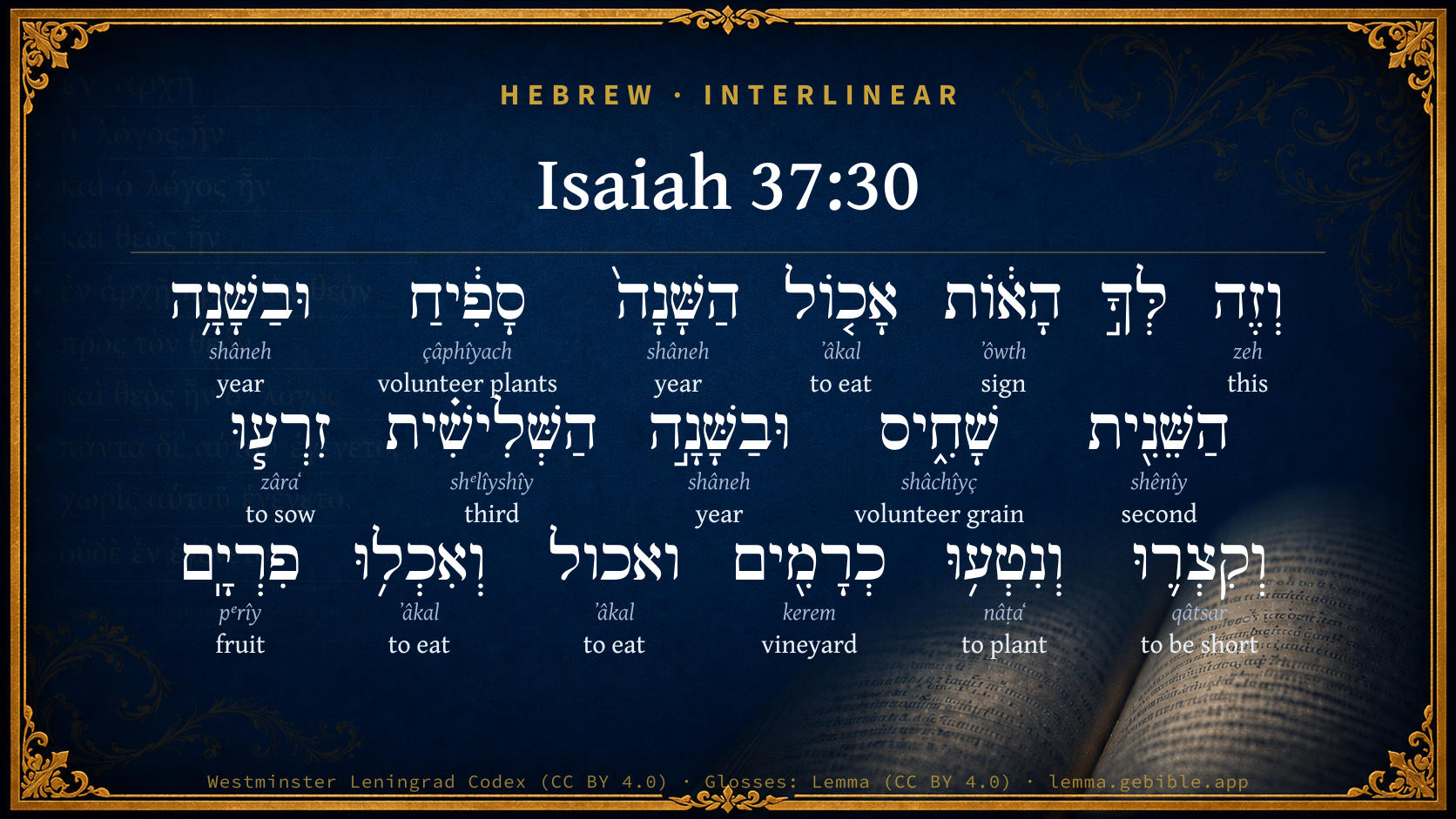
Hebrew (Westminster Leningrad Codex) Isaiah 37:30 appears in the Hebrew Old Testament. The text above is from the Westminster Leningrad Codex. Each word links to its Strong’s number, a concise gloss, and parsing drawn from the Open Scriptures Hebrew Bible morphology. Click any word for its full Brown-Driver-Briggs (BDB) entry.
Download image
Cite this verse

Isaiah 37:30 (World English Bible). Public Domain. Lemma interlinear Bible study tool, https://lemma.gebible.app/v/isaiah/37/30.

Show BibTeX & RIS
BibTeX
RIS
English Translation
This shall be the sign to you: you shall eat this year that which grows of itself, and in the second year that which springs of the same; and in the third year sow you, and reap, and plant vineyards, and eat the fruit of it.
World English Bible · Public Domain
Download a study sheet

One document with this verse’s original text, its word-by-word gloss line, the meaning frame, cross-references with their text, attributed commentary, and full source and license credits — printable, and it pastes into notes with its structure intact.

This verse Autodidact and up

Study sheet (.html) Plain text (.txt)

A passage Seminary Student

Up to 50 verses in one chapter. A passage sheet keeps up to 6 commentary sources and 12 cross-references per verse, in the order this page ranks them, and says so on the sheet whenever that leaves anything out. Ask for a single verse and you get the Autodidact verse sheet above.

Everything on this page stays free to read, with no account — the sheet is a download of what is already on screen, not access to it.

Want to remove ads? Support Godless Engineer
Compare translations 3

The same verse in 3 English versions, stacked beneath the original-language interlinear above. Click any original word for its lexicon entry.

Each is an independent rendering of the whole verse — the interlinear is not word-aligned to these translations.

Highlighted words mark where these versions differ — a whole-verse word diff, not a word-by-word alignment.

  • World English Bible Public Domain
    This shall be the sign to you: you shall eat this year that which grows of itself, and in the second year that which springs of the same; and in the third year sow you, and reap, and plant vineyards, and eat the fruit of it.
  • King James Version Public Domain
    And this shall be a sign unto thee, Ye shall eat this year such as groweth of itself; and the second year that which springeth of the same: and in the third year sow ye, and reap, and plant vineyards, and eat the fruit thereof.
  • unfoldingWord Literal Text CC BY-SA 4.0
    And this the sign for you. This year, you will eat wild grain, and in the second year, offspring. But in the third year, sow and harvest, and plant vineyards and eat their fruit.

unfoldingWord Literal Text — © unfoldingWord, licensed CC BY-SA 4.0. Word-aligned USFM3 via Door43 (git.door43.org/unfoldingWord/en_ult).

Versions to compare (up to 4)

3 of 4 selected

Show all 18 translations

Every available English version of this verse, each an independent rendering of the whole verse.

  • World English Bible Public Domain
    This shall be the sign to you: you shall eat this year that which grows of itself, and in the second year that which springs of the same; and in the third year sow you, and reap, and plant vineyards, and eat the fruit of it.
  • Berean Standard Bible Public Domain
    And this will be a sign to you, O Hezekiah: This year you will eat what grows on its own, and in the second year what springs from the same. But in the third year you will sow and reap; you will plant vineyards and eat their fruit.
  • Majority Standard Bible Public Domain
    And this will be a sign to you, O Hezekiah: This year you will eat what grows on its own, and in the second year what springs from the same. But in the third year you will sow and reap; you will plant vineyards and eat their fruit.
  • King James Version Public Domain
    And this shall be a sign unto thee, Ye shall eat this year such as groweth of itself; and the second year that which springeth of the same: and in the third year sow ye, and reap, and plant vineyards, and eat the fruit thereof.
  • American Standard Version (1901) Public Domain
    And this shall be the sign unto thee: ye shall eat this year that which groweth of itself, and in the second year that which springeth of the same; and in the third year sow ye, and reap, and plant vineyards, and eat the fruit thereof.
  • Revised Version (1885) Public Domain
    And this shall be the sign unto thee: ye shall eat this year that which groweth of itself, and in the second year that which springeth of the same; and in the third year sow ye, and reap, and plant vineyards, and eat the fruit thereof.
  • Geneva Bible (1599) Public Domain
    And this shalbe a signe vnto thee, O Hezekiah, Thou shalt eate this yeere such as groweth of it selfe: and the second yeere, such things as growe without sowing: and in the third yeere, sowe ye and reape, and plant vineyards, and eate the fruite thereof.
  • Douay-Rheims (1899) Public Domain
    But to thee this shall be a sign: Eat this year the things that spring of themselves, and in the second year eat fruits: but in the third year sow and reap, and giant vineyards, and eat the fruit of them.
  • Young's Literal Translation Public Domain
    -- And this to thee `is' the sign, Food of the year `is' self-sown grain, And in the second year the spontaneous growth, And in the third year, sow ye and reap, And plant vineyards, and eat their fruit.
  • Literal Standard Version CC BY-SA 4.0
    And this [is] the sign to you, || Self-sown grain [is] food of the year, || And in the second year the spontaneous growth, || And in the third year, sow and reap, || And plant vineyards, and eat their fruit.
  • Unlocked Literal Bible CC BY-SA 4.0
    This will be the sign for you: This year you will eat what grows wild, and in the second year what grows from that. But in the third year you must plant and harvest, plant vineyards and eat their fruit.
  • unfoldingWord Literal Text CC BY-SA 4.0
    And this the sign for you. This year, you will eat wild grain, and in the second year, offspring. But in the third year, sow and harvest, and plant vineyards and eat their fruit.
  • Darby Bible Public Domain
    And this [shall be] the sign unto thee: there shall be eaten this year such as groweth of itself; and in the second year that which springeth of the same; but in the third year sow ye, and reap, and plant vineyards and eat the fruit thereof.
  • World Messianic Bible Public Domain
    “‘This shall be the sign to you: You will eat this year that which grows of itself, and in the second year that which springs from it; and in the third year sow and reap and plant vineyards, and eat their fruit.
  • Webster's Bible Public Domain
    And this shall be a sign to thee, Ye shall eat this year such as groweth of itself; and the second year that which springeth of the same: and in the third year sow ye, and reap, and plant vineyards, and eat the fruit of them.
  • Free Bible Version CC BY-SA 4.0
    Hezekiah, this will be a sign to prove this is true: This year you'll eat what grows by itself. The second year you'll eat what grows from that. But in the third year you'll sow and reap, you'll plant vineyards and eat their fruit.
  • Bible in Basic English Public Domain
    And this will be the sign to you: you will get your food this year from what comes up of itself, and in the second year from the produce of the same; and in the third year you will put in your seed, and get in the grain, and make vine-gardens, and take of their fruit.
  • JPS Tanakh (1917) Public Domain
    And this shall be the sign unto thee: ye shall eat this year that which groweth of itself, and in the second year that which springeth of the same; and in the third year sow ye, and reap, and plant vineyards, and eat the fruit thereof.

Literal Standard Version (2020), Covenant Press — licensed CC BY-SA 4.0. Text via the HelloAO Bible API (eBible.org). Unlocked Literal Bible (unfoldingWord) — licensed CC BY-SA 4.0. Text via the HelloAO Bible API (eBible.org). unfoldingWord Literal Text — © unfoldingWord, licensed CC BY-SA 4.0. Word-aligned USFM3 via Door43 (git.door43.org/unfoldingWord/en_ult). Free Bible Version, Dr. Jonathan Gallagher — licensed CC BY-SA 4.0. Text via the HelloAO Bible API (eBible.org).

Word by word

More ways to search: Search by grammar → Find every occurrence → Compare this word →

Practice this passage: Drill this verse → Learn its vocabulary →

שָׁחִ֑יס
shâchîyç
H7823
“volunteer grain”
Noun, Common, Masculine, Singular, Absolute
Part of Speech
Noun
Type
Common
Gender
Masculine
Number
Singular
State
Absolute
Full BDB Definition

Origin: from an unused root apparently meaning to sprout

TWOT: 1484

volunteer grain - grain that shoots up of itself the second year, without replanting
  1. וְזֶה zeh H2088 “and · this” Conjunction + Pronoun, Demonstrative, Masculine, Singular
  2. הָא֔וֹת ʼôwth H226 “the · sign” Particle, Definite Article + Noun, Common, Both, Singular, Absolute
  3. אָכ֤וֹל ʼâkal H398 “to eat” Verb, Qal, Infinitive Absolute
  4. הַשָּׁנָה֙ shâneh H8141 “the · year” Particle, Definite Article + Noun, Common, Feminine, Singular, Absolute
  5. סָפִ֔יחַ çâphîyach H5599 “volunteer plants” Noun, Common, Masculine, Singular, Absolute
  6. וּבַשָּׁנָ֥ה shâneh H8141 “and · in/at the · year” Conjunction + Preposition, Determined + Noun, Common, Feminine, Singular, Absolute
  7. הַשֵּׁנִ֖ית shênîy H8145 “the · second” Particle, Definite Article + Adjective, Ordinal number, Feminine, Singular, Absolute
  8. וּבַשָּׁנָ֣ה shâneh H8141 “and · in/at the · year” Conjunction + Preposition, Determined + Noun, Common, Feminine, Singular, Absolute
  9. הַשְּׁלִישִׁ֗ית shᵉlîyshîy H7992 “the · third” Particle, Definite Article + Adjective, Ordinal number, Feminine, Singular, Absolute
  10. זִרְע֧וּ zâraʻ H2232 “sow” Verb, Qal, Imperative, 2nd Person, Masculine, Plural
  11. וְקִצְר֛וּ qâtsar H7114 “and · be short” Conjunction + Verb, Qal, Imperative, 2nd Person, Masculine, Plural
  12. וְנִטְע֥וּ nâṭaʻ H5193 “and · plant” Conjunction + Verb, Qal, Imperative, 2nd Person, Masculine, Plural
  13. כְרָמִ֖ים kerem H3754 “vineyards” Noun, Common, Both, Plural, Absolute
  14. ואכול ʼâkal H398 “and · to eat” Conjunction + Verb, Qal, Infinitive Absolute
  15. וְאִכְל֥וּ ʼâkal H398 “and · eat” Conjunction + Verb, Qal, Imperative, 2nd Person, Masculine, Plural
  16. פִרְיָֽם pᵉrîy H6529 “fruit · their” Noun, Common, Masculine, Singular, Construct + Suffix, Personal, 3rd Person, Masculine, Plural

About this verse

These counts appear in no published source. They are computed here, from the morphology-tagged text and Lemma’s own curated glosses. What Lemma adds →

18
words
13
distinct lemmas
Prophets
section

Notable vocabulary

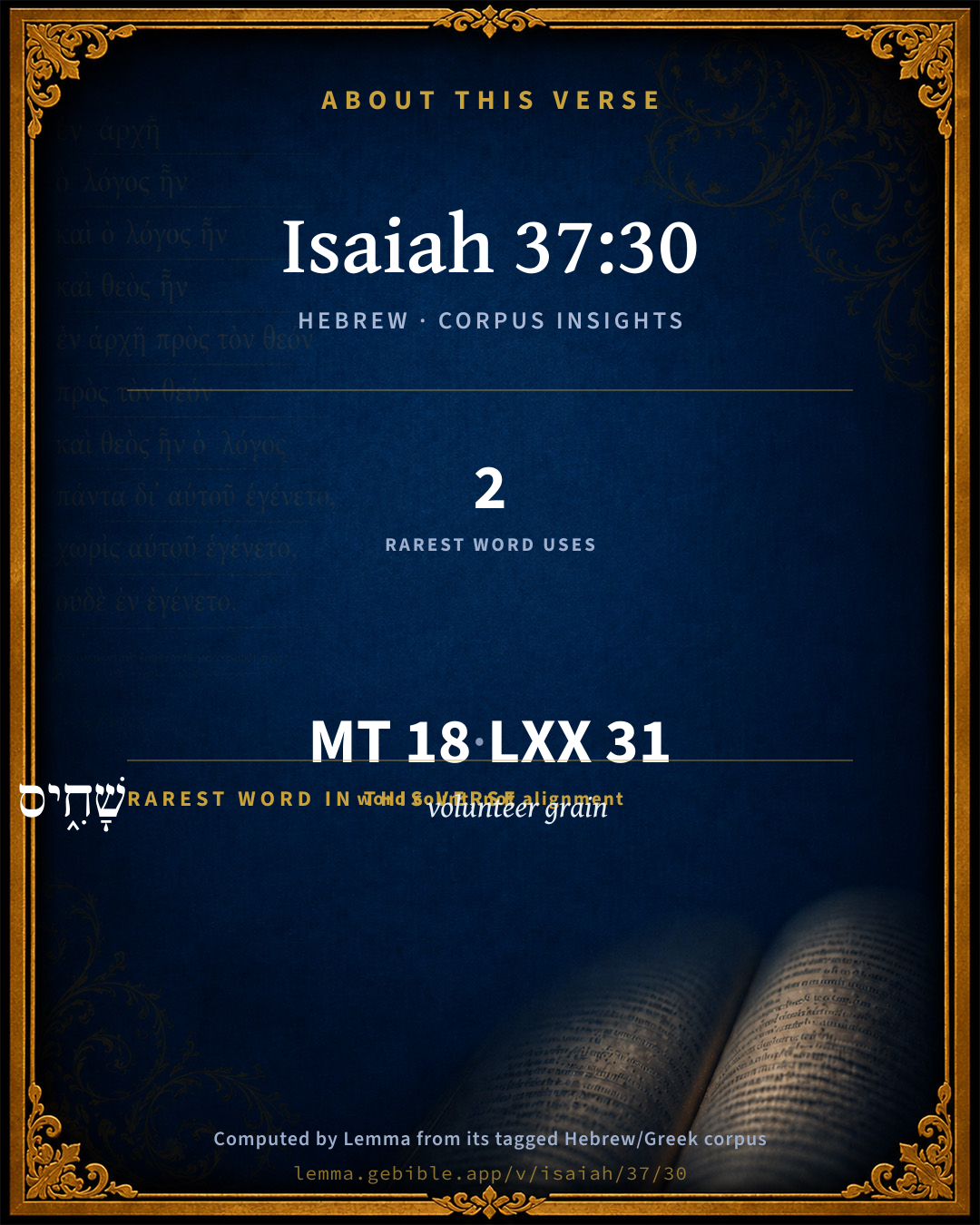
The rarest word here is שָׁחִ֑יס volunteer grain H7823 — appearing just 2 times in the whole Hebrew Bible.

Shared distinctive vocabulary

שָׁחִ֑יס volunteer grain H7823 occurs in 2 verses of the Hebrew Bible. Also found in:

Grammatical profile

  • 6 verbs
  • 8 nouns
  • 2 adjectives
  • 1 pronoun
  • 1 preposition

Verb forms

  • אָכ֤וֹל Qal · Infinitive Absolute
  • זִרְע֧וּ Qal · Imperative
  • וְקִצְר֛וּ Qal · Imperative
  • וְנִטְע֥וּ Qal · Imperative
  • ואכול Qal · Infinitive Absolute
  • וְאִכְל֥וּ Qal · Imperative

Repetition

Words recur within this verse — often emphatic in Hebrew:

  • אָכ֤וֹל to eat H398 ×3
  • הַשָּׁנָה֙ year H8141 ×3

Hebrew & Septuagint length

In English translation the verse runs 46 words from the Hebrew and 39 from the Septuagint (LXX English) — closely comparable.

A rough comparison of the two English renderings, which tokenize alike — not a word-level alignment.

Word counts can differ between the Hebrew and the Greek without any difference in meaning — e.g. the Hebrew direct-object marker אֵת has no separate Greek word, and Greek often adds the article ὁ.

In the original languages it is 18 Hebrew tokens and 31 Greek tokens — but the two are counted differently (Hebrew bundles its prefixes and suffixes into one token; the Greek is in lemma form), so that isn’t a like-for-like length.

Cross-references

9

Topical passages linked to Isaiah 37:30 in the Treasury of Scripture Knowledge — connected by theme and wording, ordered by reader-vote popularity; previews shown in the World English Bible.

  • 2 Kings 19:29 This shall be the sign to you: You shall eat this year that which grows of itself, and in the second year that which springs of the same; and in the third year sow you, and reap, and plant vineyards, and eat the fruit of it.
  • Exodus 3:12 He said, "Certainly I will be with you. This will be the token to you, that I have sent you: when you have brought forth the people out of Egypt, you shall serve God on this mountain."
  • Leviticus 25:4–5 but in the seventh year there shall be a Sabbath of solemn rest for the land, a Sabbath to Yahweh. You shall not sow your field or prune your vineyard.
  • 1 Kings 13:3–5 He gave a sign the same day, saying, This is the sign which Yahweh has spoken: Behold, the altar shall be torn, and the ashes that are on it shall be poured out.
  • 2 Kings 20:9 Isaiah said, This shall be the sign to you from Yahweh, that Yahweh will do the thing that he has spoken: shall the shadow go forward ten steps, or go back ten steps?
  • Isaiah 7:14 Therefore the Lord himself will give you a sign. Behold, the virgin will conceive, and bear a son, and shall call his name Immanuel.
  • Leviticus 25:20–22 If you said, "What shall we eat the seventh year? Behold, we shall not sow, nor gather in our increase;"
  • Isaiah 7:21–25 It shall happen in that day that a man shall keep alive a young cow, and two sheep;
  • Isaiah 38:7 This shall be the sign to you from Yahweh, that Yahweh will do this thing that he has spoken:

Cross-references courtesy of OpenBible.info (CC BY 4.0).

Hebrew and Greek witnesses Masoretic Hebrew ↔ Greek Septuagint

The same verse in the two great witnesses to the Old Testament, shown verse-for-verse.

These are two independent witnesses, not word-aligned to each other, and the Septuagint is shown in lemma (dictionary) form.

Hebrew Isaiah 37:30 Masoretic · Westminster Leningrad Codex

וְזֶה לְּךָ֣ הָא֔וֹת אָכ֤וֹל הַשָּׁנָה֙ סָפִ֔יחַ וּבַשָּׁנָ֥ה הַשֵּׁנִ֖ית שָׁחִ֑יס וּבַשָּׁנָ֣ה הַשְּׁלִישִׁ֗ית זִרְע֧וּ וְקִצְר֛וּ וְנִטְע֥וּ כְרָמִ֖ים ואכול וְאִכְל֥וּ פִרְיָֽם

This shall be the sign to you: you shall eat this year that which grows of itself, and in the second year that which springs of the same; and in the third year sow you, and reap, and plant vineyards, and eat the fruit of it.

World English Bible · Public Domain

Greek LXX Isaiah 37:30 Septuagint · lemma form

οὗτος δέ σύ ὁ σημεῖον ἐσθίω οὗτος ὁ ἐνιαυτός ὅς σπείρω ὁ δέ ἐνιαυτός ὁ δεύτερος ὁ καταλείμμα ὁ δέ τρίτος σπείρω ἀμάω καί φυτεύω ἀμπελών καί ἐσθίω ὁ καρπός αὐτός

And this shall be a sign to you, Eat this year what you have sown; and the second year that which is left: and the third year sow, and reap, and plant vineyards, and eat the fruit of them.

LXX2012 (modern English Septuagint) · Public Domain

On this verse, Keil & Delitzsch discusses the Septuagint’s reading. Read the note in Commentary ↓

Hebrew: Westminster Leningrad Codex (CC BY 4.0). Greek: Septuagint (public domain); English from LXX2012 (modern English Septuagint) (Public Domain). How the Septuagint differs from the Hebrew →

Targum (Aramaic paraphrase)

1

The Targum is the ancient Jewish Aramaic paraphrase of the Hebrew Scriptures — an interpretive translation, not the Hebrew text itself. Onkelos (literal) and Pseudo-Jonathan (expansive) render the Torah, and Jonathan the Prophets. Coverage is partial: where no permissively-licensed English translation exists for a verse, only the Aramaic is shown. This is verse-level text, not a word-by-word alignment to the Hebrew.

  1. Targum Jonathan Prophets (Joshua–Malachi)
    וְדֵין לָךְ אָתָא אֲכוֹל בְּשַׁתָּא הָדָא כַּתִּין וּבְשַׁתָּא תִּנְיֵתָא כַּתְכַּתִּין וּבְשַׁתָּא תְּלִיתָאָה זִרְעוּ וַחֲצוֹדוּ וְצוּבוּ כַרְמִין וֶאֱכוּלוּ אִבְּהֶן:

    And this shall be a sign to thee: Eat this year such as groweth of itself; and in the second year, that which springeth of the same; and in the third year, sow ye, and reap, and plant vineyards, and eat the fruit thereof.

    Targum Jonathan — Aramaic: “Mikraot Gedolot” (public domain). English: “Sefaria Community Translation” (CC0 1.0 (public-domain dedication)); “London "Chaldee Paraphrase," 1871” (public domain). Text via Sefaria.

Commentary

Notes on Isaiah 37:30 from classic Christian and Jewish commentators (each source and its license shown beneath its notes). The classic Christian expositions comment on the surrounding passage and are grouped to its opening verse, so a note may address several verses; the Jewish commentaries on the Tanakh (Rashi and others) are per-verse, so they appear only where the commentator wrote on this verse.

Lemma curates 59 commentaries, every one of them public domain or Creative Commons licensed, each selected and text-cleaned for this edition rather than reprinted as found. About our sources →

Tyndale Open Study Notes

Tyndale Open Resources

37:30-35 In this prophecy of salvation, Isaiah assured Hezekiah that Jerusalem would be spared and that the remnant was under God’s protection. The names of Isaiah and his sons anticipated God’s rescue (see 7:1–11:16). The book’s record of God’s presence and rescue provided assurance that the Lord would always have a remnant that he will protect and rescue.

37:30 This year . . . next year . . . the third year: Because of the Assyrian siege and its destruction of agriculture, the people of Judah would not be able to plant and harvest as usual. The promise that life would resume after the siege assured them that God was with them and would provide as they carried out their everyday activities. They needed to develop their trust in God over a period of three calendar years in the confident expectation that God’s word would be true (cp. 30:15, 18). Perhaps the point was that after rescue from the Assyrians, it would be too late in the present year for fall planting. They would have to wait until fall in the second year to plant again, and they would reap their first crop in the spring and summer of the third year.

Tyndale Open Study Notes — © Tyndale Open Resources, licensed CC BY-SA 4.0. Text via the HelloAO Bible API.

Ibn Ezra

Rabbi Abraham ibn Ezra

6. In the book of Kings (19:29) סחיש; in Isaiah (37:30) שחים; these two words are the same in meaning—that which springeth of the same. Comp. כבש and כשב lamb (Lev. 3:7, and 4:32)

Ibn Ezra on the Tanakh — English translations: “Sefaria Community Translation” (CC0 1.0 (public-domain dedication)); “Yalkut, Sifsei Chachomim Chumash, Metsudah Publications, 2009” (CC BY 4.0); and “Commentary of Ibn Ezra on Isaiah - trans. by M. Friedlander, 1873” (public domain). Text via Sefaria.

Geneva Bible (1599)

Geneva Bible translators

God giveth signs after two sorts: some go before the thing, as the signs that Moses wrought in Egypt, which were for the confirmation of their faith, and some go after the thing, as the sacrifice, which they were commanded to make three days after their departure: and these latter are to keep the benefits of God in our remembrance: of the which sort this here is.

He promiseth that for two years the ground of itself should feed them.

Geneva Bible (1599) marginal notes — public domain. Text via Bolls.life.

Jamieson, Fausset & Brown

Robert Jamieson, A. R. Fausset & David Brown

Addressed to Hezekiah.

sign--a token which, when fulfilled, would assure him of the truth of the whole prophecy as to the enemy's overthrow. The two years, in which they were sustained by the spontaneous growth of the earth, were the two in which Judea had been already ravaged by Sennacherib (Isa 32:10). Thus translate: "Ye did eat (the first year) such as groweth of itself, and in the second year that . . . but in this third year sow ye," &c., for in this year the land shall be delivered from the foe. The fact that Sennacherib moved his camp away immediately after shows that the first two years refer to the past, not to the future [ROSENMULLER]. Others, referring the first two years to the future, get over the difficulty of Sennacherib's speedy departure, by supposing that year to have been the sabbatical year, and the second year the jubilee; no indication of this appears in the context.

Jamieson, Fausset & Brown — Commentary Critical and Explanatory on the Whole Bible (1871) — public domain (CC PDM 1.0). Text via the HelloAO Bible API.

Ellicott's Commentary for English Readers

(30) And this shall be a sign unto thee.—The prophet now turns to Hezekiah, and offers, as was his wont (Isa_7:11; Isa_38:8), a sign within the horizon of the nearer future as the pledge of the fulfilment of a prediction which had a wider range. It was then autumn, probably near the equinox, which was the beginning of a new year. The Assyrian invasion had stopped all tillage in the previous spring, and the people had to rely upon the spontaneous products of the fields. In the year that was about to open they would be still compelled to draw from the same source, but in twelve months’ time the land would be clear of the invaders, and agriculture would resume its normal course, and the fulfilment of this prediction within the appointed limit of time would guarantee that of the wider promise that follows.

A Bible Commentary for English Readers, edited by Charles John Ellicott (1878–1897) — public domain. Text from a community e-Sword module.

The Cambridge Bible for Schools and Colleges

gen. ed. J. J. S. Perowne

30. The “sign” of this verse is of the same nature as that of Exo_3:12, and ch. Isa_7:14. It consists of a series of events, in themselves natural, which will attest the fact that all the circumstances of the deliverance had been foreordained by Jehovah, and foretold by His prophet.

such as groweth of itself] Hebr. ṣâphîaḥ, the scanty crop produced by the shaken grains of the last harvest (Lev_25:5; Lev_25:11).

that which springeth of the same] shâḥîṣ or in 2 Kings shâḥîṣ, a word which does not occur elsewhere. It is explained to mean “that which springs from the roots” of the corn. The import of the sign at all events is that for two years the regular operations of agriculture will be suspended. It is uncertain how long a period of Assyrian occupation is thus contemplated. The year runs from October to October; and this year must apparently mean the year after that in which the crops were destroyed by the invader; for in that year there could hardly be even ṣâphîaḥ to eat. We may suppose that the prophecy was spoken in the beginning of the year, i.e. in the autumn of 701, before the usual season of ploughing. The question then arises, How long would the Assyrians require to remain in the land in order to destroy the prospects of two successive harvests? Wetzstein states that at the present day, unless the ground has been several times broken up in the previous summer the seed will be lost in the ground. If therefore the Assyrian occupation lasted into the summer of 700, it would interfere with the necessary preparations for a crop in the following year, the year of the shâḥîṣ. But even this limited period can hardly be reconciled with the actual result as recorded in Isa_37:36. Probably therefore the sign does not fix the term of the Assyrian occupation, but refers to wider effects of the invasion, the depopulation of the country, the destruction of homesteads, &c., which rendered an immediate resumption of agricultural activity impossible.

30–32. A sign is given to Hezekiah of the fulfilment of the preceding prophecy. But beyond the brief period of hardship which must follow the invasion, the prophet announces the advent of a new age in which all his hopes for the future of Israel shall be realised.

The Cambridge Bible for Schools and Colleges (gen. ed. J. J. S. Perowne; Cambridge University Press, 1878–1918) — public domain. Text from a community e-Sword module.

John Gill's Exposition

For out of Jerusalem shall go forth a remnant,.... The Targum is,

"the rest of the righteous;''

the same as before; who, when the city should be free from the enemy, would go out of it, and return to their former settlements, in the several parts of Judea; a type of those who went out of Jerusalem with the Gospel of Christ, and spread it not only in Judea, but in the Gentile world:

and they that escape out of Mount Zion; the same persons, differently described; some of whom were in the city of Jerusalem, and others in the fort of Zion, but departed from hence when the siege was broke up. The Targum is,

"and the escaped of them that confirm the law out of Mount Zion;''

see Isa 2:3,

the zeal of the Lord of hosts shall do this: his concern for his own honour and glory, and his great love to his people, shall engage him to perform all that is here promised and foretold. The Targum is,

"by the word of the Lord of hosts this shall be done.''

John Gill's Exposition of the Whole Bible (1746–1763) — public domain (CC PDM 1.0). Text via the HelloAO Bible API.

Albert Barnes' Notes on the Bible

And this shall be a sign unto thee - It is evident that the discourse here is turned from Sennacherib to Hezekiah. Such transitions, without distinctly indicating them, are common in Isaiah. God had in the previous verses, in the form of a direct personal address, foretold the defeat of Sennacherib, and thc confusion of his plans. He here turns and gives to Hezekiah the assurance that Jerusalem would be delivered. On the meaning of the word ‘sign,’ see the note at Isa 7:14. Commentators have been much perplexed in the exposition of the passage before us, to know how that which was to occur one, two, or three years after the event, could be a sign of the fulfillment of the prophecy. Many have supposed that the year in which this was spoken was a Sabbatic year, in which the lands were not cultivated, but were suffered to lie still Lev. 35:2-7; and that the year following was the year of Jubilee, in which also the lands were to remain uncultivated. They suppose that the idea is, that the Jews might be assured that they would not experience the evils of famine which they had anticipated from the Assyrians, because the divine promise gave them assurance of supply in the Sabbatic year, and in the year of Jubilee, and that although their fields had been laid waste by the Assyrian, yet their needs would be supplied, until on the third year they would be permitted in quietness to cultivate their land, and that this would be to them a sign, or a token of the divine interposition. But to this there are two obvious objections:

1. There is not the slightest evidence that the year in which Sennacherib besieged Jerusalem was a Sabbatic year, or that the following year was the Jubilee. No mention is made of this in the history, nor is it possible to prove it from any part of the sacred narrative.

2. It is still difficult to see, even if it were so, how that which was to occur two or three years after the event, could be a sign to Hezekiah then of the truth of what Isaiah had predicted.

Rosenmuller suggests that the two years in which they are mentioned as sustained by the spontaneous productions of the earth were the two years in which Judea had been already ravaged by Sennacherib, and that the third year was the one in which the prophet was now speaking, and that the prediction means that in that very year they would be permitted to sow and reap. In the explanation of the passage, it is to be observed that the word ‘sign’ is used in a variety of significations. It may be used as an indication of anything unseen Gen 1:14; or as a military ensign Num 2:2; or as a sign of something future, an omen Isa 8:18; or as a token, argument, proof Gen 17:2; Exo 31:13. It may be used as a sign or token of the truth of a prophecy; that is, when some minor event furnishes a proof that the whole prophecy would be fulfilled Exo 3:12; 1Sa 2:34; 1Sa 10:7, 1Sa 10:9. Or it may be used as a wonder, a prodigy, a miracle Deu 4:34; Deu 6:22.

In the case before us, it seems to mean that, in the events predicted here, Hezekiah would have a token or argument that the land was completely freed from the invasion of Sennacherib. Though a considerable part of his army would be destroyed; though the monarch himself would be compelled to flee, yet Hezekiah would not from that fact alone have the assurance that he would not rally his forces, and return to invade the land. There would be every inducement arising from disappointment and the rage of defeat for him to do it. To compose the mind of Hezekiah in regard to this, this assurance was given, that the land would be quiet, and that the fact that it would remain quiet during the remainder of that year, and to the third year would be a sign, or demonstration that the Assyrian army was entirely withdrawn, and that all danger of an invasion was at an end. The sign, therefore, does not refer so much to the past, as to the security and future prosperity which would be consequent thereon.

It would be an evidence to them that the nation would be safe, and would be favored with a high degree of prosperity (see Isa 37:31-32). It is possible that this invasion took place when it was too late to sow for that year, and that the land was so ravaged that it could not that year be cultivated. The harvests and the vincyards had been destroyed; and they would be dependent on that which the earth had spontaneously produced in those parts which had been untilled. As it was now too late to sow the land, they would be dependent in the following year on the same scanty supply. In the third year, however, they might cultivate their fields securely, and the former fertility would be restored.

Such as groweth of itself - The Hebrew word here (ספיח sâphı̂yach), denotes grain produced from the kernels of the former year, without new seed, and without cultivation. This, it is evident, would be a scanty supply; but we are to remember that the land had been ravaged by the army of the Assyrian.

That which springeth of the same - The word used here (שׁחיס shâchiys), in the parallel passage in 2Ki 19:29 (סחישׁ sâchiysh), denotes that which grows of itself the third year after sowing. This production of the third year would be of course more scanty and less valuable than in the preceding year, and there can be no doubt that the Jews would be subjected to a considerable extent to the evils of want. Still, as the land would be quiet; as the people would be permitted to live in peace; it would be a sign to them that the Assyrian was finally and entirely withdrawn, and that they might return in the third year to the cultivation of their land with the assurance that this much-dreaded invasion was not again to be feared.

And in the third year - Then you may resume your agricultural operations with the assurance that you shall be undisturbed. Your two years of quiet shall have been a full demonstration to you that the Assyrian shall not return, and you may resume your employments with the assurance that all the evils of the invasion, and all apprehension of danger, are at an end.

Albert Barnes' Notes on the Bible (1834–1885) — public domain. Text from a community e-Sword/MySword module.

Haydock's Catholic Bible Commentary

Thee. He directeth his speech to Ezechias.

George Leo Haydock (1774–1849), Haydock's Catholic Family Bible and Commentary, 1859 edition — public domain. Excludes Psalms (Douay-Rheims chapter numbering differs from Protestant) and Deuterocanonical books (Catholic canon only).

Whedon's Commentary on the Bible

Daniel D. Whedon

30. The turn of discourse is now to Hezekiah. The main point in it is of a sign.

Ye — Hezekiah and the remnant of the people that shall be left.

Ye shall eat… such as groweth — The Assyrian depredations have prevented agriculture the last year. All that can be hoped for in the next year is from the spontaneous but scanty harvest derived from grain casually dropped in the previous season. The year following, or third year, the land will be altogether delivered from fear to cultivate to the fullest extent. The invaders will be clean gone, and the ever-to-be-preserved remnant will be here. Another view, possessing considerable weight, is, that this was the year previous to a jubilee, and consequently a sabbatic year. By law the land was to rest, no ploughing or sowing being allowed, consequently no reaping. The same law regulated also the next, or jubilee year. It may not, therefore, have been because of the ravages of the Assyrians, past or present, that the people were to eat, these two years, of such as should grow “of itself.” A somewhat curious calculation, confirmatory of the above suggestion, is given by the Speaker’s Commentary, as follows:

“That the year 710 was sabbatical may be seen, 1) By reckoning backward from data supplied by Josephus, who makes the years B.C. 164, 136, 38, to be sabbatical. Now if we add 78+7 (or 546) to 164, we get 710. 2) By reckoning onward from the date of the first occupation of the land, B.C. 1444. For fifteen periods of 7+7 years amount to 735; and B.C. 710 is the 735th year from B.C. 1444. It follows, therefore, that the next year, B.C. 709, was a jubilee year.

Daniel D. Whedon (gen. ed.), Commentary on the Old and New Testaments (1874–1909) — public domain. Text from a community e-Sword module.

The Pulpit Commentary

This shall be a sign unto thee; rather, the sign. The prophet now turns to Hezekiah, and makes an address to him. "This," he says, "shall be the sign unto thee of Sennachcrib"s being effectually "bridled," and the danger from Assyria over. In the third year from the present the land shall have returned to its normal condition, and you shall enjoy its fruits as formerly. Meanwhile you shall obtain sufficient nourishment from the grain which has sown itself." The "third year," according to Hebrew reckoning, might be little more than one year from the date of the delivery of the prophecy. The entire withdrawal of all the Assyrian garrisons from the country, which no doubt followed on Sennacherib"s retreat, might well have occupied the greater part of a year. Till they were withdrawn, the Jews could not venture to till their territory. Plant vineyards. The Assyrians had, no doubt, cut down the vines (see "Records of the Past," vol. 3. pp. 40, 62, 79; vol. 7. p. 43, etc.; Layard, "Monuments of Nineveh," second series, pl. 40).

The Pulpit Commentary (1880–1919), ed. H.D.M. Spence-Jones & Joseph S. Exell — public domain. Text from a community e-Sword module.

Keil & Delitzsch

C. F. Keil & F. Delitzsch

The prophet now turns to Hezekiah. "And let this be a sign to thee, Men eat this year what is self-sown; and in the second year what springs from the roots (shâc, K. sâchı̄sh); and in the third year they sow and reap and plant vineyards, and eat (chethib אכול) their fruit." According to Thenius, hasshânâh (this year) signifies the first year after Sennacherib's invasions, hasshânâh hasshēnı̄th (the second year) the current year in which the words were uttered by Hezekiah, hasshânâh hasshelı̄shith (the third year) the year that was coming in which the land would be cleared of the enemy. But understood in this way, the whole would have been no sign, but simply a prophecy that the condition of things during the two years was to come to an end in the third. It would only be a "sign" if the second year was also still in the future. By hasshânâh, therefore, we are to understand what the expression itself requires (cf., Isa 29:1; Isa 32:10), namely the current year, in which the people had been hindered from cultivating their fields by the Assyrian who was then in the land, and therefore had been thrown back upon the sâphı̄ach, i.e., the after growth (αὐτόματα, lxx, the self-sown), or crop which had sprung up from the fallen grains of the previous harvest (from sâphach, adjicere, see at Hab 2:15; or, according to others, effundere). It was autumn at the time when Isaiah gave this sign (Isa 33:9), and the current civil year was reckoned from one autumnal equinox to the other, as, for example, in Exo 23:16, where the feast of tabernacles or harvest festival is said to fall at the close of the year; so that if the fourteenth year of Hezekiah was the year 714, the current year would extend from Tishri 714 to Tishri 713. But if in the next year also, 713-712, there was no sowing and reaping, but the people were to eat shâchis, i.e., that which grew of itself (αὐτοφυές, Aq., Theod.), and that very sparingly, not from the grains shed at the previous harvest, but from the roots of the wheat, we need not assume that this year, 713-712, happened to be a sabbatical year, in which the law required all agricultural pursuits to be suspended.

(Note: There certainly is no necessity for a sabbatical year followed by a year of jubilee, to enable us to explain the "sign," as Hofmann supposes.)

It is very improbable in itself that the prophet should have included a circumstance connected with the calendar in his "sign;" and, moreover, according to the existing chronological data, the year 715 had been a sabbatical year (see Hitzig). It is rather presupposed, either that the land would be too thoroughly devastated and desolate for the fields to be cultivated and sown (Keil); or, as we can hardly imagine such an impossibility as this, if we picture to ourselves the existing situation and the kind of agriculture common in Palestine, that the Assyrian would carry out his expedition to Egypt in this particular year (713-12), and returning through Judah, would again prevent the sowing of the corn (Hitzig, Knobel). But in the third year, that is to say the year 712-11, freedom and peace would prevail again, and there would be nothing more to hinder the cultivation of the fields or vineyards. If this should be the course of events during the three years, it would be a sign to king Hezekiah that the fate of the Assyrian would be no other than that predicated. The year 712-11 would be the peremptory limit appointed him, and the year of deliverance.

Keil & Delitzsch — Biblical Commentary on the Old Testament (1861–1891) — public domain (CC PDM 1.0). Text via the HelloAO Bible API. (Old Testament only.)

J. A. Alexander on Isaiah

Joseph Addison Alexander

“And this to thee (oh Hezekiah, shall be) the sign (of the fulfillment of the promise) eat, the (present) year, that which groweth of itself, and the second year that which springeth of the same, and in the third year sow ye, and reap, and plant vineyards, and eat the fruit thereof.” The preceding verse closes the address to the Assyrian, begun in v. 22, and the Prophet now continues his message to Hezekiah. As to the general meaning of the verse, there are two opinions. One is that although the cultivation of the land had been interrupted for the last two years, yet now in this third year they might safely resume it. To this interpretation it may be objected, that it arbitrarily makes the year mean the year before the last, and no less arbitrarily assumes that the infinitive is here used for the preterit. The later writers seem to have gone back to the old and obvious interpretation, which refers the whole verse to the future. This is grammatically more exact, because it takes the year in a sense analogous to that of the day, the common Hebrew phrase for this day, and assimilates the infinitive to the imperatives which follow, Thus understood, the verse is a prediction that for two years the people should subsist upon the secondary fruits of what was sown two years before, but that in the third year they should till the ground, as usual, implying that Sennacherib’s invasion should before that time be at an end. But why should this event be represented as so distant, when the context seems to speak of Sennacherib’s discomfiture and flight as something which immediately ensued? Of this two explanations have been given. Most probably the year in which these words were uttered was a sabbatical year, and the next the year of Jubilee, during neither of which the Jews were allowed to cultivate the ground, so that the resumption of tillage was of course postponed to the third. It is no conclusive objection to this theory, that the chronological hypothesis which it involves cannot be positively proved. The difficulty in all such cases arises from the very absence of positive proof, and the necessity of choosing between different possibilities. The only remaining question is, wherein the sign consisted, or in what sense the word sign is to be understood. Some take it in its strongest sense of miracle, and refer it, either to the usual divine interposition for the subsistence of the people during the sabbatical years, or to the miraculous provision promised in this particular case. Others understand it here as simply meaning an event inseparable from another, either as an antecedent or a consequent, so that the promise of the one is really a pledge of the other. Thus the promise that the children of Israel should worship at Mount Sinai was a sign to Moses that they should first leave Egypt, and the promised birth of the Messiah was a sign that the Jewish nation should continue till He came.

Joseph Addison Alexander, The Prophecies of Isaiah (1846–1847; New York: Scribner, 1870–1878) — public domain. Text from a community e-Sword module.

unfoldingWord translationNotes

Door43 World Missions Community

General Information:

This continues Yahweh's message to Hezekiah. (See: Isaiah 37:21)

sign for you

"sign for you, Hezekiah." Here "you" is singular and refers to Hezekiah. (See: Forms of You)

you will eat ... you must plant

Here "you" is plural and refers to the people of Judah. (See: Forms of You)

in the second year what grows

This describes what the people will eat. The words "you will eat" are understood from the previous phrase AT: "in the second year you will eat what grows" or "next year you will eat what grows" (See: Ellipsis and Ordinal Numbers)

what grows from that

"what grows wild from that" or "what grows wild"

in the third year

This refers to the year after the second year. AT: "the year after that" or "in the following year" (See: Ordinal Numbers)

translationWords

sign

harvest

vineyard

fruit

unfoldingWord translationNotes — © Distant Shores Media and the Door43 World Missions Community, licensed CC BY-SA 4.0. Source: git.door43.org/Door43/en_tn.

Rashi

Rabbi Shlomo Yitzchaki (Rashi)

And this shall be the sign for you This statement is not addressed to Sennacherib, but the prophet said to Hezekiah, “And this salvation shall be a sign for you for another promise. Now the legions have destroyed all the vegetation and chopped off the trees, and the Holy One, blessed be He, promises you that you will have sufficient from the shoots of the plants that will grow by themselves.”

this year you shall eat (אָכוֹל) to eat this year.

and the next year what grows from the tree stumps (Heb. שָׁחִיס.) They are the shoots of the stumps. So it appears in Seder Olam (ch. 23), but Jonathan renders: כַּתְכַּתִּין, the shoots of the shoots. And this will be the sign for you; when you see that my words, that Sennacherib will return to his land and he will fall, are fulfilled, you will believe that the second promise will yet be fulfilled.

Rashi on the Tanakh — English translations: “The Judaica Press complete Tanach with Rashi, translated by A. J. Rosenberg” (CC BY 4.0); “Pentateuch with Rashi's commentary by M. Rosenbaum and A.M. Silbermann, 1929-1934” (public domain); “The Metsudah Tanach series, Lakewood, N.J” (CC BY 4.0); and “The Book of Joshua, Metsudah Publications, 1997” (CC BY 4.0). Text via Sefaria.

Lesson kit

Teaching starters — assembled from the data on this page, not authored interpretation. Every prompt links to the verse data it draws on. Edit before teaching.

Isaiah, in the Prophets, opens this verse with 18 words (13 distinct Hebrew lemmas). Its most distinctive word is shâchîyç (“volunteer grain”). A historical commentator’s framing appears above. Read the whole chapter for the surrounding context.

Discussion questions

  1. What does “volunteer grain” (shâchîyç) contribute to the verse as a whole?
  2. 2 Kings 19:29 shares the word «volunteer grain» with this verse. How do the two illuminate each other?
  3. “to eat” occurs 3× in this one verse. What is the effect of the repetition?
  4. These translations render this verse differently; the difference is in the English rendering, not the original. What questions does that raise?
  5. The verb «אָכ֤וֹל» is Qal Infinitive Absolute. How does its form color the action?
  6. Reading how Tyndale Open Study Notes and Ibn Ezra read this verse, where do the two commentators agree and where do they part?

Things to notice

Reading settings

Reading text

Shown beneath each verse's original-language words.

Old Testament
Old Testament edition

Read the OT as the Masoretic Hebrew (MT) or the Greek Septuagint (LXX).

English shown for the Greek Septuagint (in the Hebrew ↔ Greek comparison).

Comparing translations? Open the Compare panel on any verse page to stack up to four side by side.