Psalms 132:11

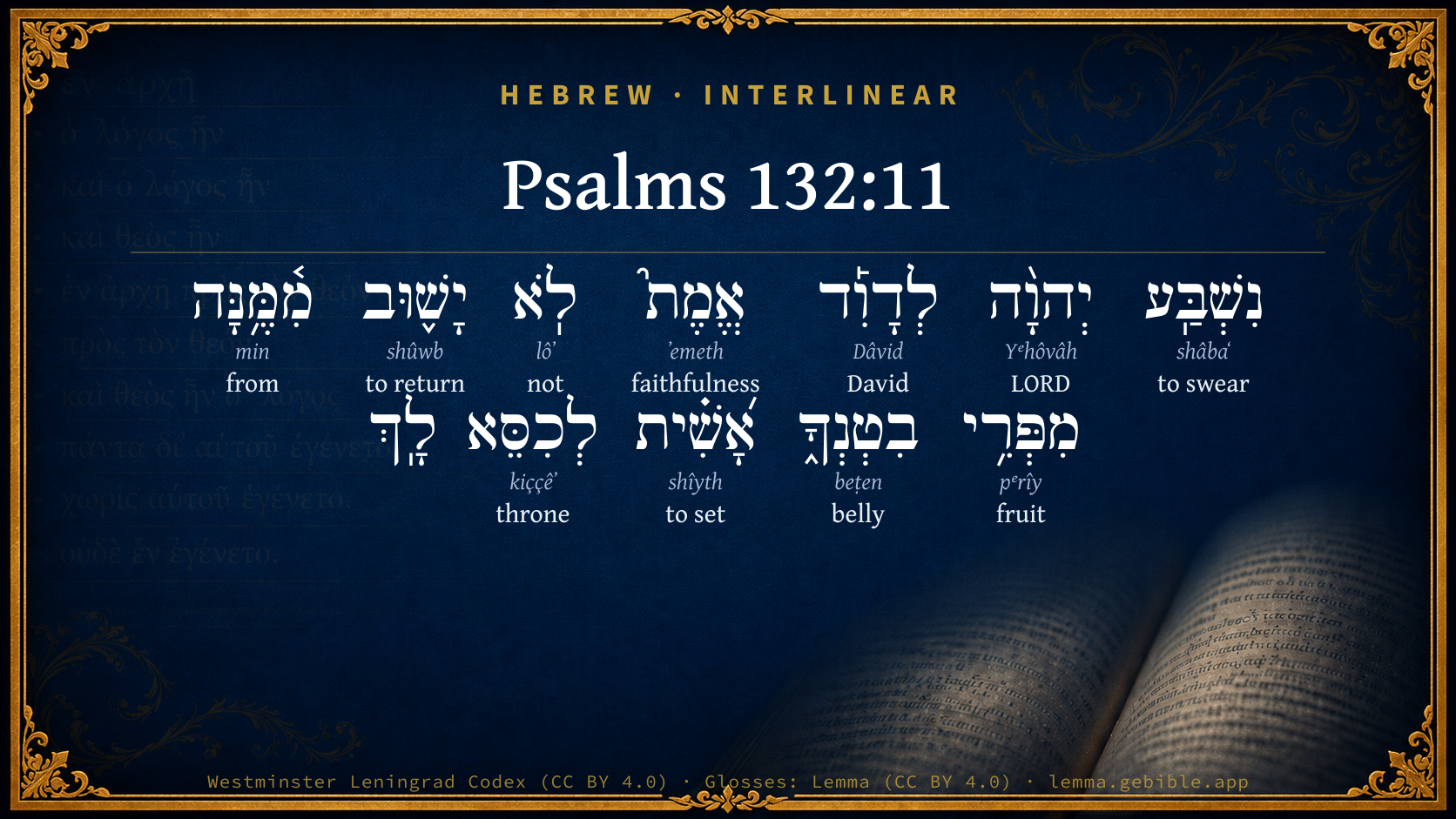
Hebrew (Westminster Leningrad Codex) Psalms 132:11 appears in the Hebrew Old Testament. The text above is from the Westminster Leningrad Codex. Each word links to its Strong’s number, a concise gloss, and parsing drawn from the Open Scriptures Hebrew Bible morphology. Click any word for its full Brown-Driver-Briggs (BDB) entry.
Download image
Cite this verse

Psalms 132:11 (World English Bible). Public Domain. Lemma interlinear Bible study tool, https://lemma.gebible.app/v/psalms/132/11.

Show BibTeX & RIS
BibTeX
RIS
English Translation
Yahweh has sworn to David in truth. He will not turn from it: "I will set the fruit of your body on your throne.
World English Bible · Public Domain
Download a study sheet

One document with this verse’s original text, its word-by-word gloss line, the meaning frame, cross-references with their text, attributed commentary, and full source and license credits — printable, and it pastes into notes with its structure intact.

This verse Autodidact and up

Study sheet (.html) Plain text (.txt)

A passage Seminary Student

Up to 50 verses in one chapter. A passage sheet keeps up to 6 commentary sources and 12 cross-references per verse, in the order this page ranks them, and says so on the sheet whenever that leaves anything out. Ask for a single verse and you get the Autodidact verse sheet above.

Everything on this page stays free to read, with no account — the sheet is a download of what is already on screen, not access to it.

Want to remove ads? Support Godless Engineer
Compare translations 3

The same verse in 3 English versions, stacked beneath the original-language interlinear above. Click any original word for its lexicon entry.

Each is an independent rendering of the whole verse — the interlinear is not word-aligned to these translations.

Highlighted words mark where these versions differ — a whole-verse word diff, not a word-by-word alignment.

  • World English Bible Public Domain
    Yahweh has sworn to David in truth. He will not turn from it: "I will set the fruit of your body on your throne.
  • King James Version Public Domain
    The LORD hath sworn in truth unto David; he will not turn from it; Of the fruit of thy body will I set upon thy throne.
  • unfoldingWord Literal Text CC BY-SA 4.0
    Yahweh swore to David, truth, he will not turn back from it: “From the fruit of your body I will set on the throne for you.

unfoldingWord Literal Text — © unfoldingWord, licensed CC BY-SA 4.0. Word-aligned USFM3 via Door43 (git.door43.org/unfoldingWord/en_ult).

Versions to compare (up to 4)

3 of 4 selected

Show all 17 translations

Every available English version of this verse, each an independent rendering of the whole verse.

  • World English Bible Public Domain
    Yahweh has sworn to David in truth. He will not turn from it: "I will set the fruit of your body on your throne.
  • Berean Standard Bible Public Domain
    The LORD swore an oath to David, a promise He will not revoke: “One of your descendants I will place on your throne.
  • Majority Standard Bible Public Domain
    The LORD swore an oath to David, a promise He will not revoke: “One of your descendants I will place on your throne.
  • King James Version Public Domain
    The LORD hath sworn in truth unto David; he will not turn from it; Of the fruit of thy body will I set upon thy throne.
  • American Standard Version (1901) Public Domain
    Jehovah hath sworn unto David in truth; He will not turn from it: Of the fruit of thy body will I set upon thy throne.
  • Revised Version (1885) Public Domain
    The LORD hath sworn unto David in truth; he will not turn from it: of the fruit of thy body will I set upon thy throne.
  • Geneva Bible (1599) Public Domain
    The Lord hath sworne in trueth vnto Dauid, and he wil not shrinke from it, saying, Of the fruite of thy body will I set vpon thy throne.
  • Young's Literal Translation Public Domain
    Jehovah hath sworn truth to David, He turneth not back from it: Of the fruit of thy body, I set on the throne for thee.
  • Literal Standard Version CC BY-SA 4.0
    YHWH has sworn truth to David, || He does not turn back from it: “Of the fruit of your body, || I set on the throne for you.
  • Unlocked Literal Bible CC BY-SA 4.0
    Yahweh swore a sure oath to David, a sure oath that he will not revoke: “I will place one of your descendants on your throne.
  • unfoldingWord Literal Text CC BY-SA 4.0
    Yahweh swore to David, truth, he will not turn back from it: “From the fruit of your body I will set on the throne for you.
  • Darby Bible Public Domain
    Jehovah hath sworn [in] truth unto David; he will not turn from it: Of the fruit of thy body will I set upon thy throne;
  • World Messianic Bible Public Domain
    The LORD has sworn to David in truth. He will not turn from it: “I will set the fruit of your body on your throne.
  • Webster's Bible Public Domain
    The LORD hath sworn in truth to David; he will not turn from it; Of the fruit of thy body will I set upon thy throne.
  • Free Bible Version CC BY-SA 4.0
    The Lord made a solemn promise to David, one he will never cancel—“I will put one of your descendants on your throne.
  • Bible in Basic English Public Domain
    The Lord gave a true oath to David, which he will not take back, saying, I will give your kingdom to the fruit of your body.
  • JPS Tanakh (1917) Public Domain
    The LORD swore unto David in truth; He will not turn back from it: 'Of the fruit of thy body will I set upon thy throne.

Literal Standard Version (2020), Covenant Press — licensed CC BY-SA 4.0. Text via the HelloAO Bible API (eBible.org). Unlocked Literal Bible (unfoldingWord) — licensed CC BY-SA 4.0. Text via the HelloAO Bible API (eBible.org). unfoldingWord Literal Text — © unfoldingWord, licensed CC BY-SA 4.0. Word-aligned USFM3 via Door43 (git.door43.org/unfoldingWord/en_ult). Free Bible Version, Dr. Jonathan Gallagher — licensed CC BY-SA 4.0. Text via the HelloAO Bible API (eBible.org).

Word by word

More ways to search: Search by grammar → Find every occurrence → Compare this word →

Practice this passage: Drill this verse → Learn its vocabulary →

בִטְנְךָ֑
beṭen
H990
“belly · your”
Noun, Common, Feminine, Singular, Construct + Suffix, Personal, 2nd Person, Masculine, Singular
Part of Speech
Noun
Type
Common
Gender
Feminine
Number
Singular
State
Construct
Full BDB Definition

Origin: from an unused root probably meaning to be hollow

TWOT: 236a

belly, womb, body - belly, abdomen - as seat of hunger - as seat of mental faculties - of depth of Sheol (figuratively) - womb
  1. נִשְׁבַּֽע shâbaʻ H7650 “to swear” Verb, Niphal, Perfect, 3rd Person, Masculine, Singular
  2. יְהוָ֨ה Yᵉhôvâh H3068 “LORD” Noun, Proper
  3. לְדָוִ֡ד Dâvid H1732 “to/for · David” Preposition + Noun, Proper
  4. אֱמֶת֮ ʼemeth H571 “faithfulness” Noun, Common, Feminine, Singular, Absolute
  5. לֹֽא lôʼ H3808 “not” Particle, Negative
  6. יָשׁ֪וּב shûwb H7725 “to return” Verb, Qal, Imperfect, 3rd Person, Masculine, Singular
  7. מִ֫מֶּ֥נָּה min H4480 “from · her” Preposition + Suffix, Personal, 3rd Person, Feminine, Singular
  8. מִפְּרִ֥י pᵉrîy H6529 “from · fruit of” Preposition + Noun, Common, Masculine, Singular, Construct
  9. אָ֝שִׁ֗ית shîyth H7896 “to set” Verb, Qal, Imperfect, 1st Person, Common, Singular
  10. לְכִסֵּא kiççêʼ H3678 “to/for · throne” Preposition + Noun, Common, Masculine, Singular, Absolute

About this verse

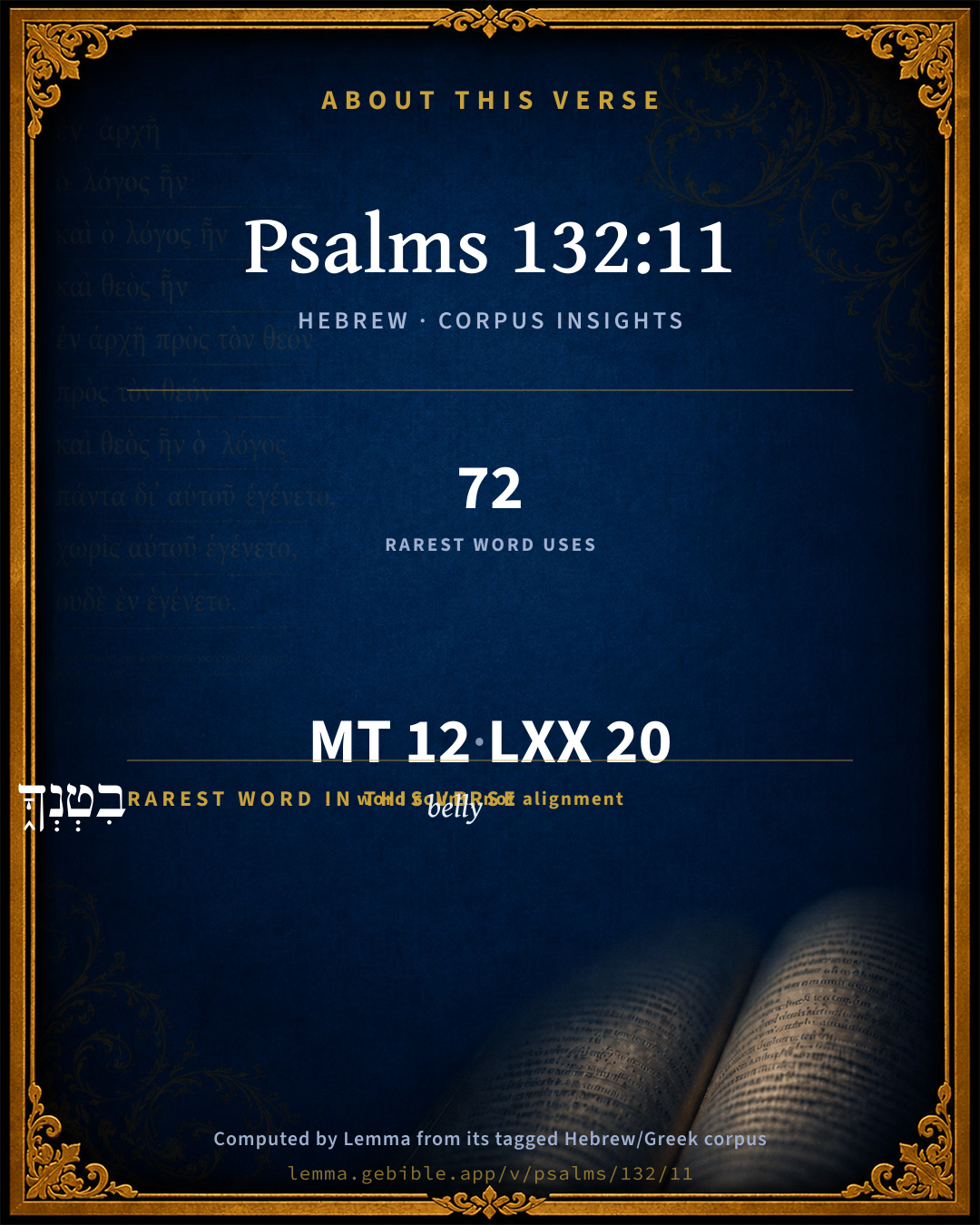
These counts appear in no published source. They are computed here, from the morphology-tagged text and Lemma’s own curated glosses. What Lemma adds →

12
words
11
distinct lemmas
Wisdom
section

Grammatical profile

  • 3 verbs
  • 6 nouns
  • 2 prepositions
  • 1 particle

Verb forms

  • נִשְׁבַּֽע Niphal · Perfect
  • יָשׁ֪וּב Qal · Imperfect
  • אָ֝שִׁ֗ית Qal · Imperfect

Hebrew & Septuagint length

In English translation the verse runs 24 words from the Hebrew and 28 from the Septuagint (LXX English) — closely comparable.

A rough comparison of the two English renderings, which tokenize alike — not a word-level alignment.

Word counts can differ between the Hebrew and the Greek without any difference in meaning — e.g. the Hebrew direct-object marker אֵת has no separate Greek word, and Greek often adds the article ὁ.

In the original languages it is 12 Hebrew tokens and 20 Greek tokens — but the two are counted differently (Hebrew bundles its prefixes and suffixes into one token; the Greek is in lemma form), so that isn’t a like-for-like length.

Cross-references

17

Topical passages linked to Psalms 132:11 in the Treasury of Scripture Knowledge — connected by theme and wording, ordered by reader-vote popularity; previews shown in the World English Bible.

  • 2 Samuel 7:12 When your days are fulfilled, and you shall sleep with your fathers, I will set up your seed after you, who shall proceed out of your bowels, and I will establish his kingdom.
  • Psalms 89:3–4 "I have made a covenant with my chosen one, I have sworn to David, my servant,
  • Acts 2:30 Therefore, being a prophet, and knowing that God had sworn with an oath to him that of the fruit of his body, according to the flesh, he would raise up the Christ to sit on his throne,
  • Psalms 110:4 Yahweh has sworn, and will not change his mind: "You are a priest forever in the order of Melchizedek."
  • 2 Chronicles 6:16 Now therefore, Yahweh, the God of Israel, keep with your servant David my father that which you have promised him, saying, There shall not fail you a man in my sight to sit on the throne of Israel, if only your children take heed to their way, to walk in my law as you have walked before me.
  • Hebrews 6:18 that by two immutable things, in which it is impossible for God to lie, we may have a strong encouragement, who have fled for refuge to take hold of the hope set before us.
  • Luke 1:32 He will be great, and will be called the Son of the Most High. The Lord God will give him the throne of his father, David,
  • Luke 1:69–70 And has raised up a horn of salvation for us in the house of his servant David
  • 2 Samuel 7:16 Your house and your kingdom shall be made sure for ever before you: your throne shall be established forever.
  • Jeremiah 33:20–26 Thus says Yahweh: If you can break my covenant of the day, and my covenant of the night, so that there shall not be day and night in their season;
  • 1 Samuel 15:29 Also the Strength of Israel will not lie nor repent; for he is not a man, that he should repent.
  • 2 Samuel 7:14 I will be his father, and he shall be my son: if he commit iniquity, I will chasten him with the rod of men, and with the stripes of the children of men;
  • 1 Kings 8:25 Now therefore, Yahweh, the God of Israel, keep with your servant David my father that which you have promised him, saying, There shall not fail you a man in my sight to sit on the throne of Israel, if only your children take heed to their way, to walk before me as you have walked before me.
  • 1 Chronicles 17:11–13 It shall happen, when your days are fulfilled that you must go to be with your fathers, that I will set up your seed after you, who shall be of your sons; and I will establish his kingdom.
  • Psalms 89:33 But I will not completely take my loving kindness from him, Nor allow my faithfulness to fail.
  • Psalms 89:35 Once have I sworn by my holiness, I will not lie to David.
  • Psalms 89:37 It will be established forever like the moon, The faithful witness in the sky." Selah.

Cross-references courtesy of OpenBible.info (CC BY 4.0).

Hebrew and Greek witnesses Masoretic Hebrew ↔ Greek Septuagint

The same verse in the two great witnesses to the Old Testament, shown verse-for-verse.

You’re reading Greek Psalm 131 (Hebrew Psalm 132). The Septuagint counts the superscription, so verse numbers can differ from the Hebrew — chapter-level alignment, not verse-by-verse. Numbering follows Rahlfs.

These are two independent witnesses, not word-aligned to each other, and the Septuagint is shown in lemma (dictionary) form.

Hebrew Psalms 132:11 Masoretic · Westminster Leningrad Codex

נִשְׁבַּֽע יְהוָ֨ה לְדָוִ֡ד אֱמֶת֮ לֹֽא יָשׁ֪וּב מִ֫מֶּ֥נָּה מִפְּרִ֥י בִטְנְךָ֑ אָ֝שִׁ֗ית לְכִסֵּא לָֽךְ

Yahweh has sworn to David in truth. He will not turn from it: "I will set the fruit of your body on your throne.

World English Bible · Public Domain

Greek LXX Greek Psalm 131:11 Septuagint · lemma form

ὄμνυμι κύριος ὁ δαυίδ ἀλήθεια καί οὐ μή ἀθετέω αὐτός ἐκ καρπός ὁ κοιλία σύ τίθημι ἐπί ὁ θρόνος σύ

The Lord swore in truth to David, and he will not annul it, saying, Of the fruit of your body will I set a king upon your throne.

LXX2012 (modern English Septuagint) · Public Domain

Hebrew: Westminster Leningrad Codex (CC BY 4.0). Greek: Septuagint (public domain); English from LXX2012 (modern English Septuagint) (Public Domain). How the Septuagint differs from the Hebrew →

Commentary

Notes on Psalms 132:11 from classic Christian and Jewish commentators (each source and its license shown beneath its notes). The classic Christian expositions comment on the surrounding passage and are grouped to its opening verse, so a note may address several verses; the Jewish commentaries on the Tanakh (Rashi and others) are per-verse, so they appear only where the commentator wrote on this verse.

Lemma curates 59 commentaries, every one of them public domain or Creative Commons licensed, each selected and text-cleaned for this edition rather than reprinted as found. About our sources →

Matthew Henry's Commentary

These are precious promises, confirmed by an oath, that the heirs of them might have strong consolation, Heb 6:17, Heb 6:18. It is all one whether we take them as pleas urged in the prayer or as answers returned to the prayer; believers know how to make use of the promises both ways, with them to speak to God and in them to hear what God the Lord will speak to us. These promises relate to the establishment both in church and state, both to the throne of the house of David and to the testimony of Israel fixed on Mount Zion. The promises concerning Zion's hill are as applicable to the gospel-church as these concerning David's seed are to Christ, and therefore both pleadable by us and very comfortable to us. Here is,

I. The choice God made of David's house and Zion hill. Both were of divine appointment.

1. God chose David's family for the royal family and confirmed his choice by an oath, Psa 132:11, Psa 132:12. David, being a type of Christ, was made king with an oath: The Lord hath sworn and will not repent, will not turn from it. Did David swear to the Lord (Psa 132:2) that he would find him a house? The Lord swore to David that he would build him a house; for God will be behind with none of his people in affections or assurances. The promise made to David refers, (1.) To a long succession of kings that should descend from his loins: Of the fruit of thy body will I set upon thy throne, which was fulfilled in Solomon; David himself lived to see it with great satisfaction, Kg1 1:48. The crown was also entailed conditionally upon his heirs for ever: If thy children, in following ages, will keep my covenant and my testimony that I shall teach them. God himself engaged to teach them, and he did his part; they had Moses and the prophets, and all he expects is that they should keep what he taught them, and keep to it, and then their children shall sit upon thy throne for evermore. Kings are before God upon their good behaviour, and their commission from him runs quamdiu se bene gesserint - during good behaviour. The issue of this was that they did not keep God's covenant, and so the entail was at length cut off, and the sceptre departed from Judah by degrees. (2.) To an everlasting successor, a king that should descend from his loins of the increase of whose government and peace there shall be no end. St. Peter applies this to Christ, nay, he tells us that David himself so understood it. Act 2:30, He knew that God had sworn with an oath to him that of the fruit of his loins, according to the flesh, he would raise up Christ to sit on his throne; and in the fulness of time he did so, and gave him the throne of his father David, Luk 1:32. He did fulfill the condition of the promise; he kept God's covenant and his testimony, did his Father's will, and in all things pleased him; and therefore to him, and his spiritual seed, the promise shall be made good. He, and the children God has given him, all believers, shall sit upon the throne for evermore, Rev 3:21.

2. God chose Zion hill for the holy hill, and confirmed his choice by the delight he took in it, Psa 132:13, Psa 132:14. He chose the Mount Zion which he loved (Psa 78:68); he chose it for the habitation of his ark, and said of it, This is my rest for ever, and not merely my residence for a time, as Shiloh was. Zion was the city of David; he chose it for the royal city because God chose it for the holy city. God said, Here will I dwell, and therefore David said, Here will I dwell, for here he adhered to his principle, It is good for me to be near to God. Zion must be here looked upon as a type of the gospel-church, which is called Mount Zion (Heb 12:22), and in it what is here said of Zion has its full accomplishment. Zion was long since ploughed as a field, but the church of Christ is the house of the living God (Ti1 3:15), and it is his rest for ever, and shall be blessed with his presence always, even to the end of the world. The delight God takes in his church, and the continuance of his presence with his church, are the comfort and joy of all its members.

II. The choice blessings God has in store for David's house and Zion hill. Whom God chooses he will bless.

1. God, having chosen Zion hill, promises to bless that,

(1.) With the blessings of the life that now is; for godliness has the promise of them, Psa 132:15. The earth shall yield her increase; where religion is set up there shall be provision, and in blessing God will bless it (Psa 67:6); he will surely and abundantly bless it. And a little provision, with an abundant blessing upon it, will be more serviceable, as well as more comfortable, than a great deal without that blessing. God's people have a special blessing upon common enjoyments, and that blessing puts a peculiar sweetness into them. Nay, the promise goes further: I will satisfy her poor with bread. Zion has her own poor to keep; and it is promised that God will take care even of them. [1.] By his providence they shall be kept from wanting; they shall have provision enough. If there be scarcity, the poor are the first that feel it, so that it is a sure sign of plenty if they have sufficient. Zion's poor shall not want, for God has obliged all the sons of Zion to be charitable to the poor, according to their ability, and the church must take care that they be not neglected, Act 6:1. [2.] By his grace they shall be kept from complaining; though they have but dry bread, yet they shall be satisfied. Zion's poor have, of all others, reason to be content with a little of this world, because they have better things prepared for them. And this may be understood spiritually of the provision that is made for the soul in the word and ordinances; God will abundantly bless that for the nourishment of the new man, and satisfy the poor in spirit with the bread of life. What God sanctifies to us we shall and may be satisfied with.

(2.) With the blessings of the life that is to come, things pertaining to godliness (Psa 132:16), which is an answer to the prayer, Psa 132:9. [1.] It was desired that the priests might be clothed with righteousness; it is here promised that God will clothe them with salvation, not only save them, but make them and their administrations instrumental for the salvation of his people; they shall both save themselves and those that hear them, and add those to the church that shall be saved. Note, Whom God clothes with righteousness he will clothe with salvation; we must pray for righteousness and then with it God will give salvation. [2.] It was desired that the saints might shout for joy; it is promised that they shall shout aloud for joy. God gives more than we ask, and when he gives salvation he will give an abundant joy.

2. God, having chosen David's family, here promises to bless that also with suitable blessings. (1.) Growing power: There, in Zion, will I make the horn of David to bud, Psa 132:17. The royal dignity shall increase more and more, and constant additions he made to the lustre of it. Christ is the horn of salvation (denoting a plentiful and powerful salvation) which God has raised up, and made to bud, in the house of his servant David. David had promised to use his power for God's glory, to cut off the horns of the wicked, and to exalt the horns of the righteous (Psa 75:10); in recompence for it God here promises to make his horn to bud, for to those that have power, and use it well, more shall be given. (2.) Lasting honour: I have ordained a lamp for my anointed. Thou wilt light my candle, Psa 18:28. That lamp is likely to burn brightly which God ordains. A lamp is a successor, for, when a lamp is almost out, another may be lighted by it; it is a succession, for by this means David shall not want a man to stand before God. Christ is the lamp and the light of the world. (3.) Complete victory: "His enemies, who have formed designs against him, will I clothe with shame, when they shall see their designs baffled." Let the enemies of all good governors expect to be clothed with shame, and especially the enemies of the Lord Jesus and his government, who shall rise, in the great day, to everlasting shame and contempt. (4.) Universal prosperity: Upon himself shall his crown flourish, that is, his government shall be more and more his honour. This was to have its full accomplishment in Jesus Christ, whose crown of honour and power shall never fade, nor the flowers of it wither. The crowns of earthly princes endure not to all generations (Pro 27:24), but Christ's crown shall endure to all eternity and the crowns reserved for his faithful subjects are such as fade not away.

Matthew Henry's Commentary on the Whole Bible (1708–1710) — public domain (CC PDM 1.0). Text via the HelloAO Bible API.

Trapp's Complete Commentary

John Trapp

Psa 132:11 The LORD hath sworn [in] truth unto David; he will not turn from it; Of the fruit of thy body will I set upon thy throne.

Ver. 11. The Lord hath sworn in truth] The eternity of Israel cannot lie, 1Sa 15:29, yet tendering our infirmity, he sweareth and sealeth to us.

Of the fruit of thy body] David was excellent at making the utmost of a promise, at pressing and oppressing it, till he had expressed the sweetness out of it, Isa 66:11. See how he improveth God’s promise, and worketh upon it, 1Ch 17:23-26. Solomon had learned to do the like.

John Trapp, A Commentary or Exposition upon All the Books of the Old and New Testament (1647–1656) — public domain. Text from a community e-Sword module.

Joseph Benson's Commentary

Psa 132:11-12. The Lord has sworn in truth — Not falsely or deceitfully, as men sometimes do, but sincerely and faithfully, what he will inviolably observe and fulfil, as the next clause expounds this. Of the fruit of thy body — Of some of thy posterity, will I set upon thy throne — See notes on 2Sa 7:12-16; and Psa 89:3-4; Psa 89:33, &c. If thy children will keep my covenant, &c. — See notes on 1Ki 8:25; 2Ch 6:16.

Joseph Benson's Commentary on the Old and New Testaments (1811–1818) — public domain. Text from a community e-Sword module.

Keil & Delitzsch

C. F. Keil & F. Delitzsch

The "for the sake of David" is here set forth in detail. אמת in Psa 132:11 is not the accusative of the object, but an adverbial accusative. The first member of the verse closes with לדוד, which has the distinctive Pazer, which is preceded by Legarmeh as a sub-distinctive; then follows at the head of the second member אמת with Zinnor, then לא־ישׁוּב ממּנּה with Olewejored and its conjunctive Galgal, which regularly precedes after the sub-distinctive Zinnor. The suffix of ממּנּה refers to that which was affirmed by oath, as in Jer 4:28. Lineal descendants of David will Jahve place on the throne (לכסּא like לראשׁי in Psa 21:4) to him, i.e., so that they shall follow his as possessors of the throne. David's children shall for ever (which has been finally fulfilled in Christ) sit לכסּא to him (cf. Jer 9:5; Jer 36:7). Thus has Jahve promised, and expects in return from the sons of David the observance of His Law. Instead of עדתי זוּ it is pointed עדתי זו. In Hahn's edition עדתי has Mercha in the penult. (cf. the retreat of the tone in זה אדני, Dan 10:17), and in Baer's edition the still better attested reading Mahpach instead of the counter-tone Metheg, and Mercha on the ultima. It is not plural with a singular suffix (cf. Deu 28:59, Ges. 91, 3), but, as זו = זאת indicates, the singular for עדוּתי, like תּחנתי for תּחנוּתי in Kg2 6:8; and signifies the revelation of God as an attestation of His will. אלמּדם has Mercha mahpach., זו Rebia parvum, and עדתי Mercha; and according to the interpunction it would have to be rendered: "and My self-attestation there" (vid., on Psa 9:16), but zow is relative: My self-attestation (revelation), which I teach them. The divine words extend to the end of Psa 132:12. The hypotheses with אם, as the fulfilment in history shows, were conditions of the continuity of the Davidic succession; not, however - because human unfaithfulness does not annul the faithfulness of God - of the endlessness of the Davidic throne. In Psa 132:13 the poet states the ground of such promissory mercy. It is based on the universal mercy of the election of Jerusalem. אוּהּ has He mappic. like ענּה in Deu 22:29, or the stroke of Raphe (Ew. 247, d), although the suffix is not absolutely necessary. In the following strophe the purport of the election of Jerusalem is also unfolded in Jahve's own words.

Keil & Delitzsch — Biblical Commentary on the Old Testament (1861–1891) — public domain (CC PDM 1.0). Text via the HelloAO Bible API. (Old Testament only.)

J. A. Alexander on Psalms

Joseph Addison Alexander

11. (Psa 132:11) Sworn hath Jehovah to David (in) truth, he will not turn back from it: Of the fruit of thy body I will place on the throne for thee. See above, on Psa 89:3; Psa 89:35, and compare 2Sa 7:28. Turn back, recede from his engagement, or fail to perform it. Of the fruit, from among thy posterity or offspring. On the throne, literally to or for it. See above, on Psa 9:4. For thee, in thy place, as thy representatives, or (belonging) to thee, i.e. thy throne.

Joseph Addison Alexander, The Psalms Translated and Explained (1850) — public domain. Text from a community e-Sword module.

Tyndale Open Study Notes

Tyndale Open Resources

132:11-12 The Lord swore an oath to David (2 Sam 7:4-16): God’s promise is unconditional, but the covenant is not (If . . . then). Those who break God’s covenant can expect the discipline of God’s judgment (see Ps 89:30-37).

Tyndale Open Study Notes — © Tyndale Open Resources, licensed CC BY-SA 4.0. Text via the HelloAO Bible API.

Adam Clarke's Commentary

Verse 11. The Lord hath sworn] As David sware to the Lord, so the Lord swears to David, that he will establish his throne, and place his posterity on it: and that he had respect to David's Antitype, we learn from St. Peter, Ac 2:30, where see the note. This verse with the following refers to the spiritual David, and the Christian Church.

Adam Clarke's Commentary on the Bible (1810–1826) — public domain. Text from a community e-Sword/MySword module.

John Calvin's Commentaries

11. Jehovah sware unto David. Compare Psalm 89:48. The sacred histories make no mention of such an oath, but a promise to the same effect is recorded in 2 Samuel 7:12; 2 Kings 8:25.

John Calvin's Commentaries (1540-1563) — public domain. Text from the Calvin Translation Society English edition (1840s-50s) via the Christian Classics Ethereal Library (ccel.org). Calvin's coverage is partial (roughly two-thirds of the Bible); uncommented books and verses are honest gaps, never fabricated. The 19th-century editor's footnotes and remarks are omitted so the notes are faithfully Calvin's own voice.

Ellicott's Commentary for English Readers

(11) In truth.—This is a possible rendering, but it is more impressive to render, Jehovah hath sworn unto David. It is a true oath; He will not depart from it. (Comp. Psa_110:4.) The substance of the oath which follows is taken from 2 Samuel 7.

A Bible Commentary for English Readers, edited by Charles John Ellicott (1878–1897) — public domain. Text from a community e-Sword module.

The Cambridge Bible for Schools and Colleges

gen. ed. J. J. S. Perowne

11. The Lord hath sworn &c.] The answer to the prayer of Psa_132:1 is given by recalling the promise to David which Jehovah has solemnly pledged Himself to fulfil. The narrative of 2 Samuel 7 does not speak of God’s promise to David as confirmed by an oath; but, as in Psa_89:3; Psa_89:35; Psa_89:49, it is the poet’s mode of emphasising the solemnity and immutability of the Divine promise. Cp. Psa_110:4; Isa_45:23.

in truth] Or perhaps, truth, i.e. a promise which will surely be fulfilled, from which he will not swerve. Cp. 2Sa_7:28, “Thy words are truth.”

Of the fruit &c.] The contents of the oath. Cp. 2Sa_7:12.

11–18. Jehovah’s answer to the prayer with which the Psalm begins. He will remember David, for He has chosen Zion to be His abode, and He will bless her people and her priests, and restore the power and prosperity of David’s house.

The Cambridge Bible for Schools and Colleges (gen. ed. J. J. S. Perowne; Cambridge University Press, 1878–1918) — public domain. Text from a community e-Sword module.

John Gill's Exposition

For the Lord hath chosen Zion,.... Not only to build upon it the temple in a literal sense, and for the place of his worship; but also for the seat of his majesty, and over which he has set his Son as King; and all this from the love he bears to Zion, which, in a figurative and spiritual sense, is his church; whom he has chosen to privileges, to grace and glory, and for his service and honour; see Psa 78:67;

he hath desired it for his habitation; heaven is the habitation of his holiness and glory; Christ is his dwelling place, in whom all the fulness of the Godhead dwells bodily: yet his desire is to his church and people; his heart is set upon them, and upon their salvation; his delight is in them, and he takes pleasure in walking with them, and dwelling among them; they being built up an habitation for God through the Spirit; see Psa 68:16.

John Gill's Exposition of the Whole Bible (1746–1763) — public domain (CC PDM 1.0). Text via the HelloAO Bible API.

Albert Barnes' Notes on the Bible

The Lord hath sworn in truth unto David - He has made a gracious promise, confirmed by an oath, which we may plead in our present necessities. That promise was made “in truth,” that is, sincerely - so that it will certainly be carried out - so that we may appeal to God, on the ground of his faithfulness, to keep his word.

He will not turn from it - We may be certain that he will carry it out. We may appeal to him on the basis of that promise with the utmost confidence.

Of the fruit of thy body will I set upon thy throne - Margin, as in Hebrew, “of thy belly.” The throne would descend to his posterity, 2Sa 7:12; see the notes at Psa 89:3-4.

Albert Barnes' Notes on the Bible (1834–1885) — public domain. Text from a community e-Sword/MySword module.

Matthew Poole's English Annotations

Sworn in truth; not falsely or deceitfully, as men sometimes do, but sincerely and faithfully, what he will inviolably observe and fulfil, as the next clause expounds this.

Of the fruit of thy body; some of thy posterity.

Matthew Poole's English Annotations on the Holy Bible (1683–1685) — public domain. Text from a community e-Sword/MySword module.

The Treasury of David

Charles H. Spurgeon

Ver. 11. Here we come to a grand covenant pleading of the kind which is always prevalent with the Lord. The LORD hath sworn in truth unto, David. We cannot urge anything with God which is equal to his own word and oath. Jehovah swears that our faith may have strong confidence in it: he cannot forswear himself. He swears in truth, for he means every word that he utters; men may be perjured, but none will be so profane as to imagine this of the God of truth. By Nathan this covenant of Jehovah was conveyed to David, and there was no delusion in it. He will not turn from it. Jehovah is not a changeable being. He never turns from his purpose, much less from his promise solemnly ratified by oath. He turneth never. He is not a man that he should lie, nor the son of man that he should repent. What a rock they stand upon who have an immutable oath of God for their foundation! We know that this covenant was really made with Christ, the spiritual seed of David, for Peter quotes it at Pentecost, saying, "Men and brethren, let me freely speak unto you of the patriarch David, that he is both dead and buried, and his sepulchre is with us unto this day. Therefore being a prophet, and knowing that God had sworn with an oath to him, that of the fruit of his loins, according to the flesh, he would raise up Christ to sit on his throne; he seeing this before spake of the resurrection of Christ." Christ therefore sits on a sure throne for ever and ever, seeing that he has kept the covenant, and through him the blessing comes upon Zion, whose poor are blessed in him. Of the fruit of thy body will I set upon thy throne. Jesus sprang from the race of David, as the evangelists are careful to record; he was "of the house and lineage of David": at this day he is the King of the Jews, and the Lord has also given him the heathen for his inheritance. He must reign, and of his kingdom there shall be no end. God himself has set him on the throne, and no rebellion of men or devils can shake his dominion. The honour of Jehovah is concerned in his reign, and therefore it is never in danger; for the Lord will not suffer his oath to be dishonoured.

Ver. 11. The LORD hath sworn. The most potent weapon with God is his own word. They remind him, therefore, as did Ethan in Ps 89:20, etc., of the solemn words which he had spoken by Nathan, and which must at that time have been still fresh in the memory of all. Solomon, too, made mention of those glorious words of comfort in his prayer at the dedication of the temple. Augustus F. Theluck.

Ver. 11-12. This Psalm is one of those fifteen which are called Psalms of Degrees; of which title whatsoever reason can be given fitting the rest, surely if we consider the argument of this, it may well import the excellency thereof, and why? It is nothing else but a sacred emulation, wherein God and a king contend; the king in piety, God in bounty. The king declares himself to be a most eminent pattern of zeal, and God himself to be a most magnificent rewarder of his servants. The king debars himself of all worldly content, while he is busily providing to entertain God; and God, who fills heaven and earth, vouchsafes to lodge in that place which was provided by the king. The king presents his supplication not only for himself, but also for his charge, the priests, the people; and God restrains not his blessing to the king, but also at his suit enlargeth it to church and commonweal. Finally, the king bindeth himself to make good his duty with a votive oath, and God stipulates again with an oath that which he promised both to king and kingdom: to the kingdom in the words that follow; but to the king in those that I have now read to you.

This speech, then, is directed unto the king, unto David; but it containeth a blessing which redounds unto his issue, "the fruit of his body." This blessing is no less than a royal succession in the throne of David: David's sons shall inherit it, but it is God that states them in it. They shall sit, but I will set them, yea, so set them that they shall never fall; they shall sit for ever; the succession shall be perpetual. And hitherto the promise runs absolute: it is qualified in that which followeth.

The king was busy to build God's house; and see how God answers him, promising the building of the king's house! God requites a building with a building. There is a very apt illusion in the word, upon which the son of Syrach also plays, when he saith, that children and the building of a city make a perpetual name; how much more if they be a royal offspring, that are destined to sit upon a throne? And God promises David sons for this honourable end"to sit upon his throne." Arthur Lake, 1626.

Ver. 11.

1. The divine oath.

2. Its eternal stability.

3. The everlasting Kingship.

Ver. 11. (middle clause). Our confidence: "He will not turn from it." He is not a changing God. He foreknew everything. He is able to carry out his purpose. His honour is bound up in it. His oath can never be broken.

Psalms 132:12*

Charles H. Spurgeon's The Treasury of David (1869–1885) — public domain. Psalms only. Text from a community e-Sword/MySword module.

Whedon's Commentary on the Bible

Daniel D. Whedon

11. Sworn—So Psa_89:3. The allusion is to 2Sa_7:8-16. The swearing is not to be sought for in form, so much as in the unchangeableness of the word, which finds its complete fulfilment in David’s prototype, Messiah, and his kingdom. See Act_2:30; Luk_1:32; Luk_1:69. The second member of the verse explains the force of the first. On the covenant with David, see on Psa_89:3-4; Psa_89:19-37

Daniel D. Whedon (gen. ed.), Commentary on the Old and New Testaments (1874–1909) — public domain. Text from a community e-Sword module.

The Pulpit Commentary

Vers. 11-18. God"s oath of promise to David. This passage is based mainly on 2Sa_7:11-16, but contains likewise expressions which seem taken from other psalms, as Psa_48:1, 2 68:16 89:3, 4 147:14. The chief promise is that of a special "fruit of his body" to be "set upon his throne" (ver. 11) and to reign in Zion forever (vers. 13, 14).

The Lord hath sworn in truth unto David. (comp. Psa_89:3, Psa_89:35) He will not turn from it. So it is said of another Divine oath, "The Lord sware, and will not repent". (Psa_110:4) Of the fruit of thy body will I set upon thy throne. (see 2Sa_7:12 Act_2:30)

The Pulpit Commentary (1880–1919), ed. H.D.M. Spence-Jones & Joseph S. Exell — public domain. Text from a community e-Sword module.

unfoldingWord translationNotes

Door43 World Missions Community

I will place one of your descendants on your throne

Making a king's descendant become king in his place is spoken of as placing him on that king's throne. AT "I will cause one of your descendants to rule Israel in your place" (See: Metaphor)

sit on your throne

Ruling as king is spoken of as sitting on the throne. AT: "rule as king" (See: Metaphor)

your sons

Here "your sons" represents the descendants of David that would become king. AT: "your descendants" (See: Synecdoche)

translationWords

oath

descend

throne

son

covenant

law

children

eternity

unfoldingWord translationNotes — © Distant Shores Media and the Door43 World Missions Community, licensed CC BY-SA 4.0. Source: git.door43.org/Door43/en_tn.

Lesson kit

Teaching starters — assembled from the data on this page, not authored interpretation. Every prompt links to the verse data it draws on. Edit before teaching.

Psalms, in the Wisdom, opens this verse with 12 words (11 distinct Hebrew lemmas). Its most distinctive word is beṭen (“belly”). A historical commentator’s framing appears above. Read the whole chapter for the surrounding context.

Discussion questions

  1. The word beṭen carries the sense “belly.” How does it shape the verse?
  2. 2 Samuel 7:12 shares this passage’s theme. How do the two illuminate each other?
  3. These translations render this verse differently; the difference is in the English rendering, not the original. What questions does that raise?
  4. The verb «נִשְׁבַּֽע» is Niphal Perfect. How does its form color the action?
  5. Reading how Matthew Henry's Commentary and Trapp's Complete Commentary read this verse, where do the two commentators agree and where do they part?

Things to notice

Reading settings

Reading text

Shown beneath each verse's original-language words.

Old Testament
Old Testament edition

Read the OT as the Masoretic Hebrew (MT) or the Greek Septuagint (LXX).

English shown for the Greek Septuagint (in the Hebrew ↔ Greek comparison).

Comparing translations? Open the Compare panel on any verse page to stack up to four side by side.