Jeremiah 12:2

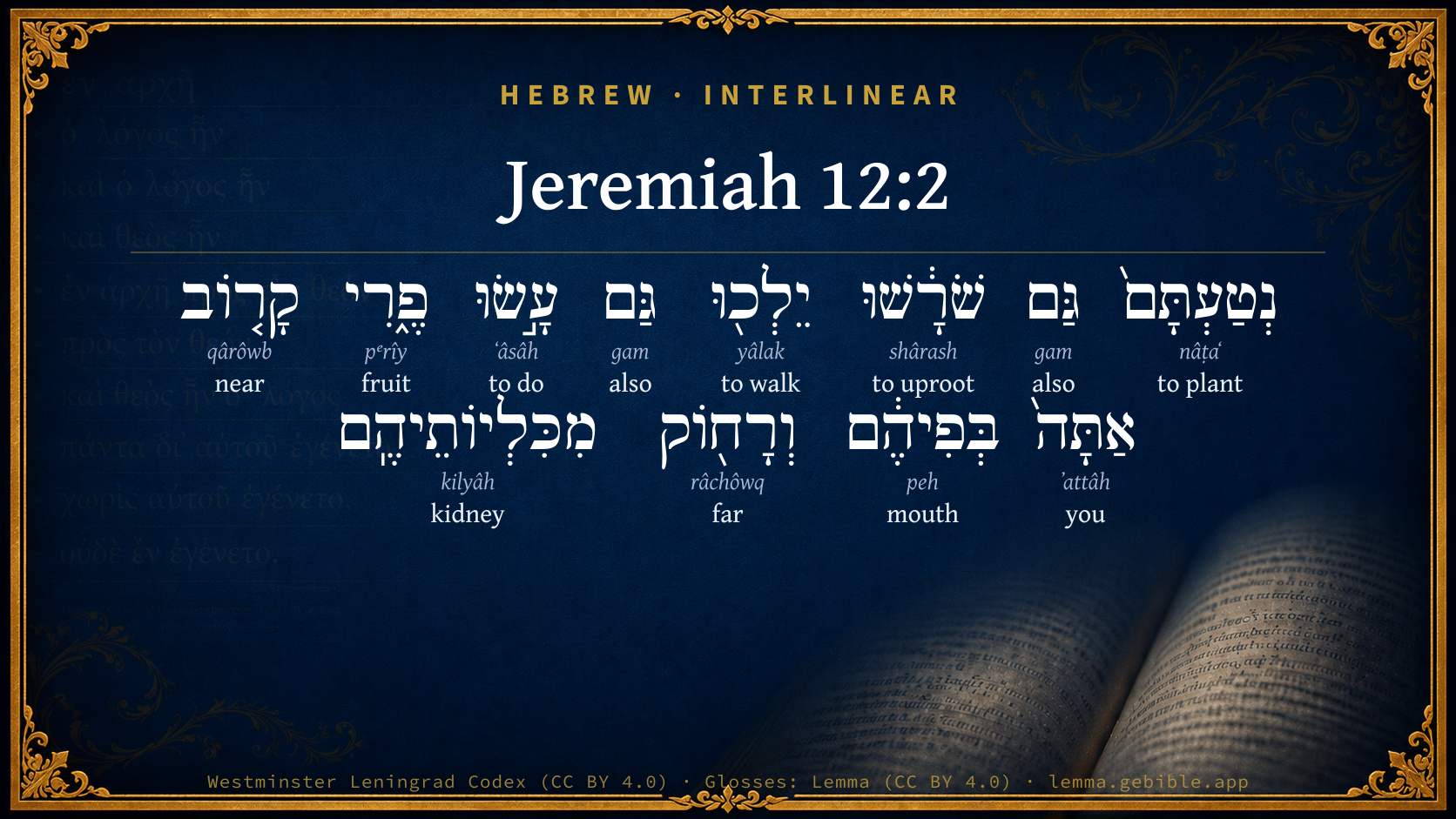
Hebrew (Westminster Leningrad Codex) Jeremiah 12:2 appears in the Hebrew Old Testament. The text above is from the Westminster Leningrad Codex. Each word links to its Strong’s number, a concise gloss, and parsing drawn from the Open Scriptures Hebrew Bible morphology. Click any word for its full Brown-Driver-Briggs (BDB) entry.
Download image
Cite this verse

Jeremiah 12:2 (World English Bible). Public Domain. Lemma interlinear Bible study tool, https://lemma.gebible.app/v/jeremiah/12/2.

Show BibTeX & RIS
BibTeX
RIS
English Translation
You have planted them, yes, they have taken root; they grow, yes, they bring forth fruit: you are near in their mouth, and far from their heart.
World English Bible · Public Domain
Download a study sheet

One document with this verse’s original text, its word-by-word gloss line, the meaning frame, cross-references with their text, attributed commentary, and full source and license credits — printable, and it pastes into notes with its structure intact.

This verse Autodidact and up

Study sheet (.html) Plain text (.txt)

A passage Seminary Student

Up to 50 verses in one chapter. A passage sheet keeps up to 6 commentary sources and 12 cross-references per verse, in the order this page ranks them, and says so on the sheet whenever that leaves anything out. Ask for a single verse and you get the Autodidact verse sheet above.

Everything on this page stays free to read, with no account — the sheet is a download of what is already on screen, not access to it.

Want to remove ads? Support Godless Engineer
Compare translations 3

The same verse in 3 English versions, stacked beneath the original-language interlinear above. Click any original word for its lexicon entry.

Each is an independent rendering of the whole verse — the interlinear is not word-aligned to these translations.

Highlighted words mark where these versions differ — a whole-verse word diff, not a word-by-word alignment.

  • World English Bible Public Domain
    You have planted them, yes, they have taken root; they grow, yes, they bring forth fruit: you are near in their mouth, and far from their heart.
  • King James Version Public Domain
    Thou hast planted them, yea, they have taken root: they grow, yea, they bring forth fruit: thou art near in their mouth, and far from their reins.
  • unfoldingWord Literal Text CC BY-SA 4.0
    You have planted them, they have also taken root. They grow, they have also produced fruit. Near you in their mouth, but far away from their kidneys.

unfoldingWord Literal Text — © unfoldingWord, licensed CC BY-SA 4.0. Word-aligned USFM3 via Door43 (git.door43.org/unfoldingWord/en_ult).

Versions to compare (up to 4)

3 of 4 selected

Show all 18 translations

Every available English version of this verse, each an independent rendering of the whole verse.

  • World English Bible Public Domain
    You have planted them, yes, they have taken root; they grow, yes, they bring forth fruit: you are near in their mouth, and far from their heart.
  • Berean Standard Bible Public Domain
    You planted them, and they have taken root. They have grown and produced fruit. You are ever on their lips, but far from their hearts.
  • Majority Standard Bible Public Domain
    You planted them, and they have taken root. They have grown and produced fruit. You are ever on their lips, but far from their hearts.
  • King James Version Public Domain
    Thou hast planted them, yea, they have taken root: they grow, yea, they bring forth fruit: thou art near in their mouth, and far from their reins.
  • American Standard Version (1901) Public Domain
    Thou hast planted them, yea, they have taken root; they grow, yea, they bring forth fruit: thou art near in their mouth, and far from their heart.
  • Revised Version (1885) Public Domain
    Thou hast planted them, yea, they have taken root; they grow, yea, they bring forth fruit: thou art near in their mouth, and far from their reins.
  • Geneva Bible (1599) Public Domain
    Thou hast planted them, and they haue taken roote: they grow, and bring forth fruite: thou art neere in their mouth, and farre from their reines.
  • Douay-Rheims (1899) Public Domain
    Thou hast planted them, and they have taken root: they prosper and bring forth fruit: thou art near in their mouth, and far from their reins.
  • Young's Literal Translation Public Domain
    Thou hast planted them, yea, they have taken root, They go on, yea, they have made fruit, Near `art' Thou in their mouth, And far off from their reins.
  • Literal Standard Version CC BY-SA 4.0
    You have planted them, || Indeed, they have taken root, || They go on, indeed, they have made fruit, || You [are] near in their mouth, || And far off from their reins.
  • Unlocked Literal Bible CC BY-SA 4.0
    You planted them and they took root. They continue to produce fruit. You are near to them in their mouths, but far away from their hearts.
  • unfoldingWord Literal Text CC BY-SA 4.0
    You have planted them, they have also taken root. They grow, they have also produced fruit. Near you in their mouth, but far away from their kidneys.
  • Darby Bible Public Domain
    Thou hast planted them, they also have taken root: they advance, yea, they bring forth fruit: thou art near in their mouth, but far from their reins.
  • World Messianic Bible Public Domain
    You have planted them. Yes, they have taken root. They grow. Yes, they produce fruit. You are near in their mouth, and far from their heart.
  • Webster's Bible Public Domain
    Thou hast planted them, yes, they have taken root: they grow, yes, they bring forth fruit: thou art near in their mouth, and far from their reins.
  • Free Bible Version CC BY-SA 4.0
    You planted them, and they've taken root, grown, and produced fruit. They're always talking about you but they don't think of you, even for a moment.
  • Bible in Basic English Public Domain
    They have been planted by you, they have taken root; they go on and give fruit: you are near in their mouths but far from their thoughts.
  • JPS Tanakh (1917) Public Domain
    Thou hast planted them, yea, they have taken root; they grow, yea, they bring forth fruit; Thou art near in their mouth, and far from their reins.

Literal Standard Version (2020), Covenant Press — licensed CC BY-SA 4.0. Text via the HelloAO Bible API (eBible.org). Unlocked Literal Bible (unfoldingWord) — licensed CC BY-SA 4.0. Text via the HelloAO Bible API (eBible.org). unfoldingWord Literal Text — © unfoldingWord, licensed CC BY-SA 4.0. Word-aligned USFM3 via Door43 (git.door43.org/unfoldingWord/en_ult). Free Bible Version, Dr. Jonathan Gallagher — licensed CC BY-SA 4.0. Text via the HelloAO Bible API (eBible.org).

Word by word

More ways to search: Search by grammar → Find every occurrence → Compare this word →

Practice this passage: Drill this verse → Learn its vocabulary →

שֹׁרָ֔שׁוּ
shârash
H8327
“to uproot”
Verb, Poal, Perfect, 3rd Person, Common, Plural
Part of Speech
Verb
Stem
Poal
Form
Perfect
Person
3rd Person
Gender
Common
Number
Plural
Full BDB Definition

Origin: a primitive root

TWOT: 2471

to uproot, take root, deal with the roots - (Piel) to root up, root out - (Pual) to be rooted up or out (of produce) - (Poel) to take root - (Poal) to take root - (Hiphil) to take root, cause to take root
  1. נְטַעְתָּם֙ nâṭaʻ H5193 “to plant · them” Verb, Qal, Perfect, 2nd Person, Masculine, Singular + Suffix, Personal, 3rd Person, Masculine, Plural
  2. גַּם gam H1571 “also” Particle, Accusative
  3. יֵלְכ֖וּ yâlak H3212 “to walk” Verb, Qal, Imperfect, 3rd Person, Masculine, Plural
  4. גַּם gam H1571 “also” Particle, Accusative
  5. עָ֣שׂוּ ʻâsâh H6213 “to do” Verb, Qal, Perfect, 3rd Person, Common, Plural
  6. פֶ֑רִי pᵉrîy H6529 “fruit” Noun, Common, Masculine, Singular, Absolute
  7. קָר֤וֹב qârôwb H7138 “near” Adjective, Adjective, Masculine, Singular, Absolute
  8. אַתָּה֙ ʼattâh H859 “you” Pronoun, Personal, 2nd Person, Masculine, Singular
  9. בְּפִיהֶ֔ם peh H6310 “in/at · mouth · their” Preposition + Noun, Common, Masculine, Singular, Construct + Suffix, Personal, 3rd Person, Masculine, Plural
  10. וְרָח֖וֹק râchôwq H7350 “and · far” Conjunction + Adjective, Adjective, Masculine, Singular, Absolute
  11. מִכִּלְיוֹתֵיהֶֽם kilyâh H3629 “from · kidneys · their” Preposition + Noun, Common, Feminine, Plural, Construct + Suffix, Personal, 3rd Person, Masculine, Plural

About this verse

These counts appear in no published source. They are computed here, from the morphology-tagged text and Lemma’s own curated glosses. What Lemma adds →

12
words
11
distinct lemmas
Prophets
section

Notable vocabulary

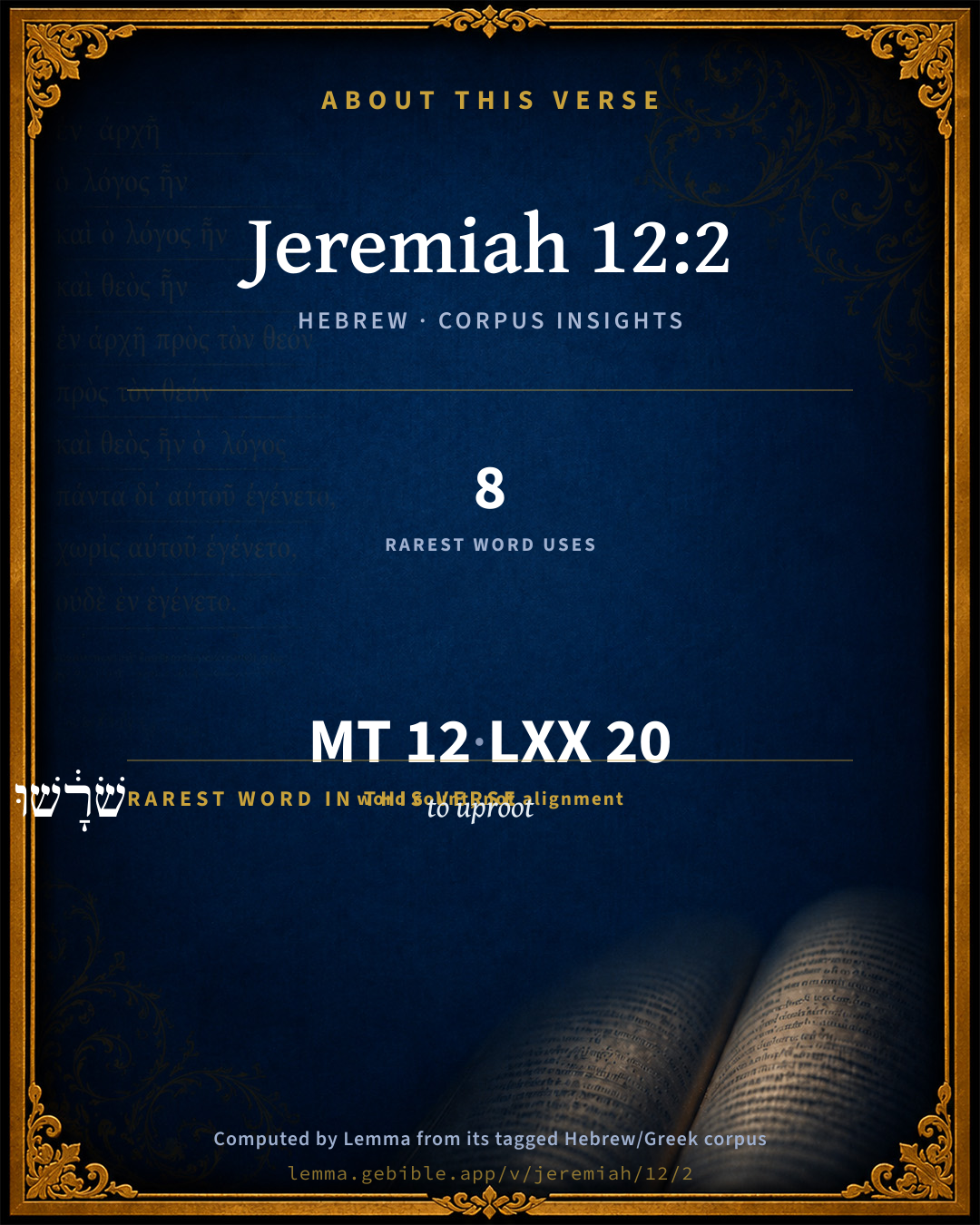
The rarest word here is שֹׁרָ֔שׁוּ to uproot H8327 — appearing just 8 times in the whole Hebrew Bible.

Shared distinctive vocabulary

שֹׁרָ֔שׁוּ to uproot H8327 occurs in 8 verses of the Hebrew Bible. Also found in:

Grammatical profile

  • 4 verbs
  • 3 nouns
  • 2 adjectives
  • 1 pronoun
  • 2 particles

Verb forms

  • נְטַעְתָּם֙ Qal · Perfect
  • שֹׁרָ֔שׁוּ Poal · Perfect
  • יֵלְכ֖וּ Qal · Imperfect
  • עָ֣שׂוּ Qal · Perfect

Repetition

A word recurs within this verse — often emphatic in Hebrew:

  • גַּם also H1571 ×2

Hebrew & Septuagint length

In the original languages it is 12 Hebrew tokens and 20 Greek tokens — but the two are counted differently (Hebrew bundles its prefixes and suffixes into one token; the Greek is in lemma form), so that isn’t a like-for-like length.

Cross-references

10

Topical passages linked to Jeremiah 12:2 in the Treasury of Scripture Knowledge — connected by theme and wording, ordered by reader-vote popularity; previews shown in the World English Bible.

  • Isaiah 29:13 The Lord said, Because this people draw near [to me], and with their mouth and with their lips to honor me, but have removed their heart far from me, and their fear of me is a commandment of men which has been taught [them];
  • Titus 1:16 They profess that they know God, but by their works they deny him, being abominable, disobedient, and unfit for any good work.
  • Matthew 15:8 'These people draw near to me with their mouth, And honor me with their lips; But their heart is far from me.
  • Jeremiah 11:17 For Yahweh of Hosts, who planted you, has pronounced evil against you, because of the evil of the house of Israel and of the house of Judah, which they have worked for themselves in provoking me to anger by offering incense to Baal.
  • Jeremiah 45:4 Thus shall you tell him, Thus says Yahweh: Behold, that which I have built will I break down, and that which I have planted I will pluck up; and this in the whole land.
  • Ezekiel 17:5–10 He took also of the seed of the land, and planted it in a fruitful soil; he placed it beside many waters; he set it as a willow tree.
  • Ezekiel 33:31 They come to you as the people comes, and they sit before you as my people, and they hear your words, but don't do them; for with their mouth they show much love, but their heart goes after their gain.
  • Jeremiah 3:10 Yet for all this her treacherous sister Judah has not returned to me with her whole heart, but only in pretense, says Yahweh.
  • Ezekiel 19:10–13 Your mother was like a vine, in your blood, planted by the waters: it was fruitful and full of branches by reason of many waters.
  • Mark 7:6 He answered them, "Well did Isaiah prophesy of you hypocrites, as it is written, 'This people honors me with their lips, But their heart is far from me.

Cross-references courtesy of OpenBible.info (CC BY 4.0).

Hebrew and Greek witnesses Masoretic Hebrew ↔ Greek Septuagint

The same verse in the two great witnesses to the Old Testament, shown verse-for-verse.

These are two independent witnesses, not word-aligned to each other, and the Septuagint is shown in lemma (dictionary) form.

Hebrew Jeremiah 12:2 Masoretic · Westminster Leningrad Codex

נְטַעְתָּם֙ גַּם שֹׁרָ֔שׁוּ יֵלְכ֖וּ גַּם עָ֣שׂוּ פֶ֑רִי קָר֤וֹב אַתָּה֙ בְּפִיהֶ֔ם וְרָח֖וֹק מִכִּלְיוֹתֵיהֶֽם

You have planted them, yes, they have taken root; they grow, yes, they bring forth fruit: you are near in their mouth, and far from their heart.

World English Bible · Public Domain

Greek LXX Structure differs

In the Septuagint, Jeremiah is about an eighth shorter than the Hebrew and arranges its material differently — the Oracles Against the Nations (Hebrew chapters 46–51) appear in the middle of the Greek book, after 25:13. Because the chapter and verse boundaries do not line up, a verse-for-verse comparison with the Hebrew is not shown.

A verse-for-verse comparison isn’t shown here because the chapters and verses don’t line up. Switch to the LXX edition with the MT / LXX toggle above to read the Greek directly.

On this verse, John Gill's Exposition discusses the Septuagint’s reading. Read the note in Commentary ↓

Hebrew: Westminster Leningrad Codex (CC BY 4.0). Greek: Septuagint (public domain); English from a public-domain English Septuagint. How the Septuagint differs from the Hebrew →

Targum (Aramaic paraphrase)

1

The Targum is the ancient Jewish Aramaic paraphrase of the Hebrew Scriptures — an interpretive translation, not the Hebrew text itself. Onkelos (literal) and Pseudo-Jonathan (expansive) render the Torah, and Jonathan the Prophets. Coverage is partial: where no permissively-licensed English translation exists for a verse, only the Aramaic is shown. This is verse-level text, not a word-by-word alignment to the Hebrew.

  1. Targum Jonathan Prophets (Joshua–Malachi)
    קַיֵמְתִּינוּן אַף תַּקִיפוּ עֲתָרוּ אַף קְנוֹ נִכְסִין קְרִיבִין פִּתְגָמֵי אוֹרַיָתָךְ בְּפוּמְהוֹן וּרְחִיקָא דְחַלְתָּךְ מִכּוּלְיָתְהוֹן:

    (no public-domain English translation for this verse)

    Targum Jonathan — Aramaic: “Mikraot Gedolot” (public domain). English: “Sefaria Community Translation” (CC0 1.0 (public-domain dedication)); “London "Chaldee Paraphrase," 1871” (public domain). Text via Sefaria.

Commentary

Notes on Jeremiah 12:2 from classic Christian and Jewish commentators (each source and its license shown beneath its notes). The classic Christian expositions comment on the surrounding passage and are grouped to its opening verse, so a note may address several verses; the Jewish commentaries on the Tanakh (Rashi and others) are per-verse, so they appear only where the commentator wrote on this verse.

Lemma curates 59 commentaries, every one of them public domain or Creative Commons licensed, each selected and text-cleaned for this edition rather than reprinted as found. About our sources →

Trapp's Complete Commentary

John Trapp

Jer 12:2 Thou hast planted them, yea, they have taken root: they grow, yea, they bring forth fruit: thou [art] near in their mouth, and far from their reins.

Ver. 2. Thou hast planted them, and they have taken root.] All goes well with them; they have more than heart can wish. {Psa 73:7} And in lieu of God’s goodness to them, they profess largely, and pretend to great devotion; but that is all.

Thou art near in their mouth, and far from their reins.] That is, From their affections. {Tit 1:16} Hypocrites are like that heap of heads {2Ki 10:8} that had never a heart among them; they have vocem in choro, mentem in foro; virtutem non colunt sed colorant. Voices in the choir, minds in the market place, they do not worship in strength but in deception. That Persian ambassador - of whom before - when conversing with Christians, he had so oft in his mouth, Soli Deo gloria, made believe that he gave glory to the only true God, whenas he meant the sun, whom he worshipped as his god. The king of Bohemia, when beaten out of Prague, was encouraged by some great commanders about him that he had many princes his friends and allies that would readily assist him; to which he made no answer, but wrote the word Deus God, in large letters. But some thought he meant Denmark in D, England in E, Hungary in U, and the Swedes in S. God knows what his meaning was; but he will make "all the Churches to know that he searcheth the hearts and reins," and that he will "kill with death" all such as had rather seem to be good, than seek to be so. If Jeremiah had been one of those, he dared never to have said,

John Trapp, A Commentary or Exposition upon All the Books of the Old and New Testament (1647–1656) — public domain. Text from a community e-Sword module.

The Biblical Illustrator

Joseph S. Exell

Jer_12:2

Thou art near in their mouth, and far from their reins.

God comes nearer to the hearts of His people in their duties than He doth to any hypocritical or formal professor

By Gods nearness we understand not His omnipresence (that neither comes nor goes), nor His love to His people (that abides), but the sensible, sweet manifestations and outlets of it to their souls (Psa_145:18). Note the limitation of this glorious privilege; it is the peculiar enjoyment of sincere and upright-hearted worshippers.

1. Sincere souls are sensible of Gods accesses to them in their duties, they feel His approaches to their spirits (Lam_3:57). The heart fills apace, the empty thoughts swell with a fulness of spiritual things, which strive for vent.

2. They are sensible of Gods withdrawment from their spirits; they feel how the ebb follows the flood, and how the waters abate (Son_5:6).

3. The Lords nearness to the hearts and reins of His people in their duties is evident to them from the effects that it leaves upon their spirits. For look, as it is with the earth and plants, with respect to the approach or remove of the sun in the spring and autumn, so it is here as Christ speaks (Luk_21:29).

(1) A real taste of the joy of the Lord is here given to men, the fulness whereof is in heaven; hence called (2Co_1:22), The earnest of His Spirit. And in 1Pe_1:8, glorified joy, or a short salvation.

(2) A mighty strength and power coming into their soul, and actuating all its faculties and graces. When God comes near, new powers enter the soul; the feeble is as David (Psa_138:3).

(3) A remarkable transformation and change of spirit follows it. The sight of God, the felt presence of God, is as fire, which quickly assimilates what is put into it to its own likeness (2Co_3:18).

(4) A vigorous working of the heart heavenward; a mounting of the soul upward.

Infer--

1. Then certainly there is a heaven and a state of glory for the saints.

2. But, oh! what is heaven? And what that state of glory reserved for the saints? Doth a glimpse of Gods presence in a duty go down to the heart and reins? Oh, how unutterable, then, must that be which is seen and felt above, where God comes as near to man as can be! (Rev_22:3-4.)

3. See hence the necessity of casting these very bodies into a new mould by their resurrection from the dead (1Co_15:41).

4. Is God so near to His people above all others in the world? How good is it to be near to them that are so near to God:

5. If God be so near to the heart and reins of His people in their duties, oh, how assiduous should they be in their duties!

6. What steady Christians should all real Christians be! For lo, what a seal and witness hath religion in the breast of every sincere professor of it! (John Flavel.)

The Biblical Illustrator, edited by Joseph S. Exell (c. 1880s–1900s) — public domain. Text from a community e-Sword module.

Joseph Benson's Commentary

Jer 12:2-3. Thou hast planted them — In a rich soil, by thy power: they have taken root; they grow — Their prosperity seems to be confirmed and settled by thy providence. Thou art near in their mouth, and far from their reins — They talk of thee, and profess piety, but do not believe in and obey thee from their hearts; the true character this of hypocrites, who, according to Isaiah, honour God with their mouths, but their hearts are far from him, Isa 29:13. But thou, O Lord, knowest me — As if he had said, Thou knowest, O Lord, it is otherwise with me: I am maligned, and my life is hunted after, though my heart is upright before thee; and I have been faithful in declaring to the people that, and only that, which thou didst reveal to me: yet it is for this they seek my life. Pull them out like sheep, &c. — Or rather, as Dr. Waterland and Houbigant translate the clause, “Thou wilt separate them as sheep to be sacrificed, and set them apart for the day of slaughter.”

Joseph Benson's Commentary on the Old and New Testaments (1811–1818) — public domain. Text from a community e-Sword module.

Tyndale Open Study Notes

Tyndale Open Resources

12:2 Jeremiah was irked that the Lord allowed evil people to become established and enjoy prosperity and happiness.

Tyndale Open Study Notes — © Tyndale Open Resources, licensed CC BY-SA 4.0. Text via the HelloAO Bible API.

Geneva Bible (1599)

Geneva Bible translators

They profess God in mouth, but deny him in heart, which is here meant by the reins, Isa. 29:13; Matt. 15:8.

Geneva Bible (1599) marginal notes — public domain. Text via Bolls.life.

Jamieson, Fausset & Brown

Robert Jamieson, A. R. Fausset & David Brown

grow--literally "go on," "progress." Thou givest them sure dwellings and increasing prosperity.

near in . . . mouth . . . far from . . . reins-- (Isa 29:13; Mat 15:8). Hypocrites.

Jamieson, Fausset & Brown — Commentary Critical and Explanatory on the Whole Bible (1871) — public domain (CC PDM 1.0). Text via the HelloAO Bible API.

Adam Clarke's Commentary

Verse 2. Thou art near in their mouth] They have no sincerity: they have something of the form of religion, but nothing of its power.

Adam Clarke's Commentary on the Bible (1810–1826) — public domain. Text from a community e-Sword/MySword module.

John Calvin's Commentaries

When the happiness of the wicked disturbs our minds, two false thoughts occur to us, — either that this world is ruled by chance and not governed by God’s providence, or that God does not perform the office of a good and righteous judge when he suffers light to be so blended with darkness. But the Prophet here takes it as granted, that the world is governed by God’s providence; he therefore does not touch the false notion, which yet harasses pious minds, that fortune governs the world. Well known are these words, “I am disposed to think that there are no gods.” It was thought there were no gods who ruled the world, because he died who deserved a longer life. And the wisest heathens have thus spoken, “I see fortune, which yet no reason governs; I see fortune, which prevails more than reason in these matters.” But the Prophet, who was far removed from these profane notions, held this truth, that the world is governed by God; and he now asks, How it was that God exercised so long a forbearance? The ungodly, the thoughtless, and inconsiderate might have said that this forbearance was far too scanty. But the Prophet, as I have said, clearly describes what the Jews deserved.

Then he says, that they had been planted by God; for they could not have prospered had not God blessed them. The metaphor of planting, as we have before seen, often occurs, but in a different sense. When the celestial life is the subject, God is said to have planted his own elect, because their salvation is sure. He is said also to have planted his people in the land which he had given to them as an heritage. Now, when he speaks of the reprobate, the Prophet says that they had been planted by God, and for these reasons, because they flourished, because they produced leaves, and because they brought forth some fruit. In short, as Scripture, for various reasons, compares men to trees, so it employs the word planting in a corresponding sense. The Prophet indeed says that the ungodly are supported by God, and this is certain; for were not God to deal kindly with them for a time, they could not but instantly perish. Hence their prosperity is a proof of God’s indulgence. But the Prophet expresses his wonder at this, not so much through his own private feeling, as for the purpose of shewing to the Jews that it was a strange thing that they were tolerated so long by God, as they had a hundred times deserved to be wholly destroyed.

Yea, he says, they have taken root By this metaphor he means their continued happiness. He says also, that they had advanced aloft; that is, were raised high and increased. He then adds, that they had brought forth fruit The fruit of which he speaks was nothing else than their offspring; as though he had said, that the ungodly were not only prosperous to the end of life, but that they also propagated their kind, so that they had children surviving them, so that their families became celebrated. But the import of the whole is this, — that God not only endured the ungodly for a time, but extended his indulgence to many ages, so that their descendants continued in the same wealth, dignity, and power, with their dead fathers.

He afterwards adds, Thou indeed art nigh in their mouth, but thou art far from their reins Jeremiah no doubt intended to anticipate them; for he knew that the Jews would have objections in readiness, — “What art thou, who summonest us here before God’s tribunal, and who pleadest with God that he may not too patiently bear with us? Are not we his servants? Do we not daily offer sacrifices in the Temple? Are we not circumcised? Do we not bear in our bodies the sign of our adoption? Do we not possess a kingdom and a priesthood? Now, these are pledges of God’s paternal love towards us, But thou wouldest have thyself to be more just than God himself. Can God deny himself? He has bound his faithfulness to us by the sign of circumcision, by the Temple, by the kingdom, by the priesthood, and by the sacrifices; and when we do anything amiss, then our sins are expiated by sacrifices and washings, and other rites.”

As then the Prophet knew that the Jews were wont thus loquaciously and perversely to defend their own cause, he says, “O, I see what they will say to me, even that which they are wont to say; for the common burden of their song is, that they are the children of Abraham, that they sacrifice, and have other ways of pacifying God, and then that they possess a priesthood and a kingdom. These things,” he says, “are well known to me: but, O Lord, thou knowest that they are mere words; thou knowest that they act fallaciously, and that they do nothing but declare what is false when they pretend these vain shifts and evasions; for thou knowest the heart, (καρδιογνώστης;) thou therefore understandest that there is nothing right or sincere in their mouth; for their reins are far from thee, and thou also art far from their reins.” We hence also perceive with more certainty the truth of what I have stated, — that the Prophet here pleads with God, in order that the Jews might know that they could in no way be absolved when they came before God’s tribunal. It, follows —

John Calvin's Commentaries (1540-1563) — public domain. Text from the Calvin Translation Society English edition (1840s-50s) via the Christian Classics Ethereal Library (ccel.org). Calvin's coverage is partial (roughly two-thirds of the Bible); uncommented books and verses are honest gaps, never fabricated. The 19th-century editor's footnotes and remarks are omitted so the notes are faithfully Calvin's own voice.

Ellicott's Commentary for English Readers

(2) Thou hast planted them.—The words express, of course, the questioning distrust of the prophet. The wicked flourish, so that one would think God had indeed planted them. Yet all the while they were mocking Him with hypocritical worship (here we have an echo of Isa_29:13), uttering His name with their lips while He was far from that innermost being which the Hebrew symbolised by the “reins.”

A Bible Commentary for English Readers, edited by Charles John Ellicott (1878–1897) — public domain. Text from a community e-Sword module.

The Cambridge Bible for Schools and Colleges

gen. ed. J. J. S. Perowne

2. planted] The same metaphor is used of the whole nation, 2Sa_7:10. The figure of a tree is worked out in the verse. They have been placed in security and have prospered throughout life. We may compare Isa_40:24 for the same figure applied in that case to the overthrow of those who are the objects of Divine wrath.

reins] See on Jer_11:20.

The Cambridge Bible for Schools and Colleges (gen. ed. J. J. S. Perowne; Cambridge University Press, 1878–1918) — public domain. Text from a community e-Sword module.

John Gill's Exposition

Thou hast planted them,.... In the land of Canaan, fixed the bounds of their habitation, given them a firm and comfortable settlement; for all the good things, even of the wicked, come from God:

yea, they have taken root; as everything that is planted does not; but these did, though it was downwards in the earth, on which their hearts were set, and so were strengthened and established in their worldly circumstances:

they grow, yea, they bring forth fruit; but to themselves, not to God; not fruits of righteousness or good works; they grow, not in grace and holiness, but in their worldly substance; and they brought forth fruit, not such as were meet for repentance, but they had great riches, and numerous families; and so the Septuagint and Arabic versions, "they produce children, and bring forth fruit." The Targum is,

"they become rich, yea, they possess substance.''

Thou art near in their mouth; they often made use of the name of God, either in swearing by it, or praying to him in an external manner; they called themselves the Lord's people, and boasted of being his priests, and employed in his service; they took his covenant, and the words of his law, into their mouths, and taught them the people, and yet had no sincere regard for these things:

and far from their reins; from the affections of their hearts, and the desires of their souls; they had no true love for God, nor fear of him, nor faith in him. The Targum is,

"near are the words of thy law in their mouth, and far is thy fear from their reins.''

John Gill's Exposition of the Whole Bible (1746–1763) — public domain (CC PDM 1.0). Text via the HelloAO Bible API.

Albert Barnes' Notes on the Bible

Their veins - i. e., their heart. The reins were regarded by the Jews as the seat of the affections.

Albert Barnes' Notes on the Bible (1834–1885) — public domain. Text from a community e-Sword/MySword module.

Haydock's Catholic Bible Commentary

Reins. They have thy name in their mouth, but not in their heart, Isaias xxix. 13., and Matthew xv. 8.

George Leo Haydock (1774–1849), Haydock's Catholic Family Bible and Commentary, 1859 edition — public domain. Excludes Psalms (Douay-Rheims chapter numbering differs from Protestant) and Deuterocanonical books (Catholic canon only).

Matthew Poole's English Annotations

Here are a people that indeed talk of thee, and one that only observeth their mouths would judge thou wert near to them, and they had communion with thee; but he that observeth their lives may easily discern that thou art far from their inward parts, they have neither fear of thee, nor love for thee, nor desire after thee, nor delight in thee, nor are they obedient to thee; yet thou hast planted them by thy power, and by thy providence they thrive, go on, and prosper.

Matthew Poole's English Annotations on the Holy Bible (1683–1685) — public domain. Text from a community e-Sword/MySword module.

The Pulpit Commentary

Far from their reins; i.e. from their heart (the seat of strong impulses and desires); comp. Psa_16:7 Psa_26:2.

Ver. 2 (last clause). God near to the mouth but far from the life.

I IT IS POSSIBLE TO HAVE THE NAME OF GOD ON OUR LIPS WHILE THE THOUGHT OF GOD IS ABSENT FROM OUR MINDS. This is the case with mere formal worshippers, who use the language of devotion without realizing to themselves its meaning. The danger of it besets us all. Words come to be handled like coins, without any distinct recognition of what they represent. This applies especially to words which refer to God, since it requires a high act of abstraction to keep constantly before us the ideas of the unseen Object of such language. Understand that these empty words are worse than wasted breath; they are a mockery to God, a deception to men, and a source of self-delusion to the speaker of them.

II IT IS POSSIBLE TO HAVE THE NAME OF GOD ON OUR LIPS WHILE THE LOVE OF GOD IS ABSENT FROM OUR HEARTS. We may not fall into the first mistake. The language may not be empty words. The thought of God may be present. Yet this may be a mere thought a cold and barren idea, having no influence on our affections. This religion of words and notions is a vain thing. Indeed, it is not a religion at all; it is only a theology. Religion does not begin till the heart opens to receive God. It consists not in the intellectual recognition of God, but in the love of God. (Deu_10:12)

III IT IS POSSIBLE TO HAVE THE NAME OF GOD ON OUR LIPS WHILE THE POWER OF GOD IS ABSENT FROM OUR CONSCIENCES. God may be spoken of, thought of, approached with a certain affection, though not the true love of our hearts, and yet be practically disregarded. His will may still be of no account to us. We may still not make our lives subservient to his Law. There is then no evidence of God in our conduct. Though our thought may be religious, our life is godless.

IV IT IS POSSIBLE TO HAVE THE NAME OF GOD ON OUR LIPS WHILE THE SPIRIT OF GOD IS ABSENT FROM OUR SPIRITS. The deepest fact of religion is the indwelling of the Spirit of God the real presence of God. God inhabits the soul as a temple. We may have much religiousness without this. The Name of God may be inscribed on the portals of the temple while the shrine is empty of his presence.

V IT IS POSSIBLE TO HAVE THE NAME OF GOD UPON OUR LIPS AND TO BE VERY WICKED. If the Name be only on our lips, this is no sign of moral and spiritual goodness. The wicked contemporaries of Jeremiah were many of them religious precisionists; yet their moral guilt was nonetheless for all their language of devotion.

VI IT IS POSSIBLE TO HAVE THE NAME OF GOD ON OUR LIPS AND TO SUFFER ULTIMATE RUIN. Formalism and hypocrisy may prosper for a time. Those men who had the Name of God on their lips were the wicked who prospered (Ver. 1). Yet they were doomed to ultimate punishment. It is important to remember this constantly, since we are too ready to be deceived by professions and appearances.

The Pulpit Commentary (1880–1919), ed. H.D.M. Spence-Jones & Joseph S. Exell — public domain. Text from a community e-Sword module.

John Wesley's Explanatory Notes

Far - Thou art far from their inward parts, they neither fear thee, nor love thee.

John Wesley, Explanatory Notes Upon the Whole Bible (1754–1765) — public domain. Text via the GEBible commentary corpus.

Lesson kit

Teaching starters — assembled from the data on this page, not authored interpretation. Every prompt links to the verse data it draws on. Edit before teaching.

Jeremiah, in the Prophets, opens this verse with 12 words (11 distinct Hebrew lemmas). Its most distinctive word is shârash (“to uproot”). A historical commentator’s framing appears above. Read the whole chapter for the surrounding context.

Discussion questions

  1. What does “to uproot” (shârash) contribute to the verse as a whole?
  2. Job 5:3 shares the word «to uproot» with this verse. How do the two illuminate each other?
  3. “also” occurs 2× in this one verse. What is the effect of the repetition?
  4. These translations render this verse differently. What is at stake in choosing one wording over another?
  5. The verb «נְטַעְתָּם֙» is Qal Perfect. How does its form color the action?
  6. Reading how Trapp's Complete Commentary and The Biblical Illustrator read this verse, where do the two commentators agree and where do they part?

Things to notice

Reading settings

Reading text

Shown beneath each verse's original-language words.

Old Testament
Old Testament edition

Read the OT as the Masoretic Hebrew (MT) or the Greek Septuagint (LXX).

English shown for the Greek Septuagint (in the Hebrew ↔ Greek comparison).

Comparing translations? Open the Compare panel on any verse page to stack up to four side by side.