Song of Solomon 8:11

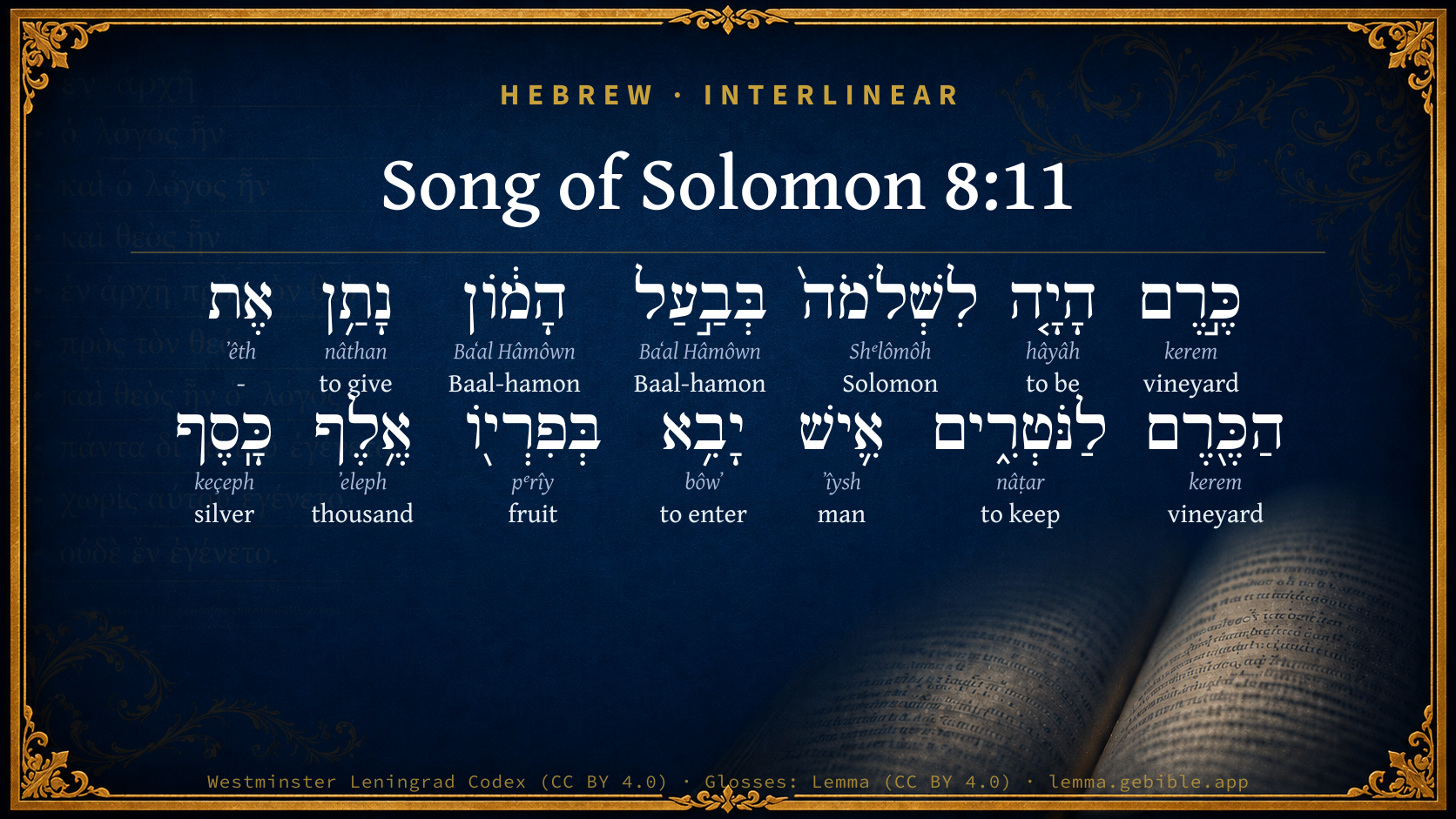
Hebrew (Westminster Leningrad Codex) Song of Solomon 8:11 appears in the Hebrew Old Testament. The text above is from the Westminster Leningrad Codex. Each word links to its Strong’s number, a concise gloss, and parsing drawn from the Open Scriptures Hebrew Bible morphology. Click any word for its full Brown-Driver-Briggs (BDB) entry.
Download image
Cite this verse

Song of Solomon 8:11 (World English Bible). Public Domain. Lemma interlinear Bible study tool, https://lemma.gebible.app/v/song-of-solomon/8/11.

Show BibTeX & RIS
BibTeX
RIS
English Translation
Solomon had a vineyard at Baal Hamon. He leased out the vineyard to keepers. Each was to bring a thousand shekels of silver for its fruit.
World English Bible · Public Domain
Highlights
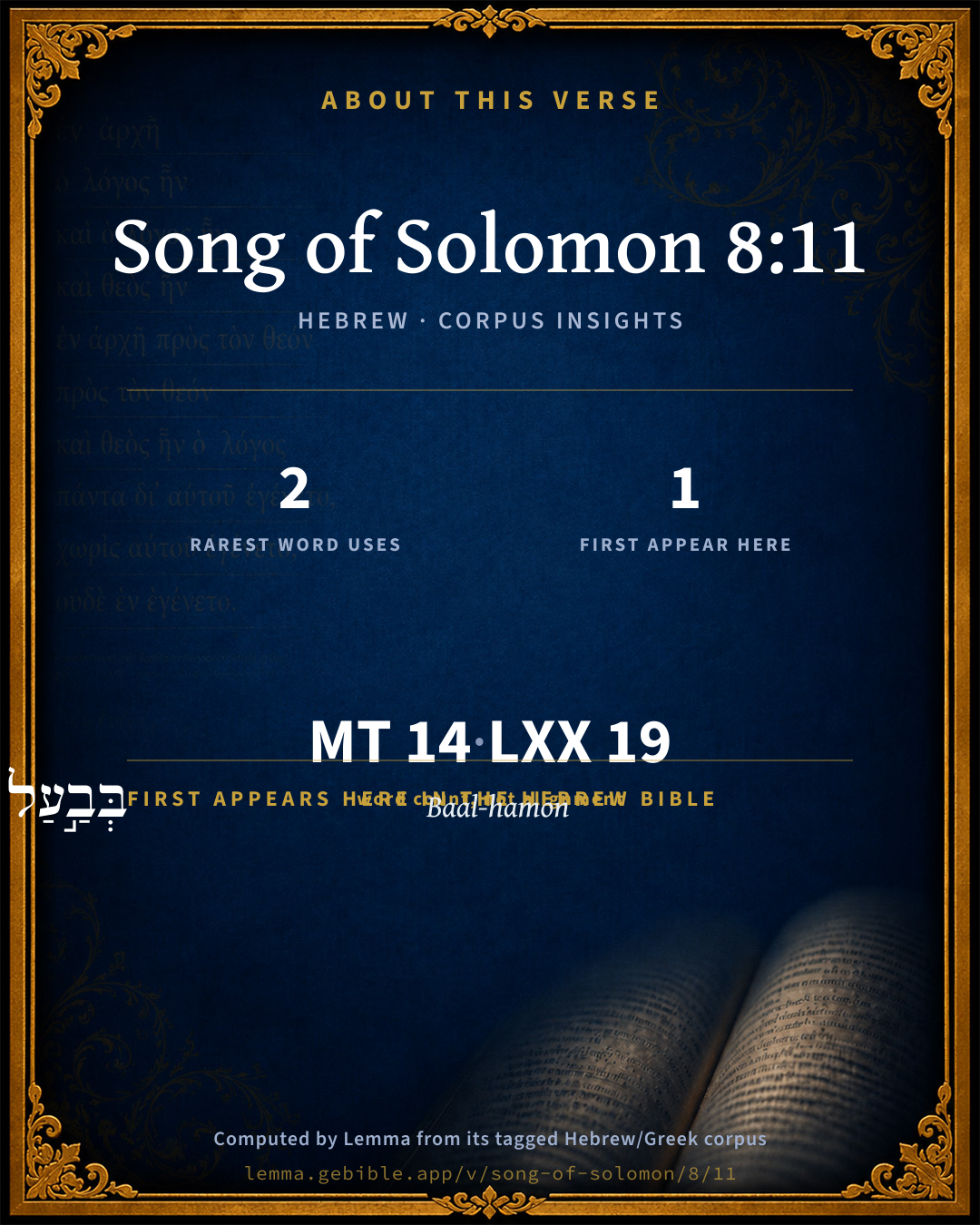
  • 1 first appearance in the Hebrew Bible
Full analysis ↓
Download a study sheet

One document with this verse’s original text, its word-by-word gloss line, the meaning frame, cross-references with their text, attributed commentary, and full source and license credits — printable, and it pastes into notes with its structure intact.

This verse Autodidact and up

Study sheet (.html) Plain text (.txt)

A passage Seminary Student

Up to 50 verses in one chapter. A passage sheet keeps up to 6 commentary sources and 12 cross-references per verse, in the order this page ranks them, and says so on the sheet whenever that leaves anything out. Ask for a single verse and you get the Autodidact verse sheet above.

Everything on this page stays free to read, with no account — the sheet is a download of what is already on screen, not access to it.

Want to remove ads? Support Godless Engineer
Compare translations 3

The same verse in 3 English versions, stacked beneath the original-language interlinear above. Click any original word for its lexicon entry.

Each is an independent rendering of the whole verse — the interlinear is not word-aligned to these translations.

Highlighted words mark where these versions differ — a whole-verse word diff, not a word-by-word alignment.

  • World English Bible Public Domain
    Solomon had a vineyard at Baal Hamon. He leased out the vineyard to keepers. Each was to bring a thousand shekels of silver for its fruit.
  • King James Version Public Domain
    Solomon had a vineyard at Baalhamon; he let out the vineyard unto keepers; every one for the fruit thereof was to bring a thousand pieces of silver.
  • unfoldingWord Literal Text CC BY-SA 4.0
    was a vineyard for Solomon in Baal Hamon. He gave the vineyard to keepers. Each person brought in exchange for its fruit a thousand silver.

unfoldingWord Literal Text — © unfoldingWord, licensed CC BY-SA 4.0. Word-aligned USFM3 via Door43 (git.door43.org/unfoldingWord/en_ult).

Versions to compare (up to 4)

3 of 4 selected

Show all 18 translations

Every available English version of this verse, each an independent rendering of the whole verse.

  • World English Bible Public Domain
    Solomon had a vineyard at Baal Hamon. He leased out the vineyard to keepers. Each was to bring a thousand shekels of silver for its fruit.
  • Berean Standard Bible Public Domain
    Solomon had a vineyard in Baal-hamon. He leased it to the tenants. For its fruit, each was to bring a thousand shekels of silver.
  • Majority Standard Bible Public Domain
    Solomon had a vineyard in Baal-hamon. He leased it to the tenants. For its fruit, each was to bring a thousand shekels of silver.
  • King James Version Public Domain
    Solomon had a vineyard at Baalhamon; he let out the vineyard unto keepers; every one for the fruit thereof was to bring a thousand pieces of silver.
  • American Standard Version (1901) Public Domain
    Solomon had a vineyard at Baal-hamon; He let out the vineyard unto keepers; Every one for the fruit thereof was to bring a thousand `pieces' of silver.
  • Revised Version (1885) Public Domain
    Solomon had a vineyard at Baal-hamon; he let out the vineyard unto keepers; every one for the fruit thereof was to bring a thousand pieces of silver.
  • Geneva Bible (1599) Public Domain
    Salomon had a vine in Baal-hamon: hee gaue the vineyarde vnto keepers: euery one bringeth for ye fruite thereof a thousand pieces of siluer.
  • Douay-Rheims (1899) Public Domain
    The peaceable had a vineyard, in that which hath people: he let out the same to keepers, every man bringeth for the fruit thereof a thousand pieces of silver.
  • Young's Literal Translation Public Domain
    Solomon hath a vineyard in Baal-Hamon, He hath given the vineyard to keepers, Each bringeth for its fruit a thousand silverlings;
  • Literal Standard Version CC BY-SA 4.0
    Solomon has a vineyard in Ba‘al-Hamon, || He has given the vineyard to keepers, || Each brings for its fruit one thousand pieces of silver;
  • Unlocked Literal Bible CC BY-SA 4.0
    Solomon had a vineyard at Baal Hamon. He gave the vineyard to those who would maintain it. Each one was to bring a thousand shekels of silver for its fruit.
  • unfoldingWord Literal Text CC BY-SA 4.0
    was a vineyard for Solomon in Baal Hamon. He gave the vineyard to keepers. Each person brought in exchange for its fruit a thousand silver.
  • Darby Bible Public Domain
    Solomon had a vineyard at Baal-hamon: He let out the vineyard unto keepers; Every one for the fruit thereof was to bring a thousand silver-pieces.
  • World Messianic Bible Public Domain
    Solomon had a vineyard at Baal Hamon. He leased out the vineyard to keepers. Each was to bring a thousand shekels of silver for its fruit.
  • Webster's Bible Public Domain
    Solomon had a vineyard at Baal-hamon; he let out the vineyard to keepers; every one for the fruit of it was to bring a thousand pieces of silver.
  • Free Bible Version CC BY-SA 4.0
    Solomon had a vineyard at Baal-hamon which he leased to tenant farmers. Each of them paid him one thousand silver coins for the fruit it produced.
  • Bible in Basic English Public Domain
    Solomon had a vine-garden at Baal-hamon; he let out the vine-garden to keepers; every one had to give a thousand bits of silver for its fruit.
  • JPS Tanakh (1917) Public Domain
    Solomon had a vineyard at Baal-hamon; he gave over the vineyard unto keepers; every one for the fruit thereof brought in a thousand pieces of silver.

Literal Standard Version (2020), Covenant Press — licensed CC BY-SA 4.0. Text via the HelloAO Bible API (eBible.org). Unlocked Literal Bible (unfoldingWord) — licensed CC BY-SA 4.0. Text via the HelloAO Bible API (eBible.org). unfoldingWord Literal Text — © unfoldingWord, licensed CC BY-SA 4.0. Word-aligned USFM3 via Door43 (git.door43.org/unfoldingWord/en_ult). Free Bible Version, Dr. Jonathan Gallagher — licensed CC BY-SA 4.0. Text via the HelloAO Bible API (eBible.org).

Word by word

More ways to search: Search by grammar → Find every occurrence → Compare this word →

Practice this passage: Drill this verse → Learn its vocabulary →

בְּבַ֣עַל
Baʻal Hâmôwn
H1174
“in/at · Baal-hamon”
Preposition + Noun, Proper
Part of Speech
Preposition + Noun
Type
Proper
Full BDB Definition

Origin: from H1167 and H1995

TWOT: None

Baal-hamon = "lord (possessor) of abundance" - the site of Solomon's vineyard
  1. כֶּ֣רֶם kerem H3754 “vineyard” Noun, Common, Both, Singular, Absolute
  2. הָיָ֤ה hâyâh H1961 “to be” Verb, Qal, Perfect, 3rd Person, Masculine, Singular
  3. לִשְׁלֹמֹה֙ Shᵉlômôh H8010 “to/for · Solomon” Preposition + Noun, Proper
  4. הָמ֔וֹן Baʻal Hâmôwn H1174 “Baal-hamon” Noun, Proper
  5. נָתַ֥ן nâthan H5414 “to give” Verb, Qal, Perfect, 3rd Person, Masculine, Singular
  6. אֶת ʼêth H853 “-” Particle, Direct Object
  7. הַכֶּ֖רֶם kerem H3754 “the · vineyard” Particle, Definite Article + Noun, Common, Both, Singular, Absolute
  8. לַנֹּטְרִ֑ים nâṭar H5201 “to/for the · keeping” Preposition, Determined + Verb, Qal, Participle Active, Masculine, Plural, Absolute
  9. אִ֛ישׁ ʼîysh H376 “man” Noun, Common, Masculine, Singular, Absolute
  10. יָבִ֥א bôwʼ H935 “to enter” Verb, Hiphil, Imperfect, 3rd Person, Masculine, Singular
  11. בְּפִרְי֖וֹ pᵉrîy H6529 “in/at · fruit · his” Preposition + Noun, Common, Masculine, Singular, Construct + Suffix, Personal, 3rd Person, Masculine, Singular
  12. אֶ֥לֶף ʼeleph H505 “thousand” Adjective, Cardinal number, Both, Singular, Absolute
  13. כָּֽסֶף keçeph H3701 “silver” Noun, Common, Masculine, Singular, Absolute

About this verse

These counts appear in no published source. They are computed here, from the morphology-tagged text and Lemma’s own curated glosses. What Lemma adds →

14
words
12
distinct lemmas
Wisdom
section

Notable vocabulary

The rarest word here is בְּבַ֣עַל Baal-hamon H1174 — appearing just 2 times in the whole Hebrew Bible.

First appearance in Scripture

This word makes its first canonical appearance in the Hebrew Bible here:

  • בְּבַ֣עַל Baal-hamon H1174

Grammatical profile

  • 4 verbs
  • 8 nouns
  • 1 adjective
  • 1 particle

Verb forms

  • הָיָ֤ה Qal · Perfect
  • נָתַ֥ן Qal · Perfect
  • לַנֹּטְרִ֑ים Qal · Participle Active
  • יָבִ֥א Hiphil · Imperfect

Repetition

Words recur within this verse — often emphatic in Hebrew:

  • כֶּ֣רֶם vineyard H3754 ×2
  • בְּבַ֣עַל Baal-hamon H1174 ×2

Hebrew & Septuagint length

In English translation the verse runs 26 words from the Hebrew and 25 from the Septuagint (LXX English) — closely comparable.

A rough comparison of the two English renderings, which tokenize alike — not a word-level alignment.

Word counts can differ between the Hebrew and the Greek without any difference in meaning — e.g. the Hebrew direct-object marker אֵת has no separate Greek word, and Greek often adds the article ὁ.

In the original languages it is 14 Hebrew tokens and 19 Greek tokens — but the two are counted differently (Hebrew bundles its prefixes and suffixes into one token; the Greek is in lemma form), so that isn’t a like-for-like length.

Cross-references

9

Topical passages linked to Song of Solomon 8:11 in the Treasury of Scripture Knowledge — connected by theme and wording, ordered by reader-vote popularity; previews shown in the World English Bible.

  • Ecclesiastes 2:4 I made myself great works. I built myself houses. I planted myself vineyards.
  • Isaiah 7:23 It will happen in that day that every place where there were a thousand vines at a thousand silver shekels, shall be for briers and thorns.
  • Genesis 20:16 To Sarah he said, "Behold, I have given your brother a thousand pieces of silver. Behold, it is for you a covering of the eyes to all that are with you. In front of all you are vindicated."
  • Song of Solomon 1:6 Don't stare at me because I am dark, Because the sun has scorched me. My mother's sons were angry with me. They made me keeper of the vineyards. I haven't kept my own vineyard.
  • Song of Solomon 7:12 Let's go early up to the vineyards. Let's see whether the vine has budded, Its blossom is open, And the pomegranates are in flower. There I will give you my love.
  • Isaiah 5:1–7 Let me sing for my well beloved a song of my beloved about his vineyard. My beloved had a vineyard on a very fruitful hill.
  • Matthew 21:33–43 "Hear another parable. There was a man who was a master of a household, who planted a vineyard, set a hedge about it, dug a winepress in it, built a tower, leased it out to farmers, and went into another country.
  • Mark 12:1 He began to speak to them in parables. "A man planted a vineyard, put a hedge around it, dug a pit for the winepress, built a tower, rented it out to a farmer, and went into another country.
  • Luke 20:9–18 He began to tell the people this parable. "A man planted a vineyard, and rented it out to some farmers, and went into another country for a long time.

Cross-references courtesy of OpenBible.info (CC BY 4.0).

Hebrew and Greek witnesses Masoretic Hebrew ↔ Greek Septuagint

The same verse in the two great witnesses to the Old Testament, shown verse-for-verse.

These are two independent witnesses, not word-aligned to each other, and the Septuagint is shown in lemma (dictionary) form.

Hebrew Song of Solomon 8:11 Masoretic · Westminster Leningrad Codex

כֶּ֣רֶם הָיָ֤ה לִשְׁלֹמֹה֙ בְּבַ֣עַל הָמ֔וֹן נָתַ֥ן אֶת הַכֶּ֖רֶם לַנֹּטְרִ֑ים אִ֛ישׁ יָבִ֥א בְּפִרְי֖וֹ אֶ֥לֶף כָּֽסֶף

Solomon had a vineyard at Baal Hamon. He leased out the vineyard to keepers. Each was to bring a thousand shekels of silver for its fruit.

World English Bible · Public Domain

Greek LXX Song of Solomon 8:11 Septuagint · lemma form

ἀμπελών γίγνομαι ὁ σαλωμών ἐν βεελαμων δίδωμι ὁ ἀμπελών αὐτός ὁ τηρέω ἀνήρ φέρω ἐν καρπός αὐτός χίλιοι ἀργύριον

Solomon had a vineyard in Beelamon; he let his vineyard to keepers; every one was to bring for its fruit a thousand pieces of silver.

LXX2012 (modern English Septuagint) · Public Domain

On this verse, Ellicott's Commentary for English Readers discusses the Septuagint’s reading. Read the note in Commentary ↓

Hebrew: Westminster Leningrad Codex (CC BY 4.0). Greek: Septuagint (public domain); English from LXX2012 (modern English Septuagint) (Public Domain). How the Septuagint differs from the Hebrew →

Commentary

Notes on Song of Solomon 8:11 from classic Christian and Jewish commentators (each source and its license shown beneath its notes). The classic Christian expositions comment on the surrounding passage and are grouped to its opening verse, so a note may address several verses; the Jewish commentaries on the Tanakh (Rashi and others) are per-verse, so they appear only where the commentator wrote on this verse.

Lemma curates 59 commentaries, every one of them public domain or Creative Commons licensed, each selected and text-cleaned for this edition rather than reprinted as found. About our sources →

Ellicott's Commentary for English Readers

(11, 12) Solomon had a vineyard . . .—Here the poet repeats the sentiment of Son_6:8-9—the contrast of his love for one chosen bride with the state of feeling and morality fostered by polygamy. But while in the former passage the contrast lay in number only, here it lies also in the value which comes to be set on the possession. Any one member of the harem of Solomon is no dearer to him than one of his many vineyards, which has to be cultivated by hirelings (perhaps with allusion to the eunuchs who guard the seraglio), and is valued only for the return it yields. But the one wedded wife is a vineyard tended by the owner, loved for its own sake as well as valued. A certain obscurity arises from the abrupt transition from simile to metaphor. Long similes, so common in classical poetry, are almost unknown in that of the Hebrews. Complete, the simile would have run, “As Solomon, who possesses so many vineyards, does not keep any one, even the choicest, in his own hands, but entrusts it to keepers and only enjoys an annual rent, so, with such a large and costly establishment of wives, he has none that is to him what my one, my sole possession, is to me.” But after the first member of it in Son_8:11, he breaks abruptly into metaphor, so much more natural to him, “My vineyard,” &c. For the figure comp. Son_4:12-13.

Baal-hamon.—Many are the conjectures hazarded as to the locality of this place. It has been identified (1) with Baal-gad, or Heliopolis (Rosenmüller); (2) with Hammon, a place in the tribe of Asher (Jos_19:28, Ewald); (3) with Balamo (LXX. Βεελαμων), a place mentioned in the Book of Judith, Son_8:3, in connection with Dothaim, which (if the same as Dothan) has possibly been discovered to the south of the valley of Esdraelon.—Recovery of Jerusalem, p. 463 (1871). (Comp. Jdt_4:10; Jdt_3:9; Meier, Hitzig, &c) But no identification is necessary. If the poet had any definite place in his mind he merely used it for the play on words (Baal-hamon=lord of multitude). The correct translation is “a vineyard was to Solomon as lord of a multitude.” The particle be often has this force. Exo_6:3 : “I appeared as God Almighty.” Comp. Pro_3:26; Isa_40:10; 1Ch_9:33, &c. We further note that Baal, as lord with us, often means husband, and Baal-hamon has a covert allusion to the polygamy of the king.

A thousand pieces of silver.—Supply shekels. The substantives denoting weight, measure, or time are frequently omitted (Gen_20:16). (Comp. Isa_7:23 : a thousand silverlings, whence we see that it was customary to portion off vineyards into sections containing a certain number of vines.) For worth of shekel, see Gen_23:15.

A Bible Commentary for English Readers, edited by Charles John Ellicott (1878–1897) — public domain. Text from a community e-Sword module.

Trapp's Complete Commentary

John Trapp

Son 8:11 Solomon had a vineyard at Baalhamon; he let out the vineyard unto keepers; every one for the fruit thereof was to bring a thousand [pieces] of silver.

Ver. 11. Solomon had a vineyard in Baalhamon.] So hath Christ in a "very fruitful hill." {Isa 5:1} Solomon’s vineyard must needs be of the best, for he abounded both with wealth and wit, to make it so. He let it also to farm for a very great rent, which showeth the fruitfulness of it, so many vines set for so many silverings. {Isa 7:23} But Solomon’s vineyard falls far short of Christ’s (wherewith it is here compared in many respects). For as it is nothing so fruitful, so he was fain to let it out to vinedressers. He could not dress and manure it himself, keep it in his own hands, as his father David his; {1Ch 27:27} neither could he take all the fruit, for the tenant also must live, and reason good. If Solomon have a thousand, the poor labourers may well have two hundred. But I, saith Christ here, neither let out the Church, my vineyard, but look to it myself, though I have a great deal of pains with it; nor suffer any part of the profits to go from me, so jealous I am of mine inheritance, being ever in the midst of it.

John Trapp, A Commentary or Exposition upon All the Books of the Old and New Testament (1647–1656) — public domain. Text from a community e-Sword module.

Joseph Benson's Commentary

Son 8:11. Solomon had a vineyard at Baal-hamon — A place, according to Aben-ezra, not far from Jerusalem, where many persons had vineyards. He let out the vineyard unto keepers — To farmers or tenants: to how many is not said; but the text supposes to several. Every one for the fruit was to bring a thousand of silver — That is, shekels, supposed to be in value about two shillings and four pence halfpenny each: as much as to say, it brought him a vast revenue yearly. The words imply the great extent of the vineyard, which required so many keepers, and its singular fertility, which afforded so great a rent. Thus Christ, typified by Solomon, had a church in a very fruitful place, (Isa 5:1,) under the means of grace. He appointed ministers to watch over, defend, and cultivate it; to dispense the word and administer the ordinances of God for the edification of its members. And each minister was to endeavour to the utmost of his power to promote the fruits of righteousness in every individual, to the honour and glory of the great proprietor of the whole. See notes on Isa 5:1-7; and Mat 21:33; Mat 21:43.

Joseph Benson's Commentary on the Old and New Testaments (1811–1818) — public domain. Text from a community e-Sword module.

Tyndale Open Study Notes

Tyndale Open Resources

8:11-14 In the dramatic view, the wife’s dilemma concerning the vineyard of 1:6 is finally resolved: She has managed to bring in the lease money from her vineyard in Baal-hamon, so she can pay Solomon and her hired harvesters. • If the passage is purely poetic, its main message is that love may not be bought, even by a powerful king like Solomon.

8:11 Baal-hamon is not otherwise mentioned in the Bible. However “Balamon” occurs in later literature as a place in northern Israel; it may be the same place. • a thousand pieces of silver (Hebrew 1,000 [shekels] of silver): There are different denominations of shekels in the Old Testament, so the exact price cannot be determined, but the vineyard was a large one.

Tyndale Open Study Notes — © Tyndale Open Resources, licensed CC BY-SA 4.0. Text via the HelloAO Bible API.

Geneva Bible (1599)

Geneva Bible translators

This is the vineyard of the Lord hired out, Matt. 21:33.

Geneva Bible (1599) marginal notes — public domain. Text via Bolls.life.

Adam Clarke's Commentary

Verse 11. Solomon had a vineyard] Calmet translates and paraphrases the Hebrew of these two verses thus: "Ver. 11. Solomon has a vineyard at Baal-hamon: he has let it out to keepers, each of whom for the fruit of it was to bring a thousand pieces of silver. Ver. 12. As for me, my vineyard is before me; that is, it is my own; I am its proprietor. Keep thyself, O Solomon, thy thousand pieces of silver, and let those who dress (thy vineyard) have two hundred for their trouble. I neither envy thee thy vineyard, nor them their profits. I am satisfied with my own. My beloved is my vineyard-my heritage; I would not change him for all the riches of the universe."

Some suppose that there is a reference here to some property which Pharaoh had given to Solomon with his daughter. See Harmer's Outlines, where this subject is considered at large.

Adam Clarke's Commentary on the Bible (1810–1826) — public domain. Text from a community e-Sword/MySword module.

The Cambridge Bible for Schools and Colleges

gen. ed. J. J. S. Perowne

11. Following up the same train of thought, that love could not be bought, she speaks of Solomon as a vineyard proprietor of exceptional wealth, who, as she implies, had attempted to add her to his possessions. He had failed in this, for her vineyard, the only wealth she has, viz. her person and her love, are in her own power, and Solomon will have to be content with the material riches he possesses. Some think that these verses are spoken by the bridegroom, but that is hardly so natural as that the bride, who has just been recalling her victory over Solomon, should continue her reminiscences.

Solomon had a vineyard] The meaning of this sentence might be expressed with or without the verb hâyâh. The verb being used here, some insist that Solomon is thereby thrust away back into the past, and cannot therefore be an actor in the book. But that is not necessary; cp. Isa_5:1, where the verb in the past tense is used of a vineyard still in its owner’s possession. The effect of the verb there is to shew that the possession of the vineyard extends over some considerable time. It involves a retrospect. That would seem to be the case here also. The bride is looking back over her past. She has just been speaking slightingly both of her brothers’ watchfulness and of Solomon’s wealth. If we might suppose that her brothers were the keepers of the king’s vineyard at Baal-hamon, then it would be very natural that her thoughts should turn at this point to the vineyard in which Solomon’s wealth and her brothers’ care as guardians were both exhibited.

at Baal-hamon] Oettli, following Rosenmüller, thinks this place is identical with Belamon or Balamon in Jdt_8:3, which, he says, was not far from Shunem, Dothan, and the plain of Esdraelon. If the keepers are the Shulammite’s brothers, Baal-hamon would naturally be in the neighbourhood of Shunem.

he let out] This is simply he gave, without any indication that it was rented; he gave it in charge to keepers.

every one … was to bring] Better, as Budde excellently translates it, anyone would gain 1000 shekels by its fruits, i.e. anyone who might sell the fruit would get 1000 shekels for it. Isa_7:23 is not parallel, since the price there mentioned is not the value of the produce as here, but the price of the vineyard, which would be sold for as many silver shekels as there were vines.

The Cambridge Bible for Schools and Colleges (gen. ed. J. J. S. Perowne; Cambridge University Press, 1878–1918) — public domain. Text from a community e-Sword module.

Haydock's Catholic Bible Commentary

The. The bridegroom, in the character of a countryman, asserts that he would not give his vineyard or spouse (Calmet) for all the king’s riches.

George Leo Haydock (1774–1849), Haydock's Catholic Family Bible and Commentary, 1859 edition — public domain. Excludes Psalms (Douay-Rheims chapter numbering differs from Protestant) and Deuterocanonical books (Catholic canon only).

Matthew Poole's English Annotations

Baal-hamon; a place not far from Jerusalem, where Solomon had, as it seems, a noble vineyard.

Every one was to bring a thousand pieces of silver; whereby he signifies both the vast extent of the vineyard, which required so many keepers, and its singular fertility, which afforded so great a rent.

Matthew Poole's English Annotations on the Holy Bible (1683–1685) — public domain. Text from a community e-Sword/MySword module.

Whedon's Commentary on the Bible

Daniel D. Whedon

11. A vineyard at Baal-hamon — From the presentation of this verse, in its connexion with the following, it suggests that the estate herein described was offered by Solomon (who has until now been called simply the King) as a dowry to the Shulamite if she would accept his proposals. No such place as “Baal-hamon” can be traced.

A thousand pieces — The “pieces of silver” which each tenant brought were probably the shekel — about fifty cents of our money. The property was evidently valuable.

Daniel D. Whedon (gen. ed.), Commentary on the Old and New Testaments (1874–1909) — public domain. Text from a community e-Sword module.

The Pulpit Commentary

Stewardship.

This language is Oriental, yet the lesson is cosmopolitan. In every kingdom there must be a system of economics. For a prosperous condition there must be division of labour. The land must be cultivated. The people must have food. The king"s household must be sustained. To this end scope should be given to personal skill and personal enterprise. So a wine king farms out his land to husbandmen, who are under obligation to render back a fair proportion of the produce. This system brings the greatest advantage to both parties. Now, all this has its counterpart in the kingdom of God. Every man is a steward entrusted with God"s property. He cannot live for himself. A day of reckoning is appointed, when the account must be produced and examined. Life, with all its possessions and privileges, is a sacred responsibility. Independence of God is impossible.

I OBSERVE THAT GOD IS THE GREAT PROPRIETOR. "The earth is the Lord"s, and the fulness thereof; the world, and they that dwell therein." No part of this vast and illimitable universe is exempt from his lordship.

1. His claim is founded on creation. God alone is uncreated. The unfallen hosts of angels, all principalities and powers in heaven, no less than the tiniest insect on earth, are the workmanship of his skilful hands. Creation gives a prescriptive and an indisputable right. What I make I claim as my own, though probably the raw material belonged to another. But God created out of nothing, or rather out of himself; therefore his title is without a flaw.

2. His claim is founded on preservation. For preservation is simply a continuous act of creation. He sustains in existence every atom of material, every form of life, every dynamic force, and this through every successive hour. In this way he asserts perpetually his supreme rights of property. Every vineyard is his workmanship. The life of every tree is his gift. The nourishing qualities of the soil; the sunshine, dew, and rain; all influences of the revolving seasonsall are his contributions to the maintenance of the vineyard. This is simply a sample of God"s sustaining activity. My life hangs upon him through every hour. "In him I live and move;" "By him all things consist.

3. His claim is founded on acknowledgment. We admit that we are not our own. The enlightened conscience of every man testifies that God is the supreme Owner. We are not masters even of ourselves, nor of our own life. We did not choose in what year, or in what city, or in what family, we would be born. We have no control over our continuance in life. The voice from heaven says, "Return to the dust, ye children of men!" We have no control over the mode or the time of our departure. Nor have we unlimited control over our property. Sudden misfortune may scatter our wealth. "Riches make themselves wings and fly away." We feel that we are accountable to God; for to the bar of our own consciences are we frequently brought, to be prejudged of the use we have made of life, and the decision of this court will simply be ratified in the great assize. We are tenants at will. We have only a life interest in our earthly possessions. We are stewards, not proprietors.

II OBSERVE THAT GOD HAS MADE US KEEPERS, OR STEWARDS. "He let out the vineyard unto keepers." The interest of the Proprietor is to be kept in view. We are "keepers" of his property. His good, not ours, must be sought.

1. This stewardship comprises everything. My body is not my own; it is a temple of the living God. Every organ of body and of mind is simply entrusted to my care. My tongue is not my own; it is an instrument for praising God. My learning is not my own; it should be laid on God"s altar. My will is not my own; it should be made submissive to God"s will. Hourly my prayer should be, "Lord, what wilt thou have me to do?" Even the skill for gaining money belongs to another. "Say not in thine heart, My power, and the might of my own hand, have gotten me this wealth. But thou shalt remember the Lord thy God, for it is he that giveth thee power to get wealth." If I live to please myself, I am usurping the place of my Lord, and I incur his displeasure.

2. We are stewards who know the will of our Master. He has not left us in ignorance respecting the business of our life, or in what way his property should be employed. The vineyard must be "kept," and must be made fruitful. His Word is full of instruction, which demands our careful study and our faithful observation. In these living oracles he clearly speaks, "Son, go work today in my vineyard." "As ye have opportunity, do good unto all men." "Follow me," says Jesus. In other words, he means, "Live as I live. Spend life in doing good." We cannot plead as an excuse for slothfulness that we know not the will of our Master. And if we desire to obtain fuller direction, the Master himself is at hand, and guides every submissive soul "Ask, and ye shall receive." For the promise still runs, "I will guide thee with mine eye.

3. We are stewards who have the ability to do our Masters will. He is no hard Taskmaster, requiring the tale of bricks without providing raw material. On the contrary, his yoke is easy. In every circumstance, his friendly voice whispers, "My grace is sufficient for thee." Often do we put up the prayer, "Thy kingdom come, thy will be done." But it behoves us to remember that the means for attaining this great end lie within our reach. Had all servants of God been faithful in their office, what a different world would this be today! How large a proportion of our fellow men would be in the kingdom of God! It does not suffice that we serve Christ with one talent, while we allow other talents to lie idle. We cannot, with our money gifts, buy release from personal service. As no man can transfer to another his mental endowments, or his social influence, or his personal responsibility; so no man can transfer to another man his work. In these vineyards, service by proxy is not allowed. That person whom I presume to employ is already under the same obligation as myself, and cannot therefore serve as my substitute. Nor can we hope to see any great enlargement in the kingdom of Christ until each separate disciple feels and realizes that the burden of the world"s salvation rests upon him. "As each one hath received the gift, let him minister the same, as a good steward of the manifold grace of God

III NOTE THAT GOD APPOINTS A RECKONING TIME. In the annual vintage season, the husbandman was required to make a proper return to the owner. This return might be made either in kind or in some equivalent.

1. There is a special season for this reckoning time. Speaking generally, the reckoning time will be at the day of judgment. Yet, for all practical purposes, this tenure terminates st death. Then our Lord comes, and convoys his servant home. Then the authoritative voice says, "Give an account of thy stewardship, for thou mayest be no longer steward." Then the faithful servant gives in his account with joy. "He has boldness in the day of judgment." It is the end for which he has toiled and waited. Just as the busy farmer rejoices greatly when his last harvest sheaves are garnered, because his toil has reached a successful end; so the disembodied Christian presents himself before his Lord with rapturous joy. For, with the fruits of his toil surrounding him, he confidently says, "Here am I, Lord, and the children thou hast given me. It is only thy talent I have thus multiplied. Not unto me, not unto me, but unto thy Name be all the glory.

2. Note the system of the reckoning. In God"s kingdom the system must be strictly equitable; on God"s part generous. That system is that a fair proportion of the gain belongs to God. He that is entrusted with ten talents is required to bring more gains than the man with only five. In proportion to our faith, fidelity, and zeal will be the measure of our success. Divested of all imagery, the simple fact is that each Christian is required to increase righteousness, loyalty, and love in God"s world. I am expected to leave this world better, i.e. holier, than I found it. My business in life is to bring men nearer to God. If I can increase in men repentance, faith, piety, mutual benevolence, I have fulfilled my stewardship in some measure. If I have persuaded men to abandon a life of sin and to follow Jesus, I have brought honour to my Master"s Name. My life work as a Christian is to enlarge the spiritual empire of Messiah. As in the fields of nature seed corn will produce sixty, or eighty, or a hundredfold; so each servant of Jesus Christ should lead sixty, or eighty, or a hundred men out of a state of rebellion into the covenant grace of our Immanuel. Saved ourselves, it should be our main business in life to save others. "What is my being but for thee, Its sure support, its noblest end? Thy ever-smiling face to see, And serve the cause of such a Friend? D.

Vers. 11, 12. The reward of the faithful.

The vine was cultivated very generally in some parts of Palestine, and afforded the Hebrew poets and prophets many similitudes, especially of the life of the nation and the Church. The incident related in these verses is apart from the main interest and plot of the work, but to whomsoever it refers and it is conjectured to refer to certain rustic brothers of the bride it suggests valuable spiritual lessons concerning the moral government of God and the responsibility of men.

I A TRUST GRACIOUSLY COMMITTED. As Solomon let out his vineyard at Baal-hamon to certain tenants, so the Divine Lord and Ruler of all has appointed for each one of us a certain province of opportunity for improvement and for service. This is more strikingly the case with regard to those who occupy positions of eminence, but in reality such is the position of every intelligent and reasonable creature of God. We are tenants to whom his goodness has assigned a sphere of action in which we may be negligent or diligent, responsive to his behests or indifferent to his claims.

II A TRUST FAITHFULLY FULFILLED. In the parable the keepers or tenants are represented as having cultivated the vineyards entrusted to them with skill and success, so that they were able to pay the king the rent which was agreed upon or the tribute which he required. In this they are representatives of all those who, having received privileges and enjoyed opportunities, turn them to good account. The scholar who cultivates his mind, enlarges his knowledge, and fits himself to influence aright the opinion and convictions of his less favoured fellow men; the man of wealth who employs his riches in a spirit of wise and expansive knowledge; the Christian minister who cultivates the corner of the spiritual vineyard committed to his care; every faithful child of God who diligently and prayerfully endeavours to do the will of the heavenly Husbandman, may be said to be faithful in his discharge of the obligations of his trust.

III FIDELITY TO THE TRUST AMPLY RECOGNIZED AND REMUNERATED. Whilst the king received his thousand pieces of silver, the cultivators of the vineyard were rewarded with two hundred pieces as the recompense of their toil. And God suffers no faithful labourer to be the loser by his service. True, the recompense may not be material or temporal. Many a diligent servant of God is allowed to live a life of privation and to die in poverty. But there is a rich reward reaped by such a faithful trustee and steward of God"s grace. He has the recompense of a good conscience; he may have the affectionate gratitude of some whose best interests he has promoted; and he certainly has the approval of him who can appoint to a higher ministry, who can confer lasting honours and true blessedness. T.

The Pulpit Commentary (1880–1919), ed. H.D.M. Spence-Jones & Joseph S. Exell — public domain. Text from a community e-Sword module.

John Wesley's Explanatory Notes

Baal-hamon - A place not far from Jerusalem. A thousand - Whereby he signifies both the vast extent of the vineyard which required so many keepers, and its singular fertility.

John Wesley, Explanatory Notes Upon the Whole Bible (1754–1765) — public domain. Text via the GEBible commentary corpus.

unfoldingWord translationNotes

Door43 World Missions Community

General Information:

Possible interpretations: 1) The woman contrasts the way she wants to give herself to the man, who will give her his love, to the way Solomon leases out his vineyard to those who will give him money. 2) The man contrasts the woman, whom he will not give to another man, to Solomon's vineyard, which he gave to other men.

Baal Hamon

This is the name of a town in the northern part of Israel. (See: How to Translate Names)

gave the vineyard

leased, agreed to let other people pay him so they could grow grapes in the vineyard

to those who would maintain it

"to people who would take care of it"

Each one was to bring a thousand shekels of silver for its fruit

It may be helpful to state that this payment was for the fruit of the vineyard. AT: "Each man was supposed to give Solomon a thousand shekels as payment for the fruit of the vineyard" (See: Ellipsis)

to bring a thousand shekels of silver

"to bring 1,000 shekels of silver." (See: Biblical Money and Numbers)

My vineyard, my very own

The woman refers to herself as a vineyard, as in Song of Songs 1:6. Here she emphasizes that she and no one else will decide what she dies with the "vineyard." (See: Metaphor)

is before me

This is an idiom that means the a person has the right to do what they want with something. AT: "is at my disposal" or "is mine to do with as I desire" (See: Idiom)

the thousand shekels are for you, Solomon

The woman knows that Solomon has leased out the vineyard so he can get money, but she does not want money.

shekels

"coins"

Solomon

Some versions understand the woman to be speaking directly to Solomon. Others understand her to be speaking in an apostrophe to her friends, to the man, or to herself. (See: Apostrophe)

the two hundred shekels

The speaker has not mentioned these before, but the hearer would understand that she is speaking of the money that those who worked the vineyard would have left for their own after they paid Solomon.

translationWords

Solomon

vineyard

silver

fruit

unfoldingWord translationNotes — © Distant Shores Media and the Door43 World Missions Community, licensed CC BY-SA 4.0. Source: git.door43.org/Door43/en_tn.

Rashi

Rabbi Shlomo Yitzchaki (Rashi)

Solomon had a vineyard This is the congregation of Israel, as it is said (Isa. 5:7): “For the vineyard of the Lord of Hosts is the House of Israel.”

In Baal-Hamon in Jerusalem, which is populous and has a multitude of people.

Baal an expression denoting a plain, like (Jos. 12:7): “from Baal-Gad in the valley of Lebanon.”

he gave the vineyard to the keepers He delivered it into the hands of harsh masters: Babylon, Media, Greece, and Edom. In Midrash Shir Hashirim, I found some support to [the theory that] these keepers are the kingdoms.

each one brought for the fruit thereof whatever they could collect from them: head taxes, tithes, and illegal foreclosures; they collected everything from them to bring into their homes.

Rashi on the Tanakh — English translations: “The Judaica Press complete Tanach with Rashi, translated by A. J. Rosenberg” (CC BY 4.0); “Pentateuch with Rashi's commentary by M. Rosenbaum and A.M. Silbermann, 1929-1934” (public domain); “The Metsudah Tanach series, Lakewood, N.J” (CC BY 4.0); and “The Book of Joshua, Metsudah Publications, 1997” (CC BY 4.0). Text via Sefaria.

Lesson kit

Teaching starters — assembled from the data on this page, not authored interpretation. Every prompt links to the verse data it draws on. Edit before teaching.

Song of Solomon, in the Wisdom, opens this verse with 14 words (12 distinct Hebrew lemmas). Its most distinctive word is Baʻal Hâmôwn (“Baal-hamon”). A historical commentator’s framing appears above. Read the whole chapter for the surrounding context.

Discussion questions

  1. How does “Baal-hamon” (Baʻal Hâmôwn) shape what this verse is saying?
  2. This is the first place “Baal-hamon” appears in Scripture (first appears here). What does its debut here establish?
  3. How does Ecclesiastes 2:4, which shares this passage’s theme, read alongside this verse?
  4. What does the repetition of “vineyard” (2× in this one verse) do in this verse?
  5. These translations render this verse differently. What is at stake in choosing one wording over another?
  6. «הָיָ֤ה» is a Qal Perfect verb. How does that grammatical form shape the action described?
  7. Compare how Ellicott's Commentary for English Readers and Trapp's Complete Commentary read this verse. Where do they agree or differ?

Things to notice

Reading settings

Reading text

Shown beneath each verse's original-language words.

Old Testament
Old Testament edition

Read the OT as the Masoretic Hebrew (MT) or the Greek Septuagint (LXX).

English shown for the Greek Septuagint (in the Hebrew ↔ Greek comparison).

Comparing translations? Open the Compare panel on any verse page to stack up to four side by side.