Psalms 72:16

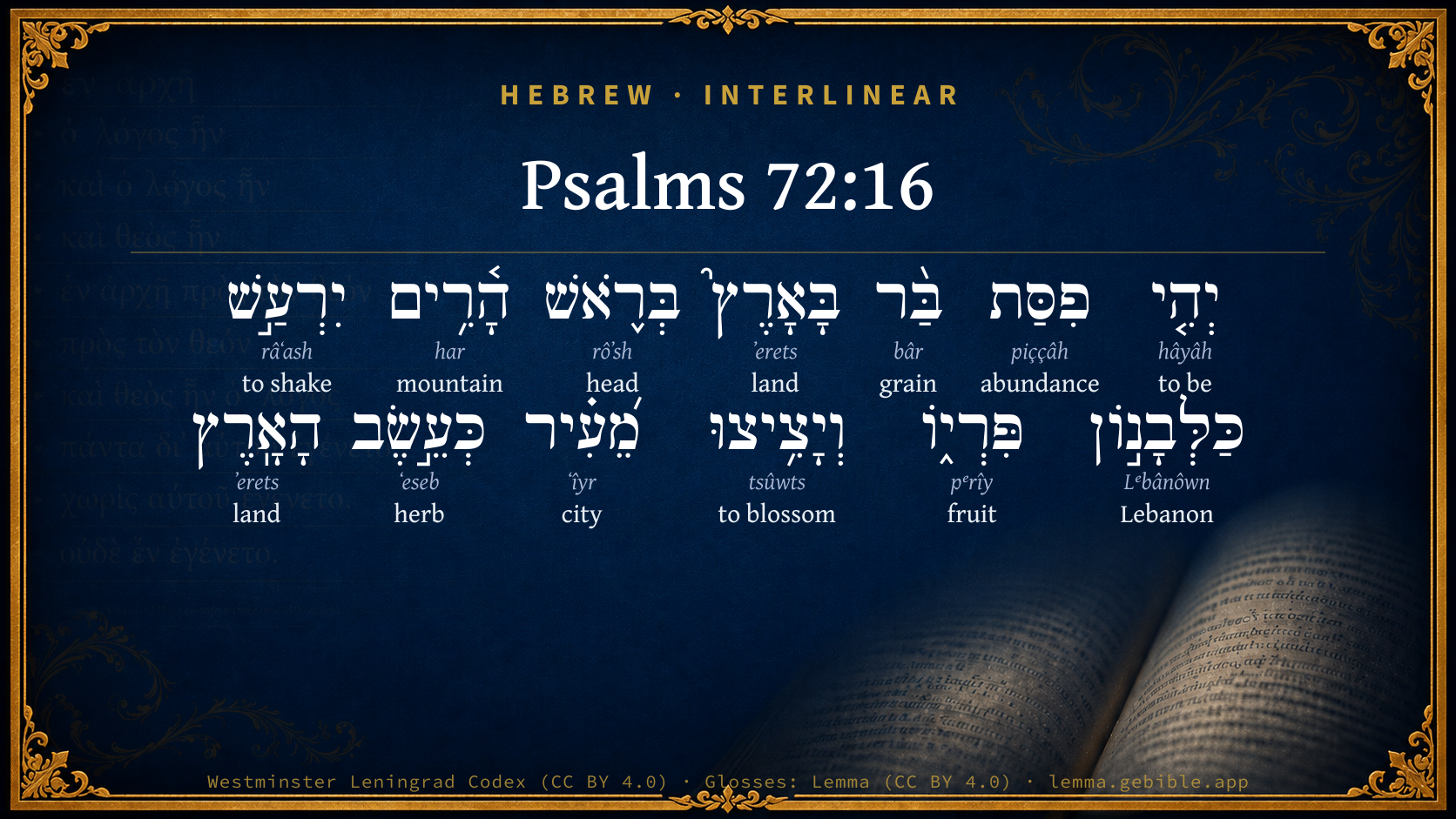
Hebrew (Westminster Leningrad Codex) Psalms 72:16 appears in the Hebrew Old Testament. The text above is from the Westminster Leningrad Codex. Each word links to its Strong’s number, a concise gloss, and parsing drawn from the Open Scriptures Hebrew Bible morphology. Click any word for its full Brown-Driver-Briggs (BDB) entry.
Download image
Cite this verse

Psalms 72:16 (World English Bible). Public Domain. Lemma interlinear Bible study tool, https://lemma.gebible.app/v/psalms/72/16.

Show BibTeX & RIS
BibTeX
RIS
English Translation
There shall be abundance of grain throughout the land. Its fruit sways like Lebanon. Let it flourish, thriving like the grass of the field.
World English Bible · Public Domain
Highlights
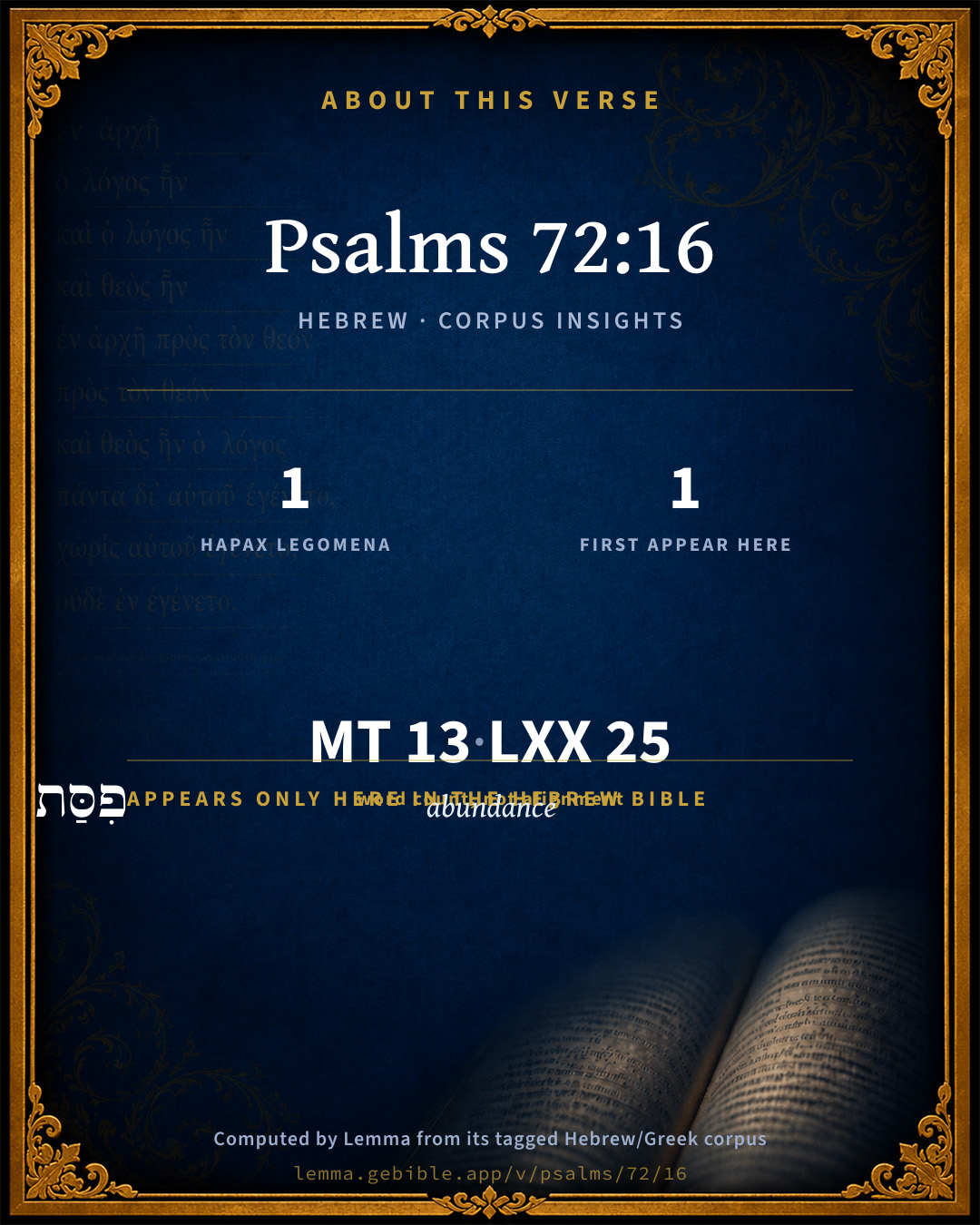
  • 1 hapax legomenon — only here in the Hebrew Bible
  • 1 first appearance in the Hebrew Bible
Full analysis ↓
Download a study sheet

One document with this verse’s original text, its word-by-word gloss line, the meaning frame, cross-references with their text, attributed commentary, and full source and license credits — printable, and it pastes into notes with its structure intact.

This verse Autodidact and up

Study sheet (.html) Plain text (.txt)

A passage Seminary Student

Up to 50 verses in one chapter. A passage sheet keeps up to 6 commentary sources and 12 cross-references per verse, in the order this page ranks them, and says so on the sheet whenever that leaves anything out. Ask for a single verse and you get the Autodidact verse sheet above.

Everything on this page stays free to read, with no account — the sheet is a download of what is already on screen, not access to it.

Want to remove ads? Support Godless Engineer
Compare translations 3

The same verse in 3 English versions, stacked beneath the original-language interlinear above. Click any original word for its lexicon entry.

Each is an independent rendering of the whole verse — the interlinear is not word-aligned to these translations.

Highlighted words mark where these versions differ — a whole-verse word diff, not a word-by-word alignment.

  • World English Bible Public Domain
    There shall be abundance of grain throughout the land. Its fruit sways like Lebanon. Let it flourish, thriving like the grass of the field.
  • King James Version Public Domain
    There shall be an handful of corn in the earth upon the top of the mountains; the fruit thereof shall shake like Lebanon: and they of the city shall flourish like grass of the earth.
  • unfoldingWord Literal Text CC BY-SA 4.0
    May there be an abundance of grain in the land; on the head of the mountains may its fruit sway like Lebanon, and may they flourish from the city like the grass of the earth.

unfoldingWord Literal Text — © unfoldingWord, licensed CC BY-SA 4.0. Word-aligned USFM3 via Door43 (git.door43.org/unfoldingWord/en_ult).

Versions to compare (up to 4)

3 of 4 selected

Show all 18 translations

Every available English version of this verse, each an independent rendering of the whole verse.

  • World English Bible Public Domain
    There shall be abundance of grain throughout the land. Its fruit sways like Lebanon. Let it flourish, thriving like the grass of the field.
  • Berean Standard Bible Public Domain
    May there be an abundance of grain in the land; may it sway atop the hills. May its fruit trees flourish like the forests of Lebanon, and its people like the grass of the field.
  • Majority Standard Bible Public Domain
    May there be an abundance of grain in the land; may it sway atop the hills. May its fruit trees flourish like the forests of Lebanon, the people of its cities like the grass of the field.
  • King James Version Public Domain
    There shall be an handful of corn in the earth upon the top of the mountains; the fruit thereof shall shake like Lebanon: and they of the city shall flourish like grass of the earth.
  • American Standard Version (1901) Public Domain
    There shall be abundance of grain in the earth upon the top of the mountains; The fruit thereof shall shake like Lebanon: And they of the city shall flourish like grass of the earth.
  • Revised Version (1885) Public Domain
    There shall be abundance of corn in the earth upon the top of the mountains; the fruit thereof shall shake like Lebanon: and they of the city shall flourish like grass of the earth.
  • Geneva Bible (1599) Public Domain
    An handfull of corne shall be sowen in the earth, euen in the toppe of the mountaines, and the fruite thereof shall shake like the trees of Lebanon: and the children shall florish out of the citie like the grasse of the earth.
  • Douay-Rheims (1899) Public Domain
    And there shall be a firmament on the earth on the tops of mountains, above Libanus shall the fruit thereof be exalted: and they of the city shall flourish like the grass of the earth.
  • Young's Literal Translation Public Domain
    There is a handful of corn in the earth, On the top of mountains, Shake like Lebanon doth its fruit, And they flourish out of the city as the herb of the earth.
  • Literal Standard Version CC BY-SA 4.0
    There is a handful of grain in the earth, || On the top of mountains, || Its fruit shakes like Lebanon, || And they flourish out of the city as the herb of the earth.
  • Unlocked Literal Bible CC BY-SA 4.0
    May there be abundance of grain in the land; on the mountaintops may their crops wave. May the fruit of it be like Lebanon; may the people flourish in the cities like the grass of the field.
  • unfoldingWord Literal Text CC BY-SA 4.0
    May there be an abundance of grain in the land; on the head of the mountains may its fruit sway like Lebanon, and may they flourish from the city like the grass of the earth.
  • Darby Bible Public Domain
    There shall be abundance of corn in the earth, upon the top of the mountains; the fruit thereof shall shake like Lebanon; and they of the city shall bloom like the herb of the earth.
  • World Messianic Bible Public Domain
    Abundance of grain shall be throughout the land. Its fruit sways like Lebanon. Let it flourish, thriving like the grass of the field.
  • Webster's Bible Public Domain
    There shall be a handful of corn in the earth upon the top of the mountains; the fruit of it shall shake like Lebanon: and they of the city shall flourish like grass of the earth.
  • Free Bible Version CC BY-SA 4.0
    May there be plenty of grain in the land, even growing on mountain-tops. May the fruit on the trees sway like the trees of Lebanon. May the people in the city flourish like grass in a field.
  • Bible in Basic English Public Domain
    May there be wide-stretching fields of grain in the land, shaking on the top of the mountains, full of fruit like Lebanon: may its stems be unnumbered like the grass of the earth.
  • JPS Tanakh (1917) Public Domain
    May he be as a rich cornfield in the land upon the top of the mountains; may his fruit rustle like Lebanon; and may they blossom out of the city like grass of the earth.

Literal Standard Version (2020), Covenant Press — licensed CC BY-SA 4.0. Text via the HelloAO Bible API (eBible.org). Unlocked Literal Bible (unfoldingWord) — licensed CC BY-SA 4.0. Text via the HelloAO Bible API (eBible.org). unfoldingWord Literal Text — © unfoldingWord, licensed CC BY-SA 4.0. Word-aligned USFM3 via Door43 (git.door43.org/unfoldingWord/en_ult). Free Bible Version, Dr. Jonathan Gallagher — licensed CC BY-SA 4.0. Text via the HelloAO Bible API (eBible.org).

Word by word

More ways to search: Search by grammar → Find every occurrence → Compare this word →

Practice this passage: Drill this verse → Learn its vocabulary →

פִסַּת
piççâh
H6451
“abundance of”
Noun, Common, Feminine, Singular, Construct
Part of Speech
Noun
Type
Common
Gender
Feminine
Number
Singular
State
Construct
Full BDB Definition

Origin: from H6461

TWOT: 1789b

abundance, fulness, plenty - meaning dubious
  1. יְהִ֤י hâyâh H1961 “to be” Verb, Qal, Jussive, 3rd Person, Masculine, Singular
  2. בַּ֨ר bâr H1250 “grain” Noun, Common, Masculine, Singular, Absolute
  3. בָּאָרֶץ֮ ʼerets H776 “in/at the · land” Preposition, Determined + Noun, Common, Both, Singular, Absolute
  4. בְּרֹ֪אשׁ rôʼsh H7218 “in/at · head of” Preposition + Noun, Common, Masculine, Singular, Construct
  5. הָ֫רִ֥ים har H2022 “mountains” Noun, Common, Masculine, Plural, Absolute
  6. יִרְעַ֣שׁ râʻash H7493 “to shake” Verb, Qal, Imperfect, 3rd Person, Masculine, Singular
  7. כַּלְּבָנ֣וֹן Lᵉbânôwn H3844 “like/as the · Lebanon” Preposition, Determined + Noun, Proper
  8. פִּרְי֑וֹ pᵉrîy H6529 “fruit · his” Noun, Common, Masculine, Singular, Construct + Suffix, Personal, 3rd Person, Masculine, Singular
  9. וְיָצִ֥יצוּ tsûwts H6692 “and · to blossom” Conjunction + Verb, Hiphil, Imperfect, 3rd Person, Masculine, Plural
  10. מֵ֝עִ֗יר ʻîyr H5892 “from · city” Preposition + Noun, Common, Feminine, Singular, Absolute
  11. כְּעֵ֣שֶׂב ʻeseb H6212 “like/as · herb of” Preposition + Noun, Common, Masculine, Singular, Construct
  12. הָאָֽרֶץ ʼerets H776 “the · land” Particle, Definite Article + Noun, Common, Both, Singular, Absolute

About this verse

These counts appear in no published source. They are computed here, from the morphology-tagged text and Lemma’s own curated glosses. What Lemma adds →

13
words
12
distinct lemmas
Wisdom
section

Notable vocabulary

1 hapax legomenon — a word that appears only here in the entire Hebrew Bible:

  • פִסַּת abundance H6451

First appearance in Scripture

This word makes its first canonical appearance in the Hebrew Bible here:

  • פִסַּת abundance H6451

Shared distinctive vocabulary

וְיָצִ֥יצוּ to blossom H6692 occurs in 9 verses of the Hebrew Bible. Also found in:

Grammatical profile

  • 3 verbs
  • 10 nouns

Verb forms

  • יְהִ֤י Qal · Jussive
  • יִרְעַ֣שׁ Qal · Imperfect
  • וְיָצִ֥יצוּ Hiphil · Imperfect

Repetition

A word recurs within this verse — often emphatic in Hebrew:

  • בָּאָרֶץ֮ land H776 ×2

Hebrew & Septuagint length

In English translation the verse runs 24 words from the Hebrew and 34 from the Septuagint (LXX English) — closely comparable.

A rough comparison of the two English renderings, which tokenize alike — not a word-level alignment.

Word counts can differ between the Hebrew and the Greek without any difference in meaning — e.g. the Hebrew direct-object marker אֵת has no separate Greek word, and Greek often adds the article ὁ.

In the original languages it is 13 Hebrew tokens and 25 Greek tokens — but the two are counted differently (Hebrew bundles its prefixes and suffixes into one token; the Greek is in lemma form), so that isn’t a like-for-like length.

Cross-references

23

Topical passages linked to Psalms 72:16 in the Treasury of Scripture Knowledge — connected by theme and wording, ordered by reader-vote popularity; previews shown in the World English Bible.

  • 1 Kings 4:20 Judah and Israel were many as the sand which is by the sea in multitude, eating and drinking and making merry.
  • Revelation 7:9 After these things I looked, and behold, a great multitude, which no man could number, out of every nation and of all tribes, peoples, and languages, standing before the throne and before the Lamb, dressed in white robes, with palm branches in their hands.
  • Job 5:25 You shall know also that your seed shall be great, Your offspring as the grass of the earth.
  • Job 8:7 Though your beginning was small, Yet your latter end would greatly increase.
  • Psalms 72:6 He will come down like rain on the mown grass, As showers that water the earth.
  • Psalms 92:12–14 The righteous shall flourish like the palm tree. He will grow like a cedar in Lebanon.
  • Psalms 104:16 Yahweh's trees are well watered, The cedars of Lebanon, which he has planted;
  • Isaiah 2:2–3 It shall happen in the latter days, that the mountain of Yahweh's house shall be established on the top of the mountains, And shall be raised above the hills; And all nations shall flow to it.
  • Isaiah 29:17 Is it not yet a very little while, and Lebanon shall be turned into a fruitful field, and the fruitful field shall be esteemed as a forest?
  • Isaiah 30:23 He will give the rain for your seed, with which you shall sow the ground; and bread of the increase of the ground, and it shall be fat and plenteous. In that day shall your cattle feed in large pastures;
  • Isaiah 32:15 until the Spirit be poured on us from on high, and the wilderness become a fruitful field, and the fruitful field be esteemed as a forest.
  • Isaiah 32:20 Blessed are you who sow beside all waters, who send forth the feet of the ox and the donkey.
  • Isaiah 35:2 It shall blossom abundantly, and rejoice even with joy and singing; the glory of Lebanon shall be given to it, the excellency of Carmel and Sharon: they shall see the glory of Yahweh, the excellency of our God.
  • Isaiah 44:3–5 For I will pour water on him who is thirsty, and streams on the dry ground; I will pour my Spirit on your seed, and my blessing on your offspring:
  • Jeremiah 33:22 As the host of the sky can't be numbered, neither the sand of the sea measured; so will I multiply the seed of David my servant, and the Levites who minister to me.
  • Hosea 14:5–7 I will be like the dew to Israel. He will blossom like the lily, And send down his roots like Lebanon.
  • Matthew 13:31–33 He set another parable before them, saying, "The Kingdom of Heaven is like a grain of mustard seed, which a man took, and sowed in his field;
  • Mark 16:15–16 He said to them, "Go into all the world, and preach the Gospel to the whole creation.
  • Acts 1:15 In these days, Peter stood up in the midst of the disciples (and the number of names was about one hundred twenty), and said,
  • Acts 2:41 Then those who gladly received his word were baptized. There were added that day about three thousand souls.
  • Acts 4:4 But many of those who heard the word believed, and the number of the men came to be about five thousand.
  • 1 Corinthians 3:6–9 I planted. Apollos watered. But God gave the increase.
  • Revelation 7:14 I told him, "My lord, you know." He said to me, "These are those who came out of the great tribulation. They washed their robes, and made them white in the Lamb's blood.

Cross-references courtesy of OpenBible.info (CC BY 4.0).

Hebrew and Greek witnesses Masoretic Hebrew ↔ Greek Septuagint

The same verse in the two great witnesses to the Old Testament, shown verse-for-verse.

You’re reading Greek Psalm 71 (Hebrew Psalm 72). The Septuagint counts the superscription, so verse numbers can differ from the Hebrew — chapter-level alignment, not verse-by-verse. Numbering follows Rahlfs.

These are two independent witnesses, not word-aligned to each other, and the Septuagint is shown in lemma (dictionary) form.

Hebrew Psalms 72:16 Masoretic · Westminster Leningrad Codex

יְהִ֤י פִסַּת בַּ֨ר בָּאָרֶץ֮ בְּרֹ֪אשׁ הָ֫רִ֥ים יִרְעַ֣שׁ כַּלְּבָנ֣וֹן פִּרְי֑וֹ וְיָצִ֥יצוּ מֵ֝עִ֗יר כְּעֵ֣שֶׂב הָאָֽרֶץ

There shall be abundance of grain throughout the land. Its fruit sways like Lebanon. Let it flourish, thriving like the grass of the field.

World English Bible · Public Domain

Greek LXX Greek Psalm 71:16 Septuagint · lemma form

εἰμί στήριγμα ἐν ὁ γῆ ἐπί ἄκρος ὁ ὄρος ὑπεραἴρω ὑπέρ ὁ λίβανος ὁ καρπός αὐτός καί ἐκ ἀντιἵημι ἐκ πόλις ὡσεί χόρτος ὁ γῆ

There shall be an establishment on the earth on the tops of the mountains: the fruit thereof shall be exalted above Libanus, and they of the city shall flourish as grass of the earth.

LXX2012 (modern English Septuagint) · Public Domain

On this verse, Ellicott's Commentary for English Readers discusses the Septuagint’s reading. Read the note in Commentary ↓

Hebrew: Westminster Leningrad Codex (CC BY 4.0). Greek: Septuagint (public domain); English from LXX2012 (modern English Septuagint) (Public Domain). How the Septuagint differs from the Hebrew →

Commentary

Notes on Psalms 72:16 from classic Christian and Jewish commentators (each source and its license shown beneath its notes). The classic Christian expositions comment on the surrounding passage and are grouped to its opening verse, so a note may address several verses; the Jewish commentaries on the Tanakh (Rashi and others) are per-verse, so they appear only where the commentator wrote on this verse.

Lemma curates 59 commentaries, every one of them public domain or Creative Commons licensed, each selected and text-cleaned for this edition rather than reprinted as found. About our sources →

Trapp's Complete Commentary

John Trapp

Psa 72:16 There shall be an handful of corn in the earth upon the top of the mountains; the fruit thereof shall shake like Lebanon: and [they] of the city shall flourish like grass of the earth.

Ver. 16. There shall be an handful of corn, &c.] i.e. The barren mountains shall yield grain abundantly, and by handfuls; as Egypt did in those seven years of plenty, Gen 41:47.

The fruit thereof shall shake like Lebanon] The grain shall rattle and rustle, like the trees in Lebanon, shaken by the wind.

And they of the city shall flourish] Men also shall increase and multiply, Jer 31:27, to a very great number, as piles of grass Christ’s subjects shall.

John Trapp, A Commentary or Exposition upon All the Books of the Old and New Testament (1647–1656) — public domain. Text from a community e-Sword module.

The Biblical Illustrator

Joseph S. Exell

Psa_72:16

There shall be an handful of corn in the earth upon the top of the mountains; the fruit thereof shall shake like Lebanon.

The life and power of the Gospel

I. Offer some expository remarks.

1. The handful of corn. This tells of the few disciples who at the first preached the Gospel. As Isaac was offered on Mount Moriah, so our Lord on the summit of the same mount was offered up. He was the seed corn.

2. The fruit. This all the result of our Lords death. And it shall be abundant like the forests of Lebanon.

3. They of the city. The apostles went forth from Jerusalem after they were endued with power.

II. The expressiveness of the simile--the corn of wheat.

1. It possesses a kind of immortality.

2. Life springs from its death.

3. Propagates its own likeness.

4. Has unlimited power of multiplication.

III. The import of the shaking here told of (Heb_12:25-29). The religious systems of the earth are doomed, and the political likewise. (J. A. Macdonald.)

Diffusion of the Gospel

I. The insignificance of the Gospel in its origin.

1. In its introduction into the world.

2. In its structure as a religious system.

3. In its operation in the heart.

II. The improbability of its success.

1. The agency was feeble.

2. The opposition Was powerful.

III. Its stupendous results.

1. The number of its followers.

2. Their influence on the world. (W. W. Wythe.)

The handful of corn or, the top of the mountains

In the kingdom of nature it is not seldom seen that the greatest results proceed from apparently the most insignificant beginnings. The oak, the pride and glory of the forest, grows from a small acorn. The mighty river, which gradually expands its bosom towards the sea, and incessantly pours into it the tribute of its many waters, springs from an insignificant rivulet. The philosopher, the orator, the hero, each enters life at first as a naked, helpless, weeping child. Now, concerning the Gospel, note--

I. Its insignificant commencement. A handful of corn, and that sown, of all places, on the top of the mountains. How this sets forth the unlikelihood of success according to all human judgment.

II. The glorious consummation the Gospel is destined to attain. This metaphorical representation conveys to us the idea of fertility; a fertility so great, that from a handful of corn, and that sown on the most barren spot, the top of a mountain, should issue a crop so strong and thick that it would shake and wave in the wind like the woods of Lebanon, while in the City of Zion the inhabitants would become numerous as the blades of grass in a field which the Lord hath blessed. It is thus beautifully intimated that in proportion to the smallness of its beginning shall be the greatness of the final increase of the Gospel. In various parts of Holy Writ we have abundant testimony to this fact. The metaphorical representation of the psalmist suggests also that the diffusion of the Gospel in the latter day will be characterized by great and extraordinary rapidity They of the city shall flourish like grass of the earth. Grass is, in Eastern countries, remarkably speedy in its growth; so will it be with the triumphs which the Gospel is destined universally to accomplish. This metaphorical announcement intimates further that the propagation of the Gospel shall be productive of happiness and joy to the world. The fruit thereof shall shake like Lebanon. Just such a change as, in the physical world, is made when the sterile mountain top is converted into the garden of the Lord, will be that which shall be made in the moral world by the agency of the Gospel, when it shall be felt in its legitimate power.

III. The manner in which it has already been fulfilled is fitted to strengthen our faith in the Divine origin of the Gospel.

IV. This prophecy furnishes us also with an encouragement to persevere in our exertions for the universal propagation of the Gospel. Although it may be with us a day of small things--although the means we employ may be feeble and small, and the obstacles we have to encounter be numerous and formidable, yet let us not give way to unbelieving doubts or fears. (Peter Grant.)

The blessed effects of sewing the Gospel seed

How precious is the Bible to men; it is the source of all our hope, the inspiration of all our work. In that we have--

I. A happy description of the gospel. It is a handful of corn.

1. For its excellency.

2. For its insignificance, in appearance, extent, instrumentality.

II. The places where it is to be sown: on the top of the mountains, the most barren and inaccessible places. There are many hearts like this, but there we are to sow the seed. And in the most populous places--the city. So did our Lord, and so should we. How great the need.

III. The blessed results which will follow.

1. Abundant fruitfulness.

2. Rapid growth--like grass.

3. A beauteous scene.

4. Ample recompense.

Conclusion.

1. Bless God if the seed of the Gospel has taken root in your heart.

2. How deeply guilty are they in whom no fruit is found.

3. Pity those who are without the Gospel seed. (J. Sherman.)

The handful of corn on the top of the mountains

1. Let us think of where the corn comes from. It does not come like anything else in the world. In the woods you may sometimes find a tree growing with a little round black fruit, hard and sour. It does not seem to be worth much by the side of the luscious plum from the garden. But that sloe, as it is called, is the plum in its wild state. The gardener takes it and cultivates it until it comes to be a larger and finer tree. So it is with the crab-tree and its little bitter fruit--that is, the wild apple. And so with the strawberry, and all the fruits and plants in our garden. They were found in a wild state, and they had to be cultivated before they were worth anything. But nobody ever found corn growing wild. Unlike everything else, corn is the special and peculiar gift of God, which He put into mans hand just as it is. And how like Jesus it is in this!

2. Corn will grow all over the world. And is not that like our blessed Jesus? No home but may have Him in it; no heart but Jesus will dwell there; no land under heaven but there men may find the Bread of Life.

3. Think again of what the corn is worth. A very little thing to talk about, this--a handful of corn! Corn is worth more than gold. Everybody wants bread. And so, all need Jesus.

4. Corn has life in it--yielding abundant increase. And so Jesus is like the handful of corn upon the top of the mountains: the prophet tells us that we esteemed Him not, and hid as it were our faces from Him; there was no appearance of greatness in Him, or of power. But in Him is life. He comes into our hearts, and we are made like Him, and from us others catch a grain of the good seed, and the life spreads from heart to heart and from soul to soul, until the whole earth shall be filled with His glory.

5. And yet though there is all this that is wonderful about the corn, let us remember that it is of no good except it be sown. A handful of corn is indeed a poor thing without that. They have found some mummies in Egypt thousands of years old, and in their hands they have found some tiny grains of corn. If they had been sown, by this time they would have grown into enough to feed the world. And so the glory of Jesus grows only when we have Jesus in our heart.

6. Before the corn does us any good, it dies. Think how much this is like Jesus. He lays down His life for us. He dies that we may live. He is beaten, and scourged, and broken, that we may have strength and everlasting life. (Mark Guy Pearse.)

The Biblical Illustrator, edited by Joseph S. Exell (c. 1880s–1900s) — public domain. Text from a community e-Sword module.

Joseph Benson's Commentary

Psa 72:16. There shall be a handful of corn — Which intimates the small beginnings of this kingdom, and therefore does not agree to that of Solomon, which was, in a manner, as large at the beginning of his reign as at the end of it; but it exactly agrees to Christ and his kingdom, Mat 13:31-33. In the earth — That is, sown in the earth. The seed is the word of God. That on good ground are they, who, in an honest and good heart, a heart made honest and good by grace, having heard the word, keep it, and bring forth fruit with patience, Luk 8:11, &c.; bring forth first the blade, then the ear, after that the full corn in the ear, Mar 4:26-28. Such, reader, is the progress of this handful of seed cast into the ground; though upon the top of the mountains — That is, in the most barren soil. It produces a number of converts, all born again of incorruptible seed by the word, 1Pe 1:23; and in each convert the fruit of genuine repentance, of living faith, and of true holiness. The fruit thereof shall shake like Lebanon — It shall yield such an abundant increase, that the ears, being thick and high, and full of corn, shall, when they are shaken by the wind, make a noise not unlike that which the tops of the trees of Lebanon sometimes make, upon the like occasion. Which expressions, as well as many others of the like nature, in the prophets, being applied to Christ and his kingdom, are to be understood in a spiritual sense, of the great and happy success of the preaching of the gospel. And they of the city — That is, the citizens of Jerusalem, which are here put for the subjects of this kingdom. Shall flourish like the grass of the earth — Shall both increase in number and in grace, being fruitful in every good word and work.

Joseph Benson's Commentary on the Old and New Testaments (1811–1818) — public domain. Text from a community e-Sword module.

J. A. Alexander on Psalms

Joseph Addison Alexander

Psa 72:16. Let there be (but) a handful of corn in the land, in the top of the mountains; its fruit shall wave (or shake) like Lebanon, and they shall flourish from the city like grass of the earth. The first noun in Hebrew occurs only here, and has been taken in senses directly opposite. The rabbinical tradition makes it mean a handful, the modern lexicographers a plenty, each relying on a doubtful etymology. According to the second explanation, the clause is a direct prediction of abundance, and should be translated, there shall be plenty of corn in the land. According to the other and more ancient view, the verse contains a beautiful antithesis between the small beginnings and the vast results of the Messiah's kingdom, not unlike that suggested by our Saviour's parable of the grain of mustard seed. This exegetical analogy, together with the striking character imparted to the verse by this interpretation, are sufficient to entitle it to the preference, even without regard to its antiquity and traditional authority. The apocopated future may then be taken in its proper sense, as a concession or a wish, equivalent to saying, though there be but a handful of corn in the land, and that in the least favourable situation, on the top of a mountain, which though cultivated (see above, on Psa 72:3, must of course be colder and less fertile than the plains below. Neither wave nor shake conveys the full force of the Hebrew verb, which suggests the additional idea of a rushing noise, like that of the wind among the cedars of Lebanon. This comparison is certainly more natural and obvious than that which some interpreters assume with the grain-crops or harvest-fields of Lebanon itself. This would be merely likening one harvest to another, nor is any such allusion ever made elsewhere to the mountain, though its circumjacent plains and valleys were productive. See Hos 14:5-7. The word translated flourish means originally to shine or glitter (Psa 132:18), but is specially applied to the brilliancy of vegetation, and might therefore be translated bloom or blossom. See Num 17:8, and compare Psa 90:6; Psa 92:7; Psa 103:15. From the city seems to mean from Jerusalem or Zion, as the centre of Messiah's kingdom and his royal residence, out of which this productive influence was to go forth. Compare the form of expression in this clause with Num 24:19, Job 5:25.

Joseph Addison Alexander, The Psalms Translated and Explained (1850) — public domain. Text from a community e-Sword module.

Tyndale Open Study Notes

Tyndale Open Resources

72:16 the trees of Lebanon: Lebanon was renowned for its lumber (see study note on 2 Chr 2:8).

Tyndale Open Study Notes — © Tyndale Open Resources, licensed CC BY-SA 4.0. Text via the HelloAO Bible API.

Geneva Bible (1599)

Geneva Bible translators

Under such a king shall be most great plenty, both of fruit and also of the increase of mankind.

Geneva Bible (1599) marginal notes — public domain. Text via Bolls.life.

Adam Clarke's Commentary

Verse 16. There shall be a handful of corn] The earth shall be exceedingly fruitful. Even a handful of corn sown on the top of a mountain shall grow up strong and vigorous; and it shall be, in reference to crops in other times, as the cedars of Lebanon are to common trees or shrubs: and as the earth will bring forth in handfuls, so the people shall be multiplied who are to consume this great produce.

And they of the city shall flourish like grass of the earth.] There have been many puzzling criticisms concerning this verse. What I have given I believe to be the sense.

Adam Clarke's Commentary on the Bible (1810–1826) — public domain. Text from a community e-Sword/MySword module.

John Calvin's Commentaries

16. A handful of corn shall be in the earth upon the top of the mountains. The opinion of those who take a handful for a small portion appears to be well founded. They think that by the two circumstances here referred to, a rare and uncommon fertility is indicated. Only a very small quantity of wheat, not even more than a man can hold in the palm of his hand, has been sown, and that even upon the tops of the mountains, which generally are far from being fruitful; and yet so very abundant will be the increase, that the ears will wave and rustle in the winds as the trees on Lebanon. I do not, however, know whether so refined a comparison between seed-time and harvest is at all intended by David. His words may be considered more simply as denoting that so great will be the fertility, so abundant the produce of wheat which the mountain tops shall yield, that it may be reaped with full hand. By this figure is portrayed the large abundance of all good things which, through the blessing of God, would be enjoyed under the reign of Christ. To this is added the increase of children. Not only would the earth produce an abundance all kinds of fruits, but the cities and towns also would be fruitful in the production of men: And they shall go out from the city as the grass of the earth I have preferred translating the word Lebanon in the genitive case instead of the nominative; for the metonomy of putting the name of the mountain, Lebanon, for the trees upon it, which is renounced by others, is somewhat harsh.

John Calvin's Commentaries (1540-1563) — public domain. Text from the Calvin Translation Society English edition (1840s-50s) via the Christian Classics Ethereal Library (ccel.org). Calvin's coverage is partial (roughly two-thirds of the Bible); uncommented books and verses are honest gaps, never fabricated. The 19th-century editor's footnotes and remarks are omitted so the notes are faithfully Calvin's own voice.

Ellicott's Commentary for English Readers

(16) An handful.—Rather, abundance, from a root meaning spread. The clauses, as arranged in the text, evidently miss the intention of the writer. Render,

“Let there be abundance of corn on the earth;

On the top of the mountains let it wave like Libanus,”

i.e., like the cedars of Libanus. The word rendered “wave” elsewhere is used of “earthquakes” or “violent storm,” and suggests here rather a violent agitation than the quiet waving of a sunny cornfield, as if the very mountains were under cultivation, and their crowning woods that sway to and fro in the breeze were suddenly changed to grain. (Comp. Psa_92:13.) The images suggested by the LXX. and Vulg., of the corn in the lowlands growing high enough to overtop Lebanon, is grotesque.

And they of the city . . .—Better, and let them (men) spring forth from the city like grass from the earth. (As images of large population, comp. Psa_92:7; Job_5:25.) But probably we ought to transpose a letter and read, “and let cities spring up like grass from the earth.”

A Bible Commentary for English Readers, edited by Charles John Ellicott (1878–1897) — public domain. Text from a community e-Sword module.

The Cambridge Bible for Schools and Colleges

gen. ed. J. J. S. Perowne

16. May there be abundance of corn in the land upon the top of the mountains:

May the fruit thereof rustle like Lebanon;

And may men flourish out of the city like grass of the earth.

A prayer for the fertility of the land, and the prosperity of the people. The poet would see the cornfields stretching up to the very top of the hills, and hear the wind rustling through the ears of corn as through the cedars of Lebanon, a name in itself full of associations of beauty and fertility (Hos_14:5 ff.). It is doubtful whether the verb means to wave, as A.V. shake, or to rustle. Grass is emblematic of freshness, beauty, abundant and vigorous growth. Cp. Job_5:25; Isa_27:6. The increase of the population was a marked feature of Solomon’s reign (1Ki_4:20), and is a common characteristic in the pictures of the Messianic age (Isa_49:20 ff.).

The Cambridge Bible for Schools and Colleges (gen. ed. J. J. S. Perowne; Cambridge University Press, 1878–1918) — public domain. Text from a community e-Sword module.

John Gill's Exposition

There shall be an handful of corn,.... By which are not meant the people of Christ, compared to corn, or wheat, in distinction from hypocrites, said to be as chaff, Mat 2:12; who are but few, yet fruitful and flourishing; nor the Gospel, so called in opposition to the chaff of false doctrine, Jer 23:28; nor the blessings of grace, signified by corn, wine, and oil, Jer 31:12; but Christ, who compares himself to a corn of wheat, Joh 12:24; for its choiceness and purity, and for its usefulness for food; and he may be compared to an handful of it, because of the little account he was made of here on earth, and the little that was expected from him; and on account of the small beginnings of his kingdom, which came not with observation, was like a little stone cut out of the mountain without hands, and like a grain of mustard seed: so R. Obadiah Gaon (m) interprets these words,

"an handful of corn; that is, the Messiah shall be at first as an handful of corn; but afterwards a multitude of disciples shall grow as the grass;''

in the earth; that is, sown in the earth: this denotes not Christ's being on the earth in the days of his flesh; but his death and burial, his descending into the lower parts of the earth, where he continued a while to answer the type of Jonah; and which is represented by a corn of wheat falling into the earth and dying, Joh 12:24; by which is signified, that Christ's death was not accidental, but designed, as is the sowing of corn in the earth; and that it was voluntary, and not forced, and was but for a time: for as the corn dies, and lives again, and does not lie always under the clods; so Christ rose again; nor could he be held with the cords of death. It is added,

upon the top of the mountains; where corn being sown, it is very unlikely it should come to anything; and as little was expected by the Jews from the crucifixion and death of Christ: or else this may denote the publicness of Christ's death, it being a fact known to all the inhabitants of Jerusalem, and many others;

the fruit thereof shall shake like Lebanon; meaning either a large number of souls converted, the fruit of Christ's death, and of the Gospel ministry; of whom there was a large harvests, both in Judea and in the Gentile world, in the first times of the Gospel, immediately after Christ's death and resurrection; and there will be still a greater in the latter day: or else the blessings of grace are meant, which come by the death and resurrection of Christ; as righteousness, peace, pardon, and eternal life. The allusion is to a field of wheat when ripe, and its ears heavy, which, when the wind blows upon it, is shaken, rustles, and makes a noise (n), like the shaking of trees, and even of the cedars in Lebanon; it denotes the goodness and excellency or the fruit;

and they of the city shall flourish like grass of the earth; or "they shall flourish out of the city" (o); which the Targum interprets of the city of Jerusalem; and so the Talmud (p), and also Jarchi; and was literally true; for the Gospel, after Christ's death, was first preached in the city of Jerusalem, and was blessed for the conversion of many there, who were fruitful in grace and good works: it may very well be understood of all the citizens of Sion; such who are fellow citizens with the saints, and of the household of God, who being planted in the house of the Lord, flourish in the court of our God, and become very fruitful in every good word and work; and flourish like grass of the earth for numbers, for quickness of growth, and for verdure and beauty; all which is owing to their being rooted in Christ, to his coming down upon them as rain, Psa 72:6; to the dews of his grace, and to his arising upon them as the sun of righteousness. The ancient Jews interpreted this passage of the Messiah:

"as the first Redeemer, they say (q), caused manna to descend, as it is said, Exo 16:4; so the latter Redeemer shall cause manna to descend, as it is said, "there shall be an handful of corn in the earth".''

Jarchi says our Rabbins interpret this of the dainties in the days of the Messiah, and the whole psalm concerning the King Messiah.

(m) In Viccars. in loc. (n) "Corpus ut impulsae segetes aquilonibus horret", Ovid. Epist. 10. v. 139. (o) "de civilate", V. L. Musculus, Gejerus; so Montanus, Tigurine version, Cocceius, Michaelis. (p) T. Bab. Cetubot, fol. 111. 2. (q) Midrash Kohelet, fol. 63. 2.

John Gill's Exposition of the Whole Bible (1746–1763) — public domain (CC PDM 1.0). Text via the HelloAO Bible API.

Albert Barnes' Notes on the Bible

There shall be an handful of corn - “Of grain,” for so the word means in the Scriptures. The “general” idea in this verse is plain. It is, that, in the time of the Messiah, there would be an ample supply of the fruits of the earth; or that his reign would tend to the promotion of prosperity, industry, abundance. It would be as if fields of grain waved everywhere, even on the tops of mountains, or as if the hills were cultivated to the very summit, so that the whole land would be covered over with waving, smiling harvests. There is a difference of opinion, however, and consequently of interpretation, as to the meaning of the word rendered “handful.” This word - פסה pissâh - occurs nowhere else, and it is impossible, therefore, to determine its exact meaning. By some it is rendered “handful;” by others, “abundance.” The former interpretation is adopted by Prof. Alexander, and is found in the older interpreters generally; the latter is the opinion of Gesenius, DeWette, and most modern expositors.

It is also the interpretation in the Syriac. The Vulgate and the Septuagint render it “strength” - meaning something “firm” or “secure,” “firmamentum,” στήριγμα stērigma. According to the explanation which regards the word as meaning “handful,” the idea is, that there would be a great contrast between the small beginnings of the Messiah’s reign and its ultimate triumph - as if a mere handful of grain were sown on the top of a mountain - on a place little likely to produce anything - a place usually barren and unproductive - which would grow into an abundant harvest, so that it would wave everywhere like the cedar trees of Lebanon. According to the other interpretation, the idea is simply that there would be an “abundance” in the land. The whole land would be cultivated, even to the tops of the hills, and the evidences of plenty would be seen everywhere. It is impossible to determine which of these is the correct idea; but both agree in that which is essential - that the reign of the Messiah would be one of peace and plenty. The former interpretation is the most poetic, and the most beautiful. It accords, also, with other representations - as in the parable of the grain of mustard-seed, and the parable of the leaven; and it accords, also, with the fact that the beginning of the Gospel was small in comparison with what would be the ultimate result. This would seem to render that interpretation the most probable.

In the earth - In the land; the land of Canaan; the place where the kingdom of the Messiah would be set up.

Upon the top of the mountains - In places “like” the tops of mountains. The mountains and hills were seldom cultivated to the tops. Yet here the idea is, that the state of things under the Messiah would be as if a handful of grain were sown in the place most unlikely to produce a harvest, or which no one thought of cultivating. No one needs to be told how well this would represent the cold and barren human heart in general; or the state of the Jewish world in respect to true religion, at the time when the Saviour appeared.

The fruit thereof - That which would spring up from the mere handful of grain thus sown.

Shall shake like Lebanon - Like the cedar trees of Lebanon. The harvest will wave as those tall and stately trees do. This is an image designed to show that the growth would be strong and abundant, far beyond what could have been anticipated from the small quantity of the seed sown, and the barrenness of the soil. The word rendered “shake” means more than is implied in our word “shake” or “wave.” It conveys also the idea of a rushing sound, such as that which whistles among cedar or pine trees. “The origin of the Hebrew verb,” says Gesenius, “and its primary idea lies in the “noise” and “crashing” which is made by concussion.” Hence, it is used to denote the “rustling” motion of grain waving in the wind, and the sound of the wind whistling through trees when they are agitated by it.

And they of the city - Most interpreters suppose that this refers to Jerusalem, as the center of the Messiah’s kingdom. It seems more probable, however, that it is not designed to refer to Jerusalem, or to any particular city, but to stand in contrast with the top of the mountain. Cities and hills would alike flourish; there would be prosperity everywhere - in barren and unpopulated wastes, and in places where people had been congregated together. The “figure” is changed, as is not uncommon, but the “idea” is retained. The indications of prosperity would be apparent everywhere.

Shall flourish like grass of the earth - As grass springs out of the ground, producing the idea of beauty and plenty. See the notes at Isa 44:3-4.

Albert Barnes' Notes on the Bible (1834–1885) — public domain. Text from a community e-Sword/MySword module.

Matthew Poole's English Annotations

An handful of corn; which intimates the small beginnings of this kingdom; and therefore doth not agree to Solomon, whose kingdom was in a manner as large at the beginning of his reign ms at the end; but it exactly agrees to Christ and his kingdom, Mat 13:31,32.

In the earth; sown in the earth.

Upon the top of the mountains; in the most barren grounds; and therefore this was an evidence of extraordinary and prodigious fertility.

Shake like Lebanon; it shall yield such abundance of corn, that the ears, being thick, and high, and full of corn, shall, when they are shaken with the wind, make a noise not unlike that which the tops of the trees of Lebanon sometimes make upon the like occasion; which expressions, as well as many others of the like nature in the prophets, being applied to Christ, are to be understood in a spiritual sense, of the great and happy success of the preaching of the gospel.

They of the city; the citizens of Jerusalem, which are here synecdochically put for the subjects of this kingdom.

Shall flourish like grass of the earth; shall both increase in number, that there may be mouths to receive the meat provided, and enjoy great prosperity and happiness.

Matthew Poole's English Annotations on the Holy Bible (1683–1685) — public domain. Text from a community e-Sword/MySword module.

The Treasury of David

Charles H. Spurgeon

Ver. 16. There shall be an handful of corn in the earth upon the top of the mountains. From small beginnings great results shall spring. A mere handful in a place naturally ungenial shall produce a matchless harvest. What a blessing that there is a handful; "except the Lord of hosts had left unto us a very small remnant we should have been as Sodom, and we should have been like unto Gomorrah:" but now the faithful are a living seed, and shall multiply in the land.

The fruit thereof shall shake like Lebanon. The harvest shall be so great that the wind shall rustle through it, and sound like the cedars upon Lebanon: --

"Like Lebanon, by soft win

Charles H. Spurgeon's The Treasury of David (1869–1885) — public domain. Psalms only. Text from a community e-Sword/MySword module.

Whedon's Commentary on the Bible

Daniel D. Whedon

16. There shall be a handful of corn—Hebrew, There shall be a diffusion, or superabundance, of corn, etc., deriving פסה, translated handful, from פסס, to diffuse, (as Gesenius, Furst,) which is more in accordance with the connexion.

Upon the top of the mountains—Dr. Moll translates, Even to the top of the mountains, as if the allusion were to the terracing, which should extend to the summit. The mountains of Palestine were terraced for more perfect tillage, and, viewed from the summit, they presented an almost unbroken forest of grain fields and vineyards. The “mountains” are here specified, instead of the plains, perhaps either because the Israelites were forced to occupy chiefly the mountainous districts, being unable to expel the inhabitants of the great plains, who fought with war-chariots, (see Jos_17:16; Jdg_1:19; Jdg_1:34,) or, because the mountains were of more difficult tillage, and more exposed to the depredations of wild beasts and the casualties of the season, especially the want of moisture. But even here should be plenty and thrift under the vigorous reign of this theocratic king.

The fruit thereof shall shake like Lebanon—Shall wave in the wind like the cedars of Lebanon.

They of the city shall flourish—The population shall spring up as grass. Thus the two great elements of national strength, a flourishing population and bountiful subsistence, should be realized. See Psa_72:3. But this external prosperity would spring from the righteousness of the people responsive to that of the government.

Daniel D. Whedon (gen. ed.), Commentary on the Old and New Testaments (1874–1909) — public domain. Text from a community e-Sword module.

The Pulpit Commentary

There shall be a handful of corn in the earth; rather, as in the Prayer book Version, a heap of corn; or, abundance of corn (Revised Version), "Abundance of corn" is put for general prosperity. Upon the top of the mountains. In flourishing times of agriculture, the very tops of the mountains were cultivated all over Palestine, as appears by the remains of terraces. The fruit thereof shall shake like Lebanon. Canon Cook"s seems to be the best exposition: "The ripened corn on the heights shall rustle in the wind like the foliage on Lebanon." And they of the city shall flourish like grass of the earth. "They of the city" are the inhabitants of the "New Jerusalem", (Rev_21:2) the citizens of Messiah"s kingdom.

The Pulpit Commentary (1880–1919), ed. H.D.M. Spence-Jones & Joseph S. Exell — public domain. Text from a community e-Sword module.

John Wesley's Explanatory Notes

A handful - This intimates the small beginnings of his kingdom; and therefore does not agree to Solomon, whose kingdom was in a manner as large at the beginning of his reign, as at the end, but it exactly agrees to Christ. The earth - Sown in the earth. Mountains - In the most barren grounds. Shake - It shall yield such abundance of corn, that the ears being thick and high, shall, when they are shaken with the wind, make a noise not unlike that which the tops of the trees of Lebanon, sometimes make. Of the city - The citizens of Jerusalem, which are here put for the subjects of this kingdom.

John Wesley, Explanatory Notes Upon the Whole Bible (1754–1765) — public domain. Text via the GEBible commentary corpus.

Keil & Delitzsch

C. F. Keil & F. Delitzsch

Here, where the futures again stand at the head of the clauses, they are also again to be understood as optatives. As the blessing of such a dominion after God's heart, not merely fertility but extraordinary fruitfulness may be confidently desired for the land פּסּה (ἁπ. λεγ..), rendered by the Syriac version sugo, abundance, is correctly derived by the Jewish lexicographers from פּסס = פּשׂה (in the law relating to leprosy), Mishnic פּסה, Aramaic פּסא, Arabic fšâ, but also fšš (vid., Job, at Psa 35:14-16), to extend, expandere; so that it signifies an abundance that occupies a broad space. בּראשׁ, unto the summit, as in Psa 36:6; Psa 19:5. The idea thus obtained is the same as when Hofmann (Weissagung und Erf׬llung, i. 180f.) takes פסּה (from פּסס = אפס) in the signification of a boundary line: "close upon the summit of the mountain shall the last corn stand," with reference to the terrace-like structure of the heights. פּריו does not refer back to בארץ (Hitzig, who misleads one by referring to Joe 2:3), but to בּר: may the corn stand so high and thick that the fields, being moved by the wind, shall shake, i.e., wave up and down, like the lofty thick forest of Lebanon. The lxx, which renders huperarthee'setai, takes ירעשׁ for יראשׁ, as Ewald does: may its fruit rise to a summit, i.e., rise high, like Lebanon. But a verb ראשׁ is unknown; and how bombastic is this figure in comparison with that grand, but beautiful figure, which we would not willingly exchange even for the conjecture יעשׁר (may it be rich)! The other wish refers to a rapid, joyful increase of the population: may men blossom out of this city and out of that city as the herb of the earth (cf. Job 5:25, where צאצאיך also accords in sound with יציצוּ), i.e., fresh, beautiful, and abundant as it. Israel actually became under Solomon's sceptre as numerous "as the sand by the sea" (Kg1 4:20), but increase of population is also a settled feature in the picture of the Messianic time (Psa 110:3, Isa 9:2; Isa 49:20, Zac 2:8 [4]; cf. Sir. 44:21). If, however, under the just and benign rule of the king, both land and people are thus blessed, eternal duration may be desired for his name. May this name, is the wish of the poet, ever send forth new shoots (ינין Chethib), or receive new shoots (ינּון Ker, from Niph. ננון), as long as the sun turns its face towards us, inasmuch as the happy and blessed results of the dominion of the king ever afford new occasion for glorifying his name. May they bless themselves in him, may all nations call him blessed, and that, as ויתבּרכוּ בו

(Note: Pronounce wejithbārchu, because the tone rests on the first letter of the root; whereas in Psa 72:15 it is jebārachenu with Chateph. vid., the rule in the Luther. Zeitschrift, 1863, S. 412.)

implies, so blessed that his abundance of blessing appears to them to be the highest that they can desire for themselves. To et benedicant sibi in eo we have to supply in thought the most universal, as yet undefined subject, which is then more exactly defined as omnes gentes with the second synonymous predicate. The accentuation (Athnach, Mugrash, Silluk) is blameless.

Keil & Delitzsch — Biblical Commentary on the Old Testament (1861–1891) — public domain (CC PDM 1.0). Text via the HelloAO Bible API. (Old Testament only.)

Rashi

Rabbi Shlomo Yitzchaki (Rashi)

May there be an abundance of grain Heb. פסת, an expression of spreading (פסיון), increase and abundance. Our Sages, however, explained this as an expression of loaves of white bread during the messianic era (Keth. 111b, Shab. 30b), and the entire psalm as referring to the messianic era. Another explanation: פִּסַת is an expression of good will, like פִּיוּס, placating; the people are appeased and accepted by the Holy One, blessed be He, when He gives plenty in the world.

may its fruit rustle like Lebanon May the wheat kernels be as thick as the kidneys of a large ox, as happened in the days of Shimon ben Shatach.

and they will blossom forth Israel.

from the city From the midst of Jerusalem like the grass of the earth.

Rashi on the Tanakh — English translations: “The Judaica Press complete Tanach with Rashi, translated by A. J. Rosenberg” (CC BY 4.0); “Pentateuch with Rashi's commentary by M. Rosenbaum and A.M. Silbermann, 1929-1934” (public domain); “The Metsudah Tanach series, Lakewood, N.J” (CC BY 4.0); and “The Book of Joshua, Metsudah Publications, 1997” (CC BY 4.0). Text via Sefaria.

Lesson kit

Teaching starters — assembled from the data on this page, not authored interpretation. Every prompt links to the verse data it draws on. Edit before teaching.

Psalms, in the Wisdom, opens this verse with 13 words (12 distinct Hebrew lemmas). Its most distinctive word is piççâh (“abundance”). A historical commentator’s framing appears above. Read the whole chapter for the surrounding context.

Discussion questions

  1. What does “abundance” (piççâh) contribute to the verse as a whole?
  2. This verse holds 1 word here found nowhere else in the Hebrew Bible. What might the rare word draw attention to?
  3. The word “abundance” first appears here in Scripture. What is being introduced at this debut?
  4. Numbers 17:8 shares the word «to blossom» with this verse. How do the two illuminate each other?
  5. “land” occurs 2× in this one verse. What is the effect of the repetition?
  6. These translations render this verse differently. What is at stake in choosing one wording over another?
  7. The verb «יְהִ֤י» is Qal Jussive. How does its form color the action?
  8. Reading how Trapp's Complete Commentary and The Biblical Illustrator read this verse, where do the two commentators agree and where do they part?

Things to notice

  • 1 word in this verse appears nowhere else in the Hebrew Bible.
  • 1 word makes its first canonical appearance in Scripture here.
  • This verse counts 13 Hebrew ↔ 25 Greek words.
  • These translations choose different wording for 21 words in this verse.
  • “land” occurs 2× in this single verse.

Reading settings

Reading text

Shown beneath each verse's original-language words.

Old Testament
Old Testament edition

Read the OT as the Masoretic Hebrew (MT) or the Greek Septuagint (LXX).

English shown for the Greek Septuagint (in the Hebrew ↔ Greek comparison).

Comparing translations? Open the Compare panel on any verse page to stack up to four side by side.