
Jeremiah 29:28

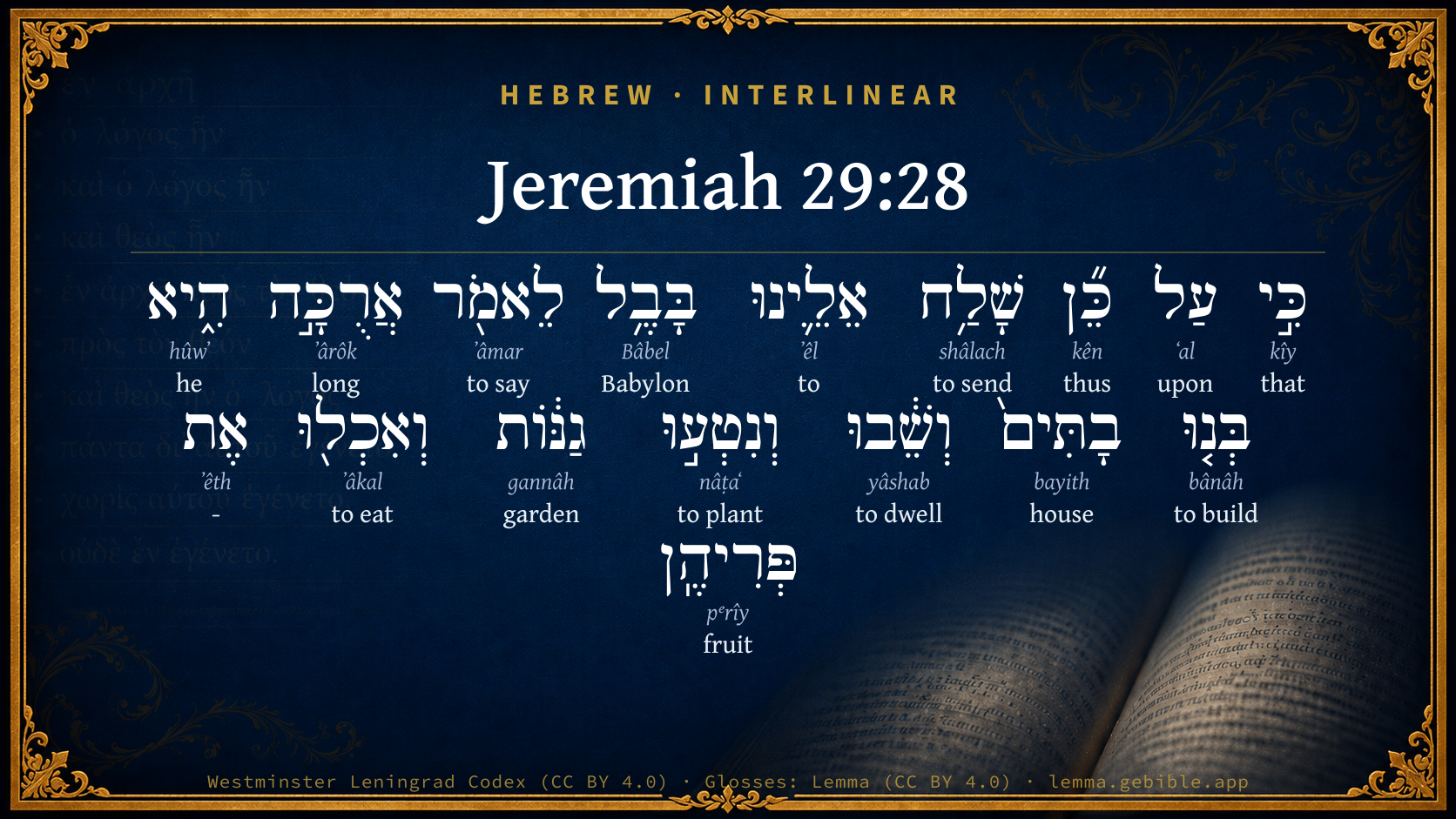
Hebrew (Westminster Leningrad Codex) Jeremiah 29:28 appears in the Hebrew Old Testament. The text above is from the Westminster Leningrad Codex. Each word links to its Strong’s number, a concise gloss, and parsing drawn from the Open Scriptures Hebrew Bible morphology. Click any word for its full Brown-Driver-Briggs (BDB) entry.
Download image
Cite this verse

Jeremiah 29:28 (World English Bible). Public Domain. Lemma interlinear Bible study tool, https://lemma.gebible.app/v/jeremiah/29/28.

Show BibTeX & RIS
BibTeX
RIS
English Translation
because he has sent to us in Babylon, saying, [The captivity] is long: build you houses, and dwell in them; and plant gardens, and eat the fruit of them?
World English Bible · Public Domain
Download a study sheet

One document with this verse’s original text, its word-by-word gloss line, the meaning frame, cross-references with their text, attributed commentary, and full source and license credits — printable, and it pastes into notes with its structure intact.

This verse Autodidact and up

Study sheet (.html) Plain text (.txt)

A passage Seminary Student

Up to 50 verses in one chapter. A passage sheet keeps up to 6 commentary sources and 12 cross-references per verse, in the order this page ranks them, and says so on the sheet whenever that leaves anything out. Ask for a single verse and you get the Autodidact verse sheet above.

Everything on this page stays free to read, with no account — the sheet is a download of what is already on screen, not access to it.

Want to remove ads? Support Godless Engineer
Compare translations 3

The same verse in 3 English versions, stacked beneath the original-language interlinear above. Click any original word for its lexicon entry.

Each is an independent rendering of the whole verse — the interlinear is not word-aligned to these translations.

Highlighted words mark where these versions differ — a whole-verse word diff, not a word-by-word alignment.

  • World English Bible Public Domain
    because he has sent to us in Babylon, saying, [The captivity] is long: build you houses, and dwell in them; and plant gardens, and eat the fruit of them?
  • King James Version Public Domain
    For therefore he sent unto us in Babylon, saying, This captivity is long: build ye houses, and dwell in them; and plant gardens, and eat the fruit of them.
  • unfoldingWord Literal Text CC BY-SA 4.0
    For he has sent to us in Babylon and said, ‘It will be a long time. Build houses and live in them, and plant gardens and eat their fruit.”’”

unfoldingWord Literal Text — © unfoldingWord, licensed CC BY-SA 4.0. Word-aligned USFM3 via Door43 (git.door43.org/unfoldingWord/en_ult).

Versions to compare (up to 4)

3 of 4 selected

Show all 18 translations

Every available English version of this verse, each an independent rendering of the whole verse.

  • World English Bible Public Domain
    because he has sent to us in Babylon, saying, [The captivity] is long: build you houses, and dwell in them; and plant gardens, and eat the fruit of them?
  • Berean Standard Bible Public Domain
    For he has sent to us in Babylon, claiming: Since the exile will be lengthy, build houses and settle down; plant gardens and eat their produce.’”
  • Majority Standard Bible Public Domain
    For he has sent to us in Babylon, claiming: Since the exile will be lengthy, build houses and settle down; plant gardens and eat their produce.’”
  • King James Version Public Domain
    For therefore he sent unto us in Babylon, saying, This captivity is long: build ye houses, and dwell in them; and plant gardens, and eat the fruit of them.
  • American Standard Version (1901) Public Domain
    forasmuch as he hath sent unto us in Babylon, saying, `The captivity' is long: build ye houses, and dwell in them; and plant gardens, and eat the fruit of them?
  • Revised Version (1885) Public Domain
    forasmuch as he hath sent unto us in Babylon, saying, The captivity is long: build ye houses, and dwell in them; and plant gardens, and eat the fruit of them?
  • Geneva Bible (1599) Public Domain
    For, for this cause hee sent vnto vs in Babel, saying, This captiuitie is long: buyld houses to dwell in, and plant gardens, and eate the fruites of them.
  • Douay-Rheims (1899) Public Domain
    For he hath also sent to us in Babylon, saying: It is a long time: build ye houses, and dwell in them: and plant gardens, and eat the fruits of them.
  • Young's Literal Translation Public Domain
    Because that he hath sent unto us to Babylon, saying, It `is' long, build ye houses, and abide; and plant ye gardens, and eat their fruit.'
  • Literal Standard Version CC BY-SA 4.0
    Because that he has sent to us [in] Babylon, saying, It [is] long, build houses and abide; and plant gardens and eat their fruit.”
  • Unlocked Literal Bible CC BY-SA 4.0
    For he has sent to us in Babylon and said, 'It will be a long time. Build houses and live in them, and plant gardens and eat their fruit.”'”
  • unfoldingWord Literal Text CC BY-SA 4.0
    For he has sent to us in Babylon and said, ‘It will be a long time. Build houses and live in them, and plant gardens and eat their fruit.”’”
  • Darby Bible Public Domain
    Forasmuch as he hath sent unto us in Babylon, saying, It will be long; build houses, and dwell [in them], and plant gardens, and eat the fruit of them.
  • World Messianic Bible Public Domain
    because he has sent to us in Babylon, saying, The captivity is long. Build houses, and dwell in them. Plant gardens, and eat their fruit?”’”
  • Webster's Bible Public Domain
    For therefore he sent to us in Babylon, saying, This captivity is long: build ye houses, and dwell in them; and plant gardens, and eat the fruit of them.
  • Free Bible Version CC BY-SA 4.0
    You should have done this because he has sent a letter to us here in Babylon, stating, ‘The exile will last a long time. So build yourselves houses there to live in. Plant gardens and grow food to eat.’”
  • Bible in Basic English Public Domain
    For he has sent to us in Babylon saying, The time will be long: go on building houses and living in them, and planting gardens and using the fruit of them.
  • JPS Tanakh (1917) Public Domain
    forasmuch as he hath sent unto us in Babylon, saying: The captivity is long; build ye houses, and dwell in them; and plant gardens, and eat the fruit of them?'

Literal Standard Version (2020), Covenant Press — licensed CC BY-SA 4.0. Text via the HelloAO Bible API (eBible.org). Unlocked Literal Bible (unfoldingWord) — licensed CC BY-SA 4.0. Text via the HelloAO Bible API (eBible.org). unfoldingWord Literal Text — © unfoldingWord, licensed CC BY-SA 4.0. Word-aligned USFM3 via Door43 (git.door43.org/unfoldingWord/en_ult). Free Bible Version, Dr. Jonathan Gallagher — licensed CC BY-SA 4.0. Text via the HelloAO Bible API (eBible.org).

Word by word

More ways to search: Search by grammar → Find every occurrence → Compare this word →

Practice this passage: Drill this verse → Learn its vocabulary →

אֲרֻכָּ֣ה
ʼârôk
H752
“long”
Adjective, Adjective, Feminine, Singular, Absolute
Part of Speech
Adjective
Type
Adjective
Gender
Feminine
Number
Singular
State
Absolute
Full BDB Definition

Origin: from H748

TWOT: 162c

long - of time - of God's wisdom (figuratively)
  1. כִּ֣י kîy H3588 “that” Conjunction
  2. עַל ʻal H5921 “upon” Preposition
  3. כֵּ֞ן kên H3651 “thus” Particle, Demonstrative
  4. שָׁלַ֥ח shâlach H7971 “to send” Verb, Qal, Perfect, 3rd Person, Masculine, Singular
  5. אֵלֵ֛ינוּ ʼêl H413 “to · us” Preposition + Suffix, Personal, 1st Person, Common, Plural
  6. בָּבֶ֥ל Bâbel H894 “Babylon” Noun, Proper
  7. לֵאמֹ֖ר ʼâmar H559 “to say” Preposition + Verb, Qal, Infinitive Construct
  8. הִ֑יא hûwʼ H1931 “he” Pronoun, Personal, 3rd Person, Feminine, Singular
  9. בְּנ֤וּ bânâh H1129 “build” Verb, Qal, Imperative, 2nd Person, Masculine, Plural
  10. בָתִּים֙ bayith H1004 “houses” Noun, Common, Masculine, Plural, Absolute
  11. וְשֵׁ֔בוּ yâshab H3427 “and · dwell” Conjunction + Verb, Qal, Imperative, 2nd Person, Masculine, Plural
  12. וְנִטְע֣וּ nâṭaʻ H5193 “and · plant” Conjunction + Verb, Qal, Imperative, 2nd Person, Masculine, Plural
  13. גַנּ֔וֹת gannâh H1593 “gardens” Noun, Common, Feminine, Plural, Absolute
  14. וְאִכְל֖וּ ʼâkal H398 “and · eat” Conjunction + Verb, Qal, Imperative, 2nd Person, Masculine, Plural
  15. אֶת ʼêth H853 “-” Particle, Direct Object
  16. פְּרִיהֶֽן pᵉrîy H6529 “fruit · their” Noun, Common, Masculine, Singular, Construct + Suffix, Personal, 3rd Person, Feminine, Plural

About this verse

These counts appear in no published source. They are computed here, from the morphology-tagged text and Lemma’s own curated glosses. What Lemma adds →

17
words
17
distinct lemmas
Prophets
section

Notable vocabulary

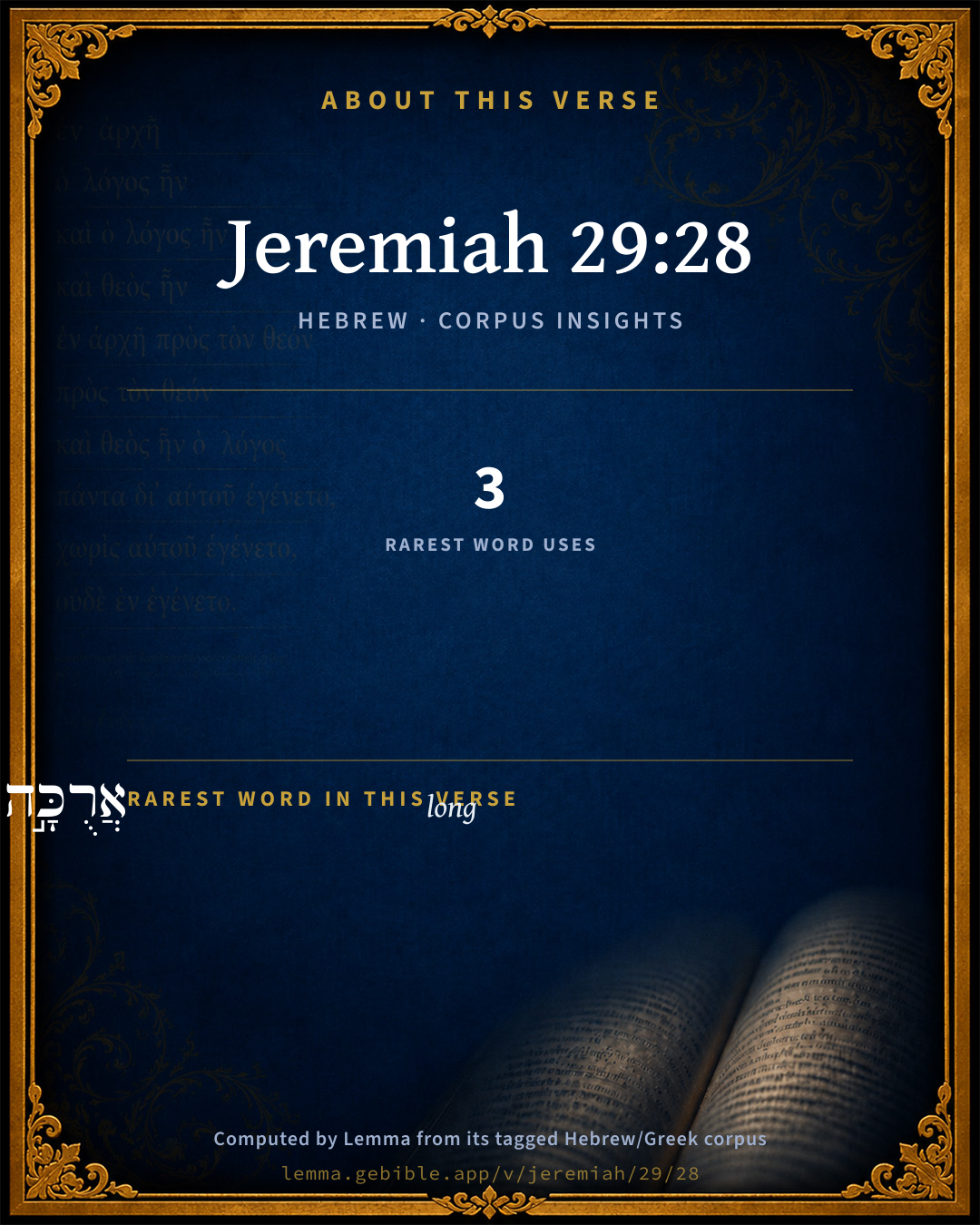
The rarest word here is אֲרֻכָּ֣ה long H752 — appearing just 3 times in the whole Hebrew Bible.

Shared distinctive vocabulary

אֲרֻכָּ֣ה long H752 occurs in 3 verses of the Hebrew Bible. Also found in:

Grammatical profile

  • 6 verbs
  • 4 nouns
  • 1 adjective
  • 1 pronoun
  • 2 prepositions
  • 1 conjunction
  • 2 particles

Verb forms

  • שָׁלַ֥ח Qal · Perfect
  • לֵאמֹ֖ר Qal · Infinitive Construct
  • בְּנ֤וּ Qal · Imperative
  • וְשֵׁ֔בוּ Qal · Imperative
  • וְנִטְע֣וּ Qal · Imperative
  • וְאִכְל֖וּ Qal · Imperative

Cross-references

3

Topical passages linked to Jeremiah 29:28 in the Treasury of Scripture Knowledge — connected by theme and wording, ordered by reader-vote popularity; previews shown in the World English Bible.

  • Jeremiah 29:5 Build you houses, and dwell in them; and plant gardens, and eat the fruit of them.
  • Jeremiah 29:1 Now these are the words of the letter that Jeremiah the prophet sent from Jerusalem to the residue of the elders of the captivity, and to the priests, and to the prophets, and to all the people, whom Nebuchadnezzar had carried away captive from Jerusalem to Babylon,
  • Jeremiah 29:10 For thus says Yahweh, After seventy years are accomplished for Babylon, I will visit you, and perform my good word toward you, in causing you to return to this place.

Cross-references courtesy of OpenBible.info (CC BY 4.0).

Hebrew and Greek witnesses Masoretic Hebrew ↔ Greek Septuagint

The same verse in the two great witnesses to the Old Testament, shown verse-for-verse.

These are two independent witnesses, not word-aligned to each other, and the Septuagint is shown in lemma (dictionary) form.

Hebrew Jeremiah 29:28 Masoretic · Westminster Leningrad Codex

כִּ֣י עַל כֵּ֞ן שָׁלַ֥ח אֵלֵ֛ינוּ בָּבֶ֥ל לֵאמֹ֖ר אֲרֻכָּ֣ה הִ֑יא בְּנ֤וּ בָתִּים֙ וְשֵׁ֔בוּ וְנִטְע֣וּ גַנּ֔וֹת וְאִכְל֖וּ אֶת פְּרִיהֶֽן

because he has sent to us in Babylon, saying, [The captivity] is long: build you houses, and dwell in them; and plant gardens, and eat the fruit of them?

World English Bible · Public Domain

Greek LXX Structure differs

In the Septuagint, Jeremiah is about an eighth shorter than the Hebrew and arranges its material differently — the Oracles Against the Nations (Hebrew chapters 46–51) appear in the middle of the Greek book, after 25:13. Because the chapter and verse boundaries do not line up, a verse-for-verse comparison with the Hebrew is not shown.

A verse-for-verse comparison isn’t shown here because the chapters and verses don’t line up. Switch to the LXX edition with the MT / LXX toggle above to read the Greek directly.

Hebrew: Westminster Leningrad Codex (CC BY 4.0). Greek: Septuagint (public domain); English from a public-domain English Septuagint. How the Septuagint differs from the Hebrew →

Targum (Aramaic paraphrase)

1

The Targum is the ancient Jewish Aramaic paraphrase of the Hebrew Scriptures — an interpretive translation, not the Hebrew text itself. Onkelos (literal) and Pseudo-Jonathan (expansive) render the Torah, and Jonathan the Prophets. Coverage is partial: where no permissively-licensed English translation exists for a verse, only the Aramaic is shown. This is verse-level text, not a word-by-word alignment to the Hebrew.

  1. Targum Jonathan Prophets (Joshua–Malachi)
    אֲרֵי עַל כֵּן שְׁלַח לְוָתָנָא לְבָבֶל לְמֵימָר אֲרִיכָא הִיא בְנוֹ בָתִּין וְתִיבוּ וְצוּבוּ גַנִין וֶאֱכוּלוּ יַת אִבְּהוֹן:

    (no public-domain English translation for this verse)

    Targum Jonathan — Aramaic: “Mikraot Gedolot” (public domain). English: “Sefaria Community Translation” (CC0 1.0 (public-domain dedication)); “London "Chaldee Paraphrase," 1871” (public domain). Text via Sefaria.

Commentary

Notes on Jeremiah 29:28 from classic Christian and Jewish commentators (each source and its license shown beneath its notes). The classic Christian expositions comment on the surrounding passage and are grouped to its opening verse, so a note may address several verses; the Jewish commentaries on the Tanakh (Rashi and others) are per-verse, so they appear only where the commentator wrote on this verse.

Lemma curates 59 commentaries, every one of them public domain or Creative Commons licensed, each selected and text-cleaned for this edition rather than reprinted as found. About our sources →

Trapp's Complete Commentary

John Trapp

Jer 29:28 For therefore he sent unto us [in] Babylon, saying, This [captivity is] long: build ye houses, and dwell [in them]; and plant gardens, and eat the fruit of them.

Ver. 28. For therefore he sent to us in Babylon.] And is this all the thank he hath for his friendly counsel? Haec est merces mundi. This is the recompence of the world.

John Trapp, A Commentary or Exposition upon All the Books of the Old and New Testament (1647–1656) — public domain. Text from a community e-Sword module.

Jamieson, Fausset & Brown

Robert Jamieson, A. R. Fausset & David Brown

Referring to Jeremiah's first letter to Babylon (Jer 29:5).

Jamieson, Fausset & Brown — Commentary Critical and Explanatory on the Whole Bible (1871) — public domain (CC PDM 1.0). Text via the HelloAO Bible API.

John Calvin's Commentaries

The crime ascribed to Jeremiah was, — that he rendered the captives indifferent, so that they cast off every hope of deliverance, and disregarded their own country. But the design of Jeremiah was far different; it was, that the people might not by too much haste anticipate the promises of God, and that he might also extend their hope to the end, prefixed. As there are two causal particles here found, כי על-כן, ki ol-ken, some give this rendering, “For for this cause,” that is, because he claimed the name of a Prophet. The simpler meaning however is, that he gives a reason why Shemaiah blamed the neglect of the priest, even because he (Jeremiah) had habituated the captives to bear their exiles. But he reproached the holy man, as though he had made them indifferent through long delay. Jeremiah had indeed said that the time would be long; but this particular phrase, It is long, means a different thing, as though Jeremiah wished to bury in oblivion the hope of a return, because it would have been foolish to languish so long.

John Calvin's Commentaries (1540-1563) — public domain. Text from the Calvin Translation Society English edition (1840s-50s) via the Christian Classics Ethereal Library (ccel.org). Calvin's coverage is partial (roughly two-thirds of the Bible); uncommented books and verses are honest gaps, never fabricated. The 19th-century editor's footnotes and remarks are omitted so the notes are faithfully Calvin's own voice.

Ellicott's Commentary for English Readers

(28) This captivity is long . . .—As the italics show, there is no word corresponding to “captivity” in the Hebrew, and some commentators render the words, It is far off . . . as though Jeremiah had counted on the distance of Babylon as enabling him to write the letter with impunity, or possibly in all the emphasis of abruptness. “All is a long way off—the end of your exile, your present distance from your native land, and haste, therefore, is but folly.”

A Bible Commentary for English Readers, edited by Charles John Ellicott (1878–1897) — public domain. Text from a community e-Sword module.

John Gill's Exposition

For therefore he sent unto us in Babylon, saying,.... That is, Jeremiah the prophet; and this was the reason, because his mouth was not stopped, and he restrained from prophesying; so that Shemaiah lays all the blame on Zephaniah, and his brethren the priests; who, had they done their duty, would have prevented Jeremiah's letter to the captives, as he suggests; the purport of which was,

this captivity is long; so Kimchi, Abarbinel, and Ben Melech, supply it; or, "it is long" (m); it will be a long time before the captives shall return to their own land; and therefore they should not think of it, or provide for it; but, on the contrary, for their continuance in Babylon; giving the following advice:

build ye houses, and dwell in them; and plant gardens, and eat the fruit of them; referring to Jeremiah's letter; See Gill on Jer 29:5.

(m) "longum est", Pagninus, Cocceius, Schmidt.

John Gill's Exposition of the Whole Bible (1746–1763) — public domain (CC PDM 1.0). Text via the HelloAO Bible API.

Haydock's Catholic Bible Commentary

Time, before you will return. (Haydock) --- Sophonias read the letter, approving of its contents, (St. Jerome) though this is not certain. He took no violent steps against Jeremias, as Phassur had done. (Haydock)

George Leo Haydock (1774–1849), Haydock's Catholic Family Bible and Commentary, 1859 edition — public domain. Excludes Psalms (Douay-Rheims chapter numbering differs from Protestant) and Deuterocanonical books (Catholic canon only).

Matthew Poole's English Annotations

The matter of fact was true, as appeared Jer 29:5,6, but it was false that this was the effect of phrensy, or that he spake this of his own head without commission from God; for he wrote nothing of this nature but by order from God, as appeareth from Jer 29:4, where he began his letter with, Thus saith the Lord of hosts, the God of Israel.

Matthew Poole's English Annotations on the Holy Bible (1683–1685) — public domain. Text from a community e-Sword/MySword module.

The Pulpit Commentary

For therefore, etc.; i.e. the consequence of Jeremiah"s not having been kept within bounds by authority is that he has even ventured, in his fanatical zeal, to trouble the exiles in Babylon. This captivity is long ; rather, It (is) long; a more forcible expression.

The Pulpit Commentary (1880–1919), ed. H.D.M. Spence-Jones & Joseph S. Exell — public domain. Text from a community e-Sword module.

Rashi

Rabbi Shlomo Yitzchaki (Rashi)

Forasmuch as For you should rebuke him since he sent to us to Babylon saying, “Your exile there is long.”

Forasmuch as like עַל-אֲֹשֶר because of which.

Rashi on the Tanakh — English translations: “The Judaica Press complete Tanach with Rashi, translated by A. J. Rosenberg” (CC BY 4.0); “Pentateuch with Rashi's commentary by M. Rosenbaum and A.M. Silbermann, 1929-1934” (public domain); “The Metsudah Tanach series, Lakewood, N.J” (CC BY 4.0); and “The Book of Joshua, Metsudah Publications, 1997” (CC BY 4.0). Text via Sefaria.

Lesson kit

Teaching starters — assembled from the data on this page, not authored interpretation. Every prompt links to the verse data it draws on. Edit before teaching.

Jeremiah, in the Prophets, opens this verse with 17 words (17 distinct Hebrew lemmas). Its most distinctive word is ʼârôk (“long”). A historical commentator’s framing appears above. Read the whole chapter for the surrounding context.

Discussion questions

  1. How does “long” (ʼârôk) shape what this verse is saying?
  2. 2 Samuel 3:1 shares the word «long» with this verse. How do the two illuminate each other?
  3. The translations on this page render this verse differently — a whole-verse word diff, not a word-by-word alignment. What might account for the different wordings?
  4. The verb «שָׁלַ֥ח» is Qal Perfect. How does its form color the action?
  5. Reading how Trapp's Complete Commentary and Jamieson, Fausset & Brown read this verse, where do the two commentators agree and where do they part?

Things to notice

Reading settings

Reading text

Shown beneath each verse's original-language words.

Old Testament
Old Testament edition

Read the OT as the Masoretic Hebrew (MT) or the Greek Septuagint (LXX).

English shown for the Greek Septuagint (in the Hebrew ↔ Greek comparison).

Comparing translations? Open the Compare panel on any verse page to stack up to four side by side.