
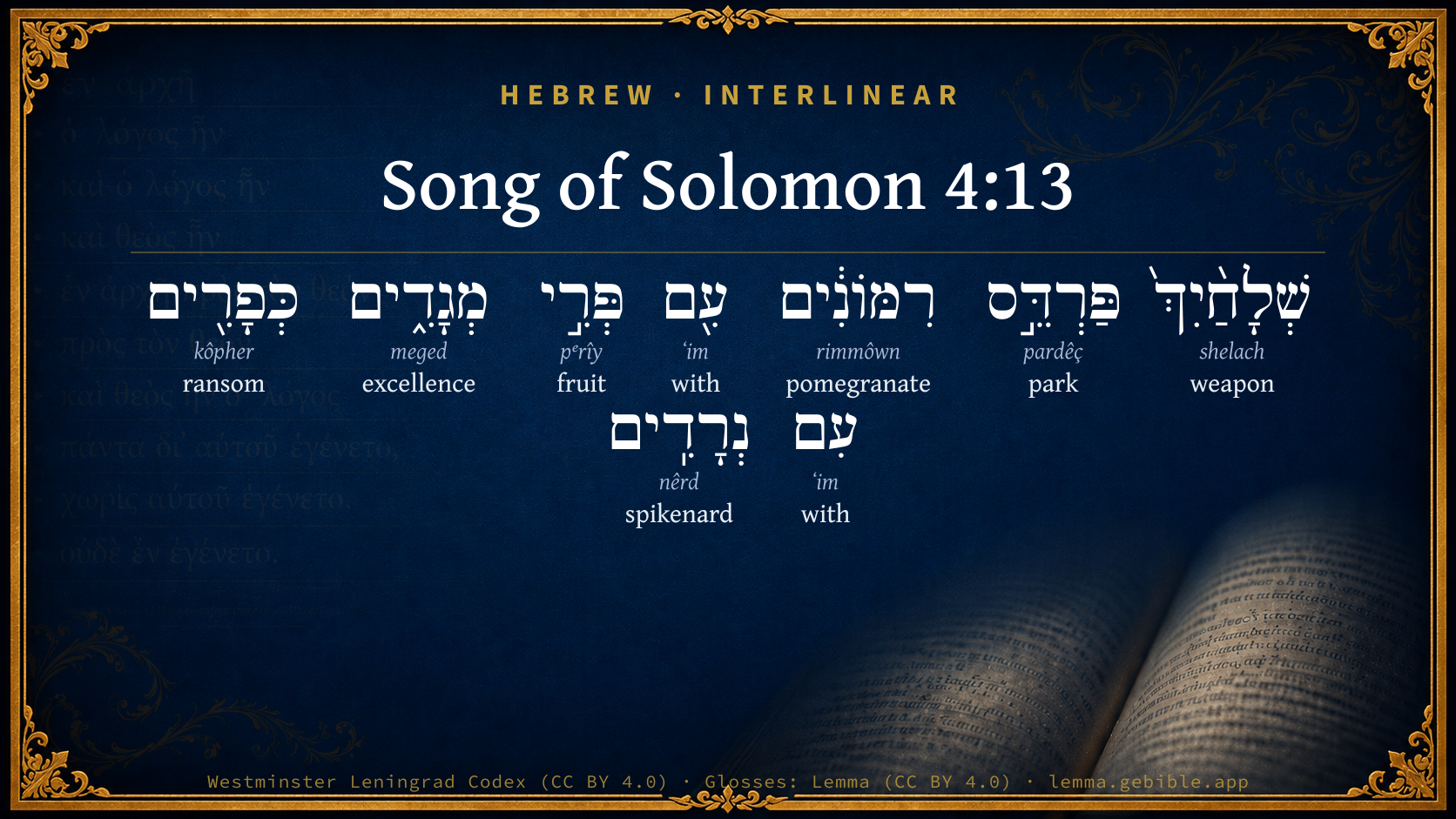
Song of Solomon 4:13

Hebrew (Westminster Leningrad Codex) Song of Solomon 4:13 appears in the Hebrew Old Testament. The text above is from the Westminster Leningrad Codex. Each word links to its Strong’s number, a concise gloss, and parsing drawn from the Open Scriptures Hebrew Bible morphology. Click any word for its full Brown-Driver-Briggs (BDB) entry.
Download image
Cite this verse

Song of Solomon 4:13 (World English Bible). Public Domain. Lemma interlinear Bible study tool, https://lemma.gebible.app/v/song-of-solomon/4/13.

Show BibTeX & RIS
BibTeX
RIS
English Translation
Your shoots are an orchard of pomegranates, with precious fruits: Henna with spikenard plants,
World English Bible · Public Domain
Download a study sheet

One document with this verse’s original text, its word-by-word gloss line, the meaning frame, cross-references with their text, attributed commentary, and full source and license credits — printable, and it pastes into notes with its structure intact.

This verse Autodidact and up

Study sheet (.html) Plain text (.txt)

A passage Seminary Student

Up to 50 verses in one chapter. A passage sheet keeps up to 6 commentary sources and 12 cross-references per verse, in the order this page ranks them, and says so on the sheet whenever that leaves anything out. Ask for a single verse and you get the Autodidact verse sheet above.

Everything on this page stays free to read, with no account — the sheet is a download of what is already on screen, not access to it.

Want to remove ads? Support Godless Engineer
Compare translations 3

The same verse in 3 English versions, stacked beneath the original-language interlinear above. Click any original word for its lexicon entry.

Each is an independent rendering of the whole verse — the interlinear is not word-aligned to these translations.

Highlighted words mark where these versions differ — a whole-verse word diff, not a word-by-word alignment.

  • World English Bible Public Domain
    Your shoots are an orchard of pomegranates, with precious fruits: Henna with spikenard plants,
  • King James Version Public Domain
    Thy plants are an orchard of pomegranates, with pleasant fruits; camphire, with spikenard,
  • unfoldingWord Literal Text CC BY-SA 4.0
    Your shoots an orchard of pomegranate trees with delicious fruits, henna with nard,

unfoldingWord Literal Text — © unfoldingWord, licensed CC BY-SA 4.0. Word-aligned USFM3 via Door43 (git.door43.org/unfoldingWord/en_ult).

Versions to compare (up to 4)

3 of 4 selected

Show all 18 translations

Every available English version of this verse, each an independent rendering of the whole verse.

  • World English Bible Public Domain
    Your shoots are an orchard of pomegranates, with precious fruits: Henna with spikenard plants,
  • Berean Standard Bible Public Domain
    Your branches are an orchard of pomegranates with the choicest of fruits, with henna and nard,
  • Majority Standard Bible Public Domain
    Your branches are an orchard of pomegranates with the choicest of fruits, with henna and nard,
  • King James Version Public Domain
    Thy plants are an orchard of pomegranates, with pleasant fruits; camphire, with spikenard,
  • American Standard Version (1901) Public Domain
    Thy shoots are an orchard of pomegranates, with precious fruits; Henna with spikenard plants,
  • Revised Version (1885) Public Domain
    Thy shoots are an orchard of pomegranates, with precious fruits; henna with spikenard plants,
  • Geneva Bible (1599) Public Domain
    Thy plantes are as an orchard of pomegranates with sweete fruites, as camphire, spikenarde,
  • Douay-Rheims (1899) Public Domain
    Thy plants are a paradise of pomegranates with the fruits of the orchard. Cypress with spikenard.
  • Young's Literal Translation Public Domain
    Thy shoots a paradise of pomegranates, With precious fruits,
  • Literal Standard Version CC BY-SA 4.0
    Your shoots a paradise of pomegranates, || With precious fruits,
  • Unlocked Literal Bible CC BY-SA 4.0
    Your branches are a grove of pomegranate trees with choice fruits, and of henna and nard plants,
  • unfoldingWord Literal Text CC BY-SA 4.0
    Your shoots an orchard of pomegranate trees with delicious fruits, henna with nard,
  • Darby Bible Public Domain
    Thy shoots are a paradise of pomegranates, with precious fruits; Henna with spikenard plants;
  • World Messianic Bible Public Domain
    Your shoots are an orchard of pomegranates, with precious fruits, henna with spikenard plants,
  • Webster's Bible Public Domain
    Thy plants are an orchard of pomegranates, with pleasant fruits; camphor, with spikenard,
  • Free Bible Version CC BY-SA 4.0
    Your channel is a paradise of pomegranates, full of the best fruits, with henna and nard,
  • Bible in Basic English Public Domain
    The produce of the garden is pomegranates; with all the best fruits, henna and spikenard,
  • JPS Tanakh (1917) Public Domain
    Thy shoots are a park of pomegranates, with precious fruits; henna with spikenard plants,

Literal Standard Version (2020), Covenant Press — licensed CC BY-SA 4.0. Text via the HelloAO Bible API (eBible.org). Unlocked Literal Bible (unfoldingWord) — licensed CC BY-SA 4.0. Text via the HelloAO Bible API (eBible.org). unfoldingWord Literal Text — © unfoldingWord, licensed CC BY-SA 4.0. Word-aligned USFM3 via Door43 (git.door43.org/unfoldingWord/en_ult). Free Bible Version, Dr. Jonathan Gallagher — licensed CC BY-SA 4.0. Text via the HelloAO Bible API (eBible.org).

Word by word

More ways to search: Search by grammar → Find every occurrence → Compare this word →

Practice this passage: Drill this verse → Learn its vocabulary →

About this verse

These counts appear in no published source. They are computed here, from the morphology-tagged text and Lemma’s own curated glosses. What Lemma adds →

9
words
8
distinct lemmas
Wisdom
section

Notable vocabulary

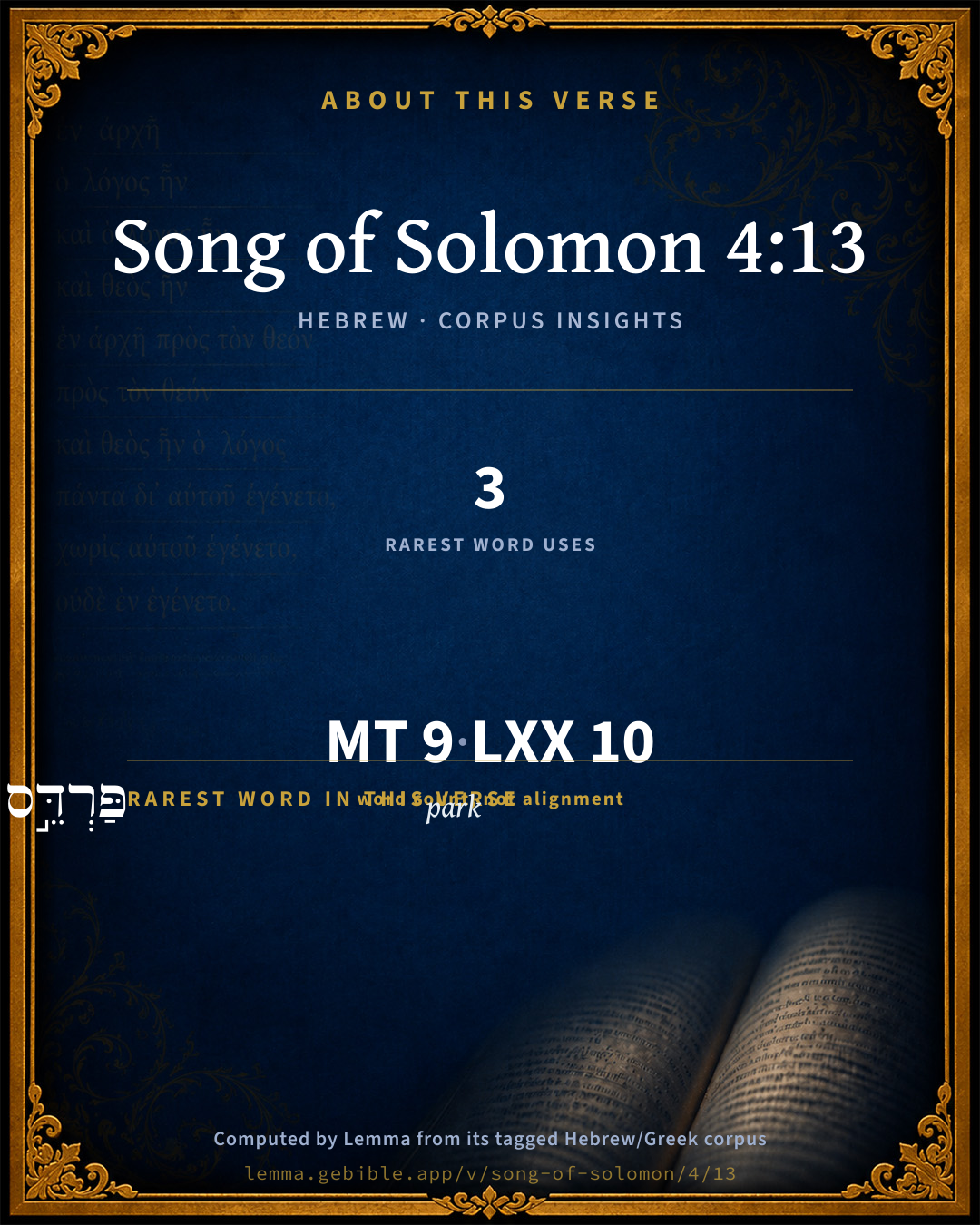
The rarest word here is פַּרְדֵּ֣ס park H6508 — appearing just 3 times in the whole Hebrew Bible.

Shared distinctive vocabulary

פַּרְדֵּ֣ס park H6508 occurs in 3 verses of the Hebrew Bible. Also found in:

Grammatical profile

  • 7 nouns
  • 2 prepositions

Repetition

A word recurs within this verse — often emphatic in Hebrew:

  • עִ֖ם with H5973 ×2

Hebrew & Septuagint length

In English translation the verse runs 14 words from the Hebrew and 16 from the Septuagint (LXX English) — closely comparable.

A rough comparison of the two English renderings, which tokenize alike — not a word-level alignment.

Word counts can differ between the Hebrew and the Greek without any difference in meaning — e.g. the Hebrew direct-object marker אֵת has no separate Greek word, and Greek often adds the article ὁ.

In the original languages it is 9 Hebrew tokens and 10 Greek tokens — but the two are counted differently (Hebrew bundles its prefixes and suffixes into one token; the Greek is in lemma form), so that isn’t a like-for-like length.

Cross-references

15

Topical passages linked to Song of Solomon 4:13 in the Treasury of Scripture Knowledge — connected by theme and wording, ordered by reader-vote popularity; previews shown in the World English Bible.

  • Song of Solomon 1:14 My beloved is to me a cluster of henna blossoms From the vineyards of En Gedi. Lover
  • Ecclesiastes 2:5 I made myself gardens and parks, and I planted trees in them of all kinds of fruit.
  • Song of Solomon 6:11 I went down into the nut tree grove, To see the green plants of the valley, To see whether the vine budded, And the pomegranates were in flower.
  • Song of Solomon 1:12 While the king sat at his table, My perfume spread its fragrance.
  • Psalms 92:14 They will still bring forth fruit in old age. They will be full of sap and green,
  • Song of Solomon 4:14 Spikenard and saffron, Calamus and cinnamon, with every kind of incense tree; Myrrh and aloes, with all the best spices,
  • Song of Solomon 6:2 My beloved has gone down to his garden, To the beds of spices, To feed in the gardens, and to gather lilies.
  • Song of Solomon 7:12–13 Let's go early up to the vineyards. Let's see whether the vine has budded, Its blossom is open, And the pomegranates are in flower. There I will give you my love.
  • Song of Solomon 8:2 I would lead you, bringing you into my mother's house, Who would instruct me. I would have you drink spiced wine, Of the juice of my pomegranate.
  • Isaiah 60:21 Your people also shall be all righteous; they shall inherit the land forever, the branch of my planting, the work of my hands, that I may be glorified.
  • Isaiah 61:11 For as the earth brings forth its bud, and as the garden causes the things that are sown in it to spring forth; so the Lord Yahweh will cause righteousness and praise to spring forth before all the nations.
  • Mark 14:3 While he was at Bethany, in the house of Simon the leper, as he sat at the table, a woman came having an alabaster jar of ointment of pure nard-- very costly. She broke the jar, and poured it over his head.
  • John 12:3 Mary, therefore, took a pound of ointment of pure nard, very precious, and anointed the feet of Jesus, and wiped his feet with her hair. The house was filled with the fragrance of the ointment.
  • John 15:1–3 "I am the true vine, and my Father is the farmer.
  • Philippians 1:11 being filled with the fruits of righteousness, which are through Jesus Christ, to the glory and praise of God.

Cross-references courtesy of OpenBible.info (CC BY 4.0).

Hebrew and Greek witnesses Masoretic Hebrew ↔ Greek Septuagint

The same verse in the two great witnesses to the Old Testament, shown verse-for-verse.

These are two independent witnesses, not word-aligned to each other, and the Septuagint is shown in lemma (dictionary) form.

Hebrew Song of Solomon 4:13 Masoretic · Westminster Leningrad Codex

שְׁלָחַ֨יִךְ֙ פַּרְדֵּ֣ס רִמּוֹנִ֔ים עִ֖ם פְּרִ֣י מְגָדִ֑ים כְּפָרִ֖ים עִם נְרָדִֽים

Your shoots are an orchard of pomegranates, with precious fruits: Henna with spikenard plants,

World English Bible · Public Domain

Greek LXX Song of Solomon 4:13 Septuagint · lemma form

ἀποστολή σύ παράδεισος ῥοά μετά καρπός ἀκρόδρυα κύπρος μετά νάρδος

Your shoots are a garden of pomegranates, with the fruit of choice berries; camphor, with spikenard:

LXX2012 (modern English Septuagint) · Public Domain

On this verse, Ellicott's Commentary for English Readers discusses the Septuagint’s reading. Read the note in Commentary ↓

Hebrew: Westminster Leningrad Codex (CC BY 4.0). Greek: Septuagint (public domain); English from LXX2012 (modern English Septuagint) (Public Domain). How the Septuagint differs from the Hebrew →

Commentary

Notes on Song of Solomon 4:13 from classic Christian and Jewish commentators (each source and its license shown beneath its notes). The classic Christian expositions comment on the surrounding passage and are grouped to its opening verse, so a note may address several verses; the Jewish commentaries on the Tanakh (Rashi and others) are per-verse, so they appear only where the commentator wrote on this verse.

Lemma curates 59 commentaries, every one of them public domain or Creative Commons licensed, each selected and text-cleaned for this edition rather than reprinted as found. About our sources →

Trapp's Complete Commentary

John Trapp

Son 4:13 Thy plants [are] an orchard of pomegranates, with pleasant fruits; camphire, with spikenard,

Ver. 13. Thy plants are as an orchard of pomegranates.] By plants are to be understood either particular churches or several saints. These are those shoots or sprouts {a} that spread abroad God’s paradise - that the word here used, and nowhere else in Scripture, save Ecc 2:5 Neh 2:8 so called for the curious variety and excellence of all sorts of precious and pleasant trees there growing; some for profit, as pomegranates, which are known to be healthful and preservative, some for pleasure; and these again were either more common and copious in Jewry, as camphires and spikenards - plurals both in the original, for the plenty of them in those parts - or more rare and costly, as those mentioned in the next verse.

{a} Emissiones, propagines.

John Trapp, A Commentary or Exposition upon All the Books of the Old and New Testament (1647–1656) — public domain. Text from a community e-Sword module.

The Biblical Illustrator

Joseph S. Exell

Son_4:13-14

Thy plants are an orchard of pomegranates, with pleasant fruits; camphire, with spikenard, spikenard and saffron; calamus and cinnamon, with all trees Of frankincense; myrrh and aloes, with all the chief spices.

Fragrance

Of all mans sources of enjoyment, none display more clearly the bountifulness of God than the fragrant odours of nature. Fragrance seems so wholly superfluous and accidental, that we cannot but infer that it was imparted to the objects which possess it, not for their own sakes, but for our gratification. We regard it as a peculiar blessing, sent to us directly from the hand of our Heavenly Father; and we are the more confirmed in this idea by the fact that the human period is the principal epoch of fragrant plants. Geologists inform us that all the eras of the earths history previous to the Upper Miocene were destitute of perfumes. Forests of club-mosses and ferns hid in their sombre bosom no bright-eyed floweret, and shed from their verdant boughs no scented richness on the passing breeze. Palms and cycads, though ushering in the dawn of a brighter floral day, produced no perfume-breathing blossoms. It is only when we come to the periods immediately antecedent to the human that we meet with an odoriferous flora. God placed man in a sweet-scented garden as his home. No sense is more closely connected with the sphere of soul than the sense of smell. Its agency is most subtle and extensive--going down to the very depths of our nature, and back to the earliest dawn of life Memory especially is keenly susceptible to its Influence. The acceptance of mans offerings by God is usually represented in the anthropomorphism of the Bible, as finding its expression in the sense of smell. When Noah offered the first sacrifice after the flood, the Lord, we are told, smelled a sweet savour. The drink-offerings and the various burnt-offerings prescribed by Levitical law were regarded as a sweet savour unto the Lord. Christ, the antitype of these institutions, is spoken of as having given Himself for us an offering and a sacrifice to God for a sweet-smelling savour. And the Apostle Paul, employing the same typical language, speaks of himself and the other apostles as unto God a sweet savour of Christ, etc. The Psalms and the prophetic writings are full of the most beautiful and expressive metaphors, applied to the most solemn persons and things, borrowed from perfumes; while the whole of the Song of Solomon is like aa oriental garden stocked with delicious flowers, as grateful to the sense of smell as to the sense of sight. In the gorgeous ceremonial worship of the Hebrews, none of the senses were excluded from taking part in the service. The eye was appealed to by the rich vestments and the splendid furniture of the holy place; the ear was exercised by the solemn sound of the trumpet, and the voice of praise and prayer; and the nostril was gratified by the clouds of fragrant smoke that rose from the golden altar of incense and filled all the place. Doubtless the Jews felt, when they saw the soft white clouds of fragrant smoke rising slowly from the altar of incense, as if the voice of the priest were silently but eloquently pleading in that expressive emblem in their behalf. The association of sound was lost in that of smell, and the two senses were blended in one. And this symbolical mode of supplication, as Dr. George Wilson has remarked, had this one advantage over spoken or written prayer, that it appealed to those who were both blind and deaf, a class that are usually shut out from social worship by their affliction. Those who could not hear the prayers of the priest could join in devotional exercises symbolized by incense, through the medium of their sense of smell; and the hallowed impressions shut out by one avenue were admitted to the mind and heart by another. But not in the incense of prayer alone were perfumes employed in the Old Testament economy. The oil with which the altars and the sacred furniture of the tabernacle and temple were anointed--with which priests were consecrated for their holy service, and kings set apart for their lofty dignity--was richly perfumed. One of the sweetest names of Jesus is the Christ, the Anointed One, because He was anointed with the fragrant oil of consecration for His great work of obedience and atonement. As our King and Great High Priest, He received the outward symbolical chrism, when the wise men of the East laid at His feet their gifts of gold, myrrh and frankincense in token of His royal authority, and Mary and Nicodemus anointed Him with precious spikenard and costly spices for His priestly work of sacrifice. His name is as ointment poured forth; and He is a bundle of myrrh to the heart that loves Him. The ingredients of the Hebrew perfumes were principally obtained in traffic from the Phoenicians. A few of them were products of native plants, but the great majority of them came from Arabia, India and the spice islands of the Indian Archipelago. So great was the skill required in the mixing of these ingredients, in order to form their most valued perfumes, that the art was a recognized profession among the Jews; and the rokechim, translated apothecary in our version, was not a seller of medicines as with us, but simply a maker of perfumes. Perfumes were at one time extensively employed as remedial agents, particularly in cases of nervous disease. They are still used freely in the sick-room, but more for the purpose of refreshment and overpowering the noxious odours of disease than as medicines. How important they are in the economy of nature we learn from the fact that when the Dutch cut down the spice trees of Ternate, that island was immediately visited with epidemics before unknown; and it has been ascertained that none of the persons employed in the perfume manufactories of London and Paris were attacked by cholera during the last visitation. From the recent experimental researches of Professor Mantegazza, we learn the important fact that the essences of flowers such as lavender, mint, thyme, bergamot, in contact with atmospheric oxygen in sunlight, develop a very large quantity of ozone, the purifying and health-inspiring element in the air. And as a corollary from this fact, he recommends the inhabitants of marshy districts, and of places infected with animal exhalations, to surround their houses with beds of the most odorous flowers, as the powerful oxidizing influence of the ozone may destroy those noxious influences. Many of the most delicious perfumes, however, are dangerous in large quantities. Taken in moderation they act as stimulants, exhilarating the mental functions, and increasing bodily vigour. But in larger and more concentrated doses they act as poisons. If we pursue them as pleasures for their own sake, they will soon pall upon us, however delicious; and if we concentrate them so as to produce a stronger sensation, they become actually repulsive and sickening. God has given them to us to cheer us in the path of duty, not to minister to our love of pleasure and self-indulgence; and in this respect the laws of the unwritten revelation of nature give their sanction to the laws of the written revelation of the Bible, indicating a common source and pointing to a common issue. (H. Macmillan, D. D.)

The Biblical Illustrator, edited by Joseph S. Exell (c. 1880s–1900s) — public domain. Text from a community e-Sword module.

Joseph Benson's Commentary

Son 4:13-14. Thy plants are an orchard — Believers, which are planted in thee, are like the plants or fruits of an orchard, which are pleasant to the eye, and delicious to the taste or smell, whereby he signifies the variety and excellence of the gifts and graces in the several members of the church. Spike-nard — Which he mentions here with camphire, and in the next verse with saffron, because it is mixed with both these, and, being so mixed, yields the more grateful smell. All trees of frankincense — Such trees as produce frankincense.

Joseph Benson's Commentary on the Old and New Testaments (1811–1818) — public domain. Text from a community e-Sword module.

Tyndale Open Study Notes

Tyndale Open Resources

4:13-14 The man’s description of his lover now focuses on the most exquisite place of delight between her thighs.

Tyndale Open Study Notes — © Tyndale Open Resources, licensed CC BY-SA 4.0. Text via the HelloAO Bible API.

Adam Clarke's Commentary

Verse 13. Thy plants are an orchard of pomegranates] This seems to refer to the fecundity of the bride or Jewish queen; to the former it would be a prediction; to the latter, a statement of what had already taken place. The word פרדס pardes, which we translate an orchard, is the same which has given birth to our paradise, a garden of pleasure. The other expressions, in this and the following verse, seem to refer wholly to matters of a connubial nature.

Adam Clarke's Commentary on the Bible (1810–1826) — public domain. Text from a community e-Sword/MySword module.

Ellicott's Commentary for English Readers

(13) Thy plants.—Some have thought the offspring of the marriage intended here; but the poet is plainly, by a new adaptation of the language of flowers, describing the charms of the person of his beloved.

Orchard.—Heb. pardes; LXX. παράδεισος; found only elsewhere in Neh_2:8 (where see Note), Ecc_2:5. The pomegranate was perhaps an emblem of love, having been held sacred to the Syrian Venus. (See Tristram, Nat. Hist. of Bible, p. 389.)

Camphire.—See Note, Son_1:14.

A Bible Commentary for English Readers, edited by Charles John Ellicott (1878–1897) — public domain. Text from a community e-Sword module.

The Cambridge Bible for Schools and Colleges

gen. ed. J. J. S. Perowne

13. Thy plants are an orchard] Better, Thy shoots make an orchard. These shoots denote all the bride’s charms. Orchard is in Heb. pardçs, which is merely a grander word for gan, and is originally Persian=‘a paradise.’ It is found elsewhere in the O.T. only in Neh_2:8 and Ecc_2:5. It is usually and rightly regarded as a proof of the late origin of this book. Cp. Introduction, § 4.

pleasant fruits] Lit. fruits of excellence, R.V. precious fruits.

camphire] Properly, henna. See note on ch. Son_1:14.

spikenard] Cp. ch. Son_1:12. Grätz for nerâdhîm reads werâdhîm = roses. Rather than that Budde would strike out the last three words as a repetition. But either suggestion would detract from the poetical character of the passage.

The Cambridge Bible for Schools and Colleges (gen. ed. J. J. S. Perowne; Cambridge University Press, 1878–1918) — public domain. Text from a community e-Sword module.

Haydock's Catholic Bible Commentary

Plants. The various orders of clergy and laity. --- Cyprus, (chap. i. 13.; Calmet) whence a healing oil is extracted. (Theodoret) --- Protestants, "camphire." (Haydock) --- Spikenard is twice mentioned, as it may be well mixed with cyprus and saffron. (Menochius)

George Leo Haydock (1774–1849), Haydock's Catholic Family Bible and Commentary, 1859 edition — public domain. Excludes Psalms (Douay-Rheims chapter numbering differs from Protestant) and Deuterocanonical books (Catholic canon only).

Matthew Poole's English Annotations

Thy plants, the plants of thy garden, believers which are planted in thee,

are an orchard; are like the plants or fruits of an orchard, which are pleasant to the eye, and delicious to the taste or smell, such as are here mentioned in the following words; whereby he signifies the variety and excellency of gifts and graces in the several members of the church.

Spikenard; which he mentions both here with camphire or cypress, and in the next verse with saffron, because it is mixed with both these, and being so mixed, yieldeth the more grateful smell.

Matthew Poole's English Annotations on the Holy Bible (1683–1685) — public domain. Text from a community e-Sword/MySword module.

Whedon's Commentary on the Bible

Daniel D. Whedon

13. The comparison of his loved one to a garden is more fully given. Not merely enclosed, but worth enclosing!

Thy plants — That is, the growths within the garden.

Orchard — Hebrew, paradise. This word, whether taken from the Hebrew or the Sanscrit, means “enclosure.” The Hindustanee and Persian of to-day have a like term, “Peridesh,” fairy land. Camphire, etc. Fragrant with perfume.

Daniel D. Whedon (gen. ed.), Commentary on the Old and New Testaments (1874–1909) — public domain. Text from a community e-Sword module.

The Pulpit Commentary

Vers. 13, 14. Thy shoots are an orchard of pomegranates, with precious fruits; henna with spikenard plants, spikenard and saffron, calamus and cinnamon, with all trees of frankincense; myrrh and aloes, with all the chief spices. Thy shoots; i.e. that which comes forth from thee, thy plants, or, as Bottcher puts it, "all the phenomena and life utterances of her personality." All the plants had their meaning in flower language. They are mostly exotics. But it is difficult now to suggest meanings, though they may have been familiar to Jewish readers at the time. The pardes, "park, or enclosure," was adorned especially with foreign and fragrant plants of great beauty. It is an Old Persian word, perhaps, as Delitzsch suggests, from pairi (peri ) and dez (Pers. diz), "a heap." Precious fruit; literally, fructus laudam, "fruits of renown" or excellence (cf. Syriac magdo, "dried fruit"). The carcom, or saffron, a kind of crocus (Ind. safran), yields the saffron colour from its dried flower eyes, used both as a cosmetic and as a medicine (cf. Sansc. kuakuma). The calamus, simply a reed, the sweet reed, a corn indigenous to the East. Cinnamon (Quinnamon), Laurus cinnamomum, is indigenous on the east coast of Africa and Ceylon, found later in the Antibes. The inner bark peeled off and roiled together forms the cinnamon bark (see Pliny, bk. 12). There are seven spices mentioned. We need not trouble ourselves to identify them all, as they are mostly Indian, and such as Solomon would fetch from the far East in his celebrated ships. The description is highly poetical, and simply means that all sweetness and attractiveness combine in the fair one. But symbolically we may see an allusion to the spread of the Church over the world, and all the glory and honour of the nations" being introduced into it. So the graces of the individual soul expand themselves under the influence of Christian truth and fellowship.

The Pulpit Commentary (1880–1919), ed. H.D.M. Spence-Jones & Joseph S. Exell — public domain. Text from a community e-Sword module.

John Wesley's Explanatory Notes

Plants - Believers, which are planted in thee, are like the plants or fruits of an orchard, which are pleasant to the eye, and delicious to the taste or smell, whereby he signifies the variety and excellency of the gifts and graces in the several members of the church. Spikenard - Which he mentions here with camphire, and in the next verse with saffron, because it is mixed with both these, and being so mixed, yields. the more grateful smell.

John Wesley, Explanatory Notes Upon the Whole Bible (1754–1765) — public domain. Text via the GEBible commentary corpus.

Rashi

Rabbi Shlomo Yitzchaki (Rashi)

Your arid fields Dry land is called בֵּית הַשְּׁלָחִין. It must be continually irrigated, and a field watered by rain is superior to it. Here he praises the arid field. Your arid fields are replete with all good like a pomegranate orchard. This is symbolic of the smallest of Israel, who are moist with good deeds like a pomegranate orchard.

henna and spikenard These are species of spices.

Rashi on the Tanakh — English translations: “The Judaica Press complete Tanach with Rashi, translated by A. J. Rosenberg” (CC BY 4.0); “Pentateuch with Rashi's commentary by M. Rosenbaum and A.M. Silbermann, 1929-1934” (public domain); “The Metsudah Tanach series, Lakewood, N.J” (CC BY 4.0); and “The Book of Joshua, Metsudah Publications, 1997” (CC BY 4.0). Text via Sefaria.

Lesson kit

Teaching starters — assembled from the data on this page, not authored interpretation. Every prompt links to the verse data it draws on. Edit before teaching.

Song of Solomon, in the Wisdom, opens this verse with 9 words (8 distinct Hebrew lemmas). Its most distinctive word is pardêç (“park”). A historical commentator’s framing appears above. Read the whole chapter for the surrounding context.

Discussion questions

  1. What does “park” (pardêç) contribute to the verse as a whole?
  2. How does Nehemiah 2:8, which shares the word «park», read alongside this verse?
  3. What does the repetition of “with” (2× in this one verse) do in this verse?
  4. The translations on this page render this verse differently — a whole-verse word diff, not a word-by-word alignment. What might account for the different wordings?
  5. Compare how Trapp's Complete Commentary and The Biblical Illustrator read this verse. Where do they agree or differ?

Things to notice

Reading settings

Reading text

Shown beneath each verse's original-language words.

Old Testament
Old Testament edition

Read the OT as the Masoretic Hebrew (MT) or the Greek Septuagint (LXX).

English shown for the Greek Septuagint (in the Hebrew ↔ Greek comparison).

Comparing translations? Open the Compare panel on any verse page to stack up to four side by side.