
Ezekiel 17:9

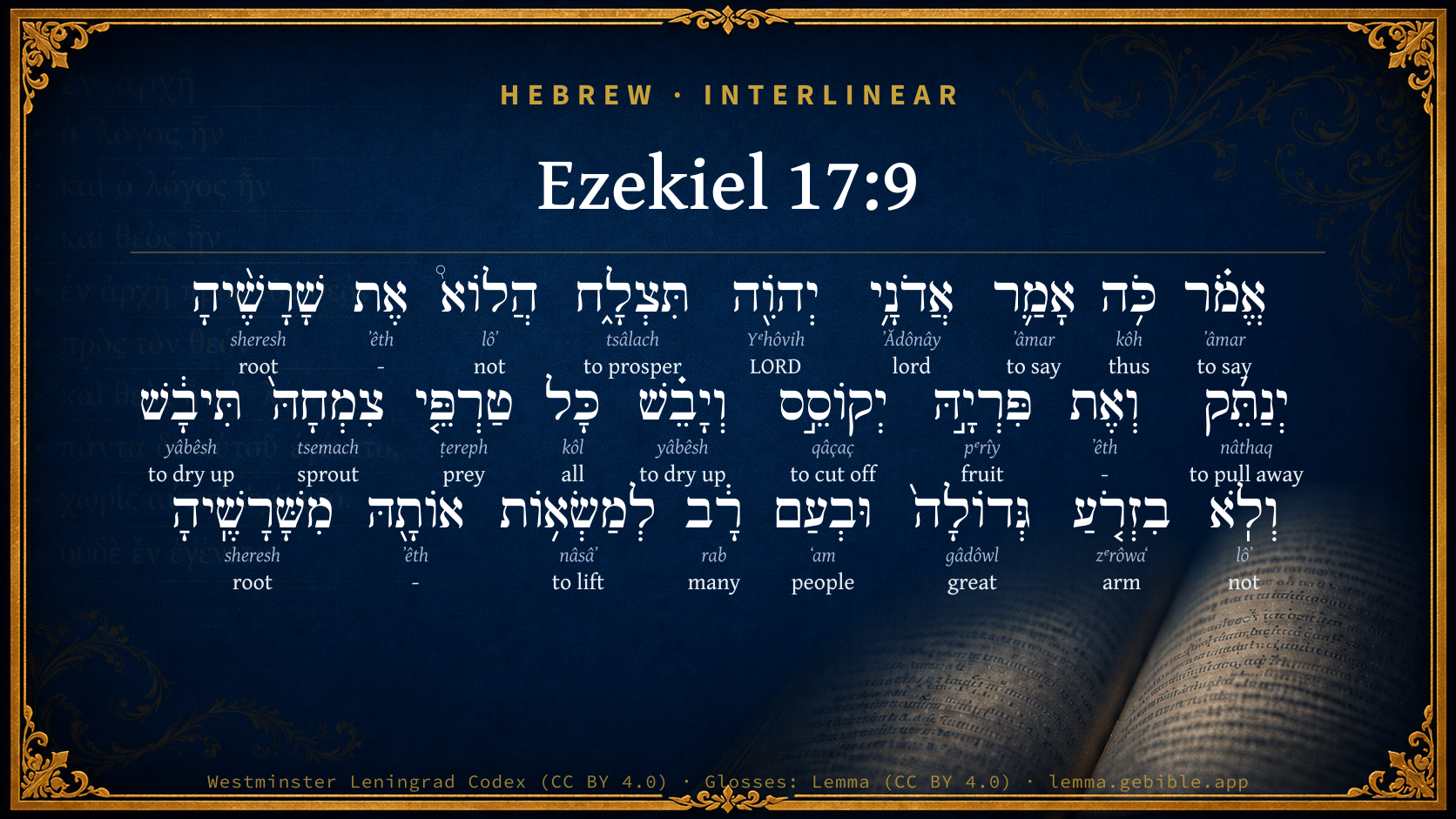
Hebrew (Westminster Leningrad Codex) Ezekiel 17:9 appears in the Hebrew Old Testament. The text above is from the Westminster Leningrad Codex. Each word links to its Strong’s number, a concise gloss, and parsing drawn from the Open Scriptures Hebrew Bible morphology. Click any word for its full Brown-Driver-Briggs (BDB) entry.
Download image
Cite this verse

Ezekiel 17:9 (World English Bible). Public Domain. Lemma interlinear Bible study tool, https://lemma.gebible.app/v/ezekiel/17/9.

Show BibTeX & RIS
BibTeX
RIS
English Translation
Say you, Thus says the Lord Yahweh: Shall it prosper? shall he not pull up the roots of it, and cut off the fruit of it, that it may wither; that all its fresh springing leaves may wither? and not by a strong arm or much people can it be raised from the roots of it.
World English Bible · Public Domain
Highlights
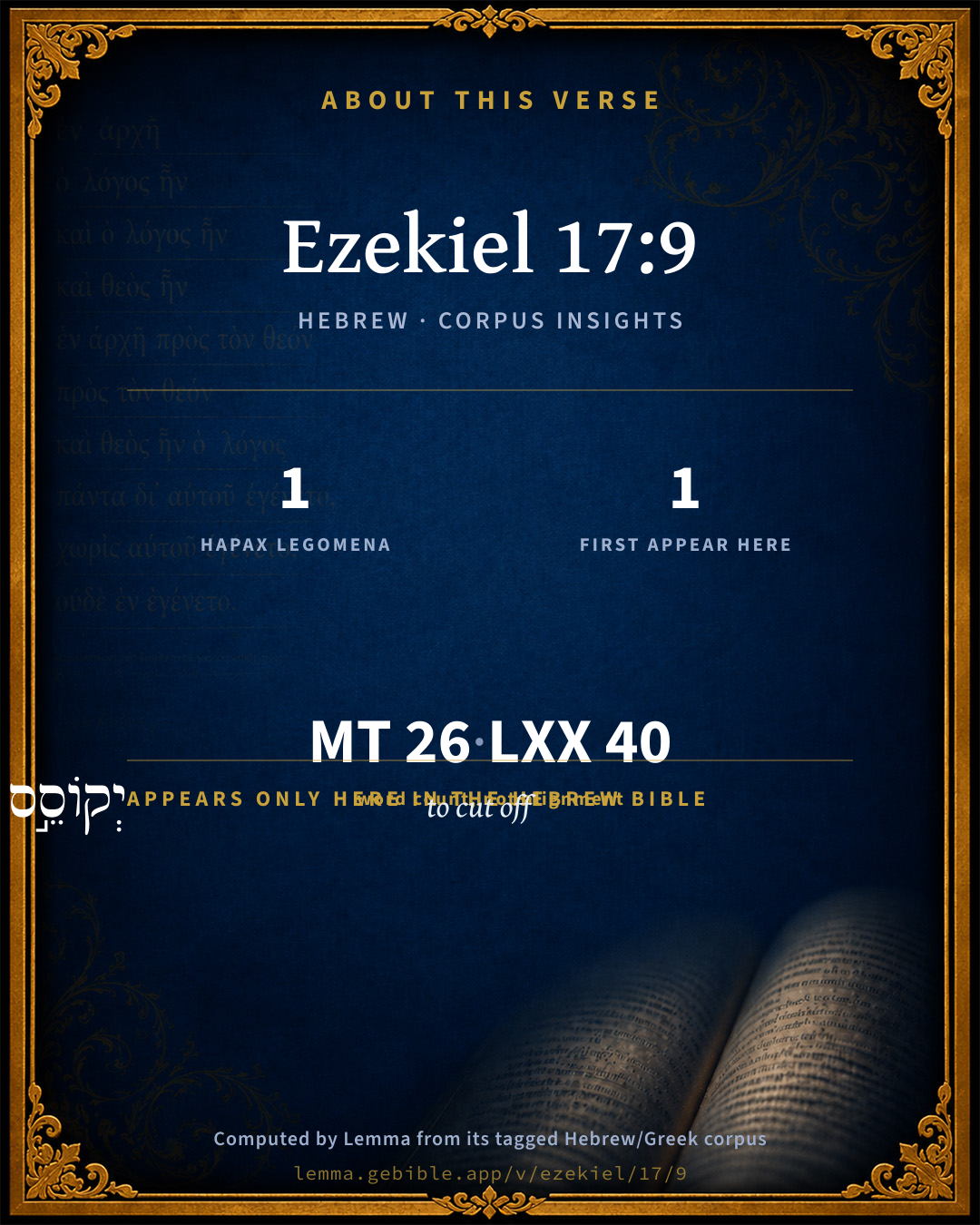
  • 1 hapax legomenon — only here in the Hebrew Bible
  • 1 first appearance in the Hebrew Bible
Full analysis ↓
Download a study sheet

One document with this verse’s original text, its word-by-word gloss line, the meaning frame, cross-references with their text, attributed commentary, and full source and license credits — printable, and it pastes into notes with its structure intact.

This verse Autodidact and up

Study sheet (.html) Plain text (.txt)

A passage Seminary Student

Up to 50 verses in one chapter. A passage sheet keeps up to 6 commentary sources and 12 cross-references per verse, in the order this page ranks them, and says so on the sheet whenever that leaves anything out. Ask for a single verse and you get the Autodidact verse sheet above.

Everything on this page stays free to read, with no account — the sheet is a download of what is already on screen, not access to it.

Want to remove ads? Support Godless Engineer
Compare translations 3

The same verse in 3 English versions, stacked beneath the original-language interlinear above. Click any original word for its lexicon entry.

Each is an independent rendering of the whole verse — the interlinear is not word-aligned to these translations.

Highlighted words mark where these versions differ — a whole-verse word diff, not a word-by-word alignment.

  • World English Bible Public Domain
    Say you, Thus says the Lord Yahweh: Shall it prosper? shall he not pull up the roots of it, and cut off the fruit of it, that it may wither; that all its fresh springing leaves may wither? and not by a strong arm or much people can it be raised from the roots of it.
  • King James Version Public Domain
    Say thou, Thus saith the Lord GOD; Shall it prosper? shall he not pull up the roots thereof, and cut off the fruit thereof, that it wither? it shall wither in all the leaves of her spring, even without great power or many people to pluck it up by the roots thereof.
  • unfoldingWord Literal Text CC BY-SA 4.0
    Say to the people, ‘The Lord Yahweh says this: Will it prosper? Will it not be uprooted and stripped of its fruit so that it withers, and all its fresh growth will wither? No strong arm or many people will be needed to pull it out by its roots.

unfoldingWord Literal Text — © unfoldingWord, licensed CC BY-SA 4.0. Word-aligned USFM3 via Door43 (git.door43.org/unfoldingWord/en_ult).

Versions to compare (up to 4)

3 of 4 selected

Show all 18 translations

Every available English version of this verse, each an independent rendering of the whole verse.

  • World English Bible Public Domain
    Say you, Thus says the Lord Yahweh: Shall it prosper? shall he not pull up the roots of it, and cut off the fruit of it, that it may wither; that all its fresh springing leaves may wither? and not by a strong arm or much people can it be raised from the roots of it.
  • Berean Standard Bible Public Domain
    So you are to tell them that this is what the Lord GOD says: ‘Will it flourish? Will it not be uprooted and stripped of its fruit so that it shrivels? All its foliage will wither! It will not take a strong arm or many people to pull it up by its roots.
  • Majority Standard Bible Public Domain
    So you are to tell them that this is what the Lord GOD says: ‘Will it flourish? Will it not be uprooted and stripped of its fruit so that it shrivels? All its foliage will wither! It will not take a strong arm or many people to pull it up by its roots.
  • King James Version Public Domain
    Say thou, Thus saith the Lord GOD; Shall it prosper? shall he not pull up the roots thereof, and cut off the fruit thereof, that it wither? it shall wither in all the leaves of her spring, even without great power or many people to pluck it up by the roots thereof.
  • American Standard Version (1901) Public Domain
    Say thou, Thus saith the Lord Jehovah: Shall it prosper? shall he not pull up the roots thereof, and cut off the fruit thereof, that it may wither; that all its fresh springing leaves may wither? and not by a strong arm or much people can it be raised from the roots thereof.
  • Revised Version (1885) Public Domain
    Say thou, Thus saith the Lord GOD: Shall it prosper? shall he not pull up the roots thereof, and cut off the fruit thereof, that it may wither; that all its fresh springing leaves may wither; even without great power or much people to pluck it up by the roots thereof?
  • Geneva Bible (1599) Public Domain
    Say thou, Thus saith the Lord God, Shall it prosper? shall he not pull vp the rootes thereof, and destroy the fruite thereof, and cause them to drie? all the leaues of her bud shall wither without great power, or many people, to plucke it vp by the rootes thereof.
  • Douay-Rheims (1899) Public Domain
    Say thou: Thus saith the Lord God: Shall it prosper then? shall he not pull up the roots thereof, and strip off its fruit, and dry up all the branches it hath shot forth, and make it wither: and this without a strong arm, or many people, to pluck it up by the root?
  • Young's Literal Translation Public Domain
    Say: Thus said the Lord Jehovah: It prospereth -- its roots doth he not draw out, And its fruit cut off, and it is withered? `In' all the leaves of its springing it withereth, And not by great strength, and by a numerous people, To lift it up by its roots.
  • Literal Standard Version CC BY-SA 4.0
    Say, Thus said Lord YHWH: It prospers—does he not draw out its roots, || And cut off its fruit, and it is withered? [In] all the leaves of its springing it withers, || And not by great strength, or by numerous people, || To lift it up by its roots.
  • Unlocked Literal Bible CC BY-SA 4.0
    Say to the people, 'The Lord Yahweh says this: Will it prosper? Will it not be uprooted and stripped of its fruit so that it withers, and all its fresh growth will wither? No strong arm or many people will be needed to pull it out by its roots.
  • unfoldingWord Literal Text CC BY-SA 4.0
    Say to the people, ‘The Lord Yahweh says this: Will it prosper? Will it not be uprooted and stripped of its fruit so that it withers, and all its fresh growth will wither? No strong arm or many people will be needed to pull it out by its roots.
  • Darby Bible Public Domain
    Say, Thus saith the Lord Jehovah: Shall it prosper? Shall he not pull up its roots, and cut off its fruit, that it may wither? All its fresh sprouting leaves shall wither, even without a great arm and many people to pluck it up by its roots.
  • World Messianic Bible Public Domain
    “Say, ‘The Lord GOD says: “Will it prosper? Won’t he pull up its roots and cut off its fruit, that it may wither, that all its fresh springing leaves may wither? It can’t be raised from its roots by a strong arm or many people.
  • Webster's Bible Public Domain
    Say thou, Thus saith the Lord GOD; Shall it prosper? shall he not pull up its roots, and cut off its fruit, that it may wither? it shall wither in all the leaves of her spring, even without great power or many people to pluck it up by its roots.
  • Free Bible Version CC BY-SA 4.0
    So you tell them this is what the Lord God says: ‘Will it grow well? Won't it be uprooted and its fruit ripped off so that it withers? All its leaves will dry up. You wouldn't need strong arms or lots of people to pull it up by its roots.
  • Bible in Basic English Public Domain
    Say, This is what the Lord has said: Will it do well? will he not have its roots pulled up and its branches cut off, so that all its young leaves may become dry and it may be pulled up by its roots?
  • JPS Tanakh (1917) Public Domain
    Say thou: Thus saith the Lord GOD: Shall it prosper? shall he not pull up the roots thereof, and cut off the fruit thereof, that it wither, yea, wither in all its sprouting leaves? neither shall great power or much people be at hand when it is plucked up by the roots thereof.

Literal Standard Version (2020), Covenant Press — licensed CC BY-SA 4.0. Text via the HelloAO Bible API (eBible.org). Unlocked Literal Bible (unfoldingWord) — licensed CC BY-SA 4.0. Text via the HelloAO Bible API (eBible.org). unfoldingWord Literal Text — © unfoldingWord, licensed CC BY-SA 4.0. Word-aligned USFM3 via Door43 (git.door43.org/unfoldingWord/en_ult). Free Bible Version, Dr. Jonathan Gallagher — licensed CC BY-SA 4.0. Text via the HelloAO Bible API (eBible.org).

Word by word

More ways to search: Search by grammar → Find every occurrence → Compare this word →

Practice this passage: Drill this verse → Learn its vocabulary →

יְקוֹסֵ֣ס
qâçaç
H7082
“to cut off”
Verb, Poel, Imperfect, 3rd Person, Masculine, Singular
Part of Speech
Verb
Stem
Poel
Form
Imperfect
Person
3rd Person
Gender
Masculine
Number
Singular
Full BDB Definition

Origin: a primitive root

TWOT: 2045

(Poel) to strip off, cut off
  1. אֱמֹ֗ר ʼâmar H559 “say” Verb, Qal, Imperative, 2nd Person, Masculine, Singular
  2. כֹּ֥ה kôh H3541 “thus” Adverb
  3. אָמַ֛ר ʼâmar H559 “to say” Verb, Qal, Perfect, 3rd Person, Masculine, Singular
  4. אֲדֹנָ֥י ʼĂdônây H136 “Lord · my” Noun, Common, Masculine, Plural, Construct + Suffix, Personal, 1st Person, Common, Singular
  5. יְהֹוִ֖ה Yᵉhôvih H3069 “LORD” Noun, Proper
  6. תִּצְלָ֑ח tsâlach H6743 “to prosper” Verb, Qal, Imperfect, 3rd Person, Feminine, Singular
  7. הֲלוֹא֩ lôʼ H3808 “not” Particle, Interrogative + Particle, Negative
  8. אֶת ʼêth H853 “-” Particle, Direct Object
  9. שָׁרָשֶׁ֨יהָ sheresh H8328 “roots · her” Noun, Common, Masculine, Plural, Construct + Suffix, Personal, 3rd Person, Feminine, Singular
  10. יְנַתֵּ֜ק nâthaq H5423 “to pull away” Verb, Piel, Imperfect, 3rd Person, Masculine, Singular
  11. וְאֶת ʼêth H853 “and · -” Conjunction + Particle, Direct Object
  12. פִּרְיָ֣הּ pᵉrîy H6529 “fruit · her” Noun, Common, Masculine, Singular, Construct + Suffix, Personal, 3rd Person, Feminine, Singular
  13. וְיָבֵ֗שׁ yâbêsh H3001 “and · to dry up” Conjunction + Verb, Qal, Sequential Perfect, 3rd Person, Masculine, Singular
  14. כָּל kôl H3605 “all of” Noun, Common, Masculine, Singular, Construct
  15. טַרְפֵּ֤י ṭereph H2964 “prey of” Adjective, Adjective, Masculine, Plural, Construct
  16. צִמְחָהּ֙ tsemach H6780 “sprout · her” Noun, Common, Masculine, Singular, Construct + Suffix, Personal, 3rd Person, Feminine, Singular
  17. תִּיבָ֔שׁ yâbêsh H3001 “to dry up” Verb, Qal, Imperfect, 3rd Person, Feminine, Singular
  18. וְלֹֽא lôʼ H3808 “and · not” Conjunction + Particle, Negative
  19. בִזְרֹ֤עַ zᵉrôwaʻ H2220 “in/at · arm” Preposition + Noun, Common, Both, Singular, Absolute
  20. גְּדוֹלָה֙ gâdôwl H1419 “great” Adjective, Adjective, Feminine, Singular, Absolute
  21. וּבְעַם ʻam H5971 “and · in/at · people” Conjunction + Preposition + Noun, Common, Masculine, Singular, Absolute
  22. רָ֔ב rab H7227 “many” Adjective, Adjective, Masculine, Singular, Absolute
  23. לְמַשְׂא֥וֹת nâsâʼ H5375 “to lift” Preposition + Verb, Qal, Infinitive Construct
  24. אוֹתָ֖הּ ʼêth H853 “- · her” Particle, Direct Object + Suffix, Personal, 3rd Person, Feminine, Singular
  25. מִשָּׁרָשֶֽׁיהָ sheresh H8328 “from · roots · her” Preposition + Noun, Common, Masculine, Plural, Construct + Suffix, Personal, 3rd Person, Feminine, Singular

About this verse

These counts appear in no published source. They are computed here, from the morphology-tagged text and Lemma’s own curated glosses. What Lemma adds →

26
words
20
distinct lemmas
Prophets
section

Notable vocabulary

1 hapax legomenon — a word that appears only here in the entire Hebrew Bible:

  • יְקוֹסֵ֣ס to cut off H7082

First appearance in Scripture

This word makes its first canonical appearance in the Hebrew Bible here:

  • יְקוֹסֵ֣ס to cut off H7082

Shared distinctive vocabulary

צִמְחָהּ֙ sprout H6780 occurs in 12 verses of the Hebrew Bible. Also found in:

Grammatical profile

  • 8 verbs
  • 9 nouns
  • 3 adjectives
  • 1 adverb
  • 5 particles

Verb forms

  • אֱמֹ֗ר Qal · Imperative
  • אָמַ֛ר Qal · Perfect
  • תִּצְלָ֑ח Qal · Imperfect
  • יְנַתֵּ֜ק Piel · Imperfect
  • יְקוֹסֵ֣ס Poel · Imperfect
  • וְיָבֵ֗שׁ Qal · Sequential Perfect
  • תִּיבָ֔שׁ Qal · Imperfect
  • לְמַשְׂא֥וֹת Qal · Infinitive Construct

Repetition

Words recur within this verse — often emphatic in Hebrew:

  • אֱמֹ֗ר to say H559 ×2
  • שָׁרָשֶׁ֨יהָ root H8328 ×2
  • וְיָבֵ֗שׁ to dry up H3001 ×2
  • הֲלוֹא֩ not H3808 ×2

Hebrew & Septuagint length

In English translation the verse runs 56 words from the Hebrew and 49 from the Septuagint (LXX English) — closely comparable.

A rough comparison of the two English renderings, which tokenize alike — not a word-level alignment.

Word counts can differ between the Hebrew and the Greek without any difference in meaning — e.g. the Hebrew direct-object marker אֵת has no separate Greek word, and Greek often adds the article ὁ.

In the original languages it is 26 Hebrew tokens and 40 Greek tokens — but the two are counted differently (Hebrew bundles its prefixes and suffixes into one token; the Greek is in lemma form), so that isn’t a like-for-like length.

Cross-references

15

Topical passages linked to Ezekiel 17:9 in the Treasury of Scripture Knowledge — connected by theme and wording, ordered by reader-vote popularity; previews shown in the World English Bible.

  • Ezekiel 17:10 Yes, behold, being planted, shall it prosper? shall it not utterly wither, when the east wind touches it? it shall wither in the beds where it grew.
  • Jeremiah 32:5 and he shall bring Zedekiah to Babylon, and there shall he be until I visit him, says Yahweh: though you fight with the Chaldeans, you shall not prosper?
  • Numbers 14:41 Moses said, Why now do you disobey the commandment of Yahweh, seeing it shall not prosper?
  • 2 Kings 25:4–7 Then a breach was made in the city, and all the men of war [fled] by night by the way of the gate between the two walls, which was by the king's garden (now the Chaldeans were against the city round about); and [the king] went by the way of the Arabah.
  • 2 Chronicles 13:12 Behold, God is with us at our head, and his priests with the trumpets of alarm to sound an alarm against you. Children of Israel, don't you fight against Yahweh, the God of your fathers; for you shall not prosper.
  • 2 Chronicles 20:20 They rose early in the morning, and went forth into the wilderness of Tekoa: and as they went forth, Jehoshaphat stood and said, Hear me, Judah, and you inhabitants of Jerusalem: believe in Yahweh your God, so shall you be established; believe his prophets, so shall you prosper.
  • Isaiah 8:9–10 Make an uproar, O you peoples, and be broken in pieces! And give ear, all you of far countries: gird yourselves, and be broken in pieces! Gird yourselves, and be broken in pieces!
  • Isaiah 30:1–7 Woe to the rebellious children, says Yahweh, who take counsel, but not of me; and who make a league, but not of my Spirit, that they may add sin to sin,
  • Isaiah 31:1–3 Woe to those who go down to Egypt for help, and rely on horses, and trust in chariots because they are many, and in horsemen because they are very strong, but they don't look to the Holy One of Israel, neither seek Yahweh!
  • Jeremiah 21:4–7 Thus says Yahweh, the God of Israel, Behold, I will turn back the weapons of war that are in your hands, with which you fight against the king of Babylon, and against the Chaldeans who besiege you, without the walls; and I will gather them into the midst of this city.
  • Jeremiah 24:8–10 As the bad figs, which can't be eaten, they are so bad, surely thus says Yahweh, So will I give up Zedekiah the king of Judah, and his princes, and the residue of Jerusalem, who remain in this land, and those who dwell in the land of Egypt,
  • Jeremiah 29:4–7 Thus says Yahweh of Hosts, the God of Israel, to all the captivity, whom I have caused to be carried away captive from Jerusalem to Babylon:
  • Jeremiah 37:10 For though you had struck the whole army of the Chaldeans who fight against you, and there remained but wounded men among them, yes would they rise up every man in his tent, and burn this city with fire.
  • Jeremiah 52:7–11 Then a breach was made in the city, and all the men of war fled, and went forth out of the city by night by the way of the gate between the two walls, which was by the king's garden; (now the Chaldeans were against the city round about;) and they went toward the Arabah.
  • Ezekiel 17:15–17 But he rebelled against him in sending his ambassadors into Egypt, that they might give him horses and much people. Shall he prosper? shall he escape who does such things? shall he break the covenant, and yet escape?

Cross-references courtesy of OpenBible.info (CC BY 4.0).

Hebrew and Greek witnesses Masoretic Hebrew ↔ Greek Septuagint

The same verse in the two great witnesses to the Old Testament, shown verse-for-verse.

These are two independent witnesses, not word-aligned to each other, and the Septuagint is shown in lemma (dictionary) form.

Hebrew Ezekiel 17:9 Masoretic · Westminster Leningrad Codex

אֱמֹ֗ר כֹּ֥ה אָמַ֛ר אֲדֹנָ֥י יְהֹוִ֖ה תִּצְלָ֑ח הֲלוֹא֩ אֶת שָׁרָשֶׁ֨יהָ יְנַתֵּ֜ק וְאֶת פִּרְיָ֣הּ יְקוֹסֵ֣ס וְיָבֵ֗שׁ כָּל טַרְפֵּ֤י צִמְחָהּ֙ תִּיבָ֔שׁ וְלֹֽא בִזְרֹ֤עַ גְּדוֹלָה֙ וּבְעַם רָ֔ב לְמַשְׂא֥וֹת אוֹתָ֖הּ מִשָּׁרָשֶֽׁיהָ

Say you, Thus says the Lord Yahweh: Shall it prosper? shall he not pull up the roots of it, and cut off the fruit of it, that it may wither; that all its fresh springing leaves may wither? and not by a strong arm or much people can it be raised from the roots of it.

World English Bible · Public Domain

Greek LXX Ezekiel 17:9 Septuagint · lemma form

διά οὗτος εἶπον ὅδε λέγω κύριος εἰ καταεὐθύνω οὐ ὁ ῥίζα ὁ ἁπαλότης αὐτός καί ὁ καρπός σήπω καί ξηραίνω πᾶς ὁ προ ἀνατέλλομαι αὐτός καί οὐ ἐν βραχίων μέγας οὐδέ ἐν λαός πολύς ὁ ἐκσπάω αὐτός ἐκ ῥίζα αὐτός

Therefore say, Thus says the Lord; Shall it prosper? shall not the roots of her tender stem and her fruit be blighted? yes, all her early shoots shall be dried up, and that not by a mighty arm, nor by many people, to tear her up from her roots.

LXX2012 (modern English Septuagint) · Public Domain

Hebrew: Westminster Leningrad Codex (CC BY 4.0). Greek: Septuagint (public domain); English from LXX2012 (modern English Septuagint) (Public Domain). How the Septuagint differs from the Hebrew →

Targum (Aramaic paraphrase)

1

The Targum is the ancient Jewish Aramaic paraphrase of the Hebrew Scriptures — an interpretive translation, not the Hebrew text itself. Onkelos (literal) and Pseudo-Jonathan (expansive) render the Torah, and Jonathan the Prophets. Coverage is partial: where no permissively-licensed English translation exists for a verse, only the Aramaic is shown. This is verse-level text, not a word-by-word alignment to the Hebrew.

  1. Targum Jonathan Prophets (Joshua–Malachi)
    אֲמַר כִּדְנַן יְיָ אֱלֹהִים תִּצְלַח הֲלָא יַת שָׁרְשׁוֹהִי יַפְסֵיק וְיַת אִבָּהּ יַקְטֵיף וְיִבְשׁוּן כָּל טַרְפֵי צִמְחָהּ יִתְּרוֹן וְלָא בְמַשִׁרְיָן סַגִיאִין וּבְעַם סַגִי יֵיתוּן לְמֶעְקַר יָתָהּ מִשׁוֹרְשָׁהָא:

    (no public-domain English translation for this verse)

    Targum Jonathan — Aramaic: “Mikraot Gedolot” (public domain). English: “Sefaria Community Translation” (CC0 1.0 (public-domain dedication)); “London "Chaldee Paraphrase," 1871” (public domain). Text via Sefaria.

Commentary

Notes on Ezekiel 17:9 from classic Christian and Jewish commentators (each source and its license shown beneath its notes). The classic Christian expositions comment on the surrounding passage and are grouped to its opening verse, so a note may address several verses; the Jewish commentaries on the Tanakh (Rashi and others) are per-verse, so they appear only where the commentator wrote on this verse.

Lemma curates 59 commentaries, every one of them public domain or Creative Commons licensed, each selected and text-cleaned for this edition rather than reprinted as found. About our sources →

Trapp's Complete Commentary

John Trapp

Eze 17:9 Say thou, Thus saith the Lord GOD; Shall it prosper? shall he not pull up the roots thereof, and cut off the fruit thereof, that it wither? it shall wither in all the leaves of her spring, even without great power or many people to pluck it up by the roots thereof.

Ver. 9. Shall it prosper?] How should it? say. "Hath ever any waxed fierce against God (or his substitute) and prospered?" {Job 9:4} Is perfidy and perjury the right way to prosperity? I trow not.

Shall he not pull up?] He that is the great eagle, {Eze 17:3} who would be upon them before they were aware.

Without great power, or many people,] i.e., For any great need there shall be of them, since the work shall be done with little ado. If the Chaldeans were but a few, and they all wounded men, they should yet rise up and burn this city, saith Jeremiah. See 2Ch 24:23-24. It is no hard matter, we know, to pluck up a vine, root and branch; God telleth us in the next verse that he can do it with a wind - with a wet finger, as we say.

John Trapp, A Commentary or Exposition upon All the Books of the Old and New Testament (1647–1656) — public domain. Text from a community e-Sword module.

Joseph Benson's Commentary

Eze 17:9-10. Say — Tell them what shall be the issue of all this, and tell it to them in my name. Shall it prosper? — Can it be that such breach of faith and such ingratitude should prosper? No, it cannot be: God will never suffer it. Zedekiah, besides the obligation of an oath, was bound to the king of Babylon by the ties of gratitude, as he owed all he possessed to him. Shall he not pull up the roots thereof? — Shall not Nebuchadnezzar, in return for this perfidiousness, destroy him and his kingdom? see 2Ki 25:7. And cut off the fruit thereof — Put his children and those of his nobles to the sword? It shall wither in all the leaves of her spring — It shall wholly wither: not only the old branch shall wither, but its young shoots also: and all the promising hopes they had shall vanish: even without great power or many people — God shall be on the side of the Chaldeans, and he does not need great power or many people to effect his purpose. He can as easily overturn a sinful king and kingdom as a man can root up a tree that cumbers the ground. The king of Babylon, therefore, God being with him, shall easily subdue the land of Judah, and shall not need a large human force to assist him. Yea, shall it not utterly wither when the east wind toucheth it? — Here the prophet compares the Chaldean army, which should come against Judea, to a parching wind that blasts the fruits of the earth, withers the leaves of the trees, and makes every thing look naked and bare.

Joseph Benson's Commentary on the Old and New Testaments (1811–1818) — public domain. Text from a community e-Sword module.

Geneva Bible (1599)

Geneva Bible translators

Shall not Nebuchadnezzar destroy it?

Geneva Bible (1599) marginal notes — public domain. Text via Bolls.life.

Jamieson, Fausset & Brown

Robert Jamieson, A. R. Fausset & David Brown

Shall it prosper?--Could it be that gratuitous treason should prosper? God will not allow it. "It," that is, the vine.

he . . . pull up--that is, the first eagle, or Nebuchadnezzar.

in all . . . leaves of her spring--that is, all its springing (sprouting) leaves.

without great power or many--It shall not need all the forces of Babylon to destroy it; a small division of the army will suffice because God will deliver it into Nebuchadnezzar's hand (Jer 37:10).

Jamieson, Fausset & Brown — Commentary Critical and Explanatory on the Whole Bible (1871) — public domain (CC PDM 1.0). Text via the HelloAO Bible API.

Adam Clarke's Commentary

Verse 9. Shall it prosper?] Shall Zedekiah succeed in casting off the yoke of the king of Babylon, to whom he had sworn fealty?

Shall he not pull up the roots] Nebuchadnezzar will come and dethrone him.

And cut off the fruit] The children of Zedekiah.

The leaves] All the nobles; all shall perish with Zedekiah.

Adam Clarke's Commentary on the Bible (1810–1826) — public domain. Text from a community e-Sword/MySword module.

John Calvin's Commentaries

Here God announces that this vine could not flourish any longer and bring forth fruit; for it had been planted to flourish under the shadow of an eagle, and it had removed itself away. Nothing therefore remains, than that the former eagle should avenge the injury committed against it. This is the meaning of the passage: hence he says, Shall it prosper? Shall not the eagle tear up its roots, and cut off its fruit? Ezekiel assumes this principle, that the vine could not be otherwise preserved than by the power and aid of the eagle which had planted it; for when it passed away from that eagle to another, the Prophet says that the end of the ungrateful vine was at hand; all the leaves of its branches shall wither, and so be dried up, and that not in, a mighty branch, nor in much people. It is certain that Nebuchadnezzar was accompanied with a great army when he came down upon Judea. But the Prophet means, even if Nebuchadnezzar had only brought with him a small band, yet Zedekiah could not remain king, since destruction awaited him through perfidy and revolt, as will afterwards be said. The Prophet often speaks by concession, as if he had said that, by a singe blast, Zedekiah and all the people would wither away, since he could not remain in safety unless he drew sap from his own root; but he had removed his root elsewhere, and so Ezekiel pronounces that he must immediately wither away. It was not then in the power of much people to tear it from its own roots; for Zedekiah had purposely cut off his own roots, when, through his own levity, he had transferred himself to the king of Egypt Behold, says he, he had been planted; but should he have good success? as if he had said, it is vain for Zedekiah to hope for safety from him, whom his own perfidy prevented from befriending him; and therefore the comparison of an east wind is added: since then the east wind has struck it, will it not wither and decay, even upon the furrows of its branches? that is, although it has furrows whence it may expect perpetual moisture; for Egypt was, as we have said, artificially watered; and the Prophet describes Zedekiah’s state just as if the king of Egypt were nourishing him by a stream of water: upon his beds, or furrows, will he wither when the east wind shall strike it. We know that the east wind destroys the fruits in that region, and so it is often mentioned in a bad sense. It now follows —

John Calvin's Commentaries (1540-1563) — public domain. Text from the Calvin Translation Society English edition (1840s-50s) via the Christian Classics Ethereal Library (ccel.org). Calvin's coverage is partial (roughly two-thirds of the Bible); uncommented books and verses are honest gaps, never fabricated. The 19th-century editor's footnotes and remarks are omitted so the notes are faithfully Calvin's own voice.

Ellicott's Commentary for English Readers

(9) Of her spring.—Our translators probably intended by this word, as they evidently did in Psa_65:10, “her springing forth,” her growth; but it would be’ better now to substitute the word growth,

Pluck it up by the roots.—The word here is a different one from the “pull up “in the earlier part of the verse, and has rather the sense of raise up from the roots.” The whole clause would be better translated, “not even with great power and many people is it to be raised up from its roots again.” The meaning is explained in Eze_17:17, that the strength of Pharaoh would be utterly insufficient to restore the people whom God had blighted.

A Bible Commentary for English Readers, edited by Charles John Ellicott (1878–1897) — public domain. Text from a community e-Sword module.

The Cambridge Bible for Schools and Colleges

gen. ed. J. J. S. Perowne

9. Threat of punishment because of his treachery. The vine shall be pulled up and utterly withered—Zedekiah’s monarchy shall be taken away before the king of Babylon.

shall he not pull up] The subject is most naturally the king of Babylon, who planted it; the words might be used in the sense of the pass.: shall it not be pulled up?

it shall wither … her spring] As R.V., all her fresh springing leaves shall wither.

even without great power] It will be a light thing for the king of Babylon to pluck up this vine by the roots. Both the words and construction are peculiar; cf. Eze_17:17.

The Cambridge Bible for Schools and Colleges (gen. ed. J. J. S. Perowne; Cambridge University Press, 1878–1918) — public domain. Text from a community e-Sword module.

John Gill's Exposition

Yea, behold, being planted,.... Supposing it ever so well planted, as first by Nebuchadnezzar; and still put into a better condition by the assistance of the king of Egypt, as was imagined:

shall it prosper? it shall not; their own strength, with the help of the king of Egypt, will not be able to protect them from the rage of the king of Babylon:

shall it not utterly wither, when the east wind toucheth it? which is very hurtful to vines, and by which is meant the Chaldean army; for Babylon, as Kimchi observes, lay northeast of the land of Israel; and it signifies how easily the destruction would be brought about, it would be only a touch of the east wind, and this vine would wither away atones:

it shall wither in the furrows where it grew; notwithstanding its being watered by Egypt, or the help and assistance that could afford it; or amidst all its prosperity, and the means of it, and the springing growing hope it had; or in the very country itself where it had been planted, and had flourished; Zedekiah and his princes were taken in the plains of Jericho, and his children and princes were put to death in Riblah, Jer 52:8.

John Gill's Exposition of the Whole Bible (1746–1763) — public domain (CC PDM 1.0). Text via the HelloAO Bible API.

Albert Barnes' Notes on the Bible

Her spring - Rather, her growth.

Even without ... - Translate; and not with great power or with much people is it to be raised up from its roots again.

Albert Barnes' Notes on the Bible (1834–1885) — public domain. Text from a community e-Sword/MySword module.

Haydock's Catholic Bible Commentary

Prosper. Will God countenance perfidy? (Calmet) --- "Faith must be kept even with enemies." (St. Jerome) --- Arm. The conquest did not cost the Chaldeans much. Sedecias fled by night, but was soon taken, 4 Kings xxv. 6. (Calmet)

George Leo Haydock (1774–1849), Haydock's Catholic Family Bible and Commentary, 1859 edition — public domain. Excludes Psalms (Douay-Rheims chapter numbering differs from Protestant) and Deuterocanonical books (Catholic canon only).

Matthew Poole's English Annotations

Say thou; tell them what will be the issue of all this, and tell it to them in my name.

Shall it prosper? this vine, shall Zedekiah aud his people thrive by this? it is a question that must be resolved negatively, and with vehemency.

Shall he, Nebuchadnezzar, not pull up, utterly overthrow this kingdom which he had set up, destroy the king thereof?

Cut off the fruit; put to the sword and slay the children of Zedekiah and of the nobles.

Wither; never be in possibility of springing, so much is threatened by the withering of the branches.

All the leaves of her spring; all the promising hope they had shall vanish as the hope of a tree vanisheth, when all its buds and leaves wither in its spring.

Without great power; the king of Babylon shall do this easily, and never need to employ all his power and people to do this, utterly to root up this vine.

Matthew Poole's English Annotations on the Holy Bible (1683–1685) — public domain. Text from a community e-Sword/MySword module.

Whedon's Commentary on the Bible

Daniel D. Whedon

9. Shall it prosper — Such ingratitude and perjury (Eze_17:13) will bring upon it not only the loss of its fruit, but of its life. It shall be plucked up by the roots. It shall wither, etc. — Rather, all her fresh springing leaves shall wither; neither with great power and many people shall any be able to lift it up again out of the roots thereof. — Hitzig, Keil.

Daniel D. Whedon (gen. ed.), Commentary on the Old and New Testaments (1874–1909) — public domain. Text from a community e-Sword module.

The Pulpit Commentary

The prophet, like his contemporary Jeremiah, (Jer_37:7) like his predecessor Isaiah, (Isa_30:1-7) is against this policy of an Egyptian alliance. The question which he asks, as the prophet of Jehovah, implies an answer in the negative. The doom of failure was written on all such projects. The he of the next question is not Nebuchadnezzar, but indefinite, like the French on. For leaves of her spring, read, with the Revised Version, fresh springing leaves; or, the leaves of her sprouting. The Authorized Version and the Revised Version of the last clause seems to assert that Nebuchadnezzar would have an easy victory. It would not take great power or much people to pluck up such a vine from its roots. I adopt, with Keil and Hitzig, the rendering, not with great power or much people will men be able to raise it up from its roots; i.e. no forces of Egypt or other allies should be able to restore Judah fromits ruins. Its fall was, for the time, irretrievable (comp. ver. 17).

The Pulpit Commentary (1880–1919), ed. H.D.M. Spence-Jones & Joseph S. Exell — public domain. Text from a community e-Sword module.

John Wesley's Explanatory Notes

Say - Tell them what will be the issue of all this, and tell it to them in my name. It prosper - Shall Zedekiah and his people thrive by this? Pull up - Utterly overthrow this kingdom. Cut Off - Put to the sword the children of Zedekiah, and of the nobles. The leaves - All the promising hope they had shall vanish. Without great power - The king of Babylon shall do this easily, when it is God that sends him. For God needs not great power and many people, to effect his purposes. He can without any difficulty overturn a sinful king and kingdom, and make no more of it than we do of rooting up a tree that cumbers the ground.

John Wesley, Explanatory Notes Upon the Whole Bible (1754–1765) — public domain. Text via the GEBible commentary corpus.

unfoldingWord translationNotes

Door43 World Missions Community

Will it prosper?

Yahweh asks this as a leading question to emphasize the negative answer. This can be translated as as statement. AT: "It will not prosper." (See: Rhetorical Question)

Will it not be uprooted and stripped of its fruit so that it withers, and all its fresh growth will wither?

Yahweh asks this rhetorical question to emphasize that the vine will certainly be judged. The question can be translated as a statement. It can also be stated in active form. AT: "Someone will pull up its roots and pluck out its fruit so all of its growth of leaves will wither away." (See: Rhetorical Question and Active or Passive)

No strong arm or many people will be needed to pull it out

The phrase "strong arm" represents a strong person. This can be stated in active form. AT: "There will be no need for a strong person or many people to pull it out" (See: Synecdoche and Active or Passive)

behold

"look" or "listen" or "pay attention to what I am about to tell you"

will it grow?

Yahweh asks this as a leading question to emphasize the negative answer. The question can be translated as a statement. AT: "It will not grow." (See: Rhetorical Question)

Will it not wither when the eastern wind touches it?

Yahweh asks this rhetorical question to emphasize that this will certainly happen. It can be translated as a statement. AT: "It will wither when the eastern wind touches it." (See: Rhetorical Question)

when the eastern wind touches it

"when the eastern wind blows on it"

translationWords

Lord Yahweh

fruit

people group

unfoldingWord translationNotes — © Distant Shores Media and the Door43 World Missions Community, licensed CC BY-SA 4.0. Source: git.door43.org/Door43/en_tn.

Rashi

Rabbi Shlomo Yitzchaki (Rashi)

Say The entire Hebrew alphabet is found in this verse, and I am puzzled that it is not listed in the Masorah.

[Will he not] pull up its roots The first eagle.

and cut off its fruits Heb. יְקוֹסֵס, like יְקוֹצֵץ, will cut off. They are Zedekiah’s sons, whom he slaughtered before his eyes.

the leaves of Heb. טַרְפֵי, leaves, feuilles in French.

And not with great power and many people will the second eagle come to their assistance.

against those who rip it out by its roots Against those who uproot and pull it out by its roots.

Rashi on the Tanakh — English translations: “The Judaica Press complete Tanach with Rashi, translated by A. J. Rosenberg” (CC BY 4.0); “Pentateuch with Rashi's commentary by M. Rosenbaum and A.M. Silbermann, 1929-1934” (public domain); “The Metsudah Tanach series, Lakewood, N.J” (CC BY 4.0); and “The Book of Joshua, Metsudah Publications, 1997” (CC BY 4.0). Text via Sefaria.

Lesson kit

Teaching starters — assembled from the data on this page, not authored interpretation. Every prompt links to the verse data it draws on. Edit before teaching.

Ezekiel, in the Prophets, opens this verse with 26 words (20 distinct Hebrew lemmas). Its most distinctive word is qâçaç (“to cut off”). A historical commentator’s framing appears above. Read the whole chapter for the surrounding context.

Discussion questions

  1. How does “to cut off” (qâçaç) shape what this verse is saying?
  2. This verse holds 1 word here found nowhere else in the Hebrew Bible. What might the rare word draw attention to?
  3. The word “to cut off” first appears here in Scripture. What is being introduced at this debut?
  4. Genesis 19:25 shares the word «sprout» with this verse. How do the two illuminate each other?
  5. “to say” occurs 2× in this one verse. What is the effect of the repetition?
  6. These translations render this verse differently. What is at stake in choosing one wording over another?
  7. The verb «אֱמֹ֗ר» is Qal Imperative. How does its form color the action?
  8. Reading how Trapp's Complete Commentary and Joseph Benson's Commentary read this verse, where do the two commentators agree and where do they part?

Things to notice

  • 1 word in this verse appears nowhere else in the Hebrew Bible.
  • 1 word makes its first canonical appearance in Scripture here.
  • This verse counts 26 Hebrew ↔ 40 Greek words.
  • These translations choose different wording for 33 words in this verse.
  • “to say” occurs 2× in this single verse.

Reading settings

Reading text

Shown beneath each verse's original-language words.

Old Testament
Old Testament edition

Read the OT as the Masoretic Hebrew (MT) or the Greek Septuagint (LXX).

English shown for the Greek Septuagint (in the Hebrew ↔ Greek comparison).

Comparing translations? Open the Compare panel on any verse page to stack up to four side by side.