Jeremiah 21:14

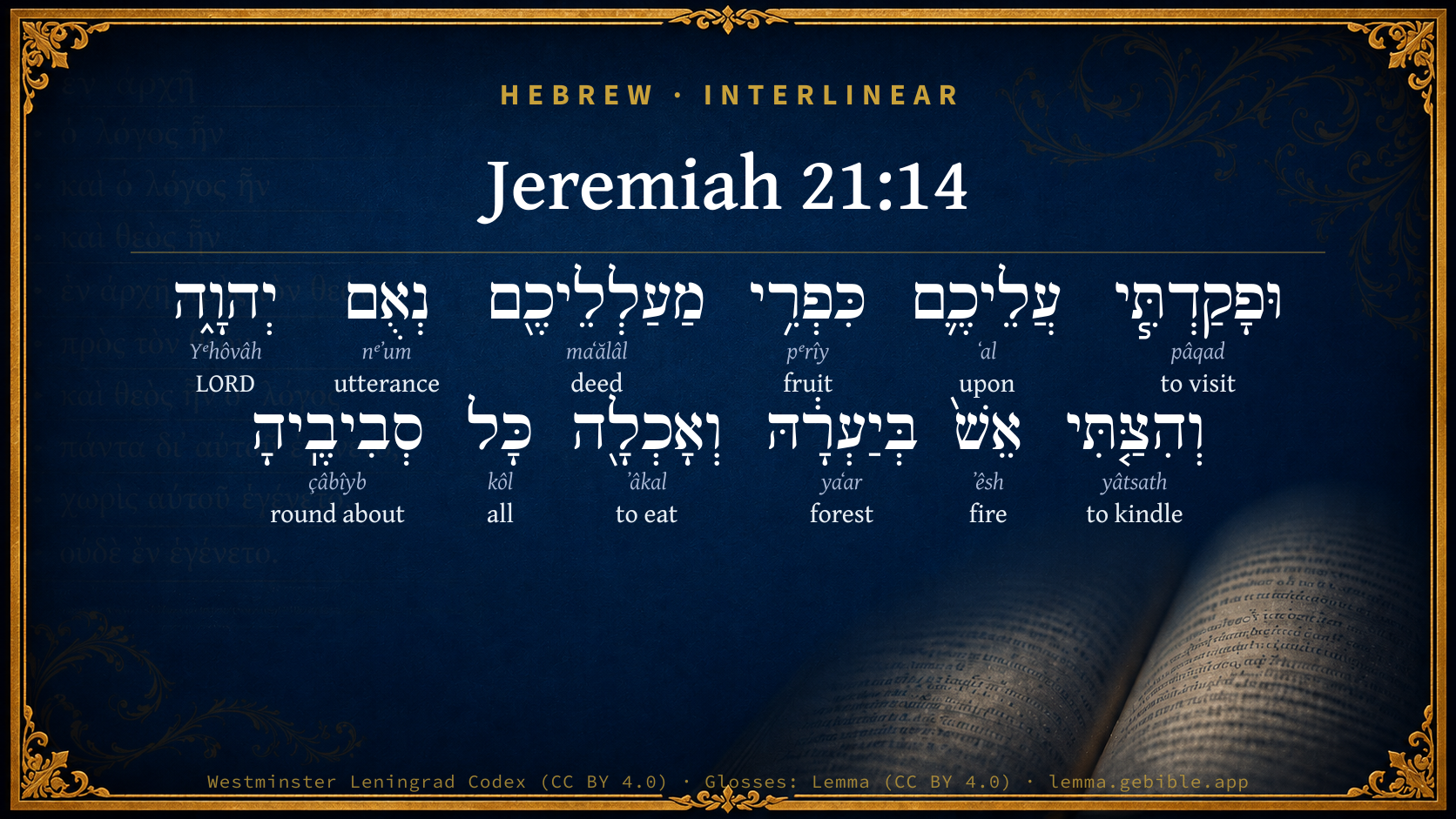
Hebrew (Westminster Leningrad Codex) Jeremiah 21:14 appears in the Hebrew Old Testament. The text above is from the Westminster Leningrad Codex. Each word links to its Strong’s number, a concise gloss, and parsing drawn from the Open Scriptures Hebrew Bible morphology. Click any word for its full Brown-Driver-Briggs (BDB) entry.
Download image
Cite this verse

Jeremiah 21:14 (World English Bible). Public Domain. Lemma interlinear Bible study tool, https://lemma.gebible.app/v/jeremiah/21/14.

Show BibTeX & RIS
BibTeX
RIS
English Translation
I will punish you according to the fruit of your doings, says Yahweh; and I will kindle a fire in her forest, and it shall devour all that is round about her.
World English Bible · Public Domain
Download a study sheet

One document with this verse’s original text, its word-by-word gloss line, the meaning frame, cross-references with their text, attributed commentary, and full source and license credits — printable, and it pastes into notes with its structure intact.

This verse Autodidact and up

Study sheet (.html) Plain text (.txt)

A passage Seminary Student

Up to 50 verses in one chapter. A passage sheet keeps up to 6 commentary sources and 12 cross-references per verse, in the order this page ranks them, and says so on the sheet whenever that leaves anything out. Ask for a single verse and you get the Autodidact verse sheet above.

Everything on this page stays free to read, with no account — the sheet is a download of what is already on screen, not access to it.

Want to remove ads? Support Godless Engineer
Compare translations 3

The same verse in 3 English versions, stacked beneath the original-language interlinear above. Click any original word for its lexicon entry.

Each is an independent rendering of the whole verse — the interlinear is not word-aligned to these translations.

Highlighted words mark where these versions differ — a whole-verse word diff, not a word-by-word alignment.

  • World English Bible Public Domain
    I will punish you according to the fruit of your doings, says Yahweh; and I will kindle a fire in her forest, and it shall devour all that is round about her.
  • King James Version Public Domain
    But I will punish you according to the fruit of your doings, saith the LORD: and I will kindle a fire in the forest thereof, and it shall devour all things round about it.
  • unfoldingWord Literal Text CC BY-SA 4.0
    And I will visit upon you according to the fruit of your deeds”—the declaration of Yahweh— “and I will kindle a fire in her forest, and it will consume all her surroundings.”

unfoldingWord Literal Text — © unfoldingWord, licensed CC BY-SA 4.0. Word-aligned USFM3 via Door43 (git.door43.org/unfoldingWord/en_ult).

Versions to compare (up to 4)

3 of 4 selected

Show all 18 translations

Every available English version of this verse, each an independent rendering of the whole verse.

  • World English Bible Public Domain
    I will punish you according to the fruit of your doings, says Yahweh; and I will kindle a fire in her forest, and it shall devour all that is round about her.
  • Berean Standard Bible Public Domain
    I will punish you as your deeds deserve, declares the LORD. I will kindle a fire in your forest that will consume everything around you.’”
  • Majority Standard Bible Public Domain
    I will punish you as your deeds deserve, declares the LORD. I will kindle a fire in your forest that will consume everything around you.’”
  • King James Version Public Domain
    But I will punish you according to the fruit of your doings, saith the LORD: and I will kindle a fire in the forest thereof, and it shall devour all things round about it.
  • American Standard Version (1901) Public Domain
    And I will punish you according to the fruit of your doings, saith Jehovah; and I will kindle a fire in her forest, and it shall devour all that is round about her.
  • Revised Version (1885) Public Domain
    And I will punish you according to the fruit of your doings, saith the LORD: and I will kindle a fire in her forest, and it shall devour all that is round about her.
  • Geneva Bible (1599) Public Domain
    But I will visite you according to the fruite of your workes, saith the Lord, and I will kindle a fire in the forest thereof, and it shall deuoure rounde about it.
  • Douay-Rheims (1899) Public Domain
    Behold I come to thee that dwelleth in a valley upon a rock above a plain, saith the Lord: and you say: Who shall strike us? and who shall enter into our houses?
  • Young's Literal Translation Public Domain
    And I have laid a charge against you, According to the fruit of your doings, An affirmation of Jehovah, And I have kindled a fire in its forest, And it hath consumed -- all its suburbs!
  • Literal Standard Version CC BY-SA 4.0
    And I have laid a charge against you, || According to the fruit of your doings,” || A declaration of YHWH, || “And I have kindled a fire in its forest, || And it has consumed all its outskirts!”
  • Unlocked Literal Bible CC BY-SA 4.0
    I have assigned the fruit of your practices to come against you—this is Yahweh's declaration— and I will light a fire in the thickets, and it will consume everything around it.'”
  • unfoldingWord Literal Text CC BY-SA 4.0
    And I will visit upon you according to the fruit of your deeds”—the declaration of Yahweh— “and I will kindle a fire in her forest, and it will consume all her surroundings.”
  • Darby Bible Public Domain
    And I will visit you according to the fruit of your doings, saith Jehovah; and I will kindle a fire in her forest, and it shall devour all that is round about her.
  • World Messianic Bible Public Domain
    I will punish you according to the fruit of your doings,’ says the LORD; ‘and I will kindle a fire in her forest, and it will devour all that is around her.’”
  • Webster's Bible Public Domain
    But I will punish you according to the fruit of your doings, saith the LORD: and I will kindle a fire in the forest thereof, and it shall devour all things around it.
  • Free Bible Version CC BY-SA 4.0
    I'm going to punish you as you deserve for what you've done, declares the Lord. I will set your forest on fire and it will burn up everything around you.”
  • Bible in Basic English Public Domain
    I will send punishment on you in keeping with the fruit of your doings, says the Lord: and I will put a fire in her woodlands, burning up everything round about her.
  • JPS Tanakh (1917) Public Domain
    And I will punish you according to the fruit of your doings, saith the LORD; and I will kindle a fire in her forest, and it shall devour all that is round about her.

Literal Standard Version (2020), Covenant Press — licensed CC BY-SA 4.0. Text via the HelloAO Bible API (eBible.org). Unlocked Literal Bible (unfoldingWord) — licensed CC BY-SA 4.0. Text via the HelloAO Bible API (eBible.org). unfoldingWord Literal Text — © unfoldingWord, licensed CC BY-SA 4.0. Word-aligned USFM3 via Door43 (git.door43.org/unfoldingWord/en_ult). Free Bible Version, Dr. Jonathan Gallagher — licensed CC BY-SA 4.0. Text via the HelloAO Bible API (eBible.org).

Word by word

More ways to search: Search by grammar → Find every occurrence → Compare this word →

Practice this passage: Drill this verse → Learn its vocabulary →

וְהִצַּ֤תִּי
yâtsath
H3341
“and · to kindle”
Conjunction + Verb, Hiphil, Sequential Perfect, 1st Person, Common, Singular
Part of Speech
Conjunction + Verb
Stem
Hiphil
Form
Sequential Perfect
Person
1st Person
Gender
Common
Number
Singular
Full BDB Definition

Origin: a primitive root

TWOT: 899

to kindle, burn, set on fire - (Qal) to kindle - (Niphal) - to be kindled - to be left desolate - (Hiphil) to set on fire, kindle
  1. וּפָקַדְתִּ֧י pâqad H6485 “and · to visit” Conjunction + Verb, Qal, Sequential Perfect, 1st Person, Common, Singular
  2. עֲלֵיכֶ֛ם ʻal H5921 “upon · you” Preposition + Suffix, Personal, 2nd Person, Masculine, Plural
  3. כִּפְרִ֥י pᵉrîy H6529 “like/as · fruit of” Preposition + Noun, Common, Masculine, Singular, Construct
  4. מַעַלְלֵיכֶ֖ם maʻălâl H4611 “deeds · your” Noun, Common, Masculine, Plural, Construct + Suffix, Personal, 2nd Person, Masculine, Plural
  5. נְאֻם nᵉʼum H5002 “utterance of” Noun, Common, Masculine, Singular, Construct
  6. יְהוָ֑ה Yᵉhôvâh H3068 “LORD” Noun, Proper
  7. אֵשׁ֙ ʼêsh H784 “fire” Noun, Common, Both, Singular, Absolute
  8. בְּיַעְרָ֔הּ yaʻar H3293 “in/at · forest · her” Preposition + Noun, Common, Masculine, Singular, Construct + Suffix, Personal, 3rd Person, Feminine, Singular
  9. וְאָכְלָ֖ה ʼâkal H398 “and · to eat” Conjunction + Verb, Qal, Sequential Perfect, 3rd Person, Feminine, Singular
  10. כָּל kôl H3605 “all of” Noun, Common, Masculine, Singular, Construct
  11. סְבִיבֶֽיהָ çâbîyb H5439 “round about · her” Noun, Common, Both, Singular, Construct + Suffix, Personal, 3rd Person, Feminine, Singular

About this verse

These counts appear in no published source. They are computed here, from the morphology-tagged text and Lemma’s own curated glosses. What Lemma adds →

12
words
12
distinct lemmas
Prophets
section

Shared distinctive vocabulary

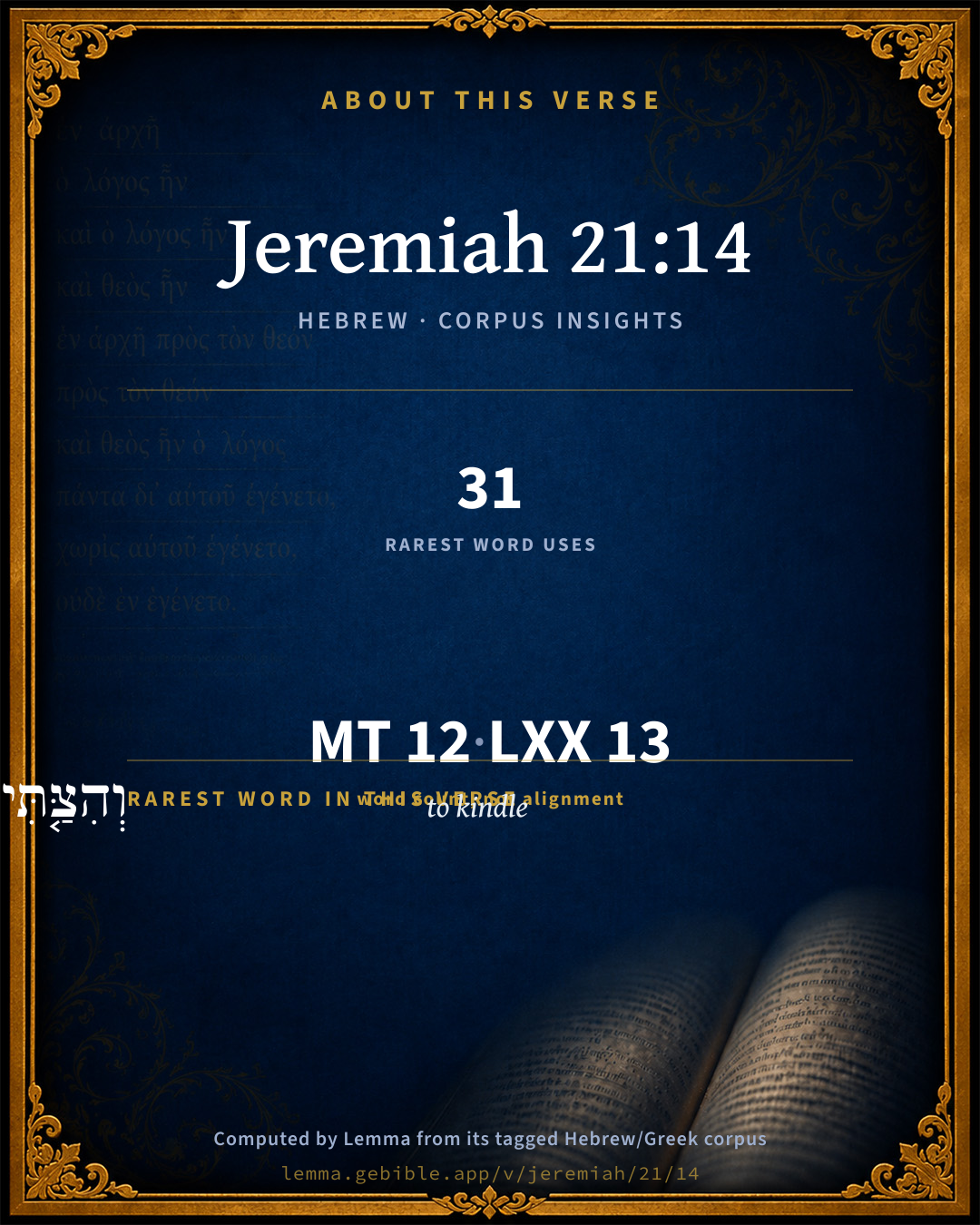
וְהִצַּ֤תִּי to kindle H3341 occurs in 28 verses of the Hebrew Bible. Also found in:

Grammatical profile

  • 3 verbs
  • 8 nouns
  • 1 preposition

Verb forms

  • וּפָקַדְתִּ֧י Qal · Sequential Perfect
  • וְהִצַּ֤תִּי Hiphil · Sequential Perfect
  • וְאָכְלָ֖ה Qal · Sequential Perfect

Hebrew & Septuagint length

In the original languages it is 12 Hebrew tokens and 13 Greek tokens — but the two are counted differently (Hebrew bundles its prefixes and suffixes into one token; the Greek is in lemma form), so that isn’t a like-for-like length.

Cross-references

18

Topical passages linked to Jeremiah 21:14 in the Treasury of Scripture Knowledge — connected by theme and wording, ordered by reader-vote popularity; previews shown in the World English Bible.

  • Isaiah 3:10–11 Tell the righteous "Good!" For they shall eat the fruit of their deeds.
  • Proverbs 1:31 Therefore they will eat of the fruit of their own way, And be filled with their own schemes.
  • Jeremiah 32:19 great in counsel, and mighty in work; whose eyes are open on all the ways of the sons of men, to give everyone according to his ways, and according to the fruit of his doings:
  • 2 Chronicles 36:19 They burnt the house of God, and broke down the wall of Jerusalem, and burnt all the palaces of it with fire, and destroyed all the goodly vessels of it.
  • Jeremiah 17:10 I, Yahweh, search the mind, I try the heart, even to give every man according to his ways, according to the fruit of his doings.
  • Jeremiah 52:13 and he burned the house of Yahweh, and the king's house; and all the houses of Jerusalem, even every great house, burned he with fire.
  • Isaiah 10:18–19 He will consume the glory of his forest, and of his fruitful field, both soul and body: and it shall be as when a standard-bearer faints.
  • Jeremiah 9:25 Behold, the days come, says Yahweh, that I will punish all those who are circumcised in [their] uncircumcision:
  • Ezekiel 20:46–48 Son of man, set your face toward the south, and drop [your word] toward the south, and prophesy against the forest of the field in the South;
  • Galatians 6:7–8 Don't be deceived. God is not mocked, for whatever a man sows, that will he also reap.
  • Isaiah 10:12 Therefore it shall happen that, when the Lord has performed his whole work on Mount Zion and on Jerusalem, I will punish the fruit of the stout heart of the king of Assyria, and the glory of his high looks.
  • Isaiah 24:21 It shall happen in that day, that Yahweh will punish the host of the high ones on high, and the kings of the earth on the earth.
  • Isaiah 27:10–11 For the fortified city is solitary, a habitation deserted and forsaken, like the wilderness: there shall the calf feed, and there shall he lie down, and consume the branches of it.
  • Isaiah 37:24 By your servants have you defied the Lord, and have said, With the multitude of my chariots am I come up to the height of the mountains, to the innermost parts of Lebanon; and I will cut down the tall cedars of it, and the choice fir trees of it; and I will enter into its farthest height, the forest of its fruitful field;
  • Jeremiah 6:29 The bellows blow fiercely; the lead is consumed of the fire: in vain do they go on refining; for the wicked are not plucked away.
  • Jeremiah 11:22 therefore thus says Yahweh of hosts, Behold, I will punish them: the young men shall die by the sword; their sons and their daughters shall die by famine;
  • Jeremiah 22:7 I will prepare destroyers against you, everyone with his weapons; and they shall cut down your choice cedars, and cast them into the fire.
  • Zechariah 11:1 Open your doors, Lebanon, That the fire may devour your cedars.

Cross-references courtesy of OpenBible.info (CC BY 4.0).

Hebrew and Greek witnesses Masoretic Hebrew ↔ Greek Septuagint

The same verse in the two great witnesses to the Old Testament, shown verse-for-verse.

These are two independent witnesses, not word-aligned to each other, and the Septuagint is shown in lemma (dictionary) form.

Hebrew Jeremiah 21:14 Masoretic · Westminster Leningrad Codex

וּפָקַדְתִּ֧י עֲלֵיכֶ֛ם כִּפְרִ֥י מַעַלְלֵיכֶ֖ם נְאֻם יְהוָ֑ה וְהִצַּ֤תִּי אֵשׁ֙ בְּיַעְרָ֔הּ וְאָכְלָ֖ה כָּל סְבִיבֶֽיהָ

I will punish you according to the fruit of your doings, says Yahweh; and I will kindle a fire in her forest, and it shall devour all that is round about her.

World English Bible · Public Domain

Greek LXX Structure differs

In the Septuagint, Jeremiah is about an eighth shorter than the Hebrew and arranges its material differently — the Oracles Against the Nations (Hebrew chapters 46–51) appear in the middle of the Greek book, after 25:13. Because the chapter and verse boundaries do not line up, a verse-for-verse comparison with the Hebrew is not shown.

A verse-for-verse comparison isn’t shown here because the chapters and verses don’t line up. Switch to the LXX edition with the MT / LXX toggle above to read the Greek directly.

Hebrew: Westminster Leningrad Codex (CC BY 4.0). Greek: Septuagint (public domain); English from a public-domain English Septuagint. How the Septuagint differs from the Hebrew →

Targum (Aramaic paraphrase)

1

The Targum is the ancient Jewish Aramaic paraphrase of the Hebrew Scriptures — an interpretive translation, not the Hebrew text itself. Onkelos (literal) and Pseudo-Jonathan (expansive) render the Torah, and Jonathan the Prophets. Coverage is partial: where no permissively-licensed English translation exists for a verse, only the Aramaic is shown. This is verse-level text, not a word-by-word alignment to the Hebrew.

  1. Targum Jonathan Prophets (Joshua–Malachi)
    וְאֶסְעַר עֲלֵיכוֹן כְּפֵירֵי עוֹבָדֵיכוֹן אֲמַר יְיָ וְאַדְלֵיק אֶשְׁתָּא בְּקִרְוָהָא וּתְשֵׁיצֵי בְּכָל סַחְרָנָהָא:

    (no public-domain English translation for this verse)

    Targum Jonathan — Aramaic: “Mikraot Gedolot” (public domain). English: “Sefaria Community Translation” (CC0 1.0 (public-domain dedication)); “London "Chaldee Paraphrase," 1871” (public domain). Text via Sefaria.

Commentary

Notes on Jeremiah 21:14 from classic Christian and Jewish commentators (each source and its license shown beneath its notes). The classic Christian expositions comment on the surrounding passage and are grouped to its opening verse, so a note may address several verses; the Jewish commentaries on the Tanakh (Rashi and others) are per-verse, so they appear only where the commentator wrote on this verse.

Lemma curates 59 commentaries, every one of them public domain or Creative Commons licensed, each selected and text-cleaned for this edition rather than reprinted as found. About our sources →

Trapp's Complete Commentary

John Trapp

Jer 21:14 But I will punish you according to the fruit of your doings, saith the LORD: and I will kindle a fire in the forest thereof, and it shall devour all things round about it.

Ver. 14. But I will punish you.] {a} And if I take you once to do, you are sure of your full payment. Heb., I will visit upon thee according to the fruit of your actions, i.e., I will lay upon you a punishment answerable to your sins; the sin being as the seed, and the punishment as the fruit that cometh of it - q.d., " Ye have sown the wind, and ye shall reap the whirlwind."

And I will kindle a fire in the forest thereof,] i.e., In the streets, which stand as thick with houses as the forest of Lebanon doth with trees, and are built with timber fetched from that forest.

{a} Puniam vos pro meritis.

John Trapp, A Commentary or Exposition upon All the Books of the Old and New Testament (1647–1656) — public domain. Text from a community e-Sword module.

Geneva Bible (1599)

Geneva Bible translators

That is, in the houses thereof, which stood as thick as trees in the forest.

Geneva Bible (1599) marginal notes — public domain. Text via Bolls.life.

Jamieson, Fausset & Brown

Robert Jamieson, A. R. Fausset & David Brown

fruit of your doings-- (Pro 1:31; Isa 3:10-11).

forest thereof--namely of your city, taken from Jer 21:13. "Forest" refers to the dense mass of houses built of cedar, &c., brought from Lebanon (Jer 22:7; Jer 52:13; Kg2 25:9).

Belonging to an earlier period than the twenty-first chapter, namely, the reigns of Shallum or Jehoahaz, Jehoiakim, and Jeconiah (Jer 22:10, Jer 22:13, Jer 22:20). Jeremiah often groups his prophecies, not by chronological order, but by similarity of subjects; thus Jer 22:3 corresponds to Jer 21:12. GROTIUS thinks that Jeremiah here repeats to Zedekiah what he had announced to that king's predecessors formerly (namely, his brother and brother's son), of a similar bearing, and which had since come to pass; a warning to Zedekiah. Probably, in arranging his prophecies they were grouped for the first time in the present order, designed by the Holy Spirit to set forth the series of kings of Judah, all four alike, failing in "righteousness," followed at last by the "King," a righteous Branch raised unto David, in the house of Judah, "the Lord our righteousness" (Jer 23:6). The unrighteousness of Zedekiah suggested the review of his predecessors' failure in the same respects, and consequent punishment, which ought to have warned him, but did not.

Next: Jeremiah Chapter 22

Jamieson, Fausset & Brown — Commentary Critical and Explanatory on the Whole Bible (1871) — public domain (CC PDM 1.0). Text via the HelloAO Bible API.

Adam Clarke's Commentary

Verse 14. I will kindle a fire in the forest thereof] I will send destruction into its centre, that shall spread to every part of the circumference, and so consume the whole.

The beginning of the thirty-fourth chapter should follow here. See the arrangement on Jer 21:1.

Adam Clarke's Commentary on the Bible (1810–1826) — public domain. Text from a community e-Sword/MySword module.

John Calvin's Commentaries

But God, on the contrary, says, Behold I will come to thee, or against thee, and will visit thee. There is, indeed, a change of number; for he says, I will visit you, for he had begun by saying, “Ye who say,” האמרים, eamrim. I will visit upon you, he says, the fruit of your doings; that is,

“I will deal with you according to what you have done, as your works deserve.” Merit is to be taken for reward. Then God threatens that he would render to the Jews what they merited, because they had not ceased to provoke his wrath.

He adds, lastly, I will kindle a fire in its forest Some take “forest” metaphorically for the neighboring towns; but this seems foreign to the Prophet’s meaning. I do not, indeed, deny but that there is a metaphor in the words; but then the word forest is not to be applied to towns and villages, but to the buildings of the city itself, according to a mode of speaking elsewhere used by the Prophets. As their houses were built of a large quantity of wood, of tall and most choice trees, the Prophet compares this mass of wood to a forest. We may, however, give a simpler explanation, and I know not whether it be more suitable that the Prophet points out Lebanon. He then means by the forest of the city the trees of Lebanon, which we know were particularly fine, for their loftiness were everywhere known; and we know also that they were very large. As, then, a part of their false glory was Mount Lebanon, the Prophet distinctly intimates that it would serve as a help to burn the city itself; for when God burned Jerusalem, he would take from the vicinity materials for the purpose.

Now, as we understand the meaning of the Prophet, let us learn how to apply this passage. We have said elsewhere that nothing is more hateful to God than false confidence; when men, relying on their own resources, promise to themselves a happy and a safe condition, they become torpid in their own security. Thus it comes, that they despise God, and never flee to him; they scorn his judgments, and at length are carried away by a mad impulse to every kind of insolence. This is the reason why the Prophets so often and so sharply reprove secure men, for they become presumptuous towards God when they are touched by no regard for him, and with no fear of him. They then not only dishonor God by transferring the hope of their safety to mere means or such helps as they foolishly depend on, but they also think that they are not under the authority of God. Hence it is, that they promise themselves impunity, and thus become wholly hardened in their sins. Now follows —

John Calvin's Commentaries (1540-1563) — public domain. Text from the Calvin Translation Society English edition (1840s-50s) via the Christian Classics Ethereal Library (ccel.org). Calvin's coverage is partial (roughly two-thirds of the Bible); uncommented books and verses are honest gaps, never fabricated. The 19th-century editor's footnotes and remarks are omitted so the notes are faithfully Calvin's own voice.

Ellicott's Commentary for English Readers

(14) I will kindle a fire in the forest thereof.—The “forest” thus referred to may be either literally the woods, then covering a larger surface than in later times, at Kirjath-jearim (Psa_132:6; 1Sa_7:2), or the wood of the lone wilderness of Ziph (1Sa_23:15), or the valley of Rephaim (2Sa_5:22), or, figuratively, the royal palace, which, from its cedar columns (1Ki_7:2; 1Ki_10:21), was known as “the house of the forest of Lebanon.” (Comp. the comparison of the king’s house to “Gilead and the head of Lebanon,” in Jer_22:6.) The desolation wrought by an invading army such as that of Nebuchadnezzar, cutting down the “choice fir-trees of Lebanon and the forest of Carmel” (2Ki_19:23), showed itself in this destruction of forests in its most conspicuous form, and explains the comparative scarcity of trees in modern Palestine. So Assur-nasirpal narrates, in the history of his conquests, how he had cut down the pine, box, cypress, and other trees of the forest (Records of the Past, iii. p. 74).

A Bible Commentary for English Readers, edited by Charles John Ellicott (1878–1897) — public domain. Text from a community e-Sword module.

The Cambridge Bible for Schools and Colleges

gen. ed. J. J. S. Perowne

14. and I will kindle, etc.] Cp. on Jer_17:27.

in her forest] i.e. Jerusalem, which is likened to a forest about to be wholly consumed by fire. For the same figure, representing in that case the people of Israel, cp. Isa_9:18. The expression does not mean literal trees, of which there was nothing like a forest in the neighbourhood of the city, but denotes either the houses clustering together like a forest, or, more generally, the beauty and grandeur of the place. Cp. for the general sense note on Gilead, etc. ch. Jer_22:6; also Isa_10:34, where Sennacherib, king of Assyria, is likened to “the thickets of the forest,” and to “Lebanon.”

The Cambridge Bible for Schools and Colleges (gen. ed. J. J. S. Perowne; Cambridge University Press, 1878–1918) — public domain. Text from a community e-Sword module.

John Gill's Exposition

But I will punish you according to the fruit of your doings,

saith the Lord,.... The situation of their city, and the strength of its fortifications, however sufficient they might be thought to keep out an enemy from annoying them; yet it was impossible to hinder the Lord's coming among them, as he here threatens to do; and "visit" them, as the word signifies, in a way of wrath and justice, according to the demerit of their sins, expressed by "the fruit of their doings"; their punishment was the reward of their unrighteousness, the effect of their sinful practices; and, though this was dreadful and terrible, they could not but own it was just and equitable:

and I will kindle a fire in the forest thereof; not in the forest of Lebanon, but in the city of Jerusalem; whose houses stood as thick as trees in a forest, and which many of them, at least the most stately, might be built or ceiled with cedars from Mount Lebanon and its forest; though some understand this of the cities and towns about Jerusalem; and so the Targum renders it, "in its cities"; and the Syriac version, "its towns"; but these seem rather meant in the following clause:

and it shall devour all things round about it; the mountains and trees upon them, the cities and towns adjacent.

Next: Jeremiah Chapter 22

John Gill's Exposition of the Whole Bible (1746–1763) — public domain (CC PDM 1.0). Text via the HelloAO Bible API.

Albert Barnes' Notes on the Bible

The forest - This suggested to the Jew the idea of everything grand and stately.

Albert Barnes' Notes on the Bible (1834–1885) — public domain. Text from a community e-Sword/MySword module.

Haydock's Catholic Bible Commentary

Doings. Hebrew, "studies." So "Your studious pursuits" occurs, ver. 12, in many Hebrew manuscripts, though the printed copy have, "their;" and "spoiled" for apprised. (Kennicott) --- Forest, the temple, which is called Libanus, (Zacharias xi. 21.) and the houses built of cedar-wood, (4 Kings xxv. 9.; Calmet) particularly the royal palace of the forest, 3 Kings vii. (Haydock)

George Leo Haydock (1774–1849), Haydock's Catholic Family Bible and Commentary, 1859 edition — public domain. Excludes Psalms (Douay-Rheims chapter numbering differs from Protestant) and Deuterocanonical books (Catholic canon only).

Matthew Poole's English Annotations

I will punish you; in the Hebrew it is, I will visit upon you. God’s visitations are either of mercy, Psa 80:14; 106:4, or of judgment; therefore the sense is here rightly given by our translators punish. According to the fruit of your doings; the fruit of men’s doings is the product of their actions; God punisheth the fruit of our doings. In showing mercy, he acts from prerogative; in punishments, he doth but fill men with their own ways, and give them according to the fruit of their doings; so Jer 21:12.

I will kindle a fire in the forest thereof; by the forest he either meaneth the forest of Lebanon, or their houses made up of wood cut out of that forest, or their idolatrous groves.

And it shall devour all things round about it; and this fire he saith should not determine in the destruction only of this city, but in the total destruction of all the country adjacent to Jerusalem.

Matthew Poole's English Annotations on the Holy Bible (1683–1685) — public domain. Text from a community e-Sword/MySword module.

Whedon's Commentary on the Bible

Daniel D. Whedon

14. In answer to the self-secure question of the preceding verse, “Who shall come down against us?” the terrible answer comes, the Lord! The strong city has no defences against Him, and he it is who will accomplish its overthrow.

Forest — The dense mass of houses, built, many of them, of the Lebanon cedar. Hence the expressions in Jer_22:6, “Gilead” and “head of Lebanon.”

Daniel D. Whedon (gen. ed.), Commentary on the Old and New Testaments (1874–1909) — public domain. Text from a community e-Sword module.

The Pulpit Commentary

In the forest thereof; i.e. in the forest of houses. (comp. Jer_22:6, Jer_22:7)

The Pulpit Commentary (1880–1919), ed. H.D.M. Spence-Jones & Joseph S. Exell — public domain. Text from a community e-Sword module.

John Wesley's Explanatory Notes

The forest - By the forest he either means the forest of Lebanon or their houses, made of wood cut out of that forest. And it - And this fire shall not end in the destruction of this city, but in the total destruction of all the country round Jerusalem.

John Wesley, Explanatory Notes Upon the Whole Bible (1754–1765) — public domain. Text via the GEBible commentary corpus.

Lesson kit

Teaching starters — assembled from the data on this page, not authored interpretation. Every prompt links to the verse data it draws on. Edit before teaching.

Jeremiah, in the Prophets, opens this verse with 12 words (12 distinct Hebrew lemmas). Its most distinctive word is yâtsath (“to kindle”). A historical commentator’s framing appears above. Read the whole chapter for the surrounding context.

Discussion questions

  1. The word yâtsath carries the sense “to kindle.” How does it shape the verse?
  2. How does Joshua 8:8, which shares the word «to kindle», read alongside this verse?
  3. The translations on this page render this verse differently — a whole-verse word diff, not a word-by-word alignment. What might account for the different wordings?
  4. «וּפָקַדְתִּ֧י» is a Qal Sequential Perfect verb. How does that grammatical form shape the action described?
  5. Compare how Trapp's Complete Commentary and Geneva Bible (1599) read this verse. Where do they agree or differ?

Things to notice

Reading settings

Reading text

Shown beneath each verse's original-language words.

Old Testament
Old Testament edition

Read the OT as the Masoretic Hebrew (MT) or the Greek Septuagint (LXX).

English shown for the Greek Septuagint (in the Hebrew ↔ Greek comparison).

Comparing translations? Open the Compare panel on any verse page to stack up to four side by side.