
Psalms 107:37

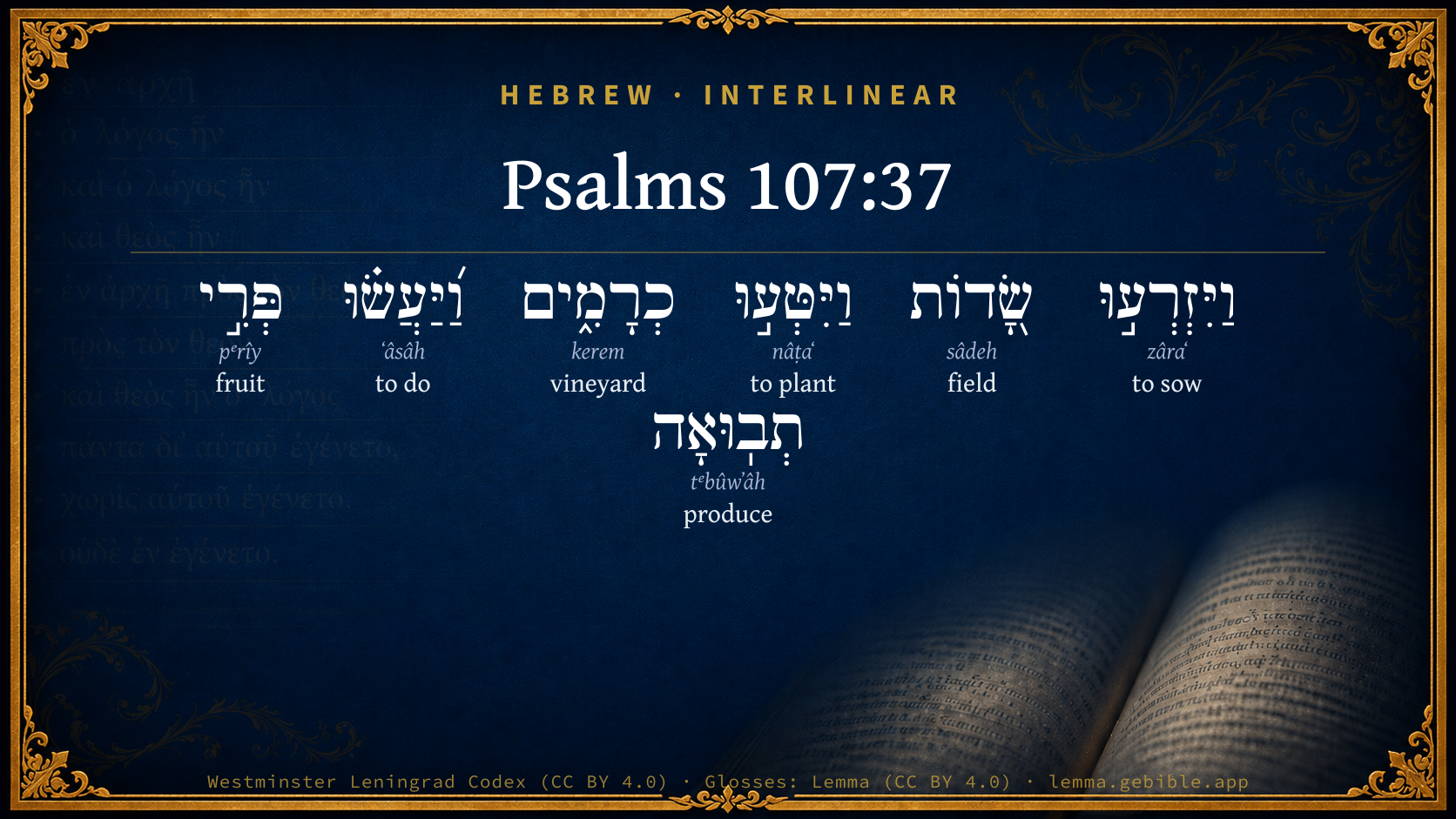
Hebrew (Westminster Leningrad Codex) Psalms 107:37 appears in the Hebrew Old Testament. The text above is from the Westminster Leningrad Codex. Each word links to its Strong’s number, a concise gloss, and parsing drawn from the Open Scriptures Hebrew Bible morphology. Click any word for its full Brown-Driver-Briggs (BDB) entry.
Download image
Cite this verse

Psalms 107:37 (World English Bible). Public Domain. Lemma interlinear Bible study tool, https://lemma.gebible.app/v/psalms/107/37.

Show BibTeX & RIS
BibTeX
RIS
English Translation
Sow fields, plant vineyards, And reap the fruits of increase.
World English Bible · Public Domain
Download a study sheet

One document with this verse’s original text, its word-by-word gloss line, the meaning frame, cross-references with their text, attributed commentary, and full source and license credits — printable, and it pastes into notes with its structure intact.

This verse Autodidact and up

Study sheet (.html) Plain text (.txt)

A passage Seminary Student

Up to 50 verses in one chapter. A passage sheet keeps up to 6 commentary sources and 12 cross-references per verse, in the order this page ranks them, and says so on the sheet whenever that leaves anything out. Ask for a single verse and you get the Autodidact verse sheet above.

Everything on this page stays free to read, with no account — the sheet is a download of what is already on screen, not access to it.

Want to remove ads? Support Godless Engineer
Compare translations 3

The same verse in 3 English versions, stacked beneath the original-language interlinear above. Click any original word for its lexicon entry.

Each is an independent rendering of the whole verse — the interlinear is not word-aligned to these translations.

Highlighted words mark where these versions differ — a whole-verse word diff, not a word-by-word alignment.

  • World English Bible Public Domain
    Sow fields, plant vineyards, And reap the fruits of increase.
  • King James Version Public Domain
    And sow the fields, and plant vineyards, which may yield fruits of increase.
  • unfoldingWord Literal Text CC BY-SA 4.0
    Then they sow fields and plant vineyards, and they produce the fruit of the harvest.

unfoldingWord Literal Text — © unfoldingWord, licensed CC BY-SA 4.0. Word-aligned USFM3 via Door43 (git.door43.org/unfoldingWord/en_ult).

Versions to compare (up to 4)

3 of 4 selected

Show all 18 translations

Every available English version of this verse, each an independent rendering of the whole verse.

  • World English Bible Public Domain
    Sow fields, plant vineyards, And reap the fruits of increase.
  • Berean Standard Bible Public Domain
    They sow fields and plant vineyards that yield a fruitful harvest.
  • Majority Standard Bible Public Domain
    They sow fields and plant vineyards that yield a fruitful harvest.
  • King James Version Public Domain
    And sow the fields, and plant vineyards, which may yield fruits of increase.
  • American Standard Version (1901) Public Domain
    And sow fields, and plant vineyards, And get them fruits of increase.
  • Revised Version (1885) Public Domain
    And sow fields, and plant vineyards, and get them fruits of increase.
  • Geneva Bible (1599) Public Domain
    And sowe the fieldes, and plant vineyardes, which bring foorth fruitfull increase.
  • Douay-Rheims (1899) Public Domain
    And they sowed fields, and planted vineyards: and they yielded fruit of birth.
  • Young's Literal Translation Public Domain
    And they sow fields, and plant vineyards, And they make fruits of increase.
  • Literal Standard Version CC BY-SA 4.0
    And they sow fields, and plant vineyards, || And they make fruits of increase.
  • Unlocked Literal Bible CC BY-SA 4.0
    They build a city to plant fields in, to plant vineyards, and to bring in an abundant harvest.
  • unfoldingWord Literal Text CC BY-SA 4.0
    Then they sow fields and plant vineyards, and they produce the fruit of the harvest.
  • Darby Bible Public Domain
    And sow fields, and plant vineyards, which yield fruits of increase;
  • World Messianic Bible Public Domain
    sow fields, plant vineyards, and reap the fruits of increase.
  • Webster's Bible Public Domain
    And sow the fields, and plant vineyards, which may yield fruits of increase.
  • Free Bible Version CC BY-SA 4.0
    They sow their fields and plant their vineyards, producing a good harvest.
  • Bible in Basic English Public Domain
    And put seed in the fields and make vine-gardens, to give them fruit.
  • JPS Tanakh (1917) Public Domain
    And sow fields, and plant vineyards, which yield fruits of increase.

Literal Standard Version (2020), Covenant Press — licensed CC BY-SA 4.0. Text via the HelloAO Bible API (eBible.org). Unlocked Literal Bible (unfoldingWord) — licensed CC BY-SA 4.0. Text via the HelloAO Bible API (eBible.org). unfoldingWord Literal Text — © unfoldingWord, licensed CC BY-SA 4.0. Word-aligned USFM3 via Door43 (git.door43.org/unfoldingWord/en_ult). Free Bible Version, Dr. Jonathan Gallagher — licensed CC BY-SA 4.0. Text via the HelloAO Bible API (eBible.org).

Word by word

More ways to search: Search by grammar → Find every occurrence → Compare this word →

Practice this passage: Drill this verse → Learn its vocabulary →

About this verse

These counts appear in no published source. They are computed here, from the morphology-tagged text and Lemma’s own curated glosses. What Lemma adds →

7
words
7
distinct lemmas
Wisdom
section

Shared distinctive vocabulary

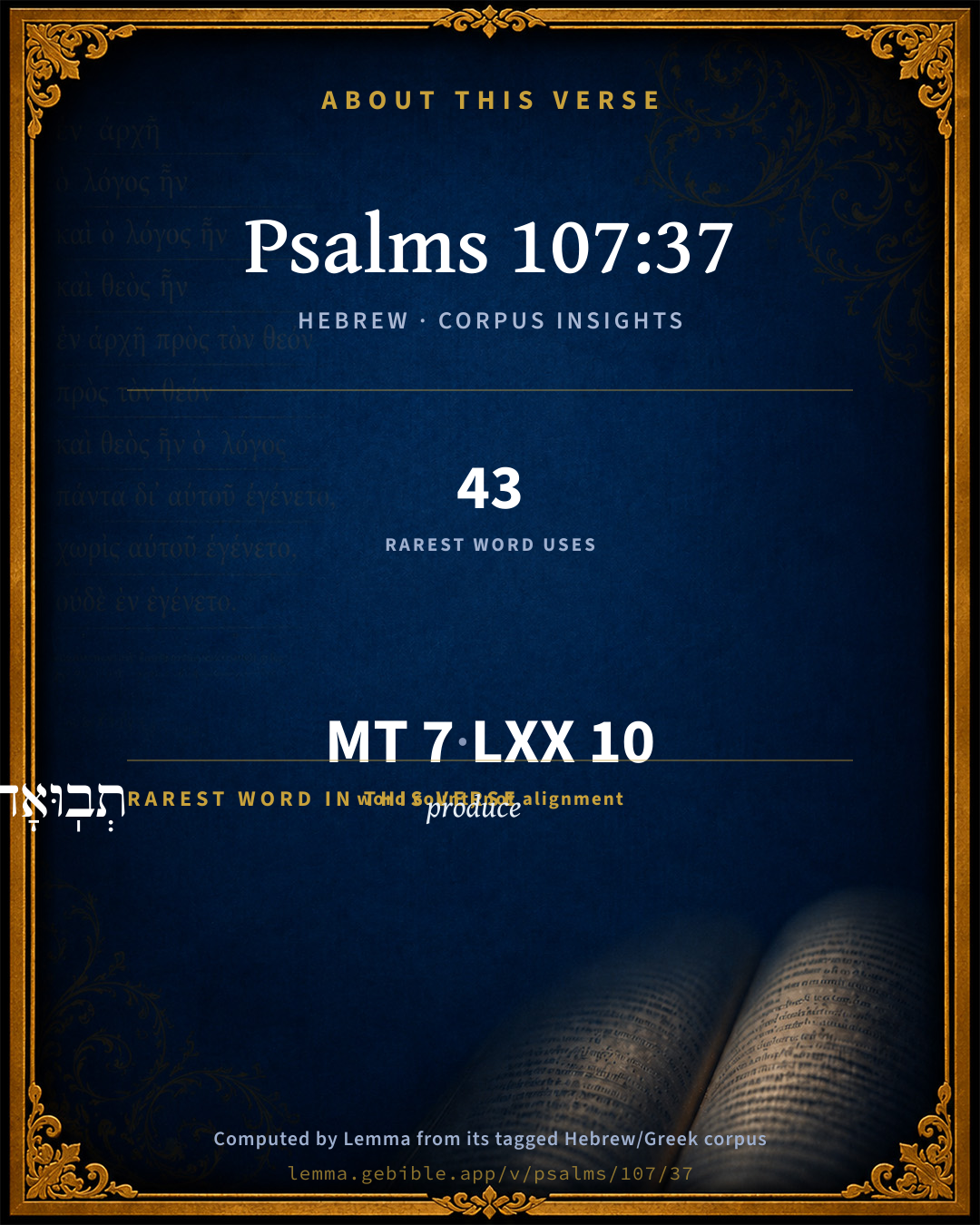
תְבֽוּאָה produce H8393 occurs in 40 verses of the Hebrew Bible. Also found in:

Grammatical profile

  • 3 verbs
  • 4 nouns

Verb forms

  • וַיִּזְרְע֣וּ Qal · Sequential Imperfect
  • וַיִּטְּע֣וּ Qal · Sequential Imperfect
  • וַ֝יַּעֲשׂ֗וּ Qal · Sequential Imperfect

Hebrew & Septuagint length

In English translation the verse runs 10 words from the Hebrew and 13 from the Septuagint (LXX English) — closely comparable.

A rough comparison of the two English renderings, which tokenize alike — not a word-level alignment.

Word counts can differ between the Hebrew and the Greek without any difference in meaning — e.g. the Hebrew direct-object marker אֵת has no separate Greek word, and Greek often adds the article ὁ.

In the original languages it is 7 Hebrew tokens and 10 Greek tokens — but the two are counted differently (Hebrew bundles its prefixes and suffixes into one token; the Greek is in lemma form), so that isn’t a like-for-like length.

Cross-references

16

Topical passages linked to Psalms 107:37 in the Treasury of Scripture Knowledge — connected by theme and wording, ordered by reader-vote popularity; previews shown in the World English Bible.

  • 1 Corinthians 3:7 So then neither he who plants is anything, nor he who waters, but God who gives the increase.
  • 2 Corinthians 9:10 Now may he who supplies seed to the sower and bread for food, supply and multiply your seed for sowing, and increase the fruits of your righteousness;
  • Isaiah 37:30 This shall be the sign to you: you shall eat this year that which grows of itself, and in the second year that which springs of the same; and in the third year sow you, and reap, and plant vineyards, and eat the fruit of it.
  • Jeremiah 29:5 Build you houses, and dwell in them; and plant gardens, and eat the fruit of them.
  • Zechariah 8:12 "For the seed of peace and the vine will yield its fruit, and the ground will give its increase, and the heavens will give their dew; and I will cause the remnant of this people to inherit all these things.
  • Genesis 26:12 Isaac sowed in that land, and reaped in the same year one hundred times what he planted. Yahweh blessed him.
  • Ezekiel 28:26 They shall dwell securely therein; yes, they shall build houses, and plant vineyards, and shall dwell securely, when I have executed judgments on all those who do them despite round about them; and they shall know that I am Yahweh their God.
  • Haggai 1:10–11 Therefore for your sake the heavens withhold the dew, and the earth withholds its fruit.
  • Psalms 65:9–13 You visit the earth, and water it. You greatly enrich it. The river of God is full of water. You provide them grain, for so you have ordained it.
  • Isaiah 65:21 They shall build houses, and inhabit them; and they shall plant vineyards, and eat the fruit of them.
  • Jeremiah 31:5 Again shall you plant vineyards on the mountains of Samaria; the planters shall plant, and shall enjoy [the fruit of it].
  • Joel 1:10–12 The field is laid waste. The land mourns, for the grain is destroyed, The new wine has dried up, And the oil languishes.
  • Haggai 1:5–6 Now therefore this is what Yahweh of Hosts says: Consider your ways.
  • Haggai 2:16–19 Through all that time, when one came to a heap of twenty measures, there were only ten. When one came to the wine vat to draw out fifty, there were only twenty.
  • Acts 14:17 Yet he didn't leave himself without witness, in that he did good and gave you rains from the sky and fruitful seasons, filling our hearts with food and gladness."
  • Amos 9:13–15 "Behold, the days come," says Yahweh, "That the plowman shall overtake the reaper, And the one treading grapes him who sows seed; And sweet wine will drip from the mountains, And flow from the hills.

Cross-references courtesy of OpenBible.info (CC BY 4.0).

Hebrew and Greek witnesses Masoretic Hebrew ↔ Greek Septuagint

The same verse in the two great witnesses to the Old Testament, shown verse-for-verse.

You’re reading Greek Psalm 106 (Hebrew Psalm 107). The Septuagint counts the superscription, so verse numbers can differ from the Hebrew — chapter-level alignment, not verse-by-verse. Numbering follows Rahlfs.

These are two independent witnesses, not word-aligned to each other, and the Septuagint is shown in lemma (dictionary) form.

Hebrew Psalms 107:37 Masoretic · Westminster Leningrad Codex

וַיִּזְרְע֣וּ שָׂ֭דוֹת וַיִּטְּע֣וּ כְרָמִ֑ים וַ֝יַּעֲשׂ֗וּ פְּרִ֣י תְבֽוּאָה

Sow fields, plant vineyards, And reap the fruits of increase.

World English Bible · Public Domain

Greek LXX Greek Psalm 106:37 Septuagint · lemma form

καί σπεῖρα ἀγρός καί φυτεύω ἀμπελών καί ποιέω καρπός γένημα

And they sow fields, and plant vineyards, and they yield fruit of increase.

LXX2012 (modern English Septuagint) · Public Domain

Hebrew: Westminster Leningrad Codex (CC BY 4.0). Greek: Septuagint (public domain); English from LXX2012 (modern English Septuagint) (Public Domain). How the Septuagint differs from the Hebrew →

Commentary

Notes on Psalms 107:37 from classic Christian and Jewish commentators (each source and its license shown beneath its notes). The classic Christian expositions comment on the surrounding passage and are grouped to its opening verse, so a note may address several verses; the Jewish commentaries on the Tanakh (Rashi and others) are per-verse, so they appear only where the commentator wrote on this verse.

Lemma curates 59 commentaries, every one of them public domain or Creative Commons licensed, each selected and text-cleaned for this edition rather than reprinted as found. About our sources →

The Cambridge Bible for Schools and Colleges

gen. ed. J. J. S. Perowne

37. And sowed fields and planted vineyards,

Which yielded fruitful produce.

With Psa_107:36 cp. Psa_107:4-5. In Psa_107:37 the R.V. and get them fruits is possible, but not in accordance with the general usage of the phrase.

The Cambridge Bible for Schools and Colleges (gen. ed. J. J. S. Perowne; Cambridge University Press, 1878–1918) — public domain. Text from a community e-Sword module.

Trapp's Complete Commentary

John Trapp

Psa 107:37 And sow the fields, and plant vineyards, which may yield fruits of increase.

Ver. 37. And sow the fields, and plant vineyards] These are noble employments, such as the ancient patriarchs were much in, and the most honourable among the Romans, as Coriolanus, Marcus Curius, Cato Major, &c. Our forefathers, if they could call any one bonum eolonum, a good husbandman, they thought it praise enough, saith Cicero.

Which may yield] The thankful earth yielding, by God’s blessing, her gratum onus, full burden to the laborious tiller.

John Trapp, A Commentary or Exposition upon All the Books of the Old and New Testament (1647–1656) — public domain. Text from a community e-Sword module.

J. A. Alexander on Psalms

Joseph Addison Alexander

37. (Psa 107:37) And have sowed fields, and panted vineyards, and made fruits of increase. The form of all these verbs requires them to be understood, like those of Psa 107:36, as referring to time actually past, from which some have inferred that the date of the psalm itself lay between the first ingathering of the fruits by the returned Jews and the founding of the temple, to which there is here no allusion. The word translated increase is applied elsewhere to the annual productions of the earth. See Lev 25:16. To make these is to gain or acquire them by cultivation, as we speak of making money, but of raising corn. See above, on Psa 60:12.

Joseph Addison Alexander, The Psalms Translated and Explained (1850) — public domain. Text from a community e-Sword module.

Geneva Bible (1599)

Geneva Bible translators

Continual increase and yearly.

Geneva Bible (1599) marginal notes — public domain. Text via Bolls.life.

John Gill's Exposition

He poureth contempt upon princes,.... That is, the Lord does, who is above them; he laughs at them, and has them in derision, when they are raging against his people, cause, and interest; he sets them up and pulls them down at his pleasure; he hurls them from their seats and thrones, and makes them contemptible to their subjects; he sometimes brings them to a shameful end, as Herod, who was eaten with worms; and wicked princes, if they are not brought to disgrace in this world, they will rise to shame and everlasting contempt in the other; and will stand with the meanest and lowest before the Judge of the whole earth; and seek to the rocks and mountains to cover them from his wrath. This particularly will be true of the antichristian princes, when the vials of God's wrath will be poured out upon them, Rev 16:1.

And causeth them to wander in the wilderness; where there is no way; no beaten track or path; whither being driven out of their kingdoms, they flee for shelter, and wander about in untrodden paths; as Nebuchadnezzar, when he was driven from men, and had his dwelling with the beasts of the field: or this may be interpreted, as it is by Aben Ezra and Kimchi, the infatuation of their wisdom, and of their being left without counsel, and erring through it; being at their wits' end, not knowing what step to take, or measures to concert; being in a maze, in a wilderness, at an entire loss what they should do; see Job 12:17.

John Gill's Exposition of the Whole Bible (1746–1763) — public domain (CC PDM 1.0). Text via the HelloAO Bible API.

Albert Barnes' Notes on the Bible

And sow the fields, and plant vineyards - Cultivate the earth. The culture of the vine was an important feature in agriculture in Palestine, and hence, it is made so prominent here.

Which may yield fruits of increase - The fruits which the earth produces.

Albert Barnes' Notes on the Bible (1834–1885) — public domain. Text from a community e-Sword/MySword module.

Matthew Poole's English Annotations

May yield, Heb. and they shall make or procure from their fields and vineyards.

Fruits of increase; such fruits as they use to produce.

Matthew Poole's English Annotations on the Holy Bible (1683–1685) — public domain. Text from a community e-Sword/MySword module.

The Treasury of David

Charles H. Spurgeon

Ver. 37. And sow the fields, and plant vineyards, which may yield fruits of increase. Men work when God works. His blessing encourages the sower, cheers the planter, and rewards the labourer. Not only necessaries but luxuries are enjoyed, wine as well as corn, when the heavens are caused to yield the needed rain to fill the watercourses. Divine visitations bring great spiritual riches, foster varied works of faith and labours of love, and cause every good fruit to abound to our comfort and to God's praise. When God sends the blessing it does not supersede, but encourages and develops human exertion. Paul plants, Apollos waters, and God gives the increase.

Psalms 107:38*

Charles H. Spurgeon's The Treasury of David (1869–1885) — public domain. Psalms only. Text from a community e-Sword/MySword module.

The Pulpit Commentary

And sow the fields; literally, and sow fields the first act of a settled population. And plant vineyards. The second act in a wine-producing country. Bread and wine were recognized in the East as the prime necessaries of life. (see Gen_14:18 Jud_1:9:13 19:19 2Sa_6:19 Neh_5:15 Psa_104:15 Dan_1:5, etc.) Which may yield fruits of increase; rather, and get them; literally, make them. The expression, "fruits of increase," points to the abundance of the harvest and vintage.

The Pulpit Commentary (1880–1919), ed. H.D.M. Spence-Jones & Joseph S. Exell — public domain. Text from a community e-Sword module.

Lesson kit

Teaching starters — assembled from the data on this page, not authored interpretation. Every prompt links to the verse data it draws on. Edit before teaching.

Psalms, in the Wisdom, opens this verse with 7 words (7 distinct Hebrew lemmas). Its most distinctive word is tᵉbûwʼâh (“produce”). A historical commentator’s framing appears above. Read the whole chapter for the surrounding context.

Discussion questions

  1. The word tᵉbûwʼâh carries the sense “produce.” How does it shape the verse?
  2. Genesis 47:24 shares the word «produce» with this verse. How do the two illuminate each other?
  3. These translations render this verse differently; the difference is in the English rendering, not the original. What questions does that raise?
  4. The verb «וַיִּזְרְע֣וּ» is Qal Sequential Imperfect. How does its form color the action?
  5. Reading how The Cambridge Bible for Schools and Colleges and Trapp's Complete Commentary read this verse, where do the two commentators agree and where do they part?

Things to notice

Reading settings

Reading text

Shown beneath each verse's original-language words.

Old Testament
Old Testament edition

Read the OT as the Masoretic Hebrew (MT) or the Greek Septuagint (LXX).

English shown for the Greek Septuagint (in the Hebrew ↔ Greek comparison).

Comparing translations? Open the Compare panel on any verse page to stack up to four side by side.