
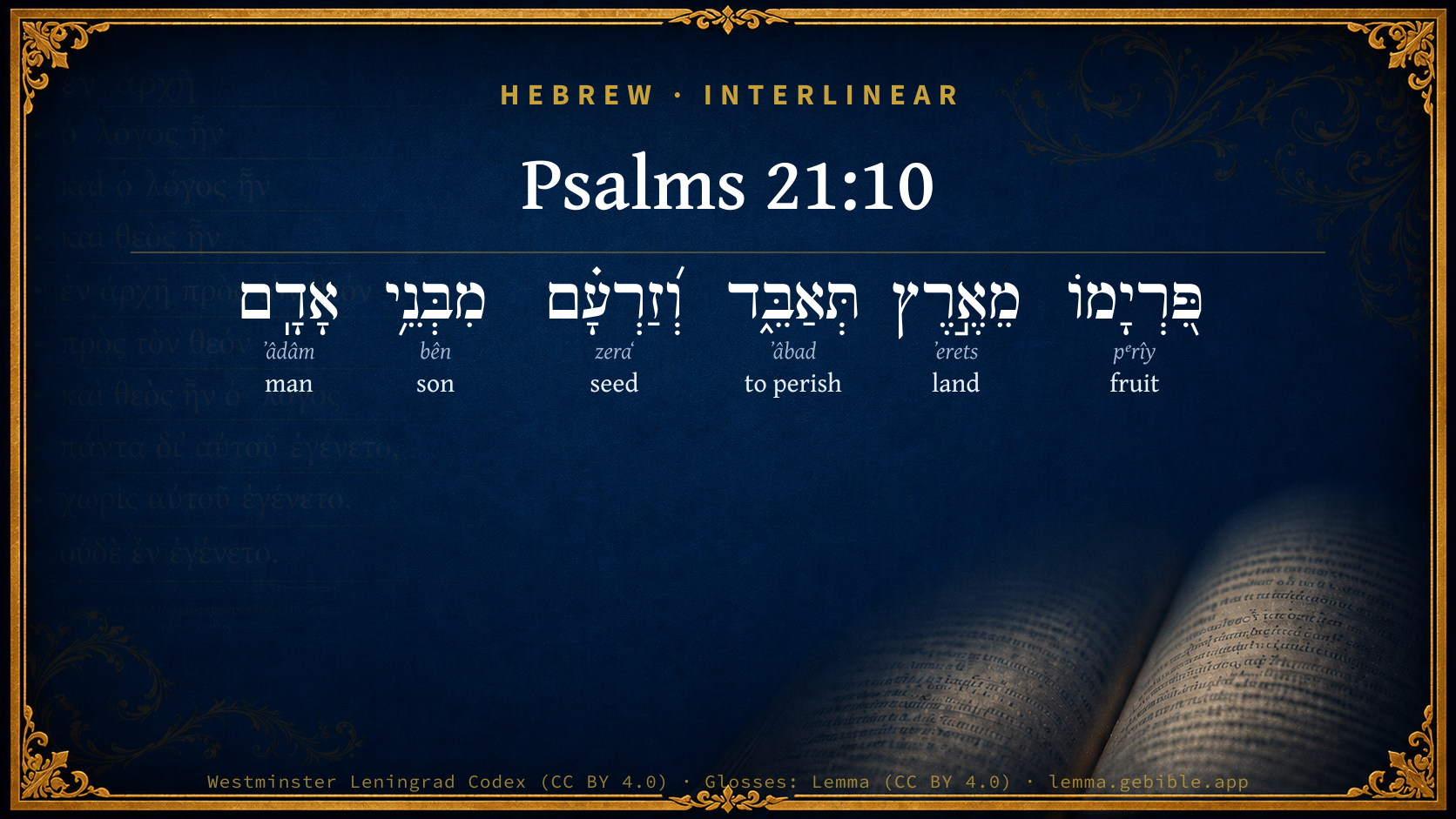
Psalms 21:10

Hebrew (Westminster Leningrad Codex) Psalms 21:10 appears in the Hebrew Old Testament. The text above is from the Westminster Leningrad Codex. Each word links to its Strong’s number, a concise gloss, and parsing drawn from the Open Scriptures Hebrew Bible morphology. Click any word for its full Brown-Driver-Briggs (BDB) entry.
Download image
Cite this verse

Psalms 21:10 (World English Bible). Public Domain. Lemma interlinear Bible study tool, https://lemma.gebible.app/v/psalms/21/10.

Show BibTeX & RIS
BibTeX
RIS
English Translation
You will destroy their descendants from the earth, Their posterity from among the children of men.
World English Bible · Public Domain
Download a study sheet

One document with this verse’s original text, its word-by-word gloss line, the meaning frame, cross-references with their text, attributed commentary, and full source and license credits — printable, and it pastes into notes with its structure intact.

This verse Autodidact and up

Study sheet (.html) Plain text (.txt)

A passage Seminary Student

Up to 50 verses in one chapter. A passage sheet keeps up to 6 commentary sources and 12 cross-references per verse, in the order this page ranks them, and says so on the sheet whenever that leaves anything out. Ask for a single verse and you get the Autodidact verse sheet above.

Everything on this page stays free to read, with no account — the sheet is a download of what is already on screen, not access to it.

Want to remove ads? Support Godless Engineer
Compare translations 3

The same verse in 3 English versions, stacked beneath the original-language interlinear above. Click any original word for its lexicon entry.

Each is an independent rendering of the whole verse — the interlinear is not word-aligned to these translations.

Highlighted words mark where these versions differ — a whole-verse word diff, not a word-by-word alignment.

  • World English Bible Public Domain
    You will destroy their descendants from the earth, Their posterity from among the children of men.
  • King James Version Public Domain
    Their fruit shalt thou destroy from the earth, and their seed from among the children of men.
  • unfoldingWord Literal Text CC BY-SA 4.0
    You will destroy their fruit from the earth and their seed from the sons of man.

unfoldingWord Literal Text — © unfoldingWord, licensed CC BY-SA 4.0. Word-aligned USFM3 via Door43 (git.door43.org/unfoldingWord/en_ult).

Versions to compare (up to 4)

3 of 4 selected

Show all 18 translations

Every available English version of this verse, each an independent rendering of the whole verse.

  • World English Bible Public Domain
    You will destroy their descendants from the earth, Their posterity from among the children of men.
  • Berean Standard Bible Public Domain
    You will wipe their descendants from the earth, and their offspring from the sons of men.
  • Majority Standard Bible Public Domain
    You will wipe their descendants from the earth, and their offspring from the sons of men.
  • King James Version Public Domain
    Their fruit shalt thou destroy from the earth, and their seed from among the children of men.
  • American Standard Version (1901) Public Domain
    Their fruit wilt thou destroy from the earth, And their seed from among the children of men.
  • Revised Version (1885) Public Domain
    Their fruit shalt thou destroy from the earth, and their seed from among the children of men.
  • Geneva Bible (1599) Public Domain
    Their fruite shalt thou destroy from the earth, and their seede from the children of men.
  • Douay-Rheims (1899) Public Domain
    Thou shalt make them as an oven of fire, in the time of thy anger: the Lord shall trouble them in his wrath, and fire shall devour them.
  • Young's Literal Translation Public Domain
    Their fruit from earth Thou destroyest, And their seed from the sons of men.
  • Literal Standard Version CC BY-SA 4.0
    You destroy their fruit from earth, || And their seed from the sons of men.
  • Unlocked Literal Bible CC BY-SA 4.0
    You will destroy their offspring from the earth and their descendants from among the human race.
  • unfoldingWord Literal Text CC BY-SA 4.0
    You will destroy their fruit from the earth and their seed from the sons of man.
  • Darby Bible Public Domain
    Their fruit shalt thou destroy from the earth, and their seed from among the children of men.
  • World Messianic Bible Public Domain
    You will destroy their descendants from the earth, their posterity from among the children of men.
  • Webster's Bible Public Domain
    \\21:9\\Thou shalt make them as a fiery oven in the time of thy anger: the LORD shall swallow them up in his wrath, and the fire shall devour them.
  • Free Bible Version CC BY-SA 4.0
    You will wipe out their children from the earth, their descendants from humankind.
  • Bible in Basic English Public Domain
    Their fruit will be cut off from the earth, and their seed from among the children of men.
  • JPS Tanakh (1917) Public Domain
    (21-11) Their fruit shalt thou destroy from the earth, and their seed from among the children of men.

Literal Standard Version (2020), Covenant Press — licensed CC BY-SA 4.0. Text via the HelloAO Bible API (eBible.org). Unlocked Literal Bible (unfoldingWord) — licensed CC BY-SA 4.0. Text via the HelloAO Bible API (eBible.org). unfoldingWord Literal Text — © unfoldingWord, licensed CC BY-SA 4.0. Word-aligned USFM3 via Door43 (git.door43.org/unfoldingWord/en_ult). Free Bible Version, Dr. Jonathan Gallagher — licensed CC BY-SA 4.0. Text via the HelloAO Bible API (eBible.org).

Word by word

More ways to search: Search by grammar → Find every occurrence → Compare this word →

Practice this passage: Drill this verse → Learn its vocabulary →

About this verse

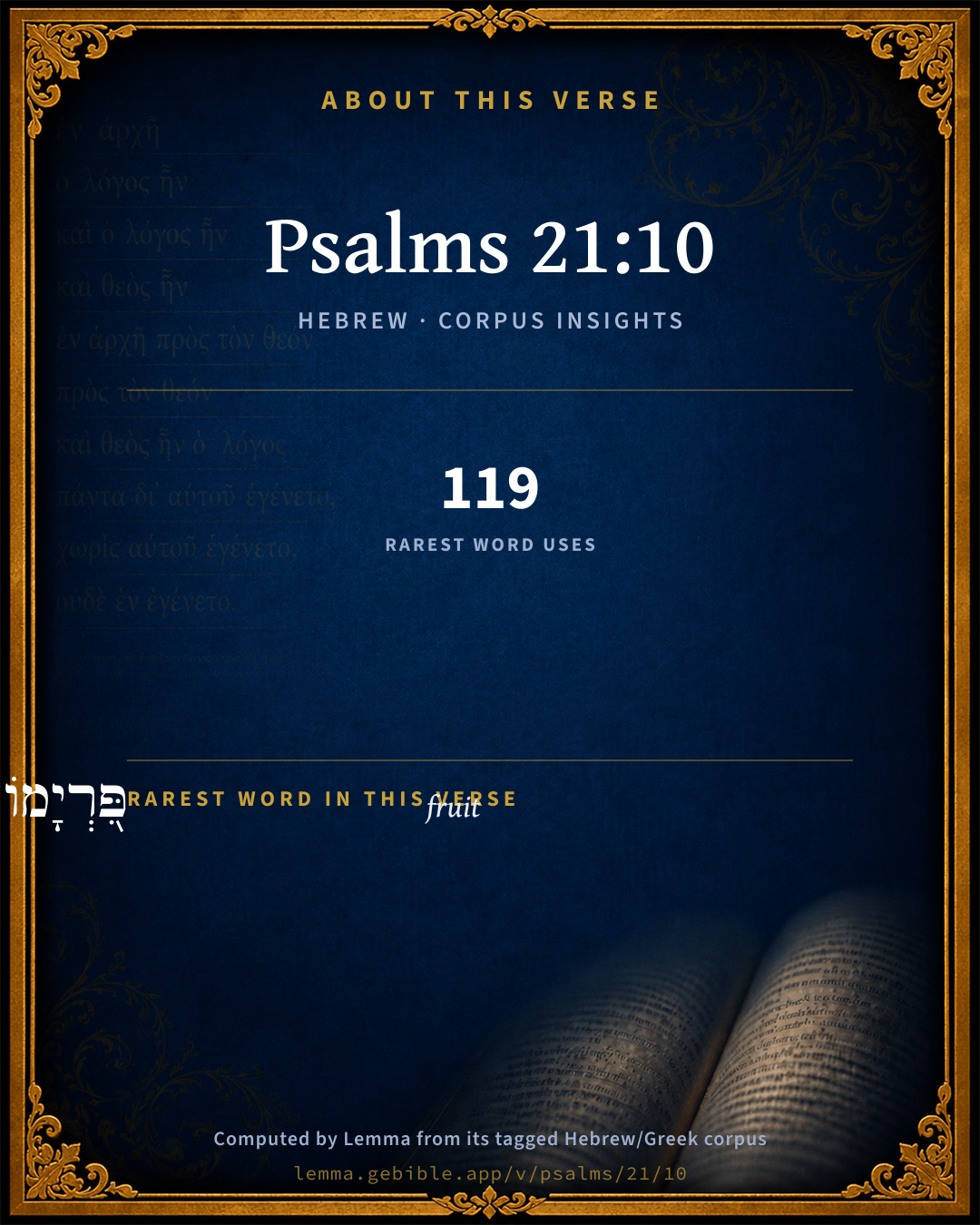
These counts appear in no published source. They are computed here, from the morphology-tagged text and Lemma’s own curated glosses. What Lemma adds →

6
words
6
distinct lemmas
Wisdom
section

Grammatical profile

  • 1 verb
  • 5 nouns

Verb forms

  • תְּאַבֵּ֑ד Piel · Imperfect

Hebrew & Septuagint length

In English translation the verse runs 16 words from the Hebrew and 17 from the Septuagint (LXX English) — closely comparable.

A rough comparison of the two English renderings, which tokenize alike — not a word-level alignment.

Word counts can differ between the Hebrew and the Greek without any difference in meaning — e.g. the Hebrew direct-object marker אֵת has no separate Greek word, and Greek often adds the article ὁ.

Cross-references

7

Topical passages linked to Psalms 21:10 in the Treasury of Scripture Knowledge — connected by theme and wording, ordered by reader-vote popularity; previews shown in the World English Bible.

  • Psalms 37:28 For Yahweh loves justice, And doesn't forsake his saints. They are preserved forever, But the children of the wicked shall be cut off.
  • 1 Kings 13:34 This thing became sin to the house of Jeroboam, even to cut it off, and to destroy it from off the surface of the earth.
  • Job 20:28 The increase of his house shall depart; They shall rush away in the day of his wrath.
  • Psalms 109:13 Let his posterity be cut off. In the generation following let their name be blotted out.
  • Isaiah 14:20 You shall not be joined with them in burial, because you have destroyed your land, you have killed your people; the seed of evil-doers shall not be named forever.
  • Malachi 4:1 "For, behold, the day comes, it burns as a furnace; and all the proud, and all who work wickedness, will be stubble; and the day that comes will burn them up," says Yahweh of Hosts, "that it shall leave them neither root nor branch.
  • Job 18:16–19 His roots shall be dried up beneath, Above shall his branch be cut off.

Cross-references courtesy of OpenBible.info (CC BY 4.0).

Hebrew and Greek witnesses Masoretic Hebrew ↔ Greek Septuagint

The same verse in the two great witnesses to the Old Testament, shown verse-for-verse.

You’re reading Greek Psalm 20 (Hebrew Psalm 21). The Septuagint counts the superscription, so verse numbers can differ from the Hebrew — chapter-level alignment, not verse-by-verse. Numbering follows Rahlfs.

These are two independent witnesses, not word-aligned to each other, and the Septuagint is shown in lemma (dictionary) form.

Hebrew Psalms 21:10 Masoretic · Westminster Leningrad Codex

פִּ֭רְיָמוֹ מֵאֶ֣רֶץ תְּאַבֵּ֑ד וְ֝זַרְעָ֗ם מִבְּנֵ֥י אָדָֽם

You will destroy their descendants from the earth, Their posterity from among the children of men.

World English Bible · Public Domain

Greek LXX Greek Psalm 20:10 Septuagint · lemma form

τίθημι αὐτός ὡς κλίβανος πύρ εἰς καιρός ὁ πρόσωπον σύ κύριος ἐν ὀργή αὐτός συνταράσσω αὐτός καί καταἐσθίω αὐτός πῦρ

You shall destroy their fruit from the earth, and their seed from among the sons of men.

LXX2012 (modern English Septuagint) · Public Domain

Hebrew: Westminster Leningrad Codex (CC BY 4.0). Greek: Septuagint (public domain); English from LXX2012 (modern English Septuagint) (Public Domain). How the Septuagint differs from the Hebrew →

Commentary

Notes on Psalms 21:10 from classic Christian and Jewish commentators (each source and its license shown beneath its notes). The classic Christian expositions comment on the surrounding passage and are grouped to its opening verse, so a note may address several verses; the Jewish commentaries on the Tanakh (Rashi and others) are per-verse, so they appear only where the commentator wrote on this verse.

Lemma curates 59 commentaries, every one of them public domain or Creative Commons licensed, each selected and text-cleaned for this edition rather than reprinted as found. About our sources →

Trapp's Complete Commentary

John Trapp

Psa 21:10 Their fruit shalt thou destroy from the earth, and their seed from among the children of men.

Ver. 10. Their fruit shalt thou destroy] i.e. Their labour, and that which comes thereof, Pro 21:16; Pro 21:31; they shall toil to no purpose; the gains shall not pay for the pains, Nulla emolumenta laborum (Juven.).

And their seed] For as personal goodness is profitable to posterity; so on the contrary; as in the second commandment: they are peremptores potius quam parentes (Bern.).

John Trapp, A Commentary or Exposition upon All the Books of the Old and New Testament (1647–1656) — public domain. Text from a community e-Sword module.

Joseph Benson's Commentary

Psa 21:10-11. Their fruit shalt thou destroy — Their children. God will take away both root and branch; the parents and all that wicked race. For they intended evil against thee — That is, against God; not directly, but by consequence, because it was against David, whom God had anointed, or against the Messiah, of whom he was a type, and against the Lord’s people, injuries done to whom, God takes to be done to himself, Zec 2:8. They imagined a mischievous device, which they are not able to perform — This clause seems to be added to teach us this great and necessary lesson, that men are justly punished by God for their wicked intentions, although they be hindered from the execution of them, contrary to what some Jewish doctors, and others, have taught. “Vengeance came upon the Jews to the uttermost, because of their intended malice against Christ. They, like Joseph’s brethren, thought evil against him, but they were not able to perform it, for God meant it unto good, to bring it to pass, as it is this day, to save much people alive, Gen 50:20. So let all the designs of ungodly men against thy church, O Lord, through thy power of bringing good out of evil, turn to her advantage; and let all men be convinced that no weapon formed against thee can prosper.”

Joseph Benson's Commentary on the Old and New Testaments (1811–1818) — public domain. Text from a community e-Sword module.

J. A. Alexander on Psalms

Joseph Addison Alexander

11. (Psa 21:10). Their fruit shalt thou make to perish from the earth, and their seed from (among) the sons of man (or Adam). This extends the threatened destruction of the enemies to all their generations. The same figurative use of fruit occurs in Hos 9:16.

Joseph Addison Alexander, The Psalms Translated and Explained (1850) — public domain. Text from a community e-Sword module.

Tyndale Open Study Notes

Tyndale Open Resources

21:10 children . . . descendants: Evil will end when God destroys all opposition to himself (109:13; cp. 18:50; 22:30-31; 25:13; 102:28).

Tyndale Open Study Notes — © Tyndale Open Resources, licensed CC BY-SA 4.0. Text via the HelloAO Bible API.

Jamieson, Fausset & Brown

Robert Jamieson, A. R. Fausset & David Brown

fruit--children (Psa 37:25; Hos 9:16).

Jamieson, Fausset & Brown — Commentary Critical and Explanatory on the Whole Bible (1871) — public domain (CC PDM 1.0). Text via the HelloAO Bible API.

Adam Clarke's Commentary

Verse 10. Their fruit shalt thou destroy] Even their posterity shall be cut off, and thus their memorial shall perish.

Adam Clarke's Commentary on the Bible (1810–1826) — public domain. Text from a community e-Sword/MySword module.

John Calvin's Commentaries

10. Thou shalt destroy their fruit from the earth. David amplifies the greatness of God’s wrath, from the circumstance that it shall extend even to the children of the wicked. It is a doctrine common enough in Scripture, that God not only inflicts punishment upon the first originators of wickedness, but makes it even to overflow into the bosom of their children. “Mais qu’il le fait mesme regorger au sein des enfans d’iceux.” — Fr. See Isaiah 65:6, 7.

John Calvin's Commentaries (1540-1563) — public domain. Text from the Calvin Translation Society English edition (1840s-50s) via the Christian Classics Ethereal Library (ccel.org). Calvin's coverage is partial (roughly two-thirds of the Bible); uncommented books and verses are honest gaps, never fabricated. The 19th-century editor's footnotes and remarks are omitted so the notes are faithfully Calvin's own voice.

Ellicott's Commentary for English Readers

(10) Their fruit.—More fully, “fruit of the womb” (Psa_127:3; Psa_132:11).

A Bible Commentary for English Readers, edited by Charles John Ellicott (1878–1897) — public domain. Text from a community e-Sword module.

The Cambridge Bible for Schools and Colleges

gen. ed. J. J. S. Perowne

10. Even their posterity shall be utterly destroyed. Cp. Psa_9:5; Psa_37:28. Fruit = children, ‘the fruit of the womb’ (Lam_2:20).

The Cambridge Bible for Schools and Colleges (gen. ed. J. J. S. Perowne; Cambridge University Press, 1878–1918) — public domain. Text from a community e-Sword module.

John Gill's Exposition

Their fruit shall thou destroy from the earth,.... Meaning the offspring of wicked men; the fruit of the womb, Psa 127:3; the same with their seed in the next clause:

and their seed from among the children of men; see Psa 37:28; which must be understood of such of their seed, and offspring as are as they were when born; are never renewed and sanctified, but are like their parents; as the Jews were, their parents were vipers, and they were serpents, the generation of them; and were the children of the devil, and did his works: now these passages had their accomplishment in the Jews, when the day of God's wrath burnt them up, and left them neither root nor branch, Mal 4:1; and in the Pagan empire, when every mountain and island were moved out of their places, and the Heathen perished out of the land, Rev 6:14; and will be further accomplished when the Lord shall punish the wicked woman Jezebel, the antichristian harlot, and kill her children with death, Rev 2:23; see Psa 104:35.

John Gill's Exposition of the Whole Bible (1746–1763) — public domain (CC PDM 1.0). Text via the HelloAO Bible API.

Albert Barnes' Notes on the Bible

Their fruit - Their offspring; their children; their posterity, for so the parallelism demands. The “fruit” is that which the tree produces; and hence, the word comes to be applied to children as the production of the parent. See this use of the word in Gen 30:2; Exo 21:22; Deu 28:4, Deu 28:11, Deu 28:18; Psa 127:3; Hos 9:16; Mic 6:7.

Shalt thou destroy from the earth - Thou shalt utterly destroy them. This is in accordance with the statement so often made in the Scriptures, and with what so often occurs in fact, that the consequences of the sins of parents pass over to their posterity, and that they suffer in consequence of those sins. Compare Exo 20:5; Exo 34:7; Lev 20:5; Lev 26:39; compare the notes at Rom 5:12-21.

And their seed - Their posterity.

From among the children of men - From among men, or the human family. That is, they would be entirely cut off from the earth. The truth taught here is, that the wicked will ultimately be destroyed, and that God will obtain a complete triumph over them, or that the kingdom of righteousness shall be at length completely established. A time will come when truth and justice shall be triumphant, when all the wicked shall be removed out of the way; when all that oppose God and his cause shall be destroyed, and when God shall show, by thus removing and punishing the wicked, that he is the Friend of all that is true, and good, and right. The “idea” of the psalmist probably was that this would yet occur on the earth; the “language” is such, also, as may be applied to that ultimate state, in the future world, when all the wicked shall be destroyed, and the righteous shall be no more troubled with them.

Albert Barnes' Notes on the Bible (1834–1885) — public domain. Text from a community e-Sword/MySword module.

Matthew Poole's English Annotations

Their fruit; either,

1. The fruit of their labours. Or rather,

2. Their seed or children, as it is explained in the next branch, oft called a man’s fruit, as Deu 28:4 Psa 127:3; 132:11; Lam 2:20. God will take away both root and branch, the parents and all that wicked race.

Matthew Poole's English Annotations on the Holy Bible (1683–1685) — public domain. Text from a community e-Sword/MySword module.

The Treasury of David

Charles H. Spurgeon

Ver. 10. Their fruit shalt thou destroy from the earth. Their life's work shall be a failure, and the result of their toil shall be disappointment. That in which they prided themselves shall be forgotten; their very names shall be wiped out as abominable, and their seed from among the children of men. Their posterity following in their footsteps shall meet with a similar overthrow, till at last the race shall come to an end. Doubtless the blessing of God is often handed down by the righteous to their sons, as almost a heirloom in the family, while the dying sinner bequeaths a curse to his descendants. If men will hate the Son of God, they must not wonder if their own sons meet with no favour.

Ver. 10. Their fruit shalt thou destroy from the earth, and their seed from among the children of men. A day is coming when all the "fruits" of sin, brought forth by sinners in their words, their writings, and their actions shall be "destroyed; "yea, the tree itself, which had produced them, shall be rooted up, and cast into the fire. The "seed" and posterity of the wicked, if they continue in the way of their forefathers, will be punished like them. Let parents consider, that upon their principles and practices may depend the salvation or destruction of multitudes after them. The case of the Jews, daily before their eyes, should make them tremble. George Horne.

None.

Psalms 21:11*

Charles H. Spurgeon's The Treasury of David (1869–1885) — public domain. Psalms only. Text from a community e-Sword/MySword module.

Whedon's Commentary on the Bible

Daniel D. Whedon

10. Fruit… seed—The words may be taken as synonymous for posterity; or, the first for the products of the earth, and the second for children. The idea is that of utter desolation.

Daniel D. Whedon (gen. ed.), Commentary on the Old and New Testaments (1874–1909) — public domain. Text from a community e-Sword module.

The Pulpit Commentary

Their fruit shalt thou destroy from the earth; i.e. their offspring or progeny. Joab, by David"s orders, remained in Edom "until he had cut off every male". (1Ki_11:16) And their seed from among the children of men. The second clause, as so often, re-echoes the first; without adding anything to it.

The Pulpit Commentary (1880–1919), ed. H.D.M. Spence-Jones & Joseph S. Exell — public domain. Text from a community e-Sword module.

John Wesley's Explanatory Notes

Fruit - Their children. God will take away both root and branch, the parents and all that wicked race.

John Wesley, Explanatory Notes Upon the Whole Bible (1754–1765) — public domain. Text via the GEBible commentary corpus.

Rashi

Rabbi Shlomo Yitzchaki (Rashi)

at the time of Your anger Heb. פניך, at the time of Your fury.

destroy them with His wrath This is a prayer.

Rashi on the Tanakh — English translations: “The Judaica Press complete Tanach with Rashi, translated by A. J. Rosenberg” (CC BY 4.0); “Pentateuch with Rashi's commentary by M. Rosenbaum and A.M. Silbermann, 1929-1934” (public domain); “The Metsudah Tanach series, Lakewood, N.J” (CC BY 4.0); and “The Book of Joshua, Metsudah Publications, 1997” (CC BY 4.0). Text via Sefaria.

Lesson kit

Teaching starters — assembled from the data on this page, not authored interpretation. Every prompt links to the verse data it draws on. Edit before teaching.

Psalms, in the Wisdom, opens this verse with 6 words (6 distinct Hebrew lemmas). Its most distinctive word is pᵉrîy (“fruit”). A historical commentator’s framing appears above. Read the whole chapter for the surrounding context.

Discussion questions

  1. How does “fruit” (pᵉrîy) shape what this verse is saying?
  2. Psalms 37:28 shares this passage’s theme. How do the two illuminate each other?
  3. These translations render this verse differently. What is at stake in choosing one wording over another?
  4. The verb «תְּאַבֵּ֑ד» is Piel Imperfect. How does its form color the action?
  5. Reading how Trapp's Complete Commentary and Joseph Benson's Commentary read this verse, where do the two commentators agree and where do they part?

Things to notice

Reading settings

Reading text

Shown beneath each verse's original-language words.

Old Testament
Old Testament edition

Read the OT as the Masoretic Hebrew (MT) or the Greek Septuagint (LXX).

English shown for the Greek Septuagint (in the Hebrew ↔ Greek comparison).

Comparing translations? Open the Compare panel on any verse page to stack up to four side by side.