
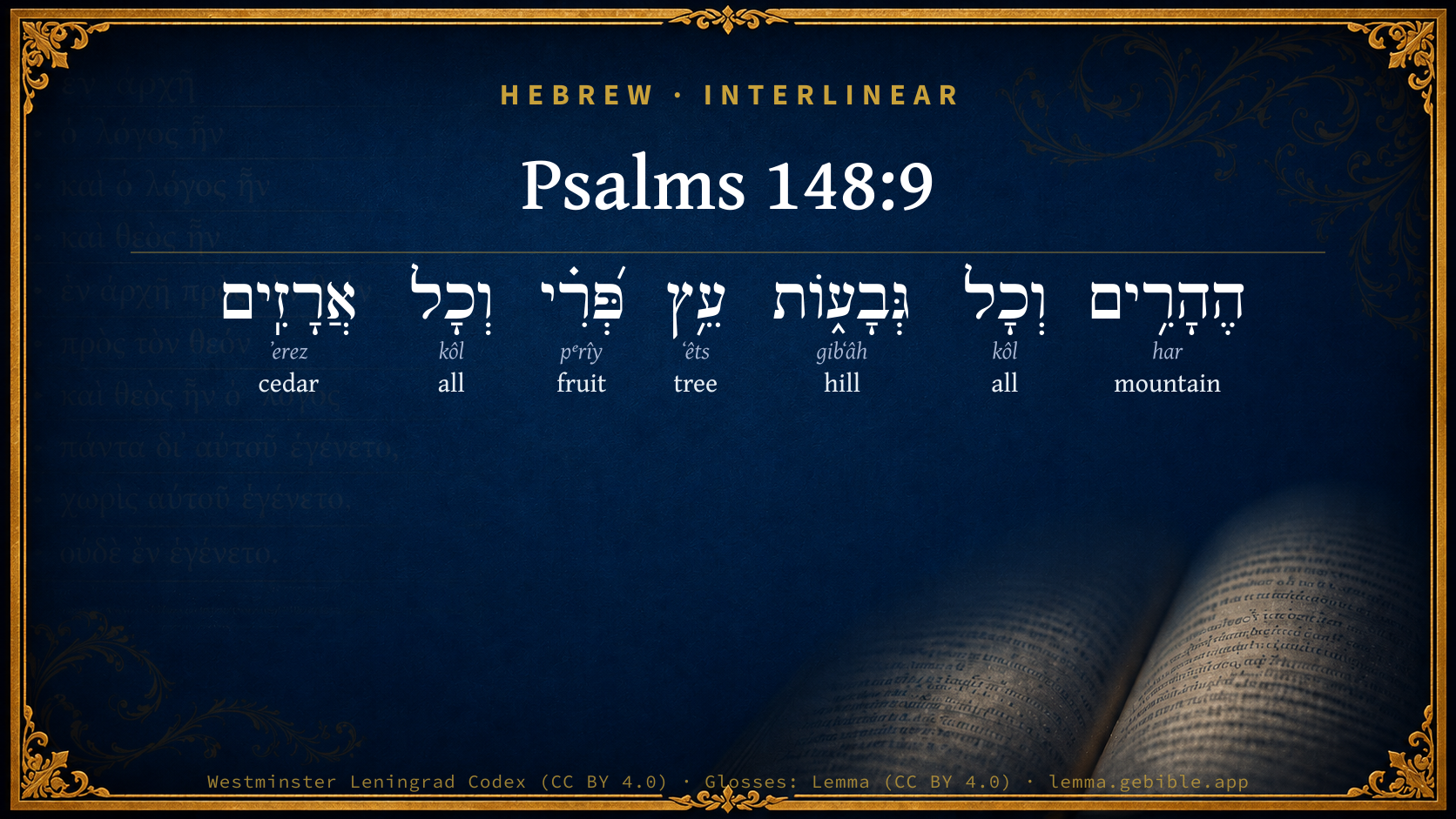
Psalms 148:9

Hebrew (Westminster Leningrad Codex) Psalms 148:9 appears in the Hebrew Old Testament. The text above is from the Westminster Leningrad Codex. Each word links to its Strong’s number, a concise gloss, and parsing drawn from the Open Scriptures Hebrew Bible morphology. Click any word for its full Brown-Driver-Briggs (BDB) entry.
Download image
Cite this verse

Psalms 148:9 (World English Bible). Public Domain. Lemma interlinear Bible study tool, https://lemma.gebible.app/v/psalms/148/9.

Show BibTeX & RIS
BibTeX
RIS
English Translation
Mountains and all hills; Fruit trees and all cedars;
World English Bible · Public Domain
Download a study sheet

One document with this verse’s original text, its word-by-word gloss line, the meaning frame, cross-references with their text, attributed commentary, and full source and license credits — printable, and it pastes into notes with its structure intact.

This verse Autodidact and up

Study sheet (.html) Plain text (.txt)

A passage Seminary Student

Up to 50 verses in one chapter. A passage sheet keeps up to 6 commentary sources and 12 cross-references per verse, in the order this page ranks them, and says so on the sheet whenever that leaves anything out. Ask for a single verse and you get the Autodidact verse sheet above.

Everything on this page stays free to read, with no account — the sheet is a download of what is already on screen, not access to it.

Want to remove ads? Support Godless Engineer
Compare translations 3

The same verse in 3 English versions, stacked beneath the original-language interlinear above. Click any original word for its lexicon entry.

Each is an independent rendering of the whole verse — the interlinear is not word-aligned to these translations.

Highlighted words mark where these versions differ — a whole-verse word diff, not a word-by-word alignment.

  • World English Bible Public Domain
    Mountains and all hills; Fruit trees and all cedars;
  • King James Version Public Domain
    Mountains, and all hills; fruitful trees, and all cedars:
  • unfoldingWord Literal Text CC BY-SA 4.0
    mountains and all hills, tree of fruit and all cedars,

unfoldingWord Literal Text — © unfoldingWord, licensed CC BY-SA 4.0. Word-aligned USFM3 via Door43 (git.door43.org/unfoldingWord/en_ult).

Versions to compare (up to 4)

3 of 4 selected

Show all 18 translations

Every available English version of this verse, each an independent rendering of the whole verse.

  • World English Bible Public Domain
    Mountains and all hills; Fruit trees and all cedars;
  • Berean Standard Bible Public Domain
    mountains and all hills, fruit trees and all cedars,
  • Majority Standard Bible Public Domain
    mountains and all hills, fruit trees and all cedars,
  • King James Version Public Domain
    Mountains, and all hills; fruitful trees, and all cedars:
  • American Standard Version (1901) Public Domain
    Mountains and all hills; Fruitful trees and all cedars;
  • Revised Version (1885) Public Domain
    Mountains and all hills; fruitful trees and all cedars:
  • Geneva Bible (1599) Public Domain
    Mountaines and all hils, fruitfull trees and all ceders:
  • Douay-Rheims (1899) Public Domain
    Who giveth to beasts their food: and to the young ravens that call upon him.
  • Young's Literal Translation Public Domain
    The mountains and all heights, Fruit tree, and all cedars,
  • Literal Standard Version CC BY-SA 4.0
    The mountains and all heights, || Fruit tree, and all cedars,
  • Unlocked Literal Bible CC BY-SA 4.0
    Praise him, mountains and all hills, fruit trees and all cedars,
  • unfoldingWord Literal Text CC BY-SA 4.0
    mountains and all hills, tree of fruit and all cedars,
  • Darby Bible Public Domain
    Mountains and all hills, fruit-trees and all cedars;
  • World Messianic Bible Public Domain
    mountains and all hills, fruit trees and all cedars,
  • Webster's Bible Public Domain
    Mountains, and all hills; fruitful trees, and all cedars:
  • Free Bible Version CC BY-SA 4.0
    Mountains and all the hills, fruit trees and all the trees of the forest,
  • Bible in Basic English Public Domain
    Mountains and all hills; fruit-trees and all trees of the mountains:
  • JPS Tanakh (1917) Public Domain
    Mountains and all hills, fruitful trees and all cedars;

Literal Standard Version (2020), Covenant Press — licensed CC BY-SA 4.0. Text via the HelloAO Bible API (eBible.org). Unlocked Literal Bible (unfoldingWord) — licensed CC BY-SA 4.0. Text via the HelloAO Bible API (eBible.org). unfoldingWord Literal Text — © unfoldingWord, licensed CC BY-SA 4.0. Word-aligned USFM3 via Door43 (git.door43.org/unfoldingWord/en_ult). Free Bible Version, Dr. Jonathan Gallagher — licensed CC BY-SA 4.0. Text via the HelloAO Bible API (eBible.org).

Word by word

More ways to search: Search by grammar → Find every occurrence → Compare this word →

Practice this passage: Drill this verse → Learn its vocabulary →

About this verse

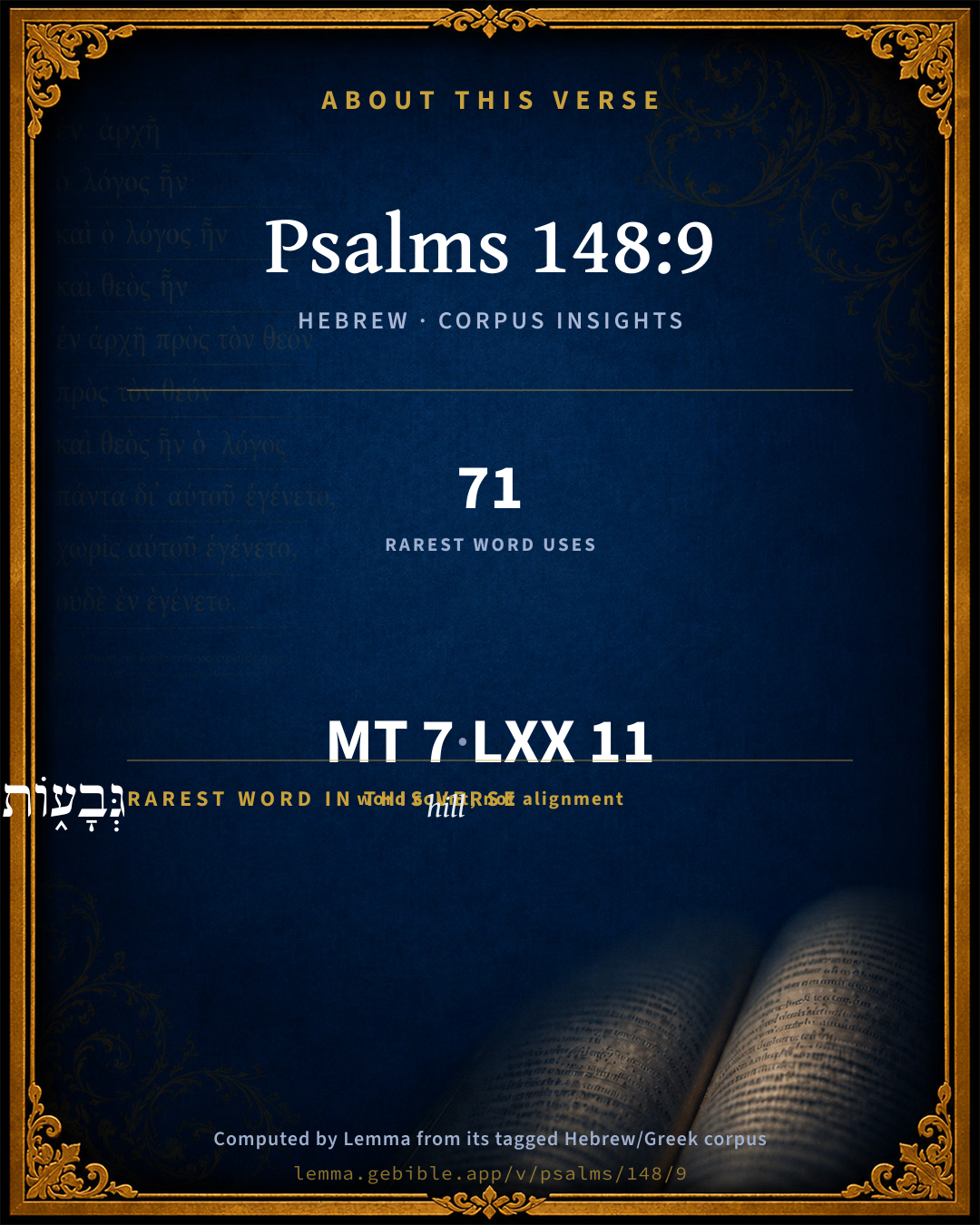
These counts appear in no published source. They are computed here, from the morphology-tagged text and Lemma’s own curated glosses. What Lemma adds →

7
words
6
distinct lemmas
Wisdom
section

Grammatical profile

  • 7 nouns

Repetition

A word recurs within this verse — often emphatic in Hebrew:

  • וְכָל all H3605 ×2

Hebrew & Septuagint length

In English translation the verse runs 9 words from the Hebrew and 9 from the Septuagint (LXX English) — the same length.

A rough comparison of the two English renderings, which tokenize alike — not a word-level alignment.

Word counts can differ between the Hebrew and the Greek without any difference in meaning — e.g. the Hebrew direct-object marker אֵת has no separate Greek word, and Greek often adds the article ὁ.

In the original languages it is 7 Hebrew tokens and 11 Greek tokens — but the two are counted differently (Hebrew bundles its prefixes and suffixes into one token; the Greek is in lemma form), so that isn’t a like-for-like length.

Cross-references

11

Topical passages linked to Psalms 148:9 in the Treasury of Scripture Knowledge — connected by theme and wording, ordered by reader-vote popularity; previews shown in the World English Bible.

  • Isaiah 44:23 Sing, you heavens, for Yahweh has done it; shout, you lower parts of the earth; break forth into singing, you mountains, O forest, and every tree therein: for Yahweh has redeemed Jacob, and will glorify himself in Israel.
  • Isaiah 49:13 Sing, heavens; and be joyful, earth; and break forth into singing, mountains: for Yahweh has comforted his people, and will have compassion on his afflicted.
  • Isaiah 55:12–13 For you shall go out with joy, and be led forth with peace: the mountains and the hills shall break forth before you into singing; and all the trees of the fields shall clap their hands.
  • Psalms 97:4–5 His lightning lights up the world. The earth sees, and trembles.
  • Psalms 98:7–9 Let the sea roar with its fullness; The world, and those who dwell therein.
  • Psalms 65:12–13 The wilderness grasslands overflow. The hills are clothed with gladness.
  • Psalms 96:11–13 Let the heavens be glad, and let the earth rejoice. Let the sea roar, and it's fullness!
  • Psalms 114:3–7 The sea saw it, and fled. The Jordan was driven back.
  • Isaiah 42:11 Let the wilderness and the cities of it lift up [their voice], the villages that Kedar does inhabit; let the inhabitants of Sela sing, let them shout from the top of the mountains.
  • Isaiah 64:1 Oh that you would tear the heavens, that you would come down, that the mountains might quake at your presence,
  • Ezekiel 36:1–15 You, son of man, prophesy to the mountains of Israel, and say, You mountains of Israel, hear the word of Yahweh.

Cross-references courtesy of OpenBible.info (CC BY 4.0).

Hebrew and Greek witnesses Masoretic Hebrew ↔ Greek Septuagint

The same verse in the two great witnesses to the Old Testament, shown verse-for-verse.

You’re reading Greek Psalm 148 (Hebrew Psalm 148). The Septuagint counts the superscription, so verse numbers can differ from the Hebrew — chapter-level alignment, not verse-by-verse. Numbering follows Rahlfs.

These are two independent witnesses, not word-aligned to each other, and the Septuagint is shown in lemma (dictionary) form.

Hebrew Psalms 148:9 Masoretic · Westminster Leningrad Codex

הֶהָרִ֥ים וְכָל גְּבָע֑וֹת עֵ֥ץ פְּ֝רִ֗י וְכָל אֲרָזִֽים

Mountains and all hills; Fruit trees and all cedars;

World English Bible · Public Domain

Greek LXX Greek Psalm 148:9 Septuagint · lemma form

ὁ ὄρος καί πᾶς ὁ βουνός ξύλον καρποφόρον καί πᾶς κέδρος

Mountains, and all hills; fruitful trees, and all cedars:

LXX2012 (modern English Septuagint) · Public Domain

Hebrew: Westminster Leningrad Codex (CC BY 4.0). Greek: Septuagint (public domain); English from LXX2012 (modern English Septuagint) (Public Domain). How the Septuagint differs from the Hebrew →

Commentary

Notes on Psalms 148:9 from classic Christian and Jewish commentators (each source and its license shown beneath its notes). The classic Christian expositions comment on the surrounding passage and are grouped to its opening verse, so a note may address several verses; the Jewish commentaries on the Tanakh (Rashi and others) are per-verse, so they appear only where the commentator wrote on this verse.

Lemma curates 59 commentaries, every one of them public domain or Creative Commons licensed, each selected and text-cleaned for this edition rather than reprinted as found. About our sources →

Trapp's Complete Commentary

John Trapp

Psa 148:9 Mountains, and all hills; fruitful trees, and all cedars:

Ver. 9. Mountains, and all hills] These praise God by their form, hugeness, fruits, prospects, &c.

Fruitful trees] These, by the variety of their natures and fruits, do notably set forth the wisdom, power, and goodness of the Almighty; while they spend themselves and the principal part of their sap and moisture in bringing forth some pleasant berry, or the like, for the use of man, who is thereby engaged to bless God.

John Trapp, A Commentary or Exposition upon All the Books of the Old and New Testament (1647–1656) — public domain. Text from a community e-Sword module.

The Biblical Illustrator

Joseph S. Exell

Psa_148:9

Mountains and all hills.

Mountain pictures in Scripture

In Scripture mountains are used to set forth--

I. The place of special communion with God. The Bible often refers to mountains as if, in a special sense, they belonged to God. Actually all things are Gods--valleys as well as hills, plains as well as mountains. But I believe you never meet with God speaking of these other things as He does of mountains. He doesnt say, My valleys, My rivers, but He does say, My mountains. And when we stand and look at a mountain, with its top piercing the clouds, the thought may well come to us, If the valleys and plains have been given to man, God has reserved the mountains for Himself. If man is able to scale them he is unable to live upon them. And there are some whose summits can never be reached. Yes, if we want to banish little earth-born thoughts, and cares, and troubles, if we would exclude them by the entrance of greater thoughts, then climb the mountain, go to its summit if you can, and you are likely to come back another man. It is in accord with all this that our Saviour, when He wanted His three disciples to lose sight of earth while they beheld His heavenly glory, took them away to a mountain-top. And whenever He Himself wanted to leave the world behind Him, and to find a place where He could feel His Father to be very near, and have intimate communion with Him, He went up into a mountain to pray.

II. Gods great power. The old Hebrew teachers, when they wanted to show the people how strong the arm of Jehovah was, used, in effect, to point to the mountains, and say, Let me tell you what Jehovah can do with them. Isaiah is rich in imagery of this sort. At one time the prophet wished to make the people feel the immense disparity between themselves and God, and he asks them the significant question, Who hath weighed the mountains in scales? When the prophet again wishes to tell us what mighty things God has done, and especially to call attention to the quiet, easy, noiseless way that God can bring about marvellous events, how splendidly he effects this by saying, The mountains flowed down at Thy presence! When Jeremiah wished vividly to picture to the people the terrible judgments which his prophetic eye could see that God was about to bring upon their land because they had been rebellious, among other things he says: I beheld the mountains, and, lo! they trembled. When Nahum seeks to make the impenitent sinner sensible of the terrors of the Lord, even though He is slow to anger, he says, The mountains quake at Him, the hills melt, and the earth is burned at His presence. And Habakkuk shows that Jehovahs power is not to be trifled with when, more than once he says, The mountains saw Thee, and they trembled. Yes, these immovable hills tremble when they see God; and what, then, will impenitent sinners do--men who take no notice of what God has to say to them; who keep their thoughts bound down to earthly things, and never acknowledge God in any of His ways?

III. Great antiquity and unchangeableness (Hab_3:6; Psa_90:2; Isa_54:10).

IV. Symbols of immense obstacles and difficulties (Mat_17:20; 1Co_13:2).

1. The pathway of every individual life has its obstacles. Not only do we pass through cloud and sunshine, and along rough places and smooth, but sometimes we have to confront obstacles which seem to be as much beyond our power to move aside as the high mountain would be. But take courage, friend! for if you cant remove it, if you cant get it out of your way in an instant--as most of us in our impatience would like to do with all our mountain-difficulties--yet by steady and persistent effort you may master the mountain and get the right side of it by and by.

2. But mountains are put, too, in Scripture as symbols of difficulties which lie in the way of Christs conquest of the world. The Alps lay in the way of Hannibal and Napoleon when they were seeking to conquer Italy; and vaster mountains still seem to lie in the way of Christs conquest of the world. The unwillingness of the people to listen to the message of reconciliation is a mighty mountain in the way of the victorious march of the Saviour; and even when they listen the unbelief and cold indifference of men stand out like a vast mountain with snowy summit and ice-bound sides. We might well believe that these difficulties would never be overcome if God had not said they should be. But God can make even these icy mountains shake and tremble and melt away. The thing that is impossible with men is possible with God. Out of these very mountains God can make a way. He can convert a Saul, the persecutor and unbeliever, into Paul, the persuasive preacher. And if we have faith we shall not only climb mountains by an incessant effort, but we shall be able to put some of them out of the way (Isa_40:4-5). (J. Clarke, B. A.)

Mountains declare the majesty of Gods handiwork

The majesty of the Creator is set forth anew in the recent classification of natures vast work of what Warren Upham, of the United States Geological Survey, terms mountain-building. Mr. Upham says that he finds six modes of mountain construction throughout the western hemisphere; namely: folded, arched, domed, tilted, erupted, and eroded. The Appalachian-Laurentian systems are specimens of the folded mountain range; parts of the Cordilleran belt in Western United States, of the arched construction; the Henry Mountains in southern Utah, of the domed; the Sierra Nevadas, of the tilted; the Andes range, of the erupted as seen in the traces of grand volcanic-action throughout the entire extent; and lastly, the remnants of vast areas once uplifted, specimens of the eroded mode of mountain architecture. (Homiletic Review.)

The Biblical Illustrator, edited by Joseph S. Exell (c. 1880s–1900s) — public domain. Text from a community e-Sword module.

Joseph Benson's Commentary

Psa 148:9-10. Mountains, and all hills — These are of great use in the earth. From them descend the running streams into the valleys, without which animals could not live. On the mountains grow those vast trees which are necessary for daily use in various ways; and on the hills and mountains is herbage for vast multitudes of cattle, whereby men are supplied with food and clothing. And all cedars — Under the name of cedars, as being the chief, seems to be included all kinds of trees which do not bear fruit. A little reflection will show how much it is a subject for praise to God that he hath furnished us with so many kinds of trees; some of which produce for us the most delicious, the most wholesome, and most useful fruits; others supply us with materials for building our habitations and ships, whereby we trade to all parts of the world; and for making our household goods, and various kinds of tools and instruments. If all these were wanting to us, we could hardly subsist; and if but a great part of them were wanting, we should lead a much more laborious and unpleasant life than we do. Beasts, and all cattle — Let the wild beasts also of the forest, and all the cattle that feed in the fields, furnish matter of praise to him who hath shown his manifold wisdom and diffusive goodness in and by them all. And, certainly, whoever considers to how many useful and beneficial purposes of life they are employed, in one way or another, must see and acknowledge that they furnish a powerful motive for praise to the great Creator, for the vast multitude and various kinds of them, which he hath formed and subjected to the dominion of man. Creeping things —

Including many animals in the waters, as well as in the land; and flying fowl — In the various forms, capacities, and instincts of which, as well as in the beautiful plumage of many of them, and the ample provision made for them all, much of the wisdom, power, and goodness of the Creator is manifested.

Joseph Benson's Commentary on the Old and New Testaments (1811–1818) — public domain. Text from a community e-Sword module.

J. A. Alexander on Psalms

Joseph Addison Alexander

9. (Psa 148:9) The mountains and all hills, fruit-trees and all cedars. Not fruitful trees, as distinguished from barren trees, but fruit-trees (literally tree of fruit), as distinguished from forest-trees, here represented by the cedar, which is usually spoken of in Scripture as the noblest species, and therefore called the cedar of God, Psa 80:10.

Joseph Addison Alexander, The Psalms Translated and Explained (1850) — public domain. Text from a community e-Sword module.

Jamieson, Fausset & Brown

Robert Jamieson, A. R. Fausset & David Brown

fruitful trees--or, "trees of fruit," as opposed to forest trees. Wild and domestic, large and small animals are comprehended.

Jamieson, Fausset & Brown — Commentary Critical and Explanatory on the Whole Bible (1871) — public domain (CC PDM 1.0). Text via the HelloAO Bible API.

Adam Clarke's Commentary

Verse 9. Mountains, and all hills] Whether primitive, secondary, or alluvial; of ancient or recent formation, with all their contents, quarries, mines, and minerals. But what a profusion of wisdom and skill is lavished on these! To instance only in the different metals, earths, and minerals; especially the precious stones.

Fruitful trees] עץ פרי ets peri, fruit trees of all kinds.

And all cedars] Every kind of forest tree. The formation of the fruits, their infinitely varied hues and savours, proclaim the unsearchable wisdom and goodness of God: not less so, the growth, structure, and various qualities and uses of the forest trees.

Adam Clarke's Commentary on the Bible (1810–1826) — public domain. Text from a community e-Sword/MySword module.

Ellicott's Commentary for English Readers

(9) Mountains, and all hills.—The invocation now alights on the crests of the highest mountains, and passes downward to the lower hills where vegetable life begins.

Fruitful trees.—Rather, fruit trees; the fruit-bearing tree being representative of one division of the vegetable world, planted and reared by man, the cedars of the other, which are (Psa_104:16) of God’s own plantation.

A Bible Commentary for English Readers, edited by Charles John Ellicott (1878–1897) — public domain. Text from a community e-Sword module.

The Cambridge Bible for Schools and Colleges

gen. ed. J. J. S. Perowne

9. Cp. Psa_104:16.

The Cambridge Bible for Schools and Colleges (gen. ed. J. J. S. Perowne; Cambridge University Press, 1878–1918) — public domain. Text from a community e-Sword module.

John Gill's Exposition

Mountains, and all hills,.... Which are originally formed by the Lord, and set fast by his power and strength; these are the highest parts of the earth, and are very ornamental and useful; they include all in them and upon them, the trees and herbage that grow upon them, gold, silver, brass, and iron in them; all very beneficial to mankind, and afford matter of praise to God for them; see Isa 55:12;

fruitful trees, and all cedars; trees bearing fruit are the fig trees, pomegranates, vines, and olives, with which the land of Canaan abounded; and such as bear lemons, oranges, plums, pears, apples, cherries, &c. which produce fruit for the use, pleasure, and delight of man, and so a means of praising God: and "cedars", the trees of the Lord which he hath planted; though they bear no fruit, yet very useful in building, and were of great service in the temple at Jerusalem; and which are put for all others of like usefulness, and minister just occasion of praise; see Psa 96:12.

John Gill's Exposition of the Whole Bible (1746–1763) — public domain (CC PDM 1.0). Text via the HelloAO Bible API.

Albert Barnes' Notes on the Bible

Mountains, and all hills - As being among the loftiest objects of earth, raising their heads highest toward the heavens.

Fruitful trees, and all cedars - Fruitful trees, not as distinguished from those which are barren, but as distinguished from forest-trees, those whose nature is that they do not bear fruit. Of the latter, the cedar was the most prominent, and, therefore, is made the representative of the whole.

Albert Barnes' Notes on the Bible (1834–1885) — public domain. Text from a community e-Sword/MySword module.

Matthew Poole's English Annotations

Admirable for your height, and strength, and use, though not for your fruit.

Matthew Poole's English Annotations on the Holy Bible (1683–1685) — public domain. Text from a community e-Sword/MySword module.

The Treasury of David

Charles H. Spurgeon

Ver. 9. Mountains, and all hills. Towering steeps and swelling knolls alike declare their Creator. "All hills" are to be consecrated; we have no longer Ebal and Gerizim, the hill of the curse and the hill of the blessing, but all our Ebals are turned to Gerizims. Tabor and Hermon, Lebanon and Carmel, rejoice in the name of the Lord. The greater and the lesser mounts are one in their adoration. Not only the Alps and the mountains of the Jura thunder out his praise; but our own Cotswolds and Grampians are vocal with songs in his honour.

Fruitful trees, and all cedars. Fruit trees and forest trees, trees deciduous or evergreen, are equally full of benevolent design, and alike subserve some purpose of love; therefore for all and by all let the great Designer be praised. There are many species of cedar, but they all reveal the wisdom of their Maker. When kings fell them, that they may make beams for their palaces, they do but confess their obligation to the King of trees, and to the King of kings, whose trees they are. Varieties in the landscape are produced by the rising and falling of the soil, and by the many kinds of trees which adorn the land: let all, and all alike, glorify their one Lord. When the trees clap their hands in the wind, or their leaves rustle in the gentle breath of Zephyr, they do to their best ability sing out unto the Lord.

Ver. 9. Mountains and all hills, etc. The diversifying of the face of the earth with higher and lower parts, with mountains, hills, and valleys, and the adorning of the face thereof with trees of varied sorts, contributes much to the praise of God. David Dickson.

Ver. 9. Mountains and all hills. What voices have the hills! How solemn the sounds of the mountains from their sublime solitudes! The mountains thunder, and the hills reecho; but they speak peace and send down plenty to the vales in running rivulets. Thomas Le Blanc.

Ver. 9. Fruitful trees and all cedars. The praise of God is in the rustling voices of the trees. They fulfil his purpose in giving fruit to refresh, and shelter and shadow for a covert, and their murmur is the soft cadence that chants mercy and grace. In India, the ancients reported that the trees were worshipped as divine, and death was a penalty awarded to those who cut them down. In classic mythology the groves were the homes of gods. Jehovah decreed that an ark of safety for man, and also a temple for himself, should be constructed of wood. Thus more than any other created things, the trees of the wood have redounded to his glory. Le Blanc.

Ver. 9. Fruitful trees. Rather fruit trees; the fruit bearing tree being representative of one division of the vegetable world, planted and reared by man; the "cedars" of the other, which are (Ps 104:16) of God's own plantation. So in Ps 148:10 we have wild animals and domesticated animals. A.S. Aglen.

Ver. 9. Trees.

All creatures of the eternal God but man,

In several sorts do glorify his name;

Each tree doth seem ten thousand tongues to have,

With them to laud the Lord omnipotent;

Each leaf that with wind's gentle breath doth wave,

Seems as a tongue to speak to that intent,

In language admirably excellent.

The sundry sorts of fragrant flowers do seem

Sundry discourses God to glorify,

And sweetest volumes may we them esteem;

For all these creatures in their several sort

Praise God, and man unto the same exhort. Peter Pett, 1599.

Ver. 9. All cedars. Beautiful indeed is the pine forest in all seasons: in the freshness of spring, when the gnarled boughs are penetrated and mollified by the soft wind and the warm sun, and, thrilled with new life, burst out into fringes and tassels of the richest green, and cones of the most tender purple; beautiful in the sultry summer, when among its cool, dim shadows the heated hours all day sing vespers, while the open landscape is palpitating in the scorching heat; beautiful in the sadness of autumn, when its unfading verdure stands out in striking relief amid changing scenes, that have no sympathy with anything earthly save sorrow and decay, and directs the thoughts to the imperishableness of the heavenly Paradise; beautiful exceedingly in the depth of winter, when the tiers of branches are covered with pure, unsullied wreaths of snow, sculptured by the wind into curves of exquisite grace. It is beautiful in calm, when the tree tops scarce whisper to each other, and the twitter of the golden wren sounds loud in the expectant hush; it is more than beautiful in storm, when the wild fingers of the wind play the most mournful music on its great harp strings, and its full diapason is sublime as the roar of the ocean on a rock bound shore. I do not wonder that the northern imagination in heathen times should have invested it with awe and fear as the favourite haunt of Odin and Thor; or that, in after times, its long rows of trunks, vanishing in the dim perspective, should have furnished designs for the aisles of Christian temples, and the sunset, burning among its fretted branches, should have suggested the gorgeous painted window of the cathedral. It looks like a place made for worship, all its sentiments and associations seem of a sacred and solemn character. Nature, with folded hands, as Longfellow says, seems kneeling there in prayer. It certainly reminds us in various ways of the power, wisdom, and goodness of him who thus spake by the mouth of his prophet: "I will plant in the wilderness the cedar, the fir tree, and the pine, and the box tree together: that they may see, and know, and consider, and understand together, that the hand of the Lord hath done this, and the Holy One of Israel hath created it." Hugh Macmillan, in "Bible Teachings in Nature", 1867.

Ver. 9. Trees. The glory of God as seen in trees.

Psalms 148:10*

Charles H. Spurgeon's The Treasury of David (1869–1885) — public domain. Psalms only. Text from a community e-Sword/MySword module.

Whedon's Commentary on the Bible

Daniel D. Whedon

9, 10. If the classifications in these verses are not scientific, modernly considered, they are comprehensive, and not without reason.

Mountains—As awakening thoughts of God through the emotions of sublimity, grandeur, and awe.

Hills—For their beauty and utility covered with flocks and fertile fields.

Fruitful trees, and all cedars—The division of all trees into fruitbearing and non-fruitbearing is very natural in a country where fruit is a staple reliance for support. As natural is it to place the princely cedar as the representative of the latter class.

Beasts… all cattle— “Beasts,” here, stand for wild animals, and “cattle” for tame or domestic ones.

Creeping things, and flying fowl—Classified according to a principle of contrariety as to spheres of life and modes of motion, but all showing the varied wisdom of God.

Daniel D. Whedon (gen. ed.), Commentary on the Old and New Testaments (1874–1909) — public domain. Text from a community e-Sword module.

The Pulpit Commentary

Mountains, and all hills. The later psalmists are great admirers of" mountains." Perhaps the fiat and monotonous Babylonian plains led them to appreciate the beauties of a landscape like that of Palestine. (comp. Psa_83:14 Psa_114:4, 6 144:5 147:8) Fruitful trees; rather, fruit trees; literally, trees of fruit. The Babylonian palms may have swept across the writer"s remembrance; but probably the vine, the olive, and the fig, which were among the chief glories of Palestine, were in his mind principally. And all cedars. Babylonia had had no "cedars." When the exiles returned, the beauty of the cedar broke upon them as a sort of new revelation.

The Pulpit Commentary (1880–1919), ed. H.D.M. Spence-Jones & Joseph S. Exell — public domain. Text from a community e-Sword module.

unfoldingWord translationNotes

Door43 World Missions Community

Connecting Statement:

The writer continues to speak to things that are not human as if they were people and commands them to praise Yahweh. (See: Personification)

animals wild and tame

The words "wild" and "tame" are opposites. Together they encompass all animals. AT: "all animals" (See: Merism)

translationWords

fruit

cedar

creature

unfoldingWord translationNotes — © Distant Shores Media and the Door43 World Missions Community, licensed CC BY-SA 4.0. Source: git.door43.org/Door43/en_tn.

Lesson kit

Teaching starters — assembled from the data on this page, not authored interpretation. Every prompt links to the verse data it draws on. Edit before teaching.

Psalms, in the Wisdom, opens this verse with 7 words (6 distinct Hebrew lemmas). Its most distinctive word is gibʻâh (“hill”). A historical commentator’s framing appears above. Read the whole chapter for the surrounding context.

Discussion questions

  1. How does “hill” (gibʻâh) shape what this verse is saying?
  2. Isaiah 44:23 shares this passage’s theme. How do the two illuminate each other?
  3. “all” occurs 2× in this one verse. What is the effect of the repetition?
  4. The translations on this page render this verse differently — a whole-verse word diff, not a word-by-word alignment. What might account for the different wordings?
  5. Reading how Trapp's Complete Commentary and The Biblical Illustrator read this verse, where do the two commentators agree and where do they part?

Things to notice

Reading settings

Reading text

Shown beneath each verse's original-language words.

Old Testament
Old Testament edition

Read the OT as the Masoretic Hebrew (MT) or the Greek Septuagint (LXX).

English shown for the Greek Septuagint (in the Hebrew ↔ Greek comparison).

Comparing translations? Open the Compare panel on any verse page to stack up to four side by side.