
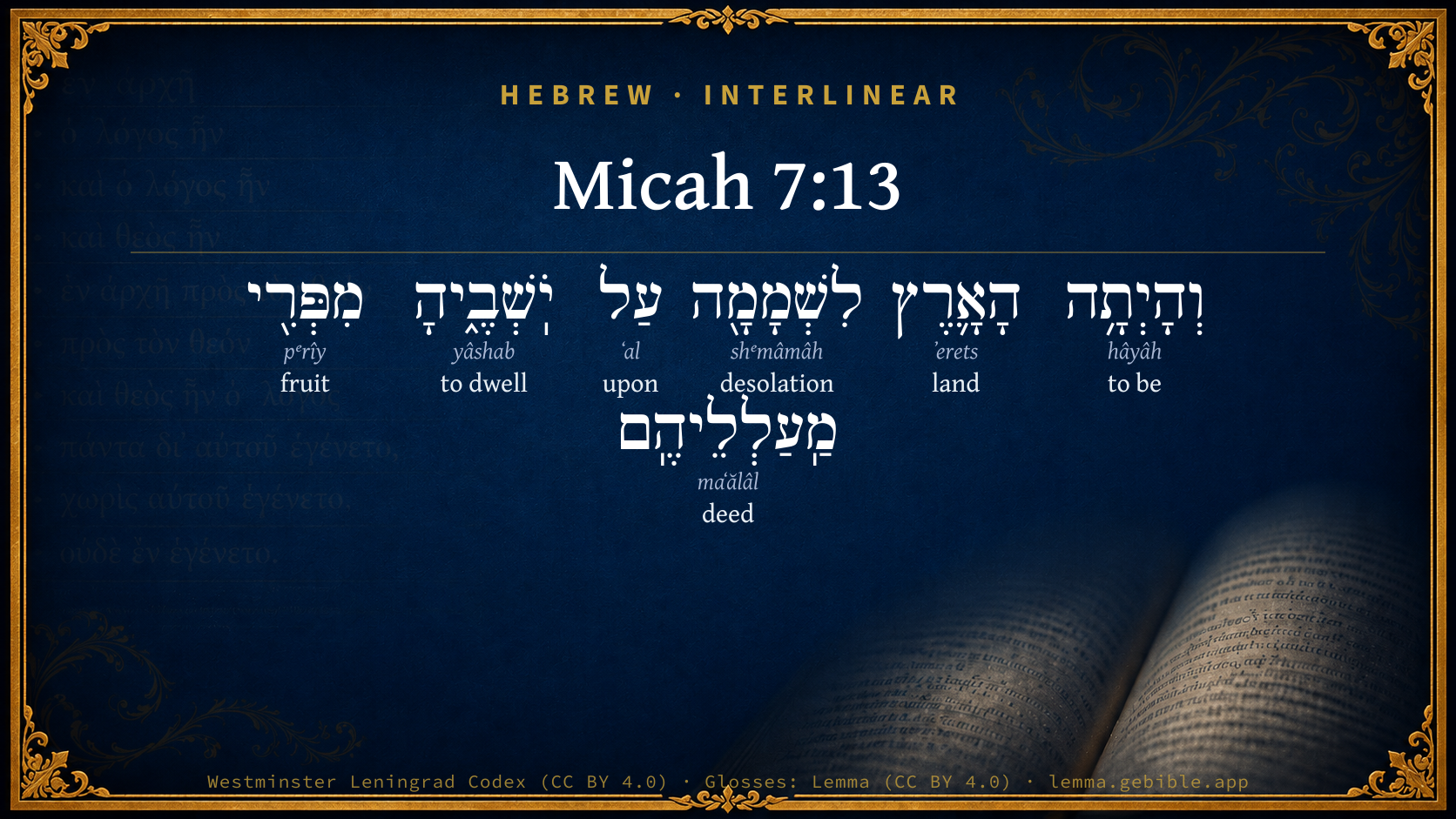
Micah 7:13

Hebrew (Westminster Leningrad Codex) Micah 7:13 appears in the Hebrew Old Testament. The text above is from the Westminster Leningrad Codex. Each word links to its Strong’s number, a concise gloss, and parsing drawn from the Open Scriptures Hebrew Bible morphology. Click any word for its full Brown-Driver-Briggs (BDB) entry.
Download image
Cite this verse

Micah 7:13 (World English Bible). Public Domain. Lemma interlinear Bible study tool, https://lemma.gebible.app/v/micah/7/13.

Show BibTeX & RIS
BibTeX
RIS
English Translation
Yet the land will be desolate because of those who dwell therein, For the fruit of their doings.
World English Bible · Public Domain
Download a study sheet

One document with this verse’s original text, its word-by-word gloss line, the meaning frame, cross-references with their text, attributed commentary, and full source and license credits — printable, and it pastes into notes with its structure intact.

This verse Autodidact and up

Study sheet (.html) Plain text (.txt)

A passage Seminary Student

Up to 50 verses in one chapter. A passage sheet keeps up to 6 commentary sources and 12 cross-references per verse, in the order this page ranks them, and says so on the sheet whenever that leaves anything out. Ask for a single verse and you get the Autodidact verse sheet above.

Everything on this page stays free to read, with no account — the sheet is a download of what is already on screen, not access to it.

Want to remove ads? Support Godless Engineer
Compare translations 3

The same verse in 3 English versions, stacked beneath the original-language interlinear above. Click any original word for its lexicon entry.

Each is an independent rendering of the whole verse — the interlinear is not word-aligned to these translations.

Highlighted words mark where these versions differ — a whole-verse word diff, not a word-by-word alignment.

  • World English Bible Public Domain
    Yet the land will be desolate because of those who dwell therein, For the fruit of their doings.
  • King James Version Public Domain
    Notwithstanding the land shall be desolate because of them that dwell therein, for the fruit of their doings.
  • unfoldingWord Literal Text CC BY-SA 4.0
    But the land will be desolate because of the people who are living there, because of the fruit of their actions.

unfoldingWord Literal Text — © unfoldingWord, licensed CC BY-SA 4.0. Word-aligned USFM3 via Door43 (git.door43.org/unfoldingWord/en_ult).

Versions to compare (up to 4)

3 of 4 selected

Show all 18 translations

Every available English version of this verse, each an independent rendering of the whole verse.

  • World English Bible Public Domain
    Yet the land will be desolate because of those who dwell therein, For the fruit of their doings.
  • Berean Standard Bible Public Domain
    Then the earth will become desolate because of its inhabitants, as the fruit of their deeds.
  • Majority Standard Bible Public Domain
    Then the earth will become desolate because of its inhabitants, as the fruit of their deeds.
  • King James Version Public Domain
    Notwithstanding the land shall be desolate because of them that dwell therein, for the fruit of their doings.
  • American Standard Version (1901) Public Domain
    Yet shall the land be desolate because of them that dwell therein, for the fruit of their doings.
  • Revised Version (1885) Public Domain
    Yet shall the land be desolate because of them that dwell therein, for the fruit of their doings.
  • Geneva Bible (1599) Public Domain
    Notwithstanding, the lande shall be desolate because of them that dwell therein, and for the fruites of their inuentions.
  • Douay-Rheims (1899) Public Domain
    And the land shall be made desolate, because of the inhabitants thereof, and for the fruit of their devices.
  • Young's Literal Translation Public Domain
    And the land hath been for a desolation, Because of its inhabitants, Because of the fruit of their doings.
  • Literal Standard Version CC BY-SA 4.0
    And the land has been for a desolation, || Because of its inhabitants, || Because of the fruit of their doings.
  • Unlocked Literal Bible CC BY-SA 4.0
    But the land will be desolate because of the people who are living there, because of the fruit of their actions.
  • unfoldingWord Literal Text CC BY-SA 4.0
    But the land will be desolate because of the people who are living there, because of the fruit of their actions.
  • Darby Bible Public Domain
    But the land shall be desolate because of them that dwell therein, for the fruit of their doings.
  • World Messianic Bible Public Domain
    Yet the land will be desolate because of those who dwell therein, for the fruit of their doings.
  • Webster's Bible Public Domain
    Notwithstanding the land shall be desolate because of them that dwell in it, for the fruit of their doings.
  • Free Bible Version CC BY-SA 4.0
    But the rest of the earth will become desolate because of what those who live there have done.
  • Bible in Basic English Public Domain
    But the land will become a waste because of its people, as the fruit of their works.
  • JPS Tanakh (1917) Public Domain
    And the land shall be desolate for them that dwell therein, because of the fruit of their doings.

Literal Standard Version (2020), Covenant Press — licensed CC BY-SA 4.0. Text via the HelloAO Bible API (eBible.org). Unlocked Literal Bible (unfoldingWord) — licensed CC BY-SA 4.0. Text via the HelloAO Bible API (eBible.org). unfoldingWord Literal Text — © unfoldingWord, licensed CC BY-SA 4.0. Word-aligned USFM3 via Door43 (git.door43.org/unfoldingWord/en_ult). Free Bible Version, Dr. Jonathan Gallagher — licensed CC BY-SA 4.0. Text via the HelloAO Bible API (eBible.org).

Word by word

More ways to search: Search by grammar → Find every occurrence → Compare this word →

Practice this passage: Drill this verse → Learn its vocabulary →

About this verse

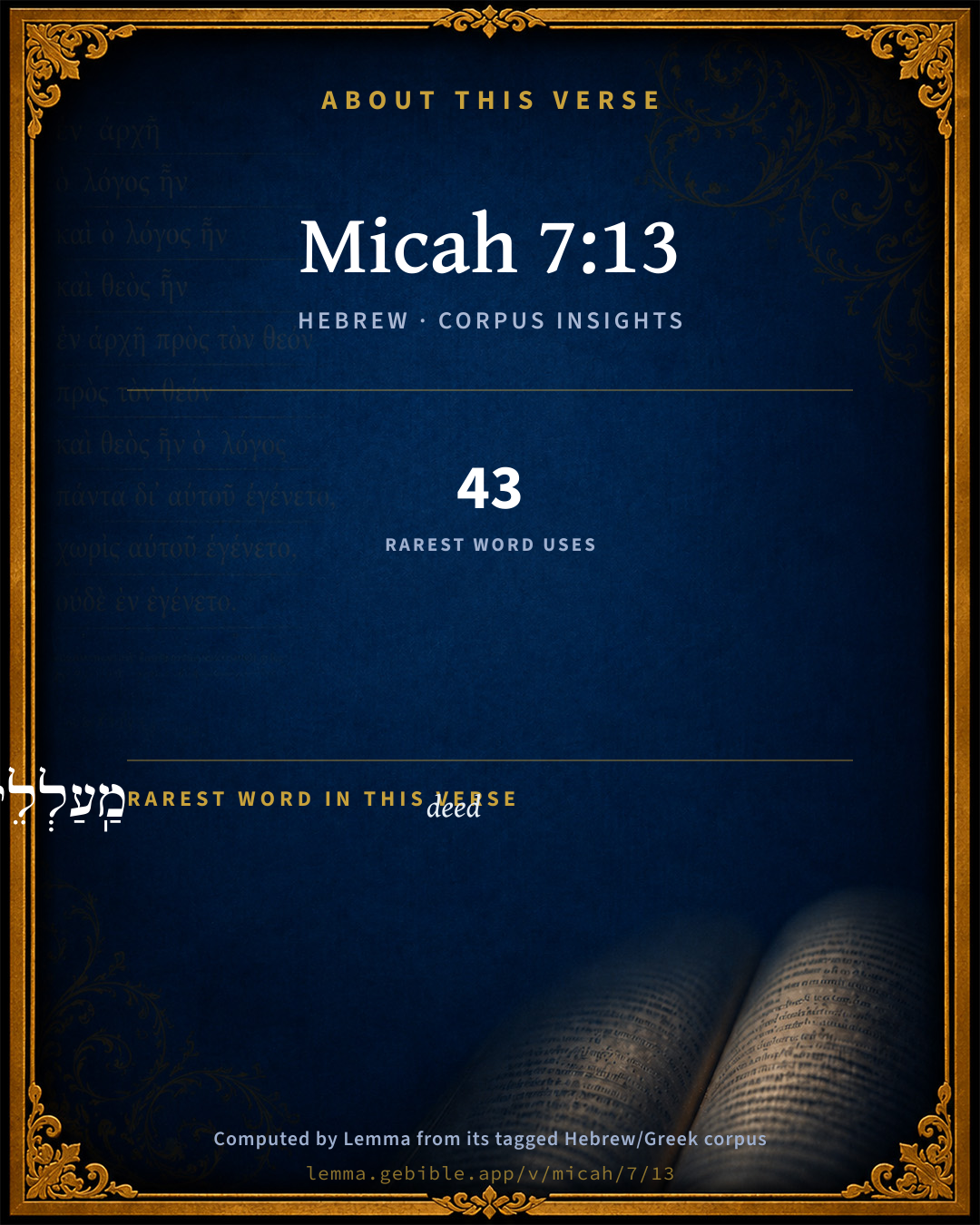
These counts appear in no published source. They are computed here, from the morphology-tagged text and Lemma’s own curated glosses. What Lemma adds →

7
words
7
distinct lemmas
Prophets
section

Shared distinctive vocabulary

מַֽעַלְלֵיהֶֽם deed H4611 occurs in 41 verses of the Hebrew Bible. Also found in:

Grammatical profile

  • 2 verbs
  • 4 nouns
  • 1 preposition

Verb forms

  • וְהָיְתָ֥ה Qal · Sequential Perfect
  • יֹֽשְׁבֶ֑יהָ Qal · Participle Active

Hebrew & Septuagint length

In English translation the verse runs 18 words from the Hebrew and 20 from the Septuagint (LXX English) — closely comparable.

A rough comparison of the two English renderings, which tokenize alike — not a word-level alignment.

Word counts can differ between the Hebrew and the Greek without any difference in meaning — e.g. the Hebrew direct-object marker אֵת has no separate Greek word, and Greek often adds the article ὁ.

Cross-references

17

Topical passages linked to Micah 7:13 in the Treasury of Scripture Knowledge — connected by theme and wording, ordered by reader-vote popularity; previews shown in the World English Bible.

  • Isaiah 3:10–11 Tell the righteous "Good!" For they shall eat the fruit of their deeds.
  • Jeremiah 25:11 This whole land shall be a desolation, and an astonishment; and these nations shall serve the king of Babylon seventy years.
  • Jeremiah 17:10 I, Yahweh, search the mind, I try the heart, even to give every man according to his ways, according to the fruit of his doings.
  • Micah 6:13 Therefore I also have struck you with a grievous wound. I have made you desolate because of your sins.
  • Leviticus 26:33–39 I will scatter you among the nations, and I will draw out the sword after you: and your land will be a desolation, and your cities shall be a waste.
  • Job 4:8 According to what I have seen, those who plow iniquity, And sow trouble, Reap the same.
  • Proverbs 1:31 Therefore they will eat of the fruit of their own way, And be filled with their own schemes.
  • Proverbs 5:22 The evil deeds of the wicked ensnare him. The cords of his sin hold him firmly.
  • Proverbs 31:31 Give her of the fruit of her hands! Let her works praise her in the gates!
  • Isaiah 6:11–13 Then I said, "Lord, how long?" He answered, "Until cities are waste without inhabitant, And houses without man, And the land becomes utterly waste,
  • Isaiah 24:3–8 The earth shall be utterly emptied, and utterly laid waste; for Yahweh has spoken this word.
  • Jeremiah 21:14 I will punish you according to the fruit of your doings, says Yahweh; and I will kindle a fire in her forest, and it shall devour all that is round about her.
  • Jeremiah 32:19 great in counsel, and mighty in work; whose eyes are open on all the ways of the sons of men, to give everyone according to his ways, and according to the fruit of his doings:
  • Daniel 4:26–27 Whereas they commanded to leave the stump of the roots of the tree; your kingdom shall be sure to you, after that you shall have known that the heavens do rule.
  • Micah 3:12 Therefore Zion for your sake will be plowed like a field, And Jerusalem will become heaps of rubble, And the mountain of the temple like the high places of a forest.
  • Luke 21:20–24 "But when you see Jerusalem surrounded by armies, then know that its desolation is at hand.
  • Galatians 6:7–8 Don't be deceived. God is not mocked, for whatever a man sows, that will he also reap.

Cross-references courtesy of OpenBible.info (CC BY 4.0).

Hebrew and Greek witnesses Masoretic Hebrew ↔ Greek Septuagint

The same verse in the two great witnesses to the Old Testament, shown verse-for-verse.

These are two independent witnesses, not word-aligned to each other, and the Septuagint is shown in lemma (dictionary) form.

Hebrew Micah 7:13 Masoretic · Westminster Leningrad Codex

וְהָיְתָ֥ה הָאָ֛רֶץ לִשְׁמָמָ֖ה עַל יֹֽשְׁבֶ֑יהָ מִפְּרִ֖י מַֽעַלְלֵיהֶֽם

Yet the land will be desolate because of those who dwell therein, For the fruit of their doings.

World English Bible · Public Domain

Greek LXX Micah 7:13 Septuagint · lemma form

καί εἰμί ὁ γῆ εἰς ἀφανισμός σύν ὁ καταοἰκέω αὐτός ἐκ καρπός ἐπιτήδευμα αὐτός

And the land shall be utterly desolate together with them that inhabit it, because of the fruit of their doings.

LXX2012 (modern English Septuagint) · Public Domain

Hebrew: Westminster Leningrad Codex (CC BY 4.0). Greek: Septuagint (public domain); English from LXX2012 (modern English Septuagint) (Public Domain). How the Septuagint differs from the Hebrew →

Targum (Aramaic paraphrase)

1

The Targum is the ancient Jewish Aramaic paraphrase of the Hebrew Scriptures — an interpretive translation, not the Hebrew text itself. Onkelos (literal) and Pseudo-Jonathan (expansive) render the Torah, and Jonathan the Prophets. Coverage is partial: where no permissively-licensed English translation exists for a verse, only the Aramaic is shown. This is verse-level text, not a word-by-word alignment to the Hebrew.

  1. Targum Jonathan Prophets (Joshua–Malachi)
    וּתְהֵי אַרְעָא לְצָדוּ עַל יַתְבָהָא מִפְּרִי עוֹבְדֵיהוֹן:

    (no public-domain English translation for this verse)

    Targum Jonathan — Aramaic: “Mikraot Gedolot” (public domain). English: “Sefaria Community Translation” (CC0 1.0 (public-domain dedication)); “London "Chaldee Paraphrase," 1871” (public domain). Text via Sefaria.

Commentary

Notes on Micah 7:13 from classic Christian and Jewish commentators (each source and its license shown beneath its notes). The classic Christian expositions comment on the surrounding passage and are grouped to its opening verse, so a note may address several verses; the Jewish commentaries on the Tanakh (Rashi and others) are per-verse, so they appear only where the commentator wrote on this verse.

Lemma curates 59 commentaries, every one of them public domain or Creative Commons licensed, each selected and text-cleaned for this edition rather than reprinted as found. About our sources →

Trapp's Complete Commentary

John Trapp

Mic 7:13 Notwithstanding the land shall be desolate because of them that dwell therein, for the fruit of their doings.

Ver. 13. Notwithstanding the land shall be desolate] Understand it, not of the land of Chaldea, as A Lapide doth; but of Judea, which must be desolated before the coming of Christ in the flesh. And this is here foretold. 1. Lest the impenitent, by misapplying the former promises, should dream of impunity, saeculi laetitia est impunita nequitia (Aug.); and, 2. Lest the godly, because of this desolation shortly to ensue, should despair of the former promises.

Because of them that dwell therein, for the fruit of their delays] What their doings were, and what the fruit thereof, see Jer 9:3-5; Jer 9:12-16. This prophet could not but tell them of both, though he had small thanks for his love and labour; even as little as Moses had of that perverse people in the wilderness. His service among the Jews was in some sense like that of Manlius Torquatus among the Romans; who gave it over, saying, Neither can I bear their manners, nor they my government. Jeremiah once thought to have done so, Jer 20:9, but might not. He lived to see this prophecy of Micah fulfilled; and was afterwards carried down to Egypt by his ungrateful countrymen; where also (for a reward of his 41 years’ incessant pains in the ministry as a prophet) they stoned him to death, who had been a brazen wall to his country, eiusque commodis adaugendis natus, and a common blessing.

John Trapp, A Commentary or Exposition upon All the Books of the Old and New Testament (1647–1656) — public domain. Text from a community e-Sword module.

The Biblical Illustrator

Joseph S. Exell

Mic_7:13

For the fruit of their doings

Mans ruin the fruit of his own conduct

Assuming it to be a fact that mans ruin is evermore the fruit of his own conduct, three things must follow--

I.

That his misery will be identified with remorse. Morally it is impossible for a man to ascribe his ruin to his organisation, to circumstances, or to any force over which he has no control. He must feel that he has brought it on himself.

II. That in his sufferings he must vindicate the Divine character. Just and right art Thou, etc. As fruit answers to seed, as echoes to sound, their calamities answer to their conduct.

III. That his salvation from ruin requires a change of life.

IV. That christianity is the only system that can meet his case. The mission of Christianity is to change the heart, to renew the life, and effect a spiritual reformation. This it is designed to do, this it is fitted to do; and no other system on earth is capable of accomplishing this work. (Homilist.)

The Biblical Illustrator, edited by Joseph S. Exell (c. 1880s–1900s) — public domain. Text from a community e-Sword module.

Tyndale Open Study Notes

Tyndale Open Resources

7:13 Before their restoration, Israel must be disciplined (Deut 4:29; 28:37, 48, 63; 30:1-6). • empty and desolate: The people’s intransigent wickedness brought on God’s judgments.

Tyndale Open Study Notes — © Tyndale Open Resources, licensed CC BY-SA 4.0. Text via the HelloAO Bible API.

Geneva Bible (1599)

Geneva Bible translators

Afore this grace appear, he showeth how grievously the hypocrites themselves shall be punished, seeing that the earth itself, which cannot sin shall be made waste because of their wickedness.

Geneva Bible (1599) marginal notes — public domain. Text via Bolls.life.

Jamieson, Fausset & Brown

Robert Jamieson, A. R. Fausset & David Brown

However glorious the prospect of restoration, the Jews are not to forget the visitation on their "land" which is to intervene for the "fruit of (evil caused by) their doings" (compare Pro 1:31; Isa 3:10-11; Jer 21:14).

Jamieson, Fausset & Brown — Commentary Critical and Explanatory on the Whole Bible (1871) — public domain (CC PDM 1.0). Text via the HelloAO Bible API.

Adam Clarke's Commentary

Verse 13. Notwithstanding the land shall be desolate] This should be translated in the preter tense, "Though the land HAD been desolate;" that is, the land of Israel had been desolate during the captivity, which captivity was the "fruit of the evil doings of them that had dwelt therein."

Adam Clarke's Commentary on the Bible (1810–1826) — public domain. Text from a community e-Sword/MySword module.

John Calvin's Commentaries

The Prophet, as I have already said, seems to be inconsistent with himself: for after having spoken of the restoration of the land, he now abruptly says, that it would be deserted, because God had been extremely provoked by the wickedness of the people. But, as I have stated before, it was almost an ordinary practice with the Prophets, to denounce at one time God’s vengeance on all the Jews, and then immediately to turn to the faithful, who were small in number, and to raise up their minds with the hope of deliverance. We indeed know that the Prophets had to do with the profane despisers of God; it was therefore necessary for them to fulminate, when they addressed the whole body of the people: the contagion had pervaded all orders, so that they were all become apostates, from the highest to the lowest, with very few exceptions, and those hidden amidst the great mass, like a few grains in a vast heap of chaff. Then the Prophets did not without reason mingle consolations with threatening; and their threatening they addressed to the whole body of the people; and then they whispered, as it were, in the ear, some consolation to the elect of God, the few remnants, — “Yet the Lord will show mercy to you; though he has resolved to destroy his people, ye shall yet remain safe, but this will be through some hidden means.” Our Prophet then does, on the one hand, as here, denounce God’s vengeance on a people past remedy; and, on the others he speaks of the redemption of the Church, that by this support the faithful might be sustained in their adversities.

He now says, The land shall be for desolation But why does he speak in so abrupt a manner? That he might drive hypocrites from that false confidence, with which they were swollen though God addressed not a word to them: but when God pronounced any thing, as they covered themselves with the name of Church, they then especially laid hold of any thing that was said to the faithful, as though it belonged to them: “Has not God promised that he will be the deliverer of his people?” as though indeed he was to be their deliverer, who had alienated themselves by their perfidy from him; and yet this was a very common thing among them. Hence the Prophet, seeing that hypocrites would greedily lay hold on what he had said, and by taking this handle would become more audacious, says now, The land shall be for desolation, that is, “Be ye gone; for when God testifies that he will be the deliverer of his Church, he does not address you; for ye are the rotten members; and the land shall be reduced to a waste before God’s favor, of which I now speak, shall appear.” We now then perceive the reason for this passage, why the Prophet so suddenly joined threatenings to promises: it was, to terrify hypocrites.

He says, On account of its inhabitants, from the fruit, or, on account of the fruit of their works Here the Prophet closes the door against the despisers of God, lest they should break forth, according to their custom, and maintain that God was, as it were, bound to them: “See,” he says, “what ye are; for ye have polluted the land with your vices; it must therefore be reduced to desolation.” And when the land, which is in itself innocent, is visited with judgment, what will become of those despisers whose wickedness it sustains? We hence see how emphatical was this mode of speaking. For the Prophet summons here all the unbelieving to examine their life, and then he sets before them the land, which was to suffer punishment, though it had committed no sin; and why was it to suffer? because it was polluted as I have said by their wickedness. Since this was the case, we see, that hypocrites were very justly driven away from the false confidence with which they were inflated, while they yet proudly despised God and his Word. It now follows —

John Calvin's Commentaries (1540-1563) — public domain. Text from the Calvin Translation Society English edition (1840s-50s) via the Christian Classics Ethereal Library (ccel.org). Calvin's coverage is partial (roughly two-thirds of the Bible); uncommented books and verses are honest gaps, never fabricated. The 19th-century editor's footnotes and remarks are omitted so the notes are faithfully Calvin's own voice.

Ellicott's Commentary for English Readers

(13) Notwithstanding the land shall be desolate.—There is still bitterness in the cup. In the midst of the triumphant expectation of the glory to come, there rises up the vision of the desolation of the land in the near future, by reason of the sins of the people.

A Bible Commentary for English Readers, edited by Charles John Ellicott (1878–1897) — public domain. Text from a community e-Sword module.

The Cambridge Bible for Schools and Colleges

gen. ed. J. J. S. Perowne

13. the land] i.e. the land of Canaan. Before the great promises of a golden future can be realized, judgment must have its perfect work. We might, however, render ‘the earth,’ i.e. the earth with the exception of Canaan. The desolation of the earth would help to explain the thronging of the people to Palestine foretold in the preceding verse.

The Cambridge Bible for Schools and Colleges (gen. ed. J. J. S. Perowne; Cambridge University Press, 1878–1918) — public domain. Text from a community e-Sword module.

John Gill's Exposition

Notwithstanding the land shall be desolate,.... Not the land of Chaldea, as some; or the land of the nations, as Jarchi and Kimchi; but the land of Israel. That part of it, which was possessed by the ten tribes, was made desolate by Shalmaneser king of Assyria; and that which was inhabited by the two tribes, by Nebuchadnezzar king of Babylon; and this desolation was to be, "notwithstanding" the above prophecies, and prior to the fulfilment of them. So some render the words, as in the margin of our Bibles "after the land hath been desolate" (g); and it is observed, partly to prevent wicked men promising themselves impunity from the above prophecies; and partly to prevent despair in good men, when such a desolation should be made. And then again it was made desolate by the Romans, previous to the spread and establishment of the church of Christ, by the success of the Gospel in the Gentile world, in the first times of it; and by the conversion of the Jews, and bringing in the fulness of the Gentiles, in, he last times of it;

because of them that dwell therein, for the fruit of their doings: because of the sins of the inhabitants of the land of Israel: the desolation made by the kings of Assyria and Babylon was for the idolatry of Israel and Judah, and other sins; and the desolation made by the Romans for the Jews rejection of the Messiah.

(g) "postquam fuerit haec terra desolationi", Junius & Tremellius, Piscator, Tarnovius, Drusius.

John Gill's Exposition of the Whole Bible (1746–1763) — public domain (CC PDM 1.0). Text via the HelloAO Bible API.

Albert Barnes' Notes on the Bible

Notwithstanding - (And) the land (that is that spoken of, the land of Judah) shall be desolate not through any arbitrary law or the might of her enemies, but through the sins of the people, because of them that dwell therein, for the fruit of their doings Truly “the fruit of their doings,” what they did to please themselves, of their own minds against God. As they sow, so shall they reap. This sounds almost as a riddle and contradiction beforehand; “the walls built up,” “the people gathered in,” and “the land desolate.” Yet it was all fulfilled in the letter as well as in spirit. Jerusalem was restored; the people was gathered, first from the captivity, then to Christ; and yet the land was again desolate through the fruit of their doings who rejected Christ, and is so until this day.

The prophet now closes with one earnest prayer Mic 7:14; to which he receives a brief answer, that God would shew forth His power anew, as when He first made them His people Mic 7:15. On this, he describes vividly the awed submission of the world to their God Mic 7:16-17, and closes with a thanksgiving of marveling amazement at the greatness and completeness of the forgiving mercy of God Mic 7:18-19, ascribing all to His free goodness Mic 7:5 :20.

Albert Barnes' Notes on the Bible (1834–1885) — public domain. Text from a community e-Sword/MySword module.

Haydock's Catholic Bible Commentary

Land of Babylon, (Challoner) or "the land of Judea (Haydock) has been," &c. It might also be again made desolate, because the captives built houses for themselves, and neglected the temple, Aggeus i. 10.

George Leo Haydock (1774–1849), Haydock's Catholic Family Bible and Commentary, 1859 edition — public domain. Excludes Psalms (Douay-Rheims chapter numbering differs from Protestant) and Deuterocanonical books (Catholic canon only).

Matthew Poole's English Annotations

Notwithstanding, Heb. And, but well rendered here Not-withstanding, viz. these promises of restitution, and gathering in the dispersed Jews, &c., which took not place till more than two hundred years after they were first made by the Lord to his people; accounting thus, one hundred and thirty-three years from the captivating of Samaria to the captivating of Jerusalem, seventy years the Babylonish captivity lasted, to which add the years to Darius Hystaspes ere the temple was built, and the years to Darius Longimanus ere the city was built and the walls repaired, it will amount to a considerable sum of years.

The land, of Canaan, shall be desolate; laid so by Shalmaneser, Sennacherib, and Nebuchadnezzar in the ruins of this last seventy years.

Because of them, the sinful Jews, that dwell therein; which now in Micah’s time did, or hereafter shall dwell in it, in Canaan.

For the fruit of their doings; as punishment for their evil doings.

Matthew Poole's English Annotations on the Holy Bible (1683–1685) — public domain. Text from a community e-Sword/MySword module.

The Pulpit Commentary

Notwithstanding the land shall be desolate. Very many commentators consider the land of Canaan to be here intended, the prophet recurring to threatenings of judgment before the great restoration comes to pass; but it is best to regard the clause as referring to all the world, exclusive of Canaan. While the Messianic kingdom is set up, judgment shall fail upon the sinful world. "For the nation and kingdom that will not serve thee shall perish; yea, those nations shall be utterly wasted". (Isa_60:12; comp. Rev_12:12) And the material world shall suffer with its inhabitants. (Gen_3:15, 18 6:13 19:25 Isa_34:4, etc.) Their doings. Their evil deeds, especially the rejection of Messiah.

"The fruit of their doings.

This expression is a most suggestive one. It occurs three times in the Prophet Jeremiah. In Jer_17:10 God declares, as one of the signs of his omniscient, heart-searching power, that he can not only recompense each individual according to his ways, but "according to the fruit of his doings. " In Jer_21:14 a similar declaration is addressed to the royal house of David: "I will punish you according to the fruit of your doings." And in Jer_32:17-19 the prophet expresses his admiration at the discriminating omnipotence of God in counsel, and mighty in work: for thine eyes are open upon the ways of the sons of men: to give unto every one according to his ways, and according to the fruit of his doings." Our text calls for exposition and admits of illustration.

I EXPOSITION. An act is one thing; the fruit of that act is another thing. By fruit we understand that which is the natural result of the acts we perform. Those natural results under the reign of moral law we might foresee. Acts, like trees, bring forth fruit "after their kind." For such fruit we are held responsible. Responsibility varies according to knowledge acquired or attainable. A child"s falsehood, though fraught with lifelong disasters, is lees criminal than the less injurious lie of an adult. But we cannot disconnect our acts and their fruit. We cannot kill them in the seed, or nip them in the bud, or blight them in the flower; they will bear fruit of some kind. We are not held responsible for what we may call the accidental issues of our acts Our good may be evil spoken of. The most unjustifiable inferences may be drawn from our words or deeds. Our Lord"s teaching has been the occasion of discord in families and strife in states. (Mat_10:34-36) St. Paul"s doctrine was perverted. (Rom_3:8) A clear judgment is needed to discern what will be the natural effect of our conduct. We may not, dare not, leave our influence on others out of the account. We must use the enlightening Word, and pray for the aid of the illuminating Spirit, that we may acquire an enlightened conscience. And then we must seek so to live that the fruit of our doings will bring honour to God and be for our own "praise and honour and glory at the appearing of Jesus Christ.

II ILLUSTRATION. Our first class of illustrations will be those in which the fruit of our doings, like the fruit of the tree in the garden, is "good" and "pleasant to the eyes," and "to Be desired" as food for the soul, through all eternity.

1. The life and work of Jesus Christ. The "good Master" "went about doing good." He did the will of him that sent him, and in doing it "became obedient unto death, even the death of the cross," What is the fruit of these doings? Eternity alone can reveal. His reward will be according to it according to the glory brought to God and the blessedness to men. (Isa_53:11, Isa_53:12)

2. The characters and labours of devoted servants of Christ. The life and work of Christ is a pattern and an encouragement to all his followers. (Luk_6:40) Sow now the seed of Christian bring and doing. It may seem to be lost, like the seed cast on the surface of flooded lands, but you shall find it after many days. You may die without seeing the fruitage in this life; you may rest from your labours, but your works will follow you. (Gal_6:7-9) Incidents confirming this frequently come to light. At a Unitarian anniversary in New England a few years ago, one of the ministers, speaking of the small results of his work, added, "It must be remembered where my field is. The Connecticut valley is the home of Jonathan Edwards, and though he has been dead a century, he is a great name and a power for orthodoxy through all that country today." A devoted Pastor, Rev. Thomas Hall, laboured for twenty-seven years at Heckmondwike, Yorkshire amid great discouragement because he saw so little fruit from his labours. His successor could report that for a long time after his death most of those who were added to the fellowship of the Curch acknowledged their indebtedness to their deceased pastor for their first religious impressions or some other special spiritual help. Take courage, fellow labourers. If you seem to have laboured in vain, you can add, "My judgment is with the Lord, and my work with my God". (Isa_49:4) He will recompense you according to the natural results of your life"s work, "the fruit of your doings". (Isa_3:10) Yet this fruit must vary with the quality of our work. (see this lesson taught in 1Co_3:8-15) But the truth of our text has its shady as well as its sunny side.

3. A nation will be recompensed according to its national sins and the fruit of them. Illust.: Great Britain and the opium traffic. Even national repentance and reformation may not avert some of the disastrous consequences of past transgressions. Colonial slavery has left some of its foul stains on the present generation.

4. Sinners must await the harvest" which is the end of the world" before they can receive the just recompense of their deeds. William Cowper, in a letter to John Newton, alluding to the translation of Homer on which he was engaged, says very truly, "An author had need narrowly to watch his pen, lest a line should escape it which by possibility may do mischief when he has been long dead and buried. What we have done when we have written a book will never be known till the day of judgment; then the account will be liquidated, and all the good that it has occasioned will witness either for or against us." Homer himself supplies an illustration of this. We are told it was the "Iliad" that did much to mould the character of Alexander of Macedon. The life of Alexander was the inspiration of two other notorious warriors Julius Caesar and Charles XII of Sweden. In contrast to the posthumous influence of Jonathan Edwards, there stands on record the baneful effect on a village in Berkshire of the infidel, wit, and libertine, Lord Bolingbroke. He died in 1751; but he had so poisoned the minds of the poor villagers against religion, that three quarters of a century afterwards "the fruit of his doings" was most distinctly to be traced. Nor need our acts be flagrantly evil to bring forth hitter fruit. The neglect of duty tends to make others neglect it, and thus to leave that duty altogether undone. The neglect of "assembling ourselves together" in public worship tends to the dissolution of such assemblies and the abandonment of such worship. The fruit of secret discipleship would be the dying out of Christian Churches. What can be the fruit of sin but sorrow, suffering, loss? "The harvest shall be a heap in the day of grief and of desperate sorrow". (Isa_17:11) Even though sin be forgiven through repentance and faith, the consequences of misused or wasted years will remain. And as those consequences, ever widening, cannot be summed up till the great day of God, "we must all be made manifest before the judgment seat of Christ; that each one may receive the things done in the body, according to what he hath done, whether it be good or bad." Let us therefore "make it our aim... to be well pleasing unto him". E.S.P. (2Co_5:9, 2Co_5:10)

Man"s ruin the fruit of his own conduct.

"Notwithstanding the land shall be desolate because of them that dwell therein, for the fruit of their doings." Here is a prediction of what would take place before the advent of those glorious events pointed out in the preceding verses. There will be a dark night before the morning, a great storm before the calm. The subject here isMan"s ruin the fruit of his own conduct. The reason why the land should be "desolate" before the coming of the glorious times is here stated the fruit of their doings." That man"s ruin springs from his conduct is demonstrated by universal experience as well as by the Word of God. "O Israel, thou hast destroyed thyself... O Israel, return unto the Lord thy God; for thou hast fallen by thine iniquity". (Hos_13:9 Hos_14:1) It is the man who heareth the sayings of Christ and doeth them not that will be ruined at last. "Whatsoever a man soweth, that shall he also reap." Assuming it to be a fact that man"s ruin is evermore the fruit of his own conduct, four things follow.

I THAT HIS MISERY WILL BE IDENTIFIED WITH REMORSE. Morally it is impossible for a man to ascribe his ruin to his organization, to circumstances, or to any force over which he has no control. He must feel that he has brought it on himself; and this feeling it is that makes his miserable condition a very hell. The suffering of remorse is the soul of suffering. "A wounded spirit who can bear?

II THAT IN HIS SUFFERINGS HE MUST VINDICATE THE DIVINE CHARACTER. Forced to see and feel that all his sin and miseries spring from his own conduct, he will be compelled to say, "Just and right art thou," etc. (Rev_15:3) Into the deepest heart of such God speaks the words, "They hated knowledge, they despised all my reproof; therefore shall they eat the fruit of their own way, and be filled with their own devices". (Pro_1:29) All their misery is but the eating of the fruit of their own doings; they reap that which they have sown. As fruit answers to seed, as echoes to sound, their calamities answer to their conduct.

III THAT HIS SALVATION FROM RUIN REQUIRES A CHANGE OF LIFE. Men"s conduct is fashioned and ruled by their likings and dislikings, their sympathies and antipathies; in other words, if their conduct is bad, it can only be made good by a change of heart. "Marvel not that I said unto you, Ye must be born again.

IV THAT CHRISTIANITY IS THE ONLY SYSTEM THAT CAN MEET HIS CASE. The mission of Christianity is to change the heart, to renew the life, and effect a spiritual reformation. This it is designed to do, this it is fitted to do, this it has done, this it is doing; and no other system on earth is capable of accomplishing this work. D.T.

The Pulpit Commentary (1880–1919), ed. H.D.M. Spence-Jones & Joseph S. Exell — public domain. Text from a community e-Sword module.

John Wesley's Explanatory Notes

Not withstanding - These promises of restitution, which took not place 'till more than two hundred years after.

John Wesley, Explanatory Notes Upon the Whole Bible (1754–1765) — public domain. Text via the GEBible commentary corpus.

Rashi

Rabbi Shlomo Yitzchaki (Rashi)

And the land shall become—The land of the nations.

Rashi on the Tanakh — English translations: “The Judaica Press complete Tanach with Rashi, translated by A. J. Rosenberg” (CC BY 4.0); “Pentateuch with Rashi's commentary by M. Rosenbaum and A.M. Silbermann, 1929-1934” (public domain); “The Metsudah Tanach series, Lakewood, N.J” (CC BY 4.0); and “The Book of Joshua, Metsudah Publications, 1997” (CC BY 4.0). Text via Sefaria.

Lesson kit

Teaching starters — assembled from the data on this page, not authored interpretation. Every prompt links to the verse data it draws on. Edit before teaching.

Micah, in the Prophets, opens this verse with 7 words (7 distinct Hebrew lemmas). Its most distinctive word is maʻălâl (“deed”). A historical commentator’s framing appears above. Read the whole chapter for the surrounding context.

Discussion questions

  1. How does “deed” (maʻălâl) shape what this verse is saying?
  2. How does Deuteronomy 28:20, which shares the word «deed», read alongside this verse?
  3. These translations render this verse differently; the difference is in the English rendering, not the original. What questions does that raise?
  4. «וְהָיְתָ֥ה» is a Qal Sequential Perfect verb. How does that grammatical form shape the action described?
  5. Compare how Trapp's Complete Commentary and The Biblical Illustrator read this verse. Where do they agree or differ?

Things to notice

Reading settings

Reading text

Shown beneath each verse's original-language words.

Old Testament
Old Testament edition

Read the OT as the Masoretic Hebrew (MT) or the Greek Septuagint (LXX).

English shown for the Greek Septuagint (in the Hebrew ↔ Greek comparison).

Comparing translations? Open the Compare panel on any verse page to stack up to four side by side.