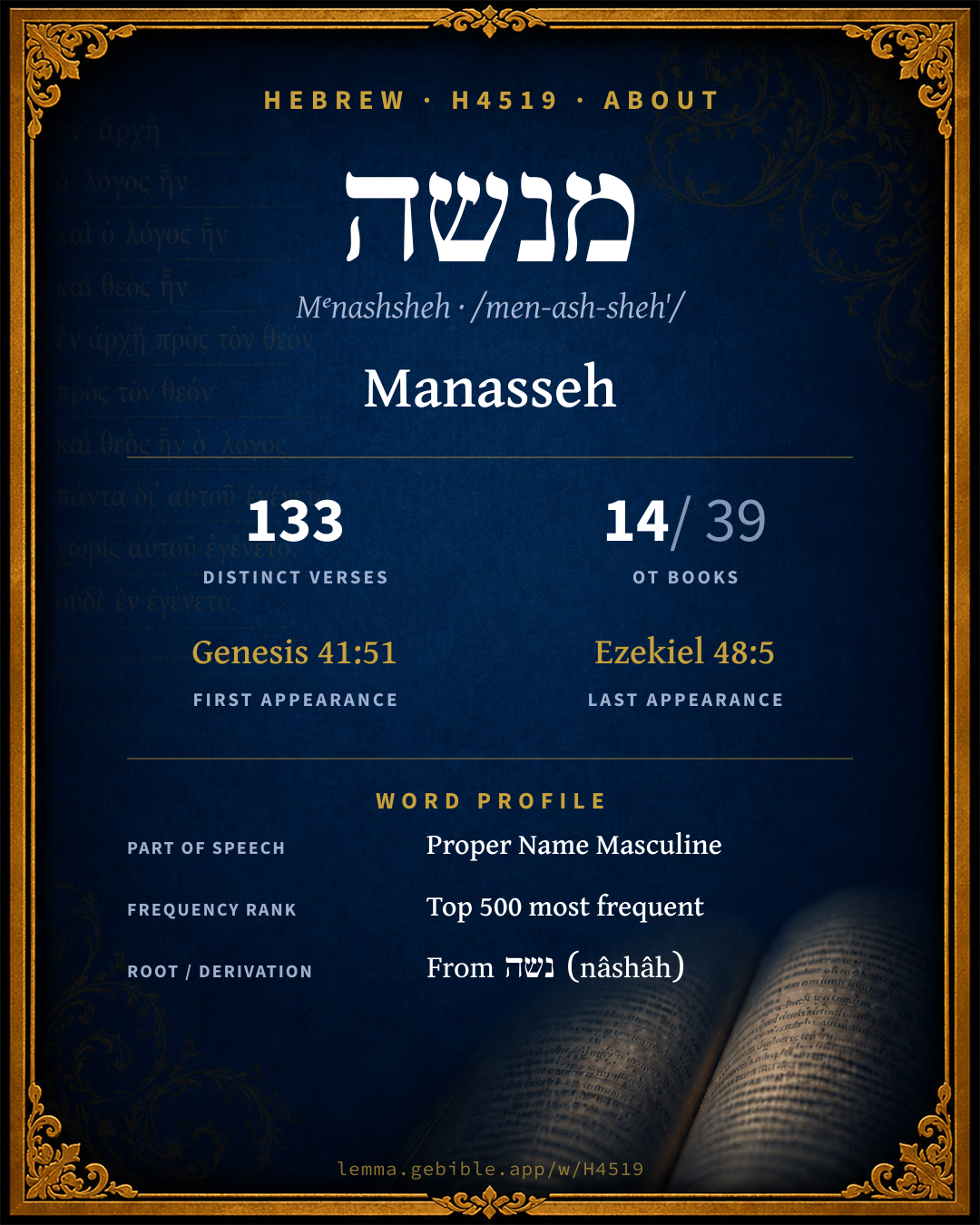
מְנַשֶּׁה
Manasseh
BDB lists 5 entries for ‘Manasseh’ fuller range ↓
Full lexicon entry — Brown-Driver-Briggs (BDB)
From Brown-Driver-Briggs (BDB)
Where this word appears
Grammar key — what these labels mean
Part of speech
- Noun
- A naming word — a person, place, thing, or idea.
Noun type
- Proper
- A name of a specific person, place, or people (e.g. Abraham, Zion, Israel).
Every verse where H4519 appears — 133 distinct verses across 14 books. Click any verse to open its interlinear word-by-word view. Verse text shown in the World English Bible for context — . Each verse’s Hebrew form is shown with its reference; the English is not keyword-highlighted, since the data carries no word-level English alignment. Use “Compare translations” on any verse to read it across multiple English versions. This concordance covers the Hebrew Bible; Septuagint (Greek Old Testament) occurrences are not indexed here.
Genesis 9 verses
- Genesis 41:51 מְנַשֶּׁ֑ה n Proper Joseph called the name of the firstborn Manasseh, "For," he said, "God has made me forget all my toil, and all my father's house."
- Genesis 46:20 מְנַשֶּׁ֖ה n Proper To Joseph in the land of Egypt were born Manasseh and Ephraim, whom Asenath, the daughter of Potiphera, priest of On, bore to him.
- Genesis 48:1 מְנַשֶּׁ֖ה n Proper It happened after these things, that someone said to Joseph, "Behold, your father is sick." He took with him his two sons, Manasseh and Ephraim.
- Genesis 48:5 וּ/מְנַשֶּׁ֔ה conj + n Proper Now your two sons, who were born to you in the land of Egypt before I came to you into Egypt, are mine; Ephraim and Manasseh, even as Reuben and Simeon, will be mine.
- Genesis 48:13 מְנַשֶּׁ֥ה n Proper Joseph took them both, Ephraim in his right hand toward Israel's left hand, and Manasseh in his left hand toward Israel's right hand, and brought them near to him.
- Genesis 48:14 מְנַשֶּׁ֑ה מְנַשֶּׁ֖ה n Proper n Proper Israel stretched out his right hand, and laid it on Ephraim's head, who was the younger, and his left hand on Manasseh's head, guiding his hands knowingly, for Manasseh was the firstborn.
- Genesis 48:17 מְנַשֶּֽׁה n Proper When Joseph saw that his father laid his right hand on the head of Ephraim, it displeased him. He held up his father's hand, to remove it from Ephraim's head to Manasseh's head.
- Genesis 48:20 וְ/כִ/מְנַשֶּׁ֑ה מְנַשֶּֽׁה conj + prep + n Proper n Proper He blessed them that day, saying, "In you will Israel bless, saying, 'God make you as Ephraim and as Manasseh'" He set Ephraim before Manasseh.
- Genesis 50:23 מְנַשֶּׁ֔ה n Proper Joseph saw Ephraim's children to the third generation. The children also of Machir, the son of Manasseh, were born on Joseph's knees.
Numbers 19 verses
- Numbers 1:10 לִ/מְנַשֶּׁ֕ה prep + n Proper Of the children of Joseph: Of Ephraim: Elishama the son of Ammihud. Of Manasseh: Gamaliel the son of Pedahzur.
- Numbers 1:34 מְנַשֶּׁ֔ה n Proper Of the children of Manasseh, their generations, by their families, by their fathers' houses, according to the number of the names, from twenty years old and upward, all who were able to go out to war;
- Numbers 1:35 מְנַשֶּׁ֑ה n Proper those who were numbered of them, of the tribe of Manasseh, were thirty-two thousand two hundred.
- Numbers 2:20 מְנַשֶּׁ֑ה מְנַשֶּׁ֔ה n Proper n Proper "Next to him shall be the tribe of Manasseh: and the prince of the children of Manasseh shall be Gamaliel the son of Pedahzur.
- Numbers 7:54 מְנַשֶּׁ֑ה n Proper On the eighth day Gamaliel the son of Pedahzur, prince of the children of Manasseh
- Numbers 10:23 מְנַשֶּׁ֑ה n Proper Over the host of the tribe of the children of Manasseh was Gamaliel the son of Pedahzur.
- Numbers 13:11 מְנַשֶּׁ֑ה n Proper Of the tribe of Joseph, [namely], of the tribe of Manasseh, Gaddi the son of Susi.
- Numbers 26:28 מְנַשֶּׁ֖ה n Proper The sons of Joseph after their families: Manasseh and Ephraim.
- Numbers 26:29 מְנַשֶּׁ֗ה n Proper The sons of Manasseh: of Machir, the family of the Machirites; and Machir became the father of Gilead; of Gilead, the family of the Gileadites.
- Numbers 26:34 מְנַשֶּׁ֑ה n Proper These are the families of Manasseh; and those who were numbered of them were fifty-two thousand seven hundred.
- Numbers 27:1 מְנַשֶּׁ֔ה מְנַשֶּׁ֣ה n Proper n Proper Then drew near the daughters of Zelophehad, the son of Hepher, the son of Gilead, the son of Machir, the son of Manasseh, of the families of Manasseh the son of Joseph; and these are the names of his daughters: Mahlah, Noah, and Hoglah, and Milcah, and Tirzah.
- Numbers 32:33 מְנַשֶּׁ֣ה n Proper Moses gave to them, even to the children of Gad, and to the children of Reuben, and to the half-tribe of Manasseh the son of Joseph, the kingdom of Sihon king of the Amorites, and the kingdom of Og king of Bashan, the land, according to the cities of it with [their] borders, even the cities of the land round about.
- Numbers 32:39 מְנַשֶּׁ֛ה n Proper The children of Machir the son of Manasseh went to Gilead, and took it, and dispossessed the Amorites who were therein.
- Numbers 32:40 מְנַשֶּׁ֑ה n Proper Moses gave Gilead to Machir the son of Manasseh; and he lived therein.
- Numbers 32:41 מְנַשֶּׁה֙ n Proper Jair the son of Manasseh went and took the towns of it, and called them Havvoth Jair.
- Numbers 34:14 מְנַשֶּׁ֔ה n Proper for the tribe of the children of Reuben according to their fathers' houses, and the tribe of the children of Gad according to their fathers' houses, have received, and the half-tribe of Manasseh have received, their inheritance:
- Numbers 34:23 מְנַשֶּׁ֖ה n Proper Of the children of Joseph: of the tribe of the children of Manasseh a prince, Hanniel the son of Ephod.
- Numbers 36:1 מְנַשֶּׁ֔ה n Proper The heads of the fathers' [houses] of the family of the children of Gilead, the son of Machir, the son of Manasseh, of the families of the sons of Joseph, came near, and spoke before Moses, and before the princes, the heads of the fathers' [houses] of the children of Israel:
- Numbers 36:12 מְנַשֶּׁ֥ה n Proper They were married into the families of the sons of Manasseh the son of Joseph; and their inheritance remained in the tribe of the family of their father.
Deuteronomy 4 verses
- Deuteronomy 3:13 הַֽ/מְנַשֶּׁ֑ה ptcl def.art + n Proper and the rest of Gilead, and all Bashan, the kingdom of Og, gave I to the half-tribe of Manasseh; all the region of Argob, even all Bashan. (The same is called the land of Rephaim.
- Deuteronomy 3:14 מְנַשֶּׁ֗ה n Proper Jair the son of Manasseh took all the region of Argob, to the border of the Geshurites and the Maacathites, and called them, even Bashan, after his own name, Havvoth Jair, to this day.)
- Deuteronomy 33:17 מְנַשֶּֽׁה n Proper The firstborn of his herd, majesty is his; His horns are the horns of the wild-ox: With them he shall push the peoples all of them, [even] the ends of the earth: They are the ten thousands of Ephraim, They are the thousands of Manasseh.
- Deuteronomy 34:2 וּ/מְנַשֶּׁ֑ה conj + n Proper and all Naphtali, and the land of Ephraim and Manasseh, and all the land of Judah, to the hinder sea,
Joshua 37 verses
- Joshua 1:12 הַֽ/מְנַשֶּׁ֑ה ptcl def.art + n Proper To the Reubenites, and to the Gadites, and to the half-tribe of Manasseh, spoke Joshua, saying,
- Joshua 4:12 הַֽ/מְנַשֶּׁה֙ ptcl def.art + n Proper The children of Reuben, and the children of Gad, and the half-tribe of Manasseh, passed over armed before the children of Israel, as Moses spoke to them:
- Joshua 12:6 הַֽ/מְנַשֶּֽׁה ptcl def.art + n Proper Moses the servant of Yahweh and the children of Israel struck them: and Moses the servant of Yahweh gave it for a possession to the Reubenites, and the Gadites, and the half-tribe of Manasseh.
- Joshua 13:7 הַֽ/מְנַשֶּֽׁה ptcl def.art + n Proper Now therefore divide this land for an inheritance to the nine tribes, and the half-tribe of Manasseh.
- Joshua 13:29 מְנַשֶּׁ֑ה מְנַשֶּׁ֖ה n Proper n Proper Moses gave [inheritance] to the half-tribe of Manasseh: and it was for the half-tribe of the children of Manasseh according to their families.
- Joshua 13:31 מְנַשֶּׁ֔ה n Proper and half Gilead, and Ashtaroth, and Edrei, the cities of the kingdom of Og in Bashan, were for the children of Machir the son of Manasseh, even for the half of the children of Machir according to their families.
- Joshua 14:4 מְנַשֶּׁ֣ה n Proper For the children of Joseph were two tribes, Manasseh and Ephraim: and they gave no portion to the Levites in the land, save cities to dwell in, with the suburbs of it for their cattle and for their substance.
- Joshua 16:4 מְנַשֶּׁ֥ה n Proper The children of Joseph, Manasseh and Ephraim, took their inheritance.
- Joshua 16:9 מְנַשֶּׁ֑ה n Proper together with the cities which were set apart for the children of Ephraim in the midst of the inheritance of the children of Manasseh, all the cities with their villages.
- Joshua 17:1 מְנַשֶּׁ֔ה מְנַשֶּׁ֜ה n Proper n Proper [This] was the lot for the tribe of Manasseh; for he was the firstborn of Joseph. As for Machir the firstborn of Manasseh, the father of Gilead, because he was a man of war, therefore he had Gilead and Bashan.
- Joshua 17:2 מְנַשֶּׁ֥ה מְנַשֶּׁ֧ה n Proper n Proper So [the lot] was for the rest of the children of Manasseh according to their families: for the children of Abiezer, and for the children of Helek, and for the children of Asriel, and for the children of Shechem, and for the children of Hepher, and for the children of Shemida: these were the male children of Manasseh the son of Joseph according to their families.
- Joshua 17:3 מְנַשֶּׁ֗ה n Proper But Zelophehad, the son of Hepher, the son of Gilead, the son of Machir, the son of Manasseh, had no sons, but daughters: and these are the names of his daughters: Mahlah, and Noah, Hoglah, Milcah, and Tirzah.
- Joshua 17:5 מְנַשֶּׁ֖ה n Proper There fell ten parts to Manasseh, besides the land of Gilead and Bashan, which is beyond the Jordan;
- Joshua 17:6 מְנַשֶּׁ֔ה מְנַשֶּׁ֖ה n Proper n Proper because the daughters of Manasseh had an inheritance among his sons. The land of Gilead belonged to the rest of the sons of Manasseh.
- Joshua 17:7 מְנַשֶּׁה֙ n Proper The border of Manasseh was from Asher to Michmethath, which is before Shechem; and the border went along to the right hand, to the inhabitants of En Tappuah.
- Joshua 17:8 לִ/מְנַשֶּׁ֕ה מְנַשֶּׁ֖ה prep + n Proper n Proper The land of Tappuah belonged to Manasseh; but Tappuah on the border of Manasseh belonged to the children of Ephraim.
- Joshua 17:9 מְנַשֶּׁ֑ה מְנַשֶּׁה֙ n Proper n Proper The border went down to the brook of Kanah, southward of the brook: these cities belonged to Ephraim among the cities of Manasseh: and the border of Manasseh was on the north side of the brook, and the goings out of it were at the sea:
- Joshua 17:10 לִ/מְנַשֶּׁ֔ה prep + n Proper southward it was Ephraim's, and northward it was Manasseh's, and the sea was his border; and they reached to Asher on the north, and to Issachar on the east.
- Joshua 17:11 לִ/מְנַשֶּׁ֜ה prep + n Proper Manasseh had in Issachar and in Asher Beth-shean and its towns, and Ibleam and its towns, and the inhabitants of Dor and its towns, and the inhabitants of En-dor and its towns, and the inhabitants of Taanach and its towns, and the inhabitants of Megiddo and its towns, even the three heights.
- Joshua 17:12 מְנַשֶּׁ֔ה n Proper Yet the children of Manasseh couldn't drive out [the inhabitants of] those cities; but the Canaanites would dwell in that land.
- Joshua 17:17 וְ/לִ/מְנַשֶּׁ֖ה conj + prep + n Proper Joshua spoke to the house of Joseph, even to Ephraim and to Manasseh, saying, You are a great people, and have great power; you shall not have one lot only:
- Joshua 18:7 הַֽ/מְנַשֶּׁ֜ה ptcl def.art + n Proper For the Levites have no portion among you; for the priesthood of Yahweh is their inheritance: and Gad and Reuben and the half-tribe of Manasseh have received their inheritance beyond the Jordan eastward, which Moses the servant of Yahweh gave them.
- Joshua 20:8 מְנַשֶּֽׁה n Proper Beyond the Jordan at Jericho eastward, they assigned Bezer in the wilderness in the plain out of the tribe of Reuben, and Ramoth in Gilead out of the tribe of Gad, and Golan in Bashan out of the tribe of Manasseh.
- Joshua 21:5 מְנַשֶּׁ֛ה n Proper The rest of the children of Kohath had by lot out of the families of the tribe of Ephraim, and out of the tribe of Dan, and out of the half-tribe of Manasseh, ten cities.
- Joshua 21:6 מְנַשֶּׁ֤ה n Proper The children of Gershon had by lot out of the families of the tribe of Issachar, and out of the tribe of Asher, and out of the tribe of Naphtali, and out of the half-tribe of Manasseh in Bashan, thirteen cities.
- Joshua 21:25 מְנַשֶּׁ֔ה n Proper Out of the half-tribe of Manasseh, Taanach with its suburbs, and Gath-rimmon with its suburbs; two cities.
- Joshua 21:27 מְנַשֶּׁ֗ה n Proper To the children of Gershon, of the families of the Levites, out of the half-tribe of Manasseh [they gave] Golan in Bashan with its suburbs, the city of refuge for the manslayer, and Be-eshterah with its suburbs; two cities.
- Joshua 22:1 מְנַשֶּֽׁה n Proper Then Joshua called the Reubenites, and the Gadites, and the half-tribe of Manasseh,
- Joshua 22:7 הַֽ/מְנַשֶּׁ֗ה ptcl def.art + n Proper Now to the one half-tribe of Manasseh Moses had given [inheritance] in Bashan; but to the other half gave Joshua among their brothers beyond the Jordan westward; moreover when Joshua sent them away to their tents, he blessed them,
- Joshua 22:9 הַֽ/מְנַשֶּׁ֗ה ptcl def.art + n Proper The children of Reuben and the children of Gad and the half-tribe of Manasseh returned, and departed from the children of Israel out of Shiloh, which is in the land of Canaan, to go to the land of Gilead, to the land of their possession, which they owned, according to the commandment of Yahweh by Moses.
- Joshua 22:10 הַֽ/מְנַשֶּׁ֨ה ptcl def.art + n Proper When they came to the region about the Jordan, that is in the land of Canaan, the children of Reuben and the children of Gad and the half-tribe of Manasseh built there an altar by the Jordan, a great altar to look on.
- Joshua 22:11 הַֽ/מְנַשֶּׁ֜ה ptcl def.art + n Proper The children of Israel heard say, Behold, the children of Reuben and the children of Gad and the half-tribe of Manasseh have built an altar in the forefront of the land of Canaan, in the region about the Jordan, on the side that pertains to the children of Israel.
- Joshua 22:13 מְנַשֶּׁ֖ה n Proper The children of Israel sent to the children of Reuben, and to the children of Gad, and to the half-tribe of Manasseh, into the land of Gilead, Phinehas the son of Eleazar the priest,
- Joshua 22:15 מְנַשֶּׁ֖ה n Proper They came to the children of Reuben, and to the children of Gad, and to the half-tribe of Manasseh, to the land of Gilead, and they spoke with them, saying,
- Joshua 22:21 הַֽ/מְנַשֶּׁ֑ה ptcl def.art + n Proper Then the children of Reuben and the children of Gad and the half-tribe of Manasseh answered, and spoke to the heads of the thousands of Israel,
- Joshua 22:30 מְנַשֶּׁ֑ה n Proper When Phinehas the priest, and the princes of the congregation, even the heads of the thousands of Israel that were with him, heard the words that the children of Reuben and the children of Gad and the children of Manasseh spoke, it pleased them well.
- Joshua 22:31 מְנַשֶּׁ֗ה n Proper Phinehas the son of Eleazar the priest said to the children of Reuben, and to the children of Gad, and to the children of Manasseh, This day we know that Yahweh is in the midst of us, because you have not committed this trespass against Yahweh: now have you delivered the children of Israel out of the hand of Yahweh.
Judges 7 verses
- Judges 1:27 מְנַשֶּׁ֗ה n Proper Manasseh did not drive out [the inhabitants of] Beth-shean and its towns, nor [of] Taanach and its towns, nor the inhabitants of Dor and its towns, nor the inhabitants of Ibleam and its towns, nor the inhabitants of Megiddo and its towns; but the Canaanites would dwell in that land.
- Judges 6:15 בִּ/מְנַשֶּׁ֔ה prep + n Proper He said to him, Oh, Lord, with which shall I save Israel? behold, my family is the poorest in Manasseh, and I am the least in my father's house.
- Judges 6:35 מְנַשֶּׁ֔ה n Proper He sent messengers throughout all Manasseh; and they also were gathered together after him: and he sent messengers to Asher, and to Zebulun, and to Naphtali; and they came up to meet them.
- Judges 7:23 מְנַשֶּׁ֑ה n Proper The men of Israel were gathered together out of Naphtali, and out of Asher, and out of all Manasseh, and pursued after Midian.
- Judges 11:29 מְנַשֶּׁ֑ה n Proper Then the Spirit of Yahweh came on Jephthah, and he passed over Gilead and Manasseh, and passed over Mizpeh of Gilead, and from Mizpeh of Gilead he passed over to the children of Ammon.
- Judges 12:4 מְנַשֶּֽׁה n Proper Then Jephthah gathered together all the men of Gilead, and fought with Ephraim; and the men of Gilead struck Ephraim, because they said, You are fugitives of Ephraim, you Gileadites, in the midst of Ephraim, [and] in the midst of Manasseh.
- Judges 18:30 מְנַשֶּׁ֜ה n Proper The children of Dan set up for themselves the engraved image: and Jonathan, the son of Gershom, the son of Moses, he and his sons were priests to the tribe of the Danites until the day of the captivity of the land.
1 Kings 1 verse
2 Kings 11 verses
- 2 Kings 20:21 מְנַשֶּׁ֥ה n Proper Hezekiah slept with his fathers; and Manasseh his son reigned in his place.
- 2 Kings 21:1 מְנַשֶּׁ֣ה n Proper Manasseh was twelve years old when he began to reign; and he reigned fifty-five years in Jerusalem: and his mother's name was Hephzibah.
- 2 Kings 21:9 מְנַשֶּׁה֙ n Proper But they didn't listen: and Manasseh seduced them to do that which is evil more than did the nations whom Yahweh destroyed before the children of Israel.
- 2 Kings 21:11 מְנַשֶּׁ֤ה n Proper Because Manasseh king of Judah has done these abominations, and has done wickedly above all that the Amorites did, who were before him, and has made Judah also to sin with his idols;
- 2 Kings 21:16 מְנַשֶּׁה֙ n Proper Moreover Manasseh shed innocent blood very much, until he had filled Jerusalem from one end to another; besides his sin with which he made Judah to sin, in doing that which was evil in the sight of Yahweh.
- 2 Kings 21:17 מְנַשֶּׁה֙ n Proper Now the rest of the acts of Manasseh, and all that he did, and his sin that he sinned, aren't they written in the book of the chronicles of the kings of Judah?
- 2 Kings 21:18 מְנַשֶּׁה֙ n Proper Manasseh slept with his fathers, and was buried in the garden of his own house, in the garden of Uzza: and Amon his son reigned in his place.
- 2 Kings 21:20 מְנַשֶּׁ֥ה n Proper He did that which was evil in the sight of Yahweh, as did Manasseh his father.
- 2 Kings 23:12 מְנַשֶּׁ֔ה n Proper The altars that were on the roof of the upper chamber of Ahaz, which the kings of Judah had made, and the altars which Manasseh had made in the two courts of the house of Yahweh, did the king break down, and beat [them] down from there, and cast the dust of them into the brook Kidron.
- 2 Kings 23:26 מְנַשֶּֽׁה n Proper Notwithstanding, Yahweh didn't turn from the fierceness of his great wrath, with which his anger was kindled against Judah, because of all the provocation with which Manasseh had provoked him.
- 2 Kings 24:3 מְנַשֶּׁ֔ה n Proper Surely at the commandment of Yahweh came this on Judah, to remove them out of his sight, for the sins of Manasseh, according to all that he did,
1 Chronicles 18 verses
- 1 Chronicles 3:13 מְנַשֶּׁ֥ה n Proper Ahaz his son, Hezekiah his son, Manasseh his son,
- 1 Chronicles 5:18 מְנַשֶּׁה֮ n Proper The sons of Reuben, and the Gadites, and the half-tribe of Manasseh, of valiant men, men able to bear buckler and sword, and to shoot with bow, and skillful in war, were forty-four thousand seven hundred and sixty, that were able to go forth to war.
- 1 Chronicles 5:23 מְנַשֶּׁ֔ה n Proper The children of the half-tribe of Manasseh lived in the land: they increased from Bashan to Baal Hermon and Senir and Mount Hermon.
- 1 Chronicles 5:26 מְנַשֶּׁ֑ה n Proper The God of Israel stirred up the spirit of Pul king of Assyria, and the spirit of Tilgath Pilneser king of Assyria, and he carried them away, even the Reubenites, and the Gadites, and the half-tribe of Manasseh, and brought them to Halah, and Habor, and Hara, and to the river of Gozan, to this day.
- 1 Chronicles 6:61 מְנַשֶּׁ֛ה n Proper To the rest of the sons of Kohath [were given] by lot, out of the family of the tribe, out of the half-tribe, the half of Manasseh, ten cities.
- 1 Chronicles 6:62 מְנַשֶּׁה֙ n Proper To the sons of Gershom, according to their families, out of the tribe of Issachar, and out of the tribe of Asher, and out of the tribe of Naphtali, and out of the tribe of Manasseh in Bashan, thirteen cities.
- 1 Chronicles 6:70 מְנַשֶּׁ֔ה n Proper and out of the half-tribe of Manasseh, Aner with its suburbs, and Bileam with its suburbs, for the rest of the family of the sons of Kohath.
- 1 Chronicles 6:71 מְנַשֶּׁ֔ה n Proper To the sons of Gershom [were given], out of the family of the half-tribe of Manasseh, Golan in Bashan with its suburbs, and Ashtaroth with its suburbs;
- 1 Chronicles 7:14 מְנַשֶּׁ֔ה n Proper The sons of Manasseh: Asriel, whom his concubine the Aramitess bore: she bore Machir the father of Gilead:
- 1 Chronicles 7:17 מְנַשֶּֽׁה n Proper The sons of Ulam: Bedan. These were the sons of Gilead the son of Machir, the son of Manasseh.
- 1 Chronicles 7:29 מְנַשֶּׁ֗ה n Proper and by the borders of the children of Manasseh, Beth-shean and its towns, Taanach and its towns, Megiddo and its towns, Dor and its towns. In these lived the children of Joseph the son of Israel.
- 1 Chronicles 9:3 וּ/מְנַשֶּֽׁה conj + n Proper In Jerusalem lived of the children of Judah, and of the children of Benjamin, and of the children of Ephraim and Manasseh:
- 1 Chronicles 12:19 וּ/מִֽ/מְּנַשֶּׁ֞ה conj + prep + n Proper Of Manasseh also there fell away some to David, when he came with the Philistines against Saul to battle: but they didn't help them; for the lords of the Philistines sent him away after consultation, saying, He will fall away to his master Saul to the jeopardy of our heads.
- 1 Chronicles 12:20 מִֽ/מְּנַשֶּׁ֡ה לִ/מְנַשֶּֽׁה prep + n Proper prep + n Proper As he went to Ziklag, there fell to him of Manasseh, Adnah, and Jozabad, and Jediael, and Michael, and Jozabad, and Elihu, and Zillethai, captains of thousands who were of Manasseh.
- 1 Chronicles 12:31 מְנַשֶּׁ֔ה n Proper Of the half-tribe of Manasseh eighteen thousand, who were mentioned by name, to come and make David king.
- 1 Chronicles 12:37 מְנַשֶּׁ֗ה n Proper On the other side of the Jordan, of the Reubenites, and the Gadites, and of the half-tribe of Manasseh, with all manner of instruments of war for the battle, one hundred twenty thousand.
- 1 Chronicles 27:20 מְנַשֶּׁ֔ה n Proper of the children of Ephraim, Hoshea the son of Azaziah: of the half-tribe of Manasseh, Joel the son of Pedaiah:
- 1 Chronicles 27:21 הַֽ/מְנַשֶּׁה֙ ptcl def.art + n Proper of the half-tribe of Manasseh in Gilead, Iddo the son of Zechariah: of Benjamin, Jaasiel the son of Abner:
2 Chronicles 18 verses
- 2 Chronicles 15:9 וּ/מְנַשֶּׁ֖ה conj + n Proper He gathered all Judah and Benjamin, and those who sojourned with them out of Ephraim and Manasseh, and out of Simeon: for they fell to him out of Israel in abundance, when they saw that Yahweh his God was with him.
- 2 Chronicles 30:1 וּ/מְנַשֶּׁ֔ה conj + n Proper Hezekiah sent to all Israel and Judah, and wrote letters also to Ephraim and Manasseh, that they should come to the house of Yahweh at Jerusalem, to keep the Passover to Yahweh, the God of Israel.
- 2 Chronicles 30:10 וּ/מְנַשֶּׁ֖ה conj + n Proper So the posts passed from city to city through the country of Ephraim and Manasseh, even to Zebulun: but they ridiculed them, and mocked them.
- 2 Chronicles 30:11 וּ/מְנַשֶּׁ֖ה conj + n Proper Nevertheless certain men of Asher and Manasseh and of Zebulun humbled themselves, and came to Jerusalem.
- 2 Chronicles 30:18 וּ/מְנַשֶּׁ֜ה conj + n Proper For a multitude of the people, even many of Ephraim and Manasseh, Issachar and Zebulun, had not cleansed themselves, yet did they eat the Passover otherwise than it is written. For Hezekiah had prayed for them, saying, The good Yahweh pardon everyone
- 2 Chronicles 31:1 וּ/מְנַשֶּׁ֖ה conj + n Proper Now when all this was finished, all Israel who were present went out to the cities of Judah, and broke in pieces the pillars, and hewed down the Asherim, and broke down the high places and the altars out of all Judah and Benjamin, in Ephraim also and Manasseh, until they had destroyed them all. Then all the children of Israel returned, every man to his possession, into their own cities.
- 2 Chronicles 32:33 מְנַשֶּׁ֥ה n Proper Hezekiah slept with his fathers, and they buried him in the ascent of the tombs of the sons of David: and all Judah and the inhabitants of Jerusalem did him honor at his death. Manasseh his son reigned in his place.
- 2 Chronicles 33:1 מְנַשֶּׁ֣ה n Proper Manasseh was twelve years old when he began to reign; and he reigned fifty-five years in Jerusalem.
- 2 Chronicles 33:9 מְנַשֶּׁ֔ה n Proper Manasseh seduced Judah and the inhabitants of Jerusalem, so that they did evil more than did the nations whom Yahweh destroyed before the children of Israel.
- 2 Chronicles 33:10 מְנַשֶּׁ֥ה n Proper Yahweh spoke to Manasseh, and to his people; but they gave no heed.
- 2 Chronicles 33:11 מְנַשֶּׁ֖ה n Proper Therefore Yahweh brought on them the captains of the host of the king of Assyria, who took Manasseh in chains, and bound him with fetters, and carried him to Babylon.
- 2 Chronicles 33:13 מְנַשֶּׁ֔ה n Proper He prayed to him; and he was entreated of him, and heard his supplication, and brought him again to Jerusalem into his kingdom. Then Manasseh knew that Yahweh he was God.
- 2 Chronicles 33:18 מְנַשֶּׁה֮ n Proper Now the rest of the acts of Manasseh, and his prayer to his God, and the words of the seers who spoke to him in the name of Yahweh, the God of Israel, behold, they are written among the acts of the kings of Israel.
- 2 Chronicles 33:20 מְנַשֶּׁה֙ n Proper So Manasseh slept with his fathers, and they buried him in his own house: and Amon his son reigned in his place.
- 2 Chronicles 33:22 מְנַשֶּׁ֣ה מְנַשֶּׁ֣ה n Proper n Proper He did that which was evil in the sight of Yahweh, as did Manasseh his father; and Amon sacrificed to all the engraved images which Manasseh his father had made, and served them.
- 2 Chronicles 33:23 מְנַשֶּׁ֣ה n Proper He didn't humble himself before Yahweh, as Manasseh his father had humbled himself; but this same Amon trespassed more and more.
- 2 Chronicles 34:6 מְנַשֶּׁ֧ה n Proper [So did he] in the cities of Manasseh and Ephraim and Simeon, even to Naphtali, in their ruins round about.
- 2 Chronicles 34:9 מְנַשֶּׁ֣ה n Proper They came to Hilkiah the high priest, and delivered the money that was brought into the house of God, which the Levites, the keepers of the threshold, had gathered of the hand of Manasseh and Ephraim, and of all the remnant of Israel, and of all Judah and Benjamin, and of the inhabitants of Jerusalem.
Ezra 2 verses
Psalms 3 verses
- Psalms 60:7 מְנַשֶּׁ֗ה n Proper Gilead is mine, and Manasseh is mine. Ephraim also is the defense of my head. Judah is my scepter.
- Psalms 80:2 וּ/מְנַשֶּׁ֗ה conj + n Proper Before Ephraim and Benjamin and Manasseh, stir up your might! Come to save us!
- Psalms 108:8 מְנַשֶּׁ֗ה n Proper Gilead is mine. Manasseh is mine. Ephraim also is my helmet. Judah is my scepter.
Isaiah 1 verse
Jeremiah 1 verse
Ezekiel 2 verses
About this entry
At a glance — auto-summarized from this page’s data, not written by a person. Every figure links to its source below. This summary describes the numbers; it doesn’t interpret them.
מנשה — transliterated Mᵉnashsheh — is a Hebrew name carrying the sense “Manasseh.” It first appears in Genesis 41:51. The Hebrew Bible uses it across 133 verses — common. More than a quarter of its appearances fall in Joshua. See 133-verse concordance and the renderings breakdown below.
Gloss history
Strong's 1890 vs modern scholarship
About this word
Strong's H4519 catalogs a Hebrew word from the Hebrew Old Testament.
These counts are not copied from any lexicon or concordance. They are computed here, from the morphology-tagged Hebrew Old Testament. What Lemma adds →
- 133
- distinct verses
- The word appears in 133 distinct verses.
- 14 / 39
- OT books
- The word appears in 14 of 39 Old Testament books.
- #307
- by frequency
- Top 500 most frequent Hebrew words (rank 307 of 8,640 Hebrew words by occurrence).
View all 133 occurrences in the concordance →
Most concentrated in
- Joshua 37 verses 28%
- Numbers 19 verses 14%
- 1 Chronicles 18 verses 14%
By section of the Old Testament
By traditional corpus
Conventional, traditional groupings — biblical authorship is debated, so this is a traditional corpus grouping, not an authorship claim. Each share is this word’s portion of its verses in that division of the Hebrew canon. Each figure is a share of the word’s 133 distinct verses.
- Prophets (Nevi'im) 60 verses · 45%
- Writings (Ketuvim) 41 verses · 31%
- Torah (Pentateuch) 32 verses · 24%
How translations render this word
Counts come from each version’s own published word-to-Strong’s tagging or interlinear alignment — an approximate guide to how each version renders this word, not a word-level alignment the data otherwise carries. Because each total is that version’s own tagged count, the per-version totals vary from one another and need not match the appearance or distinct-verse counts above. These counts may also differ from a printed concordance because Lemma counts each distinctly tagged rendering and does not collapse phrase taggings into a single head-word total. This is a fixed set of word-tagged versions (KJV, ASV, BSB, ULT) and does not change with the reading translation you choose elsewhere. Each version’s license is shown beside its name below (and on Sources).
- King James Version: Manasseh 128×, Manasseh's 3×, Tribe of manasseh 2×
- American Standard Version: Manasseh 124×, Half-tribe of manasseh 6×, Is mine 2×
- Berean Standard Bible: Manasseh 136×, Manasseh’s 3×
- unfoldingWord Literal Text: Manasseh 140×
King James Version Public Domain
Renders H4519 across 146 tagged occurrences — most commonly:
Plus 13 renderings that appear only once — usually multi-word phrases or single function words the recovered tagging swept in, not distinct renderings.
American Standard Version Public Domain
Renders H4519 across 146 tagged occurrences — most commonly:
Plus 12 renderings that appear only once — usually multi-word phrases or single function words the recovered tagging swept in, not distinct renderings.
Berean Standard Bible Public Domain
Renders H4519 across 142 tagged occurrences — most commonly:
Plus 3 renderings that appear only once — usually multi-word phrases or single function words the recovered tagging swept in, not distinct renderings. Not rendered by a distinct English word in 3 further occurrences.
unfoldingWord Literal Text CC BY-SA 4.0
Renders H4519 across 147 tagged occurrences — most commonly:
Plus 7 renderings that appear only once — usually multi-word phrases or single function words the recovered tagging swept in, not distinct renderings.
6 senses and sub-senses in the full BDB
What do BDB’s symbols mean?
BDB uses these scholarly abbreviations:
| Symbol | Meaning |
|---|---|
| 𝔊 | the Septuagint (the ancient Greek translation, LXX) |
| 𝔙 | the Vulgate (the Latin translation) |
| 𝔖 | the Syriac version (the Peshitta) |
| 𝔗 | the Targum (the Aramaic translation) |
| ψ | the Psalms |
| √ | root (the underlying root or stem) |
| ‖ | parallel passage (a synonymous or contrasted parallel) |
| † | the dagger: every passage where the word occurs is cited |
The 6 senses and sub-senses the full Brown-Driver-Briggs lexicon distinguishes for this word, in lexicon order (not ranked by frequency), with BDB’s own verbatim wording and sub-sense lettering. Shown in Hebrew script with BDB’s own scholarly abbreviations. The condensed entry is in the Lexicon Entry tab. See also the Forms in the corpus table below.
- 1.
- a. Manasseh, eldest son of Joseph Gn 41:51; 48:1, 13, 14(×2), 17, 20(×2), also 50:23 (father of Machir; all E), 46:20; 48:5 (both P). e.g. Genesis 41:51
- b. of tribe, often + Ephraim (v. אֶפְרַיִם): (1) the part W. of Jordan: †a. בְּנֵי מ׳ Jos 16:9; 17:2a (בני־מ׳ הַנּוֹתָרִים), v 2 b, 6, 12 (all JE), 1 Ch 7:29; 9:3 (בְּנֵי אֶפְרַיִם וּמ׳; Jos 13:29 v. infr.); β. מ׳ alone, Jos 17:5, 8(×2), 9b, 11, 17 Dt 34:2 (אֶרֶץ אֶפְרַיִם וּמ׳; all JE), 2 Ch 30:10 (id.), Jos 16:4; 17:7, 9a, 10 (all P), also appar. Dt 33:17 (poem), Ju 1:27; 6:15, 35; 7:23 Is 9:20(×2) ψ 80:3 + 10 times Chr; †γ. מַטֵּה מ׳ 1 Ch 6:55; חֲצִי מַטֵּה מ׳ Jos 21:6, 25 1 Ch 12:32; (van d. H. v 31); מַחֲצִית מַטֵּה חֲצִי מ׳ 6:46 (but on text v. Kit); שְׁנֵי מַטּוֹת מ׳ וְאֶפְרַיִם Jos 14:4 (P); †δ. חֲצִי שֵׁבֶט מ׳ 1 Ch 27:20; c. art. הַשֵּׁבֶט הַמְֿ׳ Jos 13:7 (D). †(2) of Manasseh E. of Jordan; a. בְּנֵי מ׳ Jos 22:30, 31 (P); β. מ׳ alone, Ju 11:29 (distinctly of territory), 12:4 (but on text v. GFM), ψ 60:9=108:9; חֲצִי הַמּ׳ 1 Ch 27:21; γ. מַטֵּה מ׳ Jos 17:1a; 20:8 (both P), 1 Ch 6:47; הֲצִי מַטֵּה מ׳ Jos 22:1 (D), Nu 34:14 Jos 21:5, 27 (all P), 1 Ch 6:56; חֲצִי מַטֵּה כְּנֵי מ׳ Jos 13:29 (P); δ. חֲצִי שֵׁבֶט מ׳ Dt 3:13 (D), Jos 13:29; 22:13, 15 (all P), 1 Ch 5:18, 23, 26; 12:38 (van d. H. v 37); הֲצִי שֵׁבֶט מ׳ בֶּן־יוֹסֵף Nu 32:33 (P); c. art. חֲצִי שֵׁבֶט הַמְֿ׳ Jos 1:12; 4:12; 12:6; 18:7; 22:1, 7 (all D), 22:9, 10, 11, 21 (all P). Here belong also (chiefly) reff. to מ׳ as father of Machir (cf. Gn 50:23 supr.): †Nu 27:1; 32:39, 40; 36:1 Jos 13:31; 17:1, 3; (all P), 1 Ch 7:14, 17; and of Jair Dt 3:14 (D), Nu 32:41 (P), 1 K 4:13 (cf. מָכִיר, יָאִיר. †(3) of undivided tribe (never שֵׁבֶט מ׳): a. בְּנֵי מ׳ Nu 1:34; 2:20; 7:54; 26:29; 36:12 (all P); β. מ׳ alone, Nu 1:10; 26:28, 34; 27:1b (all P), Ez 48:4, 5; γ. מַטֵּה מ׳ Nu 1:35; 2:20; 13:11, מַטֵּה בְּנֵי מ׳ Nu 10:23; 34:23 (all P). e.g. Joshua 16:9
- 2. son of Hezekiah, and king of Judah (Assyrian Menasê, Minsê SchrCOT 2 K 21, 1);—2 K 20:21; 20:21 + 9 times Kings, 12 times Chr, Je 15:4. e.g. 2 Kings 20:21
- 3. two who had taken strange wives:
- a. Ezr 10:30. e.g. Ezra 10:30
- b. 10:33. e.g. Ezra 10:33
Senses from the full Brown-Driver-Briggs lexicon (Brown, Driver, Briggs; Oxford 1906 — public domain), digitized via Sefaria, supplemented by the OpenScriptures HebrewLexicon (CC BY 4.0). Full attribution on Sources.
Word origin
n.pr.m. et trib. Manasseh (interpr. Gn 41:51 as Pi. causat. √II. נשׁה q.v.);—מ׳ Gn 46:20 +; מְנַשֶּׁ֑ה 41:51 + (on Ju 18:30 v. מֹשֶׁה); c. art. (strangely), הַמְֿ׳ Dt 7:13 Jos 1:12 + (v. infr.); 𝔊 Μαν(ν)ασση;—
— Brown-Driver-Briggs (Oxford 1906, public domain), digitized via Sefaria, supplemented by the OpenScriptures HebrewLexicon (CC BY 4.0). See Sources.
Derived from נשה (nâshâh) (H5382) — to forget.
Jastrow Dictionary
A second Hebrew/Aramaic lexicon for comparison, covering Aramaic and post-biblical (Talmudic, Targumic, Midrashic) usage that the biblical-Hebrew BDB does not. Matched by lemma rather than by Strong’s number, so a lemma may carry more than one Jastrow headword (shown separately below), and the entries cover usage well beyond the Bible.
מְנַשֶּׁה
- (b. h.) pr. n. m. Manasseh,
- 1. son of Joseph; also the tribe of Manasseh. Gen. R. s. 84 מ׳ גרם לשבטים לקרוע M. was the cause that the sons of Jacob rent their garments (Gen. XLIV, 13; v. Gen. R. s. 91); a. fr. e.g. Genesis 44:13
- 2. M., King of Judah. Snh. X, 2; Tosef. ib. XII, 11. Yeb. 49ᵇ מ׳ הרג וכ׳ M. put Isaiah to death; a. fr.
- 3. M., grandfather of Jonathan (Jud. XVIII, 30). Tosef. Snh. XIV, 8; B. Bath. 109ᵇ וכי בן מ׳ וכ׳ was he the son of M.? Was he not the son of Moses? Ib. מתוך שעשה מעשה מ׳ וכ׳ because he acted like king Manasseh &c. e.g. Judges 18:30
- 4. M., a scholar. Y. Meg. II, 73ᵃ bot.
A Dictionary of the Targumim, the Talmud Babli and Yerushalmi, and the Midrashic Literature (Marcus Jastrow; London, Luzac, 1903) — Public Domain. Digitized via Sefaria. Digitized via Sefaria. Full attribution on Sources.
Forms in the corpus
The 34 distinct written forms H4519 takes in the Hebrew Bible, most frequent first — each parse links to that state’s occurrences in the concordance. Hebrew forms include their vowel points and cantillation, so a single lemma takes many written forms.
| Form | Parsing | Example | Uses |
|---|---|---|---|
| מְנַשֶּׁ֔ה | Noun, Proper | Genesis 50:23 | 23 |
| מְנַשֶּׁ֑ה | Noun, Proper | Genesis 41:51 | 16 |
| מְנַשֶּׁ֖ה | Noun, Proper | Ezra 10:33 | 13 |
| מְנַשֶּׁ֗ה | Noun, Proper | Deuteronomy 3:14 | 11 |
| מְנַשֶּׁ֣ה | Noun, Proper | 2 Chronicles 33:1 | 10 |
| מְנַשֶּׁ֥ה | Noun, Proper | Ezekiel 48:4 | 10 |
| מְנַשֶּׁה֙ | Noun, Proper | 1 Chronicles 6:62 | 9 |
| מְנַשֶּֽׁה | Noun, Proper | Deuteronomy 33:17 | 8 |
| וּ/מְנַשֶּׁ֖ה | Noun, Proper | 2 Chronicles 15:9 | 4 |
| הַֽ/מְנַשֶּׁ֑ה | Noun, Proper | Deuteronomy 3:13 | 3 |
| מְנַשֶּׁ֛ה | Noun, Proper | 1 Chronicles 6:61 | 3 |
| מְנַשֶּׁ֜ה | Noun, Proper | 1 Kings 4:13 | 3 |
| מְנַשֶּׁ֤ה | Noun, Proper | 2 Kings 21:11 | 3 |
| הַֽ/מְנַשֶּׁ֗ה | Noun, Proper | Joshua 22:7 | 2 |
| הַֽ/מְנַשֶּׁ֜ה | Noun, Proper | Joshua 18:7 | 2 |
| הַֽ/מְנַשֶּֽׁה | Noun, Proper | Joshua 12:6 | 2 |
| הַֽ/מְנַשֶּׁה֙ | Noun, Proper | 1 Chronicles 27:21 | 2 |
| וּ/מְנַשֶּׁ֔ה | Noun, Proper | Genesis 48:5 | 2 |
| וּ/מְנַשֶּֽׁה | Noun, Proper | Ezra 10:30 | 2 |
| לִ/מְנַשֶּׁ֕ה | Noun, Proper | Joshua 17:8 | 2 |
| מְנַשֶּׁ֧ה | Noun, Proper | 2 Chronicles 34:6 | 2 |
| מְנַשֶּׁה֮ | Noun, Proper | 1 Chronicles 5:18 | 2 |
| בִּ/מְנַשֶּׁ֔ה | Noun, Proper | Judges 6:15 | 1 |
| הַֽ/מְנַשֶּׁ֨ה | Noun, Proper | Joshua 22:10 | 1 |
| וְ/כִ/מְנַשֶּׁ֑ה | Noun, Proper | Genesis 48:20 | 1 |
| וְ/לִ/מְנַשֶּׁ֖ה | Noun, Proper | Joshua 17:17 | 1 |
| וּ/מְנַשֶּׁ֑ה | Noun, Proper | Deuteronomy 34:2 | 1 |
| וּ/מְנַשֶּׁ֗ה | Noun, Proper | Psalms 80:2 | 1 |
| וּ/מְנַשֶּׁ֜ה | Noun, Proper | 2 Chronicles 30:18 | 1 |
| וּ/מִֽ/מְּנַשֶּׁ֞ה | Noun, Proper | 1 Chronicles 12:19 | 1 |
| לִ/מְנַשֶּׁ֔ה | Noun, Proper | Joshua 17:10 | 1 |
| לִ/מְנַשֶּׁ֜ה | Noun, Proper | Joshua 17:11 | 1 |
| לִ/מְנַשֶּֽׁה | Noun, Proper | 1 Chronicles 12:20 | 1 |
| מִֽ/מְּנַשֶּׁ֡ה | Noun, Proper | 1 Chronicles 12:20 | 1 |
Same root — word family
Other BDB entries built from the same root as H4519, grouped by Strong’s listed origin. These share a root / origin per the lexicon — not necessarily a shared meaning. Each links to that word’s own entry.
Derives from
Shares the same root
Proper names from this root
People and places named from this root — a name, not an additional meaning of the word.
Compare all same-root words → Showing 4 of 7 — not the complete family. 2 of the same-root words are proper names (people or places). They share a root, not necessarily a meaning.
Bible dictionary
Public-domain dictionary articles matched to this entry by name (Manasseh). A biblical name can be shared by more than one person or place, so an article may treat several.
Easton's Bible Dictionary · M. G. Easton, 1897
Who makes to forget. "God hath made me forget" (Heb. nashshani), Gen. 41:51. (1.) The elder of the two sons of Joseph. He and his brother Ephraim were afterwards adopted by Jacob as his own sons (48:1). There is an account of his marriage to a Syrian (1 Chr. 7:14); and the only thing afterwards recorded of him is, that his grandchildren were "brought up upon Joseph's knees" (Gen. 50:23; R.V., "born upon Joseph's knees") i.e., were from their birth adopted by Joseph as his own children.
The tribe of Manasseh was associated with that of Ephraim and Benjamin during the wanderings in the wilderness. They encamped on the west side of the tabernacle. According to the census taken at Sinai, this tribe then numbered 32,200 (Num. 1:10, 35; 2:20, 21). Forty years afterwards its numbers had increased to 52,700 (26:34, 37), and it was at this time the most distinguished of all the tribes.
The half of this tribe, along with Reuben and Gad, had their territory assigned them by Moses on the east of the Jordan (Josh. 13:7-14); but it was left for Joshua to define the limits of each tribe. This territory on the east of Jordan was more valuable and of larger extent than all that was allotted to the nine and a half tribes in the land of Palestine. It is sometimes called "the land of Gilead," and is also spoken of as "on the other side of Jordan." The portion given to the half tribe of Manasseh was the largest on the east of Jordan. It embraced the whole of Bashan. It was bounded on the south by Mahanaim, and extended north to the foot of Lebanon. Argob, with its sixty cities, that "ocean of basaltic rocks and boulders tossed about in the wildest confusion," lay in the midst of this territory.
The whole "land of Gilead" having been conquered, the two and a half tribes left their wives and families in the fortified cities there, and accompanied the other tribes across the Jordan, and took part with them in the wars of conquest. The allotment of the land having been completed, Joshua dismissed the two and a half tribes, commending them for their heroic service (Josh. 22:1-34). Thus dismissed, they returned over Jordan to their own inheritance. (See ED.)
On the west of Jordan the other half of the tribe of Manasseh was associated with Ephraim, and they had their portion in the very centre of Palestine, an area of about 1,300 square miles, the most valuable part of the whole country, abounding in springs of water. Manasseh's portion was immediately to the north of that of Ephraim (Josh. 16). Thus the western Manasseh defended the passes of Esdraelon as the eastern kept the passes of the Hauran.
(2.) The only son and successor of Hezekiah on the throne of Judah. He was twelve years old when he began to reign (2 Kings 21:1), and he reigned fifty-five years (B.C. 698-643). Though he reigned so long, yet comparatively little is known of this king. His reign was a continuation of that of Ahaz, both in religion and national polity. He early fell under the influence of the heathen court circle, and his reign was characterized by a sad relapse into idolatry with all its vices, showing that the reformation under his father had been to a large extent only superficial (Isa. 7:10; 2 Kings 21:10-15). A systematic and persistent attempt was made, and all too successfully, to banish the worship of Jehovah out of the land. Amid this wide-spread idolatry there were not wanting, however, faithful prophets (Isaiah, Micah) who lifted up their voice in reproof and in warning. But their fidelity only aroused bitter hatred, and a period of cruel persecution against all the friends of the old religion began. "The days of Alva in Holland, of Charles IX. in France, or of the Covenanters under Charles II. in Scotland, were anticipated in the Jewish capital. The streets were red with blood." There is an old Jewish tradition that Isaiah was put to death at this time (2 Kings 21:16; 24:3, 4; Jer. 2:30), having been sawn asunder in the trunk of a tree. Psalms 49, 73, 77, 140, and 141 seem to express the feelings of the pious amid the fiery trials of this great persecution. Manasseh has been called the "Nero of Palestine."
Esarhaddon, Sennacherib's successor on the Assyrian throne, who had his residence in Babylon for thirteen years (the only Assyrian monarch who ever reigned in Babylon), took Manasseh prisoner (B.C. 681) to Babylon. Such captive kings were usually treated with great cruelty. They were brought before the conqueror with a hook or ring passed through their lips or their jaws, having a cord attached to it, by which they were led. This is referred to in 2 Chr. 33:11, where the Authorized Version reads that Esarhaddon "took Manasseh among the thorns;" while the Revised Version renders the words, "took Manasseh in chains;" or literally, as in the margin, "with hooks." (Comp. 2 Kings 19:28.)
The severity of Manasseh's imprisonment brought him to repentance. God heard his cry, and he was restored to his kingdom (2 Chr. 33:11-13). He abandoned his idolatrous ways, and enjoined the people to worship Jehovah; but there was no thorough reformation. After a lengthened reign extending through fifty-five years, the longest in the history of Judah, he died, and was buried in the garden of Uzza, the "garden of his own house" (2 Kings 21:17, 18; 2 Chr. 33:20), and not in the city of David, among his ancestors. He was succeeded by his son Amon.
In Judg. 18:30 the correct reading is "Moses," and not "Manasseh." The name "Manasseh" is supposed to have been introduced by some transcriber to avoid the scandal of naming the grandson of Moses the great lawgiver as the founder of an idolatrous religion.
Smith's Bible Dictionary · William Smith, 1863
(forgetting).
+ The thirteenth king of Judah, son of Hezekiah, (2 Kings 21:1) ascended the throne at the age of twelve, and reigned 55 years, from B.C. 608 to 642. His accession was the signal for an entire change in the religious administration of the kingdom. Idolatry was again established to such an extent that every faith was tolerated but the old faith of Israel. The Babylonian alliance which the king formed against Assyria resulted in his being made prisoner and carried off to Babylon in the twenty-second year of his reign, according to a Jewish tradition. There his eyes were opened and he repented, and his prayer was heard and the Lord delivered him, (2 Chronicles 33:12,13) and he returned after some uncertain interval of time to Jerusalem. The altar of the Lord was again restored, and peace offerings and thank offerings were sacrificed to Jehovah. (2 Chronicles 38:15,16) But beyond this the reformation did not go. On his death, B.C. 642, he was buried as Ahaz had been, not with the burial of a king, in the sepulchres of the house of David, but in the garden of Uzza, (2 Kings 21:26) and long afterward, in suite of his repentance, the Jews held his name in abhorrence. + One of the descendants of Pahathmoab, who in the days of Ezra had married a foreign wife. (Ezra 10:30) + One of the laymen, of the family of Hashum who put away his foreign wife at Ezra command. (Ezra 10:33)
(forgetting), the eldest son of Joseph, (Genesis 41:51; 46:20) born 1715-10 B.C. Both he and Ephraim were born before the commencement of the famine. He was placed after his younger brother, Ephraim, by his grandfather Jacob, when he adopted them into his own family, and made them heads of tribes. Whether the elder of the two sons was inferior in form or promise to the younger, or whether there was any external reason to justify the preference of Jacob, we are not told. In the division of the promised land half of the tribe of Manasseh settled east of the Jordan in the district embracing the hills of Gilead with their inaccessible heights and impassable ravines, and the almost impregnable tract of Argob. (Joshua 13:29-33) Here they throve exceedingly, pushing their way northward over the rich plains of Jaulan and Jedur to the foot of Mount Hermon. (1 Chronicles 5:23) But they gradually assimilated themselves with the old inhabitants of the country, and on them descended the punishment which was ordained to he the inevitable consequence of such misdoing. They, first of all Israel, were carried away by Pul and Tiglath-pileser, and settled in the Assyrian territories. (1 Chronicles 5:25,26) The other half tribe settled to the west of the Jordan, north of Ephraim. (Joshua 17:1) ... For further particulars see Ephraim, Ephraim.
Hitchcock's Bible Names Dictionary · Roswell D. Hitchcock, 1869
forgetfulness; he that is forgotten
Classic public-domain reference works; full attribution on Sources.
Septuagint verse parallels
This word appears in 129 verses that also exist in the Greek Old Testament (Septuagint), out of the 133 Hebrew verses it occurs in. You can read those verses in Greek by switching the Old Testament edition to the Septuagint.
Read these verses in the Septuagint
- Genesis 41:51
- Numbers 1:10
- Deuteronomy 3:13
- Joshua 1:12
- Judges 1:27
- 1 Kings 4:13
- 2 Kings 20:21
- 1 Chronicles 3:13
- 2 Chronicles 15:9
- Ezra 10:30
- Psalms 60:7
- Jeremiah 15:4
This is a verse-level parallel only — the same verses exist in both the Hebrew and Greek Old Testaments. No word-level Hebrew↔Greek correspondence is claimed: the data carries no such alignment, so no Greek word is shown as this Hebrew word’s translation. Coverage is not total — the Septuagint omits the deuterocanon and renumbers the Psalms, so some Hebrew verses have no direct Greek parallel.