
Joshua 17:11

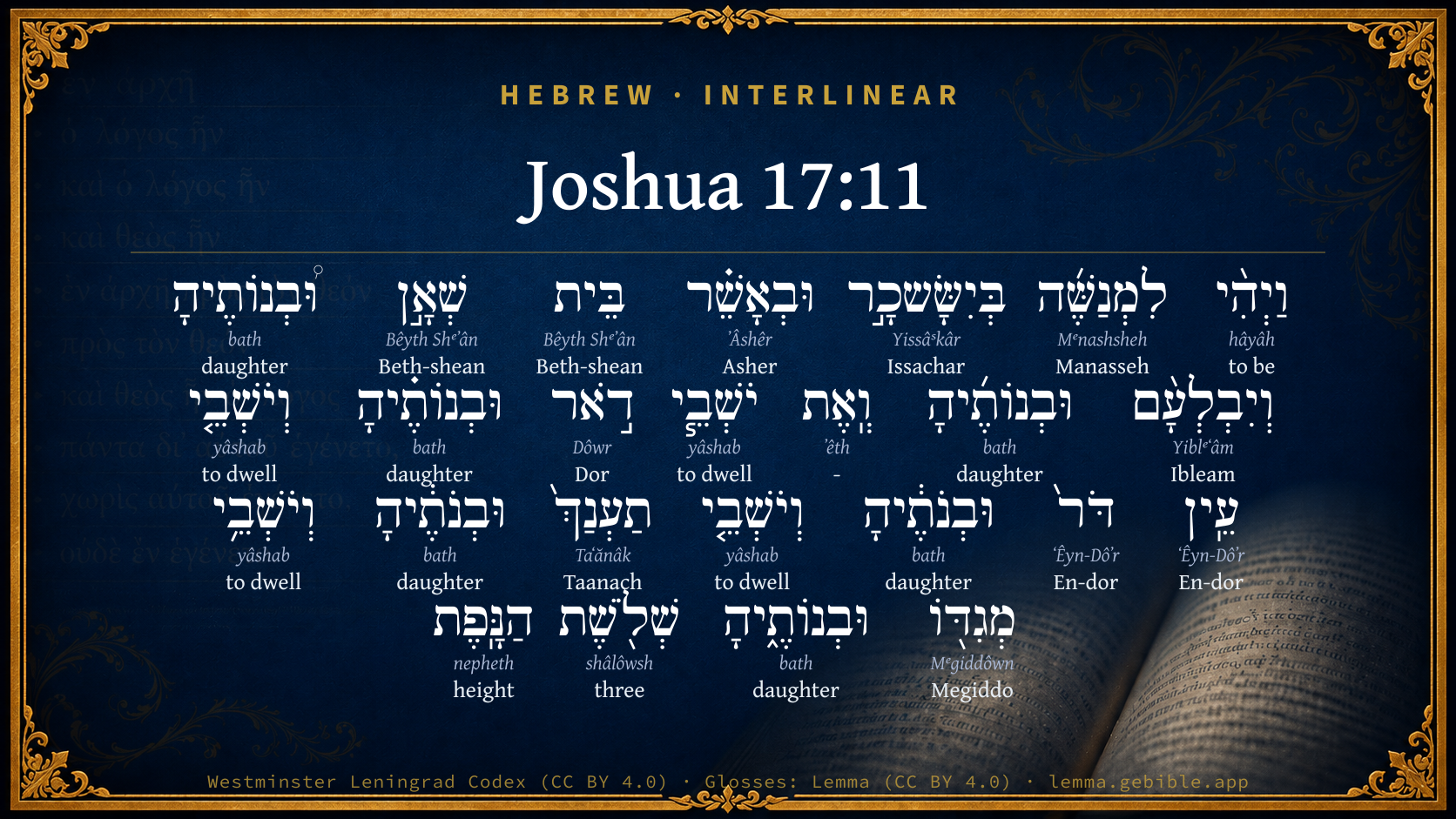
Hebrew (Westminster Leningrad Codex) Joshua 17:11 appears in the Hebrew Old Testament. The text above is from the Westminster Leningrad Codex. Each word links to its Strong’s number, a concise gloss, and parsing drawn from the Open Scriptures Hebrew Bible morphology. Click any word for its full Brown-Driver-Briggs (BDB) entry.
Download image
Cite this verse

Joshua 17:11 (World English Bible). Public Domain. Lemma interlinear Bible study tool, https://lemma.gebible.app/v/joshua/17/11.

Show BibTeX & RIS
BibTeX
RIS
English Translation
Manasseh had in Issachar and in Asher Beth-shean and its towns, and Ibleam and its towns, and the inhabitants of Dor and its towns, and the inhabitants of En-dor and its towns, and the inhabitants of Taanach and its towns, and the inhabitants of Megiddo and its towns, even the three heights.
World English Bible · Public Domain
Highlights
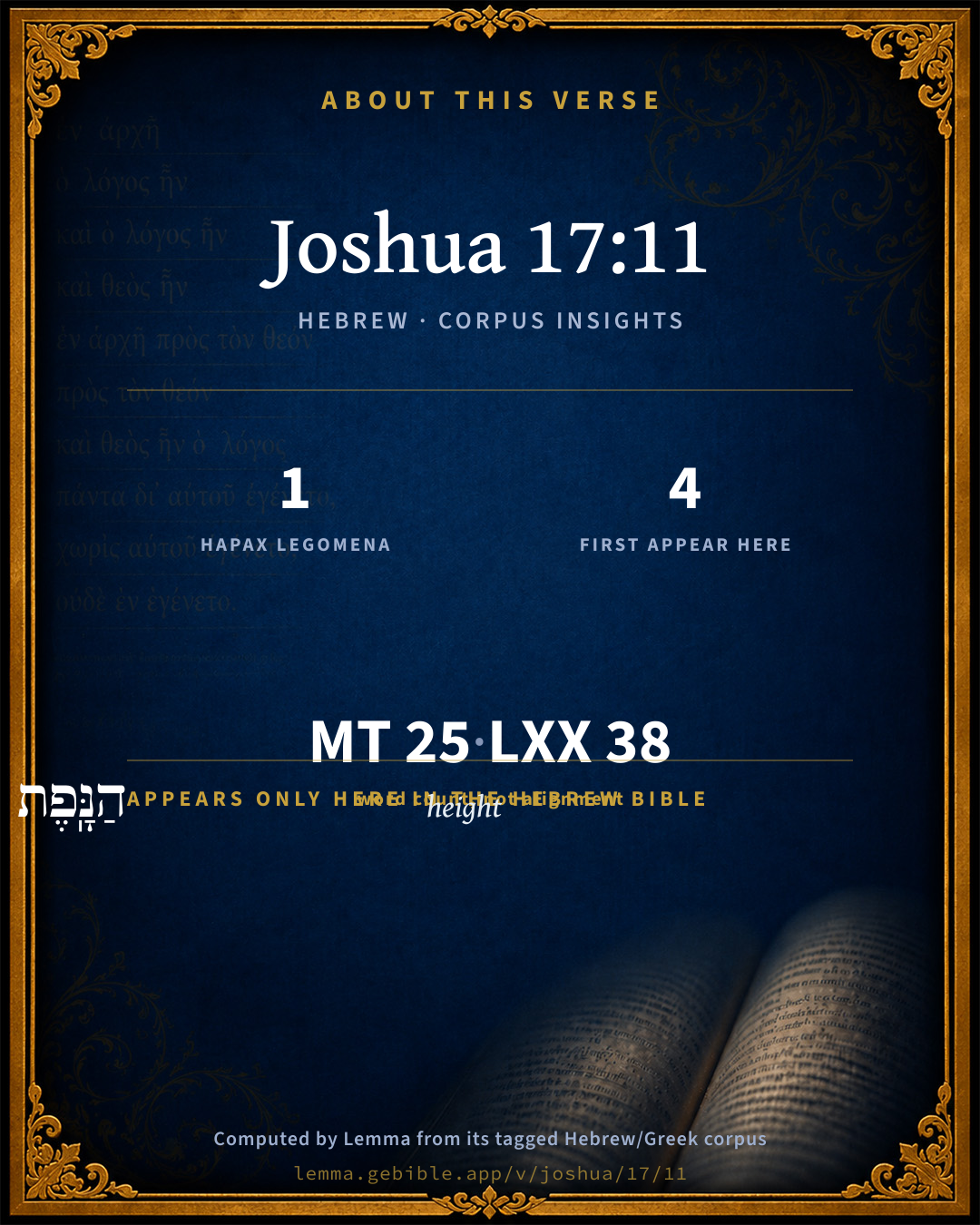
  • 1 hapax legomenon — only here in the Hebrew Bible
  • 4 first appearances in the Hebrew Bible
Full analysis ↓
Download a study sheet

One document with this verse’s original text, its word-by-word gloss line, the meaning frame, cross-references with their text, attributed commentary, and full source and license credits — printable, and it pastes into notes with its structure intact.

This verse Autodidact and up

Study sheet (.html) Plain text (.txt)

A passage Seminary Student

Up to 50 verses in one chapter. A passage sheet keeps up to 6 commentary sources and 12 cross-references per verse, in the order this page ranks them, and says so on the sheet whenever that leaves anything out. Ask for a single verse and you get the Autodidact verse sheet above.

Everything on this page stays free to read, with no account — the sheet is a download of what is already on screen, not access to it.

Want to remove ads? Support Godless Engineer
Compare translations 3

The same verse in 3 English versions, stacked beneath the original-language interlinear above. Click any original word for its lexicon entry.

Each is an independent rendering of the whole verse — the interlinear is not word-aligned to these translations.

Highlighted words mark where these versions differ — a whole-verse word diff, not a word-by-word alignment.

  • World English Bible Public Domain
    Manasseh had in Issachar and in Asher Beth-shean and its towns, and Ibleam and its towns, and the inhabitants of Dor and its towns, and the inhabitants of En-dor and its towns, and the inhabitants of Taanach and its towns, and the inhabitants of Megiddo and its towns, even the three heights.
  • King James Version Public Domain
    And Manasseh had in Issachar and in Asher Bethshean and her towns, and Ibleam and her towns, and the inhabitants of Dor and her towns, and the inhabitants of Endor and her towns, and the inhabitants of Taanach and her towns, and the inhabitants of Megiddo and her towns, even three countries.
  • unfoldingWord Literal Text CC BY-SA 4.0
    And to Manasseh in Issachar and in Asher Beth Shan and its daughters and Ibleam and its daughters and the dwellers of Dor and its daughters and the dwellers of En Dor and its daughters and the dwellers of Taanach and its daughters and the dwellers of Megiddo and its daughters, the three of a height.

unfoldingWord Literal Text — © unfoldingWord, licensed CC BY-SA 4.0. Word-aligned USFM3 via Door43 (git.door43.org/unfoldingWord/en_ult).

Versions to compare (up to 4)

3 of 4 selected

Show all 18 translations

Every available English version of this verse, each an independent rendering of the whole verse.

  • World English Bible Public Domain
    Manasseh had in Issachar and in Asher Beth-shean and its towns, and Ibleam and its towns, and the inhabitants of Dor and its towns, and the inhabitants of En-dor and its towns, and the inhabitants of Taanach and its towns, and the inhabitants of Megiddo and its towns, even the three heights.
  • Berean Standard Bible Public Domain
    Within Issachar and Asher, Manasseh was assigned Beth-shean, Ibleam, Dor (that is, Naphath), Endor, Taanach, and Megiddo, each with their surrounding settlements.
  • Majority Standard Bible Public Domain
    Within Issachar and Asher, Manasseh was assigned Beth-shean, Ibleam, Dor (that is, Naphath), Endor, Taanach, and Megiddo, each with their surrounding settlements.
  • King James Version Public Domain
    And Manasseh had in Issachar and in Asher Bethshean and her towns, and Ibleam and her towns, and the inhabitants of Dor and her towns, and the inhabitants of Endor and her towns, and the inhabitants of Taanach and her towns, and the inhabitants of Megiddo and her towns, even three countries.
  • American Standard Version (1901) Public Domain
    And Manasseh had in Issachar and in Asher Beth-shean and its towns, and Ibleam and its towns, and the inhabitants of Dor and its towns, and the inhabitants of En-dor and its towns, and the inhabitants of Taanach and its towns, and the inhabitants of Megiddo and its towns, even the three heights.
  • Revised Version (1885) Public Domain
    And Manasseh had in Issachar and in Asher Beth-shean and her towns, and Ibleam and her towns, and the inhabitants of Dor and her towns, and the inhabitants of En-dor and her towns, and the inhabitants of Taanach and her towns, and the inhabitants of Megiddo and her towns, even the three heights.
  • Geneva Bible (1599) Public Domain
    And Manasseh had in Issachar and in Asher, Beth-shean, and her townes, and Ibleam, and her townes, and the inhabitants of Dor with ye townes thereof, and the inhabitants of En-dor with the townes thereof, and the inhabitants of Thaanach with her townes, and the inhabitants of Megiddo with the townes of the same, euen three countreis.
  • Douay-Rheims (1899) Public Domain
    And the inheritance of Manasses in Issachar and in Aser, was Bethsan and its villages, and Jeblaam with its villages, and the inhabitants of Dor, with the towns thereof: the inhabitants also of Endor with the villages thereof: and in like manner the inhabitants of Thenac with the villages thereof: and the inhabitants of Mageddo with their villages, and the third part of the city of Nopheth.
  • Young's Literal Translation Public Domain
    And Manasseh hath in Issachar and in Asher, Beth-Shean and its towns, and Ibleam and its towns, and the inhabitants of Dor and its towns, and the inhabitants of En-Dor and its towns, and the inhabitants of Taanach and its towns, and the inhabitants of Megiddo and its towns, three counties.
  • Literal Standard Version CC BY-SA 4.0
    And in Issachar and in Asher, Manasseh has Beth-Shean and its towns, and Ibleam and its towns, and the inhabitants of Dor and its towns, and the inhabitants of En-Dor and its towns, and the inhabitants of Taanach and its towns, and the inhabitants of Megiddo and its towns—three counties.
  • Unlocked Literal Bible CC BY-SA 4.0
    Also in Issachar and in Asher, Manasseh possessed Beth Shan and its villages, Ibleam and its villages, the inhabitants of Dor and its villages, the inhabitants of Endor and its villages, the inhabitants of Taanach and its villages, and the inhabitants of Megiddo and its villages (and the third city is Napheth).
  • unfoldingWord Literal Text CC BY-SA 4.0
    And to Manasseh in Issachar and in Asher Beth Shan and its daughters and Ibleam and its daughters and the dwellers of Dor and its daughters and the dwellers of En Dor and its daughters and the dwellers of Taanach and its daughters and the dwellers of Megiddo and its daughters, the three of a height.
  • Darby Bible Public Domain
    And Manasseh had in Issachar and in Asher, Beth-shean and its dependent villages, and Ibleam and its dependent villages, and the inhabitants of Dor and its dependent villages, and the inhabitants of En-Dor and its dependent villages, and the inhabitants of Taanach and its dependent villages, and the inhabitants of Megiddo and its dependent villages, the three hilly regions.
  • World Messianic Bible Public Domain
    Manasseh had three heights in Issachar, in Asher Beth Shean and its towns, and Ibleam and its towns, and the inhabitants of Dor and its towns, and the inhabitants of Endor and its towns, and the inhabitants of Taanach and its towns, and the inhabitants of Megiddo and its towns.
  • Webster's Bible Public Domain
    And Manasseh had in Issachar and in Asher Beth-shean and its towns, and Ibleam and its towns, and the inhabitants of Dor and its towns, and the inhabitants of En-dor and its towns, and the inhabitants of Tanach and its towns, and the inhabitants of Megiddo and its towns, even three countries.
  • Free Bible Version CC BY-SA 4.0
    The following towns with their associated villages were allocated to Manasseh but lay within the land of Issachar and Asher: Beth-shan, Ibleam, Dor (on the coast), Endor, Taanach, and Megiddo.
  • Bible in Basic English Public Domain
    In Issachar and Asher, Manasseh had Beth-shean and its daughter-towns, and Ibleam and its daughter-towns, and the people of Dor and its daughter-towns, and the people of En-dor and its daughter-towns, and the people of Taanach and its daughter-towns, and the people of Megiddo and its daughter-towns, that is, the three hills.
  • JPS Tanakh (1917) Public Domain
    And Manasseh had in Issachar and in Asher Beth-shean and its towns, and Ibleam and its towns, and the inhabitants of Dor and its towns, and the inhabitants of En-dor and its towns, and the inhabitants of Taanach and its towns, and the inhabitants of Megiddo and its towns, even the three regions.

Literal Standard Version (2020), Covenant Press — licensed CC BY-SA 4.0. Text via the HelloAO Bible API (eBible.org). Unlocked Literal Bible (unfoldingWord) — licensed CC BY-SA 4.0. Text via the HelloAO Bible API (eBible.org). unfoldingWord Literal Text — © unfoldingWord, licensed CC BY-SA 4.0. Word-aligned USFM3 via Door43 (git.door43.org/unfoldingWord/en_ult). Free Bible Version, Dr. Jonathan Gallagher — licensed CC BY-SA 4.0. Text via the HelloAO Bible API (eBible.org).

Word by word

More ways to search: Search by grammar → Find every occurrence → Compare this word →

Practice this passage: Drill this verse → Learn its vocabulary →

הַנָּֽפֶת
nepheth
H5316
“the · height”
Particle, Definite Article + Noun, Common, Feminine, Singular, Absolute
Part of Speech
Particle + Noun
Type
Common
Gender
Feminine
Number
Singular
State
Absolute
Full BDB Definition

Origin: for H5299

TWOT: 1331c

height
  1. וַיְהִ֨י hâyâh H1961 “and · to be” Conjunction + Verb, Qal, Sequential Imperfect, 3rd Person, Masculine, Singular
  2. לִמְנַשֶּׁ֜ה Mᵉnashsheh H4519 “to/for · Manasseh” Preposition + Noun, Proper
  3. בְּיִשָּׂשכָ֣ר Yissâˢkâr H3485 “in/at · Issachar” Preposition + Noun, Proper
  4. וּבְאָשֵׁ֗ר ʼÂshêr H836 “and · in/at · Asher” Conjunction + Preposition + Noun, Proper
  5. בֵּית Bêyth Shᵉʼân H1052 “Beth-shean” Noun, Proper
  6. שְׁאָ֣ן Bêyth Shᵉʼân H1052 “Beth-shean” Noun, Proper
  7. וּ֠בְנוֹתֶיהָ bath H1323 “and · daughters · her” Conjunction + Noun, Common, Feminine, Plural, Construct + Suffix, Personal, 3rd Person, Feminine, Singular
  8. וְיִבְלְעָ֨ם Yiblᵉʻâm H2991 “and · Ibleam” Conjunction + Noun, Proper
  9. וּבְנוֹתֶ֜יהָ bath H1323 “and · daughters · her” Conjunction + Noun, Common, Feminine, Plural, Construct + Suffix, Personal, 3rd Person, Feminine, Singular
  10. וְֽאֶת ʼêth H853 “and · -” Conjunction + Particle, Direct Object
  11. יֹשְׁבֵ֧י yâshab H3427 “dwelling” Verb, Qal, Participle Active, Masculine, Plural, Construct
  12. דֹ֣אר Dôwr H1756 “Dor” Noun, Proper
  13. וּבְנוֹתֶ֗יהָ bath H1323 “and · daughters · her” Conjunction + Noun, Common, Feminine, Plural, Construct + Suffix, Personal, 3rd Person, Feminine, Singular
  14. וְיֹשְׁבֵ֤י yâshab H3427 “and · dwelling” Conjunction + Verb, Qal, Participle Active, Masculine, Plural, Construct
  15. עֵֽין ʻÊyn-Dôʼr H5874 “En-dor” Noun, Proper
  16. דֹּר֙ ʻÊyn-Dôʼr H5874 “En-dor” Noun, Proper
  17. וּבְנֹתֶ֔יהָ bath H1323 “and · daughters · her” Conjunction + Noun, Common, Feminine, Plural, Construct + Suffix, Personal, 3rd Person, Feminine, Singular
  18. וְיֹשְׁבֵ֤י yâshab H3427 “and · dwelling” Conjunction + Verb, Qal, Participle Active, Masculine, Plural, Construct
  19. תַעְנַךְ֙ Taʻănâk H8590 “Taanach” Noun, Proper
  20. וּבְנֹתֶ֔יהָ bath H1323 “and · daughters · her” Conjunction + Noun, Common, Feminine, Plural, Construct + Suffix, Personal, 3rd Person, Feminine, Singular
  21. וְיֹשְׁבֵ֥י yâshab H3427 “and · dwelling” Conjunction + Verb, Qal, Participle Active, Masculine, Plural, Construct
  22. מְגִדּ֖וֹ Mᵉgiddôwn H4023 “Megiddo” Noun, Proper
  23. וּבְנוֹתֶ֑יהָ bath H1323 “and · daughters · her” Conjunction + Noun, Common, Feminine, Plural, Construct + Suffix, Personal, 3rd Person, Feminine, Singular
  24. שְׁלֹ֖שֶׁת shâlôwsh H7969 “three” Adjective, Cardinal number, Masculine, Singular, Construct

About this verse

These counts appear in no published source. They are computed here, from the morphology-tagged text and Lemma’s own curated glosses. What Lemma adds →

25
words
15
distinct lemmas
Historical
section

Notable vocabulary

1 hapax legomenon — a word that appears only here in the entire Hebrew Bible:

  • הַנָּֽפֶת height H5316

First appearance in Scripture

These words make their first canonical appearance in the Hebrew Bible here:

  • בֵּית Beth-shean H1052
  • וְיִבְלְעָ֨ם Ibleam H2991
  • עֵֽין En-dor H5874
  • הַנָּֽפֶת height H5316

Shared distinctive vocabulary

וְיִבְלְעָ֨ם Ibleam H2991 occurs in 3 verses of the Hebrew Bible. Also found in:

Grammatical profile

  • 5 verbs
  • 18 nouns
  • 1 adjective
  • 1 particle

Verb forms

  • וַיְהִ֨י Qal · Sequential Imperfect
  • יֹשְׁבֵ֧י Qal · Participle Active
  • וְיֹשְׁבֵ֤י Qal · Participle Active
  • וְיֹשְׁבֵ֤י Qal · Participle Active
  • וְיֹשְׁבֵ֥י Qal · Participle Active

Repetition

Words recur within this verse — often emphatic in Hebrew:

  • וּ֠בְנוֹתֶיהָ daughter H1323 ×6
  • יֹשְׁבֵ֧י to dwell H3427 ×4
  • בֵּית Beth-shean H1052 ×2
  • עֵֽין En-dor H5874 ×2

Hebrew & Septuagint length

In English translation the verse runs 52 words from the Hebrew and 40 from the Septuagint (LXX English) — closely comparable.

A rough comparison of the two English renderings, which tokenize alike — not a word-level alignment.

Word counts can differ between the Hebrew and the Greek without any difference in meaning — e.g. the Hebrew direct-object marker אֵת has no separate Greek word, and Greek often adds the article ὁ.

In the original languages it is 25 Hebrew tokens and 38 Greek tokens — but the two are counted differently (Hebrew bundles its prefixes and suffixes into one token; the Greek is in lemma form), so that isn’t a like-for-like length.

Cross-references

18

Topical passages linked to Joshua 17:11 in the Treasury of Scripture Knowledge — connected by theme and wording, ordered by reader-vote popularity; previews shown in the World English Bible.

  • 1 Chronicles 7:29 and by the borders of the children of Manasseh, Beth-shean and its towns, Taanach and its towns, Megiddo and its towns, Dor and its towns. In these lived the children of Joseph the son of Israel.
  • Joshua 12:23 the king of Dor in the height of Dor, one; the king of Goiim in Gilgal, one;
  • Judges 1:27 Manasseh did not drive out [the inhabitants of] Beth-shean and its towns, nor [of] Taanach and its towns, nor the inhabitants of Dor and its towns, nor the inhabitants of Ibleam and its towns, nor the inhabitants of Megiddo and its towns; but the Canaanites would dwell in that land.
  • Judges 5:19 The kings came and fought; Then fought the kings of Canaan. In Taanach by the waters of Megiddo: They took no gain of money.
  • 2 Kings 9:27 But when Ahaziah the king of Judah saw this, he fled by the way of the garden-house. Jehu followed after him, and said, Smite him also in the chariot: [and they struck him] at the ascent of Gur, which is by Ibleam. He fled to Megiddo, and died there.
  • Joshua 11:2 and to the kings who were on the north, in the hill-country, and in the Arabah south of Chinneroth, and in the lowland, and in the heights of Dor on the west,
  • 1 Samuel 28:7 Then said Saul to his servants, Seek me a woman who has a familiar spirit, that I may go to her, and inquire of her. His servants said to him, Behold, there is a woman who has a familiar spirit at En-dor.
  • 1 Samuel 31:10 They put his armor in the house of the Ashtaroth; and they fastened his body to the wall of Beth-shan.
  • 1 Kings 4:11–12 Ben Abinadab, in all the height of Dor (he had Taphath the daughter of Solomon as wife);
  • 1 Kings 9:15 This is the reason of the levy which king Solomon raised, to build the house of Yahweh, and his own house, and Millo, and the wall of Jerusalem, and Hazor, and Megiddo, and Gezer.
  • Psalms 83:10 Who perished at Endor, Who became as dung for the earth.
  • Joshua 12:21 the king of Taanach, one; the king of Megiddo, one;
  • Joshua 16:9 together with the cities which were set apart for the children of Ephraim in the midst of the inheritance of the children of Manasseh, all the cities with their villages.
  • 1 Samuel 31:12 all the valiant men arose, and went all night, and took the body of Saul and the bodies of his sons from the wall of Beth-shan; and they came to Jabesh, and burnt them there.
  • 2 Kings 23:29–30 In his days Pharaoh Necoh king of Egypt went up against the king of Assyria to the river Euphrates: and king Josiah went against him; and [Pharaoh Necoh] killed him at Megiddo, when he had seen him.
  • 1 Chronicles 6:70 and out of the half-tribe of Manasseh, Aner with its suburbs, and Bileam with its suburbs, for the rest of the family of the sons of Kohath.
  • 2 Chronicles 35:22 Nevertheless Josiah would not turn his face from him, but disguised himself, that he might fight with him, and didn't listen to the words of Neco from the mouth of God, and came to fight in the valley of Megiddo.
  • Zechariah 12:11 In that day there will be a great mourning in Jerusalem, like the mourning of Hadadrimmon in the valley of Megiddon.

Cross-references courtesy of OpenBible.info (CC BY 4.0).

Hebrew and Greek witnesses Masoretic Hebrew ↔ Greek Septuagint

The same verse in the two great witnesses to the Old Testament, shown verse-for-verse.

These are two independent witnesses, not word-aligned to each other, and the Septuagint is shown in lemma (dictionary) form.

Hebrew Joshua 17:11 Masoretic · Westminster Leningrad Codex

וַיְהִ֨י לִמְנַשֶּׁ֜ה בְּיִשָּׂשכָ֣ר וּבְאָשֵׁ֗ר בֵּית שְׁאָ֣ן וּ֠בְנוֹתֶיהָ וְיִבְלְעָ֨ם וּבְנוֹתֶ֜יהָ וְֽאֶת יֹשְׁבֵ֧י דֹ֣אר וּבְנוֹתֶ֗יהָ וְיֹשְׁבֵ֤י עֵֽין דֹּר֙ וּבְנֹתֶ֔יהָ וְיֹשְׁבֵ֤י תַעְנַךְ֙ וּבְנֹתֶ֔יהָ וְיֹשְׁבֵ֥י מְגִדּ֖וֹ וּבְנוֹתֶ֑יהָ שְׁלֹ֖שֶׁת הַנָּֽפֶת

Manasseh had in Issachar and in Asher Beth-shean and its towns, and Ibleam and its towns, and the inhabitants of Dor and its towns, and the inhabitants of En-dor and its towns, and the inhabitants of Taanach and its towns, and the inhabitants of Megiddo and its towns, even the three heights.

World English Bible · Public Domain

Greek LXX Joshua 17:11 Septuagint · lemma form

καί εἰμί μανασσή ἐν ισσαχαρ καί ἐν ασηρ βαιθσαν καί ὁ κώμη αὐτός καί ὁ καταοἰκέω δωρ καί ὁ κώμη αὐτός καί ὁ καταοἰκέω μαγεδδω καί ὁ κώμη αὐτός καί ὁ τρίτος ὁ ναφετα καί ὁ κώμη αὐτός

And Manasses shall have in the portion of Issachar and Aser Baethsan and their villages, and the inhabitants of Dor, and its villages, and the inhabitants of Mageddo, and its villages, and the third part of Mapheta, and its villages.

LXX2012 (modern English Septuagint) · Public Domain

On this verse, The Cambridge Bible for Schools and Colleges discusses the Septuagint’s reading. Read the note in Commentary ↓

Hebrew: Westminster Leningrad Codex (CC BY 4.0). Greek: Septuagint (public domain); English from LXX2012 (modern English Septuagint) (Public Domain). How the Septuagint differs from the Hebrew →

Targum (Aramaic paraphrase)

1

The Targum is the ancient Jewish Aramaic paraphrase of the Hebrew Scriptures — an interpretive translation, not the Hebrew text itself. Onkelos (literal) and Pseudo-Jonathan (expansive) render the Torah, and Jonathan the Prophets. Coverage is partial: where no permissively-licensed English translation exists for a verse, only the Aramaic is shown. This is verse-level text, not a word-by-word alignment to the Hebrew.

  1. Targum Jonathan Prophets (Joshua–Malachi)
    וַהֲוָה לִמְנַשֶׁה בְּיִשָׂשכָר וּבְאָשֵׁר בֵּית שְׁאָן וְכַפְרָנָהָא וְיִבְלְעָם וְכַפְרָנָהָא וְיַת יַתְבֵי דֹאר וְכַפְרָנָהָא וְיַתְבֵי עֵין דֹר וְכַפְרָנָהָא וְיַתְבֵי תַעְנַךְ וְכַפְרָנָהָא וְיַתְבֵי מְגִדוֹ וְכַפְרָנָהָא תְּלָתָא פִּלְכִין:

    (no public-domain English translation for this verse)

    Targum Jonathan — Aramaic: “Mikraot Gedolot” (public domain). English: “Sefaria Community Translation” (CC0 1.0 (public-domain dedication)); “London "Chaldee Paraphrase," 1871” (public domain). Text via Sefaria.

Commentary

Notes on Joshua 17:11 from classic Christian and Jewish commentators (each source and its license shown beneath its notes). The classic Christian expositions comment on the surrounding passage and are grouped to its opening verse, so a note may address several verses; the Jewish commentaries on the Tanakh (Rashi and others) are per-verse, so they appear only where the commentator wrote on this verse.

Lemma curates 59 commentaries, every one of them public domain or Creative Commons licensed, each selected and text-cleaned for this edition rather than reprinted as found. About our sources →

Trapp's Complete Commentary

John Trapp

Jos 17:11 And Manasseh had in Issachar and in Asher Bethshean and her towns, and Ibleam and her towns, and the inhabitants of Dor and her towns, and the inhabitants of Endor and her towns, and the inhabitants of Taanach and her towns, and the inhabitants of Megiddo and her towns, [even] three countries.

Ver. 11. Bethshean.] Afterwards called Scythopolis. { 2Ma 12:29}

John Trapp, A Commentary or Exposition upon All the Books of the Old and New Testament (1647–1656) — public domain. Text from a community e-Sword module.

Joseph Benson's Commentary

Jos 17:11. Manasseh had in Issachar and in Asher, &c. — In like manner as Ephraim had some cities in the tribe of Manasseh; and, as it was not unusual, when the place allotted to any tribe was too narrow for it, and the next too large, to give away part from the larger to the less portion. Inhabitants of Dor — Not the places only, but the people; whom they spared and used for servants. Three countries — The words may be rendered, the third part of that country; and so the meaning may be, that the cities and towns here mentioned were a third part of that country; that is, of that part of Issachar’s and Asher’s portion, in which those places lay.

Joseph Benson's Commentary on the Old and New Testaments (1811–1818) — public domain. Text from a community e-Sword module.

Tyndale Open Study Notes

Tyndale Open Resources

17:11-13 All the towns mentioned here except Endor were important, but the military strength of the Canaanites prevented the tribe of Manasseh from inhabiting them for a time.

Tyndale Open Study Notes — © Tyndale Open Resources, licensed CC BY-SA 4.0. Text via the HelloAO Bible API.

Jamieson, Fausset & Brown

Robert Jamieson, A. R. Fausset & David Brown

Beth-shean and her towns--Greek, "Scythopolis" (now Beisan), in the valley of the Jordan, towards the east end of the plain of Jezreel. "Beth-shean" means "house of rest," so called from its being the halting place for caravans travelling between Syria or Midian, and Egypt, and the great station for the commerce between these countries for many centuries.

Ibleam and her towns--in the neighborhood of Megiddo (Kg2 9:27).

the inhabitants of Dor and her towns--(now Tantoura), anciently a strong fortress; a wall of wild precipitous rock defended the shore fortifications against attack from the land side.

En-dor and her towns--situated on a rocky eminence, four Roman miles south of Tabor.

Taanach and . . . Megiddo--These were near to each other, and they are generally mentioned in Scripture together. They were both royal and strongly fortified places (see on Jdg 1:27).

three countries--districts or provinces. It is computed that Manasseh possessed in Asher and Issachar portions of ground to the extent of more than two hundred square miles.

Jamieson, Fausset & Brown — Commentary Critical and Explanatory on the Whole Bible (1871) — public domain (CC PDM 1.0). Text via the HelloAO Bible API.

Adam Clarke's Commentary

Verse 11. Beth-shean] Called afterwards Scythopolis; the city of the Scythians or Cuthites, those who were sent into the different Samaritan cities by the kings of Assyria.

Dor] On the Mediterranean Sea, about eight miles from Caesarea, on the road to Tyre.

En-dor] The well or fountain of Dor, the place where Saul went to consult the witch; 1Sa 28:7, &c.

Adam Clarke's Commentary on the Bible (1810–1826) — public domain. Text from a community e-Sword/MySword module.

John Calvin's Commentaries

11. And Manasseh had in Issachar, etc How they were so mingled as to possess some cities in the lot of Asher and Issachar, while the tribe of Ephraim dwelt between their limits, it is not easy to divine, unless, perhaps, it was perceived that a more commodious habitation would not be liable to many complaints, or, perhaps, after the whole country had become more certainly known, some change was made on principles of equity in the former partition. This, therefore, seems to have been a new acquisition after it was discovered that the children of Manasseh might occupy a wider extent without loss to others. Nor was the habitation given to them a subjugated one, which they might immediately enjoy, but it was an inheritance treasured up in hope, and founded more upon heavenly promise than on actual possession. And yet their not gaining possession of those cities is attributed to their fault, because the lot assigning it to them was an indubitable pledge of victory. The reason, therefore, why they could not expel the inhabitants was, because they were not fully persuaded in their minds that God is true, and stifled his agency by their own sluggishness. But another crime still less pardonable was committed when, having it in their power easily to destroy all, they not only were slothful in executing the command of God, but, induced by filthy lucre, they preserved those alive whom God had doomed to destruction. For persons, on whom we impose tribute, we in a manner take under our faith and protection. God had appointed them the ministers of his vengeance, and he supplies them with strength to execute it: they not only delay, but deprive themselves of the liberty of acting rightly. It is not strange, therefore, that God severely punished this perverse heartlessness, by making those nations whom they had pardoned in the face of a clear prohibition, to become like thorns to pierce their eyes and pricks to gall their sides.

Here, again, a question arises, How were cities granted to them in the tribe of Asher and Issachar, when the portions of both were as yet unknown? Here, therefore, that which had not yet taken place is related by way of anticipation. Be this as it may, we gather that from ignorance of the localities, single portions were not divided so exactly as not to make it necessary afterwards to correct what had been more or less decided. And we must hold in general, with regard both to the tribe of Ephraim and the others, that many of the cities which they gained were of no account because of the devastation. I doubt not that many ruins here lie buried. On the other hand, we must conclude that in fertile spots, or spots possessed of other advantages, where petty villages only existed, their famous cities were founded. It is certain that Sichem was of sufficient importance to hold both a name and rank, and yet there is no mention of it here. The same is the case with Samaria, which, as is well known, belonged to the same tribe of Ephraim when it was the metropolis of the kingdom of Israel. It is plain, therefore, that each tribe possessed several cities, which are here passed over in silence.

John Calvin's Commentaries (1540-1563) — public domain. Text from the Calvin Translation Society English edition (1840s-50s) via the Christian Classics Ethereal Library (ccel.org). Calvin's coverage is partial (roughly two-thirds of the Bible); uncommented books and verses are honest gaps, never fabricated. The 19th-century editor's footnotes and remarks are omitted so the notes are faithfully Calvin's own voice.

The Cambridge Bible for Schools and Colleges

gen. ed. J. J. S. Perowne

11. And Manasseh had] Six cities are now enumerated, which Manasseh received beyond the borders of his own country in Issachar and Asher, but from which he failed to expel the Canaanites.

Beth-shean] or Beth-shan (1Sa_31:10) lies in the ghôr, or Jordan valley, about 12 miles south of the Sea of Galilee, and four miles west of the Jordan. See a picture of it in Thomson’s Land and the Book, p. 454. “It is naturally,” he says, “one of the strongest places even in this country of strongholds.… The ancient city consisted of several distinct quarters, or wards, separated by deep ravines, with noisy cascades leaping over ledges of black basalt.… The tell is very strong, and it rises about 200 feet high, with the sides nearly perpendicular. A strong wall was carried round the summit … and on this wall the bodies of Saul and his sons were fastened by the Philistines after the battle of Gilboa, and this supposition enables us to understand how the men of Jabesh-Gilead could execute their daring project of carrying them away. Jabesh-Gilead was on the mountain east of the Jordan, in full view of Beth-shean, and these brave men could creep up to the tell, along Wady Jalûd, without being seen, while the deafening roar of the brook would render it impossible for them to be heard.” In Solomon’s time it appears to have given its name to a district, and “all Beth-shan” was placed under one of his commissariat officers. It is mentioned in the Book of Maccabees (1Ma_5:52; 1Ma_12:40-41). In later times it was called Scythopolis, in consequence of its capture by the Scythians, who after their occupation of Media passed through Palestine on their way to Egypt (Herod. i. 104–106), about b.c. 600. It afterwards became the seat of a Christian bishop, and the name of Scythopolis is found as late as the Council of Constantinople, a.d. 536. It has now regained its ancient name, and is known as Beisan only.

and her towns = and her “daughter towns.”

and Ibleam] Afterwards a Levitical city (Jos_21:25). Here Ahaziah was mortally wounded by Jehu “at the going up to Gur, which is by Ibleam” (2Ki_9:27).

Dor] See above, Jos_11:2, Jos_12:23.

Endor] is described by Eusebius as a large village four miles south of Tabor, at the N. E. corner of Jebel ed Dûhy, facing Tabor, and overlooking the valley between them. The declivity of the mountain is everywhere perforated with caves, and most of the habitations are merely walls built round the entrances to them. It was one of these caves, which “the witch of Endor” inhabited, whither came King Saul, crossing in his agony of despair the shoulder of the very hill, on which the Philistines were entrenched, to consult her before the disastrous battle of Gilboa (1Sa_28:7). It was long held in memory by the Jews in connection with the famous victory over Sisera and Jabin (Psa_83:10). See Thomson’s Land and the Book, p. 446. Van de Velde, ii. 383.

Taanach] See above, Jos_12:21.

Megiddo] See above, Jos_12:21. “Whenever the Israelites in aggressive movements could choose their arena, they selected their own element, the mountains and the mountain-passes. The battles of Esdraelon, on the other hand, were almost all forced upon them by adverse or invading armies: and though some of their chief victories were won here, yet this plain is associated in the mind of an Israelite with mournful at least as much as with joyful recollections; two kings perished on its soil; and the two saddest dirges of the Jewish nation were evoked by the defeats of Gilboa and Megiddo.”—Stanley’s S. and P., p. 338.

even three countries] Rather, the three heights, or the triple hill. The LXX. and Vulgate translate the word as a proper name. The term brings the three cities lying on hills, Endor, Taanach, and Megiddo, into close connection with each other.

The Cambridge Bible for Schools and Colleges (gen. ed. J. J. S. Perowne; Cambridge University Press, 1878–1918) — public domain. Text from a community e-Sword module.

John Gill's Exposition

And Manasseh had in Issachar, and in Asher, Bethshean, and her towns,.... As Ephraim had cities in Manasseh, so had Manasseh cities in these two tribes, which in some parts bordered on it, before described, even the cities following, and the first that is named is Bethshean: this lay in the tribe of Issachar, and was the uttermost border of Manasseh that way; it was, as Josephus (m) says, called Scythopolis; but not from the Scythians, as Pliny (n) suggests, but from Succoth, a place where Jacob resided, and which was not far from it, Gen 33:17; it lay before the great plain of Jezreel, and was at the entrance into it,"After this went they over Jordan into the great plain before Bethsan.'' (1 Maccabees 5:52)and was six hundred furlongs, or seventy five miles, from Jerusalem, according to:"From thence they departed to Scythopolis, which lieth six hundred furlongs from Jerusalem,'' (2 Maccabees 12:29)and was one of the cities of Decapolis, from whence our Lord had hearers, Mat 4:25. It was such a pleasant place, that it is said in the Talmud (o), that if the garden of Eden was in the land of Israel, Bethshean was the gate of it; on which the gloss says, that its fruits were the sweetest in the land of Israel:

and Ibleam and her towns; it seems to be the same with Bileam, by a transposition of the two first letters, Ch1 6:70; and was a place not far from Megiddo, after mentioned, as appears from Kg2 9:27,

and the inhabitants of Dor and her towns; this had been a royal city; see Gill on Jos 11:2 and See Gill on Jos 12:23,

and the inhabitants of Endor and her towns; this place became famous for a witch there in the times of Saul, Sa1 28:7; in the times of Jerom (p) it was a large village near Mount Tabor, four miles to the south, which he calls Aeudor, of or in Jezreel; and elsewhere (q) he speaks of Endor, as near the town of Nain, where our Lord raised the widow's son the dead, and is about: Scythopolis:

and the inhabitants of Taanach and her towns; this had been a royal city; see Gill on Jos 12:22,

and the inhabitants of Megiddo and her towns: this was another royal city mentioned with the former; See Gill on Jos 12:21; there

even three countries; the three last cities, with their towns, that are mentioned, Endor, Taanach, and Megiddo; all which perhaps belonged to Dor, and may be the Naphothdor spoken of Jos 11:2; where the same word is used as here; so Jarchi interprets it.

(m) Antiqu l. 12. c. 8. sect. 5. (n) Nat. Hist. l. 5. c. 18. (o) T. Bab. Eruvin, fol. 19. 1. (p) De loc. Heb. fol. 88. L. (q) lbid. fol. 91. E.

John Gill's Exposition of the Whole Bible (1746–1763) — public domain (CC PDM 1.0). Text via the HelloAO Bible API.

Albert Barnes' Notes on the Bible

Perhaps Beth-shean (in Issachar) and the other five towns (in Asher) were given to the Manassites in compensation for towns in the Manassite territory allotted to the Ephraimites. (See Jos 17:9. Compare Jos 21:9.) To the wall of Beth-shean, or Bethshah (“Beisan,” about 5 miles west of the Jordan), the bodies of Saul and his sons were fastened by the Philistines after the battle on Mount Gilboa. After the exile it received the Greek name of Scythopolis, perhaps because it was principally tenanted by a rude and pagan population, styled in contempt Scythians. It was a border city of Galilee, and the chief town of the Decapolis. In Christian times it was the see of a bishop, who is enumerated as present at Nicaea and other Councils of the Church.

Ibleam (Bileam, 1Ch 6:70), perhaps “Jelameh,” was a Levitical town (Jos 21:25 note). Near this place Ahaziah was mortally wounded by Jehu (2Ki 9:27), and fled to Megiddo, which was no doubt not far distant.

Three countries - Rather “the three hills.” The district belonging to the last-mentioned three towns had a common name, derived no doubt from its natural features, and was called “the three hills.” Compare Decapolis, Tripolis, etc.

Albert Barnes' Notes on the Bible (1834–1885) — public domain. Text from a community e-Sword/MySword module.

Haydock's Catholic Bible Commentary

In Aser. The following towns were upon the frontiers of these two tribes, (Menochius) or they properly belonged to them respectively. But the children of Manasses took possession of them, after conquering by degrees, the former inhabitants, who were suffered to live among them, as the Jebusites were for some time, at Jerusalem, chap. xv. 63. (Haydock) --- Bethsan, or Scythopolis, as it was called by the Greeks, after the Scythians had invaded those countries, (Herodotus l. 105,) in the year of the world 3391, almost 100 years from the destruction of the kingdom of Israel. Unless these Scythians may rather be the Cutheans, who were sent to people the kingdom of Samaria, most of whom embraced the Jewish religion, while those of Bethsan adhered to their ancient idolatry, and therefore retained their name. Even in the days of Josephus, most of the inhabitants were heathens: the kings of Juda were not able to subdue them entirely. Bethsan was situated to the south of the sea of Tiberias, 600 stadia from Jerusalem; (2 Machabees xii. 29,) that is, about 37 leagues, (Calmet) or 111 miles. (Haydock) --- Dor, nine miles north of Cæsarea. --- Endor, "the fountain of Dor," four miles south of Mount Thabor. (Eusebius) --- Here Saul consulted the witch, 1 Kings xxxviii. 7. --- Thenac, near Legion, and the torrent of Cisson, where Barac gained a victory, Judges v. --- Nopheth, means "a canton," and thus Manasses may have had three portions of land round the three aforesaid cities, in which sense it is translated, chap. xi. 2. (Calmet; Masius) --- But Serarius takes Nopheth to mean a city, (Menochius) agreeably to the Septuagint, "the third part of Naphetha, and its villages." (Haydock) --- The other two parts of the city might be occupied by Zabulon. (Bonfrere) --- No mention is made of Nopheth, Judges i. 27. (Haydock)

George Leo Haydock (1774–1849), Haydock's Catholic Family Bible and Commentary, 1859 edition — public domain. Excludes Psalms (Douay-Rheims chapter numbering differs from Protestant) and Deuterocanonical books (Catholic canon only).

Matthew Poole's English Annotations

In Issachar and in Asher; either,

1. Bordering upon them, as in Asher is taken, Jos 17:10, and as Aaron’s rod is said to be in the ark, i.e. close by it, Heb 9:4; or,

2. Properly in them, as Ephraim had some cities in the tribe of Manasseh, Jos 16:9, and as it was not unusual, when the places allotted to any tribe was too narrow for it, and the next too large, to give away part from the larger to the less portion; nay, sometimes one whole tribe was taken into another, as Simeon was into Judah’s portion, when it was found too large for Judah, Jos 19:9.

The inhabitants of Dor; not the places only, but the people; whom, contrary to God’s command, they spared and used for servants, whom therefore they are said to have or possess.

Three countries: this may be referred either to some, to wit, the three last places, or to all the places named in this verse, which are here said either to have three countries or tracts of land belonging to them, or to be in three several countries or portions, as they seem to have been, some in Issachar, and some in Asher, and yet both belonging to Manasseh. Or, the words may be rendered the third part of that country; for the Hebrew word is of the singular number, and the article seems emphatical; and so the meaning may be, that the cities and towns here mentioned are a third part of that country, i.e. of that part of Issachar’s and Asher’s portion, in which those places lay.

Matthew Poole's English Annotations on the Holy Bible (1683–1685) — public domain. Text from a community e-Sword/MySword module.

Whedon's Commentary on the Bible

Daniel D. Whedon

11. Beth-shean — House of rest; the halting place for caravans from Syria or Midian to Egypt, and the emporium for the commerce of these countries. It afterwards was called in the Greek, Scythopolis, and is identified with the modern Beisan, at the east end of the plain of Esdraelon, five miles west of the Jordan. “The site of the ancient city, as of the modern village, was a splendid one, in this vast area of plain and mountain, in the midst of abundant waters and of exuberant fertility. It must have been a city of temples.” — Robinson. Ibleam was near Megiddo, (2Ki_9:27,) but its exact site is unknown.

Dor — See on Jos_11:2.

Endor, the abode of the necromancer consulted by Saul, (1Sa_28:7, note,) is now a village of the same name, nearly four miles south of Mount Tabor. For Taanach and Megiddo see on Jos_12:21. [It is noticeable that after the mention of Ibleam and her towns, in this verse, the inhabitants of the next four cities are named as a possession of Manasseh. This sudden transition, and the introduction of the accusative sign את before inhabitants, have greatly perplexed critics. It seems best, with Knobel, to suppose that the idea of possession conveyed by the English version, (Manasseh had,) and also by ויהי ל at the beginning of the verse in the Hebrew, is carried over in the writer’s mind, and applied to the inhabitants of these towns as being Manasseh’s possession, and tendering a tribute service.

Three countries — Or, a triple province, having a. sort of political combination. Others render three heights, and understand that the last three cities stood on hills, “a tripolis of mountain cities, in distinction from the places on the plain.” — Fay.]

Daniel D. Whedon (gen. ed.), Commentary on the Old and New Testaments (1874–1909) — public domain. Text from a community e-Sword module.

The Pulpit Commentary

And Manasseh had in Issachar and in Asher. (see Jos_16:9) Beth-shean. Afterwards called Scythopolis, now Beisan. It was a "noble city" in the days of Eusebius and Jerome. Many travellers have remarked on its splendid situation, "in this vast area of plain and mountains, in the midst of abundant waters and exuberant fertility" (Robinson, "Later Bibl. Res." sec. 7). "Just beyond, and separated by a narrow ridge, is another stream, also perennial, and on the peninsular formed by these two, with a bold, steep brow overlooking the Ghor, stood the citadel of ancient Beth-shean a sort of Gibraltar on a small scale of remarkable natural strength, and inaccessible to horsemen. No wonder that it was long ere Israel could wrest it from the Canaanites. The eastern face rises like a steep cone, most incorrectly stated by Robinson to be "black, and apparently volcanic;" and by Porter, "probably a crater." Certainly there are many blocks of basalt lying about, but the hill is simply a limestone bluff." (Tristram, "Land of Israel," p. 501). He goes on, "How clearly the details of the sad end of Saul were recalled as we stood on this spot" (the summit of the cone). "There was the slope of Gilboa, on which his army was encamped before the battle. Round that hill he slunk by night, conscience stricken, to visit the witch of Endor. Hither, as being a Canaanitish fortress, the Philistines most naturally brought the trophies of the royal slain, and hung them up just by this wall. By the Yasir, and across that plain below us, the gallant men of Jabesh-Gilead hurried on their long night"s march to stop the indignity offered to Israel, and to take down the bodies of their king and his sons." Jabesh-Gilead was not far off, and though in full view of the mountain, yet the men of Jabesh could creep along the Ghor by night and climb the steep face of the rock unsuspected by the warriors above; while the roar of the brook would drown all the sounds they might make (see Thomson, "Land and the Book," p. 454). And her towns. Literally, daughters, kwmai LXX; viculi, Vulgate. Canon Tristram remarks how each hill in some parts of Palestine is crowned by a village, a number of which still cluster, as of old, round the chief city of the district. So in Italy we may see how times of unsettlement led to a similar policy. The fear of the northern pirates led to the planting the mediaeval towns on hills, and the disturbed state of the country kept them there till a comparatively late period. But many of them are deserted in this more peaceful age. Ibleam. Only known as near the place where Jehu gave Ahaziah his death blow. It was near Megiddo. (see 2Ki_9:27) Dor. (see above Jos_11:2) Keil thinks that Dor and all the cities after it are in the accusative to "could not drive out" in the next verse. But it is more probable that ta was an anacolouthon. Vandevelde ("Travels," 1:333) says that he did not wonder that the fainthearted Manassites shrank from attacking Dor when he saw its formidable position, ruder. This, the abode of the famous witch, still bears the old name. It is four miles south of Mount Tabor, in a country honeycombed with caves, and it stands on the shoulder of Little Hermon. The word signifies the "fount of Dor," or "the dwelling." Taanach. For this and Megiddo see Jos_12:21. Three countries. Rather, three hills, or elevated spots. (Napheth, see note, Jos_11:2) Gesenius compares the name Temont. The reference is to Endor, Taanach, and Megiddo. Keil suggests province, but he does not explain how a derivative of pWn can have this latter signification (cf. Psa_48:3. Beautiful for its height (pwOn) is Mount Zion). The LXX and Vulgate regard it as a proper name, and translate, "the third part of Nopheth." They are puzzled by the expression here, as in Jos_11:2.

The Pulpit Commentary (1880–1919), ed. H.D.M. Spence-Jones & Joseph S. Exell — public domain. Text from a community e-Sword module.

John Wesley's Explanatory Notes

Manasseh had in Issachar and in Asher - As Ephraim had some cities in the tribe of Manasseh, and as it was not unusual, when the place allotted to any tribe was too narrow for it, and the next too large, to give away part from the larger to the less portion; nay, sometimes one whole tribe was taken into another; as Simeon's was into Judah's portion, when it was found too large for Judah. Inhabitants of Dor - Not the places only, but the people; whom they spared and used for servants. Three countries - The words may be rendered, the third part of that country; and so the meaning may be, that the cities and towns here mentioned are a third part of that country, that is, of that part of Issachar's and Asher's portion, in which those places lay.

John Wesley, Explanatory Notes Upon the Whole Bible (1754–1765) — public domain. Text via the GEBible commentary corpus.

unfoldingWord translationNotes

Door43 World Missions Community

Beth Shan ... Ibleam ... Dor ... Endor ... Taanach ... Megiddo ... Napheth

These are the names of places. (See: How to Translate Names)

translationWords

possess

Canaan

unfoldingWord translationNotes — © Distant Shores Media and the Door43 World Missions Community, licensed CC BY-SA 4.0. Source: git.door43.org/Door43/en_tn.

Rashi

Rabbi Shlomo Yitzchaki (Rashi)

These were three regions. [as the Targum], Three provinces. The three regions mentioned here consisted of Dor and Ein dor, as stated above in this Seifer: “The king of Dor of the Dor region,” and in another verse it states: “In the region of Dor on the west,” and here it is stated: “The inhabitants of Dor and its towns.” These are three regions that belonged to her.

Rashi on the Tanakh — English translations: “The Judaica Press complete Tanach with Rashi, translated by A. J. Rosenberg” (CC BY 4.0); “Pentateuch with Rashi's commentary by M. Rosenbaum and A.M. Silbermann, 1929-1934” (public domain); “The Metsudah Tanach series, Lakewood, N.J” (CC BY 4.0); and “The Book of Joshua, Metsudah Publications, 1997” (CC BY 4.0). Text via Sefaria.

Lesson kit

Teaching starters — assembled from the data on this page, not authored interpretation. Every prompt links to the verse data it draws on. Edit before teaching.

Joshua, in the Historical, opens this verse with 25 words (15 distinct Hebrew lemmas). Its most distinctive word is nepheth (“height”). A historical commentator’s framing appears above. Read the whole chapter for the surrounding context.

Discussion questions

  1. How does “height” (nepheth) shape what this verse is saying?
  2. This verse holds 1 word here found nowhere else in the Hebrew Bible. What might the rare word draw attention to?
  3. 4 words here appear for the first time in Scripture. What is being introduced at this debut?
  4. Judges 1:27 shares the word «Ibleam» with this verse. How do the two illuminate each other?
  5. “daughter” occurs 6× in this one verse. What is the effect of the repetition?
  6. These translations render this verse differently. What is at stake in choosing one wording over another?
  7. The verb «וַיְהִ֨י» is Qal Sequential Imperfect. How does its form color the action?
  8. Reading how Trapp's Complete Commentary and Joseph Benson's Commentary read this verse, where do the two commentators agree and where do they part?

Things to notice

  • 1 word in this verse appears nowhere else in the Hebrew Bible.
  • 4 words make their first canonical appearance in Scripture here.
  • This verse counts 25 Hebrew ↔ 38 Greek words.
  • These translations choose different wording for 16 words in this verse.
  • “daughter” occurs 6× in this single verse.

Reading settings

Reading text

Shown beneath each verse's original-language words.

Old Testament
Old Testament edition

Read the OT as the Masoretic Hebrew (MT) or the Greek Septuagint (LXX).

English shown for the Greek Septuagint (in the Hebrew ↔ Greek comparison).

Comparing translations? Open the Compare panel on any verse page to stack up to four side by side.