
Joshua 17:2

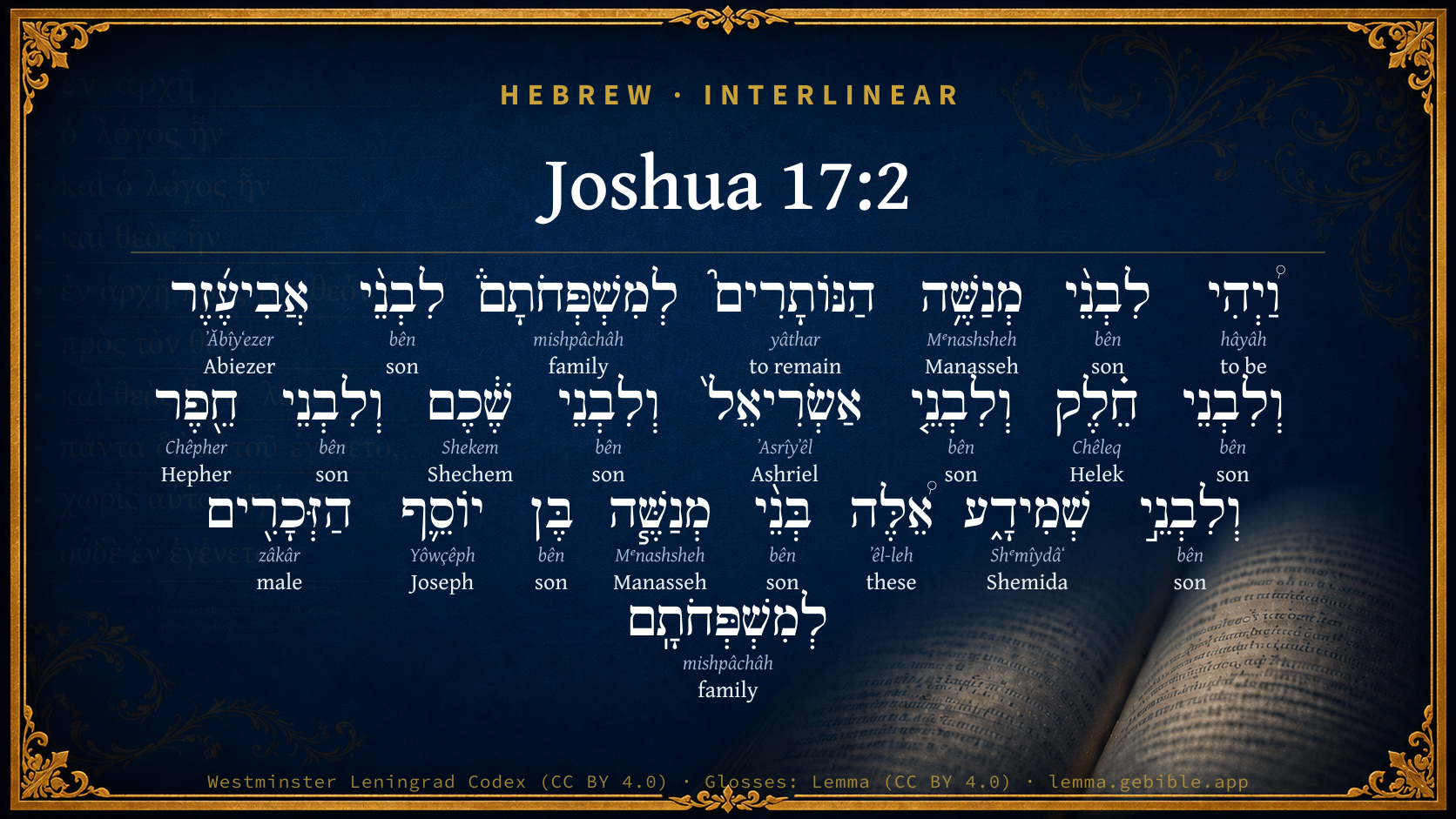
Hebrew (Westminster Leningrad Codex) Joshua 17:2 appears in the Hebrew Old Testament. The text above is from the Westminster Leningrad Codex. Each word links to its Strong’s number, a concise gloss, and parsing drawn from the Open Scriptures Hebrew Bible morphology. Click any word for its full Brown-Driver-Briggs (BDB) entry.
Download image
Cite this verse

Joshua 17:2 (World English Bible). Public Domain. Lemma interlinear Bible study tool, https://lemma.gebible.app/v/joshua/17/2.

Show BibTeX & RIS
BibTeX
RIS
English Translation
So [the lot] was for the rest of the children of Manasseh according to their families: for the children of Abiezer, and for the children of Helek, and for the children of Asriel, and for the children of Shechem, and for the children of Hepher, and for the children of Shemida: these were the male children of Manasseh the son of Joseph according to their families.
World English Bible · Public Domain
Highlights
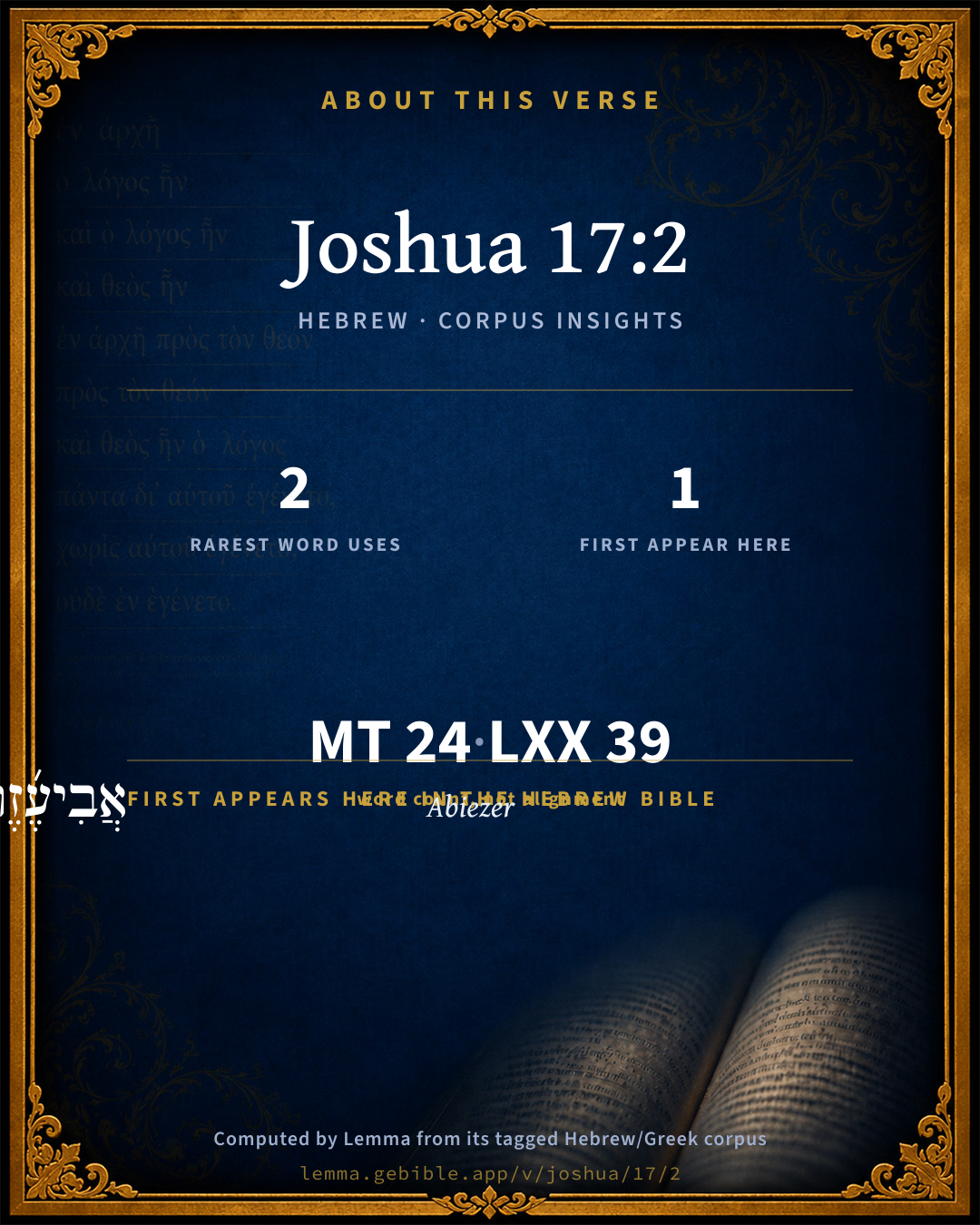
  • 1 first appearance in the Hebrew Bible
Full analysis ↓
Download a study sheet

One document with this verse’s original text, its word-by-word gloss line, the meaning frame, cross-references with their text, attributed commentary, and full source and license credits — printable, and it pastes into notes with its structure intact.

This verse Autodidact and up

Study sheet (.html) Plain text (.txt)

A passage Seminary Student

Up to 50 verses in one chapter. A passage sheet keeps up to 6 commentary sources and 12 cross-references per verse, in the order this page ranks them, and says so on the sheet whenever that leaves anything out. Ask for a single verse and you get the Autodidact verse sheet above.

Everything on this page stays free to read, with no account — the sheet is a download of what is already on screen, not access to it.

Want to remove ads? Support Godless Engineer
Compare translations 3

The same verse in 3 English versions, stacked beneath the original-language interlinear above. Click any original word for its lexicon entry.

Each is an independent rendering of the whole verse — the interlinear is not word-aligned to these translations.

Highlighted words mark where these versions differ — a whole-verse word diff, not a word-by-word alignment.

  • World English Bible Public Domain
    So [the lot] was for the rest of the children of Manasseh according to their families: for the children of Abiezer, and for the children of Helek, and for the children of Asriel, and for the children of Shechem, and for the children of Hepher, and for the children of Shemida: these were the male children of Manasseh the son of Joseph according to their families.
  • King James Version Public Domain
    There was also a lot for the rest of the children of Manasseh by their families; for the children of Abiezer, and for the children of Helek, and for the children of Asriel, and for the children of Shechem, and for the children of Hepher, and for the children of Shemida: these were the male children of Manasseh the son of Joseph by their families.
  • unfoldingWord Literal Text CC BY-SA 4.0
    And it was for the remaining sons of Manasseh, according to their clans, for the sons of Abiezer and for the sons of Helek and for the sons of Asriel and for the sons of Shechem and for the sons of Hepher and for the sons of Shemida. These the sons of Manasseh, the son of Joseph, the males according to their clans.

unfoldingWord Literal Text — © unfoldingWord, licensed CC BY-SA 4.0. Word-aligned USFM3 via Door43 (git.door43.org/unfoldingWord/en_ult).

Versions to compare (up to 4)

3 of 4 selected

Show all 18 translations

Every available English version of this verse, each an independent rendering of the whole verse.

  • World English Bible Public Domain
    So [the lot] was for the rest of the children of Manasseh according to their families: for the children of Abiezer, and for the children of Helek, and for the children of Asriel, and for the children of Shechem, and for the children of Hepher, and for the children of Shemida: these were the male children of Manasseh the son of Joseph according to their families.
  • Berean Standard Bible Public Domain
    So this allotment was for the rest of the descendants of Manasseh—the clans of Abiezer, Helek, Asriel, Shechem, Hepher, and Shemida. These are the other male descendants of the clans of Manasseh son of Joseph.
  • Majority Standard Bible Public Domain
    So this allotment was for the rest of the descendants of Manasseh—the clans of Abiezer, Helek, Asriel, Shechem, Hepher, and Shemida. These are the other male descendants of the clans of Manasseh son of Joseph.
  • King James Version Public Domain
    There was also a lot for the rest of the children of Manasseh by their families; for the children of Abiezer, and for the children of Helek, and for the children of Asriel, and for the children of Shechem, and for the children of Hepher, and for the children of Shemida: these were the male children of Manasseh the son of Joseph by their families.
  • American Standard Version (1901) Public Domain
    So `the lot' was for the rest of the children of Manasseh according to their families: for the children of Abiezer, and for the children of Helek, and for the children of Asriel, and for the children of Shechem, and for the children of Hepher, and for the children of Shemida: these were the male children of Manasseh the son of Joseph according to their families.
  • Revised Version (1885) Public Domain
    And the lot was for the rest of the children of Manasseh according to their families; for the children of Abiezer, and for the children of Helek, and for the children of Asriel, and for the children of Shechem, and for the children of Hepher, and for the children of Shemida: these were the male children of Manasseh the son of Joseph according to their families.
  • Geneva Bible (1599) Public Domain
    And also of the rest of the sonnes of Manasseh by their families, euen of the sonnes of Abiezer, and of the sonnes of Helek, and of ye sonnes of Azriel, and of the sonnes of Shechem, and of the sonnes of Hepher, and of the sonnes of Shemida: these were the males of Manasseh, the sonne of Ioseph according to their families.
  • Douay-Rheims (1899) Public Domain
    And to the rest of the children of Manasses according to their families: to the children of Abiezer, and to the children of Helec, and to the children of Esriel, and to the children of Sechem, and to the children of Hepher, and to the children of Semida: these are the male children of Manasses the son of Joseph, by their kindreds.
  • Young's Literal Translation Public Domain
    And there is for the sons of Manasseh who are left, for their families; for the sons of Abiezer, and for the sons of Helek, and for the sons of Asriel, and for the sons of Shechem, and for the sons of Hepher, and for the sons of Shemida; these `are' the children of Manasseh son of Joseph -- the males -- by their families.
  • Literal Standard Version CC BY-SA 4.0
    And there is [a lot] for the sons of Manasseh who are left, for their families; for the sons of Abiezer, and for the sons of Helek, and for the sons of Asriel, and for the sons of Shechem, and for the sons of Hepher, and for the sons of Shemida; these [are] the children of Manasseh son of Joseph—the males—by their families.
  • Unlocked Literal Bible CC BY-SA 4.0
    Land was assigned to the rest of the tribe of Manasseh, given to their clans—Abiezer, Helek, Asriel, Shechem, Hepher, and Shemida. These were the male descendants of Manasseh son of Joseph, presented by their clans.
  • unfoldingWord Literal Text CC BY-SA 4.0
    And it was for the remaining sons of Manasseh, according to their clans, for the sons of Abiezer and for the sons of Helek and for the sons of Asriel and for the sons of Shechem and for the sons of Hepher and for the sons of Shemida. These the sons of Manasseh, the son of Joseph, the males according to their clans.
  • Darby Bible Public Domain
    There was also [a portion] for the rest of the children of Manasseh according to their families: for the children of Abiezer, and for the children of Helek, and for the children of Asriel, and for the children of Shechem, and for the children of Hepher, and for the children of Shemida: these are the children of Manasseh, the son of Joseph, the males, according to their families.
  • World Messianic Bible Public Domain
    So this was for the rest of the children of Manasseh according to their families: for the children of Abiezer, for the children of Helek, for the children of Asriel, for the children of Shechem, for the children of Hepher, and for the children of Shemida. These were the male children of Manasseh the son of Joseph according to their families.
  • Webster's Bible Public Domain
    There was also a lot for the rest of the children of Manasseh by their families; for the children of Abiezer, and for the children of Helek, and for the children of Asriel, and for the children of Shechem, and for the children of Hepher, and for the children of Shemida: these were the male children of Manasseh the son of Joseph by their families.
  • Free Bible Version CC BY-SA 4.0
    The allocation was for the rest of the tribe of Manasseh, to the families of Abiezer, Helek, Asriel, Shechem, Hepher, and Shemida. These were the male descendants of Manasseh, the son of Joseph, by families.
  • Bible in Basic English Public Domain
    And as for the rest of the children of Manasseh, their heritage was given to them by families; for the children of Abiezer, and for the children of Helek, and for the children of Asriel, and for the children of Shechem, and for the children of Hepher, and for the children of Shemida: these were the male children of Manasseh, the son of Joseph, by their families.
  • JPS Tanakh (1917) Public Domain
    And the lot was for the rest of the children of Manasseh according to their families; for the children of Abiezer, and for the children of Helek, and for the children of Asriel, and for the children of Shechem, and for the children of Hepher, and for the children of Shemida; these were the male children of Manasseh the son of Joseph according to their families.

Literal Standard Version (2020), Covenant Press — licensed CC BY-SA 4.0. Text via the HelloAO Bible API (eBible.org). Unlocked Literal Bible (unfoldingWord) — licensed CC BY-SA 4.0. Text via the HelloAO Bible API (eBible.org). unfoldingWord Literal Text — © unfoldingWord, licensed CC BY-SA 4.0. Word-aligned USFM3 via Door43 (git.door43.org/unfoldingWord/en_ult). Free Bible Version, Dr. Jonathan Gallagher — licensed CC BY-SA 4.0. Text via the HelloAO Bible API (eBible.org).

Word by word

More ways to search: Search by grammar → Find every occurrence → Compare this word →

Practice this passage: Drill this verse → Learn its vocabulary →

חֵ֗לֶק
Chêleq
H2507
“Helek”
Noun, Proper
Part of Speech
Noun
Type
Proper
Full BDB Definition

Origin: the same as H2506

TWOT: None

Helek = "portion" - a descendant of Manasseh, and 2nd son of Gilead
  1. וַ֠יְהִי hâyâh H1961 “and · to be” Conjunction + Verb, Qal, Sequential Imperfect, 3rd Person, Masculine, Singular
  2. לִבְנֵ֨י bên H1121 “to/for · sons of” Preposition + Noun, Common, Masculine, Plural, Construct
  3. מְנַשֶּׁ֥ה Mᵉnashsheh H4519 “Manasseh” Noun, Proper
  4. הַנּוֹתָרִים֮ yâthar H3498 “the · remaining” Particle, Definite Article + Verb, Niphal, Participle Active, Masculine, Plural, Absolute
  5. לְמִשְׁפְּחֹתָם֒ mishpâchâh H4940 “to/for · families · their” Preposition + Noun, Common, Feminine, Plural, Construct + Suffix, Personal, 3rd Person, Masculine, Plural
  6. לִבְנֵ֨י bên H1121 “to/for · sons of” Preposition + Noun, Common, Masculine, Plural, Construct
  7. אֲבִיעֶ֜זֶר ʼĂbîyʻezer H44 “Abiezer” Noun, Proper
  8. וְלִבְנֵי bên H1121 “and · to/for · sons of” Conjunction + Preposition + Noun, Common, Masculine, Plural, Construct
  9. וְלִבְנֵ֤י bên H1121 “and · to/for · sons of” Conjunction + Preposition + Noun, Common, Masculine, Plural, Construct
  10. אַשְׂרִיאֵל֙ ʼAsrîyʼêl H844 “Ashriel” Noun, Proper
  11. וְלִבְנֵי bên H1121 “and · to/for · sons of” Conjunction + Preposition + Noun, Common, Masculine, Plural, Construct
  12. שֶׁ֔כֶם Shekem H7928 “Shechem” Noun, Proper
  13. וְלִבְנֵי bên H1121 “and · to/for · sons of” Conjunction + Preposition + Noun, Common, Masculine, Plural, Construct
  14. חֵ֖פֶר Chêpher H2660 “Hepher” Noun, Proper
  15. וְלִבְנֵ֣י bên H1121 “and · to/for · sons of” Conjunction + Preposition + Noun, Common, Masculine, Plural, Construct
  16. שְׁמִידָ֑ע Shᵉmîydâʻ H8061 “Shemida” Noun, Proper
  17. אֵ֠לֶּה ʼêl-leh H428 “these” Pronoun, Demonstrative, Common, Plural
  18. בְּנֵ֨י bên H1121 “sons of” Noun, Common, Masculine, Plural, Construct
  19. מְנַשֶּׁ֧ה Mᵉnashsheh H4519 “Manasseh” Noun, Proper
  20. בֶּן bên H1121 “son of” Noun, Common, Masculine, Singular, Construct
  21. יוֹסֵ֛ף Yôwçêph H3130 “Joseph” Noun, Proper
  22. הַזְּכָרִ֖ים zâkâr H2145 “the · males” Particle, Definite Article + Noun, Common, Masculine, Plural, Absolute
  23. לְמִשְׁפְּחֹתָֽם mishpâchâh H4940 “to/for · families · their” Preposition + Noun, Common, Feminine, Plural, Construct + Suffix, Personal, 3rd Person, Masculine, Plural

About this verse

These counts appear in no published source. They are computed here, from the morphology-tagged text and Lemma’s own curated glosses. What Lemma adds →

24
words
14
distinct lemmas
Historical
section

Notable vocabulary

The rarest word here is חֵ֗לֶק Helek H2507 — appearing just 2 times in the whole Hebrew Bible.

First appearance in Scripture

This word makes its first canonical appearance in the Hebrew Bible here:

  • אֲבִיעֶ֜זֶר Abiezer H44

Shared distinctive vocabulary

חֵ֗לֶק Helek H2507 occurs in 2 verses of the Hebrew Bible. Also found in:

Grammatical profile

  • 2 verbs
  • 21 nouns
  • 1 pronoun

Verb forms

  • וַ֠יְהִי Qal · Sequential Imperfect
  • הַנּוֹתָרִים֮ Niphal · Participle Active

Repetition

Words recur within this verse — often emphatic in Hebrew:

  • לִבְנֵ֨י son H1121 ×9
  • מְנַשֶּׁ֥ה Manasseh H4519 ×2
  • לְמִשְׁפְּחֹתָם֒ family H4940 ×2

Hebrew & Septuagint length

In English translation the verse runs 66 words from the Hebrew and 58 from the Septuagint (LXX English) — closely comparable.

A rough comparison of the two English renderings, which tokenize alike — not a word-level alignment.

Word counts can differ between the Hebrew and the Greek without any difference in meaning — e.g. the Hebrew direct-object marker אֵת has no separate Greek word, and Greek often adds the article ὁ.

In the original languages it is 24 Hebrew tokens and 39 Greek tokens — but the two are counted differently (Hebrew bundles its prefixes and suffixes into one token; the Greek is in lemma form), so that isn’t a like-for-like length.

Cross-references

4

Topical passages linked to Joshua 17:2 in the Treasury of Scripture Knowledge — connected by theme and wording, ordered by reader-vote popularity; previews shown in the World English Bible.

  • Numbers 26:29–32 The sons of Manasseh: of Machir, the family of the Machirites; and Machir became the father of Gilead; of Gilead, the family of the Gileadites.
  • 1 Chronicles 7:18 His sister Hammolecheth bore Ishhod, and Abiezer, and Mahlah.
  • Judges 6:11 The angel of Yahweh came, and sat under the oak which was in Ophrah, that pertained to Joash the Abiezrite: and his son Gideon was beating out wheat in the winepress, to hide it from the Midianites.
  • Judges 8:2 He said to them, What have I now done in comparison with you? Isn't the gleaning of the grapes of Ephraim better than the vintage of Abiezer?

Cross-references courtesy of OpenBible.info (CC BY 4.0).

Hebrew and Greek witnesses Masoretic Hebrew ↔ Greek Septuagint

The same verse in the two great witnesses to the Old Testament, shown verse-for-verse.

These are two independent witnesses, not word-aligned to each other, and the Septuagint is shown in lemma (dictionary) form.

Hebrew Joshua 17:2 Masoretic · Westminster Leningrad Codex

וַ֠יְהִי לִבְנֵ֨י מְנַשֶּׁ֥ה הַנּוֹתָרִים֮ לְמִשְׁפְּחֹתָם֒ לִבְנֵ֨י אֲבִיעֶ֜זֶר וְלִבְנֵי חֵ֗לֶק וְלִבְנֵ֤י אַשְׂרִיאֵל֙ וְלִבְנֵי שֶׁ֔כֶם וְלִבְנֵי חֵ֖פֶר וְלִבְנֵ֣י שְׁמִידָ֑ע אֵ֠לֶּה בְּנֵ֨י מְנַשֶּׁ֧ה בֶּן יוֹסֵ֛ף הַזְּכָרִ֖ים לְמִשְׁפְּחֹתָֽם

So [the lot] was for the rest of the children of Manasseh according to their families: for the children of Abiezer, and for the children of Helek, and for the children of Asriel, and for the children of Shechem, and for the children of Hepher, and for the children of Shemida: these were the male children of Manasseh the son of Joseph according to their families.

World English Bible · Public Domain

Greek LXX Joshua 17:2 Septuagint · lemma form

καί γίγνομαι ὁ υἱός μανασσή ὁ λοιπός κατά δῆμος αὐτός ὁ υἱός ιεζερ καί ὁ υἱός κελεζ καί ὁ υἱός ιεζιηλ καί ὁ υἱός συχεμ καί ὁ υἱός συμαριμ καί ὁ υἱός οφερ οὗτος ὁ ἄρσην κατά δῆμος αὐτός

And there was land assigned to the other sons of Manasse according to their families; to the sons of Jezi, and to the sons of Kelez, and to the sons of Jeziel, and to the sons of Sychem, and to the sons of Symarim, and to the sons of Opher: these are the males according to their families.

LXX2012 (modern English Septuagint) · Public Domain

Hebrew: Westminster Leningrad Codex (CC BY 4.0). Greek: Septuagint (public domain); English from LXX2012 (modern English Septuagint) (Public Domain). How the Septuagint differs from the Hebrew →

Targum (Aramaic paraphrase)

1

The Targum is the ancient Jewish Aramaic paraphrase of the Hebrew Scriptures — an interpretive translation, not the Hebrew text itself. Onkelos (literal) and Pseudo-Jonathan (expansive) render the Torah, and Jonathan the Prophets. Coverage is partial: where no permissively-licensed English translation exists for a verse, only the Aramaic is shown. This is verse-level text, not a word-by-word alignment to the Hebrew.

  1. Targum Jonathan Prophets (Joshua–Malachi)
    וַהֲוָה לִבְנֵי מְנַשֶׁה דְאִשְׁתָּאֲרוּ לְזַרְעֲיַתְהוֹן וְלִבְנֵי אֲבִיעֶזֶר וְלִבְנֵי חֵלֶק וְלִבְנֵי אַשְׂרִיאֵל וְלִבְנֵי שֶׁכֶם וְלִבְנֵי חֵפֶר וְלִבְנֵי שְׁמִידָע אִילֵן בְּנֵי מְנַשֶׁה בַּר יוֹסֵף דָכְרַיָא לְזַרְעֲיַתְהוֹן:

    (no public-domain English translation for this verse)

    Targum Jonathan — Aramaic: “Mikraot Gedolot” (public domain). English: “Sefaria Community Translation” (CC0 1.0 (public-domain dedication)); “London "Chaldee Paraphrase," 1871” (public domain). Text via Sefaria.

Commentary

Notes on Joshua 17:2 from classic Christian and Jewish commentators (each source and its license shown beneath its notes). The classic Christian expositions comment on the surrounding passage and are grouped to its opening verse, so a note may address several verses; the Jewish commentaries on the Tanakh (Rashi and others) are per-verse, so they appear only where the commentator wrote on this verse.

Lemma curates 59 commentaries, every one of them public domain or Creative Commons licensed, each selected and text-cleaned for this edition rather than reprinted as found. About our sources →

Trapp's Complete Commentary

John Trapp

Jos 17:2 There was also [a lot] for the rest of the children of Manasseh by their families; for the children of Abiezer, and for the children of Helek, and for the children of Asriel, and for the children of Shechem, and for the children of Hepher, and for the children of Shemida: these [were] the male children of Manasseh the son of Joseph by their families.

Ver. 2. For the rest of the children of Manasseh.] That is, for his grand-children by Gilead, {Num 26:29} who were yet unprovided of a portion, and were to receive it beyond Jordan in the land of Canaan.

John Trapp, A Commentary or Exposition upon All the Books of the Old and New Testament (1647–1656) — public domain. Text from a community e-Sword module.

Joseph Benson's Commentary

Jos 17:2. A lot — A distinct inheritance. The rest — Namely, those of them which had not received their possessions beyond Jordan. Male children —

This expression is used to bring in what follows, concerning his female children.

Joseph Benson's Commentary on the Old and New Testaments (1811–1818) — public domain. Text from a community e-Sword module.

Geneva Bible (1599)

Geneva Bible translators

For the other half tribe had their portion beyond Jordan.

Geneva Bible (1599) marginal notes — public domain. Text via Bolls.life.

Adam Clarke's Commentary

Verse 2. The rest of the children of Manasseh] That is, his grandchildren; for it is contended that Manasseh had no other son than Machir; and these were very probably the children of Gilead, the son of Machir.

Adam Clarke's Commentary on the Bible (1810–1826) — public domain. Text from a community e-Sword/MySword module.

The Cambridge Bible for Schools and Colleges

gen. ed. J. J. S. Perowne

2. for the rest of the children of Manasseh] The descendants of Machir received their inheritance on the east of the Jordan, the descendants of Gilead on the west side, along with Ephraim. These—the rest of the children of Manasseh—were divided into six families.

The Cambridge Bible for Schools and Colleges (gen. ed. J. J. S. Perowne; Cambridge University Press, 1878–1918) — public domain. Text from a community e-Sword module.

John Gill's Exposition

There was also a lot for the rest of the children of Manasseh by their families,.... For such that had no part in Gilead and Bashan on the other side Jordan, even for the other half tribe, whose families are particularly mentioned, as follows:

for the children of Abiezer; who is called Jeezer in Num 26:30; and was a son of Gilead, the son of Machir, as the rest that follow were:

and for the children of Helek, and for the children of Asriel, and for the children of Shechem, and for the children of Hepher, and for the children of Shemida; hence the families of the Jeezerites, Helekites, Asrielites, Shechemites, Hepherites, and Shemidaites, mentioned in Num 26:30; and for which families was the lot here spoken of:

these were the male children of Manasseh the son of Joseph by their families; which is observed for the sake of, and to lead unto what follows, otherwise in common none but males inherited; but the following is an excepted and remarkable case.

John Gill's Exposition of the Whole Bible (1746–1763) — public domain (CC PDM 1.0). Text via the HelloAO Bible API.

Albert Barnes' Notes on the Bible

For the rest ... - i. e. for those who were not settled on the east of Jordan.

Albert Barnes' Notes on the Bible (1834–1885) — public domain. Text from a community e-Sword/MySword module.

Haydock's Catholic Bible Commentary

Children here comprises grandchildren, &c. These who are specified sprang from Galaad or from Jair, as they all dwelt on the east side of the Jordan, 1 Paralipomenon v. 23., and vii. 14. (Calmet)

George Leo Haydock (1774–1849), Haydock's Catholic Family Bible and Commentary, 1859 edition — public domain. Excludes Psalms (Douay-Rheims chapter numbering differs from Protestant) and Deuterocanonical books (Catholic canon only).

Matthew Poole's English Annotations

A lot, or, a portion, or distinct inheritance.

The rest of the children of Manasseh, to wit, those of them which had not received their possessions beyond Jordan, Num 26:29, &c.

These were the male children: this expression is used to bring in what follows, concerning his female children.

Matthew Poole's English Annotations on the Holy Bible (1683–1685) — public domain. Text from a community e-Sword/MySword module.

Whedon's Commentary on the Bible

Daniel D. Whedon

2. The rest of the children of Manasseh — That is, as the next two verses explain, the descendants of the five sons named, and also of the five daughters of Hepher, whose son Zelophehad had no male children. The western lot was thus divided into ten portions, (Jos_17:5,) because there were claimants through five males and five females, the latter being descendants of Hepher. The claim of the latter had been at one time a matter of doubt, as the question of woman’s rights has been a matter of dispute in all countries. But Moses had very wisely carried the question to the Lord for his decision, who recognized their rights as inheritors. Num_27:6-7.

Daniel D. Whedon (gen. ed.), Commentary on the Old and New Testaments (1874–1909) — public domain. Text from a community e-Sword module.

The Pulpit Commentary

There was also a lot. Or, and (the lot) was (or fell). Abiezer. (Nu 36) The inheritance here described as being given to the daughters of Zelophehad was so given on condition of their marrying within the limits of their own tribe, a condition which was fulfilled. Thus the name of Zelophehad, and the portion of land belonging to him, was not blotted out from the memory of his descendants.

HOMILIES BY W.F. ADENEY Vers. 3, 4. Woman"s rights.

I WOMEN HAVE RIGHTS WHICH MEN COMMONLY DENY THEM. The justice of the Mosaic law and the just privileges accorded to women in the Jewish state stand out in favorable contrast with the almost universal injustice which marks the historic relations of men with women. In barbarous nations women are required to do the hardest manual labour. In semi-civilised nations they are kept in ignorance, idleness, and jealous seclusion. In more advanced nations they are hampered with needless social restrictions which prevent them from enjoying their fair privileges as human beings. This injustice may be traced to

(1) the superior brute force of men,

(2) the natural retiring nature of woman, and

(3) false sentiment which dishonours true modesty.

Chivalrous customs and domestic affection may soften the effects of injustice, but they do not remove the fact.

II WOMEN SHOULD BE ALLOWED TO PROVE THEIR OWN RIGHTS AND CAPACITIES. Hitherto one half of the human race has taken upon itself to settle the position and destiny of the other half. Women have been treated as though men knew their rights and capacities better than these were known to themselves. It is at least just that women should be allowed some liberty of choice, some opportunity for proving their capacities to the world. If they then fail they take a lower position fairly. But it is most unreasonable to assert that they have not certain capacities, while men are jealously closing every channel through which they might prove the existence of those capacities by putting them into practice.

III SCRIPTURAL PRINCIPLES REQUIRE JUSTICE TO WOMEN. This is required by the law. (Num_27:8) It is still more fully required by Christianity. The spiritual privileges of the gospel are equally open to men and women. The elevation of women is one of the most beneficial fruits of the gospel. (Mat_26:13 Luk_10:38-42 Php_4:3)

IV JUSTICE TO WOMEN DOES NOT IMPLY THE EQUALITY OF WOMEN WITH MEN. There must ever remain essential differences between the careers of men and women in many directions, owing to the essential differences of their physical and mental natures. Justice does not demand that all should receive the same privileges, and perform the same duties, but that there should be fairness in the distribution.

V THE EXERCISE OF RIGHTS BY WOMEN CARRIES WITH IT THE OBLIGATION OF CORRESPONDING DUTIES. Duty corresponds to right. The extension of rights increases the obligation of duties. If women obtain larger privileges, in justice they will be called upon to undertake heavier responsibilities. Happily this was realised in Scripture history. The women of the Bible enjoying greater advantages than their neighbours are often distinguished by peculiarly noble conduct. Women are conspicuous for devotion and sacrifice among the early disciples of Christ. (Luk_8:2, Luk_8:8) Much of the best work of Christendom has been done by good women. There is large work in the Church for women now. W.F.A.

The Pulpit Commentary (1880–1919), ed. H.D.M. Spence-Jones & Joseph S. Exell — public domain. Text from a community e-Sword module.

John Wesley's Explanatory Notes

A Lot - A distinct inheritance. The rest - Namely, those of them which had not received their possessions beyond Jordan. Male- children - This expression is used to bring in what follows, concerning his female children.

John Wesley, Explanatory Notes Upon the Whole Bible (1754–1765) — public domain. Text via the GEBible commentary corpus.

Lesson kit

Teaching starters — assembled from the data on this page, not authored interpretation. Every prompt links to the verse data it draws on. Edit before teaching.

Joshua, in the Historical, opens this verse with 24 words (14 distinct Hebrew lemmas). Its most distinctive word is Chêleq (“Helek”). A historical commentator’s framing appears above. Read the whole chapter for the surrounding context.

Discussion questions

  1. How does “Helek” (Chêleq) shape what this verse is saying?
  2. The word “Abiezer” first appears here in Scripture. What is being introduced at this debut?
  3. Numbers 26:30 shares the word «Helek» with this verse. How do the two illuminate each other?
  4. “son” occurs 9× in this one verse. What is the effect of the repetition?
  5. These translations render this verse differently. What is at stake in choosing one wording over another?
  6. The verb «וַ֠יְהִי» is Qal Sequential Imperfect. How does its form color the action?
  7. Reading how Trapp's Complete Commentary and Joseph Benson's Commentary read this verse, where do the two commentators agree and where do they part?

Things to notice

Reading settings

Reading text

Shown beneath each verse's original-language words.

Old Testament
Old Testament edition

Read the OT as the Masoretic Hebrew (MT) or the Greek Septuagint (LXX).

English shown for the Greek Septuagint (in the Hebrew ↔ Greek comparison).

Comparing translations? Open the Compare panel on any verse page to stack up to four side by side.