
2 Kings 23:26

Hebrew (Westminster Leningrad Codex) 2 Kings 23:26 appears in the Hebrew Old Testament. The text above is from the Westminster Leningrad Codex. Each word links to its Strong’s number, a concise gloss, and parsing drawn from the Open Scriptures Hebrew Bible morphology. Click any word for its full Brown-Driver-Briggs (BDB) entry.
Download image
Cite this verse

2 Kings 23:26 (World English Bible). Public Domain. Lemma interlinear Bible study tool, https://lemma.gebible.app/v/2-kings/23/26.

Show BibTeX & RIS
BibTeX
RIS
English Translation
Notwithstanding, Yahweh didn't turn from the fierceness of his great wrath, with which his anger was kindled against Judah, because of all the provocation with which Manasseh had provoked him.
World English Bible · Public Domain
Download a study sheet

One document with this verse’s original text, its word-by-word gloss line, the meaning frame, cross-references with their text, attributed commentary, and full source and license credits — printable, and it pastes into notes with its structure intact.

This verse Autodidact and up

Study sheet (.html) Plain text (.txt)

A passage Seminary Student

Up to 50 verses in one chapter. A passage sheet keeps up to 6 commentary sources and 12 cross-references per verse, in the order this page ranks them, and says so on the sheet whenever that leaves anything out. Ask for a single verse and you get the Autodidact verse sheet above.

Everything on this page stays free to read, with no account — the sheet is a download of what is already on screen, not access to it.

Want to remove ads? Support Godless Engineer
Compare translations 3

The same verse in 3 English versions, stacked beneath the original-language interlinear above. Click any original word for its lexicon entry.

Each is an independent rendering of the whole verse — the interlinear is not word-aligned to these translations.

Highlighted words mark where these versions differ — a whole-verse word diff, not a word-by-word alignment.

  • World English Bible Public Domain
    Notwithstanding, Yahweh didn't turn from the fierceness of his great wrath, with which his anger was kindled against Judah, because of all the provocation with which Manasseh had provoked him.
  • King James Version Public Domain
    Notwithstanding the LORD turned not from the fierceness of his great wrath, wherewith his anger was kindled against Judah, because of all the provocations that Manasseh had provoked him withal.
  • unfoldingWord Literal Text CC BY-SA 4.0
    However, Yahweh did not turn from the great burning of his nose which his nose burned against Judah because of all of the provocations which Manasseh had provoked him.

unfoldingWord Literal Text — © unfoldingWord, licensed CC BY-SA 4.0. Word-aligned USFM3 via Door43 (git.door43.org/unfoldingWord/en_ult).

Versions to compare (up to 4)

3 of 4 selected

Show all 18 translations

Every available English version of this verse, each an independent rendering of the whole verse.

  • World English Bible Public Domain
    Notwithstanding, Yahweh didn't turn from the fierceness of his great wrath, with which his anger was kindled against Judah, because of all the provocation with which Manasseh had provoked him.
  • Berean Standard Bible Public Domain
    Nevertheless, the LORD did not turn away from the fury of His burning anger, which was kindled against Judah because of all that Manasseh had done to provoke Him to anger.
  • Majority Standard Bible Public Domain
    Nevertheless, the LORD did not turn away from the fury of His burning anger, which was kindled against Judah because of all that Manasseh had done to provoke Him to anger.
  • King James Version Public Domain
    Notwithstanding the LORD turned not from the fierceness of his great wrath, wherewith his anger was kindled against Judah, because of all the provocations that Manasseh had provoked him withal.
  • American Standard Version (1901) Public Domain
    Notwithstanding, Jehovah turned not from the fierceness of his great wrath, wherewith his anger was kindled against Judah, because of all the provocations wherewith Manasseh had provoked him.
  • Revised Version (1885) Public Domain
    Notwithstanding the LORD turned not from the fierceness of his great wrath, wherewith his anger was kindled against Judah, because of all the provocations that Manasseh had provoked him withal.
  • Geneva Bible (1599) Public Domain
    Notwithstanding the Lord turned not from the fiercenesse of his great wrath wherewith he was angrie against Iudah, because of all the prouocatios wherwith Manasseh had prouoked him.
  • Douay-Rheims (1899) Public Domain
    But yet the Lord turned not away from the wrath of his great indignation, wherewith his anger was kindled against Juda: because of the provocations, wherewith Manasses had provoked him.
  • Young's Literal Translation Public Domain
    Only, Jehovah hath not turned back from the fierceness of His great anger with which His anger burned against Judah, because of all the provocations with which Manasseh provoked him,
  • Literal Standard Version CC BY-SA 4.0
    Only, YHWH has not turned back from the fierceness of His great anger with which His anger burned against Judah, because of all the provocations with which Manasseh provoked him,
  • Unlocked Literal Bible CC BY-SA 4.0
    Nevertheless, Yahweh did not turn away from the burning of his fierce anger, which burned against Judah because of all that Manasseh had done to provoke him to anger.
  • unfoldingWord Literal Text CC BY-SA 4.0
    However, Yahweh did not turn from the great burning of his nose which his nose burned against Judah because of all of the provocations which Manasseh had provoked him.
  • Darby Bible Public Domain
    But Jehovah turned not from the fierceness of his great wrath, wherewith his anger was kindled against Judah, because of all the provocations with which Manasseh had provoked him.
  • World Messianic Bible Public Domain
    Notwithstanding, the LORD didn’t turn from the fierceness of his great wrath, with which his anger burned against Judah, because of all the provocation with which Manasseh had provoked him.
  • Webster's Bible Public Domain
    Notwithstanding, the LORD turned not from the fierceness of his great wrath, with which his anger was kindled against Judah, because of all the provocations by which Manasseh had provoked him.
  • Free Bible Version CC BY-SA 4.0
    However, the Lord had not given up his furious hostility, which burned against Judah because of all that Manasseh had done to anger him.
  • Bible in Basic English Public Domain
    But still the heat of the Lord's wrath was not turned back from Judah, because of all Manasseh had done in moving him to wrath.
  • JPS Tanakh (1917) Public Domain
    Notwithstanding the LORD turned not from the fierceness of His great wrath, wherewith His anger was kindled against Judah, because of all the provocations wherewith Manasseh had provoked Him.

Literal Standard Version (2020), Covenant Press — licensed CC BY-SA 4.0. Text via the HelloAO Bible API (eBible.org). Unlocked Literal Bible (unfoldingWord) — licensed CC BY-SA 4.0. Text via the HelloAO Bible API (eBible.org). unfoldingWord Literal Text — © unfoldingWord, licensed CC BY-SA 4.0. Word-aligned USFM3 via Door43 (git.door43.org/unfoldingWord/en_ult). Free Bible Version, Dr. Jonathan Gallagher — licensed CC BY-SA 4.0. Text via the HelloAO Bible API (eBible.org).

Word by word

More ways to search: Search by grammar → Find every occurrence → Compare this word →

Practice this passage: Drill this verse → Learn its vocabulary →

הַכְּעָסִ֔ים
kaʻaç
H3708
“the · provocations”
Particle, Definite Article + Noun, Common, Masculine, Plural, Absolute
Part of Speech
Particle + Noun
Type
Common
Gender
Masculine
Number
Plural
State
Absolute
Full BDB Definition

Origin: from H3707

TWOT: 1016a

anger, vexation, provocation, grief - vexation - of men - of God - vexation, grief, frustration
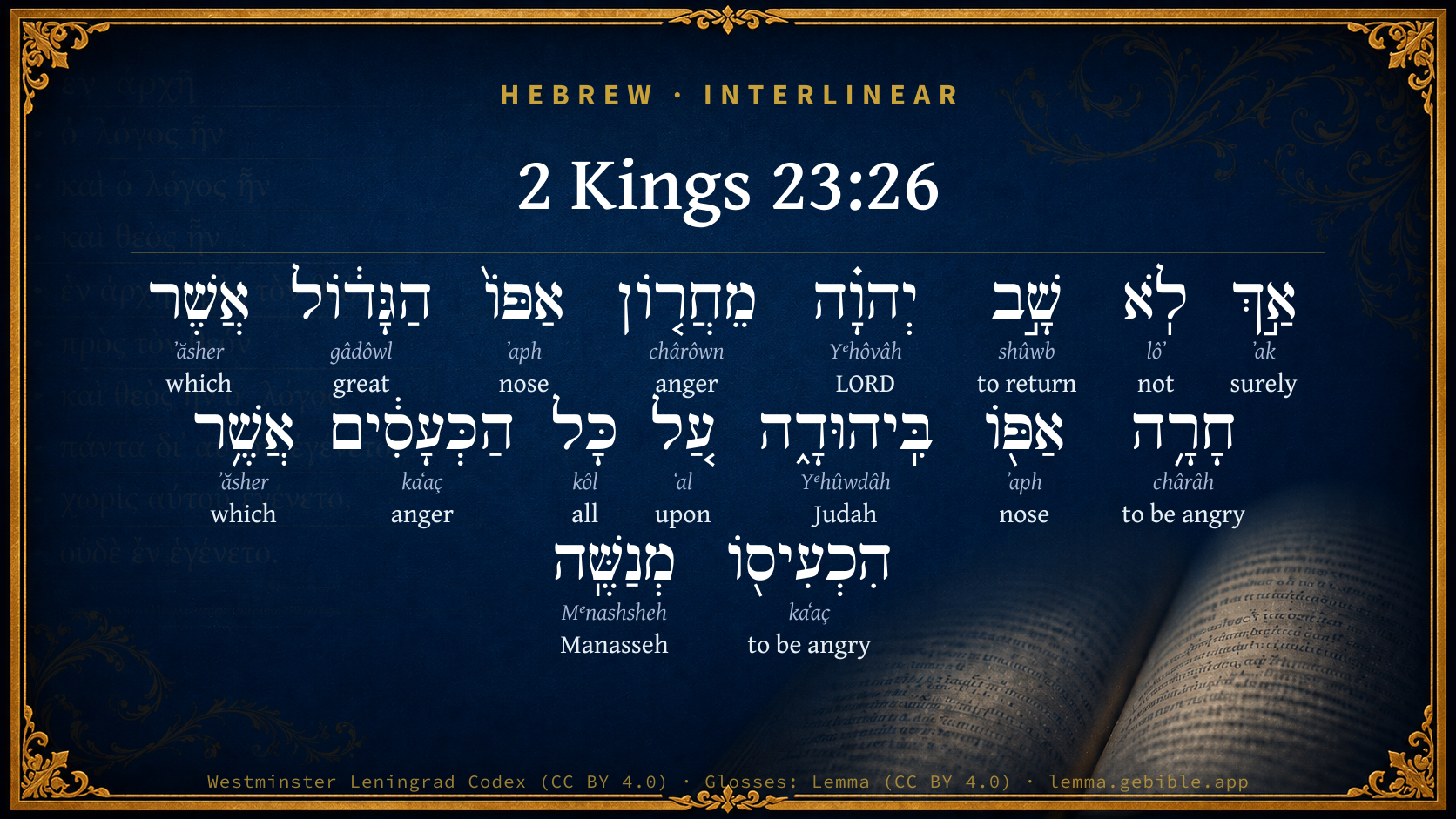
  1. אַ֣ךְ ʼak H389 “surely” Particle, Accusative
  2. לֹֽא lôʼ H3808 “not” Particle, Negative
  3. שָׁ֣ב shûwb H7725 “to return” Verb, Qal, Perfect, 3rd Person, Masculine, Singular
  4. יְהוָ֗ה Yᵉhôvâh H3068 “LORD” Noun, Proper
  5. מֵחֲר֤וֹן chârôwn H2740 “from · anger of” Preposition + Noun, Common, Masculine, Singular, Construct
  6. אַפּוֹ֙ ʼaph H639 “nose · his” Noun, Common, Masculine, Singular, Construct + Suffix, Personal, 3rd Person, Masculine, Singular
  7. הַגָּד֔וֹל gâdôwl H1419 “the · great” Particle, Definite Article + Adjective, Adjective, Masculine, Singular, Absolute
  8. אֲשֶׁר ʼăsher H834 “which” Particle, Relative
  9. חָרָ֥ה chârâh H2734 “to be angry” Verb, Qal, Perfect, 3rd Person, Masculine, Singular
  10. אַפּ֖וֹ ʼaph H639 “nose · his” Noun, Common, Masculine, Singular, Construct + Suffix, Personal, 3rd Person, Masculine, Singular
  11. בִּֽיהוּדָ֑ה Yᵉhûwdâh H3063 “in/at · Judah” Preposition + Noun, Proper
  12. עַ֚ל ʻal H5921 “upon” Preposition
  13. כָּל kôl H3605 “all of” Noun, Common, Masculine, Singular, Construct
  14. אֲשֶׁ֥ר ʼăsher H834 “which” Particle, Relative
  15. הִכְעִיס֖וֹ kaʻaç H3707 “to be angry · him” Verb, Hiphil, Perfect, 3rd Person, Masculine, Singular + Suffix, Personal, 3rd Person, Masculine, Singular
  16. מְנַשֶּֽׁה Mᵉnashsheh H4519 “Manasseh” Noun, Proper

About this verse

These counts appear in no published source. They are computed here, from the morphology-tagged text and Lemma’s own curated glosses. What Lemma adds →

17
words
15
distinct lemmas
Historical
section

Notable vocabulary

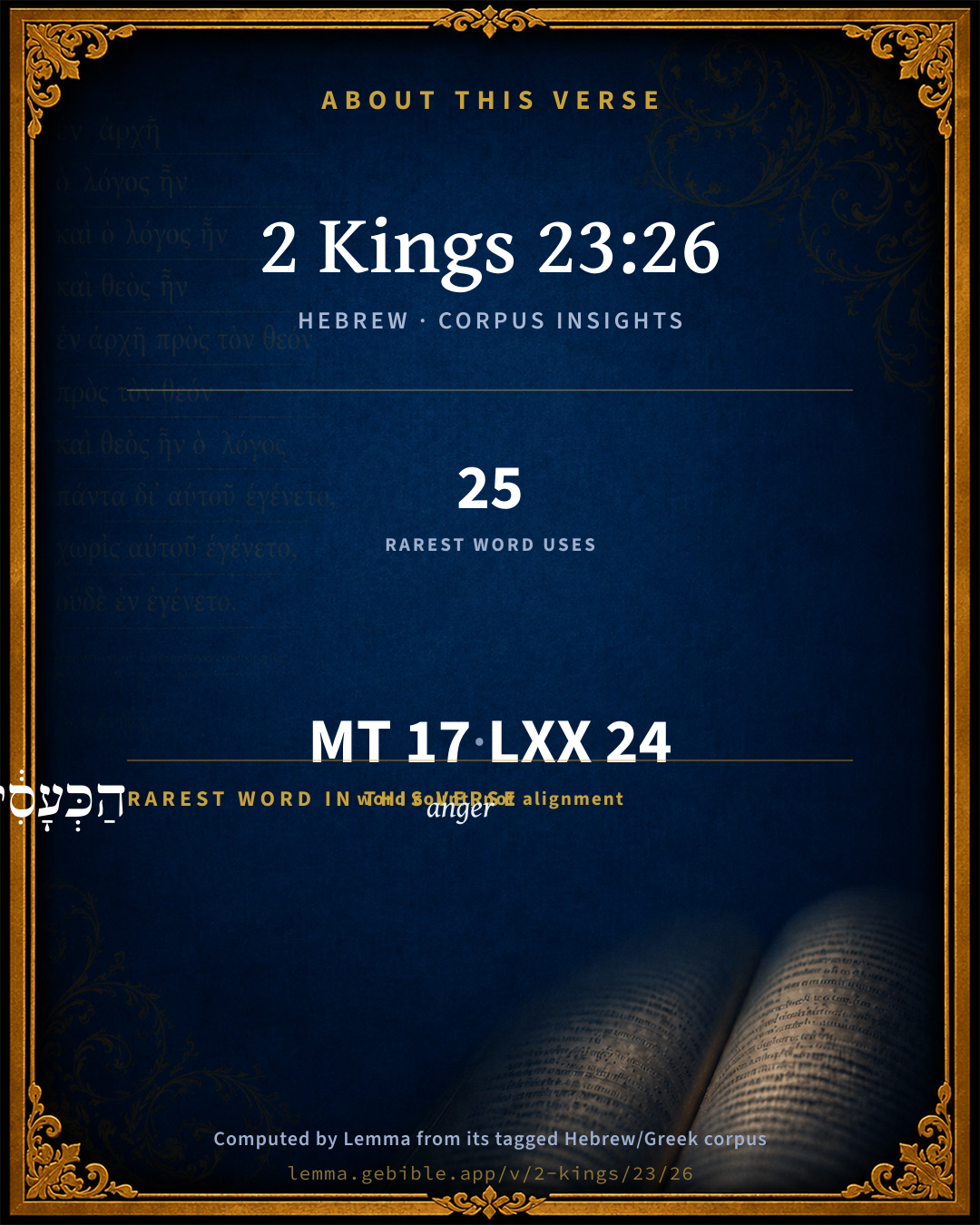
The rarest word here is הַכְּעָסִ֔ים anger H3708 — appearing just 25 times in the whole Hebrew Bible.

Shared distinctive vocabulary

הַכְּעָסִ֔ים anger H3708 occurs in 25 verses of the Hebrew Bible. Also found in:

Grammatical profile

  • 3 verbs
  • 8 nouns
  • 1 adjective
  • 1 preposition
  • 4 particles

Verb forms

  • שָׁ֣ב Qal · Perfect
  • חָרָ֥ה Qal · Perfect
  • הִכְעִיס֖וֹ Hiphil · Perfect

Repetition

Words recur within this verse — often emphatic in Hebrew:

  • אַפּוֹ֙ nose H639 ×2
  • אֲשֶׁר which H834 ×2

Hebrew & Septuagint length

In English translation the verse runs 30 words from the Hebrew and 29 from the Septuagint (LXX English) — closely comparable.

A rough comparison of the two English renderings, which tokenize alike — not a word-level alignment.

Word counts can differ between the Hebrew and the Greek without any difference in meaning — e.g. the Hebrew direct-object marker אֵת has no separate Greek word, and Greek often adds the article ὁ.

In the original languages it is 17 Hebrew tokens and 24 Greek tokens — but the two are counted differently (Hebrew bundles its prefixes and suffixes into one token; the Greek is in lemma form), so that isn’t a like-for-like length.

Cross-references

7

Topical passages linked to 2 Kings 23:26 in the Treasury of Scripture Knowledge — connected by theme and wording, ordered by reader-vote popularity; previews shown in the World English Bible.

  • 2 Kings 21:11–13 Because Manasseh king of Judah has done these abominations, and has done wickedly above all that the Amorites did, who were before him, and has made Judah also to sin with his idols;
  • 2 Kings 24:4 and also for the innocent blood that he shed; for he filled Jerusalem with innocent blood: and Yahweh would not pardon.
  • 2 Kings 22:16–17 Thus says Yahweh, Behold, I will bring evil on this place, and on the inhabitants of it, even all the words of the book which the king of Judah has read.
  • 2 Kings 24:2 Yahweh sent against him bands of the Chaldeans, and bands of the Syrians, and bands of the Moabites, and bands of the children of Ammon, and sent them against Judah to destroy it, according to the word of Yahweh, which he spoke by his servants the prophets.
  • 2 Chronicles 36:16 but they mocked the messengers of God, and despised his words, and scoffed at his prophets, until the wrath of Yahweh arose against his people, until there was no remedy.
  • Jeremiah 3:7–10 I said after she had done all these things, She will return to me; but she didn't return: and her treacherous sister Judah saw it.
  • Jeremiah 15:1–4 Then said Yahweh to me, Though Moses and Samuel stood before me, yet my mind would not be toward this people: cast them out of my sight, and let them go forth.

Cross-references courtesy of OpenBible.info (CC BY 4.0).

Hebrew and Greek witnesses Masoretic Hebrew ↔ Greek Septuagint

The same verse in the two great witnesses to the Old Testament, shown verse-for-verse.

These are two independent witnesses, not word-aligned to each other, and the Septuagint is shown in lemma (dictionary) form.

Hebrew 2 Kings 23:26 Masoretic · Westminster Leningrad Codex

אַ֣ךְ לֹֽא שָׁ֣ב יְהוָ֗ה מֵחֲר֤וֹן אַפּוֹ֙ הַגָּד֔וֹל אֲשֶׁר חָרָ֥ה אַפּ֖וֹ בִּֽיהוּדָ֑ה עַ֚ל כָּל הַכְּעָסִ֔ים אֲשֶׁ֥ר הִכְעִיס֖וֹ מְנַשֶּֽׁה

Notwithstanding, Yahweh didn't turn from the fierceness of his great wrath, with which his anger was kindled against Judah, because of all the provocation with which Manasseh had provoked him.

World English Bible · Public Domain

Greek LXX 2 Kings 23:26 Septuagint · lemma form

πλήν οὐ ἀποστρέφω κύριος ἀπό θυμός ὀργή αὐτός ὁ μέγας ὅς θυμόω ὀργή αὐτός ἐν ὁ ιουδα ἐπί ὁ παροργισμός ὅς παραὀργίζω αὐτός μανασσῆς

Nevertheless the Lord turned not from the fierceness of his great anger, wherewith he was angry in his anger against Juda, because of the provocations, wherewith Manasses provoked him.

LXX2012 (modern English Septuagint) · Public Domain

Hebrew: Westminster Leningrad Codex (CC BY 4.0). Greek: Septuagint (public domain); English from LXX2012 (modern English Septuagint) (Public Domain). How the Septuagint differs from the Hebrew →

Targum (Aramaic paraphrase)

1

The Targum is the ancient Jewish Aramaic paraphrase of the Hebrew Scriptures — an interpretive translation, not the Hebrew text itself. Onkelos (literal) and Pseudo-Jonathan (expansive) render the Torah, and Jonathan the Prophets. Coverage is partial: where no permissively-licensed English translation exists for a verse, only the Aramaic is shown. This is verse-level text, not a word-by-word alignment to the Hebrew.

  1. Targum Jonathan Prophets (Joshua–Malachi)
    בְּרַם לָא תַב יְיָ מִתְּקוֹף רוּגְזֵיהּ רַבָּא דִתְקֵיף רוּגְזֵיהּ בִּדְבֵית יְהוּדָה עַל כָּל אַרְגְזוּתָא דִי אַרְגֵיז קֳדָמוֹהִי מְנַשֶׁה:

    (no public-domain English translation for this verse)

    Targum Jonathan — Aramaic: “Mikraot Gedolot” (public domain). English: “Sefaria Community Translation” (CC0 1.0 (public-domain dedication)); “London "Chaldee Paraphrase," 1871” (public domain). Text via Sefaria.

Commentary

Notes on 2 Kings 23:26 from classic Christian and Jewish commentators (each source and its license shown beneath its notes). The classic Christian expositions comment on the surrounding passage and are grouped to its opening verse, so a note may address several verses; the Jewish commentaries on the Tanakh (Rashi and others) are per-verse, so they appear only where the commentator wrote on this verse.

Lemma curates 59 commentaries, every one of them public domain or Creative Commons licensed, each selected and text-cleaned for this edition rather than reprinted as found. About our sources →

Trapp's Complete Commentary

John Trapp

2Ki 23:26 Notwithstanding the LORD turned not from the fierceness of his great wrath, wherewith his anger was kindled against Judah, because of all the provocations that Manasseh had provoked him withal.

Ver. 26. Notwithstanding the Lord, &c.] See on 2Ki 23:22.

Because of all the provocations that Manasseh had provoked him withal.] His sin was pardoned upon his repentance, but his reproach was not altogether wiped away, as Pro 6:33. The stain of it was like iron mould, which nothing can fetch out. His posterity also, yea, and the generality of the people, persisting in Manasseh’s sins, were justly punishable for the same. The Corinthians were accessory to the sin of the incestuous person, because they bewailed it not; {1Co 5:2} and shall not we of this age smart for those bloody Marian days, if we lament not, and so disclaim them?

John Trapp, A Commentary or Exposition upon All the Books of the Old and New Testament (1647–1656) — public domain. Text from a community e-Sword module.

Joseph Benson's Commentary

2Ki 23:26. Notwithstanding, the Lord turned not, &c. — Because, though the king was most hearty in his repentance, and acceptable to God, and therefore the judgment was delayed for his time; yet the people were in general corrupt, and secretly averse from Josiah’s pious reformation, as appears from the complaints of the prophets, especially Jeremiah and Zephaniah, against them; and by the following history, wherein we see, that as soon as ever Josiah was gone, his children, and the princes, and the people, suddenly and greedily returned to their former abominations. Because of all the provocations, &c. — The sins of Manasseh, and of the men of his generation, who concurred with him in his idolatrous and cruel practices, are justly punished in this generation: because of God’s sovereign right of punishing sinners when he sees fit; because of that public declaration of God, that he would visit the iniquity of the fathers upon the children; and principally, because these men had never sincerely repented of their own nor of their fathers’ sins.

Joseph Benson's Commentary on the Old and New Testaments (1811–1818) — public domain. Text from a community e-Sword module.

Whedon's Commentary on the Bible

Daniel D. Whedon

CONCLUSION OF JOSIAH’S HISTORY, 2Ki_23:26-30.

26. The Lord turned not from… his great wrath — “In spite of all this effort, the kingdom of Judah was doomed. Even the traditions which invested Josiah with a blaze of preternatural glory, maintained that in his day the sacred oil was forever lost. Too late is written on the pages even which describe this momentary revival. It did not reach the deeply-seated, widespread corruption which tainted rich and poor alike.” — Stanley.

Daniel D. Whedon (gen. ed.), Commentary on the Old and New Testaments (1874–1909) — public domain. Text from a community e-Sword module.

Tyndale Open Study Notes

Tyndale Open Resources

23:26-27 I will also banish Judah: Despite Josiah’s strong reforms, Manasseh’s wickedness had become so deeply entrenched among the people that not even Josiah could change their apostate hearts, and the penalties for violation of God’s covenant would be applied (Deut 28:15-68).

Tyndale Open Study Notes — © Tyndale Open Resources, licensed CC BY-SA 4.0. Text via the HelloAO Bible API.

Geneva Bible (1599)

Geneva Bible translators

Because of the wicked heart of the people, which would not turn unto him by repentance.

Geneva Bible (1599) marginal notes — public domain. Text via Bolls.life.

Jamieson, Fausset & Brown

Robert Jamieson, A. R. Fausset & David Brown

Notwithstanding, the Lord turned not from the fierceness of his wrath,--&c. The national reformation which Josiah carried on was acquiesced in by the people from submission to the royal will; but they entertained a secret and strong hankering after the suppressed idolatries. Though outwardly purified, their hearts were not right towards God, as appears from many passages of the prophetic writings; their thorough reform was hopeless; and God, who saw no sign of genuine repentance, allowed His decree (Kg2 21:12-15) for the subversion of the kingdom to take fatal effect.

Jamieson, Fausset & Brown — Commentary Critical and Explanatory on the Whole Bible (1871) — public domain (CC PDM 1.0). Text via the HelloAO Bible API.

Adam Clarke's Commentary

Verse 26. The Lord turned not] It was of no use to try this fickle and radically depraved people any longer. They were respited merely during the life of Josiah.

Adam Clarke's Commentary on the Bible (1810–1826) — public domain. Text from a community e-Sword/MySword module.

Ellicott's Commentary for English Readers

(26) The fierceness of his great wrath . . . kindled.—The great heat of his wrath, wherewith his wrath burnt.

Because of all the provocations that Manasseh . . .—Comp. the predictions of Jeremiah (Jer_15:4; Jer_25:2 seq.) and Zephaniah; and see the Note on 2Ch_34:33.

(26, 27) The historian naturally adds these remarks to prepare the way for what he has soon to relate—the final ruin of the kingdom; and probably also to suggest an explanation of what must have seemed to him and his contemporaries a very mysterious stroke of providence, the untimely end of the good king Josiah.

A Bible Commentary for English Readers, edited by Charles John Ellicott (1878–1897) — public domain. Text from a community e-Sword module.

John Gill's Exposition

Now the rest of the acts of Josiah, and all that he did,.... For abolishing idolatry, and restoring the true worship of God:

are they not written in the book of the chronicles of the kings of Judah? and also of Israel, in which an account was kept of the transactions of their reign; many other of the acts of Josiah are recorded in the canonical book of Chronicles, Ch2 34:1.

John Gill's Exposition of the Whole Bible (1746–1763) — public domain (CC PDM 1.0). Text via the HelloAO Bible API.

Albert Barnes' Notes on the Bible

See the marginal references. True repentance might have averted God’s anger. But the people had sunk into a condition in which a true repentance was no longer possible. Individuals, like Josiah, were sincere, but the mass of the nation, despite their formal renewal of the covenant 2Ki 23:3, and their outward perseverance in Yahweh-worship 2Ch 34:33, had feigned rather than felt repentance. The earlier chapters of Jeremiah are full at once of reproaches which he directs against the people for their insincerity, and of promises if they would repent in earnest.

Albert Barnes' Notes on the Bible (1834–1885) — public domain. Text from a community e-Sword/MySword module.

Haydock's Catholic Bible Commentary

Had provoked him. The impiety of this king must have been extreme, since his repentance did not avert the scourge. (Haydock) --- Besides, many of the people were corrupt at heart, though they were afraid of shewing it, as we learn from the prophets Jeremias and Sophonias. God therefore withdrew the good Josias, who was their bulwark, that they might feel the effects of his just indignation.

George Leo Haydock (1774–1849), Haydock's Catholic Family Bible and Commentary, 1859 edition — public domain. Excludes Psalms (Douay-Rheims chapter numbering differs from Protestant) and Deuterocanonical books (Catholic canon only).

Matthew Poole's English Annotations

The Lord turned not from the fierceness of his great, wrath; because though the king was most hearty in his repentance, and acceptable to God, as we said before, and therefore the judgment was delayed for his time; yet the people were generally corrupt, and secretly averse from Josiah’s pious and excellent reformation, and inclined to their old lusts and idols; as appears from the complaints of the prophets, especially Jeremiah and Zephaniah, against them; and by the following history, wherein we see that as soon as ever Josiah was gone, his children, and the princes, and the people suddenly and greedily returned to their former abominations.

Because of all the provocations that Manasseh had provoked him withal: the sins of Manasseh, and of the men of his generation, who complied and concurred with him in his idolatrous and cruel practices, 2Ki 24:3,4, are justly punished in this generation; partly, because of God’s sovereign right of punishing sinners (such as these unquestionably were) when and upon what occasion he sees fit; partly, because of that public warning and declaration of God, that he would visit the iniquity of the fathers upon the children; and principally, because these men had never sincerely repented of their own nor of their fathers’ sins, but their hearts still hankered after them; which, though not yet seen by men, was manifest to God, who therefore pronounced this terrible sentence against them.

Matthew Poole's English Annotations on the Holy Bible (1683–1685) — public domain. Text from a community e-Sword/MySword module.

The Pulpit Commentary

Notwithstanding the Lord turned not from the fierceness of his great wrath. It was too late, not for God to forgive upon repentance, but for the nation to repent sincerely and heartily. Sin had become engrained in the national character. Vain were the warnings of Jeremiah, vain were his exhortations to repentance, (Jer_3:12-14, 22 4:1-8 7:3-7, etc.) vain his promises that, if they would turn to God, they would be forgiven and spared. Thirty years of irreligion and idolatry under Manasseh had sapped the national vigor, and made true repentance an impossibility. How weak and half-hearted must have been the return to God towards the close of Manasseh"s reign, that it should have had no strength to resist Amon, a youth of twenty-two, but should have disappeared wholly on his accession! And how far from sincere must have been the present conformity to the wishes of Josiah, the professed renewal of the covenant (ver. 3), and revival of disused ceremonies (vers. 21-23)! Jeremiah searched in vain through the streets of Jerusalem to find a man that executed judgment, or sought the truth. (Jer_5:1) The people had "a revolting and rebellious heart; they were revolted and gone". (Jer_5:23) Not only idolatry, but profligacy (Jer_5:1) and injustice and oppression everywhere prevailed. (Jer_5:25-28) "From the least to the greatest of them, every one was given to covetousness"; (Jer_6:13) even the prophets and the priests "dealt falsely", (Jer_6:13) The state of things was one which necessarily brought down the Divine judgment, and all that Josiah"s efforts could do was a little to delay it. Wherewith his anger was kindled against Judah, because of all the provocations that Manasseh had provoked him withal. Manasseh"s provocations lived in their consequences. God"s judgment upon Israel was not mere vengeance for the sins that Manasseh had committed, or even for the multitudinous iniquities into which he had led the nation. (2Ki_21:9) It was punishment rendered necessary by the actual condition of the nation the condition whereto it had been reduced by Manasseh"s evil doings.

Vers. 26-37. Lamentable unskillfulness and incorrigibility.

the Lord," etc. This short fragment of Jewish history reflects great disgrace on human nature, and may well humble us in the dust. It brings into prominence at least two subjects suggestive of solemn and practical thought.

I THE WORTHLESSNESS OF UNWISELY DIRECTED EFFORTS TO BENEFIT MEN, HOWEVER WELL INTENDED. Josiah, it seems from the narrative, was one of the best of Israel"s kings. "Like unto him was there no king before him." Most strenuous were his efforts to improve his country, to raise it from the worship of idols to the worship of the true God. He sacrifices his very life to his endeavors; and what was his success? Nil. "Notwithstanding the Lord turned not from the fierceness of his great wrath, wherewith his anger was kindled against Judah, because of all the provocations that Manasseh had provoked him withal. And the Lord said, I will remove Judah also out of my sight, as I have removed Israel, and will cast off this city Jerusalem which I have chosen, and the house of which I said, My Name shall be there. Now the rest of the acts of Josiah, and all that he did, are they not written in the book of the chronicles of the kings of Judah?" All the efforts of this noble king seemed to be abortive. But why? Because, as shown in our preceding homily, while his motive was good, his methods were bad. Instead of depending upon argument and suasion, moral influence, and the embodiment of moral goodness, he uses force. "He slew all the priests of the high places that were there upon the altars, and burned men"s bones upon them," etc. Here is a principle in the Divine government of man. No man, however good, can accomplish a good thing unless he employs wise means. The Church of Rome is an example. Its aim, the bringing of the world into the one fold, is sublimely good, but the means it has employed not only neutralize the purpose, but drive large masses of the population away into the wilderness of infidelity and careless living. It is not enough for a Church to have good aims; it must have wise methods: not enough for preachers to desire the salvation of their people; they must use means in harmony with the laws of thought and feeling. Hence fanatical Churches and preachers have always done more harm than good. "If the iron be blunt, and he do not whet the edge, then must he put to more strength: but wisdom is profitable to direct." Indeed, this man"s unwise efforts not only failed to benefit his country, they brought ruin on himself. He lost his life. "In his days Pharaoh-Nechoh King of Egypt went up against the King of Assyria to the river Euphrates: and King Josiah went against him; and he slew him at Megiddo, when he had seen him. And his servants carried him in a chariot dead from Megiddo." No doubt Josiah was inspired with patriotic and religious purposes in going forth against Pharaoh-Nechoh, and in seeking to prevent the march of a bloody tyrant and a hostile force through his territory in order to attack the King of Assyria. But where was his wisdom? What chance had he to hurl back such a formidable invasion? None whatever. Single-handed, of course, he could do nothing. And what help could he obtain from his subjects, most of whom had fallen into that moral degradation which robs the soul of all true courage and skill?

II THE AMAZING INCORRIGIBILITY OF THE JEWISH PEOPLE. Do we find that the men of Israel were improved by the efforts of such kings as Hezekiah and Josiah? Nay. They seemed to grow worse. Scarcely was Josiah in his grave before his son Jehoahaz, who was twenty-three years old, ascended the throne, and during the three months of his reign he "did that which was evil in the sight of the Lord;" and when he is struck down another son of Josiah, Eliakim, who was afterwards named Jehoiakim, received the throne, and, after a reign of twenty-five years, the record is, "He did that which is evil in the sight of the Lord. Here, then, is moral incorrigibility. In all history, ancient or modern, I know no people whose doings were of a baser type. With all the lofty advantages which they had, and with the interpositions of Heaven vouchsafed to them, they seemed to grow worse from age to age. The little spring of depravity that broke forth from their great ancestors, Abraham, Isaac, and Jacob, seemed to deepen, swell in volume, and widen as time rolled on. It was at last a kind of Stygian stream. You can scarcely point to one pellucid wave rising on its surface. It was foul from top to bottom. How sadly have many professed disciples of Christ misinterpreted Jewish history! So much so that they have Judaized the very gospel, and made Judaism a model after which they have shaped communities professedly Christian.

CONCLUSION.

1. A word to those who desire to be useful. Unless you practically recognize the truly scientific adaptation of means to ends, and understand the eternal principles by which the human mind can be rightly influenced, you will "labor in vain, and spend your strength for naught." There is no way by which coercion can travel to a man"s soul, no way by which cruelties and persecutions can enlighten, strengthen, and ennoble souls.

2. A word, next, to those who desire to be benefited. You may have seers from heaven working among you, endeavoring to improve you and elevate you. But unless you yield to the influences and attend to the counsels, you will grow worse and worse. Pharaoh"s heart grew harder under the ministry of Moses on the banks of the Nile; the Jewish people became worse and worse under the forty years" ministry in the wilderness, and the contemporaries of Christ filled up their measure of iniquity under his benign and enlightening ministrations. The things that belong to your peace may become the elements of your ruin. D.T.

The Pulpit Commentary (1880–1919), ed. H.D.M. Spence-Jones & Joseph S. Exell — public domain. Text from a community e-Sword module.

John Wesley's Explanatory Notes

Notwithstanding - Because though the king was most hearty in his repentance and acceptable to God, and therefore the judgment was delayed for his time; yet the people were in general corrupt, and secretly averse from Josiah's pious reformation, as appears from the complaints of the prophets, especially Jeremiah and Zephaniah, against them: and by the following history, wherein we see, that as soon as ever Josiah was gone, his children, and the princes, and the people, suddenly and greedily returned to their former abominations. Because - The sins of Manasseh, and for the men of his generation; who concurred with him in his idolatrous and cruel practices, are justly punished in this generation: because of God's sovereign right of punishing sinners when he sees fit: because of that publick declaration of God, that he would visit the iniquity of the fathers upon the children: and principally, because these men had never sincerely repented of their own, nor of their fathers sins.

John Wesley, Explanatory Notes Upon the Whole Bible (1754–1765) — public domain. Text via the GEBible commentary corpus.

unfoldingWord translationNotes

Door43 World Missions Community

Nevertheless

The writer uses this word to show that even though all of these things that Josiah did were good, Yahweh was still angry with Judah.

Yahweh did not turn away from the burning of his fierce anger, which burned against

Fire is a metaphor for anger, and starting a fire is a metaphor for becoming angry. The abstract noun "anger" can be translated as an adjective. AT: "Yahweh did not stop being fierce because he was angry with" (See: Metaphor and Abstract Nouns)

had done to provoke him

"had done to cause him to be angry"

out of my sight

"from where I am" or "from being near me"

My name will be there

The name is a metonym for the honor that people should give to the person. AT: "People should worship me there" (See: Metonymy)

translationWords

Yahweh

wrath

pagan

worship

Manasseh

chosen one

name

unfoldingWord translationNotes — © Distant Shores Media and the Door43 World Missions Community, licensed CC BY-SA 4.0. Source: git.door43.org/Door43/en_tn.

Lesson kit

Teaching starters — assembled from the data on this page, not authored interpretation. Every prompt links to the verse data it draws on. Edit before teaching.

2 Kings, in the Historical, opens this verse with 17 words (15 distinct Hebrew lemmas). Its most distinctive word is kaʻaç (“anger”). A historical commentator’s framing appears above. Read the whole chapter for the surrounding context.

Discussion questions

  1. The word kaʻaç carries the sense “anger.” How does it shape the verse?
  2. How does Deuteronomy 32:19, which shares the word «anger», read alongside this verse?
  3. What does the repetition of “nose” (2× in this one verse) do in this verse?
  4. The translations on this page render this verse differently — a whole-verse word diff, not a word-by-word alignment. What might account for the different wordings?
  5. «שָׁ֣ב» is a Qal Perfect verb. How does that grammatical form shape the action described?
  6. Compare how Trapp's Complete Commentary and Joseph Benson's Commentary read this verse. Where do they agree or differ?

Things to notice

Reading settings

Reading text

Shown beneath each verse's original-language words.

Old Testament
Old Testament edition

Read the OT as the Masoretic Hebrew (MT) or the Greek Septuagint (LXX).

English shown for the Greek Septuagint (in the Hebrew ↔ Greek comparison).

Comparing translations? Open the Compare panel on any verse page to stack up to four side by side.