
2 Chronicles 33:10

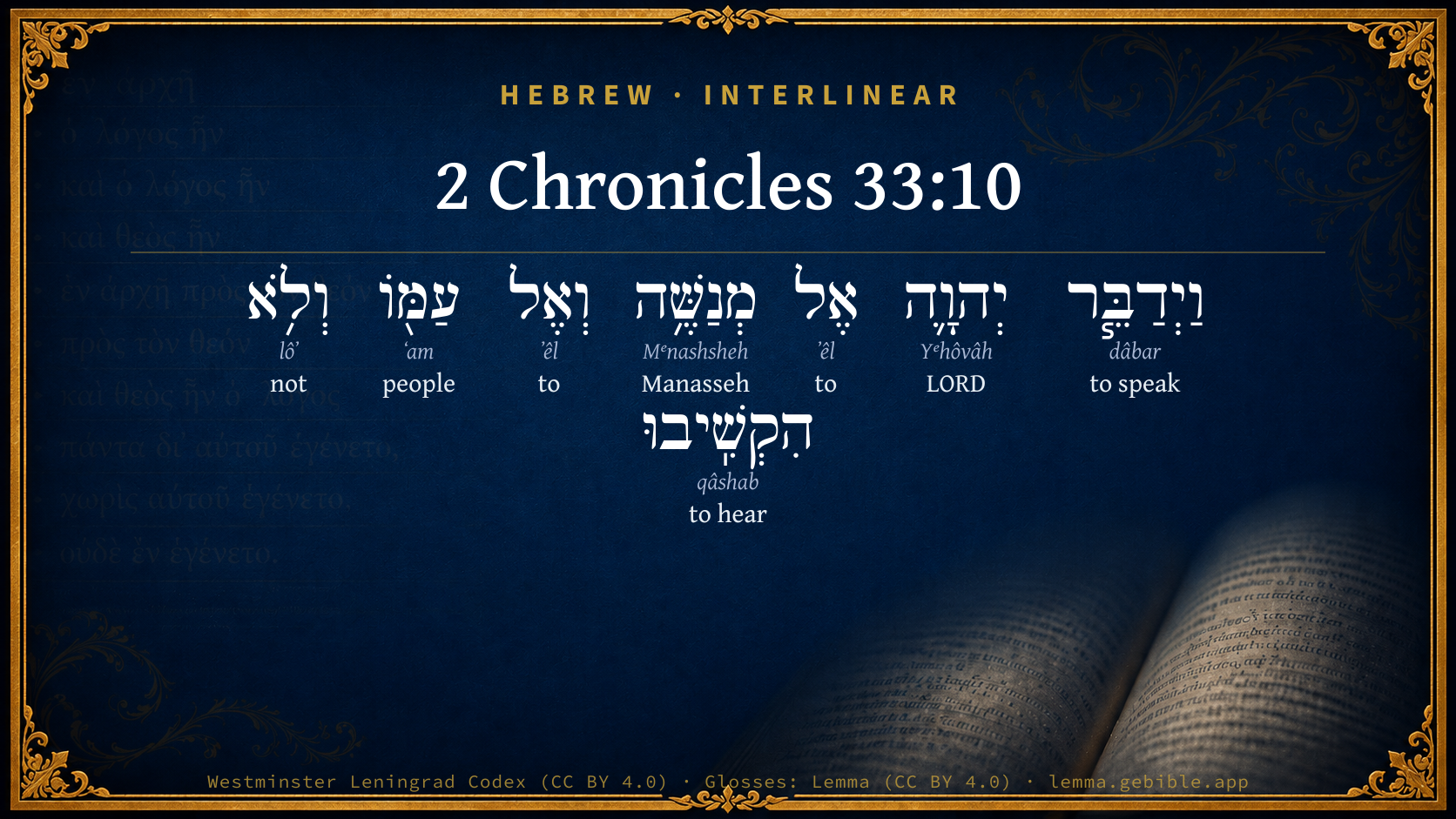
Hebrew (Westminster Leningrad Codex) 2 Chronicles 33:10 appears in the Hebrew Old Testament. The text above is from the Westminster Leningrad Codex. Each word links to its Strong’s number, a concise gloss, and parsing drawn from the Open Scriptures Hebrew Bible morphology. Click any word for its full Brown-Driver-Briggs (BDB) entry.
Download image
Cite this verse

2 Chronicles 33:10 (World English Bible). Public Domain. Lemma interlinear Bible study tool, https://lemma.gebible.app/v/2-chronicles/33/10.

Show BibTeX & RIS
BibTeX
RIS
English Translation
Yahweh spoke to Manasseh, and to his people; but they gave no heed.
World English Bible · Public Domain
Download a study sheet

One document with this verse’s original text, its word-by-word gloss line, the meaning frame, cross-references with their text, attributed commentary, and full source and license credits — printable, and it pastes into notes with its structure intact.

This verse Autodidact and up

Study sheet (.html) Plain text (.txt)

A passage Seminary Student

Up to 50 verses in one chapter. A passage sheet keeps up to 6 commentary sources and 12 cross-references per verse, in the order this page ranks them, and says so on the sheet whenever that leaves anything out. Ask for a single verse and you get the Autodidact verse sheet above.

Everything on this page stays free to read, with no account — the sheet is a download of what is already on screen, not access to it.

Want to remove ads? Support Godless Engineer
Compare translations 3

The same verse in 3 English versions, stacked beneath the original-language interlinear above. Click any original word for its lexicon entry.

Each is an independent rendering of the whole verse — the interlinear is not word-aligned to these translations.

Highlighted words mark where these versions differ — a whole-verse word diff, not a word-by-word alignment.

  • World English Bible Public Domain
    Yahweh spoke to Manasseh, and to his people; but they gave no heed.
  • King James Version Public Domain
    And the LORD spake to Manasseh, and to his people: but they would not hearken.
  • unfoldingWord Literal Text CC BY-SA 4.0
    And Yahweh spoke to Manasseh and to his people, but they did not pay attention.

unfoldingWord Literal Text — © unfoldingWord, licensed CC BY-SA 4.0. Word-aligned USFM3 via Door43 (git.door43.org/unfoldingWord/en_ult).

Versions to compare (up to 4)

3 of 4 selected

Show all 18 translations

Every available English version of this verse, each an independent rendering of the whole verse.

  • World English Bible Public Domain
    Yahweh spoke to Manasseh, and to his people; but they gave no heed.
  • Berean Standard Bible Public Domain
    And the LORD spoke to Manasseh and his people, but they did not listen.
  • Majority Standard Bible Public Domain
    And the LORD spoke to Manasseh and his people, but they did not listen.
  • King James Version Public Domain
    And the LORD spake to Manasseh, and to his people: but they would not hearken.
  • American Standard Version (1901) Public Domain
    And Jehovah spake to Manasseh, and to his people; but they gave no heed.
  • Revised Version (1885) Public Domain
    And the LORD spake to Manasseh, and to his people: but they gave no heed.
  • Geneva Bible (1599) Public Domain
    And the Lord spake to Manasseh and to his people, but they would not regarde.
  • Douay-Rheims (1899) Public Domain
    And the Lord spoke to him, and to his people, and they would not hearken.
  • Young's Literal Translation Public Domain
    And Jehovah speaketh unto Manasseh and unto his people, and they have not attended,
  • Literal Standard Version CC BY-SA 4.0
    And YHWH speaks to Manasseh and to his people, and they have not attended,
  • Unlocked Literal Bible CC BY-SA 4.0
    Yahweh spoke to Manasseh, and to his people, but they paid no attention.
  • unfoldingWord Literal Text CC BY-SA 4.0
    And Yahweh spoke to Manasseh and to his people, but they did not pay attention.
  • Darby Bible Public Domain
    And Jehovah spoke to Manasseh and to his people; but they did not hearken.
  • World Messianic Bible Public Domain
    The LORD spoke to Manasseh and to his people, but they didn’t listen.
  • Webster's Bible Public Domain
    And the LORD spoke to Manasseh, and to his people: but they would not hearken.
  • Free Bible Version CC BY-SA 4.0
    The Lord warned Manasseh and his people, but they ignored him.
  • Bible in Basic English Public Domain
    And the word of the Lord came to Manasseh and his people, but they gave no attention.
  • JPS Tanakh (1917) Public Domain
    And the LORD spoke to Manasseh, and to his people; but they gave no heed.

Literal Standard Version (2020), Covenant Press — licensed CC BY-SA 4.0. Text via the HelloAO Bible API (eBible.org). Unlocked Literal Bible (unfoldingWord) — licensed CC BY-SA 4.0. Text via the HelloAO Bible API (eBible.org). unfoldingWord Literal Text — © unfoldingWord, licensed CC BY-SA 4.0. Word-aligned USFM3 via Door43 (git.door43.org/unfoldingWord/en_ult). Free Bible Version, Dr. Jonathan Gallagher — licensed CC BY-SA 4.0. Text via the HelloAO Bible API (eBible.org).

Word by word

More ways to search: Search by grammar → Find every occurrence → Compare this word →

Practice this passage: Drill this verse → Learn its vocabulary →

About this verse

These counts appear in no published source. They are computed here, from the morphology-tagged text and Lemma’s own curated glosses. What Lemma adds →

8
words
7
distinct lemmas
Historical
section

Shared distinctive vocabulary

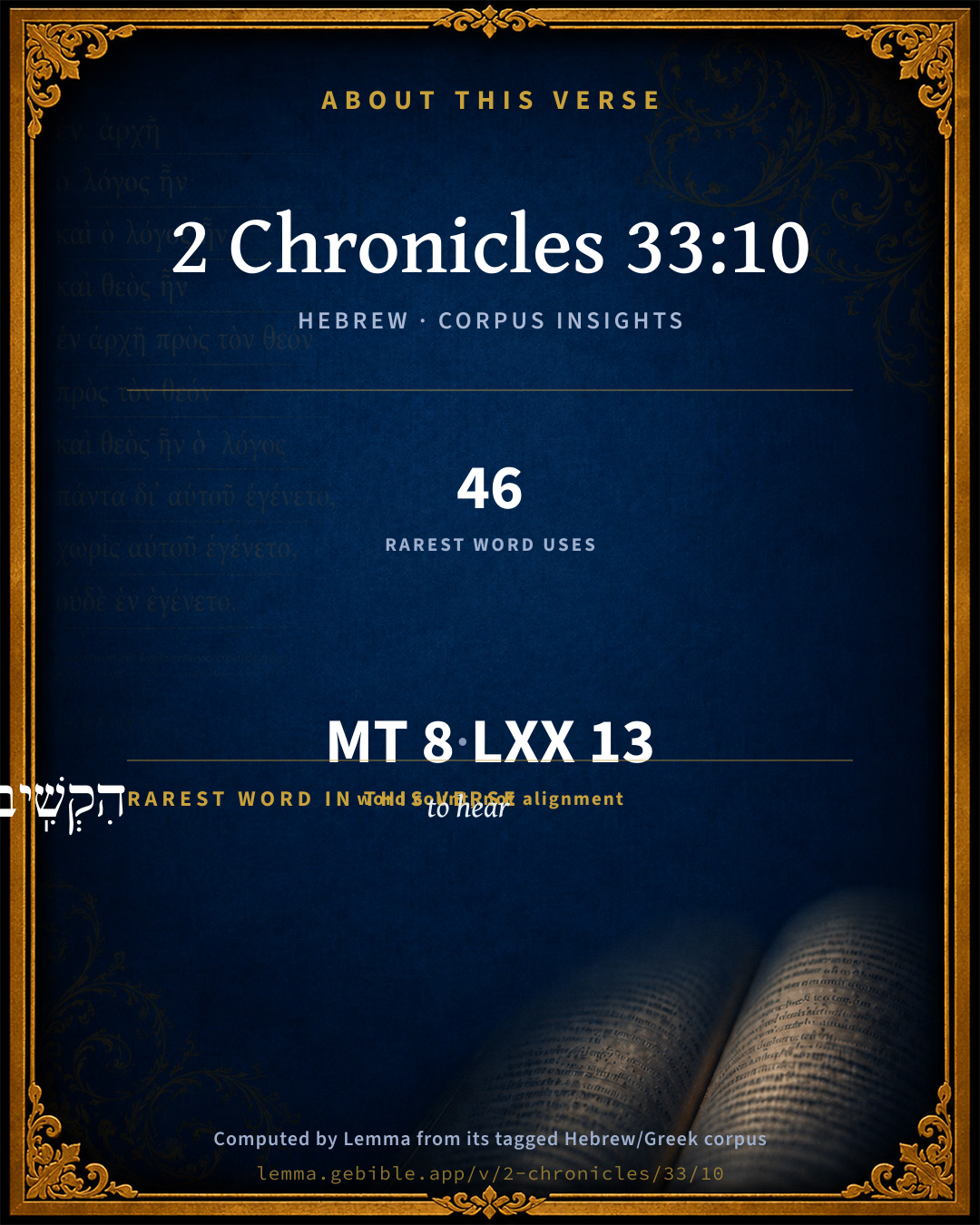
הִקְשִֽׁיבוּ to hear H7181 occurs in 45 verses of the Hebrew Bible. Also found in:

Grammatical profile

  • 2 verbs
  • 3 nouns
  • 2 prepositions
  • 1 particle

Verb forms

  • וַיְדַבֵּ֧ר Piel · Sequential Imperfect
  • הִקְשִֽׁיבוּ Hiphil · Perfect

Repetition

A word recurs within this verse — often emphatic in Hebrew:

  • אֶל to H413 ×2

Hebrew & Septuagint length

In English translation the verse runs 13 words from the Hebrew and 14 from the Septuagint (LXX English) — closely comparable.

A rough comparison of the two English renderings, which tokenize alike — not a word-level alignment.

Word counts can differ between the Hebrew and the Greek without any difference in meaning — e.g. the Hebrew direct-object marker אֵת has no separate Greek word, and Greek often adds the article ὁ.

In the original languages it is 8 Hebrew tokens and 13 Greek tokens — but the two are counted differently (Hebrew bundles its prefixes and suffixes into one token; the Greek is in lemma form), so that isn’t a like-for-like length.

Cross-references

6

Topical passages linked to 2 Chronicles 33:10 in the Treasury of Scripture Knowledge — connected by theme and wording, ordered by reader-vote popularity; previews shown in the World English Bible.

  • 2 Chronicles 36:15–16 Yahweh, the God of their fathers, sent to them by his messengers, rising up early and sending, because he had compassion on his people, and on his dwelling-place:
  • Nehemiah 9:29–30 and testified against them, that you might bring them again to your law. Yet they dealt proudly, and didn't listen to your commandments, but sinned against your ordinances, (which if a man do, he shall live in them), and withdrew the shoulder, and hardened their neck, and would not hear.
  • Jeremiah 25:4–7 Yahweh has sent to you all his servants the prophets, rising up early and sending them, (but you have not listened, nor inclined your ear to hear),
  • Jeremiah 44:4–5 However I sent to you all my servants the prophets, rising up early and sending them, saying, Oh, don't do this abominable thing that I hate.
  • Zechariah 1:4 Don't you be like your fathers, to whom the former prophets proclaimed, saying: Thus says Yahweh of hosts, 'Return now from your evil ways, and from your evil doings;' but they did not hear, nor listen to me, says Yahweh.
  • Acts 7:51–52 "You stiff-necked and uncircumcised in heart and ears, you always resist the Holy Spirit! As your fathers did, so you do.

Cross-references courtesy of OpenBible.info (CC BY 4.0).

Hebrew and Greek witnesses Masoretic Hebrew ↔ Greek Septuagint

The same verse in the two great witnesses to the Old Testament, shown verse-for-verse.

These are two independent witnesses, not word-aligned to each other, and the Septuagint is shown in lemma (dictionary) form.

Hebrew 2 Chronicles 33:10 Masoretic · Westminster Leningrad Codex

וַיְדַבֵּ֧ר יְהוָ֛ה אֶל מְנַשֶּׁ֥ה וְאֶל עַמּ֖וֹ וְלֹ֥א הִקְשִֽׁיבוּ

Yahweh spoke to Manasseh, and to his people; but they gave no heed.

World English Bible · Public Domain

Greek LXX 2 Chronicles 33:10 Septuagint · lemma form

καί λαλέω κύριος ἐπί μανασσή καί ἐπί ὁ λαός αὐτός καί οὐ ἐπιἀκούω

And the Lord spoke to Manasses, and to his people: but they listened not.

LXX2012 (modern English Septuagint) · Public Domain

Hebrew: Westminster Leningrad Codex (CC BY 4.0). Greek: Septuagint (public domain); English from LXX2012 (modern English Septuagint) (Public Domain). How the Septuagint differs from the Hebrew →

Commentary

Notes on 2 Chronicles 33:10 from classic Christian and Jewish commentators (each source and its license shown beneath its notes). The classic Christian expositions comment on the surrounding passage and are grouped to its opening verse, so a note may address several verses; the Jewish commentaries on the Tanakh (Rashi and others) are per-verse, so they appear only where the commentator wrote on this verse.

Lemma curates 59 commentaries, every one of them public domain or Creative Commons licensed, each selected and text-cleaned for this edition rather than reprinted as found. About our sources →

Trapp's Complete Commentary

John Trapp

2Ch 33:10 And the LORD spake to Manasseh, and to his people: but they would not hearken.

Ver. 10. And the Lord spake to Manasseh,] sc., By his prophets, Isaiah, Joel, Micah, Habakkuk, and others; sed surdo fabulam; they lost their sweet words.

John Trapp, A Commentary or Exposition upon All the Books of the Old and New Testament (1647–1656) — public domain. Text from a community e-Sword module.

The Biblical Illustrator

Joseph S. Exell

2Ch_33:10-11

And bound him with fetters.

Divine discipline

The proper way for a sinner to be brought to God is for God to speak to him, and for him to hear. Manasseh would not come that way, so God fetched him back by a rougher road.

I. The Lord often allows temporal trials to take men captive.

1. Business disasters.

2. Want of employment.

3. Extraordinary troubles.

4. Bodily affliction.

5. The loss of dear friends.

II. The lord sometimes allows men to be bound by mental trials; bound with fetters. Such as--

1. When sin ceases to afford pleasure. The very things that once made him all aglow with delight do not affect him now, nor cast a single ray of light on his path.

2. The daily avocation becomes distasteful.

3. There is great inability in prayer.

4. Your old sins come out of their hiding-places.

5. A great want of power to grasp the promises.

6. A fear of death and dread of judgment.

Conclusion: In order to your comfort and peace--

1. Know that the Lord is God.

2. Humble yourself before Him.

3. Begin to pray.

4. Believe on the Lord Jesus Christ. (C. H. Spurgeon.)

The Biblical Illustrator, edited by Joseph S. Exell (c. 1880s–1900s) — public domain. Text from a community e-Sword module.

Keil & Delitzsch

C. F. Keil & F. Delitzsch

At Ch2 33:10, the account in the Chronicle diverges from that in 2 Kings. In Kg2 21:10-16 it is related how the Lord caused it to be proclaimed by the prophets, that in punishment of Manasseh's sins Jerusalem would be destroyed, and the people given into the power of their enemies, and how Manasseh filled Jerusalem with the shedding of innocent blood. Instead of this, in Ch2 33:10 of the Chronicle it is only briefly said that the Lord spake to Manasseh and to his people, but they would not hearken; and then in Ch2 33:11-17 it is narrated that Manasseh was led away to Babylon by the king of Assyria's captains of the host; in his trouble turned to the Lord his God, and prayed; was thereupon brought by God back to Jerusalem; after his return, fortified Jerusalem with a new wall; set commanders over all the fenced cities of Judah; abolished the idolatry in the temple and the city, and restored the worship of Jahve.

Keil & Delitzsch — Biblical Commentary on the Old Testament (1861–1891) — public domain (CC PDM 1.0). Text via the HelloAO Bible API. (Old Testament only.)

Geneva Bible (1599)

Geneva Bible translators

Meaning by his Prophets, but their hearts were not touched to believe and repent, without the which the preaching of the word taketh no place.

Geneva Bible (1599) marginal notes — public domain. Text via Bolls.life.

Ellicott's Commentary for English Readers

(10) And the Lord spake to Manasseh.—“By the hand of his servants the prophets.” See

2Ki_21:10-15, where the substance of the prophetic message is given; and it is added (2Ch_33:16) that Manasseh also shed very much innocent blood, “till he had filled Jerusalem from one end to the other.” The reaction against the reforms of Hezekiah ended in a bloody struggle, in which the party of reform was fiercely suppressed.

A Bible Commentary for English Readers, edited by Charles John Ellicott (1878–1897) — public domain. Text from a community e-Sword module.

The Cambridge Bible for Schools and Colleges

gen. ed. J. J. S. Perowne

10. the Lord spake] i.e. by prophets; cp. 2Ki_21:10-15.

The Cambridge Bible for Schools and Colleges (gen. ed. J. J. S. Perowne; Cambridge University Press, 1878–1918) — public domain. Text from a community e-Sword module.

John Gill's Exposition

Wherefore the Lord brought upon them the captains of the host of the king of Assyria,.... Who was Esarhaddon, the son and successor of Sennacherib; this, according to the Jewish chronology (f), was in the twenty second year of Manasseh's reign:

which took Manasseh among the thorns; in a thicket of briers and thorns, where, upon his defeat, he had hid himself; a fit emblem of the afflictions and troubles his sins brought him into:

and bound him with fetters; hands and feet; with chains of brass, as the Targum, such as Zedekiah was bound with, Kg2 25:7, not chains of gold, with which Mark Antony bound a king of Armenia, for the sake of honour (g):

and carried him to Babylon; for now the king of Assyria was become master of that city, and added it to his monarchy, and made it the seat of his residence; at least some times that and sometimes Nineveh, Merodachbaladan being dead, or conquered; though, according to Suidas (h), it was he that took Manasseh; and by an Arabic writer (i), he is said to be carried to Nineveh.

(f) Seder Olam Rabba, c. 24. p. 67. (g) Vell. Patercul. Hist. Roman. l. 2. (h) In voce (i) Abulpharag. Hist. Dynast. Dyn. 3. p. 67. So Suidas, ib.

John Gill's Exposition of the Whole Bible (1746–1763) — public domain (CC PDM 1.0). Text via the HelloAO Bible API.

Haydock's Catholic Bible Commentary

Spoke, by his prophets, 4 K.

George Leo Haydock (1774–1849), Haydock's Catholic Family Bible and Commentary, 1859 edition — public domain. Excludes Psalms (Douay-Rheims chapter numbering differs from Protestant) and Deuterocanonical books (Catholic canon only).

The Pulpit Commentary

(See parallel, vers. 11-15.)

Vers. 10-17.

The penitent.

In these words we have

I THE LAST AND WORST SYMPTOM OF DEPARTURE FROM GOD OBDURACY. "The Lord spake to Manasseh, and to his people: but they would not hearken" (ver. 10). Sin reaches its extremity when it deliberately and determinately closes its ear against the recognized voice of God. A defiant refusal to listen when God is speaking to us is surely the ne plus ultra of iniquity; guilt can go no further. (see Pro_2:2-4)

II THE DESCENT OF THE DIVINE PENALTY. When other means of instruction and of influence have been tried and failed, God visits in severe discipline. To Manasseh this came in defeat, humiliation (he was bound in fetters), and captivity; he had to leave the city of David and the land of his fathers, and become a show in the distant land of the enemy. To us the Divine discipline comes in various ways, of which the most common are bodily affliction, the vision of death, substantial loss, the estrangement of those who had been near and dear to us, some form of bitter humiliation, bereavement and consequent loneliness.

III THE RISE OF TRUE PENITENCE IN THE HUMAN HEART. At length Manasseh had his eyes opened, and he saw his folly and his sin; at length he learnt that he had not only forsaken the good way of his father Hezekiah, but had grievously and guiltily departed from the living God. We can never tell what will humble the heart of a man; one is affected and subdued by one affliction, another by another. But at length the blow falls, and the edge of the sword enters in, and the heart bleeds, and it is wounded not unto death, but unto life.

1. Then comes recognition of the truth. Then God is recognized his nearness, his claims, his displeasure, his fatherly purpose. Then guilt also is discerned its greatness, its heinousness.

2. Then comes acknowledgment and appeal. The heart humbles itself before God, even as Manasseh now "humbled himself greatly before the God of his fathers" (ver. 12); and the soul prays for mercy, asks that its guilt may be forgiven, and itself restored.

3. And then comes self-surrender; for if there be not a willingness, a readiness to yield ourselves unto God, an exhibition of penitence is only an affectation; it is unreal and untrue. If it is genuine, it must be accompanied by a pure desire and a firm resolve to return unto him whom we have guiltily forsaken.

IV THE BESTOWAL OF DIVINE MERCY. Manasseh soon found how immeasurable had been his mistake in his great apostasy. For the God of his fathers proved to be a God full of compassion and of great mercy, and he heard the humbled suppliant and restored him, and brought him back to his kingdom. So God now hears and pardons and restores; he forgives us our sin, and he takes us back to his Divine favour, and he restores to us our peace, our hope, our joy, our life in him and with him. For there is one invariable and inseparable sequence, viz.

V NEWNESS OF LIFE ON THE PART OF THE FORGIVEN. Manasseh goes back to Jerusalem, takes away the strange gods and the altars he had built, and casts them out of the city; and he repairs the altar of the Lord, and re-establishes the worship of Jehovah (vers. 15, 16). We return unto God, and at the same time to all purity, to all temperance, to all uprightness, to all reverence both in spirit and in action, to all piety of thought and of behaviour. This is precious indeed, beyond all price, this restoration to God and to our true self; yet is there

VI ONE SERIOUS DRAWBACK. Manasseh could not altogether undo what he had done. Nevertheless the people did sacrifice," etc. (ver. 17). He could not, by one enactment or by a number of them, bring back the situation he had so completely broken up. It takes a long time to restore a people to the habits they have forsaken. Nor could Manasseh recall to life the brave and faithful men whom he had "done to death" with his cruelties. (2Ki_21:16) There are some things which the most genuine repentance will not effect. It will not recall the wasted years; nor undo the malign and death-bearing influences which have been at work in human hearts and lives; nor compensate the wronged for the injuries they have suffered in body or in spirit. Therefore let all remember that, while repentance and restoration are blessed, a life of holy service from the beginning is far more blessed still. C.

The Pulpit Commentary (1880–1919), ed. H.D.M. Spence-Jones & Joseph S. Exell — public domain. Text from a community e-Sword module.

unfoldingWord translationNotes

Door43 World Missions Community

brought on them

Yahweh sent the army to attack Jerusalem. AT: "brought about an attack on them by" (See: Assumed Knowledge and Implicit Information)

the commanders of the army of the king of Assyria

The commanders were accompanied by their soldiers. AT: "the commanders of the army of the king of Assyria and their soldiers" (See: Synecdoche)

took Manasseh in chains, bound him with fetters, and took him off to Babylon

Here Manasseh being taken as a prisoner is represented by him being bound by chains and fetters. Fetters were chains placed around the feet. AT: "seized Manasseh, bound him in chains, and took him as a prisoner to Babylon" (See: Metonymy)

translationWords

Yahweh

commander

king

Assyria

Babylon

unfoldingWord translationNotes — © Distant Shores Media and the Door43 World Missions Community, licensed CC BY-SA 4.0. Source: git.door43.org/Door43/en_tn.

Lesson kit

Teaching starters — assembled from the data on this page, not authored interpretation. Every prompt links to the verse data it draws on. Edit before teaching.

2 Chronicles, in the Historical, opens this verse with 8 words (7 distinct Hebrew lemmas). Its most distinctive word is qâshab (“to hear”). A historical commentator’s framing appears above. Read the whole chapter for the surrounding context.

Discussion questions

  1. What does “to hear” (qâshab) contribute to the verse as a whole?
  2. How does 1 Samuel 15:22, which shares the word «to hear», read alongside this verse?
  3. What does the repetition of “to” (2× in this one verse) do in this verse?
  4. The translations on this page render this verse differently — a whole-verse word diff, not a word-by-word alignment. What might account for the different wordings?
  5. «וַיְדַבֵּ֧ר» is a Piel Sequential Imperfect verb. How does that grammatical form shape the action described?
  6. Compare how Trapp's Complete Commentary and The Biblical Illustrator read this verse. Where do they agree or differ?

Things to notice

Reading settings

Reading text

Shown beneath each verse's original-language words.

Old Testament
Old Testament edition

Read the OT as the Masoretic Hebrew (MT) or the Greek Septuagint (LXX).

English shown for the Greek Septuagint (in the Hebrew ↔ Greek comparison).

Comparing translations? Open the Compare panel on any verse page to stack up to four side by side.