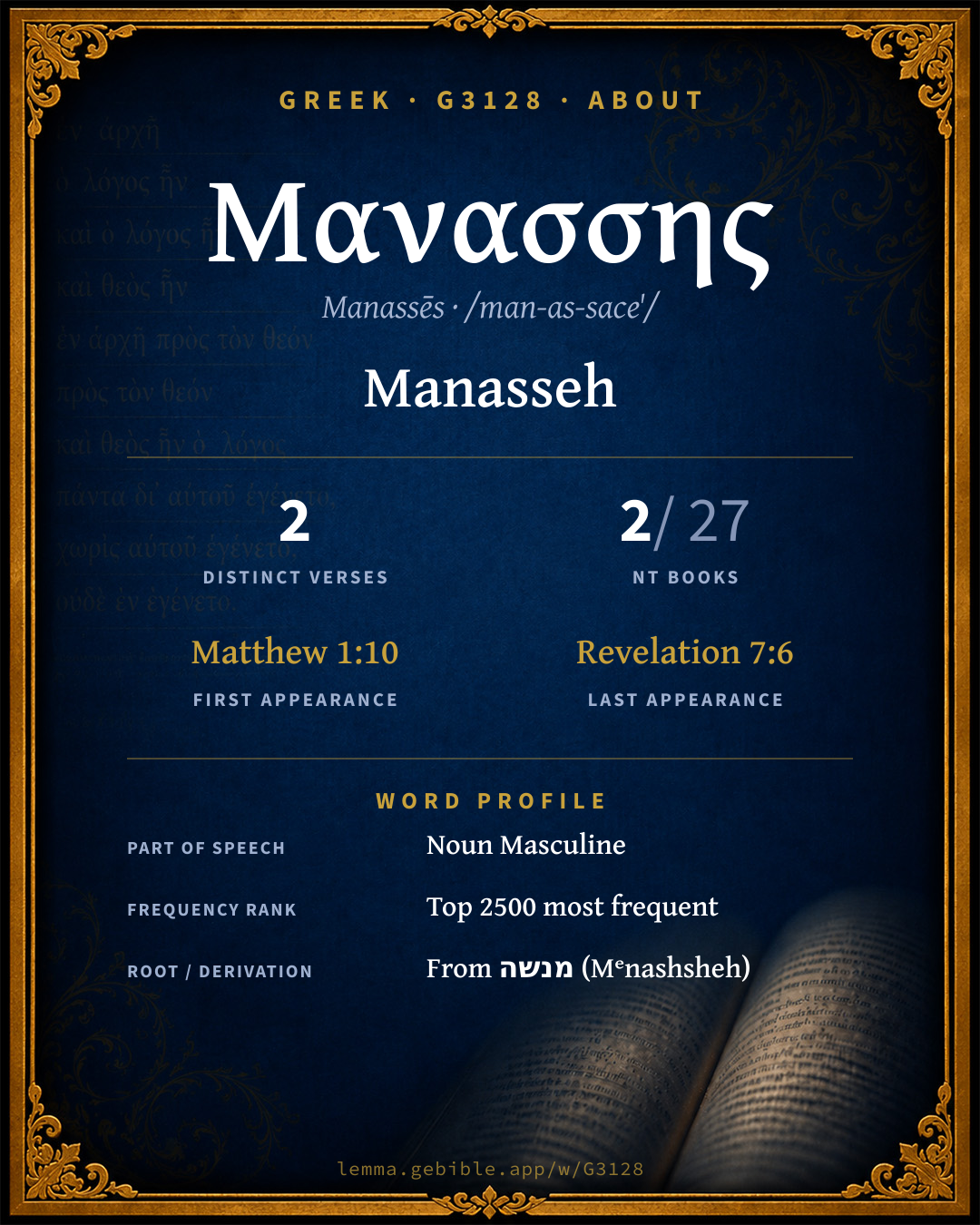
Μανασσῆς
Manasseh
Thayer's lists 3 entries for ‘Manasseh’ fuller range ↓
Full lexicon entry — Thayer's Greek Lexicon
From Thayer's Greek Lexicon
Where this word appears
See every Accusative-case word in the Greek New Testament →
Grammar key — what these labels mean
Part of speech
- Noun
- A naming word — a person, place, thing, or idea.
Case
- Accusative
- The case of the direct object and of extent.
- Genitive
- The case of source, possession, or “of” — answers “whose / from what.”
- Nominative
- The case of the subject (and the predicate nominative).
Gender
- Masculine
- Grammatically masculine.
Number
- Singular
- One.
Grammatical forms
- Noun, Accusative, Singular, Masculine 1 time (33%)
- Noun, Genitive, Singular, Masculine 1 time (33%)
- Noun, Nominative, Singular, Masculine 1 time (33%)
Parsed forms decoded from the imported morphology (Robinson–Tischendorf, public domain), counted across 3 parsed occurrences — not distinct verses.
Every verse where G3128 appears — 2 distinct verses across 2 books. Click any verse to open its interlinear word-by-word view. Verse text shown in the World English Bible for context — . Each verse’s Greek form is shown with its reference; the English is not keyword-highlighted, since the data carries no word-level English alignment. Use “Compare translations” on any verse to read it across multiple English versions. This concordance covers the Greek New Testament; Septuagint (Greek Old Testament) occurrences of this word are not indexed here.
Matthew 1 verse
Revelation 1 verse
About this entry
At a glance — auto-summarized from this page’s data, not written by a person. Every figure links to its source below. This summary describes the numbers; it doesn’t interpret them.
“Manasseh” is the headline sense of the Greek name Μανασσης (Manassēs). With only 2 verses it sits in the long tail of Greek New Testament vocabulary. More than half of its appearances fall in Matthew. First canonically at Matthew 1:10, it enters the text early. The sections below give every occurrence and version rendering.
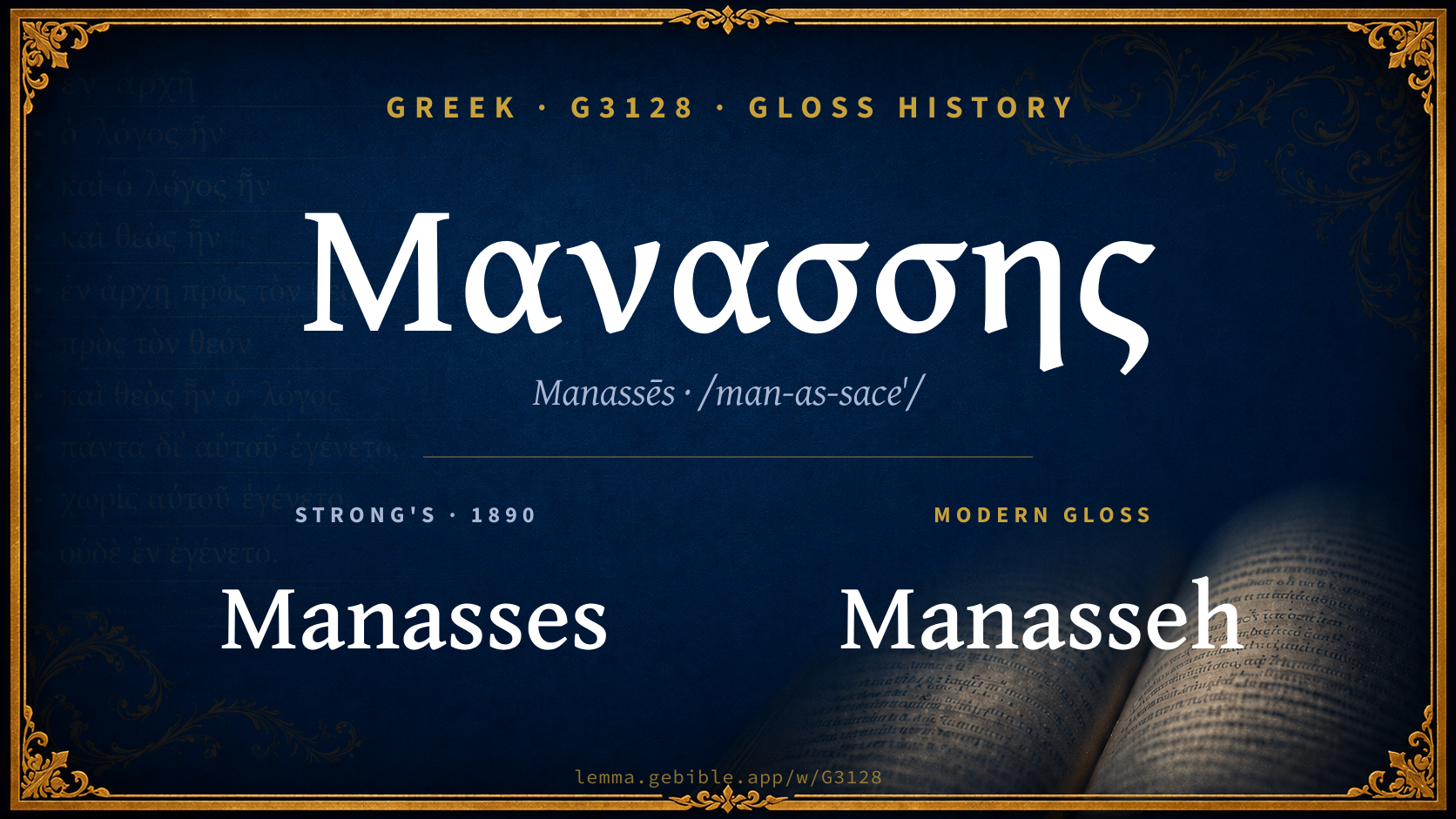
Gloss history
Strong's 1890 vs modern scholarship
About this word
Strong's G3128 catalogs a Greek word from the Greek New Testament.
These counts are not copied from any lexicon or concordance. They are computed here, from the morphology-tagged Greek New Testament. What Lemma adds →
- 2
- distinct verses
- The word appears in 2 distinct verses.
- 2 / 27
- NT books
- The word appears in 2 of 27 New Testament books.
- #2,203
- by frequency
- Top 2500 most frequent Greek words (rank 2,203 of 5,347 Greek words by occurrence).
View all 2 occurrences in the concordance →
Most concentrated in
- Matthew 1 verse 50%
- Revelation 1 verse 50%
By section of the New Testament
By traditional corpus
Conventional, traditional groupings — biblical authorship is debated, so this is a traditional corpus grouping, not an authorship claim. Some books belong to more than one corpus (Luke is in both the Gospels and the Lukan corpus, and so on), so these shares overlap and need not total 100%. Each figure is a share of the word’s 2 distinct verses.
- Gospels 1 verse · 50%
- Johannine 1 verse · 50%
- Revelation 1 verse · 50%
How translations render this word
Counts come from each version’s own published word-to-Strong’s tagging or interlinear alignment — an approximate guide to how each version renders this word, not a word-level alignment the data otherwise carries. Because each total is that version’s own tagged count, the per-version totals vary from one another and need not match the appearance or distinct-verse counts above. These counts may also differ from a printed concordance because Lemma counts each distinctly tagged rendering and does not collapse phrase taggings into a single head-word total. This is a fixed set of word-tagged versions (KJV, ASV, BSB, ULT) and does not change with the reading translation you choose elsewhere. Each version’s license is shown beside its name below (and on Sources).
- King James Version: Manasses 3×
- American Standard Version: Manasseh 3×
- Berean Standard Bible: Manasseh 3×
- unfoldingWord Literal Text: Manasseh 3×
King James Version Public Domain
Renders G3128 across 3 tagged occurrences — most commonly:
American Standard Version Public Domain
Renders G3128 across 3 tagged occurrences — most commonly:
Berean Standard Bible Public Domain
Renders G3128 across 3 tagged occurrences — most commonly:
unfoldingWord Literal Text CC BY-SA 4.0
Renders G3128 across 3 tagged occurrences — most commonly:
Senses in Thayer's
The 3 senses Thayer's distinguishes for this word, in lexicon order (not ranked by frequency or importance). The full entry — with sub-senses — is in the Lexicon Entry tab.
- Manasseh = "forgetting"
- the first born son of Joseph
- the son of Hezekiah, king of Judah
Word origin
Derived from מנשה (Mᵉnashsheh) (H4519) — Manasseh.
Of hebrew origin [ H4519 ]; manasses (that is menashsheh ) an Israelite : - Manasses.
— Strong’s Exhaustive Concordance (1890), public domain.
Forms in the corpus
The 2 distinct written forms G3128 takes in the Greek New Testament, most frequent first — each parse links to that case’s occurrences in the concordance.
| Form | Parsing | Example | Uses |
|---|---|---|---|
| Μανασσῆ Manassē̂ | Noun, Accusative, Singular, Masculine | Matthew 1:10 | 2 |
| Μανασσῆς Manassē̂s | Noun, Nominative, Singular, Masculine | Matthew 1:10 | 1 |
Same root — word family
Other Thayer's entries built from the same root as G3128, grouped by Strong’s listed origin. These share a root / origin per the lexicon — not necessarily a shared meaning. Each links to that word’s own entry.
Derives from
Proper names from this root
People and places named from this root — a name, not an additional meaning of the word.
Compare all same-root words → 2 of the same-root words are proper names (people or places). They share a root, not necessarily a meaning.
Bible dictionary
Public-domain dictionary articles matched to this entry by name (Manasseh). A biblical name can be shared by more than one person or place, so an article may treat several.
Easton's Bible Dictionary · M. G. Easton, 1897
Who makes to forget. "God hath made me forget" (Heb. nashshani), Gen. 41:51. (1.) The elder of the two sons of Joseph. He and his brother Ephraim were afterwards adopted by Jacob as his own sons (48:1). There is an account of his marriage to a Syrian (1 Chr. 7:14); and the only thing afterwards recorded of him is, that his grandchildren were "brought up upon Joseph's knees" (Gen. 50:23; R.V., "born upon Joseph's knees") i.e., were from their birth adopted by Joseph as his own children.
The tribe of Manasseh was associated with that of Ephraim and Benjamin during the wanderings in the wilderness. They encamped on the west side of the tabernacle. According to the census taken at Sinai, this tribe then numbered 32,200 (Num. 1:10, 35; 2:20, 21). Forty years afterwards its numbers had increased to 52,700 (26:34, 37), and it was at this time the most distinguished of all the tribes.
The half of this tribe, along with Reuben and Gad, had their territory assigned them by Moses on the east of the Jordan (Josh. 13:7-14); but it was left for Joshua to define the limits of each tribe. This territory on the east of Jordan was more valuable and of larger extent than all that was allotted to the nine and a half tribes in the land of Palestine. It is sometimes called "the land of Gilead," and is also spoken of as "on the other side of Jordan." The portion given to the half tribe of Manasseh was the largest on the east of Jordan. It embraced the whole of Bashan. It was bounded on the south by Mahanaim, and extended north to the foot of Lebanon. Argob, with its sixty cities, that "ocean of basaltic rocks and boulders tossed about in the wildest confusion," lay in the midst of this territory.
The whole "land of Gilead" having been conquered, the two and a half tribes left their wives and families in the fortified cities there, and accompanied the other tribes across the Jordan, and took part with them in the wars of conquest. The allotment of the land having been completed, Joshua dismissed the two and a half tribes, commending them for their heroic service (Josh. 22:1-34). Thus dismissed, they returned over Jordan to their own inheritance. (See ED.)
On the west of Jordan the other half of the tribe of Manasseh was associated with Ephraim, and they had their portion in the very centre of Palestine, an area of about 1,300 square miles, the most valuable part of the whole country, abounding in springs of water. Manasseh's portion was immediately to the north of that of Ephraim (Josh. 16). Thus the western Manasseh defended the passes of Esdraelon as the eastern kept the passes of the Hauran.
(2.) The only son and successor of Hezekiah on the throne of Judah. He was twelve years old when he began to reign (2 Kings 21:1), and he reigned fifty-five years (B.C. 698-643). Though he reigned so long, yet comparatively little is known of this king. His reign was a continuation of that of Ahaz, both in religion and national polity. He early fell under the influence of the heathen court circle, and his reign was characterized by a sad relapse into idolatry with all its vices, showing that the reformation under his father had been to a large extent only superficial (Isa. 7:10; 2 Kings 21:10-15). A systematic and persistent attempt was made, and all too successfully, to banish the worship of Jehovah out of the land. Amid this wide-spread idolatry there were not wanting, however, faithful prophets (Isaiah, Micah) who lifted up their voice in reproof and in warning. But their fidelity only aroused bitter hatred, and a period of cruel persecution against all the friends of the old religion began. "The days of Alva in Holland, of Charles IX. in France, or of the Covenanters under Charles II. in Scotland, were anticipated in the Jewish capital. The streets were red with blood." There is an old Jewish tradition that Isaiah was put to death at this time (2 Kings 21:16; 24:3, 4; Jer. 2:30), having been sawn asunder in the trunk of a tree. Psalms 49, 73, 77, 140, and 141 seem to express the feelings of the pious amid the fiery trials of this great persecution. Manasseh has been called the "Nero of Palestine."
Esarhaddon, Sennacherib's successor on the Assyrian throne, who had his residence in Babylon for thirteen years (the only Assyrian monarch who ever reigned in Babylon), took Manasseh prisoner (B.C. 681) to Babylon. Such captive kings were usually treated with great cruelty. They were brought before the conqueror with a hook or ring passed through their lips or their jaws, having a cord attached to it, by which they were led. This is referred to in 2 Chr. 33:11, where the Authorized Version reads that Esarhaddon "took Manasseh among the thorns;" while the Revised Version renders the words, "took Manasseh in chains;" or literally, as in the margin, "with hooks." (Comp. 2 Kings 19:28.)
The severity of Manasseh's imprisonment brought him to repentance. God heard his cry, and he was restored to his kingdom (2 Chr. 33:11-13). He abandoned his idolatrous ways, and enjoined the people to worship Jehovah; but there was no thorough reformation. After a lengthened reign extending through fifty-five years, the longest in the history of Judah, he died, and was buried in the garden of Uzza, the "garden of his own house" (2 Kings 21:17, 18; 2 Chr. 33:20), and not in the city of David, among his ancestors. He was succeeded by his son Amon.
In Judg. 18:30 the correct reading is "Moses," and not "Manasseh." The name "Manasseh" is supposed to have been introduced by some transcriber to avoid the scandal of naming the grandson of Moses the great lawgiver as the founder of an idolatrous religion.
Smith's Bible Dictionary · William Smith, 1863
(forgetting).
+ The thirteenth king of Judah, son of Hezekiah, (2 Kings 21:1) ascended the throne at the age of twelve, and reigned 55 years, from B.C. 608 to 642. His accession was the signal for an entire change in the religious administration of the kingdom. Idolatry was again established to such an extent that every faith was tolerated but the old faith of Israel. The Babylonian alliance which the king formed against Assyria resulted in his being made prisoner and carried off to Babylon in the twenty-second year of his reign, according to a Jewish tradition. There his eyes were opened and he repented, and his prayer was heard and the Lord delivered him, (2 Chronicles 33:12,13) and he returned after some uncertain interval of time to Jerusalem. The altar of the Lord was again restored, and peace offerings and thank offerings were sacrificed to Jehovah. (2 Chronicles 38:15,16) But beyond this the reformation did not go. On his death, B.C. 642, he was buried as Ahaz had been, not with the burial of a king, in the sepulchres of the house of David, but in the garden of Uzza, (2 Kings 21:26) and long afterward, in suite of his repentance, the Jews held his name in abhorrence. + One of the descendants of Pahathmoab, who in the days of Ezra had married a foreign wife. (Ezra 10:30) + One of the laymen, of the family of Hashum who put away his foreign wife at Ezra command. (Ezra 10:33)
(forgetting), the eldest son of Joseph, (Genesis 41:51; 46:20) born 1715-10 B.C. Both he and Ephraim were born before the commencement of the famine. He was placed after his younger brother, Ephraim, by his grandfather Jacob, when he adopted them into his own family, and made them heads of tribes. Whether the elder of the two sons was inferior in form or promise to the younger, or whether there was any external reason to justify the preference of Jacob, we are not told. In the division of the promised land half of the tribe of Manasseh settled east of the Jordan in the district embracing the hills of Gilead with their inaccessible heights and impassable ravines, and the almost impregnable tract of Argob. (Joshua 13:29-33) Here they throve exceedingly, pushing their way northward over the rich plains of Jaulan and Jedur to the foot of Mount Hermon. (1 Chronicles 5:23) But they gradually assimilated themselves with the old inhabitants of the country, and on them descended the punishment which was ordained to he the inevitable consequence of such misdoing. They, first of all Israel, were carried away by Pul and Tiglath-pileser, and settled in the Assyrian territories. (1 Chronicles 5:25,26) The other half tribe settled to the west of the Jordan, north of Ephraim. (Joshua 17:1) ... For further particulars see Ephraim, Ephraim.
Hitchcock's Bible Names Dictionary · Roswell D. Hitchcock, 1869
forgetfulness; he that is forgotten
Classic public-domain reference works; full attribution on Sources.
Septuagint usage
The same Greek word Μανασσης appears 152 times in the Greek Old Testament (Septuagint), across 140 verses in 13 books.
- 152
- LXX occurrences
- Tagged occurrences of this Greek word in the Septuagint.
- 140
- verses
- Distinct Septuagint verses containing this word.
- 13 / 39
- OT books
- The word appears in 13 of the 39 Old Testament books.
Sample Septuagint occurrences
- Genesis 41:51 μανασσή
- Numbers 1:10 μανασσή
- Deuteronomy 3:13 μανασσή
- Joshua 1:12 μανασσή
- Judges 1:27 μανασσή
- 2 Kings 10:33 μανασσή
- 1 Chronicles 3:13 μανασσή
- 2 Chronicles 15:9 μανασσή
- Ezra 10:30 μανασσή
- Psalms 59:9 μανασσή
- Isaiah 9:20 μανασσή
- Jeremiah 15:4 μανασσή
Septuagint occurrences (same lexeme)
Every verse where the same Strong’s number (G3128) appears in the Greek Septuagint — showing the first 50 of 140. Verse text shown in the World English Bible for context; the Greek form is the matched word — the English is not keyword-highlighted.
- Genesis 41:51 μανασσή Joseph called the name of the firstborn Manasseh, "For," he said, "God has made me forget all my toil, and all my father's house."
- Genesis 46:20 μανασσή To Joseph in the land of Egypt were born Manasseh and Ephraim, whom Asenath, the daughter of Potiphera, priest of On, bore to him.
- Genesis 48:1 μανασσή It happened after these things, that someone said to Joseph, "Behold, your father is sick." He took with him his two sons, Manasseh and Ephraim.
- Genesis 48:5 μανασσή Now your two sons, who were born to you in the land of Egypt before I came to you into Egypt, are mine; Ephraim and Manasseh, even as Reuben and Simeon, will be mine.
- Genesis 48:13 μανασσή Joseph took them both, Ephraim in his right hand toward Israel's left hand, and Manasseh in his left hand toward Israel's right hand, and brought them near to him.
- Genesis 48:14 μανασσή Israel stretched out his right hand, and laid it on Ephraim's head, who was the younger, and his left hand on Manasseh's head, guiding his hands knowingly, for Manasseh was the firstborn.
- Genesis 48:17 μανασσή When Joseph saw that his father laid his right hand on the head of Ephraim, it displeased him. He held up his father's hand, to remove it from Ephraim's head to Manasseh's head.
- Genesis 48:20 μανασσή He blessed them that day, saying, "In you will Israel bless, saying, 'God make you as Ephraim and as Manasseh'" He set Ephraim before Manasseh.
- Genesis 50:23 μανασσή Joseph saw Ephraim's children to the third generation. The children also of Machir, the son of Manasseh, were born on Joseph's knees.
- Numbers 1:10 μανασσή Of the children of Joseph: Of Ephraim: Elishama the son of Ammihud. Of Manasseh: Gamaliel the son of Pedahzur.
- Numbers 1:32 μανασσή Of the children of Joseph, of the children of Ephraim, their generations, by thir families, by their fathers' houses, according to the number of the names, from twenty years old and upward, all who were able to go out to war;
- Numbers 1:33 μανασσή those who were numbered of them, of the tribe of Ephraim, were forty thousand five hundred.
- Numbers 2:20 μανασσή "Next to him shall be the tribe of Manasseh: and the prince of the children of Manasseh shall be Gamaliel the son of Pedahzur.
- Numbers 7:54 μανασσή On the eighth day Gamaliel the son of Pedahzur, prince of the children of Manasseh
- Numbers 10:23 μανασσή Over the host of the tribe of the children of Manasseh was Gamaliel the son of Pedahzur.
- Numbers 13:11 μανασσή Of the tribe of Joseph, [namely], of the tribe of Manasseh, Gaddi the son of Susi.
- Numbers 26:32 μανασσή and [of] Shemida, the family of the Shemidaites; and [of] Hepher, the family of the Hepherites.
- Numbers 26:33 μανασσή Zelophehad the son of Hepher had no sons, but daughters: and the names of the daughters of Zelophehad were Mahlah, and Noah, Hoglah, Milcah, and Tirzah.
- Numbers 26:38 μανασσή The sons of Benjamin after their families: of Bela, the family of the Belaites; of Ashbel, the family of the Ashbelites; of Ahiram, the family of the Ahiramites;
- Numbers 27:1 μανασσή Then drew near the daughters of Zelophehad, the son of Hepher, the son of Gilead, the son of Machir, the son of Manasseh, of the families of Manasseh the son of Joseph; and these are the names of his daughters: Mahlah, Noah, and Hoglah, and Milcah, and Tirzah.
- Numbers 32:33 μανασσή Moses gave to them, even to the children of Gad, and to the children of Reuben, and to the half-tribe of Manasseh the son of Joseph, the kingdom of Sihon king of the Amorites, and the kingdom of Og king of Bashan, the land, according to the cities of it with [their] borders, even the cities of the land round about.
- Numbers 32:39 μανασσή The children of Machir the son of Manasseh went to Gilead, and took it, and dispossessed the Amorites who were therein.
- Numbers 32:40 μανασσή Moses gave Gilead to Machir the son of Manasseh; and he lived therein.
- Numbers 32:41 μανασσή Jair the son of Manasseh went and took the towns of it, and called them Havvoth Jair.
- Numbers 34:13 μανασσή Moses commanded the children of Israel, saying, This is the land which you shall inherit by lot, which Yahweh has commanded to give to the nine tribes, and to the half-tribe;
- Numbers 34:14 μανασσή for the tribe of the children of Reuben according to their fathers' houses, and the tribe of the children of Gad according to their fathers' houses, have received, and the half-tribe of Manasseh have received, their inheritance:
- Numbers 34:23 μανασσή Of the children of Joseph: of the tribe of the children of Manasseh a prince, Hanniel the son of Ephod.
- Numbers 36:1 μανασσή The heads of the fathers' [houses] of the family of the children of Gilead, the son of Machir, the son of Manasseh, of the families of the sons of Joseph, came near, and spoke before Moses, and before the princes, the heads of the fathers' [houses] of the children of Israel:
- Numbers 36:12 μανασσή They were married into the families of the sons of Manasseh the son of Joseph; and their inheritance remained in the tribe of the family of their father.
- Deuteronomy 3:13 μανασσή and the rest of Gilead, and all Bashan, the kingdom of Og, gave I to the half-tribe of Manasseh; all the region of Argob, even all Bashan. (The same is called the land of Rephaim.
- Deuteronomy 3:14 μανασσή Jair the son of Manasseh took all the region of Argob, to the border of the Geshurites and the Maacathites, and called them, even Bashan, after his own name, Havvoth Jair, to this day.)
- Deuteronomy 4:43 μανασσή [namely], Bezer in the wilderness, in the plain country, for the Reubenites; and Ramoth in Gilead, for the Gadites; and Golan in Bashan, for the Manassites.
- Deuteronomy 29:7 μανασσή When you came to this place, Sihon the king of Heshbon, and Og the king of Bashan, came out against us to battle, and we struck them:
- Deuteronomy 33:17 μανασσή The firstborn of his herd, majesty is his; His horns are the horns of the wild-ox: With them he shall push the peoples all of them, [even] the ends of the earth: They are the ten thousands of Ephraim, They are the thousands of Manasseh.
- Deuteronomy 34:2 μανασσή and all Naphtali, and the land of Ephraim and Manasseh, and all the land of Judah, to the hinder sea,
- Joshua 1:12 μανασσή To the Reubenites, and to the Gadites, and to the half-tribe of Manasseh, spoke Joshua, saying,
- Joshua 4:12 μανασσή The children of Reuben, and the children of Gad, and the half-tribe of Manasseh, passed over armed before the children of Israel, as Moses spoke to them:
- Joshua 12:6 μανασσή Moses the servant of Yahweh and the children of Israel struck them: and Moses the servant of Yahweh gave it for a possession to the Reubenites, and the Gadites, and the half-tribe of Manasseh.
- Joshua 13:7 μανασσή Now therefore divide this land for an inheritance to the nine tribes, and the half-tribe of Manasseh.
- Joshua 13:8 μανασσή With him the Reubenites and the Gadites received their inheritance, which Moses gave them, beyond the Jordan eastward, even as Moses the servant of Yahweh gave them:
- Joshua 13:29 μανασσή Moses gave [inheritance] to the half-tribe of Manasseh: and it was for the half-tribe of the children of Manasseh according to their families.
- Joshua 13:31 μανασσή and half Gilead, and Ashtaroth, and Edrei, the cities of the kingdom of Og in Bashan, were for the children of Machir the son of Manasseh, even for the half of the children of Machir according to their families.
- Joshua 14:4 μανασσή For the children of Joseph were two tribes, Manasseh and Ephraim: and they gave no portion to the Levites in the land, save cities to dwell in, with the suburbs of it for their cattle and for their substance.
- Joshua 16:4 μανασσή The children of Joseph, Manasseh and Ephraim, took their inheritance.
- Joshua 16:9 μανασσή together with the cities which were set apart for the children of Ephraim in the midst of the inheritance of the children of Manasseh, all the cities with their villages.
- Joshua 17:1 μανασσή [This] was the lot for the tribe of Manasseh; for he was the firstborn of Joseph. As for Machir the firstborn of Manasseh, the father of Gilead, because he was a man of war, therefore he had Gilead and Bashan.
- Joshua 17:2 μανασσή So [the lot] was for the rest of the children of Manasseh according to their families: for the children of Abiezer, and for the children of Helek, and for the children of Asriel, and for the children of Shechem, and for the children of Hepher, and for the children of Shemida: these were the male children of Manasseh the son of Joseph according to their families.
- Joshua 17:6 μανασσή because the daughters of Manasseh had an inheritance among his sons. The land of Gilead belonged to the rest of the sons of Manasseh.
- Joshua 17:7 μανασσή The border of Manasseh was from Asher to Michmethath, which is before Shechem; and the border went along to the right hand, to the inhabitants of En Tappuah.
- Joshua 17:8 μανασσή The land of Tappuah belonged to Manasseh; but Tappuah on the border of Manasseh belonged to the children of Ephraim.
These are occurrences of the same Greek lexeme (G3128) in the Septuagint — not a translation of any one Hebrew word. The store carries no word-level Hebrew↔Greek alignment, so no Hebrew original is asserted here. Counts come from the recovered LXX Strong's tagging — high-frequency vocabulary is well covered, while rare or late forms may be untagged — so they reflect tagged occurrences and may slightly undercount.